






Chancellor Gary May visits the ASUCD Senate at Nov. 20 meeting
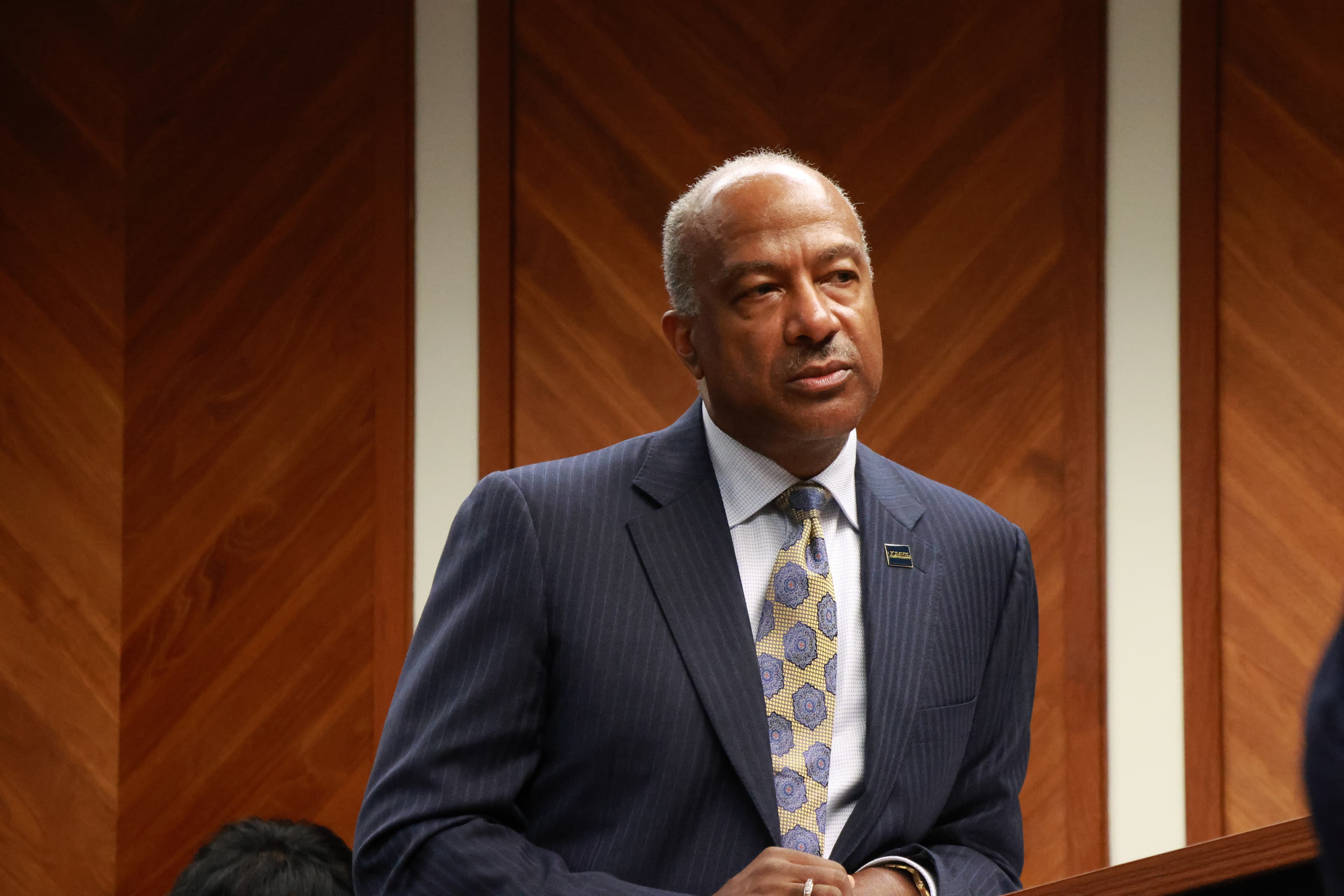
May formally apologized for a March email regarding Students for Justice in Palestine and addressed the increased presence of law enforcement on campus
By LILY KENROW — campus@theaggie.org
In his annual visit to the Associated Students, University of California, Davis (ASUCD) Senate at their Nov. 20 meeting, Chancellor Gary May gave a speech, thanking the table for their work and sharing some recent highlights and challenges for the UC Davis community. May notably highlighted the campus response to the pause in Supplemental Nutrition Assistance Program (SNAP) benefits and engaged in an open discussion with the table.
The first question directed toward May was asked by Transfer Student Representative Imani Nur, which focused on May’s March 21 campus-wide email regarding Students for Justice in Palestine (SJP) for their demonstration on March 11.
“We’ve received complaints from concerned community members about recent student activities, including the Students for Justice in Palestine demonstration on March 11, and those allegations are being reviewed at the highest level of the university,” the email reads. “I want to state as strongly as possible that we will not tolerate hatred against any individual or group, or any activities directed at any individual or group in ways that violate UC policy.”
Nur explained why she took issue with May’s wording.
“You singled out Students for Justice in Palestine,” Nur said. “Despite [SJP] being one of 15 groups coordinating the event. Many students feel this framing contributed to a hostile environment for Palestinian, Muslim and Arab students.”
May responded in acknowledgement, noting that he has had similar conversations with the Palestinian Life Advisory Committee.
“I take full ownership for what I wrote,” May said. “I own it, but I regret it. I didn’t have complete information, and I shouldn’t have written what I wrote. I apologize to the student body, to the Palestinian students and to SJP in particular.”
He attributed his language at the time to external pressures, particularly surrounding budget cuts and cuts in federal funding.
“During that time, and actually still, we were feeling tremendous pressure from external forces such that my judgement was impaired in trying to alleviate some of that pressure and keep things like federal funding flowing,” May said. “But I now realize that was a mistake on my part.”
Nur then asked if any investigations have been opened into non-UC affiliated agitators who she alleges stalked, harassed, doxxed and threatened students for the past two years.
May responded by emphasizing the difficulties for the university in investigating or taking action against non-university affiliates unless a crime is committed.
“We’re sort of in a position where our hands are tied, because we are a public university and most of these things happen in public spaces,” May said. “If there’s any harassment or criminal activity, yes, then we can take action. But beyond that, there’s not much that could be done.”
Nur went on to point out Section 100013 of University of California (UC) regulations, which states that no non-affiliate on university property shall “knowingly and willfully interfere with the peaceful conduct of the activities of the campus or facility by intimidating, harassing or obstructing any University employee, student, or any other person.” It also prohibits non-affiliates from lingering without any lawful purpose, which she alleged some individuals have been doing.
Nur then asked May why the university has not taken action against the individuals by not enforcing Section 100013 and leaving students feeling unsafe.
“I’m not right now familiar with the status of any complaints against those individuals and how those were adjudicated,” May said. “I suspect sometimes it’s [a] lack of evidence, sometimes it’s other reasons, but I don’t personally do those investigations.”
While the university has offered an increase of police presence on campus as a safety measure, Nur noted that the Council on American-Islamic Relations’ (CAIR) 2025 civil rights report showed a 71.5% increase in law enforcement encounters, many in the context of student activism.
“For Muslims, Arab and Palestinian students, police presence often heightens fear rather than safety,” Nur said. “Given this documented trend, and students’ lived experiences, why does the administration continue to default to public policing as a primary safety response, rather than implementing alternatives that do not put these communities at further risk?”
May responded by saying that in some cases, event organizers requested the presence of law enforcement.
“Oftentimes, the police presence is requested by the individual or the organization that is having an event,” May said. “We try to respond to those requests. We tend to try to have a very lowkey presence — plain clothes, AggieHosts, etc.”
When asked to commit to a meeting with ASUCD, SJP and the Muslim Student Association (MSA) to address the increase of Islamophobia and create a tangible and effective response, May agreed.
Other issues brought up by the table were student food insecurity, rising housing costs within Davis, resources for undocumented students and international students, legal aid with visas and student safety and lighting on campus.
Interim Senator Livreet Sandhu also brought up concerns over commencement, recounting a personal experience of being barred entry to the Golden 1 Center in June due to family members carrying a kirpan — a Sikh ceremonial dagger. Sandhu asked what May would do to ensure the incident would not happen again.
May acknowledged the incident with an apology but said that the Golden 1 Center is a private entity rented for graduation, with their own policies and procedures.
“I think, quite frankly, they weren’t prepared for the ceremonial dagger that the Sikhs use,” May said. “We have had some conversations now — my understanding is that we’ve come to an understanding with Golden 1. We did follow up with their personnel and [tried] to explain the meaning of why [kirpans] are carried by Sikhs and why [they] should be allowed.”
The floor was then opened up to discussion with the public.
One speaker, who wished to only be identified as a Palestinian student, asked May again about Section 100013 and brought up the Davis Oct. 7 Coalition, identifying them as a non-student group who has consistently appeared at SJP events and allegedly violated UC policy.
May provided a response to this discussion.
“I think one of the issues is some of these are in public spaces,” May said. “Certainly intimidation and harassment is not okay, even in public spaces. But in terms of lingering and all that kind of stuff, in public spaces, you can’t really police that.”
The student went on to push back against some of May’s positions on police presence on campus.
“Police do show up to a lot of [SJP] events without us requesting it,” the student said. “They show up to the events, and they do see the harassment taking place, but then don’t do anything about that harassment.”
The student also alleged that a plainclothes lieutenant shoved them while in a hallway, adding that the experience did not increase trust of personal safety through police presence but instead decreased it.
“We’re targeted by the police most of the time,” the student said. “[In] the March protest mentioned before in your email, police were there and police saw us being harassed and didn’t do anything about that. Instead, a police lieutenant shoved me while he was in the hallway — a plainclothes lieutenant.”
May then offered to hold a meeting with the student and relevant university officials, including himself, the chief of police and representatives from the Harassment & Discrimination Assistance and Prevention Program. The student did not expressly agree or disagree to the proposal at the time, but did call on May to publicly renounce his previous comments on SJP before yielding their time.
“Because of [the March 21] email, we’ve got increased, intensified attacks on us,” the student said. “Agitators got more emboldened to then go to SJP [events]. So making something that’s public, that doesn’t villainize [SJP] further, might be a good first step so that SJP isn’t attacked again.”
In response, May pointed to his apology delivered earlier in the meeting and once again acknowledged his fault in the incident before allowing other members of the public to speak.
Other Matters
The table confirmed Varsha Thummaty, a third-year chemical engineering major, as science, technology, engineering and math (STEM) Committee vice-chair, as well as four members of the Housing & Transportation Advocacy Committee.
The table then heard quarterly reports from The California Aggie, Entertainment Council (EC), Housing Advising for Undergraduate Students (HAUS), Mental Health Initiative, Aggie Arts Committee, Campus Center for the Environment and the External Affairs Commission.
In his presentation, EC Unit Director Eddie Kim, a fourth-year human biology major, noted the UC Davis ticketing office fee has increased by 500% this year, now up to $5 for every ticket. This will result in an estimated $50,000 expense to EC to cover ticketing fees for Lawntopia, their spring quarter concert. This also led to EC using AggieLife for Sunset Fest ticketing, which resulted in issues and wait times during the event.
Kim also noted that the hardest part of the ticketing process was the university-affiliated student verification and that he and his Assistant Director Abigail Wong, a fourth-year design major, were meeting with third-party vendors in search for potential cheaper solutions.
The next presentation was led by HAUS Unit Director Jasmine Stowers, a third-year community and regional development major. Stowers highlighted the fall housing fair and the set-up of Vital Emergency Shelter and Transitional Assistance (VESTA), a subunit added to HAUS last winter, which will serve as a transitional student housing option in addition to Aggie House. Set up for the subunit included hiring, as well as moving into their house at Russell Park.
The meeting was called to order at 6:12 p.m. and adjourned at 9:23 p.m.
Legislation Tracker
Bill/Resolution #
Description
Vote
SB#17
Provides clarification on dual employment practices in ASUCD bylaws
Passed unanimously
SB#26
Allocates $229.28 to the office of Senator Jaliah Payne for the Causeway Classic Tailgate event. Funds to be used to buy pizza for attendees.
Passed unanimously
SR#4
An ASUCD Senate Resolution calling on UC President James B. Milliken to reinstate recurring meetings with student leaders.
Passed unanimously
SR#5
An ASUCD Senate Resolution calling on Chancellor Gary May and the Senate to address the rise of Islamophobia and Anti-Palestinian racism on campus.
Passed unanimously
Written by: Lily Kenrow — campus@theaggie.org