






AI-planned rover route sheds light on the future of space exploration
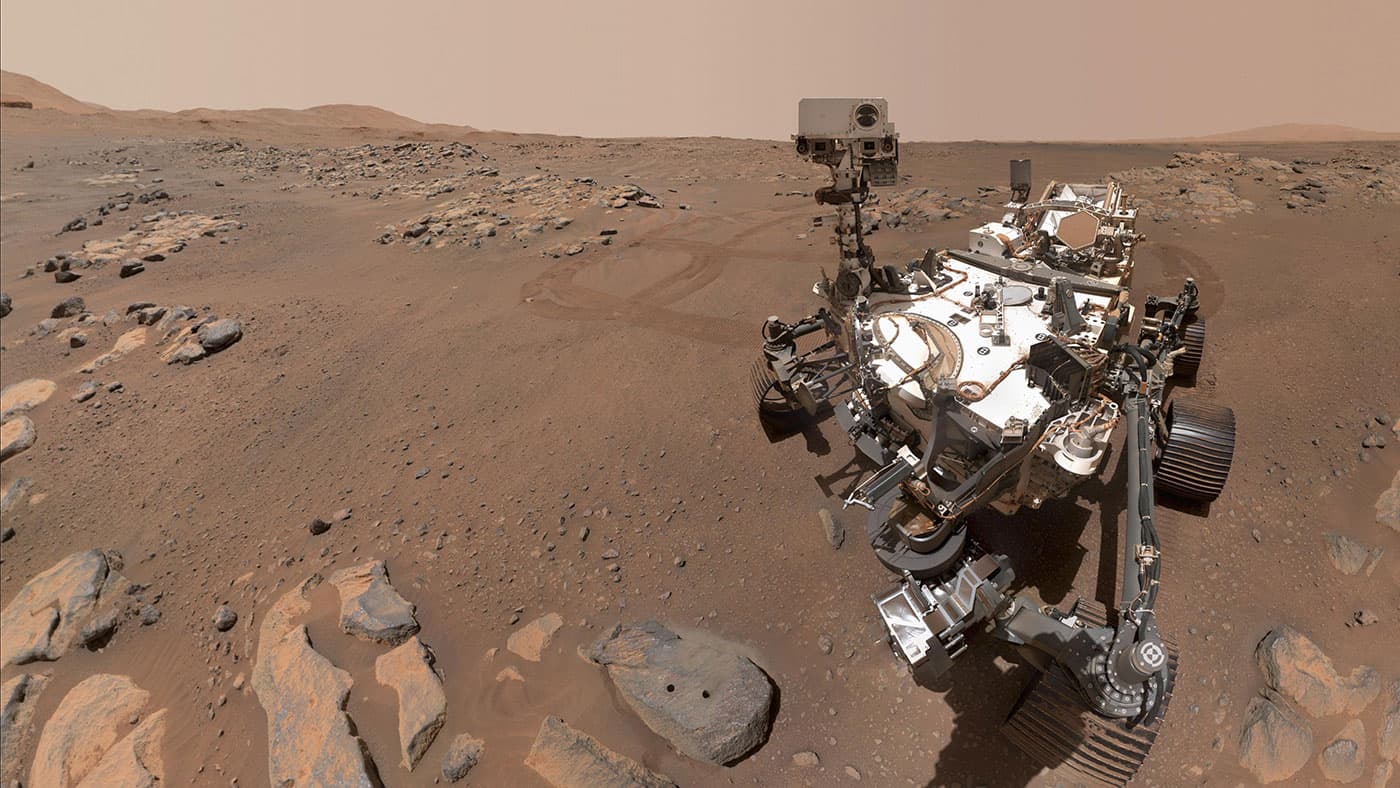
Developments in pre-planned Martian rover routes may allow humans to effectively traverse new frontiers
By EMILIA ROSE— science@theaggie.org
From Dec. 8 to 10, amidst the parched sands of the Martian surface, the National Aeronautics and Space Administration’s (NASA) Perseverance Rover travelled along its first-ever route solely devised by another machine.
On any usual day on the red planet, Perseverance drives itself along a route that NASA’s Jet Propulsion Laboratory (JPL) and its expert teams pre-plan. But in this case, generative artificial intelligence (AI) came up with the route instead.
Professor Sanjay Joshi, a researcher at the UC Davis Department of Mechanical and Aerospace Engineering, explained the importance of a pre-planned route for the rover by illustrating the expansive distance between Earth and Mars.
“It can be up to 20 minutes to get a signal from Mars to Earth,” Joshi said. “Let’s pretend we are on Earth, and we see our rover approaching a canyon through its camera. We press the ‘Stop’ button on Earth [but] by the time the signal gets there, our rover may be at the bottom of the canyon.”
Now, if not live, then how do scientists pilot our friendly Martian robot?
“We usually use waypoints,” Joshi said. “These are specific landmarks on Mars that we ask the rover to reach and then stop at […] At each waypoint, we can make sure the rover reached the correct location.”
By using these waypoints as a sort of checkpoint, the rover can cover many distances on its own, while scientists back home make sure it’s not in any trouble. However, controlling the rover is only half the story; to determine where these waypoints actually are, scientists analyze large amounts of terrain data — including high-resolution images taken from orbit, elevation models and slope data — to ensure that the rover doesn’t end up stuck or colliding with its surrounding environment.
Input into various AI models, this data allowed them to identify surface features like outcrops, bedrock and sand ripples. From this, Perseverance’s driving path and all waypoints can be mapped.
After confirming this route with an inconceivable amount of variables and checks, Perseverance managed to travel over 1,000 feet along the Martian surface: an accomplishment never seen before.
Could this be what it means to explore from a distance so large that light itself takes 20 minutes to arrive? Will it get to the point where new frontiers become so exotic that AI will need to replace human planners? While it may seem promising, the issue is that AI, at least in its current form, is still too new. And applying it to space-exploration efforts? That’s even newer. Many of those questions simply cannot be answered yet.
But science is often about reasonable speculation, and there are many conceivable questions we could ask about the future of using AI in our exploration of the cosmos. Joshi explained the potential future dynamic between AI, scientists on the ground and astronauts in space.
“The easy answer is that [humans and AI] will need to work together,” Joshi said. “Humans have extremely good problem-solving skills and intuition built up over time that’s hard for any computer to match. But computers can take in vast amounts of information […] and find issues or opportunities that a human would find hard to keep up with.”
At the new frontiers of space exploration, AI may become a critical tool — we’ve seen it succeed with Perseverance on a whole other planet, but that doesn’t mean things will necessarily get easier for us. Autonomy by itself doesn’t guarantee safety, and it’s dependent on how it is used, according to Joshi. However, further integrating and developing AI may very well let humanity take its next steps into the cosmos, with both flesh and machine in hand.
Written by: Emilia Rose— science@theaggie.org