






Facing growing budget deficit, Unitrans proposes fee referendum
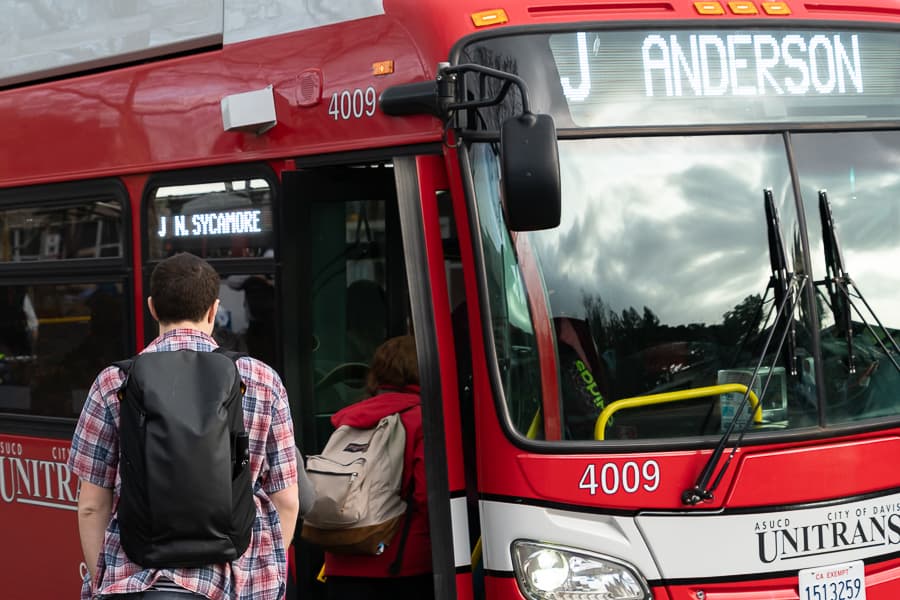
Student fees funding Unitrans would increase by $13.30 if referendum successful
Unitrans recently began instituting changes to combat its growing budget deficit, including decreasing the frequency of certain less-popular buses. In order to avoid cutting more services, Unitrans proposed a fee referendum which would increase the $34.50 fee each student already pays for Unitrans services by an additional $13.30.
Last May, after the transportation service proposed its first fare hike in 14 years, Unitrans’ General Manager Jeff Flynn told The California Aggie that the unit ran a $450,000 deficit for the 2018 fiscal year and is projected to run a $750,000 deficit in the 2019 fiscal year. Flynn estimated the deficit would increase to $1.6 million within four years without the implementation of substantive changes.
As a unit of ASUCD, Unitrans is a transportation service many UC Davis students and Davis residents use on a daily basis. Unitrans buses, routed around much of the city of Davis, transport students to and from campus everyday.
The unit is funded by both the city of Davis and UC Davis students through student fees, according to Flynn, who mentioned that while the student fee is fixed, funding from the city increases with inflation. The only way to increase the funding Unitrans receives via student fees is through fee referendums.
“Students, over the last 27 years, have voted four times to fund Unitrans service and provide free boardings for undergraduates,” Flynn said.
In order for the fee referendum to pass successfully — which will be introduced on the ballot for the upcoming ASUCD Winter Election — 20 percent of students must vote in the election and the referendum must receive a 60 percent ‘yes’ vote.
Due to historically low voting rates of UC Davis undergraduates, there is concern over whether 20 percent of students will vote in the election. While the ASUCD Winter Elections typically yields greater turn-out, less than 7 percent of students voted in the most recent Fall Election.
The last time Unitrans successfully passed a fee referendum was in 2008.
Factors contributing to Unitrans’ growing budget deficit include California’s increasing minimum wage over the last few years. A minimum wage of $15 will be implemented by the year 2023 and, as a result, Unitrans will be required to pay its workers more, thus increasing its costs.
The fee referendum is currently making its way through the ASUCD Senate. According to Flynn, the increased fees would accomplish several primary goals: maintaining fair, free boarding for undergraduates, introducing more trips or higher capacity buses and hiring career staff trainers and another mechanic.
“With the additional funding, we could also introduce more trips or service or [higher] capacity buses,” Flynn said.
In 2020, regulation changes will require individuals to have more experience before they are allowed to become trainers, Flynn said.
“Right now, Unitrans relies on mostly student trainers — undergraduates who are also our trainers — to train other people to be bus drivers, and right now, that works,” Flynn said. “However, in 2020 the regulation changes […] will essentially eliminate our training workforce, so we’re going to have to hire career staff trainers. And they are significantly more expensive than student employees.”
Of the $34.50 fee students currently pay for Unitrans, $1.50 of that goes to fund student aid, required by UC policy. If the fee referendum is successful, $3.30 would go to student aid, Flynn said.
ASUCD Senate Pro Tempore Alisha Hacker, a second-year political science—public service major and the adopted senator for Unitrans, said that there is a “return-to-aid” component built into student fees in order to support students who may struggle to pay the higher student fees.
“Those who would be otherwise negatively impacted by increased fees, especially low-income students, will get an additional increase in the amount that will be given out in financial aid to offset the higher cost,” Hacker said.
Unitrans will launch an education campaign about the fee referendum in late January, consisting of signage on Unitrans buses, social media posts, fliers posted around campus and communication with Greek Life and Athletics.
“Unitrans is not allowed to take a position on the measure,” Flynn said. “So we will merely be providing information on what the vote does and try to get people to vote. We will have a website about the measure through ASUCD [and] Aggie Studios did a video on it.”
Weston Snyder, a third-year history and international relations double major and operational manager at Unitrans, will play a role in educating students about the fee referendum. He believes that no matter what way students vote, it is important they do.
“Making people aware that this issue is on the ballot and that it is up for them to decide is really important,” Snyder said.
If the fee referendum is not successful, Unitrans will be forced to cut services. Currently, the unit is able to function thanks to reserved funds built up over the years, but these funds will run out by next year, Flynn said.
“Next year, we’ll be looking to implement 15 to 20 percent service cuts and the year after that, another 15 percent or so service cuts,” Flynn said. “To put that in perspective, currently we run 18 lines, so that’s essentially eliminating six or so bus lines. We would be reducing staffing on the students and career staff sides.”
These cuts will affect both students and workers at Unitrans.
With the knowledge of how a failed referendum would impact the campus, Hacker said ASUCD officials, including both senators and commission chairs, are backing the proposed fee increase.
“They understand the need and importance for Unitrans not only for our communities and the campus but just knowing that it’s an institution,” Hacker said. “They see the value of doing what it takes to make sure we can keep it.”
Hacker hopes that students will also view Unitrans as a key campus institution and a critical resource for students that must be supported.
“We’re just really going to have to tell Unitrans’ story to people: let them know exactly what’s at stake here, let them know what a benefit Unitrans is not only to the campus but to the community at large,” she said. “And hopefully that will be enough to let people see the urgency of this.”
Written by: Sabrina Habchi — campus@theaggie.org