The UC Davis Design Museum’s latest installation presents viewers with a range of sensation and a message of simple joy
BY JULIE HUANG – arts@theaggie.org
From Oct. 8 to Nov. 5, the UC Davis Design Museum is displaying “Embodiment,” an installation by Master of Fine Arts (MFA) design graduate student Emily Tonnos. Free of charge and available for viewing to all, the exhibit seeks to merge theatrical and narrative design elements into an immersive experience of human struggle and growth.
“I broke ‘Embodiment’ up into six scenes, hoping that each one would trigger a different emotion or series of emotions,” Tonnos said. “For the first couple of scenes, I wanted to take audiences on a downward spiral, reflecting how we might feel anxious, sad or angry when difficult situations pop up.”
When viewers walk into the darkened space, they are immediately met with a curtain. Upon passing through at the stagehands’ behest, viewers are transported into a shifting environment designed to induce an uncertain flurry of emotions.
In one moment, the room reminds visitors of a childhood nursery. In another, it transforms into a messy bedroom, capturing the experience of navigating everyday life through an unhealthy, exhausted headspace.
“I tried to take audiences through those negative emotions in our daily lives,” Tonnos said. “When we’re faced with these negative situations, how can we come out of it in a way that’s positive, instead of succumbing to the darkness?”
Tonnos described how she was inspired by her time interning with the Disney College Program.
“My inspiration for ‘Embodiment’ started with my time working for Disney, which really inspired me about how we can use architecture and design to create meaning through storytelling,” Tonnos said.
Tonnos also noted that she was influenced by her love of figure skating, having skated competitively since the age of 5.
“I’ve done figure skating shows all of my life, and the idea that we can take a theatrical performance and turn it into something that can share a message is something that I’ve always been passionate about,” Tonnos said.
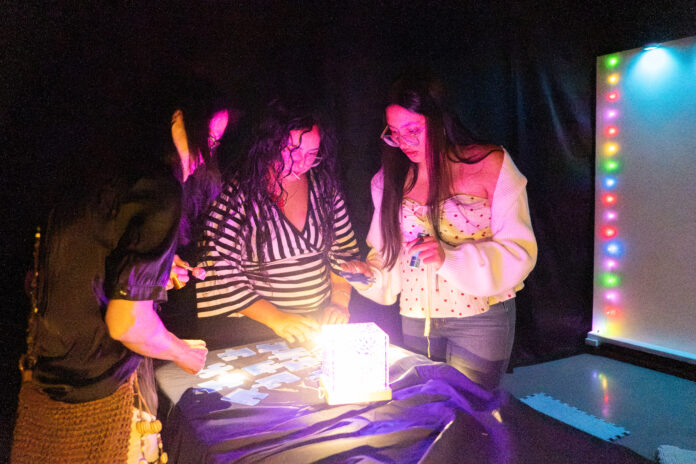
With “Embodiment,” Tonnos hopes to give audience members a different way to experience a museum space. Viewers are encouraged to physically interact with exhibit materials and leave their own changes to the space: a direct contrast to the conventional experience at a traditional museum, where viewers are instructed to stay a certain distance away from the artwork.
Periodically throughout the performance, viewers are prompted to write down certain goals, visions and emotions onto pieces of paper that they can attach to Tonnos’ handmade props, which then become their personal contributions to the installation.
Tonnos did not start the creative process of designing “Embodiment” with a specific end result in mind. She believes that the fluid, ever-developing nature of the project is a crucial quality in itself.
“I knew that I wanted [it] to be an experiment, [which] resonates with the fact that none of us have all the answers,” Tonnos said. “We’re constantly going through life, growing and changing. That’s what this show is representative of.”
The installation has not yet solidified into a final form, as Tonnos envisions new changes that could be made to improve the experience of immersion. The viewers that come into the space of “Embodiment” become a part of the experiment, as their reactions and interactive choices shape Tonnos’ ideas for what to update next.
“There’s a transformation that is happening now that the show has started,” Tonnos said. “Now that I’ve had groups of people come in and experience the show, I’ve been able to watch how they interact with the different props and how they move throughout the space, which has given me new ideas on how I want this experience to unfold.”
Despite its capacity for change being essential to its mission, Tonnos knew from the beginning that there were key moments in the installation’s narrative structure that she wanted to include, which form the emotional core of “Embodiment.”
“I was hoping to make a personal connection with the people who come to watch this show because a lot of the emotions that are present come from my personal story,” Tonnos said. “The more vulnerable I was with this show, the deeper it got, and I hope people can take something away from that.”
One thing in particular that Tonnos hopes audience members can take away is an appreciation for the combination of exhibition and theatrical design practices, which can heighten the sense of immersion that a person feels in certain situations.
“The next time viewers go to an amusement park or a themed restaurant, I hope they are able to think about how these things are made to be immersive and entertaining,” Tonnos said.
Tonnos also intended for the tactile aspect of the exhibit to add to the level of immersion experienced by audiences. The exhibit props take on varying levels of realism, ranging from a laundry basket full of real, wearable clothes to a table stacked high with puzzle pieces, inviting the audience to work together to solve it.
“I see a lot of new virtual experiences popping up and I wanted to do something different, where everything remained physical,” Tonnos said. “We seek out certain experiences for a sense of escape, and part of that is feeling like you are in another world that has been transformed from the one you’re used to.”
Engaging multiple senses simultaneously, “Embodiment” ends with what Tonnos calls “a tree of hope.” To her, the tree represents the experience of sharing “simple happiness” with others.
“My goal is for viewers to remember that there is this beauty in simple happiness that we can find in our everyday lives, and it doesn’t have to be something big,” Tonnos said. “It can even be something that brings us joy while we’re still sad.”
Just as Tonnos is open to making changes to “Embodiment” depending on audience feedback, she hopes that viewers walk away feeling changed for the better.
“I hope that my audience leaves feeling uplifted,” Tonnos said. “I want them to feel like no matter what tough times they might go through in their lives, there’s always a reason for happiness.”
Written by: Julie Huang — arts@theaggie.org