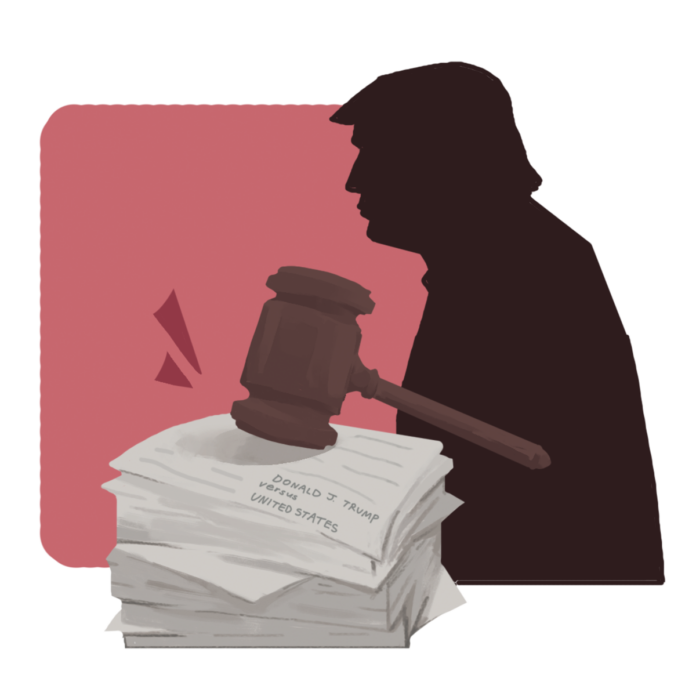
UC Davis students and law professors discuss the situation’s implications on the separation of powers
By GRACIELA TIU — features@theaggie.org
For the past three months since President Donald Trump took office for his second term, his administration has been progressing its agenda through numerous executive actions. Many of these measures have faced various legal challenges since day one, raising significant questions, particularly surrounding the United States Constitution and the scope of executive power.
These examples of legal pushback against the Trump administration aim to utilize one of the largest checks on presidential power — the judiciary’s power of judicial review. This gives federal courts the power to consider whether or not certain actions taken by the executive or legislative branches are constitutional.
Each week, new updates arise, giving the public more information surrounding the various lawsuits and their progression in the courts. Given the vast number of executive actions that have faced legal challenges (as of April 23, 2025, Trump signed 137 executive orders, 36 memoranda and 39 proclamations since his second term began), thoroughly covering all of the details of each case would be difficult. However, many of these executive actions and their lawsuits can be categorized into specific sections of his agenda.
One of the most contested actions has been Trump’s use of the International Emergency Economic Powers Act (IEEPA), which he invoked to impose tariffs. While the power to enact tariffs generally rests with Congress under the Constitution’s Commerce Clause, the IEEPA allows the president to act unilaterally during national emergencies. Legal challenges have arisen, questioning whether the president’s use of the IEEPA oversteps his constitutional boundaries.
“States like California have really pushed back,” Rominna Sharifi, a third-year biopsychology major and a member of Davis Pre-Law Society and Phi Alpha Delta, the UC Davis pre-law fraternity, said. “California’s economy is super globalized — agriculture, tech, manufacturing — and the tariffs have hit a lot of those sectors hard.
Regarding federal funding cuts, Trump has faced opposition over his decision to halt federal funds to universities, Harvard University in particular, with the Trump administration citing the university’s lack of protection against antisemitism on campus. The lawsuits filed against the administration argue that Trump’s actions violate the First Amendment by targeting free speech and academic freedom. These actions have prompted a broader debate about the relationship between the federal government and academic institutions.
“The government has not — and cannot — identify any rational connection between antisemitism concerns and the medical, scientific, technological, and other research it has frozen that aims to save American lives, foster American success, preserve American security, and maintain America’s position as a global leader in innovation,” a Harvard lawsuit, filed in Boston federal court, reads.
In March 2025, Trump’s efforts to dissolve the U.S. Department of Education also provoked legal challenges. The lawsuit against Trump’s Executive Order 14242 argues that dismantling the department violates the separation of powers, as only Congress has the authority to eliminate federal agencies. The legal fight continues as courts evaluate whether such a significant restructuring of the federal government is within the president’s jurisdiction.
“Despite Congress’s clear directives to the Department, the Trump Administration has stated numerous times, in the clearest possible terms, its intention to close this vital agency, most recently in a March 20, 2025, Executive Order,” a lawsuit, filed in the U.S. District Court for the District of Maryland, reads. “These actions are unconstitutional and violate Congress’s directives.”
Another measure, Executive Order 14248, that has drawn substantial legal resistance involves Trump’s efforts to restrict voting rights. This executive action, which limits mail-in voting and changes voter ID laws, has sparked lawsuits from civil rights organizations arguing that these measures are discriminatory.
However, on April 24, 2025, a Washington D.C. federal judge put a pause on a primary section of that executive order.
“Our Constitution entrusts Congress and the States — not the President — with the authority to regulate federal elections,” Judge Colleen Kollar-Kotelly’s opinion reads.
Trump’s controversial push to end birthright citizenship also continues to face legal opposition. The president’s Executive Order 14160, which sought to change the interpretation of the 14th Amendment, faced a major setback when the Supreme Court set dates to hear the case in May, after three district courts halted its implementation.
In another area of legal contention, Trump’s executive orders limiting transgender rights, particularly in the military and in women’s sports, have faced multiple constitutional challenges. His executive order barring transgender people from the military has been temporarily blocked, while the order barring transgender women from women’s sports is still undergoing legal contestation.
Additionally, Trump’s efforts to make it easier to fire federal employees have raised concerns over executive overreach. The president’s Executive Order 14183, which changes civil service protections, is seen by critics as an attempt to weaken federal labor rights. A new rule proposal on April 18, 2025, which would recategorize thousands of civil servants as “at-will” employees, would remove civil service protections and make the process of firing federal workers much easier.
The creation of the Department of Government Efficiency (DOGE), another controversial action by the Trump administration, has also led to legal challenges. DOGE, which was reportedly implemented to streamline government operations, has been criticized for bypassing established procedures, such as the Federal Advisory Committee Act. The legal battles surrounding the department are still amidst ongoing litigation.
Trump’s Executive Order 14151, ending federal support for Diversity, Equity and Inclusion programs, has similarly sparked multiple lawsuits. These orders are being challenged on the grounds that they violate First Amendment protections for free speech and academic freedom. The efforts have been partially and temporarily blocked by various federal judges.
Trump’s decision to suspend asylum processing has faced significant legal pushback. While lawsuits are still ongoing, an appeals court in late March allowed for the suspension of new refugees while the litigation continues.
The president also enacted Executive Order 14169 that would put a 90-day pause on most foreign aid, but faced legal challenges from various groups. Following a similar district court ruling, the Supreme Court ruled that Trump must pay around $2 billion in foreign assistance throughout the litigation process.
Sharifi discussed her thoughts on the freezing of foreign aid and its global implications.
“The U.S. has a responsibility to support global development, especially because so many of the issues other countries face — like climate change or political instability — have roots in U.S. policy,” Sharifi said. “Foreign aid isn’t just charity; It’s about justice and global solidarity. The president should have a role, but not unchecked power. Decisions about foreign aid should go through Congress and be informed by experts — not used as a political bargaining chip.”
UC Davis Distinguished Professor of Law Vikram Amar shared his view on how the ongoing legal battles showcase vulnerabilities in the constitutional system in a written statement.
“I think it does highlight how fragile our balanced system of limited constitutional powers is,” Amar said. “Congress is not a meaningful check on the executive branch these days. Courts have generally done a good job in blocking (albeit sometimes only temporarily) the most aggressive and legally dubious Executive Orders, but if and when there is a clear defiance by the President of a judicial order (especially from the Supreme Court), things could get dicey.”
Amar also outlined his thoughts on whether the court system is equipped to respond to numerous executive actions facing legal pushback.
“Courts by their nature are slow, ponderous, transparent and process-oriented,” Amar said. “The executive branch, by contrast, can act quickly and energetically along several dimensions at once, and can do so based on information and processes that aren’t always open to public view. Courts are not at their best when they have to act quickly, but in the present situation they have no choice.”
Sharifi mentioned how recent executive actions and legal proceedings have changed her view on the role of the executive.
“I used to think the president had a lot of symbolic power, but now I see how real and far-reaching executive authority can be, especially when it’s unchecked,” Sharifi said. “It’s made me more skeptical of expanding presidential powers, no matter who’s in office. We need more oversight and accountability from Congress.”
Campbell Buffington, a fourth-year political science major, shared her hopes for her generation’s political engagement.
“I hope that my generation is inspired to be much more active in government as a result of these events,” Buffington said. “I feel that my generation has a tendency to want to see change in our government, but they do not want to run for a government position or petition [or] protest against what they see.”
Though all of Trump’s executive actions and the ongoing legal proceedings mentioned are just scratching the surface, students like Buffington recommend that community members step up in terms of their civic and political engagement.
“I understand that as college students, it is difficult for my generation to take the time to actively protest, run for government, etc.,” Buffington said. “I do hope that when the time comes, we step up and actively go after what we want to see changed in our government.”
Written by: Graciela Tiu — features@theaggie.org