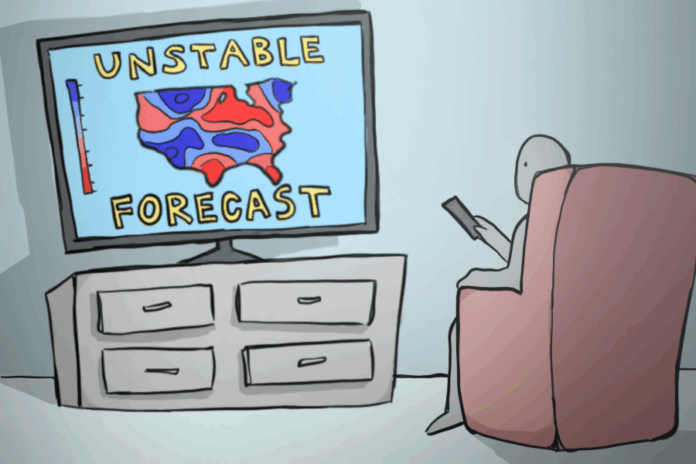
Forecast: a heavy downpour and fluctuation in political opinion
By NEVAEH KARRAKER— nakarraker@ucdavis.edu
I’ve never had an official tour of Davis; My first time on campus was a result of spontaneous exploration during a coincidental visit to town. What I did not expect, though, was to be completely drenched head to toe in rain, walking endless miles in the downpour.
Logically, springtime signifies wet weather. Yet, when people (including me) first think of Sacramento — and Davis by extension — they imagine a hot city in the middle of nowhere.
Once the school year officially began, I was surprised time and again by these short bursts of rainfall. It was 90 degrees one day, and the next I had to bundle up in layers or wade through flooded bike paths. This constant back and forth became exhausting. Bipolar weather is something I particularly detest, because you have to plan for both sides of the weather extremes. I’m convinced that there’s a team of people employed at weather stations, dedicated to frustrating users by making the most insanely inaccurate forecasts.
This unpredictability extends far beyond the skies — it’s ingrained within society. What’s in today is cringe tomorrow, like needing an umbrella in the morning and sunscreen by lunch. And, in many ways, it’s nearly impossible to accurately predict. Society can’t decide whether it wants productivity or self-care, perfection or authenticity. Every person will say a different thing, and before you know it, you get inundated by an abundance of opinions that progress into indistinguishability.
But then who’s calling the shots of what and when something changes? Is it the general consensus of the public, the dumb luck of a random post going viral or something much deeper?
Social media amplifies this disorientation. Each swipe becomes more addicting, contributing to an ever-decreasing attention span. And, on top of that, many other platforms are adopting similar styles that include short-form content similar to Instagram Reels. Users constantly require change for a dopamine boost, and, in a way, irregularity and inconsistency become the norm.
Surprisingly, some people prefer this inconsistency. It’s sort of like a challenge — seeing how long they can frolic in the sun before they burn. Either it’s an ingenious method to enhance adaptability or just plain ignorance disguised as adventure.
Still, there’s an allure to the chaos. It’s a classic search for danger and excitement; Stable, consistent things, although good, become old very fast.
This constant change isn’t just found in your “For You” page on TikTok, but also in news publications. National outrage periodically surges with each event or policy passed, and it’s hard not to think it won’t have catastrophic long-term impacts. And yet, the next day, something new occurs. Rinse, repeat.
In our current political climate, federal actions are like storms — unexpectedly and abruptly rolling in before vanishing. And, like storms, the political opinions of others rapidly sway over time. An ideal previously thought to be favorable is actually discovered to be harmful. The volatility of politics and the media results in erratic clashes between the left and right, citizens and government, the education system and students.
This boredom and inconsistency we’ve grown accustomed to (and, in some cases, fond of) keep us incessantly occupied with the next headline or trend. Oddly enough, we start craving chaos rather than feeling alarmed by it.
Hence, the bipolarity of trends, expectations and political opinions redirects our attention from the present to the future, bringing our focus away from historic events and their significance. With each new piece of information the media presents, the previous occurrences slowly fade from our minds. This unreliability is one thing all media have in common and is fueled through the consumption of misinformation. Amazingly, most people are gullible to what they see or hear; We often forget the original design of social media was for entertainment.
In our modern world, we’ve become desensitized to change. Instead of questioning why something is unstable, we simply accept it. This numbs our critical thinking and analytical skills and ends up giving more control to the media as we continue to scroll.
The weather can’t be controlled and neither can the tide of change. But we can adjust our sails to navigate the whirlwind of these unpredictable environments. So, don’t postulate about the world — stay aware of current events, and don’t put the entirety of your faith and trust in forecasters, for we may not know what is truly happening behind the scenes.
Written by: Nevaeh Karraker—nakarraker@ucdavis.edu
Disclaimer: The views and opinions expressed by individual columnists belong to the columnists alone and do not necessarily indicate the views and opinions held by The California Aggie.