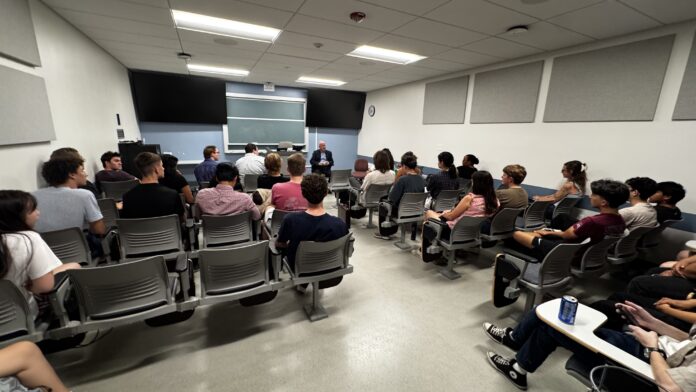
Steinberg discussed his career and reflection on public service, leadership and the future of local governance
By KATYA OKS — city@theaggie.org
On Sept. 22, Pi Sigma Alpha — the National Political Science Honor Society at UC Davis — hosted a fireside chat with former Sacramento Mayor and State Senate President pro Tempore, Darrell Steinberg. The event was open to all students, faculty and community members.
Throughout his political career, Steinberg passed the Mental Health Services Act which provides $3 billion a year to mental health services in California and worked with state leaders to pull California out of economic crisis, according to the California Department of Corrections and Rehabilitation website He served as Sacramento’s mayor from 2016 to 2024.
The fireside chat with Steinberg was the second installment of the Pi Sigma Alpha speaker series, according to their Instagram page. The first event featured a conversation with the current Davis Mayor Bapu Vaitla, in which Vaitla reflected on his experiences as a mayor and answered questions from the audience.
Pi Sigma Alpha, formally chartered in 1920, has inducted over 300,000 members — with chapters at nearly 850 campuses. The national honor society “feature[s] national, state, and local political leaders including one president, three Supreme Court justices, and dozens of members of Congress,” their official website reads.
The event began with Steinberg’s own personal reflection on his career in public service, sharing personal stories, anecdotes and advice with his audience.
Steinberg first shared the story of how he found his spark for public service during his third year at the UC Davis Law School. During his time there, he met many individuals with physical disabilities.
“The [UC Davis] Law School should be commended for admitting people with very diverse backgrounds, but there was one problem: The[ir] new courtroom was not accessible,” Steinberg said.
Steinberg then explained how he, alongside his peers, asked the Dean of UC Davis School of Law to build a lift so that people with disabilities could also participate in the courtroom. They were met with a lack of enthusiasm; Steinberg recalled being told that a lift would ruin the “aesthetic look of the courtroom.”
Steinberg then shared the law school’s response with various reporters and newspapers, which created public pressure for the law school to build a lift.
“That was my first taste of seeing the impact of my own power,” Steinberg said. “I didn’t have a title, but my power — my willingness to advocate and make a social change — was tangible. And it actually helped people.”
Steinberg then shared his own political philosophy.
“Most importantly, [the government] needs to be for the people who don’t have a voice,” Steinberg said. “The people who do have a voice, generally, can find their way through the halls of power and influence decisions. But people who are really down and out — whether they’re poor, whether they’re people with severe disabilities, […] they don’t generally have a voice. So I’ve always believed my job is to fight for those who are deemed lesser.”
Steinberg then discussed some of the people who influenced him — such as Phillip Isenberg, Sacramento’s mayor from 1975 to 1982 — on his political philosophy and goals.
“‘The real key to success is to pick one issue: one issue that is really important to the quality of life of your constituents and the state and that no one else is working on,” Steinberg said.
Steinberg then reflected on the challenges he faced in his role during the 2009 financial crisis, as he worked with members across parties to help end the state budget crisis.
“People were losing their homes, people lost their jobs, […] but the state going bankrupt would have made a terrible situation that much worse,” Steinberg said. “I had to […] convince my colleagues — Democratic colleagues — to cut things that they swore they would never cut, and to convince enough Republicans to vote for taxes so that we could minimize, or at least mitigate, the level of cuts.”
Steinberg told the story of how he, alongside other members of both Republican and Democratic parties, created a plan.
“We had literally four weeks to meet in secret, […] and we reached an agreement of more cuts than taxes, but enough taxes to mitigate the cuts,” Steinberg said.
Throughout the talk, Steinberg also shared many other stories and various accomplishments, including his mental health work, his mediation between opposing parties and more.
Pi Sigma Alpha is set to host many more events — from speaker series to movie nights — for students interested in political science or public service. More information can be found on their Instagram page.
Written By: Katya Oks — city@theaggie.org