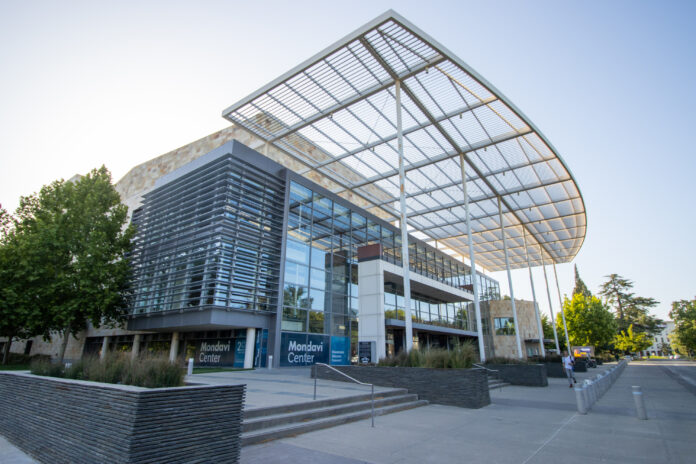
Students discuss the value within UC Davis’ art programs
By IQRA AHMAD — arts@theaggie.org
While UC Davis is ranked among the top public universities for research and is home to some of the most well-known veterinary science and agricultural programs in the world, the campus has also made sure to carve out space for its art history, art studio, design and performing arts majors. Tucked between the lecture halls and bike racks is a creative current that doesn’t clamor for attention so much as it hums insistently: the arts.
For students, the arts offer the sly thrill of discovery: a mural that makes you pause, a gallery opening in a space you never noticed or a class lecture that feels less like a monologue and more like the start of a conversation.
Shaped by the campus’ geography, the faculty and the arts community of the greater Davis area, students spoke to the value and opportunities within UC Davis’ arts programs.
A feeling of belonging
“When I was walking around campus for the first time, it was very beautiful,” Laila Penny, a fourth-year art history major, said. Penny is a campus tour guide, president of the Art History Club and works at the Jan Shrem and Maria Manetti Shrem Museum of Art.
“Students seemed productive in a way, but also very kind,” Penny said. “People held open doors for each other. It felt like a kind yet studious environment.”
In perspectives like Penny’s, a feeling of generosity seems to be built into the very infrastructure of Davis. The Maria Manetti Shrem Art Hall — the main art studio building on campus — works as a hub for sharing ideas and promoting collective growth through its features of student work.
“There’s a lot of student artwork on the first floor, all dedicated to sculpture,” Penny said. “A lot of the time, you can just walk in and see what students are working on. If you go up the stairwell, there’s a bunch of doodles all over the ceiling, so sometimes I just like to go there with friends and read them. It’s really good for inspiration, or if I just want to check out what students are into.”
These everyday experiences — walking through hallways adorned with creative expression and observing students creating art — capture the vastly unique portfolio of artists within these programs. For students, there’s always an opportunity to be inspired and welcomed.
Faculty who insist on the “why”
To many students, what truly distinguishes the arts at UC Davis is not just the sense of community, but the approach of the faculty and professors who treat teaching as an ongoing conversation. In Professor John Lopez’s undergraduate Renaissance seminar, Penny shared the value of his emphasis on conversation and inquiry.
“It was very eye-opening,” Penny said. “He’s very involved in making sure students know what they’re learning and talking about.”
Penny also noted the importance of accessible and supportive faculty as a result of small classroom sizes, which have been found to foster greater personal connections and trust within educational settings.
“We’re a small department, so you see the same people again and again,” Penny said. “It’s really nice to be part of a smaller department where you can form that sense of community.”
Penny also discussed the importance of utilizing office hours in getting to know professors on a personal level and gaining a better understanding of course content.
“Going to office hours has definitely helped me a lot,” Penny said. “It’s very comfortable to just go and ask a question as simple as, ‘How can I improve my writing on this?’”
What makes UC Davis special for arts students isn’t just the beauty of the campus or its resources, but also the way that community is formed to create a space where ideas can thrive. For students like Penny, it is a place where curiosity is celebrated and conversations matter.
A city that doubles as a studio
Creativity doesn’t stop at the edge of campus, but spills right into the city itself. Between spaces like the Pence Gallery, the Basement Gallery, The Artery and John Natsoulas Gallery, student opportunities span from classroom to gallery and from theory to practice, all to discover how ideas take shape in real-world contexts.
“I think that being well-rounded in interacting with […] the public and understanding the cogs that are involved with running such an institution has especially complimented my emphasis on museum studies,” Cadmael Tapia Zapata, a third-year art history major and student assistant at the Pence Gallery, said.
The City of Davis itself is a partner in education, a place where art meets opportunity: it’s not just work hung on walls, but a civic presence. As Zapata shares, gaining experience provides a bridge for students, closing the gap between academic study and hands-on practice.
“Working [at the Pence Gallery] has given me an opportunity to feel like I truly understand what I am being taught,” Zapata said. “I do think it has set me up for future career experiences by not undermining me as a student, giving me opportunities in a professional environment and guiding me though the responsibilities that come alongside being a community center.”
UC Davis, while not advertised as a school for the arts, provides ample support and an environment conducive to learning both in and out of the classroom, according to students. With its ever-present sense of camaraderie and community, as well as the countless opportunities to get involved, arts students at Davis hold a unique key to inspiration.
Written by: Iqra Ahmad — arts@theaggie.org