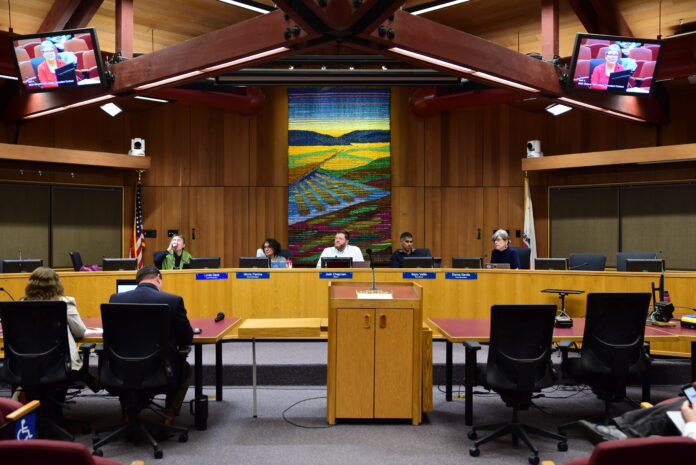
Council members debated affordable housing and clean energy proposals
By KATYA OKS — city@theaggie.org
On Sept. 30, Davis City Council met to discuss policy considerations in relation to affordable housing developments and clean energy proposals throughout the city.
Community Development Director, Sherri Metzker, started off with a staff presentation. There were two topics of discussion for the meeting: funding options for affordable housing as well as climate and energy use and production.
For the first topic, Metzker highlighted that development projects and necessary improvements are not included in the current financial plan for the city. Metzker then provided three alternative solutions to the funding problem for affordable housing.
The first would “update the fees citywide including Village Farms Davis and Willowgrove” and ensure that the new fees meet the requirements of AB 602 — a solution that would ultimately cost the city $360,000, according to the presentation.
The second alternative would “create a fee program focused only on Village Farms Davis and Willowgrove” while also ensuring AB 602 requirements are met: this proposal would cost the city $185,000.
The final alternative would “require either: payment of fair share costs, or payment of total cost with reimbursement,” giving the staff the opportunity to use “their professional judgement.”
The staff recommendation was the second alternative. The rationale for the recommendation was that it would reduce the cost and was able to be shared by multiple applicants.
Katie Dooley-Hedrick, a mother of two Davis Joint Unified School District (DJUSD) students, strongly supported the Village Farms development project.
“Davis is in desperate need of additional housing, and this development offers a thoughtful proposal that stays true to Davis community values,” Dooley-Hedrick said. “The public must have the opportunity to vote on this matter in June of 2026.”
For the second topic of discussion, the council highlighted the importance of investing in renewable energy programs in the city.
The solution included a development of a microgrid program, which is a self-sufficient energy system that serves a discrete geographic footprint, according to Microgrid Knowledge.
The presentation shared that, in partnership with Valley Clean Energy, the city can begin to create a plan to “establish community microgrids and community battery storage cooperatives.”
The staff also recommended three options, but supported the first idea: which would include deferring the microgrid concept until the general plan is completed and not vesting any rights regarding the microgrid in the development agreement.
Davis Mayor Bapu Vaitla, expressed what the focus of the meeting’s discussion on the climate resilience topic should be.
“I frankly think that from a financial perspective — requiring a full microgrid for all units on both developments — is just not feasible,” Vaitla said. “I would rather think about a discussion that focuses on giving some direction to staff about how we, as a council, are thinking about climate resilience in respect to these developments.”
The meeting then opened to a public comment.
Lorenzo Kristov, a community member who has lived in Davis since 1987 and served eight years on the City Utilities Commission, urged the council to not approve the staff’s recommended energy plan. He calls the recommendation from staff “a big mistake.”
“Locally owned and operated clean, resilient energy sources are urgently needed to meet today’s climate volatility, affordability and energy justice challenges,” Kristov said. “It’s up to cities, given our political climate, to be the leading actors for local energy concerns now. Whatever your concerns are about the cost of acting, the costs of not acting will be much greater.”
Ari Halberstadt, a community representative for Valley Clean Energy, shared his opinion on the plan.
“Davis has multiple opportunities to integrate local energy, […] deferring action would miss the opportunity and result in avoidable burdens being needlessly placed on residents and businesses,” Halberstadt said.
Halberstadt also offered another solution.
“The city should explore the creation of a greenfield municipal utility to provide electricity,” Halberstadt said. “It could save $36 million in transportation costs […] [and] it can reduce emissions by 90%.”
Ultimately, the City Council did not support the options for the Climate Action plan and urged for another discussion at a later date. More updates will be available at the upcoming Oct. 21 City Council meeting.
Written By: Katya Oks — city@theaggie.org