UC Davis graduate student Nathalie Redick shares her experiences researching subduction zones, earthquakes and debris flows
By KATELYN BURNS — science@theaggie.org
With the upcoming UC Davis Graduate and Law School Fair, undergraduate students will get the opportunity to explore graduate school opportunities.
Nathalie Redick, a second-year graduate student in the geodynamics lab of the Earth and Planetary Sciences Department, shared her experiences in a graduate program here at UC Davis.
“I spend most of my day just here on campus at a desk,” Redick said. “A typical day in the field is pretty different.”
On campus, Redick is researching subduction zones. The subduction zone is where two tectonic plates meet and where one slab — the subducting or sinking slab — goes under the other. Redick researches the molten rock surrounding the subducting slab to understand what the slab looks like, based on the direction of the flow.
“A lot of my research is considered basic science, rather than applied science,” Redick said. “We’re asking a pretty abstract question in the hopes that it’ll be useful to other people down the line.”
A more detailed picture of the subducting slab can improve other models. The subducting slab drives plate tectonics; the largest earthquakes in the world are seen along these subduction zones and the shape of the slab can influence them.
“They told me what projects they had available because master’s projects are usually predetermined,” Redick said, discussing the process of emailing people when looking for a graduate advisor. “You don’t spend a lot of time developing the question yourself since the timeline is so short.”
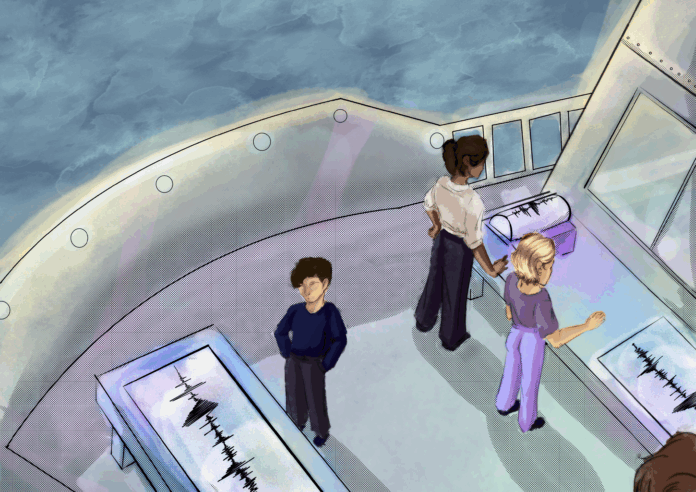
Alongside her master’s project, Redick applied to participate in field work. She took several trips to set up and collect seismometers, instruments measuring ground motion from earthquakes or debris flows. Debris flows are when glaciers in the mountains melt, causing water to collect sediment before crashing down in a big, sudden, fast-moving flow.
Redick’s field work took her on research cruises and helicopters to collect seismometers (and their data) from the ocean and to install seismometers on volcanoes such as Mount Saint Helens and Mount Rainier in Washington.
Earthquakes and debris flow can be quite devastating. Seismometers pick up real-time shaking, produced during earthquakes and debris flows. While measuring helps us understand them, not necessarily predict them, seismometers can pick up the shaking faster — allowing for earthquake alerts.
For undergraduate students looking into graduate school, your major doesn’t necessarily define your path. Before joining the geodynamics lab, Redick got her bachelor’s degree in computer science — something Redick noted opened a few doors when getting into her graduate program. Redick’s work in the geodynamics lab put her background in computer science to use, as it involved a lot of data analysis and programming.
For the large scale models Redick works with, the high-performance computing (HPC) resources on campus are necessary, and require a lot of knowledge to navigate and understand. After creating the models, data can be pulled for analysis. Programming codes help make the process more repeatable later on, and save time when running the process through several different models.
“There is a point you reach in a lot of science where the type of mass analysis you can do with the computer becomes an invaluable tool,” Redick said, noting that the other graduate students in her cohort ended up learning coding as well.
Perhaps learning coding is something to consider when building your resume for graduate school. Computer science courses can be found through UC Davis as well as various other resources.
Written by: Katelyn Burns— science@theaggie.org