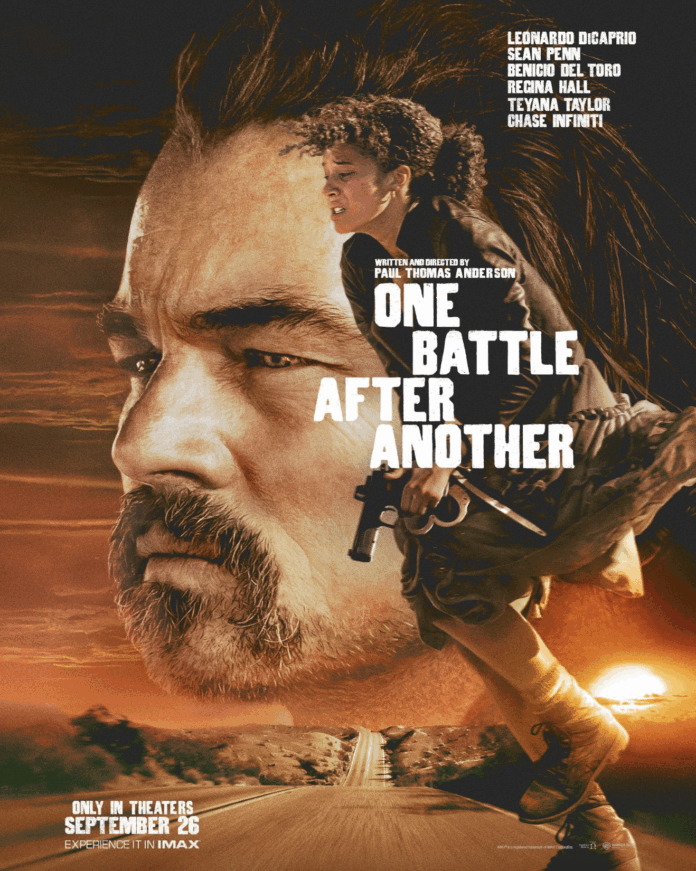
Paul Thomas Anderson’s thrilling action film is a brilliant assessment of our contemporary society
By NATALIE SALTER—arts@theaggie.org
Until 2024, no film since the 1960s had attempted to use VistaVision for the entirety of shooting. The widescreen 35mm film format was responsible for the warm, yet subtly grainy look of famous old pictures, like Alfred Hitchcock’s “Vertigo” (1958). The first film to break this trend was “The Brutalist,” set within the very era that the dated technique originated from. The second was “One Battle After Another,” which premiered on Sept. 26.
Director Paul Thomas Anderson is no stranger to honoring the past. Many of his most famous films, such as the early turn-of-the-century epic drama “There Will Be Blood” (2007) and the 1950s love story “Phantom Thread” (2017), are set long before the 21st century even began. So, it is curious that the first film he has ever shot completely in this long-gone format is his most contemporary yet — an unvarnished appraisal of the political conflicts plaguing the last decade.
Single father Bob (Leonardo DiCaprio) spends his days smoking and worrying over his daughter Willa’s (Chase Infiniti) every move. But 16 years ago, he was a fighting member of a revolutionary group known as the French 75, freeing immigrants from detention centers and protesting oppressive United States legislation. Everything fell apart when Willa’s mother Perfidia (Teyana Taylor) fled to Mexico, the French 75 was destroyed and Bob and Willa were forced into hiding, the very source of the former’s constant anxiety for his child’s safety.
Now his past threatens to steal her away when his old adversary Colonel Lockjaw (Sean Penn) comes after Willa, seeking to clear up the last pieces of his past so he can be inducted into a secret society of white supremacists. Bob is desperate to save his daughter, Willa yearns to know more about the life her father left behind and their courage is tested by a strain of evil so violently hateful it churns the viewer’s stomach.
At a runtime of 2 hours, 42 minutes, “One Battle After Another” is not interested in cutting corners of the story it means to tell. And yet, that runtime hardly means anything when the film’s relentless pace and electrifying performances completely sweep you away. Anderson balances a wealth of emotions throughout its course, dancing between side-splitting humor, blood-rushing anxiety and rousing moments of emotional catharsis.
Expertly shot and fantastically scored, there are precise moments of camerawork and musical backdropping that make the viewer’s heart race. Near the film’s end is a car chase sequence so well-directed that it grips you with pure anxiety. Further, the aforementioned use of VistaVision provides a striking richness to the film’s visuals.
“One Battle After Another” is an unflinchingly political film that captures the nauseating anxiety and disconcerting uncertainty of our modern age. The problems that the French 75 face at the start of the film are unsettlingly enduring 16 years later; in stark contrast to the endearing father-daughter duo that leads the film, Lockjaw and his cronies are unbearably sickening in their violent beliefs and actions.
At its center, “One Battle After Another” is the story of a father and daughter: the beating heart which brings life to the entire film. Bob’s paranoia chafes against Willa’s teenage sensibilities, but the love they have for each other is so earnest and fierce that every scene they share is achingly emotional. They seldom understand one another, but the love and drive to change the world that they share ties them together nonetheless.
Through Bob and Willa, Anderson seems to be grappling with a broader struggle in the fight for social justice and change. How does a parent come to accept that the fight doesn’t end with them, and that their children, the youth who will inherit the world after them, are inheriting their battles too? Is the fighting they did enough to make it just a little better for their children, the future just a little brighter?
Here is where “One Battle After Another” sticks its landing, letting a thread of hope run through all of its violence. While Bob scrambles to reckon with the war his daughter is being pulled into, Willa faces down the worst of it with unbelievable courage and determination. She is the future that Bob has fought for — not the idealized landscape of a utopian tomorrow, but the type of brave, kind person meant to belong in it.
The fight against injustice is just what the film’s title suggests: one battle after another, leaving us tearing down new evils even while knowing there are countless more to come. But there is no weariness in Anderson’s film: only unfettered hope. Hope that our children will be better than us, that there will always be good people there to lift each other up, and, as it is for Bob and Willa, that the way we change each other with our love is a victory in and of itself.
Written by: Natalie Salter—arts@theaggie.org