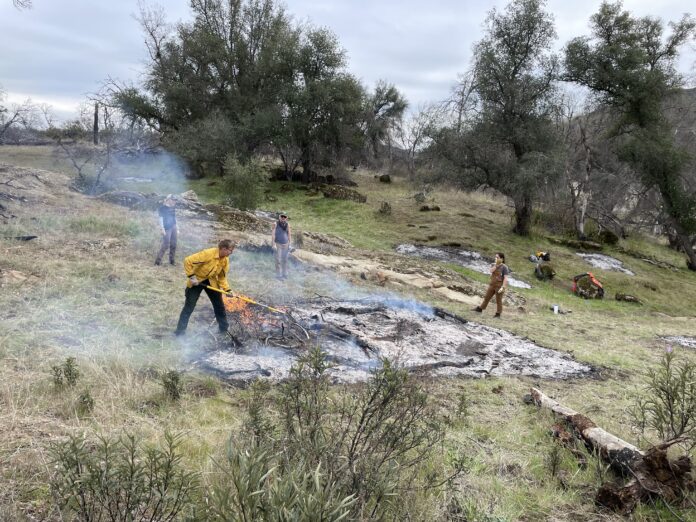
Hands on the Land provides free trips that allow students and community members to gain access to the UC Reserves and participate in habitat restoration
By LILA MAGBILANG— science@theaggie.org
Tucked away among the sprawling wilderness of California lies the University of California (UC) Natural Reserve System. With each of the nine UC undergraduate campuses responsible for a handful of these lands, this resource is abundant — yet inconspicuous.
In 2021, a group of graduate students from UC Davis gathered with the common goal of raising awareness about these reserves. With the aim of increasing accessibility for environmental education and habitat restoration, the students saw the reserves as the perfect space to get people out into nature. And thus, Hands on the Land was born.
Perhaps you have participated in some type of habitat restoration before: maybe you’ve gone out and planted a tree with a group or spent an afternoon weeding. Although any amount of work is beneficial for the well-being of the environment, the founders of Hands on the Land felt something was lacking — there was a disconnect between the people and the land.
By providing recurring trips to the two reserves closest to UC Davis — McLaughlin and Stebbins Cold Canyon — Hands on the Land invites students and community members to explore the nature surrounding Davis and take part in habitat rehabilitation. With the trips free of charge, the group hopes to incentivize repeated exposure to specific areas for an extended period of time.
Alana Luzzio, a Ph.D. candidate in the Ecology Graduate Group and a founding director of Hands on the Land, described what they’re doing differently.
“We visit the same two places throughout the year so that participants can see seasonality and phenology,” Luzzio said. “They can see tangible positive impacts of their work from previous trips.”
With trips happening nearly every month for the entire school year, students are encouraged to participate in various seasonal activities Hands on the Land organizes. In October, they can be seen collecting native seeds, and, in February, they might do a controlled burn.
Repeated and long-term restoration efforts are not only one of the best ways to actually rehabilitate a landscape, but they are also essential aspects of fostering a community of people with the same goals and passions. Though Hands on the Land naturally attracts those already interested in conservation, part of their initiative is making sure that everyone has the opportunity to make a positive impact on the environment.
Brooke Wainwright, another founding director and Ph.D. candidate in the Ecology Graduate Group, elaborated on their inclusivity efforts.
“If you’ve never been in a natural setting before — if it feels really unfamiliar to you — we want you to come on this trip,” Wainwright said. “You don’t need any experience. You can come from any discipline, and you are welcome at Hands on the Land.”
A typical Hands on the Land trip involves boarding a UC Davis Fleet Service van early in the morning, then making your way through the golden California hills to your destination. Saturday is when the majority of the work is usually done — you’ll spend a good chunk of the day out in nature, surrounded by the gnarled oaks and squawking scrub jays. Then, in the evening, all the volunteers come back to the field station and prepare dinner as one big family. Everyone lends a helping hand.
On Sunday morning, you’ll find participants engaging in a creative activity — may it be journaling, painting or even just taking a walk — to wrap up their experience. The field station becomes like a little home; somewhere you want to return to.
Cathy Koehler, the resident director of McLaughlin, explains how difficult it’s been to spread awareness about the UC Reserves. She notes that she is thrilled when someone comes to Hands on the Land and is inspired to come back.
“We’ve seen that happen where somebody comes out on Hands on the Land and then says, ‘I want to be involved in this more,’” Koehler said. “[The reserves] are places where there are opportunities for students to experience nature in its very many different forms, whether it’s heavily invaded by non-native species, be they animals, be they plants.”
Vivian Zerkle, a fourth-year environmental science and management major, is one of the Hands on the Land participants who found herself drawn to McLaughlin. After reaching out to Koehler, she was invited to come back to the reserve on her own time, sometimes with a group of friends in tow. Between her individual trips and Hands on the Land, she’s seen the landscape of McLaughlin start to change little-by-little.
“We pulled so much of this one weed one year,” Zerkle said. “The next year, I returned to that same hillside, and there was so much less of that weed taking over the hill. That was a really cool specific impact — I could see that my group and other volunteers had made a real effort and seen a real result.”
Restoration takes a long time. To many volunteers, it may seem disheartening to see the vast amount of work that needs to be done to restore just a few acres of land. However, with community mobilization and accessible opportunities for restoration, individuals can make a tangible impact — and part of that is choosing a specific place to dedicate yourself to and fully immerse yourself in.
As Wainwright noted, everyone is welcome to join a Hands on the Land trip. There will be upcoming trips in November 2025, as well as January, February, April and May 2026. For more information about signing up, follow the Hands on the Land Instagram.
Written by: Lila Magbilang— science@theaggie.org