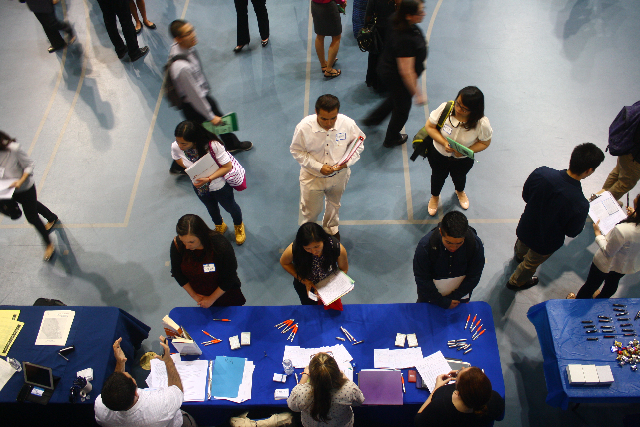
For many attending students, expectations differed from reality
By AMRA ABID — features@theaggie.org
As the time hit 3 p.m. on Oct. 15, hundreds of students donning pressed slacks, blazers and folders full of resumes filed out of the University Credit Union Center as the UC Davis 2025 Fall Career Fair came to an end.
With the purpose of helping undergraduate students land internships and entry-level positions, career fairs are advertised to serve as a way for students to speak face to face with employees and recruiters at companies and get a leg up in the hiring process.
Maya Kusumakar, a third-year managerial economics and computer science double major, attended her first career fair hoping to secure an internship. However, after speaking to recruiters and handing out resumes, she explained that she felt less hopeful about obtaining career prospects than she had before the event.
“My expectations were that, you know, they would be offering jobs,” Kusumakar said. “But I think that they are here for marketing just as much as [they are for] recruiting.”
Riya Elizabeth and Shruthi Khurana, both first-year business analytics graduate students, had travelled from San Francisco with similar, hopeful expectations in mind. However, after speaking to dozens of recruiters, they both shared shifting perspectives on the function of the event.
“I didn’t find [the career fair] as a place where we’ll actually get a land on a job,” Elizabeth said. “It felt more like a space to network and get more understanding of the recruiters.”
Having attended a career fair before, Summer Sueki, a third-year cognitive science and design double major, had a similar experience and, this time around, went with the primary objective of speaking to recruiters. To prepare, she rigorously researched the specific companies and job listings online so that she could gain more from the event than the previous one she attended.
“I didn’t really come here to pitch myself — I just wanted to get to know the companies,” Sueki said. “Just the application process, what makes someone stand out in the role [and] what the culture is like.”
Even then, Sueki noted that she left the fair disappointed and with less insight than she had anticipated, despite having a clearer understanding of what to expect.
“A lot of these places, even if they’re hiring on LinkedIn, they don’t necessarily know [specifics] about the role,” Sueki said. “I went to Pepsi because they had UX design listed on their LinkedIn, but the guy didn’t know anything about it, so I was like, ‘It’s okay.’”
Not only have unmet expectations left some students feeling frustrated, it has left many others reevaluating the purpose of showing up at all.
“Everyone was just asking us to apply on the online link, which is not really a differentiator,” Khurana said. “I could be sitting at home and applying with the same link.”
Although attending the career fair didn’t offer them any explicit upper hand in the job hunt, Elizabeth and Khurana agreed that they nonetheless benefited from the experience of interacting with professionals.
“I would have liked it if at least they did something with the resumes they took,” Khurana said. “Then the fair would be more beneficial. But at least some of [the recruiters] had feedback that will help us better prepare for next term.”
Ultimately, the career fair left many students to reevaluate and adapt their strategies for the next event. For now, the action of showing up in person with a resume in hand and ready to leave an impression on industry professionals — while it may not lead to a job offer — may be beneficial for learning to navigate an imperfect system: one career fair at a time.
Written by: Amra Abid — features@theaggie.org