Student radio station DJs view music as a deeply personal experience to be shared
By IQRA AHMAD — arts@theaggie.org
Music has long been recognized as a universal language; one capable of transcending culture, geography and even generations, according to a Harvard music study. Though infinite in its possibilities — with countless variations of notes and rhythms — music remains deeply personal.
Music is often defined as “vocal, instrumental or mechanical sounds” containing harmonies, melodies or rhythms. However, this definition falls short for many, missing the mark of what makes music so essential — its emotional resonance. DJs at UC Davis’ on-campus radio station KDVS 90.3FM spend hours each week hand-selecting and sharing music with radio listeners.
“Music to us is important culturally and socially,” KDVS radio host Maia Madsen, a second-year history and psychology major, said. “We can associate it with events and indirectly share the aspects of our lives. It’s quite intimate. It’s a callback to certain, beautiful moments.”
For Sophia Fenchel, a second-year environmental toxicology major and radio host at KDVS, music is an experience: one that is extremely personal and unique.
“The way in which our brains take in music is different for each and every person.” Fenchel said. “Each person’s ear processes and interprets the music differently.”
These perspectives reveal how music serves as an extension of the human experience, especially in the eyes of those curating the background soundtracks to our lives.
“Music exists in all of the moments in-between,” Madsen said. “The different lived experiences we bring means that we all interpret music differently.”
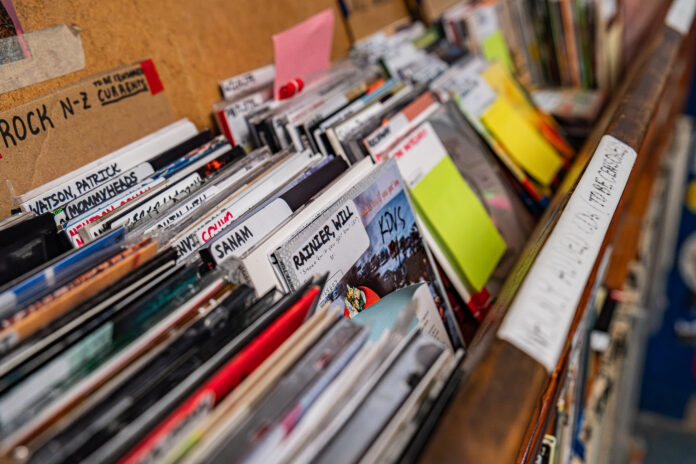
At UC Davis, these individual experiences come together at KDVS, a student-run, non-commercial and freeform station founded in 1964. KDVS hosts feel the station is not only a platform for broadcasting songs, but rather a community encouraged to engage in music appreciation and discovery. KDVS currently maintains over 150,000 titles, including vinyls, CDs and cassette tapes.
“KDVS has a music department that fosters and takes care of our music library,” Madsen said. “There is a very dedicated community of radio hosts curating shows.”
Each program on the station represents the personal taste and vision of its hosts. Madsen and Fenchel, for example, recently worked on a themed show titled “#Fuzzy.”
“A week leading up to the show, we decide on a theme, one we choose based on how we feel and what we want to share,” Fenchel said. “We choose our music separately so we can listen to the songs together for the first time and discuss them.”
Humans feel emotional responses to the harmonic continuity and progression of music, where every note adds onto the expectations of the song, according to an article by the British Psychological Society. When Fenchel selects music based on the theme of the show, she’s trying to shape the emotions she wants listeners to feel.
“I chose cozy music for ‘#Fuzzy’ — music that made it feel like I was bundled-up and drinking a cup of tea,” Fenchel said. “It was more jazzy, saxophone music.”
Another part of what makes the KDVS community distinctive is its commitment to variety and openness.
“At the end of the day, the people who listen to KDVS have to be open to different kinds of music,” Madsen said. “For example, Professor Sen plays Bollywood, and a lot of other people play indie rock or electronic, and you can go through all of that within the span of five minutes.”
Tatianna Arias, a KDVS radio host and third-year English major, shared their thoughts about the way music can deeply engage listeners and radio hosts alike to form a dialogue and connection.
“There’s a whole community of people who genuinely love music — listening to it, discovering it and sharing it,” Arias said. “Local radio has a kind of soul to it, you’re hearing songs that someone handpicked for all of their listeners, and that creates a real connection with the Davis community through music.”
The DJs shared the sentiment that working at KDVS has allowed them to interact with other students and share parts of themselves through a selection of songs.
“I think of music as a form of communication,” Arias said. “When I play something on air, I’m sharing a piece of myself. Sometimes listeners even call in to request songs that fit the vibe of my show, and in those moments, we’re bonding through the music.”
Madsen, Fenchel and Arias view music as both individual and inherently communal. Each person processes sound differently, allowing music to connect people across experience and identity, according to the DJs. For the hosts at KDVS, sharing music is more than entertainment; it is an act of communication and empathy.
“I want listeners to become more curious about music and be inspired to engage with new tastes,” Madsen said.
That same spirit of exploration resonates with Fenchel, who sees radio as a space to introduce different genres of music and share experiences.
“I hope people learn new music from us, to add [the songs], to listen to [them] or even just have it playing in the background,” Fenchel said.
At the KDVS radio station, show hosts encourage listeners to engage with music’s unique ability to unite and differentiate. Whether it’s through a saxophone or a fuzzy indie guitar riff, the DJs at KDVS remind us that music doesn’t just fill silence — it connects individuals across frequencies.
Written by: Iqra Ahmad — arts@theaggie.org