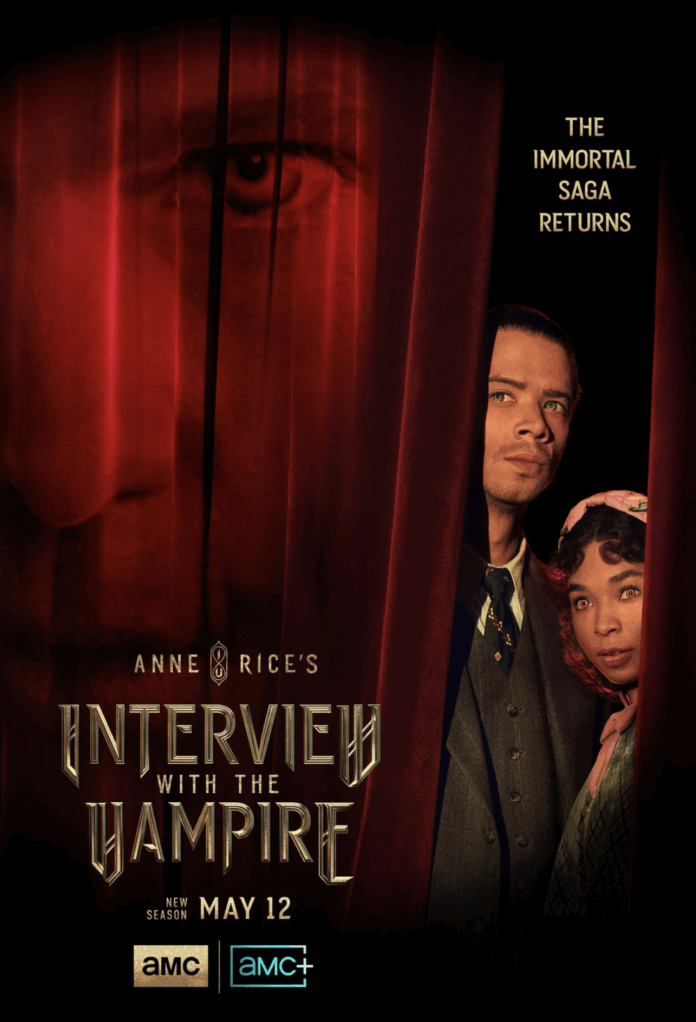
The screen adaptation of Anne Rice’s book series is a masterwork of television storytelling
By NATALIE SALTER—arts@theaggie.org
Memory is a complicated thing. While you might easily remember the details of a conversation you had yesterday, the things you said five years ago are harder to recall. Our memories fade with time, reshape themselves and are even subconsciously blotted from our minds. One can imagine, then, how difficult the act of remembering would be for someone who’s been alive — or rather, undead — for over a hundred years.
Such is the premise of AMC’s “Interview with the Vampire” (2022), adapted from Anne Rice’s 1976 novel of the same name. The second season, which came out in 2024, just arrived on Netflix this month. The titular interview’s subject is Louis de Pointe du Lac (Jacob Anderson), and the story is his: the transformation and tumultuous life of an immortal vampire, for all of its tragedy and bloodshed. But, as the show’s tagline remarks, “memory is a monster,” and committing his sanguine existence to text is not as simple as it seems.
The story is divided between Louis’ interview by the dryly honest investigative journalist Daniel Molloy (Eric Bogosian) in 2022 and his past in early 20th century New Orleans, the latter being the place of his fateful transformation. The pair find themselves unexpectedly unraveling mysteries not only in Louis’ past, but in their present interview as well — the story unwinding masterfully from episode to episode.
At the heart of Louis’ story is his torrid relationship with the charismatic vampire Lestat de Lioncourt (Sam Reid), his maker and his lover. Eternally bonded, their affection and anger towards each other profoundly shapes the very fabric of their narrative and the characters around them. Anderson and Reid deliver especially showstopping performances when on screen together. Whether they’re sharing a moment of tenderness or one of explosive rage, the depth of emotions that the characters feel for each other are expressed phenomenally by the pair.
When their family expands to include the teenage vampire Claudia (Bailey Bass and Delainey Hayles), the narrative becomes more complicated than ever before, as her feelings towards her foster parents are darkened by the fact that she is now trapped in an adolescent body for eternity. Bass, who portrayed Claudia in season one, and Hayles, who took over the character in season two, give some of the best performances of the entire series. One of the best arcs of the show ensues as Claudia struggles to accept the boundaries and sufferings of her new existence, entwining girlish whimsy with violent rage.
The setting of “Interview with the Vampire” breathes new life into a genre. Mostly set in sprawling Gothic castles in Europe, the film places the vampire in conflict with a new sociocultural environment. The historical mortal and vampiric worlds intersect as the series explores Louis’ identities as a queer Black man in the Jim Crow South, paying careful attention to the way the reality of the story’s time and place affect the characters’ lives. As the world around Louis, Lestat and Claudia shifts and evolves, they are shaped by it as well, even in a state of eternal youth.
The series also employs its unique storytelling style masterfully, capturing the viewer’s attention completely in both past and present scenes alike. Louis’ interview narration provides depth and insight into the events that unfold in the past, but the show just as cleverly plays with the gaps in his remembering. Uncertain memories and altered retellings blur the lines between objective and personal truths, weaving mystery into the fabric of every scene.
Anderson’s performance as Louis masterfully captures the vampire’s evolution over a century and the grief he acquires throughout it. His ability to convey a rich depth of emotion in the smallest of expressions or line deliveries is incredible. Likewise, Reid is as irresistibly charming and detestable as the flamboyant, fickle Lestat. His ability to make the audience loathe him one moment and love him the next is a testament to his talent.
What makes “Interview with the Vampire” so marvelous is that it pushes beyond being simply a vampire story, using the supernatural to explore tangling emotions and relationships that are all too human in nature. For all of the death and bloodshed, the story is fundamentally one of love, from its tenderest to most violent forms. Between the moving performances of the central cast and the struggles that befall their characters, every episode is an emotional experience as much as a thrilling one.
The first two seasons of the series are out now, but fans hungering for more will be delighted to know that another season is on the way. The third season, titled “The Vampire Lestat” after the second book in the series, comes out in early 2026. Notably, the power of narration will move from Louis to Lestat, offering a fresh backstory to explore and a new perspective on familiar events.
Though the Halloween season is coming to a close, “Interview with the Vampire” is such a brilliant piece of television that it ought to be enjoyed regardless of what time of the year it is. Its nuanced writing, exceptional performances and intricate visual design make it a gold standard not just for vampire storytelling, but for television as a whole.
Written by: Natalie Salter—arts@theaggie.org