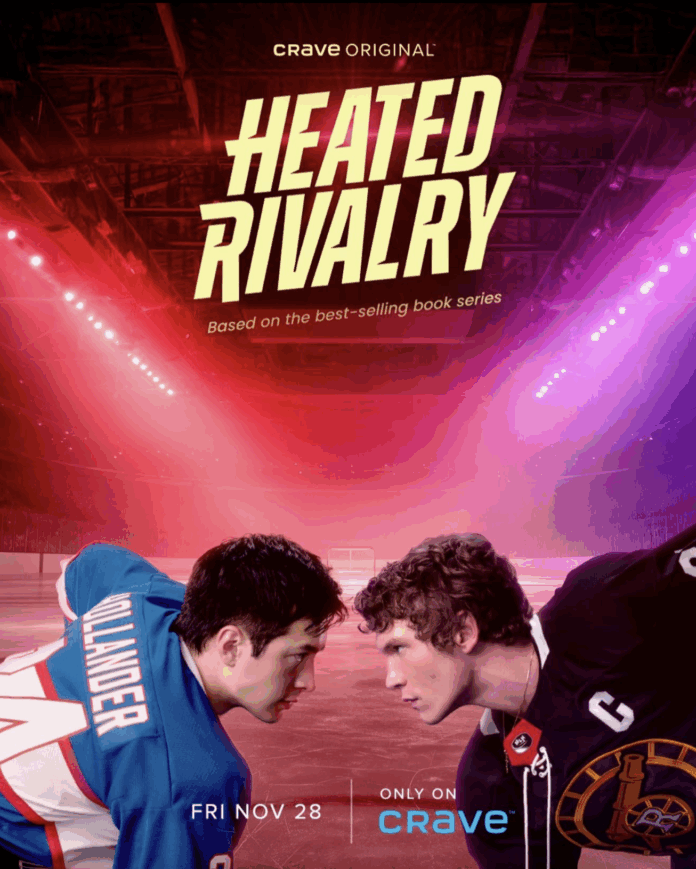
UC Davis cinema and digital media students discuss the cult-favorite queer sports romance
By JULIE HUANG — arts@theaggie.org
“Heated Rivalry” (2025) is a hot topic this winter. Originally an adaptation of Rachel Reid’s sports romance book series developed for Canadian streaming service Crave, the television series became HBO Max’s top debut for an acquired, non-animated title since 2019. The show has since sparked record-high viewership and an endless amount of online discourse, at least in the last couple of months.
This meteoric rise in popularity has become a conversational fixture in the UC Davis community, with one clear bottom line: the show’s cultural relevance is currently undeniable.
Siena Dill-Cruz, a third-year cinema and digital media and political science double major, started watching it with a friend, who was unable to finish the series.
“We had watched the first five episodes together, just her and I, but then her boyfriend actually got mad at her for watching it,” Dill-Cruz said. “I was sending her the TikTok edits anyway, because whatever.”
Social media platforms have become a common introduction for many to “Heated Rivalry.” Apps like Twitter, Instagram and TikTok feature clips from the series, interviews from its actors and fan-made edits that encourage users of these platforms to watch the show and see for themselves what the hype is about.
Kayla Tran, a third-year cinema and digital media and communication double major, has not yet seen the show, but knows the gist of its narrative arc due to exposure from social media.
“I have been incredibly spoiled on Twitter and Tiktok,” Tran said. “I thought, ‘This actually looks like a really good show,’ so I will come to it at some point, especially because all the edits that I’m getting on Tiktok and Twitter are phenomenal.”
The queer nature of “Heated Rivalry” cannot be sidelined, either. At its core, the show is a love story between two men, and its handling of this topic has become the catalyst of much discussion.
“To my surprise, everyone else has been super open about talking about it and educating themselves,” Dill-Cruz said. “It hasn’t been stigmatized in my friend group. We all love the show.”
It is inevitable that a series like “Heated Rivalry,” which is rapidly becoming known among those who engage in popular culture, receives a diverse range of audience reactions.
Keisha de la Cruz, a second-year English major, cited the short runtime — six episodes in total — as a reason why she may not have been as invested in the show as she thought she would be.
“I know everyone really likes it, but I was expecting something more life-changing,” de la Cruz said. “The story doesn’t feel like it’s monumental, but rather just another story that’s following a trope. I just don’t understand why it’s blowing up.”
Mads Sagita, a third-year cinema and digital media and psychology double major, noted that whatever people’s individual reactions may be, the topic of “Heated Rivalry” is ubiquitous among demographics.
“It’s really permeated throughout campus — but not just on campus, literally everywhere,” Sagita said. “It’s not just popular in our age group either, but among all sorts of people.”
In addition to social media, the inculcating of the show’s two lead stars, Connor Storrie and Hudson Williams, into general celebrity culture, has played a considerable role in increasing the show’s visibility.
“Hudson and Connor were on award shows, which probably helped increase the show’s popularity as well, but I think it also has cemented itself as a TV show that resonates with many different audiences,” Tran said. “You have the queer community, and you also have sports fans — especially hockey fans.”
Notably, neither Storrie nor Williams were high-profile names before the success of “Heated Rivalry.”
“I am a little surprised by it, because it’s very rare now to have a project with mostly unknown actors blow up so much,” Sagita said. “When was the last time that this has happened and actually left an impact on pop culture at large?”
The immense popularity of the show, however, has also invited some backlash.
“I would go so far as to say that I’ve seen people express shame about having watched it, and that’s so weird to me,” Sagita said. “If you didn’t like it, why are you tuning in every week? There’s a weird urge in people to be contrarian, because it’s so new and popular that they feel the need to balance the scales a little.”
One notably controversial point of discussion are the sexually explicit scenes interspersed throughout the narrative. The spectrum of opinions regarding the place of explicit content in mainstream media is highly polarized, often leading to heated online debates that often misconstrue the nature of the story as essentially sexual.
“I find it a little strange that [explicit content] becomes such a focal point of discussion, because it’s such a small fraction of the show’s entire runtime,” Sagita said. “People were telling me that ‘half of [the show is] porn’ and then when I actually watch it, it’s like five minutes of every episode, on average. I’ve seen people criticizing it online for being too explicit, and I’m like, you watched ‘Bridgerton.’ It’s basically the same thing.”
Some viewers feel that the inclusion of explicit scenes enhanced the show’s central themes and story.
“It added another layer of intimacy and allowed audiences to connect to the characters on such a deep level,” Dill-Cruz said. “Not every show needs to do this, but I think for ‘Heated Rivalry,’ it was beneficial for them to.”
Others point out that discussion that overemphasizes the explicit scenes may detract from the show’s other merits.
“People can talk about the sex, because we don’t want sex to be a taboo topic in this current climate; but there are other aspects of the show that deserve recognition,” Tran said. “There’s incredible dialogue between Shane and Ilya, and other great moments that should be highlighted as well.”
Multiple coming-out scenes comprise notable examples of the show’s heartfelt writing, which achieve a range of emotional settings and moods in characters and viewers alike.
“You don’t want to overlook these moments, because what’s great about the story is that it’s multi-dimensional,” Tran said. “There’s so much physical passion within certain moments, but there’s also so many emotional undercurrents to it. The actors’ performance shouldn’t be reduced to just sex, and that also applies to this show as a whole.”
In its portrayal of a queer love story, the writing allows for greater focus on how the emotional experience of being queer and closeted manifests from day-to-day.
“It’s really nice and refreshing to hear or see a gay love story where none of them are addicted to drugs or actively dying,” Sagita said. “Yes, it depicts internalized homophobia, but it’s not like a stereotypical depiction of having internalized homophobia because they’re scared to get [auto-immune deficiency syndrome (AIDS)] or something.”
Though “Heated Rivalry” is fictional, the impact that it has on its viewers is very real.
“I think the show has had a net positive effect, even though there is a lot of stupid discourse about it,” Sagita said. “A few days ago, snowboarder Gus Kenworthy came out with his whole story. We knew he was gay, but the show inspired him to tell more of his journey as an Olympic champion.”
The massive success and popularity of “Heated Rivalry” has led to the show being renewed for a second season. However, some, like Tran, hope that other tangible outcomes include increased pro-LGBTQ+ sentiment in North American sports culture, which is often steeped in prejudice against queer people.
“There’s still a part of the hockey world that’s pretty homophobic, which is why I think it is really important to have shows like this that have a cultural impact,” Tran said. “Hopefully it can also make some changes within the real world, in the hockey industry and sports arenas.”
Some sections of the hockey community have embraced this increased visibility and connection to the queer community. The Ottawa Senators, a Canadian ice hockey team, are selling “Heated Rivalry” themed jerseys and giving the profit to Ottawa Pride Hockey, a local organization that organizes hockey games for LGBTQ+ participants.
“Representation helps,” Tran said. “The power of film and media is to influence real-world perspectives and educate people, and seeing LGBTQ+ representation in shows like ‘Heated Rivalry’ can help make these necessary strides.”
Written by: Julie Huang — arts@theaggie.org