55.4 F
Davis

Davis, California

Monday, December 22, 2025
Home Blog Page 138

Commentary: Music serves as a universally spoken language

Examining the cross-cultural significances of tunes


By RUMA POUDELL — arts@theaggie.org


Music transcends language. Every living thing has a rhythm, whether it’s a heartbeat or a certain stride in running. You can experience it through your senses — not just by hearing but by feeling, too; for example, the bass vibrations from a drum. 

Whatever form it takes, you don’t need to learn music to understand it. The universal nature of music manifests across different cultures. 

Recently, I made a friend through our love for the same instrument. I was playing the dhol during Punjabi Week’s kick-off event in the UC Davis Quad, and someone walked by, heard the sound, asked to play and busted out his own skills. Together, we improved our skills through collaboration. Despite our differences in nationality, gender and age, the act of playing an instrument brought us two strangers together.

Apart from being an encompassing means of connecting people, music serves many purposes. One of these is that rhythms, hymns and the utterance of specific words come together to form an integral part of spiritual practices. 

Take, for example, Hindu bhajans and meditations, which place significance on music and its effect on the mind, body and spirit. One aspect of Hindu bhajans is the repetitiveness of verses, oftentimes in dedication to a deity. The idea is that through this repetition, devotees can merge with the divine presence in a meditative process. Combined with a science dedicated to the frequencies of different utterances, this aims to align spiritual seekers to a higher plane of consciousness and a more relaxed physiological state.

Practically all major religions use music to praise the essence of creation and elicit an uplifting sense of unity and reverence. Christianity has worship. Islam has nasheed. Buddhism has mantras and sutras. Sikhism has kirtan. 

The cross-cultural significance of music can be boiled down to expression of experience and the passage of values. Music serves to carry heritage and a piece of history — whether it’s through religious and spiritual means or more modern forms of music.

Today, the burst in technology and the ability to connect with others easily via the internet has led to an era of musical diversity and increased access to said media. 

Previously, music was shared through very physical means such as record vinyl, walkman players, CDs, cassettes and more. Now, we have apps like Spotify, Apple Music, Soundcloud, Youtube Premium and even Tiktok for discovering and enjoying songs.

As we increase our access to music, naturally, its significance in our lives increases too. There are many genres of music that you can connect and identify with. Whether it’s folk, salsa, punk rock, indie alternative, pop or country, music has the ability to decorate your time, connect you to similar shared experiences and immerse you into a subculture. 

Written by: Ruma Poudell — arts@theaggie.org

Culture Corner

The Art Desk’s weekly picks for movies, music and more


By CHRIS PONCE arts@theaggie.org


Book: “Crying in H Mart” by Michelle Zauner (2021)

If you read my last Culture Corner, you won’t be surprised by the fact that I love memoirs. Whether you’ve heard the news of its coming movie adaptation or open casting call, or maybe just seen it displayed at a bookstore I’m sure you’ve heard of Michelle Zauner’s “Crying in H Mart.” This book is as powerful as it is popular. Throughout, Zauner writes about finding her place in life, her identity as a half-Korean/half-white woman and the grief she experiences after the death of her mother. The heart of the story is the relationship between Zauner and her mother, which explores themes of family and cultural identity in America. A powerful motif in the book is Zauner’s highly detailed descriptions of the food and meals she prepares, as she describes food as a way of staying connected to her mother and culture. A good friend of mine recommended it to me, and now I hope I can do the same for you.


Album: “Psychopomp” by Japanese Breakfast (2016)

Zauner is not only a popular author but also an acclaimed musical artist. Her band’s debut album, “Psychopomp,” also deals with the emotional journey Zauner experienced with the death of her mother. According to an interview with Zauner, the album name comes from the feeling she had of guiding her mother through the journey of her illness and how she would see her mother in her dreams following her death. “Psychopomp” is beautiful and each song flows straight into the next. I know nothing about music theory, but this album is an emotional journey and is worth a listen. 


TV Show: “Parks and Recreation” (2009-2015)

This show has been recommended to me by many great friends, including Editor-in-Chief of The Aggie Sophie Dewees. And even though everyone told me to “skip the first season” — something I consider to be a huge red flag in TV shows — Parks and Rec has quickly become one of my favorite sitcoms. The show develops all of its main cast throughout the seasons and while the show is a goofy portrayal of local government bureaucracy, it is also a beautiful story about friendship and how people unexpectedly come into our lives and change them forever. So before you think it is just another knock-off of “The Office,” give it a chance — once the show finds its footing, it’s truly something special. 


Movie: “Missing” (2023) 

“Missing” is a Jan. movie that would typically get swept under the rug. However, the spiritual sequel to “Searching” (2018) is just as thrilling and engaging as its popular predecessor. Also, the protagonist in the movie is an incoming UC Davis student, which can be seen from her notes app and open tabs on her computer. The computer-found-footage-style film follows a daughter attempting to locate her mother who mysteriously vanishes after a vacation. Similar to “Searching,” this movie kept me guessing as to what the next twist would be. If it feels like all movies are becoming predictable and repetitive, I recommend something like “Missing.” What might seem like an obvious twist is just another false lead in the story. Now that it’s on Netflix, this movie is definitely worth a watch. 


Written By: Chris Ponce arts@theaggie.org

Five trips everyone should take in their lifetime

Trip recommendations based on your company, not your destination 


By YASMEEN O’BRIEN — yjobrien@ucdavis.edu

  • Somewhere with friends

Traveling is a bonding experience, and doing it with friends will give you the opportunity to get closer and spend quality time together without everyday stressors. You’ll learn new things about each other throughout your travels. I don’t necessarily mean taking a long — and expensive — trip abroad; it could be a weekend camping trip or a few days by the beach. You and your friends will share moments that you’ll talk about for years to come.

  • Somewhere meaningful to your family

Going somewhere that is meaningful to your family will connect you to your roots, where you came from and your identity. This could mean traveling with or without your family, depending on the kind of experience you want to have. However, I think being able to share the experience with family would enhance the experience. One of the most profound ways I have found a piece of my identity was traveling with my family to a small town in Tanzania where my grandfather is from. But so was taking a day trip to the Central Valley to see the house and town my paternal grandmother grew up in.

  • Somewhere with a lover

This is a kind of fun I think everyone should experience. You get to see the world through the eyes of the one you love and create memories you’ll cherish for a long time. Experiences tend to be a lot rosier when you are with a lover, and this will make your trip a very special one. Also, according to the U.S. Travel Association, couples in romantic relationships reported that traveling together made them significantly more likely to be satisfied in their relationships, communicate well with their partners, have a better sex life and more. It’s a win-win situation!

  • Somewhere alone

I think everyone should spend an extended amount of time alone at least once in their life. It’s important to make time to sit with your thoughts so that you can get to know yourself better. I think that nature is a great place to do this because it gives you the space, clarity and quiet to really hear yourself think. The most important relationship in your life is the one you have with yourself. Traveling alone also means you’ll have to make your own decisions, which will help you become more assertive and confident in yourself. It will make you feel strong to overcome obstacles knowing you did so on your own.


  1. Somewhere for no reason at all… 

…Other than the fact that you’ve always wanted to go — make your little self’s dreams come true. I am a big believer in doing things because they sound fun. If a place has always called to you, go! You don’t have to have a different reason than that. You are in control of your own choices, life and destiny. Taking a trip that feels like you’re accomplishing something you’ve always wanted to accomplish will make you feel strong in yourself. This trip can be big or small, with a group of people or alone — it can be anything you want. A couple of these places for me are New Orleans, the Cascade Mountains, South Africa, Tahiti and Peru. I don’t have a fancy reason for wanting to go to these places other than I’d love to go, and I think that’s reason enough. 


Written by: Yasmeen O’Brien — yjobrien@ucdavis.edu


Disclaimer: The views and opinions expressed by individual columnists belong to the columnists alone and do not necessarily indicate the views and opinions held by The California Aggie.

UC Davis women’s ultimate frisbee club team, Rogue, is a ‘home away from home’ for teammates

An unconventional sports club upholds athleticism, community and sportsmanship


By LYNN CHEN — features@theaggie.org


When discussing sports, basketball, soccer or football might pop into many peoples’ heads first. While not mainstream, ultimate frisbee is still a sport that prides itself on energetic athleticism, a passionate fanbase and steadfast sportsmanship. One such team that demonstrates these values is Rogue, the UC Davis women’s club ultimate frisbee team.

Rogue comprises two teams, A and B, with the main difference being that A is more competitive while B is developmental. Recently, Rogue’s A team competed in the District 1 regionals in Santa Barbara, where the top three teams would qualify for nationals. Rogue did not qualify, but Margo Donahue, a fourth-year psychology and philosophy double major and one of the A-team captains, said that the team “played really well” nonetheless.

The sport itself is a competition involving frisbee with elements from other sports. According to Donahue, ultimate frisbee is “a mix between soccer, basketball and football.” Both teams aim to score by passing the frisbee into end zones. While one team is on offense, the other team plays defense by assigning guards to each person on the offensive team. Players also have to keep in mind rules about passing discs within a certain time frame and keeping in bounds.

What’s special about frisbee is that it’s “self-officiated,” Donahue said. “Players are the ones calling fouls and turnovers, points — everything.”

Emily Denio, one of the A-team captains and second-year environmental policy analysis and planning major, said that it is on players to make sure games are “fair.”

As an ultimate frisbee team, Rogue also requires time commitment from its members. Every week, the A team spends nine hours practicing and one hour doing workout training, while the B team spends six hours practicing. Members also attend regular tournaments.

According to Donahue, workout training for the A team includes running and strength building, as well as exercises focused on defensive and offensive strategies. Denio said that Rogue makes sure to build skills for the two offense positions: handlers, who pass the discs downfield, and cutters, who perform certain running routes to catch the disc. These positions work together to maneuver the disc through the other team’s defense.

Rogue members also often study together and attend social events outside of practice, such as formals, barbecues and “Socks and Mugs” during winter quarter — Rogue’s version of white elephant.

“I would say we are a very close team,” Donahue said. “We definitely do a lot outside of practice to help build chemistry and become closer as a team. A lot of people say that Rogue is like their ‘home away from home.’ We’re a really close community that is super supportive.”

Denio furthered that Rogue facilitates a “welcoming and supportive environment,” especially to newer players. 

“We make buddy groups,” Denio said. “Normally, we try to match returning players with rookies or older players with younger players. It’s really cool because younger players can have someone they go to for advice. They can ask them about classes or if they just need help in some other way.”

Karly Thomas, a fifth-year sustainable agriculture and food systems major and captain of the B team, said the club is welcoming to all players of different skill levels and ages.

“I’ve played with 30-year-old postdoc students and 18-year-old freshmen,” Thomas said.

Despite ultimate frisbee’s current niche nature, Donahue and Denio believe that it is an “up-and-coming sport” in the athletic community. Donahue explained that the sport is growing in popularity among college, high school and even middle school communities.

“Very recently, pro-leagues were created,” Donahue said. “The AUDL is the American Ultimate Disc League, which is a professional men’s ultimate league […] while the WUL, Western Ultimate League, and PUL, Premier Ultimate League, are two professional women’s leagues.”

According to Denio, the sport is growing across the globe. 

“My first three years of college, I lived with a roommate from China who had been playing ultimate since high school,” Denio said. 

Even as ultimate frisbee’s popularity spreads, it occupies a unique space in the athletic world.

“Frisbee is unlike any sport I’ve ever played,” Donahue said. “One aspect of frisbee is called ‘spirit of the game,’ which is the idea that everybody plays with honesty, integrity and respect. I think the frisbee community honors that all over the world. We still are going to play very competitively, and we’re gonna try our best but not at the expense of our dignity and our respect for others.”


Written by: Lynn Chen — features@theaggie.org

Lectures should be more interactive

Professors need to find ways to improve engagement and learning


By AUDREY BOYCE — afboyce@ucdavis.edu


I am currently finishing up my second year as a psychology major here at UC Davis, and most of my psych classes, with the exception of one, have been in the same format: two or three lectures a week, three multiple-choice tests (including the final) and possibly a low-stakes essay.

I am somewhat disappointed that this is what my psychology education has consisted of. I imagined that, in classes, we would be looking at case studies of patients and having big class discussions about them or writing weekly assignments based on complex ideas or theories.

I do, however, understand that lecturing and multiple-choice tests may be the only way to get across the amount of material we need to learn, given the amount of time we have within the 10-week quarters. After all, I should have known what I was getting myself into when choosing a school on the quarter system.  

My dream of escaping the endless memorization of material and being tested on my knowledge through multiple-choice tests may not be plausible. However, there are ways in which lectures can become more interactive. It has been proven that active learning through interaction produces a better understanding of the material than passively learning through a traditional lecture.

The “illusion of knowledge” is the phenomenon in which you believe you are familiar with a subject because you have been exposed to it multiple times. Unfortunately, this style of learning does not actually allow material to become encoded in your long-term memory. This phenomenon has to do with the difference between active and passive learning. 

One effective way to interact with the material is to ask questions. However, in a lecture with over 100 people, this can be intimidating and anxiety-inducing for many. Additionally, professors often go through slides quickly, and there is not enough time to both get down all of the notes and formulate a question. In my opinion, directly asking the professor questions isn’t the only way to be engaged — simply thinking of questions to ask can be a useful exercise. This is why finding a way to allow all students to feel comfortable asking and thinking of questions during lectures is important.

In my UWP 1 class, my professor used Mentimeter, an online forum for students to ask questions anonymously. If professors would allot more pauses in between lecture slides to answer more Mentimeter questions, for example, it might give students more incentive to engage in this type of active learning.

Another way to improve interaction can be to use iClickers, an online question software, for more open-ended questions rather than multiple-choice questions. Prompting students with open-ended questions that make us think more deeply about the topics being presented could also increase participation.

At the end of the day, classes at UC Davis should increase opportunities to actively participate. Professors should look into different teaching strategies to make sure that everyone has the opportunity to engage in the material.


Written by: Audrey Boyce — afboyce@ucdavis.edu

Disclaimer: The views and opinions expressed by individual columnists belong to the columnists alone and do not necessarily indicate the views and opinions held by The California Aggie.

‘The Little Mermaid’ is a magical, inclusive reimaging of a classic film

ACE at UC Davis hosted a premiere watch party for students and community members 


By LORENA ALVAREZ — arts@theaggie.org


The release of the official teaser for the live-action adaptation of “The Little Mermaid” last year was met with mixed reactions. Some fans were excited to see actress and singer Halle Bailey step into the role of Ariel, while others voiced their disappointment that their beloved Disney princess would not have the same appearance as she did in the animated classic from 1989. This “transparently racist” backlash about Bailey being chosen for the starring role sparked a conversation about the continued need to celebrate and advocate for Black representation in the media. 

UC Davis African Diaspora Cultivating Education (ACE), a community program under the Student Recruitment & Retention Center, did just that. The program invited community members to join them for the movie’s premiere on May 26.

ACE aims to “create a supportive environment that encourages Black students’ mental, physical and academic successes through programming, retreats, and conferences that aim to empower students in the African Diaspora,” according to the program’s website.  

Arriyon White, ACE’s academic achievement coordinator and a political science and sociology double major, commented on the importance of the event. 

“‘The Little Mermaid’ premiere provided an opportunity to build community connection, expand Black students’ network and provided the space to observe one of the first representations of a Black female lead in a Disney movie,” White said. “[A] role where a young Black girl who is a princess, seeking love and adventure, [gets] to live the ‘happily ever after’ that is usually represented as white.” 

She stated the deep value inherent in representation without stereotyping, especially from entertainment produced by Disney, which ranked high on Fortune’s list of the “World’s Most Admired Companies.”

“Many of us as young Black children didn’t grow up seeing people who looked and sounded like us as Disney princesses, and I felt that […] watching ‘The Little Mermaid’ would inspire and mean a lot to members of my community,” White said. “Especially since most of the Black students at Davis will be either the first or one of the few Black people in their careers or workplaces.” 

The event was met with positive responses. Melanie Madrigal, a third-year environmental toxicology major, commented on her experience attending the event. 

“I liked that ACE was able to host a premiere because it allowed me to see the movie on the big screen and made the movie experience more fun,” Madrigal said. “Halle has such a wonderful voice and I feel like she really captures what a princess is in my mind. [The production team] showcased Eric’s crush or infatuation with Ariel a bit better [than the original movie]. They built their relationship nicely and it made us root for them.”

Aside from the positive reception in regard to Bailey’s performance, some viewers did have some critiques about the movie’s effects. Alexandra Navarro, a second-year animal biology major, noted the movie’s CGI and depiction of Flounder. 

“I particularly enjoyed the scenes in which Ariel rescues Prince Eric from drowning and when Ursula became a giant,” Navarro said. “I think they did a good job with the CGI there, [but] it was quite sad [seeing Flounder] compared to the loveable character I grew up watching. I feel as if the way he was depicted didn’t capture the true essence of the original Flounder’s personality.”   

Like Navarro, I felt that the characterizations of Flounder, Sebastian and Scuttle did not mirror their portrayal in the original movie. That said, Bailey’s performance of Ariel touched many people, myself included. Her voice reminded me of the iconic mermaid who I wished I could be as a child. I especially enjoyed the lyric changes in “Kiss the Girl” because they foster consent: “It don’t take a word, not a single word/Go on and kiss the girl” to “use your words, boy, and ask her.”

While the movie’s CGI had some mixed reactions, ACE reminded community members of the importance of representation by bringing people together to see the first Black Disney live-action princess. ACE empower[ed] students by hosting this premiere, while little girls around the world now have the opportunity to see themselves as princesses because of Bailey’s magical performance.

Written by: Lorena Alvarez — arts@theaggie.org

NBA Finals preview: Denver Nuggets versus Miami Heat

Two of the biggest stars in the NBA, Jimmy Butler and Nikola Jokic, will go head-to-head in the series


By MEGAN JOSEPH  — sports@theaggie.org


The NBA Finals between the Denver Nuggets and the Miami Heat opened last Thursday night. The Nuggets took game one with a dominant display of offense and strong defense that held Jimmy Butler, who averaged 22.9 points per game in the regular season and 27.6 in the postseason so far,  to just 13 points. In game two, the Heat impressively responded with a win to tie the series at 1-1. Being down by eight going into the fourth quarter, the Heat couldn’t miss from the three-point line and walked out of Denver with high hopes. With five games remaining, the first team to win four games wins the coveted NBA Championship.  

Since 2003, the NBA playoffs have been set up to a total of four rounds. Each round is organized in a best-of-seven-games series format. This means each round will be between four and seven games, depending on how many games each team wins. Teams are seeded within their conferences, the Western and Eastern Conferences. The top six seeded teams in each conference automatically qualify for the playoffs and the remaining two spots are decided by a play-in tournament. The teams that are seeded seventh through 10th in the regular season in their conferences compete in the tournament.


How they got here

The Nuggets, representing the Western Conference, displayed an outstanding performance this season, which explains why they are the favored team to win the championship. In the first round of the playoffs, the Nuggets defeated the Minnesota Timberwolves in five games. In the second round, they defeated the Phoenix Suns in six games. In the Western Conference semi-finals, the Nuggets swept the Los Angeles Lakers in four games. Their performance in the postseason put the Nuggets in the NBA Finals for the first time in history, in large part thanks to their two-time MVP, Nikola Jokić.

Jokić has put up impressive stats all season and in the postseason with his impressive performances against the Suns and the Lakers. In the first game of the finals, Jokić joined Lebron James as the second player in the last 25 years that put up 10 points and have 10 assists in the first half of an NBA Finals game. In the upcoming games, it is safe to say that fans are waiting on the edge of their seats to see what Jokić has in store.

The road to the finals wasn’t as easy and clean for the opposing team, the Miami Heat. As depicted by Fox News and many other media outlets, the Heat is considered to be huge underdogs in the finals. Miami became the second team in NBA history to reach the NBA Finals as an eighth-seeded team. Led by Jimmy (“Buckets”) Butler, the Heat fought through every round’s challenges to earn their spot in the finals. The Heat started off the play-in tournament on the wrong foot, as they lost to the Atlanta Hawks in a close game. However, the Heat rebounded with a win against the Chicago Bulls that placed them as the No. 8 seed in their conference, meaning they would get the last remaining spot to play in the playoffs. From there, the Heat beat the Milwaukee Bucks in five games and the New York Knicks in six games. Everything was looking good for the Heat until their toughest series came against the Boston Celtics. 

Miami started the series 3-0, needing just one win to advance to the NBA Finals. However, the Celtics turned things around to win three straight games, tying the series 3-3. With both teams needing the final win to advance to the finals, game seven was “winner takes all.” The Celtics put up a strong defensive performance against the Heat’s offense, but ultimately, the Heat was too hot for the Celtics and won with a final score of 103-84. Butler had an impressive game, putting up 28 points, seven rebounds and six assists, earning him the 2023 Eastern Conference finals MVP title for his efforts. 

Overall, the remaining games of the finals should be a powerful showdown between two of the best teams in the NBA this season. Though one team has been considered the favorite as the No. 1 seed, while the other is a huge underdog as the No. 8 seed, this series should be one of the most entertaining finals in a long time, with arguably two of the best players in the NBA today going head-to-head. Game three was on Wednesday, June 7, in Miami.  


Written by: Megan Joseph — sports@theaggie.org

Community organization combats food insecurity while fostering social interaction

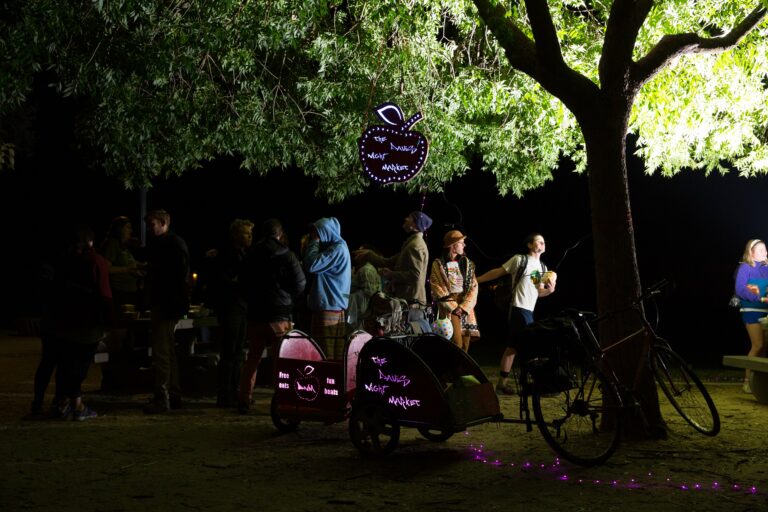
The Davis Night Market shares food with the community every weekday in Central Park 


Founded in May 2019, the Davis Night Market is an operation powered by the community, for the community. Volunteers gather at C and Fourth Streets in downtown Davis from 9-11 p.m. each weeknight to share food with the public. 

Volunteer Emmet Stephenson, a fourth-year global disease biology major, said the organization focuses on helping those who need food through a mutual-aid process.

“One big thing about Night Market is we are trying to destigmatize getting food,” Stephenson said. “So we aren’t a food bank. We aren’t trying to hand food out. We are all sharing it as a community, which is very akin to the principle of mutual aid, where we are all helping each other.”

Each evening, volunteers pick up food from local businesses that are willing to help and have a surplus of food. 

 “One of our big goals is to reduce food waste,” Stephenson said. “So everything we serve at Night Market is stuff that is going to go to the trash otherwise. It’s perfectly good food, so that’s why we go by restaurants as they are closing at the end of the day and we pick up the stuff that they don’t sell.”

According to the Night Market website, some partners include Sophia’s Thai Kitchen, Panera Bread, Village Bakery and Noah’s Bagels. It has also partnered with the ASUCD Pantry on campus and occasionally receives food from residence halls’ dining commons. 

“I describe the Night Market as the vulture of the food system — I say that in the best way possible,” volunteer Max Morgan said. “If someone needs a way to move food, they will let us know and the way we move food is creating this warm, welcoming environment that makes people want to come.”

Donated food is sometimes dropped off, but most often, volunteers pick up items by bike or car, bring them back to an area of tables in Central Park and lay them out for anyone to take, according to third-year biotechnology major and volunteer Ian Matthews.

“I think there’s a misconception,” Matthews said. “When I say we hand out free food, people are like, ‘Oh, you’re giving it purely to homeless people.’ Nope. It’s [for] the unhoused, but it’s also definitely [for] students or people in the area.”

At the end of each evening, leftovers are placed in Freedges across town, which provides people even more opportunities to access free food and the Night Market an additional way to reduce food waste.

Another key theme of the market is social interaction. The market was founded on the principles of helping people by providing them with the opportunity to receive food without judgment and engage in real human connection. 

“The basic idea was, as much as food insecurity is a food problem, one of the more fundamental problems is the stigma around food insecurity,” Morgan said. “So anything we can do to try to create this warm, welcoming atmosphere will help people who are maybe too afraid to go to other places to come here.”

Stephenson said that after the COVID-19 pandemic, interaction with the community is more important than ever, and the desire for that connection is what led him to join the Market.

“I wanted to get involved in that community because we had just been only meeting people through computers for two years,” Stephenson said, “And I was like, ‘I want to get involved in the community — plug into [the] Davis-specific community.’” 

Matthews said that in his time with the Market, he’s picked up and dispersed food but also just shared in conversation with attendees.

“You just kind of end up talking to community members who need to talk to someone,” Matthews said. “You become the community’s listening ear.”

The ideals of friendliness and community-building extend to the organizational structure of the Market as well, as it is self-described as “non-hierarchical.” Every volunteer helps in different ways, but there are no distinct roles. Moreover, volunteers are also invited to share in food, according to Morgan. 

“A lot of the people who volunteer here are also food insecure, but the beauty of our system is they don’t have to ‘out’ themselves as food insecure,” Morgan said. “Everyone is encouraged to take food for that reason, too.”

The Market has grown from one day a week to five days a week and is still in need of volunteers. 

“As a relatively non-hierarchical organization, you have to be pretty autonomous to be successful,” Morgan said. “So we aren’t going to go completely after you to help out, but anyone who comes, we love that.” 

As a long-time volunteer, Morgan has witnessed the Market change, especially after the community was affected by recent violent crimes

“The Compassion Guy, David, came here almost every night,” Morgan said. “So there are several volunteers who are still spooked out to even do distribution again.”

However, Stephenson said that the Night Market has become a place for community members to lean on each other in difficult times.

“We’ve been through a lot here in Davis recently, and the truth of the matter is a lot of our community members have been going through a lot before we noticed,” Stephenson said. “There’s been more attention drawn to the unhoused community because of the serial killings, but they have always had to deal with police raids and food insecurity. While we are not a food bank, we recognize there are a lot of community members who are not seen, and we want to see them and bring them into [the] community.”

For more information about how to get involved in Night Market, you can join its Discord server or follow the group on Facebook or Instagram @davisnightmarket

By MIA BALTIERRA — features@theaggie.org

Study researching lung cancer in non-smoking Asian American females expands to Sacramento

The expansion enables greater inclusivity and opportunity to uncover the mystery behind the disease disparity in this population


By LILLY ACKERMAN — science@theaggie.org 


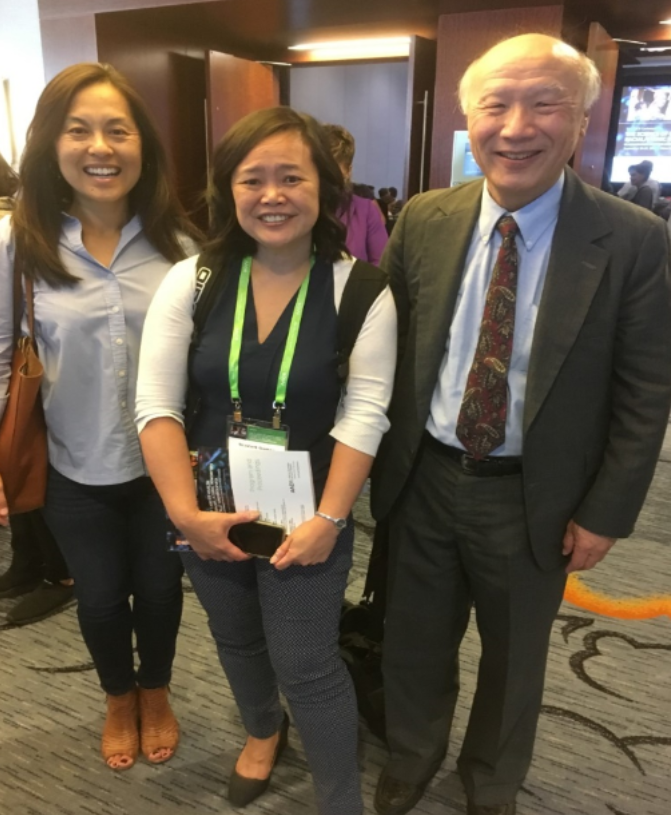
The Female Asian Never Smoker (FANS) study, led by researchers at UC Davis, UC San Francisco and Stanford University, is expanding from the Bay Area to Sacramento. The study is ongoing and looks to determine factors that contribute to lung cancer in Asian American females who have never smoked. 

The researchers are looking to raise awareness about the burden of lung cancer for Asian American females who have never smoked and encourage volunteers to participate to help understand this complex issue. 

Moon Chen Jr., one of the study’s principal investigators and the associate director for community outreach and engagement at the UC Davis Comprehensive Cancer Center, said that the most prominent cancer disparity for Asian Americans is lung cancer among females with no smoking history. 

A recent study found that 57% of Asian American females with lung cancer have never smoked — compared to an average of around 15% for all other females with lung cancer. 

“Lung cancer typically is associated with smoking, but for Asian American women, never smoking is the predominant mode,” Chen said. “In fact, the majority of lung cancer cases among Asian Americans are among never-smoking Asian women.”

Chen noted that not only is it unusual that more non-smoking Asian American females are getting lung cancer than those who do smoke, but also that Asian Americans in general are the top U.S. demographic group to experience more predisposed to cancer as the leading cause of death as opposed to heart disease.

The FANS study, funded by the National Institutes of Health, is the first and largest study comparing cases of lung cancer in Asian American females who have never smoked with a control population made up of other Asian American females in similar age ranges who don’t have cancer. The study uses questionnaire data, saliva and blood testing from participants.

Iona Cheng, a principal investigator for the study and professor of epidemiology and biostatistics at UCSF, said that previous work in understanding this cancer has used studies from Asia. The FANS study is an opportunity to look at Asian American females specifically to better understand the disease burdening this demographic. 

“This will be the first study conducted in the U.S. of Asian American females, and that is really a unique opportunity for us to evaluate those risk factors that we learned from our studies in Asia,” Cheng said. “[We are] able to investigate them here among Asian American populations, and also identify other risk factors that we think could be candidates to place Asian American women at a higher risk of disease.”

Scarlett Lin Gomez, a principal investigator and professor of epidemiology and biostatistics at UCSF, noted that expanding into the Sacramento area will allow the study to be more inclusive of the variety of ethnicities that make up the Asian American population in California.

“I think that the expansion really provides an important opportunity to be more inclusive of Asian American populations who live in different parts of California,” Gomez said. “We know that the composition of the Asian American population is different in the Bay Area than it is in the Sacramento area.”

Ultimately, the researchers hope to understand what factors lead to this high rate of cancer in Asian American females, and expansion into Sacramento will help enable the study to reach more participants and raise further awareness of this disparity. 

“I’m thrilled because it gives us an opportunity to expand and reap the benefits of this in our population,” Chen said. “It means that we are able to contribute to the knowledge base of what’s involved in understanding this disease.”

The researchers are encouraging all eligible females to volunteer as participants, which will help contribute to the understanding of the enigmatic and devastating burden of lung cancer among never-smoking Asian American females. 


Written by: Lilly Ackerman — science@theaggie.org

In defense of AI art

AI has always been discussed as a far-off future concept, but it’s quickly becoming a part of our reality


By GEETIKA MAHAJAN — giamahajan@ucdavis.edu


For a long time, artificial intelligence (AI) was a nebulous concept reserved for science-fiction authors and futurists to ponder over. This all changed when ChatGPT, an online AI chatbot, was introduced to the global public at the end of 2022. Since then, discussions of artificial intelligence and the implications of using such programs have increased exponentially as our access to it has grown. 

Chatbots are not the only AI seeing vast advances — AI art generators have also been rapidly gaining exposure. Already, AI art is being distributed commercially. In a move that has enraged readers, the newest edition of popular young-adult author Sarah J. Maas’s “House of Earth and Blood” features an AI-generated image on the cover. Many fans of the series claimed that they would not purchase the new edition, citing a “need to protect artists.” This begs the question: protect them from what, exactly? 

I believe that there is nothing inherently wrong with AI art; the only thing AI does is create something that is derivative of the thousands of pieces of work that already exist. Similar to existing work, however, does not mean unoriginal — in fact, most prominent artists, if not all, are influenced by their contemporaries in some way. There is also an argument that AI art is not “real art”; these claims are often presented without any metric for what constitutes “real art” and what is “fake art.” Artificial intelligence systems are not just spontaneously generating these works of art or literature. Creating something that is not generic or uninspired requires specific and personalized input from the user. It is true that the end result is produced by a “machine” — but so are photographs and films, and nobody denies creative photographers or filmmakers their right to be included in the art world. 

One of the biggest fears surrounding AI is that it will steal jobs from actual creatives in film, literature and art. However, if jobs are lost because of AI’s increasing ubiquity, it will not be due to the AIs themselves, but because corporations have chosen to replace the available source of labor with a cheaper form of production. This is not a new phenomenon — the same thing happened when companies began to outsource labor abroad or replace assembly lines with machines. Critiques regarding the implications of AI-generated art and writing are, inherently, a critique of capitalism and corporations’ relentless “race-to-the-bottom.” Artificial intelligence is just their newest tool. 

Broadly categorizing all AI as bad just because of one of its potential consequences is already negatively impacting how the population perceives it. There is an assumption that robots are going to start writing screenplays and making paintings sometime in the future — but this disregards the very real benefits that artificial intelligence can provide right now. It is unique in its ability to provide assistance to people in a variety of career fields, from writing rudimentary lines of code to being able to edit essays or papers. Tech companies have already begun to take advantage of this to prevent burnout amongst their employees, allocating administrative work or automating data collection, for instance. Even creatives can take advantage of this — for instance, using AI-generated images as backgrounds. 

Artificial intelligence, like all technology, is not inherently evil. Currently, the entertainment industry is mainly concerned with its negative implications. It’s true that artificial intelligence will change our reality and how we interact with it — but this is true of all technological advancements. The current attitude towards artificial intelligence is no different from how computers or smartphones were viewed when they first came out; we fear new technology, simply because it’s new and unknown. We can see how much easier life became after letters that could take weeks to deliver turned into emails and emails turned into Facetime calls; artificial intelligence, too, is just the newest development in a centuries-long saga.


Written By: Geetika Mahajan — giamahajan@ucdavis.edu

Disclaimer: The views and opinions expressed by individual columnists belong to the columnists alone and do not necessarily indicate the views and opinions held by The California Aggie.

‘They’re trying to erase a segment of our community’: Controversial book curation event causes Davis community to clash

Child safeguarding initiative by local anti-trans activists attempts to remove books about gender and sexuality from schools and public libraries 


By ZOE SMITH — city@theaggie.org


Content Warning: This article contains discussions of transphobia.


On May 21, a local group called the Yolo County Moms for Liberty hosted a “child safeguarding meeting” at Mary L. Stephens Davis Branch Library. The meeting was open to the public and was advertised as a discussion about what books are age appropriate for children to have public access to.  

All of the books discussed had to do with gender identity, sexuality and mental illness. Some of the titles include “ABC’s of Gender Ideology,” “Introducing Teddy, “What Are Your Words?,” “If You’re a Kid Like Gavin,” “This Book is Gay,” “Too Bright to See,” “Flamer,” “Let’s Talk About It” and “Thirteen Reasons Why.” All of these books can be currently found at the Davis Yolo County Library, or various Davis Joint Unified School District (DJUSD) libraries.

One concerned parent, Catie Hembrow, attended the event and spoke out against the group’s advocacy. 

“I trust that the librarians and the administrators at the school are putting material out that is age appropriate for our kids,” Hembrow said. “I think what [Yolo County Moms for Liberty] want is censorship. I think what they want to do is be comfortable. And the presence of trans people in our community particularly is discomforting for them. I feel like they’re trying to erase a segment of our community.”

Allie Snyder was one of the parents who organized the event. Snyder has been a vocal member at school board meetings over the last year and has been involved in advocating for “detransitioning,” which is the belief that trans individuals should stop or reverse gender transition.

“We really wanted to have a community discussion and explore some of the books that are offered to our children in our school libraries, and evaluate whether or not as a community we thought that these books were appropriate,” Snyder said. 

Snyder disagrees with calling the safeguarding project “book banning” and prefers the term “curation.”

“Curation is organizing and maintaining a collection of books, so librarians get to make a determination on what books they will carry in their library,” Snyder said. “Playboy is not offered in any of our school or county libraries. That’s a decision on the part of the librarians. Playboy is not banned […] book banning is more a question of a publisher, no longer offering a book. I believe that that’s the distinction.”

Attendees of the meeting were initially encouraged to ask questions to foster a group discussion. However, throughout the meeting, attendees began to shout over one another to ask questions and give answers. Three women hosted the event and about 25 community members attended.

Adrian Beth is another Davis resident in attendance who was not in support of the project. 

“I heard about the event from a friend and I know this has been a much bigger issue around the country and it’s been pretty concerning as a queer person to see,” Beth said. “I was very interested in hearing what their reasoning was and maybe, hopefully, trying to help provide perspective as someone who could have really used a lot of material like this as a child that would have helped me understand a lot more about myself.”

Snyder is not the only parent who is concerned about when and how topics of sexuality and gender identity are being discussed with children in the community. There is a group of parents in Davis advocating for these views. Some are members of Yolo County Moms for Liberty, which has nearly 200 members in its Facebook group, while others are members of Our Duty. Snyder believes that what these groups are advocating for isn’t political.

“There’s nothing political about saying it’s wrong to convince children that they might possibly have been born in the wrong body and should take drugs and surgeries that will sterilize them and render them medical patients for life,” Snyder said. “There’s nothing political about saying it’s wrong to sterilize and mutilate children.”

Beth shared a different perspective.

“I think maybe they were really underestimating what kids can be going through and how important it is to have conversations with kids who might be having some really terrible thoughts and just struggling a lot,” Beth said.


Written by: Zoe Smith city@theaggie.org

A long-winded love letter to stories

That’s all she wrote (not actually I’ve just always wanted to say that)


By KATIE DEBENEDETTI


At some point, someone has probably lied to you and told you that if you do what you love, you’ll never work a day in your life. This definitely isn’t true. But I will admit, I have spent the last four years telling everyone I talk to that I would work for The Aggie for free. That probably is true. Because as cliché as it sounds, doing work that’s really a hobby, with coworkers who are more like friends, in a place that has come to feel like home, is pretty ideal. 

At my high school graduation, my mom gave me a piece of advice in the form of her favorite quote, which reads: “Fall in Love, stay in love, and it will decide everything.” And while I can’t say I agree with her use of the Oxford comma, I do wholeheartedly agree with the sentiment of the message.

Over the past four years, I’ve fallen in love with The Aggie — its publication, its people, and, yes, its free parking spot (thank you A Street office). While I’m not sure this is exactly what the quote — or my mom — meant, I can say that my Aggie experience truly has decided everything. 

Through covering local events and stories, I’ve seen parts of Davis’s city and campus I never would have ventured to, like the STEM facilities and the ARC. On managing staff, I’ve met some of the best friends I could have asked for, like Sophie, my partner in crime, Anjini and Margo, the dynamic duo that set a great example for us, and two amazingly curious, funny and kind Editorial Boards. 

While sending Slack messages and Doodle Polls definitely does feel like work, spending upwards of five hours a week at Ed Board deciding what contexts we should use “where” in and whether “which” is a better-fitting transition never does. I feel so grateful for getting to serve on the Editorial Board for the past two years, and can honestly say that I don’t think there’s ever been a meeting I’ve dreaded going to or left feeling unhappy. And while I am certainly going to miss long days in the office, even when there’s no working light and the alarm system we don’t have is beeping every 10 seconds, I know that The Aggie is in very capable hands. 

I also know that even though I won’t get to write for The Aggie for much longer, I’ll stay in love with what it has given me long after I graduate. Let me explain. My favorite part of journalism is getting to hear and tell stories about what people love, what makes them tick so to speak. Whether it’s climate activism or tea, stand-up comedy or bike repairs, when someone is really passionate about a thing, it shows, and it allows the rest of us to understand that thing, and maybe more importantly, that person, in a different way. 

For a while, I think I thought about writing for The Aggie as the way I would find my thing. Like, one day, I would be writing a story and hear about an on-campus club or someone’s super niche major (like my amazing Freshman year roommate who literally studied global diseases during the whole pandemic) and decide, ‘here it is!’” But as time went on, no matter how much I enjoyed learning from my sources and listening to their stories, that moment never came.

I’m a bit embarrassed to say, it wasn’t until earlier this year when I took an introductory fiction writing class that I really realized that storytelling was that thing for me — and that I had said ‘this is it’ a looooong time ago. When I wandered down to the basement of Lower Freeborn on my first Friday of college ever, desperately looking for something to be a part of on a huge campus — and for the office where my interview was, because Lower Freeborn is a maze I’m still not sure I can navigate — I was asked to write a fake news story about the new prices of Unitrans bus fares. This probably sounds like the most boring assignment ever, but I loved it. 

Since then, I’ve gotten to tell some objectively more exciting stories — like those of teachers navigating online and hybrid learning during the pandemic, the all-female Friday crew at the Bike Barn and a group of researchers and study participants involved in a a first-of-its-kind male contraceptive trial — but  I’ll always remember writing about that $0.10 increase of the L line fare (which is thankfully entirely fictional by the way). 

I’m known for being long-winded, so I think it’s best if I end this column before it gets completely off course, but not before a few final thanks. Thank you, The Aggie, for all of the boring and exciting stories, the amazing friendships and all of the experiences along the way. Even though my time writing and editing these stories might be done, I always said I would do this work for free, so be careful Sonora, you might catch me lurking in Google Drive for years to come. 


Written by: Katie DeBenedetti 


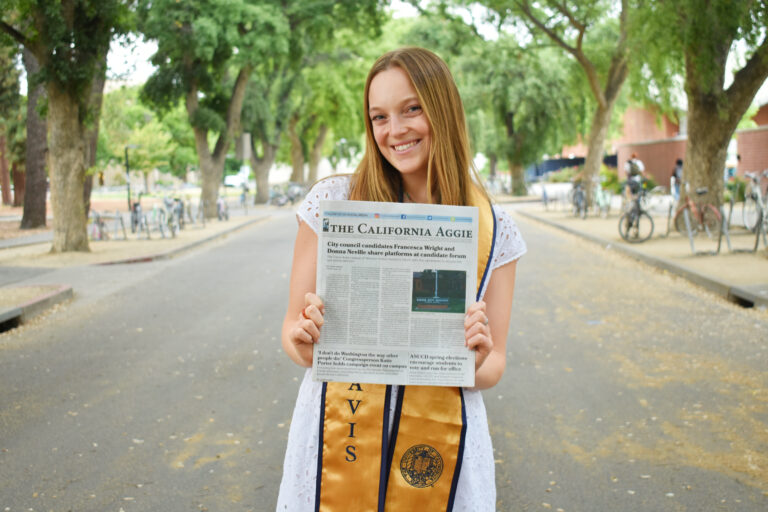
Katie DeBenedetti is The California Aggie’s current managing editor. She joined The Aggie in September 2019 as a features staff writer and took on the role of assistant features editor in the spring of 2021. In June of 2021, she joined the Editorial Board as the features editor. She became the managing editor in June 2022. She is graduating with honors with a bachelor’s degree in political science and a double minor in environmental policy analysis and planning and professional writing.

The path meant for you is not without its challenges

A guide to the lessons my unexpected college journey taught me


By JADE BELL 


I couldn’t do it anymore. I stared at the screen full of computer science word problems in agony. This would be the third time I cried this week. I researched on forums; I spent hours being tutored. Nothing assuaged the pit in my stomach, never mind helped my GPA. I was stuck and tired of it.

That was during my junior year of college when I was declared as an astrophysics major. It was a time when many life lessons about what it means to listen to your gut became most clear — and I hope they can be of help to anyone reading this today.

So, here are a couple of lessons I’ve learned as a soon-to-be college grad:


It’s Never Too Late To Change Your Mind

I think it’s drilled into us as students to always get the “right” answer. Sure, this can be helpful and necessary in fields like mathematics or science, but even then, trial and error is a must. Having this way of thinking made me paralyzed and unsure of myself that I missed out on doing things I loved, like writing. I stayed in my STEM major for three years, but I could not ignore the call within.

I made the decision then to change my major to English to see what happened. It’s one of the best decisions I’ve made in my life so far. I was forced to reconnect with my younger self, a five-year-old me who enjoyed scribbling on her Winnie the Pooh notepad.

Not only did my grades improve dramatically, but my spirit did too. I felt so happy and passionate about my classes. I’ve learned a variety of interesting literary topics from studying the works of Stephen Sondheim to learning about the historical significance of common themes like the “marriage plot” in 19th-and-20th-century literature.

I was on a roll. In the summer before my fifth year of college, I took another leap of faith — I applied to be a staff writer for The California Aggie. I only had so much time left before my college career ended, so I decided it was time to jump in and keep going toward what made me feel excited. I went through the application and interview process, and I remember saying that just being able to explore my love for writing in some capacity would make me happy. I received an offer for the volunteer staff position that May, about a year ago today.


The Path Meant for You Is Not Without Its Challenges

I’ve learned that once you accept your path, certain expectations must be let go of. Changing from a physics major to an English major meant that it took me five years to graduate instead of four. I had to grieve the fact that I would no longer be graduating from my original class. 

In addition, since I was on academic probation for a couple of quarters, I could not officially declare a new major until my academic standing was up-to-par. So before making the official major switch, I had to take a chance and enroll in English courses and hope that I liked them. 

I’m grateful that my path took some unconventional turns because it helped me to appreciate the entirety of my college experience and learn some life lessons along the way. I have made many friends and connections who have helped support me in this process, along with my family members. It all turned out fine in the end.


For the Next Chapter…

I encourage all of you — freshmen and upperclassmen alike — to keep trying new things. Your perspective will continue to change and you’ll get a better idea of who you are and who you want to become. With that, I say goodbye and good luck!


From a fellow senior (now alum),

Jade Bell


Jade Bell is a staff writer for The California Aggie. She joined The Aggie in June 2022, as a volunteer staff writer, went on a brief hiatus to focus solely on academics, and returned to write as a staff writer on the campus news desk in March 2023. She is graduating with a bachelor’s degree in English.


Written by: Jade Bell

The gift of storytelling and the power of words

 La lengua no tiene hueso, pero corta lo más grueso


By DANIELA DULA MEJIA — features@theaggie.org


When I was younger, my mom would tell me cuentos (fairy tales) to help me fall asleep. My family is from Honduras in Central America, and my mom’s stories always centered around our homeland. 

It felt like I was being transported to another world when she told me her stories. I loved to hear them growing up because they made me feel connected to my culture and my family. 

When I transferred from community college to UC Davis in 2020, I did not expect that I would become a storyteller myself. In all honesty, I aspired to be a lawyer, a professional truth seeker, not a writer. 

During what I thought would be my last quarter at Davis, I took an American political thought class as part of my major coursework. I was also questioning what I wanted to do with my life after college and if law school was my path. In that class, we read works from historical figures all throughout American history, but most importantly, we read from contemporary author James Baldwin. 

Baldwin was a Black gay author from the civil rights era. He had this way of writing that transported me into his world and made me see things through his lens, just like my mom’s stories did when I was a kid. I was so inspired by his style of writing. 

Reading Baldwin’s work made me realize that writing was something I wanted to do. I didn’t know how I was going to start writing or even what I would write, but I decided that I was going to stay another year to figure it out. 

A year after taking that class, I am just starting to figure it out. Working at The California Aggie has been one of the most rewarding experiences I’ve had at Davis. I realize that I am not super great about keeping up with deadlines (sorry Levi for being chronically late), but with each article, I get a little bit better. I learned through a lot of trial and error the best and worst ways to do an interview. Most importantly, I was given an opportunity to do something that I love, which is storytelling. 

In many ways, journalism is a form of truth seeking. We have a moral obligation to report facts, but also to tell a story. 

My mom and James Baldwin might not have a lot in common, but they both inspired me to also take my readers on a literary journey. Just as they connected me to their worlds through their stories, I have had the honor to do the same for readers in Davis. 

The stories I have been able to report on have been life-changing experiences. I had the chance to meet civil rights activists like Bobby Seale and report on anti-fascism in Davis (in the face of actual fascists) and the mental health crisis occurring throughout the UC system.

While my time is coming to an end at UC Davis, I leave with a sense of fulfillment that I would not have otherwise had if I did not work at The Aggie. Thank you to the Davis community for your kindness and support these past years and for sharing your stories with me.


Daniela Dula Mejia joined the features desk as a staff writer in February 2023. She is graduating with a bachelor’s degree in political science — public service. 


Written by: Daniela Dula Mejia — features@theaggie.org 


A Farewell to The Aggie but not to photography

My eyes have snapped the best photos


By KAYLA BRUCKMAN


Although I write countless essays as a sociology major, this column was embarrassingly hard to start. My time at The Aggie has consisted of 98% picture taking and about 2% caption writing. In other words, this is my small writing debut for The California Aggie! 

I remember back in 2019 as a freshman being told over and over that I needed to join The California Aggie because of my love for photojournalism. Well, instead I joined a sorority and got a tad busy — good busy though! Then COVID-19 hit and I felt especially lost and disassociated with my college. It was not until 2021, during my junior year, that I realized my time at Davis was not as gratifying as it could be. Although nothing could have prepared me or any of us for the terrible effect the pandemic had on undergraduate life, I realized I needed to be involved in Davis the same way I was during high school. 

At my high school, I thrived in yearbook throughout all four years. I began as a photographer, moved to photography director and then took on the role of Editor-in-Chief. My experience brought me closer to the students, faculty and campus as a whole. Davis is nevertheless an even bigger and more daunting university that I felt compelled to explore. I wanted to feel the satisfaction of taking pictures again and insert myself into corners of campus that I would never have stepped on.

The two years I spent at The California Aggie were everything and more. I met kind and brilliant peers who inspired me greatly. I got to lead a team of talented photographers whose pictures were so good I questioned my position sometimes. With all that said, The California Aggie patched the hole that I needed fixed in order to find true fulfillment in my college experience. 

I can now leave UC Davis knowing that I have left a small but gratifying mark on campus. As the photo director for The California Aggie, I realized that cameras can only capture so much. No matter how many phone and camera pictures I have, the memories and emotions will never fully be realized in the photos. In other words, I have learned to put my camera down at times, embrace the beauty away from the lens, and watch as the world unfolds around me. Life should not be lived by watching it solely through a camera lens. 

So my one word of advice is to go to that concert, fly to Hawaii and graduate from UC Davis, but only take a few special pictures or videos. Your eyes will be your best lens and capture the power of life, as well as true memories, so use them! As I enter the real world, I will carry myself high and embrace all the leadership skills and knowledge that The California Aggie and UC Davis have taught me. 


Kayla Bruckman is The California Aggie’s current photo director. She joined The Aggie in October 2021 as a photographer. The following year, she joined the managing staff as the photo director in June 2022. She is graduating with honors with a bachelor’s degree in sociology and a minor in human development.