55.7 F
Davis

Davis, California

Tuesday, December 23, 2025
Home Blog Page 162

International study on Duchenne muscular dystrophy allows for future research opportunities

 The study analyzes disease progression to provide a foundation for new treatments


By KATIE HELLMAN — science@theaggie.org 


The UC Davis Health Department of Physical Medicine and Rehabilitation is launching an international study on the history of Duchenne muscular dystrophy (DMD) in collaboration with the Cooperative International Neuromuscular Research Group (CINRG) and the Therapeutic Research in Neuromuscular Disorder Solutions

DMD is an inherited disorder that primarily affects males and is characterized by progressive muscle weakness. It presents itself at birth and can affect heart, lung and bone health.

The Duchenne Natural History Study aims to collect information from clinics around the world on the progression of DMD in people of different ages. The data will be used to conduct further research into new treatment options.

Erik K. Henricson, the co-principal investigator on the study and an associate professor in the Department of Physical Medicine and Rehabilitation, commented on the goals of the study.

“[We’re] not just looking at the rates of loss of strength of a specific muscle group but how that contributes to overall mobility,” Henricson said. “And using statistical techniques, [we’re looking at] what we can do to develop predictive models or get information from a patient today to predict where we think they’re going to be disease-progress wise two to four years from now. Not everybody progresses at the same rate; the trajectories can be different enough that the milestones we tend to see, such as the loss of ability to perform certain functions, can occur at different times.”

The project builds upon a previous study by UC Davis scientists and CINRG collaborators. The study, which ran from 2003 to 2016, included 20 institutions from nine countries and consisted of 440 families. Changes in physical abilities, the severity of health issues and the ways in which patients utilized healthcare services were analyzed throughout the duration of the study. 

That study aimed to “longitudinally assess body function and body structure (impairment) through the measurement of anthropometrics, muscle strength and pulmonary function” and to “assess participation, life satisfaction, service utilization and health-related quality of life in subjects with DMD.”

Craig M. McDonald, the co-principal investigator of the 2003-2016 study and a professor in and chair of the Department of Physical Medicine and Rehabilitation, commented on his work regarding DMD research in an article by Newswise.

“It is incredibly rewarding as a physician scientist to generate natural history data and develop novel clinical endpoints used in clinical trials, and I have been excited to be able to offer my patients precision therapeutics that target the underlying causes of neuromuscular diseases and modifying the course of these complex multisystem diseases,” McDonald said.

Researchers also discovered biomarkers associated with disease progression. These findings led them to identify how common genetic variations could alter patterns and rates of DMD progression, which can be used to develop methods to prevent DMD from occurring.

“There are a number of really cool new technologies out there that are capable of causing the body to skip over mutated parts of the genes, often called exon skipping,” Henricson said. “As a result, you often get a shorter but mostly functional dystrophin protein, which actually helps to create stronger muscle cells and to reduce the impact of the disease.”


Written by: Katie Hellman — science@theaggie.org

Are colonies still owed reparations?

The era of colonialism is technically over, but this doesn’t mean that past imperialist nations can forget that it happened


By GEETIKA MAHAJAN — giamahajan@ucdavis.edu


I didn’t officially “learn” about European colonialism in school until 10th grade. I had heard about, or history books had mentioned in passing, countries in the East or in Africa that had fallen under Europe’s sphere of influence — but that was the extent of my knowledge until I reached high school. When I think about this now, it seems ridiculous; colonialism is so deeply entrenched in the history of many European nations and the U.S. and still has ramifications that persist in the modern day. It seems that many nations in the West are attempting to bury their colonial history rather than taking accountability for it. However, rather than allowing these nations to get away with denying their pasts, people need to be made increasingly aware of the crimes committed toward colonized nations. The imperial empires must provide some sort of reparation.

The history of colonialism has been an ongoing detriment to the nations that were colonized, and on the flip side, those who reaped benefits from colonization are still benefitting today. India, for example, has had almost $43 trillion worth of artifacts stolen. While the nation was forced to reckon with this loss while rebuilding after the end of the British Raj, the British government has many of these artifacts displayed in for-profit museums still today. 

This may be the most obvious example — imperialist governments displaying stolen items in museums — as if these artifacts should be the original owners’ to display and make money off of. However, there are other ways in which these governments have disenfranchised those who live in the previously colonized territory; oftentimes, the rule of colonizers draws sharper lines between groups of people in a nation, negatively affecting the politics and attitudes in the land the colonizers left. The most obvious example of this is the Rwandan genocide, which resulted in the deaths of around 500,000–660,000 Tutsi people, because of distinctions and division exacerbated by the previous German colonizers. 

The legacy of colonialism is still being fully realized; it is not a thing of the past, despite how desperately past colonizers may wish to frame it as such. With this in mind, it should seem obvious that past colonies are owed reparations — the only question is what form these reparations should take. For example, dumping a large sum of money on a newly formed democracy is a recipe for fraud, corruption and overall inefficiency. 

Further, reparation is not just restorative — it also functions as a gesture of apology and of recognition that a crime was committed. As such, the actions should not only aid the newly formed governments but should also symbolize that the governments truly recognize how they have disenfranchised such nations. 

First, there should be a dedicated curriculum in schools in the previous empires to ensure that the history of colonialism is not forgotten, benumbed or framed as a necessary evil. Additionally, all relics stolen during colonialism must be returned to their nation of origin. Both of these actions demonstrate an acknowledgment of the wrong, and an unwillingness to hide behind the years that have passed since they actually left the colonized land. Finally, rather than paying the governments of past colonial lands, efforts should be made to provide infrastructural support to these burgeoning nations. This could come in the form of support in building and maintaining hospitals, schools or government structures. 

Colonialism may seem like an event that began and ended in the past — but if one observes the nations that were colonizers or colonized, it’s clear that its effects are ongoing. It should naturally follow that the past imperial nations pay reparations for the crimes that were committed and for the negative consequences that still result from colonialism. These reparations should not merely be a monetary donation, but a genuine gesture and acceptance of responsibility. Without this, we run the risk of colonialism being forgotten — or perhaps even doomed to be repeated again. 


Written by: Geetika Mahajan — giamahajan@ucdavis.edu


Disclaimer: The views and opinions expressed by individual columnists belong to the columnists alone and do not necessarily indicate the views and opinions held by The California Aggie.


Local politics matter a lot, actually

With an upcoming city council election and other important projects in the city, the Editorial Board encourages you to pay attention to local politics


By THE EDITORIAL BOARD


With constant and overwhelming exposure to national news through social media and the 24-hour news cycle, it can be difficult to pay attention to everything happening in the U.S. — let alone local politics. The majority of young adults aren’t confident in the future of the U.S., and it can feel impossible to influence policy, but getting involved in local politics can be a way to make a valuable difference in your community. While local elections might not be as publicized as national ones, they are often just as important, if not more important, to making change.

Many policies that affect people’s day-to-day lives are decided on the local level, whether by city council, school boards or the county. For example, the city council is responsible for maintaining roads, approving city budgets and appointing advisory boards. 

City councils can also address broader issues. The city of Davis is currently working on projects to address the housing crisis, combat climate change and support artists and activists, among others.

One such project particularly relevant to students is a plan to repurpose the University Mall. Many residents and students originally hoped the space would be used to provide new housing, but the Davis Planning Commission has approved a plan to convert it into retail space. Councilmember Bapu Vaitla appealed to the council to integrate more housing into the new development plan, but the council rejected the appeal in favor of the retail-only plan. For students struggling to find affordable housing in Davis, electing city councilmembers who prioritize increased housing is a concrete way to have an impact on the issue.

The city has also been taking steps to address climate change through its Climate Action and Adaptation Plan (CAAP). CAAP is the city’s model for reaching carbon neutrality by the year 2040; however, it’s up to concerned citizens to ensure that the city abides by its goals and that councilmembers vote in accordance with the document. Civic engagement in city council is essential if you want plans like CAAP to be more than just a page on their website.

If you feel strongly about any issue the council is discussing, you can, and should, do something about it. Davis City Council meetings are open to the public. Most council meetings are held on the first and third Tuesdays of the month, and during meetings, there is scheduled time for public comments to voice your concerns. If you can’t make it to a scheduled meeting, there is also an option to send an email to CityCouncilMembers@cityofdavis.org with written comments, or call and leave a voicemail to (530) 757-5693 prior to meetings.

Another important way to make a difference in local politics is to vote, or encouraging others to vote. There is an upcoming important special election for Davis City Council District 3 that deserves your attention. This vote-by-mail election takes place on May 2 and will determine the fifth seat on the city council. Both candidates, Donna Neville and Francesca Wright, have prioritized addressing the housing and climate crisis, among other issues.

If you are passionate about a particular candidate, we encourage you not only to vote, but to get involved and volunteer — which you can do on Neville’s and Wright’s websites.

If you are a student registered to vote in your hometown and are hesitant to change that, that’s okay too. However, we encourage you to at least consider registering to vote in your college town. College students make up a large portion of the city of Davis’s population and it’s important to make our voices heard. All you need to do is re-register to vote and enter your college address instead of your home address.

Regardless of whether or not you decide to change your voter registration to the city of Davis, you can impact student life by voting in ASUCD elections, like in the upcoming spring election that will take place from April 24-28. The Senate oversees essential student services like Unitrans, The Pantry and even The California Aggie. During the election, undergraduate students will vote on candidates for Senate, president and vice president, and measures like The Green Initiative Fund fee referendum, which currently provides financial resources to sustainable organizations and projects run by UC Davis undergraduate students. 

As spring ASUCD and city elections approach, we encourage you to take the time to learn about candidates and ballot measures and take advantage of the opportunity to influence local issues by voting.


Written By: The Editorial Board

Aggies lose back-and-forth game against the Titans

UC Davis’s baseball team lost game two of three-game series against CSU Fullerton


By PATRICK FIGUEROA — sports@theaggie.org


On Saturday, March 25, the Aggies faced off against the CSU Fullerton Titans in game two of a three-game series. This marked the second series of conference play — conference play began the week before when the Aggies played against the CSUN Matadors. Coming off of an 11-2 loss the day before, the Aggies looked to rebound and even the series. 

The Aggies’ starting pitcher was second-year left-hander Bryan Green. Entering the game, Green had a respectable 3.54 earned run average (ERA). He faced off against Fullerton redshirt third-year right-handed pitcher Trevor Hinkel. Hinkel had a less stellar 9.25 ERA, but he did not let prior poor performance affect his performance on this day. 

In Green’s first time through the batting order, he only allowed one baserunner — a walk to Titans first-year infielder Eli Lopez in the top of the third inning. Through three innings, Green struck out two batters and forced weak contact that allowed his defense to make routine plays. Hinkel struck out two batters as well with some help from second-year center fielder Moises Guzman. Guzman made two incredible catches on deep fly balls that would have likely been extra base hits in the first and third innings. 

Green continued his strong outing in the fourth and fifth innings as his defense made spectacular plays along the way. To get the first out of the fourth inning, Aggies’ third-year second baseman Alex Gouveia made an impressive throw on the run to first base. In the fifth inning, the Aggies’ third-year catcher Jack Gallagher threw out Titans’ third-year Brendan Bobo as he tried to steal second base. Through five innings, Green did not give up a single hit. 

 After four scoreless innings, the Aggies’ offense woke up in the bottom of the fifth inning. To start the inning, first-year Braydon Wooldridge got on first base with help from a Titans’ fielding error. Then, second-year Nick Leehey hit a double that allowed Wooldridge to advance to third base. With runners on both second and third bases, second-year Mark Wolbert smacked a single to center field that scored both runners. The Aggies took a 2-0 lead. 

 Fullerton responded in the top of the sixth inning. After two runners got on first and second bases, Titans’ third-year Nate Nankil hit a double that allowed one runner to score and the other to advance to third. Titans’ fourth-year Carter Wright drove in another run on a fielder’s choice, tying the game. 

Shortly after, the Titans had two outs but runners on first and second bases in the sixth inning. The Aggies substituted Green for redshirt third-year pitcher Kaden Hogan. The Titans’ Moises Guzman hit a single to center field that scored one run. However, as the Aggies tried to throw a runner out at third base, the ball went past the third baseman, third-year Nick Iverson, and, thus, allowed Fullerton to score another run. Hogan struck out the final batter, but the damage was done. The Aggies trailed 4-2. 

Replacing Hinkel, Titans’ fourth-year pitcher Fynn Chester entered the game in the bottom of the sixth inning. He did not allow a hit in the inning and the Aggies’ pitcher Kaden Hogan did the same through the top of the seventh inning. 

In the bottom of the seventh inning, the Aggies had another rally. Wooldridge, Wolbert and third-year Nick Iverson all got on base to load the bases with only one out. Third-year Damian Stone came up to the plate. He took ball one and fouled off the second pitch. With a 1-1 count, Stone hit a single to center field, driving in two runners. The Aggies and Titans were now tied at four runs each. With runners on first and second bases, the Aggies were unable to take the lead in the inning.

In the top of the eighth inning, Fullerton regained a lead. With one out and runners on first and second bases, Titans’ third-year Caden Connor hit a double to right field that drove in a runner. Hogan was substituted for utility player Danny Carrion. Carrion proceeded to walk Guzman, loading the bases. On the following pitch, he hit the batter, Bobo, which allowed Fullerton to take a 6-4 lead. However, despite having bases loaded and only one out, Carrion forced a pop-up and struck out the following batter to get out of the inning.

The Aggies threatened in the bottom of the eighth inning. Gouveia hit a lead-off double. Shortly after, Wooldridge hit a single that allowed Gouveia to advance to third. With runners on the corners (first and third base) and one out, Leehey came up to the plate. He hit the ball hard, but it resulted in a lineout to second base. With Wolbert stepping up to the plate, the Titans substituted Chester with left-handed third-year Jojo Ingrassia. Wolbert had a hit in each one of his three prior at bats, but Ingrassia struck him out to end the inning.

Carrion held the Titans to a hitless top of the ninth. Down 6-4 in the bottom of the final inning, the Aggies needed another rally. Ingrassia remained in the game and forced a ground out against Iverson. Stone managed to reach first base after he got hit by a pitch, but the Aggies could not manage to get anyone else on base. The Titans secured a 6-4 victory, winning the three-game series and improving their win-loss record to 10-8. The Aggies’ loss dropped their record to 6-12. 

Unfortunately for the Aggies, they did not win a single game against Fullerton. They lost the following day, 4-1. However, they went on to beat Loyola Marymount on Monday, March 27, 10-3. With this win, the Aggies have now won more games this season than they did all of last season. For a program in its second year under Head Coach Tommy Nicholson, this is a sign of progress. 


Written by: Patrick Figueroa — sports@theaggie.org


Reporte publicado acerca de la muerte de 21,000 peces en el centro de investigación de UC Davis

El reporte encontró que la pérdida fue causada por niveles tóxicos de cloro en los tanques del centro

Por KAYA DO-KHAN —  campus@theaggie.org

Traducido por JOSÉ HERNANDEZ

Read this article in English.


Un reporte de una investigación independiente sobre el evento de mortalidad de los peces que ocurrió el 9 de agosto del 2022 en el Centro de Biología Acuática y Acuicultura de UC Davis (CABA) fue publicado en febrero del 2023, según un comunicado reciente de prensa. La universidad llamó la pérdida de aproximadamente 21,000 peces una “falla catastrófica” en una declaración emitida el 11 de agosto, dos días después del incidente. 

El reporte de investigación por el Doctor Anthony Farrell, un profesor jubilado de Universidad de Columbia Británica, dijo que la contaminación de agua, la cual fue la causa de la muerte de los peces, fue debido a una acumulación de depósitos minerales dentro de tuberías selladas que conducían las aguas residuales fuera de la instalación. Según Farrell, este era un problema que se había estado desarrollando sobre el curso de varias décadas. Los depósitos minerales causaron un bloqueo que condujo a una contaminación repentina de niveles tóxicos de cloro en el suministro de agua de pozo que se usaba para abastecer los tanques.  

“Ningún individuo o grupo de individuos puede ser señalado como responsable,”

Farrell escribió en el reporte. “El personal de apoyo, la facultad y los estudiantes que se ocuparon de la catástrofe son dignos de elogio por sus respuestas colectivas a la catástrofe. Las respuestas fueron rápidas y apropiadas.”

El suceso ocurrió durante la noche, cuando un empleado estudiantil descubrió la mortalidad de los peces alrededor de las 8 de la mañana el 9 de agosto. Según un artículo de The New York Times, el cloro daño las branquias y la piel de múltiples especies de peces en el tanque del centro, incluyendo el esturión verde y blanco y el salmón Chinook, que está en peligro de extinción. Aproximadamente, 100 peces sobrevivieron al evento. 

El centro CABA (por sus siglas en inglés) fue construido en la década de 1950 y es el hogar de programas de investigación que tienen el objetivo de sustentar las especies acuáticas de California, apoyando el marco tecnológico de las industrias acuícolas del estado y crear una producción acuícola sostenible. El centro nunca había tenido antes tal “pérdida total” de peces, dijo Doctor Brignolo, el director ejecutivo del Programa de Investigación y Enseñanza del Cuidado Animal, en una declaración a The New York Times. 

En el reporte, Farrell hizo varias recomendaciones para eliminar el riesgo de que un evento similar ocurra en el futuro. Las recomendaciones incluyen un reemplazo del sistema de desinfección y un procedimiento avanzado para emergencias. Algunas de las acciones que fueron recomendadas ya están siendo implementadas o planeadas, y la universidad se ha comprometido a financiar mejoramientos para el centro. 

  “Estamos muy agradecidos de nuestros compañeros de campus, personal, facultad y estudiantes que han sido instrumentales en reconstruir la instalación rápidamente y con compasión para que nuestros programas de conservación acuática pudieran ser restaurados,” una declaración de la universidad dice. “CABA dio la bienvenida a los peces a las instalaciones en octubre del 2022.” 


Escrito por: Kaya Do-Khanh – campus@theaggie.org

Traducido por: José Hernandez

Three UC Davis students killed in San Joaquin car crash

A series of crashes resulted in a head-on collision with the students’ car


By SONORA SLATER — campus@theaggie.org


Three of the four people who died in a series of crashes on Highway 99 in San Joaquin County on the morning of Friday, March 31 were UC Davis students, according to a recent press release

The crashes began with a black Honda Accord running into the back of a U-Haul truck near French Camp Road, causing the U-Haul to veer into a tractor-trailer. The Honda then turned and drove southbound on northbound lanes, hitting a black Subaru Impreza that three UC Davis students were in.

The Subaru veered to the side, sideswiping a black GMC Denali pickup truck, which did not cause any injuries. The Subaru eventually came to a stop facing southbound in a northbound lane before a black Chevrolet Suburban crashed into it head-on. 

The driver and the two passengers of the Subaru died on the scene, as did the 32-year-old driver of the Honda, who is suspected to have been under the influence of drugs or alcohol at the time of the crashes, according to KCRA. The driver of the Chevrolet, 40-year-old Nicholas Craggs, was taken to a hospital with major injuries and was also believed to have been under the influence of alcohol during the crash. 

UC Davis received permission from the families to release the names of those who died, sharing them in a statement on April 3. According to the report, all of them lived in the residence halls last year: third-year electrical engineering major Minkyu Geon and fourth-year neurobiology, physiology and behavior major Codi Orland Mateo in Shasta Hall and second-year biological sciences major Margarette Guinto Ventura in Laben Hall.  

Ventura was also a member of the Girl Gains recreational weightlifting club on campus, and Mateo was part of the Filipinx Association for Health Careers.

“We are absolutely devastated and struggling to come to terms with such immense loss,” UC Davis Chancellor Gary May said in the release. “On behalf of the UC Davis community, we send our condolences to the family, friends and others who knew and loved them. Our Aggie family shares deeply in your pain and loss.”

The release went on to direct students and staff toward mental health resources to help them process the news, including Student Health and Counseling Services and the Academic and Staff Assistance Program


Written by: Sonora Slater — campus@theaggie.org

Review: The nihilism of nostalgia in ‘So Much (For) Stardust’

Fall Out Boy enters into a renewed classic rock era with their latest album


By ADHITHI ANJALI — arts@theaggie.org


After the longest gap between albums since the group’s start, rock band Fall Out Boy dropped their first album since “MANIA” in 2018 on March 24. The group’s eighth album, “So Much (For) Stardust,” returns to heavier guitars and a grander punch-drunk sound but rejects nostalgic boundaries, and it is refreshing to watch a band as established as this one continue to embrace change and refuse the nihilistic urge to let the past define them.

The first two songs, “Love From the Other Side” and “Heartbreak Feels So Good,” were released as promotional singles for the album. Both open with cinematic orchestral notes that are cut through by electric guitar, setting a dreamy, summery rock tone that is dying to be heard. The music’s springtime release is apt for the album’s sense of renewal.

After Fall Out Boy’s last couple of years, a few themes were expected of their return: post-”MANIA” criticism, calls to ‘return to the good, old days,’ the spiraling of the pandemic and all to about the future, and how it is so suffocated by the past. From the fourth track, “Fake Out,” which has lyrics such as “We did it for futures that never came / And for pasts we’re never gonna change,” we see the suffocating stagnation of denying any meaning to the present moment. You can always try to break out of it, but then you lose any control you might have had. 

In other ways, however, the album is a return to some of the band’s signature habits. Bassist Pete Wentz brought back his spoken word interludes in Track 10, “Baby Annihilation,” which have not been included on an album since 2008’s “Folie à Deux.” In “So Good Right Now” and “What a Time to be Alive,” longtime fans might be reminded of the soul dance-pop sound of Patrick Stump’s 2011 solo album, “Soul Punk.” And what would a Fall Out Boy album be without a good rock ballad like “Heaven, Iowa” to show off their theatrical side?

Midway through the album, Ethan Hawkes’s monologue from the 1994 film “Reality Bites” is set to the sound of a rising score in the song “The Pink Seashell, feat. Ethan Hawke.” He talks about his driving philosophy of life, all based on a pink seashell his father gives him. The song insinuates that life is ultimately empty, but you can fill it with meaning. The title track, which serves as the album’s closer, brings us around to the same question introduced in “Love From the Other Side,” which is “What would you trade the pain for?” It’s a matter of letting the meaninglessness of life define you or forging a life that’s worthwhile, in spite of the fear.

In a riff on old emo-punk expectations for the band, Fall Out Boy reconfigures these perceptions into a larger, cinematic composition with elements from their entire body of work. Of course, the album is not without corny lyrics or begrudging wit — but it’s the kind that makes you wonder how seriously you’re supposed to take it. It’s that teetering edge of meaninglessness, fun, the old and the new that marks this novel era of the band.

Written by: Adhithi Anjali — arts@theaggie.org

Daylight saving time: Is it worth the change?

Negative health implications go beyond just a lost hour of sleep 


By LILLY ACKERMAN — science@theaggie.org 


Every year, the clocks “spring forward” in March for most of the United States, giving us later sunsets until we “fall backward” in November. However, this comes at the price of one hour of sleep and misalignment with the morning light — penalties that actually have some serious effects on human health and well-being.

Dr. Heinrich Gompf, a sleep medicine researcher in UC Davis Health’s Department of Neurological Surgery, explained that daylight saving time was originally put in place to conserve energy during World War I and II. By extending daylight later into the evening times, people would use less electricity when they got home from work, allowing more of this energy to be used for war resources.

We still follow this annual system today, but sleep researchers have found that it has negative effects on our circadian rhythms and thus our health. This has led to questions about whether it is worth continuing, especially since energy efficiency has improved drastically since daylight saving time’s inception. 

“All organisms have an internal timekeeping mechanism known as the circadian clock which runs an approximately 24-hour rhythm of gradually increasing and decreasing hormone levels,” Gompf said via email. “This approximate clock needs to get reset every morning with light […] But when we change our clocks to daylight savings time in the spring, that light cue isn’t there.”

According to Temitayo Oyegbile-Chidi, a neurologist specializing in childhood and adult sleep disorders and an associate professor of neurology at UC Davis Health, a misaligned circadian rhythm can negatively affect human health in a variety of ways. 

“[D]uring the first week of change to daylight saving time, there are more motor vehicle accidents, especially in the morning, more strokes and heart attacks and more complaints of sleep problems amongst people than any other time of the year,” Oyegbile-Chidi said via email. 

Researchers have even seen relief from these effects when we “fall backward” in autumn, suggesting that there is a chronic de-synchronization for the entire duration of daylight saving time. 

“I’m sure you have noticed that during daylight saving period, you may go out and stay out later, eat later, watch TV later, etc.,” Oyegbile-Chidi said. “All these activities misalign with the natural body clock which expects more sunlight in the early morning instead of the late evening. There is evidence that this misalignment over time may contribute to other health issues including cancers and metabolic disorders such as diabetes.”

Luckily, there are ways to minimize these negative effects for a better experience navigating the time change. 

“The best thing to do is to get as much natural, outdoor light as possible, as early in the day following the clock change as you can,” Gompf said. “Otherwise […] [another way] is to eat only a very light meal for dinner the evening before the clock change. This will then help you be hungry enough to have your first meal of the day after the clock change—for most people that’s breakfast, but for some it’s lunch—an hour earlier.”

Oyegbile-Chidi also recommended to shift your sleep 10 to 15 minutes every day for the week leading up to the time change as a way to ease into the new schedule. 

 Ultimately, due to the health implications it has and the difficult adjustment it brings, both Gompf and Oyegbile-Chidi, along with the National Sleep Foundation and other national sleep organizations, recommend that we move away from the time change in the future. 

“Given the negative health effects of changing the clock, it is now no longer worth it,” Gompf said. “The Sleep Research Society, which I am part of, as well as all other major sleep and medical associations recommend not changing the clock anymore.”

Although those extra long summer nights would be missed, our bodies would thank us in both the short- and long-term if daylight saving time ended for good. In the meantime, the recommendations above might alleviate some of the annual strain. 

Written by: Lilly Ackerman — science@theaggie.org
Davis Joint Unified School District implements new instructional calendar for 2023-24 school year

The calendar now observes Indigenous People’s Day


By ALMA CULVERWELL city@theaggie.org 


Last March, the Davis Joint Unified School District (DJUSD) approved a new instructional calendar for the upcoming 2023-24 school year. The new calendar’s changes include observing Indigenous People’s Day on Oct. 9, starting school on Aug. 22 and ending school on June 6. This calendar was implemented following an agreement between teachers and parents that a day off between the start of school and winter break would be appropriate.

                         Laura Juanitas, the DJUSD associate superintendent of student support services, explained the justification for the shift in the instructional calendar.

  “The committee wanted to explore whether having a day off [in the fall] may give people a bit of a break, maybe reduce stress and also honor Indigenous People’s Day,” Juanitas said. 

Cara Messmore, DJUSD Director of Student Support Services, said that the change is being implemented in part as a way to support student and teacher mental health

 “An extra day off offers an opportunity for self-care,” Messmore said. “I encourage staff and students to identify something they can look forward to each month, no matter how small. The new calendar provides an opportunity for staff and students to plan a quick getaway, take a fall hike, make plans with friends or just enjoy an additional sleep in. Staff tending to their mental health prevents burnout which allows them greater job satisfaction and allows them to create the conditions for students to feel connected and thrive.

Parents and teachers completed a survey so that committee members could get a sense of what day off would work best to accommodate people’s working schedules. They originally looked into taking more than one day off, but after the survey they settled on only one. Over two-thirds of the people surveyed responded that they would be open to taking a day off during the month of October.

Although instructional calendars are typically approved for three years at a time, this new calendar was only approved for the 2023-24 year. Joe DiNunzio, the school board trustee for area 3, reflected on the impacts of this change and what future schedules might look like. 

“I believe that providing a day off on Oct. 9 to celebrate Indigenous People’s Day will be very well received by our students, teachers and community members,” DiNunzio said. “It allows us to honor the cultures and histories of the Native American people and provides a needed long weekend for students and staff in the fall. The calendar was approved for only the 2023-24 school year, and the District will review the impact of the change before deciding to either propose renewing this calendar or recommending additional changes.” 

The updated instructional calendar will be implemented with the start of the 2023-24 school year on Aug. 22, 2023.


Written by: Alma Culverwell city@theaggie.org 


Commentary: Celebrating drag as art

Looking at the performance craft as more than a political tool


By CORALIE LOON — arts@theaggie.org 


Earlier this month, Tennessee became the first state to pass a bill banning drag shows in public places, sparked by a fear of such shows “being harmful to minors.” Following the introduction of Tennessee Senate Bill 3, a slew of legislation restricting drag was introduced in other states across the country, including Idaho, Kansas, Missouri, Montana, Nebraska, Oklahoma, South Carolina, Texas and West Virginia. The politicization of this performance in many ways shadows the politicization of sexuality, gender expression and other parts of people’s personal lives.

The discussion of queer and trans rights is vital — human life, rights and autonomy are at stake. But the hyper-politicization of drag in the media often causes us to overlook what the art form is at its core and why it’s so important to protect and cherish.

Drag has often been and continues to be used as a political tool. By nature, it challenges the norm by breaking and reinventing gender roles. One of the most basic definitions of drag is “performing in an exaggerated way that caricatures or challenges male or female stereotypes,” subverting societal expectations about the relationship between sex, gender identity and gender expression.

Drag is a vehicle for making statements, speaking out and expressing discontent with the status quo. But it also doesn’t have to be political in the same way that women growing out their armpit or leg hair doesn’t have to be; it can just be a personal choice, a way to express oneself to increase self-acceptance and love.

It can also just be, well, fun. It’s time to celebrate drag for what it is: art.

Drag as art has been around for centuries. The term was coined during the era of Shakespeare when men would dress up to play women’s roles in the theater. The “first-ever” drag queen, William Dorsey Swann, was born enslaved in the 17th century, and after escaping enslavement, Swann hosted drag balls for Black men to celebrate and perform together. Drag has existed as an underground art style for most of its life, living on the fringes of society and providing a safe space for marginalized communities.

Drag resists politicization by blurring its own definitions. Far-right political movements attempt to legally confine drag through legislation, including the original Tennessee bill, which defined drag performers as “male or female impersonators.” But this definition misses the whole point of drag — to detach “male” and “female” categories from gendered social constructions, to not impersonate bodies as much as to impersonate the norms and idealizations attached to those bodies.

Drag is about breaking boundaries and definitions because that is what art is about. Some define drag as performance mixed with genderfuck, or the bending of one’s gender expression, identity or presentation. The presence of heterosexual, trans, cisgender and nonbinary drag performers prove drag’s inability to be defined as one thing.

Art that evades confinement is hard to limit through policy. CBS News talked about the politicization of drag and in doing so, addressed “common” questions people have about drag: Is drag sexual? Should children see or dress in drag? But these questions ignore drag for what it is: an art form and method of self-expression. Would you ask if a child should view or engage with art? Would you ask, “Is art sexual?”

These questions seem silly because we know that art evades definition and that all art is different. What defines it is not who it’s made for or what the final product is, but that something was created simply because someone felt compelled to create it.

People perform drag because it’s joyful. Drag can provide a sense of community when, according to Psychiatric Times, “29% of LGBTQ+ youth have experienced homelessness, been kicked out of their homes, or have run away.” Embodying a character outside of oneself has what is sometimes called a “Batman effect,” whereby individuals feel they can boost a sense of “perseverance during challenging situations, and increase [their] self-control.”

Performing drag does not come without its challenges: social ostracization, discrimination and the monetary cost of performing, just to name a few. But people still do it because drag offers them liberation and autonomy in a world where queer and gender-nonconforming people are prevented from fully realizing these feelings in day-to-day life.

And drag’s impacts go far beyond the performer — an article by the University of Northampton says that people who watched U.K. drag shows on TV described it as boosting their confidence and soothing feelings of anxiety and depression.

In their horror-drag competition show, the Boulet Brothers say it best: “Drag is art, and art is subjective.” Drag can be political, but it is also much deeper and more personal.

Drag is joy. Drag is catharsis. Drag is autonomy. Drag is necessary because when we threaten art, we threaten all that is human within us.

Most importantly, drag is a human right.

Written by: Coralie Loon — arts@theaggie.org

Why go vegan or vegetarian?

Consider reducing your animal product consumption


By EMILIE BROWN — emrbrown@ucdavis.edu


There are a variety of reasons why you should consider switching to a vegan or vegetarian diet — let’s dive right in. 

The impact of meat and animal product consumption on our planet is huge, and cutting these products out of your diet can help reduce your personal carbon footprint. 

The meat and dairy industries are responsible for 25-30% of greenhouse gas emissions, and those emissions are one of the main drivers of climate change. Cows in particular produce methane (as we have all smelled here in Davis), which is one of the most dangerous greenhouse gasses — it is 25 times more potent than carbon dioxide. And 37% of all methane emissions come directly from cattle. No one likes climate change, but few realize the positive impact our dietary choices can make in slowing it. I believe that cutting red meat out of your diet is a valuable step we can all take to lower carbon emissions.

Meat and dairy production is also the number one cause of deforestation worldwide, accounting for 41% of deforestation globally and 80% of Amazon deforestation. Deforestation leads to the loss of diverse animals, more climate change, economic losses and irreversible damage to the biomes and ecosystems we love. 

Additionally, research has shown that it takes 1,847 gallons of water to make one pound of beef. That’s enough water to sustain 78 people for a month. It also takes 2.5 pounds of grain to produce that same pound of beef. Additionally, 60% of the world’s agricultural land is used to grow food for meat and animal product production, all of which could be used to feed people instead. The meat and animal product industries today are completely unsustainable. 

Another reason to go vegetarian or vegan is because of ethical concerns. Researchers have observed fear, grief and empathy in many animals, which are sometimes kept in terrible conditions. Pigs in particular have been observed to have about the same emotional and cognitive capacities as dogs.  

The good news is that there’s an easy way to help curb the negative effects of meat and animal product production: reduce or eliminate these products from your diet. Going vegan (cutting out all animal products) reduces your carbon footprint by up to 73%, which has positive effects on the planet and future generations. 

Some people object to becoming vegan or vegetarian because they say that people need meat to survive, but that’s simply not true. Going vegan or vegetarian significantly reduces your chance of developing heart disease (the leading cause of death in the U.S.), diabetes and even some types of cancer. It’s commonly misunderstood that vegan and vegetarian diets lack essential nutrients found in meat-based diets, but this is also untrue — it’s possible, and even easy, to get all the nutrients you need through a vegan or vegetarian diet. Beans, spinach and dark chocolate all have more iron than beef, almond milk often has more calcium than cow’s milk and edamame, tofu and mushrooms have more protein than most meat. 

So, what are you waiting for? You can make a huge positive impact on your planet and your future by changing your eating habits now. 


Written by: Emilie Brown — emrbrown@ucdavis.edu

Disclaimer: The views and opinions expressed by individual columnists belong to the columnists alone and do not necessarily indicate the views and opinions held by The California Aggie.

UC Berkeley hosts 38th annual Empowering Womxn of Color Conference

The conference celebrates womxn’s history in a way that is inclusive and creates space for future generations of womxn to flourish


By DANIELA DULA MEJIA — features@theaggie.org


On Saturday, March 11, UC Berkeley hosted its 38th annual Empowering Womxn of Color Conference (EWOCC). Since its founding, the conference has been run by womxn of color, for womxn of color. According to its website, the EWOOC uses the term “womxn” to include “all who experience life through the lens of womxn in body, spirit, identity past, present, future and fluid.” 

EWOCC has become a well-established tradition and it is the longest-running conference of its kind in the nation, according to its website. In previous years, the conference has hosted many civil rights activists as keynote speakers, including Angela Davis and Eline Brown. 

Elena Ojeda, an EWOCC co-coordinator, started attending the conference in 2021 when she was looking for a community that reflected her own identity. 

“It’s a great space to meet people, and it’s great to meet friends,” Ojeda said. “It’s a very welcoming space, and the topics and workshops were all great, and it just gives you something to talk about with someone who you might not know.”

This year’s conference took place at UC Berkeley’s International House with the theme “Flourish: Nourishing Ecosystems of Joy.” Opened its doors to attendees at 8 a.m. on March 11 marked the event’s return to a fully in-person conference after the COVID-19 pandemic. As visitors trickled into the auditorium, they were welcomed with live music from local performers, including an indigenous healing drum circle with the Wakan Wiya Two Spirit Drum group

After the morning celebration, attendees participated in workshops that focused on themes of joy, healing and economic success. 

Giselle De Santiago, a third-year English major at UC Davis, attended the conference as a volunteer and participated in the workshop “Nourish the Seeds of Intimacy” with Facilitator Dominique Cowling, a mindfulness practitioner who focuses on “empowerment and self-determination of populations made vulnerable to violence and oppression,” according to her website

“The Empowering Womxn of Color Conference was something that helped me spiritually grow,” De Santiago said. “Through one of the workshops I was able to practice visualization and being okay with silence and being okay with vulnerability with people who I honestly didn’t know.” 

De Santiago said it was nice to be in a space where everyone “understood that most of the time, our space is taken up by other people, and this was our time to reclaim it.”

In the afternoon, there was a keynote presentation from Taína Asili, a New York-based Puerto Rican singer, speaker, filmmaker and activist. Asili interacted with audience members as she described how she uses music as a tool to resist oppression and fill people with joy.

“My parents — and also punk rock — taught me to imagine the world I wish to see despite the boundaries, limitations and discriminations before me,” Asili said in her presentation, “to envision that other world of liberation, that ecosystem of joy, and move towards it through music and art as my vehicle.” 

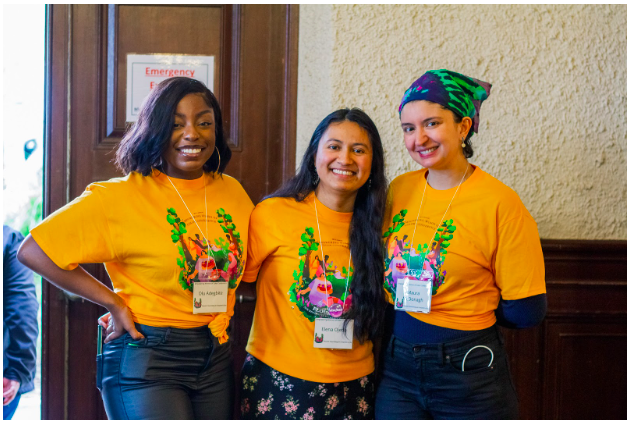
Oluwaseun Adegbite, an EWOCC co-coordinator, said Asili’s speech was well received by the event staff. 

We felt like [Asili] really encompassed our theme […] transmuting all the issues that we face and transmuting into something that you can enjoy and that uplifts you and makes you happy,” Adegbite said. 

Asili created an engaging and fun atmosphere with attendees by asking them questions and passing out notecards so the group could compose a song together. Attendees shared some of their favorite liberation songs and sang as a group. 

The conference concluded with a panel Q&A with local community leaders and healers about how attendees can cultivate and maintain joy for themselves. One of the panelists, Nakia Woods, spoke about her experience as a Black former student at UC Berkeley. She said Black students were often policed for expressing joy at public events on campus. 

“It’s not really safe for women of color to experience joy in public,” said Alex Badaoui, the panel coordinator for the EWOCC. “I think that there [are] not a lot of spaces to be vulnerable either. And we created that space to do it together.”

Woods and other panelists reminded attendees that everyone should still experience joy freely, even in the face of adversity. 

“We have to be the example of how we want to see others interact and create community and let that feeling linger with individuals so they can spread it throughout others in their lives and in their network,” Badaoui said.

The conference was an opportunity for women of color to learn from community leaders who have shared experiences and benefited from the spaces created. Each year, EWOCC continues to create a space that welcomes returning community members, like Ojeda, and draws in new attendees, like De Santiago. 

“It taught me a lot, and I’m really excited to go back next year,” De Santiago said. 

Written by: Daniela Dula Mejia — features@theaggie.org

Nervous about office hours? Here are some tips for talking to your professors

Professors and advisors share advice for students on how to approach them and other potential mentors


By KACEY CHAN — features@theaggie.org 


Students are always lectured about the importance of going to office hours and talking to their professors, but the actual experience can be rather intimidating, especially when approaching instructors with decades of experience and accumulated knowledge under their belts.

“Approaching professors as an undergrad definitely caused me anxiety,” said Cindy Alvarenga, an undergraduate academic advisor with the Economics, History and East Asian Studies Departments. “I feared rejection and embarrassment that I wasn’t able to grasp the concepts they were teaching me.” 

However, Alvarenga stressed the importance of getting over that “mental barrier” and said anxiety shouldn’t prevent students from attending office hours. 

“There are plenty of reasons why it is beneficial to go to office hours,” Alvarenga said. “They have resources, networks and opportunities for you to learn beyond the classroom.”

Magdalena Wojcieszak, Ph.D., a professor in the communication department at UC Davis, encourages students to come to her office hours. 

“Students are getting an education at a higher education institution, and professors can provide more in-depth examples, clarify their doubts and so forth,” Wojcieszak said. 

Wojcieszak highlights networking and future career opportunities as a valuable way professors can help their students.

“Having professors know you is incredibly beneficial for your future,” Wojcieszak said. “If they want to apply to graduate school, students can get letters of recommendation, or if they’re applying for industry professions, students can name a professor as a reference, offering good feedback on their performance.” 

Wojcieszak has written hundreds of recommendation letters for undergraduates. She said she is proud of the fact that she has helped those who were comfortable enough to attend office hours and be enthusiastic about the course. 

“I have served as references for industry positions and talked with HR departments from different companies,” Wojcieszak said. “[Those] students ultimately got jobs they wanted or got into their universities.” 

Students can even trust professors for advice on non-academic topics, according to Wojcieszak. 

“You can get intergenerational knowledge about the world, politics, the media and many different things from other professors,” Wojcieszak said. “At a university, you don’t really have that many opportunities to talk with people who are more senior in age and experience who can provide a different perspective on the world.” 

College is meant to prepare students for the real world, not only through classroom knowledge but also through interacting with leaders and professionals who are a part of your desired industry. Alvarenga said it is important for students to acknowledge their anxiety in talking to professors and face it head on. 

“Overcoming the barrier to talk to professors is one of the many skills students will learn for the workplace,” Alvarenga said. “Instead of professors, it will be a manager in the future, so learning how to ask for help will be beneficial later on.”

The nervousness associated with office hours can be overcome with practice. According to Wojcieszak, it is all about having a conversation at the end of the day.

“We really appreciate when students come to us, and the more you do it, the easier it becomes,” Wojcieszak said.

For students more anxious about going to office hours, Alvarenga recommends asking a friend in the class to come with you to ask questions together on concepts you are both struggling with. She also said it could be useful for students who don’t do well with large groups to ask for an alternative time to meet.

“Pick a good time,” Alvarenga said. “Approaching a professor after class can be difficult if they have back-to-back lectures, so office hours are best.” 

Lastly, Alvarenga stresses the importance of coming prepared. She recommends preparing questions in regard to the lecture, exams or research opportunities and said it can be useful to make an appointment with an academic advisor to discuss the meeting in advance. 

“If you don’t know where to start, ask an advisor,” Alvarenga said. “I had my major advisor to thank for overcoming many of my fears.” 

Wojcieszak wants to remind students that, ultimately, professors love it when students come to office hours and ask questions. 

“I find it very rewarding,” Wojcieszak said. “It is all about having a conversation, and students should remember that.”

Written by: Kacey Chan — features@theaggie.org

ASUCD encourages students to vote and run for office during spring elections

After historically low voter turnout in fall elections, ASUCD and student organizations emphasize the importance of voter participation, competitive elections to increase representation


By LILY FREEMAN – campus@theaggie.org


The ASUCD 2023 spring elections are near; students will be able to cast their votes on the ASUCD elections website from the morning of April 24 to the evening of April 28. Undergraduate students will vote for various candidates running for ASUCD leadership positions, including the roles of senator, president and vice president, external affairs vice president, student advocate and international student representative.

Students will also vote on proposed measures. Senator Stephen Fujimoto explained some of the measures that will appear on the ballot. 

“An amendment I authored will be on the ballot, CA #79 or the ‘DRIP II Amendment,’” Fujimoto said. “The Senate will also be voting on whether to put The Green Initiative Fund [TGIF] fee referendum on the ballot.” 

According to Fujimoto, the DRIP II Amendment would allow the student body to vote on  a recall and a replacement candidate for an ASUCD senator, external affairs vice president, student advocate, transfer student representative or an international student representative at the same time. 

If the Senate decides to put TGIF on the ballot, it will mark the third election in a row that it has been voted on by students, after failing during the past two elections due to a lack of voter turnout. A 20% voter turnout is required for any measure on student fees to pass. 

Cassie Eng, a fourth-year managerial economics and environmental policy analysis and planning double major and a TGIF committee member, described why she believes the TGIF referendum is important. 

“TGIF supports the UC Davis reputation as a global leader in sustainability and climate change research,” Eng said. “Given historically low voter turnout, we are really pushing for the student body to make the spring elections count.” 

Kelly Abey, a third-year environmental policy analysis and planning and sustainable environmental design double major and a TGIF committee member, explained what is at stake if TGIF does not pass during this election.

“TGIF is operating on the last of our reserves,” Abey said. “If we fail for a third time, the program will no longer exist on the UC Davis campus. We are planning on doing all that we can to increase the undergraduate voter turnout to meet the 20% voter threshold.” 

In March, the Editorial Board met with Chancellor Gary May and other UC Davis administrators. At the meeting, we asked whether the administration would financially support the continuation of TGIF and its related operations, should it fail to pass in the ASUCD elections. May said that “there are funds available […] that could address this issue” but that nothing has been done at this point. 

Fujimoto said that all proposed measures will be finalized and published on the elections website in the upcoming weeks so that students can learn about them before voting. 

Voting will take place digitally through the ASUCD elections website, but the ASUCD Elections Committee is also working on setting up in-person voting booths with volunteers who will assist in teaching students how to vote, according to Fujimoto. ASUCD will announce where students can find these booths once the locations are finalized.

Students who are interested in running for an ASUCD leadership position can sign up for a ticket until 8 a.m. on April 10. To become a candidate, according to the elections website, undergraduate students must be in good academic standing. Additionally, candidates running for Senate, transfer student representative, international student representative and student advocate must obtain 50 student signatures. The external affairs vice president must obtain 70 signatures and executive tickets must obtain 150 signatures. 

Fujimoto encouraged students to run and emphasized the importance of competitive elections.

“ASUCD elected officials get to have a say on a variety of things that impact students, including how ASUCD services are run and how the ASUCD fee revenue is spent,” Fujimoto said. “While knowledge and experience in ASUCD are useful, much of it can be taught if you are open to learning. A willingness to listen to students and a desire to advocate for them can’t be taught and is so much more important. Any student who has that willingness and desire should run even if they are remotely considering it.” 

Reid Rizk, a second-year international relations major and ASUCD elections officer, also outlined the influence of this election.

“This election, and ASUCD elections overall, are extremely important to our campus and the students who live here,” Rizk said. “After several cycles of less than ideal turnout and engagement, the elections committee believes in promoting fair and free elections with a wide field of candidates for office and providing students with the ability to advocate for policies and people they want to lead our school.” 

Sign up for a ticket to become a candidate in the spring elections here. Learn about the election candidates here and the election measures here. Cast your vote here. (Polls open on April 24 at 8 a.m. and close on April 28 at 8 p.m.)


Written by: Lily Freeman — campus@theaggie.org

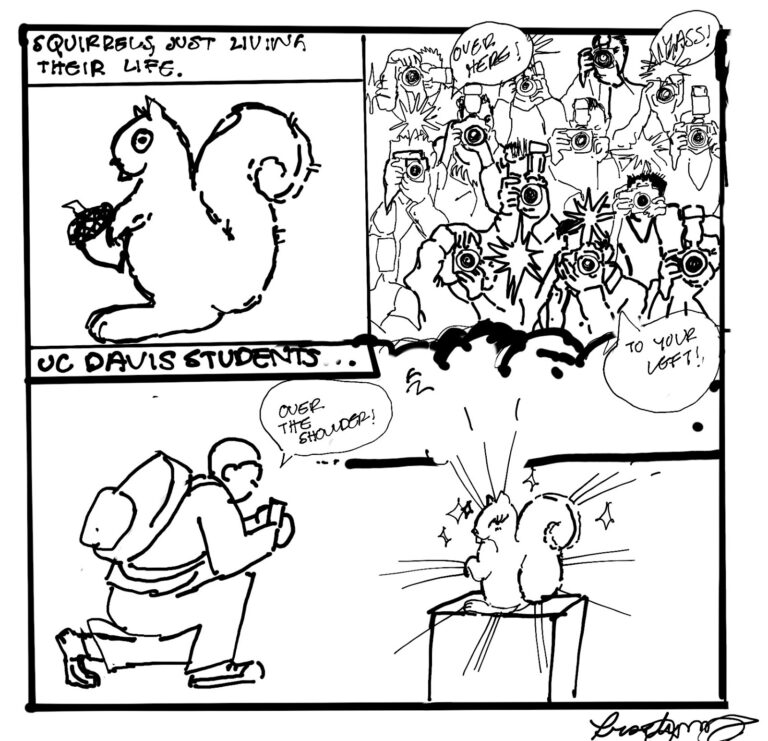
Squirrel Obsession

Drawn by: Priscila Jiménez Corrales –– pjimenez@ucdavis.edu 

Disclaimer: (This cartoon is humor and/or satire, and its content is purely fictional. The story and names of “sources” are fictionalized.)