57.2 F
Davis

Davis, California

Monday, December 22, 2025
Home Blog Page 95

Neighborhood Market collaborates with Vault Board Shop

Family-owned neighborhood store now features over 15 vendors offering vintage clothing, handmade accessories and jewelry in-store


By ALEXANDRA SHAPIRO city@theaggie.org


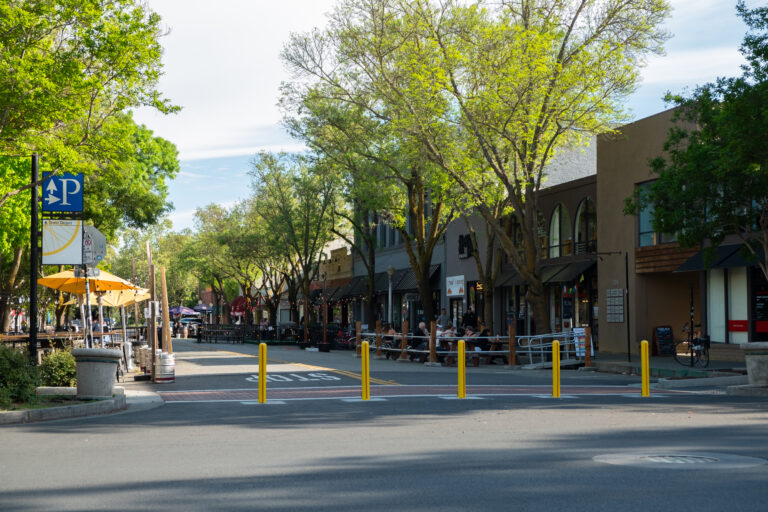
Davis’ Neighborhood Market, founded in 2022, is held every other Saturday afternoon. The pop-up was initially held at University Mall but has since moved to G Street.

The market started with six siblings who were passionate about meeting new people and sharing creativity.

“Our family upbringing instilled the entrepreneurship spirit into all of us,” Alex Barreto, one of the primary founders, said. “We’ve all vended at markets in Sacramento but slowly transitioned to full-time collectors.”

Alex Barreto’s brother, Eric Barreto, attended UC Davis and saw a rich fashion culture but a need for more opportunities. 

“There weren’t many events or places to go and gather with your friends to find cool stuff,” Alex Barreto said. “We all came up with the idea [for the market] and haven’t looked back since.”

To secure the necessary permits to operate the market, the Barretos have “worked closely with the city of Davis” to continue hosting events. With the market’s success, the Barretos decided to venture into a new business. Alex Barreto suggested to Jake Starnes, the owner of Vault Board Shop, to split the store between vintage items and skateboard goods. “[Starnes] has always shown tremendous support for our vision, so it was an easy decision,” Alex Barreto said.

This idea came to fruition with the launch of the Neighborhood Store, now located within Vault on G Street. Open seven days a week from 12 to 7 p.m., shoppers can explore a diverse selection of over 15 unique brands from Y2K button-ups to knit tops to patchwork jeans. Kodai Gosse, owner of Hangup Vintage and a vendor of the neighborhood store, appreciates the new collaboration.

“It is literally a combination of two of my main interests,” Gosse said. Gosse is grateful for the connections he has made through selling vintage clothing.

“I have learned so much from so many people over this past year of reselling,” Gosse said. “I feel that I have grown so much.” 

Alex Barreto says the best part of their job is building relationships with vendors and patrons.

“[It’s] creating a space where the community can share their passion for past fashion,” Alex Barreto said. “The most recent examples are seeing parents and grandparents find a past item they remember and telling the younger generation about it.” Des, a fourth-year clinical nutrition major and vintage vendor, began thrifting as a hobby. Over time, an overflowing closet led him to start selling lesser-worn pieces.

“To my surprise, sales were going up consistently, which brought me to where I am today,” Des said. Des emphasized the advantages of supporting small businesses beyond the unique shopping experience.

“Shopping small helps against fast fashion, unfair international clothing manufacturers practices and to reduce clothing waste in the landfills,” Des said.

Des also shared advice about how to manage a small business. 

“My advice is to be yourself as individuality is important, to have good customer service skills and to be consistent,” Des said. “Also, it’s crucial not to overstock inventory until you make a consistent profit. Lastly, the most important step in this process is to have an optimistic mindset and to do what you love.”


Written by: Alexandra Shapiro  city@theaggie.org

The benefits of outdoor study spaces

Students report that taking advantage of the spring weather can increase academic performance


By ZOEY MORTAZAVI — features@theaggie.org


To many college students, productive studying is often associated with dark, stuffy library rooms and secluded corners. Whether this reasoning stems from trying to cut off distractions, staying away from people or just because libraries are a typical study space, consider changing the scenery as we plunge deeper into the spring quarter. 

Studies show that spending time outside can have numerous health benefits. Davis is a place where students can access both indoor and outdoor study spaces. When it gets closer to being time for midterms and finals, Davis students are commenting that utilizing outdoor study spaces can boost their productivity, as well as benefit overall mental health.

“I do think that outdoor study spaces are beneficial. For me personally, being outside puts me in a better mood,” Violet Ichel, a first-year agricultural sciences major, said. “This motivates me to do work, although it’s better for me to be in an outdoor study space by myself rather than surrounded by people. I’d recommend for people to go outside to study because it’s good for their health, and it’s a nice break from the constant indoors of classes.”

While utilizing the outdoors to focus on work for some more difficult classes may be easier said than done, attempting outdoor studies may actually be good for your health.

Students can demonstrate increased coherence and a more detailed understanding of academic subjects after being taught them outdoors as opposed to an indoor class setting, according to Psychology Today. In addition, variation in study settings has been shown to increase productivity and memory retention. 

UC Davis students have access to many different outdoor study spots on campus. Popular spots include the Quad and the Arboretum, as well as the lawns near each of the student dorm areas. Students have reported that changing up where they choose to study can help bring a fresh perspective to their coursework. 

“I definitely utilize outdoor study spaces a lot,” Sonia Boughaffour, a second-year English major, said. “Being outside rather than holed up in the library all day is very beneficial. As an English major, I do a lot of reading, so taking the time to study at the Arboretum or Quad is helpful and I would definitely recommend it to others as a way to enhance their learning experience.”

For many students, adapting to a new environment for college can be a very challenging experience. Becoming aware of what type of studying environment works best for you can be an important aspect of adjusting to university life and ensuring that you are completing and comprehending your work. 

Melissa Caltacci, a first-year nutrition science major, shared her experiences with accommodating and learning to study productively as a new college student.

“As a first-year student at UC Davis, I think I can speak for most new students when I say that finding your groove and efficient study habits as well as areas [to study] can be difficult to find,” Caltacci said. “Especially with the seasonal changes, depression can hit harder during the winter, making it harder to focus with all the rain and gloomy nights.”

Caltacci continued by giving advice to students, explaining that students should take the warm weather as a way to improve their mental health.  

“Since we’re now entering spring quarter, the sun is shining again — being outside is proven to boost serotonin levels, which really motivates me to get my work done. Campus is also beautiful this time of year, especially areas [on] campus like the Arboretum,” Caltacci said. “People should reconnect with nature during the springtime; it can help relieve their stress while also increasing concentration. Plus, it always puts you in a better mood.”

Whether you tend to combine productivity and the outdoors in your day-to-day life, consider taking some of your books outside in the upcoming months to see if outdoor productivity will click for you. As many students have reported, having access to a campus with so many scenic study spots is definitely something that shouldn’t be taken for granted. 


Written by: Zoey Mortazavi — features@theaggie.org


ASUCD Environmental Policy and Planning Commission launches Cool Campus Challenge

Students, staff and faculty can participate and log activities that reduce their carbon footprint


By JORDAN POLTORAK — campus@theaggie.org


The Cool Campus Challenge, organized by ASUCD’s Environmental Policy and Planning Commission (EPPC) started on April 8 and will take place until April 29. Students, staff and faculty can all participate in logging activities that lower their carbon footprint on the website for the challenge. The challenge was created in 2013 with the goal of carbon neutrality across the entire University of California system in 2025. 

Kelly Abey, a fourth-year environmental policy analysis and planning and sustainable environmental design double major as well as EPPC chairperson, discussed the importance of this challenge.

“This shows students that it’s easy to take actions to improve your carbon footprint,” Abey said. “Things like walking or biking to school are things that we don’t even realize improve our carbon footprint.”

The website allows participants to sign up as individuals or in groups. The top ten winners will receive prizes.

“It’s like a social media platform where you can log your actions for the day,” Daphne Crother, a fourth-year political science major and vice chairperson of the EPPC, said . “Then, you get points and it shows you how much CO2 you have saved.”

The challenge was originally designed to see which of the 10 UCs was the most sustainable. However, it has evolved to an individual campus competition.

“We want to encourage students to take sustainable actions in the month of April, but also take them and apply them to life year-round,” Crother said. “All the small things you do can add up.”

The website lists the actions users can take and the amount of CO2 they would save from the action. Their Instagram page states, it is a “student-led movement to fight climate change through individual action.”

“[The challenge] allows you to see how much of a difference you can make with your individual actions,” Abey said.

Abey and Crother wanted to emphasize the importance of individual actions but also the influence of large corporations. 

“As much as students can do, it’s also important to remember the impact that these large fossil fuel companies have as well,” Crother said.

To take part in the challenge, students can go to the Cool Campus website

Written by: Jordan Poltorak — campus@theaggie.org

Review: Taylor Swift’s ‘The Tortured Poets Department’

Synth-pop beats and lyrically crowded songs mark Swift as a musical innovator — for better or for worse


By ELIZABETH WOODHALLarts@theaggie.org 


Taylor Swift released “The Tortured Poets Department” on April 19 at 12 a.m. EST, following soon after with an anthology of 15 songs at 2 a.m. EST. The anticipation had been amping up for fans worldwide as she announced this album on Feb. 5 — barely two months before she was set to release the album. 

Swift hasn’t been a stranger from the spotlight these past few years, between releasing one of the all-time top-grossing albums ever with “Midnights” and her whirlwind romance with Travis Kelce, an NFL football player for the Kansas City Chiefs. On top of that, just a few shows into her worldwide stadium tour the news broke that she had separated from long-time boyfriend Joe Alwyn, and quickly found herself in the tabloids as she struck up a new relationship with Matty Healy, the frontman of English band The 1975. She’s far gone from her “reputation” days of exile and confinement, a time when, despite fans speculating that Swift would directly address her disappearance, she instead crafted an album that talked about love, deception and forbidden relationships. 

Surprisingly enough, “The Tortured Poets Department” does a great deal in addressing the public’s opinion of who she is and who she should date. Swift is known for continuously transitioning between genres in the name of remaining innovative and groundbreaking. Jumping from indie albums like “folklore” and “evermore” to the synth-pop “Midnights” is a leap that not all artists would survive and land on their feet — but that’s the enchanting nature of this pop star. 

“Fortnight (feat. Post Malone)” is the first track and leading single of the album. It’s slow, and retains the lyrical ambiguities and intricate self-referential lyrics of “folklore” and “evermore,’ but the beat is now synth-pop — a sound reminiscent of “Midnights.” 

Combining aspects of two eras that brought her back onto the scene is not an unusual technique for Swift to employ — but it falls short of her greatest works. The track “The Tortured Poets Department” confirms its muse: Healy, with reference to him being a “tattooed golden retriever.” This track starts with referencing marriage, a topic which was allegedly part of the rift between Swift and Alwyn. In the song, someone grabs Swift’s ring and “put[s] it on the one people put wedding rings on.” 

Fans can suspect that Alwyn is also mentioned in “My Boy Only Breaks His Favorite Toys,” where she elaborates on the breakdown of their relationship and the dissembling of Swift — attributing herself doll parts that he takes apart and keeps the “tortured hearts.” This track is more upbeat than the past two as well. 

The track “Down Bad” talks about feeling physically and emotionally abandoned. The concept of being “down bad” insinuates that the passionate feelings she holds for this person are unrequited. 

The next track, “So Long, London,” is speculated to be about Alwyn — someone whom she frequently resided in London with. This track speaks to the relationship that had once been seen as a perfect match. Who could think otherwise when “reputation” and “Lover” shadowed the narrative — and the truth? 

“So Long, London” is reminiscent of “Down Bad’s themes of abandonment and holding on past the finish point. She is trying her hardest to keep them close together — “Pulled him in tighter each time he was driftin’ away / My spine split from carrying us up the hill” — but he is already gone. Despite this ending, she still exists in everything he does: “I founded the club she’s heard great things about,” referencing Alwyn’s interview where he shared that he, Paul Mescal and Andrew Scott were all in a group chat called “Tortured Man Club.” It wouldn’t be a stretch to think that Swift mentions that club through her album title. We’ve had similar instances of these seemingly obvious references to past love, such as in “Dear John” and “Style.” 

“But Daddy I Love Him” is a commentary on the public’s outrage where she claims that, “These people only raise you to cage you.” There is visual imagery of a wedding happening, something that she’s always wanted: “They slammed the door on my whole world / the one thing I wanted.” She goes on to call this uproar “bitchin’ and moanin’” and seems to poke fun at this criticism by making a joke about “having his baby” — she’s not, but she’d love to see their faces as they reacted to that line. “Fresh Out the Slammer” hints that Healy served as a rebound for her relationship with Alwyn. “Florida!!! (feat. Florence + The Machine)” has beautiful vocals from Florence and Swift, referencing crime and drugs, escaping responsibilities by leaving to Florida. Despite the ambiguities, the track stands strong because of its vocals and beat build-up. 

“Who’s Afraid of Little Old Me?” fights against this assumption that Swift is powerless against rumors and controversies. Perhaps her silence about most scandals and breakups has laced this narrative — but she’s saying that she has more power than people think. To say that she is “little” but that they “should be” afraid of her shows the cultural impact she has —- even when her reputation is tainted. 

“I Can Do It With a Broken Heart” talks about Swift’s triumphant tour as she’s experiencing various heartbreaks. A time that is filled with success in her career is also shadowed by her personal life and the collapse of the relationships she thought were going to last. “The Smallest Man Who Ever Lived” allegedly is about Healy, as she says that he tried to buy pills “from a friend of a friend.” Healy has been accused of dealing with drug abuse, as well. Listeners gain insight into what led to the end of their relationship: ghosting, inflated public image and disappearance when things got hard.

 “The Alchemy” is filled with football metaphors —- “touchdown,” “winning streak” —- seemingly referencing Kelce throughout the track. It’s one of her most slow-beat romance songs, and it does not really stand out beyond this relationship plastered across all gossip magazines.

The final track before entering the extended version of the album, “Clara Bow,” talks about making it in the industry. It’s something that she’s mastered, but it’s not easy to be competing against other artists fighting to take her throne. In the end, she views what sometimes feels like fading stardom and urges other artists to be careful of what the media wants. They’ll be glad that people are saying they have an “edge” against other artists, and enjoy the reviews saying their future looks “dazzling” because of it —- but this won’t last forever. 

“The Tortured Poets Department” is an album that’s filled with everything fans love about Swift, coupled with genuine and beautifully crafted songwriting. Despite this, there are times when these songs went on longer than they should’ve. Some lyrics go in the book of memorable lyrics by Swift — others induce confusion and perhaps a shake of the head. This album gives Swift an edge by responding to the public and taking over her narrative, calling out past relationships and setting the record straight.

 Fans are already raving about it online while others are expressing their concern that this record is too similar — or different — from her past work. Swift’s lyricism is what makes her such a good artist, and with songs that seem to be crowded with metaphors and allusions, it’s an album that places the artist dangerously close to a new genre of music that her fans might struggle to get into. Nonetheless, it’s an album that will get you through heartbreak or make you feel on top of the world. As always, Swift makes music for anyone going through the various stages of life. 


Written by: Elizabeth Woodhall   arts@theaggie.org 

Researchers uncover protein responsible for driving pancreatic cancer progression

Targeting the protein could lead to effective treatments for pancreatic cancer


By ARYAMAN BHATIA — science@theaggie.org 


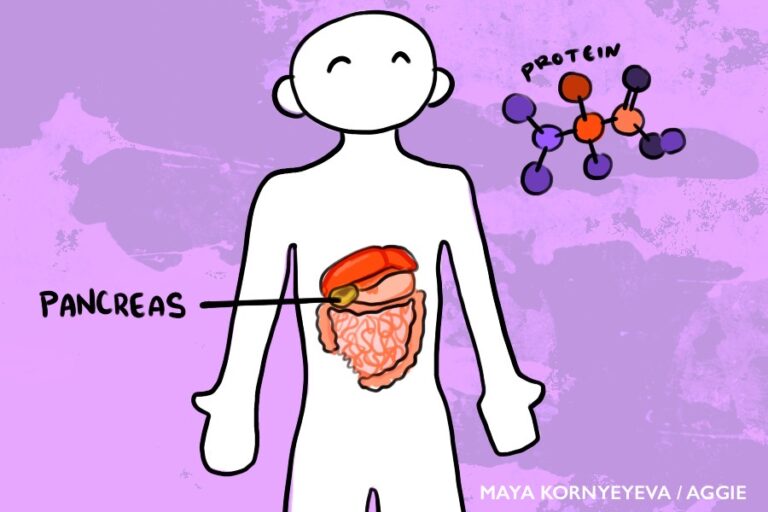
Researchers at UC Davis have published a study that has shown the Engrailed-1 (EN1) protein supports the advancement of pancreatic cancer and its spread to other parts of the body (metastasis) using laboratory cultures and mouse models. 

“Pancreatic cancer is the third leading cause of cancer-related deaths in the United States with [a] 12% 5-year relative survival rate, lowest among all common cancers,” the study reads.

The researchers discovered a correlation between high levels of EN1 and the severity of pancreatic cancer, particularly its tendency to metastasize, in human patients. This finding can lead to possible treatments for pancreatic cancer, which is currently one of the hardest cancers to treat.

The project started out by studying the metastatic process of pancreatic cancer. The metastatic process refers to the spread of cancer cells from the original (primary) tumor to other parts of the body, where they can form new tumors. 

“​​Metastasis is an important component of pancreatic cancer progression, but researchers have not been able to identify genetic mutations responsible for it,” an article from UC Davis states.

Reno Jihao Xu, a doctoral student involved in the project, commented on the process of discovering the protein.

“Initially, we were studying the metastatic process of pancreatic cancer and through various analyses we identified a transcription factor which is a protein,” Xu said. “Transcription factor goes into the cell nucleus, turning on or off the transcription of certain genes. What this means is that it controls the genotype to phenotype process, therefore carrying out a subsequent function; in this case, promoting the metastatic process. So this project is about characterizing the functionality of this protein by looking at what genes this protein targets as well as how the protein regulates this gene through various experiments.”

In order to identify this protein, the teams used a non-traditional technique.

”We identified this protein through the utilization of a technology called Organoid, which is a 3D modeling of cells,” Xu said. “This technology well-preserves the biological characteristics of a tissue, in this case, the cancer cells, which allows us to characterize or identify the differences between the different stages of cancer progression, such as primary tumor versus metastasis.” 

Due to the recently discovered nature of EN1, finding effective ways to stop the progression requires less traditional methods and creative thinking.

“There are no therapeutics that can target this protein on the market because of the unique structure that does not allow for the development of therapeutics,” Xu said. “So, what we can go about is identifying what other proteins can interact with this protein that are important to carry out its downstream pathways. To do this, we perform an experiment called immunoprecipitation followed by mass spectrometry. This experiment allows us to identify all the proteins that interact with this protein, and one of them is called DH2. It modifies the histones on the genetic level to regulate gene expressions, so perhaps we could combine these DH2 inhibitors with chemotherapy to see if there’s any differential regulation or differential response from the combination of therapy.”

Finding the protein responsible was incredibly difficult and complicated for the team. 

“For a very long time we tried different strategies to identify the genomic binding regions of the EN1, and that took up about two years,” Xu said. “We tried almost everything and finally it worked out.”

When further asked what helped make the project successful, Xu highlighted the importance of collaboration and communication amongst all members of the scientific community. 

“I started the project when COVID first hit,” Xu said. “So, it was basically just myself inside a lab, and it was really difficult to interact with other labmates. Science is a collaborative effort, so I definitely felt powerless doing the science by myself.” 

Xu mentioned what he finds to be one of the most important parts of making the project come to life.

“I would really like to emphasize teamwork because innovation doesn’t come through one single individual; it comes through daily interaction with colleagues, or with other investigators,” Xu said. “All of this is teamwork, and without teamwork, there is no discovery, [and] there is no scientific achievement.” 


Written by: Aryaman Bhatia — science@theaggie.org

Mr. Krabs visits UC Davis

Drawn by: Emma Lapidus –– eblapidus@ucdavis.edu

Disclaimer: (This cartoon is humor and/or satire, and its content is purely fictional. The story and names of “sources” are fictionalized.)

Review: ‘Love Lies Bleeding’ is the latest sapphic thriller — and it’s fantastic

This A24 film will make you question the unimaginable boundaries of love and violence 


By INDRANIL BASU — arts@theaggie.org


“Love Lies Bleeding” is a 2024 romantic thriller film directed by English filmmaker and screenwriter Rose Glass, co-written by her and Weronika Tofilska. Glass’ second feature film after “Saint Maud” (2019) is a co-production between the United Kingdom and the United States, developed by A24 and Film4. It had its world premiere in the Midnight section at the 2024 Sundance Film Festival on Jan. 20 and was released in the U.S. last month on March 8 to mostly positive reviews. 

The ASUCD Entertainment Council held a free screening of the film on campus on April 11 at Cruess Hall. They advertised the film on Instagram as “a shocking Stranger Things turned vecna-gymbro-monster” flick, which is pretty accurate. The theater of room 1002 was quite filled, with a lot of queer and/or sapphic students showing up for the film with great anticipation, making the experience even more exciting and communal.

Set in a small town in New Mexico in 1989, the film tells the story of Lou, an introverted gym manager, played by queer icon Kristen Stewart, who falls in love with Jackie, an itinerant, buff bodybuilder, played by Katy O’Brian in her first lead role. 

Lou is a butch lesbian with the aesthetic of a contemporary teenage boy, whereas Jackie is a more androgynous bisexual, both depicted aptly through their costumes designed by Olga Mill. 

Their sapphic love story starts with a series of steamy sex scenes which elicited great cheer from the audience. The filmmakers and actors are clearly authentic to the sapphism of the film, the camera framing them with empathy and capturing the affectionate intimacy in their lust. The script gives them vulnerability and space to talk about each other’s bodies, which, coupled with the sex scenes, makes them more cherished, beautiful and organic. 

The film follows several canon events of sapphic relationships with its own twists, making the queer audience identify and respond to them yet shocking them at each turn of the story. It appears to be a small-town love story — especially with the setting of Lou’s small apartment, the constricted men-dominated gym and the contrast of Jackie’s immediate aspirations with Lou’s reclusiveness. It’s not until Lou’s sister’s hospitalization due to extreme domestic violence that Jackie is sucked into Lou’s family’s harrowing criminal affairs.

The film has brilliant cinematography by Ben Fordesman, editing by Mark Towns and a palpable score by Clint Mansell, which together intensify the story considerably beyond its plot.

Ed Harris as Lou Sr., Lou’s estranged father and weaponry crime lord, looks more formidable than Voldemort, even without any special effects makeup. Jena Malone as Beth, Lou’s sister as the tragic victim of domestic violence, Anna Baryshnikov as Daisy, a femme sapphic who pursues an irritatingly one-sided love interest in Lou and Dave Franco as J.J., Beth’s husband and the insidious-looking perpetrator, deliver equally brilliant performances. 

The writers do a genius job of characterizing each and every role as people we might know in real life but capable of unimaginable harm, making them all the more monstrous and surprising to the audience. Their complexity makes the film narratively rich and deeply thrilling.

Although it does place love at its core, the film turns violently from its genre of romance into that of thriller, jolting the audiences and subverting their expectations of what this thriller would deliver. In their signature style, A24 brings the flavor of independent cinema with its niche story (or rather niche twist on a popular plot), strong aesthetics and convention-defying narratives. 

As the film went on, its “lying” twists and “bleeding” turns made the audiences cry out versions of “what the hell is happening?” The film’s many close-up shots of bloody and violent gore or surreal body horror contrast with the sequences of starry night skies of the New Mexican landscape, shots of cuddling and making breakfast for one’s lover. The film ultimately triumphs in its surreal euphoric return to sapphic love despite violence.

This is the question the film seems to explore: what is love? What are its boundaries? And what happens when those are tested by such violence? Along with dilemmas of family, romantic relationships and their transgressive violations, the film is as entertaining, weirdly cathartic and mythological as it is complicated and murky. It definitely left everyone at the screening wondering what to make of it or even where to start processing what they saw.

For watchers, leaning into the movie’s sapphism and not personally questioning its narrative until later is probably the best way to approach this genre-defying film. “Love Lies Bleeding” is playing in theaters now.

Written by: Indranil Basu — arts@theaggie.org 

Look out for these arts and culture events this spring

Art workshops, festivals and other events to work into your spring quarter


By LORENA ALVAREZ — arts@theaggie.org 


Davis artists and UC Davis organizations are bringing art to life through free community events, bringing people together for a greater appreciation of artwork and representation.

 The Artery, an art co-op located at 207 G St., is celebrating its 50th anniversary by holding free monthly art events sponsored by the city. According to Brigitte Chertok, an artist and one of three of The Artery’s co-managers, these art events will take place on the last Sunday of each month.

Chertok noted the co-op and the Arts and Cultural Affairs program’s attempts to transform G Street into an artistic and community-based environment.

“G Street is mostly bars and restaurants,” Chertok said. “So you really have to attract people to The Artery [an art store and gallery], especially now that G Street is closed to vehicles. Since the city is trying to bring people to G Street for more than just drinking, they encouraged me to apply for a grant so I could host monthly events outside The Artery.” 

Chertok went on to describe what attendees can expect from The Artery’s first event, “Clay Fun,” on April 28 from 12 to 4 p.m.

“If [attendees] build something and they want to go home with it, they’re welcome to take their art,” Chertok said. “They are welcome and encouraged to participate in making the big sculpture, but the group sculpture will stay in the store so we can fire it. The goal for the monthly events is to make something simple that everybody can enjoy and go home with.”

Chertok emphasizes the community’s involvement by noting the organization’s interest in hiring volunteers. 

“I may be looking for student helpers who are art-oriented for future events, helpers will be paid minimum wage,” Chertok said. “People hoping to volunteer can contact us and give us their names, and we will call them if we are hiring for that month’s event.”

Less than a week after The Artery’s community building and publicity event, La Familia will be hosting their first Queer Quinceañera on May 4 at 7 p.m. at the Student Cross-Cultural Center (SCC), multi-purpose room. 

Bianca Alvarado, La Familia’s co-president and a fourth-year English and Chicana/o (CHI) studies double-major, shared the event’s theme.

“Our theme is ‘Flores de Mayo’,” Alvarado said. “We’re trying to make [the event] inclusive of different identities. We want whoever attends to feel comfortable with their identity and safe enough to express it.”

Alvarado continued to note the immense support La Familia has received from organizations that play a big role in Queer Latine’s intersecting identities. 

“We’ve reached out to different organizations,” Alvarado said. “El Centro and the LGBTQIA+ center have funded [the event]. We are now in the works of asking the CHI department, who got back to us trying to gauge how much money we need.”

Expanding on the flier’s advertisement of “una noche de música, flores, baile, y drag performances,” Alvarado shared the value of hosting such an artistic and inclusive event. 

“The work that we’ve been doing this year is to create an archive of our existence on campus,” Alvarado said. “We go through so many difficulties pursuing higher education [as Queer Latines] which kind of limits us from fully enjoying this academic experience. [Through events like our Queer Quince, we are trying to] contribute in creating more paths for future generations to look back and see, ‘Oh, this is what they were doing and how they were celebrating it.’ We are making sure that we are taking up the space that we rightfully deserve.”

Another event that has been generating excitement for students and community members alike is the Whole Earth Festival (WEF). Emma Mele, a fourth-year environmental policy analysis and planning major and the co-director of WEF, noted the upcoming festival happening over Mother’s Day weekend and its roots. 

“It started out as an art class project, called ‘art happening,’” Mele said. “And then they put it on the quad and it expanded slowly. It stemmed from art and activism, and that came hand in hand with sustainability.”

Mele furthered on how WEF plans to transform the Quad this May 10 to 12. 

“The whole quad will be lined with craft vendors, food vendors, student vendors and two domes,” Mele said. “We have a bunch of activities for kids and service booths where they can braid your hair and do henna. The list goes on and on. We also have an education space. We’re trying to make sure that that space is really highlighted with everything going on in the world and climate change.”

These events embody the shift from gloomy weather to a time of growth and new beginnings that the spring weather embraces. Each event provides a space for joy and relaxation away from academics, emphasizing the importance of the communities’ identities as artists and people in Davis.


Written by: Lorena Alvarez  — arts@theaggie.org 

Oakland A’s big move to Sacramento

The Oakland Athletics to play in Sacramento through 2027 before their Las Vegas relocation


By CAROLYN (CARI) FENN — sports@theaggie.org


Despite Oakland fans’ efforts to keep the Athletics (A’s) at the Oakland Coliseum, on Nov. 16, 2023, Major League Baseball (MLB) owners unanimously approved the team’s move to Las Vegas, Nevada starting in the 2028 season. 

After this heartbreaking decision was announced, Oakland fans had no choice but to accept that they would lose the major league franchise come 2028. The heartbreak was further complicated when, on April 4, 2024, the Oakland A’s had yet another announcement where they declared that they would be leaving Oakland and heading to Sacramento for the 2025 to 2027 seasons before their big move to Las Vegas. With both decisions, 2024 marks the team’s last season in Oakland.

While the A’s lease with the city of Oakland expires at the end of the 2024 season, they were reportedly attempting to negotiate a short-term lease with the city to allow the team to play at the Oakland Coliseum for the remaining time before the move. However, after negotiations reportedly collapsed with Oakland, the A’s began looking at California’s capital for their temporary home.

The A’s will play at the San Francisco Giants AAA affiliate, the Sacramento River Cats’, home stadium — Sutter Health Park. During the A’s time in Sacramento, they have chosen not to change their name to reflect the new city, instead opting to just go by their nickname. For their time in Sacramento, they will also be sharing the stadium with the River Cats, meaning that during the three seasons the A’s are in Sacramento, the stadium will host a total of 156 games a season — 81 A’s games and 75 River Cat games.

Along with the move will come a downgrade in the seats available for fans within the stadium. The Oakland Coliseum contains 63,000 seats for fans while Sutter Health Park contains only around 14,014 seats, including the outfield lawn open seating. Although the team is having a downgrade in seating capacity, in Oakland, the A’s only averaged 6,243 attendees in their first 13 home games of the season. This year, Oakland has had the lowest number of attendees out of any MLB team with 81,167 people. 

While attendance has never been high for the Oakland-based MLB team, the fan’s turbulent relationship with franchise owner John Fisher hasn’t helped the cause. Many Oakland A’s fans have shown disdain for the team’s owner as he refuses to invest in building a competitive team, having the lowest payroll in baseball at a total of $47,275,000. Oakland’s payroll is nearly $30 million below the next lowest team, the Pittsburgh Pirates, with a payroll of $72,014,000. 

After years of poor records, low attendance and an unstable relationship between fans and the franchise owner, the A’s move to Sacramento will mark the end of their 57-year run in the East Bay. The A’s official exit from Oakland at the end of the season will also mark the third and final professional sports team to leave the city in the past six years, with the Golden State Warriors having left in 2019 and the now Las Vegas Raiders having left in 2020.

Despite the move marking the end of an era for Oakland, it is just the beginning for the city of Sacramento. For Sacramento, the next three years will be a tryout to the MLB, proving that the city can be the home to an MLB team if an opportunity arises. More specifically, Sacramento hopes that if the A’s deal with Las Vegas falls through, they could become the final landing spot of the team. With Las Vegas yet to break ground on the new stadium and debates being heard from groups against the stadium’s construction, it could very well be a plausible occurrence.

Even though the A’s will soon be heading to Sacramento, a piece of the team will always belong to the city of Oakland. From four World Series titles to the infamous Moneyball era under General Manager Billy Beane, Oakland A fans will always be able to remember the good times they had with the team.

Written by: Carolyn (Cari) Fenn — sports@theaggie.org

Researchers uncover protein responsible for driving pancreatic cancer progression

Targeting the protein could lead to effective treatments for pancreatic cancer


By ARYAMAN BHATIA — science@theaggie.org 


Researchers at UC Davis have published a study that has shown the Engrailed-1 (EN1) protein supports the advancement of pancreatic cancer and its spread to other parts of the body (metastasis) using laboratory cultures and mouse models. 

“Pancreatic cancer is the third leading cause of cancer-related deaths in the United States with [a] 12% 5-year relative survival rate, lowest among all common cancers,” the study reads.

The researchers discovered a correlation between high levels of EN1 and the severity of pancreatic cancer, particularly its tendency to metastasize, in human patients. This finding can lead to possible treatments for pancreatic cancer, which is currently one of the hardest cancers to treat.

The project started out by studying the metastatic process of pancreatic cancer. The metastatic process refers to the spread of cancer cells from the original (primary) tumor to other parts of the body, where they can form new tumors. 

“​​Metastasis is an important component of pancreatic cancer progression, but researchers have not been able to identify genetic mutations responsible for it,” an article from UC Davis states.

Reno Jihao Xu, a doctoral student involved in the project, commented on the process of discovering the protein.

“Initially, we were studying the metastatic process of pancreatic cancer and through various analyses we identified a transcription factor which is a protein,” Xu said. “Transcription factor goes into the cell nucleus, turning on or off the transcription of certain genes. What this means is that it controls the genotype to phenotype process, therefore carrying out a subsequent function; in this case, promoting the metastatic process. So this project is about characterizing the functionality of this protein by looking at what genes this protein targets as well as how the protein regulates this gene through various experiments.”

In order to identify this protein, the teams used a non-traditional technique.

 ”We identified this protein through the utilization of a technology called Organoid, which is a 3D modeling of cells,” Xu said. “This technology well-preserves the biological characteristics of a tissue, in this case, the cancer cells, which allows us to characterize or identify the differences between the different stages of cancer progression, such as primary tumor versus metastasis.” 

Due to the recently discovered nature of EN1, finding effective ways to stop the progression requires less traditional methods and creative thinking.

“There are no therapeutics that can target this protein on the market because of the unique structure that does not allow for the development of therapeutics,” Xu said. “So, what we can go about is identifying what other proteins can interact with this protein that are important to carry out its downstream pathways. To do this, we perform an experiment called immunoprecipitation followed by mass spectrometry. This experiment allows us to identify all the proteins that interact with this protein, and one of them is called DH2. It modifies the histones on the genetic level to regulate gene expressions, so perhaps we could combine these DH2 inhibitors with chemotherapy to see if there’s any differential regulation or differential response from the combination of therapy.”

Finding the protein responsible was incredibly difficult and complicated for the team. 

“For a very long time we tried different strategies to identify the genomic binding regions of the EN1, and that took up about two years,” Xu said. “We tried almost everything and finally it worked out.”

When further asked what helped make the project successful, Xu highlighted the importance of collaboration and communication amongst all members of the scientific community. 

“I started the project when COVID first hit,” Xu said. “So, it was basically just myself inside a lab, and it was really difficult to interact with other labmates. Science is a collaborative effort, so I definitely felt powerless doing the science by myself.” 

Xu mentioned what he finds to be one of the most important parts of making the project come to life.

“I would really like to emphasize teamwork because innovation doesn’t come through one single individual; it comes through daily interaction with colleagues, or with other investigators,” Xu said. “All of this is teamwork, and without teamwork, there is no discovery, [and] there is no scientific achievement.” 


Written by: Aryaman Bhatia — science@theaggie.org


Midterm review

Drawn by: Lanhui Zhen –– lazhen@ucdavis.edu

Disclaimer: (This cartoon is humor and/or satire, and its content is purely fictional. The story and names of “sources” are fictionalized.

‘Lucky Seven’: Artist Bussie Parker Kehoe featured in Pence Gallery solo stairway exhibit

The Bay Area artist discusses the methods and meaning behind her sustainable practice 


By SAVANNAH ANNO — arts@theaggie.org

In between the top and bottom floors of the Pence Gallery, visitors can find the Stairway Display. Engaging patrons with art even on their journey from one story to another, the transitional exhibit features a different local or regional artist each month. 

On March 1, the gallery debuted the work of San Francisco-based artist Bussie Parker Kehoe. Her solo exhibit, “Lucky Seven,” highlights the range of possibilities that a sustainable art practice can inspire. 

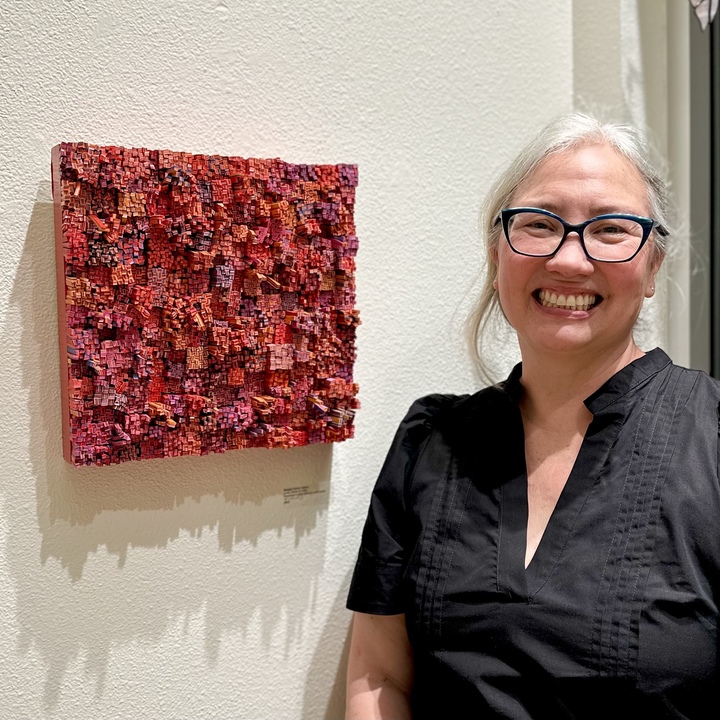
Kehoe, a mixed-media artist, utilizes discarded house paint to create her pieces. Intricate and kaleidoscopic, Kehoe dries and then layers paint to create a range of shapes, patterns and textures. Arranged and glued onto wood panels, Kehoe’s work jumps off the stairway wall directly into the eyeline of visitors. 

In her “Lucky Seven” series, Kehoe tested the limits of her creativity by setting up parameters. She had to create seven pieces, each manipulating the dried paint in a different way while only using seven colors, hence the exhibit’s name. 

“I like to be a little surprised with the final product,” Kehoe said. “This series allowed me to consider and enjoy my unusual process.” 

The unusual process she refers to came to exist in a moment of serendipity. Kehoe became inspired while creating her earlier pieces, pouring acrylic paint onto paper. 

“The short story is that I discovered my process by accident,” Kehoe said. “I had errant paint drops that landed on the plastic sheeting covering the floor. Once dried, I could peel them off the plastic and play with them. That’s when I started to work entirely with poured paint skins.”

In “Lucky Seven,” Kehoe showcases the variety of ways in which she can shape and layer her paint skins. Some pieces — square-shaped and layered in geometric patterns — resemble Bojagi, a type of Korean textile technique that reminds Kehoe of her childhood. Other paint skins take on more of a rounded, flower petal shape, layered almost like CD discs or fish scales. 

Mainly made up of warm pinks, oranges and yellows, the pieces within “Lucky Seven” remain consistent through color despite their varying textures. 

Similar to the origin story of her process, Kehoe stumbles upon her colors by chance. Each can of house paint she receives is through donation. Within less than three years, Kehoe has acquired at least 50 gallons of old paint, all from the San Francisco area.

Known for being difficult to get rid of, Kehoe provides a solution to San Francisco residents who don’t have the time or don’t know where to take their house paint for proper disposal. When disposed of improperly — thrown in the trash or put down the drain — exposure to paint chemicals can cause both environmental contamination and health issues. 

“I switched to upcycled house paint in an effort to have a more sustainable practice,” Kehoe said. “I saw an unlimited supply that I could use and keep out of landfills. I also have a soft spot for things that are unwanted. Strangely, I felt sorry for those dusty old cans.” 

Not only does the use of recycled materials make for a more sustainable way of creation, but for additional meaning. Each small piece of paint Kehoe uses was once purchased for a completely different use, possibly intended to cover a bedroom wall, a garden fence or the outside of someone’s home. 

In her work, these short histories collide, layered on top of each other to reflect Kehoe’s own life and feelings. Climbing the stairs of the Pence Gallery, each work within “Lucky Seven” builds on the last, coming together to support each other; the shared meaning is a purposeful decision on Kehoe’s part.

“[I] intentionally place each dried paint peel so that it connects to the others surrounding it, which is directly related to my own life experience of moving and searching for those connections and support,” Kehoe wrote in her artist statement

Living on both sides of the country and transitioning from a career in North Carolina to one in San Francisco, the diversity of her designs plays into the way Kehoe views not only her own experience but a larger idea of adaptation. Similar to the way her house paint changes forms to create something new, so does Kehoe. 

“Chaos and order are inherent in this process,” Kehoe wrote. “It reflects life, where you take what life throws at you and try to make sense of it.” 


Written by: Savannah Anno — arts@theaggie.org 

California’s new $20 per hour fast food minimum wage is long overdue

What does this change mean for both customers and employees?


By MAYA KORNYEYEVA — mkornyeyeva@ucdavis.edu


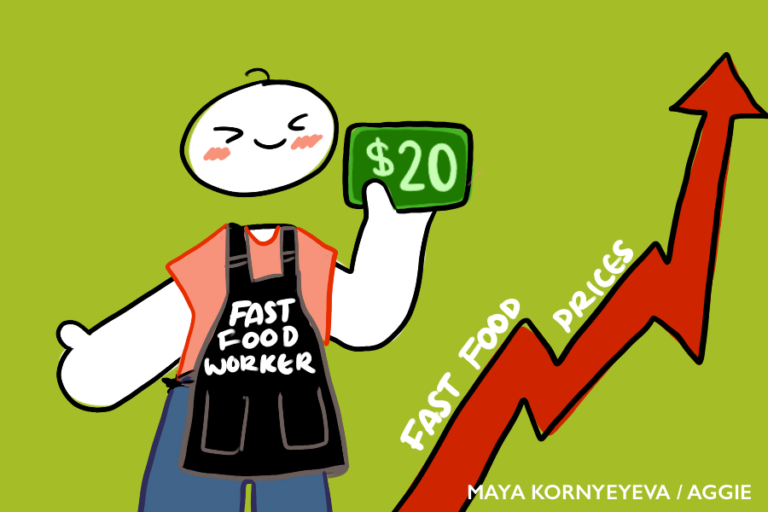
As of April 1, 2024, all fast food workers in California received a significant minimum wage increase, with a base pay of $20 per hour. AB1228, the law that permits this change, was signed into effect by California Governor Gavin Newsom in September of last year. This granted fast food workers an hourly pay increase that, for some, was almost 25% more than they were paid previously. 

While employees celebrate the fourth week of the new wage boost, customers and managers are frowning. What does $20 an hour actually mean for the future of the fast food industry?

For one, half a million fast food workers employed in restaurant chains like Starbucks, McDonalds and Jack in the Box — which all have over 60 locations to qualify AB1228’s requirements — are benefitting from the extra money in their paycheck. As a Starbucks barista, the new minimum wage has given me some financial wiggle room and a chance to work fewer hours to support myself. Employees seem to be breathing a sigh of relief; for those whose hourly pay jumped from $16 to $20, like me, $4 extra seems enormous.  

On the other hand, franchise owners and customers are actively feeling some added pressure caused by AB1228. Some businesses are forced to cut worker and store hours due to lack of funding or raise product prices by a margin of 5% (and even 10%), a change that is being felt by many customers. Fast food, generally known as an affordable option, may see an increase that deters an entire class of customers that previously relied on the accessible prices. 

It is important to note, however, that there are many ways for fast food companies to accommodate this new change while keeping profits up and customers coming back: a negative outlook on this new legislation is much too early to reflect the actual effects of AB1228. Rather than raising prices, companies can focus on leveraging hours, scheduling accordingly and introducing new products and promotional materials to maintain customers. 

With this in mind, as a fast food worker with some inherent bias, I believe that this wage increase is essential for securing a close-to-liveable wage for workers and ensuring that companies aren’t exploiting the labor of demographic groups usually employed in the fast food industry — such as women, students, migrants and semi-skilled workers. 

The previous minimum wage of $16 requires workers to dedicate themselves to a full-time job to afford basic necessities. Even then, a 40-hour week on a $16 wage is difficult to survive on, especially with the inflation we are currently experiencing and the instability of prices post-pandemic.

“Cheap and disposable food” that is often associated with the fast food industry shouldn’t extend to how we perceive laborers working in fast food. Even though a fast food job doesn’t require a college degree or a Ph.D., fast food workers go through extensive training to be specialized in their area of work — dealing with the social side of customer relations as well as the economic side of managing sales, counting inventory and calculating profit margins. The widespread outrage over the $20 minimum wage indicates that we, as a culture, have been subconsciously associating fast food work with cheap, invaluable labor. 

This mentality of “disposability” — treating fast food jobs as a position that merely serves as a stepping stone to a higher, better paying specialized position — is a dangerous mindset that alienates the thousands of people who aren’t able to get a degree and therefore, are unable to pursue “better” jobs. These individuals are forced to work long hours and multiple jobs to support themselves. They often perform more complex manual labor than those in corporate positions. 

A $20 minimum wage is the first step to ensuring that fast-food employees are compensated for their physically challenging work, and have a safety net protecting them from falling into poverty. Seeing as prices for goods and services are currently trending upwards, this minimum wage increase is both necessary and inevitable. Paying an extra 50 cents for your coffee at Starbucks is a small cost to ensure that workers whose income only comes from their fast food jobs are getting paid adequately and fairly. 


Written by: Maya Kornyeyeva — mkornyeyeva@ucdavis.edu

Disclaimer: The views and opinions expressed by individual columnists belong to the columnists alone and do not necessarily indicate the views and opinions held by The California Aggie.

Yolo County Moms for Liberty hosts forum on female sports

Davis library forum held to discuss trans people in female sports


By HANNAH SCHRADER city@theaggie.org


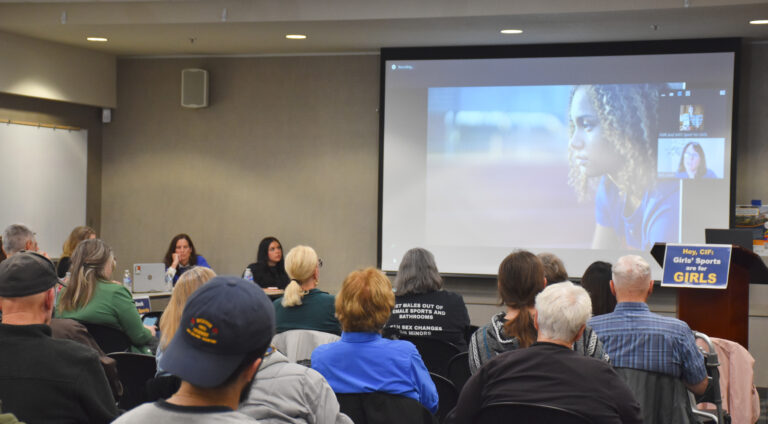
The Moms for Liberty Yolo County chapter held a public forum with guest speakers on April 13 to discuss alleged gender discrimination in the California Interscholastic Federation’s (CIF) policy. The event was held at the Mary L. Stephens Davis Library, lasting from 2 p.m. to 4 p.m., was free and open to the public.

One of the first speakers was Kim Jones, a co-founder of the Independent Council on Women’s Sports. Jones discussed alleged inequities in female sports.

“A culture either chooses to celebrate and respect women or it chooses to subjugate women,” Jones said. “Sport is a microcosm of society, and women’s sport is a reflection of how we value women in society. The fundamental question that we are asking right now is, do women and girls deserve access to fair sports?”

Jones then used an anecdote of an adult competing with a child to portray the alleged unfairness that arises when transgender women, referred to as the adult, compete in the women category, referred to as the child, of their respective sport.

“Advantage is not determined by finish,” Jones said. “If a ten-year-old beats a thirty-year-old [in a competition], the thirty-year-old still has a massive advantage with a fully mature and developed body. And yes, this happens: I was this ten-year-old. The results simply show that the [ten-year-old] did not have enough of an advantage to compensate for the skill, training and talent of a [thirty-year-old.]”

Towards the end of her speech, Jones claimed that a majority of women support sex screening in female sports. Sex screening is the process by which athletes have to have their biological sex verified to be eligible for a sport. 

“When asked, women in sports want sex screening and a protected female category over 80 to 90 percent of the time,” Jones said. “In summary, this issue is not complicated. It’s actually very simple, but it is contentious because the concept of gender identity is in direct conflict with the objective realities. You have to choose one.”

The next speaker was Richard Wharton, an elite and development cycling coach, who discussed his personal anecdotes of observed anatomical differences between men and women in the sport of cycling.

“We’ve got a spirometer alright […], and I challenge any genetic, biological, physiological male to go up against any genetic, biological, physiological female and compare your lung capacity,” Wharton said. “It’s not even close.” 

The next speaker was Beth Bourne, chair of the Moms for Liberty Yolo County chapter. She discussed a supposed tool called the “gender-bread man” that is used in schools to teach students about gender expression.

“This is the gender-bread person,” Bourne said. “This is one of the first images that kids start to see in their health and their science classes starting about fifth grade. It tells kids that your identity, your gender identity is something in your brain and that your biological sex is something in their body parts, and that their gender identity is somewhere between womanness and manness.”

Later in her speech, Bourne made clear her disdain for people who articulate their pronouns.

“And this is one of my favorites, which is the use of pronouns,” Bourne said. “If I see pronouns on your email, I’ll still try to read it, but usually it means I don’t.”

Bourne then closed out her speech, reiterating her condemnation of schools teaching gender-inclusive curricula.

“I’ve got all kinds of information about library books, school curriculum and what’s happening in our schools,” Bourne said. “I just want to say, we’ve just got to do what we can to help our kids know that they’re being lied to and that there’s no child that’s born in the wrong body. And this idea that you can play sports as a different gender that doesn’t make sense.”

Written by: Hannah Schrader — city@theaggie.org


ASUCD spring 2024 elections to be held from April 22 to 26

There are several positions up for the election cycle, and The Green Initiative Fund will be on the ballot for the last time


By LILY FREEMAN — campus@theaggie.org 


ASUCD spring 2024 elections will be held from April 22 to 26, where undergraduate students can vote online during this period on the elections website

There are six seats in the Senate up for election this cycle, with 15 candidates running for the spots. There is only one presidential ticket running unopposed for the ASUCD President and Internal Vice President positions, one candidate running unopposed for the External Affairs Vice President and the International Student Representative positions, one candidate running opposed for the Transfer Student Representative position and three candidates running for the Student Advocate position.

During election week, students will vote online through a choice voting system. Voters will be asked to rank as many or as few candidates as they wish in ascending order. 

“The advantage is that you can vote for the candidate you truly wish for without your vote being wasted if they’re an unpopular candidate,” the elections website reads. “Specifying more than one preference does not hurt your preference.” 

There will be one student fee referendum on the ballot, The Green Initiative Fund (TGIF), which is a grant program that provides funding toward students, faculty and staff to develop and lead sustainable projects on campus.

“The TGIF fee is a $3.50 quarterly fee in the undergraduate tuition,” a TGIF Instagram post reads. “This fee goes directly towards funding the TGIF grant program [and] 25% of the collected fee is returned to student aid.”

In order to reinstate this student fee, TGIF needs at least 60% of the votes in favor. On top of this, the student-voter turnout for the election must meet a 20% threshold. 

This will be the fourth time that TGIF will appear on the election ballot. In all four elections, the referendum surpassed the 60% majority needed to pass, but there has not been a voter turnout close to 20%. 

“For the past year, TGIF has been running off of reserves and money returned from projects,” the post reads. “If TGIF is not renewed this year, we will fully exhaust all funds and the program will close.”

Students can use this QR code from April 22 to 26 to cast their votes.


Written by: Lily Freeman — campus@theaggie.org