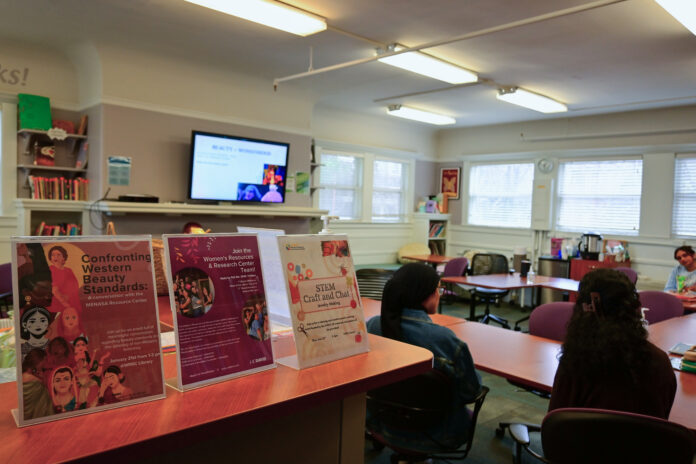
Attendees discussed femininity, identity and the importance of open conversation
By IQRA AHMAD — arts@theaggie.org
On Jan. 21, the Women’s Resources and Research Center (WRRC) and Middle Eastern North African and South Asian (MENASA) Resource Center co-hosted “Confronting Western Beauty Standards: A Conversation with The MENASA Resource Center.” The event featured scholar staff from both centers, who led a discussion on the role Western beauty standards play in shaping beauty ideals and social structures, as well as their contribution to the “othering” of non-Western femininity.
Located on the second floor of the Student Community Center, the MENASA Resource Center hosts a variety of events and offers resources to provide academic and interpersonal support, leadership opportunities and more.
“The MENASA Resource Center provides holistic support for communities by fostering belonging, support and empowerment,” an anonymous MENASA scholar staff member said. “We aim to create an affirming space rooted in community, care, advocacy and shared-identity.”
Similarly, the WRRC functions to serve as a valuable resource available to students who are seeking to challenge systems of oppression and affirm gender equity. Open from 10 a.m. to 5 p.m. Monday through Friday, the center aims to provide education, advocacy and a safe, inclusive space for students, according to their website. Through various workshops and events, the WRRC encourages open dialogue around gender and social justice.
Held at the Joy Fergoda Library on the first floor of the WRRC, organizers set up a comforting discussion space for attendees of the Western beauty standards conversation circle. Surrounded by books, guests were invited to sit at a large table and enjoy complimentary samosas and chai.
Western beauty standards have long been understood to shape women’s and girls’ relationships with their bodies by promoting unattainable ideals that deplete space for cultural and individual differences, according to a study conducted by Ashley Mckay et al. (2018) and published by the International Journal of Gender and Women’s Studies. These standards — pale skin, small noses, slim bodies — are often seen as primary hallmarks of beauty and womanhood.
“Western beauty defines beauty as an assimilation to whiteness,” WRRC Community Organizer Ashley Hanks, a second-year sociology major, said. “It defines a standard of beauty as set by social norms, media or other institutions to gain as close a proximity to whiteness as possible. These standards matter because they’re reinforced in the interactions we have with each other, in the ways that we internalize them and how we project them online and to others.”
In the student-led conversation, attendees discussed how beauty standards shape not only self-image, but also access and opportunity. This idea was touched on by Leah Donnella in her article for NPR.
“One thing to keep in mind is that beauty is a facet of power,” Donnella wrote. “Being considered beautiful can help you gain access to certain spaces, or increase your power in certain settings. By the same token, a perceived lack of beauty, or a refusal or inability to conform to certain beauty standards, also has really tangible consequences.”
The discussion at the WRRC also sparked more general reflections on how beauty and womanhood are defined in Western culture and how those definitions disproportionately affect women of color and individuals from ethnic communities.
“In Western culture, beauty is the paramount value of womanhood: It is the equivalent of being a woman,” Hanks said. “The opposite of that beauty is what we see in Disney villains — it is that ‘ugliness’ equals evilness, worthlessness and even subhumanity. Part of the conversation about what makes these villains ‘ugly’ is the emphasis of these MENASA features or distance from whiteness.”
The conversation then explored how women of color, particularly those in the MENASA community, overcome these expectations. One approach emphasized during the event was resilience through the reclamation of culture.
“I think resilience exists in the small moments,” WRRC Community Organizer Sabrina Sandhu, a second-year psychology major, said. “I love my jhumkas, I always have them on and I’m mindful to wear them to represent my culture. I want people to explore that part of themselves and realize how those little actions bring out a huge part of oneself.”
Organizers Hanks and Sandhu hoped attendees would leave with a deeper understanding of how beauty intersects with power.
“I hope people walk away able to see a connection between beauty and the power structures of colonialism that exist within the world,” Hanks said. “Beauty is valued, and the system is designed for us to want to be beautiful and supposed to want to conform.”
Hanks suggested that another way to overcome these standards is through the simple act of conversation and expression.
“There’s a consciousness of hating things about yourself, that people develop from an early age,” Hanks said. “But it’s in these conversations that allow us to explore our differences. They create an intentional space of curiosity […] where people can feel safe.”
Throughout the conversation, attendees shared their personal, lived experiences navigating Western beauty standards. Guests also connected with one another beyond the confines of the conversation circle, creating plans to attend future events together and continue to spend time with one another.
“These conversations create community, and it’s beautiful to see people connect with each other and the formation of friendships over these shared experiences and relearning or adaptations to two different cultures,” Sandhu said.
MENASA and the WRRC will continue to host a variety of future events. Students can attend MENASA’s “Connection Hour: Matcha & Muffins” social on Feb. 6, a “Palentine’s Mug Making” workshop on Feb. 10 or the center’s Career Panel on Feb. 24.
For those interested in connecting with the WRRC, the center will be hosting an upcoming “Invisible Labor: Strategies to Protect Your Emotional Energy” workshop on Feb. 5 at the Cross Cultural Center Community Lounge, as well as their fourth annual “We Rise Retreat” from Feb. 27 to March 1.
Written by: Iqra Ahmad — arts@theaggie.org