55.1 F
Davis

Davis, California

Saturday, December 20, 2025
Home Blog Page 6

Comida y Comunidad:’ How Itzel Villagran brings her heritage to the Student Farm

This UC Davis student promotes diversity and food justice by cultivating Latin American crops and hosting cooking workshops  


By LILA MAGBILANG—science@theaggie.org


Standing behind the stove of the Davis Food Co-Op Teaching Kitchen, Itzel Villagran looked like the star of her own cooking show. And to some extent, she was — this was the first of many cooking workshops Villagran will host as part of her project with the Student Farm, “Comida y Comunidad.” 

Disheartened by the lack of Latin American crops and ingredients in Davis, Villagran, a fourth-year student majoring in sustainable agriculture and food systems, decided to take matters into her own hands. 

A recipient of the Green Fellowship (an award that funds student-run projects in sustainability and social justice), she designed a project that gave traditional Latin American crops a space on the Student Farm, as well as an opportunity to educate the public about their preparation methods and cultural significance.

Villagran’s first workshop focused on masa, a corn-based dough used in tortillas, tamales and a never-ending list of other Latin American dishes. Despite its prevalence as a staple ingredient, preparing masa is no small feat. Corn has to be dried out, soaked in an alkaline solution (a process called nixtamalization) and then ground twice over to yield the end product: in this case, a coarse yellow-blue dough used to make quesadillas. 

Beneath the surface of this project, there is a foundation of science and research. The intricacies of growing new crops had to be learned — this was the first time the Student Farm had grown flour corn — and chemistry can be found running through the veins of any cooking class. 

Take nixtamalization, for example. By adding food-grade lime (calcium hydroxide) to water and soaking the corn for several hours, its chemical composition is changed.

Forrest Li, a Ph.D. candidate in the Ross-Ibarra Lab, which focuses on research involving maize and teosinte, commented on this process.

“This solution allows for the outer pericarp layer of the kernels to be removed easily, making niacin, a nutrient important for preventing pellagra, more available to humans,” Li said via email. Pellagra is a disease that causes symptoms like dermatitis and dementia.

Nixtamalization allows the full nutrient availability of corn to be accessible, an important practice when considering its ancient origins. Today, it continues to be an essential part of Latin American food preparation.

In this case, there’s only so much to learn from the classroom. Despite her background in soil science and her experience at the Student Farm, Villagran owes a lot of her understanding to generational knowledge.

“I feel like the majority of my teachings that I’m going to bring to this workshop are knowledge that has been passed down from my grandparents [….] Let me call up my grandma,” Villagran said, laughing as she described how another intern asked her how to propagate nopales (a type of cactus). 

Villagran aims to address the intersection between food justice and environmental justice through “Comida y Comunidad.” 

“When I think about food justice, I think about making sure that everyone has what they want to eat available to them,” Villagran said. “And environmental justice wraps into that — the Student Farm naturally is such a good place to learn about that. We try our best to farm with the land and nurture the land.”

“Comida y Comunidad” is one of the numerous student-run projects at the Student Farm, many of which have similar goals of making culturally-significant crops more accessible to students and the greater Davis community. Student Farm Market Garden Coordinator Janvier Velilla notes how the legacy of past projects continues to influence the farm.

“[Past projects] get carried on, not only through the actual project, but just the inspiration that comes and hits other students,” Velilla said.

From volunteering to internships, there are a number of ways to get involved at the Student Farm. 

“There are some community members who have brought in seeds of their own that they wanted to grow here, like kadu squash, fenugreek and moringa,” Velilla said. “If we can grow it, we’ll try.” 

Villagran’s masa workshop is just the first of many she has planned for the school year. They are open to the public and are free of charge — visit the Student Farm website or their page on Instagram to sign up for future events.


Written by: Lila Magbilang—science@theaggie.org
From songbird to falcon, bird siblings help teach one another new techniques

Recent research highlights a songbird species’ beneficial relationship with their siblings, a trait that also presents in falcon sibling relationships


By KATELYN BURNS — science@theaggie.org


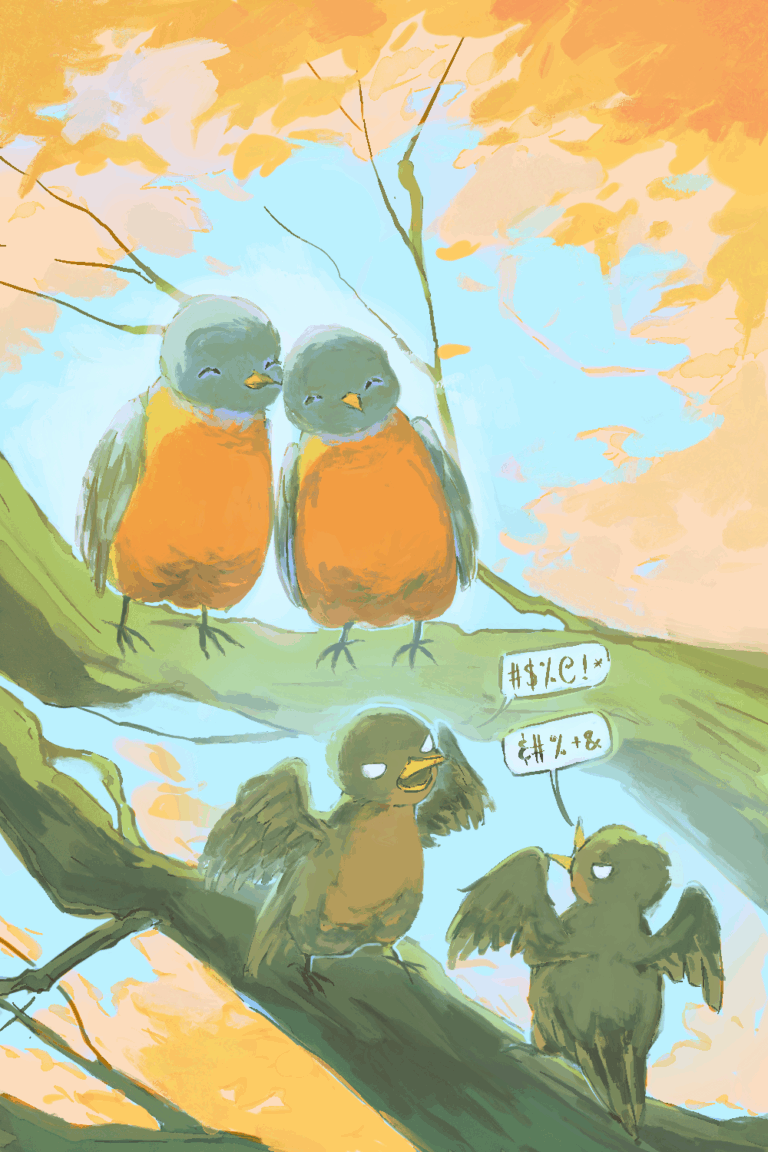
While cooperative relationships with siblings aren’t always the norm, in a study published in peer-reviewed journal Public Library of Science (PLOS) Biology on Oct. 9, 2025, a songbird species’ relationship with their siblings was found to benefit their foraging skills.

The great tit, or Parus major, the species the study looks at, makes for a good model species. The bird is well-researched, receives limited parental care and has observable social networks — an important trait for studying social learning. Social learning is any learning through observation, and involves strategies on when, who and what to copy. 

The author of the study, Dr. Sonja Wild, is a behavioral ecologist and research associate at UC Davis. She explained what she found regarding the great tit’s sibling relationships.

In a previous study looking at how social associations change during transition to independence in this species, we have shown that juveniles initially continue preferring to associate with siblings, even after they have become independent from their parents,” Wild said via email. “Our current study extends these findings, demonstrating that the close proximity among siblings provides opportunities for them to learn behaviors from one another.”

Of course, sibling relationships vary greatly. Not all bird species will have cooperative interactions; some might be more antagonistic. Lynn Schofield, a biologist for the Institute for Bird Populations, was able to comment on some of the different ways birds interact with their siblings. 

“There is a very broad variety of relationships that birds can have with their siblings; there are some species where the norm is siblicide [where one sibling kills another],” Schofield said.

For most raptor species, sibling relationships are antagonistic and siblicide is common. Falcons — one of the species Schofield has spent the most time interacting with — are a notable exception, being uniquely close to their siblings.

Falcons are very different from the great tits. They have smaller clutches and receive more parental care, which also impacts their sibling relationships.

In species with extended parental care, parents are often preferred sources of information, leading to stable intergenerational transmission of knowledge,” Wild’s study reads. “However, little is known about transmission pathways in species with limited periods of parental care.”

Great tits are species with limited parental care. There are other differences between great tits and falcons, despite both displaying cooperative — but still unique — sibling relationships. For example, unlike the great tits’ foraging behaviors, falcons’ basic hunting behaviors are innate. 

“[Falcons] that are raised in captivity, and do not have an adult that actively taught them to hunt, will learn to hunt,” Schofield said, with regards to falcons’ ability to learn hunting behaviors without parents or other adult birds.

The falcon’s basic hunting strategy is to locate a target and drop on it at high speeds. While their basic hunting skills might be innate, siblings can help one another perfect those skills. Falcons have been recorded playing with their siblings in ways that mirror hunting behaviors. 

For great tits, their siblings help them learn foraging skills via social learning. In Wild’s study, puzzles were used to represent foraging behaviors. Wild explained how puzzle boxes correspond to natural foraging behaviors.

During foraging, great tits often have to move foliage aside and sort through leaves with their beaks to find food items such as seeds or insect larvae,” Wild said. “In urban settings, they are also often required to modify the motor patterns they use for foraging in natural settings to access anthropogenic food such as trash or garden feeders.”

Different species and goals require different learning strategies. Whether experiential learning through practicing hunting with siblings or social learning through observing siblings’ foraging skills, these relationships are certainly something to consider.


Written by: Katelyn Burnsscience@theaggie.org

Aggies on ice: UC Davis club hockey builds momentum and community

Captain Wyatt Moore shares thoughts on the upcoming season


BY DANIELLE WIRNOWSKI — sports@theaggie.org


While UC Davis is home to competitive Division I athletic programs, club sports play an equally important role in campus life. These student-run teams offer opportunities for students to stay active, build close friendships and represent the school in a different way. 

Club sports often do not receive the same level of attention or support as their varsity counterparts, but this can give clubs without a varsity counterpart an advantage. 

While a student may come to UC Davis thinking there is no opportunity to play hockey at the collegiate level, they have yet to discover the club hockey team. The UC Davis club hockey team, which lacks a Division I counterpart, serves as the highest level of hockey representation at UC Davis.

The regular season for UC Davis’ club hockey team runs from the beginning of fall quarter up until the end of winter quarter. The team has the opportunity to play into spring quarter if they make the playoffs.

The Aggies are part of the Pacific Collegiate Hockey Association (PCHA) and play against other University of California (UC) schools, local universities and out-of-state schools.

The club has made much progress in recent years compared to its start in the 1980s, both in outreach and with regards to its players. 

“I came in as a first-year and there were 11 people in the club,” the club hockey team’s Captain, Wyatt Moore, a fifth-year mechanical and aerospace engineering major, said. “Maybe two or three of us had really competitive hockey experience before and coming into this year. We have 45 members now.”

The expansion of the team over the past few years has increased the team’s scores and potential for success. 

“We had all the skill in the world last year, and this year, it’s really about coming together,” Moore said. “This is the year to really try and go do something special.” 

The team went to the Western Collegiate Hockey Conference playoffs for the first time since 2020, but lost to Arizona State University in the semi-finals in February 2025. Moore reflected on the semi-finals with a positive outlook.

“Even on the side of a loss, I thought that was one of our best games of the season,” Moore said. “I’m pretty confident that if we play to our abilities, we should go undefeated. [We] can play off of strengths and [we] can play to their weaknesses.” 

Like many other sports, hockey is a team-based game. Success is determined not just by the individual skills and talents of the players, but also by how well a team plays together; a big part of which is formed by the team’s culture and bond. 

“The hockey culture in California is very tight-knit,” Moore said. “There’s a lot of prior connections, it really fosters a close connection and it’s really fun to get involved as early as you can.” 

These prior connections create a tight-knit club hockey team, strengthening their bond and increasing their ability to work together in an effort to make the playoffs again this year. Next, the Aggies play against Santa Clara State University on Nov. 8 at the Vacaville Ice Sports Center. 


Written by: Danielle Wirnowski — sports@theaggie.org


UC Davis Athletics partners with Tahoe Environmental Research Center to unveil brand new Lake Tahoe-themed jerseys

The campaign aims to boost excitement surrounding athletics and promote the research center’s work


BY COLINA HARVEY— sports@theaggie.org


In May, UC Davis Athletics announced a new line of jerseys to be worn by nine UC Davis teams this year. The jerseys introduced a new shade of blue into the color scheme: “bold aqua” to represent Lake Tahoe. 

The jerseys are a collaboration with UC Davis’ Tahoe Environmental Research Center (TERC). TERC conducts research on aquatic and terrestrial ecosystems, aiming to preserve Lake Tahoe through its studies. 

Danielle Shank, the senior associate athletics director for External Relations and chief marketing officer for UC Davis Athletics, explained how the partnership was formed. 

“Over the summer, [we] signed a new deal with Adidas; that’s who outfits all of our teams,” Shank said. “With signing this deal, they gave us some promotional money […]. I was talking with our athletic director about how he wanted to spend some of that promotional money, and we’re always looking for ways that we can show that Athletics is really the front porch of the university.”

While brainstorming which on-campus units to highlight with the new jerseys, Athletic Director Rocko DeLuca decided to partner with TERC.

“I don’t think enough people know about [TERC] given all the research they do,” Shank said. “If you were to Google what the temperature of Lake Tahoe is, that’s a UC Davis buoy that’s measuring that.” 

The jerseys, which Shank helped design in collaboration with Adidas, are light blue and feature the outline of the lake. The UC Davis Athletics logo is overlaid onto the illustration of the lake, which nearly stretches from coast to coast and creates a visual representation of the research that TERC does in both California and Nevada. The color, “bold aqua,” was chosen to represent the water of the lake. 

“When we worked with Adidas and looked at their color palette, that’s actually the name of the color,” Shank said. “We were looking at different shades of blue as much as we were learning about the Tahoe Environmental Research Center. Their research, their innovation is also pretty bold, and so it kind of seemed like the perfect marriage.”

While UC Davis Athletics has done themed games in the past, a partnership of this nature with new, custom-designed jerseys is the first of its kind at UC Davis. The nine ticketed teams each have one Tahoe-themed game on their schedule, in which they will display the jerseys. While the non-ticketed teams may not sport the jerseys this year, the Tahoe jerseys will be added to their collection once they order new jerseys. 

However, the campaign is not centered solely on the new jerseys; the Athletics Department is also ensuring that they bring attention to TERC, every step of the way. 

“We’re trying to link to their website,” Shank said. “We’re trying to make sure that we collab on social media and that we’re always talking about them, putting them in the forefront. So it’s not just, ‘Hey, we picked this new color.’ It’s very purposeful.”

The campaign has successfully boosted the profile of both UC Davis Athletics and TERC, according to Shank. After the jerseys were featured on ESPN’s SportsCenter in September, both traffic on TERC’s website and social media engagement for the Athletics Department increased significantly. 

“We got two million people who saw that segment, and that was the day of our game,” Shank said. “I’ll have to pull up the email, but I asked the Tahoe folks, ‘Did you get new people coming to your website?’ And they said we had, you know, 1,000 new users that never knew about us [or] followed our website. Our social media engagement went up 400%, so it’s clear proof of concept that it works.”

Shank hopes to be able to similarly highlight other units at UC Davis; however, the frequency will depend on the availability of funding. 

While there has been a large positive response to the campaign, some community members have objected to it. Social media users, along with fans of other universities — such as the University of Nevada, Reno (UNR) — have called it a stretch. 

“That’s ridiculous,” UNR football Head Coach Jeff Choate said in an interview from a post-media day meeting. “I’m sorry UC Davis, but that’s a fail in my book.”

UNR, which has a Division I Athletics Department 40 miles from the lake, hasn’t made a statement regarding the matter; however, many local Reno news outlets have published media in criticism.   

Shank clarified that UC Davis is not attempting to claim Lake Tahoe; rather, they are celebrating what makes UC Davis special. 

“It’s highlighting the research and the work we do there,” Shank said. “UC Davis is there 365 [days a year]; the people doing research on the boat are on the water 200 days a year. So UC Davis is always in Tahoe. Our people are there and doing the work, and people who are closer are welcome to claim Lake Tahoe. It’s not exclusive to us.”

For fans wanting to sport the gear themselves, there are several ways to acquire it. 

“Everyone asks how they can get the gear,” Shank said. “So we have an Aggie sideline store where you can […] choose the logo and then custom-design some gear if you want it there. The [UC Davis] Bookstore has some stuff too, so, ideally, we want to do a whole Lake Tahoe line and expand it in the future.” 

As these jerseys are added to the rotation in the Athletics Department, students and sports fans will be seeing a lot more of the Tahoe Blue in UC Davis Athletics.


Written by: Colina Harvey — sports@theaggie.org

Culture Corner

The Arts Desk’s weekly picks for movies, music and more 


By JONAH BERMAN — arts@theaggie.org


Song: “Automatic Love” by Nourished by Time (2025)

Baltimore native Marcus Brown, who performs under the stage name Nourished by Time, has been diligently crafting his idiosyncratic mix of R&B and pop for years. After switching to XL Recordings from an underground label in 2024, Brown has further refined his sound, resulting in one of the best breakthroughs from any artist this year.

In his stunning new album “The Passionate Ones,” Brown lyrically oscillates between discussions of labor, romance and community. As the sole performer, producer and mixer, Brown makes great use of synthesizers, percussion and piano to create a vibe all his own. If everything was right in the world, the recording’s opening track, “Automatic Love,” would be a certified automatic hit; the slow buildup which begins the song, culminating in Brown’s declaration of devotion to his unnamed lover, is a piece of pure catharsis. While this album is one of the year’s best, it has remained criminally underrated, failing to chart in the United States.

Book: “The Dispossessed” by Ursula K. Le Guin (1974)

Ursula K. Le Guin was a true original in the literary world. Over her nearly 60 years as a writer, she published 23 novels and dozens more short stories, establishing herself as a unique voice whose oeuvre of science fiction stories differentiated itself from anything else in the genre. 

“The Dispossessed” chronicles physicist Shevek as he travels from the politically-anarchist planet of Anarres to the wealthier and rigidly-hierarchical planet of Urras. The language that Le Guin uses to describe these worlds is superbly vivid and engaging. However, Le Guin’s work remains immortal not because of the worlds she built with her pen, but because of the way her stories mirror our own human follies. Shevek’s shock and dismay at customs which both Urras citizens and readers could find commonplace forces us to question the norms we take for granted, and proactively work towards improving ourselves and the societies we live in. Only the greatest of prose masters possess the power to do that.

Movie: “Phantom of the Paradise” dir. Brian De Palma (1974)

If you’re going to watch one mid-1970s rock musical with a cult following this Halloween, make it “The Rocky Horror Picture Show” (1975). But, if you want to watch two, you’ll have a rollicking good time with Brian De Palma’s absurd and mildly ridiculous “Phantom of the Paradise.” Paul Williams stars as villainous record executive Swan, constructor of the titular Paradise mansion and thief of songwriter Winslow Leach’s music. Williams also composes the film’s soundtrack, which is full of great tunes that get stuck in your head for days afterward. Some may argue that the film stretches itself too thin by attempting to simultaneously adapt elements of “Faust,” “The Phantom of the Opera” (1910), “The Picture of Dorian Gray” (1880) and “Psycho” (1960). However, these critics are allergic to fun. I urge you to suspend your disbelief for 90 minutes, revel in this film’s glam-rock glory and sigh as you wonder why so few films contain a character named “Beef.”

TV Show: “The Day Today” by Chris Morris and Armando Iannucci (1994)

Although “The Day Today” only aired for a month, its jokes are so timeless that it remains, along with Mr. Bean and Boris Johnson, one of Britain’s premier comedic achievements. Fans of wry satire will surely delight in its style, which comments on a variety of topics within mid-90s British society, along with a healthy amount of time allotted to making fun of Americans. Chris Morris stars as the creatively-named newscaster Chris Morris, who leads an ensemble of oddballs over the series’ six episodes. The show’s dark comedic style is in many ways analogous to current satirical “news outlets” like The Onion, which publish profoundly absurd headlines that nonetheless offer a glimmer of truth. “The Day Today,” however, remains in a league of its own — with farcical yet ingenious writing that makes me want to forgive the United Kingdom for the culinary disaster that is mushy peas.


Written by: Jonah Berman—arts@theaggie.org 

Language programs at UC Davis provide opportunities for cultural insight

UC Davis faculty and students discuss the importance of language learning as nationwide enrollment drops 


By HANNAH OSBORN — arts@theaggie.org 


As children, we learn a language simply through our observations of the world; it was almost mindless. As students, the loss of this ability to pick up language as easily can keep one from venturing into the world of language-learning as an adult. Despite the increased difficulty, UC Davis students and faculty still find value in undertaking the acquisition of another language.

Students seeking a Bachelors of Arts or Bachelors of Applied Science through the university’s College of Letters and Science or College of Biological Sciences must take at least 15 units of a language to complete their degree. This creates many opportunities for UC Davis students to become engaged in their choice of any of the 14 languages currently offered. 

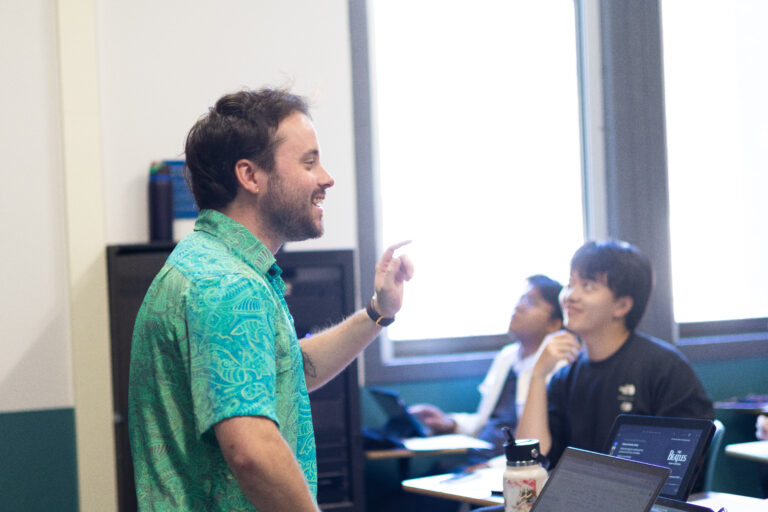
Carlee Arnett, professor of German at UC Davis, has noted the enthusiasm she witnesses in classes as a result of students feeling motivated to learn a language. Whether there’s a degree requirement or not, she has found that students are usually drawn to a language because of a personal involvement with the culture they seek to engage in.

“The importance [of learning a language] is it makes you a richer human being; it makes you think about your own culture,” Arnett said. “Even if you just take two or one year of a language, you know there are things out there that are different from you.”

For Arnett, there is great enjoyment in getting to watch first and second-year students discovering a culture through the medium of language. Students are able to confront culture on a more global scale, in order to better understand differences.

Students like Samia Parsons, a third-year pharmaceutical chemistry major who enrolled in Spanish 001 last quarter, also recognize the value of learning a language at a university level. 

“There’s definitely such a difference actually trying to speak a language in a class full of students who are all trying to do it, and a [teaching assistant] who knows how to speak it,” Parsons said. “I feel like I improved so much more in one quarter than I had done in two years of [online learning].”

Learning a language as an adult includes not only learning how to communicate, but also understanding the components of a culture, Navid Saberi-Najafi, professor of Persian, explained. Within UC Davis’ Persian Program, Saberi-Najafi emphasizes the rich heritage of the language students are engaged in.

“It cultivates empathy, historical awareness and an appreciation for the plurality of human expression,” Saberi-Najafi said. “In this sense, language learning is not an ancillary skill but a primary avenue of humanistic inquiry. Because Persian allows students to engage directly with primary texts, they gain the ability to form their own understanding of Iranian and broader Middle Eastern history and culture, rather than relying solely on narratives shaped by Western perspectives.”

Learning a language allows students to access a different realm of experience from their own and to broaden their horizon of thought, empathy and understanding, according to UC Davis students and faculty. At a time when enrollment in languages other than English has declined in American universities, the passion held by faculty to teach and the willingness of students to learn shows an appreciation for culture and the pursuit of knowledge at UC Davis.

Enrollment in languages other than English decreased by 16.6% between fall 2016 and fall 2021, according to a 2023 census report of 2,455 institutions created by the Modern Language Association (MLA). This is the 26th census of American higher education programs that the MLA has conducted, in order to better understand the field of academia and enhance humanities education.

While acknowledging a general downturn, the MLA report did note that programs which remained robust often shared a focus on the cultural aspect of language in their pedagogy and teaching approach.

The importance of the cultural component was something that students at UC Davis also report as motivating their participation in language courses. Parsons shared that while having taken Spanish, her goal is to learn Arabic as a way to reconnect with her culture.

“I feel like it would really help me connect with aspects of culture that I’m missing,” Parsons said. “I’m doing Spanish as a gateway to the process of learning a language.”

Saberi-Najafi is similarly dedicated to the cultural transmission of language. What draws students to learning a language is the culture they become immersed in through its acquisition, Saberi-Najafi explained.

“Teaching Persian to undergraduate students has been an intellectually rewarding experience,” Saberi-Najafi said. “Students study Persian to sharpen their literacy skills, to communicate eloquently with their Persian-speaking grandparents, to immerse themselves in the rich cultural heritage of Iran and to broaden their understanding of the interconnectedness of cultures.”

Saberi-Najafi also shared a poem by Sa’adi of Shiraz, which he translated from Persian and uses as educational material for his undergraduate students. The poem reflects on the importance of empathy for people of other cultures, which Saberi-Najafi believes students can gain through studying new languages. 

“The children of Adam are limbs of one another, / Created from the same essence,” the poem reads. “When the world afflicts one limb, / The others cannot remain at rest. / If you feel no sympathy for the suffering of others, / You do not deserve to be called a human.” 

Written by: Hannah Osborn — arts@theaggie.org

Review: ‘Interview with the Vampire’ is a thrilling tale of memory and devotion

The screen adaptation of Anne Rice’s book series is a masterwork of television storytelling 


By NATALIE SALTER—arts@theaggie.org 


Memory is a complicated thing. While you might easily remember the details of a conversation you had yesterday, the things you said five years ago are harder to recall. Our memories fade with time, reshape themselves and are even subconsciously blotted from our minds. One can imagine, then, how difficult the act of remembering would be for someone who’s been alive — or rather, undead — for over a hundred years. 

Such is the premise of AMC’s “Interview with the Vampire” (2022), adapted from Anne Rice’s 1976 novel of the same name. The second season, which came out in 2024, just arrived on Netflix this month. The titular interview’s subject is Louis de Pointe du Lac (Jacob Anderson), and the story is his: the transformation and tumultuous life of an immortal vampire, for all of its tragedy and bloodshed. But, as the show’s tagline remarks, “memory is a monster,” and committing his sanguine existence to text is not as simple as it seems.

The story is divided between Louis’ interview by the dryly honest investigative journalist Daniel Molloy (Eric Bogosian) in 2022 and his past in early 20th century New Orleans, the latter being the place of his fateful transformation. The pair find themselves unexpectedly unraveling mysteries not only in Louis’ past, but in their present interview as well — the story unwinding masterfully from episode to episode.

At the heart of Louis’ story is his torrid relationship with the charismatic vampire Lestat de Lioncourt (Sam Reid), his maker and his lover. Eternally bonded, their affection and anger towards each other profoundly shapes the very fabric of their narrative and the characters around them. Anderson and Reid deliver especially showstopping performances when on screen together. Whether they’re sharing a moment of tenderness or one of explosive rage, the depth of emotions that the characters feel for each other are expressed phenomenally by the pair. 

When their family expands to include the teenage vampire Claudia (Bailey Bass and Delainey Hayles), the narrative becomes more complicated than ever before, as her feelings towards her foster parents are darkened by the fact that she is now trapped in an adolescent body for eternity. Bass, who portrayed Claudia in season one, and Hayles, who took over the character in season two, give some of the best performances of the entire series. One of the best arcs of the show ensues as Claudia struggles to accept the boundaries and sufferings of her new existence, entwining girlish whimsy with violent rage. 

The setting of “Interview with the Vampire” breathes new life into a genre. Mostly set in sprawling Gothic castles in Europe, the film places the vampire in conflict with a new sociocultural environment. The historical mortal and vampiric worlds intersect as the series explores Louis’ identities as a queer Black man in the Jim Crow South, paying careful attention to the way the reality of the story’s time and place affect the characters’ lives. As the world around Louis, Lestat and Claudia shifts and evolves, they are shaped by it as well, even in a state of eternal youth. 

The series also employs its unique storytelling style masterfully, capturing the viewer’s attention completely in both past and present scenes alike. Louis’ interview narration provides depth and insight into the events that unfold in the past, but the show just as cleverly plays with the gaps in his remembering. Uncertain memories and altered retellings blur the lines between objective and personal truths, weaving mystery into the fabric of every scene.

Anderson’s performance as Louis masterfully captures the vampire’s evolution over a century and the grief he acquires throughout it. His ability to convey a rich depth of emotion in the smallest of expressions or line deliveries is incredible. Likewise, Reid is as irresistibly charming and detestable as the flamboyant, fickle Lestat. His ability to make the audience loathe him one moment and love him the next is a testament to his talent.

What makes “Interview with the Vampire” so marvelous is that it pushes beyond being simply a vampire story, using the supernatural to explore tangling emotions and relationships that are all too human in nature. For all of the death and bloodshed, the story is fundamentally one of love, from its tenderest to most violent forms. Between the moving performances of the central cast and the struggles that befall their characters, every episode is an emotional experience as much as a thrilling one.

The first two seasons of the series are out now, but fans hungering for more will be delighted to know that another season is on the way. The third season, titled “The Vampire Lestat” after the second book in the series, comes out in early 2026. Notably, the power of narration will move from Louis to Lestat, offering a fresh backstory to explore and a new perspective on familiar events. 

Though the Halloween season is coming to a close, “Interview with the Vampire” is such a brilliant piece of television that it ought to be enjoyed regardless of what time of the year it is. Its nuanced writing, exceptional performances and intricate visual design make it a gold standard not just for vampire storytelling, but for television as a whole.

Written by: Natalie Salter—arts@theaggie.org

Commentary: May the ‘final girl’ trope never die

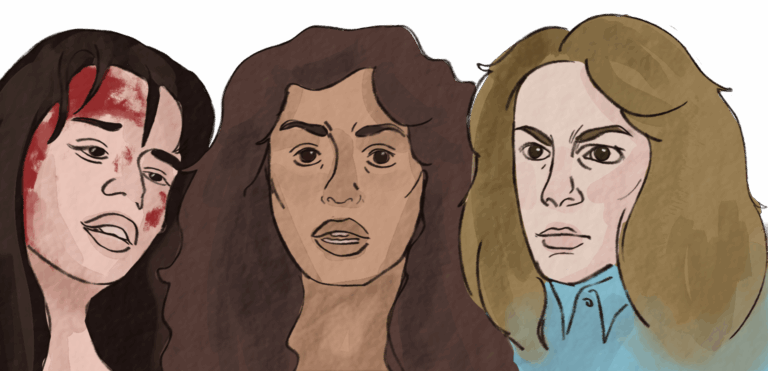
Three “final girls” that pushed the horror genre to subvert audience expectations of gender roles


By BELLA PETERSON — arts@theaggie.org 


Content Warning: This article contains mentions of sexual assault and violence against women. 


“This is Ripley, last survivor of the Nostromo, signing off,” Ellen Ripley, “Alien” (1979) heroine, recited as she reached the end of her harrowing journey. As the credits roll and Ripley has succeeded in winning her last fight against an alien aboard her commercial starship, you feel a sense of satisfaction settle in your soul at seeing the story end with a woman winning. 

When you think of many iconic horror titles, you probably think of one woman in particular. “Halloween” (1979)? Laurie Strode. “Scream” (1996)? Sidney Prescott. “Barbarian” (2022)? Tess Marshall. 

Horror movies have existed for a long time, with or without a “final girl;” a horror classic, “Nosferatu” (1922), featured the opposite of a “final girl” when its leading female character, Ellen, sacrificed herself for the greater good. So, where did this phenomenon come from? How did women find a way to singularly conquer a genre with the simple feat of survival? 

There can be many different answers when it comes to the beginnings of the final girl trope, but there’s no denying the influence of Sally Hardesty, a survivor of the 1974 “Texas Chainsaw Massacre” film. Played by Marilyn Burns, the shot of Hardesty laughing manically, covered in blood from head to toe, while clinging to the back of a truck as she’s finally free from the terrifying Leatherface and his chainsaw, has engrained itself into the minds of many. 

Knowing that somehow, despite the horrors and trauma she faced, the main female character made it out alive, gave audiences a feeling they never wanted to let go of. Since its 1970s release, the film franchise has created nine movies total and a video game. 

Just a few years after the release of “The Texas Chainsaw Massacre,” audiences found that Sally Hardesty wouldn’t be the only girl to face death and walk away to tell the tale. In 1978, “Halloween” created Laurie Strode. The then-budding actress Jamie Lee Curtis stunned audiences with her role in the film as she went up against the “babysitter killer” himself, Michael Myers. 

What makes the final girl trope so exciting are the odds, most times being stacked against “final girls”; it isn’t the muscular jock that lives to see the light of day or even the tough cop with his firearm — it’s the girl who fought like hell to live to see another day. What’s so refreshing about this trope and the role it plays in the horror genre is witnessing a woman use her intelligence and character to prevail against forces — in most cases men — that confined her.  

Prior to the rise of the final girl trope, horror films included their fair share of depicting abuse toward women. While horror films are made to be gory, movies like “The Evil Dead,” (1981) feature brutal scenes of women being attacked with no moments of empowerment or reflection to counteract the violence. 

When the film’s character Cheryl Williams, played by Ellen Sandweiss, was sexually assaulted by a forest at the beginning of the movie, many viewers drew attention to the lack of tact in the scene. After its release, Director Sam Raimi came forward to express his regret over the scene. 

“I think it was unnecessarily gratuitous and a little too brutal,” Raimi said in a 2012 interview. “I think my judgment was a little wrong at the time.” 

In contrast, the final girl trope juxtaposes this horror history — subverting these stereotypes within the genre and proving that they’re more than just a plot device to be torn to shreds. 

“Scream,” the slasher meant to pose as a parody of the genre as a whole, introduced one of the most important women in “final girl” history: Sidney Prescott. In the film, Prescott herself speaks out against the way horror films depicted women before the emergence of the trope.

“What’s the point?” Prescott said in the film. “They’re all the same. Some stupid killer stalking some big-breasted girl who can’t act, who is always running up the stairs when she should be running out the front door. It’s insulting.”

Prescott directly states in the film that horror movies use women as “eye-candy,” with little-to-no survival instinct that leads to their untimely demise. Prescott debunks the stereotype herself when she faces off against Ghostface.  

A modern day “final girl” takes shape in Zach Cregger’s directorial debut, “Barbarian.” The movie follows Tess Marshall, a woman looking to stay at an Airbnb for a job interview, after she discovers the place she booked already has a man staying there. What begins as an innocent inconvenience devolves into a petrifying nightmare as the pair discover the horrors existing below the property. 

Cregger was inspired to write “Barbarian” after reading the novel “The Gift of Fear” by Gavin de Becker, which in one chapter, informs women how best to avoid “red flags” in men. As a man, Cregger realized just how much women have to be aware of — a horror story in itself. In “Barbarian,” Cregger also reflects on Becker’s descriptions of three different types of men to look out for, each of which Marshall is confronted with. 

As Marshall faces the brutality of her situation, trapped underground as she uncovers a long history of women being kidnapped and harmed in the tunnels underneath the Airbnb, she reminds audiences of real-life social conflict and the circumstances that made the final girl trope necessary. 

Marshall is the perfect representation of the importance of the “final girl”; she reflects the mortality of women and the strength they need to possess every day. Despite the odds constantly stacked against her, she survives. 

Today, we see the trope of “final girls” continuously evolve within the horror genre, as directors continue to experiment with power dynamics and gender roles. From the bold Maxine Minx of “X” to the unflinchingly loyal Emerald Haywood of “Nope” to the sentient robot Iris of “Companion,” one thing that will never change is the “final girl’s” ability to find the strength to keep living. There aren’t many film genres dominated by women, but one can easily say that horror wouldn’t be in the place it is today without the characters who lived on to earn the title “final girl.”     

Written by: Bella Peterson — arts@theaggie.org

Tuned in: How do KDVS 90.3FM radio hosts curate their soundtracks?

Student radio station DJs view music as a deeply personal experience to be shared


By IQRA AHMAD — arts@theaggie.org   


Music has long been recognized as a universal language; one capable of transcending culture, geography and even generations, according to a Harvard music study. Though infinite in its possibilities — with countless variations of notes and rhythms — music remains deeply personal. 

Music is often defined as “vocal, instrumental or mechanical sounds” containing harmonies, melodies or rhythms. However, this definition falls short for many, missing the mark of what makes music so essential — its emotional resonance. DJs at UC Davis’ on-campus radio station KDVS 90.3FM spend hours each week hand-selecting and sharing music with radio listeners. 

“Music to us is important culturally and socially,” KDVS radio host Maia Madsen, a second-year history and psychology major, said. “We can associate it with events and indirectly share the aspects of our lives. It’s quite intimate. It’s a callback to certain, beautiful moments.” 

For Sophia Fenchel, a second-year environmental toxicology major and radio host at KDVS, music is an experience: one that is extremely personal and unique. 

“The way in which our brains take in music is different for each and every person.” Fenchel said. “Each person’s ear processes and interprets the music differently.” 

These perspectives reveal how music serves as an extension of the human experience, especially in the eyes of those curating the background soundtracks to our lives.

“Music exists in all of the moments in-between,” Madsen said. “The different lived experiences we bring means that we all interpret music differently.” 

At UC Davis, these individual experiences come together at KDVS, a student-run, non-commercial and freeform station founded in 1964. KDVS hosts feel the station is not only a platform for broadcasting songs, but rather a community encouraged to engage in music appreciation and discovery. KDVS currently maintains over 150,000 titles, including vinyls, CDs and cassette tapes.

“KDVS has a music department that fosters and takes care of our music library,” Madsen said. “There is a very dedicated community of radio hosts curating shows.” 

Each program on the station represents the personal taste and vision of its hosts. Madsen and Fenchel, for example, recently worked on a themed show titled “#Fuzzy.” 

“A week leading up to the show, we decide on a theme, one we choose based on how we feel and what we want to share,” Fenchel said. “We choose our music separately so we can listen to the songs together for the first time and discuss them.”

Humans feel emotional responses to the harmonic continuity and progression of music, where every note adds onto the expectations of the song, according to an article by the British Psychological Society. When Fenchel selects music based on the theme of the show, she’s trying to shape the emotions she wants listeners to feel.

“I chose cozy music for ‘#Fuzzy’ — music that made it feel like I was bundled-up and drinking a cup of tea,” Fenchel said. “It was more jazzy, saxophone music.”

Another part of what makes the KDVS community distinctive is its commitment to variety and openness. 

“At the end of the day, the people who listen to KDVS have to be open to different kinds of music,” Madsen said. “For example, Professor Sen plays Bollywood, and a lot of other people play indie rock or electronic, and you can go through all of that within the span of five minutes.” 

Tatianna Arias, a KDVS radio host and third-year English major, shared their thoughts about the way music can deeply engage listeners and radio hosts alike to form a dialogue and connection. 

“There’s a whole community of people who genuinely love music — listening to it, discovering it and sharing it,” Arias said. “Local radio has a kind of soul to it, you’re hearing songs that someone handpicked for all of their listeners, and that creates a real connection with the Davis community through music.”

The DJs shared the sentiment that working at KDVS has allowed them to interact with other students and share parts of themselves through a selection of songs. 

 “I think of music as a form of communication,” Arias said. “When I play something on air, I’m sharing a piece of myself. Sometimes listeners even call in to request songs that fit the vibe of my show, and in those moments, we’re bonding through the music.”

Madsen, Fenchel and Arias view music as both individual and inherently communal. Each person processes sound differently, allowing music to connect people across experience and identity, according to the DJs. For the hosts at KDVS, sharing music is more than entertainment; it is an act of communication and empathy. 

“I want listeners to become more curious about music and be inspired to engage with new tastes,” Madsen said. 

That same spirit of exploration resonates with Fenchel, who sees radio as a space to introduce different genres of music and share experiences.

“I hope people learn new music from us, to add [the songs], to listen to [them] or even just have it playing in the background,” Fenchel said. 

At the KDVS radio station, show hosts encourage listeners to engage with music’s unique ability to unite and differentiate. Whether it’s through a saxophone or a fuzzy indie guitar riff, the DJs at KDVS remind us that music doesn’t just fill silence — it connects individuals across frequencies.


Written by: Iqra Ahmad — arts@theaggie.org 

Students dive into romance books as the ‘cozy season’ arrives

0

Aggies reflect on how romance books have shaped their image of love and relationships


By AMBER WARNKE — features@theaggie.org


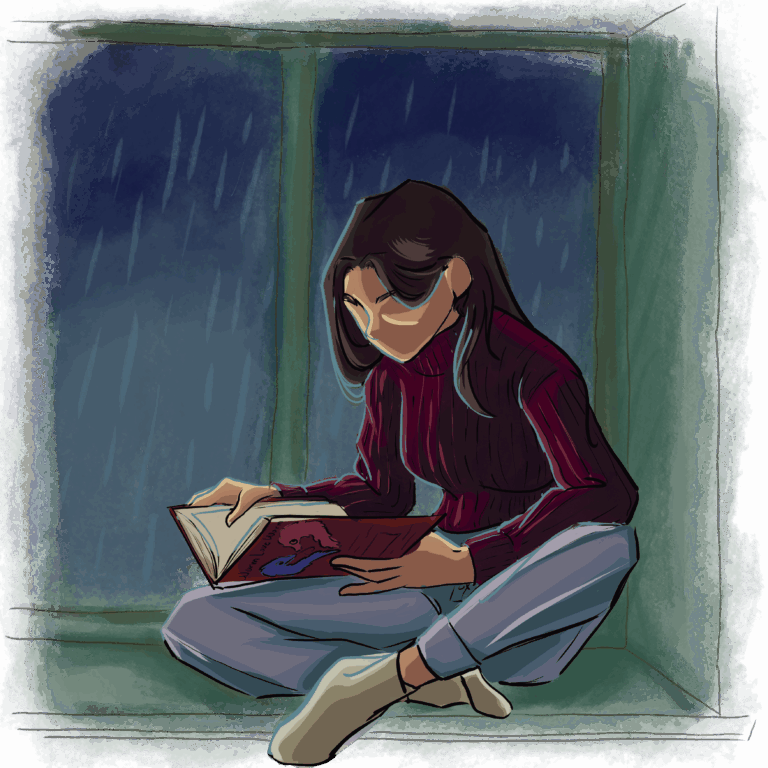
As autumn progresses and students prepare for the cold winter months ahead, many Aggies have turned to reading romance novels to get into a cozy mood. 

Ariel Park, a third-year psychology major, is an avid romance reader, especially in the “Romantasy,” or fantasy romance, subgenre. She believes that this area of romance books can connect especially well with college students, who, like the characters in these novels, also face having to balance a variety of responsibilities.

“Everyone likes love, so it’s fun to read about connection and caring, specifically in Romantasy when the world is at stake,” Park said. “Characters have to balance the weight of the world with their loved ones, and it’s not the same for college students — but we can still have a lot on our plate that we have to handle while we learn how to manage our relationships.” 

To Park, this has had an overall positive effect on her idea of love, as the genre has given her examples to learn from as she figures out what she wants in her own life.
“It definitely has raised my standards; I think it makes me expect someone to sacrifice for me and really put effort to show their love for me,” Park said.

It has been proven that reading fiction correlates with increased levels of empathy, as it encourages readers to learn how to look at any given situation through another person’s point of view. Empathy is a key factor to developing strong relationships, and romance books that have healthy portrayals of romance may help young adults as they navigate the often-messy world of college dating.

Heather Williford, a UC Davis alumna with a Bachelor of Science (B.S.) degree in cognitive science, suspected that this may be a key reason why romance books can be so popular within the college student age range, as many may be dealing with the often-difficult process of finding a compatible partner.

People can live vicariously through the characters in [romance books],” Williford said. “So if you’re lonely, it can really provide some catharsis.”

Despite the many positives of reading romance books, Park acknowledges that romance is by no means a perfect genre.

“They can provide a lot of good examples of healthy relationships, but there are also other books, like a lot of the Colleen Hoover books, that are notorious for being questionable with their standards of what love is,” Park said. 

Park’s comments are especially relevant due to Colleen Hoover’s increased popularity in recent years, with one of her books, “It Ends With Us, adapted into a movie in 2024, along with “Regretting You” in 2025. Hoover has been criticized for her representation of domestic violence, trauma and controlling behavior in her books. 

However, this issue is by no means isolated to a singular author. Other popular romance novels, such as “The Love Hypothesis” by Ali Hazelwood, have also faced criticism for their portrayal of power imbalances between characters. 

Despite the inconsistent portrayals of relationships within many romance books, UC Davis English professor Jennifer Tinonga-Valle warns against overly simplistic dismissals of the genre as a whole.

“I think too often people criticize romance as not having much literary value or lacking depth, but a lot of that is tied to the fact that women are the primary readers of many romance books,” Tinonga-Valle said. “Because the genre has always been centered around female readers, it has always been criticized for that.” 

Romance is not given nearly enough credit for its depth as a genre — with many of its books exploring themes around human existence and meaning, according to Tinonga-Valle.  

“Many of the books we think of today as classics, like ‘Pride and Prejudice’ and ‘Jane Eyre,’ are romance novels, which allows them to use these relationships to explore what human connection means,” Tinonga-Valle said. “Romance has always stayed a popular genre throughout literary trends, which I think is a testament to how universally applicable its messages are.”

Valle recommended “Persuasionby Jane Austen for its timeless themes to those looking to read romance books this fall season.

“I think it’s something that you can return to at any age and get something different out of,” Valle said. “When I first read it, I related to different points than I do now, and that has made it really special to me.”

When the months get cold and the quarter system feels like a constant stream of midterms and essays, it can be helpful for many students to take a moment to stop and read a cozy romance book. Amidst times of romantic turmoil, according to Park, romance books can also act as a beacon of hope for readers, reminding them not to lower their standards or accept treatment that is less than what they deserve. Most importantly, there are a plethora of romance books to choose from, with reading — for many — serving as a simple, non-academic activity to help promote a healthier school-life balance.


Written by: Amber Warnke — features@theaggie.org

Teaching assistants: the unsung heroes of the undergraduate classroom

0

How much of your undergraduate experience at UC Davis is determined by TAs? 


By AMBER DUHS — features@theaggie.org 


Each fall quarter, new Aggies file into lecture halls and discussion rooms alike. They find a chair, settle in and look up to find someone who isn’t the professor — a structure unique to many modern classrooms, and one most students don’t recognize.  

More and more commonly in undergraduate classrooms, specifically in general education (GE) and lower-division courses, sections are being led by teaching assistants (TAs). While in the process of completing their graduate degree or attaining their Ph.D., these amateur-professors are the glue that holds the University of California (UC) undergraduate classroom together: leading discussions, teaching entire sections asynchronously and acting as the primary liaison between students and course knowledge. 

At UC Davis, there are two main ways the classroom is set up. The first is the more traditional way — a professor who lectures on the material for a designated amount of time per week and a TA who leads discussions, hosts office hours and works directly with students. The second, however, features the TA as the star of the classroom: teaching, holding office hours, grading all student work and operating as the professor for all intents and purposes. 

Aaron Saint John, a third-year Ph.D. student in German literature and an elementary German TA, described the benefits to this classroom setup in a language course. 

“I do best when we have this kind of level of freedom, and there isn’t necessarily a professor or a lecturer there every day saying ‘this is all you have to do,’” Saint John said. 

With professors taking the backseat, TAs are given the opportunity to not only learn to manage their classrooms independently, but organize and change their curriculum accordingly. 

“Being hands-on you can specifically tailor how you teach a class to your certain section, based on general trends or behaviors; […] one section may be more active in answering questions, or pick up lab skills easier,” Kevin Gu, a fifth-year chemical engineering Ph.D. student who is teaching the Coffee Lab course this fall, said. 

This level of freedom does come with its qualms, however. As the undergraduate experience changes, so does the classroom — and for Siva Shinde, a seventh-year Ph.D. student who worked as a TA through all stages of the COVID-19 pandemic, a lot has shifted. 

“Now that we have artificial intelligence, we have to change our strategies around language, because […] the answers are available everywhere,” Shinde said.  “We want to strategize exercises or assignments where students are forced to […] engage with the material, rather than using AI to easily cheat their way through their homework.”

Beyond the challenges AI has brought upon every well-meaning TA, however, are the additional difficulties described by Gu that come with teaching a course designed for a wider audience, rather than a specialized major or seminar course.

“If you’re […] teaching a class and it’s just [for] major [students], everyone’s there for a reason: they like the subject, they are taking a certain set of knowledge away from the class,” Gu said. “[In general education courses] everyone comes from a different level of lab skills, understanding [of] the subject and what they want to take away from the class itself.” 

Gu continued to explain how student determination can shape the goals of the classroom.

 “You really have to understand what your students want to get out of it […] especially at the university level, you can’t force anyone to do anything,” Gu said. 

In addition to the struggles and victories within the classroom are the external difficulties that come with teaching through a publicly-funded position at a public research university. 

“We’re in an especially tough time for academia right now in terms of funding,” Gu said. “We’ve had a lot of cutbacks [on] the amount of TAs that [can] be hired. So that means more responsibilities for TAs that do get hired.”

This results not only in competition for a graduation requirement, but an increased workload for already busy TAs.  

The changing landscape of academia is unrelenting, from budget cuts to the constant development and improvement of AI platforms like ChatGPT, but that’s exactly why, according to Shinde, TAs are in a seemingly optimized position to foster educational growth. 

“There are no young professors,” Shinde said. “Students are more open to [TAs].”

In intimate discussion sections, or a language class where you embarrassingly mispronounce the same word for the 14th time, the goal is for students to share their ideas, feel comfortable and engage in academic conversation.

“That doesn’t [always] happen with a professor,” Shinde said.

This often necessitates a more approachable figure, allowing for students to take advantage of their more interactive courses. 

The role of a TA doesn’t solely benefit undergraduate students though, as the position provides many graduate and Ph.D. students with an opportunity to grow as instructors.

“[Being a TA] is a learning experience for your TAs as well,” Gu said. 

As a matter of fact, many graduate and Ph.D. students are required to teach multiple quarters as TAs to receive their degrees. Beyond this requirement, however, is the fact that many TAs find genuine satisfaction and love in teaching. 

“Even just after one or two weeks, watching people actually be able to communicate with each other — to write, to speak, in a language that they couldn’t even begin with just two weeks before — is actually really, really rewarding,” Saint John said.

Despite the natural stress of a graduate degree or Ph.D. — along with the changing tides of academia as a whole, especially at a UC, and the struggles and triumphs that come with your average classroom — TAs keep their heads up. As Gu, Shinde and Saint John noted, juggling multiple responsibilities and sections can be difficult; however, understanding that they’re making a difference in students’ lives and education can make it all worthwhile.


Written by: Amber Duhs — features@theaggie.org 

The new wave of the ‘pop princes’: cringe or charismatic?

0

The newly crowned “pop princes” — Benson Boone, Sombr and Role Model — are taking over the Internet


By VRITI SHAH — features@theaggie.org


“Where’s my Sally tonight?” echoes across social media, with thousands excited to find out which fan of Role Model, a new fan-favorite pop star, will be pulled on stage to dance with him while he sings his hit song “Sally, When the Wine Runs Out.” Scroll down a few videos and one might see Benson Boone backflipping on stage while singing his chart-topper “Mystical, Magical.”

It seems that, in almost every TikTok video, users are making content with Sombr’s “back to friends” or Alex Warren’s “Ordinary.” The spread of trending audios has ignited the flame of fame for many celebrated pop singers today.

Of course, the concept of a “pop prince” is not a new trend. Over the years, pop princes have included all — but are not limited to — George Michael, Justin Timberlake, Usher, Justin Bieber, Michael Jackson and Harry Styles. But even with large adoring audiences and fanbases, these artists were faced with many critics questioning their talent.  

Similar to prior male pop stars, new pop princes have taken the spotlight with their own loyal, adoring fan bases that are completely charmed by their stage presence and music. In turn, they are taking on their own fair share of critics, who are widely skeptical of the success and worthiness of the newly crowned pop princes.

UC Davis students have a diverse range of opinions regarding this new wave of musical artists.

“I actually really like them,” Pamela Pompa, a third-year computer science major, said. “I don’t listen to their music, but in terms of personality, I think I like that they are authentic and don’t try to, like, impress people. I actually liked [Benson Boone’s ‘Mystical, Magical’] when it came out, and I was surprised people didn’t. The lyrics were dumb, but I didn’t listen for [the lyrics].”

Pop songs are often made for the masses. Like Pompa, many believe that, as long as an artist is authentic in their work, the public will enjoy listening in.

However, others find that the issue with the new pop princes is their lack of authenticity. 

“Benson Boone — I find his music to be pretty generic,” Vanessa Frutos-Salgado, a first-year chemical physics major, said. “I feel like he could try to be better. He is kind of cringe sometimes, because I feel like when he doesn’t know what to do on stage, he resorts to doing backflips, which is really cool and impressive, but sometimes I’m like […] he did this because he ran out of other ideas; […] he lost potential.”

Recently, many artists have been attempting onstage viral moments to bring light to their tours. 

Pop princess Sabrina Carpenter, for example, has been an expert at these viral moments. On tour, she continuously broke the Internet with her “Nonsense” outros, in which she changed lyrics of her song “Nonsense” every night, rhyming with the cities she is performing in, with the addition of a cheeky, humorous punchline. 

Another popular public opinion involves an artist’s “hype.” Many believe that an artist’s charisma does not give them a one-way ticket to success. Others believe that these new male pop stars simply pale in comparison to the iconic crowned princes of the past.

“I was a big Harry Styles fan, so I think he really came a long way,” Isha Enriquez, a fourth-year cognitive science major, said. “I like how he has a variety of styles and his voice can suit anything. […] He started touring for like a few years straight; it was crazy,”

Enriquez continued to share her admiration for some of the more classic pop princes. 

“In my opinion, I don’t think male pop artists right now are as big as that, unless I’m just not in the loop — like, I kind of stopped listening to male pop artists after [Harry Styles],” Enriquez said. “I know Benson Boone’s out there, but like, I don’t know how big he is. Sure, his songs are on the radio, I hear them all the time, [and] they get stuck in my head, but I think Harry Styles made it big.”

The world will always have contrasting opinions on art, popular media and the next big pop prince, which highlights art’s purpose in promoting differing conversations and interpretations. It is the diverse perspectives, as these UC Davis students have shared, that fuel creative inspiration and give each new pop prince their crowns.


Written by: Vriti Shah — features@theaggie.org

Attendees at UC Davis’ Fall Career Fair reflect on their experiences

0

For many attending students, expectations differed from reality


By AMRA ABID — features@theaggie.org


As the time hit 3 p.m. on Oct. 15, hundreds of students donning pressed slacks, blazers and folders full of resumes filed out of the University Credit Union Center as the UC Davis 2025 Fall Career Fair came to an end.

With the purpose of helping undergraduate students land internships and entry-level positions, career fairs are advertised to serve as a way for students to speak face to face with employees and recruiters at companies and get a leg up in the hiring process.

Maya Kusumakar, a third-year managerial economics and computer science double major, attended her first career fair hoping to secure an internship. However, after speaking to recruiters and handing out resumes, she explained that she felt less hopeful about obtaining career prospects than she had before the event.

“My expectations were that, you know, they would be offering jobs,” Kusumakar said. “But I think that they are here for marketing just as much as [they are for] recruiting.”

Riya Elizabeth and Shruthi Khurana, both first-year business analytics graduate students, had travelled from San Francisco with similar, hopeful expectations in mind. However, after speaking to dozens of recruiters, they both shared shifting perspectives on the function of the event.

“I didn’t find [the career fair] as a place where we’ll actually get a land on a job,” Elizabeth said. “It felt more like a space to network and get more understanding of the recruiters.” 

Having attended a career fair before, Summer Sueki, a third-year cognitive science and design double major, had a similar experience and, this time around, went with the primary objective of speaking to recruiters. To prepare, she rigorously researched the specific companies and job listings online so that she could gain more from the event than the previous one she attended.

“I didn’t really come here to pitch myself — I just wanted to get to know the companies,” Sueki said. “Just the application process, what makes someone stand out in the role [and] what the culture is like.”

Even then, Sueki noted that she left the fair disappointed and with less insight than she had anticipated, despite having a clearer understanding of what to expect.

“A lot of these places, even if they’re hiring on LinkedIn, they don’t necessarily know [specifics] about the role,” Sueki said. “I went to Pepsi because they had UX design listed on their LinkedIn, but the guy didn’t know anything about it, so I was like, ‘It’s okay.’”

Not only have unmet expectations left some students feeling frustrated, it has left many others reevaluating the purpose of showing up at all. 

“Everyone was just asking us to apply on the online link, which is not really a differentiator,” Khurana said. “I could be sitting at home and applying with the same link.”

Although attending the career fair didn’t offer them any explicit upper hand in the job hunt, Elizabeth and Khurana agreed that they nonetheless benefited from the experience of interacting with professionals.

“I would have liked it if at least they did something with the resumes they took,” Khurana said. “Then the fair would be more beneficial. But at least some of [the recruiters] had feedback that will help us better prepare for next term.”

Ultimately, the career fair left many students to reevaluate and adapt their strategies for the next event. For now, the action of showing up in person with a resume in hand and ready to leave an impression on industry professionals — while it may not lead to a job offer — may be beneficial for learning to navigate an imperfect system: one career fair at a time.


Written by: Amra Abid — features@theaggie.org


Finding new music is more convenient than ever: but at what cost?

Algorithmic playlists mark a further evolution of art as a commodity


By THEO KAYSER — tfkayser@ucdavis.edu 


When you open your phone in the year 2025, you instantly become the subject of a competition between every possible website, app and advertiser, all of whom are fighting tooth-and-nail for your attention.

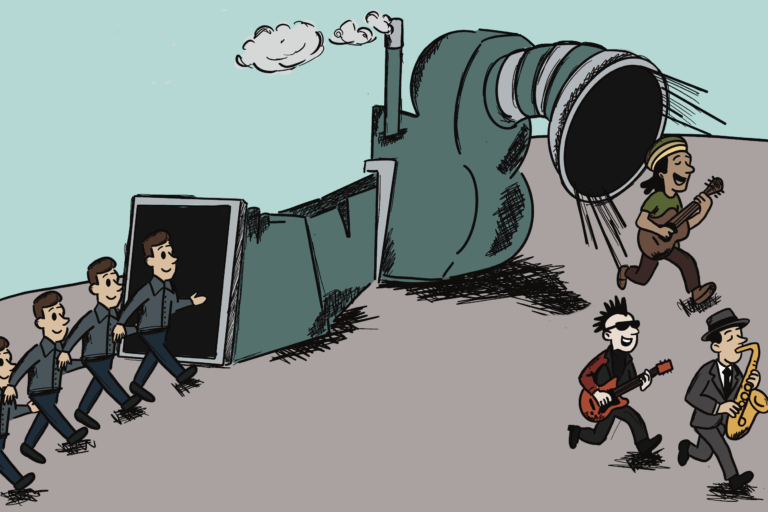
Unsurprisingly, this pattern applies to online musical consumption too. If you’ve spent any time perusing your music streaming platform of choice in the last several years, you’ve likely been suggested algorithmically-made playlists. Upon opening the homescreen of said app, you will likely be berated with playlists tailored to specific genres, such as “Indie Rock mix” or “Intimate Indie Rock mix.” This style of musical marketing is the newest strategy in a long history of evolving methods of musical consumption.

Music being commodified and sold is by no means a new tactic in our hyper-consumerist society. Historically, operas (Victorian England’s trendiest genre) were presented in extravagant theaters, the owners of which profited off tickets sold to allow entrance to the show. 

In more recent memory, the discovery of vinyl pressing marked a huge change of the tide in musical consumption, allowing a much larger group of music fans to privately consume music. Decades later, the invention of the radio made music even simpler to consume. 

The next landmark moment came with the Internet, which not only brought easily downloadable MP3s, but also online spaces to find new music without needing to go to the store to dig through physical media or having it fed to you by a DJ.

This brings us to 2025, where algorithms create seemingly endless collections of songs grouped together by genre tags, in conjunction with individual users’ listening habits. 

The way I see it, the two apparent throughline trends in this evolution are convenience of consumption and the increased commodification of artists themselves. 

Seeing as the primary goal of market-driven competition — in the music industry as well as all other private industries — is to maximize profits, record labels and streaming platforms are in a constant state of evolution to create the most appealing (or addictive) method of consumption. 

Streaming in general is, in and of itself, a manifestation of this goal. After all, it’s much simpler to tap your phone a few times to access your favorite songs than it is to fiddle with the radio or handle physical media. Algorithm-based playlists are a microcosm of the same phenomenon; they further simplify the objective of finding music, as consumers no longer need to search up individual artists or albums to listen that way or to curate their own playlists. And while this all sounds great in theory — humans do enjoy convenience — it’s relevant to ask ourselves what we as listeners might lose in the process. 

The act of putting intention and care behind the art you choose to consume forces you to, even if just slightly, make a personal connection with that piece of art. Consider the difference in how it feels to watch music performed live or choosing to buy a physical record, versus an algorithm quickly selecting a playlist based on what sounds might compliment your mood at that moment — the former encourages us to engage with each piece of music in a more focused and rewarding manner. 

 These curated playlists also depersonalize the artists themselves. Algorithm-based playlists are by no means the first attempt by record labels to put artists into a box; the use of genres to label artists as one thing or another has existed since the era of record stores and genre-associated stations on the radio. However, the way that playlists lump artists together is distinct in how flippantly they do so. 

In record stores, individual albums were grouped together with those thought to be of a similar sound. However, the sale of a record still encouraged listeners to engage with the work as a whole, which often featured songs of very different genre influences, exposing listeners to a variety of sounds. In a playlist, which is often treated like one long album (and presented using the same interface), artists and songs are grouped together based on a surface level comparison of vibe or sound.

To illustrate this, consider that an “alternative rock mix” may present a song by Imagine Dragons along with a song by Nirvana. These two bands certainly share things in common: instrumentals composed of electric guitar, bass and drums, with loud vocals and lyrics. But using these criteria to create playlists reduces each artist’s individual expression to its most superficial collection of descriptors — a dystopian way to consider art. In other words, individuality — through lyrical content or sonic innovation — is at risk of being marginalized in favor of a fixation on characteristics that can be used to package and label art as just another item to be purchased off the shelf.

It is important to consider how this trains us to consume music. If our inhuman curators are grouping music together based on the vibe or genre it’s rigidly placed into, are we as consumers then influenced to consider music using that same shallow criteria ourselves? This method of consumption may deepen existing habits of engaging with art that are both superficial and arbitrary. 


Written by: Theo Kayser — tfkayser@ucdavis.edu

Disclaimer: The views and opinions expressed by individual columnists belong to the columnists alone and do not necessarily indicate the views and opinions held by The California Aggie.

Cartoon networking

How cartoons satirize the current social, political and economic state of the world


By ABHINAYA KASAGANI — akasagani@ucdavis.edu


To preface this article, let me start by saying that I would not question it if it turned out that my first words were, in fact, “TV;” I might as well be making my way through life with a shirt that reads “I Heart TV” or with a tattoo of the aforementioned on my forehead. Still, for years I was vehemently against anything animated — regardless of the audience it was geared toward. Animation simply felt too uninspired and obtuse. It wasn’t until the season finale of “Bojack Horseman” in 2019 that I became enthused with animated satires, believing them to be a worthwhile undertaking. 

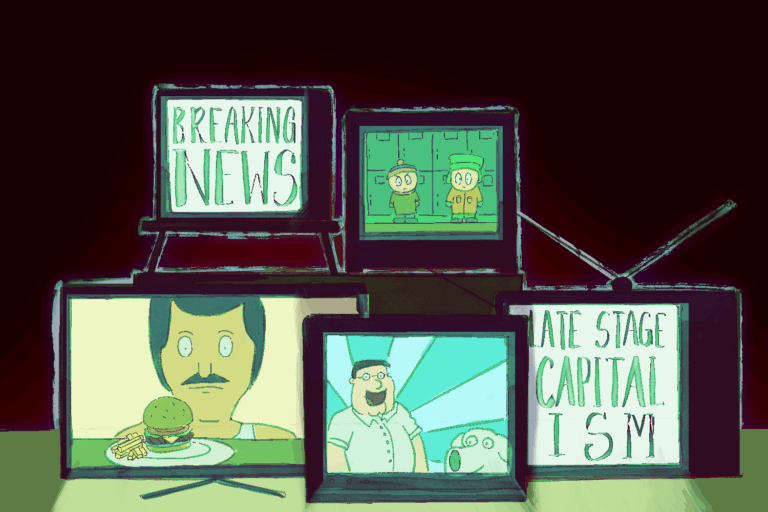
The resurgence of adult animated television shows markets itself as one of the more truthful mediums we have today, working to satirize the current social, political and economic state of our world by dissecting truths that most television obscures. These shows reveal to us what we have previously failed to notice. Adult animation does this in a way only satire can — by exposing, for instance, the absurdities of national inequality and division through gross exaggeration. In doing so, it manages to defamiliarize its audience from blindly believing what they have become accustomed to. 

“The Simpsons” is possibly the earliest instance of satirical adult animation, and was thought of as a contributor to the “Golden Age” of television. The rise in popularity of “South Park” pointed towards “a huge change in viewer habits and appetites in the late 1990s.” While “The Simpsons” has always been around, adult animation today has transformed into more of a mainstream venture. 

The resurgence of adult animation can be attributed to a variety of things. Hannah Myers, producer on the Netflix show “Big Mouth,” examines how the COVID-19 pandemic affected the TV industry: having to “move everything remote because of the pandemic … help[ed] everyone figure out how to make television from home.” The production techniques through which many adult animated films are conceived are fairly simple to carry out, making this an opportunity for up-and-coming writers and animators to break into the field. 

The truth of the matter is that animation gives showrunners autonomy over their work. The surge in production of animated satire was capitalized by streaming platforms like Netflix, Hulu and Amazon Prime Video, allowing them to profit off of the showrunners’ desire to be free from the constraints of network television. Given that animated satire can be sufficiently inexpensive to make, showrunners were exempt from catering to anyone but themselves. The medium by which this satirical animation is delivered to its audience allows for a substantial degree of auteurship; One can immediately claim to know that a show is run by Dan Harmon or Trey Parker and Matt Stone well before being briefed on the matter. This autonomy allows showrunners to create work that is unrestricted by a larger network’s desire to propagate certain ideologies, and is more truthfully and adequately able to reflect the present instability of the world.

Adult animated TV is made in an attempt to disrupt — to ask you to think. The medium allows for one to reconsider the idea of active and passive viewership, re-evaluate how their media is consumed and remind the audience of their capability for critical thought. Colin Macgillivray, Arts Editor for “The Reflector,” reminds us that “just because an animated television show deals with themes of existentialism or addiction, it doesn’t mean you’re inherently clever for watching that show.” 

All this self-indulgence tells you is that you are missing the point. Satire only works when one is ultimately exposed; The audience is made uncomfortable enough that they are forced to confront the reality of the situation with no escape.

Animated satire has proven itself to be quite effective and versatile in its ability to speak to varied experiences, somehow managing to grasp the sentiments of the collective consciousness. Myers describes her journey of incorporating female stories into this medium, noting how animation has previously primarily served young men. She also references how “Big Mouth [does] a really good job of incorporating… all genders, all identities.” The mode of satire endeavors to consider earlier debates about sexual orientation, gender binaries, class differences or cultural dissonances, inviting philosophical, moral and political inquiries on the matter at hand.

Adult animation speaks to its youth in the same tone that it speaks to its adults; never quite letting either one off the hook. Most of these shows attempt to satirize the social politics embedded into our current world, imploring their audiences to think critically and repeatedly. Some jokes don’t require you to be in on them or have any skin in the game; They do, however, always require you to care about what is being said.


Written by: Abhinaya Kasagani— akasagani@ucdavis.edu


Disclaimer: The views and opinions expressed by individual columnists belong to the columnists alone and do not necessarily indicate the views and opinions held by The California Aggie.