56.1 F
Davis

Davis, California

Thursday, December 25, 2025
Home Blog Page 789

Selfcare Warfare: Calling-In, A Better Way

0

So far I’ve talked a lot about recognizing and deconstructing behaviors and thought patterns reliant on forms of oppression and marginalisation like racism, femmephobia, sexual entitlement, monosexism and a whole bunch of other -isms and -phobias. But I don’t think I’ve actually addressed how to go about holding ourselves and others accountable for participating in the reproduction of these ideologies.

I want to acknowledge the fact that sometimes there are situations in which we experience anxiety and fear and have no one to hold accountable for these feelings. Not everyone is responsible for initiating conversations on inclusion or educating those who participate in these marginalizing actions and sometimes it is completely okay to not take advantage of a teachable moment. However, we have to hold ourselves and others accountable for our actions, despite our feelings, if we are to detoxify ourselves and our communities.

None of us are perfect. None of us can hold ourselves accountable for every aspect of our own behavior unless someone else calls us out. We are human. We make mistakes. We’re often hypocritical. And that’s okay, so long as we can actively move forward from those moments of fault.

So how do we go about holding ourselves and others accountable? This should’ve been addressed a long time ago, back when we weren’t swamped with papers and midterms, back when we could see and feel the warmth of the sun without hissing, back when the library seemed like a nice place to escape the heat, back when coffee was a luxury and not a necessity, but I digress. There are two different ways of dealing with oppressive behaviors: calling-in and calling-out. Both deal with holding someone accountable. But they are very, very different.

Calling-out, which is usually understood in the context of online feminism, is when someone says something offensive, marginalising and/or discriminatory and they are, as the phrase goes, called out. However, calling-out, especially online, goes a negative sort of route after the initial call-out happens. Suddenly the person singled out as problematic becomes a bigot. They are harassed for saying/doing something that  they didn’t realize would be considered offensive. In person, calling-out often starts an aggressive debate between individuals in which neither side is willing to listen to the other. Calling-out is this understandably angry but also extremely toxic sort of affair that doesn’t lead to any sort of progress, because as soon as someone is called out they become less human and may come off as hateful.

Calling-in is more compassionate. Rather than aggressively call someone out and dehumanize them, calling-in relies upon the understanding that we are human beings who mess up, which is totally okay as long as we can move forward from that moment and grow. Calling-in sounds easy, but it’s difficult to enact, especially when emotions get the better of you and the other side fails to see past your emotional outburst and the reasoning behind it.

By calling-in rather than outright bashing someone, you name the oppressive behavior/thing that they enacted/said and try to explain to that person exactly why it was oppressive, keeping in mind that they are human and make mistakes and that they probably aren’t aware they were doing anything wrong. Calling-in is probably a more effective way of enacting social justice and self/community care, because hopefully if both sides can reach an understanding and see past the offense as a personal attack it can transform into an educational moment for both parties.

This is not to say, however, that we should not listen to people who respond to our actions in a violent or harsh manner. This is not to say that we should discount someone’s argument because of the tone that they are using with us. We need to understand that when someone calls us out or calls us in, maybe we are doing something wrong. We need to pull our heads out of our asses and try to understand and see. And if we can’t do that in that moment because our own emotions get in the way, we need to try to reflect afterwards when our anger and hurt has died down. And when we do call someone out and they don’t understand our point of view, we need to understand that we might have to revisit this later when emotions on either side aren’t so high.

This isn’t to say that we shouldn’t hold ourselves accountable for our own oppressive behavior either. We need to think carefully about our actions and words, and be completely okay with making a mistake, owning up to it and moving onward with new knowledge. We need to remain open to criticism. We need to enact a justice based on compassion. We need to enact a self and community care that is based on understanding and love.

Contact Gilbert Gammad at gdgammad@ucdavis.edu

 

Myths and Misconceptions about Health: Healthcare and undocumented immigrants

0

As a member of a minority group in the U.S., I have many relatives with firsthand experience of the structural violence within medical institutions. Structural violence refers to the way the mechanisms of social structures harm or disadvantage people from meeting their basic needs. Such structures would include, but are not limited to, the school system and the healthcare system. Essentially, structural violence is the systematic way that these institutions are organized that allows for such harm to occur.

The healthcare system, as well-intended as it may appear, can be cruel, especially to individuals who cannot be neatly organized into its structure. Undocumented immigrants are a clear of example of individuals who compromise to a structure that intentionally leaves them out.

The two misconceptions I want to address are forms of confusion that have emerged from contradictory beliefs, beliefs that I have personally experienced. First, the juxtaposition between the intentions and outcomes of clinical service. Second, the paradoxical relationship between equality and citizenship in regard to accessing healthcare. My goal is to bring up important questions about the ethics of providing healthcare.

Healthcare: A caring monster

Usually when you think of doctors, nurses and other clinical professionals, you think of them as incredibly compassionate people who devote their entire lives to improving the lives of others. However, this is an illusion that hides many of the ugly features of the medical system and makes it a system that harms the very people it intended to help.

The rules for the distribution of healthcare can be inhibiting for certain groups. Undocumented immigrants, for example, are not entitled to healthcare insurance in America. How are these groups going to get any medical services, especially considering that a majority of them do not have the means to pay the sky high price of clinical care?

How can a doctor, who has made the decision to make their career based on improving people’s health, deny people the service due to a lack of insurance? In practical (capitalist) terms it seems obvious why a doctor wouldn’t provide healthcare to individuals who cannot afford it. The U.S. is a consumer culture, so the best way to survive is with money. If you have money you can pay for regular check-ups, you can pay for expensive treatments or pharmaceuticals and you can pay for insurance. On the contrary, if you have little or no money, your access to healthcare is limited. You may receive some sympathy, but maybe not. We are a society disillusioned  with a misconceived notion of an equal opportunity toward upward mobility. People like to think that everyone has the same access to success or the same opportunity to succeed, but that is certainly far from the reality.

The rigid categorization that I have mentioned in previous column articles might also harm the well-being of certain individuals. For example, being chronically ill but not having a proper diagnosis might limit one’s access to treatment because health insurance companies are unlikely to cover the cost of an unlabeled condition. Essentially, an unlabeled condition isn’t treated as a “real” disease or illness by the standards of the medical system, so it’s virtually invisible.

This is especially problematic for people with lower income and education levels, which are often characteristic of individuals who have immigrated from impoverished communities. Undocumented immigrants don’t get health insurance, so whatever pain or illness they experience goes unnoticed by the medical community because it doesn’t enter the medical discourse. If it isn’t in the medical discourse, then it isn’t treated as real or at least it isn’t treated as real science. At least from what I have observed, most of these immigrants don’t spend their time reading up on the newest diagnostic criteria, so they don’t really know when or how to report symptoms in the U.S. clinical system. It is only when their body causes them too much discomfort that they will seek help. Unfortunately, the medical system only works if you report, so no report means no treatment.

Everyone has the right to health, but only if you’re a citizen

Many undocumented immigrants work for low wages and usually without any benefits. They get treated and paid as temporary employees even though a lot of the time they work incredibly long hours. In a similar manner, their work is labor-intensive, so injury is not uncommon. Not only are they undergoing physical stress from work, but also mental stress from financial and living difficulties in addition to the discomfort of being perceived as an “other.” Further, these immigrants won’t seek medical attention until they experience unbearable pain, but even when they do seek help, they probably won’t get any. If you aren’t a U.S. citizen, you are not entitled to the same access to healthcare. Initially, this logic seems unproblematic because if a person isn’t from here, why should they get to benefits from “our” services? Generally speaking, U.S. citizens tend to think in a very “us vs. them” manner. We care about what makes us different from other people, but not about what makes us the same.

It boggles my mind that in school and politics, teachers and government officials preach about equality and the rights of man, but in practice that ideology gets overlooked. In reality, they don’t treat people as equals and they don’t believe everyone should be treated homogeneously. Why else would they refuse healthcare to people that are different from them? Some people might argue that it’s merely a dog-eat-dog world and that’s just the way it is. But why is it that way? And why should it be that way?

Tiffany Marquez can be reached at tmmarquez@ucdavis.edu

Graphic by Tiffany Choi.

Guest Opinion: Making mistakes

0

Over the last three years here at UC Davis, I have learned a lot about myself, and in particular, a lot about who I want to be. They say college is the time when you really get to know yourself and explore different ways of living in order to figure out where you belong in this world. Along with these changes though comes the opportunity to make mistakes, and wow, have I made a lot of them.

Mistakes vary among people. To some, a mistake is that time they forgot to use STI protection, to some it’s not having studied enough and to others it’s not having been the most moral person they could have been. To avoid beating around the bush, I am guilty of the latter. There were periods of time when life was hard, when I was stressed and sad, and lots of things weren’t going my way. Rather than reaching out for comfort and care, I emotionally lashed out at people I loved, admittedly a good handful of them. There was, of course, absolutely no excuse for this, and rather than get better or find ways to relieve a lot of the issues I was dealing with, I exacerbated these personal problems by rejecting people who genuinely cared about me. I treated them poorly from the confines of my own welled-up emotions, when in actuality, my negative emotions had nothing to do with the individuals I hurt.

Eventually, I realized that this kind of negative reaction to my own personal issues not only caused people I cared about stress and emotional pain and ruined relationships that were important to me. My negative reactions also just left me loathing life and dreading having to wake up in the morning because I had single-handedly hurt and pushed away people that loved me. I have been trying to change my approach to my own emotions and personal issues and have been doing my best to mend all of the wounds I’ve created, wary of the fact that sometimes wounds leave scars.

This being said, I have learned a lot about the healing process. I now understand that you have to wake up every day being conscious of your actions towards others and that you must really take the time to think about how everything you do will affect the people you love. It’s vital to make sure that you never take anyone you care about for granted and that you constantly remind people you care about how much they matter to you and how much you are willing to support them.

I have also come to realize that even if you are hurting, it does not give you an excuse to neglect your personal relationships; pulling others down with you out of sadness, anger, jealousy, fear and stress does not fix your problems; it only emotionally harms others, which is one of the worst things you could do to another human being. When attempting to mend the damage you’ve caused another, you must make sure you’re genuine in your intentions to be better to that person, as well as constantly remind them how important they are to you while treating them with love and respect.

It’s also important to remember that those you’ve hurt are not required to forgive you or even give you the time of day, even if you do change your ways. You can’t take back the poor decisions you’ve already made, and if you’ve done enough damage to cause someone to not want to associate with you, so be it – all you can do is change who you are for the better and learn from the losses you’ve brought upon yourself.

Now, I’m not saying that I’ve been successful yet. These are just sentiments I have learned that I am applying to how I live every day. I won’t be successful at learning from my mistakes until the day I’m on my deathbed and can honestly say I lived the best life I possibly could have and treated those I loved with the utmost care and respect. All I’m trying to say here is that I messed up a lot in the past year. Even though I’m making a concerted effort to learn from my poor choices, if I hadn’t made those choices in the first place, I wouldn’t be writing this heads up.

I hope this is a good reminder for anyone who may be making the same mistakes I have made to be self-reflective and possibly change how you deal with your emotions before you ruin something that matters to you.

Remember to be kind to those around you, especially to those who truly care about you. You only have one life, so try to live it to the fullest, but also make sure you love to the fullest.

AKIRA OLIVIA KUMAMOTO is the Arts Editor at The California Aggie. You can reach her at arts@theaggie.org or Tweet her @akiraolivia.

Graphic by Jennifer Wu.

In Our Nature: Good Tidings

0

“Climb the mountains and get their good tidings

Nature’s peace will flow into you as sunlight flows into trees.

The winds will blow their own freshness into you

And the storms their energy

While cares will drop off like autumn leaves.”

  • John Muir

Mountains  have always held a special place in the hearts and imaginations of humanity. To climb a mountain is to come as close as we earthbound humans can come to touching the sky, and from the times of our oldest legends the mountains have been the most romantic manifestation of the wild – an untamed world awaiting our wandering spirits. The mountains are a place we associate with freedom in both soul and body; the solitude they provide creates the perfect setting for the quest of self-discovery which many traditional notions of coming of age require.

When I set out for the mountains last Friday, however, I have to confess that self-discovery wasn’t really what was on my mind. And that’s because, to be honest, last week had me feeling low.

Really low.

It’s something that happens to me from time to time. And when I get into that emotional state, I have a really bad habit of going for long drives in my car. It’s as if with each press of the accelerator I burn through a little more of my misery and frustration and blast it out of my tailpipe to leave it billowing in the dust.

But something about last week was different. As I drove down the highway on Friday, it didn’t matter how hard I pressed the pedal; the darkness refused to burn away. All the anguish and self-hatred clung to my consciousness, and this time, they were laced too deeply in my mind to be eradicated by the drive alone.

Gradually I realized that despite my original intentions, I wasn’t actually heading to the mountains to find myself and broaden my mind; I was going there because I couldn’t handle being myself at all. I wanted to forget who I was, to lose myself entirely. At that point, all the mountains were to me was a place I could run away to avoid facing the reality of the self I had come to despise.

The worst part was that in this effort, I was utterly failing. I couldn’t escape myself, because no matter how hard I could try, not even the whole of the Sierra Nevada range could stand between me and who I knew or believed myself to be.

But I’m not writing this column to tell you about Friday. We all have struggles, we all have moments of darkness and despair. It’s how we get through them that matters, and what comes out on the other side.

I’m writing this column to tell you about Saturday.

Because Saturday, in the driving rain that battered Kennedy Canyon, on a trail that turned out to be far more than I bargained for, I finally started to see what it is to really be me.

That’s the amazing thing about the mountains—the strange, miraculous way they work. You might think they bring you closer to the heavens, closer to high ideals and grand thoughts. That they transcend the world and bring you up to soar with them. And in a spiritual sense, I think that might be true. But what’s truly incredible about the mountains is how they lift you –  by bringing you back to earth.

As I climbed higher and higher over steep slopes, mucky bogs and tall boulders, I couldn’t pretend I was able to lose sight of the crushing thoughts of the day before. There are some things we can’t just forget, some things that force themselves into our view no matter how we want to turn away. But as I pressed onward against the downpour, with nothing but my body and the clothes on my back, I was brought down to earth to see the self beneath my thoughts.  Because underneath the vicious lies and callous truths to which we subject ourselves, we are just bodies moving with ease or hardship through the world. We are legs that walk, lungs that breathe, hands that grasp. Every body has its struggle, but what matters in the end is whether it keeps pushing through, despite the trepidation and the pain.

These are the good tidings of the mountains, and as I ventured there this weekend they turned into a song that rang in my ears. On Sunday at high noon, as I stood on the broad shoulders of the Cathedral Range in Yosemite, the brilliant alpine sun broke through the clouds and bathed the mountains and me in absolute clarity. There is no greater tangible reminder of what you can do than to see snow covered peaks laid out under your gaze in all directions. I, my self, my body – I got there. Through my actions, I gained access to something beautiful beyond compare.

There in the bright Sierra sunlight, I finally could see: I did this. And no matter what life can throw at me, no matter what I may tell myself in my darkest moments, no one can take that part of me away. Not even the cruelty of my own mind.

So if you ever find yourself struggling to fend off the dark, or if you’re faced with a world you feel is just too heavy, I implore you to find something to climb. It may not be easy, and it probably won’t be, but you can do it. Feel your body struggle and feel it emerge at the top in the heavenly sunshine. Look around, and you’ll see how your struggle was so worthwhile. Your life, your pains, your battles: they are worth fighting. Because you are worth it. And no matter what you think you are, it’s what you do that counts – so go do something beautiful.

Climb the mountains and hear the good tidings – hope is in our nature.
Nick Jensen can be reached at njensen@ucdavis.edu

Graphic by Sandra Bae.

Rape? Yes, I do want to talk about it: Stopping the rapists

0

It is fact that one in six females will get raped at some point during their lifetime. And every 107 seconds, another rape occurs in America. So I don’t know about you, but reading those statistics motivates me to pretty much do whatever I can to be one of the OTHER 5 people who won’t be assaulted.

And naturally, I’ll do so by observing that one girl who did get raped and attempt to be the exact opposite of her. If she dresses slutty, I’m going to dress like a nun. If she takes vodka shots, I’m going to hide from alcohol. And if she gets raped, I’m just going to have to NOT get raped. Phew – dodged that bullet. It is only human nature to think this way. Nobody wants something terrible to happen to them. Nobody likes random chances. And everybody wants to feel like they have SOME control over their fate, which is why it is so much easier to blame victims for sexual assault.  It is so much easier to live in a world where things happen for a reason. Because if we don’t – how do we powerlessly accept the thought that we could literally be raped at any 107 second interval?

The answer to that question is: we shouldn’t have to live with that thought. We shouldn’t have to live in terror, knowing that we could be completely objectified and traumatized today,tomorrow or next Tuesday. But we do. And we should not have to live in terror because females are just majestic tempting creatures, but we do because of one simple fact: rape is going to happen if rapists exist.

So the only real solution, then, is to just get rid of all the rapists out there. Let’s just round them all up, put them in a box and “mistakenly” chuck that box into the ocean. Sound good? I’d probably get extreme satisfaction in doing so. But unfortunately, the “I’m a rapist” club hasn’t exactly made T-shirts yet. Rapists are a little harder to find than that – I mean hell, they don’t always know they’re rapists. They don’t wake up every morning with the total awareness and acceptance that they ruin lives. No. It’s way more complicated than that.

A rapist is not just some idiot who “accidentally” has sex with people who aren’t super down for it. A rapist is a murderer who uses sex as a weapon. And just like a murderer, a rapist’s entire character can be defined by even just one crime committed. When you are raped, you are stripped of your humanity – of the life inside of you. A rapist may not actually kill you, but they kill such a huge part of you. And it takes somebody severely and fundamentally messed up to kill.

Rapists’ problems lie in the core of their mind and soul, and often form because: 1) They have been abused at some point in their lives and want to regain a sense of control and 2) They have been raised with a distorted understanding of empathy. They have learned a sense of entitlement so powerful to the point of genuine indifference to other’s sufferings.

So have all rapists been raped? Not exactly. In fact, in a study of 114 convicted rapists, 91%  denied experiencing childhood sexual abuse. However abuse takes place even in the smallest ways. It could be the slightest mistreatment, either physical, verbal or sexual that can make someone feel powerless. It can transform somebody’s entire life purpose. It can make someone struggle their whole life to regain a sense of power. And, unfortunately, some aim to do that in the most horrifying way – through rape.

Secondly, rapists have developed a belief system that justifies their own behavior.  Think about it – kids aren’t born with empathy or compassion for others. Quite frankly, children are selfish and entitled, and only learn not to be through years of conditioning from their parents. Children must learn to care for others. They must learn to respect women just like they must learn not to yank a toy out of another kid’s hands. Because if they never learn those things then we wind up with rapists behaving as two-year-olds with who refuse to accept that sometimes they just CAN’T have that super shiny fire truck. Sometimes the answer is just NO.

Additionally, people are more likely to become rapists if they grow up in households or societies with an authoritative male figure and subservient female figure. Rapists have often grown up around people who subconsciously perpetuate the idea that women are inferior and therefore undeserving of respect. This teaches people to separate their understanding of women with their understanding of a human being. And for a rapist (and our misogynistic society), it’s a hell of a lot easier to justify raping somebody who isn’t actually a person.

We must understand what makes somebody a rapist so we can understand how to stop these people from existing. We must teach our friends, our neighbors, our kids and our two-year-old cousins to be decent human beings. Because only then can we remove rapists from the equation. Maybe once we do that, there won’t even be an equation at all. And as far as I’m concerned, nobody likes math that much anyway.

Like her bluntness? Contact Maddy Pettit at mepettit@ucdavis.edu


ASUCD senate urges UC Regents to divest from Turkish government

The ASUCD senate has called for the UC Board of Regents to divest over $74 million from the Republic of Turkey in response to its continued denial of the Armenian Genocide of 1915.

Senators appealed the UC Regents May 7 by passing Senate Resolution #15 (SR15), a measure urging the withdrawal of $74,046,600 in investments held by the UC Retirement Plan and UC General Endowment Pool in Turkish bonds and the state-owned Export Credit Bank of Turkey. The resolution further insists that the UC Regents refrain from making additional investments in the Turkish government until it acknowledges the genocide.

The Armenian Genocide of 1915 refers to the Turkish-ruled Ottoman Empire’s targeted killing of approximately 1.5 million Armenians during World War I (WWI). A consensus of historians acknowledges the genocide. However, the Republic of Turkey rejects that the Ottoman Turks made any organized attempt to eliminate the Armenians, instead regarding them as war casualties.

ASUCD senator Sevan Nahabedian, author and introducer of SR15, said divestment is an appropriate way to answer the Turkish government’s denial of the genocide and demonstrate that UC Davis will no longer be a party to that denial.

“We have a right to tell the people who are supposed to be representing us [that] this isn’t where we want our money to go,” Nahabedian said.

Similar divestment measures have been passed unanimously at UCLA, UC Berkeley and UC Irvine within this year. According to Tamar Tatoian, President of the UC Davis chapter of the Armenian Students’ Association (ASA) and co-author of SR15, UC Santa Cruz and UC Riverside are preparing their own versions.

Senate passed SR15 by a split, 10-0-2 vote. Senator Alex Lee was the only senator present who abstained.

“I feel, personally, that student government should not be involved in international affairs,” Lee explained. “While I do support the content of the message, I do not support what it is to student government. If I wasn’t a senator, I’d probably support it.”

Senator Anabiah Syed, who was not present for the vote, account for the other abstention. According to Nahabedian, Syed intended to introduce an equivalent resolution with co-author Arev Markarian before he started writing SR15. Syed also joined roughly 500 others in signing ASA’s petition in support of the resolution.

ASA commemorated the centennial anniversary of the Armenian Genocide on April 24 by staging a “die-in” on the Quad. The commemoration was one of many that took place across the world that week.

Speaking before senate, Tatoian described how the disheartening effect of 100 years of genocide denial has been compounded by the investment of Armenian students’ tuition in the very government perpetrating the denial.

“[Armenian students’] collective consciousness is affected by the knowledge that tuition money we pay is used in Turkey and has great potential to be used to deny the historically indisputable act of genocide that we are standing here in spite of,” Tatoian said.

However, both Tatoian and Nahabedian stress that the impacts of genocide denial have not been limited to Armenian students.

According to Nahabedian, the Republic of Turkey has compromised all UC Davis students’ educations by suppressing scholarship acknowledging the Armenian Genocide and propagating misinformation about the event. He says these actions have enabled books like The Armenians in History and the Armenian Question by Esat Uras—which denies Armenian deaths from forcible relocation as murder and caps the number of Armenian WWI casualties at 300,000—to find their way into the Shields Library.

“Because of the lobbying that the government of Turkey does, thanks to the money that they receive from the University of California, [students] read books like this,” Nahabedian said. “Frankly, they would fail their genocide courses, or any history courses, if they read a book like this and trusted the words that are in this,” said Nahabedian.

ASUCD President Mariah Watson passed the resolution at senate’s May 14 meeting.


Equality with Sprinkles

Culture C.O.-O.P. and United in Unity to hold Cupcakes for Equality event

America was founded on the principles of freedom and equality. However, despite this banner of equality and justice Americans aim to uphold, there are deep inequalities rooted in many of America’s institutions. The Culture C.O.-O.P. and its sister non-profit organization, United in Unity, are working to promote equal rights for all with their event Cupcakes for Equality.

Cupcakes for Equality is set to take place this Saturday at Let Them Eat Cake from 9 a.m. to 1 p.m. Cupcakes will be sold for $1 and customers can enter their cupcakes in the baking contest (there is a 12 cupcake minimum) for $10. The proceeds will go to the Culture C.O.-O.P. and United in Unity.

Sandy Holman, the director of the Culture C.O.-O.P. and United in Unity, explained the mission of the organizations and the reasoning behind those goals.

“They both focus on promoting respect for equity, diversity, cultural competency, literacy and a quality education for all,” Holman said. “The reason we have that mission statement is because we think that is the core foundation of concepts that help people survive and thrive, regardless of what their disciplines are.”

The C.O.-O.P. and United in Unity aim to spread these goals via educational forums, presentations, equity trainings and different nonprofit community events.

Isaiah Jurado, a senior English and communications double major and a member of the PR and marketing team for United in Unity, is the head of the event. He explained why the work was worthwhile and his favorite part of the job: working at schools.

“When you show up at a school assembly and see the kids so excited, it really pays off,” Jurado said. “The fundraising isn’t the most exciting thing for any intern, but when you see the kids really enjoying it and really enthused about the assemblies, it [makes it really worthwhile].

For Charity Peets, the co-leader of the event marketing team and the head blogger for the editing and writing team at The Culture C.O.-O.P., an important aspect of the work they do is the cross-cultural exchange that occurs, even just between the diverse group of interns.

“With cross-cultural exchange it is important to be around other cultures and comfort and interact with one another, learning about people of different backgrounds,” Peets said.

Holman hopes to spread the word about what the The Culture C.O.-O.P. and United in Unity have to offer those living in Yolo County.

“This work is hard. It’s challenging to do and it’s not always appreciated either. It’s a low priority to many until there’s an incident, a hate crime, or something like that. We [as a society] are always reactive, never proactive unfortunately,” Holman said.

Jurado explained that he really wants Cupcakes for Equality to be a community event for people to come together and have fun.

“We do want to promote ourselves and get our message out, but I think more so, more importantly, is to just have a great community event. We have all kinds of different people [willing to support our cause],” Jurado said.

More information can be found on the event Facebook page and at the Culture C.O.-O.P. website.


This week in UC Davis sports

0

Aggies sports action from May 18 to 24

Baseball (30-26-1):
UC Davis vs. Cal Poly (L, W, W)

After faltering over the last few weeks of the season and losing six games in a row, the Aggies finally broke through and ended the Big West play with two straight wins. UC Davis played at home against Cal Poly for the final series of the regular season, losing the first matchup 12-5. The Aggies came out to an early one-run lead, but allowed eight runs in the fourth inning and never made up the difference. Two UC Davis players accounted for six of the eight total hits for the day.

After the loss the Aggies rebounded with two straight against the visiting Mustangs. Senior pitcher Spencer Koopmans recorded the win for the first game, with Cal Poly scoring only three runs. The final game of the series was senior night for the Aggies, with a number of UC Davis players playing their final Big West game. The team won behind the pitching of senior Raul Jacobson, who struck out four, and a home run from senior Austin March.


Women’s Golf:

NCAA Finals

After finishing fourth in an extremely successful NCAA Regionals, the Aggies headed to Bradenton, Fla., to play in the NCAA Finals. The tournament is structured so there are a number of cuts, with the top 15 teams advancing after three days of play and the final eight making it past four rounds. UC Davis ended the first day on the edge, landing in 14th place after lightning shortened the round. Sophomore Paige Lee was the highest placed Aggie at No. 23.

Play was once again suspended on the second day, but not before UC Davis made a meteoric jump to No. 5. While Lee dropped to No. 34, junior Betty Chen nabbed No. 22 behind a par-72 round. Junior Andrea Wong tied Lee for 34th place after shooting a pair of 4-over 76’s.

The third day of play saw the Aggies fall to No. 9 on the leaderboards, enough to squeeze into the fourth round. Both Wong and Chen shot higher than 80 throughout the day, running into a three way Aggies tie with senior Blair Lewis at No. 57 individually. Lewis shot the best for the day, with a 1-over 73, but Lee remained the top ranked Aggie. The Aggies advanced to the fourth day after finishing the third round within the top 15.

This tournament is still in progress.

A weekend of records for Aggies in Big West Track and Field Championship

0

UC Davis track and field is now preparing for the NCAA West Prelims at the University of Texas following a competitive run at the Big West Conference Championships on May 15 to 16. Solidifying their season, both the women’s and men’s teams fought their way into the top five at the UC Riverside track facility, earning second and fifth place, respectively.

UC Davis women’s track and field broke their three-year long winning streak, but took home numerous records in place of the championship banner. Senior sprinter Ashley Marshall won first place in the 100 and 200 meter dashes for the third year in a row, becoming the first female in the history of the conference to win each event for three consecutive years. Marshall had times of 11.52 and 23.45, respectively. Senior middle distance runner Raquel Lambdin became the first female in conference history to take first place in both the 800 and 1500 meter events in the same championship. Solidifying times of 2:06.24 and 4:17.09 respectively, Lambdin was less than a second away from toppling the conference record set by Trena Hull of the University of Nevada, Las Vegas in 1987.

Following Marshall by less than a second in the 200 meter was senior sprinter Cekarri Nixon, who secured a 23.74 and another second place title in the 400 meter dash. More top three finishes for the Aggie women included sophomore distance runner Rianna Goins’ third place in the 800 meter and sophomore distance runner Clara MacLeod’s third place finish in the 5,000 meter. Senior thrower Veronica Smart also finished third in the shot put event.

For the men, senior middle distance runner Nathan Strum posted a second place finish in the 800 meter with 1:50.52 and a close third place in the 1500 meter event with 3:54.72. Times sat uncomfortably close for the top 3 finishers of the 1500 meter, who finished within less than a second of one another. Senior sprinter Marcus Johnson took third place in the 100 meter, while junior distance runner Trevor Halsted secured another third in the 5,000 meter. Junior sprinter Jason Chandler finished as second runner-up in the 400 meter hurdles. The men’s team improved to fifth this year after an eighth place finish in 2014.

“The performance was incredible,” said UC Davis Director of Track and Field Rahn Sheffield following the event. “We took enough wins. We just didn’t have the number[s] behind us. We’ve suffered too many injuries on the way to the championship, and that’s what hurt us. This team competed very well, and I can’t say enough about them. These athletes showed up. We were just out-numbered and we have to do a better job of managing our athletes through the year so those injuries will not affect our performance at the level of a championship.”

Second and third place title holder Strum agreed.

“I had an achilles injury, so I was spending a lot of time before the races getting treated. I waited too long to make my move and I had a lot of energy left at the end, so that was a little frustrating.”

Long Beach State went on to take the first place banner for the men’s at Big West, while CSU Northridge dethroned the Aggies for first place standing on the women’s side.

Following the final meet, Marshall was named conference’s women’s track athlete of the year for the third consecutive year. The Aggies will perform at the NCAA West Preliminary beginning Wednesday in Austin, Texas.

The cost of rejoining UCSA

Designed by Graphic Design Team

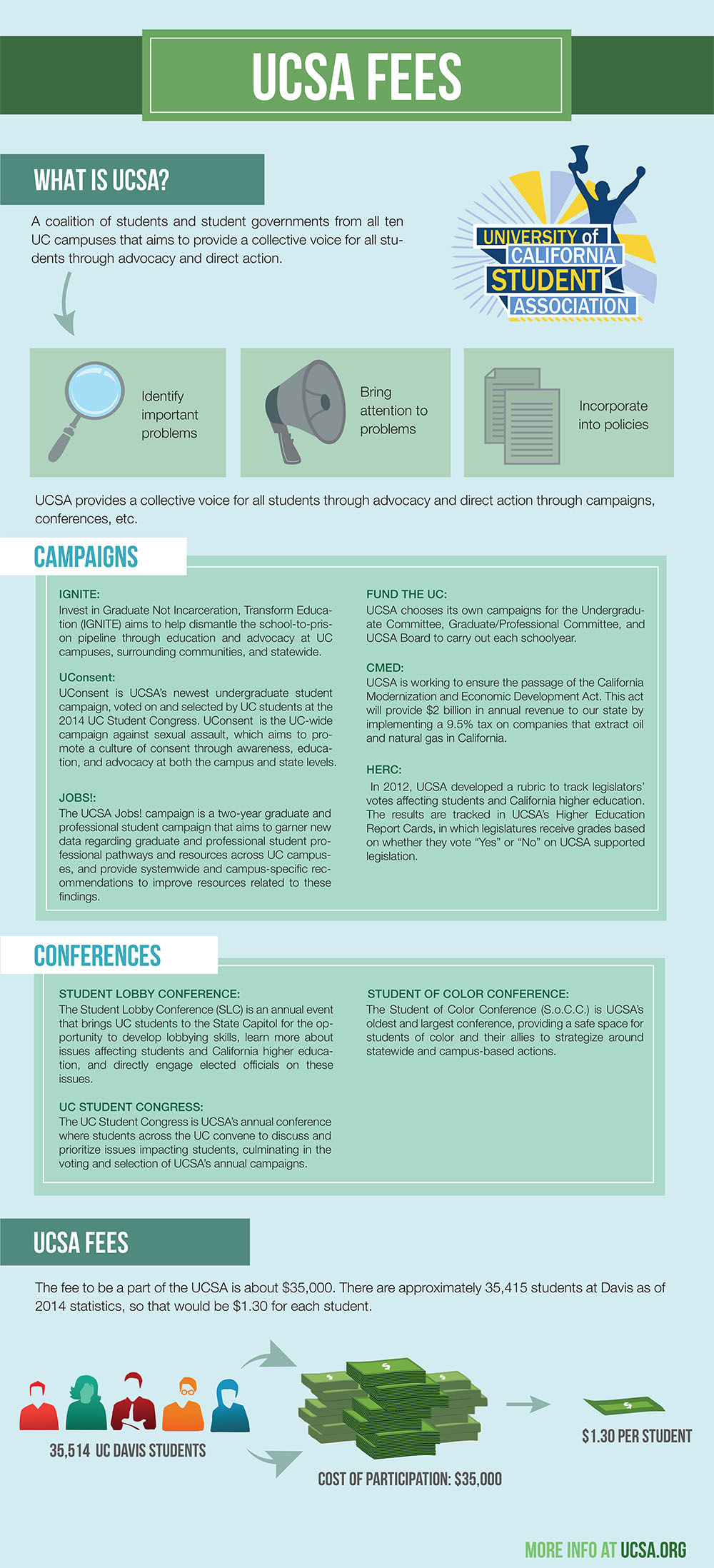
After an entire decade of absence, UC Davis is finally considering rejoining the University of California Student Association (UCSA), an entirely student-run alliance representing all ten UC campuses. The association serves as a voice for students by advocating policies to ensure the best quality and affordability in higher education.

With discussions between ASUCD and UCSA already under way, the main questions now are related to membership costs.

“UCSA is the sole entity responsible for representing UC students to everyone,” said ASUCD Office of Advocacy and Student Representation Director and second-year sociology major Harley Litzelman. “The UC student opinion, position, tactics [and] strategy are centered on the actions of UCSA. When we are not apart of UCSA, we are not doing our duty as student leaders to fulfill the ASUCD constitution. It costs something, [but] everything costs something.”

This cost is the $35,000 required fee every year for a UC campus to be a member of UCSA and gain access to the resources provided through the membership. The association granted UC Davis a fee waiver to allow a trial period of membership.

Although the original waiver was set to expire in May, the UCSA board recently voted to extend ASUCD’s waiver for membership into next year.

“I felt that a little extra time [is needed] for [ASUCD] President Watson and ASUCD to look within its own organizational resources to make ends meet,” UCSA Board of Directors Chair and UC Berkeley senior political science major Kevin Sabo said. “Everyone at the board recognized the really important role Davis has had [this year]. They’ve been really active and great members of the board, so we felt that Davis seems to be making an honest commitment in the long term.”

This commitment would entail UC Davis rejoining UCSA and budgeting for the membership fee in some form.

“[The fee waiver extension] means that ASUCD and UC Davis students can remain represented in UCSA and in all of their lobbying efforts and programs,” ASUCD controller and third-year political science and economics double major Francisco Lara said. “It also shows UCSA is willing to work with UC Davis in order to form a partnership – [it proves] this is an organization that really wants to work with us within our constraints in order to represent us.”

The decision on this extension has allowed more time for UC Davis in deciding whether the $35,000 annual fee is worth the benefits.

According to Sabo, the fee breaks down to $1.30 per student annually.

“We can’t really quantify the benefit of being in UCSA, but the important thing to remember is that [by being a member] you have access to things you only get through membership with UCSA. There are a lot of avenues that have opened up for [UC Davis] students,” he said.

Sabo, who has been involved in UCSA for almost two years now, ensures that the $35,000 is being put to necessary use. The fee is divided into different cost categories including campaigns, voter registration, staff salaries, maintaining UCSA’s office in Sacramento, memberships in other national student associations, facilities and board traveling.

“For example, back in March, the Santa Barbara graduate students wanted to get more information about what was going on with the budget update, so UCSA flew me down [there] to meet with [them],” Sabo said. “It’s very much focused on getting students to where they need to be. It’s quite an expensive budget, and we spend time on our financial board every month, so we’re definitely staying on top it. This past year, before we had our final budget, we did a lot of trimming things down.”

Third-year international relations and philosophy double major and ASUCD president Mariah Kala Watson ensures that ASUCD cannot and will not factor the UCSA membership into this budget cycle, however beneficial it might be.

“UCSA is something that I feel is extremely valuable,” Watson said. “If [we had] a budget, [like] say four years ago, where I was in the financial position to be able to invest in something that I thought would benefit the student body, UCSA would be [it]. UCSA just seems like one of those things we always should’ve been invested in, especially when they restructured – they’re a lot more professional, a lot more reputable and [we] can really depend on them.”

Lara said that he is more focused on the amount of money that ASUCD would have to cut or reallocate in order to fund the $35,000 rather than the merits of rejoining.

“We’re restrained by the fact that we have to cut so much money, and we’re not in a position to pile on $35,000,” Lara said.“[UCSA] was trying to change the way student government pays for it, so [that it would come] from a different pool of money that isn’t student government, [but that is] just a proposal.”

ASUCD is currently considering two possible ways of reallocating the funding for UCSA for upcoming years. As it stands constitutionally, students cannot be charged for UC Davis’ membership in UCSA. However, officials can make a formal amendment to the ASUCD constitution in order for each student to be charged $1.30 each year. The alternative would be to build the membership cost into a different and existing subset of money, such as the student service fee.

Whichever way ASUCD decides to approach this situation, Watson and others still believe that UCSA campaigns and policies are worth taking into consideration.

In the past, UCSA has campaigned for topics related to sexual violence, taking apart the “school-to-prison” pipeline and voter registration, but it has also been a driving force in the prevention of the five percent proposed tuition increase.

“Coalitions in communities amplify what individual voices and individual efforts can do,” Sabo said. “[UCSA is] able to amplify that voice on a student level. We’re able to accomplish extraordinary things.”

Graphic designed by Graphic Design Team.

Selfcare Warfare: Don’t forget the non-monosexuals: bi/pan/poly-phobia

0

To conclude this series of columns relating to oppressive ideologies and behaviors connected to the LGBTQIA+ community and because it’s Pride Month, I want to talk about something more directly related to sexuality than gender – monosexism and bi/pan/poly-phobia (a term I recently learned). Not to be confused with sexism, monosexism is a discriminatory idea/practice that marginalizes people who identify with non-monosexual sexualities. Bi/pan/poly-phobia, then, is the interactional experience of this discrimination. As usual, it’s probably necessary to define a few terms and give examples so we’re all on the same page.

What is a monosexuality?

Monosexuality is any sexual orientation/preference where an individual is attracted solely to one gender. Examples of monosexuality are homosexuality and heterosexuality.

Then what is a non-monosexuality?

If monosexuality, meaning one sexuality, is finding only one gender attractive in an emotional, sexual and physical sense, than non-monosexualities are those that are attracted to more than one gender. Examples of non-monosexualities are bisexuality, polysexuality and pansexuality.

So what does discrimination based upon non-monosexuality look like?

It’s when men question the validity of a woman’s bi/pan/poly-sexuality and see it merely as a “hot” phase that will lead them to a three-way.

It’s when one is constantly afraid that their non-monosexual partner is going to cheat on them with someone else because their “sexual playing field” is larger.

It’s when we forget that celebrities like Megan Mullaly (of Will & Grace fame), Azealia Banks (dance rap artist famous for ‘212’), Billie Joe Armstrong (of Green Day) and Carrie Brownstein (famous for Portlandia and the bands Sleater-Kinney and Wild Flag) are bisexual the moment that they enter into a relationship with someone of the same gender, whether or not it leads to marriage.

It’s saying that non-monosexuals benefit from straight privilege because they can “pretend” to be straight when it allows them social mobility.

But where does bi/pan/poly-phobia come from? Does it come from the idea that the majority of people are monosexuals? Does it come from the notion that it isn’t possible to find attraction to multiple genders? I don’t think so.

From what I understand, bi/pan/poly-phobia from the heterosexual community stems from anxieties over both faithfulness and the idea that a bi/pan/poly-sexual person could potentially find you attractive and make an unwelcome advance. This reinforces the idea that bi/pan/poly-sexuals are sex-hungry people, which is not at all a fair assumption. What underlies these anxieties, involving the possibility of cheating by non-monosexual individuals because of same-gender attractions, are issues of insecurity and homophobia. From the gay and lesbian community, bi/pan/poly-phobic attitudes stem from ideas of respectability and legitimacy in regards to the gay rights movement. The characterization of bi* and pan* folk as “sexually promiscuous” threatens the gay and lesbian communities’ ability to gain respect from the straight majority. Bi/pan/poly-phobic attitudes in relationships appear, at least in my mind, to stem from one’s issues with trust and insecurity, which is not something you should blame an entire group of people for.

Either way, the biggest form of bi/pan/poly-phobia is the erasure of their identities. We live in a society where we are taught that we can only love and have sex with a single gender. Being capable of being in love with and having sex with multiple people of different gender identities is often not discussed or mentioned during our formative years. You’re either gay/lesbian or you’re straight. Or at least that’s what my experience has been. Because of this, bi/pan/polysexual individuals are often forgotten or erased in the mainstream media and within the LGBTQIA+ rights movement because their sexuality doesn’t fit into mainstream conceptions of what sexuality is. So then how can we unlearn monosexist and bi/pan/poly-phobic thinking?

By now you can probably guess that I’m going to advocate for us to not forget or leave out these identities when we are thinking of LGBTQIA+ events like Pride and political issues involving the broader queer community. I want to suggest that we think further about attraction, and understand it as not limited to a single gender or a single body, but something that can be attributed to multiple genders and multiple bodies. Just as I talked about in last week’s column on the issue of gendering, sexuality as we understand it isn’t as clear-cut as it’s usually explained.

To talk about self-care and bi/pan/poly-phobia is to suggest that we need to unlearn the monosexual understanding of sexuality. We need to not prescribe identities for other people but rather allow them to self-identify, and we need to be okay with their doing so. We need to allow for self-identity to be the only “proof” needed to validate that identity. We need to erase all of the assumptions that are placed onto those who identify as non-monosexual and allow the narratives and experiences of non-monosexual people to speak for themselves.

Contact Gilbert Gammad at gdgammad@ucdavis.edu

Daily Calendar

THURS., MAY 21

UCD Film Fest

10 to 11:30 p.m.

Varsity Theatre, Davis

UC Davis students showcase their filmmaking abilities.

DJ Smilez

11 p.m.

Our House, Davis

The dance floor opens up for a free night of dancing!

Trivia Night

9 to 11 p.m.

Woodstock’s Pizza, Davis

Join teams of three to six people to answer unique and challenging trivia questions.

Poetry Night Reading Series

8 to 10 p.m.

John Natsoulas Gallery, Davis

Poetry night hosted by Dr. Andy Jones with featured guest at 8 p.m. and an open mic starting at 9 p.m. Tonight’s event features Greg Glazner and band.


FRI., MAY 22

ArtAbout

5:30 to 8:30 p.m.

Downtown Davis

View some of the best art in the Davis community at this free, monthly gathering which includes refreshments and the opportunity to meet new and upcoming artists and musicians.

Joseph in the Well

7 to 10 p.m.

Delta of Venus, Davis

Enjoy live music for free!

Live Music with Bob Wren

5:30 to 8:30 p.m.

Monticello Seasonal Cuisine, Davis

Traditional and international live music featuring instruments including the violin, banjo and mandolin.

The Heart of Robin Hood

7 to 9:30 p.m.

Davis Arts Center, Davis

Enjoy free comedy on an outdoor stage.


SAT., MAY 23

Garden Work Day

9 to 11 a.m.

Central Park Gardens, Davis

Spend a beautiful morning helping the gardens of Davis! All tools and training provided.

The Heart of Robin Hood

7 to 9:30 p.m.

Davis Arts Center, Davis

Enjoy free comedy on an outdoor stage.

Local Live Music

9 p.m.

Woodstock’s Pizza, Davis

Enjoy a fun night of live music free of charge!


SUN., MAY 24

Food Not Bombs

1:00 p.m.

Central Park, Davis

Enjoy free vegetarian meals with the fellow food-lovers of Davis.

The Heart of Robin Hood

7 to 9:30 p.m.

Davis Arts Center, Davis

Enjoy free comedy on an outdoor stage.

Live Irish Music

4 to 7 p.m.

de Vere’s Irish Pub, Davis

Enjoy drink and food specials while listening to traditional Irish music.

International Folk Dancing

7 to 9 p.m.

Davis Arts Center, Davis

Learn how to folk dance.  All levels welcome and the first time is free!


MON., MAY 25

The Heart of Robin Hood

7 to 9:30 p.m.

Davis Arts Center, Davis

Enjoy free comedy on an outdoor stage.

Pub Quiz

8:00 p.m.

de Vere’s Irish Pub, Davis

Free quiz night hosted by Dr. Andy, with teams of up to six players. Arrive an hour early to secure a table.

Myths and Misconceptions about Health: Diet Frenzy

0

Diet talk is everywhere. You hear or read about it in a variety of settings. Even a simple commute to the grocery store might result in unsolicited dietary advice. For instance, at the market, you may encounter advertisements or overhear a person’s weight loss experience. On the road, you might see diet programs plastered on billboards with before and after photos. In the car, while listening to the radio, you might hear broadcasters raving about the effectiveness of a high protein diet. Simply browsing social media might lead you to the latest “fat-burning foods.”

Although there is an enormous amount of information on diet and health spread across different mediums, the integrity of these programs is certainly questionable. Unless you’re searching through a medical library, your sources (if they are like the ones mentioned above) might not be optimal. Many of these so-called diet advisors are trying to profit from their advice and don’t mind altering some of their claims. This is especially the case when we consider that most people do not bother doing any further research.

Unfortunately, this causes fad diets to emerge, mostly because people are so infatuated with dietary programs that lead to rapid weight loss. These diets almost always entail removing a particular food (i.e., carbs or sugar) because that seems to be the only way to lose weight at the rate that people would like. People (usually from the U.S. and other Western societies) live in a pragmatic culture. Results are everything, and if they are not immediately visible, then the plan is discarded and deemed inoperative.

Of the numerous dietary misconceptions, I want to briefly discuss five that I have often come across.

  1. Numbers tell all: calories and the scale.

For a pragmatic society, numbers end up being crucial indications of results. The most important numbers, it seems, are calories and a person’s weight on a scale. Your diet becomes only as good as the numbers you receive. Therefore, the faster you receive lower numbers, the better the diet. This misconceived fixation on numbers is futile because it can lead to crash dieting, which is inevitably unsustainable. Gradual weight loss is just not as appealing to a culture so focused on hastily achieving an outcome.

The idea that “calories are the enemy” results from the logic mentioned above. People, especially those following crash diets, avoid calorie consumption at any chance they have. They substitute in lower or zero calorie foods and sometimes even skip a meal altogether. There are diets where people will only eat cabbage or restrict themselves to a liquid fast. These diets are deeply rigorous, but they do produce the results people are seeking. However, the weight loss usually doesn’t last very long. Eventually people are not able to live off of these immensely restrictive diets, so they bounce back to their old eating habits and regain the weight.

Calories are not the enemy— they give you energy and give your body the essential nutrients it needs to live. Drastically cutting them down won’t do you any good, unless you consider no energy and constant hunger to be good. The sources of your calories are what you should really look out for. Instead of counting calories, you should look at what it is that you are eating. A four hundred calorie bowl of oatmeal and fruit is a much better choice than a hundred calorie granola bar with a ton of additives. Eat foods that are energy rich, that digest well and aren’t laden with unnecessary chemicals. Your best bet is to avoid highly processed foods, because even though many of them can be low calorie they aren’t automatically “healthy.”

If you eat whole foods with tons of fruits and vegetables and get a sufficient amount of calories, you will be on your way to a healthy, gradual and sustainable weight loss.

  1. You need copious exercise.

A fair amount of people tend to think that if they just exercise a lot more, they will lose weight. This is mostly because some individuals attribute their extra weight solely to their lack of physical activity. Although exercise is helpful for losing weight, it isn’t the only factor, nor the most important one. You can exercise every single day, but your results won’t be great if you’re eating foods that your body doesn’t thrive on.

  1. Stay away from sugar.

Many diets demonize sugar, calling it the culprit behind any added weight. As a result, people turn to crazy sugar-free diets. Cutting out highly refined sugars isn’t a bad idea, but telling people not to eat any sugar is a bit extreme. For instance, people might start only eating foods labeled “sugar-free,” not acknowledging all of the odd chemicals added in to compensate for the lack of sugar. Others might even begin to fear eating fruits and other natural sugars because “all sugars are bad.”

No, not all sugars are evil. Natural sugars such as agave nectar, honey or the sugar found in fruit are different from artificial or refined sugars in that they have additional nutrients and minerals. White or brown sugar and high fructose corn syrup are just extracted from their sources and have no nutritional value. Therefore, avoiding sugars will deprive you of vital, naturally found nutrients.

  1. Carbs will make you gain weight.

If it’s not sugar that diet regimes tell you to reduce or remove, it’s carbs. So-called diet experts attribute carbs to excessive weight. However, it is not necessarily the carbs themselves that are causing the weight gain, but instead the things being added to the products. Slathering potatoes and rice in oil will not have very positive effects on the inside and outside of the body. Eating carbs in their whole forms, avoiding or at least minimizing the amounts of fats being added, will cause eating carbs to have less of an impact on weight. You shouldn’t opt out of eating carbs just because some diet online says that it will make you lose ten pounds in three weeks. Carbs are critical energy sources and shouldn’t be removed.

  1. Diets are temporary.

Lastly, a lot of people look at diets as temporary. This notion mostly stems from the fact that many of the diets people follow are restrictive, and thus not sustainable in the long-term. In fact, the term “diet” itself seems to popularly connote a course of time in which one restricts food, instead of simply expressing the types of food a person eats or prefers. Diets shouldn’t be short-term, quick fixes. They ought to be long-term, manageable lifestyle changes.

Graphic by Tiffany Choi.

In Our Nature: Sharing the good

0

One thing I’ve always loved about hiking in the great outdoors is how friendly all the people you meet on the trail tend to be. It doesn’t matter how old they are or how big their group is; when you pass another human being on the trail, they’re more than likely going to smile and greet you as you go on your way. And the best part is that, more often than not, you’ll feel like doing it too.

Now, I’m probably not someone who would ever be mistaken for an extrovert. There are many times that I do love (and need) the quiet solitude of a world untouched by the presence of other humans to recharge, refresh and recollect my thoughts.

However there have been times when I’ve been standing on a rugged North Coast shoreline watching the waves buffet the rocks in the golden light just before the sunset. Times when I’ve wandered endlessly through forests so full and green that I swear I’ve felt myself growing with them. Times when I’ve taken the last step to reach the summit of a mountain and seen the whole world laid out before my eyes, rich with wild potential. And in those times, I’ve just felt this irrepressible urge to try to find a way to share those experiences with my loved ones, the people who I know so richly deserve to experience that kind of beauty too.

It’s a feeling that comes from deep within our hearts, the camaraderie we feel toward our fellow humans and friends. Maybe it’s evolutionary, and we developed to be social animals because it proved to be a helpful adaptation. Maybe it’s just an impulse woven deep into the fabric of our souls. But no matter what its basis is, the capacity and drive for friendship has always been in us and it’s lasted throughout the ages. As much as our society may press us to highlight our differences and brandish them at each other like weapons in an endless battle for dominance, deep down somewhere in every heart there is a sympathetic pulse- ineradicable and steadfast. And contrary to what shows like “Survivor” might lead you to believe, I think it’s really nature that brings this sympathy to the fore.

Because what is it that divides us and makes us seek out differences that set us apart? It’s the competition for the kind of scarce resources society teaches us to prize. Money, promotions and the American dream of wealth and success. The way our civilization is set up, it’s just a fact of life that not everyone can win, and on the long road to the top, people have to divide themselves in order to conquer.

But in nature, what are we fighting for? Is there a scarcity of the beauty inherent in a roaring waterfall? Can any one person lay sole claim to the exhilaration of standing on a high mountain peak? What nature gives our spirits, it gives without limitation. And when we’re surrounded by its incredible abundance, we find it not only easy but truly natural to want to share its pure, genuine good with our fellow beings.

So when you’re out there on the trail and you find yourself greeting a stranger, let the warm disposition fill you to the brim. Leaving behind the barriers society creates between us is what spending time out in nature is all about. Our beautiful world is begging to be shared with a universe full of friends, some already known and others yet to be made. So let’s share it with them, and maybe when our hearts and minds have truly absorbed the spirit of friendship we can come back to our society and begin to break down the barriers there, too.

Look up, look out, look around – friendship is in our nature.

Nick Jensen can be reached at njensen@ucdavis.edu   

Graphic by Sandra Bae.

UC Davis hosts annual C-STEM day

Students test curriculum knowledge in computing, science, engineering

UC Davis’ annual C-STEM day, to be held this year on May 30, includes various competitions and award announcements for California students from middle schools, high schools and community colleges.

C-STEM stands for “computing, science, technology, engineering and mathematics,” and the annual competition brings students together to test their skills in each of these components.

“This is a curriculum-based competition, meaning they’re learning about it at their school,” said UC Davis C-STEM Program Manager Heidi Espindola. “It can enter the curriculum in a variety of ways. It can be an after-school or an elective course, or it could be that the teacher is implementing it in a math or science course, and they’re doing it as a supplement to the curriculum they already use.”

The curriculum includes programming in a language called Ch, a variation on the normal C/C++ languages, which is then used to program robots called Linkbots. The language and the robots were designed in the UC Davis Integration Engineering lab. At the competition, students are expected to solve math challenges using programming and to program robots to complete certain tasks.

“What’s really cool, I think, about C-STEM day is we give them the challenges the day of, so they kind of have to program on the fly,” said Muntaha Samad, a sophomore computer science and engineering major. “That’s kind of different from other competitions because for other robotics competitions they’ll give you challenges months in advance.”

After learning basic programming through the curriculum and practicing in their class, teams of three to five students can go to the competition at one of two sites: UC Davis or UC Irvine. Once there, they are given a booklet with the day’s challenges. There are varying degrees of difficulty dependent on the grade or math level of the students. Espindola said that there are 55 teams registered this year.

There are also options for participating outside of the single day competition in the form of separate video competitions.

“The video competition still uses the link bots; it is an alternative if teachers can’t get students here on C-STEM day,” said Ryan Mangan, the C-STEM Education Specialist and Technology Coordinator. “Maybe getting kids to a robot competition isn’t a possibility, but you can still compete in a C-STEM activity through the video competition, which is an online submission. And since we’re an educational preparation program for UCs, any student that wins awards and participates through our program can now check boxes on all UC applications.”

The video competition allows for a more integrated learning experience. Mangan said that in the past when he has had students compete he enlisted the help of English and history teachers at the high school he worked at to work with the students on developing storylines and costumes.

“It’s kind of an end-term project that’s showing mastery of concepts across multiple subjects for the students,” Mangan said. “It’s a really integrated approach. It’s a fun activity.”

The C-STEM center emphasizes creativity, both in problem solving and expression. In addition to the video portion of the competition, participants in the C-STEM Girls in Robotics Leadership (GIRL) Camp can learn videography and are taught to use Windows Movie Maker.

“I think there’s kind of a stigma associated with programing and computer science in general, ‘it’s dull; it’s for people with tunnel vision who sit at a computer all day,’” Samad said. “First of all, I think just having the program at all they see that that’s not true, especially with the robots. When they get them to move and execute different challenges, they’re all across the board very excited. But I think showing them that they can also express more of an artistic side kind of solidifies that, or really brings home that idea.”

Samad pointed out that one of the overarching missions of the C-STEM center is to promote interest in the various fields it covers.

“We try to make sure that everyone, no matter what their socioeconomic background may be, can have exposure to stem and get involved at a younger age,” Samad said.

The GIRL Camp is targeted toward female middle school students, in an attempt to increase participation in C-STEM fields.

“One of the topics we discuss is that from a young age, stereotypically boy games and toys involve different electronics and stuff like that, so boys have been playing with these kinds of things from a very young age. Whereas typical toys for girls, if you look in a Toys ‘R’ Us, the section involves more things like dolls; there’s less electronics,” Samad said. “I think GIRL Camp gives them that opportunity to speak up without having boys around.”

Samad said that GIRL Camp has expanded to include three separate sites, and the goal is to expand it even more across California. The C-STEM center is actively looking for more sites for GIRL Camp and more schools to participate in C-STEM curriculum.

Graphic by Jennifer Wu.