46.8 F
Davis

Davis, California

Thursday, January 1, 2026
Home Blog Page 873

Wait wait… Tell me about Paula Poundstone

0

Stand up comedian Paula Poundstone will be performing Feb. 21 at the Crest Theater in Sacramento at 7:30 p.m., with ticket prices starting at $27.50.

Poundstone, who, in addition to her stand up career, has contributed to NPR’s nationally syndicated weekly news quiz show Wait Wait… Don’t Tell Me and published a book entitled There is Nothing In This Book That I Meant To Say in 2006.

Over a phone interview, MUSE delved into Poundstone’s unique comedic style of performance and her plans for the future.

MUSE: To start your career, you dropped out of high school and began traveling across the U.S. performing at various open mics along the way. What made you take that initial leap to drop everything and say this is it, this is what I’m going to do with my life?

P.P: I was bussing tables for a living and it just so happened that a couple of guys started booking comics to perform at open mic nights in various locations around Boston. So, I started performing around Boston’s comedy circuit, and then thanks to a burgeoning comedy scene in the late ’80s, I was eventually able to travel around the U.S. performing various nightclubs. It was just a matter of luck and knowing the right people that started my career, because, to tell you the truth, I really had know idea what I wanted to do when I dropped out of high school.

What do you find most rewarding about doing what you do?

There is a biochemical process that happens that produces endorphins for both the comedian and the audience. Just to be in a room full of laughter for the night is just delightful. People find it medicinal; it lifts people’s burdens — it lifts my own burdens. I’m able to talk about problems I’m having at home, or wherever, and I’m able to laugh about it with other people who identify, who seem to know what I’m talking about; it’s a great feeling.

You are known to interact with the crowd, adding a level of spontaneity to your live performances. How did you initially decide to do this and how much of it, do you think, adds to the uniqueness of your comedic style?

I find performing very much like having a conversation with a friend. I mean, knowing where to go or what to say might come from years and years of experience, but all in all it is very natural. I think this aspect adds a certain level of uniqueness to every performance, it makes it so no two shows are alike.

You are also a published author and have made countless contributions to nationally syndicated radio programs, among other things. Is there anything that you haven’t yet explored and are looking to try your hand at?

Yeah, I would like to write a screenplay, which is something that has always interested me. Also, I would like to do a collaborative project with other comedians. It gets very lonely after a while performing by yourself, so to interact and feed off your peers in a live performance is something, I think, that would be very interesting.

What are you looking forward to in 2014?

Finishing my book and being able to continue doing the things that I love doing.

UC Student-Worker Union files unfair labor practice claim

0

The UC Student-Worker Union (UAW Local 2865) bargaining team filed an Unfair Labor Practice charge against the UC Office of the President in late January. The charge will be reviewed toward the end of February.

The charge was filed by the Public Employment Relations Board (PERB). According to the PERB website, the state-run administrative agency aids in “bargaining statutes.” They support employees of California’s public schools, colleges and universities, among employees of other public agencies.

UAW Local 2865 believed they were being treated unfairly by the UC Management in their working conditions. Specifically, the UC Management bargaining representatives have refused to bargain about the 18-quarter limit for Teaching Assistants (TAs). They have also refused to bargain over the issue of student-to-TA ratios.

In addition to filing the complaint, the bargaining team met with UC Management for a bargaining session on Feb. 10 and 11 at UC Davis. After a long break since their first bargaining session was cancelled in November 2013, the Union has regrouped. Their demands included gender neutral bathrooms, more undocumented student-worker rights and smaller class sizes.

 Duane Wright, a third-year student in the sociology Ph.D. program at UC Davis and unit chair of UAW Local 2865, expressed that the greatest challenges of the current class sizes is the student-to-TA ratio. Wright explained that with her previous experience in the education system, she was able to develop personal relationships with students; here it has proven to be a much more challenging task.

“It’s difficult to not go above and beyond the hours that we’re paid because it means so much to us. In a survey back in 2011, over 100 members responded saying they’ve gone over hours working for free just because teaching means so much … I’ve held extra office hours and extra study sessions. It’s hard to see people struggling and not want to help them,” Wright said.

She says one can only speculate as to why the University would not be responding to allegations of too large class sizes.

“It’s come down to the privatization of the University. The fact that it’s being run more like a private corporation than a research institution …This model is less about quality education and research and more about branding that’s based on growth to make it look successful. It’s that corporate model that says, well if they’re growing, everything must be going good. There’s no sober analysis about what’s the quality of education and the quality of life on this campus,” Wright said.

As employees of a higher education institute funded by the state, they are protected by the Higher Education Employer-Employee Relations Act. Section 3567 states that any employee or group of employees may present a grievance to the employer if a higher education employer refuses to participate “in good faith” in an impasse procedure.

Caroline McKusick, a third-year student in the anthropology Ph.D. program at UC Davis and guide on the union’s executive board, explained that the union filed the grievance because they refused to bargain over the student-to-TA ratios.

“The University originally refused to move on [our] demands but now they are because of the large amount of bargaining sessions across the state … We are hoping that if we keep bargaining we can convince them to come further on these issues to prioritize our compensation,” McKusick said.

Wright said that the University simply wouldn’t bargain over the TA-student ratios. The reason the union filed the complaint was because they believe that they have unfair working conditions and that their demands must be heard. She adds that there is a huge difference in the working conditions when a TA has 10 students versus 100.

“If you’re like myself and you’re more interested in a student-centered approach and breaking the student-teacher barrier, smaller class size helps facilitates that,” Wright said. “When you have a larger class size it’s a more one-way transmission of knowledge and you’re treating students like empty vessels that you have to pass knowledge onto … by having larger class sizes we don’t have the educational authority to teach how we want to teach.”

Students have differing views on the matter of their class sizes. Shanna Howard, a second-year neurobiology, physiology and behavior major, said that large classes make it much harder to have one-on-one interactions with professors.

“There is not a whole lot that can be done because so many people need to be taking the same classes. The size of the larger lectures would have to drastically decrease to make much of a difference, and I don’t know if this would be possible … Most of the professors I’ve had for my large classes would have no idea who I was if I saw them outside of class, and if I needed to get a letter of recommendation [from] a professor I would have nobody to ask,” Howard said.

Caileigh Brown, a fourth-year computer science major, said that she prefers small classes because it allows for more personal interaction with professors but that she has still been able to connect with professors and TAs by putting in much more time out of class. She sees this as more of a student’s responsibility whether they connect with their professors and TAs or not.

“The TAs tend to be overworked because of the large classes and grading … students, however, tend to not go out of their way to talk to the TAs so I think that might be more of a student issue,” Brown said. “Chances are anything that’s being bargained won’t be around by the time I graduate. The facilities I need, like the gender neutral bathrooms, are actually available on campus … at the ARC or the SCC. It’s more a matter of seeking them out.”

Though there is no date set for demands presented in the bargaining sessions, union members believe that much is at stake if the University doesn’t come to an agreement with them. Wright noted that graduate students are an integral part in freeing up professors time for research — research that brings the University prestige and therefore more revenue.

“We are a central part to the foundation of the University. With the declining graduate student working conditions, it negatively affects the whole graduate program,” Wright said. “You can see the decline in education and the decline of the University overall. What we’re fighting for is quality, accessible education.”

Campus organizations hold Idea Fair

0

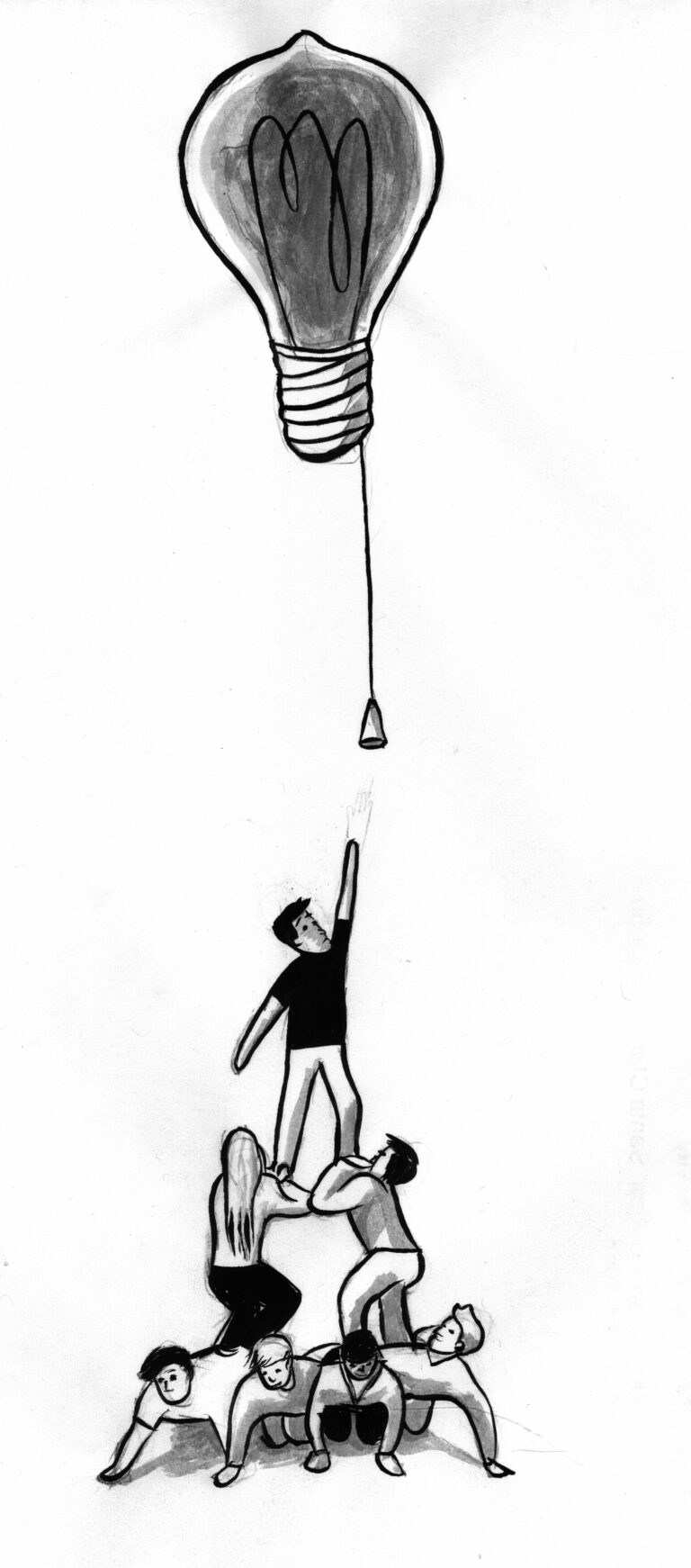
Last summer, Mike Eidlin, a fourth-year Japanese and economics double major, had an idea for an iPhone app. He presented his idea to the Hacker Lab competition in Sacramento, where he recruited a team to build the app and won third place in their hackathon.

Currently, the UC Davis Computer Science Club is running a similar event: the Idea Fair. The event is co-hosted by on-campus organizations: The Institute of Electrical Engineers, the Engineering and Technology Entrepreneurship Club and Pixel, the graphic design club.

The Idea Fair consists of three separate events: Pitch Week, the Idea Mixer and the Idea Hack. During Pitch Week, students presented their ideas to computer science officers for consultation. Then, the Idea Mixer allowed these students to present their ideas to other students, in the hopes of recruiting them to their team.

“The goal is to facilitate collaboration, make ideas happen and even make them come true,” said Charlyn Gonda, a fourth-year computer science major and president of the Computer Science Club.

Finally, from Feb. 21 at 9 p.m. to Feb. 22 at 12 p.m., the teams will have 12 consecutive hours to build their ideas at the Idea Hack: a hackathon similar to the event attended by Eidlin.

A ‘hackathon’ has become a general term to mean any continuous amount of time where teams can code, program software, create business models, design graphics and do whatever else they must to create a product within the time limit.

“We want to put people who do have ideas together with people who can make those ideas happen,” Gonda said.

Gonda said the Idea Fair is one way to give students real-world experience. On one hand, she said the event can give computer science majors a chance to apply their knowledge. On the other hand, Kevin Liu, a fourth-year computer science major and chair of the Computer Science Club’s professional development committee, said students of all backgrounds and majors have a chance to let their ideas be heard.

“If you find some sort of problem in the world, it doesn’t matter what background you come from,” Liu said. “As long as you have an idea, you can try to solve it.”

Liu said students in business, economics, design and even philosophy have pitched ideas and joined teams during Pitch Week and the Idea Mixer. He also said part of the need for the Idea Fair came about from such students recruiting software engineers from the Computer Science Club’s Facebook group.

Eidlin said he found fourth-year computer science major Raymond Lau through this method. Eidlin recruited Lau last summer for Hacker Lab.

“My idea was kind of like an Instagram for books,” Eidlin said.

As a recreational book reader, Eidlin came up with Bookbucket, an iPhone app to let users share book recommendations. The idea developed into something like a social network, where he said users could discover more books through friends, celebrities and other users. He also said the app would provide user profiles, friend tagging and a book recommendation engine.

Eidlin said he began by drawing up the wire-frames — the drawings of what the app might look like — and pitched his idea on the first day of Hacker Lab.

Lau and Eidlin were joined by two other people, a designer and a 31-year-old retired game developer who happened to be at the hackathon. Eidlin said his team worked together for over 20 hours at Hacker Lab, and noted that participants were even permitted to bring sleeping bags to the hackathon.

“You see everyone else working on their projects, and you get more motivated to work on your own,” Eidlin said. “It’s a really competitive environment.”

Eidlin said his contributions didn’t stop with the initial idea. Using his own skills, he was able to develop the app’s business model. He said whenever someone received a book suggestion and purchased that book through Bookbucket, Eidlin and his team would retain a percentage of the profits. The team even planned to partner with physical book retailers like Barnes & Noble, who could ship the books directly.

At the end of the hackathon, Eidlin said the team came up with a working prototype, the business model and strategies to face competition. In the end, they were able to win third place at the event.

“A four-person team is all you need,” Eidlin said.

Unfortunately, Bookbucket never made it to the app store. Eidlin said the back-end developer, a vital part of the small team, decided to back out of the project.

“I’m willing to revive the project,” Eidlin said. “The code is still there. I could easily pick up the business aspect.”

Until then, Eidlin has shifted his focus back to graduating and finding a job, which he said is more important to him.

The Idea Fair is using aspects similar to the Hacker Lab, giving students like Eidlin an opportunity.

Liu said last year’s Idea Fair was a small event and almost completely different than this year. This time, the club posted more advertisements, garnered a larger list of participants and added the hackathon and Pitch Week.

“This is really the first year we’re doing this at such a large scale,” Liu said.

The Idea Hack will run for 12 straight hours in Kemper Lobby. Gonda said food, drink and prizes will be provided to the participants, and judges from academia and the industry will judge teams based on the execution and practicality of the finished products.

Part of the event has been made possible thanks to sponsorships from companies like Cisco and Intel. Gonda said Cisco has had previous contact with the club and supported the Idea Fair since early on in the year. As for Intel, Gonda said an internship she held with the company over the summer gave her the chance to make a pitch.

“Intel was very supportive of the effort and believed in the vision, so they decided to sponsor it,” Gonda said.

Based on the number of signups during Pitch Week, Gonda and Liu are expecting a good turnout from the Idea Fair.

“Generally because hackathons are regarded as fun events, to bring it to everyone here is a good way to react with the community,” Gonda said.

Gonda said she hopes the Idea Fair can give students a chance to create a product that’s not only fun to make and fun to use, but maybe even profitable, and able to provide them with the chance to gain real-world experience.

Women’s water polo finishes solid home tournament; looks ahead to Irvine

0

Where: Anteater Aquatics Complex — Irvine, Calif.

When: Saturday, Feb. 22; Sunday, Feb. 23

The UC Davis Aggies women’s water polo team completed a successful weekend in Davis, Calif. as they defeated Bakersfield and Cal State East Bay (CSEB) during Sunday’s final day of action at the 34th Aggie Shootout tournament. Freshman Carla Tocchini scored six total goals on the day,  and senior Alex Rawlinson scored four. The Aggies recovered from a 3-0 deficit to post a 10-6 win over Bakersfield in the first match of the day before blowing out CSEB 15-4 to close out the tournament.

The Aggies went 3-2 during the tournament, scoring a win over Sonoma State, 14-6, on Feb. 15 as well as the wins over Bakersfield and CSEB. On Feb. 14, the Aggies lost a hard fought battle to No. 12 ranked San Jose State University (SJSU), 12-10, and then lost to No. 2 Stanford on Feb. 15, 17-5. Tocchini recorded a hat trick during Saturday’s action, while Rawlinson again posted good numbers as well, scoring another three goals on the day. In the SJSU loss, sophomore Allyson Hansen, junior Elsie Fullerton and senior Hannah Curran all scored two goals for the Aggies.

Both losses this past weekend came against top programs and quality teams, so no head hanging will be necessary during this week. The Aggies will instead look forward to their next tournament, the UC Irvine Invitational, on Feb. 22-23 where they have been drawn to compete in a group featuring exclusively UC teams. The Aggies will play the host school, Irvine, at 11:45 a.m. on Feb. 22, and then will face either Cal or UC Santa Barbara later that afternoon.

The UCI tournament field will feature the top five ranked teams in the nation with No.1 USC, No. 2 Stanford and No. 3 UCLA all competing alongside Cal and UCI who round out the top five. It will be a huge challenge for the Aggies to emerge unscathed, but with the matches against SJSU and Stanford last weekend already giving them the experience and knowledge needed of just what will be required to gut out a win against a fellow top team, UC Davis should be right in the mix on the last day of the tourney.

— Vic Anderson


Researchers create new method for producing biogasoline

Researchers at UC Davis have created a new process for “biogasoline.” The procedure effectively converts cellulosic and biomass materials — including waste from cities, farms and forests — into potential gasoline substances. The team of chemists who published their findings in the journal Angewandte Chemie include Professor Mark Mascal and co-author post-doctoral researchers Saikat Dutta and Inaki Gandarias.

“Most biomass-derived hydrocarbons are linear chain molecules, [related] to diesel and jet fuel, but not to gasoline, which requires branched molecules,” Mascal said.

Mascal’s method produces hydrocarbons that have this branched carbon chain, making the fuel available for gas-powered cars.

“The techniques where diesel-range straight chain hydrocarbons can be made from biomass which then have to undergo ‘cracking,’ a known technology in the petroleum industry, for the production of gasoline-range branched hydrocarbons. Our method allows the production of gasoline-range branched hydrocarbons directly from biomass without requiring further energy-intensive processing,” Dutta said.

Some biofuel processes require the biomass material to be converted into sugars for the purpose of fermentation. However, with the new method, the costly manufacturing step of sugar conversion and fermentation is eliminated.

Dr. Annaliese Franz, a professor in the Chemistry Department at UC Davis, researches biofuel production amongst other things.

“In order for renewable fuels to be competitive with current petroleum-based fuels, it is important to make the process cost-effective,” Franz said.

Mascal’s research group will continue to optimize their method and will also continue to work on their ongoing projects.

“We have filed a provisional patent with the help of UC Davis and are looking for a partner to further this research with the ultimate goal of commercializing the product. Since the products of our method are exactly the same as those of petroleum-derived gasoline, they can be seamlessly integrated in the current infrastructure,” Dutta said.

To the team’s knowledge, no other method exists which has such direct production of branched hydrocarbons. With the pursuit of commercialization and the manufacturing of gasoline-like biofuel, this UC Davis-born method has obvious potential.

“The market effect of this new approach to gasoline-like molecules depends entirely on any future commercial development. If a company takes this on and produces biogasoline from it, the effect could be considerable. We’ll just have to wait and see,” Mascal said.

UC Davis’ research in the chemistry department include a multitude of professors investigating the future and prosperity of biofuels. This biogasoline method is just one example of organic chemistry having real-world implementation and results.

“We hope that our method will prove to be a valuable step towards a green, sustainable world,” Dutta said.


UC Davis falls to Cal State Fullerton 65-62

0

A last-minute jumper by Cal State Fullerton’s Chante Miles helped the Titans pull away from UC Davis with a 65-62 victory on Feb. 13 at the ARC Pavilion.

UC Davis was led by junior forward Sydnee Fipps, who scored 20 points, including five three-pointers, to notch her fourth-consecutive 20-point game. Sophomore forward Alyson Doherty added 10 points and five rebounds, while junior guard Kelsey Harris finished with 14 points.

It was the second time that the Aggies played against the Titans this season; last time, UC Davis finished with a 69-67 overtime victory. This time, they weren’t so lucky, falling to the Titans and suffering back-to-back losses, including a tough overtime loss at UC Irvine.

Back-to-back three-pointers by Fipps helped the Aggies gain an early lead, 13-9, with five minutes into the first half, but soon Cal State Fullerton’s Alex Thomas and Samantha Logan put the Titans ahead, 17-13, after knocking down back-to-back three-pointers. The Aggies would once again retake the lead, 30-22 with two minutes to play, by hitting clutch shots including eight first-half three pointers.

The Aggies ended the first half with three-point lead, 30-27. UC Davis shot 40 percent from the field while Cal State Fullerton shot 24.3 percent.

As the second half started, both teams traded baskets, with UC Davis’ largest lead only being five points. The Titans were finally able to gain the lead, 52-50, as Logan nailed a corner three-pointer with 9:15 left to play in the half.

The Titans managed to pull ahead with a five point lead, 57-52, but soon the Aggies came back to even the match. They went on an 8-0 run, taking the lead, 60-57. However, Cal State Fullerton again bounced back to recapture the lead, 61-60, with only two minutes to go in the game.

With 26 seconds left to play, the Aggies led by one, but Chante Miles drove to the basket and converted, giving Fullerton a one-point lead, 63-62. After Thomas converted a pair of free throws, the Titans led by three with eight seconds left. This was too much for the Aggies, as they eventually fell 65-62.

In this game, the Aggies shot 42.3 percent from the field and 37.1 percent from three-point range, while he Titans shot 31.8 percent from the floor on the night and 30 percent from behind the arc.

With this loss, UC Davis falls to a 13-10 record overall on the season and 5-5 in conference play. The Titans improved to 9-13 overall and 5-4 in Big West play.

The next game for UC Davis will be on Feb. 20, as the Aggies head back on the road and visit the fourth-placed Long Beach State.

— Janet Zeng


Sustainable Agriculture: Cost of Fashion

0

It’s difficult to consume clothing mindlessly when pictures of the people who died in the process of sewing your crappy T-shirt are projected onto the store’s building. Such was the tactic of a group of protesters outside of New York Fashion Week who aimed to highlight recent industrial disasters in the garment industry.

Last April in Bangladesh, an eight-story building housing thousands of workers and several garment factories collapsed, leaving approximately 1,135 people dead and 2,500 injured. Cracks had been discovered in the structure the day before, but workers were forced to return to work despite recommendations to close the building.The Rana Plaza collapse is being called the worst accident in the history of the garment industry.

The Cost of Fashion, a protest group spawned from Occupy, teamed up with guerilla street artist collective, The Illuminator, to use projectors to light up city buildings with images of the victims of Rana Plaza. Their goal is to shed light on the human rights and labor violations commonly found in the garment factories that supply Western brands.

As westerners, our relationship to the global garment industry is as consumers, which means we don’t often see the sea of hands a garment passes through before we buy it. Many of these industrial processes occur in countries with little or no environmental standards and unsafe working conditions.

The global garment industry is extremely lucrative with factories supplying large retailers mainly within the U.S. and Europe. The Western World’s insatiable desire to consume, a lack of or poorly enforced regulations and low wages make it an extremely profitable industry — bringing in trillions of dollars each year.

This past November, five months after the collapse and a month after a garment factory fire claimed nine more lives, thousands of garment workers protested low wages on the streets of Bangladesh. The average Bangladeshi garment worker earned just $38 a month. These protests shut down nearly 250 garment factories and were met with rubber bullets, tear gas and the death of at least two more people.

The Bangladeshi government conceded to a 77 percent increase in wages — from $38 to $68 a month or roughly $0.39 an hour. The new minimum is still the lowest wage paid to garment workers in the world. These dehumanizing wages allow us to buy cheap, dispensable clothing at stores like H&M, JC Penney and Walmart — all retailers who contract work from Bangladesh.

The lives of Bangladeshi workers are intricately linked to the desires of Western consumers. Sustainable food systems have become a sexy topic as of late, but what about sustainable clothing systems? Most Bangladeshi garment workers are young people in their early 20s, just like us. Why aren’t we concerned for the health, safety and livelihood of our Bangladeshi counterparts?

These are questions who don’t care or think to ask. Be it ignorance or apathy, it is clear that our mindless consumption affects others. How can we reconcile the overwhelming task of researching and weighing our personal ethics against the desire to fulfill our social image?

We can boycott brands, such as Walmart and JC Penny, that are associated with poor working conditions and environmental pollution — but that is still a quiet action. Refusing entirely to participate in the garment industry by buying used clothing is another good action. But to be honest, I don’t have a feel-good solution for you, my dear reader.

I just keep reflecting on the story of a 25-year-old woman who worked in the Rana Plaza factory. She was trapped amongst the rubble for three days, because her arm was pinned beneath a beam. Once rescue workers found her, they gave her a saw and instructed her to cut off her own arm.

Compare this to the James Franco movie 127 Hours, based on the story of a hiker whose arm was similarly pinned beneath a boulder. After five days, he sawed off his arm with a pocket knife and was rescued by fellow hikers.

The hiker’s story is celebrated as one of personal strength and perseverance, while the woman’s story is shoved aside in favor of global retail brands and retaining the status quo of crappy, cheap T-shirts.

If you just checked the tag of your T-shirt, email ELLEN PEARSON at erpearson@ucdavis.edu.

Literary Lessons: Patience Padawan

0

Freshman year is indubitably the hardest year of college. People who succeed in the “important” stuff during freshman year are made of magic and probably know an elf or two. Note: winning a drinking game does not count in calculating your success.

However, coming a close second to being the hardest year in college is senior year. You’ve done everything (and maybe everyone) and you’re nostalgic for mom’s cooking as well as furniture on which you can hygienically lay your face. To all my friends graduating this quarter, I plead with you, stay patient. Senioritis is a struggle, but you only have two more quarters and getting lazy at this point in the game is very unadvisable.

In books and in life, patience is crucial. However, you can go back and redo your reading of a classic novel whenever you choose. Senior year, on the other hand, is a much harder feat to do over. It’s necessary that seniors ride out their brains’ depleted thinking tanks to the last drop.

Remember how excited you were when you got into UC Davis!? Think about how disappointed your past self would be to see your future self skipping class and not turning in homework. Giving up is your way of telling the universe that you are privileged enough to fail — that you are so well-off that extra effort has no marginal benefit anymore.

That being said, if you are sick — emotionally or physically — or anything happened to you that is making life hard right now, don’t be bummed.  If you have a reason for your senioritis, there is no shame in that. I am only saying that for those who are making a conscious effort to put in no effort … those people need to buck up.

If you have only contracted senioritis solely out of boredom, try to remember the last time you gave up on something. For me, this conjures up a failed tumultuous relationship with one of the greatest authors of the 20th century, James Joyce. Also the time I threw away my pencil sharpener because it seemed a bit too dangerous to try to fix myself. Out of the two, I pick to share how I badly regret getting bored of James Joyce and not putting in any effort to finish Portrait of An Artist as a Young Man.

I want to be a James Joyce consessiour. My loins ache at the idea of him. However, my reading escapades with him are always fast, intense and over quickly. Not that this is a bad way to do it, I can just only get so much accomplished (in pages, of course) when doing it for such a short amount of time and getting tired so quickly. I guess he just left me feeling, well, unsatisfied. About reading that is.

In the end, I never got through Portrait. Even worse, this book is nothing like the monstrosity that is Ulysses, it’s actually pretty short. I literally just got bored and decided that going on Buzzfeed outweighed the effort of finishing the novel.

Unfortunately for me, no one gives a damn about an opinion of a book unless you know what happens in the end. I can’t be at one of the fancy balls that I often frequent and impressively bring up James Joyce at because, well, I was lazy. Don’t be the guy at the black-tie gathering who can’t think of a thing he learned in any upper division classes because he was lost motivation to learn. Senior year is when all dinner conversation-worthy topics come up, don’t flake out now!

I guess I will close by saying “good for you” to anyone who actually made it to the end of their college career. It’s not easy to make it til the end. Give yourself a big pat on the back because at this point, you’re more likely than not going to make it to graduation. That being said, seeing the finish the line is no reason to lose pace.

It’s just college. You don’t live in old-time Ireland in a state similar to dementia where you relive your days in church over and over again and feel a constant sense of overwhelming loss about a old love. You just have to study and avoid criminal activities. Life is probably never going to be as easy as it is right now.

Go, young padawan, pick up the reading for tonight, review your notes like it’s sophomore year and say no to the Star Wars marathon at the hot guy’s house. Hot guys can wait, midterms cannot.


To get really dark about graduating from college, you should email EREN KAVVAS as ebkavvas@ucdavis.edu.

Latin Americanisms: Schoolyard Politics

0

One of the most disheartening things you can say about a country is that it stands alone. Such a concern might very well hearken back to experiences in our not yet fully politicized lives as children (that is, if my interaction with my own overly diplomatic nieces and nephews is any indicator).

In fact, the site of childhood politics, i.e. the playground, can shed some much-needed light on the realm of contemporary “adult” politics.

Much like on the playground, partnerships and coalitions are part and parcel of the international political system we inhabit, and for a very good reason: they lessen the chaotic forces — or at the very least lessen the brunt impact of such forces — inherent in the system itself.

Like a playground bully who might see fit to prey on the less powerful, and lay claim to lunch money tributes, certain states exercise their own brand of schoolyard justice by laying claim to their spheres of influence.

These are childhood renderings of political reality. And while it might seem a debasement of real world politics, you can’t deny that the U.S. is the poster child for bullies with self-esteem issues.

But even a playground hegemon needs allies. The U.S. for example has a longstanding tradition of partnerships with nations who are seen to either share and or contribute to the global perspective which shapes U.S. interests abroad.

The notion of Latin Americanism (an idea which feeds this column both in name and substance) and the advent of a 21st century Pan-Americanism both speak to this very concern. After a 20th century riddled with foreign interference and forceful intervention (e.g. the Guatemalan coup of 1954, the 1973 Chilean coup d’état and ensuing state-terror, the 1983 U.S. invasion of Grenada, foreign-funded death squads in Central America — just to name a few) political leaders in the region called for a reimagining of Latin America. This collaborative exercise — one imbued with the spirit of Simon Bolivar, Jose Marti and Benito Juarez, among others — was spearheaded by a group of rising leftist leaders who had come of age in a Latin America which was by all means puppeteered by Yankee strings.

Pan-Americanism taken within the political context is a movement which seeks to promote relations and regional cooperation between the nations of America (the continent). It is a movement which does not hide its suspicions or historical disdain for the 50-state hegemon. In fact, one of the most striking observations to be made of the Pan-American project is that “Americanism” (once again, of the continental bent) becomes a Latin American articulation of the idea — one grounded in bloody historical reality — that the whole of the continent stands apart from the U.S.

This admittedly divisive approach to diplomacy finds its roots in another political project which has shaped the region for centuries past: the Monroe Doctrine. From its very intellectual inception and all too quick physical manifestation, the Monroe Doctrine was widely rejected, both by governments and the citizens of most Latin American countries, who understood all too well the interests that were behind its formulation.

The problem today lies in the threat of Pan-Americanism slipping once again into dormancy. The death of Hugo Chavez (much like his ascendency into power) marked a watershed moment in the region. His standing as the leading proponent of Bolivarianism — which takes Pan-Americanism to be its ultimate legacy — leaves a vacuum of leadership both in the region and in Venezuela (as evidenced by the recent turmoil facing the Maduro government). Brazilian president Dilma Rousseff, while a capable leader, lacks the immediate charisma that graced Lula and which allowed him to be the moderate foil to the more boisterous voices of Chavez, Correa and Morales.

I can’t help but lament the utter irrelevance of my own nation in this continuing schoolyard tragedy. At the height of the Pan-American ethos, Mexico had the no-fun-allowed duo of Vicente Fox and  Felipe Calderon at the helm, two leaders who, rather than join the growing regional bloc, opted instead for BFF status with the U.S. (probably in the hopes of a less severe lunchtime beatdown). And now we find ourselves with Enrique Peña Nieto, a man who, rest assured, took his ball and went home as a child and might prove to do the same as president.

What the future holds for the region and Pan-Americanism as a movement is uncertain. But the present, one no longer tied to the whims of the neighbor up north, is promising.

Borrowing a most cherished U.S. idiom, one thing would seem to hold true: united we stand, divided we fall.

If you feel JORGE JUAREZ is a de facto bully for using his bully pulpit to bully bullies, send your lunch money to jnjuarez@ucdavis.edu.

This Week in Science: Feb. 20, 2014

The science of curls
Curly-haired animated characters might become more common. Research conducted by MIT and the University of Pierre and Marie Curie has gotten behind the science of curly hair. It had originally been difficult to understand how hair could curl under it’s own weight. They were able to create a toolset to predict how a strand of hair would curl which will aid computer animators in creating realistic hairstyles for characters.

Science brings in the Olympic medals
The patterns show that the Olympic teams with the big sponsors and new, specially-designed equipment have the edge. That is not to say that tech alone can snag the gold but that skill and tech make the winning combination. The advances in science and research for sports equipment make it difficult to keep the games fair for the teams who don’t have a big time sponsor or government funding.

12,600-year-old remains to be reburied
A study published in Nature explored the remains of an infant found in Montana in 1968. After all these years of research the remains will be reburied during a formal ceremony. The boy was thought to have died between the ages of one and one-and-a-half, about 12,600 years ago. He was buried with some powdered minerals, antler tools and other artifacts. The boy’s genome seemed to have originated from Asia and is genetically related to modern Native Americans. His timeline suggests he belonged to the Clovis culture.

Nanomotors
Published in the Angewandte Chemie International Edition journal, researchers have installed “nanomotors” inside live human cells. First seen 10 years ago, “nanomotors” are small synthetic motors which have gold rods. They move around inside cells and will be able to treat diseases and kill cancerous cells. They also might be able to deliver medication and perform surgery from within a cell. However, this is still at the basic science stage.


Corey Hawkins reaches milestone as road woes continue for Aggies

0

UC Davis men’s basketball split the season series as the Aggies (8-17) fell against Cal State Fullerton, 74-64. Junior guard Corey Hawkins scored his 1,000th career point against the Titans and led the Aggies with 21 points on seven for 14 shooting; he also recorded five rebounds and four assists.

UC Davis kept pace with the Titans in the first half. The Aggies went 11-27 from the field and shot five for nine behind the arc. Senior guard Ryan Sypkens shot poorly, only scoring six points on two for six shooting, but he drained a three-pointer, assisted by junior forward Clint Bozner, which closed the Titans’ lead to one. However, the Aggies struggled defensively after that, and in the last 4:45 minutes of the first half, the Titans went on a 14-5 run to close out the half with a 10-point lead.

Junior guard Avery Johnson was able to cut down the Titans’ lead to seven after a three-pointer to start off the second half. However, a series of turnovers and missed layups allowed the Titans to stretch their lead back to 10. Turnovers have been a huge issue for UC Davis this season. The Aggies are ranked second in the conference in turnovers. The absence of junior forward J.T. Adenrele has proven costly for the Aggies as the they rank last in rebounds in the Big West as well. Adenrele averaged six rebounds per game last year.

Freshman forward Georgi Funtarov, who finished the night with eight points and three rebounds, sank a three pointer with 16:34 left in the second half. But Cal State Fullerton’s Michael Williams — who had 20 points, five rebounds and three assists — went on a five-point streak of his own to expand the lead to 51-39. There was no turning back for the Titans as they led by double digits for the rest of the game, even leading by as many as 16 points in the second half.

Hawkins became the second Aggie this season, 20th Aggie overall, to score 1,000 career points. Sypkens reached the milestone earlier this season.

“It is an honor to reach this milestone, but I must admit that I was unaware of my situation entering this game,” Hawkins said. “All credit goes to my teammates; it is their aggressive play that creates a lot of open looks for everyone on the court.”

Hawkins scored his 1,000th point seconds before the end of the first half on a free throw.

The Aggies have lost three of their last four games as they look to right the ship against Long Beach State on Feb. 20 at the ARC Pavilion. UC Davis lost to Long Beach by the score of 99-74 in their first meeting in January.

— Oscar Dueñas

The Philosophy of Education: Being Busy

1

Do you often feel you are too busy to spend time with friends or relax? Do you feel stressed because of being busy? If so, you are not alone.

When we are busy, we are often constantly in a hurry and worried about our duties. As a result, we cannot enjoy our surroundings or what we are doing. For example, many plants around campus are blooming with beautiful, fragrant flowers. How many of us even notice the flowers’ beauty, much less stop to smell them? If we are constantly focused on future obligations and thus do not enjoy the present, we cannot be happy even when dancing at a party.

There are two main reasons we feel incredibly busy and stressed. First, we may simply have too many responsibilities, classes, work hours, research positions, etc. Second, we may not have that many things to do, but we are so stressed about them that we constantly distract ourselves with Facebook, etc. As a result, we feel like we have no time because of how much time we spend in those distractor activities.

If we are busy because we simply have too much to do, we must reduce our workload. For example, a friend of mine is taking 19 units in six classes this quarter plus a yoga class. As a result, she has no time to relax and little time to sleep. She is stressed and has little time for friends. In addition, she is struggling in two of her classes. If we spread ourselves too thin, we cannot do well in any task. She realized that and is taking 14 units next quarter, a much more manageable workload.

Most often, paradoxically, we find ourselves truly overburdened after a period of lots of free time. I believe this occurs because we feel intense pressure to constantly do things — to be productive every moment. As a result, we fill our free time with more obligations such as a new job or more units next quarter. Then, after the period with lots of free time, we find ourselves with more responsibilities than we can handle, just like my friend.

But why do we feel such aversion to free time? Are we human beings or human doings? Yes, time is money, but is money the goal of life? No, I believe the goal of life is to be happy. Money is a useful tool, but it is not an end of itself. To be happy, we require time to relax and rest our minds and bodies. If you have free time, enjoy it; don’t feel pressured to fill it up.

On the other hand, we may feel overburdened and too busy despite not actually having many duties. This phenomenon most often results from our stress or worry about our responsibilities. If we feel this way, we cannot concentrate on our tasks and most often constantly distract ourselves from them, resulting in a short, simple task becoming a long, miserable day.

For example, this quarter I had to write a paper over the weekend for a writing class. I had all of my sources and had already written my outline, but had strong negative feelings about the paper: “I don’t want to write this. I don’t care about it,” etc. As a result, I kept wandering the internet after every few words written to distract myself from my pain. After six hours, I realized that I had only written the introduction. If we do our work this way, of course we will feel overwhelmed and busy!

This form of being busy results from and is completely dependent on a negative attitude towards our work. With this attitude, even the smallest task will seem like an impossible burden. Therefore, we must first change our attitude towards our work before attempting it again.

In my case, I gave up on writing the paper when I realized how negative I was towards it. I tried again the next day after clearing my mind of it; that time, I no longer felt so negative towards the paper. It flowed easily and I finished the rest of it in an hour and a half. The paper had not changed in any way, only my attitude towards it had changed. Our attitude towards a task is one of the strongest predictors of our ability to complete it.

Constantly being busy destroys our happiness and peace of mind. We must reduce our load, either in reality or in our minds, to enjoy even the best party. Isn’t the goal of life to be happy? Thus, if what you are doing does not make you happy, change it!


To tell WILLIAM CONNER how busy or not busy you are, contact him at wrconner@ucdavis.edu.

National Academy of Engineering elects UC Davis professor to class of 2014

0

Dr. Katherine Ferrara, UC Davis biomedical engineering professor and founding chair of the Department of Biomedical Engineering, was recently elected to the National Academy of Engineering’s (NAE) class of 2014. Ferrara was elected for her contributions to theory and applications of biomedical ultrasonics.

Ferrara is one of the 67 new members to join the National Academy. Her election, along with the rest of the National Academy class of 2014, was announced Feb. 6 during the academy’s national meeting in Irvine, Calif. New members are elected by current members of the academy based on their achievements in research.

“I am particularly pleased by the selection of Professor Katherine Ferrara of our Department of Biomedical Engineering,“ said Enrique Lavernia, dean of the UC Davis College of Engineering, via email. “She helped found this dynamic department, served as its first department chair, and has helped the department gain a significant national stature.”

Ferrara is currently working on methods to better image diseases, particularly cardiovascular disease and cancer. Ferrara said what the National Academy was interested in was her work on using tiny gas bubbles to image cancer and cardiovascular disease.

Ferrara found that when little gas bubbles are injected into a patient’s bloodstream and an ultrasound wave is sent towards them, the gas bubbles will make unique sounds. Ferrara said her team was among the first to show how these unique sounds can help develop techniques involving gas bubbles to treat patients clinically.

For example, Ferrara’s work found that injected anticancer drugs encased in tiny capsules can be directed by ultrasound towards the cancerous tumour. The capsule is then burst by ultrasonics, releasing the drugs and reducing side-effects on other tissues and organs.

Ferrara said she had been interested in working with ultrasound imaging for a long time. After collaborating with a cardiologist from the University of Virginia who was also interested in using gas bubbles clinically, Ferrera was able to come up with strategies on how to use gas bubbles with ultrasound based on her observations.

As concurrent imaging methods, such as MRI, CT, PET and ultrasound, evolve into a standard for the precise delivery of therapeutics, Lavernia predicts Ferrara’s work to have a large impact on future medical research.

“Professor Ferrara has earned a global reputation for her ground-breaking work in image-guided drug delivery, which we can expect to become one of the touchstones of early 21st century medical breakthroughs,” Lavernia said.

Ferrara is the 17th faculty member from the UC Davis College of Engineering to be elected to the National Academies. Ferrera joins other faculty members such as Lavernia and Chancellor Linda P.B. Katehi in the prestigious academy.

Denneal Jamison-McClung, associate director of the UC Davis Biotechnology Program and program coordinator for UC Davis ADVANCE, is pleased that more diverse individuals are being recognized for their work in academic science, technology, engineering and mathematics (STEM).

“[Professor] Ferrara is active in the UC Davis ADVANCE program, which promotes diversity in STEM,” Jamison-McClung said via email. “Any time we have a woman recognized for her achievements at the highest levels, it lets younger women know that the ‘sky is the limit’ for their own professional achievements.”

Because only eight out of the 67 inductees to the NAE this year are women, Karen McDonald, associate dean of Engineering, also predicts Ferrara’s achievement to have a positive impact on women in STEM academics at UC Davis.

“Professor Ferrara’s election to the National Academy of Engineering will certainly encourage our women undergraduate and graduate students to pursue STEM careers, as well as inspire our women faculty,” McDonald said via email. “In addition to her major research contributions in the field of biomedical engineering, she also finds time to give back to the STEM community by helping women who are following her path.”

As a physical therapist, Ferrara said she often worked with patients who had cancer or cardiovascular disease. Well aware of the profound effects these diseases could have, Ferrara was drawn towards finding methods to treat cancer and cardiovascular disease.

“I’ve always been a believer that if you could diagnose something earlier, that you have the potential to have a bigger impact,” Ferrara said.

Ferrara said her interest in science is largely attributed to her father, who was also a biomedical engineer.

“I started as a physical therapist and my dad also was a biomedical engineer, so he had a lot of influence on me,” Ferrara said. “Really before biomedical engineering got started, he worked on the first sort of artificial heart and some of the early pace makers, so that had a major influence on me growing up.”

The National Academy of Engineering is one of the four organizations that make up the United States National Academies. The National Academies were established by the U.S. Congress to advise the nation on science, engineering and medicine.

Ferrara is a graduate from the University of Pittsburgh with a bachelor’s degree in physical therapy. She received bachelor’s and master’s degrees in electrical engineering from California State University, Sacramento and a Ph.D. in electrical engineering from UC Davis.

“I thank both the inspiration of my parents who have definitely backed me and my husband who has given me a lot of support, as well as many members of my laboratory who have performed experiments and worked very hard to achieve the results and discoveries we’ve made,” Ferrara said.

Police Briefs: Feb. 20, 2013

0

Monday 2/10

Sneak peek
Someone on Cowell Boulevard thought his daughter’s boyfriend was in her room because his shoes were outside her bedroom window, the screen was off and the bedroom door was locked.

Thursday 2/13

Dark wash
Someone requested extra patrol on Boston Terrace for a male who sits alone in the common laundry room in the dark early morning.

Sweet valentine
Someone reported an SUV parked across from the park because the windows were steamed up and the person thought the people inside might be fornicating.

Friday 2/14

Rose to the occasion
Someone stole flowers from a store on Second Street.

Boulder-dash
Some juniors on the overcrossing on Sycamore Lane were throwing rocks onto the lanes of Highway 113.

Saturday 2/16

Riding solo
Someone reported a driver masturbating at a stop sign on Fourth Street.

Police briefs are compiled from the City of Davis daily crime bulletins. Contact EINAT GILBOA at city@theaggie.org.

Aggies look to right ship in Moraga

0

Teams: UC Davis at Saint Mary’s, vs. Portland University, vs. Kansas State,

Records: Aggies, 1-3 (0-0); Gaels, 1-3 (0-0); Pilots 1-2, (0-0); Wildcats 0-3, (0-0)

Where: Louis Guisto Field — Moraga, Calif.

When: Thursday, Feb. 20 at 2 p.m.; Friday, Feb. 21 at 10 a.m.; Saturday, Feb. 22 at 10 a.m.; Sunday, Feb. 23 at 2 p.m.

Who to watch:

Izaak Silva came through when the Aggies needed him most. The junior catcher hit a go-ahead RBI double in game one of UC Davis’ Feb. 15 doubleheader against Seattle to give the Aggies a 3-2 lead, which they hung on to for a 4-3 win. Then, in the series finale on Feb. 16, Silva again gave the Aggies a late-inning lead, this time connecting on a two-run single in the sixth to put the Aggies to cap a four-run inning that gave them a 5-4 lead. The Aggies later succumbed to an 11-run Seattle seventh inning and lost 17-5.

Look for Silva to keep his clutch at-bats coming in the upcoming Gael Invitational from Feb. 20 to 23.

Preview:

After a disappointing 2013 season, the UC Davis baseball team opened the 2014 campaign by sending a message: they can play with anyone. Although the Aggies lost three of four over a weekend homestand to Seattle University, they were in every one of the games.

The Aggies (1-3) held Seattle to just five hits in the season and series opener. Senior Harry Stanwyck held the Redhawks (3-1) to just one run and three hits in five and a third innings, but the Aggie bats couldn’t get rolling to give their righty starter a win. UC Davis managed just three hits through the first eight innings before getting on the board in the bottom of the ninth. It was too little too late, however, as the Aggies fell 2-1.

UC Davis got its first win of the season in the first game of the Feb. 15 doubleheader. Junior catcher Izaak Silva drove in two runs with a one-out sixth-inning double to put the Aggies up 3-2. The Aggies, behind stellar pitching from juniors Spencer Koopmans, Raul Jacobson and Craig Lanza, allowed just three hits the entire game and held on to win 4-3. Senior third baseman Adam Young led the Aggies with three hits.

In the afternoon game, Seattle used a three-run seventh inning to tie the game at 3-3. The Redhawks used a successful squeeze play in the top of the ninth to plate the game-winning run. The Aggies were paced by senior right fielder Seth Batty, who led the team with two hits, and by senior second baseman Steven Patterson, who knocked in two runs.

The series finale was close for six innings. After a two-run Silva single in the bottom of the sixth gave the Aggies a 5-4 edge, Seattle sent 16 batters to the plate in the top of the seventh en route to an 11-run inning and a 17-5 victory.

Up next, UC Davis travels to Saint Mary’s College in Moraga for this year’s four-team Gael Invitational. The Aggies face the host Gaels (1-3) in the opener on Feb. 20 before playing Portland (1-2) Feb. 21, a team coming off a three-game series against No. 12 UCLA. On Feb. 22, the Aggies face off against the winless Kansas State Wildcats (0-3) before finishing off the weekend with a Sunday matinee versus Portland.

— Scott Dresser