


46.8 F
Davis

Davis, California

Thursday, January 1, 2026
Home Blog Page 874

Letter to the Editor: Save The Aggie

0

As a UC Davis graduate, it saddens me to hear that The Aggie may be on its last legs. It’s crazy to think that after 10 years, I can still remember the columns that made me cry with laughter and the thought-provoking articles that challenged my political stances. I always appreciated The Aggie’s ability to gather brilliant writers, artists and designers not for money, but for the passion of delivering a quality product. It is this same passion that allowed me to become a professional journalist for a technology publication that is read by millions of people today.

UC Davis is known as a university that promotes the cultivation of different ideas, and since its inception The Aggie has always allowed students to express these diverse viewpoints. While there are plenty of news outlets, what makes The Aggie special is that it is a centralized news publication by UC Davis students for UC Davis students.

The paper has existed for 99 years, never closer to reaching its centennial milestone, yet at the same time never so far. In the process, the publication has created dialogue spanning several generations, many of which are no longer with us today. But all of this rich history will vanish if you do not pass the torch. Like it or not, your class stands at the precipice of the publication’s existence, and future generations will be silenced or heard depending on what you decide today. I ask that you lay aside apathy to let your voices be heard louder than ever.


Sincerely,

Jimmy Thang

2007 Communications and Design graduate

Maximum PC Online Managing Editor
 

This week in senate: Feb. 20, 2014

0

ASUCD Vice President Bradley Bottoms presided over the meeting on Feb. 13. He called the meeting to order at 6:12 p.m.

The senators then attended a meeting and Bottoms called the meeting back to order at 7:26 p.m.

The meeting resumed with a presentation from Joshua Herskovitz regarding the points of parliamentary procedure. He went through all points of parliamentary procedure so those participating in senate meetings could abide by each point. He also went over point of clarification, point of personal privilege, right of rebuttal, point of order and point of information. Many of the senators had not had presentation regarding the parliamentary procedures.

SR 10 passed as a formal endorsement of AB 1433. This resolution would amend the education code to require that all Part 1 violent crimes as defined by the FBI that are received by campus police would also have to be received by local police. This would ensure that the UC Davis campus police are still the primary agency of law enforcement on the UC Davis campus.

SR 11 was passed in support of CA AB 1456. The resolution would assemble a focus group to research the possibility of a Pay it Forward, Pay it Back Pilot Program in all state universities and community colleges. The program would allow students to pay a certain percentage of their annual adjusted income without being charged an upfront cost for higher education.

Shinna Kim, the unit director from The Pantry presented to give the fall quarterly update. Kim said that The Pantry collaborated with CalFresh, a program that offers food stamps to those living in Yolo County. This service will hopefully be available at The Pantry sometime next quarter for UC Davis students who are eligible for food stamps. The Pantry also applied for the Go Green grant. The Pantry would obtain $1,500 to facilitate the process of bringing fresh produce from the student farm to the unit. The Pantry has now increased its open hours from three hours to four hours a day. She also said that The Pantry is encouraging more donations other than non-perishable food items including hygiene products and snack foods that do not require cooking preparation. According to Kim, the number of students using The Pantry has decreased from 500 students a week to approximately 150.

Next, Noelle Patterson, the unit director from Project Compost, presented to report its current status as an ASUCD unit as well. She said that the unit is outreaching around the campus and community to gain additional volunteer support. Through two of its interns, the unit is creating a garden space at the Experimental College garden space. The unit is also having a trip for students on March 1 to Zamora. Students will visit a compost facility that receives a large portion of compost from UC Davis. Project Compost is also looking to reach out to fraternity chapters and apartment complexes near campus and work with them to compost leftover food.

Ballot Measure 1 was then discussed. The measure encompasses the future of The California Aggie as an independent, student-run newspaper. The senators reviewed certain aspects of the referendum and determined that they were not able to make any changes because it was too late.

SR 12 was also passed in support of CA SB 841. The legislation proposes the possible development of a medical school at UC Merced. It would allot $1.8 million every fiscal year to the Regents for the expansion of the San Joaquin Valley Program in Medical Education. The legislation would also appropriate $1 million for the two-year planning period to establish the medical school at UC Merced.

An urgent resolution SR X was then passed. The resolution was drafted in response to a letter sent to both UCLA and USC that contained racial slurs and discrimination primarily towards Native American women. The resolution includes multiple accounts of racial discrimination at mostly UCLA, but also UC Davis. It urged Chancellor Linda P.B. Katehi and UC President Janet Napolitano to take action in combating such accounts of racial discrimination at other UC campuses.

SB 33 was passed. This bill concerns the Administrative Advisory Committee in regards to University Affairs at UC Davis.

SB 41 and 47 both passed. These pieces of legislation work to increase transparency for the specifics of senate meetings and processes. According to the author’s comments for SB 47, “this would address a lot of issues in student government, the notion of the ivory tower.”

SB 43 passed to include the Business Manager in the interviewing committee for the Controller to increase oversight of the hiring committee for ASUCD.

The meeting was adjourned at approximately 1 a.m.

Aggies head to Cathedral City tournament

0

Team: Syracuse; Notre Dame; UNLV; LIU Brooklyn; Oregon; UC Davis

Records: Aggies 4-8; Syracuse 2-3; Notre Dame 6-1; UNLV 2-7; LIU Brooklyn 2-7; Oregon 9-1

Where: Cathedral City, Calif.

When: Friday, Feb. 21; Saturday, Feb. 22; Sunday, Feb. 23

Who to Watch:

The Aggies traveled south for Valentine’s weekend to take part in the Stacy Winsburg Memorial Tournament in Los Angeles, Calif., Feb. 14 to 17. Starting the long weekend off right, UC Davis came out with a first-game victory versus Western Kentucky.

Several players established their dominance with both their bats and arms. Sophomore Kelly Zboralske tagged a two-run home run, her second of the season, in the 2-0 win over Western Kentucky

On the other side of the field, freshman Dana Cruse hurled a near perfect game, throwing a full, seven-inning shutout. Cruse gave up two hits and two walks with three strikeouts, pitching an excellent first game for the Aggies in the long weekend tournament. Cruse holds a current earned-run average of 2.90, the second-lowest on the team. As a freshman, she is expected to continue to do good things for the team not only this year but in her four years of wearing Aggie Blue.

Unfortunately, UC Davis was unable to hold out in their second game of the day versus No. 13 UCLA on Feb. 13. In a game that remained scoreless until the fifth inning, the Bruins finally broke the drought. UCLA ended up coming away with the 6-0 win over the Aggies. However, with plenty of softball to play throughout the weekend, UC Davis still looked to come away with multiple wins.

 In their first matchup on Feb. 15, UC Davis took on Western Kentucky again, with less satisfying results than in their first head to head meeting. Kentucky took the win in a close game, 9-8. However, the Aggies were not out of it as they fought back and won their second game of the day versus Robert Morris, 2-1. Another young player for the team, sophomore Chapa Marissa, started the game versus Robert Morris, throwing five innings with four hits, one run, one walk and one strikeout before fellow sophomore Leah Munden came in to shut it out. Munden threw two innings with no hits, and two strikeouts, recording her first win of the season.

In the final game of the tournament, the Aggies had the opportunity for redemption, taking on UCLA once again. To the athletes’ dismay, they were unable to come away with the victory, as the Bruins took the victory, 5-1.

Preview:

Although the Aggies were unable to come away with a tournament trophy this past weekend, there is still plenty of softball to be had in the coming weeks. UC Davis first takes on Stanford in their annual home matchup on Feb. 18. The Aggies have defeated Stanford the past two seasons in this mid-week classic and look to do so once again.

A victory versus the Cardinals would give the team some momentum coming into another long weekend of softball, as the Aggies will travel to Cathedral City, Calif. to take part in the Mary Nutter Collegiate Classic.

The athletes will face an excellent set of competition, opening up the tournament versus Syracuse, followed by games against Notre Dame, UNLV, LIU Brooklyn and University of Oregon.

Conference play does not commence until the beginning of April; however, these tournaments are key in getting the Aggies ready for league. Victories in these games will boost confidence levels, as the team has the opportunity to bring home several tournament trophies back to Davis.

— Sloan Boettcher

UC Davis to offer sustainable environmental design major

0

UC Davis administration approved a new sustainable environmental design (SED) major within the College of Agricultural and Environmental Science under the Department of Human Ecology on Jan. 30.

The SED major will allow students to learn about sustainable and green designs and will allow them to pursue various careers within city and regional planning, architecture, real estate, education and several other fields.

“[It] will further UC Davis’ goal of providing cutting-edge sustainability education to meet the challenges of the twenty-first century,” said Patsy Eubanks Owens, chair of the Department of Human Ecology, in a press release.

The major was called for by the landscape architecture (LDA) program’s 2004 Strategic Plan and its 2009-14 Academic Plan, according to the Undergraduate Major Proposal for SED.

“There was a concern for people with an interest in sustainable environmental design who would go to landscape architecture but would not get in,” said Sharla Cheney, undergraduate adviser for landscape architecture and environmental design.

LDA is an intensive and selective program that only allows up to 36 applicants to declare it as a major each year. SED allows students without an aptitude for art, drafting and design interested in sustainable planning to pursue a degree.

“More want to take LDA than we can accommodate,” said Stephen Wheeler, an LDA professor.

Wheeler teaches one of the major’s core classes, LDA 3: Sustainable Development and Theory Practice. Many of SED’s core classes come from landscape architecture. Certain classes from civil and environmental engineering (ECI), community and regional development, plant science and environmental science and policy are included in the pre-approved electives that can be taken for the major.

Several LDA classes were changed to accommodate the new major, and three new classes, LDA 140: Green Building, Design and Materials, LDA 141: Community Participation in Design, and LDA 142: Applying Sustainability Strategies will be offered starting next year.

LDA 142 is a capstone course that students will take in the quarter before graduation. In it,  SED students will use the knowledge they have attained through their education to work on a real-world project.

“It provides students with a project to show future employers,” Cheney said.

New sustainable programs have sprung up over the past few years, including the sustainable agriculture and food systems major, a sustainability within the built environment minor within ECI, which were both established in 2011.

“SED is the first major focused on an urban environment,” Cheney said.

As of Feb. 12, four students have officially declared the major.

Gavin Pauley, second-year SED major, was the first to declare.

Pauley, originally a student in sustainable agriculture, became interested in UC Berkeley’s sustainable environmental design major. After hearing that UC Davis had just started offering SED, he switched his major as soon as possible.

“It’s the perfect medium between sustainable policy and agriculture theory,” Cheney said.

LDA 3, the class Wheeler teaches, spurred Pauley’s interest in sustainability and sustainable development. Wheeler was also Pauley’s faculty sponsor in an internship in which he took part over the past summer, living in a sustainable community in Costa Rica.

“Living a sustainable lifestyle is a big part of it,” Pauley said, referring to his education.

The program, though only two weeks old, has garnered a lot of attention.

“We hope to get 20-30 students in the first year,” Owens said.

Unlike LDA, SED is an open major that does not require an intensive application.

“We will at least meet the 20 to 30 student goal,” Cheney said.

Students interested in the major can contact Sharla Cheney, who is the major adviser for both LDA and SED, to schedule an appointment at scheney@ucdavis.edu.

Men’s Basketball takes on Long Beach, Hawai’i

0

Teams: UC Davis vs. Long Beach State; at Hawai’i

Records: Aggies 8-17 (3-7), 49ers 11-14 (7-4), Rainbow Warriors 18-7 (7-4)

Where: ARC Pavilion — Davis, Calif.; Stan Sheriff Center — Honolulu, Hawaii

When: Thursday, Feb. 20 at 7 p.m.; Saturday, Feb. 22 at 9 p.m.

What to watch for:

In one week, UC Davis is going to see two of the better rebounding teams in the Big West Conference. Unfortunately, this is where the Aggies are weakest.

Currently, UC Davis averages 29.4 rebounds per game as a team, good for no. 345 in the entire Division I. By comparison, the Rainbow Warriors grab 36 per game while the 49ers come in the top 100 with 36.7 per game.

This means that the Aggies are going to have to see significantly better production on the glass from both their big men and their wing players. Junior guard Corey Hawkins has proven to be a good rebounder, averaging 4.5 per game, as has junior guard Avery Johnson.

The UC Davis forwards, mainly junior Clint Bozner and junior Justin Dueck, must hit the boards hard in the extended minutes that they will surely get. Dueck has brought great energy and defensive play lately, averaging 17 minutes per game over the last seven games, but has only grabbed two rebounds per game in that stretch.

Preview:

The Aggies have faced off against the 49ers already this season, losing 74-99 in Long Beach. UC Davis played one of their stronger offensive games, led by junior guard Corey Hawkins who made five out of his eight shots and added three steals.

The Aggies shot 45.3 percent from the field, including an outstanding 12 three-pointers on 52.2 percent shooting.

Where UC Davis struggled was on defense, something of a common trend early in the season. Long Beach State saw four players in double figures, led by freshman guard Travis Hammonds who had 20 points in just 20 minutes.

On the night, the 49ers shot 55.9 percent from the field, including 52 percent from beyond the arc. They also outrebounded the Aggies by 15 and had nine more assists.

The 49ers are also coming to Davis on somewhat of a hot streak, winners of six of their last eight games after an early nine game losing streak.

Where Long Beach State has struggled is in low-scoring games, losing all but one game in which they scored under 70 points. A strong defensive game will be necessary for UC Davis to win this game, something they failed to provide the last time these two squads met.
The good news for the Aggies is that they have played better on defense lately, especially with Dueck seeing more minutes. They have held their past two opponents to 67.5 points per game and seem to be in a better position to pull out a win than last time these two teams met.

Hawai’i will be a tougher matchup for the Aggies. Like the game mentioned above, UC Davis lost their last contest against Hawai’i by double digits. They let their opponent shoot 58.2 percent from the field while only forcing nine turnovers. The Rainbow Warriors saw five of their players score all but three of their 90 points.

Hawaii has been led by forward Isaac Fotu, who averages 15.8 points and 6.1 rebounds, and forward Christian Standhardinger, who scores 17.6 points and grabs 8.1 rebounds per game.

As a squad, the Rainbow Warriors shoot an outstanding 47.7 percent from the floor and grab almost seven more rebounds than the Aggies per game.

Like Long Beach State, Hawaii will be coming into the game on a hot streak, having won eight of their last 10 matchups. Their offense has been largely impossible to stop, scoring less than 70 points just twice in the whole season.

The Aggies, meanwhile, have been extremely up and down on the offensive end, but seem to thrive in low-scoring games. In their last four wins, the Aggies have either scored above 90 points or below 70, while their opponent has scored less than 70 points in three of those.

If UC Davis is able to grind out low-scoring games in each of their upcoming two, they should have a chance to steal a couple of wins.

— Ryan Reed


News in brief: Davis Dance Marathon to occur on Feb. 22

0

The Davis Dance Marathon will be held on Saturday, Feb. 22 from 6 p.m. to 2 a.m. in the ARC Ballroom. It costs $1 to register, and all the proceeds go to the UC Davis Children’s Hospital in Sacramento.

Alagu Chidambaram, a committee member for the Davis Dance Marathon, said registration is only a dollar, but participants are encouraged to do more fundraising,

“It’s called DonorDrive, and it’s essentially an online fundraising page that sends fundraising request emails out to friends and family,” Chidambaram said. “All that money also goes directly to the hospital.”

The money the hospital receives goes toward equipment for the children and toward creating a more homey atmosphere, said Caroline Balagot, a Davis Dance Marathon committee member.

“The proceeds are also used for child life, such as having playrooms and things that make the children feel like they’re not in a hospital,” Balagot said. “It helps the children recover faster.”

There is an incentive program to encourage people to fundraise so the more they donate the more they get, according to committee member Hannah Guletz.

“$10 will get you a Panda Express meal, $25 will get you 3 raffle tickets and a meal, and $50 will get you a dancer survival package, 5 raffle tickets and a meal,” Guletz said in an email interview.

According to Chidambaram, there will be a yoga instructor, a salsa instructor and other student clubs performing throughout the night.

“We have performers coming in throughout the night,” Chidambaram said. “The a cappella teams are coming, we have a couple of the dance organizations on campus coming. We try to involve more of the campus community by including a lot of other clubs on campus.”
The Bakuhatsu Taiko Dan club will be the opening performance at 6 p.m.

“We will be performing for 15 or 20 minutes, so about two or three songs,” said Henry Knight, president of the Bakuhatsu Taiko Dan club. “Taiko drumming is an old art form so it’s very difficult to drum modern, but we do have a few songs that have fun beats. We’re trying to incorporate more dancing.”

According to Guletz, the Golden Turtle Lion Dance Association, Jadoo and the Liquid Hotplates will also be performing during the event.

Balagot said the theme this year is “dancing through the decades.”

The Dj will play two hours of ‘70s music, then two hours of ‘80s music and so on throughout the night,” Balagot said.

The committee members said they hope to raise $10,000 this year for the Children’s Hospital.

Registration is online at helpmakemiracles.org/index.cfm?fuseaction=donorDrive.event&eventID=1655 or at the door the night of the event.

— JORDYN MAY

Update on Jan Shrem and Maria Manetti Museum

0

The new Jan Shrem and Maria Manetti Shrem Museum of Art at UC Davis, will have its groundbreaking ceremony at 3 p.m. on Mar. 1. The museum, two years in the making, will complete the South Entry to campus, accompanying the Robert Mondavi Institute for Wine and Food Science and Robert and Margrit Mondavi Center for the Performing Arts. Expected opening is in 2016.

The newest museum to Davis is named in honor of Jan Shrem, proprietor of Clos Pegase winery in the Napa Valley and his wife Maria Manetti Shrem. In 2011, Jan Shrem made the museum possible with a $10 million donation to UC Davis in 2011. Margrit Mondavi is among other philanthropic contributors .

“The Jan Shrem and Maria Manetti Shrem Museum of Art represents a truly transformational effort at UC Davis,” Chancellor Linda P.B. Katehi said in an email. “At its core, it is a teaching museum. Every facet of the Shrem Museum will underscore its commitment to educating students and training artists. It will become a focal point of our campus and serve as a beacon to the region, the state and the world of the essential role of the arts in higher educations.”

Rachel Teagle, who has worked in museum curation and direction for 15 years, will be the first director of the Shrem Museum. Currently, she is the director of the The Richard L. Nelson Gallery at UC Davis. The first exhibition at the Shrem Museum that Teagle will curate is UC Davis’ Fine Arts Collection, a work in process of over 50 years.

“The collection has been inspired by how faculty teach art at UC Davis so that students may have the opportunity to learn directly from world class works of art,” Teagle said in an email. “As we continue to build the collection we are thinking about ‘Davis Collects Davis’ — in other words, collecting the work of our renown faculty and students. In addition, we want to collect works of art that will exhibit well in the museum architecture.”

A competition for the search for the perfect visitor experience in museum design was judged by a jury of faculty, architects and museum professionals. Cited criteria for the winning design, according to a May 1, 2013 UC Davis press release, included “alignment with the essential characteristics of UC Davis, its celebration of the campus’ connection with culture and cultivation and its use of light … the design’s potential to expand and evolve, along with its goal of achieving LEED Gold certification for sustainability from the U.S. Green Building Council.”

The winning design was by the associated architectural team of SO-IL, based in New York, and Bohlin Cywinski Jackson, from San Francisco. Bohlin Cywinski Jackson will also serve as executive architects.

“Given that UC Davis is building its own new art museum and collection, this seemed like an opportune chance to create a campus museum [that] should not just display art, but be a place of exchange. A place where people can gather around a topic or idea,” Florian Idenburg, principal at SO – IL, said in an email interview. “In that sense it is much more a platform, and much more active, [than] a traditional museum.”

Among Bohlin Cywinski Jackson’s most notable projects are the Pixar Animation Studios in Emeryville, CA, and Apple Stores world-wide, including the iconic all-glass cube in New York City. Bohlin Cywinski Jackson is also known for their exceptionally designed and executed academic buildings, and have worked on several other UC campuses.

“The indoor-outdoor design, with open visual access and featuring outdoor projection of art on the building, facilitates 24-7 access to the museum by visitors as diverse as the late-night student visitor and travelers along I-80,” Karen Michele Nikos-Rose, senior public information representative for UC Davis, said in an email.

Nikos-Rose said the combination of indoor and outdoor spaces will also be used for many different daily activities that will be a part of the museum.

Most notable about the Shrem Museum’s design is a 50,000-square-foot “Grand Canopy.” It floats above most of the museum, so as to incorporate outdoor space into the museum’s floorplan. The indoor space is roughly 29,000 square feet.

“Like the Central Valley, the landscape under the Canopy becomes shaped and activated by changing light and seasons,” Idenburg said. “Its unique form engenders curiosity from a distance, like a lone hill on a skyline.”

The first community-targeted project at the Shrem Museum will take place at 10 a.m. on Feb. 28. Then, time capsules from the public will be accepted to be stored at a unnamed date. Suggested content includes UC Davis memories, photos, recordings, letters, papers and art.

Guest Opinion: UC Pig Cruelty

2

As students, alumni and faculty of the UC Berkeley, UC Davis, UC Hastings, UC Irvine and UCLA Schools of Law, we are writing to urge the UC Regents to cease their support and participation in the cruel confinement of pigs at the annual California State Fair.

Recently, we were horrified to learn that pregnant and nursing pigs at the UC-sponsored State Fair are confined for more than three weeks in crates that restrict the pigs’ movement to such a degree that they cannot even turn around or extend their limbs. The pigs are not provided with bedding material to protect their skin from the metal flooring, causing them significant discomfort and frustrating their maternal nesting instincts. The pigs suffer like this, restless and depressed, chewing the metal bars of their crates, for the entire three-week duration of the fair, without so much as a single break to stretch their legs.

The pigs also endure needless suffering before the fair even begins, as pigs are transported to the fair in the last two weeks of their pregnancies, a stressful process that can cause the pigs to abort. If the unborn piglets survive the transport, the mothers are then forced to give birth with a crowd of strangers looking on just four feet away, causing additional suffering as pigs have a strong instinct to isolate themselves before, during and after birthing the piglets.

There is simply no justification for this cruel practice, be it legal or scientific. California Penal Code § 597t prohibits the confinement of any animal without adequate exercise. Moreover, studies have shown that piglet mortality rates are lower when open pens are employed. The Alameda County Fair, for example, provides open pens instead of farrowing crates, precisely because doing so enhances the welfare of both the sow and her piglets.

The UC-sponsored State Fair purports to provide “big fun” and “education” to “inspire the young and young at heart,” but animal suffering is not “big fun,” and sharing methods for causing such suffering is not the kind of education we value in the UC system. By propagating this outdated and illegal cruelty with taxpayer dollars, the UC Regents are acting in direct conflict with UC system’s stated mission of “transmitting advanced knowledge and discovering new knowledge.” In fact, the modern day trend is just the opposite, with more and more farmers moving toward humane, environmentally friendly alternatives such as open pens. And yet, rather than simply ceasing this cruel and illegal practice, the UC Regents are expending taxpayer resources to defend it in court.

Through the use of open pens, the Alameda County Fair provides persons in attendance with a far better educational experience than does the Regent-sponsored State Fair: open pens allow the public to observe pigs’ natural behaviors while also conveying the importance of respecting all animals (and in particular those we exploit for food). As for “big fun,” if you asked a child whether he or she would rather watch a pig frolic in the mud or lay straight-jacketed in a metal crate, the child would invariably opt for mud.

As members of the UC community, we are ashamed to be affiliated with this cruelty. We ask that the UC Regents follow the lead of the Alameda County Fair by switching from inhumane farrowing crates to open pens. Until taking that step, the UC Regents continue to besmirch the good name of the UC system and each of us within it.

On behalf of over 100 UC Law Student, Alumni and Faculty Signatories:

National Lawyers Guild Chapter, UC Davis School of Law

People for the Elimination of Animal Cruelty through Education “P.E.A.C.E.”, UC Davis

Gillian Kuhlmann, Elizabeth Tissot, UC Irvine School of Law

Rebekah DeHaven, Matthew Hamity, UC Berkeley School of Law

Kelsey Rinehart, UCLA School of Law

Mary Vegher, Angel Korer, Megan Miller, UC Hastings School of Law

Traveling preacher moves onto Memorial Union courtyard

0

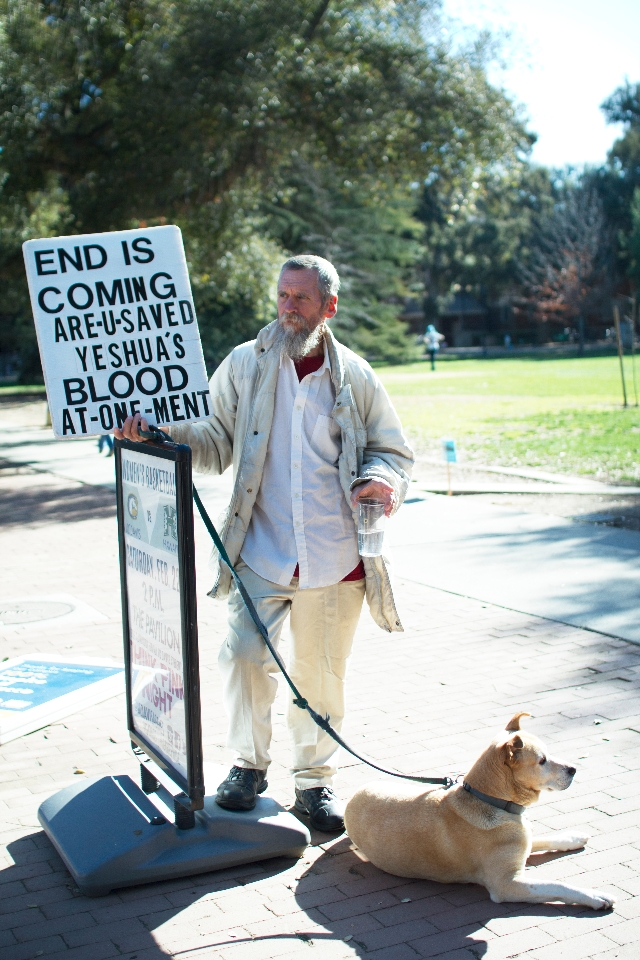
If you’ve been to the Memorial Union (MU) lately, you may have noticed that Monte is back. He stands in the courtyard reading from a small Bible, while his dog, Sarah, lies next to him.

Monte has been preaching across the country since the early ’80s, hoping to plant religious ideas in people’s minds.

  “I’m here to plant seeds when no one else is,” Monte said.

While most people peacefully pass by him on their way through the MU, Enhao Cheung, a fourth-year pharmaceutical chemistry major who has tabled with the Muslim Student Association (MSA), said that there have been a few unsavory encounters.

“Even though he is exercising his First Amendment right, it’s not right to use the F-word. I see some people who are very rude to the gentleman. One time I saw someone put up the middle finger at that guy’s face,” Cheung said.

According to Cheung, some people might feel compelled to react negatively to Monte because they are turned off by his overzealous approach.

However, the spread of information, including religion, is a part of campus life according to Janna M. Tolla, the senior assistant director at Building Services and Risk Management.

Religiously affiliated groups, like Cheung’s, often set up tables in the MU, though Cheung’s said the MSA isn’t looking to preach.

“If people have a misunderstanding of our religion, we’re not trying to convert people; we’re just here to give general information.”

The process that allows individuals to table in a public location are not that different from the process which allows Monte to preach.

“Campus is open and individuals have the ability and right to speak freely about their thoughts and opinions as long as they do not obstruct the flow of traffic or individuals,” Tolla said.

According to the Student Rights and Grievances under the UC Davis Principles of Community, the First Amendment protects the right to think, say or write ideas on campus, even ideas that are unpopular, derogatory or repugnant.

Under this rule, both tabling for a religious association and preaching religious ideas are forms of individual expression.

As such, Monte is allowed to be on campus as much as any student or citizen, even if some people may object to his ideas.

Though Monte said he always believed in the Christian God, he had something of an awakening while in college.

“One day I’m in between classes — I just realized I need to find something greater than myself. I wanted to find truth,” Monte said.

Monte said that he didn’t like the direction his life was heading in, and so he took the initiative to find the truth he was seeking. He had been taking various classes, but wasn’t satisfied with the results. Then one day, in 1977, Monte found his answer.

“I tried to find solutions in my own engineering mind. With velocity and all this other stuff coming at me, I’m not going to understand this and find answers. I’ve got to start saying that I’m part of the problem,” Monte said.

After his revelation, he said his beliefs had shifted, and just as abruptly, he changed his way of life.

“After that, I moved seeking Him, traveling around the country. I started simplifying my life. And living by faith. Though, I wasn’t totally into the Lord or the Bible yet, I just knew God was real and I wanted to seek Him,” Monte said. “I dropped out of college and I traveled, hitchhiking, all over the country, experiencing a lot of things.”

He had not started preaching at this point, but continued educating himself through his travels. He said that he did eventually begin to preach and spread his beliefs, though the thought of standing in front of strangers and sharing personal beliefs seemed daunting.

“I hated to stand up in front of people, I was self-conscious. God gave strength in me to do that.”

After time he was able to distance himself from his nerves and said he now feels much more comfortable speaking in front of people, even to the point of being able to sing hymns. He was able to recall the experience which made him more comfortable preaching in front of a crowd.

“Jesus loves me this I know/For the Bible tells me so/Little ones to him belong/We are weak/but He is strong,” Monte sang. “I started singing that song, my hands went up. I started getting louder. Standing in the middle of a college campus. Getting away from the inhibitions and wondering what people were going to think.”

As for his future plans, he said they are vague.

“Just praying, taking it day by day. I was thinking of going to Sacramento, today even. I was thinking about taking the bus,” Monte said.

Concerning all the years spent on the road, living simply and preaching, Monte said that his feelings about God and truth are still the same.

“Jesus, he’s my life. Like I said, back in ’77, I never regretted a moment since,” Monte said.

Artsweek: Feb 20, 2013

0

MUSIC

The Spring Quartet
Feb. 21, 2014, 8 p.m., prices vary
Mondavi Center, Jackson Hall
The Mondavi Center will be hosting the Spring Quartet, a jazz group made up of Jack DeJohnette, Joe Lovano, Esperanza Spalding and Leo Genovese. DeJohnette (drummer) and Genovese (pianist) are both internationally-known jazz masters, while Spalding and Lovano have won Grammys for their work in instrumental jazz. The group is known for their innovative modern take on jazz technique and jazz theory. Together, these talented musicians make one stellar quartet.

THEATRE

The Broadway Song Book of 1977
Feb. 22, 7 p.m., $35
Veterans Memorial Center Theatre, 201 E. 14th St.
The nonprofit organization, Citizens Who Care, will be hosting their 22nd annual Broadway-themed benefit concert. The proceeds of the concert will support elderly citizens and their caregivers throughout Yolo County. The concert will feature classic songs from Annie, Pippin, Godspell and more. Capital Public Radio’s star personality Stephen Peithman will be hosting the event. Ticket information can be found at citizenswhocare.us.

LITERATURE & POETRY

Poetry Night at Natsoulas Gallery
Feb. 20, 8 to 10 p.m., free
John Natsoulas Gallery, 521 First St.
Enjoy some of Davis’ most talented poets at Natsoulas Gallery’s monthly readings. As tradition goes, the event will be hosted by Dr. Andy Jones and will hold open mic performances after the main show. Featured poets are TBA.

Author Event: The Greenhouse Redemption of the Planet Kraal
Feb. 21, 7:30 p.m., free
The Avid Reader, 617 Second St.
Local author and professor Thomas Cahill will be speaking about his recently published science fiction novel. The story takes a look at an alien civilization 6.2 light years away from Earth that have cloned human beings in order to create their very own human zoo. Cahill, also a renowned physicist, looks at the possibilities that surround this scenario and offers insight into the mystery of life on other planets.

FILM

International Film Series: Amour
Feb. 21, 7:30 p.m., free
International House, 10 College Park
The International House will be holding a screening of the 2013 Oscar winning film Amour. As a part of the International Film Series, Amour is a foreign film from France. The movie follows the story of an elderly couple, one of whom has suffered a crippling stroke. Music is the last stable connection they have to one another and the film intends to keep the soundtrack going until the conclusion of this heartbreaking story. Seating is limited, so arrive early to ensure a spot.

Screening: The Deer Hunter
Feb. 23, 7:30 to 9:30 p.m., $2 donation
Yolo Pleasure Dome, 1401 Pole Line Road
The Yolo County Film Society will be screening the 1978 film The Deer Hunter. Directed by Michael Cimino, the movie takes place in a small town in post-Vietnam War America. It highlights the aftereffects of the war on three Russian-American veterans and steelworkers. Seating is limited, so arriving early is suggested.

ART

The Verve of Quilted Textiles
Now through March 14, free
UC Davis Design Museum
The UC Davis Design Museum is currently featuring African American quilts from the Sandra McPherson Collection. The exhibit features quilts made by African Americans from all across the country. The quilts tell stories of their family life, joys, struggles and traditions.

In Transition: C-C-Conclude

0

They say that hindsight is 20/20. Now that I’ve been a UC Davis student for over a year, there are a lot of things I wish I would have known, done differently or changed.

Despite the fact that my higher education has been split between two institutions over the past five years, there are a lot of shoulda, coulda, wouldas in my college experience I’m just now realizing.

Of course it’s too late to change any of those things now, but you know what they say … YOLO: you only live —

Just kidding.

What they really say is that you can either sit in pity about the past, or actually do something to change your future. I’m gonna attempt to do the latter.

So although I only have a quarter and a half left here, I also have four and a half years of past education that has given me reflection, appreciation and opportunities to change my future. Knowing that I’ll be graduating soon has spurred me to compile a wish list of sorts. Ultimately, there’s no time like the present and no better present than getting everything on your wish list, so here we go.

1. I wish I would have enjoyed the ease of my CCC. I was more than proficient at listing off the benefits of it, but I wish I had taken the time to truly enjoy it.

Believe me, I totally understood the upside of going to a community college; I was more than happy to knock out my GEs at a place where more than 60 percent of the classes they offered were remedial education courses.

I was more than happy to pay $350 for a semester of classes, spend a total of four hours a weekend on homework (*cough cough* hear that UC Davis? *cough cough*) and still have the ability to work full time.

I was more than happy to list off all these benefits, I just wasn’t capable of seeing the big picture of it all.

I wish I would have spent less time humdrumming over the seemingly sad plight my education had just taken and put some faith in my future.

2. I wish I would have utilized the diversity of my CCC’s classes better.  I always registered for the most conveniently scheduled classes — giving me a solid 9 a.m. to noon, Monday through Thursday schedule.

I also completely avoided classes that I suspected I wouldn’t thrive in.

Instead, I wish I would have taken the classes that truly interested me, no matter how complex they seemed. Instead of the “Oh, I’ll figure out what I want to do with my life once I’m at UC Davis,” I wish I could have thought “Hmm. Maybe I should get a head start on that now”.

3. Lastly (oh come on — everyone knows you always get 3 wishes), I wish I had actually prepared myself for UC Davis. Outside of all of that learning-inside-the-classroom stuff, I wish I had taken just one moment to say, “You know that college thing everyone gets so excited about? Well this is it.”

Actually, my statement probably would have been more like “Wah wah wah. You didn’t get to go off to a real college. Boo hoo. But you should make the best of this anyways.”

Despite my tendency to become incredibly sappy when I write these columns, it’s true. I wish I could have owned up to how much of a baby I was being and instead, focused on my interests, my future and my agency in those matters.

So that’s my wish list. And now, with a quarter and a half left, I’m going to grant all my wishes (well, those three plus some Joe Nichols tickets):

1. I’m enjoying the ease of my UC. “Ease” being a relative term, but still. There’s a certain comfort zone that surrounds you as a student and I’m taking the time to appreciate that.

2. I’m utilizing the diversity of my classes to the best of my abilities. Though I’m predominantly taking classes in only one subject, I can still tell you about things I’ve learned in classes I was scared to take — both because the subject matter intimidated me and the fact that 8 a.m. discussions are just plain terrifying.

3. I’m preparing myself for the next step in my life — at least, I’m trying to. I’m reflecting, learning and adjusting to things I was unsatisfied with in my past and employing those lessons. Then hopefully employing myself somewhere.

So, here’s to taking what we learn in college and actually making use of it in the real world!


To gift SARAH MARSHALL with your wishes or goals, email her at smmarshall@ucdavis.edu.


City, University work on economic expansion

0

On Feb. 11, the idea of development of the Downtown University Gateway District was presented to the Davis City Council. The project combines the development of three different properties totaling approximately 100 acres.

While planning of the project is not yet complete, the three different properties will most likely make up some combination of high-density housing, research facilities for UC Davis and shopping and entertainment for citizens of the City of Davis.

“One of the things that is special about this project is the big desirable trend in city planning,” said Bob Segar, assistant vice-chancellor of Campus Planning and Community Resources. “It’s walkable. People live close to where they work, their grocery stores and to entertainment. It’s walkable to downtown and walkable to campus.”

The project combines the 45-acre Nishi Property, owned by Tim Ruff, which runs along the University near the Mondavi Center, the 42-acre UC Davis East Village along the southeastern most edge of campus and the 11 acres of property on Olive Drive.

Currently, the UC Davis East Village area is occupied by the Solano Park housing development, but there are plans to close the area in 2016 and to redevelop it, according to Segar.

“This neighborhood has historically been housing with Solano Park, and is on the edge of main academic neighborhoods,” Segar said. “But we have flexibility for the future. The city is also thinking about bringing developments to private property, so we’ve launched a collaborative planning effort to create an integrated idea.”

This push for development is a culmination of a couple of factors: the UC Davis 2020 initiative in which the University hopes to add 5,000 undergraduate and 1,000 graduate students to the campus by 2020, as well as a push for economic development in the City of Davis.

“The timing is a good mesh between the economic needs of the University and the campus,” said Mike Webb, director of Davis Community Development. “Either site could develop independent of each other, but we want to create a framework for the development of the two properties for a seamless district.”

The Nishi Property had been under consideration for development for several years prior to the recent developments that have been made.

“In 2008, the City looked at all of the sites in the city for potential housing developments, and ranked them in order of preference,” said Tim Ruff, owner of the Nishi Property. “This site was identified back then as a green light (highly desirable) site.”

So far, the pre-development costs of the sites have been shared between all three parties: the property owner, the City of Davis and UC Davis.

Architecture company Perkins+Will was brought in to develop the concept master plans of the project and to develop the Feb. 11 presentation to the Davis City Council, but their contract expired after the presentation was completed.

According to Webb, the next steps in the project include public outreach and submitting a grant application to the strategic growth council, which will hopefully secure grant funds for some of the technical planning, such as a greenhouse gas reduction plan and a water conservation plan for the project.

“We also want to embark on community engagement,” Webb said. “We need to make sure that what is being put forward will resonate with the voters, and we hope to get some valuable input on the project.”

Moving forward, Ruff and Webb both agree that one of the biggest challenges that the project will face is mitigating traffic.

“There are existing traffic issues, so that’s a big thing,” Ruff said. “But the best way to mitigate it is to have people live where they work so that they’re less likely to need a car.”

While the predevelopment costs have been split throughout the various involved parties, revenue sharing will need to be negotiated.

“We need to have a better understanding of what exactly the development will look like and a better understanding of the land use,” Webb said.

According to Dennis Dornan, project manager from Perkins+Will, communication between the involved parties has been exceptional so far.

“The spirit of cooperation and mutual respect of each other’s agendas among the steering committee has been truly inspiring,” Dornan said in an email. “It was noted by the Mayor last week at the City Council hearing as ‘truly historic.’”


Campus Chic: Feb 20, 2014

0

In Full Bloom.

When I think “spring,” the quintessential things that come to mind are pastels, lace, chiffon, tulle, bright pops of color, silks, nautical and of course, florals. In this week’s edition of Campus Chic, I decided to choose the beautiful Narvy Preap, a second-year design major, as our “Muse of the Week” because there’s such an effortlessly chic quality to her look and she understands how to make the smooth transition from winter to spring without all the fuss.

She loves florals, but also incorporates items with darker accents into her wardrobe and maintains a muted color palette for added sophistication and edge. I appreciate the juxtaposition of a feminine, floral print with a simple, yet edgy leather jacket — especially when played up by a cute pair of boots and a flowy green maxi skirt, which is totally on-trend for the season as we’re seeing a lot of forest green and earth tones back on the runway. It’s like Bohemian meets New York street-chic with a modern twist and I wouldn’t have it any other way.

James’ Notes: More is more. Spring is all about color and texture so feel free to incorporate more lights and brights into your wardrobe to bring some life and personality to your look. Perhaps it’s time to try a bold neon or metallic? A great deal of the spring/summer 2014 ready-to-wear is pretty out-there in terms of both color and material, but you really never know until you try right? Like Preap says, “When you think you look good, you feel good!” And I say, “Cheers to that.”

Interview with Narvy Preap:

1. If you could describe your personal style in three words, what would they be?
I think my personal style is comfy and casual with an edge.

2. Who or what is your style icon?
I get a lot of my fashion inspiration from a variety of fashion bloggers on Tumblr and Instagram. A couple of my favorites are @hilisaa and @iamamypham. Go check them out!

3. What are your three must-have items in your wardrobe?
My wardrobe staples are V-neck T-shirts in white, black, maroon or gray, thick leggings and a leather jacket. Side note: I think three must-have items that every girl should have in her wardrobe would be a LBD [little black dress], black skinny jeans and a white button up shirt!

4. What is your favorite accessory and why?
I don’t normally wear jewelry or scarves, so I would say my favorite accessory would be a red or wine-colored lip. Lipstick completes an outfit and jazzes it up. If I’m wearing all black, I need a pop of color, so I add lipstick. On the other hand, if I’m having an extremely bad hair day, my favorite accessory would definitely be a beanie or a hat. Beanies and hats are also good for making a boring outfit more fun!

5. Where do you love to shop and why?
Most of my clothes are from Forever 21, Ross or thrift stores. I love to shop at stores that have affordable clothing since I’m on a budget. I like the feeling of getting something super cute for a really good price. One of my favorite pairs of loafers only cost me $2!

6. What is your most treasured item in your wardrobe?
Currently, my treasured item would be my black Nike Roshe Runs. They are so comfortable and cute. I could wear them with leggings and a crew-neck for my long days on campus or I can dress them up with a simple dress and a leather jacket. They’re really versatile.

7. How has your style changed since high school?
My style has changed a lot! During my freshman year of high school, I wore skinny jeans and black Vans almost every day. I rarely wore dresses or shorts because I was still in that insecure phase that a lot of teens go through. I was worried about people making fun of my pale legs and how skinny and awkward I was. During sophomore year, I experimented more with my clothing and began to wear things that were outside of my comfort zone, like tank tops or shorts. It really helped me understand what I liked and what I didn’t like on my tall frame. I began to not care about what others thought of me so my confidence grew. Now, I wear whatever the hell I want to wear even if I get weird looks. You’ll usually catch me wearing leggings and a basic tee, a maxi skirt, high-waisted pants or a casual dress.

8. What does fashion mean to you?
Fashion is something that should make you feel confident. Fashion is not about the price of your clothing. Fashion is wearing a white tee and loose boyfriend jeans and feeling like you just stepped off of a runway. When you think you look good, you feel good!

9. What items would you recommend our readers to incorporate into their wardrobes for the upcoming spring season?
I would definitely recommend florals for both males and females! Florals are just so fun and easy to wear. I would also recommend getting a cute pair of sunglasses!

10. What final tips can you give to our fashion-forward readers?
Wear whatever you want to wear and own it! There are no rules to fashion. If you want to wear Crocs, then wear those Crocs! Be fabulous and confident.

IMG_1102

IMG_1116

IMG_1129

IMG_1103

IMG_1138

IMG_1165


Campus climate dialogue discusses hate, bias on campus

0

On Feb. 13, the UC Davis Center for Student Involvement held Campus Climate Dialogue: Reporting Hate and Bias on Campus in the Student Community Center multipurpose room. Sheri Atkinson, executive director of the Campus Resource Centers, and Milton Lang, Associate Vice Chancellor, hosted the event.

According to the UC Davis Student Judicial Affairs (SJA) website, a hate or bias crime incident is any non-criminal conduct that is motivated by hatred or bigotry and directed at an individual, residence or other group. A hate or bias crime is a criminal act that results in injury, whether physical or verbal. The reporting procedure allows victims and witnesses of incidents or crimes to let administration know that it happened.

Atkinson said that the dialogue was a follow-up to a meeting with Chancellor Linda P.B. Katehi and a small group of students regarding hate and bias-related incidents on campus on Dec. 9.

“The meeting will provide specific protocol for reporting hate and bias and will help people make a report,” Atkinson said. “We’re also hoping to get feedback in order to make the procedure student-friendly.”

Lang said the point of the meeting was to help students and staff gain a better understanding of the protocol to report instances of abuse. Lang said that similar incidences have been reported at UC Davis have also been reported at UCs and other college campuses.

“These issues are not isolated to UC Davis,” Lang said. “But what happens here and how we treat one another is our responsibility.”

The system for reporting crimes was updated after winter break ended. Staff members at the dialogue explained the renewed steps to report incidents and crimes, and allowed students in the audience to ask questions and give feedback on the system.

Director of SJA, Donald Dudley, went through the necessary steps to file a report. All reports go to and are reviewed by SJA, Dudley said.

“SJA is concerned with both the rights and concerns for students,” Dudley said.

The process to report an incident of hate or bias is done completely online from the SJA website. Students can provide a description of the incident and also have the option to say how they would like the University to respond.

“It was only last year that we transitioned in a system where we could receive complaints on the web,” Dudley said.

Dudley said that SJA receives 50 to 60 reports a year, and most regard issues with grading or roommate complaints.

According to Dudley, the University will make anonymous reporting of incidents possible, and that it will take as much action as possible and conduct an investigation with the given information. However, he said that the University will be able to take further action if the reporter is identified.

“If you choose to identify yourself, you will receive acknowledgement, an email and will be invited to talk about the incident in person,” Dudley said.

Another part of the updated system is a new marketing campaign geared towards spreading awareness on campus of how to file reports. During the event, students and members of  the audience were invited to comment on the marketing strategies and say what things they liked best and what they thought needed work.

“We’re trying to connect students with the resources available to them,” said Nefretiri Cooley-Broughton, director of Student Affairs Marketing and Communications.

Directors of many of the Campus Resource Centers were present at the meeting. These centers included the Center for Student Involvement, the Women’s Resources and Research Center, the Student Recruitment and Retention Center, Campus Community Advocacy Center, Student Judicial Affairs and Counseling and Psychological Services (CAPS). The resource centers were offered as places for students to go when they experience or witness physical or verbal abuse, along with reporting the experience through the system.

CAPS was listed as one of the places where students can go to receive confidentiality regarding their report.

“We can offer confidentiality and provide you with a social justice lens that is really about empowering you,” said Natacha Foo Kune, CAPS director of training.

Students asked questions regarding training on hate and bias for faculty and staff. There are currently several training programs and classes regarding cultural sensitivity and community exploration for faculty and staff. The programs have been available since 1995. New faculty and staff at UC Davis are required to take these training courses.

Rahim Reed, Associate Executive Vice Chancellor, said that recruitment for staff and faculty is based heavily on the applicants’ previous experience with cultural awareness and diversity.

“We quite frankly want people who have already had exposure with diverse communities,” Reed said. “We’re looking to recruit that kind of person.”

A public data system showing which faculty members have taken courses and which haven’t is being worked on and should be available fall 2014.

“We’re in a process of creating diversity profile projects for each of the 23 units that make up UC Davis,” Reed said. “It will show faculty staff and give information about who took the training and who didn’t take the training.”

Atkinson said a follow-up to this event and further campus climate dialogues will be held in the future. Specific dates have not been set.

News in Brief: Poetry Night Reading Series to host Latino, Chicano literary community

0

On Feb. 20 at 8 p.m., the Poetry Night Reading Series at the John Natsoulas Gallery, hosted and coordinated by Andy Jones, will feature poet and UC Davis lecturer Francisco X. Alarcón and the Writers of the New Sun, a literary collective based out of Sacramento.

Alarcón, whose body of work includes 12 volumes of poetry and several books, is a founding member of the Writers of the New Sun. They will be celebrating their 20th anniversary as a literary community, which values the “literary and artistic cultures and traditions of the Chicano, Latino, Indigenous and Spanish-language peoples” in their writings, which are in English, Spanish or a mixture of both.

Alarcón explained that the group acts as a support system, allowing each writer the chance to have their work closely critiqued by fellow writers.

“Every writer [in Writers of the New Sun] is very unique,” Alarcón said. “In my own case, it has been a very beneficial process. We get together every month; I became an author for children through this process [of getting responses from others in the literary community], and my first readers were Writers of the New Sun. I now have six titles for children. It’s very helpful to get feedback from your fellow poets.”

Alarcón emphasized the importance of the present moment to his writings. He explained how a single poem he wrote in response to the arrest of nine student protesters at the Arizona state capitol following the controversial anti-immigrant law Arizona SB 1070 triggered the development of the Facebook page “Poets Responding to SB 1070.”

“I was very moved by the actions of the student protesters,” Alarcón said. “They reminded me of Martin Luther King Jr. and the civil rights protests, but were protesting against anti-immigration and xenophobic attitudes. I put [the poem] on Facebook and I started the page. It was incredible; thousands of people responded right away. We now have 20 poets working as moderators of the page, and still receive poems daily.”

Alarcón, as a lecturer in the Department of Spanish at UC Davis, teaches one of the very few Spanish language creative writing programs in the country. He believes that poetry is something that can be accessed and appreciated by all.

“Poetry is something universal,” Alarcón said. “I think everyone’s a poet. It’s a way of expression that’s essential to society.”