57.7 F
Davis

Davis, California

Sunday, January 11, 2026
Home Blog Page 908

Women’s field hockey preview

0

UC Davis’ field hockey team continues their long stretch of road games as they head off to the Hawkeye State. The Aggies are preparing for a face-off against Penn State and Iowa. Taking a break from conference action, the Aggies will hope to attain good form in preparation for conference playoff action.

The Aggies head into the week on a two-game losing streak suffered at the hands of Pacific and California. Although coming up short, UC Davis senior Cloey LemMon had herself a solid game against Pacific, recording two assists and now holds a team high total of five assists this season.

“We were disappointed with the losses,” said coach Austin Piles. “But at the same time we did see growth especially late in that second half against Cal.”

The Aggies will have their hands full yet again as they prepare for two Big Ten Powerhouses. Currently leading the Big Ten and ranked sixth nationally, Penn State will be looking to continue their amazing run of play as they prepare for the Big Ten playoffs.

UC Davis will have numerous players to defend against such as forward Taylor Herold, who is fourth in the Big Ten in points scored averaging 1.71 points/game. Herold will be assisted by Laura Gebhart who is third in the nation with an average of 0.85 assists/game.

The Aggies offense will also be tested as Penn State goalkeeper Kylie Licata has allowed an average of just one goal per game.

The Aggies head from one nationally ranked team to another as they face off against the Iowa Hawkeyes. Currently ranked 19th in the nation, the Hawkeyes have several players that could create challenges for the Aggies.

Sophomore Natalie Cafone who leads the Big Ten with 40 points this season could pose a threat to the Aggies defense, as well as Dani Hemeon who has accumulated 25 points in her junior campaign.

“Heading into this week, it is a great opportunity for us,” said coach Piles. “It is really about gaining the experience from our non-conference games to take with us in our conference tournament.”

The Aggies return to play 4-10 overall and 2-3 in conference.

— Shaun Moncada
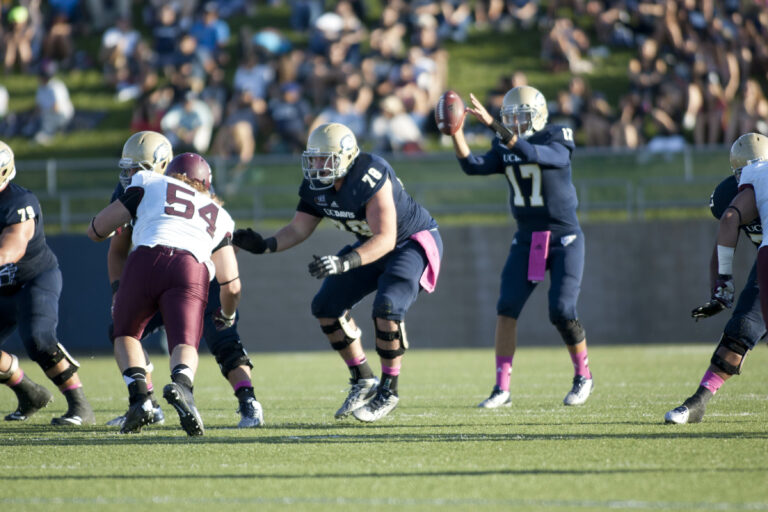
Rampaging Aggies head to Bobcats’ den

0

Teams: UC Davis at Montana State

Records: Aggies, 3-5 (3-1); Bobcats, 5-2 (3-0)

Where: Bobcat Stadium — Bozeman, Mont.

When: Saturday, Oct. 26 at 2:05 pm

Who to watch?

After a disappointing loss on Homecoming, the Aggies got back on the road with a vengeance and took it out on the University of Northern Colorado Bears (UNC), winning 34-18. With two back-to-back road wins, UC Davis should have no problem bringing home another win as they prepare to take on the Montana State Bobcats at Bobcat Stadium this Saturday.

One UC Davis tight end who proved that he could do more than just block is senior Taylor Sloat. The McArthur, Calif. native, who was selected during preseason as the top tight end in the Big Sky Conference, caught three passes for 57 yards and got his first touchdowns of the season last Saturday. In the first quarter, Sloat caught passes for 28 and 16 yards. Sloat is a major strength in the Aggies’ offense.

Senior quarterback Randy Wright is yet another Aggie to watch for, after giving one of his best performances both as a starter and of his entire collegiate career. The Santa Rosa, Calif. local threw for 310 yards and four touchdowns. Despite getting hit hard several times, Wright maintained his composure and focused on finding his tight ends and wide receivers, including a 13-yard touchdown pass to T.J. King. Wright’s control and poise have been great assets to the Aggies’ success this season.

Preview:

Despite losing their Homecoming game against Montana University, UC Davis took off for Greeley, Colo. on Oct. 19 and went on to silence a crowd of 4,196 by demolishing the UNC Bears, 34-18.

The Aggies played a tremendous first half of football on Oct. 19, leading the Bears 24-0, running four scoring drives, converting nine of 10 third downs, and possessing the ball for 21:42 out of 30 minutes all before halftime.

“I am extremely pleased with how hard the young men came out and competed,” coach Ron Gould said. “I told them three things: one, to compete; two, to have the right mindset and three, focus on the details.”

Almost every single component of the Aggies’ offense took their coach’s advice to heart. Senior quarterback Randy Wright led the Aggies down the field in six plays which totaled for 74 yards. The drive ended when Wright hit senior tight end Taylor Sloat for a 28-yard touchdown.

The seasoned veteran devised a second 74-yard drive, this time in 12 plays, but finishing it with yet another touchdown pass to Sloat keeping the Aggies ahead, 14-0. Wright completed 27 of 37 passes for 310 yards.

Senior tight ends Ryan O’Holleran, Cameron Sentence, and Mark Martindale also got some action, each having one catch in addition to demonstrating exceptional blocking that contributed to the Aggie ground-game’s which earned 178 yards.

Senior Tom Hemmingson led the Aggie wide receivers with six catches for 64 yards. Senior Corey Galindo had five receptions for 52 yards, including a 20-yard touchdown while T.J. King had four receptions for 46 yards with a 13-yard touchdown pass from Wright in the third quarter.

The dependable Aggies defense did not disappoint. UC Davis accumulated 54 tackles between 22 Aggie defenders and restricted the threatening UNC’s big three receivers from having an impact. Sophomore cornerback Shamawn Wright knocked down three passes in the win.

The Aggies will have to play more than just one amazing half of football if they wish to defeat the Montana State Bobcats on Saturday, Oct. 26.

The Bobcats scored 24 of their points in the second half of their 44-24 win over Weber State. UC Davis will have to contain Bobcat quarterback DeNarius McGhee, who surpassed the 10,000-yard passing mark throwing for 313 yards and three touchdowns in MSU’s win on Oct. 19.

“It’s about playing four quarters and [they] have to have the same focus and mentality as at the start of the game,” Coach Gould stated.

The Aggies need to maintain their same level of play for both halves of the game if they wish to defeat the Bobcats and seize their third away game victory.

— Jordanna Baddeley


Hypin’ the Hawk

0

As the college basketball season creeps closer to tipoff, the hype surrounding UC Davis men’s basketball team — specifically junior shooting guard Corey Hawkins — grows louder. So what’s up with the hype? Is it justified?

Averaging 20.3 points per game along with 5.6 rebounds and 3.3 assists last season, the high praise which Hawkins has been receiving seems to be well-deserved. But, as sports fans know, it’s one thing to have a great season and another thing entirely to have back-to-back great seasons.

ESPN, CBS Sports and other publications have noticed Hawkins’ success last season and are touting another successful season for the talented two-guard. The media is alerted and expectations have been set.

However, before we push the Hawkins-to-the-NBA bandwagon, there are a few things Hawkins needs to prove during his remaining career as an Aggie.

With accolade comes recognition and Hawkins will definitely be recognized, especially by opponents. Triangle-and-two, box-and-one and other unique defenses were used at times to try and stop Hawkins last season. He should expect more of the same this season as teams — especially in the Big West — will be keying in on him.

The injury of junior forward and All-Big West honorable mention J.T. Adenrele, who suffered a season-ending knee injury in August, is going to ratchet the pressure on Hawkins to provide more than buckets. Adenrele was second on the team, averaging 5.9 rebounds per game.

The 6’3” Hawkins was the third-leading rebounder on the team last season, with recent graduate Ryan Howley leading the way with 7.5 rebounds per game. The Aggies are a small team already and the loss of two of their leading rebounders is only going to force them to crash the boards more effectively as a team.

With UC Irvine, a contender for the Big Sky title, recruiting a pair of seven-foot giants, the Aggies are going to need to find a way of rebounding over the skyscrapers which the Anteaters currently have. Hawkins will most definitely need to continue to contribute on the boards.

The preseason schedule is not any prettier for the Aggies, as they face possible Pac-12 title contenders Utah and Stanford. How well will Hawkins play against the “more talented” teams of the Pac-12?

Well, looking at last year’s performance against Stanford, not well. Hawkins went 3-14 from the field with 10 points and four rebounds. Clearly not a stellar performance.

However, this was only the seventh game in his UC Davis career. He clearly gained steam near the end of the year including an impressive 21-point game against UC Irvine and 34-point explosion against Long Beach State on national television.

Hopefully, Hawkins can keep up his momentum and remove the horrendous experience at Stanford from his memory.

Regardless of Hawkins’ performance against Stanford on Dec. 14, his season will be judged on one thing: winning.

As Al Davis once said, “Just win baby, win.”

No matter how great his stats may be — and it stands to reason that they will be pretty impressive — the bottom line is how much Hawkins does to help the Aggies win games. Hopefully the answer is: a lot.

UC Davis is a team on the cusp of making the Big Dance. They definitely have the talent especially with newcomers freshmen Brynton Lemar and Georgi Funtarov. Now it is important for them to put their talents to use and consistently win games.

As a junior and the team’s best player, Hawkins will need to be the leader for the team. Pushing his teammates to step up their games and providing excellent performances when needed will be key for Hawkins’ success this season.

At the end of the day, the Aggies will go as far as Hawkins takes them.

It’s great to have hype surrounding UC Davis basketball and the hype is definitely alive. Despite the injury to Adenrele, a difficult preseason schedule and a much improved Big West conference, Hawkins is expected to have another fantastic season. The hype is very much real.

Now it’s time for Hawkins to justify the hype is not just a flash in the pan.

If you thought KENNETH LING was talking about an actual hawk, email him at sports@theaggie.org.

Men’s Soccer Preview

0

Teams: UC Davis vs. Sacramento State

Records: Aggies 6-7-1 (2-3-0); Hornets 2-8-3 (0-5-0)

Where: Aggie Soccer Field — Davis, Calif.

When: Saturday, Oct. 26 at 3 p.m.

Who to Watch:

Fifty-seven seconds left on the clock and UC Davis can taste victory. With a 2-1 lead, all the Aggies have to do is hold off the Gauchos from scoring for less than a minute. Until tragedy strikes and a penalty allows UC Santa Barbara (UCSB) to tie the game with mere seconds left to play in regulation.

The above play-by-play chronicled only one of many intense moments in the double overtime match-up between UC Davis and number-two ranked UC Santa Barbara last Saturday. Although the team did not come out with the win, the morale is high.

“It was one of our best games of the season,” said junior forward Matt Wiesenfarth.

And many of the spectators would agree, with the full house at Aggie soccer field on their feet for nearly the entire game.

Wiesenfarth scored the first goal of the game for UC Davis, tying the score at 1-1.

“I saw Alex (Henry) make the run down the left side … I just floated to the back post and hoped he could find me,” Wiesenfarth said. “All I had to do was head it in, he gave me the perfect cross.”

With that goal, Wiesenfarth now has four on the season, tying him with Matt Sheldon for the leading goal-scorer this season.

Next goal came from senior captain and forward Alex Aguiar which put the Aggies ahead 2-1. With 31 shots on goal, Aguiar’s first goal of the year could not have come at a more opportune time.

“It felt great! All my teammates had the confidence in me that the goal would eventually come, so having them still have the confidence that I would score eventually was awesome,” said Aguiar. “I celebrated like no other.”

That celebration was matched both on and off the field, with Aggie fans erupting in excitement after Aguiar’s goal. Although the team was unable to come out with the victory, as UCSB tragically scored with less than a minute left in double overtime to end the game, both coaches and players kept their heads held high.

“I thought it was a great game overall … I was proud of my guys,” said coach Dwanye Shaffer. “I thought we played extremely well”.

Preview:

The Aggies head into the their rivalry game against the Sac State Hornets with some solid momentum. Known in all sports at Davis as the “Causeway Classic,” the game on Oct. 26, is not to be taken lightly. Although the Hornet’s current record in the league stands at 0-5, Weisenfarth and the rest of the team knows the Hornets will put up a good fight.

“They’re a good team every year and they give us a good game no matter what,” Wiesenfarth said.

With their heartbreaking loss against UCSB fresh in their minds, the Aggies are hungry for wins and would love to take down their rivals that reside just 15 minutes east down Interstate 80.

Kick off against Sac State commences at 3 p.m. on Oct. 26 in Davis, Calif.

– Sloan Boettcher


Guest Opinion: Memorization and critical thinking in education

0

In many lower division classes, we are asked not to take the facts we have learned and apply them to a new situation, but only to regurgitate memorized information. We are not asked to analyze the strengths and weaknesses of opposing theories, but only to know them. Our education often does not teach or ask us to think critically, missing the point of schooling.

For example, every lab course I know provides step by step instructions for each “experiment.” This does not foster critical thinking, only following memorized directions. Instead, the lab manual should tell us what we are to measure and give an overview of the materials and equipment available to us. It could provide general guidance and useful facts, but should not reduce us to machines executing commands. If we are stuck and cannot think of what to do, the teaching assistants are there to give advice.

I understand that one reason for step by step instructions is safety and liability issues, but those could mostly be bypassed by not using dangerous chemicals, which is likely possible at least in the lower division labs. In addition, at the start of each lab, the teaching assistant could identify common hazards or mistakes and how to avoid them. In effect, teaching laboratories would simulate research laboratories; we would have a goal and decide, mostly on our own, an experiment to achieve it. This method would foster synthesis of learned facts into a working experimental procedure.

While the goal of any class, or education in general, is to help us think critically, many of us do not study with that aim. Many of us study by spending countless hours and sleepless nights memorizing the professor’s slides and lectures. When we do this, we think we know all of the material, and we are right! We do know all of the material covered, but we can only regurgitate it, not synthesize it to solve new problems; we cannot think critically about it.

For some classes, often lower division science classes, this approach is sufficient, even encouraged, to do well in the class. However, when we move on to upper division classes, where we learn facts more rapidly and are asked to synthesize what we have learned on exam questions, this approach is disastrous, resulting in studying for seven to 10 hours yet failing the exam. However, as we did not learn how to approach material without brute force memorization in earlier classes, we cannot adapt, so we struggle and stress.

To address this problem, lower division exams should not consist of questions that lend themselves to memorization, such as definitions, matching, or pure calculations. Instead, questions should address novel systems not covered in lecture but that can be figured out based on material in lecture. We should be asked not just to know facts but also to be able to use those facts.

However, memorizing facts should not be abandoned. Rather, it should be seen as a means to the end of being able to use those facts to analyze a new situation, i.e. to think critically. If we do not know something, we cannot think critically about the implications of that knowledge.

Unfortunately, in many classes, especially lower division classes, memorization of facts is not a means to an end but an end in itself. This approach leaves us unprepared and struggling when we pass the point where memorization is sufficient.

WILLIAM CONNER is a fourth-year biochemistry major. He can be reached at wrconner@ucdavis.edu.

Cosmic Relevance: Robot Domination

0

Until last week, I had never felt threatened by technology. It all changed when I stumbled upon a WIRED magazine article, titled “Can an Algorithm Write a Better News Story than a Human Reporter?”

I really hoped the answer was no, but the report made a convincing case for yes. The article investigated Narrative Science, a company founded to create programs that can act as journalists.

According to Kristian Hammond, the CEO and co-creator, “computers mine vast troves of data to produce ultracheap [sic], totally readable accounts of events, trends, and developments that no journalist is currently covering.” Not only can the algorithm do its own research, but clients also can customize the writing style. And errors are reportedly rare, as it has built-in error checking.

The program is already wildly successful. Big companies like Forbes have been using the service to give company analysis and financial reports. When asked what percentage of news articles computers will write in 15 years, Hammond replied, “More than 90 percent.” And asked further about the future of the company, Hammond claimed, “In 20 years, there will be no area in which Narrative Science doesn’t write stories.”

As a writer, I never thought a machine could do my job. Yet here I was, a replaceable human, paranoid of androids.

So I asked myself, do we control technology or does technology dominate us? Is coexistence possible?

To find an answer, I asked some of my CoHo co-workers for their thoughts. How do you coexist with technology?

Right off the bat, a student responded, “I start every day with technology; it’s what gets me up in the morning.” Other students mirrored this answer, stating that many machines are part of their daily routine, including transportation, communication and work. So our lives and our lifestyle depend on these advancements.

But do we feel like we are slaves to machines? I had to ask the follow-up question, what does technology do for you? Another student answered, “It empowers.” With an iPhone, anyone can become an instant navigator, researcher, long-distance caller, photographer, DJ … and the list goes on.

The consensus seemed to be that students thought of technology as a positive addition to their lives. But still, I was upset at the new invention of the robot author. It seems that progress may have cheated me out of a career. Jealous, I asked my fellow students one last question: what robot invention would you like to see in 50 years?

The answers were surprisingly mixed.

Half the students wished for Jetson family ideas, like “robot maids,” “hover devices” and “Yoda shit”.

However, the other half seemed very skeptical of new innovations. One student scoffed, “my first answer is none,” as “it’s better to do things yourself.” Although we obviously depend on many devices each day, this student thought we should revert to old school labor. Another student asked, “Have you seen Wall-E?” referring to the disastrous effects of letting technology do our work.
It seems that technology and progress both aid and hinder our lives. For example, phones help us connect to others. But if you walk around campus, try to spot the amount of students not plugged into their headphones and facing down into their screens.

Above all, technology is a tool. It allows humans to do what we could not do alone. I cannot replace somebody’s heart valve nor scan somebody for cancer.

Progress doesn’t seem like it will stop anytime soon. Since harnessing the power of fire, humans have been using technology to better our species. So it is up to us be mindful of how we are using it to keep it that way.

If you want to welcome the coming of our robot overlords with DANIEL HERMAN, he can be contacted at dsherman@ucdavis.edu

Stay Tuned: Watch & Learn

0

Viewing the world through the lens of street performance is a spectacular thing. It gives you the unique opportunity to completely submerge yourself in a culture, while paradoxically remaining on the outside of it — a participant, and yet an unbiased observer. This is especially true when playing in a new place.

At 16, my musical partner Betty and I had grown somewhat bored of the music scene behind the local café. We decided it was high time to be a little more adventurous.

The Gaslamp District of San Diego is a wonderful place to play music at night. Not because the audience is particularly interested or even aware of your presence, but because you have an excuse to sit and observe a phenomenon that to the innocent 16-year-old is perfectly whimsical. We had arrived at the time when drunk people in their brightest colors wander around in a sort of frantic stupor, always yelling for something or someone they have misplaced. That is to say, we arrived at night.

We found a spot that was strategically isolated enough to avoid getting run over by cars and people while also far enough from trash cans to prevent getting puked on. We got out our guitars and began to play, with our inhibitions cast aside and the inhibitions of our audience non-existent due to intoxication.

The first half of the night was one of observation. Our vantage point was spectacular as we unabashedly inspected the packs of heel-clad hyenas that clicked passed us.

I had been playing on the streets for years so I hardly felt the familiar pang of nervousness that night, though admittedly there were moments I felt weakly panicked as those who noticed us glared bleary-eyed as if they could smell our sobriety (we could certainly smell their lack thereof).

It was unnerving being the only sober ones for miles — like being the oldest kids at a birthday party. All around us shrill-voiced men and women swarmed out of one bar and into the next, their hair gelled into pincushions and eye shadow up to their foreheads.

We had already seen some strange sights that night, but none quite matched the oddity of the man who introduced himself as “The Alias.” He was in his mid-to-late thirties, a self-proclaimed poker champion and told of his many enlightening experiences in between swigs from the flask he kept in his pocket. There was no guarantee that anything he said was true, and Betty and I exchanged furtive glances at some of the more outrageous stories, but we were captivated all the same.

“See these scars?” Betty and I examined his knuckles to see patches of white calloused-looking skin.

“All from my fighting days.” We were intrigued.

“Could you still take someone down if they came at you now?”

“Sure!” he told us proudly. “I’ll teach you some basic moves!”

This was not an opportunity we were about to turn down. We spent the next hour training as the crowds began to thin out, until we were the loudest ones left on the street.

“Running stance! Shotgun! Your windows are open! Guard your face! Low center!”

He took slow swings at us and we blocked and ducked feeling like superheroes the whole time. Eventually he left with his friends who appeared to have been looking for him. He said thanks for the music and we said thanks for the lessons and we parted.

“Ron Stewart!” he called out as we departed.

“What?”

“It’s my name!” It was as if Batman had revealed his identity.

We drove home that night, our legs sore and our minds buzzing with all the surreality of the last few hours.

Street musicianship is about give and take. Take a risk, go where no street performer has ever gone before. Give the world a piece of your music, a piece of yourself, and you will be rewarded with strange sights, extraordinary adventure and Ryu-level street fighting skills.

For lessons in mediocre street fighting contact ELLY OLTERSDORF at eroltersdorf@ucdavis.edu.


The F Word: Naked/Exposed

1

They say the easiest way to scare a guy is to whisper the word tampon into his ear. We’re all just a huge caricature of a flame-breathing dragon on our ceremonial week of menstruation; prone to biting your head off if we’re pissed. Why are people so scared of us when the image of femininity is “docility”? Is it because there are parts of us that stray from that ideal of purity that has been built up and reinforced for centuries?

As soon as we’ve slipped up once, it feels like we’re marked for life. That area of our permanent record never leaves us. This becomes especially apparent when you see it exaggerated in the hypersensitive reactions towards female celebrities.

Lindsay Lohan will always be judged for that one time she decided not to wear underwear, but the paparazzo who snuck a picture between her legs will never face the same judgment. When Heidi Klum has a nip slip, even as a consequence of trying to save her son from drowning, the articles that don’t focus prominently on the uncovering of her nipple still blur it to protect all innocent eyes. This censorship is obviously counterproductive.

The conundrum is that these women have the pressure of being our role models, and as soon as their image is tainted we’re told we have no good role models to lead us into womanhood. This plays a huge part in the public scrutiny of former child stars.

If you’ve read through the YouTube comments for Miley Cyrus’ “Wrecking Ball” music video, you would see some variant of these questions: “Miley, what happened to Hannah Montana? Why did you become such a whore?”

But, if you look up the video for Robin Thicke’s “Blurred Lines” (the unrated version), you’ll see comments like “that brunette is so hot” and “it’s just a song,” and if anyone decides to vocalize how they think that it objectifies women they get hateful replies from multiple users. Simultaneously, there are many people on the other end of the spectrum who feel sorry for the girls in the video, even though the models expressed their agency when they agreed to be a part of the project.

The focus is lifted off of them and given to Thicke, who looks like the trope of the Alpha Male: he’s got these three gorgeous girls who follow him around and lean on his strong man-shoulders suggestively. He’s “the Man”.

It’s as if it’s more acceptable for women to be nude in a video if it’s in relation to a man who is just flaunting his irresistible masculinity. But as soon as people realize that a woman has made her own decision to expose herself, she is deemed to be someone with no self-respect or morals; a tragic heroine who has lost her way.

The idea of females being so confident with their bodies seems to be a turn-off. We can see this in the criticism surrounding “The Vagina Shirt,” designed by photographer Petra Collins and The Arduous. The shirt features a line drawing of a vagina with blood watercolored onto it, pubic hair sketched on, and a shifty pair of fingers moving in on the gloryhole. The vilification for this has centered mostly around how gross pubic hair is.

The big mystery is if women really have hair “down there.” All the vulva we have seen in movies are cleanly shaven and of the same basic design. All the women in mainstream porn are carefully groomed. We’ve simply grown to view the female body as having a narrow mold to fit inside of.

It’s unhealthy for girls not to understand something that is a functional part of them; to not understand that vulva come in many shapes and sizes. There’s no need for girls to get extremely defensive when asked about masturbation as if they’ve done something really unthinkable and criminal. On the other hand, within my freshman year of high school, I heard at least five boys proclaim confidently, “every single high school boy has watched porn.” Male masturbation, in comparison, is so common that it can be shown in movies and still be PG-13.

The idea of femininity has evolved into the dogma that we, as females, should never step over the societal boundaries set up for us. The fear of the female anatomy needs to end. It’s time for our sexualities to stop being hidden and only taken out in order to be exploited.

As the wise, contemporary philosopher Macklemore once asked, “Have you read the YouTube comments lately?” Email MONA SUNDARA at msundarav@ucdavis.edu about what role you feel YouTube plays in our modern culture.

The Left Nut: Legacies

0

Quick, name one thing John Adams did that changed the course of the United States forever.

If you said the Midnight Appointments, congratulations! You studied way too hard for the AP US History exam. You also happen to be correct.

When Adams appointed John Marshall to be the Chief Justice of the Supreme Court, he probably had no idea how much of an impact his decision would have hundreds of years later. When Marshall’s ruling in Marbury v. Madison established judicial review and thereby strengthened the power of the Supreme Court, it set a precedent for years to come.

Although Adams himself had no part in this ruling, we can give him credit for vicariously influencing the decision through his nomination of Marshall, despite the fact that the ruling took place long after Adams left office.

One hundred and fifty years later, another monumental nomination was made when President Eisenhower chose Earl Warren to be Chief Justice. As you may know, the Warren Court made some of the most important liberal rulings in United States history. We can thank Eisenhower for this, as he appointed Warren.

Although Eisenhower supposedly called this appointment “the worst damn fool mistake” he ever made, he made it nonetheless. The Warren Court’s decisions live on as an extension of Ike’s decision to name Warren Chief Justice, whether he intended for them to turn out as they did or not.

The president’s power to choose who fills important positions can come back to bite him in the rear, as he must also take the blame when a nominee screws up. Look at Antonin Scalia. One of the longest-tenured members of the Court, Scalia has gained notoriety for spewing homophobic vitriol. Who appointed him? Ronald Reagan did. That’s right: Reagan indirectly continues to screw America over 10 years after his death.

While new Supreme Court Justices usually make headlines, not all nominations gain as much media coverage. If you’ve watched any news at all in the last month, you probably know about the government shutdown. It seems pretty important: tons of government employees losing their paychecks, the economy losing approximately $24 billion in activity, veterans locked out of their own memorials, et cetera.

Meanwhile, President Obama made perhaps the single most important economic decision of his presidency, and it flew almost totally under the radar. A couple weeks ago, he announced that he would nominate Janet Yellen to become the chairwoman of the Federal Reserve.

Were Washington not in the midst of a crisis, this decision may have turned a few more heads than it did. Still, too many people overlook the importance of this appointment. If Yellen happens to be the chairwoman 10 years from now and the economy collapses, the president then will undoubtedly bear more of the blame than he or she deserves.

One can, of course, trace economic collapses to plenty of different sources, but the Chairman of the Fed usually takes some due heat. Though people could argue all day over how much fault the Fed Chair has in the event of an economic recession, Ben Bernanke deserves a good chunk of the blame for the 2008 crash.

During the crash, the uninformed masses desperately needed a face on which to pin the crisis. Naturally, they chose the easiest target: the president. Yet it was Bernanke, not Obama, who had the power to hike interest rates on loans which could have softened the blow of the housing bubble. He chose not to do so.

In fact, Obama had no say in the monetary policies that led to the bubble, as Bush elected Bernanke in 2006 (although, to be fair, Obama did re-nominate him in 2009 after the crash). Bernanke, who will serve officially as Fed Chairman until Yellen is sworn in, can be considered part of Bush’s legacy.

Now we can consider Yellen part of Obama’s legacy, and if she mismanages the Fed, we can blame Obama for nominating her, even after his presidency.

The above examples highlight a truth about our political system that too often goes unnoticed: presidential appointments to any position, whether it be the Fed Chair, Supreme Court Justice, Director of the CIA or anything else, have some of the strongest and farthest-reaching effects of a president’s tenure. For better or for worse, presidents are accountable for the actions of their appointees, and we must hold them as such.

If you would like to share your fond memories of the AP US History test with ZACH MOORE, you can reach him at zcmoore@ucdavis.edu. 

Fire department merger: Good intent, bad idea

0

For the past few years, the Davis Fire Department (DFD) has been in a major state of flux. Their staff has been cut from 45 firefighters to 36, their call volume has more than doubled and their management has shifted from one interim fire chief to another. Such issues have forced the firefighters to pick up nearly 500 hours of overtime per person in just this past year and have led them to be seriously concerned about their ability to protect the Davis community.

Currently, the DFD is led by the City of Davis Chief of Police Landy Black. Unfortunately, this leads to all the problems in organization you might expect from someone heading a department that does not fit their expertise.

In order to address this issue, the DFD and the UC Davis Fire Department will attempt a one year “joint trial period” in which both entities will be led by a single fire chief.

This proposed merger will initially save the City of Davis approximately $78,000 with the potential to save up to $200,000 a year afterwards. Unfortunately, these savings come with a price for UC Davis: a measly $1.3 million annually.

Although we sympathize with the firefighters’ plight and agree that steps need to be taken to ensure that they have adequate management, we don’t think this is the best solution possible.

It is great that the City of Davis is saving money, but we do not understand where these savings are coming from, or why the costs need to be absorbed by our campus. Furthermore, simply adding a joint fire chief does not seem to be addressing the problem of an understaffed fire department.

We are also concerned by the transition period while the new fire chief gets accustomed to their new role. Since the city is recruiting nationally, the new chief will undoubtedly need time to acclimate, but if there is a major emergency before they have gotten their bearings, it could spell disaster.

Finally, in light of the increased cost to our campus, city officials have proposed cutting our student firefighting program. This is totally unacceptable.

In the end, this proposed merger seems to benefit only the City of Davis while costing UC Davis more than it’s worth, especially considering it doesn’t even completely solve the fire department’s problems.


Promise for Education: What promise?

0

As the six-week campaign known as Promise for Education draws to an end, there have been mixed reviews regarding the effectiveness of the program. Promise for Education is an attempt to raise money for UC scholarship funds.

The program is a crowd-sourced fundraiser which allows people to pledge a promise of their choice if their funding goal is met. Then, through social media, those who have promised can attempt to raise funds.

The promises range from impressive to, well let’s just say, lackluster. UC Irvine Chancellor Michael V. Drake has one of the better promises: he promises to lead a cycling tour of Irvine and host a post-ride reception for all who donate.

He has raised $18,000 which surpassed his goal by $8,000. Such unique and interesting promises are great ways of getting those who may not necessarily be affiliated with the UC system to donate.

However, a large amount of promises seem to be uncreative and generally useless. For example, one student promised to have the “best senior year ever.”

Furthermore, even though this is helping the ASUCD scholarship fund, some members haven’t even come close to reaching their goals.

We appreciate that people are willing to try and make a difference. However, such promises really don’t further the cause as they offer no incentive for others to donate, depicted by the lack of donations many have received.

One person who could definitely make a bigger impact is Chancellor Linda P.B. Katehi. Her promise to work as an employee at the Coffee House when she raises $5,000 is an interesting idea.

But, if the purpose of this program is to raise money, Chancellor Katehi should put her money where her mouth is. Instead of simply working as an employee, she could also match any offers up to the $5,000 goal. After all, what good is a $400,000 base salary if you can’t donate to a good cause?

Any effort to raise money for the UC system — especially for scholarship funds — is a good idea. But we question whether the actual program will be successful and whether it is the best form of fundraising.

For example, there are currently 213,626 living UC Davis alumni. If each of them were to donate $0.50 to the UC system, UC Davis would raise $106,813 — which is almost $67,000 more than UC Davis’ current goal.

Promise for Education is definitely a step in the right direction. However, we believe that the execution of the program has been far from stellar.

Astroblurb

The autumnal equinox has passed. The sun has moved below the celestial equator in its journey along the ecliptic, the plane in our sky on which our solar system lies. Venus, the evening star, is easily visible from now until the beginning of next year. You might have already seen it beaming mightily around dusk from the southwest. If you happen to be an early riser, look to the southeast just above the horizon from 5 to 6 a.m. to catch Jupiter on its morning stroll.

For stargazing in October, the most interesting stellar features tend toward the north until the unreasonable hour of 4 a.m., when Orion reaches its peak brilliancy in the south. Otherwise, from 8 to 10 p.m., one can look north and behold Cassiopeia, Ursa Minor (the Little Dipper, which always shines reassuringly throughout the whole year), and Ursa Major (the Big Dipper, which will dip partially below the horizon at 10 p.m.). Turn slightly westward to view the real point of this article, the Summer Triangle. The easily recognizable Summer Triangle is composed of the three brightest stars from three constellations. Those stars are Altair of Aquila, Vega of Lyra, and Deneb of Cygnus. In the east, the great square of Pegasus looms high in the sky above Andromeda and Auriga. The Pleiades, an open star cluster in the constellation Taurus, can be viewed with the naked eye if in a remote area.

ProTips:

Driving even just five minutes out of Davis can greatly improve stargazing.

Warm clothing is absolutely essential.

Bring a star chart to help you recognize constellations.

A red light won’t destroy your night vision.

png;base64bf6aa0dc8cd2b18b
png;base6426c59cadbd15c325
png;base64d7b11a26b910b601

Study finds sleep deprivation epidemic among teens

Caffeine, late nights and lack of sleep are just a few ways to describe the life of a typical teenager. Fortunately, a recent teen sleep study conducted at the Golden Bear Sleep and Mood Research Clinic at UC Berkeley aims to help address this problem. Allison Harvey, a psychology professor and the main investigator of the study recognizes the growth in the number of sleep-deprived adolescents and the need to do something about it.

This study has been going on for four years. Participants in the study must be between the ages of 10 and 18 and experience at least one problem relating to emotional health, social aptitude, behavioral irregularity or academic achievement. They also must report having problems sleeping at night. If all criteria are met, they are then invited to a sleepover at the UC Berkeley sleep lab for observation.

Researchers of the study used many methods for improving sleep among the teenage participants. For instance, common methods included motivation interventions and chronothereapy — a type of therapy that involves controlling sleep cycle times as well as the amount of light present — in order to adjust the participants’ circadian rhythm, the internal clock that regulates our biological functions every 24 hours.

The aim of the study was to try to shift the bedtimes of the teenagers. To do so, researchers manipulated melatonin — a hormone which aids in sleep and wake cycles. Once the participants arrived at the campus for the sleepover, they were expected to complete a six-week intervention. The intervention included sessions with a sleeping coach, interviews, saliva samples as well as monitoring activity levels through a special watch known as the Actiwatch.

The study wouldn’t have been possible without the undergraduate student research assistants, whose help includes everything from helping with recording, monitoring Actiwatch, being a morning or night buddy for the participants and having an active role in the biomeasures and outreach group.

Grace Wang, an undergraduate student majoring in psychology, molecular biology and nutritional science, has been an active member of the research assistant team for the study.

“More and more people realize how important sleep is and how important it is to set a regular sleep cycle. Perhaps it would be harder for the teenaged generation to understand, acknowledge and actually implement this into their schedules as they have a lot of things on their plates: clubs, activities, homework, etc.,” Wang said, who is no stranger to unhealthy sleeping cycles herself, in an email interview.

However, sleep-deprived teenagers are not only exclusive to the UC Berkeley campus. Ariel Sim, a third-year UC Davis statistics major and economics minor, has the tendency to calculate the number of hours of sleep she will be getting, though sadly it’s not nearly enough. Just like many students found over all sorts of campuses, Ariel is involved in not only her academics, but other activities as well.

“I am a student leader at a Christian fellowship on campus. I also have to work as much as I can without sacrificing schoolwork to cover rent, tuition, bills, insurance, groceries and any other living expenses. While I have a lot of responsibilities that take up my time, I also suffer from mild insomnia. Perhaps, that’s why I don’t get an ‘ideal’ amount of sleep or ever feel fully rested,” Sim said in an email interview.

Dr. Irwin Feinberg and Dr. Ian Campbell, both from the UC Davis Sleep Research Lab and the Department of Psychiatry and Behavior Sciences are also interested in studying sleep deprivation among teenagers. Both are involved in a sleep need study in adolescents and how the need changes from the ages of 10 to 18 years old.

“There is a decreased need of sleep across adolescence from 12 to 16.5 years, and right now the recommended hours of sleep for teenagers is nine to 10 hours a night,” Dr. Campbell said.

Feinberg and Campbell’s findings lead the researchers to believe that adolescents need less recuperation during the night if they achieve it through naps during the day. Because these findings are not yet conclusive, they are working on teasing out the details.

So if you have brothers or siblings at that age or care for kids yourself, and if they are falling asleep during the day, then most likely they are sleep-deprived. According to both Dr. Feinberg and Dr. Campbell, it is equally important that teenagers develop a regular sleeping schedule regardless of the weekday or weekend.

As a rule of thumb, it is important to try to ensure that teenagers are well-rested in order to have a healthy lifestyle, but in the process of ensuring their sleep, don’t forget to catch some shut eye yourself.

Street light replacement

Picture this:

It’s a balmy fall evening, you’re out with your friends enjoying all of the pleasantries the Wednesday evening Farmers Market has to offer — maybe an elderly folk band playing for a troupe of squealing children, a bottle of irresistible fresh icy apple juice or a naanwich. Food and company aside, what is perhaps most delightful and curious about this evening in particular are the bioluminescent trees that light your way and bring a gentle, pulsing glow to Central Park.

Truth be told, it might not be too far in the future that glow-in-the-dark trees actually do become a totally badass alternative to traditional, energy-siphoning light sources; Stanford and Cambridge University PhDs Omri Amirav-Drory, Kyle Taylor and Antony Evans have been working around the clock to create the world’s first truly sustainable natural lighting.

According to the genetics team, “The long term goal idea is to replace electric or gas lighting with natural lighting from plants.”

Some of you might ask, “How is it even remotely possible to make a tree, or any plant for that matter, glow in the dark?” Well, thanks to synthetic biology and Genome Compiling software, this team of geneticists have isolated the genetic sequence that codes for the biochemical pathways employed by light producing fireflies, artificially synthesized it, and have spliced it into the plant genome via an intermediary bacterial vector.

Now, for those of you who do not speak biochemistry, please allow for some  elaboration. A genetic sequence is a chunk of DNA, also known as the “blueprint of life.” DNA is essentially an encrypted roadmap of our entire physical being. DNA, when deciphered, codes for anything from your eye color, to your height, to your degree of excitement when experiencing an adrenaline rush (and also whether or not you like cilantro, pretty cool!). DNA has it all, and it is the prime subject of genetic research. Continuing, what the “Glowing Plants” geneticists did was isolate and fabricate the specific chunk of DNA in a firefly that, via a cascade of chemical reactions, will result in a bioluminescent glow. They then took this isolated bit of code and combined it with plant DNA, causing the plant to put on a very exciting light show.

Study finds cigarette alternatives may not be safer than cigarettes

If you’ve ever been convinced to smoke hookah — or anything else for that matter  — because someone told you it was completely safe, you aren’t alone (but you’ve been lied to).

Are smoking alternatives as safe as people think? UC Davis pulmonary physicians recently published a study concluding these replacements can be addictive gateways to cigarette smoking. The assessment — which focused on cigars, hookah, e-cigarettes and a Swedish smokeless tobacco called snus — provides new insight on why people trying to quit smoking (and those who haven’t started) should avoid all types of tobacco products.

“Everything I included … in some way or another has become popular in America or worldwide… [These products] are the most commonly used, and because [of this], there is a misperception about them,” said Michael Schivo, assistant professor of internal medicine at UC Davis Health System and lead author of the study.

The research team found that because of a lack of regulation and research, e-cigarettes show unclear risks. From 2011-12, e-cigarette use among students in grades six to 12 doubled. Many people trying to quit smoking view e-cigarettes as a safe way to wean themselves off nicotine, but according to the study, Schivo recommended smokeless tobacco before e-cigarettes to better avoid lung cancer and cardiovascular disease. Moreover, for non-smokers trying something new, the nicotine can be dangerously addicting.

Smoking hookah, a technique that employs a special form of tobacco called shisha smoked out of a water pipe, is growing in popularity among college-aged adults and is commonly perceived as a harmless recreational activity, was discovered to be significantly worse than cigarettes. Waterpipe use leads to deeper and longer inhalation of tobacco smoke than other forms of smoking. In fact, the Mayo Clinic says a typical one-hour-long hookah session consists of 200 puffs compared to the cigarette’s average of 20 puffs. Nicotine levels are reduced in waterpipe smoking, but the amounts of arsenic, chromium and lead — chemicals known to be carcinogens — are all significantly higher.

While this information may come as a shock to some, many others know it and choose to ignore it as best they can.

“I’m sure that almost everyone who smokes … has been told countless times that they should stop. It’s not that they don’t know the risks, it’s just a tough habit to quit,” said Brad Howard, a second-year civil engineering major.

The study arrives in the final months of UC Davis’ tolerance for smoking. Beginning in January 2014, the UC Davis Smoke-Free policy takes full effect. The campus will no longer tolerate any forms of smoking, including e-cigarettes and hookah.

Krystal Wong, a second-year human development major and intern at the Student Health and Wellness Center, welcomes the addition of this new policy.

“Davis is trying to promote a healthier environment … Second-hand smoking can cause health hazards for many students,” Wong said.

Schivo is in support of the new rules.

“Public awareness is good however it’s employed,” he said.

Whether you are for or against the policy, we can at least now know not to believe anyone who tries to convince us smoking alternatives are safe. We only have evidence to prove the opposite. Take it as you will, live your life, be smart.