47.8 F
Davis

Davis, California

Sunday, January 11, 2026
Home Blog Page 910

Watts Legal

0

I hear UC Davis wants to implement a new free speech policy, supposedly to make sure another pepper spray incident doesn’t happen. But I read in the Davis Enterprise that there was some controversy at the public forum where the draft policy was discussed. What’s the problem?

Bryan B. Davis, CA

First of all, let’s clear up a misconception. This proposed “freedom of expression” policy does not protect free speech. It limits speech.

The First Amendment to the Constitution protects freedom of speech from government overreach. If we erased every law passed by our government other than the Constitution, all speech would be permitted. That’s because until a government acts to limit speech, there aren’t any bans on speech at all. Freedom is the default.

We don’t live in this default world, though. Governments have indeed limited speech, usually with justification. Most people would agree that the phrase “give me all your money or I’ll kill you” should not be uttered with sincerity, for example. Statements like that, when used with intent to deprive someone of their money, are banned by state and federal criminal laws. In the absence of a university policy, your speech is thus limited only by existing law — county ordinances, state law and federal statutes.

The only way the university’s speech policy could expand your rights to free speech would be to override these existing laws limiting speech. But a university can’t override federal law. So since the university’s policy cannot override real world laws, there’s nothing that the university could do to “expand” or “protect” free speech. It can only restrict it. All attempts at implementing speech policies will necessarily result in less speech, not more. (The primary exception would be if the university released all its valuable research into the public domain, free of copyright or patent restrictions).

Like most university speech policies, this one is particularly offensive to the First Amendment.

Here’s the first problem. This comes straight from the draft policy:

“All members of the University community should recognize that freedom of expression includes a responsibility to respect the dignity of others, to acknowledge the right of others to express differing opinions, and to maintain civility at all times.”

Have you seen Congress recently? Or talk radio? Freedom of expression does NOT include a “responsibility to maintain civility,” whatever that means. A “civility” requirement is unconstitutional on two grounds: it’s both void for vagueness, and because it’s overbroad. It’s vague because “civility” varies depending on the listener. No one can determine whether the administrator enforcing this policy watches R-rated movies or instead cringes at every “fuck,” “shit” or “damn” uttered in public.

It’s unconstitutionally overbroad because although this ban might prohibit genuinely unprotected speech (“your money or your life”), it would also bar speech that is definitely protected. The Supreme Court already ruled that statements like “fuck the draft” are protected speech in most contexts.

Next, the policy tries to “provide reasonable protection” for “involuntary audiences.” At the public forum, a student asked what this meant. Provost Hexter responded that it was supposed to help staff members who aren’t free to leave their jobs, who, in the past, have said they felt “threatened” by student protesters. There is no absolute right to be free from hearing offensive speech when you’re in public. If the protesters genuinely threaten the staff, then the staff should call the police — like I said, true threats are already banned by state law. But an employee working at the MU does not have the right to censor people on the Quad without a good reason. “Involuntarily” encountering unpopular beliefs is one of the risks we run living in a free society.

The policy also states that “expression guaranteed by the federal and state constitution does not protect speech or expressive conduct that violates federal or state anti-discrimination and other laws.” Actually, it does. The Constitution does protect speech that might violate laws; that’s the whole point of the Constitution. Unlike the university, the constitution can and does override federal and state law. If the university interprets an anti-discrimination law as banning speech that offends a certain ethnic group, for example, that interpretation of the anti-discrimination law would be unconstitutional.

And that brings me to my final point. The Davis Enterprise quotes Provost Hexter: “There’s no desire to control any speech based on its content, apart from hate speech. None whatsoever.”

Hate speech is protected speech. I know that makes people uncomfortable, but that’s what the Supreme Court says. Most famously, the Court held in National Socialist Party of America v. Village of Skokie (1977) that the Ku Klux Klan has the right to hold anti-Semitic rallies in public areas, even if those rallies are located in towns with a large population of Holocaust survivors. You can’t get much more hateful than that. If the university intends to “control” hate speech (again, a vague term), it’s going to find itself on the wrong end of a federal lawsuit in a hurry.

Of course, I’m assuming that the university actually intends to enforce this policy and punish students for disobeying it. If this is simply another version of the UC Davis Principles of Community (which are an unenforceable mission statement), then there’s no problem. Administrators have free speech rights, too, and they’re perfectly within their rights to write stories about a fictional world in which the First Amendment does not exist.


Muse of the week: The Sound of Peaks

0

Rich with a myriad of sounds and influences, local Davis band Summer Peaks will be releasing their first LP, Your Days, this November.

This new band was formed two years ago by friends Daniel Mandrychenko, Melina Duterte and Zachary Elsasser after many years of performing together in their high school jazz band.

Bassist Melina Duterte describes the conception of the band and how effortless it was to blend their individual influences.

“It wasn’t difficult getting into the groove, I mean, for example, if there were three guitars in a room we would pick them up and sing in harmony or something. It was just very natural. When we first started out it was definitely a jamming sort of thing to test the waters. Now we’re starting to find our sound since our tastes aren’t far out from each other,” Duterte said.

Summer Peaks have released two EPs over the past year. Their first eponymous release is a conglomeration of sounds that takes the listener through a cobweb of differing musical genres, from punk, to blues, to indie pop. The band describes their second EP, Some Are Songs, as a more cohesive effort than their first EP Summer Peaks.

Guitarist Daniel Mandrychenko comments on Summer Peaks’ ability to effectively collaborate together to produce songs that are not limited to any standard or genre.

“It’s different than other stuff that I’ve been a part of in that we don’t really set any stylistic parameters on the music. We just go song by song and whatever works best for the song being played, that is what we try to emulate,” Mandrychenko said.

Summer Peaks’ drummer, first-year music major Zachary Elsasser, describes the recording process of the new Summer Peaks LP and how it is different from that of their previous recording attempts.

“The first one was recorded by my brother but we didn’t have a mixer, which made our songs have a raw, unfinished edge to them. I didn’t mind it but I felt like we could have produced something different, something that sounded more cohesive. Our second LP was recorded at our guitarist’s house by our bassist. Basically we have been recording at our houses, but our new LP will be mixed and I think that our sound will definitely have some character, something that wasn’t there on our previous stuff,” Elsasser said.

With higher quality production, the new Summer Peaks LP yields a mature sound that speaks to their musical development over just two years. This young, rising talent among the Davis music scene will be furthering its musical endeavors this fall with the release of their first full length record.

To find out more about Summer Peaks and to stream their music, visit facebook.com/summerpeaksmusic.

Daily Cal

0

Thursday, October 24

Percussion Recital
12 to 1 p.m.
Yocha Dehe Grand Lobby, Mondavi Center
Listen to “What I Did With My Summer Vacation,” a free concert at the Mondavi Center.

Movie: Under the Same Moon
7 to 9 p.m.
International House, 10 College Park
Watch this bilingual English-Spanish film, which offers a powerful visual complement to the book Enrique’s Journey. The film follows a courageous nine-year-old Mexican boy who sets off across the U.S. border to find his mother in Los Angeles. Refreshments provided by the International House and the event is free.

Friday, October 25

Author Event: Circle of Thirteen
7:30 to 9:30 p.m.
Avid Reader, 617 2nd St.
Join William Petrocelli as he discusses his debut thriller about a future world threatened by terrorism and the women who can save it. The event is free.

Prelude to a Kiss
8 to 10 p.m.
Wyatt Deck, UC Davis Arboretum
Common House Productions and the Friends of the UC Davis Arboretum present this slightly dark, but touching comedy with a whirlwind romance. Tickets are $12 for adults and $10 for students and seniors.

Saturday, October 26

Farmers Market and Fall Festival
8 a.m. to 1 p.m.
Central Park
Celebrate the harvest with local food, a Kids’ Costume Parade, music and a kids’ science and craft activities. The event is free.

7th Annual Central Park Gardens Open House
9 a.m. to 1 p.m.
Central Park
Learn timely gardening tips, pick up free seeds and enjoy the garden. The event is free.

Heroes Run
9 a.m. to 11 a.m.
UC Davis Quad
Join the superhero-themed 5K around the UC Davis campus. All proceeds will benefit the ASUCD Scholarship and Endowment Fund. Heroes and sidekicks of all ages are encouraged to register at heroesrun.ucdavis.edu/heroesrun. Registration costs $20 to $40.

Prelude to a Kiss
8 to 10 p.m.
Wyatt Deck, UC Davis Arboretum
Common House Productions and the Friends of the UC Davis Arboretum present this slightly dark, but touching comedy with a whirlwind romance. Tickets are $12 for adults and $10 for students and seniors.

Sunday, October 27

Voice of the Woods
2 to 3 p.m.
Davis Art Center
Attend this spooky show of skits, stories, songs and shenanigans. Admittance is $6 for all ages, or $5 for those in costumes.

Prelude to a Kiss
8 to 10 p.m.
Wyatt Deck, UC Davis Arboretum
Common House Productions and the Friends of the UC Davis Arboretum present this slightly dark, but touching comedy with a whirlwind romance. Tickets are $12 for adults and $10 for students and seniors.

Monday, October 28

Provost’s Undergraduate Fellowship Info Session
4:10 to 5 p.m.
UR Center, 2300 Student Community Center
Learn about research funding opportunities for undergraduates through the Provost’s Undergraduate Fellowship. The fellowship provides funds for undergraduates to pursue research projects or other creative activities under faculty supervision.

Tuesday, October 29

Salsa Tuesday
9:30 to 11:30 p.m.
The Graduate, 805 Russell Blvd.
Attend dance lessons at the Grad with Cori from Barbara’s Dancing Tonight. The event is $6 and 18+.

Wednesday, October 30

Picnic in the Park
4:30 to 8:30 p.m.
Central Park
Shop the Farmers Market and enjoy live music from the Regal Beezers.

Author Event: The Book of Jezebel
7:30 to 9:30 p.m.
Avid Reader, 617 2nd St.
Join Anna Holmes, founding editor of Jezebel.com, as she discusses her new book that contains content from her site in an “Illustrated Encyclopedia of Lady Things.” The event is free.

News in Brief: Recent homicide cases to appear in court

0

In the past year, the City of Davis has seen a few significant cases of high-profile crime. These include the Daniel Marsh double homicide case, the more recent allegations against Alquelin Talamantes for the murder of her five-year-old daughter and the James Mings murder case — all due back to court in the upcoming weeks.

Daniel Marsh trial, Nov. 1 hearing

Davis resident, Daniel Marsh, 16, was charged by the Yolo Superior Court in his preliminary hearing on July 14 with two counts of first-degree murder. His charges were enhanced due to the use of a deadly weapon, special circumstance for multiple murders and heinous and depraved murder.

Marsh was found guilty of murdering elderly Davis residents Oliver Northup, 87, and his wife Claudia Maupin, 76, on April 13, 2013. He was 15 at the time of the crime.

Marsh will be appearing in court Nov. 1 for a ruling on 995 —  a defense motion to set aside preliminary ruling.

A 995 essentially means that the defendant doesn’t agree with the charges the judge has ruled. A new judge will review the transcript from the preliminary hearing and decide whether he denies or agrees with the initial motion made by the first judge. Marsh’s attorney filed the motion to review the special circumstances on the charges.

According to a Davis Police Department (DPD) press release, the murders were committed at the home of Northup and Maupin on 4000 block of Cowell Boulevard. During the course of the initial investigation, they found evidence of forced entry through a screen window.

Chief Deputy District Attorney, Jonathan Raven, explained the general procedure for these cases.

“In this case, it took a number of months to find the suspect [because] they didn’t have the leads immediately. The case broke when witnesses came forth,” Raven said. “We filed a complaint and he was arraigned — told his charges.”

Then Marsh was appointed a public defender for the preliminary hearing — a smaller trial before a judge where the prosecution meets a lower burden than for trial.

“In all likelihood the judge will say, ‘no I don’t believe the first judge made any errors,’ and they affirm his decision. I can’t say what’s going to happen,” Raven said.

Aquelin Talamantes Preliminary Hearing

Davis resident, Aquelin Crystal Talamantes, 29, has a preliminary hearing set for Nov. 14 at the Yolo County Superior Court for the murder of her five-year-old daughter, Tatianna Garcia.

Talamantes pleaded not guilty to charges to one count of first degree murder at her arraignment on Sept. 30. She is also charged with a count of assault on a child under the age of eight-years-old to produce great bodily injury resulting in death.

Alleged crimes took place Sept. 25 when Talamantes drove with her unresponsive daughter in the trunk from her home on Glide Drive to that of a relative. Garcia was proclaimed dead later at the local hospital.

“As of now, there’s not much new information regarding the Talamantes case,” said DPD Lieutenant Paul Doroshov. “Based on her preliminary hearing, I am sure facts will be uncovered.”

James Erlon Mings, assisted murder

James Mings is to be sentenced Nov. 7 at Yolo County Superior Court for a seven-year state prison sentence, waiving one year of custody credits for time served in the Yolo County Jail for the case duration. He is charged on counts of murdering an ailing Davis man.

“Students should realize that serious crimes can happen anywhere. [They] really need to be mindful of that and aware of [their] surroundings and always limiting [their] risks at a university,” Raven said. “It’s important, particularly if you make choices that reduce the risk and put you out of danger … It’s important to stay informed.”


— Gabriella Hamlett

This Week in Senate

0

Vice President Bradley Bottoms presided over the meeting, and Senators Liam Burke and Yee Xiong were absent.

The meeting started at 6:20, ten minutes later than posted.

Administrator of Diversity Education with the Office of Campus Community Relations Michael Villalobos announced the Neutral Observer Program, a new program set to launch in Winter Quarter. The program will provide a volunteer team of neutral observers to events, protests and demonstrations where a possibility for conflict exists. This staff will be community-owned and will consist of both students and staff.

CALPIRG Chapter Chair Donna Farvard announced the Global Frackdown, an anti-fracking event to take place on Saturday, Oct. 19th.

Paul Medved, a 1978 alumnus of UC Davis, gave a presentation about changes to Intercollegiate Collegiate Athletics at UC Davis. He urged Senate to hold Administrators and UC Davis Athletics Director Terry Tumey accountable for four team cuts in 2010 and rising debt.

The Senate then moved to a closed session to discuss a possible fee referendum for a new ASUCD building.

Tinder sweeps through UC Davis

0

Editor’s note: Quoted students are only mentioned by their first names to respect their privacy.

Looking for a simple way to meet your next match? There’s an app for that.

Compared to other popular dating sites such as OkCupid, which has approximately 5.6 million active users, Tinder still remains the fastest-growing free dating app in the United States, according to Bloomberg Businessweek.

Although Tinder will not leak its precise number of user downloads, CEO and co-founder Sean Rad stated that out of 5.8 billion user ratings, 58 million matches have been made.

Any iPhone or Android user can download the app, and since its September 2012 debut, Tinder has attracted hundreds of UC Davis students.
It is fairly simple to navigate. Users sign in through a Facebook account, set their age, location and gender preferences, and based on the suggestions that Tinder generates, they can begin to swipe through an endless stream of profiles.

They can either “pass” or “like” those suggestions, and if two people end up “liking” each other, it is considered a match. At that point, the users are free to chat with one another.

After hearing about Tinder through a friend, Jordan, a second-year biological sciences major, decided to download the application.

“It’s not like Match.com where someone can talk to you without you being interested in them,” Jordan said. “You can only talk to a person if they liked you back.”

Due to the relatively straightforward nature of Tinder, some users have found it helpful in finding serious relationships.

“It’s easy to find relationships in high school, but to have a connection in college is a lot harder,” Jordan said.

Jordan is currently dating a student from Sacramento State who she met on Tinder.

“We talked for a while and that’s when I gave him my number,” Jordan said. “We met at Black Bear Diner and saw a movie after. It’s been two dates and it’s going fairly well.”

For other users, Tinder is just a fun way to meet new people without expecting any long-term relationships to develop.

“I mean I’m never actually going to meet [up with] someone,” said Jazmin, a second-year student majoring in animal science. “If I sort of already knew them, I might actually meet [up with] them, [but] I wouldn’t talk to some random person I didn’t have any mutual friends with.”

Jazmin first stumbled upon Tinder through a friend’s Facebook post. While she does not foresee any kind of serious relationship by means of Tinder, she enjoys having conversations with people that share common interests with her.

“I did a lot of traveling last summer and I went on Tinder in North Carolina, you can totally tell that people are different,” Jazmin said. “I thought it would be kind of cool to look at the people and see the differences.”

Although it is difficult to measure the total number of UC Davis student users, Jazmin estimated that there are anywhere from 500 to 1,000 on Tinder.

Neither gender seems to dominate Tinder. While Jordan believes there are more male student users, some users like Sarah, a second-year student majoring in managerial economics, thinks that there is a bigger percentage of student users that identify as female.

Sarah created a Tinder profile after her sorority sister recommended the application to her.

Despite the fact that Tinder is often labeled a ‘hookup’ app, Sarah actually knows of a long-term relationship that resulted from Tinder. One of Sarah’s sorority sisters is currently dating someone she found on the app.

Sarah started using Tinder about three weeks ago, and she has recently met up for coffee with someone she met through the application.

“I first thought of it as a compliment and an ego boost,” Sarah said.

Other users share a similar sentiment in regards to their experience with Tinder.

“When someone likes you back, it makes you feel kind of good about yourself,” Jazmin said.

While the Tinder users agreed on the overall advantages of the app, there was also a general consensus on some of the more negative aspects.
“Everyone makes fun of it as like a stupid app. I mean it attracts the wrong kind of people,” Jazmin said. “People that are just kind of creepy I guess.”

Even though Tinder users are able to block specific profiles, there is always the chance that a troublesome situation may arise.

“A lot of guys are on there to find a girl, have sex, and that’s it,” Jordan said.

Similarly, Sarah agreed that it’s hard to know who created a profile or who is out there on the internet.

“You have to be careful,” Sarah said.

In addition to the potential dangers when using Tinder, the application does not necessarily include a broad demographic in regards to sexuality.

“Tinder is definitely better in the straight population than the gay population,” an anonymous fourth-year neurobiology, physiology and behavior student said.

Because of the limited, heteronormative choices when creating a profile, heterosexuality is established as the general option for its users.
Despite these particular downsides of Tinder, these users would ultimately recommend the application to friends and people they know.

“You can take it as far as you want,” Sarah said.

LUJAIN AL-SALEH can be reached at features@theaggie.org.

UC campuses unite in a Promise for Education

In a collaborative effort to assist students in need, nine of the University of California campuses have made various promises towards a common promise for education.

An unusual fundraiser that began on Sept. 18, Promise for Education involves students, faculty, staff, alumni and even celebrities.

Participants must commit to a promise of their choice, whether it’s humiliating or generous, and set a funding goal to meet by Oct. 31. Then they share with friends on Facebook and Twitter, and ask them to help reach their goals.

Many Aggies are participating in this campaign including Chancellor Linda P.B. Katehi. She pledges to work as an employee at the Coffee House for a day if her $5,000 goal is met.

“Promise for Education is so important, to raise money for students in need, that I have a second promise,” Chancellor Katehi said.

Extending her commitment, the Chancellor plans on hosting a VIP Greek Gala if her goal is doubled which will include an evening of festivities and food.

With the campaign reaching a little over $1 million so far, UC Davis hopes to contribute about $40,000 from the 44 promises made. The University expects to be within the top three campuses raising the most funds within the next two weeks.

Currently, however, most campaigns started by UC Davis members have yet to be fulfilled.

Currently, UC Davis has raised nearly $8,000. Nine pledges have been successful in accomplishing their goals, including the UCD Donor Relations team that has reached and exceeded its $1,000 goal. However, 21 of UC Davis’ pledges have yet to raise a dollar.

According to Jason Wohlman, Associate Vice Chancellor for University Development, “ … the largest share of gifts received to date have been designated to the program that will support all the UC campuses overall.”

UC Davis’ Alumni Association has been highly involved with the Promise platform. They have been promoting on campus as well as networking with their 225,000 alumni. Also collaborating with ASUCD and their scholarship team, the money raised for UC Davis will be added to the scholarship pool almost immediately.

“There is no specific dollar goal for the overall program, rather just the hope to generate as much private gift support as possible for the benefit of student scholarship programs.  The dollars given directly to UC Davis will be incorporated into the existing scholarship program of the campus and the number and size of the awards will be varied,” said Associate Vice Chancellor Wohlman in an email interview.

Promise for Education’s utilization of social media and crowdfunding as its driving forces have also been a point of discussion.

“Crowd sourcing on a scale like this for the university is a relatively new concept. To try this on a nine campus basis and engage so many individuals in doing it is really a unique idea, so we consider this a research project in motion as we go through it,” said Assistant Vice Chancellor for Alumni Relations and Executive Director Richard Engel.

As the campaign’s UC Davis “street team coordinator,” Assistant Vice Chancellor Engel’s role involves assembling a team to help promote the cause.

He too has made a promise and has reached closer to halfway to making his goal.

“I have promised to wear a big cow suit and lead the Aggie fight song at half time at the UC Davis Cal Poly game,”  Engel said.

The concept of uniting in support of education is simple, and so is the process of making a promise.

“Most students are already frequent Facebook and Twitter users. If all you have to do is share it with your social network friends for donations, it seems like it’s barely a task compared to the amount of time we spend on those sites, ” said fourth-year psychology major Jun Lee.

NICOLE YI can be reached at campus@theaggie.org.

Aggies get mauled by nationally-ranked Grizzlies

0

Coming into the game with significant momentum after two straight victories, UC Davis had serious upset potential against the Montana State Grizzlies.

In the end, however, the Aggies failed to get key stops and turned the ball over twice, which led to a 42-7 victory for Montana State.

Montana State came into the Oct. 12 matchup averaging 40.6 points per game, while the Aggies had been led to their last two victories by a stingy defense. UC Davis held opposing offenses to an average of eight points per game. Still, the Aggies have struggled on offense despite the phenomenal play of junior running back Gabe Manzanares.

The game quickly turned in favor of Montana State as they capitalized on an interception with a 30-yard touchdown pass less than five minutes into the game. Four minutes later, the Grizzlies scored on an 18-yard run by running back Travon Van after having received the ball at the UC Davis 45-yard line due to a bad punt.

By halftime, Montana State had the game well in hand, leading by a score of 21-0. UC Davis senior quarterback Randy Wright threw two interceptions in the half and the defense was unable to stop the Grizzlies running game.

The second half proved to be more of the same for the Aggies as they were gashed for three touchdown runs, including a 41-yard run on fourth down.

The Aggies scored their lone points on their first drive of the second half, marching 70 yards down the field completed by a nine-yard touchdown run by Wright. In addition to his touchdown run, the senior quarterback was able to pick up two key first downs on his feet.

Despite the disheartening loss, UC Davis has a lot of lessons to take away from this game.

“I was encouraged by the way we took the ball down the field to start the second half and scored on a long drive,” head coach Ron Gould said. “That’s something I challenged my offense to do, and they did it.”

The defense also played another solid game, despite being stuck on the field as the Aggie offense failed to maintain possession. They managed to hold Montana State quarterback Jordan Johnson to only 163 yards through the air, 70 yards below his per game average.

Still, the Grizzlies were able to rush for five yards per carry as starting running back Jordan Canada ran over the Aggie defense to the tune of 126 yards and two touchdowns. The Aggies were also unable to force any turnovers, failing to pick up one Grizzlies’ fumble and having a fumble recovery called back due to a penalty in the third quarter.

“We work on a turnover drill every single day that we practice — every single day — and we have an opportunity to get a ball that we do not get,” coach Gould said. “Those are things right there that can help us as a team.”

UC Davis also continued to struggle on offense as Randy Wright threw two costly interceptions and Manzanares failed to produce to the level he had in prior weeks, rushing for only 60 yards in the game.

The focus for UC Davis now turns to next week, as they travel to Greeley, Colo. to take on the Northern Colorado Bears.

“This loss stings, but this is about the process and I can think about things I want to focus on next week,” said senior defensive end Nick King. “There is a process, and we will start over on Monday after we watch film.”

If the UC Davis defense returns to its stingy ways and the offense is able to sustain drives, they should have no problem restarting their winning streak.

RYAN REED can be reached at sports@theaggie.org.


Sophia’s Thai Kitchen Season Finale

0

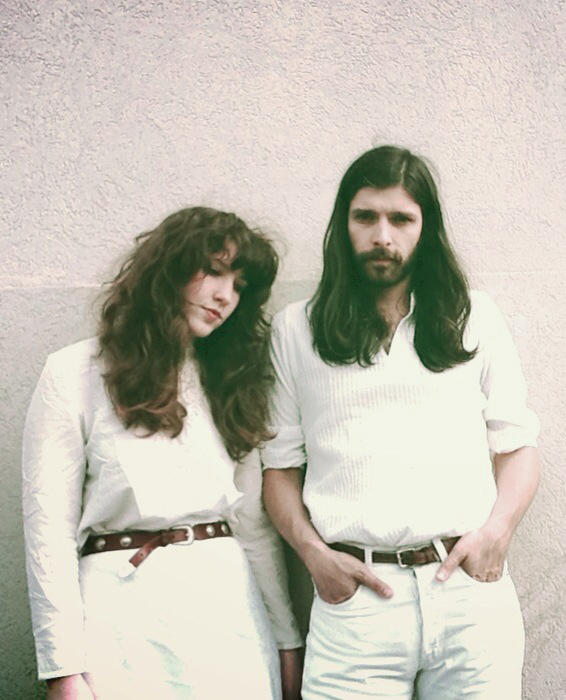
With weekly live music shows on its outdoor deck, the bar at Sophia’s Thai Kitchen serves as a reliable source for indie music aficionados to discover up-and-coming indie bands. Oct. 19 is the venue’s Season Finale, with performances by Brooklyn-based duo Widowspeak and Portland-based Pure Bathing Culture.

Widowspeak spent the first half of their North American tour with Iron & Wine and Pure Bathing Culture recently toured with Father John Misty. Now, the two bands are joining up for the remainder of their North American tours on behalf of Widowspeak’s forthcoming EP The Swamps and Pure Bathing Culture’s new album Moon Tides.

Kevin Wan, co-owner of Sophia’s Thai Kitchen, helps book promising new bands for their live music shows, which occur from the end of March until the end of October every year.

“Pure Bathing Culture has a cool, retro 80s vibe going on. I’m a big fan of Cat Power and Mazzy Star, and Widowspeak has that kind of sound,” Wan said.

Some of the artists booked by Sophia’s in the past, like The Lumineers and The Head and the Heart, have gone on to become huge sensations in the indie scene, often going on to play at big name music festivals.

“I tend to book on-the-rise indie bands and bands touring on new material. Davis people have a wide variety of tastes and Davis is a town that responds well to new bands,” Wan said. “Widowspeak and Pure Bathing Culture seem to be a complimentary package as performers. They have very different sound, but speak to a like-minded audience.”

In phone interviews, MUSE spoke with Widowspeak’s guitarist Robert Earl Thomas and Pure Bathing Culture’s guitarist Daniel Hindman. Thomas spoke about Widowspeak’s aesthetics and creative influences when working on their music.

“Molly and I are both really into storytelling and imagery, and every time we do a recording project, we come up with a set of influences in all aspects of art, like color, design, film and clothing,” Thomas said. “We pull all these elements together and then pull back and think about the feelings and imagery in the world that we want and then make songs from that point.”

Thomas and Hamilton have known each other since they were teenagers, and formed their band with one of their friends, Michael Stasiak. After touring extensively, Stasiak left the band, but the remaining duo has since upheld their dreamy, often foreboding sound that recalls the feel of different regions of America.

“A moniker we’ve acquired is ‘swoon lords,’ and we’ve been described as ‘cowboy grunge.’ We have a dreamy Western twinge. There’s definitely a lot of boots and fringe between [Molly and me],” Thomas said. “In terms of our aesthetic style, we’re definitely an American band, but not specifically from one region of the country like New York or the West coast. Right now we’re looking at New Mexico,” Thomas said.

Widowspeak’s latest EP, The Swamps, was approached like an album with one thematic element, recalling the swamps of Louisiana and dealing with themes like stagnation.

“Our last album had to do with nostalgia and the pitfalls that come from that. This EP is about that hazy feeling that the swamps give you, sort of like you’re moving underwater. We tried to replicate the feeling of walking through the swamps of the Bayou,” Thomas said.

Moving forward since their earlier work, Widowspeak’s music progresses from the feelings evoked by an old-world country life to those of a more modern world.

“Our last album, Almanac, had to do with nostalgia and living in a closed-off world, but in The Swamps we’re starting to deal with modernism and the modern world,” Thomas said. “We are trying to take more risks in our songwriting, and trying to expand that canon of what can be Widowspeak. We do a lot of layered recording based off home demos, but we’re also trying to introduce new tones and instruments.”

The Swamps serves as a bridge between their past work on Almanac and True Believer and their third studio record, which is still in its primary stages.

Former members of the indie folk band Vetiver (on Sub Pop and Bella Union records labels), Hindman and Versprille started working on music together and became Pure Bathing Culture. The duo works collaboratively, slowly building their sound through new beats while working together on music and lyrics.

“I’ll start with a drum beat and some kind of song structure, then I’ll bring it to Sarah, talk about it and finish the song together. We both co-write music and lyrics. It’s a highly collaborative process, and it works because its just two of us so we can move pretty quickly,” Hindman said.

Moon Tides is Pure Bathing Culture’s first full-length album. The duo created an introspective and cohesive album that resists being labeled under a specific genre.

“We’re songwriters, mostly, and we’re not trying to participate in a specific genre. People pay attention to that aspect in our music and will call it dream pop, but I don’t really like that. In its most basic format, I think we do pop songs, but beyond that people are going to call it what they want,” Hindman said.

Moon Tides, deals with themes of transformation and transition, and seeing the positive in that, Hindman said.

Pure Bathing Culture recently ended a tour with singer-songwriter Father John Misty, whose solo career kicked off after leaving Fleet Foxes in 2012.

“That tour was great. It was about two or three weeks long, and I was interested to see how [Father John Misty’s] audience would respond to our music because his music is really visceral and he is really entertaining as a person,” Hindman said. “Our show was much simpler than his, as it would be in this point in time, but people really appreciated us and really listened, which I think is a testament to say that people weren’t just there for him.”

Widowspeak’s Ep The Swamps is set to be released on Oct. 29, and Pure Bathing Culture’s Moon Tides was released in Aug. 2013.

Tickets can be purchased online at sophiasthaikitchen.com for $6 or at the door for $10.

CRISTINA FRIES can be reached at arts@theaggie.org.

A bird’s eye view comes to life

1

In the state of California, UC Davis is the only university with an on-campus airport. From business and recreational travel to flight training and atmospheric studies, the University Airport serves the Davis community in a variety of ways.

“Aviation is starting to be taken for granted. At some point there was a knowledge and understanding of how crucial aviation is for a local economy,” said Jonathan Bar-or, chief pilot and chief executive officer of Cal Aggie Flying Farmers (CAFF). “[The airport] is probably the coolest hidden gem at this university or in the city of Davis. Not just the fact that we have an airport, but the fact that we have an airport with the highest caliber training facility on its file.”

In order to show off the airport facilities to the campus community, both the Friends of the University Airport and UC Davis Transportation and Parking Services will be hosting the 11th annual University Airport Open House on Saturday, Oct. 19 from 10 a.m. to 2 p.m.

“It’s more for the education of what we do,” said Bill Hartman, a representative of The Friends of the University Airport. “To let the people in town and the new students know what aviation is about.”

From standard aircrafts to antique automobiles, many attractions will be on display for visitors. Professional pilots and former National Aeronauttics and Space Administration (NASA) employees will also be attending to explain the academic aspects of the event.

“[The hangars] will be open and full of [UC Davis] students. We will have at least two different flight simulators, so you can sit down, fly on a computer and feel like you’re flying an airplane,” said mechanical and aerospace engineering professor and former NASA astronaut Stephen Robinson. “If anyone has even the slightest curiosity about flying, about aerospace engineering, or about what’s out there on the other side of the 113, come on out.”

Since his return to UC Davis last year, Robinson has made many efforts to involve students with the airport’s academic value.

“My role is to connect the university’s primary mission, education, with the airport and aerospace engineering,” Robinson said. “We are interested in making airplanes safe, in demonstrating the principles of aerospace engineering in real life.”

Students, specifically in the aerospace engineering department, work voluntarily every quarter with different airport facilities, such as the hangars and wind tunnel.

“Right from the beginning, my intent was to take advantage of the very unique opportunity that the airport offers students here at UC Davis,” Robinson said. “It affords us a very unique combination of educational opportunities between the various departments here and the facility so that students can get hands on physical exposure to aerospace.”

The airport facility has come a long way since its original start. In 1947, engineer Harold Hopkins bought the land with the idea of creating an airport to fly fruits and vegetables across the country, considering Davis as the breadbasket of the nation.

The University Airport land was bought by the University of California Board of Regents in the early 1950s and has been run that way ever since, now serving hundreds of people daily.

“The whole role of aviation in the United States is for transportation and research, and we need to support that,” Hartman said. “The bigger airports are impacted with airline traffic. So, you need the smaller airports like this to support the smaller airplanes.”

Although the University Airport does not operate through commercial airlines, over 50 planes take off from the airport’s runway every day. UC Davis professors, visitors and veterinary hospital animals constitute only a few types of typical flight passengers.

“There are some major Silicon Valley employees that commute [by plane] from Davis to the Bay Area every day,” Bar-or said. “Airports like this are the tie from these communities to technological powerhouses. Without the airport, we would lose a lot of community members.”

Many of the flights described are administered by one of the 400 members of the non-profit CAFF. Although the University manages the airport in terms of buying fuel and maintaining the grounds, CAFF handles 80-90 percent of the facility’s daily functions.

Since 1947, the on-campus Davis flying club has offered flying lessons and aircraft rentals to students, university associates and the general public from the University Airport itself. With seven full-time flight instructors, affordable pricing and one-on-one classes, flying is a universal activity, according to Bar-or.

“Anyone can come learn to fly and see the University from the air,” Bar-or said. “It’s amazing what you learn by doing something as hands on and out of the box as learning how to fly.”

After a pre-briefing in one of the flight instructor rooms on site, flight school students begin their lessons off the ground. With dual control airplanes, students learn techniques and strategies in the air without the expected pressure of being inflight.

Students in the flying program also receive ground instruction regarding topics necessary for flight, such as weather phenomenon. After accumulating an average of 60 to 70 hours in the air, pilots-in-training take both oral and flight exams with the Federal Aviation Administration at the University Airport.

More information regarding flight lessons and other airport services will be available at the Open House. In addition, the CAFF will have a drawing for a free introductory flying lesson.

“Students have limited time, but they don’t have limited energy. They have unlimited energy, unlimited creativity and an unlimited thirst to learn,” Robinson said. “All the university facilities are our facilities. It’s your airport, you should come see it.”

RITIKA IYER can be reached at features@theaggie.org.

Music enthusiasts unite for annual event

Student-run radio station KDVS 90.3 FM and local record store Armadillo Music will be co-hosting this year’s annual Vinyl and Music Fair. The fair will be held at the Davis Senior Center on Oct. 20 from 9 a.m. to 4:30 p.m.

The fair began around a decade ago with twelve record vendors and a small crowd of vinyl enthusiasts. In the past few years the fair has become increasingly popular and will be hosting 50 vendors this year.

Sellers will be traveling from the likes of Reno, Los Angeles and Portland and will be working alongside some of Davis’ local vendors. Along with a vinyl exchange, the event will also offer tables of collector CDs, DVDs, audio devices and concert memorabilia.

Armadillo Music Store Manager Paul Wilbur is one of the main organizers of the event and has a passion for vinyl himself. He believes the fair is great way to find rare merchandise.

“Vendors from all over California come to sell records; everything from cheap records fifty cents apiece to expensive hard to find collectables. There are people selling CDs and turn tables and audio equipment, but the major focus is vinyl,” Wilbur said.

The event attracts people of all ages and all different tastes in music. The offerings range from records dating back as early as the 1960s to albums released this year. The selections span across all genres of music, including rock, jazz, hip-hop, pop, classical and beyond.

Mike Wilson, who has sold concert memorabilia at the fair, has spent a lot of time interacting with customers and has noted the array of unique preferences the event draws in.

“It’s a good place to get like-minded people in the same area. You could go to one hundred record stores and not find what you want, which is why people who love music go here,” Wilson said.

Records were first created in the late 1870s and were originally played in phonograph machines. By the late 1940s Columbia Records released the common LP vinyl record we are familiar with today. Many of the records from this era have since been disposed of or lost in forgotten storage, leaving collectors to search for items at special vinyl fairs like this one.

The event has known to turn up rarities like Janis Joplin, The Doors and Led Zeppelin. The prices for these finds tend to be lower at the Vinyl and Music Fair than from private bidders, and this has been a big reason for spikes in attendance in the past few years.

Marvin Philips, past record store owner and vinyl tradesman, used the fair as a way to find and keep a variety of records in his shop.

“I love going to them because you never know what you’re going to find. You’ll find something you never knew existed,” Philips said. “If you’ve never been to one, it could be a real eye-opening experience.”

Philips expressed the belief that unlike many of its musical counterparts, vinyl records will stand the test of time, especially through events like this.

“The record is always going to be here, it’s never going to go away. Like tape records, I can see the CD being gone in five or 10 years, but the record will still be going,” Philips said.

For more information regarding the Vinyl and Music Fair you can visit kdvs.org/vinyl-and-music-fair or contact Armadillo Music at (530) 758-8058. Early entrance to the fair starts at 8:30 a.m. with a $5 fee and 9 a.m. entrance is free.

AKIRA OLIVIA KUMAMOTO can be reached at arts@theaggie.org.

City, University fire departments to share management

The City of Davis Fire Department (CDFD) and the UC Davis Fire Department (UCDFD) will be entering a one-year “joint powers agreement” (JPA) for a Shared Management Services trial period. The motion passed in a 3-1-0 vote at the Oct. 15 City Council meeting.

The JPA California Legislation came about in 1921.The legislation allows public agencies to work in concert as separate institutions. The purpose is to cut costs, increase efficiency, reduce or eliminate overlapping services and share resources.

It is so flexible, according to past CDFD Interim Fire Chief, Scott Kenley, that it can apply to almost any two entities that involve cooperation with no set formula.

For this reason, many fire departments all over California have formed similar intercity agreements — San Mateo County, North County Fire Authority and Central County Fire Department, to name a few.

According to UC Davis Vice Chancellor for Administrative and Resource Management John Meyer, the UC Santa Cruz Fire Department is currently in the process of a similar agreement with the City of Santa Cruz Fire Department.

Changes for CDFD

The fire department has been through many changes in the last few years to arrive to this point. In September 2010, the CDFD and the UCDFD had a “Management Services Agreement” (MSA). The MSA dictated that the two departments would share a fire chief and an assistant fire chief as a trial to see if full consolidation would be an optimal choice. However, it was paused two years later due to “unresolved conflicts,” Kenley said. Though it provided positive contributions, such as Engine 34, it wasn’t the ideal situation.

“One reason we discontinued the MSA, until we came to some other agreement, is we wanted consistent leadership and not interim leadership,” Meyer said.

Since then, the UCDFD has hired a full-time fire chief. The CDFD, however, has had a series of interim chiefs. And though the UCDFD and the CDFD do not remain in a MSA, they continue to work together — most recently in regards to the boundary drop implemented in September 2013. The boundary drop separates the response districts such that now the closest resources are dispatched to all calls for service.

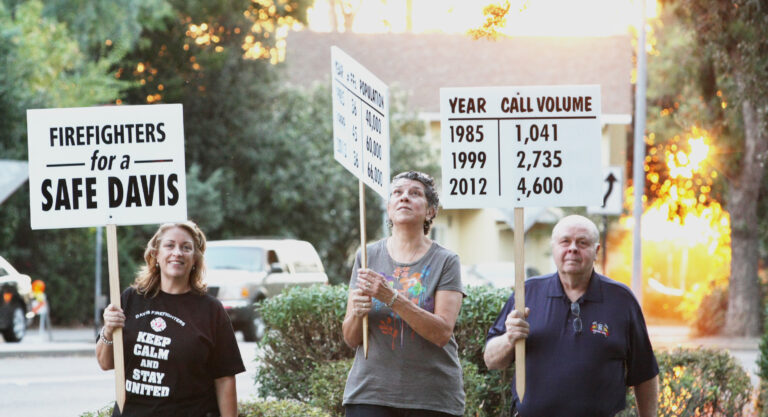
“Over the past couple years, there’ve been some challenges in the [City’s] Fire Department … [due to a lack of] a full time fire chief since 2009,” said Joe Tenney, CDFD fire captain and a member of the Davis Professional Firefighter Association — Local 3494.  “There’s been a lack of leadership and direction … [the City has] cut nine positions which has had a real effect on the staffing for emergency response. We are concerned not only for the firefighter safety but for that of the community.”

Local 3494 compiled data showing that in the last two fiscal years, there has been a 220 percent increase in overtime and call volumes have more than doubled.

“[In the mid-80s] we were running with 36 firefighters and 40,000 citizens. Now we have over 65,000 citizens and 45 firefighters. Last year [the city] cut it back to 36 firefighters. They continue to ask us to do more with less. The breaking point is now, it’s here,” said Emily Lo, CDFD fire captain, and a member of Local 3494.

Alternatives considered

Many options have been considered but as of yet, none have appeared ideal. Kenley discussed alternatives at the city council meeting — a full merger, shared management services or completely autonomous entities at some point in the future.

Kenley explained that a full merger would yield a projected cost of $1.3 million to UC Davis while saving the City of Davis $170,000 annually. It might also mean the loss of the UC Davis student firefighter program.

A shared management service exercising the JPA would in turn provide deputy chiefs that answer to the Fire Chief for additional intra-department continuity and management, with projected cost savings of $78,000 to the city. It will also keep in cooperation between departments that are already in place, such as the boundary drop, and the joint personnel training services to name a few.

“The alternative is … to continue the nationwide recruitment for a separate fire chief,” Kenley said.

Vice Chancellor Meyer added that, given the joint ambition the City of Davis and the University have for growth, a coordinated fire management would make preventative methods for safety easier and make for a “cleaner” conversation between the two entities.

The status quo, however, for the management of the CDFD has been a series of interim Fire Chiefs. The current one being Police Chief Landy Black, who was named Public Safety Director of Police and Fire in February 2013.

“The fact that it’s taken a few months [to come to a decision] is undoubtedly unsettling. It’s important, however, to acquire a more patient response, as we have discovered no lapse in public safety in terms of boundary drop,” Black said.

Conflict, controversy regarding decision

The decision has marked an attempt at a solution to an ongoing struggle in the face of the changes the Fire Departments have gone through in the last year. It is still met with some controversy.

“I support an autonomous City Fire Department…I have issues concerning respect…I’m not sure [the UCDFD Chief] will get the respect from the City Fire Department. There is a lack of credibility…the previous interim chief did have credibility…it’s important to get someone from outside…The next question is where does it stop? There is a consistent movement towards consolidating departments and I don’t know if it’s the right time for this one,” said City Council member Lucas Frerichs.

Still others believe this decision may be a step in the right direction for the CDFD. Mayor Joe Krovoza commented just prior to moving forward with the motion, “It seems there is room for autonomy but hope for unity.”

GABRIELLA HAMLETT can be reached at city@theaggie.org.

Letter to the Editor: Regarding “YOU Should Run for Senate”

0

Last week, The California Aggie published an opinion piece by the ASUCD Elections Chair entitled “YOU Should Run for Senate.” I took issue with many of the claims made in this piece. With this I mean no disrespect to the Elections Chair; I consider Mr. Renslo a good friend and unquestionably qualified in his role. However, having run successfully for Senate myself, I would like to address his arguments for running for Senate and present some of my own. I will begin with his three reasons, which I’ve paraphrased here.

           1. Student government has a $11.8 million budget, which senators approve.

Most of this money is not discretionary to Senate, being preemptively allotted to Unitrans and the CoHo each year, and the rest is awarded as closely to arbitrarily as possible. There is little consideration of each units’ budget in the context of the rest, and most of the discussion from my peers during budget hearings was not focused around how to optimize our day-to-day, but how to fund pet programs. The numbers are quite appealing to rattle off to voters, so if you, dear reader, decide to run for Senate, this is still a good figure to remember.

           2. Senators legislate and vote.

Our only explicit duty is not one to be neglected, but this is hardly an appealing facet of the job to many beyond a political nerd, which is one of the biggest issues in student government. How well do we reflect the student body if we have not had a senator from the College of Engineering in over a decade? The College of Bioscience found its first representative in nearly as long just last quarter in Senator Sahota, with Senator Torres and myself happily serving as the occasional delegates for the College of Ag. If you’re already sold on politics, I don’t need to convince you, but if you’re not, understand that your unique perspective could provide something incredibly valuable to the whole student body.

           3. Senators are attractive potential employees.

Too many treat Senate like Teach for America or a “gap year” in a foreign country, where the experiences they gain end up being all about themselves rather than the people they are supposed to be serving. Chair Renslo’s article reinforces that, going as far as to herald Senate as a fantastic talking point in job interviews. Personally, I would prefer to be represented by someone whose first priority is to make the student experience at UC Davis better, not to bloat their resume.

So why should you run for Senate?

           1. You’ve found success in making a difference elsewhere on campus, and would like to use your skills on a larger scale.

           2. You’ve identified areas on campus that could use improvement and will work tirelessly to make sure that they’re made whole.

           3. You believe in representative democracy and are excited to endlessly address the needs of the student body.

If these things are true of you, make sure you do what very few of your potential predecessors have done and attend a Senate meeting and a few commissions so that you know what you’re getting yourself into, and talk to someone in the position who’s not emotionally invested in seeing you run in the race.

And if you are indeed set on running for public office at this wonderful university of ours, also make sure to check out another feature The Aggie ran last week: a visual breakdown of ASUCD. The graphic details the three branches of government that mirror the federal system our country and state employ, and what they mean in the context of UC Davis. However, something absolutely critical is missing from it — the components of student government that really matter.

ASUCD is not the collective of self-important students who “govern” but instead is the hundreds of people who drive the busses, make your coffee, compost your bananas, fix your bike, provide food to hungry students, save the environment, drive you back from parties on weekends, lobby on behalf of the student body and host a radio show at 4 a.m. on a school night. That it’s all run by individuals who often begin their tenure without even being able to name every unit is testament only to this nation’s understandable love of democracy.

Given all that, if you believe that you’d be able to make an impact on the student body that is positive, substantial and permanent, I encourage you to run for ASUCD Senate. Show us what you have to offer; Aggies are easily satisfied with the very best.

Miles Thomas

ASUCD Senator

California Raptor Center opens its doors

0

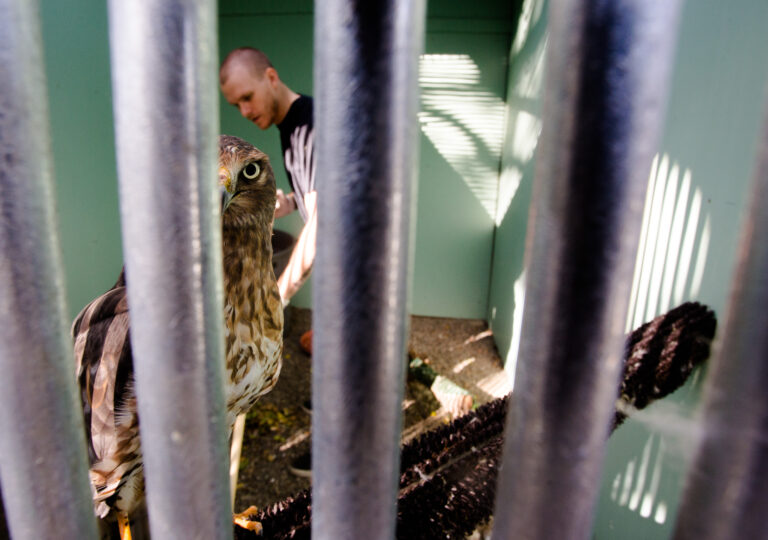
From barn owls to golden eagles, the volunteer-run California Raptor Center (CRC) is home to hundreds of local predatory birds, and around 200 people from all over the community will gather at the CRC for its biannual Open House this Oct. 19.

Established in 1972, the CRC was first founded by the Department of Avian Sciences with the assistance of the California Department of Fish and Game. Due to the growing number of non-releasable raptors and the need for a larger facility, the CRC was handed over to the UC Davis School of Veterinary Medicine and moved out to Old Davis Road eight years later.

One of the primary goals of the CRC is to provide medical care for healing raptors, and the center still continues to carry on this goal to this day.

Every year approximately 200 injured, sick and orphaned birds are brought to the CRC by the community. After the rehabilitation process, about 120 raptors are able to be released back into the wild.

Before nourishing the raptors back to health, volunteers are trained to give medication and perform physical checkups, therapy and inoculation. Additionally, the center focuses on illness prevention by testing for West Nile Virus among the raptors.

Since its founding, the CRC conducts raptor research, aids in the rehabilitation of birds and raises general awareness through education.

Lis Fleming, an education program volunteer, has been volunteering at the Raptor Center for 19 years and thoroughly enjoys informing the public through her informational presentations.

“I really enjoy the enthusiasm that people have when they come learn about the birds. We can’t really explain [what we do] without people coming to see the birds,” Fleming said.

The open house provides numerous ways in which visitors can acquire a better understanding of the CRC and its main objectives.

Starting at 8 a.m., visitors have the opportunity to view wild birds through a scenic “hawk walk” along Putah Creek. Visitors can also observe the raptors up close through self-guided tours around the premises of the CRC.

“The purpose of these birds is education and people can see these birds in a way that they couldn’t in the wild,” Fleming said.

To specifically learn more about raptor biology and ecology, the open house will include interactive classroom presentations which cover topics ranging from conservation and species identification. These presentations will be led by trained volunteers who specialize in the education program.

After hearing about the Raptor Center through a professor, Michael Chu, a fourth-year student majoring in animal biology, decided to volunteer at the center.

“I like observing the birds and their behaviors. I also like learning more about them and what they’re comfortable with,” Chu said.

Tim Couch, a volunteer from Vacaville has been volunteering at the Raptor Center for about a year, helping birds regain flight ability by attaching them to fishing poles and letting them test their wings.

“It’s an opportunity you don’t really get. It’s pretty neat testing the birds,” Couch said. “It’s kind of weird putting a bird on a fishing pole.”

While the CRC continues to maintain its facility and educate hundreds of people every year through its local volunteers, it is no longer funded by the state.

“We’re really underwatered,” Fleming said.

According to Fleming, it costs about $5 a day to feed each bird. Since there are approximately 100 birds at the center, it would cost nearly $500 to feed all of the raptors daily. Taking into consideration all of the factors that contribute to the center, its daily operations become quite expensive.

Currently, the center solely depends on the public for the majority of its funds. In addition to public donations, sponsorships are extremely helpful in keeping the CRC running.

Fortunately, Whole Foods is sponsoring the open house and will be giving out free samples throughout the event. The Mendocino Brewing Company, who happen to name their beers after the raptors, is also sponsoring and will attend the open house as well.

Some of the raptors at the CRC are even individually sponsored. Mikey, a red-shouldered hawk, found his claim to fame after being featured on PBS with the late American television personality, Huell Howser.

After hitting his head as a chick, Mikey’s right eye stopped growing; as a result, his depth perception was completely damaged.

“Mikey was named after a food commercial because he loves to eat. He’s a fun story and is quite a character,” Fleming said.

Due to his increasing popularity, Mikey is frequently sponsored by Adopt-A-Bird. This program allows the public to “adopt” a raptor by sending monetary donations which provide food, veterinary care and housing for a permanent resident or patient recovering at the CRC.

For 19 years, the CRC has been a home for Mikey, and also for hundreds of local raptors who share similar, yet individual stories.

On Oct. 19, the community will have the opportunity to discover some of these interesting stories while exploring the California Raptor Center and its facility.

LUJAIN AL-SALEH can be reached at features@theaggie.org.

This Week in Senate

0

ASUCD Vice President Bradley Bottoms presided over the Senate meeting on Thursday, Oct. 10. The meeting began at 6:20 p.m.

The highlight of the meeting was the passing of a bill that would give the Elections Committee the option to decline the distribution of sample ballots through The California Aggie. This bill was proposed and passed due to a lack of funding for the Elections Committee this year. The bill gives the option to the Elections Committee to not post sample ballots in The Aggie if they do not have the funds to do so. If the Elections Committee chooses not to post the sample ballot during election time, it will take a significant amount of funding from The California Aggie. This bill was also questioned due to the breaking of a long-running tradition that ASUCD has with running sample ballots in the Aggie.

“It’s upsetting that ASUCD had to write a bill to take away funding from The Aggie,” said ASUCD Senator Maxwell Kappes, who introduced the bill. “It had to be written due to the financial situation with the Elections Committee, because they were purposefully under-funded.”

New and returning members Kelly Kong, Alexander Abu-Hakima, Ian Lee and Marissa Ayala were confirmed to the EPPC Committee. Nichelle Esquitin, Warren Kim, Jeremy Kirshner, Nate Bentham and Mary Sedarous were confirmed to the Internal Affairs Commission Board. Allan Bach, Kimberly Yu, Katherine Green, Rahul Sachdev, Sana Sareshwala, Angela Santos and Joyce Sun were confirmed to the Academic Affairs Commission. Phi Nguyen, Priya Seth, Lawrence Feygin, Daniel Riesgo, Wesley Wang and Alisha Makmuri were confirmed to the E-fund Commission Board.

A bill was passed to formalize the process of ASUCD renaming units in order to have only one name assigned to every unit run by ASUCD. Another bill was passed to tighten the use of Robert’s Rules of Order during Senate meetings and to make points of inquiry consistent with those rules. Many senators were relieved that a bill to clarify the use and restrictions of deferments during parliamentary procedures was passed. They believed it would save a lot of time during meetings, due to the fact that senators will no longer be able to use deferments simply for having more time to talk. The last bill that was passed clarified the role of Commission-authored bills and was questioned by some senators. The bill passed 8-4.

Senator Miles Thomas described what his presentation on ASUCD finance will entail. This presentation, along with others, were rescheduled to happen at next week’s meeting.

MELISSA DITTRICH can be reached at campus@theaggie.org.