A look at the ongoing AB94 Seismic Improvement project and the changes coming to one of UC Davis’ most iconic buildings
By: AALIYAH ESPAÑOL-RIVAS — campus@aggie.org
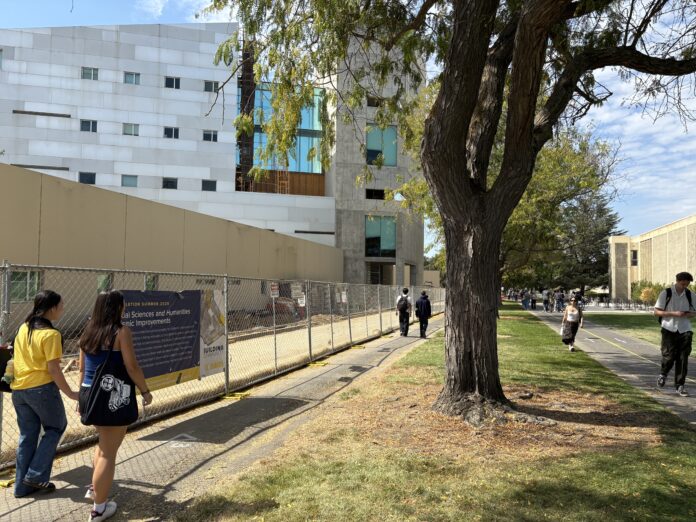
The Social Sciences and Humanities Building, one of the most architecturally confusing landmarks at UC Davis, according to students, continues to be under construction as the 2025-2026 school year gets underway. Referred to by many as the “Death Star,” it is one of six sites on campus involved in structural and seismic construction as part of the ongoing AB94 Seismic Improvement Project, which uses state funding from the 2013-2014 Budget Act (California Assembly Bill 94) to fund needed improvements.
According to Sandra Mott, associate director of Major Capital Projects for UC Davis Design and Construction Management and main project manager for the AB94 program, the main objectives of the project include safety and general improvements in accordance with UC Seismic Safety Policy.
“The primary project goals are seismic strengthening, fire and life safety upgrades, accessibility improvements and [polishing] things up a little wherever we can,” Mott said.
Other project sites include Jungerman Hall, the Mann Laboratory, Young Hall, Voorhies Hall and the Sprocket Building. Some construction, including at the Mann site and at Jungerman Hall, has already been completed.
The Death Star improvements are the biggest endeavor of the project; Construction began in fall 2024 and is slated for completion in spring 2026. Improvements to the building — which houses the departments of History, Economics, Sociology, Philosophy and the offices of the College of Letters and Sciences — will cost $25 million.
The construction will also result in the most cosmetic changes of any of the sites in the larger AB94 project. According to Mott, the area that previously featured a large stair pit — located directly across from the A Street Field — will be replaced with a plaza.
“There’s a lot of construction activity happening at the North facade of the building,” Mott said. “But the good news is that there’s new paving, sidewalks and a pit infill where the pit stairs were.”
Additionally, construction fences have obstructed one of the two lanes on the North Quad bike path that intersects with A Street.
“The bike path is a huge area of concern,” Mott said. “We’re working on it [on a daily basis] with campus partners […] to try and figure out how we can make that area the safest possible until it opens again.”
For some returning students, like second-year biological sciences major Uchena Nekes, the construction has proven to be an inconvenience.
“It’s bad,” Nekes said. “I almost get run over by so many bikes every time I’m walking. [Pedestrians] need a bigger space.”
Kai Dodd, a second-year biology major, also communicated her displeasure with the construction, citing biker and pedestrian inattentiveness as a cause for concern.
“Nobody listens to the signs. People just put on their headphones and don’t pay attention,” Dodd said. “People are almost getting hit, then they’re getting yelled at and it’s a constant problem. People are getting annoyed and frustrated — it’s scary.”
As of date of publication, the one open bike lane can be utilized by pedestrians, while the sidewalk next to it can be used by bikers. The bike path is scheduled to fully reopen by the end of November.
Incoming students have also found the obstructions confusing to navigate as they acclimate to campus. Isabelle Corona, a first-year chemistry major, expressed concern about student safety given the new routes.
“I’m worried about the pedestrians and people getting in [my] way, or even crashing into me,” Corona said. “Students are not being attentive to the signs so bikes and people are using the same path.”
In the meantime, campus officials call on students to remain aware of the signage surrounding the impacted area and slow down while on bicycles. In addition, Aggie Host Security Officers will be posted at each end of the bike path to aid students with the redirection for the first few weeks of the school year.
“I’m all for improving infrastructure, but I don’t think it’s okay [when it] come[s] at the cost of student daily life, especially if it’s not going to get done anytime soon,” Dodd said.
Other project sites
Meanwhile, Voorhies Hall continues to be under construction, which began in spring 2025. The building saw the demolition of its perimeter, and remained closed from June through Sept. 12. The building, which houses the English department, Medieval and Early Modern Studies and the University Writing Program (UWP), will see upgrades continue until June 2026.
Young Hall enhancements advance with the recent closure of the southern side of the building in late August. Construction began in spring 2025 and is slated to end in summer 2026. The Sprocket Building, which housed the Food Science and Technology Department before the opening of the Robert Mondavi Institute, will see work done through spring 2026.
Ultimately, while ensuring the stability and long-term health of these buildings is the main priority, Mott and the design team hope that students will come to appreciate the more structural and visual effects of their work.
“The main goal of this project is student safety,” Mott said. “But we also hope that everyone will notice the beautification that we’re trying to get done.”
Full information regarding ongoing Seismic Improvement Projects can be found on the UC Davis and Construction Management website.
Written by: Aaliyah Español-Rivas — campus@theaggie.org