


It’s time to pay attention, now more than ever before
By SABRINA FIGUEROA — sfigueroaavila@ucdavis.edu
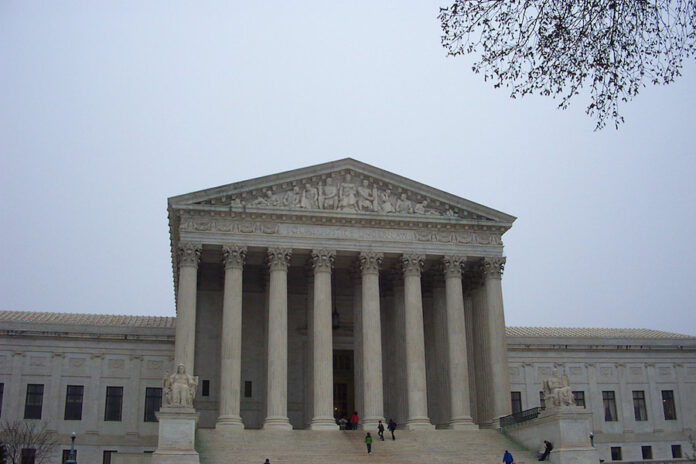
The United States Supreme Court’s (SCOTUS) decision to allow racial profiling in immigration raids should be alarming for everyone, not just for minorities.
On Monday, Sept. 8, 2025, SCOTUS lifted restrictions on immigration raids across Los Angeles in a 6-3 decision in the case of Noem v. Vasquez-Perdomo, granting Immigration and Customs Enforcement (ICE) the permission to stop and detain people based on appearance, accent, language spoken and even employment. In other words, the court has willingly opened the door for discrimination and racial profiling to occur legally — once again.
The U.S. is stuck in a never-ending cycle of singling out the people that make it whole. The government demonizes them through media and propaganda campaigns, gains the consent of the rest of the public and enforces harmful acts and laws against them. Then, when the public starts to feel guilty after it’s all said and done, everyone apologizes without fully addressing the problem (sometimes we skip this part) and repeats the cycle. When a country is built upon discrimination and social hierarchy, the very culture and legacy that arises from it are tainted. Everyone knows old, bad habits die hard, especially if you think they keep you safer.
Dating back to the 1700s, slave patrols were created to apprehend escaped slaves and use terror to deter uprisings and crimes against the white community in the antebellum South. In the 1930s, the Mexican Repatriation Program sent up to 1.8 million American people of Mexican descent to Mexico, regardless of citizenship, based on nothing but the rhetoric that they were stealing “American” jobs and resources. This was followed by the 1940s, when the U.S. sent Japanese-Americans to internment camps in the name of national security. Even now, mass deportations all over the U.S. are based on racial profiling and justified by the need for security.
Videos of children begging ICE not to take their parents away will forever haunt our history. Pictures of families taken at “Alligator Alcatraz,” posing as if they’re visiting a theme park and not a detainment center, will be photographs that everyone claims to be ashamed of in the future. Likewise, the Trump administration considering a televised game show for people to compete for citizenship — as a spectacle for profit — will eventually seem bizarre and unrealistic to all: perhaps even funny. We will all come to regret what is currently happening someday, and then we’ll allow it to repeat again.
In other words, none of what is happening today is new. The idea that discrimination and atrocious acts are okay as long as it’s for the justice and safety of Americans is reinforced by our history. Our very systems are designed to uphold and promote such discrimination. Without proper reform, no changes will be made; People will continue to grow angry and weary.
Immigrants are human beings — that alone is enough to make them deserving of the same rights as the rest of us. They are not aliens, they are not criminals, they are not threats. They are kind people who have only ever wanted to survive, just like anyone else.
SCOTUS’ decision to lift this lower court ban tests the boundaries of our institutions — not only the checks and balances within the government, but of the people they govern. The wave of fear that has engulfed many immigrants and Latinos, which stops them from going to work and leaving their houses, will not end there. If we do not stand against this decision, we only provide our consent to let it happen over and over again. The biggest mistake we can make in a changing world is giving into the false perception of safety; If you allow your government to dissolve the rights of some, you risk the government dissolving the rights of all in the future.
Right now, it’s easy to give in to despair — the thought that there is nothing left for us to do. But, not all hope is lost. In Los Angeles and San Diego alone, communities have mobilized to keep their people safe, patrolling neighborhoods to look out for ICE agents and documenting ICE’s unlawful activity for the public to see. These selfless acts from volunteers encapsulate the power we have to protect each other, to hold our government accountable and to address the problems at hand. So long as there is hope, there is a way.
Written by: Sabrina Figueroa — sfigueroaavila@ucdavis.edu
Disclaimer: The views and opinions expressed by individual columnists belong to the columnists alone and do not necessarily indicate the views and opinions held by The California Aggie.
