55.5 F
Davis

Davis, California

Tuesday, December 23, 2025
Home Blog Page 105

A love letter to not knowing what’s next

How to practice gratitude for this uncertain time in your life

By THE EDITORIAL BOARD

Whether you’re graduating this June or in a couple years, the thought of life after college has surely crossed your mind. Some people wince at the thought, some are excited to get out of here and some even have jobs lined up and waiting for them. No matter what point you’re at in your planning for post-grad life, you’re on the right path.

If you have chosen to study something you love and it also happens to have economic value, continue pursuing it with fervor and dedication (you’re one of the lucky ones!). If you don’t have that perfect combination, that’s okay too. Welcome to the experience of most people. A lot of us feel that same stress, so definitely don’t feel alone.

Once you graduate, you have an infinite number of paths ahead of you. You could join the Peace Corps, go to graduate school, travel the world, move home for a bit, start bartending, develop welding skills, start a podcast — you get the point. You can do anything you want, and that’s the beauty of it. These possibilities might not be immediately available to you under the constraints of finances and other responsibilities, but the fact remains that there are more potential paths for your life than the one you imagined when you were 18. When you graduate, you graduate into more freedom over your future — and even though that can be scary, it’s exciting too.

This is a time in your life when it’s okay not to know. It’s a time when you have the freedom to try new things because there’s so much life ahead of you to keep trying. Give yourself grace and time to figure out what you want to do because the journey is part of the process and the fun. You’re creating meaningful memories and stories you will tell for years to come. Although it may feel like society expects you to know what you want to do right out of college, please know that all people experience periods of exploration and self-discovery before they find a path that is right for them. In fact, many recommend it!

It’s also normal to change your career multiple times, so don’t feel pressured to pick something and stick with it forever. In fact, this is a perfect time to start trying out career fields to begin your search. Maybe you just find a job to pay the bills for now — that’s fine and doesn’t mean you’re locked in for life. The point we’re trying to make here is that it is all on your own schedule, and you shouldn’t feel persuaded to do what society or even your parents want. Do your best to listen to your own desires and curiosities — start there.

After all, the point of school is to learn, not to just learn how to get a job (though maybe that should be incorporated into the curriculum given our current economy and society). But once you graduate you can take all the knowledge you’ve gained and apply it to the world around you, even if it’s in a different way than you expected when picking your major. Much like your knowledge, the world is multifaceted and intersectional, and can benefit from your uniquely curious mind.

Giving yourself time to explore without bounds can be a way to truly make a difference and find a way to spend your life doing something (or somethings!) that fulfills you.

As you look for these potential careers, understand that you don’t need a job that changes the world AND is in your dream city AND is creatively fulfilling AND uses your specific diploma AND impresses your mom. Find work that makes you feel valuable, yes, but all of these expectations that have been placed on what a “valuable life” looks like, are fake. You get to decide what fulfills you and what gives your life value. And what a wonderful privilege that is. Not to mention, it’s likely that much of what fulfills you will come from other facets of your life, rather than your career. 

Remember, happiness is not dependent on having things “figured out.” Your happiness is much too important, and life is much too beautifully messy for this to be the case.

You might be looking for a job or figuring out where to live or trying to find what you’re most passionate about, but even in the midst of all of this, you can still appreciate the little things and enjoy where you are now. It’s important to teach yourself how to be happy while experiencing stresses like these, especially because you’ll probably never feel like you’ve fully figured it out. There will always be things you’re waiting for or more goals to reach, so learning to protect your peace in all the craziness of life is essential to your happiness. 

It may feel like this editorial is saying, how could the future be stressful when it’s also all of these wonderful things? But we recognize that like many things in life, this is something that is exciting and beautiful, and also scary and anxiety-inducing. Financial stress and social pressures are real, and finding a balance between exploration and stability is going to be tough. 

But humans are nothing if not adaptable and resilient, and the good news is that you, too, are a resilient, adaptable human. You’re going to do just fine out there.

No one changes the world alone, and no one doesn’t change it at all. We are all lost sometimes. In our experience, this is when the most growth happens. Remember that doing things for yourself and your future dreams should be a priority, so use this time of uncertainty to tend to your dreams, whether they be big or small. The wandering you’re doing and will be doing is meaningful, and it might actually help lead you to your next job or passion. It will show you strength and resilience you didn’t know you had and teach you the virtue of patience. 

So you’re on a path and you don’t know where it’s going, what a boring life it would be if you did. Embrace the unknown, try new things, find your place.

Written by: The Editorial Board
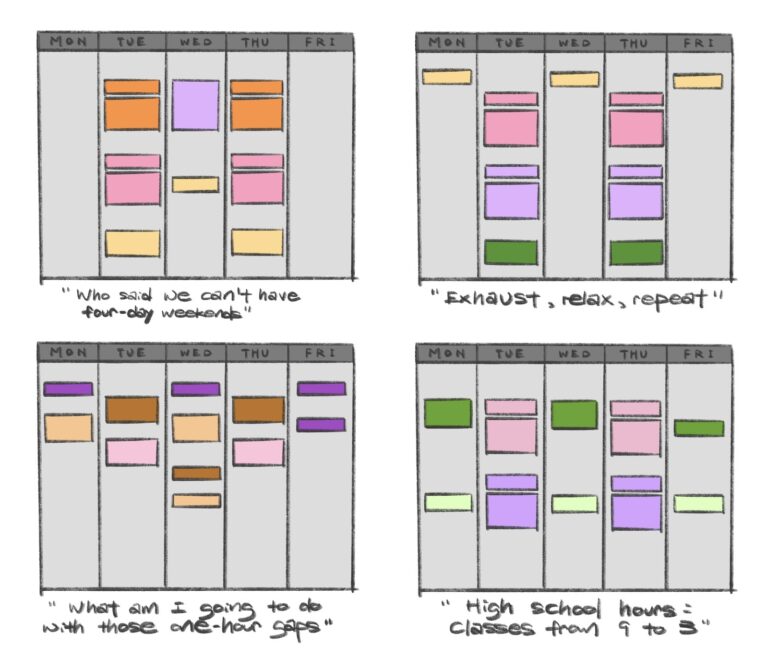
Different types of schedules


Drawn by: Lanhui Zhen –– lazhen@ucdavis.edu 

Disclaimer: (This cartoon is humor and/or satire, and its content is purely fictional. The story and names of “sources” are fictionalized.)

YG Marley and the trailblazing Black artists that came before him

The son of singer Lauryn Hill and Rohan Marley recently put out his first single, containing themes of activism from the artists that brought him to where he is today


By HANNAH SCHRADER arts@theaggie.org


Joshua Omaru Marley, known professionally as YG Marley, is the son of singer Lauryn Hill and Rohan Marley. The singer and songwriter released his first single, “Praise Jah in The Moonlight,” in Dec. 2023 — a reggae song exploring themes of gratitude and spiritual growth that he co-wrote with his mother, Lauryn Hill.

Hill is a profoundly influential rapper, songwriter and singer; she was the first woman to win the Grammy for Best Rap Album and is the most Grammy-awarded female rapper. 

Marley is the grandson of the late world-renowned reggae singer Bob Marley. Bob Marley was known for his social activism and fervent dedication to cultural unity. Bob Marley was also a believer in Rastafarianism, a monotheistic religion developed in Jamaica in which god is referred to as “Jah.”

February is nationally recognized as Black History Month. In light of the recent release of “Praise Jah in The Moonlight,” the month brings a perfect opportunity to discuss the cultural impact of the trailblazing Black artists that are shaping the career of YG Marley.

They say the sun ana shine for all, but in some people world it never shines at all,” Bob Marley sang as the song began.

Bob Marley frequently used his music as an avenue to bring attention to the importance of opposing systems of oppression. YG Marley’s use of this clip of his late grandfather at the start of his first song is a testament to his commitment to upholding and spreading the ideals that his grandfather once did. 

The rest of the song echoes a similar theme, often urging others to choose the path of freedom. 

“Tell them not to sell it; it’s worth more than gold, and guiltiness will catch up to them in the end,” YG Marley sang, referencing freedom, in the song. 

Later in the song, YG Marley alluded to the financial component of oppression and how harmful it can be, referencing the vision — meaning money has the power to skew morality. 

“They’ll try to manipulate you through your pockets,” YG Marley sang. “Now you’re caught up in a funk with the optic, with the vision.” 

Lauryn Hill is dedicated to helping underprivileged kids in urban areas and started the “Refugee Project” in 1996 as a non-profit to help uplift at-risk urban youth. The term “Refugee” was used as a derogatory term for Haitian Americans. Hill held a lot of people close to her who experienced discrimination based on their race and ethnicity, which undoubtedly had an impact on her founding of the “Refugee Project.”

While “Praise Jah in The Moonlight” was only the first song YG Marley produced, the singer has evidently taken inspiration from his family members based on the clear undertones of social activism. The future of YG Marley’s career has the potential to be very successful if he continues to spread messages of love and understanding — just like others before him. 

Written by: Hannah Schrader  city@theaggie.org

WAGs bring new attraction to sports

Taylor Swift is not the only well-known girlfriend in sports


By CAROLYN (CARI) FENN — sports@theaggie.org


Taylor Swift and her fandom have recently joined the world of sports thanks to her new relationship with Chiefs’ tight end Travis Kelce. As Swift’s fans are now discovering the world of football, ticket and jersey sales have skyrocketed along with broadcast viewership as fans hope to catch a glimpse of the singer during a game. With her new sports beau, Swift has now gained the title of WAG within the sports world.

A WAG is a term that refers to the wives and girlfriends of high-profile sportsmen and women. The term was originally coined by British tabloids during the 2006 FIFA World Cup to describe the wives and girlfriends of the English national soccer team, such as Cheryl Tweedy and Coleen McLoughlin, among others. 

While the term WAG has been around for nearly two decades, it has seen a revival in recent years thanks to not only celebrities like Swift, but also social media platforms such as TikTok. These platforms allow WAGs to post content to give their followers an insight into the sports world. Women have been transforming the misogynistic title into a career, building followings on social media, creating businesses, gaining impressive partnerships and even increasing their significant others’ fan base thanks to their popularity. 

While some WAGS had already made a name for themselves in their careers before their relationships, such as Swift, decorated gymnast Simone Biles, former Spice Girl Victoria Beckham and supermodel Gisele Bündchen, many have established fame while in their relationship. It is important to highlight what these WAGS have done by not only establishing and growing their followings, but their businesses as well.


Kristin Juszczyk

Kristin Juszcyk is a fashion designer and the wife of San Francisco 49ers fullback Kyle Juszcyk. Kristin garnered a great deal of attention in 2024 after creating custom Kansas City Chiefs-themed puffer jackets for Taylor Swift and Brittany Mahomes. The puffer jackets went viral after Swift wore hers to a game, increasing Juszcyk’s following by hundreds of thousands in a short period of time. Her incredible work ended up even getting her a signed deal with the NFL, allowing Juszczyk to license team logos on her clothes and sell her designs to the public. 

While Juszczyk has only recently garnered a huge following and recognition for her incredible work, she has been making game-day looks for numerous years, not only for herself but for other WAGS and celebrities as well. She has made custom vests for Simone Biles and Olivia Culpo, and even a custom jacket for Taylor Lautner

While she hasn’t been able to sell her custom clothes until now, she is taking full advantage of her new NFL license by creating an NFL Super Bowl Puffer Vest. The vest ended up selling for $75,000, with all the proceeds going toward breast cancer research. Now that Juszczyk has started making her mark in the NFL, it will be interesting to see what she will do in the future. 


Allison Kucharcyk

Allison Kucharcyk is one of the more well-known WAG Tiktokers who is married to NFL defensive end Issac Rochell. She has gained her 3.1 million followers through not only creating lifestyle videos, but more importantly through giving a very real and true look into the brutal sports industry, something that isn’t often talked about. Her videos have shown the ups and downs of her and her husband’s life, since his career moves them all around the country as he tries to find a new team to sign with. This lifestyle is common for many NFL players as they bounce around from team to team when cuts get made throughout the year. 

What made Kucharcyk gain such a massive following was the honesty and realness that she portrayed on the internet. Kucharcyk has built a rather successful social media presence that has brought her numerous business ventures by showing the real sides of being a WAG to people curious enough to listen.


Morgan Riddle

Fashion influencer Morgan Riddle is the girlfriend of American tennis player Taylor Fritz. Due to her growing fame and popularity, she has been dubbed by the New York Times to be “the most famous woman in men’s tennis.” With her ever-growing popularity from her Tiktok page, she has become somewhat of a niche celebrity at many tennis matches.

While Riddle originally gained followers and popularity from trying on outfits to go to Fritz’s tennis matches, she has transformed this fame into incredible opportunities. She has since been hired by Wimbledon to host a video series on fashion at the tournament called “Wimbledon Threads” and has released two pieces of gold-plated jewelry with a small New York jewelry company called Lottie. 

While many people would believe that her tennis boyfriend funds her lifestyle, Riddle has been able to remain financially independent thanks to the income she makes through social media like TikTok. Riddle has been able to make a career out of social media, while still being able to travel around the world and support her tennis beau.


Although there are many more WAGs of professional athletes, it is hard to mention them all in one article. What people often don’t realize, is that there are more WAGs in the sports world more similar to Juszcyck or Kucharcyk than Swift who deserve just as much recognition for the work they have done. Despite not being world-renowned artists or athletes themselves, they have owned their WAG-ness and have transformed the misogynistic title to be their own.


Written by: Carolyn (Cari) Fenn — sports@theaggie.org

Senate passes bill to establish equitable ASUCD elections at Feb. 22 meeting

The table also heard several quarterly reports from various committees


By RIVERS STOUT — campus@theaggie.com


Vice President Aarushi Raghunathan called the Feb. 22 meeting to order at 6:30 p.m. After roll call, she read the UC Davis Land Acknowledgement.

Following Senator Chasa Monica’s resignation from the position of Senate President Pro Tempore, the meeting then voted for a different senator to fill the role. Senator Chen nominated Senator Chow. As the only nominee, she was voted into the position unanimously. 

Next on the agenda was the quarterly meeting with Unitrans. Jeffery Flynn, general manager of Unitrans, said that ridership had increased 20% this quarter. However, they are currently experiencing a driver shortage, as there is an excess of applicants but a lack of trainers. Unitrans asked for a training budget increase to account for this problem.

As far as what the community can look forward to in the future, a deal has been made to supply Unitrans with more electric buses. However, the buses will not be delivered to campus for a couple of years as they take a long time to manufacture. 

Two students were next nominated to serve on the Undocuscholars Advocacy and Aid (UAA) Committee, an organization dedicated to serving undocumented students on campus. Both were unanimously approved. 

The Sexual Assault Awareness Advocacy Committee (SAAAC) was next, also nominating two students to serve on the committee. Both were also unanimously approved. 

SAAAC’s quarterly report followed, where they discussed the success of their monthly decompression workshops. New Narcan lockers, operated by the UC Davis Fire Department in collaboration with multiple student organizations, were also announced. 

The Student Health and Wellness Committee (SHAWC) followed with their quarterly report. They announced a new Airtag awareness training course being brought to the UC Davis Police Department. The course is being introduced after multiple students filed complaints of having Airtags put on them or in their belongings by unknown individuals across multiple incidents. The course seeks to inform the police of what they can do in response to the complaints.

The possibility of selling emergency contraceptives at the Memorial Union (MU) through a vending machine was announced as a future plan. Julia Miller, SHAWC chairperson, said that this project is in the works due to the large gap between contraceptives sold at the MU Student Store versus the Activities and Recreation Center (ARC)’s vending machine. Miller noted that students may be too nervous to buy contraceptives from others due to perceived social stigma, making a vending machine in the MU a solution to this problem. 

SHAWC requested a larger budget, as the majority of items they use or donate are donated by others, and SHAWC’s services cannot be maintained with the current budget. Senator Chen briefly raised the question of promoting SHAWC to a unit in order to sustain their current work and even expand it.

After a brief break, the Internal Affairs Commission (IAC) had its report. Plans to allow professors to incorporate syllabi into Schedule Builder have been delayed, but will likely proceed next year. 

Constitutional Amendment #89 was brought to the table. The amendment seeks to enforce the Code of Ethics onto elected officials. It received a majority vote. 

Senate Bill (SB) #51, which will transfer funds to the Bike Barn in order to buy more lights for the Lit Not Hit program as they’d run out after providing over 3,000 free lights to students, was passed through a majority vote. 

SB #54, which will create a translation committee in order to translate important ASUCD announcements and surveys and increase community engagement with students whose primary language is not English, was passed through a majority vote.

SB #55, which will reform campaign finance regulations to ensure more equitable, transparent and efficient elections, was then discussed. Initially, it would have banned all material donations and posed further restrictions on monetary donations. After a long debate, primarily between several senators, amendments were made to allow material donations under $10 with substantial receipts, and other restrictions were loosened. The bill was then passed through a majority vote.

The meeting was adjourned at 11:50 p.m. 


Written by: Rivers Stout — campus@theaggie.org 

Loved ones celebrate 51st birthday of David Henry Breaux, ‘The Compassion Guy’

Breaux’s friends and family celebrated his life and legacy 


By CHRIS PONCE — city@theaggie.org


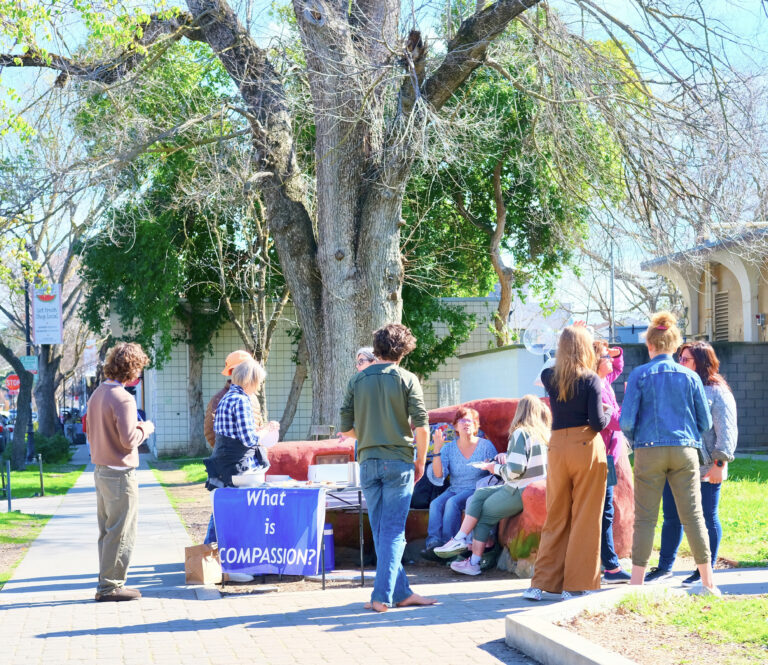
On Monday, Feb. 26, nearly 20 people shared Boston cream pie as they celebrated the 51st birthday of David Henry Breaux, also known as “The Compassion Guy.” The event, which was hosted by Maria Breaux, David’s older sister, was meant to celebrate his life and his vision of compassion for Davis. 

“Today’s event, to me, just means honoring, not only David’s birthday he would have been 51 today but also his message of compassion,” Maria said. “Knowing that he would have wanted us to be joyful today and not despair because of everything going on. He actually, after a while, wasn’t big on celebrating his birthday, but he was big on anything that reminded people of compassion, so that’s what this event is about.”

David was one of three victims of last year’s serial stabbings. He dedicated his life to finding an answer to one question: What is compassion? At the event, birthday balloons were placed behind the “Compassion Bench” where David would sit every day as he asked people for their definition of compassion.

Maria shared that Boston cream pie was her brother’s favorite dessert and that whenever she has it, she is reminded of him “instantly.” Growing up, the two of them didn’t eat healthy food often due to their environment. They discovered their love for the pie once they both were students at Stanford University.

“We both went to Stanford University and for us dorm food was actually a step up, like a huge step up from what we were having growing up,” Maria said. “When he was at Stanford, I visited him and his dorm, and we shared that love of [the] pie. When I think of it, I think of him. I think of coming together and doing something joyful together. I think of expressing love through giving away things to each other or sharing things with each other.”

Aly Tikka, a friend of David, woke up at 3:30 a.m. on Monday to drive four hours from Los Angeles to attend the birthday celebration. She’s currently staying with people she’s never met before who are other friends of David. These friends also hosted David in the past, as he was unhoused in Davis. 

“All of these people that knew David but didn’t know each other had now come together and now we all know and love each other,” Tikka said. “We support each other like a family.”

As an example, Tikka noted that someone she hadn’t known before offered to host her for an entire week “just because” she knew David.

Tikka described David as her “teacher.” She was a philosophy student in college and said that most of what she’s learned outside of the classroom was from him. 

Tikka’s best friend who went to UC Davis worked for a homeless shelter and was then introduced to David. According to Tikka, David was voluntarily unhoused and he had been offered housing many times before. 

 “[David’s friends] did offer him their spare room in Sacramento and David said ‘no,’ Tikka said. “David had many opportunities for free housing and he said no.”

Tikka said that this was because it brought him more peace to be outdoors in nature than indoors. She said that she didn’t understand this until recently when she lived in a Zen monastery for three months. 

Tikka has a background in Tibetan Buddhism. She said that compassion is the most important thing in this branch of Buddhism and is what caught her attention about David. 

“When I walked by, I saw a Stanford grad who gave up all of his possessions to be homeless and to ask about compassion all day, every day. It really reminded me of the holiest Tibetan monks I’ve ever met,” Tikka said. “That made me stop and start to ask him questions and then I realized that he was his own deal, but he was as profound as the wisest people I’ve ever met.”

Once Tikka moved to Los Angeles, she and David would call on Facebook Messenger every Thursday. She said David was a man of his word and that he was “on time with everything.” 

“One day he just didn’t show up and obviously I knew that he was unhoused and it’s really rough being on the streets,” Tikka said. “So my mind jumped to his phone dying […] it was just highly unusual for David to not show up. Then the next day, I was scrolling through Facebook, and then I saw the news that he was slain in Central Park.” 

Vice Mayor Bapu Vaitla attended the event and discussed the responsibility he felt for what happened last spring. 

“In David’s case, perhaps if we’d been able to provide the kind of housing that he wanted, [it] wouldn’t have happened,” Vaitla said. “Perhaps if we [hadn’t] failed [in] mental health gaps, this wouldn’t have happened”

When asked, Maria said that it wasn’t until her brother passed that she fully understood the extent of the people he impacted.

“He never indicated,” she said. ”He didn’t keep it a secret, but he did not brag. He was not self-serving. […] So, since his passing, I’ve again been blown away by the impact that he had on tens of thousands of people.”

Maria continued about the grieving process she’s been through over the last year. 

“Now I understand the words ‘I never thought this would happen to me,’” she said. “Just kind of sitting with that, and letting whatever motions happen, happen and not feeling ashamed of them and knowing that it’s going to be a process and it’s going to take some time.”

Tikka does not remember what she told David when he asked her “What is compassion?” However, she said that his definition of compassion changed her life. David’s definition of compassion was, “recognizing unconditional love,” according to Tikka. Maria also shared her definition of compassion.

“Compassion, to me, means putting yourself in someone else’s shoes and understanding their story, and not having snap judgments that don’t do justice to who they are at their core,” Maria said.

She shared how people can honor her brother’s legacy of compassion.

“We can honor David’s legacy by trying to live as compassionately as possible,” Maria said. “You know, we have days [where] that’s harder to do and we have our blinders on. We have our own pain [and] our own experiences that we’re contending with, but that would be my message. Try to live as compassionately as you can.”


Written by: Chris Ponce — city@theaggie.org


Yolo County to host Women’s History Month celebration on March 2

This year’s theme will be “Women Who Advocate for Equity, Diversity, and Inclusion”


By KATELIN PANG — city@theaggie.org


In a Yolo County press release on Feb. 14, it was announced that the annual Yolo County Women’s History Month celebration will take place on Saturday, March 2. The celebration will be hosted in Woodland at the Gibson House property at 512 Gibson Rd. and will be from 10:30 a.m. to 1 p.m. 

The 34th Yolo County Women’s History Month celebration is open to the public and free of charge offering a variety of different speeches and speakers from all over the county, giving women an opportunity to connect with those who are honored in the community.

According to the announcement, the Yolo County Women’s History Month Committee (YCWHM) also introduced this year’s theme, “Women Who Advocate for Equity, Diversity, and Inclusion.” 

Speakers include Tessa Smith and Dr. Dawnte Early. Both women are strong leaders in their communities for influential progress toward issues of race, inclusion and equal opportunity within businesses and legislative bodies.

Smith, the Yolo County Health and Human Services Agency’s Diversity, Equity and Inclusion Coordinator, has advocated to raise awareness of racial disparity within criminal justice, government assistance and health.

“[Smith] has worked as Chair of the Yolo County Multi-Cultural Community Council (MCCC), a group that advises the District Attorney’s office on community and race issues,” the press release reads.

Early is a West Sacramento City Councilmember and CEO of United Way California Capital Region. She helps lead engagement within her community to create a strong need for gender equality. She is also an active leader in the Department of Health in Yolo County.

Before United Way, she was a leader at the Department of Public Health and the Mental Health Services Oversight and Accountability Commission,” the Yolo County Women’s History Month Committee website reads.

As for the Davis community, Jenny Tan, the director for community Engagement in Davis, said the city of Davis does not currently have anything planned for Women’s History Month.

We do not have anything planned for Women’s Day on March 8,” Tan said. “We may do a social media post.”

Tan also said that she plans to take celebratory photos of the staff and that more than half of city leadership in Davis are women.

“The post will go up on March 8. I’m hoping to have two photos, one of women staff at the city and another of the women department heads. More than half of the leadership at the city of Davis are women.”

The Yolo County Women’s History Month Committee is a non-profit organization that annually plans this event to showcase women’s successes and to applaud those serving their community. Many community members appreciate bringing friends, family and women of importance to this event every year. 

“I have attended the luncheons for several years,” Jim Brewer, a past event attendee, said. “My mother, though she did not have the opportunity to attend college, was an independent woman who was very interested in the history and culture of her family and her community. It is encouraging to see that spirit continue, not only in the women of my family but also in our Yolo County community.” 


Written by: Katelin Pang — city@theaggie.org

Review: ‘Avatar: The Last Airbender’ remains phenomenal 19 years later

Here’s how one of Nickelodeon’s most successful shows has stayed beloved and critically acclaimed in the public eye


By NATALIE SALTER — arts@theaggie.org


On Feb. 21, 2005, children’s television channel Nickelodeon aired the pilot episode of what would become one of their most critically acclaimed shows and prompt multiple live-action adaptations, a string of comic books and an entire animated sequel to continue the universe. 

“Avatar: The Last Airbender” captivated audiences upon its initial release and still receives immense praise and recognition nearly 20 years later. 

It became apparent that “Avatar” was something more than children’s entertainment: it had a universe rich in fascinating characters and moving story arcs that continue to hold up in the eye of critical analysis decades later.

The series is set in a universe where certain individuals are born with the ability to manipulate and wield an element: fire, water, earth and air. The show’s titular character is Aang, an airbender who is also the newest reincarnation of the Avatar, a powerful entity capable of wielding all four elements who is reborn into a new body after the previous incarnation dies. 

After being frozen in ice for a century, Aang discovers that he is the last surviving airbender, with his people being wiped out in a devastating genocide carried out by the war-mongering Fire Nation in their campaign to imperialize the other kingdoms. The Avatar’s responsibility is to promote and maintain peace between the nations, and thus Aang is left to shoulder the responsibility of stopping the Fire Nation’s 100-year conquest and unite the four elements once more.

This barely touches the surface of the show’s complex and fascinating worldbuilding and storytelling, which deftly deals with themes of imperialism, genocide, environmentalism, parental abuse and the costs of war in ways that are understandable to both young and experienced audiences. Despite the terrible conflicts that Aang and his friends witness and become caught in, the story repeatedly shows audiences that there is love and hope to be found in even the darkest of times. The love each character wields throughout the series reveals that their love is a stronger power against the hatred of war than any weapon or bending power. 

Furthermore, the story is applicable to one’s real-life experiences. Part of the show’s rewatchability lies in the fact that when you feel lost or scared of what the world is becoming, “Avatar” can remind you that you always have the ability to change your life by choosing to do good despite the odds stacked against you. 

The characters of “Avatar” are equally complex, crafted with strong personalities, nuanced motivations and emotions that resonate with viewers no matter how many times they have seen the show. For example, the dynamic between Sokka and Katara, siblings from the Southern Water Tribe, extends beyond brother-sister banter. Sokka’s stubborn desire to lead and toxic ideals of masculinity combined with Katara’s overly motherly tendencies and high maturity for a girl in her early teens are not just traits placed onto the characters to elicit comedic arguments: they are indicators of the deeper natures of each character. 

The loss of their mother and separation from their father are explored thoughtfully as nuanced experiences that affect their personalities and decisions. Furthermore, the siblings’ arcs give them realistic places to grow and mature. This extends out to the other members of the cast of characters too. 

For example, the exiled prince of the Fire Nation, Zuko, has received massive critical acclaim for his arc of self-discovery, progressing from villain to hero whilst liberating himself from the pain and abuse of his past. “Avatar” devotes itself to not only having well-written characters, but developing them in emotionally moving ways that encourage the audience to look inward and find ways to heal and grow in order to make the world a better place. 

Of course, as a show geared toward younger audiences, “Avatar” has plenty of lighthearted material to enjoy. The show’s playful sense of humor, endearing character dynamics, themes of found family and adorable animal sidekicks make it as much a comfort show as an excellent piece of storytelling. It’s easy to fall in love with the show’s beautiful scenery and relaxing music, and it often feels like a warm hug to curl up and watch the heroes joke around and explore the world together. 

“Avatar” brilliantly balances phenomenal writing and character development with the warmth and peacefulness of any true comfort series. If you want to feel at ease, study fascinating characters or see stunning worldbuilding matched with engaging storytelling, “Avatar” is there for you — and 19 years later, it delivers in every category just as perfectly as ever.


Written by: Natalie Salter—arts@theaggie.org

Tell your ASUCD representatives how to best represent you

From Lawntopia to divestment bills, the student body can directly impact where their student fees go 


By THE EDITORIAL BOARD


Every Thursday night at 6:10 p.m., the ASUCD Senate and other elected officials gather on the third floor of Memorial Union to make decisions representative of the wants and needs of the student body. Despite this, these meetings are typically a ghost town. Aside from the required attendance of ASUCD officials and the obligatory presence of a reporter from The Aggie, it’s not often that students show up to a Senate meeting, and it’s even more unlikely that they stay the whole time. 

We don’t entirely blame you — with an agenda that severely underestimates the amount of time that it takes to discuss a single topic, these meetings can sometimes last as long as seven hours. Even further, there is no accessible place to find these agendas which outline the topics that the Senate will be deliberating at each meeting ahead of time.

However, these last few weeks have shown us why wider student engagement at the Senate meeting actually works, and we need to keep this momentum going.

For example, SB #41, which allocates $469,075.63 from the ASUCD General Reserves to the Entertainment Council (EC) to go toward the 2024 Lawntopia concert, passed 9-4-1 (Yes-Abstain-No) at the Feb. 8 Senate meeting. This bill was controversial: Many senators originally felt that nearly half a million dollars from the reserves was too much to put toward a concert that can only host 15% of the student population. Other senators argued that this amount was needed to make a successful Lawntopia happen amidst the EC budget being reduced by over $150,000 for this academic year.

Regardless of the Editorial Board’s opinions on this piece of legislation, the bill’s widespread and productive dialogue serves as an excellent example of the power that the student voice holds. Once Senators Binh Do and Jonathan Kang made an Instagram post — which received over 900 likes — encouraging students to attend the Senate meeting in support of the bill, a large sea of students showed up and shared their various opinions on the topic during the public comment period. While the Senate held split opinions on the bill, it was the strong attendance of individuals in support that pushed them to vote in favor of what the students wanted. 

Another recent bill, SB #52, implements an ASUCD-wide boycott and divestment from Israel and corporations “complicit in human rights violations against Palestinians in Gaza.” This bill passed 12-1-1 (Yes-Abstain-No) at the Feb. 15 Senate meeting. Prior to the meeting, UC Davis Students for Justice in Palestine (SJP) made an Instagram post that also encouraged students to attend and speak in support of the bill. When the meeting started, hundreds of students came and voiced their opinions, leading to nearly six hours of debate before the piece of legislation was passed. Once again, the Senate table’s votes toward the bill reflected the majority opinion of students who voiced their support at the meeting, determined to get it passed.

Showing your face and presenting your opinion on something that you care about forces the Senate to listen. We recognize that these meetings are long and tedious, but being present during the deliberation of a bill or topic important to you both better informs the Senate and holds them accountable for the campaign promises they made to get elected. Every Senate meeting has a public comment section during which students and community members are allowed to raise objections or express support for agenda items. 

It’s also a two-way street: The Senate needs to be better at publicizing when they will be making certain decisions and how students can let their perspectives be known. When student organizations publicize relevant Senate legislation prior to meetings, it often increases turnout significantly — but they shouldn’t be the only ones putting work into making Senate agenda items known. 

SB #41 and #52 both involve a lot of money and impact a ton of students, but where is the publicity for other pieces of legislation? Every bill, big or small, affects a number of students, whether or not they know it exists.

Why are the Senate agendas impossible to find? The ASUCD Government website has been down for months, and aside from the bill regarding Lawntopia, senators rarely ever post about legislation prior to it being deliberated on during a meeting. Students can’t show up if they don’t know where to look for this important information. 

Why is the ASUCD roster not available online? And why is the ASUCD roster that is currently linked to the ASUCD Senate Instagram from the 2021-2022 academic year? (It’s 2024.) Students can’t reach out to their senators if there’s no accessible way to find out who they are in the first place.

With the goal of making this information easier to navigate, the Editorial Board has decided to start posting the Senate’s weekly agendas prior to each meeting on The Aggie’s Instagram page (Although we can’t control how far ahead of time the agenda is shared with us).  

If you can’t make the Senate meetings, here are some other ways that you can make your voice heard within ASUCD:

  • Because it’s so hard to find, let us remind you who the current senators are: Chasa Monica, Gabriel Gaysinsky, Jacob Klein, Dani Antonio, Curtis Chen, Trinity Chow, Jonathan Ng, Binh Do, Katia Bouali, Yara Kaadan, Nur Ambaw, Leah Jung. Each has an Instagram account dedicated to promoting what they do as senators. 
  • Talk to a senator during their office hours. Most senators publicize the times and places that they hold their office hours on their Instagram page.
  • Fill out the ASUCD Senate Public Comment Form if you cannot attend the meetings but still have opinions that you would like to see voiced there. Submit your comment before each Senate meeting and it will be read out loud during the public comment portion. The link to this form can be found on each Senate agenda.
  • Join the Senate meeting via Zoom if you can’t join in person. You can still participate in public comment this way. The Zoom link is always the same and can also be found on each Senate agenda. 


Written by: The Editorial Board

First Japanese hot pot restaurant in Davis set to open in March

Shabu Shack, an Elk Grove-based hot pot franchise, is set to open in the Davis Commons


By HANNAH SCHRADER city@theaggie.org


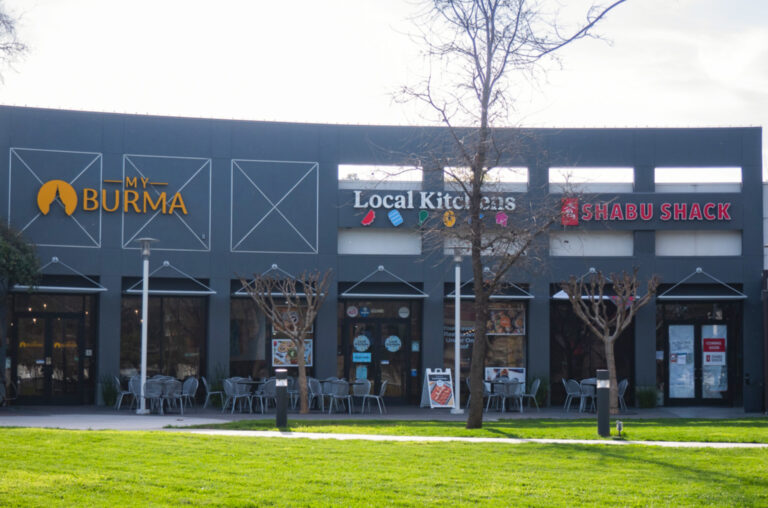
Shabu Shack is a family-owned business that originally started in San Jose when the Quang family purchased the first hot pot location — where Richard Quang’s wife worked. The business is now set to join the Davis Commons by March 10.

Quang, the co-owner of Shabu Shack, spoke about how the restaurant came to be.

“My [now] wife was working at a Japanese hot pot restaurant,” Quang said. “And the opportunity came about where she was able to purchase the location that she was working at from the previous owners. So […] we rebranded it to what is now called Shabu Shack today.”

The business has grown to include locations in Elk Grove, San Francisco, Sacramento and now Davis. Quang then spoke about their decision to bring a Shabu Shack location to Davis.

“[The Davis location is] owned and operated by two gentlemen that are native to Sacramento,” Quang said. “When they were looking at the market, trying to see where they could expand and bring Japanese hot pot to, they realized that Davis didn’t actually have a Japanese hot pot […] It just happened to be that the Davis Commons had a spot open for them.”

The owners of the Davis Shabu Shack location commented on their favorite menu items.

“Our favorite items on the menu have to be the beef belly toro or American wagyu dishes, because they are sourced fresh and cut to order,” the owners said. “[Shabu Shack is] also the only hot pot with a spicy Sichuan soup base, which makes it super unique for [spice] lovers.”

Nickolar Saldivar, Shabu Shack’s real estate broker, talked about the process of establishing the Davis location.

“This was a full build-out, so we’re not talking a second-generation restaurant,” Saldivar said. “So it took a little time because [the owners] had to go through planning and submit their permits.”

Saldivar spoke about his excitement for Shabu Shack coming to Davis.

“From portion to cost and everything else, you know, I’m just really happy for Davis to be able to have that [hot pot] experience,” Saldivar said. “And Shabu Shack does a really great job at it.”

When asked about Quang’s long-term goals for Shabu Shack, he discussed possibly expanding further.

“[For] the company-wide [goals] for Shabu Shack as a whole, we’d love to continue to expand and bring the concept into new communities,” Quang said. “Assuming, you know, we continue to be successful.”


Written by: Hannah Schrader city@theaggie.org

UC Davis Athletics initiative celebrates Black Futures Month

The transition from Black history to Black Futures is a nod toward present prosperity


By MI’ZAUNI REESE — sports@theaggie.org


In the U.S., the month of February is not only a time for reflection but also gratification for the Black community. As we acknowledge the historical contributions made by some of the most resilient people in our society, we also look forward to Black prosperity and advancement. 

Terms such as Diversity, Equity, and Inclusion (DEI) and Black Excellence have been introduced to curricula of both primary and higher education as our country progresses toward more equitable representation. Additionally, these terms highlight not only the importance of Black people in America but their success as well. 

Since Black History Month’s founding in 1976 by Carter G. Woodson, the month has become recognized across the country, including in the sports community. February was chosen to include the birthdays of two very important individuals who had a hand in shaping Black history, specifically President Abraham Lincoln and Fredrick Douglas. President Lincoln, whose birthday is Feb. 12, created the Emancipation Proclamation that emancipated all slaves in 1863, and Feb. 14 marks the birthday of Fredrick Douglas, the leader of the abolitionist movement.  

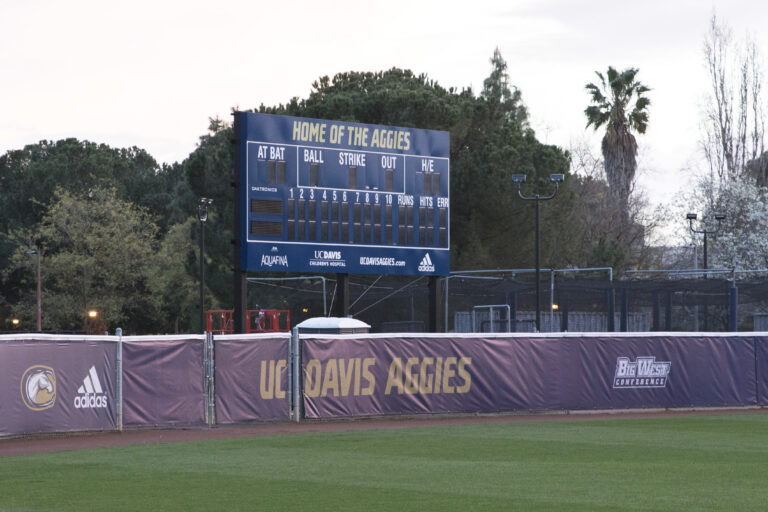
The UC Davis athletics department has decided to input its own efforts of equity and inclusion by honoring Black Futures Month rather than Black History Month. This transition is not to disregard Black history’s impact, existence or significance, but rather to uplift, emphasize and push Black stories of success and longevity in America.

As the initiative is through the athletics department, there have been multiple posts, articles and interviews with Black athletes on campus. One Instagram post highlights women’s basketball star, Bria Shine, a third-year neurobiology, physiology and behavior major and member of the revitalist Alpha Kappa Alpha (AKA) sorority chapter here at UC Davis. 

When asked “What does the term ‘Black Excellence Month’ mean to you and your lived experience?” Shine elaborated upon this idea and discussed the hardships Black people have faced, as well as the degree to which she must work to achieve the same as her non-Black counterparts. 

“I will always be unapologetically Black and celebrate my heritage by carrying my ancestors legacy, remembering the struggle and continuing to remain steadfast for the future,” she said.

As stated on a UC Davis campus flyer promoting the campus-wide change, “February marks Black Futures Month. A collective envisioning of the path for Black life at UC Davis and beyond.” 

The statement goes on to remind readers that this is still a time for remembering and celebrating history, but also for looking forward to current recognition as well.

As said on the flyer, “[February is] an opportunity to recognize the global marginalization of blackness and strive internally to elevate marginalized identities within communities for genuine liberation.” 

This statement about the existence of Blackness among Americans adds a positive appreciation for the community in America as it stands currently is entirely necessary.

In efforts to feature Black life and community more this month, numerous events have been and will be hosted up until the end of the month. With 18 events planned in total, there is something for everyone to enjoy. There are more casual fun events such as R&B Paint Night and BlerdOut: Murder Mystery Night. On the other hand, there are more informative events such as the Black History, Freedom, and Love Master Class. 

No effort has been spared to give Black experiences to the UC Davis community as guest speakers, professional musicians and physicians visit the UCD campus to spread awareness, information and overall joy during this month of remembrance. The conversations pushed this month have been progressive and beneficial for all students here at UC Davis, especially incorporating Black athletes.

With the support of UC Davis athletics and other institutions, Black students can continue to celebrate their past, present and future.


Written by: Mi’Zauni Reese — sports@theaggie.org

What’s in your water?

Where Davis water comes from, and how to ensure it is safe to drink 


By MAYA KORNYEYEVA — mkornyeyeva@ucdavis.edu


Do you know where your water comes from?

I asked around with this question, curious to see the breadth of knowledge that my peers, friends and UC Davis students in general have about our drinking water. In response, I received a lot of shrugs and some contemplation-filled pauses. A few responded with guesses: the Sacramento River, rain water, Putah Creek, to name a few.

While these guesses are not far off from the truth, it was surprising to see that so little was known about our drinking water. Seeing as water — which covers 71% of the planet and is one of the most abundant molecules on the Earth’s surface and within our cells — is crucial to our survival, not knowing what we are drinking and where it is coming from is quite concerning. 

To dive deep (pun intended) into the Yolo County and Central Valley water systems, our first stop along the way is, as many guessed, the Sacramento River. 

The Sacramento River runs approximately 384 miles, through the city of Sacramento and beyond. Daily, 10.2 million gallons of water are taken and processed by the Regional Water Treatment facility in Woodland to make up a significant portion (87%) of Davis city water. As the Sacramento River is categorized as “surface water” — water that is collected and trapped at the surface of the Earth — it can contain run-off sources of contamination like livestock and agricultural drainage, waste-water facilities, stormwater and urban runoff and watershed spills.

The second source that makes up the remaining 13% of the drinking water in the city of Davis is groundwater. “Groundwater” is a term used to describe water stored naturally beneath layers of soil and rock, which usually accumulates as a result of snowmelt or rain. Due to its underground location, groundwater is perceptible to naturally occurring contaminants like selenium and chromium, which are by-products of land use activities like agriculture. 

According to the Annual Davis Water Quality Report (2022), our water contains a number of things besides just clean, crisp H2O. While many of the harmful substances are removed during processing, they are only removed up to the Environmental Protection Agency’s (EPA) chemical limits. Some trace amounts still remain in the water even post-processing. The Water Quality Report lists five categories of potential contaminants to be aware of, including microbial, inorganic, pesticides and herbicides, organic chemicals and radioactive contaminants. 

After and during water processing, disinfectants are often used to remove these potential contaminants. A small amount of the disinfectant can get through to your drinking water. There’s no need for alarm, as the amount is substantially small; however, it is important to know what you may be drinking, besides just what we think of as “water.”

While the Davis water quality is up to standards, it is crucial to employ some at-home precautions. For instance, using a portable water filter such as a Brita is a key step to water safety. Filters often contain absorbents to remove lead and activated carbon to remove chlorine taste and odor, along with a fibrous matrix to remove small particles from your water. Moreover, they are reusable and filters can be replaced every few months to ensure your water is clean. 

Another step you can take is boiling your drinking water, which is especially effective after filtering. Boiling water kills bacteria, viruses, pathogens and other protozoa that may be present in the water. In short, boiling sterilizes the water by removing any microorganisms that could prove potentially harmful to humans. 

If anything, just make sure you are careful about where you are sourcing water from. Too many times I have watched students walk up to one of the water dispensers on campus, the filter status shining bright red, and refill their water bottles. A red filter status is most definitely not a good sign — this means that the water is “tap” quality, and isn’t going through any safety filters or through old, no longer functioning ones. 

Water is central to our health and well-being. Therefore, taking the extra effort to filter or boil your water, avoid drinking straight from the tap or from unfiltered stations and increase your knowledge about how water is processed in Davis can help protect you from ingesting potential contaminants. Who knows, maybe next time you see someone dangerously close to drinking from a red filter station, you can be a hero.


Written by: Maya Kornyeyeva — mkornyeyeva@ucdavis.edu


Disclaimer: The views and opinions expressed by individual columnists belong to the columnists alone and do not necessarily indicate the views and opinions held by The California Aggie.

How keychains and pins can be a representation of who we are and who we wish to be

UC Davis students express their identities through creative personalizations of their belongings


By LYNN CHEN — features@theaggie.org


An important aspect of being a young adult is self-expression. As humans, we often observe the world around us and seek to find ways to emphasize our identities to others.

One creative outlet for expressing who we are is through adorning our personal belongings. This may include pins, badges, keychains and an assortment of other ornaments on our backpacks, which are ever-present accessories at UC Davis.

Michelle Zhu, a second-year computer science major, is an avid decorator of her backpack.

“I really like pins from Disney, because my favorite films come from [the company],”  Zhu said.

For instance, Zhu has pins related to movies such as “Zootopia,” “Inside Out,” “Winnie the Pooh” and “Mickey Mouse.” She collected these memorabilia from the various Disney locations she has traveled to, including Shanghai Disneyland Park, California’s Disneyland Park, Florida’s Walt Disney World and Disneyland Paris, according to Zhu.

“I also have pins from places [that] I’ve visited, like Maui and Alaska, to remind me of the cool trips I’ve taken [before],” Zhu said. “I really like having pins on my backpack to express myself as a lover of traveling and all the Disney stuff I like.”

She also has keychains from places like Taiwan and Lisbon, further proof of her fondness for traveling. Additionally, Zhu mentioned the plethora of keychains she attaches to her backpack, many of which also have personal significance to her. 

“I have a giant ‘Among Us’ keychain — which is a joke among my sisters — and keychains I’ve made myself [using] friendship bracelet string[s],” Zhu said.

Furthermore, many of the ornaments on Zhu’s bag are gifts from friends and family. 

“[My close ones] all know how much I like my backpack and decorating it with cute keychains,” Zhu said.

Like Zhu, many others on campus also choose to add creative flairs to their personal belongings.

Mihini Jayasinghe, a third-year political science major, said that she believed expression of the self to be particularly important during the college years, emphasizing that college is a critical time for self-discovery.

“Creative individual expression allows [undergraduates] to realize who they are and explore parts of themselves that they might not have been able to prior to coming to college,” Jayasinghe said. “Now is definitely the time when everyone’s just trying to figure out who they are [and] what they’re passionate about.”

Phoebe Chu, a third-year sociology major, agreed with Jayasinghe’s sentiment. She noted that accessories can be a fun way for students to explore the person they wish to become.

“In college, we’re all trying to find out what career paths or future goals matter to us,” Chu said. “I see people showing their values and beliefs through keychains, pins on backpacks, as well as through stickers on their computers and water bottles.” 

She brought up the larger point that other than reflecting who you are, personal accessories and decorations on belongings can demonstrate one’s goals and aspirations for the future.

For instance, sustainably-made keychains can highlight a person’s journey to becoming a more environmentally friendly consumer. Political pins can illustrate a student’s values that they seek to live by. 

Self-expression through accessories is one popular way UC Davis students reflect their beliefs and passions. By conveying their identities through these key chains, badges and pins, students can learn to be comfortable in their own skin.


Written by: Lynn Chen — features@theaggie.org


Chris’ Culture Corner

The Art Desk’s weekly picks for movies, music and more


By CHRIS PONCE — arts@theaggie.org


Book: “On Earth We’re Briefly Gorgeous” by Ocean Vuong (2019)


Okay, I’m sure I’m not the first person to recommend this book to you, but I’m doing it anyway. “On Earth We’re Briefly Gorgeous” was the last memoir I read and it’s stuck with me ever since. Vuong is a poet, and his mastery of syntax and art is apparent on every page of the book. This memoir, unlike most traditional nonfiction works, is all one letter to Vuong’s mother who was illiterate. This heartbreaking story deals with several topics Vuong experienced throughout his life: his complicated relationship with his mother, his sexuality, his racial identity and trauma his family has experienced. Vuong does a beautiful job of explaining that he and his family shouldn’t be defined by the trauma they’ve lived through while still explaining the role it’s had in his life. This read is deeply personal and it’s worth all of its praise. You won’t regret picking this up on your next visit to the Avid Reader. 


TV Show: “My Adventures with Superman” prod. by Jake Wyatt (2023)


Sometimes, the media we consume doesn’t have to make us ponder the deepest questions of the universe. Sometimes, media can exist just to make us smile and that’s what “My Adventures with Superman” has done for me. Please don’t stop reading if you’re not a Superman or comic fan. This animated series is by far the most accurate portrayal of Superman that’s been made in years, and the show does this by staying simple. The show follows an early reporter, Clark Kent, as he begins working for the Daily Planet (we’re a newspaper, of course we love Superman). It’s a wholesome watch and great to throw on if you need a background show.


Movie: “Palm Springs” dir. by Max Barbakow (2020)


“Palm Springs” is one of my favorite romantic comedies and I’m surprised I haven’t written about it yet. In a genre that’s often bashed for its cheesiness and repetition, “Palm Springs” offers an original story with a unique setting for its love story. The film follows two characters, Nyles and Sarah, as they find themselves trapped in a time loop (yes, like “Groundhog Day”). As they live the same day over and over, rather than being terrified, the two begin to appreciate their new lives with each other. “Palm Springs” deals with questions such as our place in the universe, why our actions matter regardless of consequences and of course, love. On top of this, the movie is hilarious — what more is there to ask for? This is truly one of my comfort movies and I hope you have a similar experience as I did with it. While it’s no longer Valentine’s Day, it’s never the wrong time for a romcom. 

Album: “This Old Dog” by Mac DeMarco (2017)


This album is deeply personal to me, the way it portrays feelings of grief and letting go of someone couldn’t feel more accurate. “This Old Dog” is about DeMarco’s messy relationship with his absent father. Many of the songs also deal with his father’s death and the confusing situation that left him in. In the track “Watching Him Fade Away,” DeMarco dives into the struggle of watching someone you barely know pass away — in this case his father. This album, like most albums, is worth listening to in order to feel the journey of loss that is being told. Of all of DeMarco’s releases, “This Old Dog” has the most purpose and intention. For these reasons, and many personal ones, this is something worth listening to. 


Written by: Chris Ponce — arts@theaggie.org


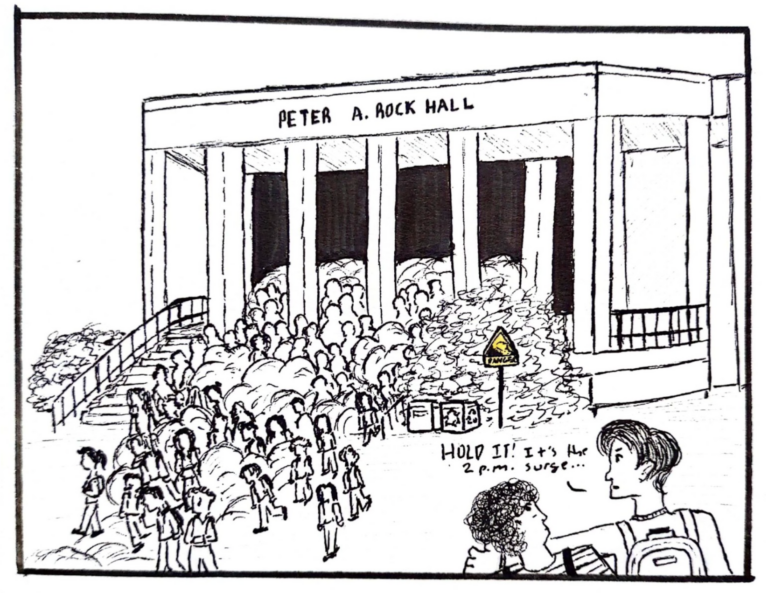
Bits of Davis: Rock avalanche

Drawn by: Nimra Farhan –– nfarhan@ucdavis.edu

Disclaimer: (This cartoon is humor and/or satire, and its content is purely fictional. The story and names of “sources” are fictionalized.)