

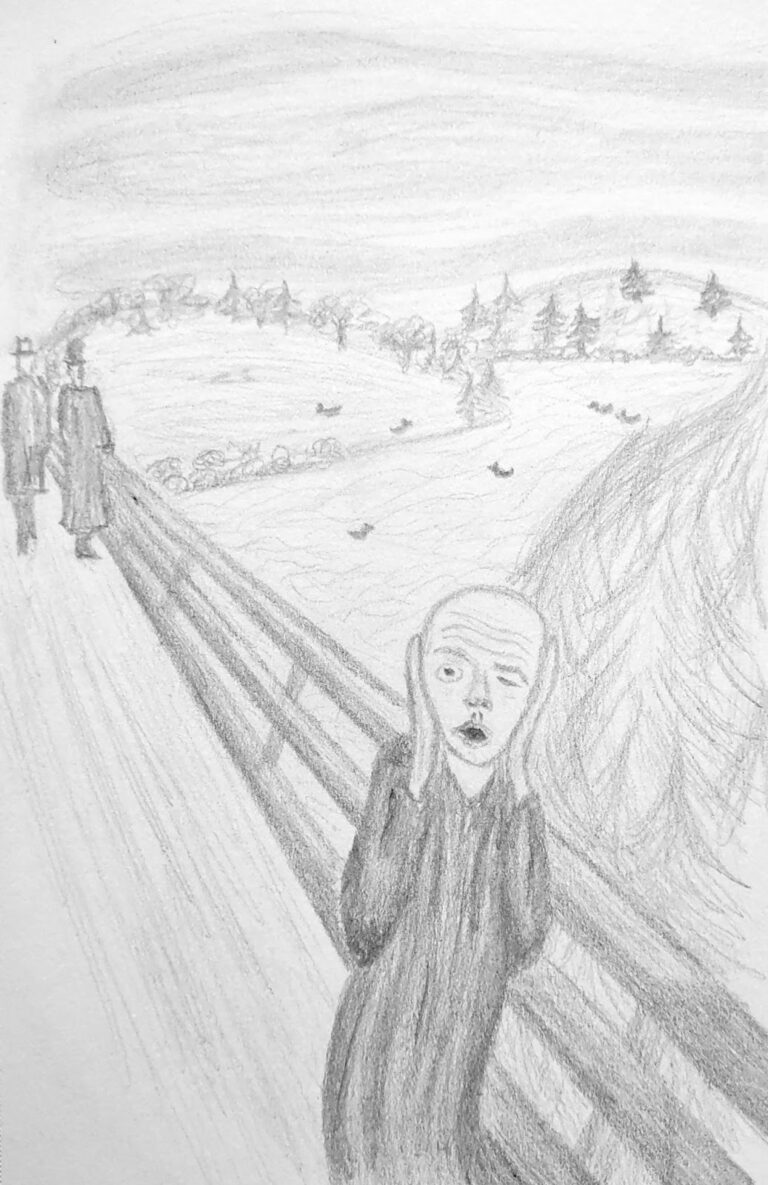
Original: “The Scream” by Edvard Munch
Drawn by: Nimra Farhan –– nfarhan@ucdavis.edu
Disclaimer: (This cartoon is humor and/or satire, and its content is purely fictional. The story and names of “sources” are fictionalized.)
Original: “The Scream” by Edvard Munch
Drawn by: Nimra Farhan –– nfarhan@ucdavis.edu
Disclaimer: (This cartoon is humor and/or satire, and its content is purely fictional. The story and names of “sources” are fictionalized.)

Drag brunches, dinners, cabarets and more in the Yolo-Solano-Sacramento area
By SAVANNAH BURGER—arts@theaggie.org
At a time in the world where almost everything seems hectic and negative, it’s important to be able to enjoy a respite from the stresses of daily life. Different forms of entertainment are one way we seek to decompress. Lucky for you, some of the most enthralling and hilarious forms of performance are just a short drive away.
For those who don’t know, drag shows feature professional performers called drag queens and kings, who crossdress to create a unique and dazzling caricature of gender. They often have extravagant outfits, amazing talents and unique, exaggerated makeup.
Drag events, which typically range from being open to all ages to adult-only admission, always have something to make you laugh until you fall over — be it through dance numbers, lip-syncing, stand-up comedy or endless other forms of one-of-a-kind performances. Drag shows are the home of queer freedom of expression that strive to put a smile on people’s faces.
On Saturday, Feb. 4, Solomon’s Vinyl Diner, located at 730 K St. in Sacramento, is hosting a drag brunch for patrons of all ages. The entry tickets are ten dollars, and the event is held sometime every month. Keep in mind that there are two shows on Feb. 4: one at 11 a.m. and another at 1 p.m. While you eat brunch, drag queens will weave in between tables, dancing, lip-syncing and singing. It’s extremely exciting and affordable entertainment to enjoy while having brunch with your friends or family.
If you go to Roscoe’s Bar and Burgers at 07 K St. in Sacramento, you can catch “The Velvet Revue: A Drag Cabaret Dinner Show” every Saturday at 7 p.m. This drag show, which has an entry cost of ten dollars, features a rotating cast of performers and is currently being hosted by drag queens Rose Rowzay, Khamiyah Punani, Elayna Roberts and Manni Peddi. The show is open to all ages and is the perfect entertainment to pair with dinner. Roscoe’s Bar and Burgers also has many other queer events, such as movie nights, “RuPaul’s Drag Race” viewing parties, karaoke and more.
Right in the heart of Old Sacramento, you can see the extravagant Illusions The Drag Queen Show” every Saturday and Sunday at 7 p.m. The event is 21 years and older and is located at 910 2nd St. in Sacramento. The show is a combination of comedy performances in a classic burlesque style along with a specialization in celebrity-impersonating drag queens. These queens impersonate some of the most iconic pop-culture figures in the queer community, among them being Cher, Beyoncé, Joan Rivers and Brittany Spears.
Looking for another brunch-time show? Drag brunch at The Hide-a-Way is a drag performance and brunch that spotlights local drag stars. It is happening on Sunday, Feb. 4 at 11 a.m. at The Hide-a-Way Lounge & Grill, located at 1080 Orange Drive in Vacaville. The event is 21 years and older, and general admission is $17, with beverages and food being bought separately. It’s okay if you can’t make Feb. 4; The Hide-a-Way Lounge & Grill holds a drag brunch every month, along with having a myriad other drag shows that are regularly announced on their Instagram page.
There are also other opportunities to engage in open discussion with the performers if you want an insider’s perspective on drag culture. On Friday, Feb. 2, at 10 p.m., LoLGBT+, a queer, comedy performing arts group, is holding an all-ages drag queen discussion panel called “Say YAS! – A Drag Discussion Salon & Kiki!” This panel, which is hosted by drag queen Suzette Veneti, is going to be held at the STAB! Comedy Theater at 1710 Broadway in Sacramento. Tickets to the event are ten dollars and the discussion panel will return every month if you happen to miss one. Come for an entertaining night full of drag culture you may or may not have known about.
Last on this list, on Friday, Apr. 19, the Crest Theatre on 1013 K St. in Sacramento will be hosting legendary drag queen and winner of RuPaul’s Drag Race season six, Bianca Del Rio. The famous drag queen is stopping in Sacramento on her new world company tour of her stand-up comedy special “Dead Inside.” The comedy show is appropriate for all ages and is Del Rio’s sixth-ever worldwide tour. Her set will cover political correctness, pop culture and current events with a sassy and witty edge. Tickets start at $49.50.
If you find yourself looking for something new and exciting to engage with on your time off, drag shows are a fulfilling experience where positive queer freedom and experimentation are celebrated. Take the opportunity to celebrate them and keep this sect of queer culture alive.
Written by: Savannah Burger — arts@theaggie.org

The Undergraduate Womxn in Economics Society hosts speaker panels, socials and other career events for those of all genders
By LYNN CHEN — features@theaggie.org
Economics has historically been a male-dominated field at many colleges in the United States. In fact, only 37% of declared economics majors at UC Davis identify as women.
However, a particular organization was created on campus to help change this narrative.
The Undergraduate Womxn in Economics Society was created at UC Davis to encourage more diversity in the study of economics. The society was founded in 2018 by Anya Gibson and Leanna Friedrich of the Economics Advising Department.
Despite the name of the organization, all that is required for applicants is to be a declared economics major and to have a commitment to equal representation within the field.
The organization facilitates professor and alumni speaker events, social gatherings and other academic and professional development opportunities for students. These events are held to provide a network of support for all undergraduates in the field, especially since economics is such a broad and widely applicable subject.
“Economics is one of those disciplines that opens a lot of doors — it’s a toolbox to solve problems in the world,” Janine Wilson, associate professor in the economics department and faculty advisor for the Undergraduate Womxn in Economics Society, said.
As a result of being such an interdisciplinary major, students benefit greatly from the guidance this club provides in terms of navigating coursework and their career paths.
Megha Nagaram, a third-year economics major and student leader of the society, agreed that the club has helped her learn more about the major, its professors and its classes.
“I would even say, professionally, [the organization] opened my eyes to so many different careers in economics that I was not aware existed or that I didn’t really know what they looked like in practice,” Nagaram said. “The diversity of the guest speakers we’ve had really helped clarify that for me.”
Celine Narciso, a fourth-year economics major and general member of the club, contributed insight into choosing economics classes.
“[The club] helped with the kinds of classes I might want to take because guest speakers did talk about which classes were important for which jobs,” Narciso said.
Once students graduate, they face a plethora of options to pursue, whether that’s a job in the private sector, the public sector or in fields like the medical sciences or policy-making.
“Sometimes people don’t know where to start in terms of transitioning from college to career,” Wilson said. “Our hope is that the young people in the group can really see the opportunities and the variety of paths that are possible with a degree in economics.”
Nagaram shared a similar view regarding the intersection between economics and other career options.
“[The Undergraduate Womxn in Economics Society] really showed me that I could have a career in law and economics,” Nagaram said. “That’s exactly what I wanted.”
An important goal for the society is also to bridge the gap between students and professors.
For instance, every week the club hosts study halls for members in the economics department building. Faculty will often pop into these study sessions to tell students about new courses or opportunities in the major, according to Wilson.
“[This] gives students a place to be in the day-to-day of the department in a way that we haven’t had [occurring],” Wilson said.
What’s more, the society is a chance for students to form long-lasting bonds with their peers and to interact with colleagues they never would have otherwise met.
“[It’s] really cool and eye-opening [to] expose yourself to people who come from a different perspective,” Nagaram said. “I think [I was able to] meet some of my best friends in college through [the society]. I would [see] them at a meeting, and I would see them again in class later. It was just seeing that familiar face that I was able to open a door to friendship.”
Currently, the Undergraduate Womxn in Economics Society is heading in a new direction in terms of its goals for students.
“Community building has been so critical these last few years, and it seems to be good for our students,” Wilson said. “It seems to be a positive direction of the club: to focus more on being casual, social and [having] community-building events.”
Wilson also emphasized the important role that camaraderie plays in the club.
“The real value is the community of people that, you know, support you and whatever path you choose and want to be in study groups with you,” Wilson said. “This is the greatest value.”
Written by: Lynn Chen — features@theaggie.org

Aggies improve to 3-0 standings during the 2023-2024 season
By LUCIENNE BROOKER — sports@theaggie.org
The UC Davis gymnastics team continued their strong start to the season with two victories over Alaska Anchorage Seawolves on Jan. 19 and 21. A long but rewarding weekend for the Aggies, the team dominated against the Seawolves while boosting their season stats. The two wins extend their winning streak to three following a season-opening win over rivals Sacramento State.
The Aggies traveled all the way to Anchorage to face the Seawolves on their home turf. The Aggies had to brave harsh weather conditions as temperatures were in the negatives for their entire trip, with light snow on the side. Despite the intense weather, the Aggies touched down in Anchorage and immediately started to dominate in their first meet against the Seawolves.
Finishing with a total score of 195.125 points, the Aggies triumphed over the Seawolves’ mere score of 186.250 points. The Seawolves put up a good fight against the Davis team as this was their first meet of the season, however, the Aggies came prepared for the meet with numerous training hours and one prior meet that ultimately gave them the upper hand.
Starting out the competition on the bars, several Davis gymnasts set or tied their personal best scores. As one of the best performances of the meet, second-year landscape architect major, Amelia Moneymaker scored a team-high 9.850. Additionally, on the vault, junior neurobiology, physiology and behavior major Keanna Abraham set the standard with a stellar score of 9.850.
As the meet moved on to floor routines, Abraham again scored a 9.850, continuing to lead against the other team. The Aggies closed out the meet on the beam, and Abraham once again finished first, scoring 9.875. A truly dynamic athlete, Abraham sprang into action this meet and became one of the highest-scoring competitors of the meet. Similarly, Moneymaker also claimed a strong performance as she had the highest all-around score of the meet with a total of 39.025 points. Heading into their rest day, UC Davis was feeling confident after their win.
The Aggies and Seawolves faced off again two days later on Jan. 21 after a much-needed two-day rest. This time the SeaWolves were looking for revenge for their loss on Friday and came out fierce from the get-go. Nevertheless, it again was not enough to take the win away from the Aggies who came out on top. Both teams improved their overall scores, with Davis scoring 195.300 and Alaska Anchorage finishing with 191.050. Opening on the bars, first-year undecided major Ayumi Oshiro recorded a 9.825 for the team’s high score.
The vaulting event saw a tie between fourth-year design major Emma Otsu and third-year psychology major Megan Ray, who both scored a 9.800. Furthering her point show, Ray recorded another tie on floor as she and Moneymaker both scored a 9.850.
As the final event from the meet, the beam proved to be the best event of the day. Continuing with the Davis tying streak, Abraham and Oshiro tied for first with a score of 9.875. Excellent performances from the Aggie team led to their decisive victory, adding to their season consecutive winning streak. With a 38.700, Emma Otsu recorded the team-high for all-around score and the Aggies flew back to Davis in high spirits and ready for their next meet.
Next up, the Aggies will face off against Gustavus Adolphus College at the University Credit Union Center. The Gusties have lost their only meet of the season, so they’ll be looking to turn their luck around against the Aggies and prove to be tough competition. Nonetheless, the Aggies are still favored to win the meet on their home turf.
Written by: Lucienne Brooker — sports@theaggie.org
Are you having a hard time reading for pleasure? Here are some recommendations
By CLAIRE SCHAD — cfschad@ucdavis.edu
As a college student, developing an unhealthy relationship with reading is easy. Whether it is detailed research articles or seemingly never-ending textbooks, reading frequently becomes a task on my to-do list that needs to be checked off rather than a way to relax.
The significant amount of reading that is assigned weekly for my classes often makes it difficult to find the time and motivation to read for pleasure. Even though most of the texts I’m assigned are interesting and informative, the language used often requires a lot of effort to dissect. Working to understand the information while simultaneously trying to think about how it could be asked in a test question or essay prompt is far from relaxing.
Even though I feel better about myself when I take time to read for pleasure, I sometimes have a hard time doing it. When it comes time to relax before bed, I often find myself reaching for my phone or turning on the TV.
This was not the case when I was younger: I was obsessed with reading. I’d go through phases where I’d finish an entire book in a single day. As a college student, I find myself longing for my reading-obsessed middle-school self.
Last year, I worked to reignite my love of reading. It had been years since I actually read and finished a book that wasn’t assigned to me for a class. People also kept telling me that I must read more than I write if I ever want to become a better writer. So, given both the personal and professional benefits, I was determined to incorporate reading for pleasure into my routine.
The first step to rekindling my love for reading was picking out books that I felt excited about. For me, this ranged from heartbreaking memoirs to light, happy romance novels and everything in between. However, I knew I wanted to read things that were far removed from the topics I was studying in school. I felt that selecting these types of books would help me separate my academic reading and my free time reading, creating some sense of a work/life reading balance. So without further ado, here are a few books that helped me rekindle my love for reading.
“Tell Me Everything” by Minka Kelly
This fast-paced and inspiring memoir grabbed me from the first chapter. Telling her story of her rise to fame as a successful actress, Minka Kelly, who starred in NBC’s Friday Night Lights, details the many struggles and triumphs that have sculpted her life and career. As I made my way through this book I found myself enthralled by Kelly’s perseverance and positive mindset as she faced unthinkable obstacles while remaining determined to reach her goals. Kelly’s writing style makes you feel all her emotions through the page and by the end, I felt like I knew her as a close friend. After finishing this book in less than a week, I found myself searching for “books similar to ‘Tell Me Everything,’” but I have yet to find a memoir that is as captivating and inspiring.
“The Ballad of Songbirds and Snakes” by Suzanne Collins
What better way to channel your reading-obsessed middle-school self than to read the prequel to arguably the best dystopian series of all time? I’m not usually a fan of fantasy novels, but when I was younger, I couldn’t get enough of the dystopian genre. I read all The Hunger Games novels and definitely had a Hunger Games phase in middle school, so when The Ballad of Songbirds and Snakes came out in 2020, I picked it up right away. In full honesty, it did end up sitting on my bookshelf for three years before I actually finished it. However, once I finally started it last fall, I couldn’t get enough. Some books just make you feel a certain way and this book instantly transformed me into my middle school self, feeling the same excitement for reading as when I read The Hunger Games for the first time.
“Happy Place” by Emily Henry
A summer romance taking place in a coastal Maine cottage, what’s not to love? After reading the back cover of this book, I knew that it would be something I would enjoy. I am a sucker for a cute romance novel and with the backdrop of coastal New England, I couldn’t wait to dive in. However, this was more than a surface-level romance, Henry was able to develop the characters in a way that made me completely and totally invested in their lives and relationships. Once I finished this book, I quickly acquired a few of Henry’s other bestselling books and enjoyed them as well. With an interesting plot and minimal effort needed to read, these books helped me jump back into reading and readopt reading as a way to relax.
If you are also working to rekindle your long-lost love for reading, I encourage you to try some of these books. If none of these excite you think back on what excited you when you were younger, then look for similar, but maybe more mature books in the same genre. After all, that love for reading is still somewhere inside you, but you might have to work a bit to uncover it.
Written by: Claire Schad — cfschad@ucdavis.edu
Disclaimer: The views and opinions expressed by individual columnists belong to the columnists alone and do not necessarily indicate the views and opinions held by The California Aggie.

From taekwondo to tic tac toe
By MI’ZAUNI REESE — sports@theaggie.org
As a college with exceptional academics and numerous Division 1 (D1) sports, it is not hard to find athleticism everywhere on campus. Although UC Davis has a total of 25 D1 sports teams, these don’t even account for half of the sports offered at Davis.
With a total of forty registered club sports teams on campus, club sports at UC Davis surpass the D1 sports teams in membership, community and perhaps even individuality. From the more known basketball and volleyball to the unconventional taekwondo and alpine skiing, there are sports teams for everyone at UC Davis.
One of the more competitive, undiscovered club sports on campus is table tennis. While offering a space of leisure, community and friendly competition, the table tennis team has also become one of the best in the league. Headed by President Vi Pham, the team has competed in the National Collegiate Table Tennis Association (NCTTA) league for the past few years, going head-to-head against powerful schools such as Stanford, Sacramento State and UC Berkeley.
The UC Davis table tennis team also hosts bimonthly competitions for players to enjoy and test their skills.
“[Table tennis] tends to be competitive, but only if you are looking for competition. As a way of destressing for most members, the games tend to range from friendly matches to intense practicing in preparation for upcoming competitions,” Pham said. “The sport is more physical than you’d think: it is a great source of exercise as well as collaboration, with the team being open to all levels.”
As one of the more demanding sports teams on campus, the triathlon team has also grown a following on campus, with a dedicated coaching staff and an even more committed team. Led by their president, Bradley Manzo, the triathlon team is one of the longest-standing sports on campus, with over 20 years of establishment. As a method for self-improvement and challenging oneself for most members, Manzo and his team take pride in their sport with a wide range of member experience.
Additionally, the triathlon team has a skillful coach. With 20 years of experience at UC Davis, Head Coach John Hansen was a very distinguished athlete in his field and can be seen sharing his knowledge with his Aggie athletes.
The team also gets many opportunities to travel across the state and country for events. With such long travels, the team has formed strong bonds and holds each other accountable not only physically but academically. So, if any UC Davis student has a desire to step outside their comfort zone and try swimming, biking and running, why not give the triathlon team a try?
Another club sports team Aggies should give a try is the very welcoming fencing team. President Audreen Bandegen and his team do what they can to make a sport with a relatively elitist reputation accessible and open to people with all levels of experience. They ensure this inclusion and accessibility for all by making the dues very affordable and work hard to open up the sport to others in the community. The team spends a significant amount of time donating swords, fencing bags, blades and covers to many local Davis organizations.
With a large range of skill levels among team members, from never having tried fencing before to dominating the sport, the team is uplifting and supportive of all its members. And although the sport can feel very challenging at points, there is always more to learn and someone who will aid in teaching you. Thus, as Bandegan says, “The sport is fun — that’s what’s attractive — and who doesn’t wanna sword fight?”
On the other hand, for those who want to compete in a less physical capacity, there are many more mentally challenging club sports such as electronic sports, or esports. Although esports can just be fun video games to some, there are also competitive gaming events all over the country and even the world. With both local and out-of-state tournaments, esports offers an opportunity to feel a sense of community and support from being on a team.
President of Eports at UC Davis Jonathan Wang described the community as “a very close-knit community.”
As it is many of our member’s first time being on a team, so we take kinship very seriously.”
In addition to supporting first-time players, the esports team competes constantly, with two teams from the club going to the University of California Esports Initiative’s (UCEI) gaming tournament in LA earlier this year. Both teams, Overwatch and Valorant, did very well in their competition, placing in the top ten and bringing back recognition for the UC Davis esports team.
Besides playing your favorite games with like-minded gamers, the club offers opportunities to develop skills such as graphic design and PR marketing, making it one of the more lucrative club sports teams on campus.
With these just being four of 40 teams, it’s easy to see that club sports have something to offer for just about everyone regardless of interest or experience. It is no surprise that the community of club sports has grown to such an immense size, as they serve as welcoming communities as well as sources of healthy competition and self-improvement. If you find yourself interested in these clubs and want to find out more, the club sports website is a great resource to use and has basic information about each club. Remember, these opportunities are ours to take to get involved and stay happy and healthy, with a little fun on the side.
Written by: Mi’Zauni Reese — sports@theaggie.org

UC Davis students share their views on the recent TikTok trend
By ZOEY MORTAZAVI — features@theaggie.org
If you’re familiar with the constantly changing realm of TikTok trends, you’ve probably heard of one referred to as “girl math.” Essentially, girls have been posting videos justifying excessive spending, with captions saying that it’s “girl math,” or that it “doesn’t count.”
Predominantly, the trend displays women buying items that are worth, for example, 100 dollars, and using the logic that it technically costs 10 dollars a wear for 10 wears — therefore the purchase wasn’t actually 100 dollars. Other videos introduce ideas like “cash doesn’t count,” even saying that some of their purchases “pay themselves off” after a few uses.
UC Davis students discuss that funny trends can simply be just that, but sometimes, we need to ask ourselves the question: how far is too far? Jokes like these, even if they’re funny on a surface level, have the potential to harm those watching them, even if they don’t realize it.
“We’re sort of on the back-end of the whole ‘girlboss’ era where every female character in media was like a perfect badass who could do no wrong,” Natalie Canchola, third-year computer science major, said. “We’ve sort of left that behind and are now pushing that women don’t have to be perfect to be respected.”
Canchola continued on to describe the circular trajectory of women’s identity and self-worth.
“The ‘girl math’ trend, and other trends like that, arose from this kind of mindset, but are starting to go too far in the opposite direction and are reverting back to ‘all women are dumb’ kind of thinking, rather than ‘women are imperfect and that’s okay,’” Canchola said. “It’s fun to poke fun at ourselves but […] it can be subtly harmful, so it’s important to be mindful about what we say.”
There is definitely something satisfying about going to brunch with your friends and paying with cash; not seeing the dollar amount go down in your bank account is something that many appreciate. However, rather than considering cash as something that “isn’t real” or “doesn’t count,” consider reframing the narrative. Instead, think, “I made a responsible decision by using cash instead of my card today.”
The issue with this trend does not seem to lie within the jokes themselves but in the tendency to associate irresponsible financial decisions with girls. Why is it that, under the frame of this trend, a girl handling her finances suggests carelessness? Perhaps this trend shouldn’t have been named “girl math,” but instead reflected the sentiment that all people are capable of making irresponsible decisions with their money.
“‘Girl math’ is something that is fun to joke about to a certain extent, but I feel like there is a point where it goes past just a gag about some girl’s spending habits,” Olivia Patsch, first-year animal science major, said.
Patsch also said “girl math” perpetuates negative stereotypes about women.
“The patriarchal roots underlying the trend can be seen in the fact that bad spending is immediately associated with being a girl, […] perpetuating the myth that women are bad with money, alongside deeper themes about the incompetence women have within many fields,” Patsch said. “The idea that women aren’t able to handle money and are insufficient spenders isn’t something that women should have to prove wrong.”
TikTok trends centered around “girl habits” have dwindled in popularity over the last several months. It began with a trend called “girl dinner,” where people would post videos of various assortments of snacks, drinks and even objects — rather than a full meal — joking that the items in front of them were a substitute for their dinner.
This trend was followed by many variations of the same sentiment, displaying girls making less-than-ideal choices and justifying them by saying that they’re “just girls.” Soon, “girl math,” was born from the mentality that initially sparked these trends.
Despite the issues that seem to stem from these kinds of videos, particularly the association of irresponsibility with girls, the videos were not created to belittle girls or women and their decision-making skills.
There is definitely a way that these videos can be appreciated as well as critiqued, according to many young women at UC Davis.
“These ‘girl’ phrases demonstrate a freedom from what is proper and what is expected while also encouraging a sense of girlhood as sisterhood, which is rare to come by,” Thalia Miracle, a third-year biological systems engineering major, said. “Of course, these ideas can be misconstrued. What started as a lighthearted explanation as to how many rationalize minor choices or spending can be tied back to [the] generations-old discrediting of women from serious academic, financial and critical comprehension.”
These trends, which seemed to begin as a harmless stream of jokes about the tendencies of young women everywhere, may have taken a step too far. It seems important to remember the difference between common human error and blaming the occasional lapse in judgment on the fact that you’re a girl. It should go without saying that women are fully capable of being financially literate and responsible.
These trends, while funny in moderation, should not become normalized at the expense of women’s intelligence.
Written by: Zoey Mortazavi — features@theaggie.org
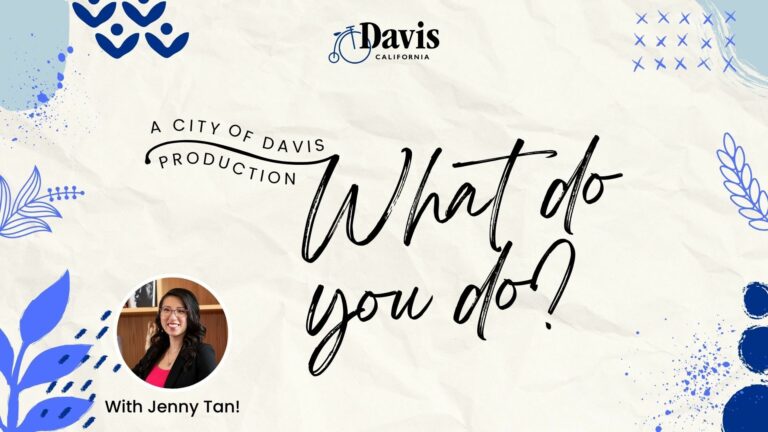
The series hopes to shine light on the work city staff does for the community
By KATELIN PANG — city@theaggie.org
On Jan. 9, the city of Davis’s Facebook page posted a teaser for their new series released at the end of January called, “What Do You Do?”
These videos should be posted biweekly, each being about five to six minutes long. These posts would be telling a day in the life of different city of Davis employees. This would entail an interview with the guest employee and a step-by-step process of their day and what their jobs require of them.
The city of Davis production will have a host and interviewer, Jenny Tan. Tan works for the city and as the director of Community Engagement, she said her job allows her to work behind and in front of the scenes, gathering perspective on the inner workings of city departments.
Tan explained her goals for the channel are to address people’s confusion about local government and to allow the public to get to know their city employees.
“I want to give a face to government work and for the people of Davis to learn about some of the jobs that are available here,” Tan said. “But also the different things that we do when there is a lot of confusion between what the city of Davis does and what UC Davis does.”
She also emphasized that these interviews will be with everyday people such as people who fill potholes in the streets, engineers, front desk workers, people who work for the parks and unhoused people and positions people don’t necessarily think about.
Tan carries a lot of responsibilities herself such as running the city’s social media, press, interviews, surveys, graphics for communities, branding, public relations and even working with organizations like Hate-Free Together and Diversity, Equity and Inclusion (DEI).
“In the last year from 2022 to 2023, I increased our social media reach by almost 400%, with engagement being around 200%, and that really revolves around what our community wants to see and hear,” Tan said.
These posts will help keep positive interactions with the public and Tan also shared the importance of the Davis atmosphere.
“We have a really unique community that speaks up and speaks up often and so there are a lot of great interactions that I have with residents,” Tan said.
Tan said that she hopes to make two videos a month, and with there being six departments the majority of the videos will be city staff. But there will be a few special edition interviews with people from the community and organizations or even potentially UC Davis staff.
Rohit Mantramurti, a second-year history major at UC Davis, talked about how important it is to highlight unseen staff in the city.
“As a club organizer for Davis Revolutionary Student Union, I understand that a lot of the behind-the-scenes workers go unappreciated, but in reality, the club we work hard to build wouldn’t exist without them,” Mantramurti said.
Tan hopes this is educational for people in Davis but also a chance for people to see potential positions of interest and to encourage people to seek jobs within the city of Davis, or Yolo county government.
Saralynn Staub, a second-year biological science major, is also looking for internships and opportunities at Davis.
“I am super interested in city work and working for local organizations,” Staub said. So I think the channel will be a good way for students and community members to get a good look at possibilities for career options.”
Tan also shared a little about the first episode which drops on Jan. 29. She will include an introduction to the series explaining her idea and the first interview will be with someone high up in leadership.
“I think this will encourage more city staff to take an interest in the video, which will make staff more enthused to take part in the series,” Tan said.
The video will be streamed on the city YouTube channel, @cityofdaviscalif, along with a series playlist. Other ways to see what’s happening in the city of Davis are on Facebook, X and Instagram (@cityofdavis).
Written by: Katelin Pang — city@theaggie.org
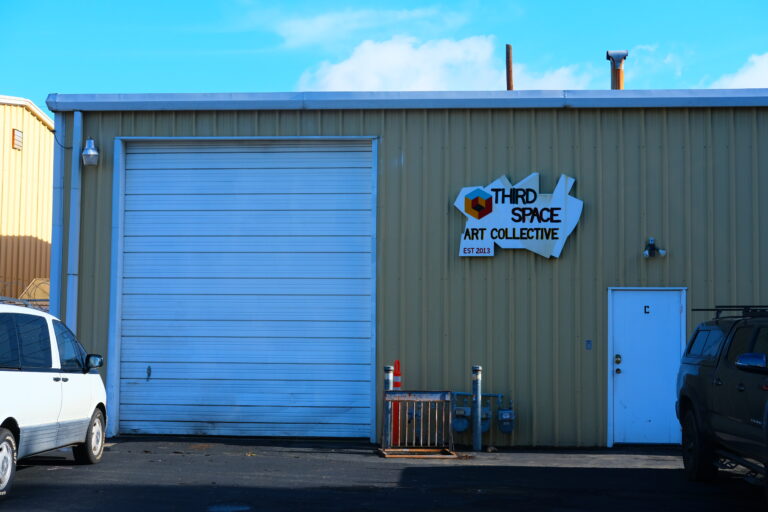
Board members discuss the evolution and purpose of the organization
By SAVANNAH ANNO — arts@theaggie.org
Before its founding in 2012, Third Space was a fantasy. A group of Davis artists dreamed up a place where community members could collaborate, create and engage with one another. There was a need for a space that could belong to a variety of creatives — musicians, photographers, painters, sculptors — and provide them with a community they could rely on.
“A big component of this being a collective is sort of showing up and pouring yourself into the space,” Board Member Sedona Patterson said. “There’s a lot of different ways to do that.”
Through the work of board members, volunteers and local artists, Third Space has maintained a warm, connection-driven environment for its visitors.
“I yearned for a way to be involved in spaces where I could be around other creative people,” Third Space President and Executive Director Jord Nelsen said. “When I stepped into Third Space it really reignited my creative self and turned my life around in a positive way.”
The collective underwent reconstruction in 2017 following the move to its current location off Arboretum Drive. Third Space now resides in a two-level warehouse with the ability to support resident artists, gallery shows, open studio hours and a music room. The collective has also shifted into being recognized as its own non-profit organization and received a grant from the City of Davis’ Art & Cultural Affairs Program.
Third Space hosts a wide array of gallery shows, sometimes put together by Board Member Jamie Angello and other times put together by outside community members. The gallery space can be rented out, or creatives are free to visit the space and bring their ideas for shows to the board. The most recent show debuted on Jan. 12, focusing on local artists’ works centered around the theme of Conflict and Adversity.
The best part: anyone can submit their work to Third Space’s open calls for artists. Once a theme is announced, the collective welcomes artists of all mediums and styles to interpret it in whatever way feels best to them.
“There are many, many creative people in our communities that want to have a chance to show their artwork, get feedback and be involved in a creative world, so part of our work is to provide an easier access to that process,” Nelsen said. “That’s kind of the main motivation: to be in a creative space that nurtures growth, involvement and a sense of place.”
The collective also recently scheduled open hours every Thursday from 4 p.m. to 8 p.m. in hopes of providing visitors with the chance to work in the presence of one another. The studio space is open to general members free of charge and non-members with a 5 dollar entrance fee.
“Something a lot of artists talk about and want is to be in community with other artists,” Patterson said. “It’s really nice that you can come here and work on your art around other people who are doing the same thing, it’s a good way to motivate yourself to keep creating.”
Open hours at the collective also mean that their free art supply pantry is available, providing camera film, paints, fabric, drawing tools, carving supplies, canvases and more to artists in need. Inspired by an art supply mutual aid training, Patterson pitched the pantry idea to Third Space just last year.
“I studied Art History and Fine Art at UC Davis — I graduated in 2022 — but I worked a part-time job all four years and was financially independent from my parents, so I know first-hand how expensive it can be to pay for all of your own art supplies,” Patterson said. “It’s expensive, but that doesn’t change the fact that art is an integral part of living.”
The pantry accepts both new and used donations, operating on the idea of artists helping other artists. Open every second and fourth Sunday of the month from 10:30 a.m. to 12 p.m., as well as during each Davis ArtAbout, anyone is welcome to visit and take what they need at no cost.
The collective is accepting volunteers, new general members and is open to anyone who wants to come and check out the space. By creating room for local artists to shine and providing materials and workspaces, the collective hopes more and more creatives will begin to visit. Third Space also looks forward to planning more interactive events for artists and community members in the future.
“I love the way the energy changes in the space,” Nelson said. “I’m here a lot alone, but when other people are here working, it’s interesting how it changes. There’s talking but also a lot of intense focus, and I just love that. That camaraderie is what feeds the creative class, and we can provide that to the community.”
Written by: Savannah Anno — arts@theaggie.org
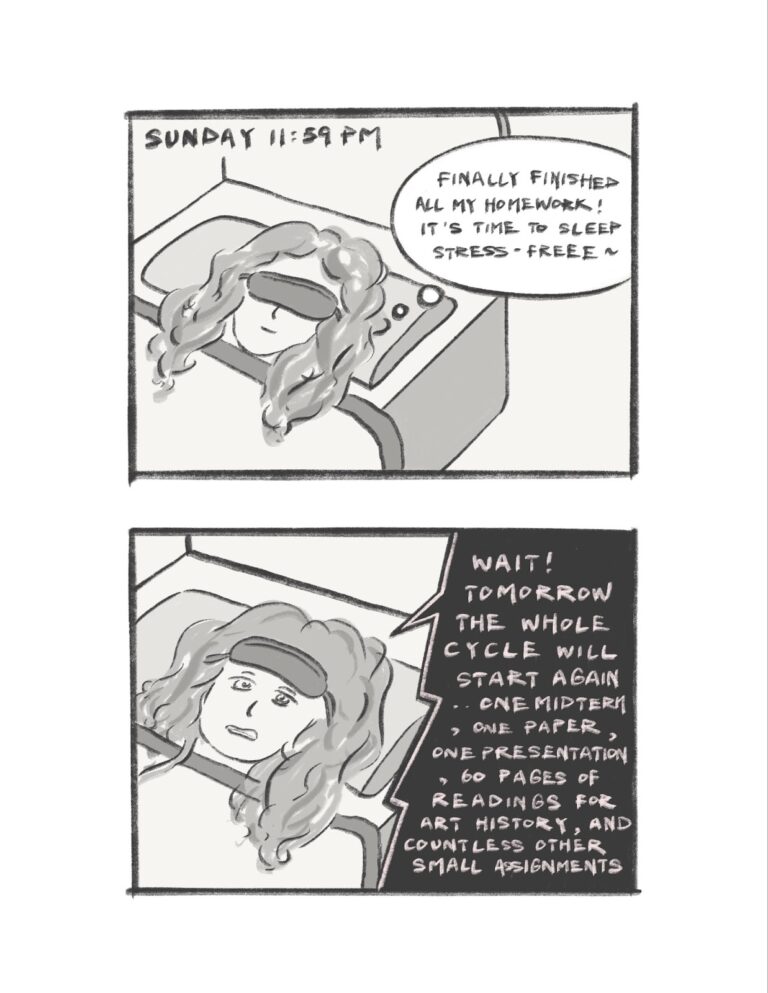
Drawn by: Lanhui Zhen –– lazhen@ucdavis.edu
Disclaimer: (This cartoon is humor and/or satire, and its content is purely fictional. The story and names of “sources” are fictionalized.)
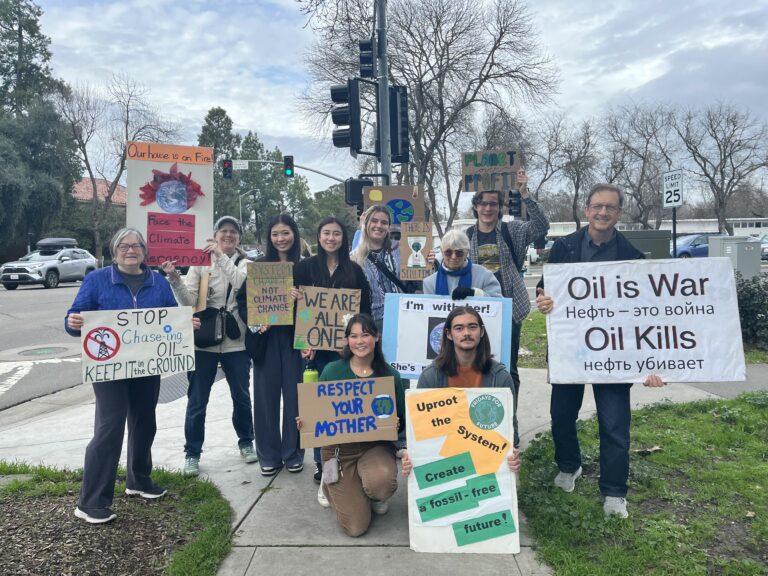
Members of the UC Davis Environmental Club joined other community organizations in downtown Davis to promote climate action
By RIVERS STOUT — campus@theaggie.org
On Jan. 26, a group of activists met on the intersection of 5th and B Street in Davis to raise attention toward climate action. The group included members of the UC Davis Environmental Club, representatives from the local Fridays for a Future and the Yolo Climate Emergency Coalition, as well as other community members.
“We’re trying to gather as much attention as possible,” Rae Bear, a third-year environmental policy major and president of Environmental Club, said. “That way [people] know we’re here, we do care [and] we’re trying to help.”
Fridays for a Future is a local club run by students of the Davis Senior High School, formed following Greta Thunberg’s 2018 protest of the Swedish parliament.
“I’m here every Friday because it makes me feel as though I can make a difference in my community,” Kai Leonard, a member of Fridays for a Future, said. “Every time I show up, I see a group of like-minded individuals, and I can protest with them on the corner every week, and it feels like I can make a difference.”
Other than club members, many older community members came in support of the youth-led strike.
“We’re not suggesting how they set their agenda, we’re here to support the agenda they set,” Scott Steward, a member of the Yolo Climate Emergency Coalition, said.
The agenda is to focus the community’s attention on climate action, in hopes of encouraging a desire to take action.
“I’m hoping for [people] to reflect; when cars pass by us, I hope they see the posters and change small things in their lives,” Leonard said.
Students at the protest expressed their thoughts on student activism, strongly supporting the work that needs to be done for climate action.
“I think [student activism] is very important,” Bear said. “As students, we have responsibilities. We’re at that age where we’re getting a lot of knowledge and information and we have energy to really do something and get involved. It’s really important that everyone steps up and does what needs to be done.”
The gathering of people held signs on the road, sometimes receiving acknowledgment via an occasional honk from drivers passing by.
“I’m here because we’re holding space and creating an opportunity to remind people that we’re in a climate crisis, while we try to rationalize continuing with the way we use our resources,” Steward said. “This is a community action that symbolizes and creates the narrative around Davis as being a place where climate action is a high priority, and more of our Davis fellows need to be a part of in a more effective and constructive way.”
The older community members continued to emphasize that they were not the focus, and instead that the students were, throughout the event.
“The youth are the next generation taking power in this world,” Leonard said. “We need people that understand the situation we’re in. I think the youth is a great way to start that.”
Stewart shared his closing thoughts on what the community of Davis must do to move forward and effectively aid in helping against the climate crisis.
“I think Davis stopped being as forward-thinking as it needs to be,” Steward said. “The [types] of building projects that they’re planning, the [types] of transportation preferences that they are incenting, the types of engagement with the school system in terms of environmental and social justice thinking needs to be elevated more.”
Written by: Rivers Stout — campus@theaggie.org
During the Davis City Council meeting, the council approved a motion to create a progression plan that will eventually ban gas-powered leaf blowers and small off-road engines
By HANNAH SCHRADER — city@theaggie.org
At the Davis City Council meeting on Jan. 16, the council unanimously approved the motion to create a transitory plan that eventually bans gasoline-powered leaf blowers and small off-road engines (SORE).
The leaf blower ban was initially brought before the city council in January of 2022 when council members decided not to move forward with a ban. Instead, the city continued to survey the use of gas-powered leaf blowers and research battery-power alternatives.
Adrienne Heinig, the deputy director of public works for the city of Davis, discussed a path forward for the city to move toward battery-powered leaf blowers while considering the possible difficulties.
“At this time, we are not recommending a full ban on gas-powered leaf blowers or other small off-road engine equipment because we do still need to be able to use this equipment where there is not a battery-powered facsimile,” Heinig said.
Heinig introduced the background of this agenda item, sharing that this conversation is in response to AB 1346, which restricts the sale of small off-road engines in California.
“Back in 2018 there was an introduction of AB 1346, which effectively bans the sale of new small off-road engines, also called SORE-powered equipment, in the state of California after 2024,” Heinig said. “So this does mean that equipment that was made in 2024 or after can only be sold in the state of California if it is battery powered.”
A study done by the Illinois Waste Management and Research Center found leaf blowers to be markedly harmful to our air quality, producing emissions comparable to 100,000 passenger cars annually.
Davis resident Tom Schmidt expressed concern about using gas-powered leaf blowers and believes the city needs to restrict these tools.
“I know a lot of cities in California have banned leaf blowers for many reasons,” Schmidt said. “I don’t think there’s a whole lot of research to do if we were to just get ahold of Berkeley [and] Orange California [who] outlawed leaf blowers when they first came out. They did a huge study about the particulates that they throw up in the air. The herbicides, the pesticides, the dog feces, everything that is supposed to land on the ground is now again back up in the air, and for somebody with emphysema, it is very difficult.”
Artem Lada, a researcher at UC Davis with a Ph.D. in cancer research, talked at the council meeting about the dangers of leaf blowers due to their carcinogenic emissions.
“Now we know very well from science that the exhaust of the leaf blowers contains so many carcinogens in such large quantities,” Lada said. “This is directly inducing cancer in the population and in animals [like] in pets. So I’m a scientist, I spend quite a bit of time looking at the genomes of cancer patients, and we now have the technology to see this course of the DNA […] of this patient from the very same chemicals exhausted from the gas-powered leaf blowers.”
Local Davis resident Alan Hirsch talked about the City of Davis’ lack of regard for the more harmful greenhouse-gas-emitting city projects.
“We should spend as much time on the one or two tons maybe of greenhouse gasses that come out the leaf blowers as out of the 72,000 tons of greenhouse gasses that come out of I-80,” Hirsch said. “We talk about the noise of leaf blowers, well, I can hear constantly — 24 hours a day — the freeway noise but there was no discussion of that at the approval meeting at the Yolo transportation district about it.”
Written by: Hannah Schrader — city@theaggie.org
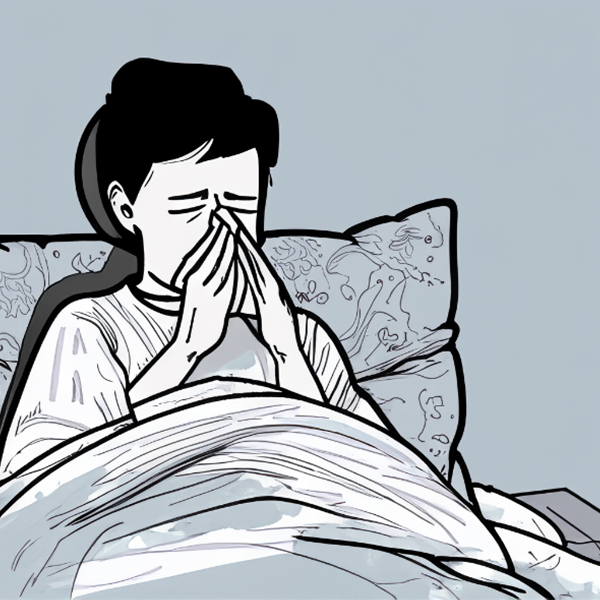
Students and the executive director at UC Davis’ Student Health and Counseling Services share their advice for the cold season
By SABRINA FIGUEROA— features@theaggie.org
Walking around the UC Davis campus, seeing masks and hearing people coughing and sneezing isn’t new during the winter quarter. But people are curious to know what is behind the amount of people getting sick at the same time.
“I think we’re just in that time of year where respiratory illnesses circulate,” Margaret Trout, executive director of the UC Davis Student Health and Counseling Services, said. “This is based on the fact that the winter season is responsible for the circulation of over 200 respiratory illnesses that all have cold-like symptoms, including the flu, RSV, rhinoviruses and now COVID-19.
Dr. Nahid Bhadelia, founding director of Boston University’s Center for Emerging Infectious Diseases Policy and Research, offers another logical explanation for the rise of respiratory illnesses this season. She stated that the severity of the viruses has not changed, but that the precautions taken during the pandemic slowed the spread of COVID as well as all other respiratory illnesses.
Adding onto this explanation, immunity to common cold-causing viruses doesn’t last long if exposure is halted. “If your immunity dates back to strains that were in circulation three or four years ago, you’re needing to pay [that] back,” Dr. Luis Ostrosky, chief of infectious diseases and epidemiology at UTHealth Houston and Memorial Hermann, said. Once the body relearns how to build the antibodies, it will recover much faster with milder symptoms if exposed to the virus again.
Although there seems to be a large number of people in the Davis community getting sick, according to wastewater data in Yolo County, it’s up to state and local governments, as well as the individual, to protect themselves and others.
“We really want you to support your immune system in all sorts of ways which includes getting enough sleep, eating a nutritious diet and doing positive things for yourself,” Trout said. “I know it’s hard to sneak in enough sleep as a student, but be aware that when you’re running your body down because of studying and activities, you’re also taxing your immune system.”
Students at UC Davis also have their own takes on how sickness takes a toll on their education, especially during winter quarter, commonly thought of among students as one of the most stressful quarters in the academic year.
“I don’t really have the time to be sick, it’s just really inconvenient […] you feel so unmotivated because you’re tired,” Alondra Pimentel-Solorio, a second-year human development major, said. “That makes it hard to stay caught up with your homework [and] making sure to do it on time. I just really don’t want [to get sick]; I’m trying to be as cautious as possible.”
Being cautious and aware of these infectious diseases spreading across cities and college campuses are big steps in the right direction. Yolo County officials even began to recommend masking inside crowded indoor areas again.
“I think masks are so important, especially that we utilize them now, it’s wonderful,” Trout said. “Other countries certainly utilized masks before COVID as a polite way not to share your germs with others, and I guess around here we just didn’t adopt them until the pandemic. Wearing a mask protects both you [and] if I happen to be sick, it can also really protect me. It’s also a nice barrier to keep people from touching their faces.”
According to Victoria Bechtel, a second-year neurobiology, physiology and behavior major, the best ways to take precautions include washing your hands, covering coughs and sneezes, wearing a mask when you or someone that you are close with doesn’t feel well, testing for COVID when necessary and getting enough sleep each night.
Along with wearing masks and making sure their hands are clean, there are other remedies people practice to make themselves feel better when they’re sick. Some are based on science, and some are based on cultural myths or even random “hacks” people try from TikTok and other social media platforms.
Trout explained that a lot of the advice on preventing yourself from getting sick and getting others sick would be similar to what she’s always advised for the flu: putting as much energy as possible into the immune system.
“[Once you’re sick], try to relax somehow, get some rest. Y’know, put something on Netflix that makes you feel better. There’s also over-the-counter things for fever and aches, things like that,” Trout said. “When I get sick, I try to switch over from coffee to tea, drink more fluids and hot liquids because the heat does actually open [sinuses] up. Sometimes it helps to even let the steam from your showers help open [your sinuses].”
Tea helps with soothing sore throats, as well as hydration, which is the “main key” to helping your body fight illnesses, especially the flu. Fevers — a common symptom of cold-like viruses — cause your body to sweat in an attempt to lower its temperature, but sweating causes you to lose important electrolytes and water. In addition to tea, it’s also recommended to drink Gatorade, Pedialyte and broth to regain all the hydration your body lost.
When it comes to foods, any foods with high Vitamin C are strongly recommended because they boost the immune system and its ability to fight off viruses. These include but are not limited to: oranges, broccoli, strawberries, potatoes, tomatoes and kiwi.
As for medications, Pimentel-Solorio suggested DayQuil and NyQuil for coughs and other cold symptoms and ibuprofen or Advil for headaches.
“I’m really reliant on medicine because I really want to get [the sickness] out of the way [quickly]” Pimentel-Solorio said. “When I was younger, I would not take medicine. After comparing my younger self to me now, I know that medicine is really important.”
Following the CDC’s announcement that COVID-19 viral activity is very high in wastewater all around the US, the public is still not quite back at a “steady state” when it comes to cold and flu season.
“I don’t actually think we know what, sort of, the ‘normal’ is post-pandemic yet,” Richard Webby, an influenza researcher at St. Jude Children’s Research Hospital, said.
Bechtel explained that the “norm” for preventing sickness now and treating it is not the same as it was pre-pandemic.
“[Now that COVID is in the mix], some things I do now, I definitely didn’t do before,” Bechtel said. “Just things like wearing a mask whenever I felt mildly sick, and taking COVID tests when family or friends didn’t feel well, weren’t things I did regularly until now.”
Pimentel-Solorio also chimed in on this topic, explaining the changes that the pandemic made to precautionary measures.
“I’m more of a germaphobe now,” Pimentel-Solorio said. “I put on way more hand sanitizer and I make sure to clean shared surfaces, and I just have gotten more aware of what I touch. I’m just much more aware of my surroundings.”
A great resource for students to learn more or get advice about how to treat their illnesses is the UC Davis Student Health and Counseling Services. Regardless of UC SHIP or other insurance status, they are there for students who need help with physical and emotional well-being.
Even if you’re not sick right now, viruses and bacterial infections are everywhere and they’re spreading. To protect yourself and community members, it’s better to be cautious, take preventative measures and know your options for when a time of crisis comes.
Written by: Sabrina Figueroa— features@theaggie.org

The cubs’ rescue is part of a conservation effort to protect the species as they face a rapid population decline
By KATIE HELLMAN — science@theaggie.org
Mountain lions — also called cougars, panthers or pumas — are a keystone species, as other species in the ecosystem largely depend on them. They can be found anywhere from Canada to the tip of South America and live in a wide variety of environments, such as mountains, deserts and coastal areas. They are solitary animals and can be identified by their long hind legs, sleek body and curved claws.
Recently, three mountain lion cubs were rescued by the UC Davis Karen C. Drayer Wildlife Health Center along with the San Diego Zoo Wildlife Alliance and the California Department of Fish and Wildlife.
Over the period of a week, each six-week-old cub was found in their own location but still within 250 feet of the other cubs. The rescuers used the GPS collar of the cubs’ mother to establish the parameters of their search. The first two cubs were found on the same day — one was hiding in a hole and the other was between two rocks — and the third cub was found three days later. Throughout the remainder of the week, trail cameras searched for signs of more cubs, but didn’t find any.
Winston Vickers, director of the Mountain Lion Project at the Karen C. Drayer Wildlife Health Center, commented on the process leading up to the cubs’ rescue.
“Their mother was collared in San Diego County and we had been following her,” Vickers said. “We had noted that when we collared her, she had a kitten and that kitten had appeared to mature and disperse, and then we noticed that her data indicated she was probably denning again. For about six weeks she had been denning and then we learned that she had been killed.”
Once the cubs were safely located, they were assessed and treated for dehydration and then transported to the veterinarian. If they had not been found, they may not have survived even a week on their own. The mountain lions will live at the San Diego Zoo Safari Park and receive lifelong care; since they were separated from their mother at a young age, they will no longer be able to gain the survival skills they need to live in the wild.
Mountain lions used to live throughout the country, but human activities have been causing their rapid population decline, according to the Mountain Lion Foundation.
“Mountain lions used to be found throughout the United States, but due to bounty hunts in the early 1900s and threats such as persecution, trophy hunting, poaching, retaliation in response to livestock depredation, kitten orphaning, poisoning and habitat loss and fragmentation, mountain lions are now only found in 15 western states,” their website reads.
Vickers mentioned that in young mountain lion populations specifically, predators are one of the main causes of death.
“[The cubs] can get taken by predators like coyotes and bobcats,” Vickers said. “The mothers have to be away from them for fairly long periods of time — sometimes over a day — hunting, and so they’re susceptible even though the mothers hide them really well.”
Many conservation efforts have been put into effect to try and increase their populations, such as the aforementioned rescue mission. Organizations dedicated to increasing ecological biodiversity have been making an impact as well. For example, the Center for Biological Diversity has been working to secure state-level protection for mountain lions in California, and one of the ways they have done this is by petitioning to list certain mountain lion populations as “evolutionarily significant” under the California Endangered Species Act.
“That would prevent state and local authorities from approving highway or development projects that jeopardize the persistence of these populations by not accounting for adequate connectivity,” the article reads. “And state agencies would have a clear legal mandate to protect mountain lions and improve connectivity, such as by proactively building wildlife crossings at existing barriers and upgrading culverts.”
It’s crucial for humans to continue to increase their conservation efforts before mountain lions become threatened to the point of extinction.
“[Mountain lions] are iconic and they’re charismatic megafauna, but most people don’t really think about them, and most people in California assume that they’re doing fine because they’re not hunted here,” Vickers said. “That’s been the shocking thing about our findings and something we want to continually put out there — they’re not fine.”
Written by: Katie Hellman — science@theaggie.org
The department has released a survey which will be open until Feb. 20
By EMMA CONDIT — city@theaggie.org
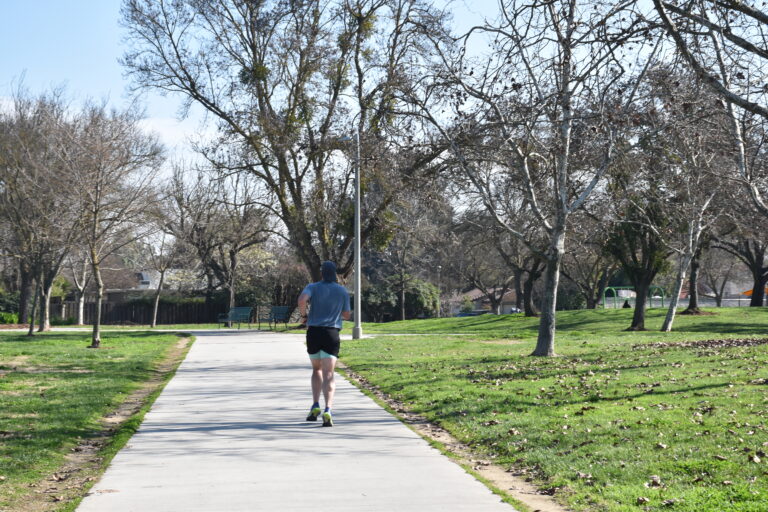
The city of Davis’s Parks and Community Services Department has released a survey to receive input about the city’s parks and recreational programming. The survey is open to the public and will remain live until Feb. 20.
The short survey asks questions about how to improve park amenities, how to increase outreach and what services are most valuable to park users. The survey’s responses will determine how the Department of Parks and Community Services will allocate its resources in the coming year.
Deanne Machado, the director of Davis Parks and Community Services, explained that the survey is not geared toward any particular group. Rather, her department hopes to receive feedback from all groups around Davis to better cater their services, facilities and amenities.
“We want to reach all the groups,” Machado said. “Every single demographic uses our green spaces or our amenities.”
This survey is part of a larger effort to assess the needs of Davis. As the Parks and Community Services website states, the most recent Parks Master Plan was completed in 2011, nearly 13 years ago. The plan has been modified over the years but is in need of community feedback to receive a proper update.
Machado explained that master plans are intended to last 10 years. They are forward-looking and are not a report card of the work the department has done.
“One way to do a master plan is to not just look at the way your outdoor space is designed, but to look at what program’s you’re offering,” Machado said. “We offer programming to many different demographics. Everything from active adults to our teeny-tiny preschoolers. […] We want to understand how we can make our programming more effective, reach a broader community, be more accessible.”
In the last 10 years, the enrollment of UC Davis has increased by 22% and the population of the city has increased alongside it. Davis parks have changed along with its growing population. Machado cited a major recent success of the Parks department called “Inclusive Parks, Inclusive Hearts: United Communities Through Recreation,” which responded to a gap in recreational enrollment programming.
“This project was to gather up a larger cross section of our underserved or under-resourced youth in the community and get them to participate in our recreational programs,” Machado said. “We brought programming to one of our low-income family housing locations in town and conducted the recreational programs on site so that we could remove the barriers around cost and transportation.”
Parks play a major role in Davis, and the city is heralded for its abundance and attention towards green spaces. Davis’s public information officer Barbara Archer explained the large responsibilities held by the city’s parks department.
“The parks and green belts are integral to Davis,” Archer said. “The department manages and maintains 42 community parks and nine dog parks. They also manage 25 athletic fields. The total area of landscape they maintain is 485 acres.”
Davis resident Ben Preskitt thinks that Davis parks are less accessible than many of the amenities offered by UC Davis, where arts and athletics are usually free and in a central location. Preskitt wishes there were more visible parks in the city, as well as facilities for people in his mid-twenties age group.
“The closest park to me is the one on F St., Community Park, and it’s not very pedestrian friendly,” Preskitt said. “Davis has approached the walkability issue well, but there’s a reason I visit Central Park the most. I don’t see a lot of things where 24-year-olds are gathering at the park.”
To give your input, fill out the Davis Parks and Community Services survey here.
Written by: Emma Condit — city@theaggie.org

©2021, ASUCD. Designed by Creative Media.