54.1 F
Davis

Davis, California

Tuesday, December 23, 2025
Home Blog Page 114

The concerning business of college consulting

Is it ever really fair to pay someone to help you get into college?


By CLAIRE SCHAD — cfschad@ucdavis.edu 


In the spring of my third year of high school, as I was about to embark on the journey that is college applications and admissions, the news about the “Operation Varsity Blues” scandal broke. I learned that wealthy elites had been paying to ensure their children gained admission to top universities in the form of bribes, falsified test scores and made-up athletic careers. As a soon-to-be first-generation college student, learning what I could be up against was daunting.  

“But at least they got caught,” I thought. This must be a step in the right direction. And while yes, there was some justice served for those who had been cheating, the college admissions system remains immensely flawed and unequal, continuing to heavily favor the wealthy and privileged

In recent years, the acceptance rates at top colleges and universities have been decreasing, meaning qualified applicants are receiving more rejection letters than ever before. This steady increase in the difficulty of admissions has paved the way for a new industry, available to those willing to front the money: college admissions consultants. 

These so-called college admissions experts are hired by families to help their children through the college admissions process. Their scale of work can vary greatly from client to client, but in some of the most involved cases, the consultant is hired while the child is still in middle school. The counselors work closely together with the family to develop the child’s interests and then guide them to opportunities that showcase their interests in a way that will impress top colleges. 

I was in my first year of high school when a close friend’s parent suggested that my family hire the college consultant their family was using. It was presented simply: fork up a couple thousand dollars, and the consultant will help develop your child into the best possible applicant they can be. 

This specific college consultant helped my friend throughout high school, offering test prep support for the SAT and suggesting specific activities and volunteer experiences that were sure to wow college admissions representatives. When it came time to start the college application process, my friend’s resume was filled to the brim with activities suggested by the admissions consultant, and she had a relatively high SAT score. 

In contrast, I had gone through high school personally seeking out activities that I enjoyed. I volunteered at my local animal shelter, joined clubs to spend more time with friends, played the sports I loved and worked with community groups that I felt strongly connected to. As a result, I had a resume that had a little bit of everything on it. It wasn’t fine-tuned to show my dedication and connection to my intended major, which is what some say colleges look for. Despite this, it was representative of me as a person, which is something I am proud of, even if I didn’t realize it at the time. 

When it came time to write my college admission essays, I felt wildly unprepared. I read countless articles about which topics make a good college essay and which ruin it. After all of this preparation, I decided to sit down and start writing. And honestly, most of my essays were not great — I didn’t fully understand how to present my ideas in a way that would be interesting to college admissions officers, likely because I was never really taught how to do so. 

My friend who used the admissions consultant, on the other hand, had someone by her side as she wrote her essays. They would review them after each draft and provide detailed suggestions on how to improve. If I had used this service, would my essays have been better? There is no way to know for sure, but targeted guidance and suggestions would have likely made a difference in the process. After all, my friends who used these services yielded positive results and gained acceptance to practically all of their desired universities.

Throughout the entire college admissions process, I was aware that multiple of my friends were using college consultant services. However, I was adamant that I wanted to complete all of my applications on my own. Maybe I thought these services were unfair, or maybe my stubborn teenage self just wanted to prove that I could do something on my own. Either way, looking back on it, I am happy to say that I have gotten to where I am today without the help of a paid consultant. 

Now that I have matured and am on the cusp of graduation, I can confidently say that college admissions consultants are just another means to providing wealthy students with an advantage in the college admissions process. 

So, if in the future you are ever thinking about spending thousands of dollars on a college consulting service for yourself or someone you love, I encourage you to think deeply about the way these services are contributing to the inequity of higher education. Think about how being molded into the “perfect applicant” may limit self-exploration and personal development. Even though the college consulting industry will try to convince you about the necessity of their services, I challenge you to push back and try to figure it out yourself. After all, rejection isn’t really failure, it’s just redirection. 


Written by: Claire Schad — cfschad@ucdavis.edu 


Disclaimer: The views and opinions expressed by individual columnists belong to the columnists alone and do not necessarily indicate the views and opinions held by The California Aggie.
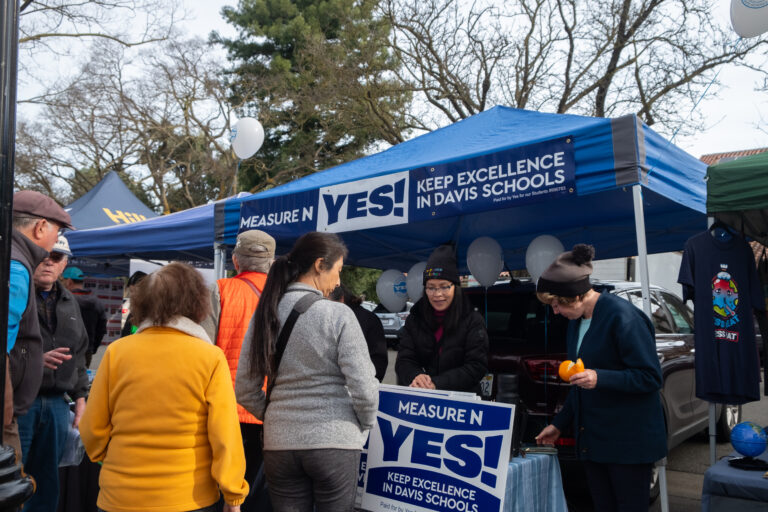

Measure N campaign underway in Davis ahead of upcoming election

The election, scheduled for March 5, will have Davis voters deciding on whether to support continued funding for local public schools


By ANTHONY W. ZAMMIKIEL  — city@theaggie.org


On March 5, Davis voters will be heading to the polls to not only participate in the presidential primary election but to vote on local and state propositions featured on the ballot for the general election. Members of the Davis community will vote on Measure N, submitted by the Davis Joint Unified School District, which will determine whether to continue a parcel tax to provide funding to local public schools.

If adopted, Measure N will continue funding Davis public class programs, support students’ mental health and safety, continue athletics programs, limit classroom sizes, retain and bring in new high-quality teachers and more. These services will be funded via a parcel tax. 

“Shall Davis Joint Unified School District’s measure be adopted, [Davis will renew] the expiring education parcel tax at the current rate of $768/year, raising approximately $11,700,000 annually until ended by voters, with adjustments for inflation; senior/ disability exemptions; and independent oversight,” the measure description on the Yolo County Elections Office website read.

Based on its summary findings, the Yolo County Elections Office stated that re-introducing a parcel tax of $64 monthly or $768 annually will continue providing important funding to Davis Joint Unified schools, which serve approximately 8,500 students in preschool through 12th-grade programs. 

The elections office also stated that Measure N will replace the existing Measure H, which was first approved by Davis voters during the 2016 election and was set to expire after July 1, 2023.

Evan Jacobs, a community activist involved in the Yes4Students campaign to support Measure N, said that Davis schools are able to provide their students with outstanding academic and extracurricular programs with the help of measures like the one proposed.

Davis is a community built on knowledge and education, from [the] world-class UC Davis to our kindergarten classrooms, education is at our core,” Jacobs said. “Passage of Measure N will keep excellence in Davis public schools by renewing the parcel tax that has been supporting our classrooms for 40 years. It maintains 100 classroom teaching and support staff.” 

Jacobs said Measure H, and Measure N if passed, funds core academic programs. 

These include vocational programs, performing and visual arts programs, career and technical education programs, athletic programs, counseling services, nursing services and librarian services. 

Jacobs shared concerns about what could happen assuming Davis voters do not pass Measure N within the upcoming election.

“In the state school funding formula (LCFF), Davis is a below-average funded district without the parcel tax,” Jacobs said. “If Measure N does not pass, local public schools will lose $12 million in annual funding, 10% of the budget.” 

Jacobs is optimistic about the Davis community coming together and passing the measure, noting that Davis voters came together after campaigning in the 2016 election to introduce the original parcel tax, which has since supported Davis public education.

“It’s critically important for us to vote to protect what we care about and fix what isn’t working in our country,” Jacobs said. “While national races get the most attention, local races and referendums are critical to make sure our democracy functions well, and it’s often where the most impactful votes occur. First and foremost, everyone who is eligible should register to vote and cast their ballots. With online registration and vote-by-mail ballots, it’s easy to do in California.” 


More voter information about Measure N as well as other local and state propositions can be accessed at the Yolo County Elections Office, which has ballot information for what will be featured on the March 5, 2024 and November 5, 2024 elections. 

Written by: Anthony W. Zammikiel  — city@theaggie.org

Culture Corner

The Art Desk’s weekly picks for music, movies and more


By NATALIE SALTER — ncsalter@theaggie.org


TV Show: “Succession” (2018-2023)


If you’ve kept up with this year’s awards season, you’ve almost certainly heard of one of television’s newest prize-winning juggernauts. The show centers around the affluent Roy family: Logan Roy, the family’s patriarch and massively successful CEO of the media giant Waystar Royco, and his children, each vying for their place in this company upon their father’s imminent retirement. Beyond the drama’s intricate web of ambition-driven maneuvers and manipulations, however, lies an impactful and complex family dynamic that creates the series’ emotional core. “Succession” boasts masterful acting on the part of its award-winning cast, who play their characters with a nuance that is unmatched in modern television. Likewise, the show’s subtle-yet-brilliant writing choices elevate it to one of the most interesting and moving on-screen stories yet. Give it a watch, and you’ll be singing its praises as reverently as Hollywood’s most prestigious award shows have for all of its four-season run.


Book: “Emily Wilde’s Encyclopaedia of Faeries” by Heather Fawcett (2023)


If you have any interest in faeries, folklore and their intersection with academia, look no further than this enchanting novel. Emily Wilde, a professor of dryadology at Cambridge, embarks on a field study in the isolated winter village of Ljosland. As she unveils the mysteries of the village’s local fae, she is followed by fellow professor Wendell Bambleby, who may be much closer to the faerie folk than he presents himself to be. Some faeries are friends, but others hide a dangerous bloodlust, and it falls onto the unlikely pair to discover that the wintry court has been snatching away innocent villagers to their deaths. Filled with immersive worldbuilding, lush writing, amusing banter and characters bursting with personality, you’re bound to fall in love with “Emily Wilde,” and once you enter the novel’s universe, you won’t want to put it down for a second.


Movie: “The Sound Of Music” (1965) dir. by Robert Wise


One of the most influential classics of the musical film genre, “The Sound Of Music” follows beloved actress Julie Andrews’ energetic Maria, a free-spirited young woman with a love of singing who is sent away from her path as a nun to serve as governess to the seven Von Trapp children. Their father is a retired military captain unable to connect with his family after his wife’s passing a few years earlier. Maria’s unconventional approach to rearing the children endears her to them, and her bright outlook on life provides an opportunity for reconciliation between the family. Filled with heartwarming characters, vibrant moments of song and dance and an endearing message of love and hope against all odds, “The Sound Of Music” is a warm hug of a film that you surely won’t want to miss.


Album: “Bewitched” by Laufey (2023)


Chinese-Icelandic singer-songwriter Laufey Lin has already captivated the world with her enchanting voice and romantic lyricism. She shines brighter than ever before on “Bewitched,” her newest studio album. The album’s orchestral instrumentals paired with Laufey’s stunning harmonies creates a cinematic and moving listening experience that takes the listener to another world, one filled with rabbit holes to fall into, Cupid’s arrows struck through hearts and letters to one’s younger self. Laufey balances romance, melancholia and nostalgia together against a beautiful musical backdrop in this emotionally pervasive and atmospheric work, one that is sure to mark a defining moment in her rising career.


Written by: Natalie Salter — arts@theaggie.org  

Broke man spotted at the Silo Market

Aggies, stand on business


By ALLISON KELEHER — adkeleher@ucdavis.edu


I was perusing the Silo market the other day during my gap between classes, starving and needing to eat lunch before my next lecture. Usually, I hit up the pre-made sandwich and salad section to get my pathetic turkey and cheddar on a wheat sandwich. Sadly, they were out. Nothing else looked appetizing or affordable. 

This was when something caught my eye — a couple wearing matching plaid pajamas in the line for Boar’s Head sandwiches. I decided against my better judgment and got in line behind them since my struggle meal had fallen through the cracks. It was quite nauseating to witness their public displays of affection. The amount of times I had to hear “Babe, stoppppp” made me pull out my noise-canceling headphones. 

When it was their turn to order, there was a lot of giggling and playful slaps to the arm. I’m not sure what’s so funny about a sandwich. Then there was another playful slap elsewhere, and I was officially over getting a sandwich. I looked over at the Boar’s Head employee and they had a very unamused look on their face.

“Babe, why don’t you want yours toasteddd,” the girl whined. As her sandwich was being toasted, they entered into a long embrace. It took everything in me to continue to keep my straight face. I looked over at the Boar’s Head employee and he looked like he wanted to get his head toasted. 

I was counting the seconds it took for their sandwiches to get wrapped up and taken to the register. She was standing in front of him in line, so she made it to the register first. He moved out from behind her, and just as I thought he was about to take over at the register, he wrapped his arms around her and hugged her from behind. Oh no. I’ve never seen this in person. The Broke Man Hug. 

I looked at the employee running the register and she had the same unamused look on her face that I did. 

“Babe, don’t worry I got the next one. You have way more Aggie Cash than I do,” the broke man said — obviously lying.

She whipped out her Aggie card and swiped it at the register. They got their sandwiches and left the Silo Market holding hands, off to haunt the rest of campus with their disgusting young love. I was so busy paying attention to them leaving that I didn’t notice that my sandwich was also completed.

“Aggie Cash or card?” the employee asked. I let out a loud laugh and the employee didn’t seem amused. 

“Card.”

Written by: Allison Keleher — adkeleher@ucdavis.edu


Disclaimer: (This article is humor and/or satire, and its content is purely fictional. The story and the names of “sources” are fictionalized.)


Are movie theaters dying in a post-pandemic world?

0

UC Davis students defend their love of the big screen


By ZOEY MORTAZAVI — features@theaggie.org


For many, some of their earliest and most cherished memories took place in movie theaters. There is an undisputed magic within them for people all over the world: the smell of popcorn wafting throughout the lobby; the suspense rising as trailers play and the lights begin to dim. The movies have been a tradition of togetherness and celebration for generations, and many students at UC Davis hope that movie theaters will continue to be appreciated and cherished for years to come. 

Despite the fondness that many associate with movie theaters, there is no doubt that their popularity has faded significantly since the COVID-19 pandemic, with box office numbers plummeting every year. 

“Ticket sales are down 21% from four years ago, but that’s not the only thing that’s down. So, too, is the number of wide releases,” Sarah Whitten wrote in an article for CNBC. “From January to June 30 in 2019, 57 films were released in 2,000 theaters or more. In 2023, there have been only 45 releases during that same period.”

Despite this, many UC Davis students are enthusiastic about the chance to see movies on the big screen, especially in downtown Davis theaters.  

“The movies have always been a fun experience that I keep going back to when I want to destress and enjoy a relaxing time with my friends or family,” Dari Gonzales, a first-year wildlife, fish and conservation biology major, said. “The enjoyment of watching a movie on a big screen, with buttery popcorn to snack on as you excitedly wait with your friends and family for the movie to start; I believe those experiences are what the movie theaters here in Davis give to many.”

There are numerous circulating theories that modern streaming services have the potential to eradicate the remaining movie theaters. To many, this threat to the film industry is a scary possibility. The question must be asked: Is streaming the newest movies from home the same as seeing them in a theater? The answer to that question is no, according to many students — and therefore, movie theaters in Davis are worth saving. 

“When I watch movies at home, I find myself getting distracted during uneventful parts of the film, missing important moments and generally being less emotionally impacted by what I’m watching,” Emily Essex, a second-year English and psychology double major, said. “The environment that movie theaters create allows for people to get the most out of their movie-watching experience while simultaneously encouraging people to get out of the house and do something fun.”

There is also a huge difference between chain movie theaters and independent ones. In times of financial stress, independent theaters hardly stand a chance against inflation, while many chain theaters can rely on a much larger pool of funds to keep them afloat. Independent cinemas across the country were forced to close their doors in the face of the pandemic.

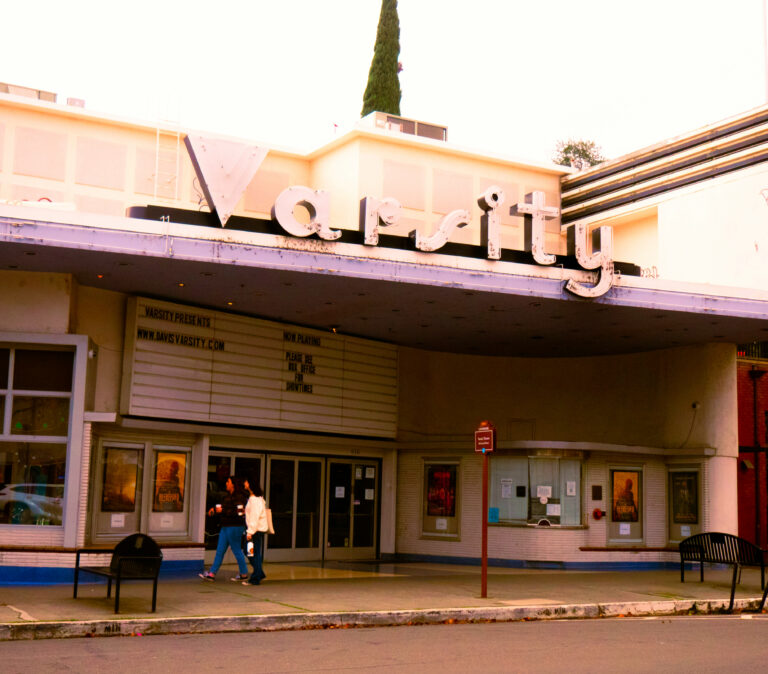
Right in UC Davis’ backyard is the Varsity Theatre, one of the charms of downtown which has been part of the Davis community since 1921. It was remodeled to look architecturally “futuristic” when it moved locations in 1949. There’s also the Regal Davis Holiday, which is part of the Regal Cinemas national chain system. There was a third theater, the Regal 5, which closed in May of 2023. 

“To me, there is nothing like the experience of live cinema. There is something so intense about being in a theater with so many people, immersed in sounds and visuals and unable to press pause,” Jenna Gage, a first-year communications major, said. 

Gage also works at the Regal Davis Holiday in downtown Davis.

 “Going to a movie theater to see a movie allows yourself to be completely lost in the story that movies tell, which is something that streaming services at home do not provide,” Gage said. 

Movie theaters have been a consistent source of entertainment, togetherness and joy for a long time. Regardless of the power that modern streaming services have in terms of their revenue, UC Davis students will continue celebrating movies the way they were meant to be watched for the first time — in the theaters.


Written by: Zoey Mortazavi — features@theaggie.org

Rhythms of unity: AfroVibes unleashes the soul of Afro-Caribbean culture

0

Learn how one of the largest multicultural dancing groups on campus came together


By FAITH DEMEULENAERE — features@theaggie.org 


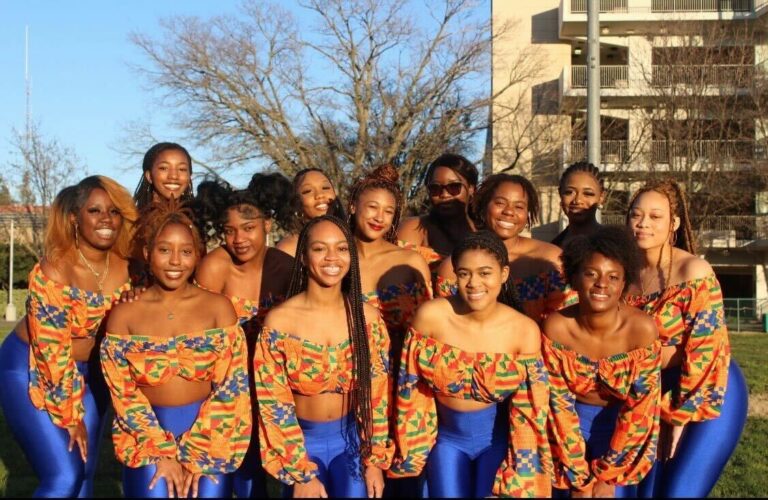
AfroVibes, a student-run multicultural dance group, emerged as a rhythmic force, passionately championing the artistic traditions of Africa and the Afro-Caribbean diaspora. With a compelling fusion of music and dance, this organization is more than just a performance group; it stands as a living testament to the celebration of shared heritage and individuality. 

Formed in 2016, AfroVibes’ mission was to bring African dancing to UC Davis. AfroVibes does events and performances for multiple festivals and events within the Black community, usually not competing with other dance teams. AfroVibes also hosts workshops for UC Davis students to learn African dancing semi-frequently.

“When I joined in 2020, things were still very much under COVID requirements and we were in isolation,” Co-President Dionna Eaglin, a fourth-year communications major, said.  “Even though it was virtual at the time, finding community in these Black and African women was really powerful for me because I felt alone, especially in COVID, but also at a PWI [predominantly white institution].”

Treasurer Naomi Myrye, a fourth-year food science major, described the experience of joining the group and bonding with others. 

“It was a good sense of community,” Myrye said. “I was lucky that I joined when I did because I’m Jamaican, and a senior was also Jamaican. She was kind of a guiding person to me. It really gave me a sense of belonging and sisterhood.”

Social Media Manager Teri Beasley, a third-year communications and cinema and digital media double major, spoke on how AfroVibes impacted her experience with UC Davis early on. 

“I was interested in dance before coming to Davis, and when I saw Afrovibes on UCD’s list of Black organizations to join, it was a perfect opportunity since Davis’ population is pretty small for Black students,” Beasley said.

“Going to practice two times a week is kind of like coming home, where I can have that sense of community, since there’s not that many students who look like me, generally, in Davis,” Beasley said. “Being able to have that group of people who look like me and act like me where I can be myself, it really helped me get acclimated to Davis as well, being connected to the team in that way.” 

AfroVibes is a group that encourages discovery; each member has the opportunity to find and develop their personal, unique style of dance.

When describing her dancing, Beasley said: “Smooth, with a hip-hop flair. Something that’s my own style.”

Eaglin described her dancing as: “Developing. It’s still a work in progress as I learn more styles. Maybe assertive too. But for the whole team, it’s beautiful. Everyone dancing together is beautiful.”

For anyone looking to join the community of AfroVibes, Eaglin had a piece of advice to share. 

“A lot of us on the team would agree that it really is a work in progress, you continuously adapt,” Eaglin said. “Even now, after being on this team for years, I’m still learning. Even though we are a team and the goals are to unify and look good on stage, it’s also a learning experience about yourself. We are very welcoming to newcomers. Everyone’s still growing, we encourage each other and anyone who wants to learn to try.”

Myrye added to this thought and emphasized the importance of the community — not the competition. 

“We get invites to competitions, but we highlight that we are not really a competition-based team,” Myrye said. “Our name is AfroVibes, because it’s for a sense of coming together and feeling the music, then bringing that to the community. It’s all dependent on the community aspect mainly.”

If you want to support AfroVibes, their annual showcase is coming up soon. You can find this information and more on their Instagram page, including information about their shows and dates for tryouts.


Written by: Faith DeMeulenaere — features@theaggie.org


Is dating doomed?

Nobody loves you anymore


By ANDIE TARABZOONI — rmtarabzooni@ucdavis.edu 


The idea of meeting someone organically tends to send people into a frenzy, whether it be social anxiety or a fear of rejection — it’s impossible to orchestrate but horrible to wait for. But meeting through dating apps is looked down upon. So what’s the solution here? Is dating worse than ever? Are we doomed as a planet since you can’t find “the one” on Hinge? Should we get into a bunker to be saved from Armageddon? 

The answer isn’t that simple, although we’d like it to be. To preface, I’m Saudi Arabian, so I don’t date. But most people I’ve met in college do. So, I’m purely basing this on what I think (which is usually correct). 

The online dating scene in the United States is really interesting since it’s very multifaceted and multicultural. The interaction of all of these cultures tends to create some tiring displays of code-switching in relationships. I’ve seen that a lot of my international friends — who tend to date people they’ve met off Hinge and Bumble — have had a hard time keeping up with the constant work of code-switching. This usually leads to them dating people whom they feel more comfortable around, whether that means another international student, someone who can resonate with their culture or someone from back home.

 Often, these connections made through silly prompts tend to fade. It’s not all that personal, you just want to be able to express yourself with someone you like. But maybe there are the right people out there, and maybe you can’t expect people to adjust within the first few days. Your “perfect partner” needs you to give them time. Patience is the biggest virtue when it comes to dating; don’t be afraid to give it or look for it.

If not Hinge, how do you meet someone? I met someone during my first year through an orientation group who I thought was really cool. Thankfully, they moved continents without telling me or their roommate. So maybe it’s not how you meet them — maybe people are just crazy. Is there really that big of a difference between dating apps and meeting people “organically”? What does organically even mean? 

I’m not sure if being in the same Living-Learning Community or orientation group is all that organic. Or maybe it is, maybe it really is fate. But maybe you could also meet the love of your life on Tinder. Who am I to judge? I have no firsthand experience other than ad-libbing as my friends doom scroll through Tinder. I think at the end of the day, it is important to put yourself out there, and do as much as you can if you really want to find someone to reciprocate your love.

I mean, personally, I think it’s superficial to date people purely based on looks and a prompt that tells you they like to pet dogs and watch “Cake Boss” in their free time. But that’s just me. I feel like I’d really need to feel the chemistry (if there is any) and figure out if they have an annoying voice. But maybe that doesn’t matter, maybe you’ve been telling the universe every night, “The one for me loves Cake Boss.” And if that’s how you find the one, who am I to tell you differently? The universe has its ways, so telling people you met on Hinge might be funny. But if you love them, you love them!

There is definitely a problem with dating apps and how we treat people as little whimsical sims, but that’s the era we’re in. So maybe we should adapt and become a little more superficial? It’s better than giving the person you don’t like and aren’t attracted to “a chance” because you met in person. 

Back to a more serious topic: alignment is really important when it comes to finding “the one.” I’m sure a good majority of us had our parents tell us their disagreeing opinions at some point or another. But as we’re allowed to become more vocal and express more opinions, it’s only fair we try to align ourselves with people who we agree with. I’m sure that for some people that doesn’t matter, considering the influx of people with partners with terrible opinions. 

But why should we settle? Why should we choose someone who we have to warn our friends about? It doesn’t have to be political, it can simply be not wanting to stay in the same area or having different life goals. I’m writing this about 20-somethings, so why feel the need to drop it all for someone you met at such a young age? Life will go on for, hopefully, another 50 or so years. You‘ll be okay (no promises though). 

At the end of the day, dating isn’t necessarily worse than ever. It’s definitely harder, and a lot more is going on now. We’re aware of multicultural relationships, we’re aware of our own identities and we’re aware of what our needs are. That’s a lot of awareness. Maybe people in the past had a different mindset of “just having to marry someone.” Maybe our mindsets have changed. But people are finding people for them. It’s less of a dating problem and more so being aware of all of your needs and options that it feels more like online shopping rather than something intimate.

 There’s hope for you — don’t date the guy who uses therapy-speak on every Hinge date. There is so much more for you! Life has so much to offer, it isn’t over because you got ghosted at the ripe age of 20. And I’ve never watched “Love, Actually,” but this quote saves me from trying to be heartfelt to the select few California Aggie fans: “If you look for it, I’ve got a sneaky feeling you’ll find that love actually is all around.” 


Written by: Andie Tarabzooni — rmtarabzooni@ucdavis.edu


Disclaimer: The views and opinions expressed by individual columnists belong to the columnists alone and do not necessarily indicate the views and opinions held by The California Aggie.

Impeachment of ASUCD IVP Aarushi Raghunathan withdrawn by Judicial Council

The petitioner in Monica v. Raghunathan withdrew the case from consideration just days after the Judicial Council ruling in favor of ASUCD President Ojeda


By VINCE BASADA — campus@theaggie.org


The second impeachment hearing into ASUCD Internal Vice President Aarushi Raghunahtan has been canceled, according to the Judicial Council (JC) in a statement posted on their Instagram on Jan. 25. 

Chasa Monica v. Aarushi Raghunathan (2024) has been withdrawn from consideration at the request of the Petitioner on behalf of the ASUCD Senate,” the post read. “No other hearings pertaining to this case will proceed.”

 As a result, Raghunathan will retain her position and office through the end of her term.

Raghunathan was unanimously impeached by the Senate alongside ASUCD President Francisco Ojeda in a special closed session Dec. 6. 

The first impeachment hearings into both Ojeda and Raghunathan took place Jan. 12. Raghunathan’s second hearing was supposed to take place on the same day as Ojeda’s on Jan. 16, but was postponed due to “unforeseen circumstances,” according to JC Head Justice Katrine Lee at that time.

The news that Raghunathan’s case would be withdrawn came three days after the Judicial Council ruled that Ojeda will remain in office. 

The announcement was signed by Lee, Deputy Justice Albena Goulisheva and Justices Madison Whittemore and Samantha Figlietti. 


Written by: Vince Basadacampus@theaggie.org

A sit down with Cowboys After Dark

0

The local band shares how they formed and their experiences as musicians


By FAITH DEMEULENAERE — features@theaggie.org 


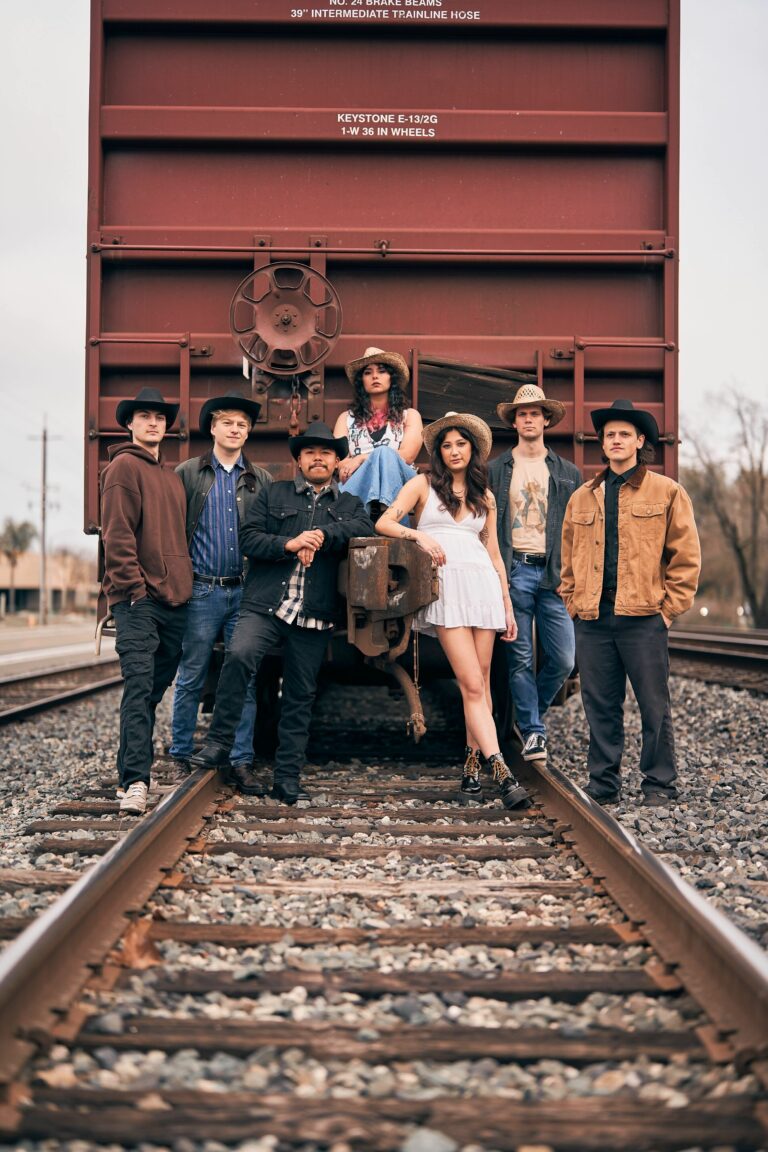
Many students and Davis residents are familiar with the local band Cowboys After Dark. Whether it’s by attending their shows or seeing their posters downtown, Cowboys After Dark has accrued quite a reputation in Davis.

For those who don’t know, there are seven members in the band. As a group that’s on the larger side, they call themselves similar to Earth, Wind & Fire and Santana: “Bands that move around and add fun with audience participation,” band member Jacob Johnson said.

Cowboys After Dark portrays this high-energy performance through their stage presence and joyful music. As many fans know, the group often plays covers of older bands such as Pink Floyd and ABBA.

As for the members of Cowboys After Dark: Mason Johnstone is on the drums, Dewey Patterson on the bass, Eric Aguilar on the guitar, Henry Humphrey on the keys, Rosie Mendoza on the trumpet, Jacob Johnson on the saxophone and Bernadette Grace on vocals.

Many of the members are currently students at UC Davis. Mendoza is a third-year English major, Johnstone and Grace are third-year biology majors and Johnson is a fourth-year PhD candidate in animal behavior. 

The band was formed through Aguilar putting up posters downtown looking for various musicians to join. 

“I printed out some sketchy-looking posters, and I found most of my bandmates that way,” Aguilar said. “But now we are as strong as we’ve been.”

“It was my first day of college, and I saw said sketchy-looking flyer that said ‘lead singer wanted,’” Grace said.

The band has fluctuated in members, but the trusty flyers built Cowboys After Dark into the band it is today. Being a completely self-made group, each member agreed that they had the most trouble with technical complications. 

 They set up and take down all their own sets and agree that carrying the large speakers they connect their instruments to is the worst part of this since only a couple of people in the band can even lift them at all. 

Although each member described the band dynamic differently, they all agreed on how close the group is. 

“Siblings, we are all just a family,” Mendoza said. “These are [like] my brothers.”

“Alive,” Humphrey said. “It feels like a living thing. There are so many moments where we feature an individual and the way we interact with the audience is more unique than many other things I’ve seen.”

“Eclectic,” Aguilar said. “We all come from really different musical backgrounds, so it is definitely a big combination in the best way possible.”

“Chaotic,” Johnstone said. “I don’t think we’ve had a single show that hasn’t had really chaotic moments. That’s not even a bad thing. There is some really good chaos, and sometimes not-so-good chaos. When there’s so much happening at once with the lights and everyone screaming, it’s great chaos.”

The “Cowboys” express gratitude to fans who come to most or all of their shows, especially to those who are enthusiastic about their music. 

“When the energy is reciprocated by the audience, it’s what we love. I really love it,” Johnson said. 

The group encourages everyone to support local bands and find their next favorite song at a Cowboys After Dark show. Those interested can keep an eye out for more information about upcoming shows this quarter on their Instagram account, @cowboysafterdark


Written by: Faith DeMeulenaere — features@theaggie.org


ASUCD Judicial Council rules that President Francisco Ojeda will remain in office

The decision was released one week after the second impeachment hearing for the case


By LILY FREEMAN — campus@theaggie.org 


On Jan. 23, the ASUCD Judicial Council (JC) released the ruling for ASUCD Senate v. Ojeda via email, which began by recognizing that the legislative branch has the power to impeach the president in the event that they engage in, “gross misconduct” or “[demonstrate] incapability of [the President’s] office.” 

The ruling then wrote that it is difficult to prove that the president is incapable for office. 

“The ASUCD President is elected by the students of UC Davis, not by any internal process by the ASUCD Senate,” the ruling said. “Subsequently, the Senate does not have the power to oust a President by a simple vote of no confidence.” 

While Ojeda may not have performed his duties to the satisfaction of the Senate, according to the ruling, “the claim that [Ojeda] is incapable for his office is invalid on these grounds.” 

The ruling wrote that Ojeda has fulfilled several of his constitutional duties as president, such as providing mandatory weekly reports to the Senate and being a representative of the student body. 

“Though [Ojeda] has not completed a first State of the Association Address, it is neither the power of the Senate nor the Judicial Council to enforce a specific deadline on when it may be delivered,” the ruling read. “We concur that the ASUCD President must be held to a high standard, but this standard must remain within reason.” 

The ruling also wrote that the Senate remains to have the power to impeach the president on different terms should Ojeda fail to carry out his constitutional duties in the future.

Finally, the ruling ended with the JC’s decision not to remove Ojeda from office.

“We find the arguments and evidence presented by Petitioner on behalf of the ASUCD Senate insufficient in establishing that [Ojeda] is incapable for office,” the ruling read. “[Ojeda] will continue his term of office.”


Written by: Lily Freeman — campus@theaggie.org 

Michigan Wolverines secure 2024 College Football Championship win

0

Washington Huskies lose to Michigan Wolverines with a final score of 34-13


By MI’ZAUNI REESE — sports@theaggie.org


As one of the nation’s most anticipated events of the season, the College Football Playoff National Championship took place on Jan. 8. With fans from all over coming to watch the event play out, it was one of the largest football games of the season. 

If having a packed stadium wasn’t enough, neither the Michigan Wolverines nor the Washington Huskies had won a championship title since the 1990s prior to this game — talk about a comeback. After waiting almost 30 years for both teams to make their long-awaited moves for the championship title, fans have felt nothing short of exhilaration for this match. 

With near-perfect records the last two seasons and long-standing winning streaks from both Michigan and Washington, it was no surprise that these two forces were up against one another. Given the high stakes for both Michigan and Washington, this game was bound to be an all-out battle from the start.

At the start of the game, both teams came out strong, with Michael Penix as quarterback for Washington and J.J McCarthy as quarterback for Michigan. Both McCarthy and Penix have played strong seasons with both players acquiring a substantial amount of rushing and passing yards. Though Penix had numerous successful plays in the beginning, the Huskies were soon shaken by Michigan’s strong defensive line which left Penix having to make many running plays. 

The Michigan defensive line continued to prove its resilience, only allowing Washington to score one mere touchdown throughout the entirety of the game. The remainder of Washington’s points were thanks to kicker Grady Gross who scored two field goals — almost half of Washington’s total points scored. This poor touchdown performance left Washington fans feeling defeated as a good defense is just as important as a good offense when it comes to securing victory. Unfortunately for the Huskies, their defense was no match for the Wolverine’s offense, letting a significant amount of touchdowns through. 

Led by tight end Devin Polk, the Washington offensive line tried their best to create space for gameplay as they bulldozed through as many players as they could. However, the Michigan coaches were prepared for this tactic and devised counterplays that the Huskies were powerless against — this led to 34 points scored by the Wolverines. 

One of the most significant moments in the game for the Huskies came when wide receiver Jalen McMillan caught a three-yard pass from Penix in the endzone, granting the only touchdown for the Huskies. McMillan used his agility to run his routes into the end zone just in time to receive the on-target pass from Penix. 

Following halftime, Penix was feeling the intensity of the game as he struggled to connect with his wide receivers and running backs. In the fourth quarter, Penix threw two interceptions with one of them resulting in an 80-yard gain by the Wolverines’ Mike Sainristil. Sainristil’s run left Michigan at the 10-yard line with little time left in the fourth quarter and the Huskies playing catch-up. Blake Corum saw his opportunity and snuck into the endzone for his second touchdown for the Wolverines in the fourth quarter. With no time left in the game, Michigan was named victorious for the first time in almost three decades. 

J.J. McCarthy worked harmoniously with his offensive line as he threw over 140 yards throughout the game. McCarthy, having played with Michigan for three seasons, has really made a name for himself this season — currently the top quarterback prospect for the upcoming NFL draft. The Michigan defense also gave an outstanding performance as they played their parts perfectly and prevented Washington from making nearly any comebacks in the game.

 Overall, both teams had an equal amount of possession time, with Washington holding about 90 seconds more than Michigan, yet the difference in play is staggering. Washington was able to rush a feeble 46 yards while Michigan gathered a whopping 303 yards. This statistic not only further signifies the strategic superiority in Michigan’s offensive game play, but also the significance and sheer success of their defensive line.

 With equal first-down amounts and Michigan only averaging about 7.8 yards per play compared to Washington’s 4.2 yards, both teams had equal scoring opportunities. In the end, it simply came down to the execution of routes, plays and positions, which Michigan proved to be more adept with. After a grueling and competitive match in the 2024 College Football Championships, the Michigan Wolverines proved to be a formidable opponent and powerful team. 


Written by: Mi’Zauni Reese — sports@theaggie.org


2024 Golden Globe Awards recap

From a Barbenheimer face-off to a failed opening monologue 


By INDRANIL BASU — arts@theaggie.org


The 81st Golden Globe Awards, one of the most popular American film and television award shows, took place this year on Jan. 7, 2024, at The Beverly Hilton in Beverly Hills, California and was broadcast live on CBS. It kicked off Hollywood’s awards season for the year, reconvening for the first time since the resolution of twin union strikes that shut down the industry for most of last year. This was also its return to air for the first time after its own ethics, finance and diversity scandal that resulted in the sale of the show, a reconstitution of its voting body and a change of network from NBC to CBS. 

This year was marked by historic wins for underrepresented communities at the awards. Lily Gladstone became the first Indigenous American person to win the Globe for best actress in a drama for her performance in “Killers of the Flower Moon.” Ali Wong and Steven Yeun won in the best actress in a limited series and best actor in a limited series categories, respectively, for their performances in Netflix’s road rage drama “Beef” (which won best limited series), becoming the first and second actors, respectively, of Asian descent to win in their categories.

FX’s “The Bear” won the Globe for best comedy, while two of its actors, Ayo Edebiri and Jeremy Allen White, also won for their performances.

“Oppenheimer” won five Golden Globes out of its eight nominations, including for best drama, best director for Christopher Nolan and best actor in a drama for Cillian Murphy. Greta Gerwig’s “Barbie” won two categories out of its nine nominations, including for best cinematic and box office achievement (a new category) and best song for “What Was I Made For?” by Billie Eilish.

HBO’s “Succession” was the top television winner with four Golden Globes including best drama, Actress (Sarah Snook), actor (Kieran Culkin) and supporting actor (Matthew Macfadyen). Yorgos Lanthimos’ “Poor Things” won best movie, comedy or musical. Emma Stone received the Globe for best comedic actress for the film.

Some memorable moments from the awards included America Ferrera and Kevin Costner appreciating each other while presenting. Costner quoted the “It is impossible to be a woman” monologue from “Barbie.” Daniel Kaluuya, Shameik Moore and Hailee Steinfeld did a comic bit that appreciated writers in the industry. Kristen Wiig and Will Ferrell had a playful dancing moment while presenting another award.

Comedian Jo Koy’s opening monologue was an overall bomb, making headlines across news platforms for its poor reception. He started blaming the writers and his lack of time for preparation as he dragged on with his set amidst a cold response. His most controversial joke was his remark on “Barbie”: while calling “Oppenheimer” a film based on a Pulitzer Prize-winning novel about The Manhattan Project, he reduced his personal logline of “Barbie” to a movie about “a plastic doll with big boobies.” 

There were no honorary awards this year, a category that had given a voice to many iconic people and significant speeches in past years, including Oprah’s #MeToo speech in 2018.

Overall, the winners were “largely supportable, if largely predictable,” according to an article by Vanity Fair. This year’s Golden Globes reached a viewership of 9.4 million and had the highest ratings in years. After this eventful award show, The Emmy Awards took place on Jan. 15 and the Oscars are lined up for March 10. The Golden Globes have set the predictions for “Oppenheimer” to win big at the Oscars.


Written by: Indranil Basu — arts@theaggie.org

New mural centered around mental health installed in the CoHo

“Murals for Mental Health” was a collaborative project between Aggie Mental Health and Aggies Helping Aggies to raise mental health advocacy 


By RAGAVI GOYAL — campus@theaggie.org 


During winter break, the ASUCD Coffee House (CoHo) was retouched through the installation of a new mural as part of the Aggie Mental Health campaign. The design selected for the mural was illustrated by Nicole Paja. 

“Murals for Mental Health” was a collaboration between Aggie Mental Health and the UC Davis Student Foundation (Aggies Helping Aggies). It first began as the UC Davis 2023 senior class challenge, allowing graduating students to donate towards a mural to leave their mark on campus and promote mental health advocacy. 

Shannon Yi, a fourth-year food science major and President of Aggies Helping Aggies, said that the mural serves as the connection between art and mental health. 

“Looking at art can make you feel better and hopefully affect your mental health in a positive way,” Yi said. “This is where we came about with the idea for the mural and then we started crowdfunding for it.”

Other fundraising for this senior class challenge came from tabling, gifts from students, alumni and graduations and presentations for the Davis Foundation Board, a board of trustees that funds philanthropic initiatives, according to Yi. Aggies Helping Aggies also applied for several grants to paint the mural.

“We were also able to partner with student affairs in Aggie Mental Health and the Aggie Arts Committee to get this mural funded because of crowdfunding,” Yi said. 

In order to generate student involvement and representation in the mural, Aggies Helping Aggies held a design contest for the mural. The contest was held in sections, where the first round asked for students’ visions and the second round had them submit their designs. 

According to Sydney Holmes, a UC Davis mental health promotion specialist associated with Aggie Mental Health, the Aggie Arts Committee became involved in helping choose a student design to be featured on the mural, 

 “The Aggie Arts Committee played a big role in presenting the [final] idea and coming up with the idea, and us as a whole group moved it forward over time to eventually get it installed,” Holmes said. 

Holmes said that the mural fits into the CoHo space very well. 

“I think it’s really cool to highlight that the artist, Nicole [Paja], did an amazing job of really bringing the CoHo theme into it with the coffee and the mental health aspect of it,” Holmes said. “[Paja] just made it a really inviting piece of artwork that will hopefully impact students for a long time.”

The mural is filled with speech bubbles containing conversation starters related to mental health, according to Yi. The wall also has painted coffee mugs and cups on it to fit in with the theme of the CoHo. 

“[It’s] just overall very pleasant to look at, and we hope that when people do get to view the mural, it serves as a reminder for them to check on their peers and their friends regarding their mental health,” Yi said. “We hope that this is a way for students to be reminded that their mental health matters too. Not only students, the entire UC Davis community.” 


Written by: Ragavi Goyal — campus@theaggie.org 


How stop motion continues to stun audiences

Why this “antique” animation style is both unique and challenging


By MAYA KORNYEYEVA — mkornyeyeva@ucdavis.edu


Among the dozens of different animation techniques existing today, I believe that none are as hands-on and tedious as stop-motion animation. Tracing its roots back to the early 20th century, stop-motion animation was first widely experimented with by Wladyslaw Starewicz, an avid insect collector in Lithuania who created short films of fiction by setting up beetles and other insects and moving them one tiny bit at a time in front of a camera. After every adjustment — snap! — a photo would be taken, and, over thousands of images, the insects appeared to be moving on their own on screen. 

After these films gained widespread popularity and praise for their fine attention-to-detail and revolutionary approach to filmmaking, other entertainment companies began to take this concept of stop-motion animation and run with it. Over the following century, movies like “King Kong” (1933), “Nightmare Before Christmas” (1993) and “Chicken Run” (2000) were released as stunning visual successes, inspiring sequels and the creation of new technology to help aid animators on the set. 

One of these revolutionizing stop-motion techniques was the introduction of the “armature:” a metal frame with specifically designed joints for every character in the picture. Having this frame allowed animators to create gravity-defying poses and truly explore the possibilities of what expressions and movements a clay doll or puppet could achieve. Beyond a metal frame, stop-motion animators also tested ways to manipulate facial expressions, such as using clay to mold every change or taking removable pieces and attaching them to the character to show actions such as smiling, blinking, laughing and crying.

I recently rewatched some stop-motion classics from Aardman Animations, a studio that is famous for its use of clay in stop motion. These films included “Chicken Run,” “Chicken Run: Dawn of the Nugget” and “Wallace and Gromit.” Every single one left me incredibly inspired. I loved the details of everyday objects being used on the miniature set, such as tiny bottles of toothpaste or paper clips. In each scene in the movie, I couldn’t help but think about a human hand moving the doll a millimeter in multiple frames to create such fluid and beautiful animation. 

The set design is another aspect of stop motion that is so meticulously hand-crafted that it should be displayed in a museum somewhere. Down to the tiny plants, the gravel on the roads and the miniature villages and buildings, I can truly appreciate the days that the production team put into constructing each location. 

Beyond “claymation,” there is another show that I would like to highlight when it comes to stop motion. Recently, Netflix released a Japanese stop-motion animation called “Pokemon Concierge,” based on the Pokemon franchise founded by Satoshi Tajiri in partnership with Nintendo.

The stop-motion animation style is a mix of fuzzy, almost plush-looking Pokemon characters and plastic dolls for the human characters. The show has four episodes with a total run-time of 60 minutes. It is a beautiful story with a female lead who accepts a job at a remote Pokemon resort after a series of unlucky events, learning how to take care of the guests and Pokemon and, most importantly, have fun and be herself. 

I particularly like how the show developed relationships between the Pokemon and the human concierges and how wholesome and kind-hearted their interactions were — I kid you not that every 2-3 minutes of the show, I said an audible “Awwwww.” The fluidity of the animation, 24 frames-per-second as opposed to the common 12, helped to truly bring the story alive. 

If you ever have time to spare, I highly suggest watching a few stop-motion animation films and paying close attention to the way the animators portray movement, expression and scenery, as well as the way they develop the characters themselves. Unlike traditional 2D or 3D animation, stop motion has a frame quality that can be both unnerving and exceptionally charming. Alternatively, you can experiment and create your own animation; just find your object, set up your camera and start adjusting.


Written by: Maya Kornyeyeva — mkornyeyeva@ucdavis.edu


Disclaimer: The views and opinions expressed by individual columnists belong to the columnists alone and do not necessarily indicate the views and opinions held by The California Aggie.
Dillan Horton announces campaign for Davis City Council seat representing District Two

The first candidate to be announced for the 2024 election hopes to represent the people of Davis

By MADELEINE YOUNG city@theaggie.org

Dillan Horton has become the first to announce his candidacy for Davis City Council in the 2024 General Municipal Election. After running for Davis City Council in 2020 and coming in second place, Horton will be running for the Second District of the Davis City Council which serves North Davis and some of Central Davis. 

“I ran for this position once four years ago when we created districts for the first time in 2020,” Horton said. “I was compelled to run the last time and I feel compelled to run again because I feel like our community, particularly working-class Davisites, are in a period of multi-layered crises. Our housing crises, our crises related to economic development and our fiscal house in terms of city government, school districts and county government.”

After his first candidacy, Dillan has stayed active as a member of the Davis community, serving as a member and former chair of the Davis Police Accountability Commission, as well as serving on the board of the Yolo County Democratic Party and leading movements to reform Davis’ law enforcement. 

“One of the reasons I came to Davis was it seemed like a community where you could come to town with all your possessions on a knapsack over your shoulder and people would accept you,” Horton said. “And that is still true after living here for a decade and my view is still that it is the best of Davis, but of course, there are times in our not-too-distant history and times in our present where I think we get off track of that. I feel like we are becoming a town that is losing that future, gradually, as we devote less of our attention to the housing crisis than we need and less of our attention to spurring economic development, particularly among small businesses.”

Horton believes the importance of education and community service was instilled in him at a young age as he was raised in a working-class union household by a single mother who was a veteran and later became a nurse.

“Dillan’s early experiences inspired him to become a public servant and to strengthen communities by ensuring all voices are represented in decision-making processes, and expanding access to opportunities for good jobs and quality education,” Horton’s campaign website reads.

Horton has a wide range of experience in local politics. This spans back to when he was serving El Camino College as a student senator — and later, as vice president — before becoming the Director of University Affairs at UC Davis. Following these positions, Horton served as a California Democratic Party Delegate for Assembly District 4 and chair of the Yolo County Democratic Party Legislation and Resolutions Committee. Today, he serves as a representative of the 4th Supervisorial District on the Yolo County Democratic Committee and a co-chair of the Yolo County Democratic Socialist of America (DSA).

In Dec. of 2018,  Horton was appointed by the city council to the newly reformed Police Accountability Commission where he was elected to be vice chair. Dillan led the commission and successfully presented recommendations for police reform.

“There were people who have never heard of Dillan Horton, didn’t know that the Police Accountability Commission existed and didn’t know the Yolo DSA existed, but even though they were fully unaware of all of that, I knew that they were counting on us to get the job done,” Horton said. 

Horton’s top goals for the council are ensuring quality, affordable housing for the community, creating economic opportunities, prioritizing inclusivity and putting values into action. 

“We are gradually, through inaction or lack of urgency, losing that future, that accessible inclusive future that I think so many of us Davisites value,” Horton said. “I think economic development, particularly equitable economic development, is a really core part of that.”

Horton believes the housing crisis is a multi-layered issue and that finding sustainable careers for citizens is a crucial element to address it.

“We talk a lot about how the housing crisis pushes people out, and that’s definitely true.  But what’s secondarily important is the fact that people who are my age range and a little bit older, on top of not being able to find or afford housing in our community are also in a position where they can’t find a sustaining career for themselves because of anti-development sentiments in some corners of our community,” Horton said. “We don’t need to redraw everyone’s mindset in terms of development in the city, but there are things that we have done in the past to support small business owners and aspiring business owners, and I think we need to.”

If elected, Horton also wants to bring diversity and accessibility to the city council, a perspective that Horton believes has grown distant from elected officials. 

“None of the five Davis City Councilmembers have been a renter in about 15 years or so — that’s wild in terms of direct representation,” Horton said. 

“Also, in 106 years of history, there has never been an African American on the Davis City Council, there has never been an openly LGBT person on the City Council. I mention that not because the color of my skin is going to make me a better city councilmember, but I think that part of the reason we have gotten into some of the issues that we have found ourselves in terms of housing, economic development and accessibility is because, I think, we have elected leaders who are living a life too distant from the crises that the working class Davisites are living in.”

Written by: Madeleine Youngcity@theaggie.org