55.4 F
Davis

Davis, California

Monday, December 22, 2025
Home Blog Page 12

Leaf Monitor: the AI-powered future of better crop management

UC Davis team develops mobile tool, providing farmers with real-time plant health data

By EKATERINA MEDVEDEVA — science@theaggie.org

Imagine you could scan a leaf of a plant like a barcode and instantly know its health status. The Leaf Monitor — a mobile tool in the Digital Ag Lab App developed by a team of researchers from the UC Davis Digital Agriculture Laboratory — does just that: It can analyze leaf spectral data using a machine learning model and returns key nutrient values indicative of plant health within seconds. 

The funding for this project came from the U.S. Department of Agriculture and the California Table Grape Commission. Led by Alireza Pourreza, director of the Digital Agriculture Laboratory, and run by Parastoo Farajpoor, a Ph.D. student in the department of biological and agricultural engineering, this project brings technological innovation and agriculture together to address one of the key issues in the field: resource allocation.

“One of the biggest challenges that many growers face is figuring out how many nutrients each plant actually needs,” Farajpoor said. “It is a complicated issue because different plants, even within the same field, can have different nutrient [needs]. On top of that, not all of the fertilizer applied to the soil ends up being used by the plants. This makes nutrient management difficult and often inefficient.”

The traditional approach to evaluating specific nutrient levels in plants is slow, labor-intensive and expensive. Usually farmers need to collect leaf samples from across the field, dry and grind them up, send them to the laboratory and then wait for several weeks until the results come back. In consequence, valuable time is lost when crucial decisions could have been made for improving the yield and quality of the crops.

“[The traditional analysis method] also lacks spatial resolution because the results usually represent an average over a large block or the entire farm, rather than showing the condition of individual plants,” Farajpoor said. “This often leads to overapplication or underapplication of fertilizer in different parts of the field, which increases cost and can harm the environment.”

This is where the Leaf Monitor comes in. For the past five years, the team at Digital Agriculture Laboratory has been building up a database that matches spectral data from leaves of different plants to the nutrient values, biochemical and structural leaf traits that have been retrieved through the traditional chemical and structural analyses. They then used it to train a machine learning model, which is now uploaded to a cloud service, so that it can be accessed to make predictions from new spectra in real time. This enables farmers to make faster and better crop management decisions. 

The process of using it is simple: First, spectral data is collected by a hand-held spectrometer that is connected via bluetooth to the mobile app by scanning a leaf. A research paper by Purdue University researcher John J. Couture, titled “Spectroscopic determination of ecologically relevant plant secondary metabolites,” details how on the microscopic level, the light that the spectrometer shines onto the leaf gets absorbed at certain wavelengths and reflected at others.

“[The] vibrational excitation of molecular bonds, primarily C–H, N–H and O–H bonds at specific wavelengths [is] in the visible (400–700 nm), near-infrared (700–1100 nm) and shortwave infrared (1100–2400 nm),” the paper reads.

As a result, a characteristic absorption spectrum is produced, which is sent to the cloud to be processed by the trained model that returns the nitrogen levels, water content and other values reflecting the crop’s condition to be displayed in the app. 

In the long run, this technology can help significantly reduce costs for farmers by enabling optimized fertilizer use, as well as support sustainable agricultural practices. 

Reflecting on the performance of the Leaf Monitor so far, Farajpoor noted that it received a lot of attention from growers. 

“We tested the app on some farms, and the ease of use and the speed of getting results brought a lot of positive feedback,” Farajpoor said. “Growers appreciated that they could simply scan a leaf and get useful information within seconds, without needing any special training […] [It] feels [motivating] when you see your research actually working in the real world.”

The team is currently working on expanding and diversifying the training database for their model in order to raise the accuracy of predictions across various plant types.

 “One challenge is that different crops have different spectral responses and trait ranges, so a model trained on one crop may not work well for another,” Farajpoor said. “The early impact has been promising, and we are excited to keep improving it so that it can be used more widely and effectively in real farm conditions.”

As it continues to be developed, the Leaf Monitor is a powerful demonstration of the fruitfulness of cross-disciplinary research: in particular, the projects at the intersection of agriculture, sensing technologies and machine learning. 

“I think agriculture is incredibly important because it provides food for people, and this kind of technology can really help us use our resources more wisely,” Farajpoor said. “So, in a way, this project supports both the grower and the environment.”

Written by: Ekaterina Medvedeva — science@theaggie.org
Behind the scenes of graduate student research in the geodynamics lab

UC Davis graduate student Nathalie Redick shares her experiences researching subduction zones, earthquakes and debris flows

By KATELYN BURNS — science@theaggie.org 

With the upcoming UC Davis Graduate and Law School Fair, undergraduate students will get the opportunity to explore graduate school opportunities.

Nathalie Redick, a second-year graduate student in the geodynamics lab of the Earth and Planetary Sciences Department, shared her experiences in a graduate program here at UC Davis.

“I spend most of my day just here on campus at a desk,” Redick said. “A typical day in the field is pretty different.”

On campus, Redick is researching subduction zones. The subduction zone is where two tectonic plates meet and where one slab — the subducting or sinking slab — goes under the other. Redick researches the molten rock surrounding the subducting slab to understand what the slab looks like, based on the direction of the flow.

“A lot of my research is considered basic science, rather than applied science,” Redick said. “We’re asking a pretty abstract question in the hopes that it’ll be useful to other people down the line.”

A more detailed picture of the subducting slab can improve other models. The subducting slab drives plate tectonics; the largest earthquakes in the world are seen along these subduction zones and the shape of the slab can influence them. 

“They told me what projects they had available because master’s projects are usually predetermined,” Redick said, discussing the process of emailing people when looking for a graduate advisor. “You don’t spend a lot of time developing the question yourself since the timeline is so short.”

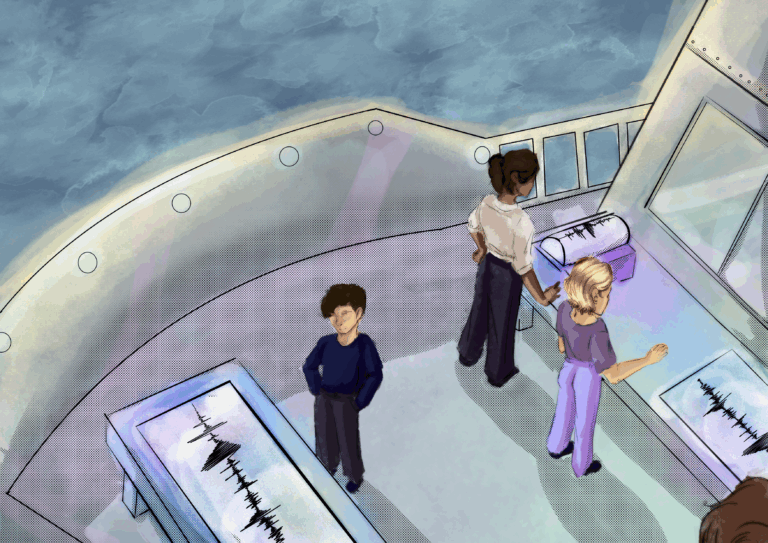
Alongside her master’s project, Redick applied to participate in field work. She took several trips to set up and collect seismometers, instruments measuring ground motion from earthquakes or debris flows. Debris flows are when glaciers in the mountains melt, causing water to collect sediment before crashing down in a big, sudden, fast-moving flow. 

Redick’s field work took her on research cruises and helicopters to collect seismometers (and their data) from the ocean and to install seismometers on volcanoes such as Mount Saint Helens and Mount Rainier in Washington. 

Earthquakes and debris flow can be quite devastating. Seismometers pick up real-time shaking, produced during earthquakes and debris flows. While measuring helps us understand them, not necessarily predict them, seismometers can pick up the shaking faster — allowing for earthquake alerts.

For undergraduate students looking into graduate school, your major doesn’t necessarily define your path. Before joining the geodynamics lab, Redick got her bachelor’s degree in computer science — something Redick noted opened a few doors when getting into her graduate program. Redick’s work in the geodynamics lab put her background in computer science to use, as it involved a lot of data analysis and programming. 

For the large scale models Redick works with, the high-performance computing (HPC) resources on campus are necessary, and require a lot of knowledge to navigate and understand. After creating the models, data can be pulled for analysis. Programming codes help make the process more repeatable later on, and save time when running the process through several different models.

“There is a point you reach in a lot of science where the type of mass analysis you can do with the computer becomes an invaluable tool,” Redick said, noting that the other graduate students in her cohort ended up learning coding as well.

Perhaps learning coding is something to consider when building your resume for graduate school. Computer science courses can be found through UC Davis as well as various other resources.

Written by: Katelyn Burns— science@theaggie.org

The history of Halloween

0

A look into popular Halloween traditions and UC Davis students’ favorite ways to celebrate 

By AMBER WARNKE — features@theaggie.org

As Halloween is just around the corner, students are starting to participate in traditions long associated with the holiday. From buying costumes to carving pumpkins, the beginning of October denotes a segue into the spooky season. Despite the popularity of this iconic holiday, many do not know where these traditions came from, or why we still celebrate them the way we do today. 

“I know [the origins of Halloween] are pagan from Samhaim, and how [practitioners] believed it was when the veil between this world and the spiritual world was the thinnest,” Nirvana Ziaie Nejad, a fourth-year English major, said. 

Like Nejad explains, Halloween’s roots can be traced to the Celtic festival of Samhaim, or “summer’s end” — a Celtic harvest festival dating back at least 2,000 years. The celebration involved bonfires meant to bring light into the dark part of the year and ensure survival through the winter by pleasing the deities. This was a time when it was believed that the veil between the mortal and spirit worlds was the most fragile, allowing spirits to enter the world of the living. 

This explains the basic origins of the holiday, but many people still wonder why Halloween famously includes the tradition of dressing up in costume. 

“My favorite part of Halloween is getting to dress up with friends and planning a group costume — I guess that’s also something that would be interesting to know why we do,” Sarah Lazureanu, a second-year managerial economics major, said. 

Costume-wearing came about as a way for people to try to frighten off evil beings who managed to enter our world. However, this was not the only purpose of the costumes — Samhaim also offered an opportunity for individuals to cross-dress, granting celebrators the rare opportunity to don clothing of the opposite sex.

The chance to dress up and express oneself in different ways through costumes has been one of the most consistent aspects of the holiday throughout time. 

For many at UC Davis and beyond, this is their favorite aspect of the holiday — this especially rings true for Harmony Aragon, a first-year molecular and medical microbiology major. 

“In a perfect world, anyone would wear whatever they want and that would be normal, but we have specific holidays meant for that, so that’s when people can have fun,” Aragon said. 

Nowadays, costumes often go hand-in-hand with trick-or-treating, a longstanding tradition when children go door-to-door asking for candy while in costume. There are multiple traditions that trick-or treating could have stemmed from, including the Celtic practice of leaving out food to appease spirits during Samhaim. 


By the Middle Ages, “Mumming” became a tradition when people would dress up as ghosts and demons, performing and entertaining in exchange for food or drinks. Lastly, trick-or-treating may have originated from young people committing acts of vandalism and occasional violence on the holiday. In response to this, family-friendly trick-or-treating came about as a way to give the youth a way to celebrate without delving into chaos. All these factors may have contributed to the creation of the modern trick-or-treating tradition as we know it. 

Another key part of Halloween celebration is pumpkin carving, which originated as turnip carving in Ireland. According to legend, a man named Stingy Jack once trapped the Devil and only released him after making him promise to never send Jack to Hell. Instead, when Jack died and was rejected from Heaven, he wandered earth as a ghost for eternity, and the Devil gave Jack a carved out turnip with a burning coal for light. This led to turnip-carving as a way to ward off Jack’s spirit, bringing about the name “Jack-O-Lantern.” When the tradition was brought over to America by Irish immigrants, people began using pumpkins instead.

All of these traditions have come together to create the contemporary version of Halloween that we celebrate today. While college students look forward to Halloween parties or scary movie nights, they can remember the origins of the same celebrations they continue today. When Aggies dress up, they carry out the same human desire to play around with self-presentation, just like Celts had thousands of years ago.

 Ultimately, through all its traditions, Halloween is about togetherness — whether that be partying, planning costumes, carving Jack-O-Lanterns or watching scary movies. The thrill of fear we associate with the holiday is only meaningful when combined with the realization that there is nothing to be afraid of after all, as these Davis students have shared, so long as we surround ourselves with care and community. 

Written by: Amber Warnke — features@theaggie.org

Live and let rich

0

How did a generation raised on fantasies of revolution grow to idolize the leisure class?

By GEETIKA MAHAJAN — giamahajan@ucdavis.edu

The start of the 2020s felt like the end of the world as we knew it. Between a global pandemic and constant political upheaval, it seemed like the very pillars of society were collapsing — but nobody was more prepared for this change than Gen Z. 

“We grew up reading ‘The Hunger Games’ / ‘Percy Jackson’ / ‘Divergent,’ what did y’all expect?” read the description of a Spotify playlist from 2021 called “Gen Z’s Political Revolution.” 

When you’re sitting at home and watching the world blow up online, it’s easy to draw comparisons to Katniss Everdeen and other fictional revolutionaries, but when the pandemic ended and it was time to put all this sentiment into action, it dissolved into something much more ironically detached.  

The United States is dragging itself closer to the dystopian worlds we grew up reading about; the staggering wealth inequality in the nation is nothing new, but it’s harder to ignore now than ever before. Social media, and TikTok specifically, have made it so that witnessing the capitalization of America isn’t just easy, it’s entertaining. While rich people flaunt dining sets and cutlery that costs thousands of dollars, those on the other end of the wealth spectrum rely on vitriolic comments for a check. When both extreme poverty and extreme wealth become a spectacle, it’s easy to forget their broader social implications. They’re not two separate realities; they exist as cause and consequence of each other.

If President Snow had a TikTok account, the entire plot of “The Hunger Games” would never have happened. At least, if social media functioned in their reality the way it does in ours. If you’re a rich person who “riches right,” you are above critique. If you, like heiress and influencer Becca Bloom, can look demure while unboxing hundreds of thousands of dollars worth of Hermès, nobody will think about the fact that you spent their entire year’s salary on a bag before liking your video — they’ll be too busy doomscrolling to think about the political and economic state of the world.

The reverse is also true: You can rich right and “poor wrong.” If you are visibly in poverty, you’re not doing enough to help yourself, you just need to work harder. While the wealthier influencers of TikTok can weaponize aesthetics to shield themselves from critique, low-income creators can’t afford similar defenses. Nobody sees Nara Smith’s tripod, ring light or glam team; everybody sees and loudly comments on a messy living room or dirty stove. Two very different streams of content emerge: one for escapism and one for an artificial sense of moral superiority. 

There is a deeper reason why Nara Smith can make her kids cereal from scratch while a working mother-of-three gives them toaster waffles, but that reason exists in real life, and these influencers exist on TikTok. I don’t know why a generation that was so committed to societal change five years ago is now obsessed with platforming these out-of-touch influencers, but the consequences run far deeper than the rich getting richer. The amount of wealth that Becca Bloom or Nara Smith have isn’t just excessive; it’s obscene. Every video emphasizes that they aren’t constrained by the two most limiting resources in our society — time and money. 

I despise an overused social media buzzword as much as the next person, but the normalization of this kind of luxury is truly problematic. It makes abhorrent wealth seem less foreign, warping our perception of what kind of lifestyles are realistic for the average person. Seeing people feed their cats expensive fish prepared by their private chef while other people struggle to provide a healthy dinner for their family should make people angry, but somehow we’ve lost sight of the broader picture. The existence of both extreme wealth and extreme poverty suggests that the persistence of wealth inequality is a choice: There are clearly enough resources for everyone to live a safe life. For some reason, the public believes that this is something people themselves are responsible for, rather than a structural mechanism for preserving wealth concentration.

America today isn’t divided so much as it is stratified. There are people at the very top and the very bottom of the wealth pyramid, but there are also millions of people in between who do the work of preserving the system. This is where the “richfluencers” of the Internet come in — the more we watch and support and validate their existence, the more acclimated we become to this dystopian level of consumption. Desensitizing ourselves to the deliberate inequality that exists in America does nothing to protect the middle class or their relative financial stability, it only further insulates those at the top: the ones standing on everybody’s shoulders. 

Written by: Geetika Mahajan — giamahajan@ucdavis.edu

Disclaimer: The views and opinions expressed by individual columnists belong to the columnists alone and do not necessarily indicate the views and opinions held by The California Aggie.

GUEST COLUMN- Anti-apathy

0

How to thrive in the face of indifference 

By JACKSON IVY — jjivy@ucdavis.edu

To be young in today’s world is to struggle. We struggle for calm, justice or some assurance that things are not as bad as they seem, yet so many things are stacked against us. Media reports are rarely good, and it’s too easy to reach a point where you dread the notion of even looking at your phone. 

This is no accident — corporations want you to feel drained, hopeless and eventually apathetic. They want you to feel like there’s no point — that obstacles are insurmountable. That way, you’ll reach for your phone and numb yourself by scrolling. This does not make us bad or weak; all of us know that things ought to change, and every second they don’t is an injustice and a disservice to our generation. But it still feels impossible. 

I believe this feeling is natural. When we look to history for inspiration on how to enact sweeping change, we see revolution, civil unrest, grassroots movement, mass mobilization — all things that feel out of place or “too far” in today’s world. But there’s one lingering question I always have: Where does resistance begin?

In the wake of a world designed to overwhelm, it’s natural to want to shut down or look the other direction. But this does not solve our discord with the problem, nor does it address the problem itself. Instead of shutting down and shutting out the chaos, I propose a strategy I’ve been practicing since I got to college. I like to think of it as a form of compartmentalization, where I can take steps toward effective and meaningful resistance that relieves the strain of inaction and helps me approach the issue, one step at a time.

This compartmentalization strategy starts with expanding the definition of “resistance.” Resistance, as a concept, doesn’t just include protesting the injustices of the world; it includes resisting the feeling that protesting injustice is pointless. It expands to include seeing every word, every step forward and every breath as a form of defiance. 

Think about it: big corporations who contribute the most to climate change, for example, want you to feel hopeless. But if it were truly hopeless, why would we continue to see our friends, drink coffee, go to class or otherwise have fun? It’s not meaningless, and extracting meaning from a life in which you are made to feel that none exists is the very essence of defiance. Every day you thrive without the permission of power-hungry individuals is a day you win. Every time you laugh with your friends is a laugh at their expense. Every time you hug someone you love, that precious moment belongs to you forever. Choosing to thrive in spite of how many terrible things happen every day is a constant state of victory.

Once you can build a foundation of passive resistance, it becomes easier to face the bigger things. Once I started waking up and seeing that defining moment where I finally got out of bed as a step toward positive change, I started feeling like it was easier to think about protest — to write, to advocate, to boycott, to revolt. I believe this happened because I could recall all the times I resisted apathy by getting up anyway, resisted repression by reading a book or resisted consumerism by falling in love. I felt like I was getting the hang of resistance and started to think bigger. 

All this abstract talk is really a means to an end — at the end of the day, tangible change is not caused by breathing without permission; rather, learning what resistance means to you, first and foremost, is what allows us to resist together.

Written by: Jackson Ivy— jjivy@ucdavis.edu

Disclaimer: The views and opinions expressed by guest contributors belong to the guest contributors alone and do not necessarily indicate the views and opinions held by The California Aggie.

The rise of religion as a political shield

0

How MAGA Christianity is being used to protect the Trump administration

By SABRINA FIGUEROA — sfigueroaavila@ucdavis.edu

When you grow up in the Catholic church, going to mass with medieval stained glass windows and the Virgin Mary constantly staring you down, you retain a lot of religious guilt about everything you do, especially if your actions go against the word of God. So imagine my surprise when the second Trump administration took office earlier this year, blatantly claiming a man with 34 felony convictions, an anti-immigrantion platform and sexual assault allegations to be “the second coming of Christ.” I shiver at the audacity. 

In all seriousness, Christianity among supporters of the “Make America Great Again” (MAGA) movement — the slogan of Donald Trump’s political party — has been in the media spotlight since the death of Charlie Kirk. However, it’s been a topic of cultural conversation since Trump’s first term, when he first claimed to be “the chosen one.” His claims to be a “savior” only increased in the summer before the 2024 Presidential Election, when he was shot in the ear at a political rally in Pennsylvania. By that point, some of his MAGA supporters saw him as a divine being, with a divine order to rule.

David French, a columnist at the New York Times, recently wrote about how MAGA evangelicals applauded Charlie Kirk’s widow Erika Kirk for her forgiveness of her husband’s murderer, while simultaneously applauding Stephen Miller, White House deputy chief of staff, and Trump’s comments on “hating your enemies.” French argues the misinterpretation of Romans 13 — a biblical passage on the role of authorities — allows MAGA to approve of forgiveness and hate at the same time.

“To look at Romans 13 as excusing Trump is to make what amounts to an astonishing category error… Scripture could not be more clear that a ruler is obligated to do justice and that the sword (to the extent it should be wielded) exists to protect the innocent, not to punish your enemies,” French’s column reads. 

Trump’s speech about “hating his enemy” only served as a confession that his first priority is vengeance on his enemies, while protecting the innocent is his last. Even the way the Trump administration and MAGA supporters framed Kirk’s death as a partisan issue goes to show that they are not concerned with injustices done against constituents — unless it benefits their power as authority figures. We are just pawns in this big political game.

If one does not take into account context and accepts the narrative of Romans 13 as followers of Trump tell it, it would appear as though political authority figures have the God-given right to do anything. It’s a return to the rhetoric of the divine right of kings — a worrisome thought considering the United States was founded on opposing the abuse that manifested from this power and doctrine.

Nonetheless, this newly popular variant of evangelicalism views Trump as an extension of God, which, in itself, makes it a challenge to hold Trump accountable for his actions. The blurred lines between politics and religion in this case make it difficult for people to argue against Trump’s actions — a critique on Trump is unacceptable as it’s a critique on God by extension.

That logic, exacerbated by stalls on judicial and legislative checks through the Supreme Court’s decision on presidential immunity and a loyal Republican majority in Congress, only adds another layer of protection from accountability — a protection from the informal check on power by the public. 

Religion is a knife, and Trump is wielding it as a dangerous weapon, a political tool. The line that separates church and state — fundamental to the foundation of the U.S. —  is being crossed and we cannot fall into the mistake of accepting it as the status quo.

Trump unabashedly calling himself “the chosen one” is not normal. The Trump administration’s recent efforts to deploy the National Guard to Los Angeles, Chicago and Portland is not normal. Selling “God Bless The USA” Bibles plastered with an American flag on the covers and printed with copies of the Constitution and the Bill of Rights — which his presidential actions don’t seem to support either — for $60 to $1000 (the one with his signature in it!) is not normal. Not only do these Bibles merge Christianity with American nationalism, its price point violates a core principle of Christianity: which is to support and be accessible to the poor — a Bible should never cost $60, let alone $1000. 

Faith should not be defined by political ideology — God himself cannot be placed on any given side of the spectrum. It’s not about whether MAGA evangelicals are “real” Christians or not, it’s about leading them in a direction that involves productive education and discussion of faith — without propaganda. It’s easier said than done, but it’s necessary. People should find what faith means to themselves on their own terms, not on anyone else’s, and certainly not on the terms of a man who says “an eye for an eye” is his favorite biblical verse — a line he takes to simply mean “vengeance.”

Written by: Sabrina Figueroa — sfigueroaavila@ucdavis.edu

Disclaimer: The views and opinions expressed by individual columnists belong to the columnists alone and do not necessarily indicate the views and opinions held by The California Aggie.

One killed in medevac helicopter crash on eastbound Highway 50

Flight nurse Suzie Smith passed from her injuries on Oct. 11


By RIVERS STOUT— campus@theaggie.org


On Oct. 6, a Redwood Empire Air Care (REACH) Air Medical Services helicopter crashed on eastbound Highway 50 in Sacramento. The helicopter took off from the UC Davis Medical Center and carried a pilot and two medical personnel on board, but no patients. 

67-year-old flight nurse Susan “Suzie” Smith died four days after the crash, as a result of her injuries. As of Friday, Oct. 17., 60-year-old pilot Chad Millward is being treated at the UC Davis Medical Center and 66-year-old paramedic Margaret Davis has since been released from the hospital, according to the Sacramento Fire Department.

The helicopter, which took off around 7 p.m., was returning to the city of Red Bluff around 130 miles north of Sacramento. The helicopter crashed less than a mile from the helicopter pad and hit no other vehicles as it crashed. The cause of the crash remains under investigation.

In a statement shared to ABC 7 news, Smith’s family mourned her loss.

It is with deep sorrow, yet deeper hope, that we share the passing of our beloved Suzie Smith, who has gone from this life into the waiting arms of her Savior, Jesus Christ,” the statement reads. “Suzie’s life was not wasted but poured out with purpose, courage, and deep intention. Her legacy reminds us to live boldly, love freely, and never hold back the good we can give when we follow Him.”

In a separate statement, REACH celebrated Smith’s work and service.

“We will remember Suzie as a pillar of the [Emergency Medical Services] and healthcare community who saved countless lives by delivering compassionate care in their darkest hours,” REACH said. “Suzie’s 50-year career as a nurse included nearly 21 years with REACH, and we are proud to call her our colleague and friend. We hope she is remembered for the light she brought to every call, every shift, and every patient she blessed with her care.”

 Registered as N414RX, the helicopter was a model EC 130 T2 manufactured by Airbus helicopters. It is capable of carrying up to six passengers; it also utilizes a crash-resistant fuel tank which successfully prevented a fire from starting, according to the manufacturer.

The Federal Aviation Administration (FAA) and National Transportation Safety Board (NTSB) are both responsible for investigating the crash; The California Aggie emailed the FAA and NTSB, and received an automated reply from both agencies stating that inquiries may not be answered at this time. 

The UC Davis Medical Center declined to comment when asked if they were aware of any circumstances that may have contributed to the crash.

In honor of Smith, the Our Angel That Flies Foundation is being formed in order to further the causes she believed in and issue scholarships for aspiring nurses. Donations are currently being accepted through Plumas Bank and can be made to: Attention Matt Moseley, 192 Hartnell Ave., Redding, California. Additionally, Smith’s family is hosting a public celebration of life Nov. 14 at the Redding Civic Auditorium.

Written by: Rivers Stout campus@theaggie.org

UC Davis Women’s Volleyball remains undefeated in Big West play

0

The 3-1 victory over UC Irvine marks the Aggies’ fifth consecutive win

By COLINA HARVEY— sports@theaggie.org

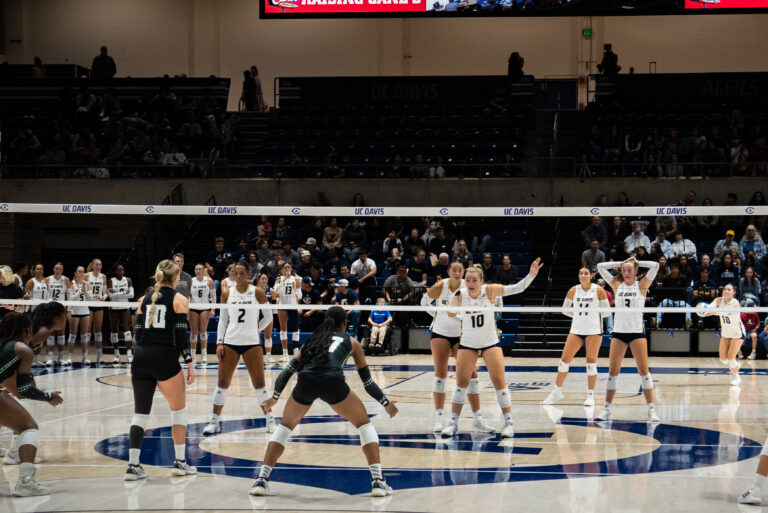
On Oct. 4, UC Davis Women’s Volleyball hosted University of California, Irvine (UCI) in the second game of a four-game home stand. The Aggies defeated the UCI Anteaters 3-1, marking their fifth win in a row. The win also brought the team’s conference record to 4-0.

In early-season invitational tournaments and non-conference games, the team had mixed results, with a non-conference record of 4-4. However, since starting conference play, they have racked up wins against UC Riverside, the University of Hawai’i, California State University Fullerton, and UCI. 

The first set of the Aggies’ matchup against UCI started with both teams trading points until the Anteaters scored five straight times, four of which were off of UC Davis’ errors. This took the score to 12-6, giving UCI an edge. 

While the Anteaters were able to maintain their lead for much of the first set, the Aggies crept closer and closer until senior setter Haden Bones, a fourth-year cognitive science major, tied the game up at 23-23. An opponent block took the score to 24-23, creating a set point for UCI. A kill by outside hitter Jade Light, a fourth-year aeronautical engineering major, tied the game back up, until an error by the Aggies created another set point for UCI. However, the Anteaters could not capitalize on this set point, as the Aggies scored three more points to come from behind and take the first set. Middle blocker Ally Chandler, a third-year human development major, stood out early with six kills in the first set alone. 

Although the second set was even at the start, UCI quickly pulled ahead and created separation, forming their largest lead of the game and leading the Aggies 18-10. Nonetheless, the Aggies crept back, managing to close the gap to four points. However, the Anteaters had created too big a lead for the Aggies to overcome. UCI equalized, winning the set 25-18. 

In the third set, the tables turned, and it was the Aggies who built up an early lead. They got off to a quick start, leading Irvine 6-1 before prompting UCI to take a timeout. Then, a kill by outside hitter Brooke Hibino, a third-year managerial economics major, was successfully challenged by UCI and overturned, slowing the Aggies’ momentum. 

UCI started to close the gap, turning the Davis lead — which had been seven points before the challenge — down to three. However, the Aggies bounced back with a strong set of kills that put them ahead by nine points. The Aggies were able to maintain their lead and close out the set with a score of 25-13. 

The fourth set stayed extremely tight throughout, with neither team able to break away. That was until near the end of the set, when Davis started to creep away. Kills from Hibino and Breeze Czapinski, third-year international relations and psychology major, brought the score to 23-19, the largest lead of the set. 

The Aggies kept the small lead until the end of the game, winning the set 25-21 to remain undefeated in Big West play. 

Chandler led the team with 14 kills, while Light and Czapinski had 13 each. Libero Ximena Cordero Barr, a second-year landscape architecture major, showed out defensively, recording 35 digs. 

In last season’s Big West tournament, the Aggies comfortably clinched a position as the third seed out of six qualifying teams. While they were able to get past the sixth seed, UCI, they fell to the second seed in the quarterfinal, University of Hawai’i, in a riveting five-setter. 

Their strong performance in this season’s games so far shows that this year’s squad has the potential to make a deep run in the Big West tournament, and potentially reach the national tournament.

Written by: Colina Harvey — sports@theaggie.org

Is ‘The Life of a Showgirl’ for everyone?

UC Davis students express ambivalence toward Taylor Swift’s latest album 

BY JULIE HUANG – arts@theaggie.org

The release of a new Taylor Swift album has become synonymous with a flurry of discussion, ranging from speculation on the inspiration for each track, connections to Swift’s personal life and passionate reactions from fans and critics alike. Swift’s 12th studio album, “The Life of a Showgirl,” has not escaped this fate, quickly becoming one of her most polarizing albums amongst both critics and the general public. 

Swift herself has even acknowledged the mixed reception that her newest album has received in the days since its release.

“I welcome the chaos,” Swift said on Apple Music’s “The Zane Lowe Show.” “I’m not the art police. It’s like everybody is allowed to feel exactly how they want. And what our goal is as entertainers is to be a mirror.”

UC Davis students have listened and formed their own opinions on “The Life of a Showgirl” and its place within not only Taylor’s discography, but their hearts and minds. 

Ben Carrillo, a third-year political science major, has been a fan of Taylor Swift since childhood. 

“I was personally really excited for ‘The Life of a Showgirl’ to drop,” Carrillo said. “This seemed like a return to form for her after she released what was, in my opinion, her weakest album.” 

On “The Zane Lowe Show,” Swift described her previous album, “The Tortured Poets Department,” as “serious, sensitive, introspective, earnest and stoic.” In comparison, she characterized “The Life of a Showgirl” as “mischievous, fun, scandalous, sexy, flirty and hilarious.” 

For some long-time fans, however, the new album did not deliver. 

Malaika Dewar, a third-year communication and English major, suggested that her personal listening experience was characterized by a sense of mediocrity. 

“My first impression was that it sounds bad in a way that is basically uninteresting,” Dewar said. “She makes the same song over and over again.” 

Rather than highlighting the lively and luminous qualities associated with showgirls, Dewar also said that the album felt derivative compared to Swift’s previous works, and forgettable even within her own discography. Carillo echoed this notion.

“I felt like it was not her best foot forward and it almost felt like a cash grab in many ways, which is something I never thought I’d say about a Taylor Swift album,” Carrillo said. 

Swift’s marketing strategies of releasing multiple CD and vinyl variants of the same album have not gone unnoticed. In 2024, she released 36 album variants of “The Tortured Poets Department.” Though it has contributed to Swift’s impressive sales, critics have characterized this practice as disingenuous and exploitative of her fan-base.

Anika Konkati, a third-year English major, also said that the album failed to live up to her expectations of what a flashy showgirl-themed project should feel or sound like. 

“The first half of the album is definitely more listenable than the second half, but even then, it doesn’t quite build or go anywhere,” Konkati said. “There’s far stronger stuff on her previous albums.” 

Elsewhere on the album, Konkati found Swift’s lyrical efforts lacking when held up against previous works. 

“‘Eldest Daughter’ is a really, really weak Taylor ballad,” Konkati said. “It feels immature, and I think Taylor’s fans have come to expect a little more from her.” 

  Specifically, the line “I’m not a bad bitch, and this isn’t savage,” which is featured in the song’s bridge, has become controversial for its apparent incongruence with the rest of the song’s lyrics, along with well-established audience expectations of what a track five from Swift might sound like. 

 Track fives within Swift’s discography are expected to be especially vulnerable and reflective songs — “All Too Well,” “Tolerate It” and “My Tears Ricochet” are just three of 12 emotional ballads. Swift has previously said that “picking a track five is sort of a pressurized decision.” 

“This [album] feels like a step down from anything she’s ever written,” Carrillo said. “It’s frustrating as a long-time fan because this is nowhere near the quality of her other works.” 

Despite criticism, fans were luckily still able to find a couple of stand-outs within the album. 

“I find myself returning to ‘The Fate of Ophelia,’ which is the only one that feels like a Taylor Swift song,” Carrillo said. “It has a catchy hook, a pretty good chorus and is more interesting in terms of lyricism and writing quality.” 

Overall, Carrillo and Kontaki felt the album’s lyricism came off overblown and out of touch, not just with listener expectations, but also the clear-eyed perspective that was often present in Swift’s previous works

“The lyricism feels a little bit like a parody of herself,” Konkati said. “It comes across like a Taylor Swift hater decided to write a Taylor Swift album.” 

For some, “The Life of a Showgirl” was simply a step in the wrong direction, which does not cancel out the overall merits of Swift’s discography. 

“She’s been on a bit of a downward trend,” Konkati said. “I’ve never been a super fan, but I still know that she’s put out some pretty interesting stuff.” 

Regardless of her latest album’s public reception, Swift undeniably remains at the very top of the music industry. Despite criticism, her new album broke Swift’s own Spotify single-day streaming record set by her previous album, and is “poised to break the longstanding record for largest sales week for an album in the modern era,” according to NBC News. 

It seems she has the ability to remain a thriving force in the music industry until she herself is tired of it, and there are a myriad of paths forward for her. Which one can win her critics back over? 

“Her next project might be the most important one in her discography, because it will determine where she is going from now on,” Carrillo said. 

Written by: Julie Huang — arts@theaggie.org

UC Davis students share their reasons for vaping and smoking cigarettes

0

Why the practice of smoking persists, despite health risks 

By GRACIELA TIU — features@theaggie.org

One of the biggest associations with vaping and smoking cigarettes has, for years, been their negative health effects. Despite this, many students here at UC Davis and in the United States still vape and smoke nicotine products. 

Research surrounding the topic acknowledges a variety of reasons for this — for example, the impact of tobacco and e-cigarette advertising — but what reasons truly resonate with current and past nicotine users?

A current UC Davis student, who wishes to remain anonymous, detailed how smoking cigarettes can enhance social settings, beyond the common “looking cool” reason people often provide to justify smoking. 

“I smoke mainly as a social activity because it’s something that can kind of bring people together and break the ice,” the student said. “I also really like how it can be an activity that gets you out of the house. For example, my friends and I will hike to the top of a mountain or drive to a spot with a cool view to smoke a cig. While vapes can be hit almost anywhere, cigs at least require leaving the house. Also, it can definitely be a way to relax or unwind after a long day, especially if you roll your own cigarettes with loose tobacco, it can be a good way to chill.”

A common reason people vape or smoke nicotine products can be the physical feeling it brings, whether through vape flavors, the head rush or buzz from the initial hit or the physical sensation of smoking or vaping itself. 

Despite their possible appeal, both smoking cigarettes and vaping can lead to detrimental health effects due to the toxic chemicals present in the smoke and vapor, nicotine’s classification as a highly addictive substance and many other parts of the process that can harm the body. Smoking cigarettes can cause cancer, heart disease, lung disease, type 2 diabetes and many other harmful health conditions, according to numerous health organizations. Vaping, though different from cigarette smoking, can also cause irreversible heart and lung problems, organ damage and much more.

Another student who wishes to remain anonymous shared their personal experience with their habit of vaping.

“This is coming from my experience, but I never craved the head rush,” the student said. “I craved the cool feeling of it down my throat — that sounds weird, but I swear. And I think not having that feeling is kind of hard.”

The overall feeling of smoking or vaping can also bring a certain level of stress relief, according to the first student. 

“In terms of inner need, I think it fulfills different things depending on the occasion,” the student said. “If it’s after a stressful day, a cigarette is mostly about relaxing and unwinding.”

For many people who feel addicted to vaping, the habit itself can be hard to break.

“When I tried for the first time, I think it was hard for me to quit because of the motion of grabbing something and being able to do it when bored or after eating, etc.,” the second student said. “It became part of my routine, so quitting felt like removing a part of my routine.”

Students have also shared that an additional allure to vaping or smoking can be the excitement it brings, especially when feeling bored or having other negative feelings.

“I honestly feel like a big part of the reason I vape is because of boredom; it’s just something to do,” a third anonymous student said.

The first student described how the process of vaping made doing difficult or unappealing tasks feel easier.

“I think vaping low-key helped me do stuff that I didn’t want to do, because it was like ‘oh but I have my vape’ so I can tolerate it,” the student said.

Of the many reasons students continue vaping and smoking despite health risks, the challenge of quitting can be one of the strongest contributors. UC Davis offers various resources to aid students who wish to quit, available through the UC Davis branch of Healthy Campus Network (HCN), Healthy UC Davis.

A final anonymous student shared their experience after quitting vaping, underlining the true change they felt in their life.

“I remember how physically painful it was when I was addicted — it would hurt to breathe,” the fourth student said. “I don’t want to be dependent on a substance that is bad for my health, and I know staying off of it puts the minds of my loved ones at ease.”

Written by: Graciela Tiu — features@theaggie.org

The dichotomous politics of immigration in the modern United States

0

What global protests reveal about the state of our nation

By NEVAEH KARRAKER — nakarraker@ucdavis.edu

Immigration is arguably the most prevalent issue in the world right now, and the unease encompassing it isn’t leaving anytime soon.

Japan, the United Kingdom, Australia, Poland and Germany are being swept deep into a wave of anti-immigration protests. Although these conflicts surfaced years prior, they are now thrown into the spotlight.

In Poland, anti-immigration protests took place in more than 80 cities over the summer. In Japan, a recent influx of tourism has fueled resentment among locals, as they battle rising housing prices and pollution. In the U.K., far-right activist Tommy Robinson led 100,000 Londoners in anti-migrant sentiment just a month ago.

While many of these protestors align with extremist factions, their concerns stem from legitimate issues about housing shortages, unemployment, economic instability and the premise that the government favors foreigners over their own citizens. 

Abroad, Russia’s war in Ukraine displaced millions, with over five million Ukrainians seeking refuge in neighboring European countries like Germany and Poland. The U.K., Poland and Germany are accepting numerous more international asylum applications than their resources allow, which compounds the already critical housing shortage. Even in the United States, the “American dream” feels unreachable; the “land of opportunity” is nowhere in sight, especially in the face of political unrest and a fragile economy. 

It is of paramount importance that we understand these global issues, as they indirectly force the U.S. to reconsider its own diplomatic policies. When European countries turn away asylum seekers or war refugees to ease their own domestic affairs, the U.S. is the next place they turn to. This amplifies the pressure on our overwhelmed border system and stretches our thin resources. In July 2024, the Department of Homeland Security declared that asylum centers had hit overcapacity, and, in 2023, they discussed how overloaded borders create vulnerabilities that transnational criminal organizations can exploit for drug and human trafficking.

Similarly, when countries like Japan limit tourism or foreign residency, skilled workers and students migrate to countries that have more lenient customs policies. The U.S., despite the new line of federal immigration policies under the Trump administration, remains a sought-after destination for research and employment. As these influences put even more strain on the borders, it propagates its many existing vulnerabilities.

The U.S., similarly, has experienced its own stream of protests in recent months. In contrast to the far-right demonstrations in countries overseas, pro-migrant protests and demonstrations against Immigrations and Customs Enforcement (ICE) — such as the nationwide “No Kings” protest this past June — were a response to the actions of the Trump administration. Strict regulations on HB-1 visas have sparked tension in universities and organizations, and immigrants continue to live in fear of being one of the two million people deported by Trump’s increasingly severe policies.

Immigration is a delicate topic. Tourism and migration both enrich culture and boost economies with skilled labor and business innovation. To some, anti-immigration sentiments aren’t always rooted in opposition to diversity; instead, they can be a plea for the government to bring balance and structure to a dysregulated population. Expecting immigrants to uphold national laws, values and cultures in the process to gain citizenship is not always inherently xenophobic. Yet, unaddressed fears lapse into anger and become a driving force for violent or exclusionary public outrage.

At the core, people in the U.S. are facing the same dilemma as those abroad: Who should we help first? Should the government prioritize international citizens seeking refuge from war and homelessness, or the welfare of their own struggling people? These rampant protests represent the ongoing skirmish between globalists and nationalists: one values open borders, equity and compassion; the other sovereignty and structure. When does caution become overprotective? 

Today, immigration is extremely salient, so staying informed with foreign affairs is just as vital as with domestic ones. Like the domino effect of World War II, the welfare of one country shapes the welfare of others — and America might be the next domino to fall.

Written by: Nevaeh Karraker—nakarraker@ucdavis.edu

Disclaimer: The views and opinions expressed by individual columnists belong to the columnists alone and do not necessarily indicate the views and opinions held by The California Aggie.

Pundamental humor

0

In defense of puns as a form of highbrow humor

By ABHINAYA KASAGANI — akasagani@ucdavis.edu

I promise the reader that the initial conception of this article did not stem from my being relentlessly mocked for my penchant for puns. My sincerest apologies that we all cannot be absolutely hilarious with the way we turn words on their sides and arrange them with care. 

 Something as trivial as a pun, often dismissed as being a “dad joke” or a type of lowbrow humor, represents a cerebral form of social sport that rewards both parties precisely because of the mental leaps and bounds that they are required to make. 

James Geary, author of “Wit’s End,” notes that “puns are all about exchange and they create an intimacy […] you’re in it together, sharing a secret.” In order to make a pun work, both parties must share a set of references, meanings and cultural associations; the construction of a joke is reliant on shared understanding. Puns collapse two ideas into one sound, imploring the listener to consider the simultaneous existence of both possibilities. They are, in this way, democratic by nature — one must agree on what makes the joke funny in order to derive any satisfaction from it.

Geary also notes that “the pun’s primacy is demonstrated by its strategic use in the oldest sacred stories, texts, and myths.” Ancient Egyptian hieroglyphs contained puns with the same persistence as Shakespeare’s plays, the Bible is rife with wordplay that gets represented and misrepresented and even psychiatrist Sigmund Freud appreciated puns because of their capacity to reveal one’s subconscious. President Abraham Lincoln reportedly once received a letter from a priest “asking him to suspend the sentence of a man to be hanged the next day,” to which his response was, “if I don’t suspend it tonight, the man will surely be suspended tomorrow.”

While other forms of humor, in these fraught and tense times, do have their benefits, our current social and political climate calls for the re-evaluation of what we, as a collective, deem funny. While most humor can be weaponized, puns eliminate all attempts to one-up another; you must bring yourself down to the level of the other in order to get the joke. Puns are playful without being divisive and are thus able to much more quickly diffuse any tension they may create.

Apart from democratizing society, puns reward quick thinkers — those thinking on their feet. When one resorts to making puns, they are manipulating the rules of language as we know them, demonstrating their understanding of phonetics, semantics and irony. Words can mean anything: Language is often fickle and malleable. Occasionally, puns serve as cultural tools that reward intelligence, bridging these existing gaps between cultures and languages. Language becomes gamified, reminding one of their ability to conquer the written and spoken word. 

This is not to say that all puns are well-reasoned. I am, admittedly, guilty of making puns that warrant the loudest of groans. Maybe the answer is as simple as puns are fun; maybe the long punchline that you’ve been waiting in for hours wasn’t packed with any punch. Puns will, until the end of time, elicit a groan from their audience; this only means they are doing their job. Speaking as a pundit of sorts, I would claim that to laugh at a pun is to participate in a fleeting moment of collective comprehension where any and all are welcome.

Written by: Abhinaya Kasagani— akasagani@ucdavis.edu

Disclaimer: The views and opinions expressed by individual columnists belong to the 

columnists alone and do not necessarily indicate the views and opinions held by The California Aggie.

These parties are no fun

0

Affective polarization: an affliction with insufferable symptoms

By VIOLET ZANZOT— vmzanzot@ucdavis.edu

History will have its way with the affective polarization that exists in America today. Future textbooks will have headlines that read “The battle between the blue-haired and red-capped raged onward,” and Alligator Alcatraz will be memorialized similar to Manzanar. Much as we may have read about Ronald Reagan’s presidency and the civil rights movement, we can see plainly that we once again exist at a cultural and political inflection point — a moment in time that is producing a shift in our cultural norms.

Affective polarization — defined as “the tendency of Democrats and Republicans to dislike and distrust one another” — has been exacerbated by extremists, who create a feedback loop to push people further apart. The masses seem to be the fuel feeding the fire of the tension we’re seeing emerge between the political left and right: there is no question that there is partisan division in America today. 

In essence, politicians and public figures are feeding off the existing social and political turmoil to gain popularity; they rally their supporters around collective animosity for the opposing side, tightening their allegiance to their party while decreasing their tolerance of the other. 

Oftentimes, when we talk about the problems in our country today, speculatory commentary far outweighs self-reflection. How often do we look in the mirror and ask ourselves why we dislike or distrust people who think differently? How often do we assume we are right, without even considering what it even means to be right in the first place? 

Researchers Jesse Graham, Brian Nosek and Jonathon Haidt studied the accuracy of how political liberals and conservatives stereotype one another. Their results revealed that the differences in how people think are exaggerated relative to the actual differences. It’s not that no differences exist, but rather that people have moved their perceptions of the “other” farther and farther away from their perceptions of themselves. Interestingly, they found that liberals were the least accurate in their stereotyping, while conservatives were more accurate and moderates were the most accurate. But, as a whole, participants demonstrated over-inflated in-group and out-group discrepancies.

When was the last time you asked someone who disagreed with you why they think that  way, especially at a moral or ethical level? As a result of media sensationalism and the tendency for benefactors of polarization to prey on people, our planes of consciousness have been separated. If we could be more compassionate about why people think the way they do, perhaps we could reach more consensus on the grounds of “why,” even if we disagree on “what.” Our goals may be similar in spite of disagreements regarding how to approach them.
In the end, this is a war based on unfounded assumptions. It is not a substantiated distinction, it is a war of perception rather than material reality. Respectful politics have become old fashioned because we’ve allowed rivalry to take over. Maybe blaming the other side relieves us of any personal accountability, but this “othering” is not the smart nor the moral thing to do. 

Written by: Violet Zanzot— vmzanzot@ucdavis.edu

Disclaimer: The views and opinions expressed by individual columnists belong to the columnists alone and do not necessarily indicate the views and opinions held by The California Aggie.

City Council discusses policy considerations on development projects

Council members debated affordable housing and clean energy proposals

By KATYA OKS — city@theaggie.org

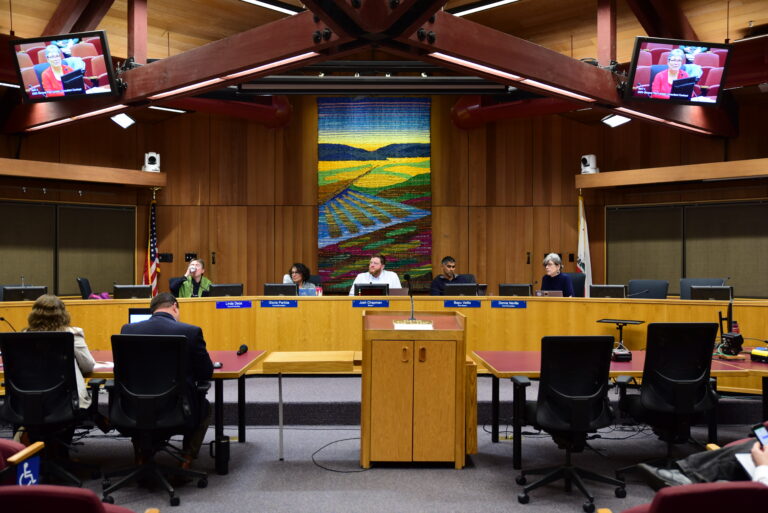
On Sept. 30, Davis City Council met to discuss policy considerations in relation to affordable housing developments and clean energy proposals throughout the city.

Community Development Director, Sherri Metzker, started off with a staff presentation. There were two topics of discussion for the meeting: funding options for affordable housing as well as climate and energy use and production.

For the first topic, Metzker highlighted that development projects and necessary improvements are not included in the current financial plan for the city. Metzker then provided three alternative solutions to the funding problem for affordable housing. 

The first would “update the fees citywide including Village Farms Davis and Willowgrove” and ensure that the new fees meet the requirements of AB 602 — a solution that would ultimately cost the city $360,000, according to the presentation

The second alternative would “create a fee program focused only on Village Farms Davis and Willowgrove” while also ensuring AB 602 requirements are met: this proposal would cost the city $185,000. 

The final alternative would “require either: payment of fair share costs, or payment of total cost with reimbursement,” giving the staff the opportunity to use “their professional judgement.”

The staff recommendation was the second alternative. The rationale for the recommendation was that it would reduce the cost and was able to be shared by multiple applicants.

Katie Dooley-Hedrick, a mother of two Davis Joint Unified School District (DJUSD) students, strongly supported the Village Farms development project.

“Davis is in desperate need of additional housing, and this development offers a thoughtful proposal that stays true to Davis community values,” Dooley-Hedrick said. “The public must have the opportunity to vote on this matter in June of 2026.”

For the second topic of discussion, the council highlighted the importance of investing in renewable energy programs in the city. 

The solution included a development of a microgrid program, which is a self-sufficient energy system that serves a discrete geographic footprint, according to Microgrid Knowledge.

The presentation shared that, in partnership with Valley Clean Energy, the city can begin to create a plan to “establish community microgrids and community battery storage cooperatives.”

The staff also recommended three options, but supported the first idea: which would include deferring the microgrid concept until the general plan is completed and not vesting any rights regarding the microgrid in the development agreement.

Davis Mayor Bapu Vaitla, expressed what the focus of the meeting’s discussion on the climate resilience topic should be. 

“I frankly think that from a financial perspective — requiring a full microgrid for all units on both developments — is just not feasible,” Vaitla said. “I would rather think about a discussion that focuses on giving some direction to staff about how we, as a council, are thinking about climate resilience in respect to these developments.”   

The meeting then opened to a public comment.

Lorenzo Kristov, a community member who has lived in Davis since 1987 and served eight years on the City Utilities Commission, urged the council to not approve the staff’s recommended energy plan. He calls the recommendation from staff “a big mistake.”

“Locally owned and operated clean, resilient energy sources are urgently needed to meet today’s climate volatility, affordability and energy justice challenges,” Kristov said. “It’s up to cities, given our political climate, to be the leading actors for local energy concerns now. Whatever your concerns are about the cost of acting, the costs of not acting will be much greater.”

Ari Halberstadt, a community representative for Valley Clean Energy, shared his opinion on the plan.

“Davis has multiple opportunities to integrate local energy, […] deferring action would miss the opportunity and result in avoidable burdens being needlessly placed on residents and businesses,” Halberstadt said.

Halberstadt also offered another solution.

 “The city should explore the creation of a greenfield municipal utility to provide electricity,” Halberstadt said. “It could save $36 million in transportation costs […] [and] it can reduce emissions by 90%.”

Ultimately, the City Council did not support the options for the Climate Action plan and urged for another discussion at a later date. More updates will be available at the upcoming Oct. 21 City Council meeting.

Written By: Katya Oks — city@theaggie.org

UC Davis-designed payload to be launched into space this November

UC Davis team partners with Proteus Space to send the first-ever satellite equipped with a digital twin into orbit 

By EKATERINA MEDVEDEVA — science@theaggie.org

When is your computer battery going to fail? Most people wouldn’t know an answer to this question — it could be in two years or two weeks. The most damage that you would incur if it were to suddenly fail would most likely be a couple of hundred dollars in expenses and maybe some missed assignments in the time it takes you to replace it.

  However, in systems of greater scales where the stakes are much higher — in satellites, for example — knowing the answer to this question is crucial, and so is figuring out how one can adapt the manner in which the battery is used to address anomalies and prolong its performance.

This is where digital twins come in. The idea behind a digital twin is to create a virtual representation of the battery. The collected real-time data — such as electrical data (i.e. voltage), thermal data (i.e. cell temperature), performance metrics (i.e. energy efficiency) and environmental data, coupled with predictive models — enables monitoring of the physical battery’s health and performance, along with forecasting of its future conditions, according to an Amazon Web Services for Industries blog post

Over the past year, a group of four graduate students at the Center for Space Exploration Research, led by Stephen Robinson, a professor of mechanical and aerospace engineering, along with Associate Professor Xinfan Lin, whose laboratory researches intelligent battery systems, collaborated with Proteus Space on a United State’s government-sponsored project to launch a satellite with a digital twin payload of the satellite’s battery.

“This project is the first time, at least publicly, that a digital twin has been flown in orbit,” Adam Zufall, the coordinator of the project on the UC Davis side, said.

Jackson Fogelquist, an UC Davis alumnus with a Ph.D. in mechanical and aerospace engineering, and Ayush Patnaik, a third-year Ph.D. student in Lin’s lab, developed algorithms of the digital twin that combine physics-based mathematical and data-driven empirical models to simulate the behavior of the battery. The team also includes Ansha Prashanth, a master’s student in computer science, who created the software to gather the battery data and allow the payload to communicate with the satellite. 

“Oftentimes the power system is the determining factor of how long the spacecraft is going to last in orbit,” Zufall said. “So, if you can do a better job at managing your batteries by making better predictions and models, you will get more value out of your spacecraft, which is why we created this digital twin. But, in theory, it could be applied to other parts of a spacecraft as well.”

The payload harnesses machine learning capabilities in order to make a more dynamic model of the battery that learns from collected data over time, changing the weights it assigns to different factors and its calculation methods, resulting in more informed and accurate predictions about potential problems.

“The spacecraft was just handed over to the launch provider [two weeks ago], which is an exciting time,” Zufall said. 

For the past four months, the spacecraft, which carries multiple commercial and research payloads along with UC Davis’ digital twin, underwent various kinds of tests, including environmental, vacuum and thermal testing to ensure it will survive its ride up to the orbit and will be able to operate in space as designed.

The launch is now scheduled to take place in November from the Vandenberg Space Force Base. The outcomes of this project have potential for applications to power systems beyond satellites, and the project itself is a testament to the fruitfulness of partnerships between researchers and enterprises. 

“All the technologies we are working on, especially on the battery modeling side, could actually be useful for people working on electric cars, electric aircraft[s] — really anything with a rechargeable battery that could have higher levels of performance,” Zufall said. “I think it is a very good example of how universities and private companies can partner together. […] The U.S. government has a few different funding opportunities to support activities just like this, and I think it works well when you have universities doing science, because that’s what we like to do — we like to do things that people haven’t done before — and then have private companies use their resource of professional engineers to build a product.” 

Written by: Ekaterina Medvedeva — science@theaggie.org