57 F
Davis

Davis, California

Monday, December 22, 2025
Home Blog Page 216

Graduate students present research projects at the UC Davis Grad Slam Semi-Finals

UC Davis graduate candidates compete for a chance to represent UC Davis at UC Grad Slam Finals

By MAYA SHYDLOWSKI — features@theaggie.org  

You’re up on stage in front of a crowd of eager students who are ready to absorb all that you have to say about your life’s work thus far. There are judges, academics, peers, people who might know more about your topic than you do and friends cheering you on in the back. 

No, it’s not a TED Talk. It’s the UC Davis Grad Slam. And maybe it’s not your entire life’s work, but it is what you’ve dedicated at least four — and in many cases six — years of study to. And it’s probably similar to what you’ll be spending your career doing. 

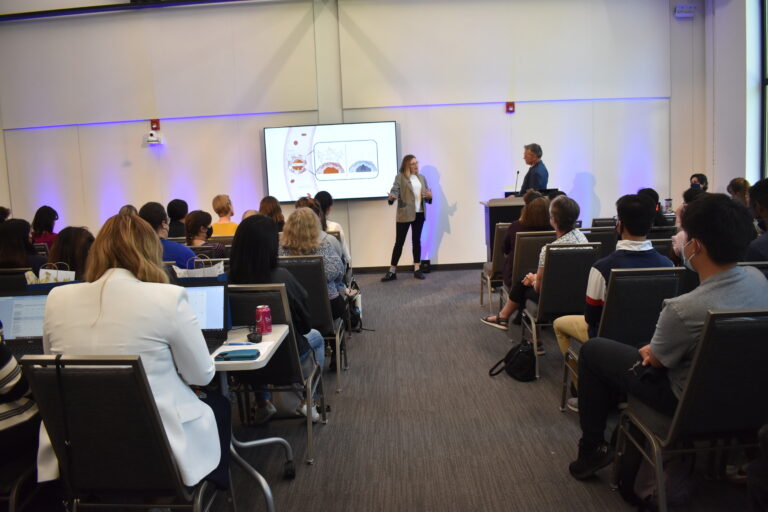
On Wednesday, April 6, 10 graduate students stood in Walker Hall in front of judges and supporters to give three-minute speeches meant to encapsulate the progress and impact of their research thus far in their respective graduate programs. 

According to the UC Davis Grad Slam website, contestants are judged on three criteria: audience engagement, effectiveness and focus of their presentations and ability to communicate their concepts.

Out of the 10 contestants, five prizes were awarded: first, second, third, people’s choice and the public impact prize. Only the first-place winner advanced to the University of California Grad Slam, but all five winners took home monetary prizes.

Alice Dien, a third-year Ph.D. candidate in biological systems engineering, received the $2,500 first place prize and the $500 public impact prize for her presentation on the innovation of drying in agriculture to reduce energy use and food loss. She will also advance to the UC Grad Slam, where she will compete for additional awards. Savannah Free, a second-year Ph.D. candidate in integrative genetics and genomics, was awarded $1,500 as the second place winner for her speech on the interaction of tumor cells and blood platelets in cancer research. Paige Kouba, a fourth-year Ph.D. candidate in ecology, received third place and a $750 award for her work looking at the effects of different carbon dioxide levels on trees to simulate future climate changes. Andrea Guggenbickler, a first-year Ph.D. candidate in public health sciences, received $500 as the people’s choice winner for her presentation on how more comprehensive sex education can improve public health and reduce the risk of teen pregnancy.

Dien had one thing that the other winning contestants did not: no experience with public speaking. Free and Guggenbickler said that they had competed in debate in high school, and Kouba had participated in theater. Dien said she was never trained for public speaking, but her confidence came from enjoying the event and being passionate about her research.

“I had rehearsed my speech so many times and tried to deliver it the same way every time,” Dien said. “But actually, it was a little bit different when I was on stage because it really came from my heart. I was just enjoying the moment and being there.”

Dien, like many graduate students, are very passionate about their research. All four of the award winners mentioned how fun it was to present their research to a larger group of people, especially people outside of their fields of study. 

I have always wanted to give a TED talk,” Kouba said. “I think about how exciting it would be to pitch your biggest, best idea or the thing you’re most excited about. I actually ask that of my students a lot, like, ‘What would you talk about if you had the stage for just three minutes?’ So I was kind of putting my money where my mouth is.”

However, Free said that one of the biggest challenges for many of the graduate students who are preparing their talks is taking the technical jargon from their research and translating it into words that the majority of a university-level audience would understand. 

“As graduate students, we get kind of bogged down in the very minute technical details of our work,” Free said. “It’s good sometimes to come up for air, and take a look at your work from an outside perspective.”

Not only did the graduate students need to translate their research, but they also needed to do that within a three-minute speech, which Kouba said proved to be challenging since she could go on for hours about her work. 

The question of how to tell such a big, global-scale story with such a short time frame was a real challenge at the start,” Kouba said. 

Additionally, the presentations needed to be polished. To enter the competition, each contestant submitted a video recording of their speech. The top 10 students were selected and given feedback for revision. Then, they were able to have a one-on-one mentoring session in which their presentations were further critiqued. 

Dien said that she initially had a slide with multiple images that she wanted to use to illustrate the broad range of products that require industrial drying in agriculture. The judges told her that an elaborate slide would cause the audience to focus on the screen behind her, rather than the content of her speech, so she would have to go without it.

Similarly, Guggenbickler said that she practiced her speech endlessly to make sure that the audience could focus on her content rather than any mishaps in the delivery.

“I wanted to sound confident and knowledgeable because I feel like people are more likely to listen to what you’re saying if you’re delivering it in an impactful way,” Guggenbickler said.

The first step was drawing in the audience. Some topics were immediately relatable to the audience, like Free’s research on cancer or Guggenbickler’s research on sex education. Others had to be more creative with their approach. 

Dien said that not everyone knows how important industrial drying is in food systems, so she started by talking about the increase in energy prices. This has raised the cost of drying staple crops like grains and nuts, which could eventually lead to higher prices for these pantry staples. With other options for drying, energy use can be reduced, limiting how energy supply and demand impact the cost of food.

How these important scientific discoveries and innovations are communicated to the public is critical, Free said. 

“I kind of came into the competition thinking that everybody is familiar with cancer,” Free said. “Everyone knows someone who has had cancer, so everyone’s going to have a basic understanding. But even if that’s true, people usually have a more clinical understanding or general understanding. They might not have a very biological understanding.”

The UC Grad Slam aims to allow graduate students to develop their communication skills and engage with a larger community. Each contestant also has the opportunity to describe how their research affects the larger community. Four of the 10 students who presented at the UC Davis Grad Slam were acknowledged as Global Education for All recipients, a designation awarded to research that has a global impact. 

“I like to think I can touch everyone’s life with this,” Guggenbickler said about her work on improving sex education. “And that’s the goal, right?”

For many, the impact of their research has started with their own story. Kouba remembers growing up climbing Douglas fir trees with her sister — now she’s studying how they’ll fare in the future. Free found cancer research to be a “puzzle” that has affected most people’s lives, including her own. Guggenbickler said she grew up in a small town where sex education consisted of two sessions between middle and high school; now, she says she wants to be the one to destigmatize talking about sexual health for future generations. 

Dien is passionate about reducing food insecurity, so she chose to focus her research on  one of the biggest causes of food loss and energy use in agriculture. She said that she plans to bring her best to the UC Grad Slam final on May 6 where she’ll be representing UC Davis.

“It’s exciting, but it’s also a lot of pressure,” Dien said. “I entered into the competition thinking I’m just going to share my research, and now I’m representing UC Davis.”

You can find a recording of the UC Davis Grad Slam semi-finals online and tune in on May 6 to watch the livestream of the final UC Grad Slam on their website.


Written by: Maya Shydlowski — features@theaggie.org

Guest column: To pay or not to pay?

By PAUL MEDVED — pcmedved@gmail.com

You may have heard about two proposed referenda to re-formulate the SASI and CEI student fee initiatives. Those are the initiatives jointly approved by UC Davis students and the Regents decades ago to support and protect in perpetuity a number of programs important to students. By far the largest of those was Intercollegiate Athletics (ICA). Since then, and in the name of the SASI and CEI (as well as that of the related FACE initiative), hundreds of millions of student fee dollars have flowed into ICA over the years. Last year alone student fee support of ICA totaled $25 million — nearly five times what the university itself kicked in. As a result of this secure source of funding and the educational (“teacher/coach”) model the program was founded upon, Aggie Athletics became a great and rightfully prideful example of how to do intercollegiate sports right — even and especially at the NCAA Division I level where the business model of college sports, along with its many bad actors, reigns supreme.

But beginning a little over a decade ago, after a change in campus leadership, something began to go terribly wrong. In direct violation of the CEI, four ICA sports that students were paying millions to protect were suddenly eliminated. ICA coach contracts, which had always required Aggie coaches to lecture (primarily PE classes) part time, were modified from a 50/50 split to 35/65 to emphasize their role in athletics over academics and, conveniently, reduce the university’s share of the cost of the SASI partnership. Incentive bonuses based on athletic performance began appearing in ICA coach contracts. In the dead of night, admissions procedures governing Admit By Exceptions (ABEs) were subverted by one of the six individuals to serve as the athletics director in the past dozen years, and the number of athletics ABEs spiked. 

Consistent with her role as Faculty Athletics Representative (FAR) the FAR brought a number of concerns to the chancellor’s attention, whereupon she was dismissed as FAR and promptly replaced with a new individual apparently more to her liking. This, along with the resignation of a long-serving Director of Athletics and a concurrent “Strategic Audit” of ICA commissioned by the chancellor led the UC Davis Academic Senate to appoint a Special Committee on Athletics whose full report was published in the spring of 2012. Sadly, the Special Committee’s report, along with the context it provides and the recommendations it makes, has been largely forgotten in the subsequent turmoil and turnover at the chancellor level.

Then there was the little matter of the university quietly diverting several million dollars of the students’ SASI fees to pay for coach lecture time (in addition to their coaching time), which prompted Campus Counsel’s office to later opine: “…use of these fees to pay for academic programs including lecturer salaries would be highly discouraged and that a student referendum designating funds for an academic program would not be approved by OGC or the Regents.” Apparently it was more convenient for campus administrators to ask for forgiveness than permission. A few years later ICA would awake one morning to discover it had drifted out of compliance with Title IX — both a matter of law and the CEI — and had to add two new women’s sports (neither of which was women’s rowing, which had been eliminated in 2010).

But the final blow came in 2020 when the May administration, whom many had hoped would restore ICA to its principled past, suddenly and unilaterally eliminated the PE program — the academic component of the teacher/coach model — in its entirety. That shocking decision, over the objections of nearly everyone who has ever cared about any of this, not only obliterated the last of ICA’s foundational teacher/coach model and the very thing that tied Aggie Athletics to the university’s academic mission, meant that for the first time in nearly a century UC Davis students no longer had the opportunity to enroll in credit-bearing PE classes taught by ICA coaches. Chancellor May laid a capstone on it all when he said the quiet part out loud — suggesting what’s really important is the role Aggie sports play in promoting the university’s brand. That’s a far cry from where this all began.

To be clear, Aggie student-athletes themselves are not in any way, shape or form responsible for any of the aforementioned misdeeds. And, as an enthusiastic fan and supporter of Aggie Athletics for many years and the parent of a former Aggie student-athlete, it gives me no pleasure to be writing any of this. But, to borrow a line from Bernie Sanders: enough is enough. Even former Chancellor Larry Vanderhoef was disturbed enough to break his silence and write about it shortly before his death in his 2015 memoir “Indelibly Davis”. 

That all these things and more have happened is beyond dispute, though campus admin and UCOP have their own ways of describing them. But no matter who you believe or what you think of Aggie Athletics the essential questions would seem to be these: In light of current circumstances, should students or the university itself be the primary funder(s) of ICA? And, either way, shouldn’t today’s students have the right to revisit decisions made by their predecessors decades ago that were based upon promises the university no longer has any intention of honoring?

Now would be a really good time to share your thoughts on all this with your elected leadership (president@asucd.ucdavis.edu and senate@ucdavis.edu).

Written by: Paul Medved ’78

Disclaimer: The views and opinions expressed by individual columnists belong to the columnists alone and do not necessarily indicate the views and opinions held by The California Aggie.

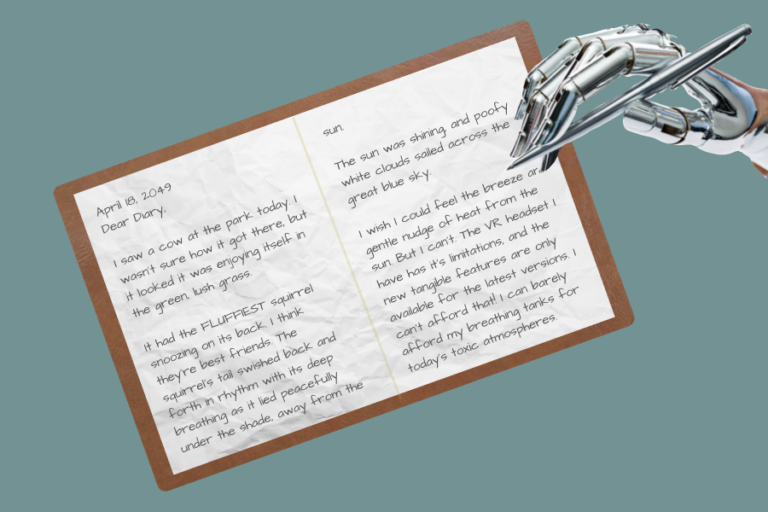
A case for journaling

Everyone should give expressive writing a try 


By OWEN RUDERMAN — opruderman@ucdavis.edu 

I’m willing to bet that most students at UC Davis write on a daily basis. Texts, academic papers and discussion posts are a few of the most common forms of writing for us. But those are all for school or for other people. When was the last time you wrote for yourself?

In the past, I’ve attempted to keep a journal. I tried to write by hand in a little notebook or to keep my feelings on a Google Doc. I even tried to record myself talking as a way of cataloging my thoughts. But none of it stuck.

This quarter, I started to keep a journal again, and I’ve finally figured out the trick: Just write. I know that sounds obvious, but in the past I had specific expectations about what sort of things I was supposed to write about, and for how long, and when and where. I realized that the content of your journal can be about anything. It can be as much or as little as you want. It can be composed at any time of the day, and it can even be revisited only once or twice a week. At the end of the day, there is no word count requirement for your journal, no deadlines. It’s just for you.

As I wrote in my journal, I began to notice a subtle shift in the way I viewed myself. Now that my thoughts were more organized and I could read them over, I began to know myself better. Journaling has allowed me to think more clearly about my stresses and issues.

I also began to develop healthier habits with writing. Now that I have rid my mind of all expectations about what journaling is, I am free to do whatever I want with it. Whenever something pops into my head that seems like an insight into myself, I quickly write it down in my notes app. I’m more in touch with myself than before, and it’s only been a few weeks.

Additionally, I’m getting the opportunity to flesh out my creative side. Before I started my journal, thoughts would come and go throughout the day without much of a filter. I had no interest in catching the good ones and storing them away for further use. But now that I’ve begun to listen to myself more, it’s easier to come up with ideas for various stories and projects.

For some, the journal might become more like a diary. For others, it may become an incubator for ideas. For others still, it may look like a fusion of both or something entirely different. There are no downsides, no judgment. It’s just a risk-free way of talking to and getting to know yourself.

There are a lot of stresses and anxieties that come along with college life. We aren’t sure what we’re doing or what the future holds, confusing things happen, classes are hard and sometimes it feels like everything is falling apart. I truly believe that keeping a journal can help one work through these feelings.

But don’t take my word for it. Expressive writing can quite literally heal you, according to a study. This research suggests that writing about emotions and stress can boost your immune system. Another study states that expressive writing can boost your IQ and self-confidence.

I can’t recommend journaling enough. Next time you feel like you just need to vent, consider picking up a pad of paper or opening your notes app. Remember: Just write.

Written by: Owen Ruderman — opruderman@ucdavis.edu 

Disclaimer: The views and opinions expressed by individual columnists belong to the columnists alone and do not necessarily indicate the views and opinions held by The California Aggie.


What is the right amount of failure?

A discussion on how failure contributes to learning and success


By ALEX MOTAWI — almotawi@ucdavis.edu


We hear it all the time: “Two steps forward, one step back,” “For every good idea there are thousands of bad ones” and “Nobody succeeds on their first try.” What I want to ask first: Who is “nobody” and how can I emulate them, and second: Are all of these sayings really true? As we all know, failure is a part of life experienced by everybody, but does it inhibit or accelerate learning? Does failure make people give up or try harder? How does failure shape me as a person, and how much of it is healthy? We spend an awful lot of time talking about the thing we try to avoid most, but I believe that failure is better for us than we think — in small amounts.

In my opinion, it feels like we do need to fail a bit in order to push ourselves to do better. If everything I did resulted in a resounding success, I think I would stop trying as hard and put less effort into my next projects. Even if those next projects are still successes, maybe I would stop innovating and trying new things and instead just stick to what’s working versus improving for the future.

We see this in competitive sports all the time. Professional sports call it a “hangover,” referencing the fact that teams often falter the season after winning it all (or getting close). Whether it’s because the athletes got complacent due to constant success or burned out from committing the extra hours it takes to be the best, it’s a real phenomenon. Maybe the real advantage for the future goes to the teams that are hungry to do better after failing in the largest moments of their lives the season before.

However, constant failure definitely doesn’t feel like a recipe for success either. Consistent failure can just feel so degrading that it gets hard to stay committed. It makes people (myself included) feel like they just aren’t cut out for the task in the first place and that their time would be better spent somewhere else.

It makes sense that there is a certain “Goldilocks” zone where we succeed enough that we are inspired to keep working but also fail enough that we are hungry to fix our mistakes and understand that there’s always an open avenue for improvement.

Thankfully, this is a question science is trying to answer. It seems like there really could be a certain wheelhouse where failure is present but not denigrating, and current research points toward following the “Eighty Five Percent Rule for optimal learning.” The rule states that the theoretical best failure rate for learning is a failure rate of 15.87%. If you love doing experiments and deciphering math, there are plenty of proofs in the breakthrough study, but for someone like me who generally trusts in science along with his gut, a failure rate of around 15% just feels right. 

Now before you go parroting this “magic number” around to your friends, understand that it’s calibrated more toward things like learning math and not the reason why you are having a hard time finding a date. However, a similar theory does apply to teaching 7- to 8-month-old infants and has been a part of learning strategies without being scientifically known for ages.

With all the nerd stuff out of the way, does that mean getting a B (or anywhere around 85%) in my college class means I’m doing the best learning? And if it’s the best learning, shouldn’t it just be an A instead? Well, our college classes have a lot of variables, so that doesn’t quite check out. You aren’t going to be able to change the minds of your teachers with it, but maybe it can provide solace to all of our struggling GPAs.

If you are acing all of your homework and exams, then it’s simple to say that you might learn better if you had more of a challenge. If you are scoring around the B range on these sorts of assignments, bask in the glory of knowing that you are experiencing optimal learning right now!

In the end, it does seem like failure truly does contribute to success and that it’s been researched a lot more than one might think. The most common proverbs about failure aren’t perfect, but their words do have some wisdom after all.


Written by: Alex Motawi — almotawi@ucdavis.edu

Disclaimer: The views and opinions expressed by individual columnists belong to the columnists alone and do not necessarily indicate the views and opinions held by The California Aggie.


As more visitors come to campus this Picnic Day, the Editorial Board shares what makes Davis special

There are so many things to celebrate about UC Davis and the city of Davis


As prospective students are starting to affirm their decision to attend UC Davis and Davis residents are looking to attend an event as the weather warms up, we expect to see a lot of new faces at Picnic Day — people who perhaps do not know much about our campus or even the city itself. With that, the Editorial Board would like to welcome all of you to the lovely city we call home.

Picnic Day is a time when the city of Davis and the university come together to showcase all the best parts of Davis. With student a capella groups performing throughout the day, sheep mowers prancing through the streets in the parade and diverse dance groups hosting the annual Davis Dance Revolution, there is no doubt that those new to Davis will get a taste of what it is like to be a student here. 

But Davis is more than what can be seen on Picnic Day. Although Davis may seem isolated and in the middle of nowhere — a “cow town” if you will — we have grown rather fond of our small, quaint college town. For some members of the Editorial Board who have grown up in bustling cities, this environment is a nice change of pace and an opportunity to have the quintessential college experience. 

Downtown Davis is as close as you can get to the embodiment of a college town; filled with homey coffee shops, locally-owned restaurants and small businesses, the streets are always packed with students. The farmers markets attract the attention of not only those from UC Davis, but the entire Davis community as local farmers sell fresh produce and food trucks give customers something to munch on while chatting on the Central Park lawn. 

 One of the perks of being a student in such a small town is how easy it is to commute. UC Davis is known for its bike culture, with many students choosing to bike to class or around town. It is not uncommon to see a professor wearing a suit and carrying a hefty backpack biking through campus amid a crowd of students. Downtown Davis is also just a short walk off campus, and students can utilize our university bus service, Unitrans, for further distances. 

Here at UC Davis, you can get involved in just about anything you want to. Want to learn how to make coffee? Take ECH 1. Love fungi? Consider joining the Swett Lab. Want to dip your toe into improv comedy? Go watch a Birdstrike Theater performance. There are research labs in just about any subject and clubs catering to a wide variety of interests. Although it may be overwhelming with so many options to choose from, it’s relieving to know there’s always something you can get involved in once you figure out what you want to pursue. 

Aside from Unitrans, there are myriad services that students can use to their advantage. The Pantry provides free produce and other basic necessities for students. Throughout the pandemic, our COVID-19 testing site at the ARC has been an efficient and convenient resource for both students and other Davis residents to minimize the spread of COVID-19.

While the members of the Editorial Board each have their own favorite parts of Davis, we all agree that what really makes our campus special are our very own Aggies. The welcoming atmosphere of Davis is largely set by the many kind, friendly and inspiring people in our community. So whether this is your first time coming to Davis or if you’re a Davis resident who doesn’t frequently visit our campus, we hope all of you enjoy your time here as much as we do. 


Written by: The Editorial Board


UC Davis’ offensive struggles end in sweep at the hands of CSU Northridge 

The Aggies offense continues to leave runners on base, losing five of their last six


By MARLON ROLON — sports@theaggie.org


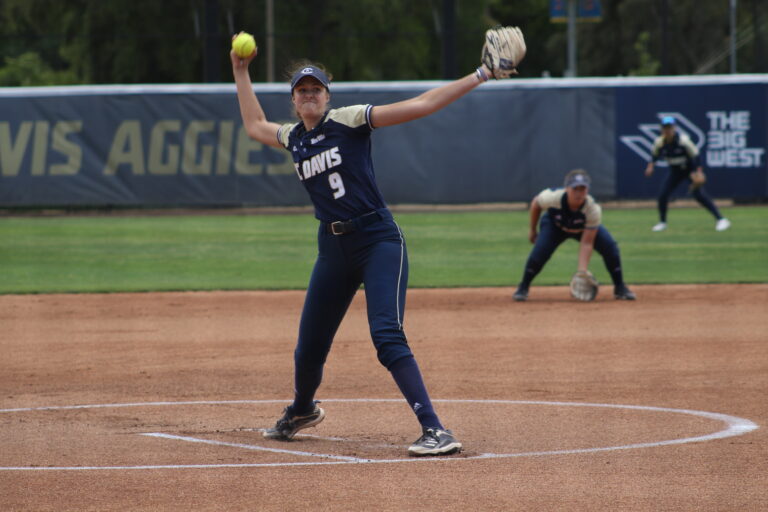
Starting pitcher Kenedi Brown struggled on the mound, allowing three runs off four hits with four strikeouts throughout seven innings in game one of the double header against Cal State Northridge last Friday afternoon at La Rue Field. The offense attempted to help out their pitcher, generating hits but struggled to bring runners home, ultimately falling 3-1 and 7-2 in game two after allowing five runs in the seventh inning. 

“I don’t think today was [Kenedi Brown’s] best performance, but overall she’s done nicely in progressing,” said UC Davis Softball Head Coach Erin Thorpe. “It’s tough because we haven’t had a ton of offense behind her. She’s having to really work in that zone knowing that may happen.”

Opportunities came in the second inning for UC Davis after senior infield slugger Delaney Diaz doubled to left center field, advancing Libbie McMahan to third until she was called out attempting to cross home plate. A few plays later, first-year Reese Mattley reached second base while Diaz advanced to third only for them to be stranded after third-year Alyssa Ito hit a pop up fly to end the inning. 

Trouble started for the Aggies in the top of the third after Brown walked a batter, allowing  two hits, a home run and three runs scored. 

“The 12 losses is not indicative of how well she’s pitched this year,” Thorpe said. “She’s doing a nice job of keeping a level head with that and having that understanding, and I think she’s doing a really nice job adjusting now into her second season of playing”.

UC Davis’ only run came in the bottom of the third off an RBI single by McMahan that brought sophomore Anna Dethlefson, who was previously hit by a pitch, across home plate. The inning ended with two runners stranded on base, a common occurrence that has plagued the team throughout the season.

The Aggies left six runners in scoring position in their 3-1 loss. In total, they had four- hits throughout the contest and their best hitter, Dethlefson, was 0-3 at bat.


Game 2

Second-year pitcher Taylor Fitzgerald (4-6) started the game on the mound for UC Davis. The second-year was off to a rocky start within the first three innings, allowing six hits, including a home run and two runs scored. 

The Aggies offensive woes followed them early into game two, mustering only one hit throughout the first three innings. If they were going to be competitive, the pitching was going to have to be stellar to make up for the lack of hits early in the ball game. 

That is when second-year Fitzgerald stepped up, keeping CSUN hitless from the fourth through the sixth inning. 

“I thought she did well,” Thorpe said. “She’s come off a couple of tough performances, and it was really good to see her come out, struggle, but get out of some things early with minimal damage and to kind of really start to feel that flow. [It was] what she needed to do.”

Despite being in an offensive funk, the Aggies got their rhythm flowing in the bottom of the fourth when Mattley singled through the right side of the field. Diaz followed with a line drive through center field. On the next play, second-year Bella Pahulu grounded into a double play to end the inning.

With Fitzgerald in a groove on the mound, she was keeping the Aggies in the game. In the bottom of the fifth, first-year Grace Kilday made an appearance in the hit column with a single down the left infield line. Her teammate Dethlefson smacked the ball to left field, but teammates third-year Sommer Kisling and second-year Sarah Starks could not get on base prompting quick outs to leave two runners stranded. 

 Being down 2-0 in the bottom of the sixth inning, UC Davis loaded up the bases off a McMahan single, Mattley walk and Pahulu hit by a pitch. Yet, the Aggies could not bring any of them home — Kilday hitt a pop up and second-year Sarah Nakahara struck out.  

“Through six innings, we had 10 batters come up with a runner in scoring position and we got 10 outs,” Thorpe said. “So it was kind of one of those things where we have the right people up in the right situations and today was not their day.”

Fitzgerald could only keep the CSUN’s dormant offense at bay for so long. In the top of the seventh, the second-year pitcher succumbed to the Matadors’ potent offense, allowing three hits and three runs.

Still in the same inning, the bases were loaded when UC Davis coach Thorpe decided to make a pitching change after a five score barrage. Second-year pitcher Sara Reineman came in relief to close the inning. 

Instead of going out quietly, the Aggies’ infielder Kisling smacked the ball down the right field line to get the offense going. Her teammate infielder Starks followed through with a powerful swing that sent the ball deep down into the infield line, giving enough time for Kisling to reach third base. After a pair of hits by Mattley and Diaz, the home team was finally able to cross home plate scoring two runs in the bottom of the seventh.

It was too little too late as CSUN closed the show, 7-2, winning the double header Friday afternoon.


Game 3

In a close game, a home run in the fifth inning proved to be the difference in concluding the Big West Conference series between UC Davis and Cal State Northridge. 

The Aggies started Kenedi Brown on the mound, looking to stop the team’s two-game losing skid. Brown got off on the wrong foot when CSUN’s Alexis Lemus crushed the ball out of the ballpark. 

The second-year pitcher continued her slump in the second inning after Alexa Landeas tripled deep into center field. Then Brown proceeded to walk two consecutive batters, loading up the bases that eventually led to two runs off of two hits. 

Aggie slugger Dethlefsen answered back with a single to left field. Starks would send her teammate to third base off a single to the right side of La Rue Field. Dethlefesen would cross home plate after an RBI from Mattley who has been consistent on the plate throughout the series for UC Davis. 

The bottom of the second inning came to an end when Ito grounded out, leaving two Aggies on base, again wasting scoring opportunities which has been the theme in this series. 

However, the offense reemerged in the fourth, the home team scored twice off three-hits from Ito, McMahan and Diaz evening up the score 3-3.

However, the tie didn’t last very long. In the top of the fifth, Brown recorded two easy outs and allowed a homer that saw the ball fly out of left center field. The home run would eventually be the difference maker in the game as the Aggies fell 4-3, getting swept in the process. 

Overall, UC Davis had eight hits in the game while leaving 10 runners stranded on base. Brown had another forgettable game, allowing five hits, six walks, four runs and struck out five batters. She fell to 11-12 on the season while the Aggies dropped to 18-21 and 6-9 in conference play.

“Not a lot of people hit Kenedi, so it’s kind of a surprise when they do. I think she really did a nice job of adjusting and working to determine what the strike zone was going to be. She did a really nice job,” Thorpe said. 


The 400 Milestone

Coach Thorpe has notched 397 wins under her coaching career. She won 50 games at Whittier College, 173 with Boise State and currently has 174 with UC Davis. While at Boise State, Thorpe was the first ever softball coach in program history, leading the Broncos to 30 win seasons three times.

“I think it’s awesome, it’s important for coaches to celebrate those milestones. All that really tells me is that I’m old,” Thorpe said. 

Thorpe was hired in the summer of 2014 as the UC Davis softball head coach. She was brought in to change the culture within the program. In 2018 she did just that, leading the Aggies to their first winning record in 11 years (27-24). In 2019, she led them to an impressive 39-14 record. 

“I kind of assess it in a different way, and I’m kind of a coach that’s gone into programs that were struggling; that’s been my M.O. or starting programs from scratch,” Thorpe said. “I’m not chasing wins in the jobs that I choose to take; I mean that’s awesome, and that’s great, and I think it should be celebrated. If you ask me, I should’ve been there a long time ago, but it is kinda cool to know.”

With 13 games left in the season, the odds are in favor for coach Thorpe to secure her well deserved 400th career win. 


Big West Conference

The end of the season is approaching, UC Davis (6-9) is sitting in the seventh slot in the standings. Cal State Fullerton (12-3) is in first, Long Beach State (12-3) is in second, Hawaii (9-6) sits in third, Cal Poly (9-6) is in fourth, UC San Diego (8-7) is in fifth and UC Riverside (7-8) is in sixth. CSU Northridge (6-9), UC Santa Barbara (3-12), and CSU Bakersfield (3-12) all sit behind the Aggies in the standings. 

The Aggies play Cal in Berkeley (4/19) in a non-conference game. They end the season against conference foes such as San Diego, Santa Barbara, Cal Poly and Hawaii. UC Davis can still finish within the top three but they must win the series against their conference opponents. 

“It’s one of those things were we got to keep them focused on continuing to get better and fighting, and a lot of it is going to come from inside them as a group as well and their belief in each other; learning and understanding of what they’re capable of and believing in that and then going out and playing a little more confident,” Thorpe said. 


Written by: Marlon Rolon — sports@theaggie.org


Study finds gaps in demographic data collected by STEM organization surveys

The study, led by a UC Davis postdoctoral student, found that many organizations lacked data on employee demographics, especially on sexual orientation and disability status


By SONORA SLATER — science@theaggie.org


Professional science, technology, engineering and mathematics (STEM) organizations are at times ineffective in their collection and application of data from demographic surveys, according to a study published on March 31 in Science. 

The researchers surveyed 164 U.S.-based STEM organizations, 73 of whom responded, according to a recent press release about the study. Each organization was asked about the categories of demographic information they collected on members and conference attendees, the range of answer options available for each category and what they did with the data they collected. 

Nick Burnett, the lead author of the study and a postdoctoral researcher in the Department of Neurobiology, Physiology and Behavior at UC Davis, said that they did see disparity between categories of collection — while 60% of respondents reported collecting at least some information on gender identity and race and ethnicity, only 15% collected information on disability status and sexual orientation.

“This data can equip [organizations] to know [their] membership, recognize them and give them the resources to make their experience in STEM better,” Burnett said. “The other part is […] you need to be able to collect this information to identify these groups that are currently overlooked so that you can provide them with tailored resources.”

Emily King, the research coordinator for Biology Scholars at UC Berkeley, explained how the concept of resource allotment might be applied to demographic data.

The resource I think about a lot is time,” King said. “If you think about conferences, specifically, [there is] an overlap in events that are pertaining to various aspects of diversity or inclusion, with the most important science talks of the event. So attendees are like, well, do I go to the thing that is supposed to advance my career, or do I go to the event that might make me feel more well-supported in this group of scientists?”

King went on to give another example of how knowing demographic information about employees can help organizations supply resources accordingly.

“If a society knows, we have a large proportion of folks in our group who are deaf or hard-of-hearing, can we figure out how to already provide sign language interpretation without individuals having to ask for it?” King said. “I think there’s room for seeing what we can offer to people up-front, because we did the legwork already; we know who’s in our group.” 

King acknowledged that some of these solutions for accommodation are expensive, but said that they’re easier to justify when organizations can quantify what percentage of their groups would benefit from them. 

Alyssa Hernandez, another researcher who worked on the study, offered more ways consideration can be given by organizations to venues and events, as well as general accessibility to the STEM community.

Are your events accessible to those with physical disabilities?” Hernandez said via email. “What about members who may require child-care? […] Mentoring programs and scholarships are [also] a great way to provide better access to a broader STEM community.”

Hernandez went on to say that improving survey accuracy and inclusion is one way for STEM organizations to live out mission statements that often emphasize innovation — according to Hernandez, bringing a diverse set of “experiences and ideas” into a field is one of the best ways to put an emphasis on innovation into practice. 

She also said that diversity can encourage scientists who are minorities by allowing them to see themselves represented in leadership or conference speakers. 

“Whether it was hearing a particular speaker at a conference or meeting someone who would eventually serve as a mentor, it was seeing these similar experiences expressed openly that really allowed me to push through some of the harder moments,” Hernandez said. “It was very much an ‘if they can do it, so can I’ sort of moment, and I think that having these relatable moments is important for those of us who may not see these similar stories at our universities or company spaces.”

Burnett clarified the purpose of the paper, saying that overall, it is meant to be more of a commentary than a criticism.

“We’re holding up a magnifying glass to how STEM thinks about diversity,” Burnett said. “It’s not a study on just surveying techniques, but it’s a survey of attitudes towards diversity — that’s what we are wanting to change or improve within STEM.”

King said that to her, the biggest purpose of improving surveying is just for organizations to recognize and acknowledge the diversity within their ranks. 

To me, it boils down to this,” King said. “You can’t help folks if you don’t know that they’re there.” 


Written by: Sonora Slater — science@theaggie.org  


The unexpected journeys of WWOOF

Students tell their Worldwide Opportunities on Organic Farms (WWOOF) stories and what they learned from their volunteer experiences

By SIERRA JIMENEZ — arts@theaggie.org


Worldwide Opportunities on Organic Farms (WWOOF) has become a popular way for individuals to get outdoors and have experiences outside of everyday life during the pandemic. 

The mission statement of WWOOF is to create “a worldwide effort to link visitors with organic farmers, promote an educational exchange, and build a global community conscious of ecological farming practices.” 

WWOOF provides free experiences around the globe in which visitors work on a property in exchange for housing and food. There are currently 1515 organic host farms to choose from in the U.S. and in over 132 countries around the world.

Whether participating in the program for sustainable agriculture, to learn new skills, travel or meet new people and immerse yourself in new cultures, anyone and everyone is welcome to volunteer. 

Holly Murphy, a fourth-year environmental policy, analysis and planning major, volunteered for three weeks in the summer of 2021, using the filtering tool to search for the farm that would best fit what they were looking for. Murphy decided that they wanted a queer-friendly farm as a priority, and ended up finding the perfect spot for themself in Curtis, WA. 

Advertised as an anarchist-queer farm, Murphy joked about how “chill” their experience was because of this preliminary information. Murphy explained how the hosts were pro-fair labor and established a relationship with them with a position of “do what you can, we’re just starting out so it will be a relaxed environment,” they said. 

On a small, start-up farm, Murphy spent most of their days watering the small gardens, cleaning up forestry for an upcoming project, doing archery, learning how to make mortise and tenon joints, listening to music and podcasts and relaxing. They would start the day eating breakfast with the hosts, work through the morning and then have time for themselves the rest of the day.

“It was just really restorative,” Murphy said. 

Murphy went as far as deleting social media, dedicating their time to reading and drawing instead of the common habit of scrolling on a cellphone. Living in a tent for three weeks, Murphy was able to “scratch that itch” for the outdoor experience they were looking for without the burden of renting or buying expensive outdoors gear.

Murphy explained that their experience was a positive time of solitude and self-reflection, and would recommend WWOOF to others. The big thing they wish they did differently was having their own form of transportation to give them even more freedom for exploration. 

Additionally, they recommend talking to the host prior to committing to make sure the farm is a perfect match for you. Murphy had an interview with the host to discuss the expectations of both parties, day-to-day activities and ask questions to make sure the farm was the ideal spot for them. 

Other WWOOF-ers agree that it’s important to do your research prior to committing and departing to your chosen farm. For Allison Rose, a third-year international agriculture development major, her WWOOF experience was not what she expected. 

In the summer of 2021, Rose ended up in Laupahoehoe, a small agricultural region of the Big Island of Hawaii, for about three weeks. She initially decided on this farm as a way to be close to the ocean and in Hawaii during the pandemic. However, she soon realized that she was nowhere near the ocean, and the area where the farm was located was completely isolated. 

The host seemed to be a liberal-minded individual, which was very important to Rose, advertising organic farming and “liberal fishing,” but Rose said he ended up being completely the opposite: a Trump supporter, Rose’s worst nightmare. 

Rose said her host ended up being manipulative, making her feel undervalued and wondering “why am I being gaslighted into feeling like I owe this guy something?” She said the host expected an absurd amount of work while holding the fact that he was giving the volunteers food and housing over their heads, Rose explained.

Rose had to walk 30 minutes every day to the one cafe near the property for Wi-Fi because the host did not let the volunteers use the Wi-Fi. Rose ended up leaving early from her unexpected Hawaii getaway. 

Although Rose did not have the best experience through WWOOF, she still recommends the program under different circumstances. Rose recommends bringing a car for transportation to allow more freedom of movement. She was quite confident that her experience would be a lot better if she had a car to move around. 

She also recommends bringing a friend with you during the experience to have a buddy and have more “bargaining power and a step up” in case of a host like hers. She believes that having an open mindset and trying to get along with the other volunteers is what saved her through her unexpected experience. 

Moral of the story, make sure to do your research and talk to your host about expectations on both sides before committing, especially somewhere as isolating as an island. Also, be sure to check surrounding towns, transportation and hosts before making a final decision. 

Despite Rose’s WWOOF unexpected experience, there are lessons to be learned from those stories, and still other WWOOF-ers have had much better experiences. Abby Golde, a fourth-year animal science major, got everything she wanted out of her WWOOF experience in Devon, England, even if it wasn’t exactly what she thought it would be. 

In the summer of 2021 during the pandemic, Golde decided to pack up and leave the States to mimic a study abroad experience she didn’t get to have in her college career. Her motive to participate in WWOOF was to travel cheaply and immerse herself in a new country and culture — and that’s exactly what she got. 

In her free-time, she would travel around Europe via train, a 30 minute walk from the property, with the other various volunteers. The property always had a minimum of 10 volunteers which meant it was bustling with individuals from around the world. 

“We would have a tea break at 11 because we were in England, and that was cute,” Golde said. With group meals and constant travel buddies, her stay was very communal.

“It’s a really cool experience, especially if you are young and don’t have money. You could just fully live in somebody else’s life and experience all these things you would never be able to do, and meet all these cool people,” Golde said. 

However, from her own experience, Golde warns potential WWOOF-ers to be prepared for an experience that is different from what was described. You have to be able to be flexible and have an open mind going into the process. 

“I got fully catfished,” Golde said. “It was a little less of a farming experience… he had two cottages on the property and rented them out as Airbnbs which we cleaned for turnovers.” 

The host had advertised himself as a beekeeper with various animals and a big garden with different crops, but in actuality, Golde said there were a few sheep, a small garden and no bees. Nobody had a good relationship with the host out of frustration for his false advertising, she said.

Although Golde said her host situation was not ideal, “I met 20 cool young people, lived with them, traveled around and ended up traveling by myself afterward,” Golde said. “WWOOF totally gave me what I was looking for.” 

All individuals who have had experiences with WWOOF, good or bad, recommend this program to people thinking about volunteering on a farm. It is a mostly free way to have a place to stay wherever you are, learn about new cultures and tools and meet new people. 

All past WWOOF participants who told their stories remind potential volunteers to keep an open mind and research, research, research beforehand!


Written by: Sierra Jimenez — arts@theaggie.org


Picnic Day makes its return in person after two years of virtual celebrations

The event’s theme for 2022 is “Rediscovering Tomorrow,” a twist on the past two virtual Picnic Day themes of “Envisioning Tomorrow” and “Discovering Silver Linings”


By KAYA DO-KHANH — campus@theaggie.org


On Saturday, April 23, UC Davis’ 108th Picnic Day will be celebrated in person for the first time in two years. Picnic Day is a student-run event that serves as an open house for prospective and current students. It is a tradition for alumni, students, staff, faculty, family and the greater Davis community to gather together and connect with the university through a variety of events such as the parade, student organization fair, fashion show and doxie derby races. The schedule of events can be downloaded from the Picnic Day Website. 

The Board of Directors selected the theme “Rediscovering Tomorrow,” a twist on the 2020 and 2021 themes of “Envisioning Tomorrow” and “Discovering Silver Linings” that took place virtually due to the COVID-19 pandemic. According to Picnic Day Chair and fourth-year community and regional development major Amanda Portier, when the board was choosing a theme during fall quarter, they were inspired by the campus navigating the return to in-person activities. 

 “‘Rediscovering Tomorrow’ is really about how everyone is facing these changing times, but how we can rediscover them and make them joyful in the process,” Portier said.

Portier attended Picnic Day during her senior year of high school, which she said solidified her choice to go to UC Davis as she was impressed by the passion people expressed for the community throughout the day. She has been a part of the board since her freshman year, now serving as the board chair for her fourth year. 

“I think it’s been something that people have been holding on to, to look forward to as a sense of new beginnings and hope and looking forward to the future,” Portier said. “I think it will feel like a […] true community celebration amongst everyone, and it’s been something we’ve been missing for so long.” 

In planning the event, and knowing that it will be the first in-person Picnic Day for many, the board has focused on promoting what Picnic Day is and what can be expected from it. The board has focused primarily on connecting with the student body by depicting the planning process through Instagram and by partnering with Aggie Studios to create promotional videos. 

Picnic Day Vice Chair Jesse Goodman is a second-year economics major and will experience his first in-person Picnic Day this year. He said that Picnic Day 108 will be different from past years, as there will be a greater use of technology in the hopes of giving attendees a better experience. 

“We are having an ASL [American Sign Language] live stream for the first time, so people at the parade will be able to watch that as well as people online,” Goodman said. “All of the Aggies that can’t make it out to this Picnic Day for whatever reason will have the livestream as well. It’s something we’ve learned how to do from the past few years of remote learning.” 

Michael Navarro, the parade director and a second-year psychology and political science double major, described the parade as the kickoff for Picnic Day, with an Opening Ceremony that will include words from both Chancellor Gary May and the Parade Marshal. 

“Most of the events from previous years were virtual, but the parade was unable to occur [virtually], so that’s one of the main things I’m excited for,” Navarro said.

The Parade Marshal represents Picnic Day and is picked based on their active participation in the community, their positive impact on others and their embodiment of the theme. Professor and Senior Director of Clinical Pathology at UC Davis Health Dr. Nam Tran was chosen as the 2022 Parade Marshal.

“The thing I’m looking forward to the most is seeing our community of students, faculty, alumni and community members come together again,” Portier said. “Since the pandemic, we haven’t really had an opportunity like this to celebrate in the same capacity [as] Picnic Day.”

Written by: Kaya Do-Khanh — campus@theaggie.org


Student journalism is a privilege and a service

The Editorial Board reflects on the important role of being UC Davis’ official, student-run newspaper

With Picnic Day upon us and a notably larger community on campus this week, the Editorial Board thought now would be a perfect time to re-introduce ourselves — and highlight our work here at The Aggie. 

Everyone on the Editorial Board feels that working for The Aggie is an immense privilege that we do not take lightly. We feel honored to share stories within the UC Davis community and bring to light issues we observe. 

Being a student journalist is also a service. As students, we are often able to offer an inside perspective different from non-student-run Davis news outlets and university media. We write as the members of the community who are affected by the university’s policies and practices, and we understand the importance of holding UC Davis and its administration accountable when these policies are not just.

Student journalism is something that any student can participate in and we encourage anyone who’s interested to give it a try. Part of the beauty of many student-run publications is that you don’t have to have reporting experience or a lengthy list of pre-requisites to get started. Anyone can be a journalist, as long as you are curious and paying attention. 

Not everyone who works for The Aggie, including some on managing staff, wants to be a journalist after college either. There’s so much to be gained from working at a newspaper other than pre-professional experience; working with others, communicating effectively and looking critically at and learning about local communities are necessary skills for life. 

Acknowledging where we fall short and where we can grow is also critical. A lot of trust is placed in us to report for and about our community — by both the people who read The Aggie and those who offer their stories to our writers. We work hard to continue to earn that trust, but also acknowledge that we aren’t even close to perfect. Being journalists means constantly assessing our own biases and calling attention to how they might be present in our reporting. 

It is also clear that as much as we work to address our personal biases, a key to a strong newsroom is a staff with diverse perspectives. This is why we began releasing annual Diversity Reports in 2020 and have been working to more accurately reflect the student body within our staff. 

The Aggie is also a platform for guest opinion columns, which offers people the opportunity to share their perspective. Anyone in the Davis community can submit an opinion piece. As long as it is factual, respectful and relevant, a submission will be taken into consideration by the editorial team.

The Editorial Board wants to share how honored and grateful we are to have this platform on UC Davis’ campus and how excited we are to continue our service as UC Davis’ official, student-run newspaper. Have a fun— and safe — Picnic Day. Support your local journalists, and go Ags!


Written by: The Editorial Board


‘This just keeps happening. Over and over’: Students respond to Sacramento shooting

Students, faculty and experts speak on Sacramento shooting that killed six and injured 12 

By CHRIS PONCE  — city@theaggie.org


Content Warning: This article contains descriptions of gun violence and death which some readers may find disturbing.


On April 3 at approximately 2 a.m., police officers responded to a mass shooting in the 10th St. and K St. area in downtown Sacramento, according to a press release from the City of Sacramento Police Department. In a later press release, police stated they believe that the mass shooting, involving at least five shooters, was a result of gang violence.

 Details on the mass shooting are still limited as of April 18, the Sacramento Police Department is investigating and tracking suspects. In a press release from April 12, authorities announced a suspect they believe to be one of the 5 shooters, Mtula Payton. Payton is wanted on other violent crimes, and his whereabouts are unknown. Authorities called on the public to send them information that may assist in the ongoing investigation. 

Some Davis residents say the mass shooting has left an impact on the community. Davis sits roughly 18 miles away from Sacramento. UC Davis’ Chancellor Gary May made an official statement on April 3 via the UC Davis website regarding the shooting.

“To our Sacramento community, we offer our condolences and support,” May said in the statement. “We are all interconnected, and days like this remind us that we must do all we can to prevent gun violence. We must put an end to gun violence that impacts families and communities long after headlines turn to other global events.”

Director of UC Davis’ Violence Prevention Research Program, Dr. Garen Wintemute, also made a statement regarding the Sacramento mass shooting. According to UC Davis Health, Wintemute is a renowned expert in the field of gun violence. Wintemute commented via email on his reactions to the mass shooting. 

“[I felt] Grief for those who died, and sadness for the thousands of others who are affected: those who were wounded and survived, family members and friends of all who were shot, the many others at the scene, and people all around the world whose painful memories of their own tragedies are reawakened each time they learn of an event like this,” Wintemute said via email.

Some students on campus have also been vocal about their opinions related to the shooting. Many have expressed that it feels personal due to the short distance from Sacramento to Davis. Ava Hurley, a first-year student majoring in marine and coastal science, spoke on the shooting’s impact on her. 

It was really heartbreaking and unsettling to hear about the shooting,” Hurley said. “I think being less than half an hour away from the incident made it especially eye-opening. I feel that for myself and for other Davis students there was a personal sense of fear involved, as many of us have family in Sacramento.”

Madi Burns, a first-year landscape architecture major, shared her reaction to finding out the news regarding the shooting. Burns mentioned via Snapchat messaging that she felt desensitized to this kind of news. 

I found out about it through my mom,” Burns said. “To be honest, I’ve been a little detached from the news lately and mostly hear about it through her. It was scary to have it so close to home (being Davis)…but another kind of shameful part of me was not surprised. This just keeps happening. Over and over. I feel as though I’m being desensitized and that’s honestly troubling to me.” 

There have now been eight shootings in 2022 around the Sacramento area according to the Gun Violence Archive. Governor Gavin Newsom made a statement on the mass shooting in relation to gun violence on April 3 stating, “Sadly, we once again mourn the lives lost and for those injured in yet another horrendous act of gun violence.”

According to the Sacramento Police Department, another suspect, Dandrae Martin. was arrested for possession of an illegal firearm, and more than 100 expended shell casings were found at the scene of the shooting. Wintemute also pointed to the issue of firearms and detachable magazines in regards to the shooting.

“Mass shootings tend to involve firearms that accept detachable magazines, as was the case here,” Wintemute said via email. “They allow for a higher sustained rate of fire and more casualties. Most mass shooters—80 percent or so—make their intentions known in advance. One of the most important measures is also one of the simplest: if you see something, say something.”

Hurley spoke out about solutions to the gun crisis in the U.S.. She said she hopes that those in power stop replying with platitudes and start responding with solutions. 

“The need for increased gun control with effective and fair enforcement strategies is a necessity if we want to prevent more tragedies like what happened Sacramento and in so many other cities,” Hurley said. “I can’t imagine how difficult it is for the victims’ families to hear the phrase ‘thoughts and prayers’ time after time while there is no concrete progress in gun laws being seen. My heart breaks for these families, and I’m holding onto hope that lawmakers will start to listen and that these troubling gun violence headlines will start to lessen.”


Written by: Chris Ponce — city@theaggie.org 

If you or someone you know is experiencing a mental health crisis, a list of resources can be found at the Aggie Compass Basic Needs Center. Students can schedule individual counseling sessions through the Student Health and Wellness Center at 1(530)752-0871, text RELATE to 74174 to confidentially chat with a crisis counselor or call Yolo County’s 24-hour crisis line at 1(530)756-5000. 


Students protest in favor of masking, hybrid learning

The rally organized by Davis Socialist Association and Cops Off Campus demanded accessible education through masking and hybrid learning

By JENNIFER MA — campus@theaggie.org 


On April 12, students gathered on the corner of 1st and A Street and marched to Mrak Hall to protest against UC Davis’ instruction policies during the pandemic. According to organizers, UC Davis should make classrooms more accessible for people with disabilities, and the money spent on UC chancellor raises should be reallocated for increased accessibility.

Davis Socialist Association (DSA), UC Davis Cops Off Campus (COC), Students for Reproductive Freedom at UC Davis and United Students Against Sweatshops (USAS) Local 143 signed a list of demands. This list included the following: hybrid modality for students in all lectures, discussion sections, labs and other instructional spaces without requiring formal requests for access through Student Disability Services; reinstatement of the mask mandate; provision of free, high-quality masks for all members of the campus community and permanently upgraded ventilation in all buildings to MERV-13 or higher. 

Megan Lynch, a third-year master’s student in the graduate group of horticulture and agronomy, emphasized how important accessibility is for everyone.

“This is something that a lot of individuals, like all of us, need,” Lynch said. “We all pay for this public university. We all pay in the form of taxes and tuition and fees. It needs to be a university that works for the entire public that’s funding it.”

Lynch also addressed the Academic Senate’s statement that hybrid instruction creates an increased workload for instructors, lecturers and professors.

“[The university wants] to punt the result of their lack of planning onto instructors and not give them enough resources, not give them the staffing they need, not give them the training they need,” Lynch said.

 Peter James Russell, a thirdthird-year biological and agricultural engineering master’s student, echoed this statement.

“This is all admin’s failures,” Russell said. “No work or blame should be put on teachers for the way that classes are designed. Admin needs to get their act together.”

Maxine Valkov, a third-year sociology and philosophy double major, believes that this is intentional. 

“As much as the university loves to try to play toward values of progressive and liberal ideals, because of its history and because of how it’s organized systemically, it can only fail at that,” Valkov said. “This is how the system was designed from the beginning.”

UC Davis’ Chief Marketing and Communications Officer Dana Topousis supplied a comment on the rally over email on behalf of Chancellor Gary May. 

“The faculty have sole authority over the curriculum at UC campuses, including the mode by which instruction is offered,” the comment reads. “Having said that, we encourage students to practice freedom of expression.”


Written by: Jennifer Ma — campus@theaggie.org


CalFresh financially supported almost 5,000 UC Davis students in 2019-2020

Students share their experience with the CalFresh program at UC Davis

By JENNIFER MA — campus@theaggie.org 


CalFresh, also known federally as the Supplemental Nutrition Assistance Program (SNAP), helps individuals and families with monthly food assistance. This is done through food stamps and Electronic Benefit Transfer (EBT) cards. According to the CalFresh website, it is the largest food program in California. 

CalFresh financially supported almost 5,000 UC Davis students in 2019-2020, according to a California Policy Lab study. This equates to about 15% of the student population and is higher than the systemwide average. The 15% does not, however, represent the entire student population that experiences food insecurity. The data from the study is based on the student enrollment rates in CalFresh rather than who is eligible. In fact, at UC Davis alone, 39% of undergraduates report low or very low rates of food security according to the UC Undergraduate Experience Survey from 2020. 

Jonathan Kha, a third-year human biology and Asian American studies double major, shared his experience with CalFresh.

“I remember when I had first moved in and was in the process of applying, I just spent a lot of money out of pocket,” Kha said. “I didn’t realize that that was a hindrance on my family’s finances overall, just because things slowly add up. And for me, it was my first time paying for groceries. Also, when I had to spend money out of pocket, I was very stingy on what I ate and most of the times, that translated to bad eating habits.”

According to Kha, his participation in CalFresh ended up getting him access to more nutritious foods, but there was a period of time where he did have problems with the program. 

“Every once in a while, CalFresh asks for those who are part of the program to report their income for the past month and such,” Kha said. “And so I assumed [because I work] a campus job, I wouldn’t have to really report it because it’s like work study. In doing so, I had CalFresh terminated for about two to three months, and while I was trying to get in contact with them, it took a while for me to get all that money that I was supposed to receive in CalFresh or EBT benefits. It took a really long time to get that compensated.”

Monica Lui, a third-year managerial economics major, shared similar sentiments about communication difficulties associated with the program.

“I applied for CalFresh in September 2021, and I started getting benefits in October 2021,” Lui said. “I feel like the process wasn’t too bad. They were really efficient, but there were a few miscommunications here and there. Sometimes I felt like it was hard to reach out to their specific offices when I had specific questions.”

Lui also mentioned that the program can only give out benefits to so many people, and widening the eligibility requirements would allow more students to have access to a stable source of food.

Eligibility requirements include being classified as a student and meeting other criteria, such as being approved for work-study or working at least 20 hours per week. However, if a student does not meet one of these requirements, they may still be eligible. Those that are undocumented, with a student visa or are DACA/AB540 are not eligible, according to the CalFresh website

CalFresh Outreach Coordinator Martin Tellez, however, stated that there are solutions for those ineligible.

“The Aggie Compass Basic Needs Center can also help students find other food resources they can access​ without meeting any eligibility requirements, like the ASUCD Pantry, the Eat Well Yolo​ food distribution, Fruit and Veggie Up​!, and more,” Tellez said via email. “Just visit aggiecompass.ucdavis.edu.”

Tellez also mentioned that students who are interested in CalFresh can apply online at any time, or they can call 530-752-9254 to make an appointment with a CalFresh outreach team for application support and to better understand eligibility requirements. 


Written by: Jennifer Ma — campus@theaggie.org  


Fourth-year Arpa Boghozian on choosing Davis, viticulture, freshmen advice

This spring, seniors reflect on their time at UC Davis and share their post-graduate plans

By JALAN TEHRANIFAR — features@theaggie.org


This is the first story in The California Aggie’s five part series profiling seniors graduating from UC Davis this spring. Throughout the quarter, The Aggie will be speaking with seniors about their UC Davis experiences, favorite memories and plans for after graduation. 


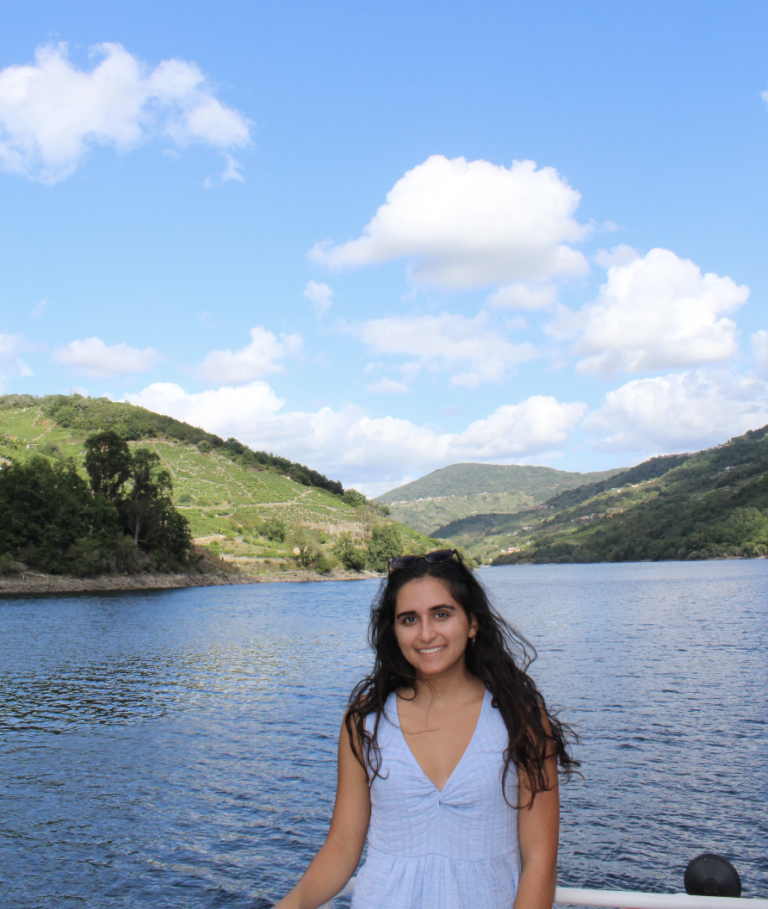
Arpa Boghozian is a fourth-year viticulture and enology major graduating this spring quarter. Growing up in Orange County, she actually was not introduced to her future college major until a Picnic Day at Davis, which she said makes graduating from the university feel like a full circle moment for her.

“I chose to come here because of the [viticulture and enology] program initially,” Boghozian said. “I was kind of introduced to the idea of winemaking by my mom. We were here for the 100th annual Picnic Day, and I saw the UC Davis viticulture and enology float, and my mom said ‘You can study winemaking here, and its chemistry and biology but with winemaking so it’s fun.’ I was 13 or 14 at the time.” 

Boghozian found that her mother’s description of the major was not the entirety of the area of study, but a lot of it still rings true to her. She feels that viticulture and enology allows her the perfect mix of science and creativity.

“I chose the major because it’s a great intersection of science but also the outdoors, and if you go into winemaking you have the option of being a creative and making the wine that you imagine people would love,” Boghozian said. “The plant science side is also really cool, because you get to be out with nature all day and observe the seasons as a part of something bigger.”

Although she said that she feels like she lost many college experiences due to the COVID-19 pandemic, Boghozian said the time she spent here during her freshman and senior years has been really special.

“I think freshman year, the community that existed in Davis was super fun,” Boghozian said. “There was Sunset Fest and Picnic Day and I wouldn’t trade those two events for anything. Everyone was out, everyone was having a good time on campus exploring and making new friends […] There was nothing like it.”

Boghozian said that one piece of advice she has for younger students is to take advantage of the many opportunities Davis has to offer for undergraduates.

“I started off doing a pruning internship for mostly orchard crops at the Student Farm [during] my freshman year, and that kind of fed into another program that was through the farm called SCOPE, which is an organic plant breeding program,” she said. “I had another lab opportunity that was more about spinach, alfa-alfa and barley breeding. That kind of brought those two internships together, where I did more of the lab side, and I also did a lot of field work, like cross pollination.”

Along with her research, internships and field work, Boghozian has also worked a viticulture job at the Student Farm during her time at UC Davis. 

“I managed the small vineyard on the Student Farm, it’s a table group vineyard,” Boghozian said. “The first year you’re under someone’s wing, and the second year you choose your mentee and work through the vineyard with them and apply the skills you learned in class.” 

During her junior year, Boghozian began working on a laboratory project that studies smoke tank analyses of grapes that she plans to continue after graduation, while she pursues a Ph.D. at Davis. 

“I will be joining the horticulture and agronomy graduate group,” Boghozian said. “My research will be focused on viticulture, specifically in grapevine red blotch virus and the enzymatic effects of the virus on cellulose.”

Boghozian said that the advice she would give her freshman self and any underclassmen just arriving in Davis is to get involved in on-campus activities.

“I always think about doing more,” she said. “I think as a freshman I would’ve joined clubs that didn’t particularly pertain to my major. I joined the wine club and that was super fun, I met a lot of people, […] but I sometimes wish I had joined other things that have interested me or clubs for things I didn’t know how to do and wanted to learn.” 

Boghozian also urged younger students to say yes, within reason, when new and unexpected opportunities do arise. 

“You never know where it might take you,” Boghozian said. “Internships, clubs, friend groups, literally anything. This is your time to grow as a person — it’s not all about academics. Enjoy your time here and have fun — also study — but have fun.”


Written by: Jalan Tehranifar — features@theaggie.org


Review: Bringing back the classics with a modern spin on ‘West Side Story’

A dazzling rendition of everyone’s favorite musical — songs, dance and all 

By SIERRA JIMENEZ — arts@theaggie.org

The Oscar nominee for best motion picture of the year, Steven Spielberg’s 2021 remake of Robert Wise’s 1961 film “Westside Story,” is a must watch for musical lovers. Even if you aren’t a musical fanatic, the film is worth watching — from its vibrant use of color to its beautifully executed take on character roles from a movie that left big shoes to fill. 

With leading roles Tony played by Gold Derby Film Awards nominee Ansel Elgort and Maria played by rising actress Rachel Zegler, this pairing perfectly conveyed the characters’ extreme love for each other challenged by the looming hatred between the Sharks and Jets. 

Anita, played by Academy Award winner for Best Actress in a Supporting Role Ariana DeBose, was the real star of the show. She fully deserved this award with her passionate dancing capabilities combined with her exquisite acting skills. Personally, I felt every emotion from her every move, her every word, her every song as if I knew her personally. 

Choreographed by Justin Peck, this film was a fresh take on the original film’s iconic choreography, with eccentricity radiating from the blend of ballet, jazz and mambo.

Speilberg’s rendition brought a modern spin on the antiquated classic while keeping most of the film the same. The vibrant colors of the costumes and set brought to life this world of darkness. The use of the cool and warm colors in the gym scene visually reflected the clash between the Sharks and the Jets. 

This 2021 version of the classic musical also underscored many social issues that were somewhat glossed over in the original. The racial divide between the Irish and Puerto Ricans has always been the prime theme of the film, but with more open conversations about racism today, this film portrays this divide through a modern lens. 

From interracial relationships to segregation, these social issues continue today. To view these issues in film through song, dance and acting, the viewer has a different perspective of real life matters. 

Another issue that was emphasized in the newer film was the stress on women empowerment and sexuality. The nameless character who tirelessly tries to fit in with the Jets featured in both the original and remake brings to light the matter of gender identity and gender nonconformity. Played by Iris Menas in the 2021 version of the film, they display a rejection of femininity.

At first, the Jets laugh at their identity, but at the end, the Jet boys come to call them “buddy boy,” fully accepting who they are. This is a big step up from the original film, which did depict the gender-noncomforming character, in and of itself is a big deal for the LGBTQIA+ community, but in the remake, the character explicitly shares their gender identity when they say they are not a girl when sitting on the girls bench in jail. 

Additionally, the women empowerment present in this film was quite considerable. Rather than having a male actor playing the role of the drug store owner, Rita Moreno played a brand new character, Valentina, who is based on Doc in the original screening. Being the mother figure of the troubled boys, she provides consolation and hope for a better future. 

This is not the first time we’ve seen Moreno. In fact, she played the original role of Anita in the 1961 film. Her debut in Speilberg’s new release was a fitting nod to the original that brings “West Side Story” full circle. 

This musical is bold, emotional and tackles real issues, but does it in a beautiful masterpiece of song and dance. The original “West Side Story” is an all time classic, and this new rendition only adds to the brilliance. 


Written by: Sierra Jimenez — arts@theaggie.org