57 F
Davis

Davis, California

Monday, December 22, 2025
Home Blog Page 224

Culture Corner

The Art Desk’s weekly picks for movies, books, music, and television shows

By ANGIE CUMMINGS — arts@theaggie.org


Album: “Caprisongs” by FKA Twigs (2021)

Although we are barely one-quarter of the way through the year, I can say with almost full confidence that this is my top album of 2022 (yeah, maybe it came out in December of 2021 but that’s basically 2022). With only one of these 17 songs qualifying as skippable, “Caprisongs” is a listen that really never gets old. And the skip in question, “christi interlude,” is a song where a random lady reads you a hypothetical horoscope; there is no singing and no Twigs in sight for that one. Basically, this is an amazing album showcasing Twigs’ ability to go from the deep melancholy of “Magdalene” (2019) to pulse-racing party tracks like “papi bones (feat. shygirl)” or “pamplemousse.” Over the course of the album, Twigs takes you on an effervescent journey through love and life, with little pitstops of her and her friends chatting on the tracks along the way. I’m not typically a fan of conversation interrupting my albums, but in this case, we get to hear what seems like anecdotal snippets of a couple of friends hanging out and talking about life, and it completely works. Twigs put it perfectly when she said “it’s like … elevator music but you’re going to the 50th floor,” in the intro to “which way (feat. dystopia)” — this album can function as the perfect background or foreground music with its free-flowing sounds and fun lyrics (if you choose to pay attention to them). 


TV Show: “Peaky Blinders” (2013-2022)

Writing about this show that I’ve for some reason stood by for over six years now is incredibly bittersweet, as the final season is coming out right now, and I’m not even able to watch it yet (curse you, BBC). Objectively, this is a well-written and well-made historical fiction TV show about themes I’m always a sucker for: the effects of WWI on those who served and the rest of society, the plight of the working class and the consequences of industrialization and globalization. They are essentially a British mob family led by the eldest brother, Thomas Shelby (played by Cillian Murphy) — a widower and decorated veteran (not really dealing) with PTSD. The visuals of this turn-of-the-century British family gang have oddly been co-opted by many wannabe-Peaky Blinders, and I cannot emphasize how far from that I am. While the show is loosely based on the actual Peaky Blinders gang and features historical figures like Winston Churchill, Sir Oswald Mosley (an early British fascist played by Sam Claflin) and Charlie Chaplin, as well as many other smaller figures. It’s good TV and each season is full of invigorating storylines, as well as a good amount of devastation which might make you ask how Thomas Shelby gets through the day. 


Movie: “Wet Hot American Summer” dir. by David Wain (2001)

Recently, I’ve felt a deep void of new laugh-till-it-hurts comedies, leading me to revisit the great stupid movies of the early 2000s. “Wet Hot American Summer” is the epitome of this genre of painfully funny, unnecessarily raunchy and generally absurd movies. The movie is packed with an absolutely stacked cast of what were then up-and-coming actors, including Paul Rudd, Elizabeth Banks, Bradley Cooper, Amy Pohler, Chris Meloni, Joe Lo Truglio and Molly Shannon, in addition to some names that were big back then but have since faded out of the spotlight. The majority of this talented collection of nearing-middle-aged actors playing high schoolers is set at a chaos and romance-filled summer camp in 1981 — making for some hilarious visuals in addition to the written jokes. If you have never heard of this movie, I urge you to watch the revisited TV show version (with the same cast) Netflix made in 2017, which of course doesn’t top the original but comes pretty close in terms of levels of absurdity.


Book: “Play It As It Lays” by Joan Didion (1970)

After the renowned author Joan Didion passed in December of 2021, I realized I had no clue she even wrote fiction books, as I had only come into contact with “The Year of Magical Thinking” (2005) and other essays over the years. While listening to the audiobook rather than reading the real thing might be seen as cheating, it was a great way to “read” an entire book in the midst of midterm season this quarter. In true Didion fashion, “Play It As It Lays” is by no means an uplifting or happy book but is an incredible insight into the effects of losing loved ones and, consequently, oneself. It follows the story of Maria, a not-very-famous actress and model. It follows her life after the death of her mother and through her unwinding (and toxic) marriage to Carter, a prominent Hollywood producer, eventually leading to the unraveling of every aspect of her life. Set in late 1960s Los Angeles and cutting between memories of New York City and Maria’s now-desolate Nevada hometown, the book is akin to many of those old existentialist movies of that time that don’t seem to have a singular or cohesive plot but instead bring pieces of a life together to form both a cultural critique and an honest view of (some deeply flawed) human nature. 

Written by: Angie Cummings — arts@theaggie.org

 

‘Guardians: Spirits of Protection’ follow up project encourages community to submit cathartic poetry

The outdoor exhibit has a clear message: together we heal 

By CLARA FISCHER — arts@theaggie.org


Ann Savageau, professor emerita and artist, and Edward Whelan, UC Davis associate instructor and MFA graduate in design, have collaborated to bring the Davis community a follow up to Savageau’s earlier exhibit “Guardians: Spirits of Protection.” 

The aforementioned exhibit explored healing after facing loss and was inspired by tragedies weathered by Savageau in both the pandemic and her personal life. This follow up is meant to inspire the community to explore their emotions much in the same way as Savageau, albeit through a different medium: poetry.

Anyone and everyone is welcome to submit poetry relating (or very loosely relating) to the themes of healing and loss displayed in Savageau’s work. Submissions are accepted on the project’s website, and the deadline has been extended through March 14.

Whelan said he was inspired to take on the project by the immense feedback from the community, especially pertaining to the interactive component of the initial exhibit (in which viewers were encouraged to write down any thoughts, prayers or comments they might have had after reflecting on Savageau’s work). 

“Ann and I started focusing on her writing as a way to really deal with her grief, but also as a way to build hope and resilience. I thought a good thing to do would be make that opportunity available to everybody,” Whelan said. “I think it’s really great that we’re able to provide some kind of outlet right now — we welcome everyone to submit, in any language they’d like.” 

Poetry submissions are welcome in any prose — every submission will be made part of the exhibit and put up for display in the Arboretum. Whelan and his creative team, including students Iris Xie, Niloufar Abdolmaleki and Julia Dang, who help with both outreach as well as other creative aspects of the installation, will carve the poems into 24×12 inch pieces of slate and arrange them in a spiral staircase formation. The exhibit is set to be installed around March 18, 2022. 

“We picked the Arboretum because there is a lot of foot traffic… and there’s something about nature that fits well with the poetry,” Whelan said.

The creative team chose the medium of stone because they “wanted a sense of permanence,” and were partially inspired by the Scottish art exhibit “Little Sparta.” They also plan on giving the stone to the corresponding participant after the installation is taken down, indicating the permanence of their art. When asked about the significance of the spiral formation, Whelan noted that they “wanted something that was a progression.”

Similarly, this project itself can be seen as a progression of the impact Savageau’s initial gallery had on the community. After all, the process of healing after dealing with personal loss is a topic that resonates with many, especially after the past couple of years. 

“Exhibitions have an opportunity not only to inspire and provide a story, but also, they can be places where communities can come together and really talk about what’s going on,” Whelan said. 

For those interested in more of Whelan’s work, he is offering a first-year seminar starting Spring 2022 entitled “Make an Exhibition” that is open to all majors, and those who want to explore more of Savageau’s pieces can find them on her website.


Written by: Clara Fischer — arts@theaggie.org


Basic Needs Center offers emergency housing, rent reduction for students

Eligible students can receive benefits from these programs through the Aggie Compass website

By SYDNEY AMESTOY — campus@theaggie.org


The Aggie Compass Basic Needs Center features numerous programs designed to help students, including rent reduction and emergency housing programs. 

The Emergency Housing program provides students in urgent need of housing with a place to stay. Since January 2021, this service has expanded to provide quarantine

housing for students living off campus if they or their roommate has tested positive for COVID-19.

Abiel Alesana, a fourth-year neurobiology, physiology and behavior major and a CalFresh student intern, said he has seen an uptick in students using the COVID-19 quarantine emergency housing program.

The other half of the program focuses on securing help for students experiencing homelessness. According to Howard Channel, the basic needs coordinator for the center, students in need of housing are eligible for the Hotel Voucher program which gives students without housing a place to stay. During their stay, the center determines a students’ eligibility for a basic needs grant, which can help pay for a student’s rent or security deposit, or the Rapid Rehousing Program, which provides students with a place to stay for six to nine months, along with other resources. 

The center also provides a rent reduction program for students currently living at the Green at West Village Apartments. Student’s rent can be reduced by up to $300 per quarter through the program.

“From the perspective of these students, they told me it just meant a lot to know that they have that additional money to help out with buying books, paying for parking passes, things like that,” Channel said.

Alesana currently receives rent reductions through the program while living at the Green, and said he appreciates the assistance the program provides. 

“I’m thankful I have it,” Alesana said. “It helps out, every penny counts.”

The Basic Needs Center can also help students sign up for CalFresh, grants and a number of other resources. Additionally, the center runs a produce program, Fruit & Veggie Up, that provides fresh produce for students twice a week in front of the Memorial Union.

Many of the programs featured by the center, including the Fruit & and Veggie Up program, were created based on student input, according to Alyssa Wong, the programs’ co-coordinator.

“Not that many […] students had access to fresh vegetables or fresh food,” Wong said. “So, I would say, it was in demand.”

Programs such as the WiFi hotspot program under the Affordable Fast Internet

Program, which gives out hotspots and routers for students lacking a stable internet connection, were established on campus based on student demand during the beginning of the pandemic.

According to Channel, future basic needs programs will likely be established based on students’ ideas.

 “This is where our student voice comes in,” Channel said, “It’s probably going to be [a] student voice that’s going to tell us where to go, what’s going to be the next [program].”

 Written by: Sydney Amestoy — campus@theaggie.org


The Davis Independent Music Initiative offers $10,000 grant to local musicians

Open through April 1, the grant seeks to support Davis’ music scene

By JACOB ANDERSON — arts@theaggie.org

For two years, the Davis Independent Music Initiative has been working to cultivate the local music scene. In 2019, Joel Daniel started DIMI after receiving a $5,000 grant from the city government. In 2022, the organization will offer yet another $10,000 to a local artist.

Applications are open now, and all interested local musicians would be well-advised to apply — especially, according to a DIMI press release, those who identify as “Black, Indigenous, [or] People of Color (BIPOC)” or who otherwise promote social equity.

Last year’s winner, Kevin Welch — frontman of the Brazilian space funk band Boca Do Rio — spoke to The Aggie about his band and his experience receiving the DIMI grant.

“I’ve been the band leader for about 20 years. Producer, songwriter, lead singer and guitarist,” Welch said. 

At night, Welch and his rotating group of accomplices light up the Davis area with what he describes as music “in the space between traditional Brazilian beats and modern funky jazz.” While membership can be sometimes eclectic, the band has been doing shows for two decades now. By day, however, Welch is a scientist with the California Department of Forestry and Fire Protection.

Welch remembers the inception of his musical style as a succession of different influences, beginning with the Grateful Dead but being truly marked by the music he encountered on a trip to Brazil. “I really just got into psychedelic samba, which I don’t think anyone else does,” Welch said. 

He named the band’s most vital influences as both Brazilian bands like Caetano Veloso and Martinho da Vila, and jazz guitar legends like Django Reinhardt and Wes Montgomery. Even hip-hop is in the fray, according to Welch.

“For years I’ve been in Davis playing with this band, doing the World Music Fest, Davis Music Fest. I’ve always kind of been a community-minded musician. That’s what I like to experience. Samba is like American blues: It comes out of that same culture of community. So I heard about Davis [Independent] Music Initiative, and it does sound like a really great idea. I was like, ‘Wow, this is really cool.’” 

After receiving the grant, Boca Do Rio got to work laying down some of their tracks in a nearby studio shared with some other local bands — something they hadn’t always had the time and resources to do in the way they wanted. 

“I was really impressed, first of all, that they were able to put that kind of funding together because that’s really what you need,” Welch said. “I’ve been in grad school for years, and you can apply for these grants — they want everything, and then they’re like $1,200 […] We’ve already started work on our third album. We’ve had two albums already over the years, and for our third album we’ve got some great basic tracks already. This money is really gonna allow us to finish up this thing, which I would think is going to be our best.”

The grant, Daniel said, “is crucial in keeping music alive in Davis by giving local musicians an incentive to stay, write, produce, and perform their music for and in the community.” 

By helping groups like Boca Do Rio, the DIMI hopes to make the scene livelier than ever. Awarding this year’s recipient—whoever it is—will be a vital step toward that goal.

Applications for the grant are already open, and they’ll be staying open until April 1.

Written by: Jacob Anderson — arts@theaggie.org

What is the future of meat?

The transformation of our carnivorous society

By ALEX MOTAWI — almotawi@ucdavis.edu

It’s pretty clear we have already reached the apex of meat consumption in the U.S. Animal products are finally “meating” their makers and going out of style in a flash and with good reason. Constant consumption of animal-based protein has been a mainstay in humanity since we were hunter-gatherers, but the only constant in our society is change — and it’s hitting the meat industry harder than a semi-truck.

There are a few primary problems with the meatpacking industry, and they encompass both the mental and physical realms. The most talked-about premise I’ve heard behind the abandonment of meat is the ethical quandary of mistreating and slaughtering living animals because people like eating meat. Although vegetarianism only gained popularity in the U.S. in the 1970s, vegetarianism has been and continues to be a common practice in other countries dating back to well before the 20th century. Given its long history and prevalence around the world, concerns from vegetarians about meat consumption need to be factored seriously into future decisions. Now that the U.S. as a nation has enough general food security to have the luxury of choice when it comes to daily meals, it can afford to be more humane with its nutritional choices. 

Beyond the abstract issues that are growing in priority, having a primarily meat-based diet is just not feasible anymore. As the Earth’s population is still growing, every year there are more and more humans and less and less space for livestock. The shrinking amount of available space to grow livestock will inevitably lead to a slow in meat production and will also turn even the most humane animal farms into factory farms full of mistreated animals. And to add on, the amount of arable land consumed by the production of feed for our favorite protein sources is just way too high to be feasible in the much fuller Earth of our future.

This is without even mentioning the ongoing debates about the nutritional value of meat compared to other foods in general along with theories based on us being biologically inclined to vegetarian or even frugivory diets. We have more than enough ammunition to drive our society’s transformation away from meat but with science unlocking new avenues for humanity every day, I think there’s a solid chance that meat could have a resurgence in the future.

There is a real possibility that lab-grown meat is the solution that ensures meat will be enjoyed by future generations. In my judgment, the livestock industry will be long-gone but with meat that can be grown almost anywhere with a caloric investment that’s just a fractional 

amount of traditional meat (three to four times better than chicken, six to eight times better than beef), we could very well be able to save steak. It will never be as efficient as a plant-based diet, but it’s an improvement. It also completely solves the ethical problems behind meat consumption. With no animals being harmed in its production, people would be able to eat meat without feeling guilty or morally wrong. The emergence of lab-grown meat in local markets may be met with a bit of resistance by people who like the status quo, who are scared of consuming something “unnatural,” but it’s impossible to make everyone happy and I believe that eating lab-grown meat could become the new normal.

However, this explosion of lab-grown meat is still many years down the road. A main analysis of the industry provides incredibly optimistic data stating the cost could be tenable by 2030. Other studies aren’t yet convinced implementation on a large scale is even possible due to equipment cost. To add to that, we have all had opportunities to try “alternative” plant-based meats and it’s obvious that they aren’t good enough to be legitimate replacements for traditional meat just yet. As a result, I think the U.S. meat industry is about to enter a deep dive and if it emerges, it will have a very new look. Traditional meat-based diets are being left in the past and plant-based diets are the present and future, but the lab is very well capable of ushering in a new golden age of lab-grown meat if our leaders in science can play their cards right.


Written by: Alex Motawi — almotawi@ucdavis.edu

Disclaimer: The views and opinions expressed by individual columnists belong to the columnists alone and do not necessarily indicate the views and opinions held by The California Aggie.


Information theory research helps explain how individuals interact in a collective

A new study done by researchers at UC Davis and Hokkaido University in Japan seeks to understand collective behavior through leader-follower information exchanges

By SONORA SLATER — science@theaggie.org

Have you ever seen a flock of birds flying in formation or watched a school of fish swim in perfect sync and wondered how it was possible? 

Researchers at UC Davis and Hokkaido University in Japan have suggested a new way to look at information and how it flows between individuals to influence a group’s behavior, which has many potential applications in understanding collective behavior in various fields of study. This research was published on Feb. 9 in the journal Science Advances.

James Crutchfield, a distinguished professor in the Department of Physics at UC Davis, described how collective behavior came to be studied through the framework of “information theory,” or the scientific and mathematical study of information.

“It really comes out of much more basic questions,” Crutchfield said. “In physics, energy comes in different forms: kinetic, potential and chemical. […] We are trying to put this concept of information into a physical basis.”

The caption is “In this graphic, the red shapes represent leaders, the blue shapes represent followers, and the lines between them represent information flow. It is meant to show that while leaders do influence followers, followers influence each other as well.” and the credit is to Tamiki Komatsuzaki.

 Just as there are different types of energy, Crutchfield said that the researchers found different types of information, as well as different modes of information flow. 

“So we ask, what kinds of information are there, and how are they transformed into each other?” Crutchfield said. “This is new in the sense that it refines previous notions of information that treated information as this kind of one, unitary thing.”

Ryan James, a previous postdoc researcher at UC Davis and one of the co-authors of the paper, elaborated on how their ideas challenge previous concepts of information theory.

“The oldest information theory quantity used is something called time-delayed mutual information,” James said. “Which is the idea that you look at one time series at Time A, and you look at another at Time B and you ask, how much information do they share?” 

He offered an analogy, comparing Davis’ time zone to where he is an hour ahead in Mountain Time.

“If we looked at the clock in my room here, it says 3:06,” James said. “A clock in Davis, it’ll say 3:06 an hour later. But my clock isn’t influencing your clock in any way, even though my clock perfectly predicts yours — the issue is that they’re both synchronized from a common source. So even though our clocks share information in that sense, it’s meaningless to say that my clock is influencing your clock.” 

A theory called “transfer entropy” tries to solve this by removing the information that two time series share based on the fact that they might have some sort of common history, according to James. However, this method has other problems.

“Just relying on transfer entropy numbers can be misleading,” James said. “Two time series could be deeply intertwined synergistically, and not just one giving information to the other. In [a paper I wrote], I suggested an alternative, using intrinsic mutual information. [Sulimon Sattari] saw this, and was interested in looking at collective behavior.” 

Sattari, an assistant professor at Hokkaido University and the first author on the paper, was studying a type of amoeba called ‘Dictyostelium discoideum.’ During its lifetime, it transitions from a collection of unicellular organisms into a multicellular slug; a small percentage of cells spontaneously become leaders and the others become followers.

When Sattari heard about James and Crutchfield’s theory, he reached out to see if they might be able to use the intrinsic mutual information framework to understand how a collective functions by using a leader-follower framework.

“We cannot ask each cell, how do you feel?” said Tamiki Komatsuzaki, one of the co-authors of the paper and a researcher at Hokkaido University. “Do you feel that you are a leader? So we have to look at the motion to see what information they are using.”

He went on to explain the three different types of information that the researchers identified — intrinsic, synergistic and shared/redundant — using an ice cream metaphor.

“Suppose we’re looking at whether or not you and I get ice cream,” Sattari said. “With intrinsic, we can only predict whether or not I’ll get ice cream today if we know whether or not you got ice cream yesterday. For synergistic, we need to know if you got ice cream yesterday and if I got ice cream yesterday in order to predict if I’ll get ice cream today. And with shared information, we can predict if I’ll get ice cream today if we know if you got ice cream yesterday or if we know if I got ice cream yesterday.”

Udoy Basak, another co-author on the paper, explained that transfer entropy is the combination of intrinsic and synergistic information. Their research found that when they recognized and separated these different types of information flow, the distribution of the elements “shed light on the influences that drive leader-follower relationships,” according to Basak.

In the paper, the team looked at a few very simplified examples, mostly focusing on situations where there was one leader and one follower, according to James.

“The leader kind of moves around randomly, and the follower also moves around randomly, but it also takes into account what the leader’s doing,” James said. “We looked at how the amount of information flow went from leader to follower and follower to leader.”

Sulimon used this framework to begin to understand how the collective communicates and coordinates their motion.

“Using just simplified rules where you only look at your immediate neighbors, you get things like bird flocks and fish schools, where a whole group coherently moves as a whole wave,” James said.

Crutchfield explained how this new research could be used in the field of animal behavior. He is currently working on a project studying humpback whales near Alaska, where he is applying information theory to understand their auditory communication.

“The tools that we’ve developed are desperately needed in the field of animal behavior,” Crutchfield said. 

James talked about another application: stock markets. 

“We looked at how individual stocks are influenced by and how they influence the market index,” James said. “Oil companies, for example, the value of their stocks was effectively independent of what the overall market was doing. But then consumer products, like Pepsi, for example, were highly influenced by how the overall index was doing. […] I do know a few people who have taken this work and have used it for investing purposes and have done well.” 

From understanding disease processes, to traffic issues, to observing human behavior, Komatsuzaki said that one of the things the researchers find so exciting about this new theoretical framework is that the potential applications are not limited to one field.

“It’s almost infinite,” Komatsuzaki said.

Written by: Sonora Slater — science@theaggie.org

‘Girl Gains’ empowers women in the weight room

New club promotes weightlifting for women to improve athletic performance and long-term health

By MAYA SHYDLOWSKI — features@theaggie.org 

Girl Gains,” a new club at UC Davis, hopes to destigmatize and empower women in the weight room — which is good news for women’s health, because strength training has proven to be beneficial for athletic performance, injury prevention and long-term health

The club is the newest chapter of a larger organization on college campuses across the U.S. and Canada. The Girl Gains lifting club was established in 2020 at San Diego State University (SDSU), where its founders noticed a serious gender imbalance in the weight lifting areas of their campus gym. Just two years later, more than 20 chapters have been established with the goal of providing “women of all backgrounds and fitness levels with community, resources and confidence.”

Amanda Hamblin, one of the co-presidents of the Davis chapter, is a first-year political science – public service major. She was inspired to start the club after finding a TikTok from Elisabeth Bradley, one of the founding members of the original Girl Gains club.

She was saying all the benefits of having the club [and] how much it’s helped so many women, and I thought it was such a great thing,” Hamblin said. “I thought about how I really wish our school had that, and then at the end of the TikTok, she said something like, ‘If you’re interested in starting [a chapter] at your school, please fill out the form in my bio.’ The next day, she got back to me, and I told her I was interested.” 

Hamblin brought the idea to the Center for Student Involvement, which connected her to Jennifer Chavez, a second-year communication and Chicana/o studies double major, who also wanted to start a chapter of Girl Gains at Davis. 

Chavez and Hamblin began setting up the club during fall quarter, then launched a website and Instagram account at the beginning of winter quarter. The two co-presidents, along with Audrey Vargas, the vice president, and Simran Khinda, the director of marketing, posted flyers around the gym and dorms and reached out to different organizations on campus. 

Two months after their initial launch, their Instagram account had over 600 followers, and the club had received over 200 applications for membership. They have held multiple events already this quarter, including one called “Gymtimidation” that aimed to address women’s intimidation when picking up weights or not knowing where to start at the gym. The club plans to have events in the future with guest speakers and discussions of topics like “weightlifting for beginners.” 

The club’s values of knowledge, body positivity, community and strength reflect a greater movement that has increased the number of women reaching for weights rather than just the elliptical at the gym. Podcasts like Fit & Fearless and social media fitness influencers have helped make weight lifting less intimidating and more accessible for women. 

Keith Baar, a professor of molecular exercise physiology, said that sociological expectations and the stigma surrounding women lifting weights hold women back from lifting like men do. He referenced a study suggesting it is a misconception that testosterone determines muscle gain. Women, who do not produce the same levels of testosterone that men do, are still able to gain muscle mass at a similar rate to men. 

Baar said that one of the most common factors that holds women back is societal expectations of women’s bodies.

When I was a strength coach at the University of Michigan, the hardest thing that I had for some of my female athletes was that they would come in and say, ‘My boyfriend thinks I’m getting too big,’” Baar said. “The conversation I had with them was that if your boyfriend finds it difficult to be with you because you’re big and strong, then I think you are probably better off with a different boyfriend than with not being big and strong.” 

He said that he was excited to hear about the new club supporting women because it helps lessen the stigma around gaining muscle and makes the gym scene less intimidating for women, especially beginners. 

Not only does weight training empower women and build their confidence, but it also has many positive effects on short-term and long-term health. Baar explained that lifting weights can affect both physiological and mental health.

Endurance or cardiovascular exercise helps prevent harmful neurotoxins from entering the bloodstream and going to the brain, but weight lifting can also benefit people’s mindsets.

Depression tells you that no matter what you do, nothing changes, nothing gets better and everything gets worse,” Baar said. “When you contrast that with every time you go to the gym — [where] you’re actually getting better, bigger and stronger — there’s a direct contrast to the mental state that you’re in.”

In terms of physical health, strength training is most helpful for injury prevention. Danielle Steffen, a Ph.D candidate in biochemistry, molecular, cellular and developmental biology, studies the role of mechanical loading in tendon development, injury and repair. Tendons (the tissue that connects muscles to bones) and muscles are common areas for injuries. Steffen said that weightlifting helps prevent muscle and tendon injury by increasing muscle strength and balancing the stiffness between the tissues. 

“If the tendon is really stiff, it’s going to pull on a weak muscle and the muscle is going to become injured,” Steffen said. “Weightlifting is going to increase muscle strength while decreasing tendon stiffness to help prevent muscle and tendon injury.”

Activities like running and other plyometric dynamic exercises typically increase stiffness, so as an athlete, weight training is important to prevent musculoskeletal injury.

Weightlifting can also aid in tendon repair after an injury. Isometric holds are common types of exercises in which you hold a position with your muscle, contracting without moving joints. Baar has used isometric exercises in conjunction with dietary collagen supplementation to completely reverse patellar tendinopathy, which is an inflammation of the patellar tendon that limits knee function, in a professional basketball player. Both Steffen’s and Baar’s preliminary data show that isometric exercises increase specific molecular signals for tendon regeneration, which helps rehabilitate an injury.

Steffen was a pole vaulter on the UC Davis track and field team as an undergraduate, ranking in the top ten at UC Davis. She is now a self-proclaimed “competitive hobby jogger” with the cross country and track and field club at UC Davis. She runs six to seven times per week, incorporating at least one day of weight training in order to prevent injuries. 

According to other studies, strength training can also make joints stronger without intense impact on bones. This is especially helpful for older people who might have a harder time with high impact activities like running because of low bone density. Women in particular are susceptible to reduced bone density, which can result in easily fractured or broken bones with long periods of recovery. But that’s not all of the benefits, according to Baar. 

What we know is that the greatest predictor of human longevity is actually your muscle size, muscle mass and strength,” Baar said.

Barr said that individuals between the ages of 40 and 65 are twice as likely to live to 100 if they are in the top third of their age and gender groups for strength. Comparatively, individuals in the top third of their populations for endurance ability are only 10% more likely to live to 100 than the lower two-thirds of the population. Thus, while endurance training certainly improves cardiovascular health, Baar said, weight training has a better correlation with lifespan.

It’s never too late to pick up weights. Baar suggested starting with bodyweight workouts before moving on to heavy lifting.

 “Once you’ve mastered the movements with a full range of motion using just bodyweight, weight lifting is easy,” Baar said. “Just repeat those motions with heavier weights. It’s imperative to find trustworthy sources when getting information about how to lift and figuring out a lifting routine.”


Written by: Maya Shydlowski – features@theaggie.org


NFL Free Agency shaping up to have big impact around the league

Possible trades and big free agents round up what should be an entertaining free agency window in the NFL

By OMAR NAVARRO — sports@theaggie.org


With NFL free agency set to begin on March 16 at 4 p.m. ET, this offseason is shaping up to be one of the biggest and most impactful negotiation periods in recent memory. From star quarterbacks to high impact players, teams will have an opportunity to improve — if they are willing to spend.

The most obvious player who would create a domino effect in this free agency period isn’t even a free agent. Green Bay Packers 4x MVP quarterback Aaron Rodgers has had a very publicized back and forth with the Packers, as last year he only agreed to come back to the team under a specific set of circumstances. Another MVP (and another playoff flameout) later, Rodgers remains with the Packers with one year remaining on his contract. The agreement the team and Rodgers made last year gives him the opportunity to negotiate a new contract and stay a Packer for life, or ask for a trade if he chooses, which is something that the quarterback was said to be “torn” with. 

If Rodgers does stay with Green Bay, the roster will look a lot different than it did last season as many key players are set to become free agents or will have to be cut. Projected at $50 million over the salary cap, the Packers have begun to make moves to try to continue to keep the team together if Rodgers decides to stay. But what if the quarterback doesn’t want to stay? There was a report that perhaps the quarterback would choose between the Denver Broncos, Pittsburgh Steelers and Tennessee Titans if he did decide to ask for a trade, but the report has been shot down. Still, it seems as though if a move were to happen, those teams mentioned were the favorites to acquire the star quarterback. 

This entire situation is a difficult one for the Green Bay Packers because an MVP quarterback is difficult to pass up. The thing is, they drafted another quarterback, Jordan Love, in the first round of the 2020 NFL Draft to be his replacement, and if Rodgers does stay, that would mean they would most likely have to let go of Love at a lower value than what they got him, forever stamping that selection as a wasted one for Green Bay. And on Tuesday morning, it seems that this will be the case. Aaron Rodgers confirmed the reports on Twitter that he would be staying in Green Bay. Although the details of the contract have not been confirmed, the reigning MVP staying now means that the Packers and their front office now has to make certain moves to keep the QB happy. 

With Packers star wide receiver Davante Adams set to break the wide receiver contract market, Rodgers staying means that he will want his star receiver there as well. But, despite Adams continuously being at the top of wide receiver rankings, Packers general manager Brian Gutekunst has not guaranteed Adams will stay, rather opting to say there is a possibility that the receiver could walk in free agency. It remains to be seen if it is a negotiation tactic or what, but with the news of Rodgers staying, the top wide receiver free agent is going nowhere.

Seattle Seahawks Super Bowl Champion quarterback Russell Wilson made some noise about perhaps finding a new home. Wilson had been with Seattle his entire career and now at the age of 33, it feels like the perfect time to find a new home. But, the Seahawks didn’t seem interested in moving the quarterback, as they have been reported turning down a trade from the Washington Commanders that included multiple first-round picks. That is, until news broke that Wilson would be heading to Denver in a mega deal that included three players and draft compensation for the star quarterback. 

A trade of this magnitude involving a quarterback does not happen often in the NFL. Russell Wilson now enters an AFC West division that includes Patrick Mahomes and Justin Herbert — perhaps the best division in football. This move will send shockwaves to the rest of the league as teams will have to adjust their approach to free agency and the draft —both in the AFC, which just got tougher, and the NFC, which just lost a great QB. 

Teams who are ready to compete now will look for other options, like San Francisco 49ers quarterback Jimmy Garoppolo. Despite making an NFC Championship game run, the 49ers will look toward the future as Trey Lance — who they traded up to draft number three overall in last year’s draft — is set to take the reins under center. San Francisco will work together with Garoppolo to find his new home and with one year left on his contract, wherever he ends up will likely have to negotiate a contract extension. But, the possibility of the quarterback being cut still remains so if teams who are needing a quarterback aren’t able to trade for one or draft one they like, Garoppolo will be a hot name for them.

Aside from Adams, this wide receiver class will also be one to monitor as there are some big names whose contracts are about to expire. Tampa Bay Buccaneers star Chris Godwin is coming off an ACL tear, but will certainly attract a lot of attention if he hits the open market. But, even after Tom Brady’s retirement, the Buccaneers feel as though they can compete right now and want to keep the receiver, so it will likely end in another franchise tag if an agreement cannot be reached. Speaking of franchise tag, that also seems to be where the negotiations for Los Angeles Chargers wide receiver Mike Williams is heading, as the team will likely tag him before he can hit free agency. 

The position of wide receiver can be a difficult one because it is dependent on quarterback play, as Allen Robinson has found out. Robinson continues to be productive but the quarterback carousel with the Chicago Bears never allowed him to fully reach his potential. That coupled with injuries led to a down 2021 season and after that, it seems as if the two sides are ready to split. Robinson will have many suitors and as another wide receiver showed, situation is everything. That was Odell Beckham Jr., who was released by the Browns midseason and found himself in a perfect situation with the Super Bowl winning Los Angeles Rams. Although he suffered a torn ACL in the Super Bowl, Beckham Jr. found his former self with the Rams. The injury makes this harder, but the Rams are confident they will be able to keep the free agent receiver and run it back.

The defensive side of the ball also has some high-level players available — but it won’t be cheap. Coming off his second Super Bowl win, defensive end Von Miller will hit free agency and has many options. While the interest is mutual between him and the Rams, Miller will test the market to see what he prefers. Chandler Jones is another edge rusher who will likely hit free agency after the Arizona Cardinals did not offer him an extension during the year. Although he is 32, he is coming off of another 10-sack season and will surely attract attention this offseason wherever he ends up. 

It is rare that a player of J.C. Jackson’s caliber becomes available in free agency, but that is shaping up to be the case. The New England Patriots are reportedly not going to place the franchise tag on Jackson and will let him test the market. If so, Jackson — who is a Pro Bowler and has been one of the highest rate corners in the last two years — will likely get big money from cornerback-needy teams. 

EDGE Jadeveon Clowney, EDGE Randy Gregory, DB Stephon Gilmore, DB Carlton Davis, S Tyrann Mathieu, G Brandon Scherff, TE Mike Gesicki and many more highlight this free agency class. While some of the bigger names might stay put with their team, there is more than enough noise and players available for teams to improve and for some to get over the Super Bowl hump.


Written by: Omar Navarro — sports@theaggie.org


Humor: Courtroom Transcript: Prof v. The Guy in Your English Class Who Didn’t Do the Reading

Don’t let that horde of political science kids through the door. Please.

BY ANNABEL MARSHALL — almarshall@ucdavis.edu


JUDGE MAY: We are here today to hear the case of Michael Plegger, a sophomore English major. Plaintiff, state your case.

PLAINTIFF: Hello, your honor. My name is Dr. Kelly Garcia and I’m teaching Romanticism Literature. Michael is a student in my class who has, to the best of my knowledge, never read a word of the assigned reading. Despite this, he insists on participating in class, including shouting out tangential comments while I am lecturing. I have been told I am not allowed to have students drawn and quartered, so I seek punitive damages in the form of Aggie Cash.

JUDGE MAY: Alright. You may proceed.

PROSECUTION: The Prosecution calls a character witness to the stand. Can you please state your full name for the court?

WITNESS: Derek “Socks” Tripp.

PROSECUTION: And the “Socks” is a fraternity nickname, correct?

WITNESS: Yeah. Alpha Kappa Omega Phi Kappa Kappa. 

PROSECUTION: Can you explain the significance of your nickname “Socks” for the court?

WITNESS: You don’t wanna know.

PROSECUTION: Alright. You sit next to the defendant in class, do you not?

WITNESS: Yes.

PROSECUTION: You do not?

WITNESS: Yes. What?

PROSECUTION: Do you or do you not sit next to Michael in English?

WITNESS: Who’s Michael?

PROSECUTION: Short guy, blue glasses. Has introduced himself to you several times.

WITNESS: Oh yeah, that guy. He sucks.

PROSECUTION: Witness dismissed. The Prosecution rests.

JUDGE MAY: Thank you for your testimony, Derek. You may leave.

WITNESS: Nice wig, May. See you at the kegger. 

JUDGE MAY: Sure thing, Socks. Strike that from the record, please. Defense?

DEFENSE: The Defense calls the defendant, Michael, to the stand. Michael, did you do the reading?

DEFENDANT: Of course.

DEFENSE: Can you tell us a little bit about it?

DEFENDANT: Of course.

DEFENSE: Please do that now.

DEFENDANT: Sure. I think, personally, for me — and I think, when we look at society as a whole, honestly — and I don’t want to generalize, but pretty much all of society — if you look at the juxtaposition between… what is being juxtaposed — and it really all boils down to like — I truly believe, in my heart — Marx once said, and I don’t think I’m misquoting, he said — don’t you think — well, actually, if you just analyze the historical context of this — there seems to be a lot of tension between —

DEFENSE: Alright, alright. Can you tell us a little bit about Romanticism as a whole?

DEFENDANT: Definitely. Most times, like 90% of the time — and you can take any book from, you know, any book off the shelf — I know, I wish, I hope that one day we as a people of America — look, and I say this out of love, though it pains me to say this — the ethos of this whole operation, really —

JUDGE MAY: Enough! It seems to me that you have no idea what you’re talking about.

DEFENDANT: Obviously not, I’m an English major.

JUDGE MAY: This is ridiculous. Surely, after being in this class for eight weeks you should have something to show for it.

DEFENDANT: Hey, who are you to judge me anyway?

JUDGE MAY: I’m… Judge May.

DEFENDANT: Well, I’m… a theatre minor.

JUROR #3: Boo!

JUDGE MAY: The jury will keep their emotional reactions to a minimum. Michael, seeing how you are able to speak in such mind-bending riddles that even a professor with a Ph.D. is unable–

PLAINTIFF: M.D. Not Ph.D. 

JUDGE MAY: You have an M.D? Why are you teaching English?

PLAINTIFF: No one ever specified.  

DEFENDANT: Permission to read some of my poetry? This one is called Ode to Loneliness. Cold hands, harpy’s winged whisper. The hum of life and love and death. Cigarettes. 

JUDGE MAY: Please stop. That’s it. I’m calling a mistrial. I have to go rule on whether the men’s basketball team is allowed to play in beach volleyball bottoms. 

JUROR #3: Woohoo!

Written by: Annabel Marshall — almarshall@ucdavis.edu 

Disclaimer: (This article is humor and/or satire, and its content is purely fictional. The story and the names of “sources” are fictionalized.)

The hidden usefulness of office hours

Getting personal with your professors is a key part of the college experience

By OWEN RUDERMAN — opruderman@ucdavis.edu 

For most of the time I’ve been in college, I’ve always seen attending office hours as a last-ditch effort to raise a grade. Back at my previous college, office hours seemed to be a way to plead for an extension or to request extra credit. But after transferring to UC Davis, I realized that I was making negative assumptions about office hours. Turns out, there is a lot of value to attending office hours that isn’t often talked about.

I’ve experienced some of this hidden value myself. At the start of last quarter, I took 15 minutes to attend one of my professor’s office hours. I didn’t plan out what I was going to talk about, I just showed up to introduce myself. I thought it was no big deal, but over the course of the quarter, I realized that my initiative was having a positive impact on my experience in class. The professor recognized me and remembered my name. She was interested in how I was doing in the class and what I thought. A 15 minute interaction at the start of the quarter made the entire class so much more engaging and pleasurable.

As crazy as it sounds, professors like it when students are invested in their classes. If you are interested in your class and your professor seems nice, I highly recommend you try going to office hours. It is never a waste of time. You will immediately stand out as someone who is actually trying in a sea of students who don’t seem to care. And who knows, your professor might end up enlightening you. They could help you figure out what you want to study or what you want to do with your degree. You could discover a new passion.

General life advice isn’t the only plus to attending office hours. Getting to know your professors more at the beginning of the quarter can help you to succeed academically. If you establish a relationship early, coming in later for help or clarification becomes less stressful. I’ve heard from a couple of professors that they aren’t huge fans of students who only come to the last few sessions of office hours to attempt to salvage a low grade. Attending office hours once or twice at the start of the quarter shows your teacher you’re serious about the class and helps to maximize your chances of getting the grade you want. But attending office hours shouldn’t always be about the grades.

As you probably know, many UC Davis professors are experts in their field. As a result, they have a depth of knowledge that likely extends beyond the boundaries of the classroom. Many of them have impressive careers and experiences. Being able to draw from these banks of knowledge is incredibly valuable and one of the best things about attending college. Where else would you have access to so many smart and talented people? It would be a shame to miss out on office hours and, in turn, this incredible pool of knowledge and experience. But even if you don’t learn anything new, having a professional connection is always useful.

Building a professional relationship with your favorite professors can help you even after you leave the classroom. During my first quarter at UC Davis, I met with one of my professors during her office hours a number of times. We discussed the class, but we also talked more generally. Things like traveling, her past career and my future all came up during my meetings with her. Because I attended her office hours, I now have a better understanding of what I want to do with my degree and potential opportunities. Whenever we see each other around campus, she always checks in to see how I’m doing. And since we now know each other decently well, she’s offered to put in a good word for me wherever I should need it.

As you can hopefully see, office hours aren’t just a place for students who are struggling. They’re a valuable resource that can help you in almost every aspect of your college life. They’re not scary, and they aren’t a huge commitment. A few minute-long conversations with an interesting person at the start of the quarter can transform your entire experience. When you look at it like that, who wouldn’t want to pop into the office?

Written by: Owen Ruderman — opruderman@ucdavis.edu 

Disclaimer: The views and opinions expressed by individual columnists belong to the columnists alone and do not necessarily indicate the views and opinions held by The California Aggie.


Postdoctorates, student employees need rent relief

Renting in Davis is a burden on employees and students, but increased collaboration between the university and city could lead to improvements

Members of the three unions representing postdoctoral students, academic researchers, teaching assistants, graduate student instructors, tutors and readers recently held a rally to raise awareness about how high rent prices impact UC academic employees. It is unacceptable that 70% of postdoctorates and 90% of academic student employees are rent burdened, meaning they spend 30% or more of their income on rent. 

These employees help to make UC Davis the amazing university it is by taking part in its groundbreaking research and by performing essential student services. In return, UC Davis has a responsibility to ensure they can afford to pay rent and buy other necessities with their wages. 

People who are Black, Latinx, immigrants, undocumented or have a disability experience high rates of being rent burdened. There don’t appear to be any federal studies that track what percentage of their income LGBTQ+ people spend on housing, but they are more vulnerable to homelessness, housing insecurity and housing discrimination than people who are straight and cisgender. It’s especially important that UC Davis offers rent relief services to those most at risk of being burdened by high rent prices.

The city of Davis has a very low vacancy rate of 1.4%, which drives up rent prices because it means there is high demand for units. It also limits renters’ ability to be choosy about quality and price since nearly all units are taken by a certain point in time. Although building additional market-rate housing on campus and in the city of Davis would decrease rent prices, there are other short term actions the city and university can take to improve quality of life for renters. 

Many Davis renters feel pressured to sign leases seven to nine months in advance in order to nab the best and most affordable housing options for leases starting in the fall. And with Davis’ low vacancy rate, this pressure isn’t unfounded since nearly all units eventually become occupied. Based on the experiences of the Editorial Board, apartment complexes and landlords require current tenants to resign their leases for the next year or give up their spot by a certain date, often in the first few months of the year.

The need to predict what the world will look like over half a year in advance was an obvious problem for the many students who signed leases in January and February of 2020 and were stuck paying rent for the entirely-virtual 2020-21 school year. It also negatively impacts potential employees, students considering transferring out of UC Davis and prospective transfer and graduate students who may not receive admissions decisions until May but need to start looking for housing earlier. 

This may not be such an issue if there were more flexible leasing options in Davis, but members of the Editorial Board have seen very few landlords offer short-term leases. Most of the leases we have seen or signed have been nine to 12-month contracts. This poses a problem for temporary employees, students taking a quarter abroad or deferring a quarter and students graduating in fall or winter quarter. Subleasing isn’t always allowed, either forcing tenants to covertly sublease or pay rent for housing they’re not using.

The Aggie Compass Basic Needs Center does offer emergency housing services, basic needs grants and rent reduction for students living at the Green at West Village, which are admirable programs that reduce the strain that rent puts on students. Given the high percentage of postdoctorates and student employees who are rent burdened, however, it’s clear that additional programs for these groups are necessary — especially for those disproportionately impacted by rent burden and housing instability. 

It will take years for new construction to bring down rent prices, but the city of Davis and UC Davis can work together to help renters. UC Davis should lead by example and give all of its tenants until late spring to decide whether or not to re-sign their leases and offer more short-term leasing options. The housing rally made clear that renting in Davis is far too much of a burden on employees and students, but it doesn’t have to be. 

Written by: The Editorial Board

City of Davis no longer part of CA Congressional District 3 due to redistricting

California’s recent loss of a Congressional seat in the 2020 census shifts representation for Davis 

By CHRIS PONCE  — city@theaggie.org

After the new census data is released every 10 years, states must use these numbers to redraw districts. The results of the 2020 census have impacted the state of California, with one of the most significant changes being that the state has lost a Congressional seat. This is the first time California has lost a House seat in the state’s history. 

This outcome can be attributed to a decrease in population growth in California. Before the 2020 census, the state had 53 Congressional seats. The number will drop to 52 during this year’s election. The effects of redistricting have trickled down to Davis and the surrounding local areas. UC Davis Professor and Chair of the Political Science Department Ben Highton spoke on the impact of the census data. 

“[Because of the] census and change in population distributions across the country, California lost one house seat, so we are down to 52 from 53,” Highton said. “My general understanding is that [that] seat is being lost in Southern California, not in Northern California, so that impact is relatively muted up here. But at the same time, whether or not a state gains, loses or doesn’t change the number of seats that it has, because of the requirement of equal population across districts, everytime we have a census, we need to redraw.”

California announced its newly redrawn districts in December 2021. There are no changes to California’s Assembly seat (District 4), which has been represented by Cecilia Aguiar-Curry since 2016. Davis’ State Senate seat (District 3) has also seen no changes after the redistricting and is still being represented by Bill Dodd, who was elected in 2016. The biggest change is that the city now finds itself ousted from California’s third Congressional District and a part of California’s newly drawn District 4

California’s prior third Congressional District consisted of more than 700,000 citizens. The District included all of Yuba, Sutter and Colusa county but also included parts of Yolo County. California’s newly drawn District 4 includes Lake, Napa and Yolo County. 

Following the redistricting, Davis’ current Congressional Representative now finds himself in a different district. House Representative John Garamendi has represented California’s third Congressional District since 2013. Representative Garamendi was very interactive with the Davis community, having his district office near downtown Davis where students could volunteer or work as interns. 

Instead of being a citizen of District 4, Representative Garamendi is now a citizen of District 8. California’s new District 8 includes much of Solano County and the Fairfield area. Representative Garamendi announced his campaign for Congress in California’s new District 8 on Dec. 20, 2021 in a statement on his campaign website. 

The 760,000 residents of the 8th Congressional District want a proven progressive who will fight for them every single day,” the website reads. “That’s exactly what I’ve done my entire tenure in Congress, and that’s what I’ll continue to do. That’s why, today, I’m kicking off my re-election campaign for Congress.”

As a seat is left open by an incumbent (Garamendi), new attention is now drawn to Califorania’s fourth Congressional District. The party demographics are very similar to that of former District 3. CA-3 consisted of a 41% Democrat and 30% Republican population prior to the census and CA-4 now consists of a 49% Democrat and 23% Republican population.

Among those seeking the opportunity of the open seat in CA-4 is Congressman Mike Thompson. Thompson, who has represented California’s fifth Congressional District since 2013, announced his candidacy for reelection in California’s fourth Congressional District on Dec. 21, 2021. Thompson made his announcement on his campaign website.

“I was born, grew up and have lived my entire life in the newly numbered Fourth Congressional District,” Thompson said. “The outpouring of support I’ve received is humbling and I’m looking forward to working with state and local leaders on the challenges we face.”

The primary election will be on June 7 this year. Check your registration status or register to vote at How to Register to Vote | USAGov. More information on the final maps after redistricting can be found at Final Maps – We Draw the Lines CA.

Written by: Chris Ponce — city@theaggie.org

‘One, two, three, four, rent burden no more’: UC academic workers rally for affordable housing

The rally coincided with 2022 contract bargaining for UAW 2865, UAW 5810 and SRU-UAW


By ISABELLA KRZESNIAK campus@theaggie.org


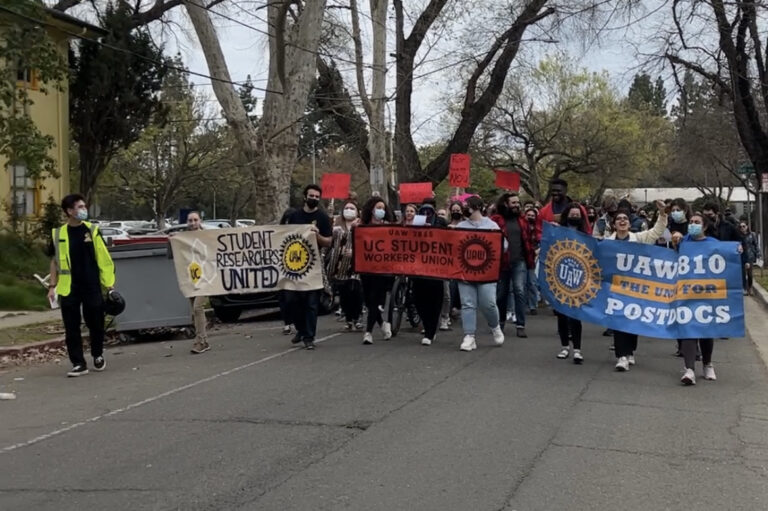
On March 3, members of United Auto Workers (UAW) 5810, the union that represents postdoctoral and academic researchers, UAW 2865, representing teaching assistants, graduate student instructors, tutors and readers and Student Researchers United (SRU-UAW) held a rally to bring awareness to rent burden in Davis. Members of the unions marched from 1st and A Street to Mrak Hall. The rally was one of several that have been taking place across the nine UC campuses and coincided with 2022 contract bargaining for the UC system, which occurs from March to April.

“We have been having housing actions at [all UC schools] as we are entering bargaining to really prioritize housing in this next contract,” said Frangy Pozo, a part-time organizer for UAW 2865.

According to a press release from UAW 2865, 70% of postdoctorates and 90% of academic student employees are rent burdened, which is defined as having to use more than 30% of one’s income on housing. Among the unions’ demands is that the UC put an end to rent burden for all academic student employees.

“The demand is to eliminate rent burden so that none of us as workers need to be prioritizing rent over food, childcare or transportation,” Pozo said.

UAW 5810, UAW 2865 and SRU-UAW collectively represent over 48,000 academic workers. SRU-UAW, which represents more than 17,000 individuals, was recently recognized as a union in December 2021.

“We’re really excited at this stage because we’re at this historic moment,” Pozo said. “We have 48,000 members because of the postdocs, tutors, TAs, readers, student researchers and academic researchers.”

According to a 2022 apartment vacancy survey published by UC Davis, the City of Davis has a vacancy rate of 1.4%.

“That type of scarcity drives up rent prices, which makes it hard for people to live comfortably in Davis,” said Gwen Chodur, a union member and PhD student for nutritional biology. “If you move out of the city in search of cheaper housing, you’re adding on transit costs, and all those things that add up over time.”

On the same day of the rally, the California Supreme Court upheld a 2021 ruling that caps enrollment at UC Berkeley. The ruling favors a group of Berkeley residents who filed a lawsuit pursuant to the California Environmental Quality Act (CEQA), to prevent the dislocation of existing city residents. In effect, this ruling can hamper housing development, and some fear that residents in places like Davis could file suit under the same act, according to Chodur.

“[The ruling] is going to have trickle-down effects,” Chodur said. “We have a very litigious group of homeowners in Berkeley, and it’s a pretty reasonable expectation on our part that we might expect something similar from neighbors in other places.”

The unions also demand that housing be guaranteed for workers from marginalized groups. According to a press release from UAW 2865, rent burden affects people who are undocumented, LGBTQ+, Latino and Black disproportionately.

Pozo believes that the UC Regents’ recent decision to increase chancellor salaries is misguided in light of the prevalence of rent burden. 

“We think that is wrong,” Pozo said. “These chancellors can 100% choose to redirect funds, but they chose not to.”

According to the UC’s 2021 Accountability report, the gap between worker salaries and increasing costs of living in the state is a significant issue that deters student recruitment.

“I hope that [the rally] humanizes these struggles and these stories,” Chodur said. “This draws attention to how difficult this is. We need to communicate the urgency of the housing crisis.”


Written by: Isabella Krzesniak — campus@theaggie.org


Vehicle collision, shooting on Interstate 80 and Mace Boulevard cause temporary Unitrans P, Q Line detours

Detours for Unitrans buses is standard procedure during line obstructions, according to Unitrans general manager

By RACHEL SHEY city@theaggie.org


On Feb. 10, around 6 a.m., a road rage incident that occurred on Mace Boulevard caused Unitrans buses to temporarily reroute their lines. The dispute took place between two drivers and ultimately led to a manhunt involving helicopters, according to California Highway Patrol Officer Rodney Fitzhugh. 

“They were both traveling westbound 80, east of Mace Boulevard, [when] both vehicles exited the freeway,” Fitzhugh said. “After they exited the freeway, one of the vehicles shot at the other vehicle. There were a couple of stray bullets that missed the target and hit another vehicle unrelated to the incident. The suspect’s vehicle tried to re-enter the freeway after it crossed over, lost control of the vehicle and then collided with a fence.”

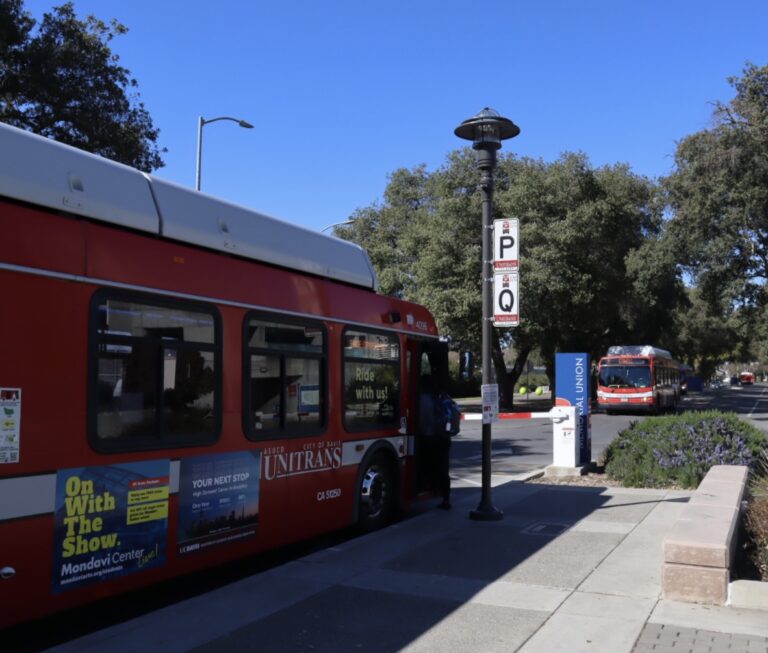
Fitzhugh told the Davis Enterprise that the suspect was detained along 2nd Street. During this incident, which spanned several hours, two Unitrans bus lines, which generally travel on Mace Boulevard, were detoured. The P and Q lines skipped a few stops while Mace Boulevard was closed. 

ASUCD Unitrans General Manager Jeffrey Flynn said that such detours happen with great frequency, though usually for more quotidian reasons. Unitrans buses are detoured on a daily basis due to the system’s expansive coverage. There are often incidents occurring somewhere around the city or campus, according to Flynn.

“Having to detour because of a vehicle collision or some type of police incident or something or unnotified construction activity is very frequent,” Flynn said. “Sometimes it happens on campus or in the city. We are very well-versed in trying to be nimble and respond to detours as quickly as possible. Interestingly enough, we were detoured on the P and Q lines on the 10th due to this incident on Mace, and on the 15th, Mace was shut down again for 12 hours, so we were doing it all over again.”

During a traffic-obstructing incident, the Unitrans dispatcher uses all available information to quickly assemble a detour while trying to miss the least possible stops. The dispatcher then transmits the detour to bus drivers and checks using GPS that the drivers are following the detour, Flynn explained. The detours can be created in just a few minutes. 

“The dispatcher uses whatever information they have at their fingertips in the moment to get buses around a closure, and with our route supervisor, who is mobile and in a vehicle, they go out to the scene and try to get more information and create a more permanent detour that we can adjust to and share with all of our drivers,” Flynn said. “There’s often two detours we do: one that’s immediate, responding to something unknown, and then a more permanent one that is widely shared with subsequent drivers on the route.”

It’s important that the drivers understand the detour, according to Flynn. Dispatchers require the driver to repeat the detour back to them to ensure that they understood the detour route. If the driver doesn’t understand the detour, he or she is supposed to stop and wait for a route supervisor to drive out and assist them. Route supervisors sometimes serve as a pace car to guide them through the detour, driving ahead for the bus to follow, according to Flynn. 

Flynn encourages all Unitrans customers to check the Unitrans website, Facebook and Instagram for updates on detours. For those relying on the buses to make it to school or work on time, the website is where the most up-to-date information can be found. 

“We encourage people to follow us on Facebook or Instagram, where we post these kind of detours,” Flynn said. “It’s very hard to get customers to find our information. Not many people are signed up for our Facebook page or Instagram page, and a lot of people don’t use our website. We really want to steer people to our website, our Facebook and Instagram pages for of-the-moment detour information. We try to post detours and missed stops as they come up on those services, so that’s the best place to get the information.”

Fitzhugh encourages people to drive courteously and to avoid becoming involved in road rage behavior. Collecting information about aggressive motorists is also a good idea in case violence occurs. Calling 911 is a great first step. 

If someone is driving aggressively near you, get good witness information, should you find yourself in a road rage incident,” Fitzhugh said. “Do not engage in that road rage behavior, just be a good witness.”  

Written by: Rachel Shey — city@theaggie.org


A case for reconsidering cancel culture

Carelessly canceling others isn’t a substitute for listening to those impacted and addressing your own biases

Technology has not only shaped the way we’re able to present ourselves online, but also the way we’re capable of viewing and judging others. The whole experience of using social media is detached: Often the images we post online are highly artificial, either by being manipulated in their angles, edited with photo editing apps or evaluated and vetted for how others will perceive them. Even if we strive to make the images we post seem unfiltered, we often still consider how these images will be viewed by others. 

These barriers also persist in online discourse. When we present virtual versions of ourselves, we limit our ability to have a natural back-and-forth dialogue by reviewing and rewriting every word and sentence before commenting. Rarely do we vocalize unfiltered thoughts as we do while having in-person conversations. 

Often, we try to sense the general reactions to a post before commenting an opinion of our own to gauge how we might be perceived: When was the last time you commented on a post before assessing what others wrote in the comments first, let alone advocated for your original position when it seemed like the majority disagreed? It can feel easier to not contribute at all in these situations, as the fear of being lashed out at online is a powerful deterrent. 

The beauty of social media is its potential for connectivity, meaning you can comment on Kim K’s most recent post or message your favorite singer and pray for a response. Yet this connectivity comes with a price. Words and actions can circulate the globe in a matter of minutes to be judged by thousands, and once posted digitally, they’re rarely able to be retracted. 

In this sense, the ability to spread information so widely is valuable for public awareness, but when the words or actions of a public figure come under criticism online, commenters call for them to be “canceled.” 

Cancel culture, “a modern form of ostracism” as described on Wikipedia, can be problematic, especially in cases where it deters people from learning about their mistakes and actively changing their mindset. Conversations on controversial topics that don’t cause harm to others can be dominated by the majority, with little room to explore less common opinions. By shunning those with different viewpoints, and deeming them unacceptable individuals to converse with because they’re “canceled,” it stunts powerful discussions and the ability of individuals to be exposed to new ideas. 

But not all offenses are on the same level; some transgressions are severe and harmful enough that it can only be up to the people directly affected to determine a course of action and shouldn’t be assessed by strangers online.

That being said, technology and online forums have given us a space for holding important figures accountable for their actions; the act of tearing down someone’s online presence can give a feeling of palpable change when systemic change is slow and frustrating. And in some rare instances, public pressure can result in societal change, like the personal testimonies from sexual assault survivors on social media which fueled the #MeToo movement.

Yet in some cases, when someone unrelated inserts themselves into a situation, canceling does more to uplift their own status than actually opening up a discussion of why the person is getting canceled. It solidifies the canceler’s place in the majority group and sends a sign that if others do not follow suit, they’re at risk of being canceled too.

Especially when an individual’s controversial words or actions from several years ago resurface, immediately canceling them ignores the human potential for growth and change. In certain situations, when the person calling out a mistake made by another individual is in the same place of privilege, it can be a means to virtue signal. While it is important that people in places of privilege hold each other accountable, canceling someone can be a poor, performative substitute for addressing biases and prove counterproductive in effecting change. 

As students, it’s crucial to assess our own role in cancel culture on social media. In instances of canceling, we should be conscious of impacted individuals’ assessment of the incident and check our own privilege. It is vital to consider whether or not an individual has demonstrated a capacity for change and if impacted individuals’ have expressed that irreparable harm was inflicted. We should practice humility and address our own biases and privileges — far more impactful steps when cultivating systemic change than simply blaming others. 


Written by: The Editorial Board