58.7 F
Davis

Davis, California

Sunday, December 21, 2025
Home Blog Page 225

Community science initiative The Seed Pile Project studies native seed growth in human-dominated environments

The project, which dispersed seeds by way of community participation, is led by Miridae Living Labs in collaboration with the UC Davis Department of Human Ecology

By SONORA SLATER — science@theaggie.org

Urban areas aren’t known for being kind to plants: herbicides, lawnmowers and landscape management teams often interfere with the germination of native, local seeds. But The Seed Pile Project, a citizen science initiative by Miridae Living Labs and the UC Davis Department of Human Ecology, is researching which species of plants are able to thrive in human-dominated environments, how they do it and why human disturbances might actually help some of these species establish themselves. 

Miridae Living Labs is a nonprofit shoot-off of the Miridae sustainable landscape architecture company. According to their website, they aim to “develop [the] best practices for the landscaping industry and [restore] native biodiversity in human-dominated areas.”

Billy Krimmel, one of the co-founders of Miridae and a leader of The Seed Pile Project, said that the idea for the project sprung out of his experience with native plant landscaping.

“One of the challenges I’ve always had is how to incorporate some of these seed-dispersed species that I really like,” Krimmel said. “Tarweed is my favorite plant, and it’s super important habitat-wise, but it’s too messy for a typical residential design. There’s a lot of super important habitat plants that are just difficult to integrate into design landscapes; they don’t stay put, or a lot of them are annuals and they die off every year.” 

According to Krimmel, he sees this project as an opportunity to “embrace establishing seed-dispersed species in urban areas.”

“Along Highway 50, you see tarweed growing along the side of the road, or there’s native sunflowers growing,” Krimmel said. “Some of these are really hard to even establish in a garden or in your backyard, but they’re great in these areas, so why does that happen? There’s a lot of questions about how we can embrace disturbance in cities as an opportunity.” 

For the first iteration of the project last year, Krimmel and Haven Kiers, an assistant professor in the Department of Human Ecology at UC Davis, dispersed the seeds themselves, kept track of their locations and monitored their germination and growth over time. 

This year, they scaled it up by inviting the public to participate in the seed dispersal. The first year, around 50 seed piles were monitored — this year, that number grew to 2,000.

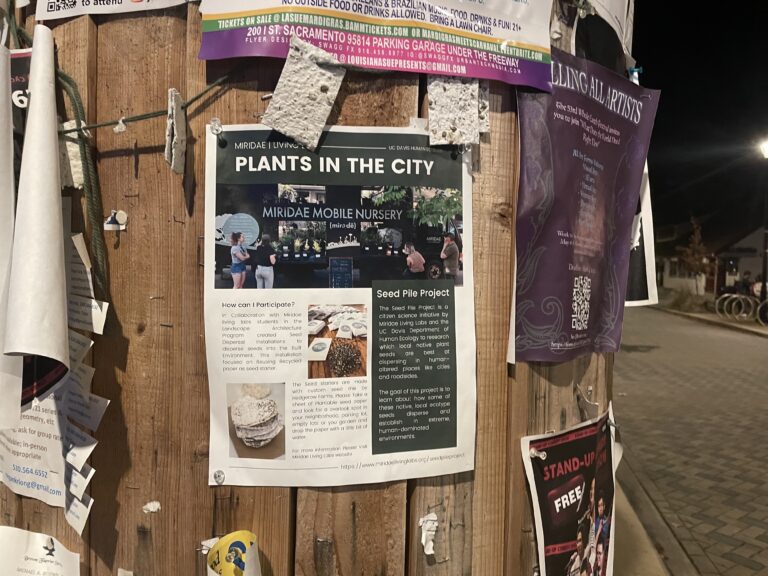
One of the ways the seeds were distributed was by flyers posted around the Davis and Sacramento areas, along with plantable seed paper. 

“The seed starters are made with custom seed-mix,” the flyer reads. “Please take a sheet of Plantable seed paper and look for an overlook spot in your neighborhood, parking lot, empty lots or your garden and drop the paper with a little bit of water.” 

Caroline Larsen-Bircher, the second co-founder of Miridae, elaborated on how they collected community data.

“Participants get their free packet of native seeds, register online, dump their seed packet in an urban environment like an alley, sidewalk, bike path, along a highway, etc., then each month fill out a data form checking for how many of each type of plant is sprouting,” Larsen-Bircher said via email. “We’ve been blown away by the enthusiasm from different communities. Families with kids of all ages have used it as a [COVID-]friendly activity. Educators have used it as a science and data lesson for their classes.”

This year, the project utilized Google Forms to collect information, according to Krimmel. However, in the future they hope to develop an app to streamline and simplify the project. 

“Next year, we’re hoping to expand the project to a greater area in Sacramento, the Bay area, and the Los Angeles area,” Larsen-Bircher said. “We will be moving to a web-based community science platform with a mobile app, which we think will greatly improve the user experience both from a data entry and data management perspective.”

Larsen-Bircher said that they’re beginning to analyze the data from this year’s experience and talked about what they hope to learn.

“[We] are excited to learn about which types of native plants can survive and even thrive in extreme environments,” Larsen-Bircher said. “If we are able to identify native species that can help restore areas such as along highways in a low-cost, low-energy manner like passive seeding, we can greatly increase the overall proportion of native plant habitat for the other species that depend on them, such as insects and birds.” 

Krimmel said that many of the plants they’re studying do poorly in competition with other species, and in this way, urban disturbances can actually help them. 

“For example, turkey mullein germinates late in the season,” Krimmel said. “A lot of the city managers who are doing road control, they apply herbicides in the early spring so it kills a lot of their early-germinating competitors, and then turkey mullein is able to germinate.” 

He went on to describe what they’re hoping to learn in the long term. 

“We’re looking at this as a study that we’ll do every year, you know, forever,” Krimmel said. “The project is all about figuring out which of these species could be best suited for urban existence and then what human disturbances influence their existence.” 

Larsen-Bircher added that, in addition to their goal of research, the team is just as interested in the opportunity to use the project as a tool to engage the public.

“We love that the Seed Pile Project is fun, educational, and valuable research,” Larsen-Bircher said. “But [it’s] also a very low barrier entry point into learning about plants, biology, and the natural world around you. Anyone can participate regardless of age, education background, or where they live.”

Krimmel offered some final thoughts on the positive benefits of dispersing native seeds.

“Even if we don’t learn a thing,” Krimmel said, “we’re putting down 70 pounds of native, locally grown seeds in the area in places where they might otherwise not exist.” 

Written by: Sonora Slater — science@theaggie.org

Editor’s note: A previous version of this article contained misspellings of Billy Krimmel’s name. The article has since been updated to correct the spelling. The Aggie regrets this error. 
 

Commentary: Crochet’s evolving relationship to femininity

How this once “domestic” activity is being reclaimed and becoming more popular


By CORALIE LOON — arts@theaggie.org


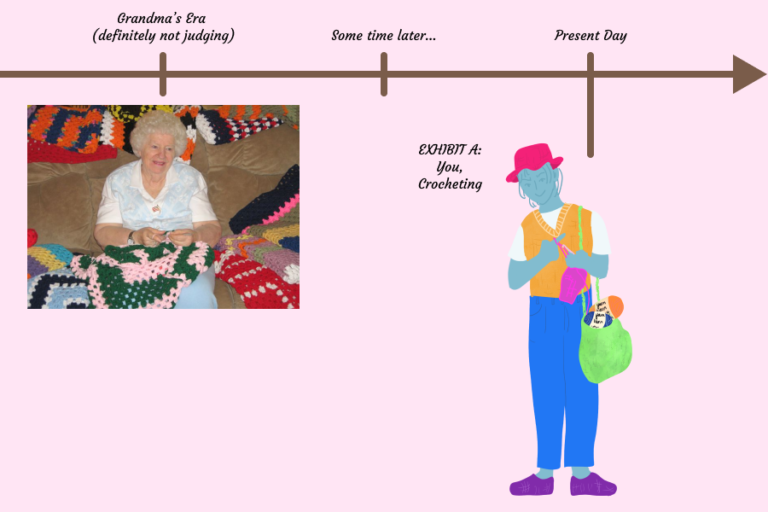
Crocheting, a textile technique that involves using a hook to turn loops of yarn into intricate cloth patterns, has been around for centuries, but thanks to social media, it has had a recent resurgence in popularity. While it is still a gendered craft, the relationship between crocheting and femininity has changed in some important ways. 

According to a Martha Stewart article, Mademoiselle Riego, often referred to as the “Mother of Crochet,” published the first book on Irish crochet in 1846, which inspired a surge in crocheting in Ireland and England before its expansion to America.

With the Industrial Revolution in the mid-19th century, crocheting became a popular hobby as middle and upper-class women had more free time to twiddle their thumbs. Thus, the image of a Victorian housewife busy crocheting garments for her and her children was born. 

Tasks such as quilting, sewing, crocheting or doing needlework have been traditionally tied to domestic conceptions of femininity. The portrait of a woman doing meticulous craftwork is not only prevalent in historical media but intrinsically tied to definitions of femininity that rely on concepts of service, domesticity, delicacy and beauty. 

Pierre-Auguste Renoir’s 1875 painting, “Woman Crocheting,” depicts the soft and romanticized figure of a woman doing exactly what the title suggests — crocheting, but also posing for the man who is theoretically painting her, as if fulfilling his expectations of femininity.

Of course, a lot has changed between then and now. As a Reno News & Review article explains, crochet fell out of popularity with the rise of second-wave feminism, ditched as an old-fashioned, leftover piece of the patriarchy. Women were in the process of rewriting femininity, pushing for new spots in the workplace that had been denied to them for so long, and sitting home and crocheting colorful blankets just seemed to have lost its previous appeal.

Femininity, however, is still being rewritten. As the backlash to the recent M&M redesign, in which the infamous green M&M’s go-go boots were replaced with sneakers, showed us, ditching traditionally “feminine” elements in favor of traditionally “masculine” ones is a feminist tactic that is being questioned, and the mainsteamification of crochet could be an example of this.

Crochet has experienced a spike in popularity since the beginning of the COVID-19 pandemic: a few YouTube searches or scrolls through TikTok and you will inevitably find a tutorial on how to crochet all sorts of items, from bags to gloves to water bottle holders. Ironically enough, for many, the beginning of lockdown mimicked the historical experience of many middle-class European and American women: stuck at home without a traditional job and a minimal social life. 

Like then, modern crochet trends are deeply intertwined with femininity. The community of crochet-creators (whether selling their products on Etsy, writing crochet patterns or posting video tutorials) is dominated by women who create mostly feminine pieces, seeing as popular crochet clothing sold on Etsy tends to be cropped, bikini-style tops, skirts and the occasional cardigan.

Despite this, the craft holds a much different relationship with femininity than it once did. Male or gender non-conforming crocheters (and customers) break the perception of who can participate in traditionally female activities, and items such as oversized sweaters, bucket hats and beanies are popular in part for their gender neutrality. Most importantly, young people today are exploring the world of crochet not because it is expected of them, but because they enjoy it and because it is a creative form of self-expression that counters the suffocation of participating in a traditional workforce.

It comes as no surprise that younger generations, increasingly well-versed in capitalism’s grip on social attitudes, may find value in art or traditionally “domestic” activities as they question why these activities have been societally undervalued. 

While current crochet trends could benefit from being more gender-inclusive, the practice serves to reclaim and rewrite “femininity” as something that is useful for all genders and all people interested in expanding creative autonomy.


Written by: Coralie Loon — arts@theaggie.org


Leading antiracism activist Ibram X. Kendi set to give lecture for Campus Community Book Project

“How to Be an Antiracist” author Ibram X. Kendi will speak about the Campus Community Book Project’s theme of “social justice in practice”


By KAYA DO-KHANH — campus@theaggie.org


Ibram X. Kendi, a renowned Boston University history professor and the author of “How to Be an Antiracist,” will visit UC Davis to talk about his book and its relation to social justice in practice at 7:30 p.m. on Thursday, March 31, at the Mondavi Center for the Performing Arts.

The event is organized by the Campus Community Book Project at UC Davis, an initiative out of the Office of Diversity, Equity and Inclusion (DEI) that came about in response to 9/11 to bring the campus community together and promote dialogue about specific issues. 

“[It does this] by encouraging diverse members of the campus and surrounding communities to read the same book and attend related events,” the program’s website states.

The 2021-2022 project features leading antiracist activist Kendi’s book, “How to Be an Antiracist.” The facilitators of the project have hosted lectures, discussions and film viewings related to the book’s themes. There have been discussions about social justice, racism and antiracism across various disciplines, with programs from the Stand-Up Comedy Club to the School of Veterinary Medicine. 

“We’re trying to be comprehensive in recognizing that racism is so deeply steeped in everything we do in every structure, and that applies to the various academic disciplines,” Program Co-Director Megan Macklin said. “We’ve been really grateful for all the partnerships we’re able to build to encourage folks and to provide a space for folks around the campus and the community to talk about what social justice means in their particular field while also again having that unifying vision of what does this really mean when we’re thinking about UC Davis as an institution.” 

Before his talk in the evening of March 31, Kendi will take part in a non-ticketed panel discussion that is open to the public at 4 p.m. in Jackson Hall at the Mondavi Center. It will be a live, in-person discussion, but it will also be available via livestream for members of the UC Davis community as well as for other UC schools.

“Now that we’re doing a lot of [programming] virtually and we have those video recordings available, I think that it creates a lot of longevity to the conversation,” Macklin said. 

The Campus Council on Community and Diversity, which is made up of representatives from across the UC Davis campus, chose the project’s 2021-2022 theme to be the topic of “social justice in practice.”

“They were very, very intentional in having that ‘in practice’ component be attached to our discussion of social justice,” Macklin said. “We are not talking about how social justice might look at a very high level or how we might want it to look in the future. We wanted to have an opportunity to talk about what social justice looks like right now and what it looks like for our particular community.”

Associate Chief Diversity Officer in the Office of DEI Mikael Villalobos said that the book project strongly aligns with the office’s mission.

“The community-building aspect of the book project is important in supporting the goals of the Office of DEI, because we have a community relations part,” Villalobos said, “and it is an avenue that really brings faculty, student, staff and the greater campus community to engage in the importance of dialogue and also explore the topics that impact us collectively in a way that is a part of supportive learning.”

Written by: Kaya Do-Khanh — campus@theaggie.org

UC Davis students, professor weigh in on U.S.’ diplomatic boycott of the Winter Olympics

The 2022 Winter Olympics in Beijing spark conversation about the role of politics in sports and the effectiveness of boycotts

By ALINA ISSAKHANIAN — features@theaggie.org


Much conversation around the 2022 Winter Olympics in Beijing, China, has been focused on the current human rights crisis in the country. Globally, governments and international entities have chosen to diplomatically boycott the games, citing harsh human rights violations committed by the Chinese government in recent years.

In March 2021, the Biden administration declared China’s treatment of Uyghur Muslims a genocide, officially categorizing it as a crime against humanity. According to the Human Rights Report discussing the poor treatment of Uyghur Muslims, China was involved in the imprisonment, torture, enforced sterilization and persecution of Uyghurs, as well as members of other religious and ethnic groups.

The U.S., U.K., Australia and Canada have diplomatically boycotted the games in an effort to call out the human rights abuses in China. While each country has its own definition of boycotting, generally, it includes that dignitaries representing the country’s government do not attend the games while athletes still get to compete. 

UC Davis professor of political science and Department of International Relations director Ethan Scheiner explained that international power dynamics play a large role in who does and does not boycott in situations like these.

“The United States, in particular, is one of the few countries that has less to fear from Chinese retaliation than other countries,” Scheiner said. “The fact that the United States is such a big country is a big factor. Also, the United States actually has a much stronger stake in pushing for democracy and has done so for a longer period of time, whereas others have been less inclined to do so.”

Many believe that the U.S. should have taken a stronger stance in opposition to China’s human rights violations, since they are classified as crimes against humanity. Scheiner said that he does not believe that the diplomatic boycott will be very effective, and that both the 2008 Summer Olympics and the 2022 Winter Olympics could have been opportunities for the U.S. to make a more impactful statement.

“What China learned in 2008 when it hosted the Summer Olympics was, ‘Hey, we can do whatever we want, and nobody’s gonna make us change,’” Scheiner said. “We saw that carryover where China became increasingly aggressive between 2008 and 2022. Nobody ever called them on it and so now the problem still exists. So in many ways, either in 2008 or in 2022, [this] was sort of a lost opportunity to send a stronger signal.” 

However, Scheiner explained that most likely, the U.S. did not take any other steps because of international power dynamics and economic concerns. 

“If China wanted to, it could lash out at the United States in various economic ways,” Scheiner said. “American companies and sports leagues — especially the NBA — are terrified of losing the Chinese market […] If China wanted to boycott the 2028 Los Angeles Summer Olympics, and not show it on television or market it at home, that would have an economic impact on the ability of people trying to hold those Olympics and athletes competing in them to make money using the Chinese market.”

He also said that this is not the first time that the U.S.has boycotted an Olympics. The U.S. actually implemented a full boycott of the 1980 Moscow games, during which the U.S. did not even send athletes to compete. According to Scheiner, some believe that even a full boycott — like that in 1980 — is not very effective.

“The main lesson that people draw about boycotts they draw from 1980,” Scheiner said. “[After the 1980 games], when everybody came away with ‘oh, boycotts don’t work,’ if you boycott all you do is hurt the athletes. And so I think the United States is always coming back to that example and saying, ‘Okay, we shouldn’t boycott because all it did was have our athletes lose their opportunity, and everybody’s mad about it.”

First-year psychology student Michell Bancks, a volleyball player and co-captain for Davis second club team, said that athletes often see the Olympics as a career-defining moment, and some believe that those spots should not be lost due to politics.

“Many Olympic athletes can only perform at the Olympic level for a few Olympics,” Bancks said. “I think it’s rare for an athlete to attend more than three Olympic Games, and between those competitions, it’s even more rare for an athlete to medal more than once. There are athletes who are at their prime for this Olympics and won’t be as competitive in four years, so they should be given the chance to try for a medal.” 

However, Scheiner pointed out that others believe that it’s not possible to keep politics and sports completely separated. 

“It’s sort of like saying let’s keep life out of sports,” Scheiner said.

First-year American studies major Nic Sardo agreed with Bancks that the loss to the athlete is great if they do not compete, but he said that choosing to do so sends a strong statement. 

An athlete can sacrifice so much and spend years training for the Olympic games so if that same athlete decides that their energy is put to better use by boycotting those games, I believe that is very brave. By boycotting or speaking out against one’s own country, or against the host country, that athlete is putting a lot at risk and may have their whole life disrupted because of that one decision.” 

Written by: Alina Issakhanian — features@theaggie.org


In loving memory of Daft Punk

Remembering the electronic music duo’s biggest hits, and honoring their lesser known but just as groovy tracks 

By ANGIE CUMMINGS — arts@theaggie.org


It has been approximately one year and a week since we lost the world’s most beloved French robot musical duo: Daft Punk. Thomas Bangalter and Guy-Manuel de Homem-Christo, the artists behind the masks, announced the end of their decade-spanning musical career together on Feb. 22, 2021, and as we go into March 2022, their songs have not lost any cultural relevance. 

While the depths of their vast discography might not be well known to everyone, Daft Punk is anything but obscure. The first songs of theirs that come to mind are typically their collaborations with huge names in music over the past 20 years or so, most notably Pharrell, Kanye West and The Weeknd. These include some radio and Billboard hits that we have grown up with and deserve to be revisited again and again. 

Going all the way back to 2001 (were you even born yet?), Daft Punk released a piece of music that arguably rivals Beethoven’s Symphony No. 9 in its historic levels of auditory perfection and general impact. This song is none other than “Harder Better Faster Stronger,” with a whopping 12 unique words repeated in different orders, tones and speeds. Listening to this song has been known to cause anything from a slight head nod or a shoulder bounce to a full mind-body-and-soul ascension into another dimension. The song builds up, taking twists and turns that never cease to excite and somehow metaphysically scratch that itch at the back of your brain. “Harder Better Faster Stronger” is a perfect song in every way. It is at this point that I must disclose that I personally know next to nothing about the technicalities of music production.

While this almost five minute long loop of a few words may not have affected the vast majority of listeners, it is almost impossible to have not heard the sound before as it was prominently used in Kanye West’s hit “Stronger” (2007). Of course, West is an incredibly controversial figure today, but there is no denying his knack for making music — especially on his critically acclaimed third album, “Graduation,” on which this is one of the top songs. This song solidified Daft Punk’s place in the burgeoning future of genre-transcending music in the 21st century. 

Perhaps the next huge Daft Punk song that was played far past enjoyment on the radio and at school dances was “Get Lucky” featuring Pharell & Nile Rogers (2013). Having almost a decade of respite since that song took over, and revisiting it with fresh ears, there is no wonder why it basically achieved world domination for a while. Pharrell really could not have said it better: We are all in fact “up all night for good fun.” Maybe it is just odd middle school nostalgia, but the groove of this song makes you feel light and airy with a nice sprinkling of swag. 

From the same album as “Get Lucky” came another impeccable song that might not have had the same immense cultural impact, but still seamlessly blended Daft Punk’s genius with the vocals of a big name in music. “Instant Crush,” featuring Julian Casablancas, the lead singer of The Strokes, is one of those songs that you can listen to once, suddenly realize it is almost over and need to replay it just because there is too much goodness in (what feels like) such a short time. As it happens with many Strokes songs, just listening to the sound of Casablancas’ voice makes for a full yet relaxed experience, but choosing to pay attention to the lyrics makes the song cut that much deeper. 

Most recently, Daft Punk returned to the collective consciousness with their features on The Weeknd’s show-stopping singles “I Feel It Coming” and the album’s titular track “Starboy” (2016). Similar to what happened with “Get Lucky” three years earlier, it was incredibly hard to escape the clutches of these singles for most of 2016 and 2017 — and again, this was for good reason. This album marked the beginning of The Weeknd’s distinctly ‘80s and synth-filled R&B style that he has continued to evolve for the past six years, and with Daft Punk’s expertise on all things synth and electronic, these two singles are some of the most delicious-sounding songs to flood our airwaves in a long time. 

Even in their very first album from 1997 there are classics like “Around the World” and “Da Funk” — a lyricless, electronic and funky five and a half minutes of fun. In all honesty, there are countless other Daft Punk songs from the depths of their discography that I could praise for far too long, but the point is Daft Punk has hits worth the hype as well as some equally strong hidden gems. 

After a long year of grieving our loss of any future Daft Punk releases, the duo took to social media on the anniversary of their breakup, which also happened to be the 25th anniversary of their debut album, “Homework” (1997). They posted cryptic messages before re-releasing a new edition of “Homework” as well as posting a special streaming of a concert from 1997 (sans helmets) to their now vacant Twitch account

This momentary return begs the question: Will we be lucky enough to hear new Daft Punk creations in the future? Whether or not they return, the world is forever indebted to these French robots for some of the most delectable and fresh mixes, collaborations and original creations. 


Written by: Angie Cummings — arts@theaggie.org


I’ll take grocery shopping in person over Instacart, any day

How the grocery store is my personal oasis


By NADIA ANEES — nsanees@ucdavis.edu 

One of my favorite activities is taking a trip to the grocery store. It’s a place where I feel safe and content. A place where being alone doesn’t feel strange. A place where asking for help is normal. A place where striking up mundane conversations is commonplace.   

I think the grocery store is one of the best ways for people to unplug in their daily lives. Why? Well, having food is a necessity for us to survive, so making the trip to get your fuel for the week becomes a mini-escape from your everyday tasks. 

When we’re not eating, we’re probably at work, studying, staring at screens or stressing over something. The grocery store is the one place that we can be doing something other than attending meetings and staring at multiple screens. There, we can tune out the world and tune into our senses. You can smell the fresh flowers as soon as you walk in, the scent of coffee roasting at the coffee shop inside; you can feel the produce to pick the best-looking ones and absorb the bright colors and patterns of the produce and products lining the tall aisles. 

I fully understand the convenience and ease of ordering groceries online, and admittedly, I’ve benefited from these services myself. Instacart is extremely convenient. Instacart was also especially helpful when I was living with immunocompromised people while COVID-19 cases were soaring since it meant avoiding the anxiety-inducing grocery store trip. Many people have health concerns that lower their incentive to go grocery shopping in person, and so they will most likely continue to prefer using online grocery services.

Although online grocery shopping is convenient, the satisfaction of having crossed items off your checklist when ordering groceries online isn’t there. Oftentimes, there’s uncertainty over whether you’ll even receive the items you had selected, or if they will look like they’re in a usable condition. 

Grocery shopping in the physical supermarket can prompt inspiration and ideas for someone, while grocery shopping online can start and end within five minutes, which usually doesn’t provide the same outlet for creativity and time to be present. In an already stressful environment between work and school, for me, the grocery store is a safe place for me to slow myself down, even for the short duration of the trip.  


Written by: Nadia Anees — nsanees@ucdavis.edu


Disclaimer: The views and opinions expressed by individual columnists belong to the columnists alone and do not necessarily indicate the views and opinions held by The California Aggie.


ASUCD Senate hosted its quarterly Town Hall meeting on Feb. 24

SB #54, #55, #56 and #57 passed unanimously  

By JENNIFER MA — campus@theaggie.org 


The Senate meeting was called to order at 6:10 p.m. on Feb. 24 by Vice President Juliana Martinez Hernandez, who recited the UC Davis Land Acknowledgement. 

The quarterly Town Hall began, and the public asked the senators questions. 

A member of the public asked Senator Owen Krauss about his goals for making UC Davis a more LGBTQ+ inclusive environment.

Krauss said he is working on ASUCD’s first Pride Festival at UC Davis, which is scheduled for June 2022.

The Town Hall took a new format this quarter, where senators individually chatted with members of the public. According to the senators, this is in hopes of making Town Hall meetings less intimidating, as it allows members of the public to ask questions without speaking in front of everyone. 

Following the Town Hall, the Office of Diversity, Equity and Inclusion gave a presentation regarding its impact reports for the past year. 

The Student Sustainability Career Fair Committee followed up with confirmations of committee members. 

Chairperson of the Gender and Sexuality Commission Ashley Chan then provided the commission’s quarterly report. The report went over new additions to the commission, legislation that was seen, winter quarter events, internal projects and spring projects. 

Chan also discussed Christian Baldini, the orchestra conductor at UC Davis, who was temporarily removed without pay in 2017 after substantiated allegations of sexual harassment. Chan stated that Baldini cannot be tried for the same offense twice, and since he was previously put on probation, no further action can be taken unless more information about the original case comes to light. 

The Academic Affairs Commission also provided its quarterly report. Most notably, this quarter, the commission has been working to implement wellness days as a part of the quarter system schedule. This would “allow students to utilize a Wellness Day if they are not feeling mentally prepared to attend a lecture.” A survey asking for student input is currently open. 

Next, the Ethnic and Cultural Affairs Commission gave its quarterly report. The report mentioned collaborative events and internal projects as well the commission’s future plans. 

The Housing Advising for Undergraduate Students then followed with its quarterly report. Housing week, which will take place between Feb. 28 to March 4, was the primary highlight. The week will have events every day that cover everything from personal finance advice and insurance advice to finding housemates or a home for next year. 

Next, senators provided their elected officer reports, detailing what they did during the week.

In Public Announcements, Senator Ambar Mishra brought up implementing wellness days in the quarter system and urged the student body to complete the aforementioned survey. 

In Public Discussion, Krauss touched on the current crisis in the Ukraine. He urged the table to work with him to write a letter to the chancellor and UC Regents about education visas to help Ukranians. 

Martinez Hernandez then gave a presentation about ASUCD Payroll and emphasized the importance of senators logging hours for their work.   

The Senate table then moved on to legislation. SR #23 is a resolution in support of the movement to make the UC Davis mascot a cow and SR #24 demands an institutional commitment to the end of fossil fuel usage on UC Davis campuses by 2030. Both resolutions were tabled and are to be on the following Senate meeting’s agenda.

SB #48 allocates $2,015.77 to the Office of ASUCD Senator Dennis Liang for marketing materials for a Senate project and task force. It failed to gain approval from the Internal Affairs Commission and has been tabled indefinitely. 

Lastly, SB #54 structures the composition of the Office of the International Student Representative. SB #55 allocates $4,966.75 to the Exploratory Board on an ASUCD Pride Festival for the Pride Festival. SB #56 allocates $1,000.00 to The Pantry for the purpose of purchasing. The last Senate Bill to be introduced was SB #57, which requires the ASUCD Volunteer Award Committee to distribute the ASUCD Volunteer Award twice during an academic year. All four bills passed unanimously.   

Martinez Hernandez adjourned the meeting at 12:04 a.m.


Written by: Jennifer Ma — campus@theaggie.org


City of Davis to invest in environmental infrastructure as Yolo County works toward green energy

The first phase includes electric vehicle fleet procurement as part of the Electrify Yolo Project 

By CHRIS PONCE  — city@theaggie.org


The city of Davis has been undergoing environmental changes under the first phase of Electrify Yolo. This regional project is being led by Davis and one of its major goals is to expand the electric vehicle fleet, as explained by Mayor Gloria Partida. 

The City of Davis is committed to doing its part to reaching carbon neutrality,” Partida said. “Part of that is finding ways to electrify its fleet. As part of the Electrify Yolo regional Project, of which the City of Davis is the lead agency, we have initiated the first phase of making this a reality exploring ways to install electric vehicle infrastructure. This is the first part of a phased approach to electrify Yolo.”

On Feb. 9, the city met with Jim Provenza and Don Saylor of the Yolo County Board of Supervisors to discuss the electric vehicle “fleet procurement” and other climate initiatives. The discussion items included climate action initiatives, the adult day health center and the long range planning center. Early into the meeting, Mayor Partida spoke on the importance of cooperation between county and city efforts. 

“That’s the one thing I am interested in, figuring out ways that we can align some of our efforts with the county’s efforts,” Partida said. “Maybe we can both save some money around the efforts we are putting out.” 

During the meeting, members of both the city and county expressed the benefits that can be seen from working together to implement such environmental policies. Both parties have a close relationship working together to achieve their goals of being carbon negative by 2030, according to the Director of Yolo County Community Services Department, Taro Echiburu. Echiburu described the actions that need to be taken first.

“We’re thinking that it might be advantageous for us to put together an actual electric vehicle fleet plan, to really understand what comes first,” Echiburu said. “Do we buy the vehicles first or do we [install] the charging stations first?”

The meeting also mentioned Unitrans’ plan to move to all electric and how charging stations were mapped out for its transportation. The city of Davis is making other plans to advance and encourage environmental responsibility as well. On Feb. 16, Davis announced that it is seeking nominations for the 28th Annual Environmental Recognition Awards. 

Moves are also being made by the local community and county to move to green energy and combat climate change. On Feb. 23, Davis City Council announced that Valley Clean Energy is opening applications for two “at-large seats” for the Community Advisory Committee (CAC). Valley Clean Energy is responsible for providing green electric energy as part of Yolo County’s green climate initiatives. This agency includes Davis, Woodland and Winters. In an official statement, CAC member Christine Shewmaker explained the importance of the CAC and the impact it has on the environment. 

“As a scientist and someone who loves the outdoors, the urgency to address climate change is clear,” Shewmaker said. “Being on the CAC allows me to help VCE succeed in its mission: to provide clean electricity, taking real action on climate change while reinvesting in the community.”

Meetings for CAC are scheduled for the fourth Thursday of every month. Virtual meetings are available in response to the pandemic. Members will also be appointed for a three-year long term. 

The CAC is responsible for advising members of Valley Clean Energy and reflecting the thoughts and opinions held by the communities that they represent (communities across Yolo County). A statement from Valley Clean Energy details each VCE jurisdiction will have two representatives (11 members for the VCE in total).  

The city of Davis is encouraging applicants from diverse communities. The application open to all residents 18 years and older can be found on a PDF listed on the Valley Clean Energy website. Applications can be submitted by mail to Valley Clean Energy at 604 2nd Street, Davis, CA 95616 or via email to Alisa.Lembke@ValleyCleanEnergy.org

The Davis community is taking strides towards green energy. Both Davis and Yolo County are continuing to work hand in hand to achieve these goals together. County Supervisor Don Saylor emphasized that the county is taking bold actions in order to achieve their plans.

“The work that the county is doing with our climate action commission, we have an aggressive goal, and a deliberate process to achieve it,” Saylor said.


Written by: Chris Ponce — city@theaggie.org


Topic of dual citizenship revived at this year’s Winter Olympics

Eileen Gu, along with other American-born athletes, represented China for the Beijing Olympics 2022

By Katherin Raygoza- sports@theaggie.org 


The Winter Olympics kicked off on Feb. 4 and recently, there have been headlines regarding nationality and an athlete’s ability to compete for two different countries. News stories have emerged about 18-year-old Eileen Gu, who was born in the U.S. and won gold representing China’s Olympic team. She is one of many Chinese-American Olympians straddling between two countries, and some people have questioned whether athletes are allowed to do this or why they would do this.

“There are those who love her, moved by her ability to soar over treacherous slopes with ease,” wrote Ashley Wong from The New York Times. “Others are inspired by her efforts to navigate the uneasy political tension between two countries and cultures. Some believe she chose to represent China simply to cash in on the lucrative opportunities it has afforded her.”

Gu or Gu Ailing — “Snow Princess,” as she is known in China — was born in San Francisco to a Chinese mother and an American father. She began skiing at the age of eight on weekend trips. American-born Gu has talent that allowed her to grow as a skier and was finally able to land the double cork 1620 — a move in which skiers spin 4 ½ times while rotating 20 plus feet in the air. 

Chinese fans have been very supportive of Gu’s success and are proud to watch a Chinese win gold for their country, as opposed to her birth country which criticizes her decision. 

“It’s very cheering. She’s of Chinese origin and has returned to China. I feel proud of her,” said Jiang Yu, a Beijing resident and a Gu fan.

This is a great accomplishment for the skier, as she became the youngest freeski Olympic gold medalist in history and the first action-sport athlete to win three medals at the same Olympics. Despite her accomplishments, she is being called a traitor and ungrateful.

She has also received backlash on social media because users are arguing that she cannot be American if she competes for China. Some are saying that she must pick between identifying as American or Chinese.

“I’m an 18-year-old out here living my best life. I’m not going to waste my time trying to placate people who are uneducated, and don’t experience the gratitude and love I have on a daily basis,” Gu told The Guardian.

Some dual citizens face the same challenges as Gu, and it has been seen all throughout sports, especially during the Olympics. That is why there has been a set of rules created which indicate that if a competitor who is a citizen in two or more countries, they have the freedom to represent the country they desire. They cannot represent a country if they play for a different country in other events like the Olympic Games, continental or regional games or world or regional championships. Once they compete in those games, they cannot change the country that they represent.

An athlete can be exempt from these rules under certain circumstances. For instance, if an athlete has gained a new citizenship or wishes to change their Olympic status, they can do so if three years have passed since they competed for their previous country.

There is an especially large controversy with China because they have 30 foreign-born athletes competing in the 2022 Winter Olympics. Olympians in China must follow specific rules since they do not allow dual citizenship. So the question remains whether American-born athletes are following the rules or simply have been exceptions to compete. Are they allowed to be U.S citizens while competing for Team China?

It has appeared that the Chinese Government has loosened their strict laws on nationality to attempt to win more medals. Other than Gu, about half of the Chinese Men’s Hockey Team are American and all maintain their U.S citizenship.

“I told China that I’ll never give up my [U.S.] passport, and they said that’s fine,” said goalie Jeremy Smith, a Michigan native who’s eligible to represent China due to a stint with Chinese club Kunlun Red Star.

Other countries have used naturalized foreign athletes for decades, but very few have laws as strict as China’s. Regardless, China is slowly relaxing their rules, but it seems they still require a particular allegiance, such as Chinese players using Chinese names and not speaking in English during interviews.

Competing for a country that is not where the athlete was born is not a new concept. Many Olympians take pride in having a diverse background and are given an opportunity to compete for a national team that can utilize their talent. Still, it seems as though the topic will always stir headlines.


Written by: Katherin Raygoza — sports@theaggie.org


UC Davis lecturer, student discuss romantic comedy stereotypes, heteronormativity

A gender studies lecturer and a student point to potentially harmful tropes and more inclusive plotlines that they hope to see in future romantic comedies

By SOPHIA PLACHE-CREECH — features@theaggie.org


Every Valentine’s Day, many of us curl up on our sofas and watch — and day dream about — romantic comedies from our childhood, but many of these early 2000’s romantic comedies are now being discussed and reframed as problematic because of some of their sexist and heteronormative plotlines. 

Some students believe that romantic comedies portray false narratives of women and paint them in a negative light while reinforcing and adding to stereotypes about the way women act in relationships. They can also create unrealistic expectations about how relationships should be and write gender roles for men and women, according to second-year gender studies major Sachi Gunderia.

“When you’re looking at the different types of women in these movies, you can put each one into boxes,” Gunderia said.

“Ten Things I Hate About You” characters Kat and Bianca are examples of some of these tropes. Bianca is a more “conventionally feminine” character whose actions often revolve around boys. Kat is more moody and a passionate feminist. These characters exemplify the stereotypes that feminists are angry and standoffish and that more feminine women aren’t intelligent. 

Gunderia explained that women are far more complex.

“I can be a feminist and love pink and not be angry all the time,” Gunderia said. 

Furthermore, Gunderia said that in many movies, female characters’ arcs often revolve around men, which she said is backed by the Bechdel Test. The test evaluates sexism in movies by checking for three criteria: (1) two female characters (2) having a conversation about (3) something other than a man. 

“It requires so little of a movie,” Gunderia said. “Just two women speaking to each other about anything other than a man. So many movies do not pass this test. For the reverse Bechdel Test with men, [more] pass, which is a great representation of how messed up the media is.” 

Dr. Sarah Thompson, a lecturer on film in the gender, sexuality and women’s studies department, shared a similar sentiment regarding the Bechdel Test.

“[It] is such a low bar to clear and yet so many films fail to clear that bar, and this realization gives you a starting point to ask why that might be,” Dr. Thompson said via email.

The romantic comedy “Love Actually” does pass this test, with a single conversation between a mother and daughter about a lobster costume. But Gunderia pointed out that even some of the movies that pass do so with conversations revolving around topics stereotypically discussed by women, like babies, marriage or wine. 

“How hard is it to have two women talking about literally anything else?” Gunderia said. 

Gunderia said that these movies also construct narratives about how women should act in relationships, which can lead to self doubt and make women change their behavior to appear more “attractive” to men. 

“Men like the unattainable, cold women in movies,” Gunderia said. “Why are these men so attracted to the word ‘no’?” 

Another concern that Dr. Thompson pointed out is that many rom-coms are fairly heteronormative. 

“The assumption is usually that everyone is heterosexual and must be monogamously paired off, probably with marriage and children in the works, before life is complete,” Dr. Thompson said via email.

In “Love Actually,” although there are nine relationship story lines, each one involves a man and a woman and most of the characters are white — the only character that isn’t doesn’t have any dialogue. 

Gunderia said that even in recent movies that include more queer relationships and diverse casts, a lot of the representation makes that representation the focal point ofthe plot or seems like tokenism. Dr. Thomson expressed the ways in which they hope future rom-coms will show more realistic relationships. 

“I’d like to see more and different kinds of rom-coms,” Dr. Thompson said via email. “Queer romcoms that don’t revolve around coming out, polyamorous romcoms, romcoms with body diversity that don’t present that as an obstacle to overcome or overlook, romcoms where a short term relationship [that] can end and still be considered meaningful.”

Overall, Dr. Thompson said that many people can recognize that these movies are not real life. 

“Spectators are not unthinking sponges who just absorb everything we see,” Dr. Thompson said via email. 

She suggested instead of refraining from watching these movies, viewing them with the ability to critique their tropes and stereotypes.

“We can watch a film and ask, what do I like about this, and what feels wrong about it?” Dr. Thompson said via email. “If you’re able to do that, and romcoms give you pleasure, I say watch them.”


Written by: Sophia Plache-Creechfeatures@theaggie.org


Annual student housing energy and water challenge promotes sustainable changes across campus

UC Davis Student Housing and the Arboretum and Public Garden work toward creating a more eco-friendly campus through water conservation 


By ANGELINA ANGELO — campus@theaggie.org


UC campuses hold the annual Energy & Water Challenge to promote sustainability among university residents. This year, the sustainability team for UC Davis Student Housing tested Cool Campus, an online platform used to track all UC campuses’ challenges. The website allowed participants to score points by completing simple sustainable tasks and answering questions. It also presented rankings via a weekly scoreboard. 

The challenge ran from Feb. 7 to 27 across all resident halls and on-campus housing. There were a total of 38 possible teams divided by housing location, but only 13 teams chose to participate this year.

“We are […] promoting sustainability through small, sustainable practices that students can start on campus and then apply to apartment living and other aspects of their life,” Liz Shepherd, the Student Housing and Dining Services sustainability specialist, said. 

Beyond sustainability goals in UC Davis Student Housing, the UC Davis Arboretum and Public Garden is also working to conserve water, according to Andrew Fulks, the assistant director of the Arboretum and Public Garden.

This has been a long term effort beyond the current drought, though efforts are certainly advancing in ways that will deal with our current climate reality,” Fulks said via email.

The Urban Tree Stewardship team, the Sustainable Landscape team and the Arboretum staff are working together to develop a campus-wide plan entitled the Living Landscape Adaptation Plan (LLAP) that includes converting turf areas to drought-tolerant landscaping and creating a healthy tree canopy. 

“The LLAP will be the roadmap toward a sustainable future as it pertains to the campus urban ecosystem,” Fulks said.

According to Shepherd, the Sustainable Housing Team saw significant participation and involvement in the water and energy challenge.

“As of Feb. 15, there are 182 users across 13 teams from the residence halls and apartments, with hundreds of actions being completed,” Shepherd said.

Malia Reiss, a second-year environmental science and management major and a student sustainability educator, echoed Shepherd’s statement.

“Hundreds of actions have already been taken, and many are quite simple,” Reiss said. “From taking a shorter shower, turning the water off while brushing, washing your clothes in cold water, or properly sorting your trash — there are many ways to earn points.”

Students could complete other tasks like attending resident garden hours, signing up for the sustainability newsletter and unplugging any devices once they are fully charged. 

“Students can take small actions to make big differences and see a change in the environment,” Reiss said.

Written by: Angelina Angelo — campus@theaggie.org

Upcoming events in March

Shows, speaker events, live music and more to check out in Davis this March


By JACOB ANDERSON — arts@theaggie.org


“On the Slant – A Mini-Symposium” (Manetti Shrem Museum, Friday, March 4, 11 a.m. – 5:30 p.m.):

This symposium explores the curious fame of a step stool purchased at a thrift store in 1965. William T. Wiley and Bruce Nauman, enamored by the eponymously slanted object, spurred an artistic movement among those who found something beautiful and inexplicable in it, culminating in a 1966 exhibition at San Francisco’s Berkeley Gallery, which brought national notoriety to the stool. The symposium will accompany an exhibition at the museum titled “William T. Wiley and the Slant Step: All on the Line.” If you can’t make it in person, they are also offering a virtual livestream of the event.


“Clouds from a Crumbling Giant” (Wright Hall, March 3 through March 5):

This upcoming collaborative piece between Granada Artist-in-Residence Shinichi Iova-Koga and the UC Davis Department of Theatre and Dance promises to be a musical experience that “follows the birth and death of a species, an empire, a universe, a flower,” according to the show’s website. “Time unfolds on stage like a wheel revolving, seeming to follow a path that becomes the snake eating its own tail. Behind the curtain, vibrations emerge to shape the earth, the rocks, the people.” Iova-Koga, the director of the physical theater and dance company inkBoat, fuses elements of Japanese and Chinese stage tradition, from Noh theater to Daoist internal arts, in his works. This new production promises to innovate even further — check it out.


“UC Davis Symphony Orchestra: ‘Pastoral Moods’” (Jackson Hall, Sunday, March 5, 7 p.m. – 9 p.m.):

Come see UC Davis’ orchestra if you’ve got an itch for something classical: Christian Baldini, director and conductor, will be leading our own musicians in Antonín Dvořák’s “Symphony No. 8” and the premiere of Miguel Farías’ “Violin Concerto.” If you haven’t had the opportunity to catch the university’s orchestra yet, this is a fantastic chance to see what the buzz is about.


Bill Smith Lecture: ACLU Staff Attorney Taylor Brown (UC Davis School of Law, Wednesday, March 9, 12:00 p.m. – 1:00 p.m.):

Taylor Brown, an attorney with the ACLU specializing in LGBTQ matters, will be speaking later this month at the School of Law. Brown fights against discrimination towards transgender people in employment, schools and health care, pushing back against decades of embedded transphobia in America’s public institutions. She has also helped support and defend those living with HIV. Her talk is sure to be interesting, and will also be available online on March 9.


“Tremble Staves” (UC Davis Arboretum, Saturday, March 12, 12 p.m. – 1:30 p.m.):

UC Davis’ Department of Music will be offering a unique performance on March 12. “Tremble Staves,” a multi-movement work by Raven Chacon, will move between various locations in Davis in a narrative inspired by Navajo creation stories. Numerous instruments will be on display, including dowsing rods, broken mirrors, an amplified fishing rod, an oxygen tank and even water. The performance will be free, so anyone interested in the unique experience will have the opportunity to attend. 


Written by: Jacob Anderson — arts@theaggie.org


Aggies’ baseball 2022 season preview

The Aggies’ rough start to the season spurs hope for team

By GABRIEL CARABALLO — sports@theaggie.org


Despite an 0-4 record to start their campaign, three losses by the hand of Saint Mary’s team and the most recent by the hand of the University of San Francisco with an average deficit of 3.5 runs, the coaches and players of the UC Davis Baseball team will continue to keep their heads up for the remainder of the season. 

This is a young team of ball players with a new head coach, as the Aggies recently hired Tommy Nicholson, who was formerly the coach of Stanford’s baseball team. An investigation into the baseball program in the second half of 2021 found violations of hazing and a culture of drinking within the program and eventually led to the resignation of previous head coach Matt Vaughn after 10 years. Nicholson was introduced on Dec. 16, 2021. 

“Tommy has brought a standard for us,” senior infielder Kyler Arenado said. ”He wants us to have good comradery, pick each other up, never keep your heads down and keep that head up… that’s the mindset he’s brought to us.”  

Arenado has played all four years at Davis and has faith in the culture Coach Nicholson has brought with him. The slow start shows that there are going to be “growing pains” with a young team and a new coach. 

“We’re a really young team so we got a lot of growing to do, but all our young guys look great. I think they’re going to be great ball players,” Arenado said. 

Arenado and the team are confident in the young players. They believe in the offense and think pitching is one of their strengths. Coach Nicholson has seen some signs of potential that they hope can contribute to winning in the long run.

“I think we’ve played real good defense on the infield and we play hard,” Nicholson said. “We’re doing a good job of staying locked in pitch to pitch… if we’re going to make mistakes we’re going to be aggressive.” 

They are hoping these strengths will manifest wins later in the season, but there is always work to be done according to Nicholson and Arenado. A common trend for the Aggies these past few games were landing base hits but failing to capitalize on runs. 

“The difference in the game is that [opposing teams have] been getting those clutch hits, we haven’t. In every game we’ve played they’ve had one big inning,” Arenado said. 

However, the players aren’t the only ones to have noticed this pattern. Coach Nicholson shared his insight as well.

“We haven’t been able to come through with the runners in scoring position and get a hit for whatever reason; sometimes it just takes a guy at bat to come through,” Coach Nicholson said, regarding that weakness for the team. 

The players and coach understand this trend and hope it fades with time and hard work. However, this has not deterred Coach Nicholson and the team from learning from their mistakes and staying positive. Nicholson emphasized the learning process of baseball and what that means for the team.

“It’s important to understand that it is about learning and in these times of struggles or mistakes that we’re making, if we learn from them, we right those wrongs, down the line we’re going to be a better team and learn how to win,” Nicholson said. 

Nicholson brings this philosophy to the team, knowing that the benefit is winning. Learning from mistakes and keeping their heads high will allow the team to maintain their confidence despite losing. There will be a slight break for the players until they play Saint Mary’s on March 1. This gives the team time to put in some hard work and prepare for the ball game. 

UC Davis was projected as 11th in the Big West Conference Preseason Coaches Poll after finishing in 11th last season. They will face their first Big West opponent in a three game series from March 18 to 20 when they travel to play UC Irvine — a team ranked second in the poll. They then play host the following week against UC Santa Barbara, the third ranked team in the poll. 

On April 26, they will host San Jose State, and the following week, they will travel to play Stanford in their first matchup since 2019. They will not play the projected number one seed, Long Beach State, until the final series of the season. Throughout the year, they will play no more than four straight-away games, so the toll of being on the road will not be as high. 

The players play hard, remain optimistic and are confident in themselves. There is no doubt this will be an exciting season of baseball. 

“I believe when conference [play] comes around it’ll be a turnaround… You know we’re a young team but a good team,” Arenado said after the game.


Written by: Gabriel Caraballo — sports@theaggie.org


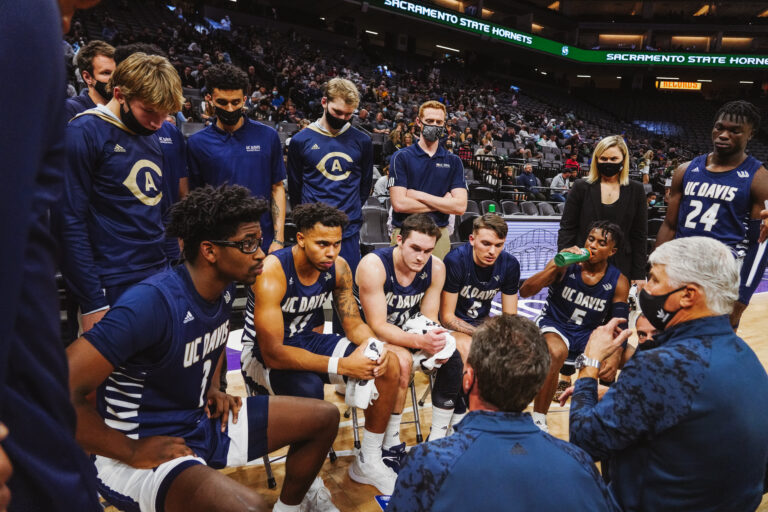
Aggies lose a heartbreaker in overtime; win on Senior Night in last home game of the year

Elijah Pepper and Ezra Manjon carried the Aggies down the stretch, but the Gauchos proved to be too much in the final minutes. Still, they sent off their seniors with a win

By MARLON ROLON — sports@theaggie.org

The UC Davis Men’s Basketball team came into the University Credit Union Center hot, riding a three-game win streak prior to Thursday night’s Big West showdown against UC Santa Barbara, who had won four of their last five games.

Because this is a conference game, they typically play each team in the Big West twice during the season. The first matchup between the Aggies and Gauchos was slated on Jan. 22 in Santa Barbara; however, the game was canceled due to COVID-19. UC Davis has played only 19 games throughout the season, a league low, due to eight being called off because of COVID-19 issues.  

The Aggies’ last loss came at the hands of Long Beach State on Jan. 29, then beat the likes of UC Riverside, Hawaii and CSU Bakersfield by no more than five points. With momentum building as they near the end of the season, both teams are fighting for seeding implications — the top six seeds earn a first round bye in the Big West tournament.

However, the Gauchos, who rank #3 on offense and #4 on defense in the conference, had a significant size advantage — four of their players measure a staggering 6 ’10” and another who’s right under at 6’ 9”. After the opening tip, it became evident that UC Davis would struggle matching up to UCSB’s size, especially with starter Caleb Fuller out due to injury. 

The visiting team were quick to score a put back dunk by forward Miles Norris the 6 ’10” 220-pound junior. Then, Josh Pierre-Louis, the third-year guard, followed up by splashing a three pointer, making it a 5-0 start. Rebounding looked to be an issue from the start as the home team lacked a physical presence inside the paint. 

After Santa Barbara got off to a 9-4 lead, UC Davis second-year guard Elijah Pepper took advantage of a turnover eliciting a spin move for the easy bucket that sparked a 6-0 run for the Aggies giving them their first lead of the game off a one point margin. The high-flying guard Ezra Manjon facilitated the ball to teammates, Kane Milling and Aaron Murphy as they scored off open looks. Manjon’s elusive handles and ball movement gave the opposing defense problems. 

Second chance buckets became the narrative — forward Amadou Sow became a factor, bullying his way on the inside and taking advantage of the pick and roll mismatches. The Gauchos led 15-12 with Sow being responsible for eight of those points.

“We weren’t physical enough blocking out and that hurt us,” UC Davis Head Coach Jim Les said after the game. 

Manjon decided to insert his offensive presence with a quick stepback jumper. The Aggies’ defense stood their ground deflecting the ball with Manjon tracking down the rock running full speed down the court with a beautiful behind-the-back pass to Pepper for the easy two causing a standing ovation from the crowd. A few plays later senior  Cameron Ba contributed with a three pointer making it a 7-0 run. Once again, the hosts took the lead 19-15. 

The pace slowed in the final minutes of the first half, allowing Santa Barbara to regroup as the Aggies went into the locker room leading 31-25.  

“I thought the rebounding [was an issue], especially in the first half,” Les said. “We held them to 25 points but they got 10 of those points off second chances, rebounds, put backs and that size and athleticism.”

UC Davis shot 13-27 from the field, 40% from the three-point line, committed five turnovers, and picked up 17 rebounds. Pepper led the team with 12 points and two steals with Milling not too far back, adding seven points of his own being efficient with his shot selection. Manjon had five points with five assists as well at the break. 

Santa Barbara shot 11-36 from the field, 1-7 (14%) from beyond the arc, committed four turnovers with 24 rebounds. They dominated the offensive boards with 12, which is what kept them in the game. 

The Gauchos swung the ball around until finally first-year Ajay Mitchell opened the second half scoring a 16-foot jumper over Milling. Suddenly, it became the Mitchell show, as he scored seven straight points with a pair of and one’s. He became the focal point of the offense for the Gauchos doing what he wanted whenever he wanted, pushing the ball down the court while shooting at will. 

There was a scoreless drought for two and a half minutes until third-year forward Christian Anigwe made a much-needed layup. Pepper and Manjon had open looks but the ball would not go in the hoop with the Aggies desperately needed buckets to stay within striking distance. However, Mitchell kept knocking down contested jumpers, continuing his dominance. The visitors once took the lead 39-38 with about 10 minutes left in the second half.

“Mitchell got hot; he’s a good player, and he kinda just went one on one,” Les said. “He went one on one against our best defender with Ade hanging all over him, [Mitchell] made [shots on] some tough looks.”

Both teams would keep trading baskets, but the difference was Mitchell and Pierre-Louis drawing shooting fouls and going to the line knocking down free throws. With 6:22 remaining, Pierre-Louis would score on a fast break turnover bumping their lead to 47-42. Just as Santa Barbara began to pull away, Manjon finally made a cameo scoring his first points of the half with a jumper over Sow. 

Over a minute later, Mitchell once again was clutch splitting two defenders shooting a rainbow shot over the 6’ 8” forward Caleb McGill, 51-46. Regardless, the Aggies would not go away with Murphy scoring his free throws and a drive into the paint from Manjon to rally the crowd and cut the deficit to two, 52-50. 

One of the biggest plays of the game happened off an inbound pass from Ba to Pepper on a quick catch and shoot from the three-point line over a defender. Finally, Pepper made his presence felt as the Aggies trailed by one, 54-53 with 1:55 remaining. A few lead changes later, the home team led by one with a pair of free throws from Pepper. However, with 25 seconds remaining Mitchell scored a step-back three over Adebayo putting the Gauchos on top 59-57. The first-year scored 18 points in the second half alone, shooting 7-10 from the field, 1-1 from 30 feet and going 3-4 on his free throws. 

The intensity turned up, and the home team would not go away without a fight. In the last 16 seconds remaining the drama unfolded, Manjon took over, scoring over Mitchell and getting fouled in the process; however, he would go on to miss the crucial free throw. Luckily for the Aggies, Adebayo powered through and rebounded the ball but Coach Les would call a timeout to regroup. An inbounds pass to Manjon saw him run underneath the basket for a quick layup over Sow to tie the game at 59. 

The game was on the line — Mitchell took a step back and shot the ball as time expired, narrowly missing with the ball bouncing off the rim. There would be an extra five-minute quarter to decide the winner in overtime.

“Those guys are really big time competitors. They had a refuse to lose attitude and they just kept coming back making plays. [Manjon and Pepper] those guys were awesome. They put us on their back and carried us through that second half and into overtime,” Les said about his dynamic duo on offense. 

In overtime, the Aggies took the lead 61-60 after Pierre-Louis dunked the ball but got called for a technical for hanging on the rim which resulted in a free throw shot by Pepper and a step-back jumper by Manjon. The game was close again, both teams exchanged lead changes until Mitchell once again threw up a dagger from beyond the arc to go up 66-64. 

After two missed free throws by the Gauchos, the Aggies caught a break getting a rebound off their missed shots until the ball was kicked out to Pepper who hammered a corner,  three causing an eruption of cheers from the crowd — once again, Pepper was the hero making the most of his opportunities. That was the last time UC Davis led, eventually falling to Santa Barbara 76-69.

“I thought we fought really hard, and we had some great opportunities. Some nights, the ball just doesn’t go in. We had great shots, we had the right guys shooting the shots and they just didn’t go in and they made some tough shots. So you got to give them credit too; I thought our defense was really good all game, but they hit some tough contested shots,” Les said after the game. “We had some good looks, and they didn’t go in, and that was just enough for them to get separation, but I thought it was a heck of a basketball game.” 

Pepper led the Aggies with 21 points and four threes followed by Manjon’s 19, five rebounds and six assists. Milling was efficient throughout the game adding 11 points going 5-8 from the field. The home team scored 38 points from the paint; however, they shot 7 for 12 from the free throw line which ended up hurting them in the end.

Santa Barbara’s Mitchell scored a season-high 31 points while his teammate Sow finished with a double-double 17 points and 11 rebounds. Pierre-Louis contributed with 14 points. The Gauchos success came behind their 46 rebounds and their 14 second chance points. 

UC Davis’ overall record dropped to 11-8 and 4-4 in conference play. They are tied with UC Santa Barbara for the sixth seed in the Big West Conference standings. The Aggies hosted CSU Northridge in their last home game of the season (2/26) . This particular game held meaning as it was senior night, Caleb Fuller, Cameron Ba, and B.J. Shaw would suit up for the last time at home for UC Davis. The home crowd sent them off with a standing ovation, but the celebration didn’t end there. The Aggies beat CSU Northridge 68-49 sweeping them for the season series. Up next, they travel to Long Beach on (3/3) and conclude their season against CSU Fullerton on (3/5). 

After the game coach Les was asked about his preparation and what he is looking for in the final games of the season before the tournament in Henderson, Nevada.

“Momentum, we want to continue to play well,” he said. “We want to get healthy and develop a game rhythm. We had some stops and starts with our down time and it’d be nice to string some games together that we can play and develop some continuity and go into Vegas with some confidence.” 

Written by: Marlon Rolon — sports@theaggie.org


Column: I’ll take grocery shopping in person over Instacart, any day

How the grocery store is my personal oasis

By NADIA ANEES — nsanees@ucdavis.edu 

One of my favorite activities is taking a trip to the grocery store. It’s a place where I feel safe and content. A place where being alone doesn’t feel strange. A place where asking for help is normal. A place where striking up mundane conversations is commonplace.   

I think the grocery store is one of the best ways for people to unplug in their daily lives. Why? Well, having food is a necessity for us to survive, so making the trip to get your fuel for the week becomes a mini-escape from your everyday tasks. 

When we’re not eating, we’re probably at work, studying, staring at screens or stressing over something. The grocery store is the one place that we can be doing something other than attending meetings and staring at multiple screens. There, we can tune out the world and tune into our senses. You can smell the fresh flowers as soon as you walk in, the scent of coffee roasting at the coffee shop inside; you can feel the produce to pick the best-looking ones and absorb the bright colors and patterns of the produce and products lining the tall aisles. 

I fully understand the convenience and ease of ordering groceries online, and admittedly, I’ve benefited from these services myself. Instacart is extremely convenient. Instacart was also especially helpful when I was living with immunocompromised people while COVID-19 cases were soaring since it meant avoiding the anxiety-inducing grocery store trip. Many people have health concerns that lower their incentive to go grocery shopping in person, and so they will most likely continue to prefer using online grocery services.

Although online grocery shopping is convenient, the satisfaction of having crossed items off your checklist when ordering groceries online isn’t there. Oftentimes, there’s uncertainty over whether you’ll even receive the items you had selected, or if they will look like they’re in a usable condition. 

Grocery shopping in the physical supermarket can prompt inspiration and ideas for someone, while grocery shopping online can start and end within five minutes, which usually doesn’t provide the same outlet for creativity and time to be present. In an already stressful environment between work and school, for me, the grocery store is a safe place for me to slow myself down, even for the short duration of the trip.  

Written by: Nadia Anees — nsanees@ucdavis.edu

Disclaimer: The views and opinions expressed by individual columnists belong to the columnists alone and do not necessarily indicate the views and opinions held by The California Aggie.