55.7 F
Davis

Davis, California

Tuesday, December 23, 2025
Home Blog Page 233

UC Davis equine medical director temporarily suspended, placed on administrative leave

Events since Jeff Blea’s suspension reveal divisions between the California Veterinary Medical Board and the California Horse Racing Board

By CAROLINE VAN ZANT — campus@theaggie.org

Jeff Blea, jointly appointed as the equine medical director at the California Horse Racing Board (CHRB) and at UC Davis, was placed on administrative leave after his veterinary license was suspended on Jan. 3. 

His license suspension followed an emergency hearing called by the California Veterinary Medical Board (VMB), and formal arguments were heard on Jan. 21.

On Dec. 17, the VMB issued a formal accusation outlining eight causes of discipline against Blea. The accusations ranged from minor charges of sloppy recordkeeping to “dispensing dangerous drugs without medical necessity.” As noted in the complaint, “dangerous drugs” are defined under California law as any drug that cannot be obtained without a prescription.

The infractions allegedly occurred when Blea was working in private practice, but he left after accepting the equine medical director position in July 2021. When The California Aggie requested an interview with Blea on Jan. 23, he declined to comment on the allegations, citing the ongoing legal case.

In his position, Blea would have overseen the necropsy of Kentucky Derby winner Medina Spirit, but, due to the nature of the horse’s death and the allegations against Blea, the VMB asserted in a Dec. 21 filing that Blea’s involvement in the investigation would be “a clear conflict of interest.” The three-year-old horse collapsed after a workout at Santa Anita on Dec. 6 in what has been classified as a “sudden death” by the CHRB. He had tested positive for a drug that was banned on race day that cast doubt on his Kentucky Derby victory in May 2021. His trainer has stated that it was never given to him.

In response, the CHRB announced that John Pascoe, the executive associate dean of the UC Davis School of Veterinary Medicine, will replace Blea in the investigation. Pascoe did not respond to a request for comment. 

UC Davis has sufficient personnel to ensure that the obligations of the position are fulfilled,” UC Davis News and Media Relations Specialist Amy Quinton said via email.

The series of events has reportedly been characterized as infighting between the CHRB and the VMB. Though both organizations fall under the umbrella of the Business, Consumer Services and Housing Agency, they operate independently. While the VMB is attempting to rescind Blea’s license and remove him from his position as equine medical director, the CHRB is defending its employee

At the Jan. 21 hearing, the CHRB argued that the VMB’s actions constitute “agency overreach,” and that it has no role in determining the equine medical director. The CHRB, however, was denied a motion to intervene on Blea’s behalf.

George Wallace, the attorney representing Blea, takes issue with the VMB’s characterization of his client. 

“He is one of the finest equine veterinarians, certainly in California, and probably in the country,” Wallace said. 

Seeking an interim suspension order is reserved as “an unusual and extreme measure” taken to restrict the practice of veterinarians who present a clear danger to public safety, according to Wallace.

“[The interim suspension order] is not appropriate, particularly since he’s not in practice, for someone like Jeff Blea,” Wallace said.

The VMB has never sought an interim suspension order against any practitioner except for Blea.

Prominent figures in the veterinary community have expressed support for Blea. He is “an exceptional individual — high integrity, high ethics and very high standard of practice,” Rick Arthur, Blea’s predecessor in his role as equine medical director, said. 

In a letter to the Business, Consumer Services and Housing Agency Secretary Castro Ramirez, Arthur called the VMB’s treatment of Blea “a political hit-job” and called on the secretary to investigate. 

Rather than any misconduct on Blea’s part, Arthur said the issue is that “veterinarians in ambulatory practice have challenges to meet the California Veterinary Medical Board regulations that are designed for dog and cat hospitals.”

Administrative law Judge Nana Chin is expected to rule on Blea’s license within 30 days of the Jan. 21 hearing. Further down the line, Wallace predicts a hearing to determine the merits of the allegations made by the VMB, which could take several weeks.

Written by: Caroline Van Zant  — campus@theaggie.org

Student-planned walkout seeks more flexibility, remote options

Two days after the return to in-person instruction, students planned a walkout in solidarity with immunocompromised students and students with disabilities

By KATHLEEN QUINN campus@theaggie.org

A student organized walkout on Feb. 2 demanded ‘hybrid options’ be made available to support students with disabilities at UC Davis. The walkout asked students to not attend their in-person courses on Wednesday but to continue to attend any courses that were normally online or that had an online recording of the lectures.

Lane Dounias, a second-year psychology major, organized the walkout.

“Even though some people prefer in-person, we need to at least have online accessibility, that is essential, that’s a need, that’s a human right,” Dounias said. 

Instruction returned to campus for all students who were enrolled in courses designed primarily for in-person instruction on Monday, Jan. 31 after cases of COVID-19 declined following a spike in early January.

Dounias said the mid-week date for the walkout was chosen to make clear that students’ absences were not due to logistical concerns like testing requirements or the process of moving back to Davis.

According to the ASUCD Instagram page, a survey that received over 1,000 responses showed that 59% of students prefer a hybrid option for their classes.

Richard Tucker, the head of the Academic Senate, stated in an email that students who refer to “hybrid” are actually referring to “dual modality,” meaning the instruction is provided both in-person and online at the same time.

“The Academic Senate does not allow dual modality instruction for a number of reasons, including equity of experience for the students enrolled in the course and workload for instructors who would have to offer two versions of many of their assignments, activities, exams, etc,” Tucker stated via email.

ASUCD’s poll showed that 65% of students with disabilities would prefer “hybrid options” including dual modality instruction. 

Jennifer Billeci, the director of the Student Disability Center (SDC), said that the center received 57 requests for remote learning in the fall quarter. Of those, 42 students underwent the process of determining reasonable accommodation, and 19 were granted remote instruction as their accommodation.

“The criteria we are looking for is tied to the risk if they were exposed to the virus,” Billeci said.

In Dounias’ view, referring students to the SDC is not enough.

 “The problem I’m hearing from disabled and immunocompromised students is that they are going to the Student Disability Center and either being ignored or they are not getting the accommodations that they need,” Dounias said. 

Prior to the pandemic, Billeci said requests for this type of accommodation were considered very unusual.

“We are really busy and still want students to contact us,” Billeci said. “Contact us early, there is a lot more to it than people realize.” 

Another reason Tucker stated the Academic Senate does not allow for dual modality is the increased workload for instructors. 

“To put it simply, dual-modality instruction is often not pedagogically sound, and it is unreasonable to ask instructors to essentially teach two courses at once,” Tucker stated in an email. “That said, we recognize that adapting back to in-person instruction will take time, so we’ve continued to encourage instructors to provide recordings of their classes, avoid attendance-based grading, use final exam flexibilities where applicable, etc., to aid the transition.”

Dounias said they hope instructors are provided adequate training to allow for dual modality format courses in the future. 

“The UC should give training if possible on how to educate online properly,” Dounias said.

On Jan. 24, Chancellor Gary May stated in an announcement that instructors can opt in to a program that allows the university to hire student workers to record and upload lectures.

Amos Hammar, a doctoral candidate in Education at Aspen University and the customer success representative at UC Davis, is currently working on a dissertation about students in hybrid, remote and dual modality education.

According to them, the focus on going back to in-person instruction is on healthy students and not students from diverse backgrounds or students with disabilities.

“A lot of people in those minority groups enjoy the social part of online learning because it gives them equity and a voice,” Hammar said. “When you are in a brick and mortar course — I’ve been there, I’m a minority — I tend to withdraw from the main discussion because people who are not in the minority control the environment.”

As a part of their research on remote instruction, Hammar produced a survey that consists of a brief questionnaire followed by an optional focus group. The survey is open to students until April.

Michael Albrecht, a student auditor in biology, said he thinks there should be hybrid options but disagreed that the walkout was the right approach. 

“It’s just kind of disruptive and I think the best option would be direct communication,” Albrecht said. “You should talk one-on-one with a professor about it and explain why you are having doubts about going in person.”

adnan Minasian, a third-year Native American studies student and one of the organizers of a petition requesting hybrid options on behalf of students, said that for them, providing options allows students to learn in an environment that works best for them and best meets their educational needs. 

“I’ve been learning about a lot of the disability activism that’s been going on, and it’s been going on since before COVID […] because disabled people have always needed online options,” Minasian said.

Written by: Kathleen Quinn — campus@theaggie.org

Editorial Board meets with Chancellor May, UC Davis administrators

May and administrators discuss return to in-person instruction, conversation with students, spring graduation plans and more 

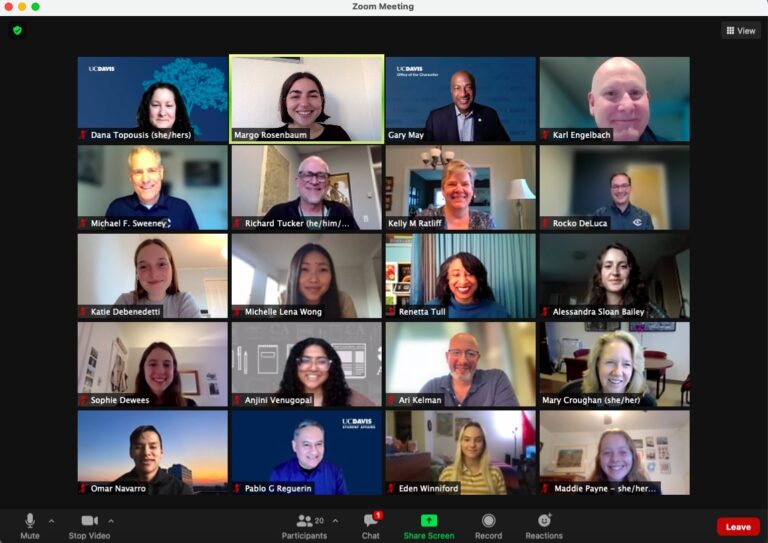
The California Aggie’s Editorial Board met with Chancellor Gary May, Provost and Executive Vice Chancellor Mary Croughan, Chair of the Academic Senate Richard Tucker, Associate Chancellor and Chief of Staff Karl Engelbach, Chief Campus Counsel Mike Sweeney, Vice Chancellor for Finance, Operations and Administration Kelly Ratliff, Director of Athletics Rocko DeLuca, Vice Chancellor for Diversity, Equity and Inclusion Renetta Tull, Faculty Advisor to the Chancellor and Provost Ari Kelman, Chief Marketing and Communications Officer Dana Topousis and Vice Chancellor of Student Affairs Pablo Reguerín on Jan. 27.


Below is a transcript of the meeting that has been edited for length and clarity. This interview took place the Thursday before in-person instruction resumed. Our questions and the administrators’ answers reflect this. 


How did you decide that all classes will return on campus starting Jan. 31?


May: I think most of it is a data driven decision. We’re looking at case positivity data. We’re looking at the availability of isolation quarantine housing. We’re looking at booster updates. We’re looking at what the situation is in Yolo County and in our hospital and all those things. The good news is we’ve passed the local omicron peak by a pretty substantial margin. If you look at our dashboard on Campus Ready, you can see that we’re currently at 1.47% positivity over the last eight day window compared to almost 5% at the peak a couple weeks ago. This is consistent with the modeling we had looked at when we made the decision to start on Jan. 31, and things are looking good. The other thing that was a concern earlier that is less of a concern now was the positivity [rates] for our staff which was going to inhibit some of our ability to provide services to students — custodial staff, housing and dining staff, etc. Those numbers have also declined as well, so we think we’re going to be able to start on Monday. 


Croughan: All of our modeling for fall quarter and winter quarter showed that risk of transmission on campus is incredibly low, even with the omicron variant. It’s our high vaccination rate, wearing masks and our testing programs that make the risk so minimal. Thankfully, with Healthy Davis Together you also are at lower risk than most of the rest of the populations in any other community because even here, you’re less likely to get it in a grocery store than anywhere else. But it really came down to a decision for all of us at the first week of January, end of [December] really, of looking at staff numbers. If we couldn’t provide the services that students needed on campus, then it made more sense to take the time that it was going to take for the surge to be over and have us on the downside of the slope for the surge and then be able to reopen the campus. Our prediction was the surge would peak between Jan. 15 and Jan. 20. We called that one right again, and sure enough, we’re way down at this point, so we really do have faith and full expectation that we’ll be fine next week. I say all this also noting there were students who did not heed our advice and in fact didn’t stay in Davis, so they are starting to return now in anticipation of return to in-person instruction on Monday. So we are seeing a few more positive cases than we’ve seen in the last week and that’ll probably reach another little, small blip, so don’t get concerned if you see another miniature surge here — just students returning from places with a higher incidence of the omicron variant. We expected this, but we’ll still get through that fine. They may need to be isolated next week, but we need to get people back here and get them back in the classroom, so we appreciate your patience with that little blip too. 


May: Overall, I just think this is a healthier environment here than there would be anywhere else, so that’s why we really are confident in restarting in-person instruction. We think this is the best thing for all, all things considered.


What advice do you have for students who are struggling to keep a routine as we navigate the continued switch between online and in-person classes?


May: In any case when students are struggling, I would urge them to turn to Student Health and Counseling Services for mental health support and resources that they need, whether it’s [for] returning to in-person or any other kind of mental or emotional struggle. I think students have been very resilient and they’ve worked hard through all of this, and I hope that doesn’t change. I will say that I sort of expect more of a positive response to coming back to in-person. Every time I am running into a student at the ARC or wherever I happen to be, they’re asking “Can we come back to in-person? Can we come back to in-person? Are we going to be back in-person?” So I’m expecting people will be buoyed by this and not struggle with this, but I am not a psychiatrist or a psychologist, so I’m just telling you what anecdotally I’ve seen. 


Reguerín: As [May] mentioned, with our counseling psychological services group, we have crisis work. There’s one-on-one therapy. We also have weekly groups and we also have our counselors that are out across the campus, so there’s a number of entry points. Depending on what the issue is, sometimes it can be challenging for a student to connect to the right resource, so the Aggie Info and Help Line is a good starting place. Part of that is connecting students with the answers that they need, helping them navigate whatever processes are in front of them, so they can help make that connection. Sometimes it’s just a matter of matching up the student need with the resources we have on campus because it can be confusing, especially when you’re stressed and you’re going through links and websites. It’s a little overwhelming, so that’s a good resource to work that out individually. Especially in the transition as students have been remote as they come back, study in groups. Get into a routine in groups or with a small tutoring group or with a tutor. There can be a lot of benefits to studying in groups and studying with others. Similarly, some of our campus recreation programs offer activities, so if you haven’t been able to establish your social network, take one of the classes, join one of the programs. They really range in their offerings, but getting into an environment with other folks is good scaffolding to reintegrate and relaunch social connections. There’s a lot of other resources to do that but those are some that come to mind to get started.


What are the current plans for spring graduation? Are the commencement ceremonies still expected to happen in person? When will this news be released to students? 


May: Commencements are planned to be in person. I’m very excited about it because we have a new format that we were going to debut in 2020, but we all know what happened in 2020. We’re going to be having commencement at UC Davis Health Stadium. We’re going to do three large ceremonies — early in the morning because it’s going to be hot in June, so we’re going to make sure it’s early in the morning. I think I’m excited because rather than doing the traditional thing where you graduate from your college, you’re going to be graduating from UC Davis. You’re going to get a full experience of the entire university and all your friends from all other parts of the university participating. A little bit higher profile experience.


Engelbach: So the in-person undergraduate ceremonies will take place June 10, 11 and 12. We’ll have roughly 2,500 of our graduates participating in each of the three ceremonies. We anticipate our students will begin to be able to register to participate in the commencement ceremony some time in March, and next month in February we are going to begin the process for nominations for student speakers who will speak at the ceremonies. Happy to share more details if there are other questions, but plans are underway and we’re making progress to ensure that we can have safe, in-person ceremonies this June. That’s our plan. In March we’re going to start sending out information to students who are eligible to graduate so that they can register.


Some students have expressed that they saw news of the extension of remote instruction on social media before receiving it via email. Could you explain the process and general timeline you follow when releasing information to students and faculty? 


Topousis: Our first form is to get the letter from the chancellor sent through email. That does sometimes tend to take longer and I think, just like any of you, sometimes I go to social media before I look at my email inbox. It’s just a funner way to find information. So I think it just depends on the communication, but we always hit the send button from the chancellor’s email account before we post on social [media]. But social [media], as you know, is instantaneous, and I think if people are already on that, they may see that first from the UC Davis account or from the chancellor’s account. But we do everything we can to put it in email. I think sometimes students think that a social post doesn’t count as an official announcement, but if it’s coming from the chancellor’s social media account or the UC Davis social media account, those are UC Davis official channels. I think sometimes students really want that email first, and I think that there is sometimes a little bit of confusion if they feel like they haven’t received an email before they’ve seen it on social [media]. Obviously we can’t control when people check their email inboxes, but we do send it to 130,000 people and sometimes the ether[net] can take a little bit longer than social media. So we try to get the letter from the chancellor out first. 


Even within the Editorial Board, it seems we received that email at wildly different times on the day it was sent. What is the rollout for these emails — are they sent alphabetically or are they all sent at the same time?


Topousis: We transitioned the chancellor’s letter to Mailchimp so we can look at how people are opening their emails, what people are interested in. It helps us just do more quality control and also measure how well things are being read. If any of you use Mailchimp, you know that [it takes] a longer period of time when it goes to that many people. It makes sure it gets to all 130,000 people and so it can’t do them all at once. I’ve been in that situation too where the last two times I’ve received [the email] immediately, but the first time I got it at 8 p.m. at night when I knew it went out at 2 p.m. in the afternoon. It’s a result of the tool that we use, but that is why we post things on social [media] through our official accounts because that is our official way to announce that in concert with the letter, which does take longer using the tool that we have. Honestly, I don’t know how Mailchimp separates the emails. I don’t think it’s alphabetical just based on my own experience of the different time.


How much weight do you place on feedback from students in the form of petitions?


May: I think, first, we always welcome feedback from students and faculty and indeed the entire UC Davis community, so we certainly look at all of that. I have to say, though, that I don’t make policy by petition, and there’s a reason for that. One, in the course of an academic year we probably get several hundred petitions and some of those petitions have exactly the opposite goals, like diametrically opposed. Somebody wants to start in-person [instruction], somebody doesn’t. We get petitions that are exactly the opposite. So we can’t just do what the petition says, although we can use that information to take the temperature of a certain community. The other thing you have to consider is how easy it is for people to generate a petition. It doesn’t take a lot of effort to one, generate it, and two, to get signatures because everything is electronic. So I always take those with a grain of salt because I myself have been asked to do an electronic petition, and I’ll admit sometimes I barely read them. That’s not the only source of data you should use when trying to make an informed decision. We look at social media. We have meetings with student leadership. We have meetings with faculty and staff leadership. There’s many different sources of input. UCOP. Other chancellors. All those sorts of things come into play when we’re trying to make those decisions. So we do look at those petitions, but I wouldn’t call those things the main driver of decision-making.


Tucker: From the [Academic] Senate side, we take especially the ASUCD resolutions very seriously when they come into our office. We discuss them amongst ourselves, decide if this is something that we really can address or should address, and then we all touch [base] in either the chancellor’s office or the provost’s office, whichever is most appropriate. It is something that we consider, definitely. The students oftentimes have really good suggestions and we need to take them seriously. 


Croughan: I think a really nice way to go about these is to have a conversation. Whether it’s in a Zoom room or more ideally in person, but if there is a student concern, to actually approach us, let us know about it. Let’s sit down and talk about it. In particular, if you have a sense of the groundswell of support or if there’s even differing opinions, being able to present that to us. I personally find a conversation much more helpful than a petition or an ASUCD resolution. Quite honestly, and I’m speaking for myself here, I see petitions that a vast majority of people who’ve signed them aren’t even affiliated with UC Davis or it’s a student-related issue but many of the people who’ve signed it are not in fact students. So it really waters down the effectiveness of the petition in my opinion. On the ASUCD resolutions, they get sent to all of us as administrative leadership plus a huge number of elected officials plus a large number of media outlets. I think that kind of a resolution needs to be reserved for the things where we haven’t been able to work it out on campus or where it’s something where you want elected officials to take action and a newspaper to do an investigatory report or something like that. I find it much easier and much more instructive when we have a conversation. Just to give you an absolutely recent example, very pertinent to Monday morning — Jonathan Minnick is president of Graduate Student Association, Ryan Manriquez is president of ASUCD and some individual students not affiliated with student government — all came to us and said, “As you’re doing planning for our return to in-person in winter quarter, we really need to think about how we can address issues when students are out sick.” This is relevant now with omicron, but it’s relevant every winter with flus and colds, and we expect more students to be out sick because of omicron this quarter. “Is there something we can do?” I talked to [Tucker] about it. He said he was a 32nd-year student — I go back even further for my undergraduate days here at Davis, but there used to be a program called Classical Notes here on campus where students were paid to take notes for every single class, pretty much. I think it was 100 percent [of classes] or pretty much close to it. Then you went and bought those notes from an office in the basement of Memorial Union. It was a great way to get notes. You didn’t even have to ask a fellow student if you missed a class for some reason or if you just didn’t think you heard something correctly. [This is] what would now be the equivalent of somebody audiotaping or videotaping a lecture on your phone or on a laptop. So we took that concept and came up with the idea of “Let’s pay more students to be able to do the capture on their phones or on their laptops.” So Monday morning, if faculty were agreeable to it, because they have authority over this, you will see this launched. We sent that information out to the faculty. We’ve sent a survey that’ll go to students who are in the classes of the faculty who are willing to have students do lecture capture or discussion section capture or field work capture, whatever it is. Now importantly, it’s up to the student, but that is to provide an opportunity for students who’ve missed a class to get the material. That all came out by conversation. And I think we arrived at those conversations [by] methodology that actually met the needs and desires of the students. So for me personally, let me know when you have a concern. I like that much better because I think we end up with better decisions and more cooperative and collaborative approaches to solving problems than I see with the petition or an ASUCD resolution. By the way, I’ve also told this to [Manriquez]. I much prefer a conversation to doing that.


May: I completely agree with everything [Croughan] said about preference for just conversation. I’ll say that for people that write these petitions, there’s probably a style lesson that we should think about. When you write something that’s really offensive or inflammatory or snarky, I’ll ask you the question, do you think that makes me more or less likely to want to cooperate with you? I think there’s a developmental thing here that we should consider. I’m happy to have this in the transcript because I think if people really want to motivate or persuade leadership to do something, doing it in a more collaborative, collegial, polite way is much more effective than some of the things I’ve seen. 


What is the best way for non-student leaders who are interested in having such conversations to reach out to any of you?


May: I have never turned down a meeting with a student. It’s quite simple. You can email our office. You can get a phone call. You [will] get a response to the email, and you can ask for a meeting. I’m sure the other campus leaders feel similarly. It’s very easy to reach out and to make connections with us. 


Tull: I’d just like to add for my office, again I’m sure others as well, I’ve had meetings with students, invited them for coffee. We have conversations, and if there is something that needs to be reported to HDAPP which is our Harassment & Discrimination Assistance and Prevention Program, then we do that and there is an investigation that then goes forward. Having those kinds of conversations also helps to advance the issue if needed. If there’s something that can be resolved in another way with regard to whatever the situation is and we need to have some conversations or bring people together to maybe brainstorm some solutions and then pilot some ways of trying to work some things out, then we try to do that. But I really enjoy talking to students and having an opportunity to hear what they think and to also see what we can do. And I think a lot of us, as former student leaders ourselves and student activists ourselves, that’s part of our background and psyche.


Engelbach: I would just add that if a student feels uncomfortable in reaching out to a campus leader, the chancellor does have two undergraduate student advisors. They’re undergraduate students, and you should feel free to reach out to [them] to share concerns; [their] responsibility is to bring those issues forward to the administration for appropriate discussion and resolution. That’s another avenue, a resource, if folks are interested in that. 


May: I have one graduate student advisor as well. 


Many students are divided on whether or not we should be returning to campus. How do you plan to address pushback from students who prefer to stay online as we approach a return to in-person instruction?


May: I think some of that was answered in the previous answer, but we do plan to try to reassure everyone. We think that we made the best possible decision for health reasons. We think that we are accommodating students who need accommodations through the mechanism that the provost just talked about, the lecture capture. I forget what we call those students — student technical assistants or something like that. There will be literally hundreds of them. I don’t know the right number right now because it’s growing, but there were 100 last time I checked with [Kelman].


Kelman: We’re at over 140 requests from faculty. [In terms of] the outreach to students so far, surveys have gone out to 5,300 students so far and we’ve heard back from approximately 600 at this point. 


May: I’ll just reiterate, in this environment, with 99% of the people vaccinated and soon to be everyone boosted and KN95 or N95 masks being worn indoors everywhere, this is a much less risky environment than if you go to Target or if you go to Safeway. People need to be reassured that we’ve thought about this. Nobody wants anyone to get sick. Nobody wants to get sick themselves, so we would not be going on a course that would lead to a lot of illness if we thought that was what was going to happen. Please rest assured that the safety and health of our campus environment [and] campus community is the highest priority. It just is.


Tull: I want to also add that there is of course recognition that we do have students who are immunocompromised and who are not able to get the vaccination for one reason or another, and so there’s a mechanism through the Student Disability Center for them to request accommodations so that they can have the kind of support that they will need, so that has been part of the discussion as well.


Given the recent publicity surrounding the calls for the elimination of Student Activities and Services Initiative and Campus Expansion Initiative (such as articles in The Sac Bee), has the university conducted additional research into alternative funding for the Internal Affairs Commission should the fee referendum pass? 


Reguerín: Our associate vice chancellor Cory Vu is working with the author of the referenda and we’re going through the process right now of looking at the language. It had an initial meeting with the Council on Student Affairs and Fees (COSAF). We’ve been spending time trying to understand all of the impacts because in developing the language, we want to make sure that students clearly understand what a yes vote would mean [and] what a no vote would mean. On March 30, it goes back to COSAF for review and consideration for an endorsement, so this is a pretty long process and we’re pretty much still in the beginning stages. It’s gone through our review. It’s gone to the UC Office of the President. We’re getting information back and we’re continuing to work with a student author. Our team here on campus has been trying to make sure the language is clear, understandable and that we can illustrate what the impacts are of each side. But it is still early in the process, so I don’t want to get ahead of that and I don’t want to get ahead of COSAF. In the presentation that the others did to COSAF, they did generate some feedback which has been shared both with the author and we’ve reviewed it as well. So we’re working more right now on the impacts of what this would mean and being clear with students on that piece and also understanding what the financial ramifications would be.


Ratliff: I can say to the idea of how we’ve been able to identify other fund sources. This is the time of the year — it started back in November with the regents adopting a budget — the governor puts out a budget proposal in early January, and we’re in the process of kicking off the campus budget process right now. We had a several-hour retreat this morning with the Academic Senate. I always start the academic year by giving a presentation to COSAF about the state of the budget. As is the case for most years, budgets are constrained. We had a positive budget proposal from the governor for the overall University of California, and still we’ll be facing a bit of a gap in what we call those core funds, our state funds and tuition. So we’re working to resolve that. The way the budgets work, there’s really only two solutions — increase revenue or reduce costs. So as [Reguerín] mentioned, we want to make sure it’s clear what those impacts could be, but speculation is difficult to do. The state budget for UC Davis has a gap. There have been other conversations and some of the dialogue has been around gift funds. This campus is succeeding in awesome ways in terms of fundraising, but most of what comes in for fundraising is very specific. It’s specific to the particular program the donor wants. Athletics successfully fundraises. Last year they raised about $6 million. Four million of that is for the student-athlete performance center. So we’re always raising funds but the ability to raise funds in an ongoing way to support something like replacing the fees is not really how fundraising tends to work. So what you would do instead is try to build an endowment, and the way endowments work, you would need to raise close to half a billion dollars to generate the sort of annual revenue we have from those fees. So we’ve taken a look at what some of the other options might be. We want to be able to describe some of the consequences, but it’s not a matter of finding the money. Whatever we found would require some sort of consequence somewhere else in the university and that’s, again, difficult to speculate about or it would be a very significant reduction to the athletic programs themselves. We’ve tried to spell those things out in terms of a fiscal analysis and other information is going to COSAF, and so that’s probably the best I could do right now.


DeLuca: I think from my point of view, and I’ve shared it with everyone I’ve talked to, just given the nature of how speculative this is, we’re not going to make any prognostications about our department. Really, [UC Davis] Athletics is done in concert with the campus leadership and everybody here so if or when we get to that point, we’ll make the decisions together on that.


What was the reasoning for placing Equine Medical Director Jeff Blea on administrative leave by UC Davis? How long do you expect him to be on administrative leave? Some have said Blea’s work at UC Davis is in conflict with his role as the California Horse Racing Board’s equine medical director. What do you all have to say in response to that? 


May: We really don’t comment on personnel matters, especially when they’re in the middle of being adjudicated.


Sweeney: We have no comment on personnel issues to the extent that there are any personnel issues. I will say that under statute and as consummated in a contract, we provide the veterinary medical director services for the California Horse Racing Board and that’s pursuant to a state law, and that was requested specifically by the state and we’ve provided those services for many, many years. And we continue to do that. With respect to Jeff Blea, I think at this point in time it’s best just to not comment on the personnel issues as they unfold.


In light of the Fossil Free UCD petition, which advocates for UC Davis to end the use of fossil fuels as a source of energy for UC Davis campuses by 2030, what actions is the administration going to take to achieve the UC-wide promise to be carbon neutral by 2025? Will the administration take steps towards being completely fossil fuel free by 2030?


May: This is an area I’m actually very proud of UC Davis. You saw the most recent ranking by GreenMetric. We’re No. 1 in North America in terms of campus sustainability. We have lots of really good stories and good projects, the Big Shift — or as I like to say shift happens — where we’re changing from steam to water-aided systems which will save a lot of energy cost and be a more sustainable solution. We did form a new Campus Advisory Committee to the chancellor on Sustainability. Many of the authors or the generators of that petition, the Fossil Free UCD group, were part of the meeting that we had prior to the holidays to talk about that. I have charged that committee which is chaired by Camille Kirk who’s our campus sustainability officer and Jim Carroll, our campus architect essentially, to come up with a plan for a fossil-free campus within some reasonable time frame. I think this 2030 thing, there’s nothing magical about 2030. It just has a zero at the end. Let’s just make sure we can do something that’s feasible in a reasonable time frame, and consider cost as well and all the different strategies we might employ. I asked them to come up with that plan by the end of this year, the end of 2022.


Ratliff: I put in the chat the new Campus Advisory Committee on Sustainability and in there is a link to this request the chancellor just made of [Carroll] and [Kirk] as co-chairs of the committee but in consultation with the committee which has a lot of faculty and staff experts, student representatives as well. This isn’t the only thing that we do. This is one example, but we have made a commitment to have a plan and understand what it would take time wise and budget wise to achieve fossil free. That will enable us to continue on this path. We definitely are well on our way to carbon neutrality. That’s a university-wide, University of California-wide goal by 2025, and so those efforts continue. As the chancellor mentioned, this Big Shift project which is in the way now that folks are starting to come back to campus, this is a really good thing. At the last Board of Regents meeting last week, planning funding was approved for phase two and some heat exchangers that will take that project. It’s probably a five or six phase project but this first phase of $57 million, the campus self funded. We’re looking for funding partners as we proceed, but we’ve started the planning for phase two of that project and that’s one of the really major efforts. Also, efforts are underway on our Sacramento campus as we’re getting ready there for major renovation and rebuilding of the hospital tower to move to an electrification strategy in Sacramento. So there’s many, many things happening. We’re trying to find better ways to share what’s happening and then have this broad based committee. We have engagement from throughout campuses as we take these steps. 


As UC Davis builds more on-campus housing in order to meet its memorandum of understanding with the city of Davis and Yolo County, are there plans for any of these developments to specifically be affordable housing (especially the Orchard Park redevelopment plan for family housing)?


May: We’re coming toward the end of the most ambitious housing development program in the history of the university. In the last several years we’ve built thousands and thousands of beds, of new housing, and by the time this is finished we’ll be able to house just under 50% of the campus community who wants it. We’re really proud of that and in every project that we do, in Orchard Park in particular, there is a striated plan to have affordability on different levels in different numbers of units in the project. I don’t know the exact percentage in Orchard Park or what it is in other projects, but we always, through cross subsidies and other means, make some units more affordable than others within a project. I think we have a pretty good story to tell there as well.


Ratliff: You plan ahead on these projects several years in advance, but the financial structure for Orchard Park has a goal of being 30% below market [price] and market [price] can be difficult to describe. In Davis we have all different types of housing — some things out in the community where folks live many to a house compared to some of the newer stuff we’re building — but our overall goal is to be 30% below market [price]. But separately, we’re also setting aside funding and running a program through the Basic Needs Center where there’s individual opportunities for students to apply based on need and get further reductions in rent. When you do something across the board, that’s great for the whole project, but we also want to have programs where individual students based on their need circumstance — student families, undergraduate students, graduate students — can apply to these programs. At The Green, there’s a program that makes available $100 a month rent reduction for folks who qualify. As we move to Orchard Park, those programs will be expanded to include those projects and leveraging our Basic Needs Center. It is a really good way for us to do this so students can continue to go to one place to address the range of needs they might have. 


May: As we increase the supply of housing in general, both on campus and as the city of Davis increases the supply with new projects, this simple microeconomic supply and demand, there’s going to be more competition. Over time, the rates, the rents, become more affordable. Now that’s not an immediate solution. That’s a longer term solution, but that’s something that we expect to see happen.


Will the university be expanding isolation housing for students who live off campus (in housing not affiliated with the university)?


May: So as you know, before the omicron surge, we did allow students that didn’t live on campus to use the isolation quarantine housing. With omicron, we stopped doing that. I think what the plan is is we’re going to try and get through this first week of being back in person and see what it looks like. We talked about the bump we expect to see from students who didn’t stay in Davis, etc., and there may be some higher positivity this first week. We want to get through that first week and then we’ll consider reopening the isolation quarantine housing to students that live off campus.


Croughan: Our thought is it should not be a problem actually, after this week, to open it up if needed.


Ratliff: Yeah, I think we need to wait and see what the data show us, but the chancellor described it correctly.


What advice do you have for Aggies when making their post-graduation plans, especially in light of the continuing COVID-19 pandemic? 


May: I would say first, start early on thinking about your career after you get your degree. I would say make good use of the Internship and Career Center (ICC), that’s what it’s for. I would say look for some mentors and people that can assist with your career search and job search. I would say think about entrepreneurship as a possible option. Many students think they’re not prepared or too young. My daughter graduated two or three years ago. She just quit her job. She was part of this great resignation. She’s got a start-up and she’s hired about seven people, which is probably five too many but I’m not in charge, she is. There are options like that available that I think students should consider. The one thing you shouldn’t do is worry or panic. You should really think about taking advantage of all the resources that you have here and people that want to help you be successful. 


Reguerín: So we know that students who start about a year, at least two quarters but preferably a year, before they need to be on the job market, it makes a big difference. Similarly, if you’re applying to graduate school you need to plan that early on and get advice and take your exams. One of the things we try to recommend is to start as early as possible as [May] mentioned, but also to try to build in your weekly schedule two hours a week so there will be times where you have to get things together. You need a dedicated amount of time, but it’s helpful if you work in preparing as you go along. I always encourage students, if you can fit in two hours weekly just to focus on advancing yourself, whether that’s preparing your materials, making an appointment, going and seeing someone. Dedicated, steady progress along the way is really important, and there’s opportunities that come up all the time so I just really recommend not trying to think of it as “I’m going to do my studies and then I’m going to turn to looking for a job” but mastering the process of weaving those two things together. I just really recommend at least an hour a week. If I could mandate that, I would in everybody’s time management schedule. Use your networks, and you don’t have to do it alone. We have drop-in services at the ICC but we also have our appointments with our career counselors. Just to think broadly, I think sometimes too, students think that “Okay if I had this major, I only have to look to work in this sector.” Highly recommend thinking broadly and again, don’t do it in isolation and connect with the ICC, your faculty, others that have expertise in different fields.


Tull: If anyone is involved in research and doing work with the Undergraduate Research Center or in any of those various research groups or student groups or if you’re in any affinity-based groups, talk to the leaders of those groups as well because there’s so many emails that are coming in from employers who want to hire students. Sometimes it’s an internship that will continue year after year until they graduate and then are able to be employed full-time. Sometimes there are special programs that are associated with it, and I know that there’s so many emails going out there, but if there’s a way to even scan through emails — I’m going to use [Reguerín’s] methodology — once a week to just see what kinds of opportunities are there, I know that so many emails are being sent out that have those opportunities and we get messages from companies, from government agencies, from industry, from even universities looking for people who are going to work in various capacities. They’re looking for folks and especially UC Davis graduates, and that’s why they’re coming to us. There are a lot of jobs available and people are taking those jobs and we just want to make sure that the masses of the students get an opportunity to have those kinds of experiences and get those notifications. 


Reguerín: It’s important that students develop their profiles in Handshake and use Handshake, as we’re funneling all of our information about this into Handshake so you want to set up your profile and be active in Handshake. In addition to that, develop a really good profile and become active in LinkedIn because that has become a really big source of connecting folks. Again, you don’t have to do it alone. Come see one of our peer advisors at the ICC and try to make it fun. I know that it’s stressful but try to make it fun as well.


Topousis: When I graduated from college, I joined the Peace Corps, and so I shook up my world in a big way and I went to East Africa which was definitely one of the most amazing experiences of my life. If you’re really looking for a change — and I will say that when I came back I was interviewed by so many people because they were just interested in what I did as a volunteer — don’t be afraid to step out of your comfort zone too because that can really force really positive change on your life, personally and professionally, for a long long time.


In light of the recent discovery of the stealth omicron variant, what are your plans moving forward should there be another surge?


May: I hesitate to answer before the resident epidemiologist chimes in here, but let me just say, we’re on omicron now. There have been many, many variants. Most of them have not been a factor so people, I think, need to take a breath and not panic when the media puts out there’s another variant because there’s going to be more variants. Yes, we’re aware of the emerging situation. We keep a pretty good eye on all of these things, but right now I don’t think that there’s any indication that we need to be overly concerned. We should always keep our eyes open, be aware, but I don’t think we need to be concerned as of yet.


Croughan: It hasn’t even been classified […] yet as a variant of concern. I think the most important thing that we do on this campus to pay attention besides our testing and effluent testing programs is that every single sample that comes through our genome center is genotyped. So anyone who’s positive for any variant of COVID-19, we know the genotypes and we have very carefully monitored those. Now we hardly ever turn up a delta variant. It’s predominantly omicron. We will know when a new variant hits Davis or even Yolo County because our Healthy Davis Together expanded to Healthy Yolo Together so we’ve got a pretty broad swath of people providing their saliva on a regular basis, to be totally blunt about it. So we’ll know when it hits. As the chancellor said, there have actually been hundreds and hundreds of variants, and they’re rarely ones that become of concern and very often they stay local. Apologies to those who’ve had to hear me lecture if you’re an Aggie Public Health Ambassador, but what you expect the virus to do is to mutate through time to become more infectious and also to cause less serious disease in their host. That’s how a virus stays alive and stays in the population. Omicron is a variant that we finally have crossed over to less severe disease, more easily transmissible. Chances are the next variant will be even more easily transmitted and even less severe disease. But this is where you start to see a pandemic or an epidemic die out. It will become endemic like influenza, and it’s just going to be something we’ve got to live with into the future. Unfortunately — this is actually very much tied into what [Topousis] just brought up with the Peace Corps and having a global perspective — really official pandemic level won’t end until 75-80% of the world has been vaccinated. That’s really what we’re looking at. But we will more than likely hit endemic levels here in Davis and in Yolo County infinitely sooner than that, and I will not be surprised if it’s in the next year. That’s my crystal ball perspective — I don’t think I’ve been quite off yet.


May: Even though the New York Times roasted me for putting that out in that letter. Even though now all the papers last week had all these articles about how we’re endemic or close to being endemic, so I’m not going to write the New York Times back. 


Croughan: Just so people know, my infectious disease training was here at Davis when I was an undergraduate. I got phenomenal training. I think that’s the main thing you’re going to find when you go out to graduate school, professional school, your first job after graduation. Whatever it is, you’re going to find out that you got amazing training here at Davis.

UC Davis’ agriculture, sustainability research recognized as one of top 10 research stories across all UCs

UC Davis discovered a way to reduce methane emissions from cattle

By AARYA GUPTA — science@theaggie.org 

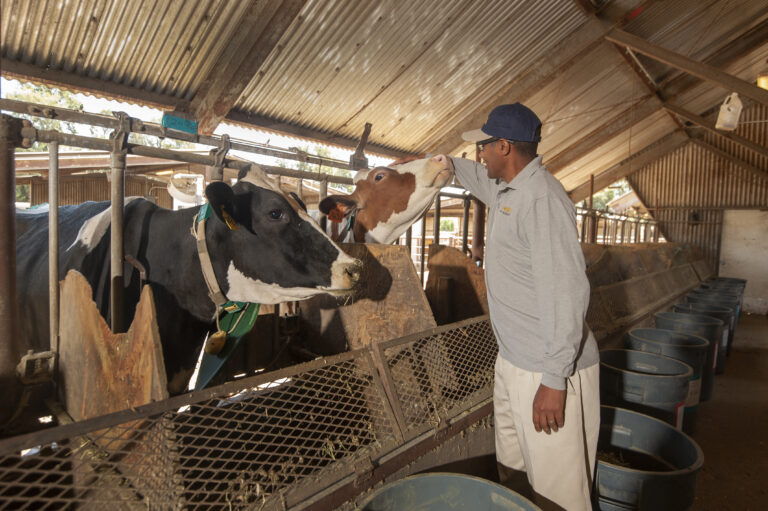
An article published by the University of California Office of the President deemed UC Davis’ research on the effects of feeding cattle seaweed on greenhouse gas emissions as one of the top 10 research stories of 2021. 

Professor and Sesnon Endowed Chair of the Animal Science Department Ermias Kebreab and graduate student Breanna Roque published the results of their study in March 2021 in the PLOS One Journal. 

“We have been working on methane reduction [for] two decades already,” Kebreab said via email. “The renewed interest in climate change gave us the opportunity to continue in this line of work. Livestock contributes [a] considerable amount of methane so we wanted to find [a] solution for reduction.” 

According to an article published by UC Davis, the number one source of greenhouse gases emitted from the agriculture sector is cattle. In particular, one cow can emit 220 pounds of methane each year. In comparison to carbon dioxide, methane is 28 times more potent. 

“The state of [California] has a mandate to reduce methane emissions by 40 percent by 2030,” Kebreab said. “As a public university, UC Davis is charged with finding solutions to our stakeholders and to our state in general. So it is important that UC Davis find solutions to help farmers reduce their carbon footprint.” 

Kebreab and Roque’s experiment followed a completely randomized design, and collected data from 21 Angus-Hereford cross beef steers, which were all randomly assigned to three different treatment groups.

“The main take-away is that by using such a small amount of seaweed[,] we can reduce emissions by over 80 percent, which is the first time such reductions were observed in livestock,” Kebreab said.

After feeding the beef cattle seaweed, researchers concluded that cattle that consumed approximately 80 grams of seaweed emitted 82% less methane into the atmosphere, while gaining the same amount of weight as other cattle in their herd, according to the article. 

“It is incredible to learn about how UC Davis is researching ways to reduce greenhouse gas emissions and discovering novel sustainable practices to improve the livestock industry overall,” third-year animal science major Azra Mahic said.

These results pave the way for a more sustainable production of beef and dairy products. Kebreab and Roque’s study also uncovered that seaweed had no effects on the taste of beef or milk.

“The main greenhouse gas from cattle is methane so by reducing methane from livestock we can have [a] much more environmentally sustainable production system,” Kebreab said. 

Similarly, third-year design major Emma Smith said she was intrigued by the applications of seaweed in animal sciences after learning about seaweed farming as a sustainable crop in her classes at UC Davis. Smith is also minoring climate science and policy and sustainability in the built environment. 

“It is really exciting to hear that researchers here at UC Davis are using the superpower of seaweed to contribute to more sustainable practices when it comes to cattle,” Smith said. “Not only is seaweed an important carbon sink, but it is super exciting to hear that it can reduce methane emissions from cows.”

Written by: Aarya Gupta — science@theaggie.org 

Is Haruki Murakami ‘pop’ or ‘literary’?

And does it even matter?

By JACOB ANDERSON — arts@theaggie.org

As has been remarked by pretty much everyone, there are increasingly few writers of literary fiction that have ascended to the throne of worldwide icon in the previous two decades or so. One could make a compelling case for the likes of Jonathan Franzen or David Foster Wallace or take-your-pick-of-other-white-dude-postmodernist, but in the last 10 years? Five years? Sally Rooney comes to mind, but the pool of truly well-known literary authors is undeniably evaporating. Reasons are myriad, and many now find it occasionally challenging to identify an iconic living writer without asking in their head for a moment, “Wait, is that dude/chick still alive?”

For convenience, there has to be a name one can blurt out and be assured with near absolute certainty that the listener has read, one preferably not part of high school curriculum. Enter Haruki Murakami: one of the few living rockstar fiction authors, whose every neatly terse sentence has been ingrained within a western reader, whose numberless first-person narrators and Beatles references have defined the American perception of Japanese literature for the majority of his life. Ignoring Murakami’s torpedoing of the Japanese literary canon in American minds, he offers one of the last modern points at which the wide spectrum of readers can converge with some sort of opinion. And it’s not surprising that he’s so popular: His style manages to achieve the difficult state of being both effortlessly readable and almost spiritual. It evades all obfuscation and pushes the action of each work into a less conscious plane. It allows a pure communion with that undercurrent of supernatural logic that defines even his realistic novels.

As with any widely read author, Murakami of course has his detractors, and many of them not without sense. His unguided method of composition (in which the organization of each first draft consists of “sit down and write,” according to his book “What I Talk About When I Talk About Running”) can sometimes produce clunkers, and one gets the sense, especially in his later works, that his ego has grown to slimy proportions. But a consistent criticism (if it can be called that) is that his works are pop rather than literary.

So what makes an author pop? There are some easy criteria to throw out. Genre authors are certainly pop (Stephen King, Brandon Sanderson), and so are adaptations (film novelizations, if those still exist). But of course genre fiction still usually has literary elements, and the distinction isn’t always clear. This is the point at which many get an urge to plagiarize Justice Potter Stewart (“I know it when I see it”!), but if we defer, we’ll get to the somewhat obvious conclusion that the two categories are not mutually exclusive. But Murakami doesn’t write genre fiction or film novelizations. In fact, it appears initially that the only basis for his assignment of “pop author” is his popularity — and why not, doesn’t “pop” mean “popular”?

Rather than a coherent category, the assignment of “pop” in relation to art usually has to do with the public’s impression of an artist’s goal: if it’s to make money, that’s pop. The term is often pejorative obviously, intending to draw whatever is being discussed into the cabal of soap operas and Marvel movies and Top 40 music, but the term at its simplest level is a symbol of one’s impression of an artist. When people apply the term to Murakami, there is a justification. His orderly prose, while it has undeniable utility from an artistic perspective, has a perhaps greater utility in widening the audience for his books. If that sounds specious, let’s take a counterexample:

Imagine a college student walking into Barnes & Noble — someone intelligent but busy who hitherto has not had the time nor motivation to dive seriously into literature. It’s 2015, and in keeping with the notions of contemporary newspaper critics, this student encounters a copy of Joshua Cohen’s “Book of Numbers,” the 180,000-word hardcover that Mark Sarvas of the New York Times has declared “a digital-age ‘Ulysses.’” If this student flips to a random page in Cohen’s pleonastic, boomerish novel, they’re immediately invited to navigate the words “inconcinnous,” “bordelloized” and “microphenoms.” Imagine now a parallel universe in which this budding reader instead grabs “Kafka on the Shore” and opens it to the immensely pleasing sentence: “Nakata visited the vacant lot for several days.” In which of these worlds does the student read the first chapter, find themselves charmed and bring the novel home with them? Judging by the relative Goodreads ratings of “Kafka on the Shore” and “Book of Numbers” — 368,229 and 1,146 respectively — this fantasy has already played out several times. 

While the unwieldy diction and quintuple prepositional clause-ridden dexterity of many properly literary authors is generative and allows for a greater range of expression, there’s not much to say in their defense from an economic point of view. Murakami is easier to read, and his novels are nourishing, pleasant and melancholy and put the reader in a world they very much want to be in. Joshua Cohen probably has a thesaurus next to his keyboard but can’t properly punctuate a dependent clause to save his life.

But intentional or not, Murakami’s financially gratifying prose, when mired in a world of difficult books, leads some to view his deviation as more innate. It’s a difficult perspective to dismiss when the numbers tell such a convincing story. By choosing to write the way he does, Murakami has invited this paradox of categorization, despite its dubious importance, one which grows more ubiquitous as the number of young writers aping his prose grows with his popularity.

Making readable fiction is not condemnable, and Murakami is doubtless a better writer than Cohen. But in engaging with writing in his distinctive way, Murakami has opened both doors at once: those of popular acclaim and genuine artistic achievement. Whether those were ever mutually exclusive is an even worse conversation and one to which the answer is almost certainly a definitive and meaty “no.”

Written by: Jacob Anderson — arts@theaggie.org

Walmart egg price-gouging case settled in Yolo County

Walmart will pay $10,200 to the Yolo County Food Bank and $70,798 for the investigation cost and penalties 

By RACHEL SHEY city@theaggie.org

On Jan. 5, the Yolo County District Attorney posted a press release describing the settlement of a Walmart price gouging case. 

“As part of the settlement, Walmart agreed to pay a partial reimbursement for investigation costs and civil penalties totaling $70,798.00,” the press release read. “Walmart also agreed to pay $10,200.00 to the Yolo County Food Bank to support its mission to advance the quality of life of vulnerable county residents by elevating food security.”

The story of this case begins with Governor Gavin Newsom’s Executive Order N-44-20. The executive order prohibited the sale of food and other items “for a price that is more than 10 percent greater than the highest price charged by that person or entity for that item on February 4, 2020.” 

The complaint in the Walmart case stated that Walmart had increased the egg price by over 10% in Yolo County. This was not just a complaint about Yolo County, nor was it just a complaint about Walmart. In a separate case, filed with the US District Court of the Northern District of California, the plaintiffs found that eggs were “grossly marked-up” at nearly every major grocery outlet in the US, among which were Walmart, Trader Joe’s, Costco, Amazon and Albertsons. 

Not only does this violate the executive order, it also violates Penal Code Section 396, which states that during a state of emergency, it is “unlawful for a person, contractor, business, or other entity to sell… any consumer food items or goods… for a price of more than 10 percent greater than the price charged by that person… immediately prior to the proclamation or declaration of emergency.” 

What was the actual egg price increase? According to Urner Barry, a dozen eggs cost $1.55 in California on March 2, 2020. On March 27, 2020, that price increased to $3.66. This doubling in price looks like price gouging. Urner Barry director Brian Mosoguiri told Reuters that this is just a normal function of the economy. Most likely, people were worried about the COVID-19 pandemic and decided to shop ahead, buying more eggs than usual. 

“People see a sharp increase in prices and assume they’re being gouged, but it’s just a function of the market,” Mosoguiri said in the article. “Egg prices are up because demand is up sharply. Suppliers are seeing four, five, six times the level of demand as before, and there’s essentially a fixed supply.”

According to the executive order, the increase in price is not considered unlawful if the seller can show that the cost of making the goods has increased or if the item was on sale on Feb. 4, 2020. 

Wholesale prices of eggs did increase to $3.09 in March 2020, and the rise in prices among grocery stores, including Walmart, was likely due to this wholesale price increase being passed along to consumers, according to Reuters. Had grocery stores kept the same prices as before, they would have lost money on the eggs. A spokesperson for Trader Joe’s told TODAY that the grocery store did indeed lose money on eggs in March. 

“Even while our costs were rising, we chose not to raise our prices on eggs during the time referenced,” the spokesperson told TODAY. “In fact, for a period of time, we lost money on eggs because of this.”

Walmart did not admit any wrongdoing, according to the press release, but agreed to pay reimbursement and give money to the food bank, in lieu of reimbursing the actual consumers. The stipulation states that it would be unfeasible to contact and reimburse every single consumer individually, and the overall cost would “far exceed the benefit consumers would gain.” 

Yolo County District Attorney Jeff Reisig was pleased with the open communication with Walmart’s team. 

“Our office is proud that communications with Walmart remained professional and constructive, that price discrepancies were corrected, and the Yolo Food Bank will have additional funds to support its mission,” Reisig said in the press release.

Written by: Rachel Shey — city@theaggie.org

Cal Aggie Camp creates lifelong memories for campers, counselors alike

0

UC Davis students share how the one week camp has impacted their Davis experiences and local children’s summers

By ANNE SALTEL — features@theaggie.org

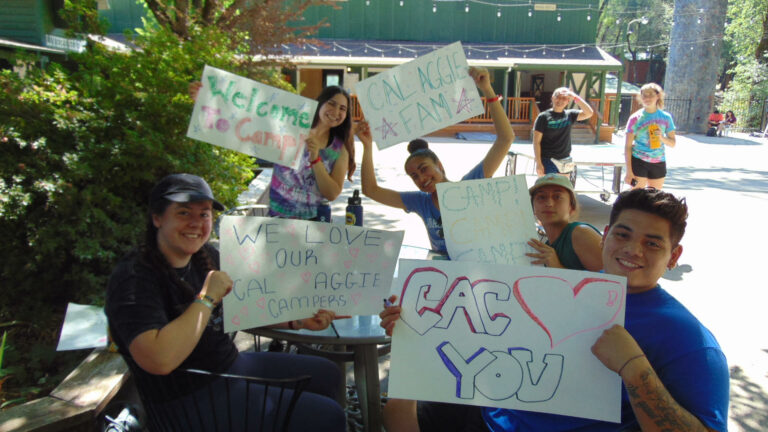
Impromptu fashion shows, wishboat making and 7 a.m. plunges into the lake make Cal Aggie Camp a whole lot of summer fun. But for both the campers and counselors, the week-long trip to Camp Rockin U in Dobbins, CA means a lot more.

Cal Aggie Camp, founded in 1961, provides youth in the Davis and Sacramento foster care system a week-long experience of summer camp — free of charge. At camp, children from ages 6 to 17 participate in recreational activities and spend time with UC Davis undergraduate students who volunteer as counselors for the program. 

With this summer being their 61st, Cal Aggie Camp has lots of beloved traditions, including the daily polar plunge at 7 a.m. Fourth-year Sonam Sehdev didn’t look forward to this tradition at first, but has come to appreciate it throughout the years.

“I remember I was super nervous to do that, because I’m not a morning person,” Sehdev said. “I was very reluctant, but we all just channeled that into excitement. We have a little chant that we sing before we dunk in,[…] then you get hot chocolate right after and we just all sit. I feel like it’s the traditions that the kids remember.”

Because of the experiences they share and the community they foster at camp, counselors become a community at UC Davis that exists outside of the campgrounds, according to Rachel Callegari, a third-year political science major. Callegari, who joined Cal Aggie Camp last year and is now the internal communications director, explained that the counselor community is a definitive quality of the program. 

“[The counselors] are such nice people,” Callegari said. “That’s why Cal Aggie Camp is so successful and why the kids love coming back every year, because of how awesome our dynamic is as counselors and how much we love this camp. I met some of my best friends through camp and the nicest people in the world.” 

To prepare for the summer, counselors spend time together both socially and educationally. They have bonding nights to get to know each other as friends and specific training to prepare for camp programming. 

Counselors must also complete child development courses to prepare them for the more difficult situations that might arise at camp. All counselors take EDU 198 during spring quarter, a two-unit course that focuses on language and culture coaching. This education aids them in building skills to understand the complexity of adolescents who have been through the foster care system and trains them in dealing with more sensitive situations that could happen during camp. 

“I’ve never taken a child development class, but I could really see, ‘Oh, this is how their mind is working,’” Callegari said. “You have to understand the hardships these kids face and that not every day is going to be all sunshine and rainbows — some people will have a bad day.” 

While campers may sometimes rely on counselors for de-escalation and moderation, the kids mostly benefit from the support and encouragement that they bring. Sehdev said that the main reason for camp is to create fun memories for these kids and to give them childhood experiences that they might not be able to experience otherwise. 

“I feel like [the most important part is] showing them that you’re there for them and that they have someone that loves them,” Sehdev said. “It’s just the community that’s really supportive towards everyone that I’ve seen.”

Sehdev said that the experience that both the campers and the counselors have during their one week stay at Camp Rockin U is transformative and often ends in reluctant and tearful goodbyes.  

“I feel like the most meaningful thing [was] at the end of camp realizing how much of a difference you made by being there for them throughout the week,” Sehdev said. “I think that’s the biggest thing that I still take with me.”

Cal Aggie Camp is currently taking applications for counselors for summer 2022. Applications close on Jan. 31. To apply, fill out the application online or email rcallegari@ucdavis.edu

Written by: Anne Saltel — features@theaggie.org

College athletics is experiencing deja vu

0

The entire NCAA is feeling the effects of the latest COVID-19 outbreak

By KATHERIN RAYGOZA — sports@theaggie.org 

As we enter 2022, the omicron variant of COVID-19 has created new obstacles and challenges for athletes all across the globe. Despite the emergence of COVID-19 almost two years ago, many athletes have recently been experiencing a lot of similar feelings as they did in 2020. Once again, the National Collegiate Athletic Association (NCAA) has updated their protocols and has gone as far as canceling a few games due to the easily transmissible omicron variant. 

During the first few days of January, the NCAA released new guidelines for winter sports during the pandemic. Since the Centers for Disease Control and Prevention has updated their protocols, the NCAA has created a 2022 Winter Training and Competition document

“The omicron variant has presented another surge of cases across the country,” NCAA Chief Medical Officer Brian Hainline said. “This guidance was designed to align with the latest public health directives. Given how the pandemic continues to evolve, it’s important that staff on member campuses continue to work with their local and state health officials on protocols most suitable for their locations.”

One of the biggest changes includes that the NCAA COVID-19 Medical Advisory Group developed a “new” definition of fully vaccinated. Being fully vaccinated now means that athletes and coaches must have all of the booster shots. A third shot is required within two months of receiving the Johnson & Johnson vaccine, five months after receiving the Pfizer vaccine or six months of receiving the Moderna vaccine. 

“The omicron variant has presented another surge of cases across the country,” NCAA chief medical officer Brian Hainline said. “This guidance was designed to align with the latest public health directives. Given how the pandemic continues to evolve, it’s important that staff on member campuses continue to work with their local and state health officials on protocols most suitable for their locations.”

The NCAA also shortened the amount of days individuals must quarantine. Athletes are allowed to quarantine for only five days if they tested positive, and if on the sixth day, they no longer are showing signs of symptoms, they can return while wearing a mask. If on the preceding five days they are tested negative, they can return to athletic activities permitted without a mask, but those that have been around that person must test within five days.

Five college football bowl games were canceled, one that featured UCLA and North Carolina State. The game between the Bruins and the Wolfpack was set to take place on Tuesday, Jan. 4 at Petco Park in San Diego, but UCLA announced internal COVID-19 protocols prohibited the team from playing. Seven more bowl games were impacted because of the rise in COVID-19 cases. More than 140 D-1 mens’ basketball teams have had their games canceled. Across the U.S., omicron has impacted the rest of college winter sports as well.

“We are extremely grateful to the Holiday Bowl, students, fans, sponsors, and the people of San Diego for their support this week,” Martin Jarmond, a UCLA athletic director, said in a statement on Twitter. “We are deeply disappointed for our young men in the football program that worked extremely hard for this opportunity. My heart goes out to them. The health and safety of our student-athletes will always be our North Star.”

As for the UC Davis Aggies, the mens’ and womens’ basketball season has faced the challenge of canceling their games. So far, both teams have canceled four of their games. As for their latest games, the UC Davis men were scheduled on Jan. 13 against the Roadrunners in Bakersfield at 7 p.m., while the women were set to play in Davis at 6 p.m., but both were canceled due to COVID-19 health and safety protocols CSU Bakersfield program.

Despite having new rules, the NCAA is planning on continuing other conference games as long as the surveillance of COVID-19 testing is low within their communities. Although it may presume that winter sports will not have a season, it has been assured that with proper rules, COVID-19 cases can be maintained so that the season can start anew.

Written by: Katherin Raygoza — sports@theaggie.org

Study shows dried goji berries may prevent age-related macular degeneration

UC Davis researchers found that eating only a handful of dried goji berries increases protective pigments in the eye

By MONICA MANMADKAR — science@theaggie.org

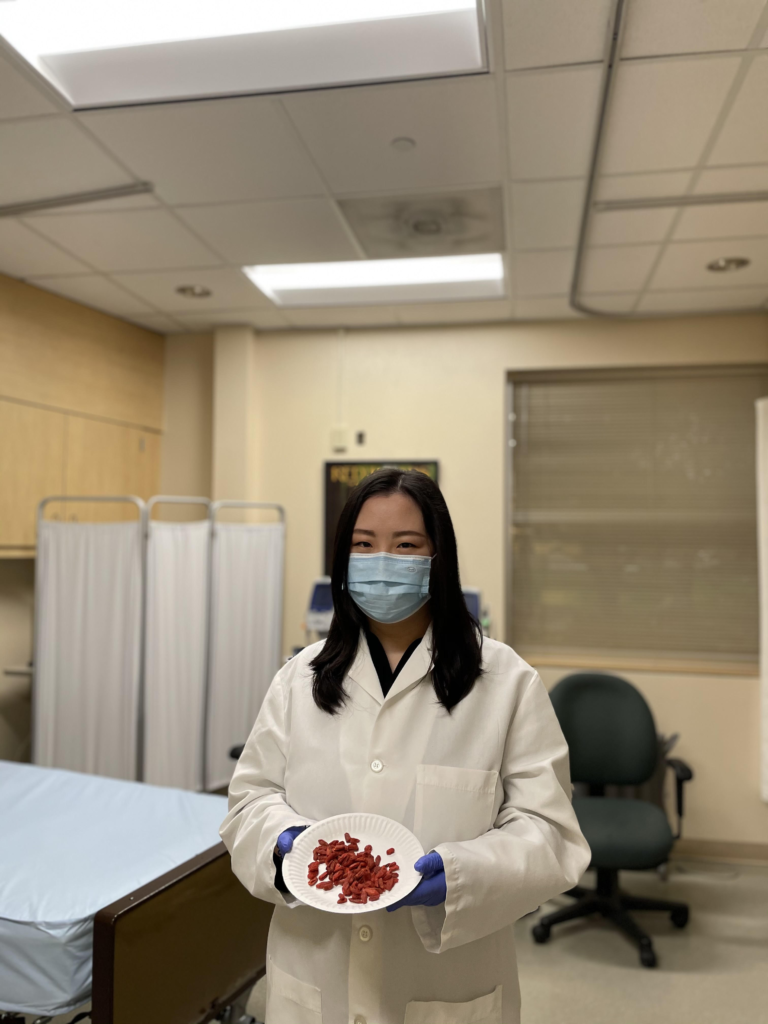
Consuming only a handful of dried goji berries can increase the density of protective pigment in the eyes, according to a study by UC Davis researchers. With a regular intake, these berries can help prevent age-related macular degeneration (AMD).

AMD is a disease that can cause central vision loss and affects one’s ability to read and recognize faces. It has affected over 11 million people in the U.S. and is the most common cause of vision loss for older people.

“If we would all live to 300 years old, then we would all have AMD at some point in our lives,” Dr. Glenn Yiu, an associate professor in the Department of Ophthalmology and Life Sciences and a co-author on this study, said. “It’s just that some people, especially those who smoke a lot and have light-colored eyes and skin, are more likely to develop AMD in their life during their sixties and seventies.”

During the small study conducted, researchers found that participants who consistently consumed about 28 grams or a handful of berries for 90 days had an increase in the density of the pigments. According to the study, these pigments, lutein and zeaxanthin, not only protect the eye against AMD but also filter out blue light. They act like sunscreen for the eyes. Meanwhile, the other group of participants, who took a commercial supplement did not see the same increase in density.

“The higher the concentration of these pigments in the eye’s retina, the more protection you have,” Xiang Li, the lead author of the study and a doctoral candidate for the Nutritional Biology program, said. “Their concentration is positively associated with cognitive performance.”

The study initially started with goji berries and their association with traditional Chinese diet and medicine. Li was born and raised in Northern China. Knowing that goji berries have “eye-brightening” qualities, Li was even more interested in researching the benefits of the berries.

“[Goji berries] are very common in Chinese medicine and even in the regular diet, and [they] are usually included in soups, like herbal soups, which are healthy for you,” Yiu said. 

Studies showed that the marker macular pigment optical density (MPOD) in the eye is also representative of the concentration of lutein and zeaxanthin in the brain, which means goji berries may also benefit cognitive health.

Goji berries show a lot of promise for future research. However, Yiu noted that this study was quite small and more research is needed to produce more concrete results. The berries increase the macular pigments, which should help decrease the risk of AMD, but there hasn’t been a study yet that quantitatively connects these two.

Written by: Monica Manmadkar — science@theaggie.org

Zendaya is living every child actor’s dream

The former Disney channel darling has blossomed into a successful actress and activist 

By CLARA FISCHER — arts@theaggie.org

The 2000s child actor to A-lister pipeline has produced some extremely successful celebrities, including the likes of Ariana Grande, Keke Palmer, Nick Jonas and Olivia Rodrigo. One member of this club who is currently experiencing a major moment of pop culture relevancy is Zendaya.

Before garnering fame, the Bay Area native attended Oakland School for the Arts, a K-12 institution that combines college preparatory material with visual and performing arts. Coincidentally, she shares the alma mater with her “Euphoria” costar Angus Cloud, though when asked about their high school relationship in an interview with the Wall Street Journal, Cloud stated, “We had some of the same friends I guess, but I didn’t really know her.” 

 After booking some roles in her local theater (including a silkworm in her school’s production of “James and the Giant Peach”) and being part of a hip-hop dance group at the tender age of eight, Zendaya got her big break in 2010 as one of the lead roles in Disney’s “Shake It Up.” On the show, she starred as Rocky Blue, 14-year-old dancer and best friend to Bella Thorne’s CeCe Jones. 

After “Shake It Up” ended its successful three-year run, Zendaya had a brief stint away from the Disney bubble, appearing on the 16th season of major reality TV show “Dancing With the Stars” as well as launching a short-lived (but fairly successful) music career. She ultimately came back to the company in 2015, but on her own terms this time around.

“The only way I was going back to Disney Channel was if I was in a position of more power,” said Zendaya in an interview with Cosmopolitan. “One thing that is really important to me is diversity on the channel.”

 She took on a dual job, both producing and starring in “K.C. Undercover.” The series focused on K.C. Cooper (played by Zendaya), an uber intelligent, black-belt wielding teenager who gets recruited to be a superspy, and the typical Disney channel shenanigans that ensue. Though still with Disney, Zendaya’s work on the show marked a pivotal moment in her career, proving not only her skills as a more mature actor, but also establishing her as someone not afraid to create necessary change in the industry. 

And it’s exactly this fearless willingness to speak on issues that matter to her that sets Zendaya apart from her peers. Through her pure outspoken nature, she has become a spokesperson for diversity in the entertainment industry. 

Zendaya herself has commented on the nature of her position a number of times. Notably, in a discussion at 2018’s Beautycon Festival, she stated, “I am Hollywood’s acceptable version of a Black girl, and that has to change… As a light-skinned Black woman it’s important that I’m using my privilege, my platform, to show you how much beauty there is in the African-American community.”

Another key aspect of her growth from child actor to well-respected A-lister was her use of fashion to represent her newfound maturity. 

“I wanted to create who I was as a person outside of my Disney character… Fashion helped with that,” Zendaya said in an interview with Janet Mock for Marie Claire. “My stylist, Law Roach, and I created a world beyond what I was known as through clothes.” 

This approach worked, and Zendaya is now also famous for turning out some iconic fashion moments. Who could forget her hot pink breast-plated Tom Ford dress for the 2020 Critics Choice Awards, or the plethora of showstopping Met Gala looks she and Roach have produced over the years? It’s safe to say that the young actress has already made a name for herself in the fashion industry.

Since her departure from Disney Channel, Zendaya has landed an astonishingly high rate of high-profile roles, including leads in Marvel’s “Spider-Man” trilogy, “Dune” and “The Greatest Showman,” working with other big names like Tom Holland and Timothee Chalamet. She also stars in HBO’s hit teen-drama “Euphoria,” the show which led her to become the youngest recipient of the Emmy award for the “Best Actress in a Drama Series” category.

Suffice it to say, Zendaya is a shining example of how to successfully translate childhood fame into a rewarding career. As she puts it in her conversation with Mock, “Sometimes you build your platform to step off so others can step on, and that’s what honestly motivates me.” 

Balancing the pressure of growing up in the spotlight with the gritty challenges of normal life is no mean feat, but that may just be part of the reason the public loves Zendaya — she makes it look easy.

Written by: Clara Fischer — arts@theaggie.org

Four pieces of legislation passed at Jan. 20 Senate meeting

The Senate confirmed commission and committee members and heard quarterly reports from Unitrans and two committees

By SONORA SLATER — campus@theaggie.org

On Thursday, Jan. 20, at 6:10 p.m., the Senate meeting was called to order by Internal Vice President Juliana Martinez Hernandez.

Following roll call and the reading of the land acknowledgement, candidates Amanda Clark and Kevin Andrew Liu were confirmed as members of the Judicial Council.

“I really like the community at Davis, and I want to give back to it the way it’s given to me,” Clark said.

Jaisey Grace Joseph was then confirmed as the Internal Affairs Commission vice chair.

Next, Stephen Fujimoto, the chair of the ASUCD Research and Data Committee, gave a presentation informing the Senate about student government volunteers, focusing on internal tracking issues and the possibility of instituting pay for current volunteer positions.

According to Fujimoto, the presentation sought to provide information about the potential benefits of paying volunteers and encourage the Senate to seriously consider pay, rather than providing a committee stance on whether volunteers should be paid.

President Ryan Manriquez responded to the presentation.

“We are having these very real conversations,” Manriquez said. “We want to make sure to explore avenues to make sure students are paid fairly, and students are paid for their time.”

Nic Riani, Christopher Tun, Kaytlin Kobayashi, Cynthia Juarez and Claudia Nava provided an update on CALPIRG, a student public interest activism group. They presented information on the organization’s activity during fall quarter, with a focus on 100% renewable energy, ending oil drilling and affordable textbooks, and plans for this quarter, with a continued focus on affordable textbooks and a push to ban unnecessary plastics.

Following the CALPIRG presentation, UC Davis Fire Chief Nathan Trauernicht gave a presentation on Health 34, a mobile, integrated health initiative that, according to Trauernicht, seeks to “deliver what people need, when they need it, right where they are.”

“We’re not therapists, we’re not psychologists, we’re just people who can come and be with you in a moment, and then introduce you to resources,” Trauernicht said. “Health 34’s goal is to remove barriers from people not getting the help they need.”

Next, Malerie Hurley was confirmed as a member of the Gender and Sexuality Commission upon recommendation by Chairperson Ashley Chan. Ellie Hanssler, Britney Sun and Alexis Vlavianos were confirmed as alternates. 

Hurley will seek to address issues of economic instability and lack of financial resources that face LGBTQ students. 

Nine members were confirmed as a part of the Research and Data Committee, as recommended by Fujimoto.

One of the new members, Anchal Lamba, noted that they aspire to “bridge the gap between data science analysis and social impact.”

Kavika Kapoor was confirmed as an Ethnic and Cultural Affairs Commission member by recommendation of Chairperson Jared Lopez.

Jeffrey Flynn, the general manager at Unitrans, provided the unit’s quarterly report. 

Winter quarter plans to restore 30-minute service on E and F lines and 15-minute all-day service on the West Village V line, as well as to launch a new line in West Village called the V Express, were put on hold after a return to remote learning and increased COVID-19 cases led to a significantly reduced available staff.

“A lot of the gains we made during fall have been completely erased, so as of now we are not going to be putting into place any of the improvements we planned for winter,” Flynn said. “Our goal is to try to keep fall service levels going for winter quarter starting the 31st. However, we may have to go back to summer service level depending on what the status of our workforce is.”

Flynn also gave an update on Unitrans’ ongoing transition to more sustainable operations, announcing that electric buses, which will replace the current gas buses over the process of 12 years, have begun production, but their arrival has been delayed to April 2022.

Mariah Padilla, the vice-chair of the Student Sustainability Career Fair Committee, gave the committee’s quarterly report. Padilla recapped the organization’s fall quarter activities, including various sustainability-based social media campaigns and an in-person networking event, as well as detailing plans for winter quarter. 

These plans include a continued online presence, welcoming new committee members, a virtual screening of “Coming Clean — A Demand for a Fossil Free UCD” and an Internship and Career Center Resume Workshop.

Brooke Isrow provided the AggieMentors Committee’s quarterly report, stating that the program has focused on remaining consistent throughout the school year so far. 

Isrow also announced that AggieMentors is looking to hire a temporary chairperson to fill her position while she travels abroad during the next academic year. 

After the elected officials provided individual updates about their progress throughout the week, the meeting shifted into Public Announcements.

Fujimoto shared that a survey asking students what mode of instruction and accommodations they want to see during winter quarter is now available.

The meeting then moved into Public Discussion.

Manriquez relayed feelings from the administration that the Senate table’s passage of resolutions may be too frequent. Members of the Senate then expressed opinions on the issue.

“I think a lot of times people don’t like to hear things, and I get that, but it is the Senate’s prerogative to write whatever […] we would like to write,” Senator Owen Krauss said. “So with all due respect, I will continue to write resolutions.”

Next, the Senate moved into reviewing the status of previous legislation. 

SB #35, which allocates $470.76 from the Senate reserves to the salary of the student advocate for winter quarter, passed automatically. Manriquez signed SB #36 which proposes changes to the ASUCD Champagne Award, and SR #19, which calls on faculty and the Academic Senate to not make use of proctored exams during remote learning winter quarter.

The table then moved into the introduction of new legislation. 

SB #37 calls to establish an executive board of the ASUCD Lobby Corps, and the bill went to commission.

The Senate then moved to consider old legislation. 

SB #32 passed unanimously. The bill will allocate $400 to Aggie Reuse for the purpose of making the EcoHub an occupiable space by funding a dumpster service to collect waste.

SB #38, which will provide a revised vision of the ASUCD Personnel Committee and further define its role, passed unanimously.

SR #20 recognizes January as National Human Trafficking Prevention Month. The bill passed unanimously.

SR #21, which urges UC Davis administration, faculty and staff to recognize the barriers that menstrual pains and complications can present to academic success and provide accommodations accordingly, passed unanimously.

Senator Radhika Gawde adjourned the meeting at 10:26 p.m.

Written by: Sonora Slater — campus@theaggie.org

Culture Corner

The Arts Desk’s weekly picks for movies, books, music and television shows

By SIERRA JIMENEZ — arts@theaggie.org

Movie: “The Power of the Dog” dir. by Jane Campion (2021)

Within five minutes — yes, five minutes — I was drawn into the Western allure and ominosity of this Netflix film. Benedict Cumberbatch does it again, playing extremely complex and mysterious characters effortlessly. A Western addict myself, this film incorporates the classic themes that we all know and love: toxic masculinity (although we don’t love this, per se, it tends to be a crucial part of Western film), a life of outdoors and freedom and some type of war waged between characters. What makes this Western film special in particular is the exploration of queerness in an typically hetero and rugged macho-man genre. The inclusion of a rather unfamiliar influence on a masculine-driven Western creates a domino effect on the psychological intricacies of the film’s plot. Pay close attention to detail in this film. Nothing is randomly placed, nothing is randomly said. It all connects in a strange way with an even more strange and disturbing ending. 

TV Show: “Peaky Blinders” 

Thomas Shelby has been stuck on my Netflix watch list for a while now, almost begging me to engage in the Peaky Blinders gang life himself through his watchful eyes and secretive presence. Despite the series’ hype, I have not dabbled in the British criminal world until now, and I think it’s safe to say that I am now addicted. Whether I am cooking, taking a break between classes or just wanting to relax and wind down before bed, I’m a fiend for the captivating British crime drama. This series has mystery, romance, humor, drama, violence and pretty much every adjective possible all wrapped up into five thrilling seasons. The suave and sophisticated chaos makes the viewer wish they could join the family of the Peaky Blinder gang: a life full of adventure, family loyalty, trickery, gambling and booze-filled pubs with whiskey and cigarettes. Highly recommend (if you are of legal age) to sip on your favorite whiskey on rocks while getting blown away by the intoxicating cinematography, acting and soundtrack of the series — it makes you feel the prestige and control of being a Shelby yourself. 

Album: “Pulp Fiction: Music from the Motion Picture” (1994)

The iconic song “You Can Never Tell” from the infamous dancing scene at Jack Rabbit Slims naturally makes you shake your hands and feet like the duo Mia Wallace and Vincent Vega, but coupled with the legendary snippets of dialogue that seem to mistakenly be attached to the album, it elicits a full-body experience. The movie can’t be encapsulated by the simplicity of a few songs, perhaps because it is not a film but an experience. The bridge between song and spoken word come together to create a chaotic masterpiece. Classic Quentin Tarantino: unpredictable yet brilliant. If accessible, slap the vinyl on and indulge in the patchworked soundtrack that will surely transport you into the “Pulp Fiction” experience without a need for visual aid — the scratch of the record, bangers from all ages and dialogue that sends shivers down your spine as if the characters from the film were talking directly to you. 

Book: “Brave New World” by Aldous Huxley (1932)

A dystopian world where humans are hatched and citizens are engineered into an intelligence-based society, you wouldn’t think that this novel was published in 1932. Although these concepts may seem foreign, the science fiction novel depicts a technologically advanced futuristic society in which humans are dependent on a tech-driven world. Sound familiar? Written as a plea for help, Huxley essentially predicts a drastic future of an industrious and accelerating society that is so obsessed with progress that it ends up being its own downfall. It is an interesting and relevant read despite its antiquated terminology, especially with the rise of environmental degradation and dependency on technology for everyday life. If the film series “The Matrix” didn’t do it for you, try to digest this one, then get back to me.  

Written by: Sierra Jimenez — arts@theaggie.org

New plant DNA research suggests that mutations are non-random

Research done at UC Davis and the Max Planck Institute discovered mutation bias in Arabidopsis thaliana plants

By SONORA SLATER — science@theaggie.org

Grey Monroe, who is currently an assistant professor in the Department of Plant Sciences at UC Davis and principal investigator at the Monroe Lab, was a postdoctoral student in Germany at the Max Planck Institute when he made a surprising discovery — one that led to three years of plant genome research.

The research, published on Jan. 12 in the journal Nature, challenges the theory that DNA mutations are random. 

“You’ve probably heard in biology class at some point that mutations are random,” Monroe said. “What we found is that the places that have very low mutation rates are actually the places in the genome that are responsible for the most important biological functions of the plant.”

According to a recent press release about the study, researchers spent three years sequencing the DNA of hundreds of Arabidopsis thaliana, or thale cress. Monroe said that this commonly-studied plant is the “fruit fly of plant research” due to its relatively small genome. 

The press release went on to explain that researchers grew specimens in a lab environment, “which allowed plants with defects that may not have survived in nature [to] be able to survive in a controlled space.” When the genomes were then sequenced, analysis of the mutations revealed a non-random pattern. 

Detlef Weigel, the scientific director at Max Planck Institute and senior author on the study, talked about what “random” means when it comes to mutations. 

“What is generally accepted is that mutations are random with respect to being ‘good,’ ‘bad’ or ‘neutral,’” Weigel said. “We assume that’s random, and then natural selection produces that pattern that we see. But this showed that instead, there are fewer mutations to begin with in those really important genes.”

However, even after seeing a pattern of non-random mutation, explanations other than mutation bias remained. 

“How do you know you’re not just accidentally observing natural selection?” Monroe said. “Because we would expect natural selection to remove that bias anyway. So without getting into the weeds too much, no pun intended, we spent a lot of time doing analyses that were able to show that that was not what was going on.” 

According to Mariele Lensink, a second-year graduate student at UC Davis and one of the authors of the paper, they did this through running theoretical experiments and eventually creating a statistical framework to show support for evidence of mutation bias. 

“I developed a way for us to confidently say that the results were due to mutation bias rather than purifying selection,” Lensink said.

Monroe described one of the ways the results of this study might be applied to future research.

“Mutation is the source of cancer and genetic disease,” Monroe said. “If we can fully understand how this plant is protecting its most important places of the genome from mutating, understanding how that works and how that evolves…  it’s not going to cure cancer, but it just leads to a bunch of new questions that could inspire research.”

Monroe went on to introduce another potential application of the study’s findings.

“This shapes our understanding of genetic variation in general, and this is really relevant for understanding crop breeding,” Monroe said. “Crop breeding is basically applying evolutionary genetic principles in directions that we want to achieve. We want to make plants that are more nutritious and more climate-resilient and a lot of the analyses that underlie how we go about that breeding rely on an understanding of mutation.”

Lensink offered some final words about how important this could be to our understanding of basic biology.

“We’re readdressing how we think about mutation in general, and I think that has implications for just how organisms adapt and change,” Lensink said. “This is the kind of research that changes textbooks.” 

Written by: Sonora Slater — science@theaggie.org

City of Davis meets to discuss decennial redistricting process

The first district map drafts were presented at city council in the third hearing out of five concerning city district boundaries

By LEVI GOLDSTEIN city@theaggie.org

Every ten years, it is required by federal law that voting districts are redrawn to reflect the population data gathered by the Census. Districts with well-balanced population numbers ensure that every elected representative has an equal number of voters, and that voters have equal representation and voting power.

The City of Davis is currently undergoing the redistricting process for city council member voting districts. 

On Tuesday, Jan. 11, the first official draft maps for new city district boundaries were brought to the Davis city council. This was the third public hearing in a series of five that began in Nov. 2021. The final hearing is scheduled for Tuesday, Feb. 15, during which the council will vote to officially adopt the final district map. 

According to Assistant City Manager with the City of Davis Kelly Stachowitz, the city converted to a district election system in 2019, based on districts that were drawn according to 2010 Census data. 

The council must approve maps that reflect changes in population between the 2010 Census and the 2020 Census. For the maps to be viable, the population difference between the districts with the smallest and largest populations cannot deviate from the target (the total city population divided by the number of districts) by more than 10%. 

“We have to make sure that it works with population numbers,” Stachowitz said. “If you add to one district in one place, you may have to take away someplace else from the district in order to keep the districts relatively even. It’s just kind of a puzzle that you have to put together.”

City council has been meeting with Redistricting Partners, a contracting firm that aids in the redistricting process. Their purpose is “to make sure that the population numbers […] are meeting both the spirit and the intent of the law,” according to Stachowitz. 

Paul Mitchell, a data consultant and Redistricting Partners’ owner, said during the city council hearing on Jan. 11 that in addition to equal population sizes, districts must be contiguous, keep communities of interest together, follow designated geographic boundaries such as highways and remain compact. 

A community of interest is a “contiguous population that shares common social and economic interests,” according to the city’s redistricting website

The city council has paid special attention to protecting communities of interest, including communities of renters versus homeowners, minority communities and specific neighborhoods. 

“We want to make sure that if there was a community of interest […] we put that community of interest in one district so that they’ll have a larger percentage of the voice, versus spreading them throughout two or three districts where their voice might be diluted,” Stachowitz said.

The city has provided various opportunities for public input during the process, including a public workshop on Dec. 13, 2021, a community of interest survey that closed Dec. 31, time allotted for public comment during hearings and an email address (districts@cityofdavis.org) to which residents can send comments and submit draft maps for consideration. 

Most of the input the city has received is from residents of Aggie Village, a neighborhood in Davis that is considered a community of interest. Aggie Village is currently zoned in District 5, which consists of South Davis, Olive Drive and a small piece of downtown. 

“What they said was, ‘We believe that we are much more closely aligned in our needs and our interests and our issues with other downtown residents, and we believe that we should be in a district with those residents, rather than where we are currently,’” Stachowitz said. “Both option A and option B of the draft maps […] do take into consideration that input and include that neighborhood with the downtown area that they requested to be in.”

City council also considers the direct effects of redistricting on Davis residents when discussing draft maps. The main impact they’re concerned about is a result of staggered council member elections. Three out of five districts voted in Nov. 2020, before redistricting, and the remaining two will vote in Nov. 2022, with voters zoned based on the new district maps that will be approved this year. 

Staggered elections are beneficial to the city because they allow for continuity on the council, according to Stachowitz. However, because some voters will change districts between elections, they could end up voting twice, or not at all. 

“‘Accelerated’ means that you voted in the last election but then your district got changed around and you’re actually going to vote again in the next election,” Stachowitz said. “The other way would be ‘deferred’, which is the exact opposite. It means that you didn’t vote in the last election but then your district was changed and wherever you are now is also not voting in the current election.”

Stachowitz said that the city council will try their best to limit the number of voters that are deferred. 

The redistricting process is going smoothly thus far. However, one concern that was discussed during the hearing on Jan. 11 is that the city’s version of the city boundary lines don’t match up with the county’s version. Plans for the city’s Mapping and Geographic Information Systems staff to meet with Yolo County to discuss those inconsistencies and create a synced map based on taxpayer records should solve that issue. For now, it is causing a delay in the drafting process. 

The final district draft maps will be released on Jan. 25. The fourth city council hearing is on Feb. 1. The finalized maps will be released on Feb. 8, which will be voted on at the final hearing on Feb. 15. 

Written by: Levi Goldstein — city@theaggie.org

The Editorial Board shares some fun, interesting GEs

With pass times approaching for spring quarter, the members of the Editorial Board share some of their favorite classes they have taken at UC Davis

Anjini Venugopal, Editor-in-Chief – ECH 001: Design of Coffee

If you ask any of my friends about my most quintessential traits, they’re sure to mention that I’m quite the coffee gal. This three-unit course involved a weekly lecture and a lab section during which we roasted, ground and brewed coffee beans to investigate basics of chemistry and chemical engineering; though I sometimes flaunt to pre-med friends that I haven’t needed to take a biology, chemistry or physics class, this was a nice, basic course that examined one of my favorite things from a more academic perspective than I had ever considered (and it provided some visual literacy GE units). I’d love to share some other top contenders for courses that I absolutely recommend taking if you have a chance: LIN 127, ECS 122A and PSC 136. 

Margo Rosenbaum, Managing Editor – GEL 012: Evolution and Paleobiology of Dinosaurs

As an avid dinosaur lover, I was so excited to see a class devoted to the very subject and even bought a dinosaur-covered notebook to take notes in lecture. Using dinosaurs as examples, GEL 012 covers introductory ideas to evolutionary biology, paleobiology, ecology and paleoecology, making it a great GE for people without an extensive science background. I took the class with Dr. Sandy Carlson, who is incredibly animated about fossils, dinosaur reconstructions and current events in paleontology. I highly recommend this class for anyone looking to geek out about dinosaurs (like me), or to earn two units toward the science and technology GE category. 

Sophie Dewees, Campus News Editor – ENL 105: History of the English Language

ENL 105 is easily one of my favorite classes I’ve taken in college. Even without a background in linguistics, I found the concepts easy to understand and the deep dive into Old and Middle English fascinating. I took the class with Professor Seeta Chaganti, whom I cannot recommend enough. As a medieval historian, she was incredibly knowledgeable and passionate about the subject and made the class one of the highlights of my time at Davis

Madeleine Payne, City News Editor – GEL 020: Geology of California

This two-unit course explores the many diverse and distinctive geologic features of California and offers a billion-year-old history lesson on the state. It’s perfect for those who are new to geology or looking to satisfy the visual or scientific literacies core requirements. I took this class my freshman year, and it totally transformed how I see California, giving so much more meaning to the mountainous features and coastal landscape I enjoy spending time in every day. 

Eden Winniford, Opinion Editor – PHI 011: Asian Philosophy

PHI 011 can be dense at times but it’s always engaging — it’s amazing how applicable ancient texts can be to modern life. Dr. Thorian Harris is incredibly knowledgeable and approachable, and he gives his students the freedom to think deeply and write meaningful essays. I initially signed up for it to satisfy my world cultures GE requirement, but now I always check to see if any philosophy classes fit into my schedule.  

Katie DeBenedetti, Features Editor – ETX 020: Introduction to Forensic Science

For crime nerds like me, taking a GE that studies real life murders, how they’re solved, the evolution of DNA evidence — and fulfills a science requirement — is a no-brainer. This course delves into famous crimes committed in California, like the 1989 “Yosemite Murders,” and how forensic evidence like fingerprints, bloodpatterns and small skin and hair samples can help detectives solve hard to understand cases. I’d definitely recommend this course to anyone looking to up their armchair detective skills — but maybe not to the easily spooked.

Allie Bailey, Arts & Culture Editor – WMS 050: Intro Gender Studies

I feel lucky to have taken many classes at Davis that could have made this list. Looking back on my four years here, however, I think the most valuable course I’ve taken is WMS 050. One of the central ideas of the course is intersectional feminism, and how social issues can be better understood and remedied when considered through a feminist lens. Having taken it my first quarter at Davis, I’m surprised that the course has stuck with me, but I think it’s the fact that it was one of my first classes that made it so influential; it gave me critical thinking tools early on and an intersectional feminist framework that I used to analyze other course content. I think having these skills has deepened all of the subsequent learning I’ve done at Davis and will continue to impact how I learn about and interact with the world around me.

Omar Navarro, Sports Editor – CMN 001: Introduction to Public Speaking

As someone who really does not like public speaking, I find it surprising that I would recommend a public speaking course. But, the reason I selected this class is because of the valuable things I learned, the interesting course content and how much the practice of public speaking has really helped other areas of my life. While public speaking can be frightening sometimes (and it was for me in that class), it is going to be necessary in a lot of our lives down the road, so getting over that fear or working on it can go a long way. The class is four units and falls under social sciences, but to me, the value is something you can take with you even after you are done in Davis. 

Michelle Wong, Science Editor – MUS 116: Music of the Beatles

Growing up listening to “Sergeant Pepper’s Lonely Hearts Club Band” and “Yellow Submarine,” I have always been an avid listener of The Beatles and was excited to see UC Davis offered a course solely dedicated to the band. For anyone who loves The Beatles, this course dives into the background of the members, different influences on their evolving music style and how their music influenced artists to come. After learning more about the different hardships and trials this band faced, I have further grown in my appreciation for all music artists and the intertwinement between music and culture. 

Written by: The Editorial Board