55.7 F
Davis

Davis, California

Monday, December 22, 2025
Home Blog Page 286

COVID-19 vaccines available to individuals in phase 1A and phase 1B, tier 1

0

It is unclear when students and employees in phase 2 will be able to access the vaccine

UC Davis laid out a tiered system of eligibility for the COVID-19 vaccine through the Campus Ready COVID-19 Vaccine Program. While some students and staff have already gained access as part of the first wave, it is unknown when Phase 2 will begin.

“We can truly make a difference in preventing the spread of COVID-19 in Davis by working together and by advocating for all of our community members,” said Cindy Schorzman, medical director of the Student Health and Counseling Services, via email. 

According to Schorzman, both phase 1A and phase 1B, Tier 1 are currently open for appointments.

Phase 1A consists of Aggie Public Health Ambassadors, CARE Advocacy staff, UC Davis healthcare workers and employees who work directly with COVID-19 exposed patients such as: COVID-19 researchers, student and occupational health employees and Housing and Dining workers in the campus quarantine and isolation unit.

Sarika Sethi, a second-year biotechnology major, was recently vaccinated through the program. Sethi is a housing employee at the Tercero Service Desk and qualified as part of phase 1A. 

“Once we got the notification that our tier was eligible for the vaccine our staff made appointments through Health-e-Messaging and were vaccinated at the ARC,” Sethi said. 

Sethi said her side effects were mild and suggests if anyone has a chance to receive the vaccine, to take it. 

“I have received the first dose of the Moderna vaccine, and I had a sore arm and felt a little tired, but overall the experience was very manageable,” Sethi said. “I decided to get vaccinated because, although I am in a population where the chance of adverse health risks for me are very low, I also know that I could accidentally spread [it] to other more at risk populations if I were to contract the virus.”

Phase 1B, Tier 1 includes employees and students over the age of 65 and individuals who can be exposed to COVID-19 due to their job requirements.

An Pham, a second-year neurobiology, physiology and biology major said she likes the way UC Davis was handling the situation.

“it puts me at ease to see that they are providing COVID-19 testing and access to vaccinations,” Pham said. 

The next stage, Phase 1C, involves providing vaccinations for individuals between the ages of 16 to 64 years old who have underlying health conditions that make them more vulnerable to severe symptoms of COVID-19. This group includes workers in water, waste, energy, chemical, hazardous materials, communications, IT and financial services workers, administrators on campus and individuals partaking in contact tracing and COVID-19 case investigation according to the Campus Ready website. 

After all three phases of Tier 1 are complete, UC Davis will extend students and employees as permitted by local and state public health officials and the California Office of the President (UCOP), according to the UC Davis rollout plan on their website.

“We do not have an anticipated timeline of when additional tiers will become eligible as it depends on the amount of vaccine that we receive,” Schorzman said. 

Pham said that and that she looks forward to seeing how they will be distributing the vaccination in the near future. 

“Getting vaccinated for COVID-19 is one of my top priorities,” Pham said. “I’m glad that UC Davis has this option for me, to ensure that we stop the spread of the virus.”

The first doses of the COVID-19 vaccines were administered on Feb. 1, the same day the campus vaccine clinic started. Receiving the vaccine is free for employees and students

“Our goals are to use every dose that we receive to help protect our UC Davis community, to continue to advocate for increased vaccine supply for our campus community and to continue to expand our delivery system as increased doses become available,” Schorzman said. 

With the help of the UCOP Office of Emergency Management, UC Davis receives its vaccine from the California Department of Health. 

Schorzman said frequent updating of their website helps to prevent the spread of misinformation related to the vaccination process.

“Students are sent weekly updates via text messaging,” Schorzman said. “Our Aggie Public Health Ambassadors do an outstanding job of delivering updated information about COVID-19 and current public health measures.”

At this time, it is strongly encouraged, but not required for employees to receive the vaccine. If an employee declines, for any reason—whether it be religious or medical—they must wear protective equipment

“The hard work and collaboration by a group of individuals who never would have otherwise come together has made a real and measurable difference, and has made me so proud to be an Aggie,” Schorzman said. 

Written by: Aarya Gupta — campus@theaggie.org 

Reddit vs. Wall Street

0

GameStop used as a blunt-force weapon against hedge funds

Between Jan. 20 and Jan. 27, stock for GameStop (GME) rose from $39.12 to $347.51, an 888% increase. In a matter of days, hedge funds like D1 Capital Partners and Melvin Capital, which had short sold GameStop and AMC (which saw a similar rise) to a nearly obscene degree, found themselves grappling with heavy losses. Melvin Capital had lost 53% of its value, requiring a lifeline of $2.7 billion from Citadel LLC and Point72 Asset Management to stabilize itself in the midst of GME’s insane rally. 

The responsible party is Reddit’s r/wallstreetbets community, a subreddit of day traders who pride themselves on incredibly risky bets and use homophobic slurs as sentence fillers. Included in the more notable financial escapades to spread beyond the site itself, is the story of a user known as “fscomeau,” who put $200,000 in puts against Apple and, over the course of a  two-hour livestream (in which he wore a rubber wolf mask), lost everything and found himself in insurmountable debt. While fscomeau was eventually outed for faking the whole thing, r/wallstreetbets has no shortage of real monetary losses—“loss porn,” or screencaps of trading accounts with losses sometimes well into six digits, remains the most commonly gilded posts in the community. Unlike fscomeau’s downfall, r/wallstreetbets’ instigation of one of the largest short squeezes in history, too, is very real.

The first sign of trouble came when a r/wallstreetbets user (whose name The California Aggie cannot, in good conscience, print here) pointed out that the ailing GameStop, which found itself grappling with a double-sided onslaught from the pandemic and the games industry’s shift towards digital ownership, was being short sold an astounding 140% of its public float. From there, it was only a matter of organization and, for r/wallstreetbets, of getting the “tendies” in order.

Hedge fund manager of “The Big Short” fame Michael Burry was one of the few to see the writing on the wall; Last spring, he purchased 5.3% of GameStop at between $2 and $4.20 a share. While he likely didn’t see a short squeeze of this magnitude in the cards, there’s no doubt that early warning signs were present for this sort of dramatic event.

After the damage became clear, the narrative, at least among the internet-minded, seemed to be that holding GameStop was an act of vengeance against Wall Street—which at first, it very well may have been—but the narrative shifted. Melvin Capital was way out after its initial staggering losses and before the hype machine started chugging along. Hedge funds, in sum, are risk averse and, as a result, not likely to stay in on securities that swing in value by the hundreds daily. 

Though this narrative of lucrative activism was dubious at best after the initial squeeze, it was apparently enough to get a substantial number of Americans to pump their hard-earned money into meme stocks, at least partially under the guise of righteous warfare against the 1%.

This, like many popular internet narratives, was easy to spread and a well-evolved falsehood. GameStop, as of Feb. 11, is sitting at $51.10—just a fraction of its 51-week high of 13 days prior. As it turns out, those who knew what they were doing were in and out before pop culture got a true hold on the situation, and the ones who paid were those late to the party. (Imagine following the Twitter hype and buying GameStop at like $300, only to have to sell at $50. Geez.)

After the horror of 2008, the steady rises in deaths of despair since the ‘90s and an ever-decreasing labor force participation rate among young people, a narrative like this was far from a difficult sell—put $500 of stimulus money into a dying company, and I can watch Wall Street get all nonplussed? (And make a pretty penny?) Sounds like a good deal. But of course, when this much cash is involved, there’s bound to be a plague of opacity when it comes to what’s really true and what’s not. It’s easy to forget that nobody is more learned and capable than Wall Street when it comes to profiting off the illusions of the middle class.

There are real ways to attack America’s woodchipper-like financial infrastructure without losing your life savings on nebulous hype waves, but unfortunately, investing in whatever stock people happen to be talking about at a given moment is not one of them.

Hedge funds were hurt, laughs were had and a lot of people made and lost a lot of money. Only time will tell whether this style of digitally-organized market terrorism is replicable, or even tenable in the first place, but some will be watching Wall Street squirm all the same.

Written by: Jacob Anderson — arts@theaggie.org

Yolo County follows Gov. Gavin Newsom’s order to vaccinate seniors 65 and older

0

Yolo County officials and volunteers work for hours to distribute COVID-19 vaccines

Healthcare providers in California are now following Gov. Gavin Newsom’s order to transition to age-based vaccine eligibility. Residents who are 65 and older are now eligible to be vaccinated in Yolo County. 

Yolo County Public Information Officer Jenny Tan explained why seniors have received vaccine priority. Data has shown that the majority of the people in Yolo County who have passed away due to COVID-19 complications were 75 and older, therefore elderly people were given vaccine priority, according to Tan. 

While Tan understands that many residents may feel like they should be higher up on the list depending on their health concerns or age, she noted that Yolo County receives only 1,000 to 2,000 doses a week although there are 220,000 residents in total.

“When everyone is a priority, no one is a priority,” Tan said. “Even if we add more categories and more priorities, it doesn’t fix the supply issue.”

Healthcare providers receive their own limited doses, so seniors are able to check for vaccine availability at their regular institution. Furthermore, seniors may receive vaccinations from Yolo County by signing the vaccine notification form, which includes the individual’s age, place of work, city of residence and underlying health conditions. Once an individual meets the tier requirements, the county will send them an email that shows the available facilities and how one can sign up.

Patients may also visit Yolo County’s vaccine information website, and they will be notified which clinics are eligible for registration. Tan and other Yolo County employees work with various partners, such as senior homes, Meals on Wheels and food banks to help their clients sign up when clinics are offering vaccines. 

Tan mentioned that there are several ways seniors may hear about vaccine updates, even if they struggle with technology. She explained that Yolo County has been active in media interviews, so residents can find information online, on the radio, television or even through word of mouth.

Tan urges Yolo County residents to stay patient because hours of hard work are being spent behind the scenes, like ordering doses, figuring out how many to distribute to each institution and doing outreach.

Yolo County uses a database to request a number of doses from the state, but they do not always receive that amount. In the week of Feb. 7, 1,975 doses of Moderna and Pfizer were directly sent to Yolo County, according to Tan. 

Tan explained that when Yolo County is notified of the number of doses they will receive, they work on locating the clinics, deciding which hospitals will receive vaccines and how many to give out to each area. If they decide to organize a drive-thru, the county will need volunteers. Volunteers must complete paperwork, and the county sets a schedule to unfreeze the vials. 

In a typical drive-thru clinic, five to 10 staff members prepare and set up data entry, which takes about 10 hours, according to Tan. Another five to 10 staff members require a few hours to load supplies into trucks. A total of 100 volunteers and staff members would work for six to seven hours to vaccinate the clients who come in. Afterwards, 50 to 100 hours are dedicated to data entry, as forms must be entered in the system for their second dose. 

“For you, it’s 30 minutes, but on the back end, it’s hundreds of hours for us to do that,” Tan said.

Kaiser Permanente, a hospital that receives doses from Yolo County, has been vaccinating individuals 75 and older. They reach out to the community when appointments are available, and members who are contacted by Kaiser can schedule an appointment online.

Kaiser Permanente Public Relations and Media Relations worker Chyresse Hill shared via email that Kaiser prioritizes patients “who are at an increased risk of mortality or other severe disease, as well as those who reside in vulnerable communities.”

Tan has also received the vaccine, and she believes that it is safe since studies have been done and millions have already received it. She had a sore arm and described the feeling as a “flu shot,” but it soon healed. If people are worried, she recommends that they do careful research at legitimate sources, including the Centers For Disease Control (CDC), rather than listening to someone who may provide false information.

Until the majority of the population is vaccinated, Tan explains that everyone has a responsibility to continue wearing masks and practice social distancing. She was hopeful that life can return to normal once vaccinations are widespread. 

“If more people get vaccinated, then we will be able to open up more businesses and have some sort of normal life,” Tan said.
Written by: Ellie Lee — city@theaggie.org

UCLA student and founder of America First Bruins arrested by FBI for participation in insurrection at Capitol

0

Davis College Republicans say they would expel anyone involved in extremist activities

Christian Secor, an undergraduate UCLA student, was arrested by the Federal Bureau of Investigation (FBI) this week for participating in the insurrection at the U.S. Capitol on Jan. 6. Secor, “a self-described fascist,” is one of more than 200 defendants who stand accused of taking part in the violence last month. 

Bill Kisliuk, the director of media relations at UCLA, said via email that information about Secor wasn’t publicly available. 

“What I can tell you is that UCLA believes the Jan. 6 attack at the Capitol was an attack on our democracy,” Kisliuk wrote. “As an institution, UCLA is committed to mutual respect, making decisions based on evidence and using rational debate and not physical violence.”

He was affiliated with the Bruin Republicans, a political group on campus, over a year ago but was later expelled for his behavior.

“There is not much else to say on the matter,” wrote a Bruin Republican via email. “He was once a member, he was expelled for being radical, reckless, and acting inappropriately over a year ago. We didn’t know about his affiliations, and then when we did, we kicked him out. Our club has no affiliation, association or contact with him and we denounce and disavow his decisions.” 

Jenna DiCarlo, a fourth-year international relations major at UC Davis, spoke on behalf of the Davis College Republicans in an email. DiCarlo said that any member who participated in similar extremist activities would immediately be expelled from the group. 

“Davis College Republicans (DCR) would absolutely remove someone from our club if they acted in such a despicable manner,” DiCarlo wrote. “Christian Secor is a fringe extremist and we as a club unanimously condemn his participation in the Capitol riot. Someone with the same views would be a poor representation of DCR and the values we stand for. Therefore, we would immediately ban anyone who committed a similar act, just as UCLA did.”

Secor claimed to be a “Groyper,” a member of a loosely affiliated group of white supremacists who follow American First podcaster Nick Fuentes. Fuentes has claimed that the group espouses conservative Christian values. According to the Anti-Defamation League, the Groypers are hostile to “immigration, globalism, gay and transgender rights and feminism.”

Secor is charged with five federal offenses including assaulting, resisting or impeding officers; aiding and abetting civil disorder; obstructing an official proceeding; entering and remaining on restricted grounds; violent entry and disorderly conduct.

Secor also live-streamed a video of himself taking part in the Capitol riots. An FBI affidavit available to the public contains pictures of him sitting in former Vice President Mike Pence’s chair in the Capitol building that day. Secor had previously expressed anti-Semitic and racist views at UCLA, according to the affidavit.

Secor also started a group on campus called America First Bruins. Their Facebook page appears to be deactivated.

Written by: Rebecca Bihn-Wallace — campus@theaggie.org 


Students reflect on power outages experienced during midterm season

0

Faculty worked to accommodate students in the recent power outages, although some students felt unsupported by their professors and the university

Many students and residents in Davis and surrounding areas experienced power outages starting on Tuesday, Jan. 26 and lasting until Jan. 30. 

When their power went out, first-year molecular and medical microbiology major Isabelle Smith and her roommate checked into the Residence Inn by Marriott only a couple of miles away from their West Davis apartment.

Smith said that all of her midterms were pushed back and her professors were accommodating.

“We had no food,” Smith said. “All of our devices were dead and we still needed to study. If it happened again, I’d probably just go back to the hotel again. It was $120 for two people, so we split that in half.”

Other students weren’t so fortunate. Erika Lambert, a fourth-year linguistics major, lost power for 20 hours and the following day her internet went down, all while she was recovering from COVID-19. She sat in her car to charge her phone and send emails to her professors.

 “I had pretty bad symptoms,” Lamber said. “I didn’t have to go to the hospital, but there were a few times where I thought I might have to.”

Lambert falsely assumed that all of her lectures would be recorded and, as a result, missed a handful of classes. One professor expressed discomfort being recorded, explaining that he would have to change the way that he acts. 

“He’s in the Midwest area right now and does Zoom from over there,” Lambert said. “He basically just made fun of the storm. He was like ‘30 miles an hour is nothing and you guys are so overdramatic.’”

Megan McFarland, a spokesperson for PG&E, said in an email that the storm was actually highly uncommon for this area.

“Based on 30 years of weather data, PG&E meteorologists described the late January winter storms as the strongest since 2011 and say that it caused the highest two-day and three-day outage totals since 2010,” McFarland said. “From Tuesday, Jan. 26, through that Saturday morning, more than 935,000 PG&E customers lost power due to heavy wind, rain and snow.”

Lambert reached out to the linguistics department chair and the Office of Undergraduate Education to discuss her situation and request that lectures be recorded in the future. When she was sick, she notified two of her professors who were both understanding. She didn’t request special accommodations, such as extensions for assignment or exam deadlines, besides lectures being recorded.

“I think it’s definitely nice for professors to record [lectures], but I guess it is somewhat like an in-person class where if you miss it, that’s it,” Lambert said. “But I think this school year is definitely a lot different than when we had in-person in that people have a lot of stuff going on. I think just not recording during the power outage is a big deal, because more than half of the class wasn’t there.”

Lambert said she doesn’t feel supported by the university during this unprecedented time. 

“We’re expected to just continue on with school as if nothing is happening,” Lambert said. “As if there is not a pandemic and a new president and an insurrection and a power outage and a storm. They’re like, ‘Okay, well go to class.’ I think the school underestimates how much we’re going through right now, some more than others, but still I think it’s a lot for everybody.”

Dr. Wolf-Dietrich Heyer, the chair of the department of microbiology and molecular genetics, said that he didn’t receive any complaints from students and was surprised by this silence. 

“There was a lot of sympathy with the situation,” Heyer said. “I think everybody was extremely accommodating to mitigate the circumstances. Of course, it hit right at the time where exams were up, so deadlines had to be extended. It added a lot of stress to students and to faculty, on top of the stress we already work under with the pandemic.”

Heyer said that faculty have become crisis management experts. 

“From my vantage point, I think we managed the crisis well,” Heyer said. “We are becoming overly good at managing crises because of all the experience of the last 10 months. It is not a good status quo. I do hope we get back to normal in the fall with face-to-face instruction. It will be much more enjoyable for everybody involved.”

Being from Germany, power outages are a new phenomenon for Heyer. 

“I’m from Germany, an equally as developed country as the U.S.,” Heyer said. “In all of my life in Germany, I cannot remember experiencing a power outage. In my time in Davis, it’s a common event. I think there is a lack of investment in vital infrastructure. There is an incredible need to improve this.”

If the power goes off on campus, on-campus generators switch on immediately, protecting sensitive samples and years of work collected by researchers. On-campus power outages are extremely rare, compared to outages in the city; Heyer said he could count with one hand the number of on-campus outages that have occurred in his 20 years at UC Davis.

Dr. Rena Zieve, the department chair of physics and astronomy, was grateful for the more robust power infrastructure on-campus as opposed to the less reliable surrounding Yolo County infrastructure. 

If power was lost, it could be detrimental and researchers would lose years of work. 

“We have some things that particularly are kept under vacuum,” Zieve said. “There are samples that basically will be destroyed [if power is lost]. Not physically destroyed, but they’ll lose the special properties that we’re trying to study if they’re exposed to air.”

Zieve said she was concerned about the students who lost power and may not have known to request accommodations.

“I offered the students in my class spots to work in the physics building if they needed a place where there was power,” Zieve said. “On Saturday, there were a couple of students who came. Some of the students were very proactive about trying to get help, other students didn’t really believe that anyone would help them. The message I’d really like to get out is that if you need help you should ask for it.”

Heyer said that he trusts when students are asking for help, they need it. 

“We’re all in the same boat,” Heyer said. “We better all row in the same direction, otherwise we’re not moving forward. These are real problems. They take time. If we all have some understanding towards each other, we can help ourselves through these problems. Luckily, they’re always only temporary.”
Written by: Rebecca Gardner — campus@theaggie.org

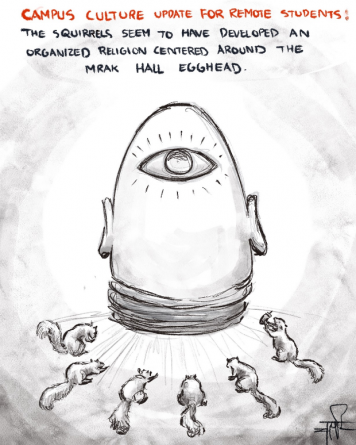
Religious nuts

0

Drawn by: Rushi Tawade –– rntawade@ucdavis.edu 

Disclaimer: (This cartoon is humor and/or satire, and its content is purely fictional. The story and names of “sources” are fictionalized.)

UC Davis Yoga Club stretches practices and mindfulness into the new year

0

Club members reflect on the importance of yoga and meditation during the pandemic

In response to stressors relating to the pandemic, many students have developed self-care habits to maintain mental and physical health, such as yoga and meditation. At UC Davis, the Yoga Club welcomes students interested in yoga and provides them with resources including free yoga or meditation classes. 

Nicole Drake, a third-year wildlife fish and conservation biology major and the vice president of UC Davis Yoga Club, practices yoga three or four times a week, integrating meditation into her yoga routine.

Drake shared how practicing yoga has helped her to stay present during the chaos of the pandemic. 

“It’s definitely helped me maintain my sanity,” Drake said. “It helps me stay focused, stay grateful and stay present. Instead of thinking about all the things that I’m missing, it kind of grounds me, and makes me realize that no, I have the ground underneath my feet, I have the air around me to breathe: it’ll be okay.”

Drake said she notices a difference between the days she practices yoga and the days she does not. Specifically, she shared that practicing yoga allows her to hone in on her schoolwork and avoid peripheral thoughts. 

“When I do practice, I’m able to focus better,” Drake said. “I just feel not as cloudy in my head. I’m just able to be present and focus on the tasks in front of me instead of all of these thoughts in my head buzzing around and competing for attention. I feel like I’m able to separate those better and focus on what I need to do and separate my tasks.”

Moreover, Drake shared that yoga goes beyond exercise, but rather creates a blending experience that can invite new values to your life. 

“Real yoga is about nourishing your body and your mind and connecting the two and appreciating everything that your body can do and everything that your mind can do, and the harmony that they can create together,” Drake said. “By practicing yoga, you instill that in yourself. By practicing those values and that concept, it really can change how you think and how you view the world around you in a really beneficial way.”

Emily Velez, a third-year psychology major and public outreach chair of Yoga Club, practices yoga approximately six times a week. Velez received her yoga teaching certification during a gap year in Bali but is not currently teaching due to the pandemic and the difficulty of juggling teaching and school. 

Velez shared that yoga helps provide a sense of stability during such uncertain times. 

“It’s very grounding, especially at a time when nothing feels certain, yoga not only grounds me, but it also helps balance,” Velez said. 

Velez stated that yoga techniques can be beneficial in one’s routine. Specifically, she identified the importance of a good breathing routine to aid in times of stress. 

“Yoga has a lot to do with the breath,” Velez said. “And I feel like in daily life, a lot of people, including myself, can get so taken up, especially as a student, with all the assignments and the midterms and exams, and just having breath techniques and knowing where I can go and what I can do to help come down from that anxiety and that stress is really helpful.”

Zanny Zellers, a third-year international relations major and the content creator of Yoga Club, participates in daily informal yoga that involves both yoga and forms of stretching for around 15 minutes. Zellers said that she uses meditation practices as a way to reset her mind when she is feeling down. As of late, she has been incorporating high-intensity interval training (HIIT) workouts into her routine as well. 

Zellers shared that the pandemic at large has been a difficult time for her as she strives to graduate early while balancing personal issues. While she continues to navigate through these unprecedented times, Zellers uses yoga and meditation as a tool to push forward in the face of adversity. 

“I wish that I had accomplished more during this time, but I am proud that I wake up excited each day and that I have a lot of energy and make everything happen, and maybe that’s an accomplishment in and of itself,” Zellers said via email. “I don’t know to what degree yoga and meditation help me, but I know that they help. They’re simple, free tools, and every time I use them they get more effective.”

Zellers shared that every moment of practicing yoga feels as if they added up to create significant and lasting changes in her life. 

“Every day I do yoga I feel a little better and stronger in really subtle ways,” Zellers stated. “Compound this over a year, and you have like a totally new body with new muscles everywhere. I remember an instructor I had telling us that he was amazed the first time he could touch his foot in the shower. It’s really little things that you can do that give you a feeling of serendipity.” 

Written by: Nora Farahdel — features@theaggie.org

Newly opened vaccine clinic at ARC serves Davis community

0

The clinic is currently serving individuals in Phase 1B, Tier 1. Student EMTs have been granted opportunities to administer the vaccine

UC Davis continues to prioritize student well-being and campus safety with the opening of a COVID-19 vaccine clinic at the Activities and Recreation Center (ARC).

The clinic opened its doors on Feb. 1 and has been administering approximately 144 vaccines per day to eligible members of the community, according to Dr. Cindy Schorzman, the medical director of Student Health and Counseling Services. 

“The clinic is a joint effort between occupational health and student health, determining vaccine eligibility according to the tiered system as established by Yolo County Public Health and CDPH [The California Department of Public Health],” Schorzman said.

The clinic is open Monday through Friday from 9 a.m. to 4 p.m. and aims to make this location as robust as necessary to accommodate the community and vaccine availability, according to Schorzman.

Currently in Phase 1B, Tier 1, the clinic is serving employees of any age who are at risk of exposure. This includes in-person professors, faculty, teaching assistants, police officers, firefighters, child-care employees and dining staff. 

People who come to the clinic for the vaccine begin the process by filling out a consent form. 

“When they fill out that form, they consult with a nurse on site to go through more information about that and see if they are a good candidate for the vaccine,” Schrozman said. “Most people are.”

If they are a good candidate for the vaccine, they are vaccinated. Then they must rest in the clinic for 15 minutes so that they can be monitored for any reaction their body may have to the vaccine. 

The vaccine clinic is also offering student Emergency medical technicians (EMTs) the opportunity to administer vaccines. Brittney Novak, a fifth-year neurobiology, physiology and behavior major and senior student EMT, was one of the student EMTs administering the vaccine. 

“As an EMT in normal times, our scope of practice—anything we’re allowed to do—does not normally include being able to administer vaccines, so having this new opportunity is a privilege,” Novak said. 

Although everyone’s response to the vaccine is different, Schorzman confirmed the Centers for Disease Control’s (CDC) findings that serious side effects of the vaccine are rare.

“With the first dose, there tends to be mostly arm soreness. With the second dose, a fair number of people have more side effects,” Schorzman said. “[They] feel flu-like side effects, including potential muscle aches and low-grade fevers.” 

Student health ambassadors who check daily symptom surveys at the entrance of UC Davis buildings were able to start receiving the vaccine this week. Jessica Weisman, a first-year political science major and student health ambassador, is among those students. Weisman was able to receive the vaccine due to her job’s potential virus exposure.

“Physically, the next day my arm was a little bit sore,” Weisman said. “[I felt] a little tired, slight headache. But it was nothing that was unbearable or unmanageable.” 

Despite slightly uncomfortable side effects, the response of Davis residents toward vaccine access has been positive, according to Schorzman.

“People want to get their pictures taken, some people are so excited that they’re crying a little bit,” Schorzman said. “This has been an amazing effort to have the opportunity to be a part of and to be able to start to help people take some control back.”

 In addition to rolling out the vaccine, Schorzman said the UC Davis medical team emphasizes conservation to ensure no amount of vaccine goes to waste.

“The Moderna vaccine comes in a vial [and] has either 10 or sometimes 11 [doses],” Schorzman said. “We have a waitlist of people who qualify in the current tier but were unable to get into those scheduled appointments, but they guarantee they can be there in 30 minutes or less once we call them. At the end of the day, we have zero doses remaining.”

Davis remains at the forefront of COVID-19 prevention protocol and efficient efforts to keep the campus and community safe—efforts that were recently featured in an article by The New York Times.

“I think we’re super lucky that UC Davis in general has been a bit of a trailblazer for other universities,” Weisman said. “The sooner everyone gets vaccinated and gets their two doses, the sooner we can go back to whatever normal is on the other side of this.”

Written by: Maddie Duley — campus@theaggie.org

Commentary: It doesn’t matter if astrology is fake

0

Let’s start letting the things enjoyed and popularized by girls exist

Mercury is in retrograde, and does that really mean anything? Who knows, but sometimes it is reassuring to think everyone else might be going through a weird time simultaneously, and that the stars are affecting it. Whether you know each detail of every placement in your zodiac chart or you just like when websites say you’re “fiery, bold, and spontaneous” based on your birthday, like me, astrology offers a small bit of fun for anyone.

 Yet for some reason, this entirely harmless practice is consistently made fun of and discredited primarily by straight cis-gendered men. This partially has to do with the fact that far less men believe in astrology than women—as a 2017 study by Pew Research Center shows, 37 percent of American women believe in astrology, while only 20 percent of men do. The often-elusive deeper reason behind this mockery is rooted in misogyny, as astrology is most predominantly enjoyed by and marketed towards women. 

Anytime there is something predominantly enjoyed by young girls or deemed a “feminine” interest, there are troves of people creating countless reasons to criticize or belittle it. In one article asking readers why they hate astrology, author Hannah Krieg provides some examples of this: “makeup is vain, deceitful, and lame; candles are frivolous and lame; boy bands are lame; astrology is lame,” (Krieg, 2019). While this can be applied to innumerable hobbies, interests and trends, the one I’d like to focus on is astrology. 

More often than not, the moment that star signs, zodiac or horoscopes are mentioned by a girl she is met with three kinds of people—those who enjoy astrology, those who are entirely neutral on the subject and last but definitely not least, those who despise astrology and for some reason always have to tell her something along the lines of “you know that’s all made up, right? It doesn’t mean anything.” My primary rebuttal to this is who cares? Why let things like “fantasy football” and “the stock market” slide, but draw the line at harmless personality types correlated with the stars and planets? 

I won’t actually get into whether astrology is real, because, as I previously stated—who cares? Who’s to say if the time of year someone is born, and the alignment of the stars at that time doesn’t have any impact on your personality or disposition? Definitely not the frat boy majoring in econ who laughs at girls for asking when his birthday is—he was probably a Taurus anyways. 

In all honesty, astrology is just so fun. It’s fun to look through one of those zodiac meme accounts (check out @glossy_zodiac if this interests you), to find yours and send them to all your friends. It’s fun adding someone new on the app Co-Star to see your platonic or romantic compatibility. While a lot of these memes and horoscopes we see are highly susceptible to the phenomenon called confirmation bias—the tendency for people to only seek out and pay attention to information that supports what they already wanted to believe—it’s still entirely harmless and an incredibly fun way to connect with friends, or to reflect on yourself. It’s also a great way to find out if you’re emotionally, sexually or platonically compatible with someone you’ll never meet, like that one celebrity crush you just can’t get over. 

I strongly advise us all to use astrology as the first stepping stone to letting people enjoy things. For example, I don’t understand the stock market (I don’t want to) and with the recent GameStop stock debacle, it’s been made pretty clear that the stock market is not an entirely logical setup, but I personally let people enjoy it (it’s just not something for me). You can be skeptical of the validity of astrology, or even outright not believe in it, but putting people down—especially young girls—is unnecessary. 

I personally can’t think of one popular thing among teenage girls that hasn’t been ruthlessly ridiculed—take a minute to think of one, and if there’s something I missed please let me know. Once we all take note of this pattern, the obvious next step is to take action to fix it—for some, letting astrology be enjoyed, and holding back the urge to “disprove” it can be a great first step. Next, maybe we could even move onto admitting that music that young women like is actually good, or the dances they do on a particular video sharing app are cool and fun—these are just some suggestions I’m putting out there. 

Written by: Angie Cummings — arts@theaggie.org

ASUCD Pantry provides food aid to students during power outages

0

The Pantry adapts its services to continue combating food insecurity and to supply basic necessities to students

The conditions brought about by the COVID-19 pandemic have had a negative impact on many facing food insecurity, including UC Davis students. Many students have been left unemployed or have had reduced work hours, causing financial strain. These effects can be further exacerbated by natural disasters, such as the storm on Jan. 26 that caused power outages throughout Davis for several days. 

In response to the power outages, the ASUCD Pantry provided short-term emergency food aid while maintaining its food distribution program. The Pantry continues to provide food and hygiene products to UC Davis students as part of their mission to ensure that no student has to go without basic necessities due to financial reasons.

According to Ryan Choi, the director of the ASUCD Pantry, a widespread power outage like the one the Davis community faced after the storm can cause spoilage of perishable food, can impact food preparation activities such as microwaving ready-to-eat foods and can put financial strain on individuals who are unable to obtain new groceries in a timely manner. To help combat this, the Pantry supplied the Aggie Compass Basic Needs Center with dry foods from its inventory to distribute to UC Davis students.

The Pantry also maintained its daily Grab-n-Go food distribution program which enables students to order up to 40 food items online and pick them up on campus. The Pantry handled a 138.8% surge in food and basic necessity orders for pick up on Thursday, Jan. 28, and Friday, Jan. 29, in comparison to previous Thursdays and Fridays that month.

“Every student facing food insecurity has a unique experience,” Choi said via email. “The current conditions of the pandemic have exacerbated the detrimental effects of food insecurity for many students, leading some who may not have felt the need to access the Pantry to begin utilizing our services. We are here to welcome anyone in need and to ensure that no Aggie goes hungry.”

The Pantry has altered its food distribution model during the pandemic in order to better fit the needs of students. Before the pandemic, it served up to 1,050 students every day and utilized an equality-based model with a limit of five items for each student per day. Now, it utilizes an equity-based model where any student, regardless of income or citizenship status, can order up to 40 items in advance via their website.

“We were able to make this shift because strengthened collaborations with our campus and community partners make donating to the Pantry an incredible investment: every $10 donated provides 30 meals worth of food through the Pantry,” Choi said via email. “90% of our funding comes from community support and we are trying to raise $100,000 in preparation for a return to in-person learning in fall 2021.”

Choi stated that the Pantry needs help spreading the word that they are open and ready to serve anyone who would like fresh groceries and basic necessities. More information about how to contribute can be found on their website and social media pages.

The Pantry receives additional assistance from the ASUCD senators who have chosen the Pantry as their adopted unit. Laura Elizalde, a fourth-year political science major, has been one of the Pantry’s adopted Senators for the past three quarters.

“I decided to adopt the Pantry as one of my units because I am passionate about basic needs and felt I had much to learn regarding food insecurity,” Elizalde said. “I’ve consciously chosen to continue working with them because I’m inspired by the hard work put in by the entire team to ensure students are assisted, beyond just access to food. Students should not have to face hunger or worry about when they might receive their next meal, and that is exactly what the Pantry helps prevent.”

Elizalde has worked with other ASUCD senators to put out a survey to better understand the impact of the power outages on the student population.

“From a personal experience and from conversations with close friends, the outages impacted students both academically and with regards to basic needs,” Elizalde said. “I’m hopeful that once our survey is complete we’ll have a more comprehensive list of ways students were impacted to prevent these situations moving forward.”

Michael Navarro, a first-year political science-public service major, is another one of the Pantry’s adopted ASUCD senators. Navarro continues to volunteer with the Pantry two hours a week, as well as meet with leaders of the Pantry and Aggie Compass, to discuss students’ basic needs. Despite the distance that must be observed because of COVID-19 guidelines, Navarro stated that the connection between volunteers and students remains.

“You get to see the students being thankful for what they get,” Navarro said. “It’s a nice demonstration, in my opinion, of how the Pantry works. Even though we’re in this pandemic, the level of gratefulness hasn’t decreased.”

Navarro also highlighted the Pantry’s ongoing projects. He stated that Ryan Choi advocated for volunteers and staff members to be eligible to receive the Pfizer-BioNTech COVID-19 vaccine. The Pantry is also currently working on renovations allowing them to have a larger space. Lastly, although they are closed for the time being, the ASUCD Coffee House has allowed the Pantry to use their refrigerators, enabling the Pantry to expand their supply lists to include cold products.

“The Pantry is a big supporter within the community in terms of wanting to directly help the students,” Navarro said.”They’re trying to have that one-on-one connection with the students; they want to see the students thrive, and they want to make sure that students have everything they need. They don’t want them to carry any other burdens that’s not education or academic related. The Pantry is important because they help students lift some weight off their shoulders.”

Written by: Liana Mae Atizado— features@theaggie.org

ASUCD Senate unanimously passes housing crisis resolution

0

The emergency resolution SR #7 recommends the City of Davis remove the housing density restrictions put in place in 2008

The ASUCD Feb. 4 meeting was called to order by Vice President Emily Barneond at 7 p.m.

The senate unanimously passed Emergency resolution SR#7, which is intended to encourage more affordable housing in Davis. The resolution includes five proposals that will go to the Davis Housing Element Committee for approval and ultimately to the Davis City Council in the coming weeks. 

The resolution aims to combat the housing crisis in Davis that has left 7% of students homeless and 18% experiencing housing insecurity, according to a 2018 survey by the ASUCD-GSA Housing Affordability Task Force.

“There is not adequate discussion of it outside of students circles,” said Allie O’Brien, the ASUCD chief of staff and author of the resolution. “Students having to find housing are acutely aware of the housing crisis, but a lot of folks in the City of Davis still deny that it exists for students.”

If approved, the bill would remove a 1% growth cap on new housing in Davis, a restriction that has been in place since 2008.

“This sort of resolution is incredibly important,” said ASUCD President Kyle Krueger. “We’re representing student needs and making sure [the proposals] are going forward because it’s an area where what we say really matters.”

Senators hope that this resolution will begin a new era of cooperation between ASUCD and City Council.

“I think that this is a first step showing that we also know what we’re talking about, we have the research done,” said senator Maahum Shahab. “We can show up and speak for ourselves just as well as anybody else.”

Senator Amanjot Gandhoke said he agreed that the resolution may help sway the City Council.

“City Council, they do listen to us when the entire student body can come together around one issue,” Grandhoke said.

Included in the proposals is a call to reduce parking minimums for new developments. When new housing units are built, a certain number of parking spaces must be built with them, and each space costs between thirty and fifty thousand dollars a piece

The resolution would also allow properties that were originally zoned for single families to be converted into multi-unit dwellings. 

“There’s a history of particularly wealthy white folks being very attached to single family zoning, and to some people it feels like a really radical idea to eliminate it,” O’Brien said. “Even though you’ll still have massive single family neighborhoods, there will just be the occasional duplex, triplex or four-plex.”

Among the recommendations, the city is encouraged to create a list of recommended zoning requirements for future projects so developers have a clear idea of what the city wants from their development. 

“It essentially will speed up the process of allowing developments to get approved,” said O’Brien. “It often takes years for developments to get approved in the City of Davis, and that is probably one of the main causes of the housing crisis.”

Lastly, if approved, SR #7 would change city fees for new developments. The new fees would be based on square-footage or the number of units as opposed to the current flat fee, making it less expensive for smaller developments to get approved.

 O’Brien says there is support for the resolution on City Council, but success is not guaranteed and the city process is complex. She said the best things for students to do is to stay involved.

“I would really encourage the City Council to consider these policies,” O’Brien said. “And I would definitely encourage any students who are interested in this kind of thing to reach out to me.”

Before adjourning, the senate unanimously passed SB #54, which allows future legislation in the senate be named instead of referred to by its bill or resolution number. 

Written by: Wm. Schroedter Kinman — wskinman@ucdavis.edu

A comprehensive understanding of our country’s history is the only way to fix present inequities

0

The Editorial Board recognizes the importance and significance of Black History Month

In 2021, Black History Month has come at a time when Black Americans are dying of COVID-19 at three times the rate of white Americans, and after a year in which Black Americans faced countless instances of continued police brutality and injustice. But this year, Black History Month also comes after a year when the Black Lives Matter (BLM) movement became the largest in U.S. history, and has become what many hope is a turning point in this country’s attitude toward racial justice.

Black History Month brings with it the best intentions to honor and remember important Black figures in history and their role in shaping this country, but one month is not enough to address the glaring inequities that continue from a history of injustice. Originating in 1915, Charles G. Woodson and Jesse E. Moorland founded the Association for the Study of Negro Life and History, an association dedicated to the research and promotion of achievements by Black Americans. It wasn’t until 1976 when former President Gerald Ford officially recognized February as Black History Month that it became the tradition we’ve come to know today.

In more general terms, Black History Month is just that: a month about actually acknowledging and celebrating Black history and its heroes, and a month that should remind us how unjustly Black people have been treated in America for so long. But it’s not just the wrongdoings of slavery or the Jim Crow era, it’s the continued environmental, individual, systemic and legal racism that are prevalent today that we should acknowledge in our hearts, not just in our captions. Because that is why history is so important and is intended to teach us about our present; to answer the question: “Why are things the way they are today?” The racial inequities we see today can only be understood by their deep-rooted history. Why did Colin Kaepernick take a knee? Why did Rosa Parks sit in the front of the bus? Why did Frederick Douglas write a book? 

Our education system is failing students if it does not provide an accurate understanding of our country’s past—racial bias training and quizzes can only do so much. And unfortunately for most students, our history classes before college failed in providing a realistic depiction of Black history. There needs to be educational reforms from K-12 to college in how we tell history to ensure we all have a comprehensive understanding of American history.

We hope to see UC Davis address this considering they’re already a worldwide leader when it comes to certain aspects of “diversity and internationalization,” according to the 2020 QS World University Rankings. UC Davis consistently ranks near the top in diversity, yet Black students only made up 4% of the university’s undergraduates in 2019. More broadly, according to a study by the Urban Institute, Black students are severely underrepresented at “more selective colleges” across the country and state.

Hopefully indicative of a change, Dr. Michael Drake became the first Black president in UC history. Most recently, as the president of The Ohio State University, Drake successfully reversed a 20-year trend of decreasing Black enrollment. Previously, Drake spent years in the UC system working to improve minority representation and increase access to college for low-income students, students of color and first-generation students. We expect to see these accomplishments continue across a UC system that has severely low Black student enrollment—only 2% of the total undergraduate population in 2019. 

History is about knowing and learning from the past so that we can understand the meaning of today. To achieve a more equitable future, we must acknowledge and analyze the wrongs of our past so that we can help uplift those who have been burdened by injustice. 

Written by: The Editorial Board

Supporters and protestors of the Central Park Gandhi statue clash during event

0

 Incident followed vandalism of Gandhi statue as city officials decide whether to re-erect after investigation

On Jan. 31, an event was held in Davis’ Central Park to support the park’s Mohandas K. Gandhi statue after its recent vandalism. The statue has been controversial since its installation in 2016, when some community members expressed discomfort with Gandhi’s personal history, including his racist remarks and his sleeping naked beside female relatives

City of Davis Councilmember Dan Carson explained that the current status of the investigation regarding the vandalism is ongoing.

“At our City Council meeting [on Feb. 2nd], our police chief indicated that the investigation is continuing,” Carson said. “He made it very clear that we’re not investigating any particular ethnic group of people or anything like that. That’s not something that we do.”

Easan Katir, the California advocacy director of the Hindu American Foundation attended the event and explained that a car rally was arranged, in which about fifty cars drove down B Street and ended at Central Park. Various leaders from the Indian community and Katir himself were set to speak at the event. 

Carson further explained the City of Davis Mayor Gloria Partida, Vice Mayor Lucas Frerichs and the City Council were invited to speak at the event to reinforce that they don’t endorse the vandalism. 

“We condemn the vandalism that destroyed the statue,” Carson said. “We don’t support actions that preclude the destruction of property.”

Katir said that protestors of the statue stood next to the stage and chanted with bullhorns while the speakers were still presenting. 

“It was actually very chilling and intimidating,” Katir said. “I don’t think it was quite right to go on, but that’s what happened.” 

Katir noted his personal sadness at seeing the statue vandalized and potentially destroyed. 

“Gandhi is accepted and world-renowned as the symbol of the peaceful, nonviolent resolution to problems and with that simple principle, he freed nations,” Katir said. “[My friends and I] were very sad to see it destroyed.”

Sacramento community organizer, resident and third-year student at UC San Diego Harkomal Nijjer had an opposing viewpoint regarding the statue. She noted that protests against the Gandhi statue have been ongoing. 

“There has been a lot of community work for the Mahatma Gandhi statue to be removed before,” Nijjer said. “I’m relieved that my community and all the communities surrounding Davis don’t have to see him glorified into a hero.”

Nijjer further commented on the issue. 

“I think people are rightfully angry that the city is choosing to instead listen to [political action committees] that are demanding for that statue to be reinstated,” Nijjer said. “[The community] has been telling them for years that they don’t want that statue there anymore because it does not represent peace.”

Katir said that he considers the statue of Gandhi as a representation of peaceful resolutions to problems. 

“That’s why we want Gandhi there,” Katir said. “It’s because he stands for nonviolent resolutions to problems, which I think is a very important thing in the world.” 

Nijjer noted the importance of listening to members of the community from where a controversial figure is coming from. 

“I think it’s important when we’re regarding figures of different societies that we understand the context and perspective of people from that community that that figure is from,” Nijjer said. “It’s not fair to take this figure and put him on a pedestal.”

Carson noted that the state of the statue is still unknown, so it won’t return to Central Park in the near future, regardless of what is decided. 

“No one has assessed the condition of the statue to know whether it’s repairable or not, and right now it’s a piece of evidence in a crime investigation,” Carson said. “It’s going to take some time for that investigation to occur.”

Carson further noted that the City of Davis plans to discuss the topic with the community before reaching a final decision. 

“We’ll be having discussions with folks in the community one-on-one and in other ways to understand what the people would want to happen,” Carson said. “At this point, those conversations need to occur.”

Carson emphasized the importance of understanding differences of opinion on controversial topics. 

“We understand that we’ve got a community with a range of views and values, but our expectation is that everyone will be respected in person and in shared spaces like a community park,” Carson said. “We want Davis to be a place where everyone feels safe, and the violence that occurred with the destruction of the statue we believe shatters this sense of safety.”

Written By: Jelena Lapuz city@theaggie.org

Pickleball: The rising sport

0

The pandemic has brought to light one of the fastest growing sports in the country

Nowadays, it’s hard to play the regular sports to which people are accustomed. With the pandemic still being a major factor, people have looked for alternative ways to stay active. But oftentimes, doing activities alone can get lonesome, which is why pickleball has become a popular alternative to compete against others while staying safe at the same time.

Pickleball has become a household name in recent years due to it’s fun nature. The rules are simple to follow and it’s a great way to involve friends or even family members from all age groups. Today, it is played all over the world, and during the pandemic it has served as a simple way to stay active while socially distancing. 

The origin of the game dates all the way back to 1965 when it was founded by Washington State congressmen Joel Pritchard and Bill Bell. There was a badminton court on Pritchard’s property, but he didn’t have badminton equipment, so Bell and Pritchard improvised with a set of ping pong paddles and a wiffle ball. Shortly after, they created rules to the game and used it as a way to keep their families active.

By 1990, all 50 states in the U.S. were playing pickleball. Today, pickleball is a formal sport that doesn’t require much equipment—only a court, net, paddle and ball are needed to play. Although it may sound like tennis, Morgan Hall, a beginner in pickleball and a third-year anthropology major, finds a difference when it comes to these two sports.

“Tennis is a lot harder because there’s more running since the court is bigger,” Hall said. “Even though it looks like a tennis court, the court for pickleball is smaller.”

The standard pickleball court is 20 feet wide by 40 feet long, and it’s net is 34 inches tall and separates the court in two. Four courts can fit into one standard tennis court. Normally two or four people are on the court and people can play as singles or doubles.

“There are designated pickleball courts around that you can book, but really you can play almost anywhere with concrete,” said Katie Nelson, a fourth-year biotechnology major who has played pickleball for a couple of years. “Oftentimes my friends and I will chalk out a court on our local cul-de-sac and play for hours.”

Over the past decade more than three million Americans have participated in pickleball, whether competitive or recreational. In fact, it is currently considered the fastest growing sport in the U.S. because it’s simple rules make it easy for beginners to pick up quickly. 

“It was easy to pick up,” Hall said. “I’m not very athletic and I was struggling at the beginning, but after a couple practice rounds I was able to get a rally going.”

 Since pickleball’s popularity is expanding, thousands of new courts are being built across the country. Many public parks that contain tennis courts are being repurposed into pickleball courts.

“Pickleball appeals to everyone. You don’t have to be super athletic and a certain age to play,” Nelson said.

With the ongoing pandemic, many people struggle to find ways to stay fit and maintain proper social distancing protocols. 

“These days it’s more important than ever to stay active and social to keep up with mental and physical health during these tough times,” Nelson said. “That being said, it’s often hard to motivate yourself to work out and unless you live with friends/family, it’s hard to stay safely social. Pickleball helps with both—it’s a great work out as well as being socially distanced.” 

 Even when times are difficult during COVID-19, pickleball is compatible with social distancing. It’s commonly played in doubles where people are closer to one another, but the good thing is that pickleball requires no physical contact.

“Compared to other sports where you have a lot of contact with each other, [in] pickleball you’re very rarely getting close to each other,” said Laura Gainor, a USA Pickleball representative. “You see everyone keeps a safe distance on the court, so you’re for the most part keeping that six-feet of separation.”

Measures that are being taken to prevent the spread of COVID-19 are changing exercise routines for many Americans. Exercising is especially important during times like this because it boosts the immune system, reduces stress and prevents future health risks. Now that gyms are closed in many areas and many sport events are being canceled, people have found an alternative way to stay active by playing pickleball, while also following precautions. 

Pickleball is an easy game to understand and has become a mainstream sport. Even after the pandemic, there is enough to believe that the sport of pickleball will only continue to grow with people across all ages.  Written by: Katherin Raygoza—- sports@theaggie.org

UC Davis researchers use isotopes of fisheye lenses to analyze fish diet

0

UC Davis Center for Watershed Sciences peel back the layers of the history of fish

For the first time ever with a freshwater fish, UC Davis researchers analyzed the stable isotopes of fisheye lenses to determine the life history of the aquatic organism by its diet. The ultimate goal was to determine if restoration projects aimed at helping the salmon species in the California Central Valley are effective.

         Miranda Bell Tilcock, an assistant research specialist with the UC Davis Center for Watershed Sciences, explored this method as a side project to her master’s thesis, which focused on looking at the isotopic food web differences between a floodplain and river habitat.

         “Knowing what a fish is eating and knowing where they eat helps us understand what habitats they’re using at different critical times in their life-history [so] that we can make better management decisions,” Tilcock said.

         Chinook salmon populations in the California Central Valley have been declining due to the building of dams, climate change and habitat loss, according to Tilcock. The California State Water Projects’ infrastructure also has severe environmental impacts on migratory fish that use upper watersheds for spawning, according to Rachel Johnson, a research fisheries biologist with National Oceanic and Atmospheric Administration (NOAA) Fisheries and research associate with the UC Davis Center for Watershed Sciences.

         Johnson’s background includes using the chemistry of the bony parts of the fish to identify important habitats in various points of the fish’s life. The individual rivers where salmon are reared have different geology and a variety of water signatures, and the isotopes correlated to these differences get recorded in the ear bone of the fish, according to Johnson.

         The Yolo Bypass of California’s Central Valley, a floodplain, has the same water chemistry as the Sacramento River, so habitat mapping could not be done using the ear bone. Only the diets of the fish could be used to identify from where they have traveled, due to the different food sources from each location. According to Johnson, the Sacramento River contains scarce amounts of food and the floodplain contains a larger quantity of food and unique sulfur isotopes.

         These differences can be found in the isotopes in the fish’s eye lenses. The method of peeling the layers of the lens allows researchers to see isotopes collected in the eye back to when the fish was a juvenile. The data indicates the diet of the fish throughout its life history which helps researchers determine where the fish lived by comparing the isotopes in their eye to the isotopes found in various floodplains and rivers, according to Carson Jeffres, a research ecologist at the UC Davis’ Center for Watershed Science who learned how to peel the layers of the eye lens from Tilcock.

         “If you’ve ever separated an onion, it’s like doing that on a very small scale,” Jeffres said.

         Beginners start off with a larger fish eye, but Tilcock has practiced peeling smaller eyes that are just 1.5 mm in diameter. The assistant research specialist had no one to teach her the methods, so she taught herself.

         Tilcock discovered through trial and error that if the lens was too wet when the peeling was attempted, the layers would squish together and result in a smashed lens. If the lens was too dry, it would become brittle and be at risk of shattering or flying off the eye. It is normal for a beginner to smash a few eyes, but within a week or two they can master the technique, according to Tilcock.

         Jeffres brought this technique to Brazil when studying the lenses of fish in the Xingu River. The world’s fourth largest dam and hydroelectric facility were built on this river, and Jeffres’ goal was to use the eye lenses to quantify changes in the food web before and after the dam was built.

         During the five months Jeffres was in Brazil, he observed that different fish have a lot of variation in their eye lenses. Visual predators, such as tuna, have bigger eyes and therefore bigger lenses. Amazonian catfish have small eyes because they live in turbid waters and depend on their sense of smell to navigate their way. The Amazonian catfish, which is large in size, has a small eye lens, proving that the size of a fish is not correlated with the size of its eye.

         On a local scale, the fisheye lens is used to quantify the benefits of the inundated Yolo Bypass of California’s Central Valley. The flooding can expand juvenile salmon habitats, a vital restoration project that would have a greater impact than making a side-channel or revegetation, according to Johnson.

         Tilcock’s tools give researchers the opportunity to figure out the benefits of salmon and other fish species living in a floodplain by analyzing their diet and the locations where they have thrived to help future restoration projects go in the right direction.

         “I think that this project and its contribution that Miranda has put together is a really exciting example of innovation and the ability to develop new tools for conservation planning and habitat restoration,” Johnson said.
Written by: Francheska Torres —science@theaggie.org