52 F
Davis

Davis, California

Friday, December 19, 2025
Home Blog

‘What’s all that racket?’: A photo essay on campus construction


By CHRISTIAN CENDEJAS – photo@theaggie.org


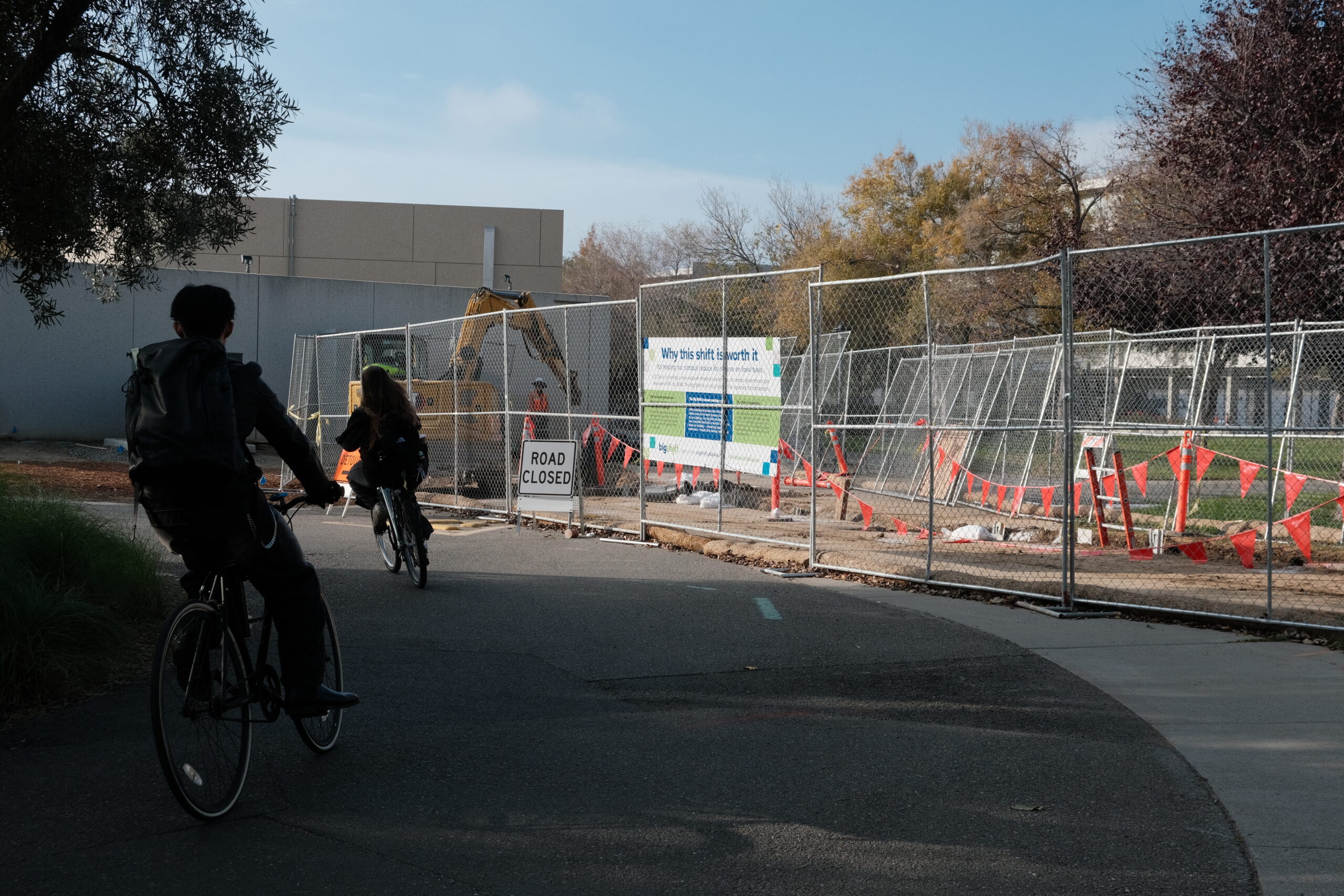
The “Big Shift” is an infrastructure project that aims to update our inefficient and deteriorating steam heating system with a greener, efficient and durable hot water system. Currently, construction crews are focusing on upgrading the Sprocket district, which includes the Segundo and Regan residence halls, the ARC and a handful of facilities and classrooms. Construction in this district is projected to be completed in early 2027. 

Closed sidewalk in front of Cruess Hall on December 4, 2025. (Christian Cendejas / Aggie)
Road closed at the bike circle near Segundo Dining Commons on Dec. 2, 2025. (Christian Cendejas / Aggie)


Important seismic improvements are being made to the Social Sciences and Humanities Building, Young Hall, Voorhies Hall and the Sprocket Building. These improvements are projected to be completed in Spring and Summer 2026. 

Signs warn of construction by the Social Sciences and Humanities Building on Dec. 2, 2025. (Christian Cendejas / Aggie)
View of the Death Star construction and closed sidewalk from inside the building on Dec. 2, 2025. (Christian Cendejas / Aggie)
Construction on Voorhies Hall on Dec 2, 2025. (Christian Cendejas / Aggie)


In the Quad, the Coffee House is getting a renovation that will bring more outdoor seating, bike parking and upgraded lighting. On the side closer to the library, security improvements are being made through new security cameras, outdoor lighting and emergency call boxes. The security lighting improvements are expected to be completed by December 2025, and the Coffee House by Summer 2026.


Blocked sidewalk leading to the west entrance of the Coffee House on Dec. 2, 2025. (Christian Cendejas / Aggie)
Closed-off west entrance of the Coffee House on Dec. 2, 2025. (Christian Cendejas / Aggie)
Detours and closed sidewalks by Hart Hall on Dec. 2, 2025. (Christian Cendejas / Aggie)
Detour signs in front of the Shields Library on Dec. 4, 2025. (Christian Cendejas / Aggie)


Photographed By: Christian Cendejas – photo@theaggie.org
The California Aggie hosts Fall Couch Concert

0


By TATEV SERGOYAN – photo@theaggie.org
 

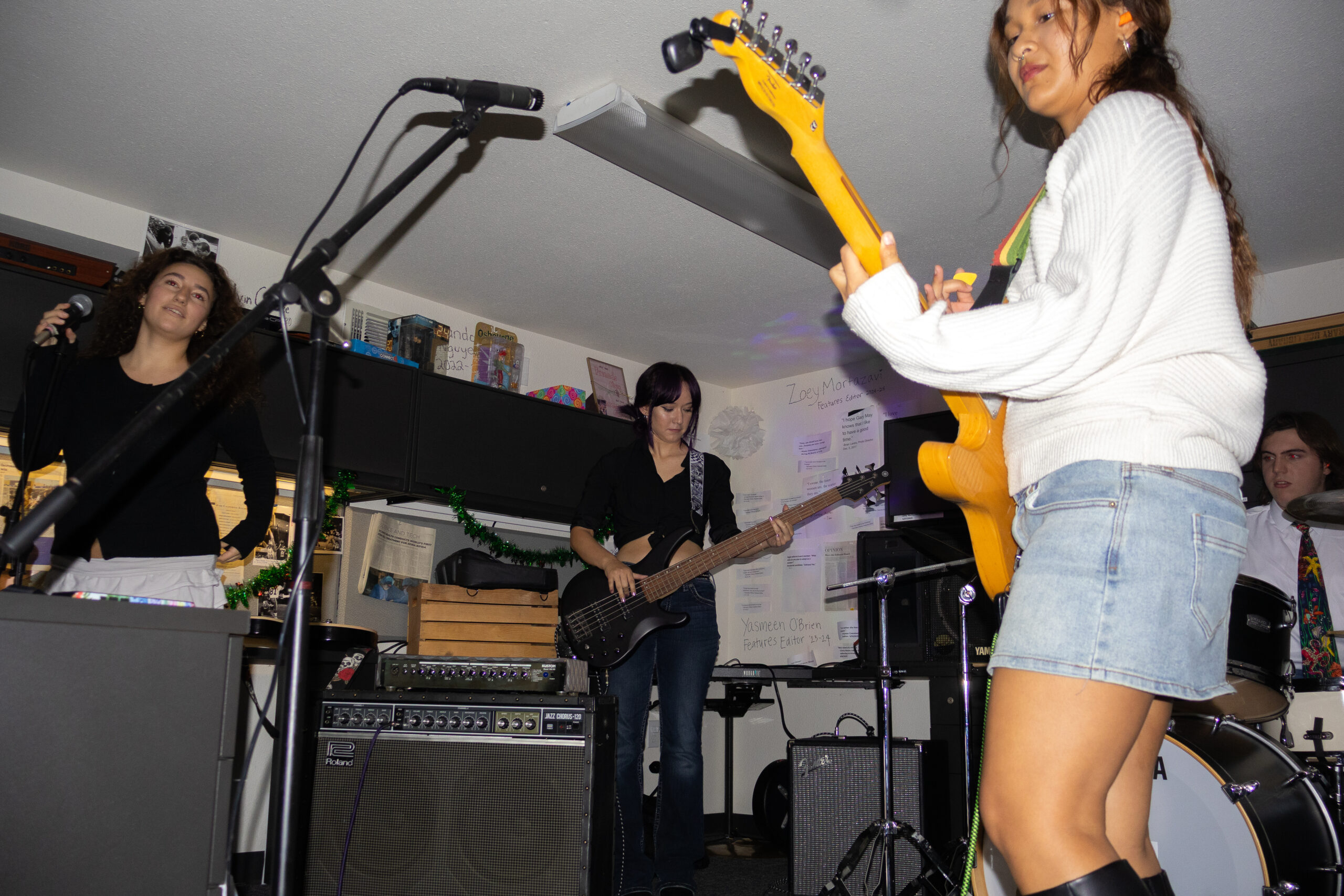
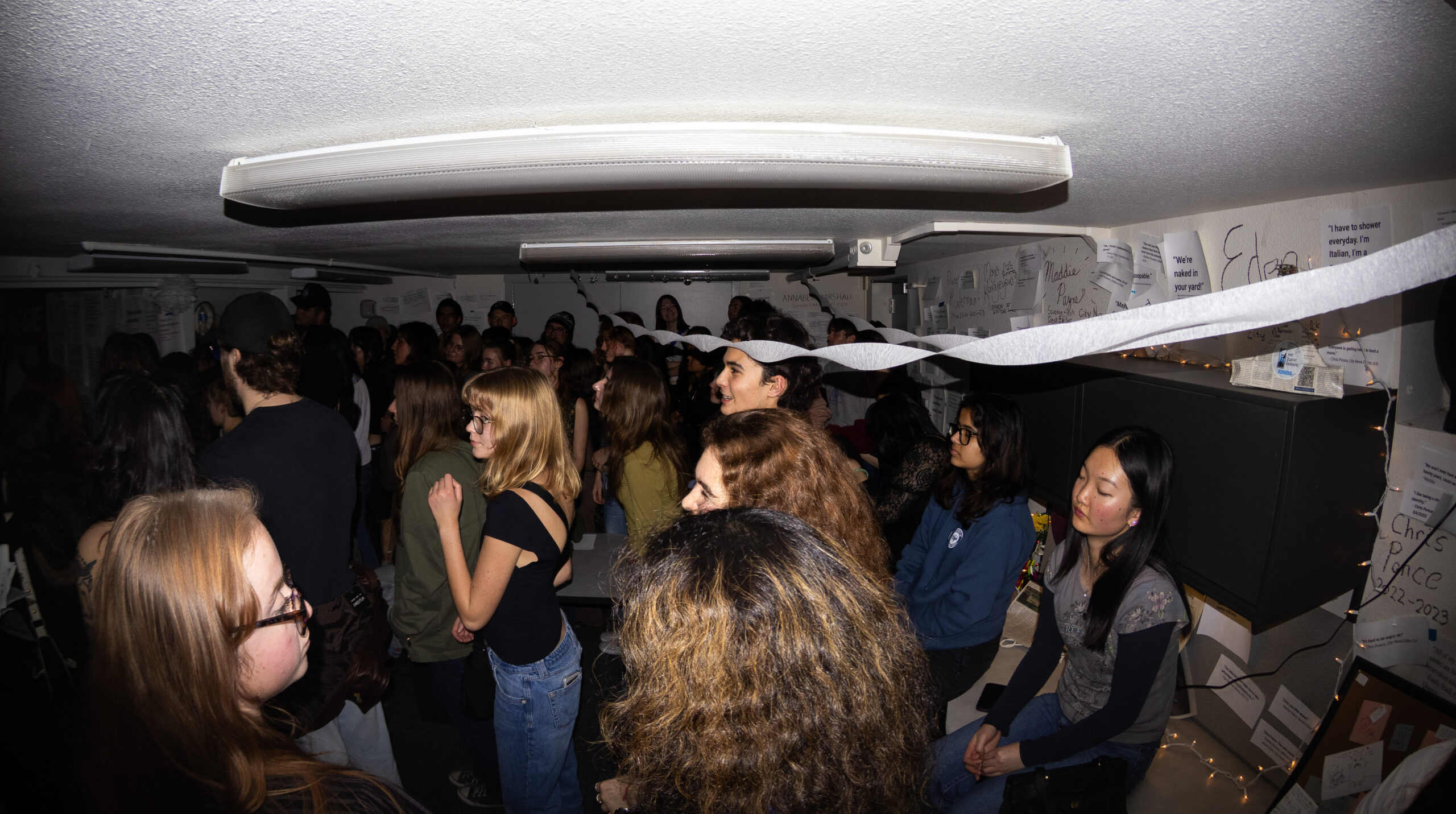
On Nov. 21, 2025, The California Aggie hosted their Fall Couch Concert in their office basement. The concert featured four local bands: Suits, Inglenook, First Name Basis and Shmoozi.


Indie-rock band Suits opens the Fall Couch Concert in The California Aggie Office basement on Nov. 21, 2025.
Colorful lights illuminate The California Aggie Office basement as fourth-year Destiny Thephavong, lead guitarist of Suits, performs at the Fall Couch Concert on Nov. 21, 2025. (Tatev Sergoyan / Aggie)
Third-year Athena Seiple, lead singer of Suits, performs an original song at the Fall Couch Concert on Nov. 21, 2025. (Tatev Sergoyan / Aggie)
Second-year Callum Clark, drummer for Suits, performs at the Fall Couch Concert on Nov. 21, 2025. (Tatev Sergoyan / Aggie)
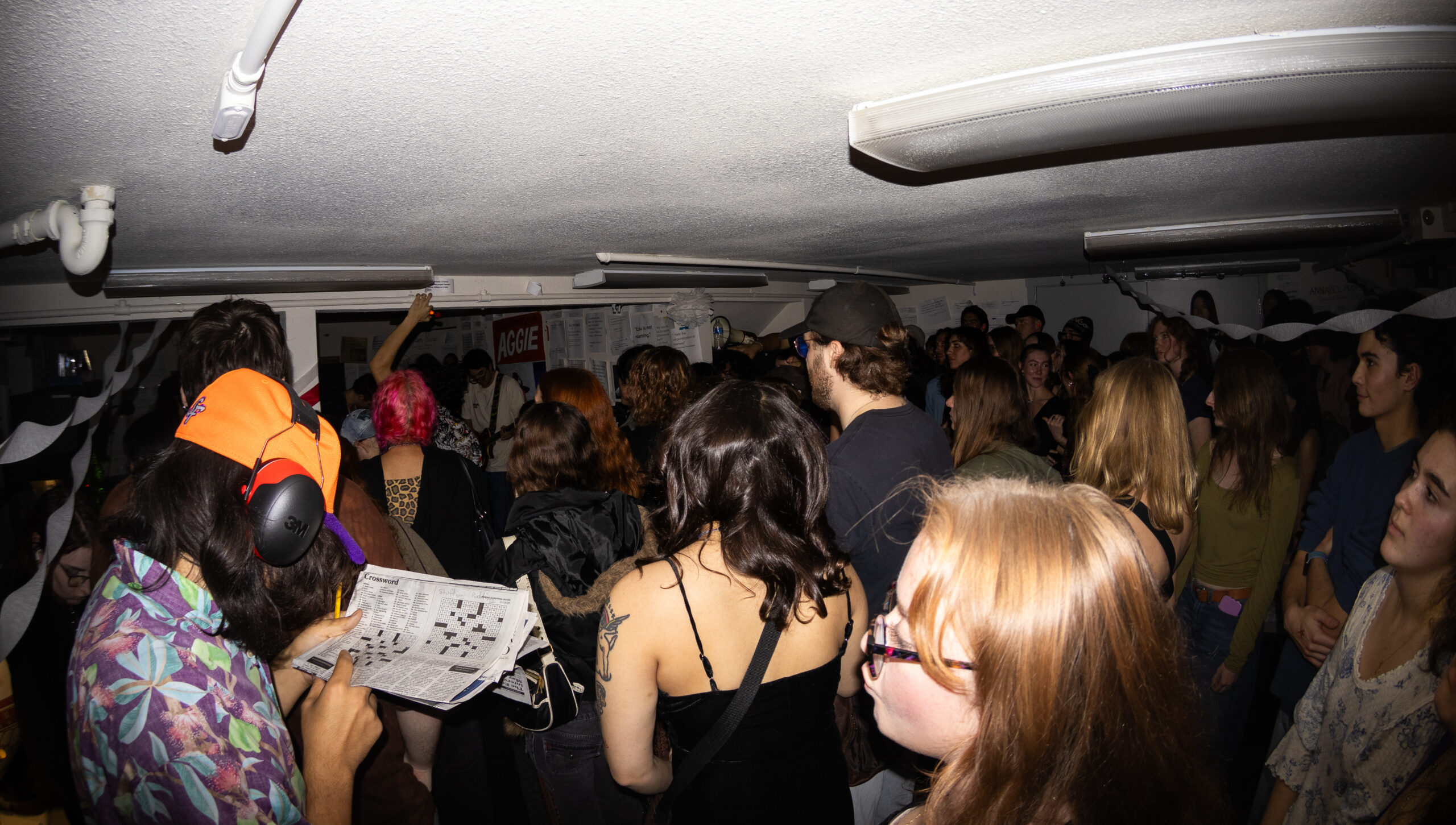
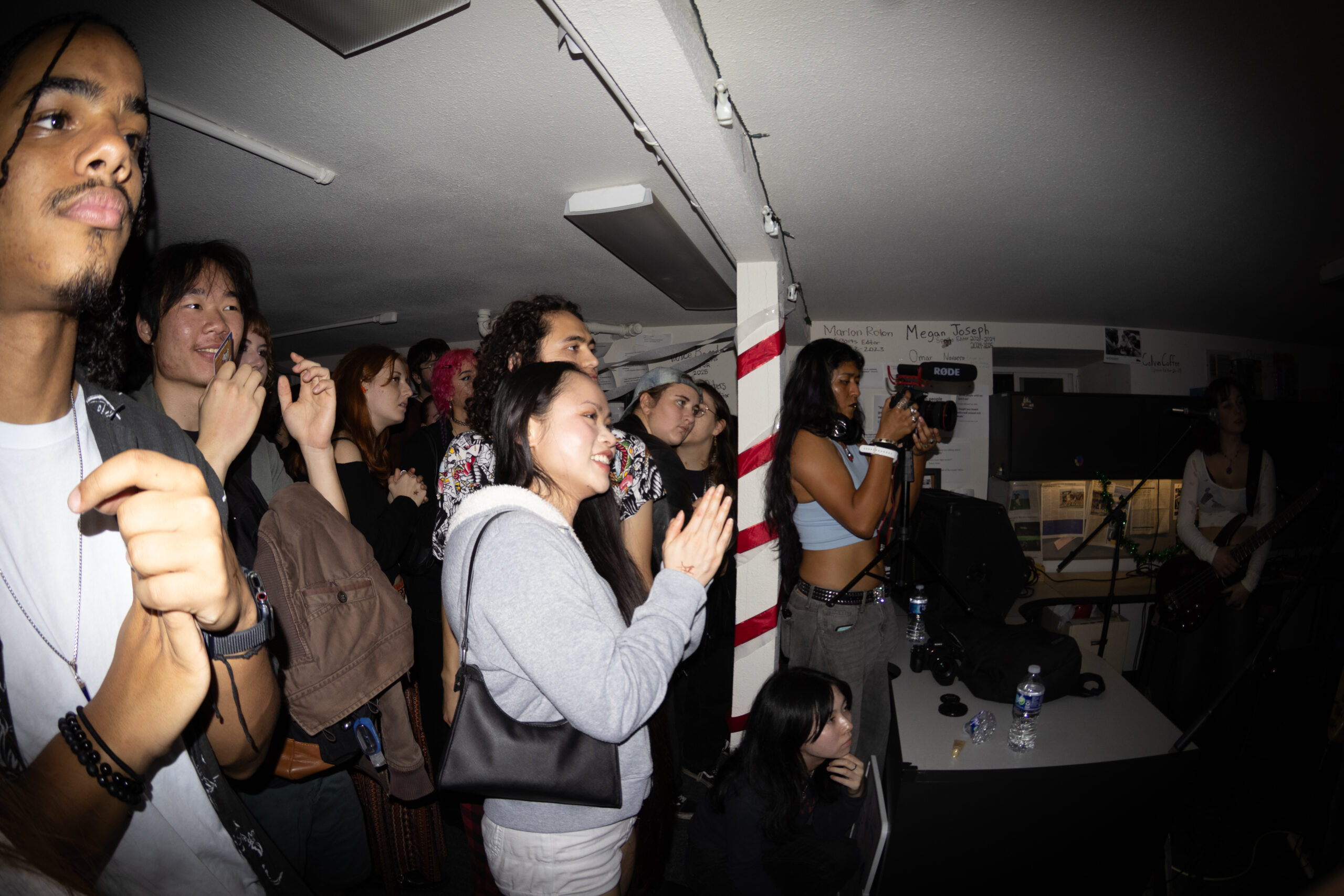
The crowd at the Fall Couch Concert in The California Aggie Office basement on Nov. 21, 2025. (Tatev Sergoyan / Aggie)
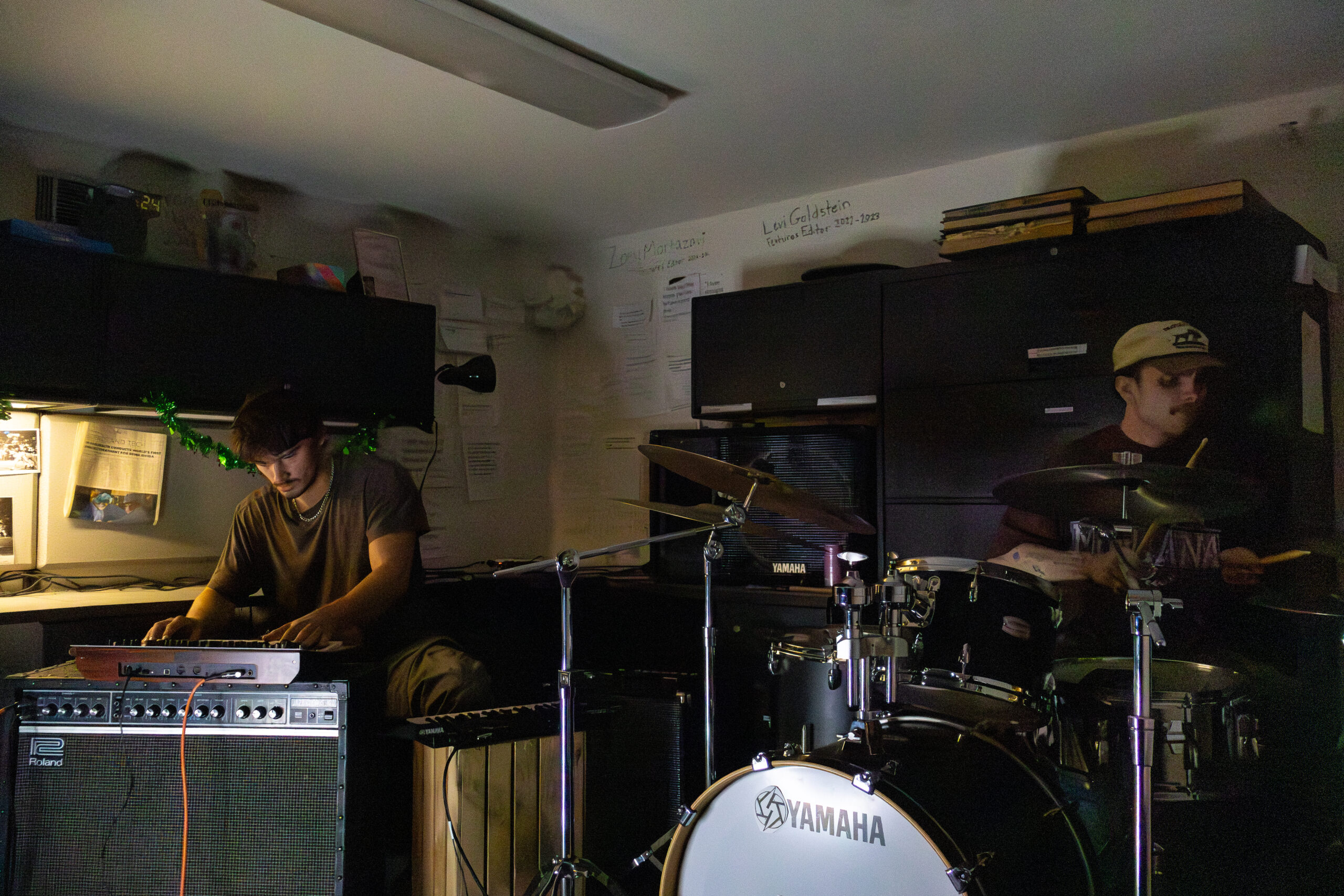
Drum and synth duo Inglenook performs at the Fall Couch Concert in The California Aggie Office basement on Nov. 21, 2025. (Tatev Sergoyan / Aggie)
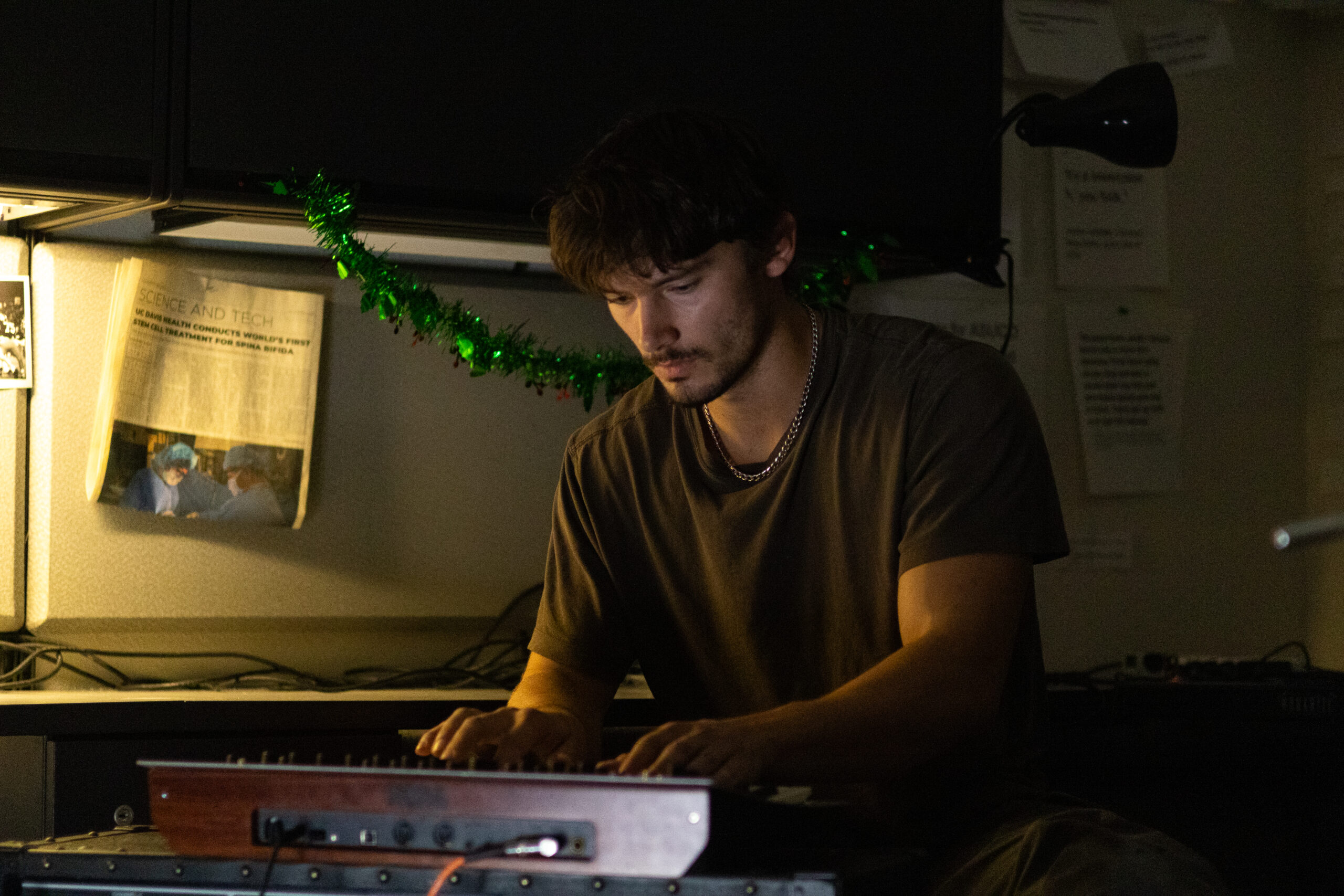
Fourth-year Caleb Rankin plays the synthesizer for Inglenook at the Fall Couch Concert on Nov. 21, 2025. (Tatev Sergoyan / Aggie)
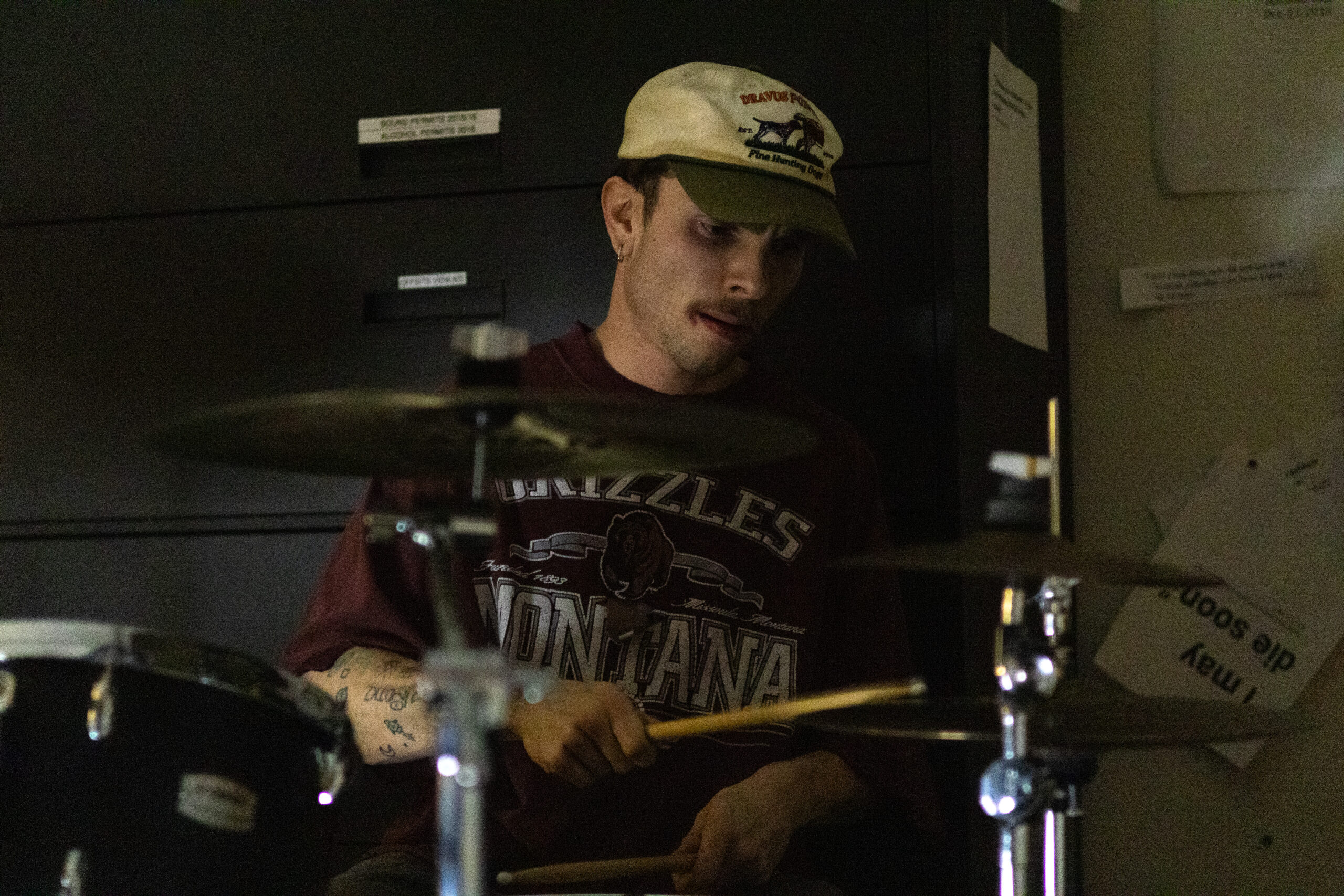
Second-year Jacob Heim, drummer for Inglenook, delivers an intense solo at the Fall Couch Concert on Nov. 21, 2025. (Tatev Sergoyan / Aggie)
A crowd member does the The California Aggie crossword at the Fall Couch Concert on Nov. 21, 2025. (Tatev Sergoyan / Aggie)
Indie-rock band First Name Basis performs at the Fall Couch Concert in The California Aggie Office basement on Nov. 21, 2025. (Tatev Sergoyan / Aggie)
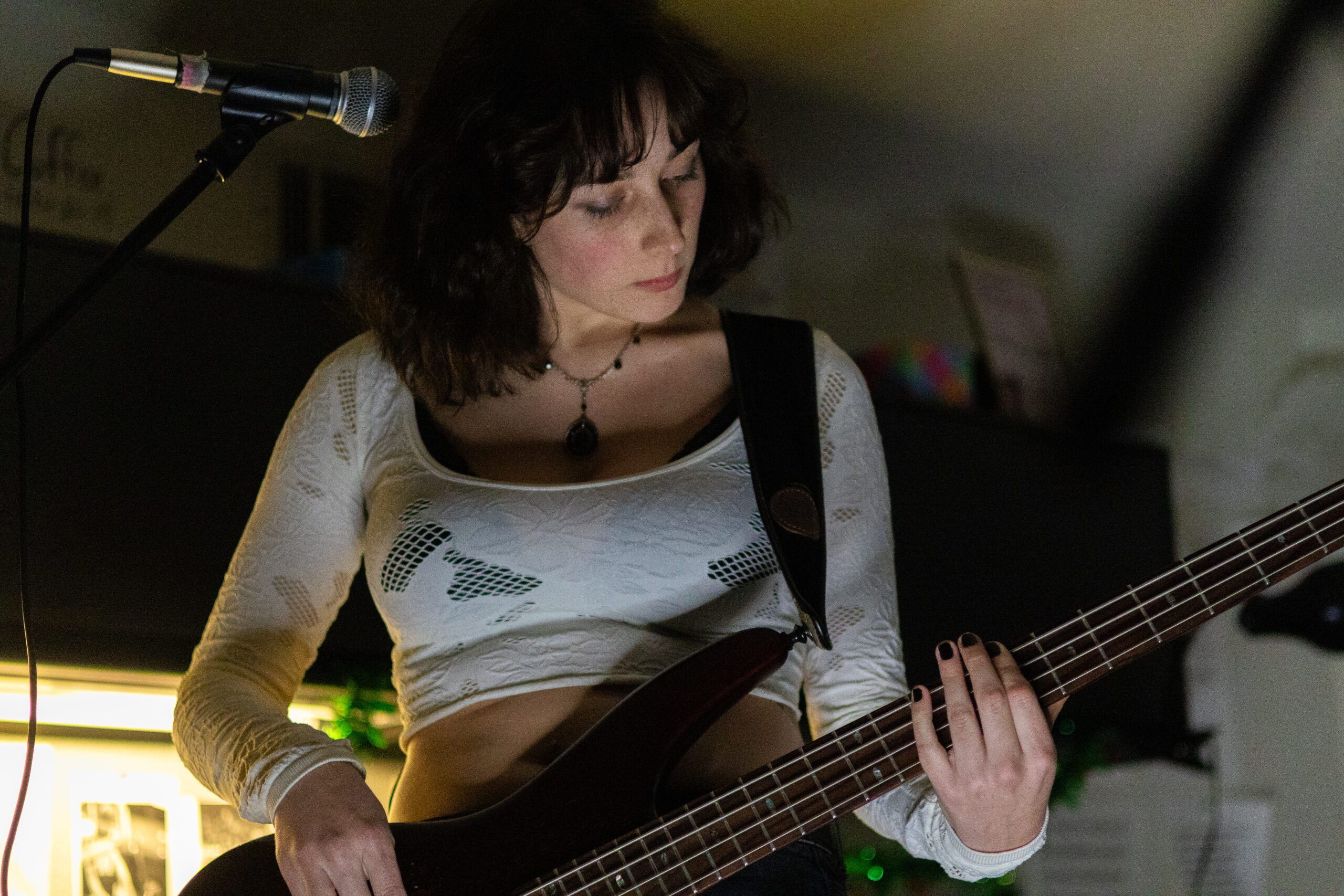
Moon Winokur, bassist and vocalist for First Name Basis, performs at the Fall Couch Concert on Nov. 21, 2025. (Tatev Sergoyan / Aggie)
Andrey Pravdic, vocalist and guitarist for First Name Basis, delivers an intense performance at the Fall Couch Concert on Nov. 21, 2025. The band’s high-energy set created a palpable connection with the enthusiastic crowd. (Tatev Sergoyan / Aggie)
Concertgoers cheer for indie-rock band First Name Basis at the Fall Couch Concert on Nov. 21, 2025. (Tatev Sergoyan / Aggie)
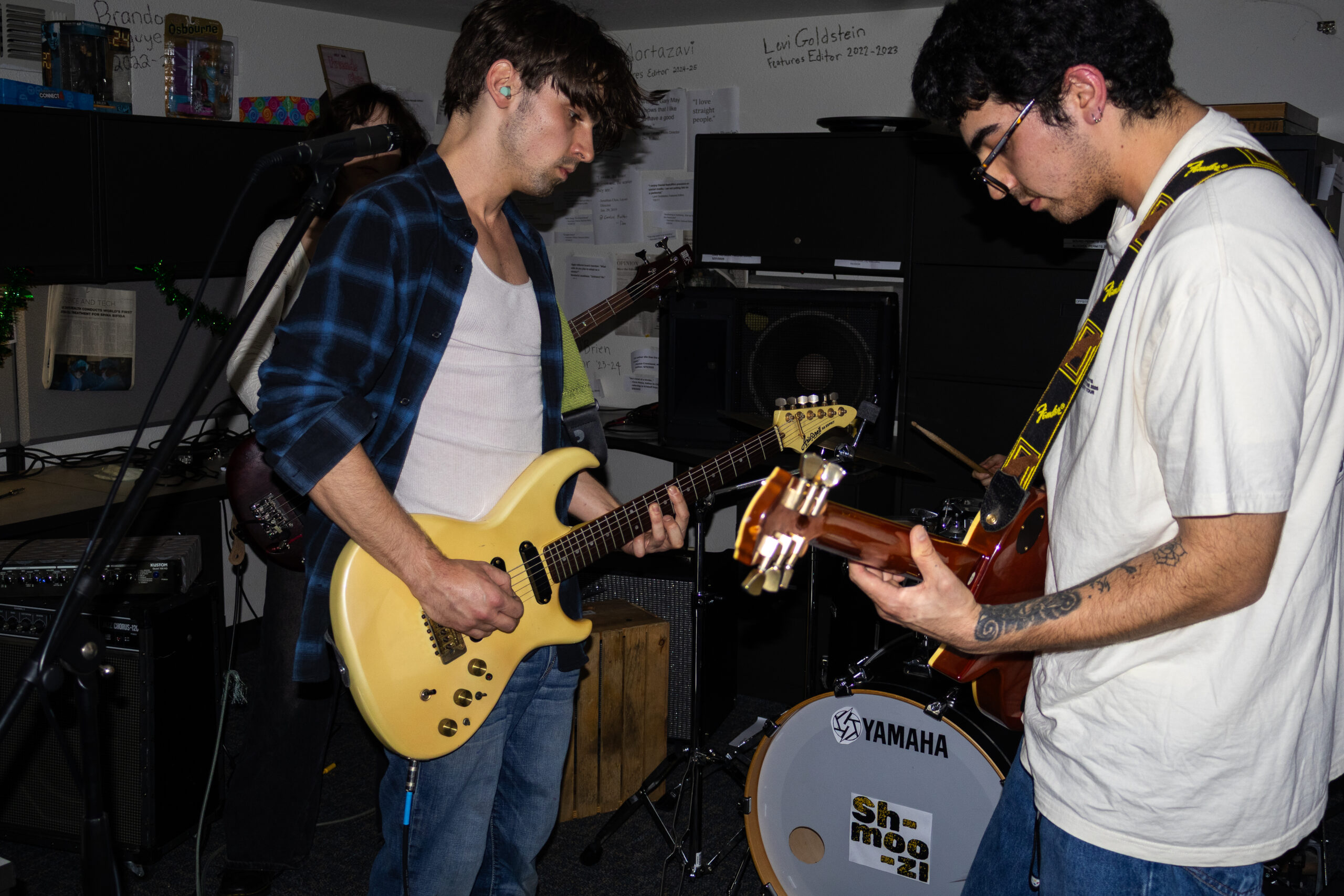
First Name Basis guitarists Andrey Pravdic and Vicente Valdebenito riff off each other at the Fall Couch Concert on Nov. 21, 2025. (Tatev Sergoyan / Aggie)
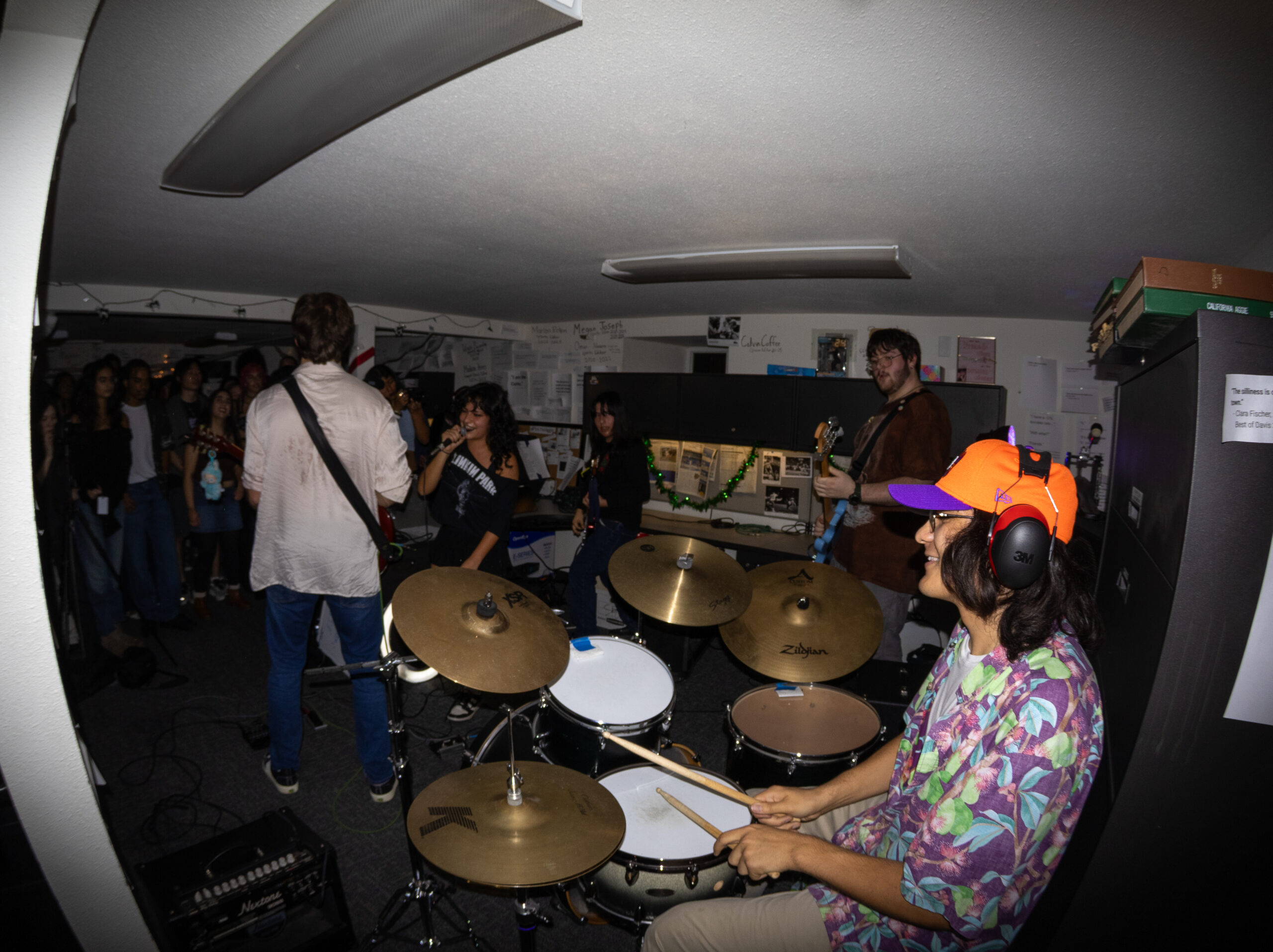
Indie-rock band Shmoozi performs at the Fall Couch Concert in The California Aggie Office basement on Nov. 21, 2025. (Tatev Sergoyan / Aggie)
Shmoozi’s rhythm guitarist, Ash Agal, performs at the Fall Couch Concert on Nov. 21, 2025. (Tatev Sergoyan / Aggie)
Shmoozi’s guitarist, Alex Liesegang, lets loose with an improvised solo at the Fall Couch Concert on Nov. 21, 2025. Liesegang’s guitar work drew cheers from the crowd. (Tatev Sergoyan / Aggie)
Shmoozi’s drummer, third-year Nathaniel Ewing, performs at the Fall Couch Concert on Nov. 21, 2025. (Tatev Sergoyan / Aggie)
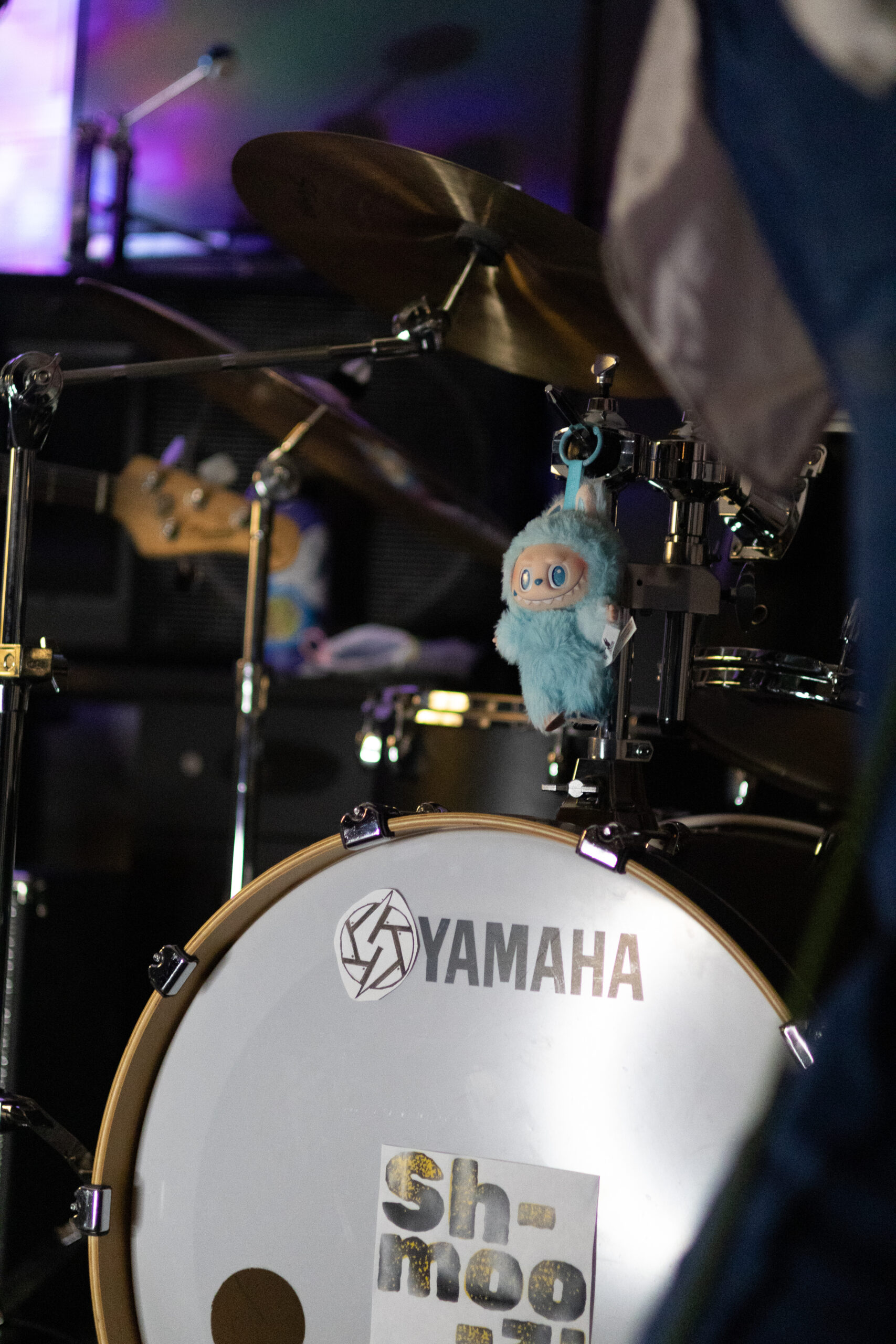
Shmoozi’s lucky Labubu, which they won from Partridge Records’ Battle of the Bands, hangs from the drums during the band’s set at the Fall Couch Concert on Nov. 21, 2025. (Tatev Sergoyan / Aggie)


Photographed By: Tatev Sergoyan – photo@theaggie.org
Photos Curated By: Jenna Lee – photo@theaggie.org

Bezos Earth Fund gives grant to UC Davis AI nutrition project

Swap it Smart seeks to develop healthy and ethically sourced recipes using artificial intelligence


By RIVERS STOUT— campus@theaggie.org

 

On Oct. 23, the Bezos Earth Fund announced that they will donate $2 million to the Periodic Table of Food Initiative, an organization managed by the American Heart Association, in order to create the Swap it Smart project. Led by two UC Davis professors, the project plans to develop artificial intelligence (AI)-based recipes aimed at developing healthy and ethically sourced foods using large language models (LLMs) and machine learning. 

The grant was issued alongside 14 others, all aimed at using AI to benefit the environment and as part of an investment into AI technologies.

Started by UC Davis Professors and Co-Principal Investigators Ilias Tagkopoulos and Justin Siegel, Swap it Smart aims to use AI to create recipes for both chefs and the general public, using an app. 

“We got an award from the Bezos Earth Fund and this consortium of multiple parties to use AI and create meals that are nutritious,” Tagkopoulos said. “They will probably use ethically sourced foods that are sustainable and will have the right nutrients to support our diet.”

The Bezos Earth fund acts as a philanthropic arm for its namesake, Amazon founder Jeffrey Bezos. It was founded in 2020 with an initial commitment by Bezos of $10 billion for grants to address issues in the climate and nature.

“At the Bezos Earth Fund, we’re focused on making AI work for the environment — not the other way around,” Amen Ra Mashariki, the director of AI at the Bezos Earth Fund, said in the grant press release. “These projects show how AI, when developed responsibly and guided by science, can strengthen environmental action, support communities, and ensure its overall impact on the planet is net positive.”

However, the fund has recently faced some scrutiny, with allegations that the non-profit has acted to further Bezos’ economic and political interests. Both the fund and Bezos himself faced criticism early this year when they cut funding to the Science Based Targets initiative, an international climate certification group. The move was seen by some as a bowing down to the Trump administration and its distancing from climate change action.

Tagkopoulos’ and his partners’ labs have been working with AI in the form of machine learning and LLMs in the context of food sciences for years. However, the Swap it Smart project is new and has yet to be completely fleshed out. Tagkopoulos indicated that it will take years and more funding to fully develop, but the one-time $2 million grant is getting it started.

“We have no idea [how it’ll work],” Tagkopoulos said. “We will work with our partners at the American Heart Association and the Periodic Table of Food Initiative to get the right data, then we will develop the methods, AI methods and computational methods to mix and match foods that are more sustainable and nutritious.”

While Tagkopoulos is hopeful that the project will work toward a greater good, UC Davis postdoctoral scholar, AI ethicist and researcher Carrie Alexander noted that using AI puts a strain on natural resources and can be harmful to the environment.

“We should remember how costly the environmental implications of AI are,” Alexander said. “That is often not thought about or seen, and we have not adequately addressed it. It’s always in the background.”
The largest issue with using AI is the large energy resources needed to power and cool energy and data centers — mostly water, according to Alexander. While LLM providers and Big Tech companies have not always been transparent about the environmental costs to develop and use their models, estimates and predictions by researchers at Cornell University place AI as a big driver of data-center construction in the United States, greatly increasing energy and water needs to develop and power these models.

“There are definitely environmental implications that mean we will be leaning more heavily on those resources in order to fuel the [creation and use of models],” Alexander said.

When asked about the possible contradiction created by an AI tool designed to help the environment, Tagkopoulos answered that the use of LLMs was not inherently different from any other use of natural resources.

“I don’t know if they’re bad for the environment,” Tagkopoulos said. “Anything that consumes power can be intense on resources. Whether the benefit you get for the human race and our planet is bigger than the resources it actually consumes is a different story.”

Another risk posed by AI models in health guidance are issues referred to as a “hallucination,” or what AI ethicists such as Alexander call a “lie.” They happen when an LLM provides a nonsensical answer that ranges from harmless to deadly. A Center for Countering Digital Hate report revealed the ease by which people could get ChatGPT, an LLM that Tagkopoulos said Swap it Smart would use, to encourage self-harm and enable harmful habits related to eating disorders. 

“I think there are a lot of cases where something is inaccurate or can’t be used without being checked,” Alexander said. “Maybe something is added that’s toxic, or an allergen. I don’t want to sit here and speculate to find ways to knock out ideas without checking out their safety precautions; I want to hear them out. But what we know about LLMs is that they would need safety precautions, but they would require effort and in some ways possibly defeat the advantages posed by AI.”

Tagkopoulos said that their project would use domain experts in order to verify that recipes do not contain any hallucinations. He added that the app they hope to develop would likely not have the same domain experts but would have additional automated safety features built into the AI and programs to verify safety.

Celebrity chef and influencer Stephen Cusato, who also runs the YouTube channel “Not Another Cooking Show,” said that he has doubts about the use of AI for culinary purposes.

“There’s [a] sense in having an entity to bounce ideas off of, but you still have to be a cook,” Cusato said. “I’m not trying to be someone who doesn’t embrace the world that’s changing but there’s a level of balance. The ability to taste food an AI lacks. You have to be rational and know when to approach it.”

Although Cusato feels his brand is safe from AI due to the repertoire he has developed with viewers, Cusato noted that there’s a limited audience interested in seeing LLMs used in the food space.

“Anything AI-related with my audience seems to invoke a viscerally negative reaction,” Cusato said. “I also have an older audience. My [core] audience ranges from their 30s to 50s. The channels you see with AI videos, you can bet [that] they have an 18 [to] 25 [demographic].” 

While he believes there’s limited use for AI in the kitchen, Cusato commented that he wouldn’t want to be secondary to it.

“My recipes are the result of the picky eater inside of me that was a kid and now has all the knowledge I have of 20 years of cooking,” Cusato said. “I’m a control freak. I would never give control to the AI.”

In order to safely make use of AI, Alexander said that two things can be done: slowing down development and having productive conversations between people critical of AI and industry members.

“It seems people, more often than not, tend to be in camps about AI,” Alexander said. “I don’t sense that there’s a lot of openness, to the point that we should say, ‘Yes we should look at this and pause.’”

In the meantime, Tagkopoulos, along with Siegel and their partners, are focused on developing Swap it Smart and keeping the health of both potential app users and the environment in mind.

“Everything we [at the lab] do looks toward planetary health as a whole,” Tagkopoulos said. “I wouldn’t be too fast to judge LLMs at this point.”

Written by: Rivers Stout campus@theaggie.org

Deck the halls with festive gift-giving this holiday season

The Editorial Board’s recommendations for crafts, experiences and all things handmade 


By THE EDITORIAL BOARD


When the days grow colder and the nights are lit up by sparkling Christmas lights, the feeling of merriment and wonder is almost palpable; it is a time for cozying up with a fuzzy blanket and a cup of tea, de-compressing after a busy quarter and spending time with loved ones. The holiday season is also a joyous time of recognizing those that are meaningful to you, whether it’s by making time to catch up with distant friends, strengthening your relationship with family or giving yourself some much-deserved self care. 

The act of gift-giving — a love language in and of itself — is another way to show appreciation for the people in your life that you are grateful for. Here is the Editorial Board’s gift guide for this holiday season:


Alyssa Crevoiserat, Editor-in-Chief — Give the gift of noticing 

I consider myself to be somewhat neurotic when it comes to holiday gift-giving. A self-proclaimed Santa Claus, I come bearing a sleigh full of tips and tricks when it comes to giving personalized, unique presents for your loved ones. Holiday gift guides are useful for brainstorming, but they’re almost always generic. Your loved ones will notice that the gift could easily be re-gifted to their least-favorite colleague and weird family member they see once a year. 

The easiest method to thoughtful gift-giving is to pay attention throughout the year — don’t just lock in during December, take note of what your loved ones are mentioning. If it’s already December and too late to take this advice, not all hope is lost. A simple trick to gift-giving is to think about what someone in your life is missing or in need of upgrading. People appreciate gifts they will use in the long-term but never would have thought about buying for themselves — all you need to do is notice. 

If they’re stressed from work and in need of self-care, make them a relaxation basket with items you know they’ll love. If they’ve mentioned wanting to start a new hobby, grab them a few items to get them started. If you know they have holes in their socks or rips in their t-shirts (it happens), take the initiative to replace them. The trick is to make your purchases personalized to the individual: Gifts that are both practical and customized to their interests and hobbies are the perfect mix of usable and thoughtful. 


Maya Kornyeyeva, Managing Editor The art of gift-wrapping

While scavenging for gifts is a delightful activity on its own, my favorite part of gift-giving is one of the last steps of the process: packaging. Wrapping up your carefully chosen items in festive wrapping paper, creasing the edges and creating neat folds is an activity that is endlessly satisfying to me. The care and intention that is put in the presentation of the gifts — although often considered secondary to the actual gift itself — is all part of the charm and mystery, adding another dimension of thoughtfulness to the process. 

The harsh reality, however, is that more often than not, wrapping paper and ribbon is cheaply made and mass-produced, ripped off of a gift and instantly discarded. During this holiday season, I urge you to explore eco-friendly and creative solutions for packaging your gifts — whether that’s hiding your gift inside another gift, enclosing it in an item like a reusable bag, box or sustainable material, or repurposing packaging materials you already have. Why not grab a copy of The California Aggie as wrapping paper? It is high time that the art of gift-wrapping is given as much thought as the gift itself.


Vince Basada, Campus News Editor Chocolate oranges

Homemade cookie boxes are a classic and thoughtful holiday gift, but as college students living in dorms and cramped apartments, it’s not always practical or possible for us to bake desserts at home. If you still want to give out sweet treats this winter, consider gifting chocolate oranges. 

There’s something simple yet elegant about chocolate oranges. You can dress them up further, but I think they’re beautiful straight from the store. The chocolate itself is wrapped in shiny foil, and it’s all contained in a blue, bold box. And enjoying chocolate oranges is an experience in itself! Cracking the orange is always satisfying and allows you to play with your food. 

They are also very accessible; they don’t cost more than a few dollars. And if you’re giving them to multiple people, they’re just distinct enough to be charming and memorable without breaking the bank.


Jordan Poltorak, City News EditorHandmade cards

One of my favorite items to give someone is a handmade card. In the age of electronic gift cards and Amazon shipping gifts straight to your friends and family, they have been rendered somewhat useless. However, cards are a crucial part of any gift. 

It started when I was younger, always making cards for my parents for various holidays, birthdays and sometimes just because. I loved looking up ideas online and tracing different designs onto the paper. After a while, I realized my friends would probably appreciate these cards as well. To me, a handmade card captures the essence of a person so much more than anything you can find at the store.

Over the years I have experimented with different designs for cards. What started out as drawings with markers turned into cutting different paper strips into designs and trying my hand at watercolors. I love getting to think about what exactly the person will enjoy: colors, shapes, mediums, all of it. So, this holiday season, instead of buying a card from the store, think about making your own. All it takes is folding a piece of paper in half to start.


Molly Thompson, Opinion Editor A homemade holiday bakery

To me, a good gift is born of effort, passion and knowing the person you’re giving it to; the best gifts are appreciated for the work they took to make as much as for how the receiver enjoys them. By this metric, no present is better than a homemade holiday cookie box. 

Over the past few years, I’ve spent my Decembers up to my elbows in butter and sugar as I craft a collection of eight carefully curated Christmas cookies to deliver to my extended family members. It’s become a tradition, and I think I look forward to it as much as the recipients do. It’s fun to brainstorm flavor combinations, plan out the baking process, spend time in the kitchen mixing ingredients and rolling dough, designing an aesthetically pleasing flavor guide and packing them all up in little boxes to be sent in the mail, ready for Christmas morning. 

It’s a gift of experience as much as it is of the cookies themselves. It’s fun to match each one to the menu I send along with them, sample each one with family members, pick favorites and sit down every afternoon with a cup of coffee and a new treat — maybe you try a cranberry pistachio molasses cookie today and a piece of pecan toffee biscotti tomorrow. And it’s consumable, so it won’t sit on a shelf collecting dust come January.

Cinnamon, vanilla and peppermint just taste like the holidays. Flavors evoke sense memories, so you’re not just giving a delicious dessert, you’re giving an irreplaceable, viscerally festive experience that will warm your loved ones from the inside out. Above all else, it’s an act of love. Investing the level of creativity and work that a project like this requires into a Christmas present truly achieves the goal at the core of holiday gift giving; it shows how much you love, care for and appreciate the person you give it to. 


Savannah Anno, Arts & Culture Editor Crafts for all 

While it may sound cheesy, there truly is nothing better than a handmade gift. One-of-a-kind and perfectly curated for a specific person, these presents showcase the amount of time and effort you’re willing to spend on someone else. Each holiday season, I take advantage of the free time winter break provides to try my hand at a few new crafts for family and friends. 

Even if you don’t consider yourself artistic by any means, there are a plethora of online tutorials and Pinterest links with entry-level crafts that require nothing more than some paper, scissors, a glue stick and your own two hands. Photo collages can be placed in decorated, fabric-lined frames; pocket-sized tins; a custom scrapbook; or even inside Christmas Tree ornaments. To make it even more heartfelt, try to include other small items like movie tickets, receipts, handwritten notes and images that remind you of them. 

If you’re feeling ambitious, some of my other favorite handmade gift ideas include bouquets of felt flowers; journals or stationary made with homemade paper; beaded keychains made with soda tabs and hanging mobiles made with small buttons, shells, charms and other tiny trinkets. Some of the best crafts can also include repurposing secondhand items or scrap fabric, like adding custom embroidery to thrifted sweaters or patchwork graphics to cotton tees. 

While it may take a few attempts, there’s no better gift to show someone how much you love them than a homemade one. And who knows, you may find yourself a brand new hobby to explore in 2026 along the way. 


Megan Joseph, Sports Editor — Practical gift giving 

Holiday gift shopping may seem overwhelming, but it does not need to be. Many people often try to give meaningful gifts, only for them to end up useless and just sitting on a shelf. The best advice I can give to any holiday shoppers is simple: Give something that is practical — not just a tool or gadget, but something that will create memories. 

Speaking from experience, I used to give my mom jewelry and my dad a new gadget every year. But last year, I tried something different: I gave my mom a painting class gift certificate, which ended up being one of the most fun activities I have ever done with her. Now, she goes all of the time and loves it. The experience meant so much more than just a book or a necklace. Sometimes the best gift isn’t about the value or necessity, but rather a meaningful memory or activity. Happy holidays everyone and good luck brainstorming presents!


Katie Hellman, Science & Technology EditorThe gift of experiences

In a world of materialism, consider giving someone the gift of an experience. This means that instead of presenting someone with a physical item, you can offer a meaningful activity to create memories that will long outlast a last-minute purchased present.

While many experience-type gifts that come to mind might be on the more expensive side (concert tickets, plane boarding passes, etc.), there are plenty of cheaper options as well! If your gift recipient is crafty, consider signing up for a class, such as pottery or cooking. You can also take them to a sporting event they like, buy tickets to go to a local museum together or treat them to a day at a music festival or theme park.

If you want to give a gift that will span a longer length of time, consider making a coupon book. You can bind together 5 to10 or so pages and write things like: “Good for one homemade meal,” “Good for one movie night” or “Good for one self-care night,” and then plan the events as the coupons are redeemed. You can personalize these ideas to the interests of your loved one and decorate the pages to your heart’s content.


Written by: The Editorial Board

Holiday decor and human connection

UC Davis students share how the act of decorating for the holidays creates cozy memories and fosters a feeling of togetherness


BY JULIE HUANG – arts@theaggie.org
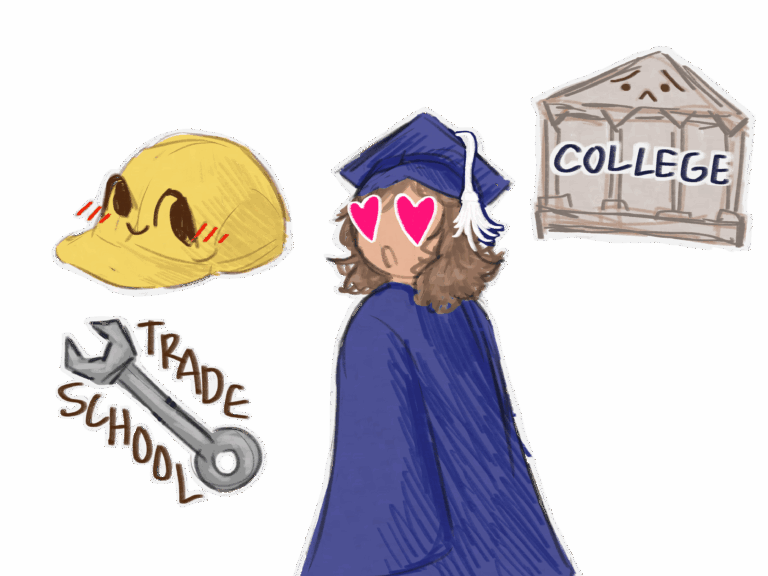
 

The holiday season is a time for rest and reflection as people celebrate with their loved ones and hold close the things that are dear to them. People often choose to showcase their holiday spirit by putting up decor, which can evoke childhood memories, uplift darker moods and give families something positive to look forward to each season, according to HuffPost

Amidst an array of festive decor, the Christmas tree looms large in American culture as an iconic symbol of the winter holiday season; though not everyone participates in Christmas or its traditions. Seasonal winter decorations take on a variety of forms, reflecting the numerous holidays that people celebrate as the year nears its end.

Vanya Malhotra, a second-year animal sciences major, recalled her family’s informal attitude toward installing seasonal decor.  

“It’s mainly my mom and I who put decor up, but I do wrangle my brother into it,” Malhotra said. “We put up a tree and ornaments, and it’s a casual thing.” 

Despite the laid-back atmosphere in Malhotra’s home, the act of decorating retains a touch of personal charm and satisfaction for her family. 

“We have a very old fireplace that we installed when my parents built the house, and my dad takes pride in it,” Malhotra said. “We’ll decorate the fireplace and put lanterns and little figurines on it.” 

Ava Pelkey, a third-year environmental policy analysis and planning major, explained that, due to her family’s German background, they primarily celebrate Christmas on Dec. 24 rather than Dec. 25. Pelkey noted that this has uniquely shaped her memories of the holiday experience. 

 “Growing up, we would always have presents and family time on Christmas Eve, and then in the morning, we would find Santa’s presents,” Pelkey said. “My aunt always gets us these handmade countdown calendars, and I always have it up, even though my countdown’s slightly different from other people that I know.” 

The transition from family life to college can include many changes, but the holiday season provides a throughline for festive traditions to be remembered and upheld, or even increased, according to Malhotra.

“Growing up, celebrating the holidays wasn’t much of a big deal in my household, so I like to make it my mission to make it a big deal in college,” Malhotra said. 

Not everyone chooses to continue participating in the holiday activities that they participated in as children, however. Thanh Nguyen, a third-year English major, shared that his interest in putting up festive decor has decreased over time. 

 “I’ve found less appeal in celebrating Christmas or any holiday as I get older,” Nguyen said. “I go back home for the holidays, and I see no point in putting up a tree that I won’t see for most of December.”

Some of the considerations that go into choosing not to put up holiday decorations come from time and financial constraints, according to Nguyen.

“I find it a hassle and a financial burden to purchase seasonal holiday decorations,” Nguyen said. “At most, I will buy a small table decoration that I can reuse for years.” 

The association of Christmas decorating with childhood experiences may mean the reduction of festive involvement in college, but it also presents an opportunity to reminisce about the warm memories made at home, according to Malhotra. 

“A bunch of [my family’s] ornaments are probably more than 10 years old, because there are a lot that my brother and I made when we were in preschool and kindergarten,” Malhotra said. “My mom kept those — even the really badly painted wooden-stick ones.” 

Pelkey explained how hand-made ornaments often serve as reminders of family milestones worth celebrating, such as a child reaching a certain age. 

“Decorating is an opportunity to come together,” Pelkey said. “For example, you’re unboxing the ornaments for the Christmas tree, and a lot of them are ones that you made as kids. It brings back a lot of memories, and you get to talk about it with whoever’s decorating with you: usually siblings and family.” 

For those who choose to decorate a Christmas tree, each collection of ornaments is personalized. The finished tree with all its decorations becomes just as personal — even irreplaceable, according to Malhotra.

“We have ornaments ranging from years ago to freshly brand new ones, and then we put them all on the same tree every single year,” Malhotra said. 

Pelkey shared a similar sentiment, noting that the assortment of ornaments unique to each household becomes a reflection of the people it belongs to and their experiences and loved ones.  

“They become heirlooms of a sort, because individual ornaments remind me of certain people or whoever gave them to us,” Pelkey said. “Just knowing the story behind each and every ornament is really cool, because you get to have this tree full of meaning.” 

In addition to its symbolic meaning, the physical act of decorating also encourages togetherness — with people crowding the tree and contributing to the group effort of putting up decorations. 

“When we prepare the tree, all hands are on deck,” Nguyen said. “Even my parents, who are often busy, end up getting caught up in decorating.” 

The beauty of the ornaments, lights and baubles provide another layer to the benefits of decorating, according to Pelkey; handling them often becomes a sensory experience, shared with others in the household. 

“As a family, we would put tinsel on the tree, which not everyone does,” Pelkey said. “The tinsel is really fun because it involves shiny plastic everywhere, and it’s nice to find the tinsel around the house weeks later.” 

The true magic of festive decor flourishes in the presence of others, according to Malhotra. 

 “I feel grateful when I’m decorating,” Malhotra said. “It reminds me of Christmas mornings, and how my mom would always put little things under the tree. It could have been the smallest piece of candy for all I cared. Whatever it was, my brother and I would always be so excited.” 

Paired with cozy memories, participating in holiday decorating traditions serves as a way for students to easily access the optimism and cheerfulness that permeate the winter holiday season, according to Nguyen.

“There’s a warm and hopeful feeling associated with holiday decor,” Nguyen said. “It indicates a shift into a time of year that highlights community and camaraderie through simple acts of love and gift-giving.”


Written by: Julie Huang — arts@theaggie.org 

Chancellor Gary May visits the ASUCD Senate at Nov. 20 meeting

May formally apologized for a March email regarding Students for Justice in Palestine and addressed the increased presence of law enforcement on campus


By LILY KENROW — campus@theaggie.org
 

In his annual visit to the Associated Students, University of California, Davis (ASUCD) Senate at their Nov. 20 meeting, Chancellor Gary May gave a speech, thanking the table for their work and sharing some recent highlights and challenges for the UC Davis community. May notably highlighted the campus response to the pause in Supplemental Nutrition Assistance Program (SNAP) benefits and engaged in an open discussion with the table.

The first question directed toward May was asked by Transfer Student Representative Imani Nur, which focused on May’s March 21 campus-wide email regarding Students for Justice in Palestine (SJP) for their demonstration on March 11. 

“We’ve received complaints from concerned community members about recent student activities, including the Students for Justice in Palestine demonstration on March 11, and those allegations are being reviewed at the highest level of the university,” the email reads. “I want to state as strongly as possible that we will not tolerate hatred against any individual or group, or any activities directed at any individual or group in ways that violate UC policy.”

Nur explained why she took issue with May’s wording.

“You singled out Students for Justice in Palestine,” Nur said. “Despite [SJP] being one of 15 groups coordinating the event. Many students feel this framing contributed to a hostile environment for Palestinian, Muslim and Arab students.” 

May responded in acknowledgement, noting that he has had similar conversations with the Palestinian Life Advisory Committee. 

“I take full ownership for what I wrote,” May said. “I own it, but I regret it. I didn’t have complete information, and I shouldn’t have written what I wrote. I apologize to the student body, to the Palestinian students and to SJP in particular.”

He attributed his language at the time to external pressures, particularly surrounding budget cuts and cuts in federal funding.

“During that time, and actually still, we were feeling tremendous pressure from external forces such that my judgement was impaired in trying to alleviate some of that pressure and keep things like federal funding flowing,” May said. “But I now realize that was a mistake on my part.”

Nur then asked if any investigations have been opened into non-UC affiliated agitators who she alleges stalked, harassed, doxxed and threatened students for the past two years.

May responded by emphasizing the difficulties for the university in investigating or taking action against non-university affiliates unless a crime is committed.

“We’re sort of in a position where our hands are tied, because we are a public university and most of these things happen in public spaces,” May said. “If there’s any harassment or criminal activity, yes, then we can take action. But beyond that, there’s not much that could be done.”

Nur went on to point out Section 100013 of University of California (UC) regulations, which states that no non-affiliate on university property shall “knowingly and willfully interfere with the peaceful conduct of the activities of the campus or facility by intimidating, harassing or obstructing any University employee, student, or any other person.” It also prohibits non-affiliates from lingering without any lawful purpose, which she alleged some individuals have been doing. 

Nur then asked May why the university has not taken action against the individuals by not enforcing Section 100013 and leaving students feeling unsafe.

“I’m not right now familiar with the status of any complaints against those individuals and how those were adjudicated,” May said. “I suspect sometimes it’s [a] lack of evidence, sometimes it’s other reasons, but I don’t personally do those investigations.”

While the university has offered an increase of police presence on campus as a safety measure, Nur noted that the Council on American-Islamic Relations’ (CAIR) 2025 civil rights report showed a 71.5% increase in law enforcement encounters, many in the context of student activism. 

“For Muslims, Arab and Palestinian students, police presence often heightens fear rather than safety,” Nur said. “Given this documented trend, and students’ lived experiences, why does the administration continue to default to public policing as a primary safety response, rather than implementing alternatives that do not put these communities at further risk?”

May responded by saying that in some cases, event organizers requested the presence of law enforcement.

“Oftentimes, the police presence is requested by the individual or the organization that is having an event,” May said. “We try to respond to those requests. We tend to try to have a very lowkey presence — plain clothes, AggieHosts, etc.”

When asked to commit to a meeting with ASUCD, SJP and the Muslim Student Association (MSA) to address the increase of Islamophobia and create a tangible and effective response, May agreed.

Other issues brought up by the table were student food insecurity, rising housing costs within Davis, resources for undocumented students and international students, legal aid with visas and student safety and lighting on campus. 

Interim Senator Livreet Sandhu also brought up concerns over commencement, recounting a personal experience of being barred entry to the Golden 1 Center in June due to family members carrying a kirpan — a Sikh ceremonial dagger. Sandhu asked what May would do to ensure the incident would not happen again.

May acknowledged the incident with an apology but said that the Golden 1 Center is a private entity rented for graduation, with their own policies and procedures.

“I think, quite frankly, they weren’t prepared for the ceremonial dagger that the Sikhs use,” May said. “We have had some conversations now — my understanding is that we’ve come to an understanding with Golden 1. We did follow up with their personnel and [tried] to explain the meaning of why [kirpans] are carried by Sikhs and why [they] should be allowed.”

The floor was then opened up to discussion with the public.

One speaker, who wished to only be identified as a Palestinian student, asked May again about Section 100013 and brought up the Davis Oct. 7 Coalition, identifying them as a non-student group who has consistently appeared at SJP events and allegedly violated UC policy. 

May provided a response to this discussion.

“I think one of the issues is some of these are in public spaces,” May said. “Certainly intimidation and harassment is not okay, even in public spaces. But in terms of lingering and all that kind of stuff, in public spaces, you can’t really police that.” 

The student went on to push back against some of May’s positions on police presence on campus.

“Police do show up to a lot of [SJP] events without us requesting it,” the student said. “They show up to the events, and they do see the harassment taking place, but then don’t do anything about that harassment.”

The student also alleged that a plainclothes lieutenant shoved them while in a hallway, adding that the experience did not increase trust of personal safety through police presence but instead decreased it. 

“We’re targeted by the police most of the time,” the student said. “[In] the March protest mentioned before in your email, police were there and police saw us being harassed and didn’t do anything about that. Instead, a police lieutenant shoved me while he was in the hallway — a plainclothes lieutenant.”

May then offered to hold a meeting with the student and relevant university officials, including himself, the chief of police and representatives from the Harassment & Discrimination Assistance and Prevention Program. The student did not expressly agree or disagree to the proposal at the time, but did call on May to publicly renounce his previous comments on SJP before yielding their time.

“Because of [the March 21] email, we’ve got increased, intensified attacks on us,” the student said. “Agitators got more emboldened to then go to SJP [events]. So making something that’s public, that doesn’t villainize [SJP] further, might be a good first step so that SJP isn’t attacked again.”

In response, May pointed to his apology delivered earlier in the meeting and once again acknowledged his fault in the incident before allowing other members of the public to speak.


Other Matters

The table confirmed Varsha Thummaty, a third-year chemical engineering major, as science, technology, engineering and math (STEM) Committee vice-chair, as well as four members of the Housing & Transportation Advocacy Committee. 

The table then heard quarterly reports from The California Aggie, Entertainment Council (EC), Housing Advising for Undergraduate Students (HAUS), Mental Health Initiative, Aggie Arts Committee, Campus Center for the Environment and the External Affairs Commission.

In his presentation, EC Unit Director Eddie Kim, a fourth-year human biology major, noted the UC Davis ticketing office fee has increased by 500% this year, now up to $5 for every ticket. This will result in an estimated $50,000 expense to EC to cover ticketing fees for Lawntopia, their spring quarter concert. This also led to EC using AggieLife for Sunset Fest ticketing, which resulted in issues and wait times during the event. 

Kim also noted that the hardest part of the ticketing process was the university-affiliated student verification and that he and his Assistant Director Abigail Wong, a fourth-year design major, were meeting with third-party vendors in search for potential cheaper solutions. 

The next presentation was led by HAUS Unit Director Jasmine Stowers, a third-year community and regional development major. Stowers highlighted the fall housing fair and the set-up of Vital Emergency Shelter and Transitional Assistance (VESTA), a subunit added to HAUS last winter, which will serve as a transitional student housing option in addition to Aggie House. Set up for the subunit included hiring, as well as moving into their house at Russell Park. 

The meeting was called to order at 6:12 p.m. and adjourned at 9:23 p.m. 


Legislation Tracker

Bill/Resolution # Description Vote
SB#17 Provides clarification on dual employment practices in ASUCD bylaws Passed unanimously 
SB#26 Allocates $229.28 to the office of Senator Jaliah Payne for the Causeway Classic Tailgate event. Funds to be used to buy pizza for attendees.  Passed unanimously
SR#4 An ASUCD Senate Resolution calling on UC President James B. Milliken to reinstate recurring meetings with student leaders.  Passed unanimously
SR#5 An ASUCD Senate Resolution calling on Chancellor Gary May and the Senate to address the rise of Islamophobia and Anti-Palestinian racism on campus.  Passed unanimously


Written by: Lily Kenrow — campus@theaggie.org
 

Upside down and all around: ‘Stranger Things’ and Gen Z nostalgia

Why Gen Z is still enamored with ‘Stranger Things’ as it premieres its final season


By IQRA AHMAD — arts@theaggie.org 

 

When “Stranger Things” first flickered onto screens in 2016, it wasn’t just another piece of nostalgia-laced science fiction: It became a phenomenon powerful enough to turn the world upside down. For Gen Z, many who grew up alongside the cast and watched the series evolve across its five seasons, the show has consistently commanded their attention upon each return. 

Set in 1980s Indiana, “Stranger Things” chronicles the lives of a group of best friends, Will, Mike, Dustin and Lucas, whose ordinary world fractures when Will mysteriously vanishes on his bike ride home after a night of playing Dungeons & Dragons (D&D). 

Their search for answers leads them not only into the dark shadows of their small town, but to Eleven, a quiet girl with a buzzed haircut and the unnerving power of telekinesis. What begins as a quest to find a missing friend quickly unravels into an encounter with sinister forces and an otherworldly, parallel dimension that challenges the concept of reality itself. 

As the series premieres its final chapter — with volumes releasing on Nov. 26, Dec. 25 and Dec. 31 — its influence feels impossible to ignore. With all four previous seasons charting on Netflix’s Top 10 list and setting viewership records, the show’s reach has stretched far beyond its sci-fi niche. But, how did “Stranger Things” come to resonate so profoundly with a generation raised on hyper-connected media, visual storytelling and a relentless churn of pop-culture cycles?


Retro-rewind and Nostalgia 

A central part of the series’ appeal lies in its meticulous curation of 1980s aesthetics and pop culture. From the use of iconic tracks like Kate Bush’s “Running Up That Hill” and The Clash’s “Should I Stay or Should I Go” to film references ranging from “Stand by Me” (1986) to “The Goonies” (1985) and even “The Terminator” (1984), the series utilizes homages to connect with various viewers.

“It’s a big Halloween bowl of retro candy,” James Poniewozik wrote for The New York Times. “It is, in other words, a human-made equivalent of the algorithm.”

“Stranger Things” exemplifies the way streaming television repurposes pop culture touchstones audiences already love, by packaging them into a bingeable, immersive viewing experience, according to Poniewozik. In this sense, the series does not simply evoke nostalgia, but embodies the streaming era itself: a medium defined by discovery, recommendation and the philosophy that “If you liked that, you’ll like this next,” according to Poniewozik

These retro elements are not only decorative, but serve as a bridge between generations, according to Lubna Beary, a second-year cognitive science major. 

“I obviously didn’t grow up in the 80s, but I did grow up listening to a lot of 80s American music and movies because of my dad,” Beary said. “So in that sense, I did experience nostalgia whenever I would notice a reference to an old movie or heard a familiar tune. References in general are always well-received by an audience, and help people feel more connected to what is going on by linking what they are already familiar with to something new and exciting.”

The show also exemplifies the nostalgia Gen Z chases through retro music, older movies and vintage fashion, according to Shaffana Mustafa, a second-year statistics and economics double major. 

“I feel like Gen Z is heavily inspired from previous eras,” Mustafa said. “We’ve seen the return of low rise jeans, Y2K fashion, etc., and “Stranger Things” is very reminiscent of past eras. It also brings back nostalgia of magical and supernatural stories we grew up reading like Harry Potter and Jurassic Park.”

While the referential aesthetics of the show were key in shaping viewers’ fascination with the series, so did its original, now-emblematic moments, according to Chloe Zarrinkelk, a second-year linguistics major.

“I remember the image of Joyce’s Christmas lights and letters being everywhere,” Zarrinkelk said. “It was just so new for us at the time; everyone was addicted.”  


Why Gen Z Can’t Look Away

The series’ ability to blend horror, sci-fi, thriller, comedy and drama is more than just stylistic flair —  it mirrors the way Gen Z consumes media, according to Beary.

“The mix of genres — in combination with the pacing of each episode — allows the show to be engaging to a wider audience,” Beary said. “Our generation has a shorter attention span, so mixing genres like horror with sci-fi allows the audience to constantly be on their feet and guessing what happens next, whilst the occasional comedic relief prevents overstimulation.” 

While the fusion of these different genres may be a reason why Gen Z can’t seem to look away, another possibility for why the show is so enthralling to viewers is the sense of figuring out the mystery as the series goes on, according to Zarrinkelk. 

“‘Stranger Things’ does one thing really well, and that’s at the climax of the season when all [of] the separate plot lines come together,” Zarrinkelk said. “We have all these characters that have been working independently realize that everything is actually connected. It’s just so satisfying.”


Characters and Connections

At its core, “Stranger Things” is about connection: highlighting both the joys and challenges of friendship. Max Mayfield — who skated onto the scene in season two and solidified herself as a main character after her older brother became possessed by the Mind Flayer — for example, has resonated strongly with viewers like Beary.

“I consistently related to Max, especially with how her character was introduced as sort of an insert into the friend group,” Beary said. “It reminded me of my own friendships where I have felt like I didn’t belong with certain people. One of the most relatable aspects of her character was her use of music as a form of escapism throughout the seasons. The way her detachment and depression was showcased in season four was one of the most accurate depictions of what grief looks like on television.”

Beary noted that the friendships portrayed in the show, such as the bond between Max and Eleven, also demonstrate the importance of support and personal growth. 

“Most times in shows, directors tend to pin the two girls in a group against each other, but ‘Stranger Things’ did the opposite, using their friendship as a way to grow Eleven’s individuality and expand her character beyond just a girl with powers,” Beary said. “Max showed Eleven what it meant to be a teenage girl and the importance of girlhood.”

This depiction of relationships applies across the cast. Characters like Steve Harrington evolve from self-centered teenagers into empathetic, supportive friends, demonstrating growth that mirrors real-life emotional development. 

“Steve confesses his feelings to Robin, and instead of shaming her for being queer, he respects her and doesn’t tell anyone,” Beary said. “Given the norm of homophobia in the 80s, his reaction shows a lot about his development.”

Mustafa noted that these arcs give the series emotional weight, offering young viewers a mirror for their own struggles and growth; the realistic nature that both the characters and their relationships experience is another feature that has heavily shaped the popularity of “Stranger Things” among Gen Z.

“What makes it relatable is that the characters were also kids around our age and did kid-like things: played D&D, rode bikes everywhere, had crushes and all that,” Mustafa said. “At the end of the day, they’re still kids, except that they live in the 80s and fight monsters. The series shows the good, the bad and the ugly of friendships and how characters work to overcome them.”


By combining streaming-era binge habits, nostalgic elements and universal themes of childhood and friendship, “Stranger Things” is both immediate and timeless, according to UC Davis students. It’s a series built for a generation that grew up in the digital age while longing for old-school charm; appreciative of genuine connection and relationships, no matter the era. 


Written by: Iqra Ahmad — arts@theaggie.org  

Gun violence: the continuing American tragedy

Recent mass shootings remind us of the continued widespread harm firearms inflict on modern life


By THE EDITORIAL BOARD — opinon@theaggie.org


As many families gathered and enjoyed the Thanksgiving weekend, too many across the nation were forced to face the consequences of gun violence.  

In Washington D.C., a shooting against two members of the National Guard on Thanksgiving Eve left 20-year-old Army Specialist Sarah Beckstrom dead and Staff Sergeant Andrew Wolf in serious condition. 

In California, a shooting on Black Friday at the Valley Fair Mall in San Jose injured three. A 17-year-old suspect has been identified by police, who have said the shooting during the busiest shopping day of the year was “gang-motivated.” 

And, on Saturday, a shooting at a 2-year-old’s birthday party in Stockton left 11 injured and four dead, including three minors; the victims were aged 8, 9, 14 and 21.

The individual circumstances in each incident are different, and the Editorial Board is by no means trying to conflate these unique scenarios and tragedies into one nondistinct event. What we do recognize is that gun violence — and the culture around it — remains pernicious in American society.

As of Dec. 1, there have been 13,501 shooting fatalities in the United States in 2025, according to the Gun Violence Archive (GVA). The U.S. gun homicide rate is 26 times that of similar high-income countries, and the GVA counts 380 mass shootings in the country so far this year. As of 2022, the U.S. had 121 firearms for every 100 residents.

The role of the Second Amendment of the Constitution — the right to bear arms — remains complicated. Most Americans agree that there should be stricter gun control laws, with 61% of those surveyed saying that it is too easy to legally obtain a firearm, according to a 2023 survey by the Pew Research Center. Around half said that they view gun violence as a major problem. 

Instead of taking decisive action against the leading cause of death of children in America, President Donald Trump has instead decided to take retribution on the millions of migrants seeking entry into the U.S. and shift focus away from firearm regulation. His argument stems from the fact that the National Guard shooter is an Afghan national, granted asylum to the U.S. after the country’s withdrawal from Afghanistan.

The latest changes to immigration policy have been sweeping and swift. They include bars on issuing visas to Afghan nationals, a pause on new asylum claims and a revised green card vetting process. The Trump administration had previously made plans to reassess the asylum claims of refugees made under President Joe Biden.

These policy changes may just be the beginning. In a statement on social media on Monday, Secretary of Homeland Security Kristi Noem called for a “a full travel ban on every damn country that’s been flooding our nation with killers, leeches, and entitlement junkies.”

It is clear that the administration’s actions are misguided and opportunistic. Rather than whole-heartedly addressing gun control through new policies or executive orders, the President has instead chosen to further the anti-migrant, xenophobic rhetoric which has become synonymous with his time in office.

The Editorial Board condemns the federal government’s blatant attempts to manipulate the narrative and wrongfully place blame on vulnerable communities in the U.S. Instead of addressing the root causes of gun violence and the system that perpetuates it, the administration has prioritized scapegoating entire demographics and upholding white supremacist ideologies that are becoming far too common. 

“The annual chance of being injured by a foreign-born mass shooter was about 1 in 94.7 million, and the chance of being injured by a native-born shooter was about 1 in 6.9 million per year,” a Cato Institute study reads. “About 14.4 percent of mass shooters were foreign-born, and they were responsible for 13.3 percent of murders, roughly in line with their share of the population, and 6.8 percent of injuries in mass shootings, roughly half their share of the population.” 

The answer to curtailing gun violence resides within our borders — not outside them. Stricter gun legislation, background checks and safer gun policies have proven effective; in states where stricter gun safety laws have been passed, fewer individuals fall victim to gun violence, according to analysis by Everytown Research. In countries with stricter gun ownership laws, gun homicides are extremely rare — in Japan, a country which boasts highly restrictive firearm regulations, the rate of gun violence is the lowest in the world.

In the U.S., there is still much work to be done. Even one of the states leading in gun violence prevention laws, California, saw two of the mass shootings that occurred over the weekend. As we move into the holiday season, let us remember that — if we really care about our neighbors, children and friends — we should work to protect them. Be cautious of racist and transphobic propaganda spread by the administration, stay engaged in local and state politics and continue to advocate for improved safety measures.  


Written by: The Editorial Board — opinon@theaggie.org

What Measure J/R/D means for housing in the City of Davis

The California Department of Housing and Community Development has required the amendment of the measure to allow for more affordable housing


By MADELYN SEVIGNY  — city@theaggie.org


Measure J/R/D, also known as the Citizens’ Right to Vote on Future Use of Open Space and Agricultural Lands, is an ordinance that requires a citizen vote on general plan amendments that redesignate land on the outskirts of the city from agricultural use or open space to urban use.

The measure was initially passed as Measure J in 2000, and was renewed in 2010 and 2020 as Measures R and D, respectively. 

On Oct. 8, the City of Davis held a Joint Commissions Special Meeting to discuss amending Measure J/R/D. The meeting was held in response to a request to amend Measure J/R/D by the California Department of Housing and Community Development (HCD). 

Barbara Archer, public information officer for the City of Davis, explained why the state of California asked the city to amend this measure. 

“In order to get our housing element passed, the state asked us to at least look at Measure J/R/D because we weren’t meeting housing goals, [which] most cities are not,” Archer said.

In order to get the housing element passed by the state, the City of Davis agreed to add Policy 2.6 in the 2021-2029 Housing Element, which said, in part, that Davis must revise the language in Measure J/R/D that would exempt it from a public vote, according to the staff report.

In a statement via email before the joint commissions meeting, Archer clarified that the City is looking to amend Measure J/R/D by expanding the scope of exemptions to the measure, intending to make building affordable housing more achievable.

City of Davis Director of Community Development and Sustainability Sherri Metzker started the meeting with an overview of the gathering’s purpose, along with details about Measure J/R/D.

Her presentation was followed by comments given by each commission in turn. The commissions in attendance were: the Climate and Environmental Justice Commission; Fiscal Commission; Open Space and Habitat Commission; Planning Commission; and Social Services Commission. 

Vince McLaughlin of the Planning Commission provided his perspective on the public’s opinion on Measure J/R/D and how it would impact the ability to amend the measure.

“It seemed to me the electorate [during the original adaptation of the measure] fell generally into three categories,” McLaughlin said. “There were thoughtful and conscientious people that were pro [Measure J/R/D], there were thoughtful and conscientious people that had legitimate objections to the project, then there’s a large contingent in the population that are just [not in my backyard] (NIMBYs). We’re going to have a real uphill battle here trying to pass a J/R/D amendment, because it’s the same electorate.”

Judith Ennis of the Social Services Commission expressed support for an amendment to Measure J/R/D, stating that it would be necessary in order to meet the affordable housing needs of the city.

“Davis, along with the rest of California, is facing the dual housing and climate crisis, with poverty rates hovering around 20% right here in Davis,” Ennis said. “An amendment to the exemptions can help us build to meet both our housing needs and our climate reality.”

After comments from commissioners, the floor was opened up to the public.

 Jean Jackman, a Davis resident and columnist for the Davis Enterprise, expressed her opinion on the amendment to Measure J/R/D. 

“[The] measure already allows for exemptions for school sites, park sites and more essentials,” Jackman said. “I am not against development, but I want to be able to vote on good developments.”

Richard McCann, an environmental economics consultant and a member of the Davis Planning Group, shared his belief that the City Council should not allow for more expensive single-family homes to be built when amending Measure J/R/D.

“It is not in our economic or environmental benefit to produce expensive houses for citizens who will only end up commuting out of town,” McCann said. “If we amend Measure J/R/D and do so in a way where we permit more expensive housing to be built and ignore the population of inbound displaced workers, then we will have failed the entire point of this exercise.”

Stephen Wheeler, a professor emeritus in the Department of Human Ecology, described how Measure J/R/D has impacted the quality of housing developments in the city.

“We are not arriving, as a city, at the best possible development solution […] because of these measures,” Wheeler said. “There have been several projects in Davis that have been seriously worsened because of major JRD.”

When asked about how the city could strike a balance between building more housing for workers to live in Davis while also limiting sprawl, Wheeler gave two suggestions.

“One way is for the university to build housing, and the university started to do that with West Village,” Wheeler said. “Unfortunately, it stopped before it built a staff housing out there. […] Davis could also try to promote different types of housing. Staff at the university, which are one of our biggest markets for this kind of thing, and also 20-somethings, don’t necessarily need big single family houses. They are pretty good with smaller apartments and studios and even micro-units.”

Ultimately, Wheeler offered his views on the root problems with housing in Davis, and on a national scale.

“The biggest problem overall is that land development in the United States has been driven primarily by the private sector, by developers,” Wheeler said. “We are still, as a society, caught in the middle where we haven’t acknowledged that the public sector really does need to take control of a lot of basic things that people need in their lives.”

Housing development projects such as the Village Farms Davis and Willowgrove are slated for the 2026 ballot in the upcoming City of Davis elections, and a vote on Measure J/R/D will also be required after an amendment is determined.

To learn more about Measure J/R/D and the City of Davis Housing Element, visit the City of Davis website.


Written By: Madelyn Sevigny — city@theaggie.org

The billionaire obsession with surrogacy

0

America’s elites are exploiting working-class women to produce the next upper echelon

By ANJALI IYER — amiyer@ucdavis.edu

In 2023, Rebecca Smith (a pseudonym) agreed to become a surrogate for Silicon Valley venture capitalist Cindy Bi. Once Smith signed the contract, she was promptly impregnated with a male embryo and saddled with binding legal ties to Bi and her husband. Despite the fact that Bi had budgeted over $200,000 for the birth of two embryos, Smith was compensated with $45,000 to put her body, profession and life at risk.

The pregnancy began relatively smoothly, as Bi took it upon herself to micromanage every aspect of Smith’s lifestyle. Bi went so far as to allegedly share Smith’s health records on an anonymous Facebook account in an abhorrent violation of Smith’s Health Insurance Portability and Accountability Act (HIPAA) rights. Suddenly, at the 29-week-mark, Smith began experiencing abnormal bleeding and nearly died from a hemorrhage. As she fought for her life in a hospital bed, Bi’s only priority was to coerce her into signing yet another contract.

Unfortunately, the baby was stillborn. Bi and her husband were understandably devastated, but Bi’s sadness quickly turned to anger. She attacked Smith on social media, blaming her for the baby’s death, claiming it was “1,000 percent preventable.” She refused to pay Smith, doxxed her online and even went so far as to attempt to put her in jail by smothering her with a barrage of legal charges. In a chilling quote, Bi describes how she felt compelled to respond to the death of her baby with every form of revenge possible to prevent looking weak to investment founders, instead of taking the time to prioritize her healing from this tragedy.

As surrogacy has become an increasingly common method for having children, it’s moved to the forefront of a contentious cultural discussion. Personally, I take no issue with a mutually beneficial decision between consenting adults. Surrogacy is a great option for couples who are unable or are unwilling to have biological children through typical reproductive means. Often, the surrogate is someone they know, such as a sibling or close friend. However, in many cases, a surrogate is found through an agency that matches couples with women willing to birth children for monetary compensation.

As reflected in the Smith and Bi case, stranger surrogacy can lead to mismatched expectations and a dangerous power imbalance. Bi’s willingness to weaponise her wealth to exact revenge and sacrifice Smith in the process is indicative of her attitude towards the woman she used to birth her children. In recent years, billionaires and Silicon Valley entrepreneurs have become enamoured with surrogacy in a bizarre attempt to circumvent the declining birthrate and produce genetically designed superbabies. Notorious pronatalist Elon Musk has conceived numerous children through in vitro fertilization (IVF) and surrogacy. He intends to produce as many “elite” children as possible by taking advantage of his role as the chief executive officer of X to scour the site for potential mothers. To ensure his success, Musk also coerces his female employees into having his children, allegedly using his position of power to financially reward and punish his surrogates as he so chooses.

This rising trend reveals a more troubling insight into the minds of a class so removed from society that they feel entitled to the bodies of anyone less wealthy, whose lives are seen as expendable. The way in which these billionaires exploit their surrogates seems reflective of the business practices that brought them to the top — using money and power to control both their subordinates and financial outcomes.

This pattern is also reflected in the surrogate project run by billionaire Greg Lindberg, whose methods include finding women with Aryan traits and coercing them into donating their eggs without disclosing his eugenicist intentions — he has dubbed this venture his “baby project.” In one case, he pressured his girlfriend Anya (a pseudonym) into donating over 20 eggs to impregnate a surrogate mother, for which she was provided with $1.5 million to waive her parental rights. In hopes of creating up to 50 “elite” Aryan children, Lindberg has built a network of contractually obligated women to donate eggs and birth his children in furtherance of his deluded cause. 

Bi, Musk and Lindberg’s obsession with surrogacy highlights the growing divide between the ultra-wealthy and a weakening middle class. These business moguls embark on relentless pursuits to ensnare willing surrogates that they can use as disposable wombs, only to abandon them the minute they consider the fetus “imperfect.” Or, more insidiously, they attack their surrogates with litigation to drain their resources. More often than not, billionaires’ search for surrogates is nothing more than a self-aggrandising quest to produce what they consider to be “superior” children.

Billionaires are often plagued by an obsession with perfection and a compulsion to achieve “greater goals:” no matter the cost. But, when you have the means to solve every problem with money, tensions arise in situations where money cannot account for every variable. Pregnancy is an organic process with so many possibilities and risks; while having access to wealth decreases the maternal and infant mortality rate, no amount of money can prevent unforeseen emergencies. Perhaps it’s time that Silicon Valley billionaires understand that wealth has no power over nature.

Written by: Anjali Iyer — amiyer@ucdavis.edu

Disclaimer: The views and opinions expressed by individual columnists belong to the columnists alone and do not necessarily indicate the views and opinions held by The California Aggie.

Money, money, money makes the world go… to trade schools?

0

As Gen Z heads to trade schools, it’s time to talk about how we view college education

By SABRINA FIGUEROA — sfigueroaavila@ucdavis.edu

At the end of high school, my peers and I were constantly swarmed with questions about our plans after graduation. Many were heading off to a traditional college or university, but a few opted for trade schools instead. 

Although university is still the dominant choice, it seems as though the trade route is gaining more traction, especially amongst members of Gen Z. This has been credited (at least in part) to increasingly high costs of university tuition, which has “more than doubled in the 21st century,” according to The Education Data Initiative. In just one academic year, “the average in-state student attending a public four-year institution and living on-campus spends $27,146” — simply not an attainable metric for many people.

In comparison, trade schools (depending on the program type and location) cost, on average, cost roughly $3,800 to $16,000 total. Not only are these programs often cheaper, they’re shorter — some can be completed in less than a year. And, due to federal initiatives like the Bipartisan Infrastructure Law, certain industries that require trade school training are experiencing a job boom; yet, there’s a lack of skilled workers fit for the open roles. This high demand and low supply situation makes trades especially appealing for recent high school graduates — they allow you to make money faster than attending college does.

As the cost of living continues to rise, our survival is increasingly based on our abilities to financially sustain ourselves and, for some, our whole families. If you can make that essential income more immediately by going to trade school, why would you consider getting a college education in the first place? Why struggle with finding a job after attending a four-year university when you can directly enter a market in demand of labor?

What we have forgotten is the beauty of education as a form of liberation; it helps us learn critical thinking skills necessary for solving real-world problems and systemic issues, for knowing when we are being deceived by people in power and for progressing into the future rather than regressing and repeating history.

Beyond what you learn in lecture halls, you’re able to become part of a community; interacting with people from different walks of life that have plenty to teach you and vice versa. The value of higher education is far greater than the sum of its parts; more than just a path to a career, college and university impart crucial life skills and experience on their students.

By no means is this to suggest we should stay away from trade schools, which are still great opportunities that people should take advantage of to pull through in this society. The problem lies with how we’ve begun to treat college or university as nothing more than a means to an end — a replacement for job training, the first step in an inevitable chain of events that lead to a career — and nothing else.

This mentality creates room for anti-intellectualism; “why do you study [insert any poorly perceived major] if it won’t make you money?” can turn into “college is a scam” very quickly. Hearing “what are you going to do with that?” after sharing your major as a social science or humanities student is not only annoying, but a consequence of how we as a society have begun to devalue education. When we fail to recognize that the privilege of knowledge and learning is useful beyond our need to accrue wealth, it’s easy to say going to college is a waste of time. 

 We assess the value of any given experience on a monetary basis — a consequence of capitalism — but this is ineffective, deceptive and problematic when we apply it to education. Failing to appreciate the value of higher education only keeps us going in circles where we continue to fall in line in a system that puts profit over humans. 

We should be able to study something simply because we find it interesting or amusing — without feeling like we’re wasting our time and our money. The value of a collegiate education extends far beyond the career opportunities it can provide. Although it’s not the world we live in today, we can strive for it in the future with more accessible tuition rates, the elimination of barriers that dissuade students from attending university and a greater focus on pursuing higher education overall.

Written by: Sabrina Figueroa — sfigueroaavila@ucdavis.edu

Disclaimer: The views and opinions expressed by individual columnists belong to the columnists alone and do not necessarily indicate the views and opinions held by The California Aggie.

Why we need trade unions

0

Unions play an important role in securing worker protections

By SAGE KAMOCSAY— skamocsay@ucdavis.edu

Union participation in America is at an all-time low. As working conditions worsen and average pay lowers compared to the cost of living, this decline in union membership is especially concerning. Workers are increasingly left without necessary protections — a reality that could be avoided if we reincorporate unions into common practice.

Workers should understand that their employers are materially interested in paying as little as possible for as much labor as they can get. A worker cannot obtain truly livable conditions and wages through the trust of their employer or the ballot box alone; those provisions, unfortunately but realistically, must be fought for and won in opposition to employers.

This is what unions do: They bring together the common people and provide them an avenue through which to fight for good working conditions. They harness the power of the masses to compel high-up businessmen to listen to their demands. If enough workers want to change a policy, unions can force employers to make that change via the passion of their members. In theory, this goal can be achieved through more civil means, like private discussions between union representatives and company heads. But the real power of the union lies in what they can do if companies refuse to listen.

Strikes are a common example of this power. Union members will refuse to work until their demands are met, targeting a company’s bottom line. Profits decrease, stock prices fall, and C-suite staff salaries are threatened. When lower-level employees don’t work, they don’t produce value for the company. Even with replacement workers, employers often struggle to outlast a prolonged strike. It’s a war of attrition — the winner will be whoever can afford to continue the strike. However, unions typically pick fights they know they can win — and it is far less costly to organize a strike than to endure one. Companies thus often lose this game of tug-of-war, and in many cases, ultimately meet union demands rather than risk long-term financial damage. 

Strikes can also help to raise public awareness for a cause. Demonstrations allow non-workers to see the plight of the strikers and can drastically bolster the effects of strikers’ efforts, putting further social and monetary pressure on company owners to improve working conditions.

Unions can also facilitate change through the judicial system. Large unions often have lawyers who can bring lawsuits against their companies and the government to the courtroom in order to secure restitution and empirical institutional improvements.

But what are these conditions, exactly? What do unions seek to protect through strikes and litigation? Wages are one example — with the minimum wage currently below what’s realistic for living, unions can incentivize companies to pay their workers fairly. Unions can also help employees secure better job benefits, shorter hours and safer facilities, all of which help to give them better and more fulfilling lives while making sure they are properly compensated. Any union worth its salt is also a democratic process; the issues that workers are most upset about are the ones that will be bargained for by the union representatives. Unions are designed to help workers in real, tangible ways.

With all this being said, unions are facing increasing attacks from the government. Federal workers are being stripped of their right to organize; the National Labor Relations Board (NLRB) has been hijacked by the Trump administration to represent the wishes of employers and the Federal Mediation and Conciliation Service, which helps to mediate labor disputes, has laid off 95% of its workforce; an action that will cause mediation to grind to a halt, leaving labor disputes unsolved. 

The effectiveness of unions in protecting their hard-working members is in jeopardy. While now may not be the easiest time to join a union, it certainly remains important to do so. Even if you can’t join one yourself, go out and support workers on the picket line. With the support of the masses, unions can stay safe and powerful — which is exactly what we as a society need.

Written by: Sage Kamocsay— skamocsay@ucdavis.edu

Disclaimer: The views and opinions expressed by individual columnists belong to the columnists alone and do not necessarily indicate the views and opinions held by The California Aggie.

The colonization of food

0

Heirlooms of flavor and family

By NEVAEH KARRAKER — nakarraker@ucdavis.edu

I had the privilege of growing up in an “ingredient household.” As a chef, my dad constantly filled the house with the aromas of new concoctions and rows of potions wafting over the countertops. 

To others, “candy meat” is a weird conjunction of words. Yet to my family and I, it’s a delicious traditional dish of pork shoulder coated in a mouth-watering brown sugar rub. It’s born from a kitchen crowded with siblings sneaking bites and parents taking the time to teach us the proper ways to use a knife, all while music blasts in the background.

There’s no tangible recipe for this dish. It’s rather a culmination of dozens of tests, several cookbooks and the finesse of experience. It’s derived from an intimate familiarity with earth’s provision of whole foods, not from the soulless assembly lines inside of factories.

In the United States, the wide accessibility of convenient fast food — making up 60% of the total caloric intake — has unfortunately caused the loss of culture passed down through food. After all, stereotypical “American food” is mass-produced burgers, french fries and frozen dinners.

Recipes physically passed down through crumpled pieces of paper or via verbal instructions are as authentic as pleating dumplings with technique, love and connection. It’s a palpable transference of history and passion. What’s more, the gesture of making food with our own hands — the zesting of the orange, the kneading of the dough — is more than culture: It’s a tradition of servitude. 

Yet today, the servitude and invaluable heritage that used to define our society has fizzled out. Grocery stores have exploited healthy ingredients by controlling the influx of microwave meals, challenging our discipline in turn: How much time and effort is our health and wellbeing worth? 

Post-World War II, the evolution of industrial kitchens transgressed into automation. The commercialization of air fryers, microwaves or similar appliances has replaced the authentic expertise of humans. Our reliance on these machines has diminished our skills, softened our hands, degenerated our cultures and robbed future generations of inheriting that priceless knowledge.

Junk food corrupts our bodies and minds into lazier, more lousy versions of ourselves. Further, society harbors a selfish mindset; a “what can I get out of this” in lieu of “what can I give?” We prefer the overconsumption of popular items to a home-cooked meal and quality time if it means less work for us.

The kitchen is a center of unity. Our past, language and ethnicity is irrelevant when it comes to enjoying a meal together; the sensation of flavors and a grateful smile is all we need. In a way, food sustains the memories that we make with people and allows us to savor special moments in ways we’d never be able to otherwise. Each clang of pots and pans, each tear shed from an onion and every recipe shared is an act of preservation. 

Hence, the table where a meal is shared is a physical representation of fellowship, provision and sustenance. It’s built by the strength of family, the service of grace and the secrets of the obscure elements that form it.

This Thanksgiving, I encourage you to purposefully spend time not only at the table, but in the kitchen with your family. There’s something so satisfying and enriching about repeating the same techniques as our elders did, transforming mundane ingredients into unforgettable meals and serving others the food we worked hard to make. Inherit that knowledge, and with it, an indispensable heritage.

If you’re unsure about your own traditions, then let this be an inspiration to create some. Be an advocate to prevent the novelty of food (and in turn, culture) from dissipating. In time, I hope to construct a kitchen like my dad has; one filled with the aroma of creativity, care and love.

Written by: Nevaeh Karraker — nakarraker@ucdavis.edu

Disclaimer: The views and opinions expressed by individual columnists belong to the columnists alone and do not necessarily indicate the views and opinions held by The California Aggie.

Davis Joint Unified School District hosts outreach events to discuss district redesign

0

The district faces a potential loss of 1,000 students over the next 10 years

By MADELYN SEVIGNY  — city@theaggie.org

On Oct. 30, the Davis Joint Unified School District (DJUSD) announced a community outreach series to discuss and receive feedback from the community about a possible district-wide redesign.

Any potential adjustments are in response to declining enrollment, with the district expected to lose around 1,000 students in the next 10 years if residential developments in the City of Davis are not passed by voters in 2026. The school board is expected to make its decision by the spring of 2027, with the changes set to go into effect for the 2028-2029 school year. 

The DJUSD outreach events were meant to gather input from the community on how best to cope with the possible challenges the district will face. DJUSD held three meetings, one on Nov. 3 at Davis Senior High School, one on Nov. 5 at Emerson Junior High and the last on Nov. 13 at Da Vinci Charter Academy.

The Nov. 5 meeting started with a presentation by DJUSD Chief Strategy Officer Maria Clayton and DJUSD Superintendent Matt Best. Clayton began the presentation with a review of the issue of declining enrollment, with the projected loss of 1,000 students representing the “worst-case scenario.”

Clayton offered several reasons for this potential loss, which included a declining birth rate and the expensive housing costs in Davis; she described the housing market as “very competitive.” For context, the median sale price of a home in Davis being $764,000, according to Redfin.

The City of Davis is currently reviewing two major affordable housing developments: Village Farms and Willowgrove, which, if passed, would mitigate much of the student population decline. Clayton explained that things remain uncertain as the housing projects continue to be reviewed by the city.

“We know the projection is that we’re declining, but we also know there’s these huge potential housing projects that, if they’re built, would bring a bunch of kids into a very confined area,” Clayton said. “So, we have the flip side of two problems: one is that you either have not enough students to sustain or we’re going to have enough students […] It’s all happening in real time and we need to plan for the worst, so that’s what this activity is about.”

Clayton also provided her perspective on the reasons for the decline in young families in Davis.

“Over time, there was nothing new built, and so there was a pressure as UC Davis got bigger, a lot of the students were moving into housing that was being vacated by [families],” Clayton said.

Best proposed two options to address the potential loss of students.

Concept A includes the closure of Patwin Elementary School in the 2028-2029 school year and the relocation of the Davis School for Independent Study (DSIS) to the Patwin campus. Under this plan, there is a high likelihood that additional school closures would be required in the future.

Concept B involves a district-wide redesign. It proposes the closure of both Patwin Elementary School and Birch Lane Elementary School in 2028; transitioning all sixth-grade students in DJUSD to junior-high campuses; moving Da Vinci Junior High students to the Da Vinci High School campus; and relocating Davis School for Independent Study (DSIS) to either the Patwin or Birch Lane campus. The plan would also require the addition of up to 12 portable classrooms in order to accommodate additional student enrollment at the remaining campuses.

Best spoke about the future impacts of implementing the Concept B plan. 

“A key difference with Concept B is that, under the current projections, this approach would likely not require a junior-high closure within the decade,” Best said in a summary video presentation on the DJUSD website.

Best also shared six assumptions that the district used when developing the concepts. These include that the district has enough identified funds to cover the facilities needs; elementary schools with fewer than 350 students are not viable; consistent school models are applied across town; the district will attempt to maintain existing choice programs; the district will not close the campus with the greatest number of students furthest from opportunity; and the district will not increase the number of grade-level transitions.

Families, teachers and members of the community were then asked to participate in a feedback activity, in which they visited various stations that focused on concepts such as instructional programs, finances and student support. At each station, they had the opportunity to ask staff members questions about the specific concept, engage in discussion and provide feedback via sticky notes. 

Amanda Rayls, president of the Davis Teachers Association and first-grade teacher at Willet Elementary, explained how the potential school closure would affect teachers and students.

“My site would absorb some students, […] so that does have an impact because then it means more students on campus,” Rayls said. “There are also contractual things as far as class size goes and as far as transfers and re-assignments. So, when we’re looking at a school closing, it’s not necessarily that those teachers will lose their jobs; it’s how they get transferred and placed around the district according to what our bargaining agreement says.”

The main union for DJUSD is the Davis Teachers Association, which handles matters of collective bargaining. Their bargaining agreement outlines conditions of employment, including reassignments. 

Chris Theg, a parent of two students at Patwin Elementary, shared how his family would be impacted if their school were to close. 

“Our whole family is involved with the school,” Theg said. “My kids would have to switch in the middle of their elementary school career and all their friends would go to different schools […]. I live about a five-minute walk from the school, and that’s part of the reason I bought my house. So, it would be very disruptive for us.”

Theg also explained his thoughts on the district’s current course of action.

“We need more options, and we need to have a values discussion. There were some assumptions that were used to make these options, and the assumptions haven’t been vetted or discussed with the community.”

To watch a recording of the presentation and share feedback on the proposals, visit the DJUSD website.

Written By: Madelyn Sevigny — city@theaggie.org

On Nov. 22, the City of Davis will hold the 37th annual Turkey Trot

0

Behind the scenes: Logistics, planning and community-building initiatives of the Davis Turkey Trot

BY MICHELLE BEKHTEL — city@theaggie.org

Every year, alongside the observance of the Thanksgiving holiday, the City of Davis hosts an event known as the Turkey Trot. This is a running event that features multiple races for all ages. This year will be its 37th year of operation, and the event will take place on Saturday, Nov. 22. 

Dave Miramontes, the executive director of A Change of Pace Foundation, spoke about the creation of the Turkey Trot.

“The Davis Turkey Trot was born out of a simple idea — to bring people together through fitness, fun and community spirit during the holiday season,” Miramontes said.

What began in 1988 as a 5K/10K run has evolved into a full day of races and activities. This day of celebration includes competitive runs, kids’ runs and a dog-friendly division. With a variety of activities, Davis residents of all capabilities are welcomed to participate.   

Miramontes explained how the event has changed over the years. 

“While the event has grown in size and sophistication, the heart of the Turkey Trot remains the same: celebrating community, health and gratitude,” Miramontes said.

For newcomers, the Davis Turkey Trot offers an immersive experience. Participants are greeted by enthusiastic volunteers, the North Davis fall landscape and a festive atmosphere which combines athleticism with the city’s charm.

“You’ll enjoy a supportive, family-friendly atmosphere, post-race refreshments and the chance to be part of a local tradition that’s been bringing people together for over 37 years,” Miramontes said. 

The event’s inclusive design ensures that everyone, from active runners to children, find a place to participate. For instance, toddlers can participate in the Toddler Trot, which is held as part of the Kids Fun Runs in the morning. The 2-Mile Dog Jog, sponsored by the Yolo County SPCA, is a crowd favorite as well. This event celebrates these companions while also supporting animal welfare and adoption programs. 

The Davis Turkey Trot is deeply rooted in philanthropy. The event organizers partner with local school clubs, organizations and nonprofits, all of which play a vital role in the event’s production. This year, the event will be supporting the Cancer Champions, which is committed to helping individuals facing cancer improve their health during or after treatment.

Miramontes noted how the event would not be possible without philanthropic partnerships. 

 “These partnerships reflect what the Turkey Trot is all about,” Miramontes said. “Coming together as a community to promote health, happiness and heart — all while giving back to causes that make a real difference.”

Organizing an event of this magnitude takes careful timing and planning. Planning begins in January, weeks after the previous year’s race concludes, according to Miramontes.

“We start by reviewing feedback, updating permits and confirming key dates with the City of Davis,” Miramontes said. 

These recorded logistics include the course routes, safety planning and vendor coordination. Each factor is addressed early on, in order to ensure the event’s success and allow ample time to brainstorm new ways to elevate the event. Miramontes explained that each year, the course through North Davis remains relatively consistent, but there are small adjustments made in order to navigate any safety concerns. 

“It’s a route runners have come to love, but we’re always looking for ways to make the experience even better,” Miramontes said. 

For Miramontes, the most rewarding part of the Turkey Trot isn’t the logistics, but seeing the Davis locals come together.

 “I especially enjoy seeing many familiar faces year after year, along with multiple generations participating and passing this tradition down through their families,” Miramontes said. 

Written By: Michelle Bekhtel city@theaggie.org