56.1 F
Davis

Davis, California

Friday, December 19, 2025
Home Blog Page 3

News Explainer: ASUCD Elections

What are students voting for and why does it matter?

By VINCE BASADA — campus@theaggie.org

This week, students across campus are being encouraged to participate in the ongoing Associated Students of the University of California, Davis (ASUCD) fall elections. Those who do choose to cast their vote will have a role in deciding who among their peers will be the next six individuals to have the opportunity to serve as student senators.

ASUCD is the school’s undergraduate student government, and is responsible for administering a $22 million annual budget. Senators help decide how funds are allocated, serving as crucial players in the annual budget hearings that decide appropriations and budgets for ASUCD units.

The senate is the student government’s most important legislative body, meeting every Thursday night of the academic year to hear reports from ASUCD units and bodies (such as Unitrans and the Coffee House), pass legislation on spending bills and vote on resolutions. They also act as the student body’s liaison to university administrators and can also help represent UC Davis to local and state officials.

12 senators sit on the table, each with a single vote. They serve a one-year term, with half elected in spring and the other half elected in fall. Two additional voting members from special subsets of the student population — the transfer and international student representatives — also serve alongside the senators. Those positions are elected in spring.

Typically, the fall election sees a much lower voter turnout than its spring counterpart; the latter benefits from more races aside from senator positions (including ASUCD president and student advocate). Only 8.33% of the student population (2,689 voters) participated in the 2024 fall ASUCD election, compared to 13.93% of eligible voters (4,167 voters) in spring of 2025.

This current round of voting has 13 candidates and three slates. 

The Aggie Alliance slate is focused on addressing transportation issues and building ties with registered student organizations (or RSOs). The Unidad slate is focused on advocacy, support and representation for marginalized and mixed-status students. Lastly, the Warda slate is running on a platform of protecting student activism, ethical spending and resource accessibility. 

The election is determined by ranked-choice voting. Each voter can rank as many or as few of the candidates, based on preference.

The successful candidates will replace the seats left vacant by: Nanki Kaur, a fourth-year biomedical engineering and South Asian studies double major; Jenna Younes, a fourth-year international relations major; Lexi Raben, a second-year environmental sciences and management major; and Umar Shaikh, a third-year political science major. Younes is the only currently serving senator seeking re-election.

There are also two interim senators who are set to vacate their roles at the end of the quarter: Livreet Sandhu, a third-year political science major and transfer student, and Shaina Taebi, a second-year political science and philosophy double major.

The winning candidates of this week’s election are set to be sworn in at the last senate meeting of the quarter on Dec. 4.

The vote opened early Monday, Nov. 10 and will close on Friday, Nov. 14 at 8 p.m. Voters must be undergraduate students and currently enrolled in classes. 

Students can vote now at elections.ucdavis.edu.

Our voter’s guide and information on all of the candidates in the Fall 2025 election is linked here.

For more information on ASUCD, read our ASUCD explainer linked here.

Written by: Vince Basadacampus@theaggie.org

Headline: ‘Breath(e): Toward Climate and Social Justice’ serves as a throughline between human and non-human communities of all kinds

The latest Jan Shrem and Maria Manetti Shrem Museum exhibition considers the importance of connections across time, space and species 

By JULIE HUANG — arts@theaggie.org

Open from Aug. 7 to Nov. 29, “Breath(e): Toward Climate and Social Justice” is one of two exhibitions available to the public at the Jan Shrem and Maria Manetti Shrem Museum this fall quarter. The project originated as a traveling exhibition that was guest-curated by conceptual artist Glenn Kaino and independent curator Mika Yoshitake at UCLA’s Hammer Museum. The Manetti Shrem is its last stop. 

Kaino and Yoshitake first began to conceptualize this exhibition in February 2020, gaining new clarity on the message of their work with the rise of the COVID-19 pandemic and the increased awareness of police brutality amid the Black Lives Matter movement. 

Manetti Shrem Curatorial Assistant Grace Xiao explained that the pandemic and the Black Lives Matter movement left foundational and lasting influences on the show’s intended themes. 

“They remind us that breath is precarious,” Xiao said. “The curators were really gesturing towards the idea that because of its precariousness, breath can be a point of resistance. Breath is survival, and survival for marginalized communities is resistance in and of itself.”

The theme of environmental consciousness permeates the gallery, also taking the form of a collection of paintings by Brandon Ballengée, an artist, educator and biology professor based in Louisiana. These works depict fish in the Gulf of Mexico, which have recently disappeared — likely due to oil spills in the area.  

“These Ballengée works have been a student and staff favorite,” Xiao said. “The five paintings displayed are all made from oil that came from oil spills.” 

Ballengée’s unconventional usage of this material, which is typically considered harmful, to create delicate artwork, highlights the often-ignored reality that the adverse effects of human activity on vulnerable environments like the Gulf of Mexico are regrettable, but not inevitable: that the negative relationship between people and the environment can be changed.

Another series of works, by Cannupa Hanska Luger, an enrolled member of the three affiliated tribes of Fort Berthold who is of Lakota descent, further examines the necessity of responding to climate change in ways that break away from prevailing attitudes. One such attitude is anthropocentrism, or the idea that everything in the world exists in relation to human beings. Through this worldview, natural landscapes and other living things are defined and valued only by how well they serve as resources to further human goals. 

Combating this human-centric view of nature, Luger’s works, and “Breath(e)” as a whole, present an anti-anthropocentric and non-Western view of the world. Sculptures of people in futuristic suits, which are a part of Luger’s “Sovereign Series,” are made of a variety of materials including ceramic, steel, felt paper, cork, wood, synthetic hair, glass and detritus. 

“Anti-anthropocentrism is about what happens when we understand other things around us as sovereign,” Xiao said. “Cannupa’s work imagines the land as sovereign. For example, the boots [of these statues] are made up of clay from the local area. He’s really thinking about how all these things around us are sovereign.”

Like Ballengée’s fish, Luger incorporates a range of materials into his work that are not always associated with art in the public imagination. Another piece of his on display, titled “Red Rover,” refashions outdoor furniture and discarded materials, granting them new purpose in the form of artwork. 

“[Luger] is thinking a lot about Indigenous futurity, which is the idea that there are a lot of indigenous knowledge structures that we can learn from, in order to better face the climate changes that we have today,” Xiao said. “Indigenous peoples had been living on this land rather sustainably for centuries before settler-colonialism came into the country.” 

Luger’s work centers the perspective that in nature, there is a place for everything. Rooted in Indigenous American culture, this view reveals that humanity’s environmental future might be preserved through connections to the past. 

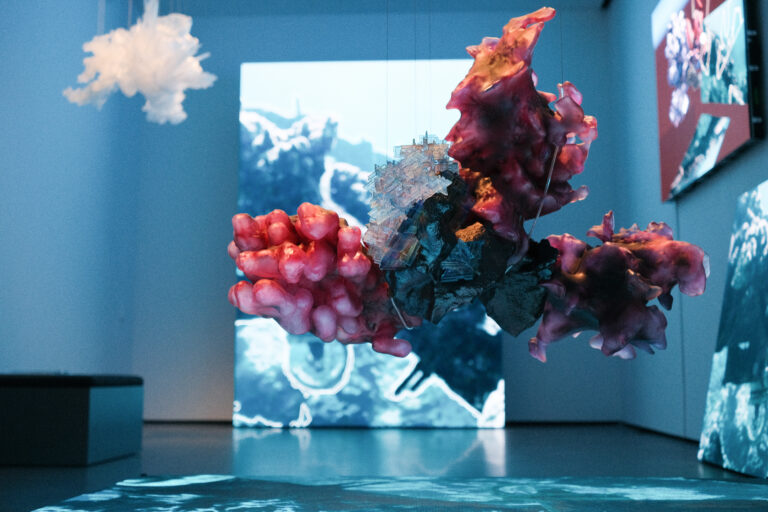
The anti-anthropocentric perspective that is diffused throughout the gallery space takes on a unique manifestation in Michael Joo’s 3D-printed coral sculptures and “Noospheres (Composition OG:CR),” a multichannel live AI-edited video installation. 

“Michael is thinking a lot about how we might use AI to help the environment, and how artificial coral structures might benefit marine life if scientists find a way to use them appropriately,” Xiao said.

Acknowledging the controversial, culturally-charged reputation of artificial intelligence (AI), Xiao noted that learning of the AI-usage in the making of Joo’s piece can evoke emotional reactions in visitors, which ultimately become a part of their viewing experience.  

“I approached the piece by sitting with my frustration, and it helped me discover more about the work,” Xiao said. 

Occasionally, text appears at the bottom of the display screens, based on a conversation that Michael had with his collaborators — including scientists, programmers and engineers — about the concept of flux. 

“He ran it through AI and it morphed the text a bit, so now the language occasionally makes sense and occasionally is garbled,” Xiao said. “The usage of AI, even if unintentionally, helps reflect the ways that language morphs over time.” 

The centrality of time in “Breath(e)” continues in Jin-me Yoon’s “Turning Time (Pacific Flyways),” an 18-channel video installation filmed at a bird sanctuary on Vancouver Island, Canada. It features a group of dancers, all Korean-Canadian young adults, performing a traditional Korean crane dance. 

Yoon coined the term “vertical time” to describe her work, referring to the ways that the future and the past are represented in the present moment. 

“ I really love that description, which I think underlies a lot of the work in ‘Breath(e),’” Xiao said. “The Korean dance is about longevity, and this piece feels like it’s honoring what came before and what’s coming in the future.”  

Yoon’s installation reflects a greater theme threading together the collection of works displayed in the “Breath(e)” exhibit center: the connections that can be made across the boundaries of space and time. 

“Each of these artists are thinking about this idea that, in order to face climate change, we have to come together globally,” Xiao said. “Even though it began with something that could be called tragic, this is more of a hopeful show than anything.”

The exhibition suggests that dominant notions of what constitutes culture and appropriate reactions to cultural issues must be re-evaluated. “Breath(e)” challenges what true growth looks like, as humans might have to consider resources and perspectives that were previously dismissed in order to reach an uncertain future. 

The Manetti Shrem is committed to supporting the community-building themes displayed in “Breath(e)” with its own hands-on events. One of these programs is “Art Spark,” a weekly activity that invites the community to make their own artwork related to the exhibits currently on view. 

Linda Alvarez, the Manetti Shrem’s coordinator for programs and student connection, explained that there have been three different free weekend art activities centered around the “Breath(e)” exhibition, including a bee-themed sculpture in the vein of Garnett Puett’s “Apisculpture Studies” and a gel plate printing activity inspired by Ballengée’s research with fish species.
“Art Spark serves a wide audience range, and you have elementary-age kids, college-age students and elders all processing information from the show and making their own connections,” Alvarez said. 

  Manetti Shrem’s Academic Liaison Qianjin Montoya stated that “Breath(e)” also inspired a course taught by Professor Margaret Kemp, titled “Major Voices in Black World Literature.” 

“It’s an embodied experience, as students respond not only to texts in the form of books but also artwork and images,” Montoya said. “What Margaret is doing is aligning Black storytelling with non-Western narratives that don’t always follow a linear structure.” 

Montoya finds that this unconventional approach to art also resonates with the central themes of “Breath(e),” as individual artist experiences come together to form a message of environmental consciousness and social justice, not the other way around. 

“Almost every artist in ‘Breath(e)’ is making artwork in response to their work with another community, whether it be a community of bees or a community in Flint, Michigan,” Montoya said. “All of them are building bridges to wider issues like climate change and social justice through personal connections to another community.”

Xiao noted that visitors have been spending more time than usual in the gallery space that constitutes “Breath(e),” which she hopes reflects the strength of interests that visitors are able to form with the artwork. 

“I feel like there’s something for everyone in this show,” Xiao said. “One of my colleagues told me that she has a friend who never goes to museums, but this time he went and saw the Tiffany Chung piece. He loved it, because he’s a data scientist.” 

Montoya said that the variety of mediums and forms represented by the pieces in “Breath(e)” allows its message to resonate with a wide variety of people who might think in different ways, but are each connected by shared communities, global problems and ultimately, the act of breathing.

“These urgent situations and issues that we’re dealing with can’t be communicated on a single register,” Montoya said. “They need to come through multiple registers, whether that looks like data, visual art or dance.” 

Xiao characterized her own experience with the gallery space of “Breath(e)” as one of slow contemplation, reflecting on how that experience slots into the weight of its message. 

“Topics like climate change and social justice have an urgency to them,” Xiao said. “There’s this idea that we always have to think about the solution, but in this exhibition, I resonated with this idea of slowing down and taking the time to stand in front of a work of art and absorb it. What can we learn from our ancestors? What can we learn from the people who have stewarded this land for centuries?”

Written by: Julie Huang — arts@theaggie.org 

Sacramento-based artist Lily Therens shares her style and inspiration behind new murals for The Davis Collection

The UC Davis alumna has been working as an illustrator and graphic designer for over a decade

BY JONAH BERMAN – arts@theaggie.org 

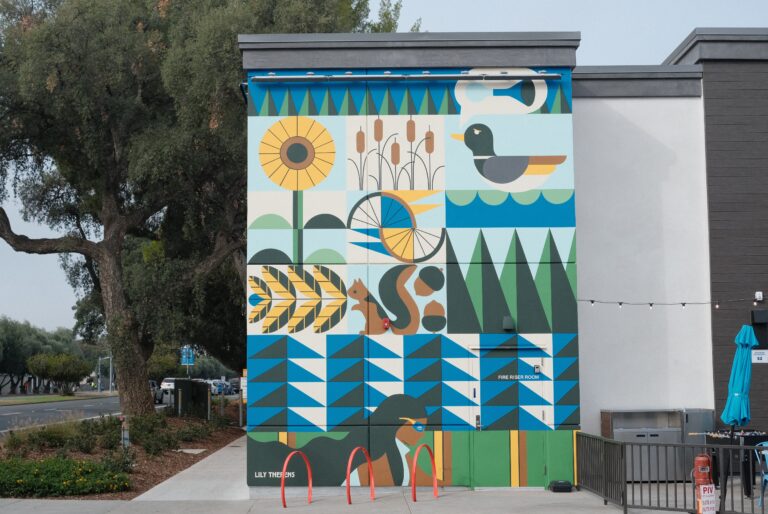
On their next visit to The Davis Collection, Davis students and residents now have an opportunity to see multiple new murals. Painted in vibrant blues, greens and yellows, the assortment of hand-painted artworks are now on display in the brand new shopping center.
These new murals are available for viewing thanks to UC Davis alumna Lily Therens, a Sacramento-based designer and illustrator. Therens has been working as a visual artist for over a decade, and recently transitioned to a full-time freelancer. 

Therens didn’t originally plan on a career in the arts. In fact, she attended UC Davis with the intention of declaring a major in environmental science. However, her ambitions shifted after taking a design course to fulfill her General Education (GE) requirements. Enthralled by the course, Therens eventually switched to being an art history and design double major.
“It was kind of just listening to my instincts that I had been ignoring for a while,” Therens said.

Therens took a particular interest in illustration courses during her time at UC Davis. She noted how learning illustration further ignited her passion, providing her with a skillset that she regularly uses to this day. 

Notably, Therens’ time at Davis — especially her art history coursework — led her to find inspiration from a plethora of sources. She specifically touched on the ways that modernism influenced her as she developed her style, sharing her affinity for bold color palettes and “anything that was sort of tongue-in-cheek thematically;” design aspects that are now a staple in Therens’ works. 

“I always try to do something that infuses a silliness or a story into [the piece] that gives it a little bit more levity,” Therens said.
The process for creating her murals at The Davis Collection began almost two years ago, when the property developers reached out in late 2023 after learning about Therens’ previous designs for the city. Therens began creating her designs before the buildings were completed, working extensively with both The Davis Collection developers and the City of Davis.

Although Therens had significant creative control when designing her sprawling murals, the city communicated which images they did and didn’t want represented; specifically, the city felt the murals should branch out from over-represented images of Davis. 

“We didn’t want it to feel really cliche, so we [didn’t] want to see overdone images of bicycles, agriculture and cows,” Therens said.

 Another thing the City of Davis emphasized was the importance of how Indigenous practices — specifically land stewardship — would be reflected in the murals in addition to the broader topography and geography of the town.

Outside of Nordstrom Rack, Therens’ largest mural out of the three within The Davis Collection features an assortment of symbols that highlight native foods and vegetation, outlined in earthy green, brown, yellow and blue. 

Therens’ second mural, taking up the south corner of Mendocino Farms, captures figures enjoying the scene set out before them, depicting a rich Arboretum-like space with plenty of plants and animals. 

Therens hoped that when visitors saw her murals, they would appreciate them as a representation of how Davis has grown to encompass so many unique and treasured elements  — beyond the common cliches that descriptions of the town fall into. 

“Hopefully it feels like a more accurate representation of daily life in Davis and what community is,” Therens said. “I would love if people felt that the pieces I created are representative of a community that is long-lasting, beyond what it’s known as on the UC Davis brochures.”

While Therens already has a substantial portfolio, she still has some dream projects she’d like to check off her list. She specifically cited the Pabst Blue Ribbon annual Art Contest, which searches for new beer can designs, as something that she’d love to contribute to. 

“I do a lot of work with the food and beverage industry, and I’d love to design retail packaging,” Therens said. 

As Therens looks back on her time at UC Davis, she advises current students to focus on the importance of finding the convergence between passion, individual talents and style. 

“Find the things that make you happy and find the way to make that your bread and butter,” Therens said. 

The new murals at The Davis Collection serve as a testament to the way perceptions of Davis have developed past pre-conceived notions, throughout our town’s storied history. Similarly, Therens views a willingness to upend our own expectations as a crucial part of our lived experiences. 

“There are things out there that you don’t even know exist as careers,” Therens said. “When I first attended Davis, I didn’t know that art and design could be a pursuable career, let alone a focus, you know?”


Written by Jonah Berman — arts@theaggie.org

Third Space Art Collective hosts triple band lineup at Nov. 9 house show

Dustin Wong, Julius Smack and Synthesaurio set to perform at local ‘Banana House’

By MIRIAM RAMAKRISHNAN — arts@theaggie.org 

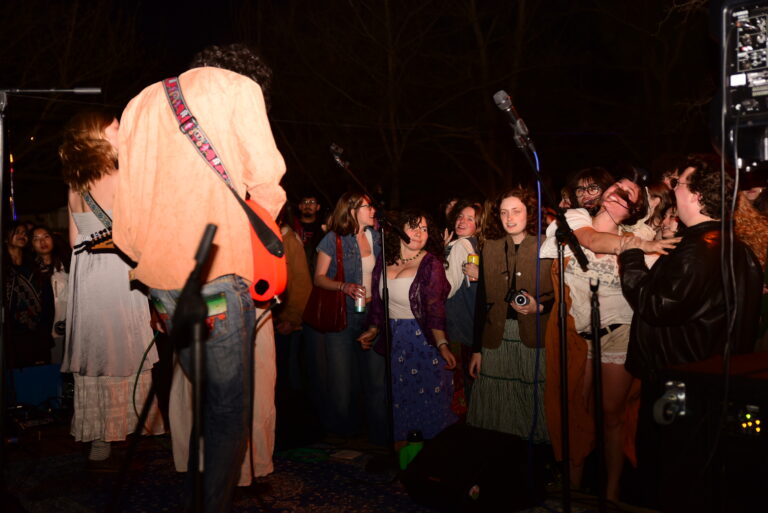
On Nov. 9, Third Space Art Collective — a community of creatives who adhere to a do-it-yourself philosophy — will be hosting a house show featuring three distinctive performers. From 6 to 9 p.m., Dustin Wong, Synthesaurio and Julius Smack will be taking over the Banana House at 616 11th St. to play an eclectic mix of genres. Admission starts at $10, but no one will be turned away for lack of funds. 

Wong is a former guitarist for Ponytail, an art-rock band from Baltimore Art School. After getting its start as a school project, the band continued to experiment with music professionally, according to Impose Magazine

“Wong tends to arrange his electronic material in short, sporadic bursts, often contrasted against a cantering percussive synth line or reedy wisps of guitar,” Reed Jackson said in an article for Spectrum Culture. 

Currently local to Davis, Synthesaurio is an “audiovisual project” by epidemiologist Pablo Gomez. He utilizes algorithms as a way to influence his production design and visual composition process, resulting in a very unique sound.

“I see music as another tool to bring people together and uplift the efforts of those who are working on building a better world for all of us,” Gomez said.

As Synthesaurio, Gomez defines his music style as a mix of cumbia, psychedelic rock, ambient and vaporwave genres. 

“To me, cumbia experimental is an esoteric process that evokes near-spiritual experiences,” Gomez said. “My biggest influence right now is the current political climate, which is what pushes me to write and perform music. I like to think of my music as an extension of community organizing — another tool to bring people together and uplift the efforts of those working on building a better world for all of us.”

On tour with Wong from Los Angeles, Julius Smack is an alter ego created by LA-based musician Peter Hernandez, in which he blends Y2K dance music with other synth beats to create a wholly new concept.

“The house scene matters more than ever right now,” Hernandez said via email. “House shows are humble, [do-it-yourself (DIY)], human — the antidote to online.” 

Hernandez first became interested in the music scene when he himself attended a house show in his hometown of San Jose. 

“When I was 18, I saw an experimental folk artist from Portland called Dragging an Ox Through Water, and we talked for a bit about his unusual set up of homemade synthesizers,” Hernandez said. “I remember leaving and feeling ecstatic that an amazing musician would have a conversation with me. I think that moment really instilled a determination to meet as many artists as I could.”

Gomez shared a similar experience, explaining that the house show environment inspired him through a unique camaraderie.  

“Living-room shows are so intimate and [a] great way to connect the audience with the performers,” Gomez said. “I have been in lots of shows where I end up hanging out with the performers and learning more about their music and eventually becom[ing] friends.”

The technical aspects of organizing such an event are a feat in-and-of-themselves. Josh Redman, an events director for Third Space, detailed the process of planning the Nov. 9 show and others like it.

“Bands on tour usually reach out about shows months in advance — at least two months but often three months in advance or more,” Redman said via email. “Once a band asks about a show, then the organizer needs to confirm a space, find other bands, make a flyer and start promoting.” 

Redman went on to highlight the importance of audience behavior and courtesy during smaller shows at places like the Banana House.

“It’s really important for people going out to a house show to understand what the expectations are, because it’s so generous of people to host,” Redman said. “If attendees don’t respect the space, then they may be discouraged from hosting again.”

Beyond the logistics, Redman is very enthusiastic about the haven that smaller, more intimate shows provide for artists and listeners alike. 

“House shows provide an alternative and non-commercial space for more experimental and challenging art that conventional venues may not be open to,” Redman said. “[House shows] build a community around shared experiences and collaboration and not just a traditional performer/audience dichotomy.”

All aspects of the show — from the bands to the organizers to the attendees — are set to come together on Nov. 9 at the Banana House to bring the Davis community this standout show; come one, come all.

Written by: Miriam Ramakrishnan — arts@theaggie.org 

Commentary: Cable TV’s reality in a world dominated by streaming services

Hallmark hit ‘Providence Falls’ shows that cable TV can still remain relevant in modern-day viewing

By IQRA AHMAD — arts@theaggie.org   

In the endless whirl of streaming services — Netflix, Prime Video, Hulu, Peacock, Disney+, Apple TV+, Paramount+ and more — viewers are drowning in choice. What once felt like liberation from cable’s grip has twisted into a tangled web of logins, monthly fees and an eternal search for which platform owns which shows.  

Somewhere between all the buffering and password sharing, another question arises: Whatever happened to cable television? 

Surprisingly, it turns out that it never really left. 27% of Americans said they mainly use cable TV to watch live sports and 26% kept cable because of comfort and convenience, according to a 2024 survey of 11,000 Americans by CableTV.com. No autoplay countdowns, no vanishing titles — viewers just turn the TV on and something’s already there.

While streaming giants continue to raise prices and compete for attention, and as many Americans begin cancelling their subscriptions and trimming their streaming budget, cable is perhaps making an unexpected comeback. Networks, like Hallmark Channel, are reviving their charm with feel-good classics and originals.

Hallmark’s comfort comeback

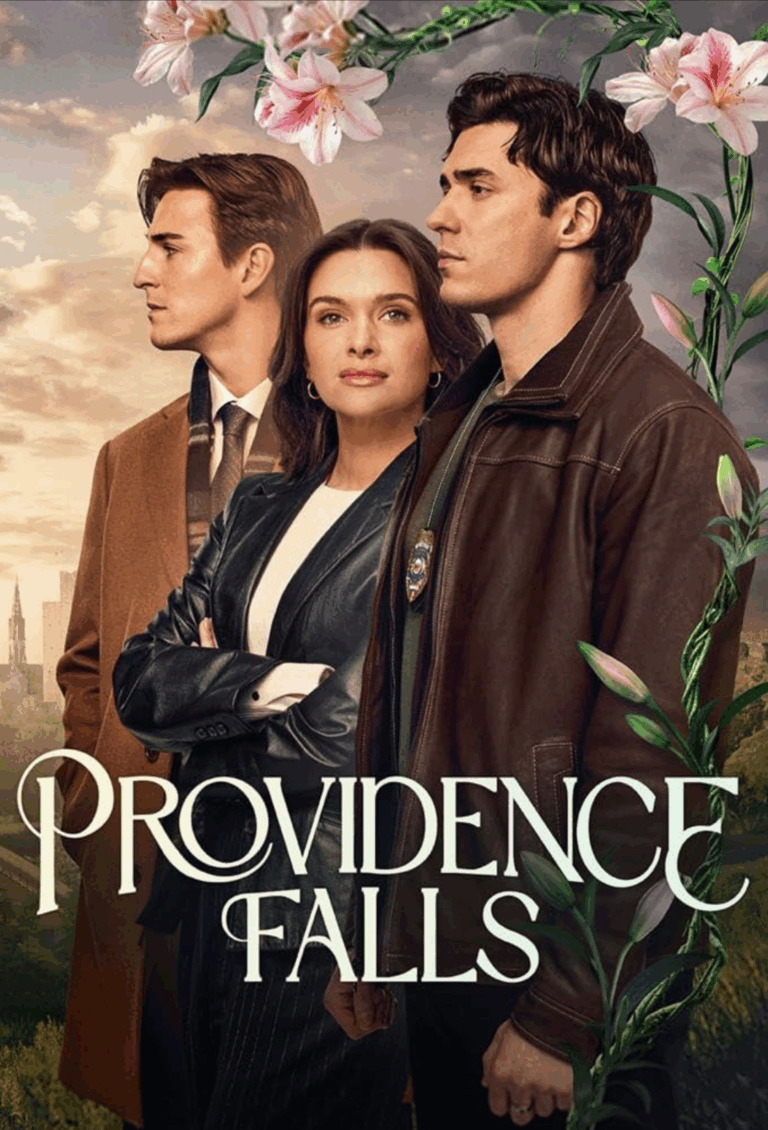
Hallmark has long been the home of cozy predictability, with snow-covered towns, second chances and that one bakery that saves Christmas every year. But with its new original series, “Providence Falls,” the network shows that even in a streaming-saturated world, there’s still a hunger for slower, feel-good storytelling. The series mixes Hallmark’s signature sweetness with a touch of magical realism and historical romance that draws viewers in

This three-part series shows that cable TV is not recycling old formulas and plotlines, but rewriting them. Based on novels by Jade Deveraux and Tara Sheets, the series follows Liam O’Connor, a 19th-century Irish rogue sent forward in time to modern day Oregon to help his ill-fated love find her “destined” partner, even though he is still in love with her. It’s part romance, part mystery and time-travel fantasy: a bit bolder than the typical Hallmark holiday story. 

While viewership numbers and ratings are modest, with 6.8 out of 10 stars on IMDb, these ratings don’t tell the full story. The fact that Hallmark invested in a three-part special event, produced partially in Ireland and Vancouver, signals a renewed ambition to change their usual small-town storylines and implement something new. 

The chemistry between the leads also gives the story its heart. The actors balance Hallmark’s sincerity with a more grounded emotional connection. Liam isn’t just a stock romantic lead, but flawed and human, which makes the fantastical premise and the way he navigates time travel believable. 

While the series still feels familiar and comforting for loyal Hallmark fans, its imaginative and new formula still works to attract new ones back to the world of cable. 

Why cable still matters in 2025

While cable TV might not dominate the conversation like it once did, and many assume it’s on the road to obsolescence as networks continue to lose subscribers each year, some providers are fighting back. Cable companies such as Spectrum and DirecTV have held press events to showcase their efforts to make the viewing experience more seamless and accessible; integrating traditional cable with popular streaming apps and on-demand content. 

Beyond that, cable still offers various comforts that streaming services cannot yet fully replace. Cable remains a popular choice because it provides high-quality picture and sound — without the buffering or compression that often plague streaming services. Cable TV users also have longer-standing relationships and tenure than with streaming services. 

Though, it is important to recognize that streaming services have ultimately changed the way TV is viewed. Streaming services have captured 45% of the United States’ TV viewership in May 2025, according to an article by the New York Times. This dominance of streaming services reinforces why cable’s remaining foothold in live sports, local news and convenience is so valuable. 

Despite the rise of streaming, cable TV remains a vital part of the media landscape. Its reliability, access to live programming and connection to local communities give it a niche which algorithms and streaming services can’t replace. In an age of endless choice, cable provides consistency, convenience and comfort that still matter. It seems that some stories are best enjoyed the old-fashioned way: on a familiar channel, at a familiar time.

Written by: Iqra Ahmad — arts@theaggie.org

Review: Erotic Nightmares Club debuts first show of the year on Halloween night

Amidst the 50th anniversary of the cult classic, ‘The Rocky Horror Picture Show,’ Erotic Nightmares cast reflects on the importance of the performance

By BELLA PETERSON — arts@theaggie.org 

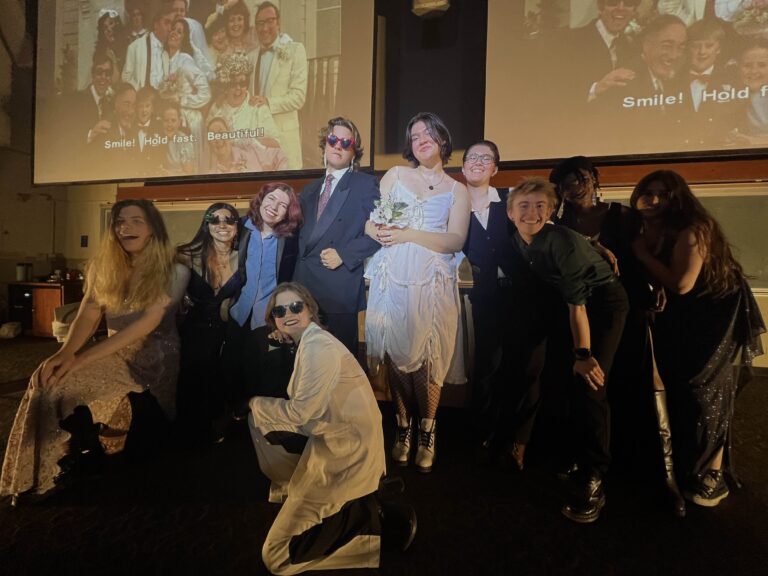
The Davis community is no stranger to shadowcasting, especially with the ever-charming Erotic Nightmares Club on campus. With nearly monthly performances of the live rendition of the cult classic film, “The Rocky Horror Picture Show” (1975), many found themselves turning to “The Rocky Horror” Club when looking for a way to celebrate Halloween. 

On Oct. 31, Erotic Nightmares held their first official Halloween viewing, something that’s become a tradition since the film’s release. “The Rocky Horror Picture Show,” while at first unpopular in the mainstream for its depiction of sexuality, rose to fame in 1976 through midnight showings, with fans starting to sing and shout at the screen. 

Shadowcasting, as a form of performance, involves not only a cast of characters performing live alongside the film, but also full participation from the crowd — a completely unique experience. Getting to squirt water guns at the rest of the audience and snap rubber gloves while watching a movie is something everyone should experience at least once in their life. 

With the show falling on Oct. 31 — and this year being the original movie’s 50th anniversary — it’s hard to imagine the club’s performance as anything other than fantastical. Upon entering the showspace in Rock Hall, you could feel the energy in the air like lightning, with everyone dressed in their Halloween costumes and buzzing with anticipation. With the crowd eagerly awaiting the cast to begin the performance, many were pleasantly surprised by the pre-show featuring the Davis DRAG Club. 

Members of Erotic Nightmare’s board shared their excitement for the show and how they make their shadowcast come to life each quarter. Erotic Nightmares President Vivian Sapovits, a fourth-year molecular and medical microbiology major, discussed the importance of this showing in particular. 

“We perform three shows every quarter, but our first of the year is always in October and it is usually our biggest audience,” Sapovits said. “Since shadowcasting has become a Halloween tradition over the years, it’s extra exciting that we are doing our first Halloween show. This is also the only show where we don’t have a theme — just pure Rocky Horror.” 

Erotic Nightmares Secretary Maiya Duvall, a fourth-year classical civilization major, shared the influence of their personal experiences on the Halloween show. 

“For me, personally, I didn’t have a lot of Halloween celebrations as a kid that I’ve been able to remember fondly, so I’m very grateful that I get to make some long-lasting memories this Friday,” Duvall said. “I hope that if there’s anyone else out there in Davis who doesn’t have anything to do this Halloween, they feel encouraged to come see our show and celebrate this extravagant holiday with so many passionate partygoers.”

As most of their shows have different themes — ranging from “emo night” to “Star Wars” to “pirates and mermaids” — it was especially thrilling for the cast to perform on the spookiest night of the year with no theme at all. 

When it came to their roles in the club, the cast shared how their personal experiences shape the work that they do. 

Erotic Nightmares Vice President and Treasurer Vivian Albelda, a fourth-year biological sciences major, shared her journey discovering and joining the club. 

“My first time seeing [“The Rocky Horror Picture Show”] was at a shadowcast this club put on three years ago, during my very first quarter at Davis,” Albelda said. “I had so much fun that night that I started doing tech for the club the next quarter, and I have not missed a show since.” 

Albelda also noted what stood out most to her about Erotic Nightmares: not just the act of shadowcasting, but the group of shadowcasters themselves. 

“This club is just such a wonderful community — everyone has been so friendly to me since the moment I joined,” Albelda said. “It is so important to me that we as a board work to maintain a welcoming environment accessible to everyone, regardless of their theatre experience.”

“The Rocky Horror Picture Show” has been a staple in the LGBTQ+ community since its debut, and the act of shadowcasting only furthers the sense of community it fosters, according to Sapovits. Beyond shadowcasting, Erotic Nightmares functions as a non-profit, donating proceeds from ticket sales to various LGBTQ+ organizations. Albelda noted that continuous donations to the Sacramento LGTBQ Community Center has become one of the most meaningful parts of the club to her personally. 

Sapovits also shared the importance of not only the club’s philanthropic mission, but how it serves to create a new space for queer UC Davis students. 

“Rocky brings me so much joy that it’s honestly hard to put into words,” Sapovits said. “For me, the best part is the community. Obviously times are hard for everyone, but safe spaces for queer identities, and especially trans people, are so important right now. I am so grateful I am a part of this group that accepts everyone as they are,” Sapovits said.

The strongest element of “The Rocky Horror Picture Show” is the community it fosters. The cast made their feelings of pride obvious for everyone to see, and the crowd became connected through a collective, celebratory feeling. 

The crowd was stunned by Sapovits’ raunchy performance as Dr. Frank-N-Furter — the movie’s complex, melodramatic antagonist — alongside Albelda’s creepy and quiet Riff Raff. 

Eren Peixoto masterfully acted out Rocky the moment the monster of a man came to life in Frank-N-Furter’s laboratory. Each member of the cast showed off their strengths as the show progressed, fully capturing the essence of their characters in the film through song and dance. 

Beyond the cast’s individual talent, the absolute love and effort that went into their performances effectively crafted an atmosphere where everyone involved would be included; if it was an audience member’s first time, they were welcomed into the space as “virgins” with open arms. 

Having each performed multiple shadowcasts, the members of Erotic Nightmares have longstanding hopes and goals for each show. For Sapovits, performing “The Rocky Horror Picture Show” has allowed him to continuously discover new things. 

“Rocky Horror has let me explore my gender identity through a very unique outlet,” Sapovits said. “Stepping into a character like Frank really lets you embody that personality and experience in a way that might be impossible otherwise.” 

Albelda also expressed the emotional importance of the club’s performances. 

“We say that the message of this movie is ‘Don’t dream it, be it,’ and I find that this rings very true to my own experience in this club,” Albelda said. “I usually like to stay on the tech side of theatre, but it really is so wonderful to watch your friends perform with such confidence, and then realize that you are also capable of that.”

Just the beginning of this year’s shadowcasts, Erotic Nightmares’ Halloween show has set the bar for their upcoming shows, which will have their very own themes to make each night especially memorable. If the cast performs even half as spectacularly as they did on Halloween, you’re guaranteed to not be disappointed. 

“Shadowcasting has created this bright and wild community that brings so many of us together in such an unusual way, across the globe,” Sapovits said. “At Rocky showings, everyone can be themselves. It’s a very ‘come as you are, or who you want to be’ vibe.”

Written by: Bella Peterson — arts@theaggie.org

Culture Corner

The Arts Desk’s weekly picks for music, movies and more

By NATALIE SALTER — ncsalter@theaggie.org

TV Show: “Gravity Falls” by Alex Hirsch (2012)

Mystery is the heart of “Gravity Falls,” a two season animated series about the misadventures of a pair of twins stuck for the summer in a not-so-normal Oregon town. 12-year-old siblings Dipper and Mabel are put in the care of their great-uncle Stan at his tourist trap attraction, the Mystery Shack, but soon discover that the oddities and myths of Gravity Falls are more real than they thought. Guided by a mysterious journal, the twins encounter a slew of eccentric creatures and curiosities, all whilst a darker conspiracy unfolds in the shadows. Dancing from funny and heartwarming to emotional and tense — and, at times, downright frightening — “Gravity Falls” is a fantastic work of storytelling, endlessly enjoyable at any age. And, with hidden codes and ciphers tucked away in every episode, the mystery doesn’t end when the episode does: leaving curious viewers with an undeniably unique chance to participate in the story themselves. It’s a loving reminder from the show’s creator to its fans to stay curious and to never stop dreaming up and discovering new wonders every day. 

Film: “Charade” dir. by Stanley Donen (1963)

Millions of dollars are on the line when Regina “Reggie” Lampert (Audrey Hepburn)’s husband turns up dead, and three of his World War II compatriots come to cash in. With the help of the charismatic Peter Joshua (Cary Grant), Lampert is forced to unravel the mystery surrounding her late husband’s death and find his secret fortune, or her own life is in jeopardy. But how much can she trust those closest to her, when everyone has something to hide? “Charade” is a nail-bitingly suspenseful, and oftentimes extremely funny, work of cinema. Hepburn and Grant give dazzling performances as an unlikely investigative duo, and the twists and turns that the story employs will take even the most observant and suspicious of viewers by surprise. If you’re on the hunt for a good thriller, “Charade” stands as one of the finest, ready to make you doubt everything you thought you knew about the answer to its mystery.

Video Game: “Slay The Princess” by Black Tabby Games (2023)

You are on a path to a cabin in the woods, and, in its basement, there is a princess. “You are here to slay her,” the Narrator, your guide throughout the story, says. “If you don’t, it will be the end of the world.” The 2023 choose-your-own-adventure visual novel “Slay The Princess” operates on a seemingly simple premise — slay a princess, save the world — but in actuality, it’s anything but simple. Offering players a web of complex choices and endings, from whimsical to terrifying, it becomes quickly clear that “Slay The Princess” is hiding much more beneath its direct narration. It is not only a delightfully tense and scary game for fans of the horror genre to enjoy, but also a marvelous story about growth, sacrifice and what really gives life its very meaning. As you carve your own path through this strange and mysterious world, you’ll discover much more hiding there than you initially expect. 

Song: “I Want You To Love Me” by Fiona Apple (2020)

“And I know none of this will matter in the long run, but I know a sound is still a sound around no one,” sings Fiona Apple over the bridge of “I Want You To Love Me,” her voice aching with emotion. In spite of her admission that she is just a speck of particles in a vast universe, she declares “I want what I want, and I want you.” The song, backdropped by a soaring piano melody that rings through the listeners’ hearts, is a tribute to how our human desire for love is all-encompassing, regardless of our relatively miniscule place in the grand design of time and space. Apple insists that, just because our lives are fleeting, does not mean our hopes and desires are any less real or important. In fact, she seems to suggest that our fragility is what makes our capacity for love all the more meaningful. How she manages to fit so much raw emotion into one song is a feat in and of itself, and it shines as one of the most exceptional pieces of music Apple has created in her career thus far.

Written by: Natalie Salter — arts@theaggie.org 

‘The middle of everywhere’ or ‘the middle of nowhere?’

0

Is Davis Northern California’s best-kept secret? 

By AMBER DUHS — features@theaggie.org 

UCLA, in the heart of one of the biggest cities in the world; UC Berkeley, in the bustling corner of the Bay Area; and UC Davis, cow-town, USA? 

Compared to its other UC counterparts, UC Davis doesn’t always fit the “college town” archetype students typically imagine. With farmland on either side of the town and a well-known agricultural program, differing perspectives emerge on whether Davis is truly in “the middle of nowhere,” or, more affectionately, in “the middle of everywhere.” 

With this in mind, future Aggies across the country are warned of the possible negative effects of the university’s location. From rumors of cow-tipping being a Davis student’s favorite (or only) pastime, to the standard worries of whether your top school hosts a bustling social scene in addition to strong academics — these whisperings often impact the overall narrative that UC Davis holds. 

“I was under the impression that Davis was going to be really boring and that I would have nothing to do,” Sophia Aran, a third-year political science major, said. “I was kind of worried that my whole life would be just school and that I wouldn’t be able to find a sense of community or activity to do around here.” 

Though many incoming students mirror these fears, Davis is like any other college town: it has opportunities and social events for those who seek them out.

“I think [Davis is] what you make it,” Sophie Morrill, a third-year wildlife biology major, said. “Davis, physically, yes, is incredibly in the middle of nowhere, but I think in this town and on campus between the student organizations and all the things randomly going on downtown on a random Saturday, there’s kind of always something to do.” 

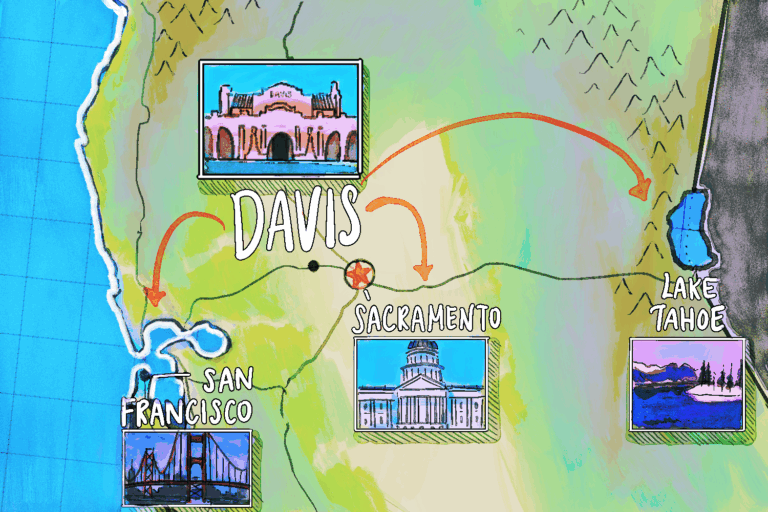
Davis, as a town, is located near California’s state’s capital of Sacramento: a walkable city with antique stores, political and legal opportunities for students and live music. Like everything else in life, however, making the most of it takes effort. 

“I feel like there are certain places in Sacramento, if you know, you know,” Erin Hale, a third-year psychology major, said. “You have to go looking for it [though]; you have to go spend days just finding these places.” 

Beyond the immediate Davis area lie both Yosemite National Park and Lake Tahoe — both only a few hour drive away — not to mention convenient options (often with student discounts) for a train ride to the Bay Area.

So, with all of these places and possibilities at our fingertips, why is it that Davis is still regarded as the college town with nothing going on? 

“Honestly, I think Davis is kind of a little gate-kept secret,” Aran said. “When you look at it on a map, it does kind of look like the middle of nowhere, and when you drive here it’s really underwhelming — But I think once you immerse yourself in the community and you explore, it’s very unique.”

Even if some students, especially first-years and transfers, are restrained to campus, there’s hidden beauty in every corner.

“The Arboretum is just so beautiful,” Aran said. “When I first discovered it, I was like ‘this is probably the best thing ever.’”

The opportunities don’t end at the edges of campus. In the walkable downtown area outside of the university, small dining and shopping businesses line the streets, student organizations host after-hours events and the Davis farmers market arrives semi-weekly. 

“There’s a really fun music community [in Davis],” Aran said. “I work at Watermelon Music, and I’ve met a lot of local musicians and bands. And seeing them play and perform and have little house parties is really fun.” 

If you want to explore downtown but aren’t sure where to start, oftentimes you don’t have to look beyond UC Davis’ own student body, who will always be excited to share their recommendations for restaurants, thrift shops and more. 

“If we’re talking food [there are] many, many options,” Hale said. “Ike’s [Love &] Sandwiches […] is amazing; I have my go-to sandwich. Taco Bell, Guad’s — anything in general, there’s a lot of good food [in Davis].” 

Additional fan favorites to check out downtown, according to students, include: Yesterday Vintage, a vintage thrift shop; Bohème Clothing & Gifts, a Davis-favorite local thrift store; and Armadillo Music, every record or CD-lover’s dream.  

Despite Davis’ slightly underwhelming physical location in terms of proximity to booming cities or the Pacific coast, there are plenty of local events for students to check out. From student organizations — like the KDVS90.3FM radio station hosting band parties where students can meet and connect over a shared interest in music — to the multitude of local restaurants and businesses that need student traffic, if you go out and try new things, it seems you’ll never truly be bored in Davis. 

Written by: Amber Duhs — features@theaggie.org 

A plea from your downstairs neighbor

0

Stop dropping your bowling balls!

By MADISON SEEMAN — meseeman@ucdavis.edu

Dear upstairs neighbor:

Neighbors are a natural side effect of any community. Whether you’re separated by a dubiously sturdy fence, acres of land or paper-thin plaster walls, everybody has them — and some of us can hear their (mostly) domestic pitter-patter a little more than others. 

I was raised to “love thy neighbor,” and although I’m re-inspecting my relationship with religion, I still come to you with love, compassion and just one, multilayered plea: no more strange noises!

Let me paint a picture: In teen dramas, the protagonist returns to her bedroom after a long day, tired and aching, to the tunes of a 2000s indie singer trying (and failing) to channel Fiona Apple. My soundtrack looks a little different; with a budding headache and headphones that only work in one ear, my existential crises are set to the sounds of rolling, stomping and a mysterious (but persistent) thumping. It’s interrupting my 20-something angst!

Although we’ve never met, I’m plagued with burning questions for you. What could possibly be compelling you to constantly rearrange your furniture? Am I living below an aspiring interior designer, or is the feng shui of your bedroom that messed up? Are you conducting the Fitness Gram Pacer Test in your living room? Why do your footfalls sound like falling bags of sand, and do you seriously wear your shoes in the house ALL the time?

I listen to the struggles of the problematic roommate situation next door while making my lunchtime struggle meal (baby carrots and hummus) and, when I go to bed at the (mostly) reasonable hour of 2 a.m., I drift off to the repetitive rhythm of the sliding wheels of your closet door. Who plays dress up at 2 a.m.?

And what could you possibly be listening to? I mean, music is a universal language, but I’m not sure I understand the appeal of your bass-heavy brown noise, which is just loud enough to fight the PinkPantheress playing in my singular functioning earbud. Maybe I’m the infamous nosy neighbor, but it’s hard not to notice when my walls are thinner than my patience.

So, if you’re feeling generous, I implore you to maybe turn down your speaker’s bass, or at the very least listen to some real music. Maybe even take your shoes off before you go for another round of pacing. And please — when a man and a woman love each other very much, I’d rather not have to hear it.

If you could also just politely tell your very shy vacuum cleaner to just get over her performance anxiety, that would be great. She’ll start in one dense burst, then stop, then start again and stop, over and over again until she’s timidly made her way through all the dust in the apartment. It’s almost sweet, but mostly annoying — every time I wishfully think it’s over, she just starts again.

To be fair, you’re not the worst of my neighbors. I once lived under a family that had an admirably consistent weekly midnight movie night, an impressive surround sound system and a dedicated love of action movies. I’d fall asleep guessing the movie by the frequency of cinematic explosions vibrating my bedside table. 

And then there’s that man across the hall who lets out a blood-curdling scream every once in a while — probably a computer science major.

Then again, can I really judge? What did my downstairs neighbors think of my short-lived living room rollerskating phase? And what do they hear when I scramble to chase my roommate’s persistent little tuxedo cat off of our kitchen counter? Do they think our Australian accents are getting any better?

Despite it all, I do like living in an apartment. Waking up to the sounds of life outside your own — the gentle hum of a shower upstairs or soft conversation from your roommates in the kitchen — can be nice, as long as it’s later than 9 a.m. Living in community is about compromise; sometimes life’s soundtrack is your neighbor who very audibly regrets pursuing higher education.

I’ll cut you some slack — maybe student housing makes everyone a bad neighbor. But maybe you could try a little harder not to drop your bowling balls.

Written by: Madison Seeman –– meseeman@ucdavis.edu

Disclaimer: (This article is humor and/or satire, and its content is purely fictional. The story and the names of “sources” are fictionalized.)

Go to your friend’s birthday party

0

Hyperindividualism is ruining your life

By ABHINAYA KASAGANI — akasagani@ucdavis.edu

I’ll admit that I have a tendency to retreat into my deliberately constrictive, shell-like enclosure in order to ward off the willies, the weepies or the like. I do, however, always manage to drag myself to “go to the party.” Let me explain. 

Singer-songwriter Lucy Dacus shared this message with “Rolling Stone” in early October: “I have a friend who’s studying public health … and one of the things they learned was, like, ‘go to the party.’ You need to go to the party for your wellness.” 

Sure, if you’re sick, you’re granted time off; but, ultimately, Dacus noted that “You can’t just self-care your way alone […] there’s a biological imperative to breathing each other’s air.”

Contemporary relationships fail to endure — far too often, they are undone by a general reluctance to “put in the work.” Our modes of connection — delivered through pixelated simulations of genuine care, wrapped in copper cuboids of despair — are hollow and gestural. We have begun to subscribe to friendship; opting out at our leisure and returning only when it’s convenient. While many blame technology (or find themselves a new scapegoat) for ruining the world as we know it, people have long since stopped prioritizing real life in favor of hyper-independence. We attempt to posture ourselves as good people, good friends even, but this verdict of goodness exclusively comes from ourselves.

The Internet has left us unwilling to admit that we care. There is a reluctance for earnestness; almost a distaste for it. One, instead, leverages boundary-setting as an excuse to avoid investing time and energy into others meaningfully, shielding an individual from responsibility or blame (and occasionally, even hurt). While apprehension toward power imbalances within relationships is understandable, the cult of hyperindividualism and emotional minimalism has bled us dry. Now more than ever, we retreat due to fear that our efforts will be unreciprocated. We have begun to conflate commitment with obligation. And, in doing so, we’ve lost sight of what we owe one another.

Friendships, unfortunately (or fortunately), continually demand intentional effort. 

“All of us participate in the social contract every day through mutual obligations among our family, community, place of work, and fellow citizens,” according to Minouche Shafik’s “What We Owe Each Other.” 

While Shafik notes how this participation has changed in recent years, she proposes “a more generous and inclusive society would also share more risks collectively […] a better social contract that recognizes our interdependencies, supports and invests more in each other, and expects more of individuals in return.” 

This is not to say hypercollectivism is the answer. While it is simply false to claim we owe nothing to anyone, it is equally misguided to believe we owe everything to everyone. This generational impulse toward extremes has us buying into sentiments of guilt-based collectivism, which weaken personal boundaries and autonomy. Healthy interdependence requires you to recognize the extent to which we benefit from others, and to consider how we choose to give back. 

This way of being is why we suffer — it’s why our political systems do too. Why do we find ourselves unable to collectively agree to vote for programs that would benefit everybody? We’ve been deeply trained to care only about ourselves and to believe that struggle is to be avoided at all costs. Ironically, struggle is where growth takes root and where community flourishes. 

Dacus considers this in her argument.

“People just come home and stay in their houses,” Dacus said in her interview. “That’s great news for the government. We’re not showing up together or […] realizing how to organize without social media.” 

She remains apprehensive about what this means for the future.

 “[Once] they get in charge of that, you know, it’s harder to figure out how to get together,” Dacus said. 

Right now is when it would benefit you to admit that you need others; working to take care of yourself doesn’t substitute that. So if your friend invites you to their birthday, go. Not showing up for your friends (on a Friday night of all nights) reflects a larger sociological inability to prioritize someone other than yourself. This epidemic of wanting constant comfort disguised as self-awareness is immature. Friendship requires sacrifice; community is built on sacrifice. 

Let me be perfectly clear — I am not attempting to negate the value of a healthy boundary, but instead, imploring you to reevaluate the difference between setting a boundary and being lazy in your friendships. Community has fallen so low on our priority list that our allegiance to one another is flailing and so is our ability to experience our lives. Sometimes, it is perfectly necessary to sleep less than eight hours because you chose to go out. These boundaries you’ve drawn to excuse yourself from social obligations are unfortunately written in chalk; your task, should you choose to accept it, is to step outside the lines — or simply, step outside.

Written by: Abhinaya Kasagani— akasagani@ucdavis.edu

Disclaimer: The views and opinions expressed by individual columnists belong to the columnists alone and do not necessarily indicate the views and opinions held by The California Aggie.

The Democratic Party needs a wake-up call

0

Democratic politicians follow the money, when they should be focused on reconnecting with their base

By SAGE KAMOCSAY— skamocsay@ucdavis.edu

The approval rating of the Democratic Party has been plummeting for some time. Party approval ratings are at 34.7%, with disapproval at 59.0%, according to an analysis by RealClear Polling of several polls taken over the past few months. To offer a more specific critique, 64% of respondents described the Democrats as “weak,” while only 26% answered that they were “effective,” according to a poll by CBS News

As these polls continue to show declines in the party’s favorability, we are also seeing increasingly center-right tendencies within their tactics; a prime example being Kamala Harris’ promise to finish the wall along the United States-Mexico border during her 2024 presidential campaign. The stark contrast between this policy and former-President Barack Obama’s Deferred Action for Childhood Arrivals (DACA) act prominently displays how democratic philosophy has shifted: We’ve fallen from grace.

But why is this the case? Why has the Democratic Party seen such a drastic change in their policy? To put it simply, it’s profitable. Left-wing organizations, like Indivisible, tend to be grass-roots — they simply don’t have the funding to facilitate lobbying and large campaign donations. Moderate and conservative organizations, on the other hand, have more institutional and monetary power. Political Action Committees (PACs), for example, have historically been a major method for candidates to receive funding — but there are almost none on the Left. As such, Democrats who lean center have more access to fiscal support for campaigns and bill propositions. 

Lobbying, therefore, has a significant impact on the positions taken by prominent Democrats — and even decides who gets a seat in the government in the first place. A fantastic example of this power is the American Israel Public Affairs Committee (AIPAC). AIPAC funded campaigns for over 80% of the 469 seats in Congress up for election in 2024, according to an analysis done by The Intercept. Even more chillingly, they found that only four of the AIPAC-backed candidates lost.

In short, it’s easy for Democrats to lay on their backs and resign themselves to allow corporate meddling in elections. It’s the logical choice for most candidates — why would you run against these lobbies that are so incredibly successful? It significantly narrows the playing field for who can participate in lawmaking — only the most moderate survive.

As America continues to descend into the throes of fascism, however, this party strategy becomes increasingly concerning. Fringe Grand Old Party (GOP) policies from less than 10 years ago are now being paraded by the Democrats as “the reasonable alternatives” to current GOP agendas. 

Take Harris’ campaign promise to finish building the wall, for example: It’s an echo of President Donald Trump’s alt-right 2016 campaign, and a fast-track to the fascist America we are rapidly approaching. The policies being pushed by mainstream politicians continue to approach the depths of the alt-right, and, for voters, there are three options: surrender to the extreme, vote for the “lesser of two evils” or step out of politics entirely.

What’s not offered is left-populist policy. While voters tend to discount or even fear ideas labeled as “left-wing,” it’s been shown that the public prefers policies much further to the left than current mainstream Democratic policy when that label is omitted. For example, the average support across party lines for ending cash bail, creating more generic options for pharmaceuticals, establishing job guarantees and funding a public internet option was up, according to a 2018 poll by Data for Progress. Among 2016 Clinton voters, these numbers were even higher, almost double the increase. Even among non-voters, support for these policies was also significant. 

More recently, polls have shown significant support for left-wing politicians, Zohran Mamdani’s win over Andrew Cuomo in the recent New York mayoral race being one example. Additionally, a 43% positive popularity rating among voters for Representative Alexandria Ocasio-Cortez and 48% for Senator Bernie Sanders were found in a 2025 YouGov poll. In the same poll, their establishment peers like House Minority Leader Representative Hakeem Jeffries and Senate Minority Leader Charles Schumer demonstrated positive ratings of 28% and 20%, respectively.

Even though they may shy away from calling it what it is, the average voter wants to see more liberal policy change in America: These polls prove it. However, most Democrats aren’t giving it to them — they would rather bulk up their paychecks than protect the interests of their constituents.

To recapture their base of support and delay — or even prevent — America’s fascist demise, Democrat politicians need to turn left; they need to realize that the people are more important than the money. To achieve this goal, however, the Democratic base needs to show their representatives what they want.

So, when you see a local candidate working to truly do right by their constituents, consider voting for them. If you can, contribute in more ways than just voting: volunteer, go to demonstrations, maybe even donate. Call your representatives — make sure they know your vote depends on their policies. Ultimately, the most important thing is to protect what’s right, not just what’s safe.

Written by: Sage Kamocsay— skamocsay@ucdavis.edu

Disclaimer: The views and opinions expressed by individual columnists belong to the columnists alone and do not necessarily indicate the views and opinions held by The California Aggie.

The commodification of fall — friend or foe?

0

Capitalism really popped off with this one

By VIOLET ZANZOT— vmzanzot@ucdavis.edu

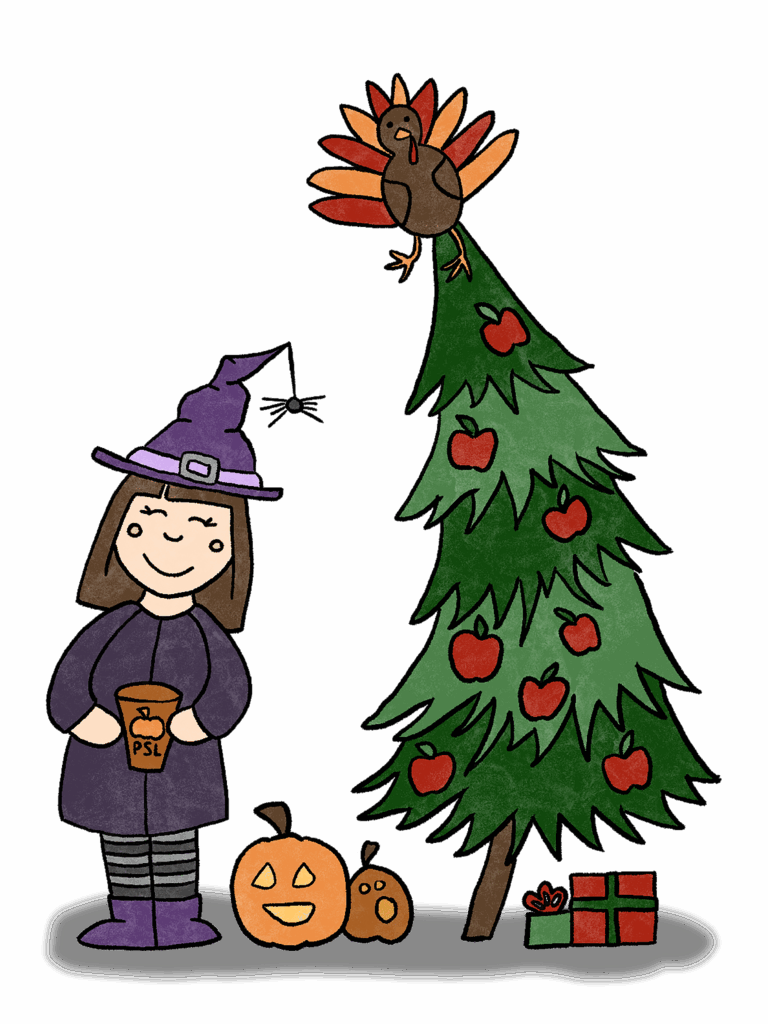
With streets and storefront windows full of perfectly-painted ceramic pumpkins, seasonally spiced lattes and witches’ wardrobes, fall is the best season of the year. When the weather starts to turn, the leaves begin to change to auburn and Pillsbury jack-o-lantern cookies make their way back to the shelves, the air gets cold but the warm, palpable feeling of joy grows. 

Our capitalistic society has driven the cynic in me to ask: Is this internal sense of “merry and bright” all synthetic? Large corporations have capitalized on both fall’s naturally occurring beauty as well as the calendar’s sequentially smooshed holidays (particularly, Halloween, Thanksgiving and Christmas). I wonder if the driving force behind the cozy feeling of fall is significant — is it merely manufactured as a means to juxtapose shorter, colder, darker days? Does it matter if it is? 

In 2018, Banksy left behind a work of art called “Season’s Greetings.” The piece is spread across the corner of a building, spanning two faces. From one side, you see a small child sticking his tongue out to taste snow that is falling above, with a sled on the ground beside him. On the other side, you see that the snow is, in fact, ash emitted from a flaming dumpster. 

Banksy has an affinity for making social and political commentary, particularly about environmental justice. While this particular piece exemplifies that, it can also speak more broadly to this dichotomy: the natural season of fall — which comes about because of the earth’s rotation around the sun — and the synthetic season of fall — which comes about because cute, warm boots pair so well with a pumpkin spice latte and a brand new orange beanie.

On the one hand, there is the side of fall defined by the dropping temperature and the warming color palette of the natural landscape; on the other, there is a feeling of a change in the seasons of life, which is ushered in every time Target unfurls the year’s news “Spooktober” decor in late August.

In tandem, these phenomena work together to produce feelings about this time of the year: desire for companionship and comfort, feelings of appreciation for the natural beauty and disdain for the near-constant rain. Banksy plays with the relationship between these concepts — how correlated they are and how one often causes the other (and vice versa). 

It is an important quandary to consider as we go about our daily lives: Does this commodification have the capacity to disconnect us from the natural world? Can this lead to an erosion of meaning? Changing seasons always mean time is passing — as we enter the colder seasons especially, we tend to want to hold people closer and appreciate that which is fleeting. We cherish fall because it reminds us that leaves do… well, fall, and nothing is permanent. 

Fall is a time to account for what is real; to sit and shiver and appreciate the beauty that exists all year, regardless of what Homegoods or Target is selling at the time. I think what Banksy was trying to convey is that we should not take this sense of joy for granted: It matters where it comes from. There’s more to fall than capitalism and consumerism — we can enjoy this special season — the coffee and candle flavors that make the fall feel special — while still admiring the natural beauty we’re lucky enough to witness once a year.

Written by: Violet Zanzot — vmzanzot@ucdavis.edu

Disclaimer: The views and opinions expressed by individual columnists belong to the columnists alone and do not necessarily indicate the views and opinions held by The California Aggie.

‘No Kings’ protests: grassroots movement or feckless centrism?

0

A progressive movement requires more than faux-radical sloganeering

By THEO KAYSER — tfkayser@ucdavis.edu 

Nationwide “No Kings” protests were held on Oct. 18, including here in the City of Davis. These protests followed demonstrations (which took place under the same name) earlier this year — both of which were aimed at the Trump administration’s actions since entering office in January. 

The event boasted over 7 million attendees across all 50 states, totalling 14-times the size of the crowd at President Donald Trump’s inaugurations from 2016 and 2024 combined. The alleged goal of this movement was to condemn President Trump’s heavy-handed approach to executive power, which he’s taken in spite of widespread dissent. 

In today’s era of consistently low voter turnout, these widespread mass protests are an encouraging sign of a politically rejuvenated American population — at last willing to attempt to mobilize against the wrongdoings of the United States government. However, this political angst in and of itself is not enough to create progressive change. 

While this energy and enthusiasm is admirable, in order to generate real change we should carefully inspect the issues at hand, and make sure not to fall into the trap of scapegoating issues of deportation, genocide, corruption, homlessness and food insecurity as being the fault of one man: “King” Trump. 

The foremost reason for skepticism of these protests is their proximity to the Democratic Party — especially members whose own policy records align quite closely with many actions being taken by the Trump administration — which they claim to vehemently oppose. 

One among several vocal proponents for attendance at these protests was the Democratic Party’s presidential candidate in 2024, Kamala Harris. Harris, as Vice President and “Border Czar” from 2020-2024, oversaw the detention of upwards of 3 million immigrants in her own right. For those rightfully condemning the more overt and publicized Immigration and Customs Enforcement (ICE) raids that have occurred in recent months, these metrics might also be relevant to examine. Immigration has long been a method of scapegoating in American politics, and attributing this systemic issue to the presidency of one man is infantile. Demonizing marginalized groups in this way has routinely been a political strategy of the Democratic Party, and only seems to become an issue when it’s the other team committing the evil.

The term “No Kings” takes direct aim at the authoritative, decidedly undemocratic nature of Trump’s presidency. 

In doing so, it crucially dodges poignant criticism of any material issue. Of all the things to take issue with in Trump’s regime, the haste of action is a baffling choice — If you’re in the Democratic Party, you can’t criticize the true evil he’s committing without condemning policies you yourself supported just a year ago. 

The No Kings platform does not specifically take aim at anything that Trump is doing with this authoritarian power. I might assert this is because officials who are propping up these protests (Kamala Harris, for example), wish to co-opt society’s political frustration and funnel it into support for their party just to do the same thing more discreetly. 

This gameplan for the Democrats is nothing new. In 2008, a vote for Barack Obama was advertised as the “Audacity of Hope” while in actuality, a vote for Barack Obama was a continuation of misguided foreign wars and siding with big banks in a moment of financial collapse. In 1992, a vote for Bill Clinton was a move left from Ronald Reagan and George H.W. Bush — two of the most violently imperialist presidents in U.S. history. The result was a furtherance of austerity measures and the crown jewel of U.S. neoliberal trade policy: the North American Free Trade Agreement (NAFTA). In both cases, Democrats took political unrest aimed at Republicans and falsely advertised themselves as bringers of change. I see little indication of today’s Democratic Party being any different.

Any of those aspiring to create a meaningful progressive movement in the wake of the horrors which surround us should be certain to not allow enemies of the cause to fester within its walls. An optimistic view of these protests is a slippery slope towards our perception of a country unified around the ideals of democracy and independence it was founded on — as opposed to one ideologically dominated by a class more interested in self preservation than the common good; I am skeptical.

Written by: Theo Kayser — tfkayser@ucdavis.edu

Disclaimer: The views and opinions expressed by individual columnists belong to the columnists alone and do not necessarily indicate the views and opinions held by The California Aggie.

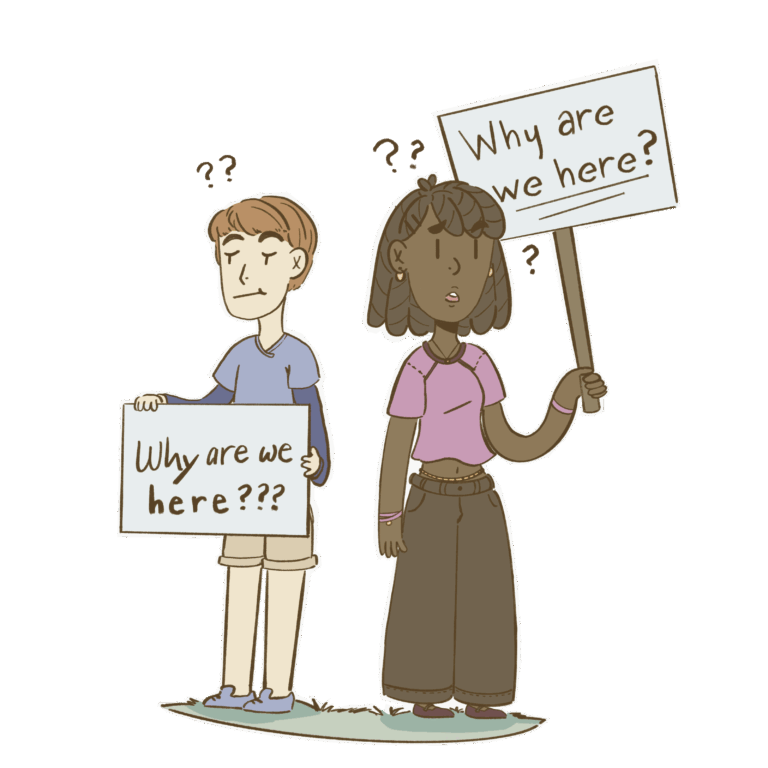
The monocultural tendencies of international students

0

The explanation behind their culturally homogenous cliques

By ANJALI IYER — amiyer@ucdavis.edu

I spent the week leading up to my first day of classes attending a series of tedious orientation activities for international students like myself. As the days went on, I began to notice a peculiar pattern amongst my fellow foreign peers: the rapid formation of monocultural cliques.

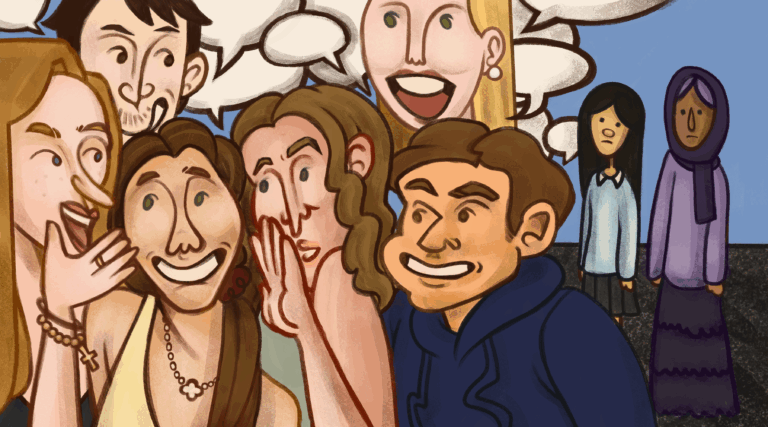
There was a palpable force of attraction between students from the same country that alienated outsiders like myself; my best efforts to start conversations with other foreign students were often met with one-word answers or uncomfortable silence. As I became increasingly familiar with the sting of exclusion, I began to wonder if the separation between American and international students was a conscious choice, or if it was the result of greater cultural implications.

After a few weeks of wallowing in my feelings of dejection, I realized that this phenomena wasn’t personal disdain towards me. I recognized that this monoculturalistic behavior among the other international students was the result of a natural human desire for comfort in an unfamiliar environment. I had the privilege of growing up in an English-speaking country surrounded by American media, and even then, moving to the United States was a huge culture shock — the addition of a language barrier would have made branching out even more challenging.

The persisting cultural divide between international and domestic students also seems exacerbated by how different countries have vastly different views of the experience of higher education. The stereotypical American “college experience” emphasizes socialising through clubs and parties in conjunction with pursuing a degree.

In my experience, an international student’s expectations of college life stems from preconceived ideas formed at home. The goal of obtaining a university education is just that: to get a degree in pursuit of a future career. Social endeavors are seen as mere distractions. When I realized I wanted more from college than simply a means to a career (as I had been taught it should be), I felt isolated: Was it too late to find my community?

After months of conversations fielding questions about Singapore (most of which consisted of explaining that it wasn’t in China), I felt fatigued by the mere prospect of discussing anything to do with my background. Before long, I could predict that conversations about my hometown would devolve into me refuting the archetypical portrayal of Singapore in “Crazy Rich Asians.” 

Over time, I understood why so many international students choose to connect with students of a similar background — more profound than the mere annoyance of navigating superficial misunderstandings, finding domestic students who could relate to the loneliness of the international student experience felt impossible. At their core, these cliques are just another example of people finding a community built on shared experiences. 

I’ve known I was going to emigrate to another country since I was a child. The prospect of eventually leaving home to pursue a college education was an open topic of conversation at home; still, I found myself mourning my past life after the initial excitement of a new, exciting place wore off. 

Despite an (admitted) lack of international student friends in my life, I still feel connected to other foreign students through the shared struggle of finding identity in a new country. While it’s easy to view monocultural cliques as purely an internal problem, in reality, they’re a reaction to being thrust into an uncaring, unfamiliar host country. While I still believe that college provides a unique opportunity to meet a diverse range of people and vehemently adhering to cultural homogeneity is a waste of this experience, I occasionally envy the stability these groups seem to have amidst the chaos of college. There is comfort in the unspoken shared understanding of a unique experience.

Written by: Anjali Iyer — amiyer@ucdavis.edu

Disclaimer: The views and opinions expressed by individual columnists belong to the columnists alone and do not necessarily indicate the views and opinions held by The California Aggie.

Bring back learning language through phonics

0

America’s children can’t read: readoption of phonics might be a solution

By SABRINA FIGUEROA — sfigueroaavila@ucdavis.edu

We can’t ignore that the current level of literacy within the United States — especially among the younger generations — is inadequate. In 2024, the Nation’s Report Card found that 40% of fourth graders and 33% of eighth graders scored below their specified reading levels, each two points lower than the scores in 2022 and five points lower than the in 2019. In California alone, 54% of fourth graders and 52% of eighth graders failed to meet their reading standards on state testing exams from the 2024-2025 school year. 

While recent low reading scores have been credited to the COVID-19 pandemic, these results have been present for the past two decades — especially among Black and Latino students — indicating that there’s something much deeper at play.

The loss of instruction through phonics, a method of reading and writing that focuses on the relationships between letters and sounds, is currently the key reason as to why reading levels are so low. This technique lost popularity in the U.S. by the 1980s, as the “whole language” model became more prominent in schools. The whole language model’s focus is on the memorization of words, encouraging students to use context clues to infer their meanings. This strategy, unlike the phonic methods, fails to create a good foundation for learning new words and how to speak and spell.

The question of which method should be used has been highly debated across the country and dubbed “The Reading Wars.” This topic sparked further conversation this year, as AB 1454 — a California bill encouraging state schools to adopt more phonic-focused reading curricula and guaranteeing increased funding for the transition — was passed and approved by Governor Gavin Newsom. 

Many proponents of the bill based their arguments on research that students learn to read much better when they know the phonological aspects of letters. Conversely, using the “whole language” model creates a guessing-game that doesn’t help students when they encounter a new word they’ve never seen before, causing them to fall behind in other subjects beyond language arts, like math, science and history. As kids move on to higher levels of learning, educational content becomes more complex. If they don’t have the skills to comprehend written language outside of what they’ve memorized, learning more demanding skills like critical thinking, problem-solving, essay-writing and data interpretation become even more difficult; language is used to communicate all types of intelligence. 

Before the bill guaranteed funding, opponents of the bill, such as the California Teachers Association (CTA), mainly argued that transitioning over to a new literacy framework would be too expensive and that it would disregard the needs of English learners. Members of the CTA argued that “reading programs that are heavily focused on phonics are too narrow and confusing for students who struggle with English, especially if they can’t understand what they’re reading,” according to an article by CalMatters.

Learning to read English relies on more than just understanding what words mean. Each language will have its own set of phonemes, so learning English phonetics still has value to non-English speakers when they are constantly encountering words that they will not only read, but write and speak. 

As someone who was an English Language Development (ELD) student until the fifth grade, learning phonics was crucial to my English fluency. It set up a foundation to learn everything else about the English language, including meaning and context. This debate should not be about picking a side — phonics-only or whole language-only — it’s about finding a balance between phonics, semantics and comprehension of larger texts.

Though the research, or “the science of reading,” in which this bill has been based will always be debated, refuted and improved upon, it doesn’t mean the current system should resist change. The government has funded studies that show the positive impact of phonics on reading for decades, yet action to improve the actual system has been scarce. Clearly, the long pattern of low reading scores signifies that we must revise the way we teach kids how to read, and we shouldn’t wait it out any longer. Children completing their education continue to suffer the costs while we continue to stand still.

Literacy is crucial for learning and navigating the immense amount of information — some fabricated or manipulated — that we are exposed to. Reading is important for the overall development and education of future generations, including lowering rates of incarceration and poverty. This is not simply an education debate; it has nuance and disparities based on class, race and ethnicity, making it a civil rights issue too.

This new legislation won’t mandate phonic-based curricula all over the state, but it will encourage it. Other states like Mississippi and Louisiana have been able to successfully implement and mandate this kind of curriculum. As a result, they have seen improvements in their reading scores, which alone is reason enough to be excited for this effort. 

Still, the work is not over. Let this serve as a wakeup call for everyone in the U.S. — if we want to make a better future for our children, it’s time we start focusing on the fundamental issues within their education. Literacy is an important skill not just for academia, but for navigating our world at large. As our political climate becomes increasingly complicated to parse, these basic skills likewise become paramount. This is bigger than elementary education — it affects the integrity of our society as a whole, and we need to treat it as such.

Written by: Sabrina Figueroa — sfigueroaavila@ucdavis.edu

Disclaimer: The views and opinions expressed by individual columnists belong to the columnists alone and do not necessarily indicate the views and opinions held by The California Aggie.