53.8 F
Davis

Davis, California

Friday, December 19, 2025
Home Blog Page 4

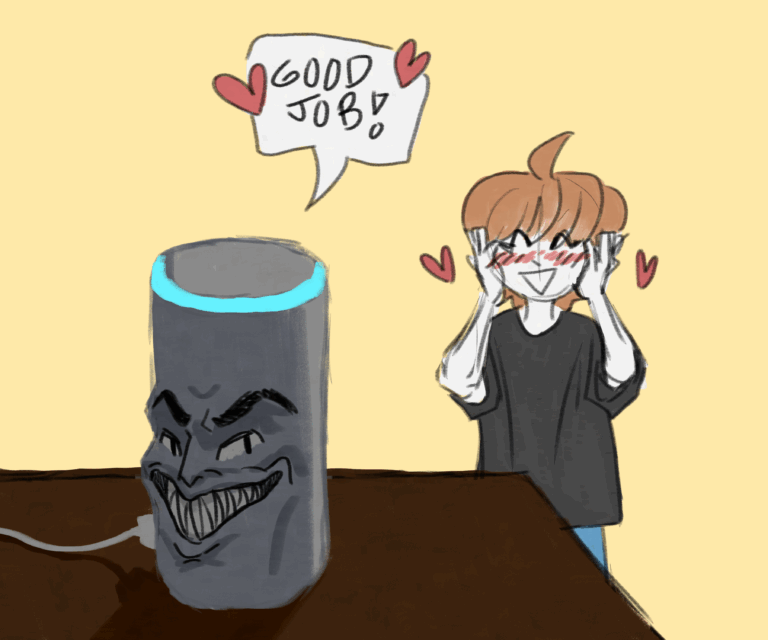
Ditch your homepod

0

We’ve spent millennia seeing spirits in nature — now we’re filling the void with Alexa

By MILES BARRY — mabarry@ucdavis.edu

David Hume once said, “there is an universal tendency amongst mankind to conceive all beings like themselves, and to transfer to every object those qualities.” 

If you’ve ever named your car, kicked a broken vacuum or yelled at a dysfunctional television remote, you’ve felt this urge. 

Anthropomorphizing is defined as “the tendency to imbue the real or imagined behavior of nonhuman agents with humanlike characteristics, motivations, intentions, or emotions,” according to PubMed. It can serve as a useful heuristic when attempting to understand complex systems; it’s easier to imagine your thermostat “wanting to” increase the temperature than to understand its complex mess of wires. Psychologists and cognitive scientists are divided on the evolutionary reasons for anthropomorphism, but they generally agree that it’s hardwired into the human psyche.  

In fact, some scholars believe that this impulse led to animism — a pre-modern belief that non-human things have souls. Before we had scientific explanations for natural phenomena, anthropomorphism meant seeing human-like beings everywhere; trees and streams were cared for by friendly spirits, natural disasters meant the gods were angry and, according to anthropology professor Christine VanPool, even clay pots “had a spiritual essence that is affected by and that impacts humans.” 

All this to say, we see human traits in everything: in our fickle bicycles, irritating electric toothbrushes and trustworthy hammers. Humanity collectively yearns for the time when our world was enchanted; when we could speak to a clay pot and it would answer. 

This desire for enchantment is the driving force behind the effort to make computers conversational. Because of our instinct to anthropomorphize inanimate objects, projects like Amazon’s Alexa, Apple’s Homepod and Google Home are easy sells for executives and consumers alike. Tech companies use this blurred line between user and device to sell you machines that will re-enchant your life. 

Clifford Nass argued in 1994 that computers are social actors — he found that computer-literate college students would treat speaking computers according to gender stereotypes, follow politeness norms with them and respond well to their praise. Paying careful attention to the language humans use to describe computers reveals further tendencies to humanize: we “interact” with computers, they have “memory,” they are “intelligent.” We’ve also begun to describe our own brains in computer terms, saying things like “I’m still processing that” or “that’s just how I’m wired.” Now, with the continued development of artificial intelligence (AI), it’s never been easier to speak with a computer. 

But re-enchantment, when cynically abused by profit-seeking tech companies, is dangerous. For one, David Hoffnes, a professor at Northeastern University, said that smart devices “allow nearly any company to learn what devices are in your home, to know when you are home, and learn where your home is.” 

Beyond tracking, these devices are also listening. The Verge reported in 2019 that anonymized Alexa audio recordings are reviewed by a small army of human workers — if the device is activated by mistake, a stranger could hear some of your most intimate moments. I wouldn’t trust Amazon — the company with “a sophisticated, secret program and team to spy on its workers in closed Facebook groups” — to use its microphone-equipped devices responsibly.  

Smart devices also reinforce gender stereotypes by defaulting to female voices for subservient roles. Derek Connell, senior vice president for search at Microsoft, told the New York Times that “both men and women prefer a woman, younger, for their personal assistant, by a country mile.” Siri used to respond “I’d blush if I could” when users verbally abused her — reinforcing that female-voiced entities should tolerate, and even enjoy, abuse. 

Letting smart devices infiltrate (or “re-enchant”) your home is more dangerous than is popularly believed; it’s a step towards the insidious erosion of boundaries between humans and our tools. Americans are lonely enough that the United States Surgeon General penned an advisory in 2023 detailing health hazards caused by our loneliness epidemic. We’re stuck with tech oligarchs who want you to pay for computer friends, instead of effective policy addressing the epidemic’s root causes — isolated, car-dependent suburbs, dwindling availability of third spaces and a high cost of living. 

When your house can talk to you, agree with everything you say and understand all of your interests, will you still want to go on that coffee date? Smart devices promise convenience, but as they get more intelligent, it will be dangerously easy to retreat into a cocoon of artificial companionship, without any of the work of maintaining real relationships. We may have re-enchanted the world, but we’ve done so in the loneliest way possible.

Written by: Miles Barry — mabarry@ucdavis.edu

Disclaimer: The views and opinions expressed by individual columnists belong to the columnists alone and do not necessarily indicate the views and opinions held by The California Aggie.


The resurgence of the 2000s

How nostalgia has become our quiet rebellion

By NEVAEH KARRAKER — nakarraker@ucdavis.edu

Second-hand clothing, once frowned upon, has now become aspirational — the targeted style exudes nostalgic mid-90s to early 2000s vibes. Presumed iPad-raised generations have now openly adopted flip phones, along with other forms of older technology. Everything appears to have inverted.

This sudden desire to go back in time is a counterintuitive act of rebellion. In our unprecedented, advanced civilization, the consumerism and profit-driven culture we reside in cultivates a stingy attitude, rather than authentic experiences.

There is indeed truth behind the cliche phrase “things aren’t how they used to be.” The nationwide aesthetic changes experienced in the last decade have ripped the brightness out of life. Houses, once architectural masterpieces, are stripped of their beauty and transformed into bleached boxes, saturated with plain IKEA furniture. Logos have lost their enticing charm, as walls are repainted gray and McDonald’s colorful playgrounds are uprooted. Where once children’s laughter mixed with the scent of fresh air, stretching into late afternoons of scraped knees and explored trees used to define our days, we now spend our time glued to our phones or alone in our rooms.

Social media algorithms prey on the addiction of users, who watch their lives being played out by influencers. Clothing that provides toddlers overly-mature styles is mass produced, becoming tattered in a year due to its low-quality material. Minimalism can’t possibly showcase the great depths of the human mind and its limitless creativity, like the kindergarten paintings laid to dry on metal racks, where messy swirls of color were unguarded masterpieces. Technology cannot replace the tangible interactions with others, nor the adventure of aimless wandering in nature.

Our parents’ houses are full of shelves brimming with memories of travel, spontaneous walks with friends and life events preserved in photo albums and scrapbooks — physical souvenirs. Yet our own shelf is empty with the hope of experiencing all the variety and shades of life, as concert tickets are emailed and baby photos are electronically shared.

The glossy sameness of modernism contrasts with the diverse, chromatic atmosphere that existed in the 90s and early 2000s. That’s why we’re so obsessed now with film cameras, camcorders and blurry editing on professional photos; it feels like memories, and is a more visceral representation than Snapchat filters. The unfathomable jubilation of juvenescence continues to blanket us as we forgo walking barefoot on country trails and face the cusp of adulthood.

We remember our past — our childhood — through glimpses of faded sun and fuzzy recollection. The detailed faces of friends long ago have dimmed, and it’s become harder to remember their once chirping voice as it deepens with age.

And, before we know it, we begin to reject the minimalism of today the same way our parents did with the era they grew up in. It’s a repetitive cycle we repudiate — yet, we are all the same. With modernity comes change, and, with change, comes the alteration of the things we cherish the most.

In a parallel universe, we can remain in the sticky heat of August, where board games cluster the dining table, grandparents sing happy birthday and we wake to the solace of mourning doves. 

Through our embrace of vintage styles and retro aesthetics, we long to resonate with the eccentricity of our past and to replicate the luminosity that once inhabited the world. The resurgence of the 90s and 2000s isn’t just a trend; it’s a collective crave for when life felt slower — when it wasn’t filtered through screens or modest branding designed to mute emotion. There’s comfort in the low resolution of faint photos, scratched CDs and dirt under our fingernails.

As the world progresses, our hearts grasp for familiarity. It’s common to endure this, yet it’s also important to balance remembrance with renewal. The past can color our lives so that we forget to be present. There is true beauty in infusing that same nostalgia, vibrancy and intensity into our lives that formerly defined them.

Written by: Nevaeh Karraker — nakarraker@ucdavis.edu

Disclaimer: The views and opinions expressed by individual columnists belong to the columnists alone and do not necessarily indicate the views and opinions held by The California Aggie.

Unitrans and the City of Davis seek feedback on bus routes and schedules

0

The proposed changes affect the A, B, F, G, P, Q and Yolobus 42 routes

By MADELYN SEVIGNY — city@theaggie.org

The City of Davis and Unitrans have invited community members to provide feedback to current services through an online survey and outreach events where locals could learn about the proposed changes and provide feedback. One such event was the Oct. 25 Halloween Block Party, during which the City of Davis and Unitrans were stationed at the Davis Food Co-op to give community members and answer questions and offer in-person feedback. 

The online survey launched Oct. 14 and is open through Nov. 14, allowing residents an opportunity to help determine new routes and schedules starting in 2026. 

These proposals are updates to the current Short Range Transit Plan (SRTP), where Unitrans and the City of Davis review bus services and propose improvements every 10 years. This current SRTP began in 2024 and is set to continue until 2031.

Jennifer Donofrio, the senior transportation planner for the City of Davis, described how the proposed changes were made in collaboration with the city, Unitrans and their consulting team.

“[The consulting team] helped create the proposed changes based on feedback from Unitrans and feedback from the city,” Donofrio said. “They did an analysis of the system, they rode the bus […] and we provided a lot of data to them. [..] And, from there, they’re figuring out  ‘Okay, well, here’s how people in Davis move. Here’s how people are moving on the Unitrans buses.’ Now, how can we build a system […] based on that data that they collected?”

Donofrio also explained what factors are taken into consideration when making proposals.

“We look at walkability, […] how close everyone is to a transit stop,” Donofrio said.
”We look at potential and new development, […] where Davis is growing, and then the density of Davis, different demographics. […] We want to make sure that we’re putting the routes where people live.”

 The most recent draft recommendations will continue to be updated based on the feedback provided in the survey and through in-person events. The project is expected to be pitched to the Davis City Council in the summer of 2026, and the changes, if approved, will be implemented in the fall. 

The goals of the current recommendations are to provide expanded service hours on weekends and more efficient routes for the community, according to the City of Davis website

Here are the current proposed route and service hour changes:

In East and South Davis, proposed changes include routing the P and Q lines to no longer operate south of Interstate 80 and, instead, operate on the north side of the freeway on 2nd St. and 5th St.. This change would discontinue the A line and introduce new S and O lines to serve South Davis. 

In Central Davis, the B line would be discontinued, replaced by the G line between Russell Blvd. and Alvarado Ave. moving from Anderson Rd. to Sycamore Lane. 

The F line would be routed onto Catalina Drive, providing two-way service on 14th Street and F Street. The new R line would serve the area near Anderson Rd. and Alvarado Ave., which is currently served by the F line.

Finally, Yolobus Route 42 would serve Sutter Davis Hospital on John Jones Road. Service hours would also be expanded on Friday, Saturday and Sunday, moving the last departures to later times than they are currently scheduled. 

Eric Wang, a third-year electrical engineering major and a driver for Unitrans, explained how the changes to routes and schedules would affect Unitrans employees. 

“If you introduce new routes and you change the current routes […] most employees […] have to be trained on any new routes or changes that are implemented,” Wang said. “So all employees will likely have to go through a refresher or retraining process to get used to the new routes.”

Unitrans General Manager Jeff Flynn commented on how the changes to services have to be made without any additional funding.

“The short range transit plan is only addressing this key scenario of status quo funding,” Flynn said. “Unitrans is a really well used and often overcrowded public transit service. And unfortunately, there’s not funding available to expand service. So [what] this plan is really looking at [is] what are our current challenges and how do we best address those challenges within the current resources that we have today.”

Flynn shared how recent changes were made to services based on public outreach, which was conducted as part of the SRTP in fall of 2024.

“In winter we actually reallocated [based on survey results], and put more service into West Village,” Flynn said. “So that was [a] place where we immediately responded and were able to do something with the survey results.”

To review the proposals and provide feedback on Unitrans services, take the survey on the Unitrans website.

Written By: Madelyn Sevigny — city@theaggie.org

MENASA Resource Center to hold grand opening on Nov. 19

The Middle Eastern, North African and South Asian Center recently relocated to the second floor of the SCC

By KHADEEJAH KHAN — campus@theaggie.org

UC Davis’ Middle Eastern, North African and South Asian (MENASA) resource center is moving up — literally. 

The retention and cultural center is currently in the process of moving into a new space on the second floor of the Student Community Center (SCC), in an effort to provide students with community and a greater sense of belonging.

The center was established following advocacy by the Middle East/South Asia Studies Program (ME/SA) post-2001, which was a student and community-led effort to address the need for greater academic, social and campus support amid increased discrimination of Middle Eastern and South Asian students, staff and faculty. MENASA did not have a formal space prior to the move, but held on-campus events and connected students to campus resources and staff.

MENASA is one of UC Davis’ Community Resource and Retention Centers, which are dedicated to providing resources, programs and opportunities for students to help them develop personally and professionally. Other centers include the Center for Student Involvement, the Cross Cultural Center, the Undocumented Student Resource Center and the Women’s Resources and Research Center. 

“The center’s mission is grounded in providing holistic support for students,” MENASA Director Affaf Waseem said. “We enhance the student experience by offering engaging programs that foster skill building, knowledge development and meaningful connections within the campus community.”

MENASA held a soft opening at its new location on Oct. 29 with a Kulfi social to celebrate the move and welcome new visitors. By offering Kulfi and other cultural snacks, Waseem believed the event reflected Middle Eastern and South Asian hospitality culture in welcoming guests. 

“We wanted to anchor the celebration around something sweet,” Waseem said. “In many cultures and communities across Southwest Asia, North Africa and South Asia — regions that are known for hospitality culture — offering sweets is a common way to share joy, express goodwill and welcome guests with appreciation and warmth.”

The official grand opening and ribbon cutting ceremony for the MENASA Resource Center will be on Wednesday, Nov. 19 from 4 to 6 p.m. MENASA will be welcoming alumni, community members and special guests to join the celebration alongside refreshments and prizes.

For MENASA’s Outreach Coordinator Hasti Sharif, a second-year international relations and ME/SA double major, the new space represents more student connection. In her first year, Sharif worked as a MENASA intern and attended MENASA’s leadership retreat at UC Riverside.

“[The new space] is just going to be a lot more engaging and collaborative,” Sharif said. “We’re just going to be way more involved with students now, since we get to have one-on-one talks through the center. Having a space just opens up a lot of possibilities for us, which is a very exciting thing.” 

Waseem echoed the sentiment, noting that he has already received interest in the new center’s space.

“I can already sense the excitement students have when they ask about the opening of the center,” Waseem said. “This new space will allow us to raise more awareness about our work, host impactful programs in a welcoming and comfortable environment and, most importantly, create a space where students feel represented to help them feel a sense of belonging.”

Joumana Khalaf, MENASA’s marketing and communications coordinator and a fourth-year psychology major, says that MENASA’s resources helped her find community as a transfer student. Now, she’s excited to be a part of a space where culture can be celebrated. 

“There’s such a need for a center for MENASA students,” Khalaf said. “It’s great to have a place for them and all communities with MENASA artwork, with chai — with tea — where we can connect with other students and study together.”

Throughout the rest of the school year and even prior to the center’s grand opening, MENASA will be holding a series of Chai Chats to host dialogue and workshops on selected topics. The center will also be hosting Connection Hour events — unstructured times for students to connect with each other and MENASA staff in the space.

The MENASA center will also be holding its annual leadership retreat to engage in conversations centered on a yearly theme. This year’s theme is “Seeds of Us: Cultivating Collective Care,” and explores how communities nurture care and connection. 

To learn more about MENASA and their programming, students can visit menasa.ucdavis.edu or reach out to Program Coordinator Mahum Manan at mmanan@ucdavis.edu

Written by: Khadeejah Khancampus@theaggie.org

ASUCD Senate hears presentation from Manetti Shrem Museum on planned art installation

Senators also heard quarterly reports from Unitrans and Aggie Reuse at their Oct. 30 meeting

By AALIYAH ESPAÑOL-RIVAS and LILY KENROW — campus@theaggie.org

Representatives of the Jan Shrem and Maria Manetti Shrem Art Museum presented to the Associated Students of UC Davis (ASUCD) Senate at their Oct. 30 meeting, discussing a future art installation by artist Woody De Othello. 

The museum representatives discussed current public art throughout campus, including the famous egghead statues by Robert Arneson. They moved on to discussing plans for De Othello’s work, the first public art commission on campus in 30 years, and explored his evolving artistic growth, pulling inspiration and parallels from Arneson. 

Alison Rossi, director of education and community connection at the Manetti Shrem Museum, presented the work along with De Othello’s thought process, advocating for the piece as a perfect fit for the UC Davis campus. The commissioned work is planned to be a 7-foot-tall, bronze sculpture depicting roots and hands holding two embracing figures with trumpets for heads.

“[De Othello has] been very inspired by music, especially jazz,” Rossi said. “But he’s really thinking about the idea of listening and receiving; that shape [of the trumpets is] very much about listening and receiving sound.”

Development and Education Assistant Audrianna Escobedo led a discussion with the senate table about what they would like to see in regards to related events and student group involvement, as well as how the sculpture could become a part of the UC Davis campus experience. 

Multiple members of the table pulled on the theme of jazz that influenced De Othello’s work, suggesting jazz-centered events.

“There is such a very big history with jazz as a musical genre, especially with [regards to] liberation,” Ethnic and Cultural Affairs Commission Chair Mālie Nee said. “I think it would be really good to have a jazz history plus jazz band club kind of night around this.”

Direct involvement with student musicians and the ensemble groups on campus was also pitched.

“I think it would be super cool if we get a student ensemble to perform or perhaps even have some compositional competition,” International Student Representative Robi Castaneda said.

While there is no confirmed location for the sculpture yet, Rossi says that the current projected installation date for the sculpture is in winter or spring quarter of 2027.

Other matters

The senate also heard quarterly reports from Aggie Reuse and ASUCD Unitrans. 

Aggie Reuse Point Director Aradhya Chakraborti, a third-year genetics and genomics major, noted that the store is facing declining donations and visits from students. 

“We saw checkouts peak at the beginning of week two, but by the end of week four there has been a concerning trend of low checkouts and lower donations,” Chakraborti said. “There was so much excitement for the first week that everybody brought in everything they wanted to donate, and now things have gotten super slow because there are less people coming in.” 

Unitrans General Manager Jeff Flynn also discussed enhancements and new records for the unit. Since the start of the academic year, Unitrans has been able to operate at the same service levels as they did in spring quarter 2025 — a post-pandemic first for the unit.

“This is the first year since 2020 when we’ve not had to cut service going into fall quarter,” Flynn said. “Ridership is up 5% compared to last fall and has returned to pre-pandemic ridership. Buses are very full, very crowded.”

Flynn also noted the $0.75 wage increase for current active bus drivers, as well as the 14 new electric operated buses set to be deployed in 2028.

In legislative matters, Senate Resolution (SR) #3 — which advocates for continued support and accessibility of University and ASUCD services for international and non-U.S. resident students — passed unanimously with minimal discussion.

Legislation Tracker

Bill/Resolution # Description Vote
SR#3 An ASUCD Senate Resolution to outline the ongoing institutional, academic, financial and logistical challenges facing international and non-US resident students in UC Davis. Passed unanimously

Written by: Aaliyah Español-Rivas Lily Kenrow — campus@theaggie.org

Thousands attend “No Kings” rally in Civic Center Park

0


By CHRISTIAN CENDEJAS and SACHA CHICKERING — photo@theaggie.org


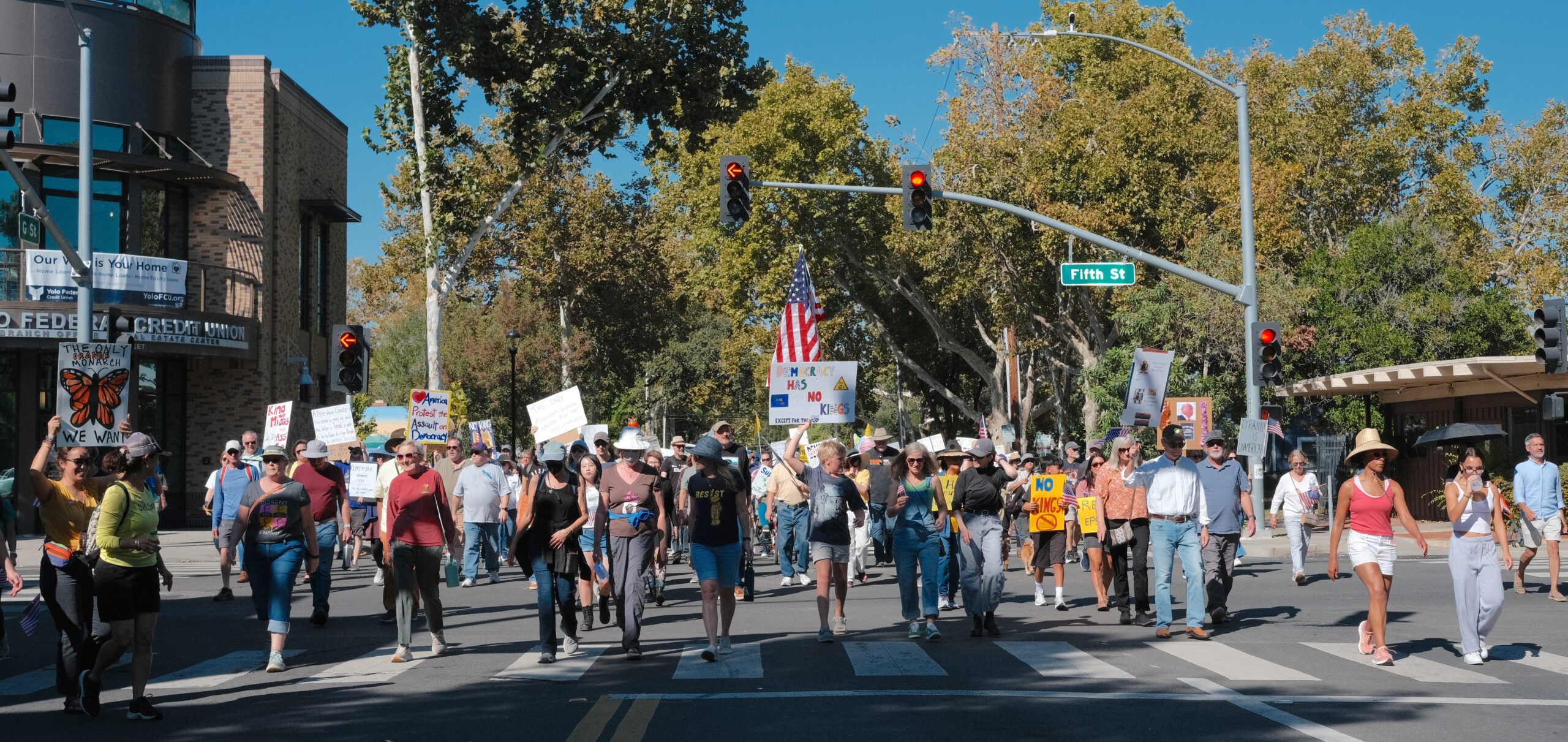
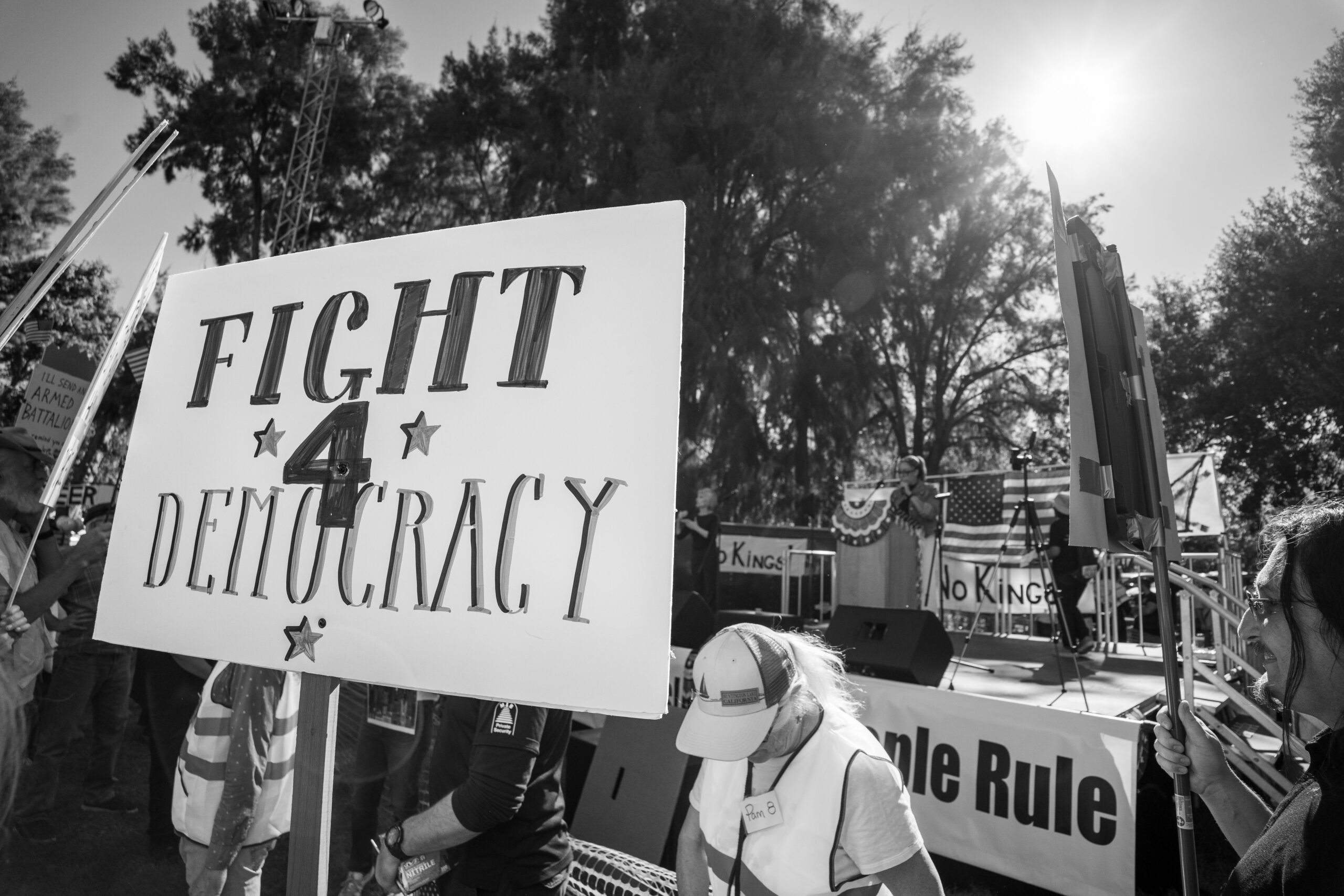
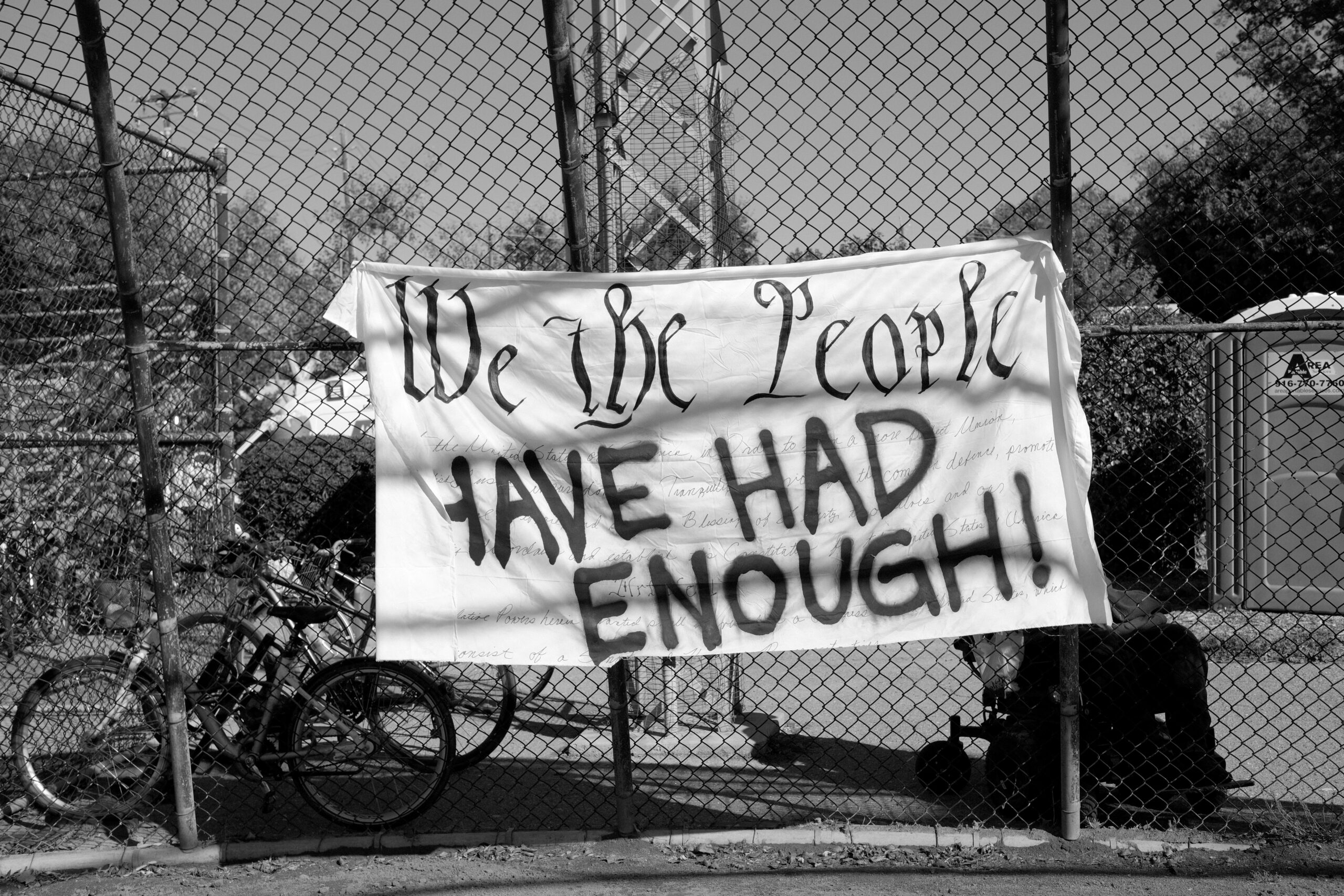
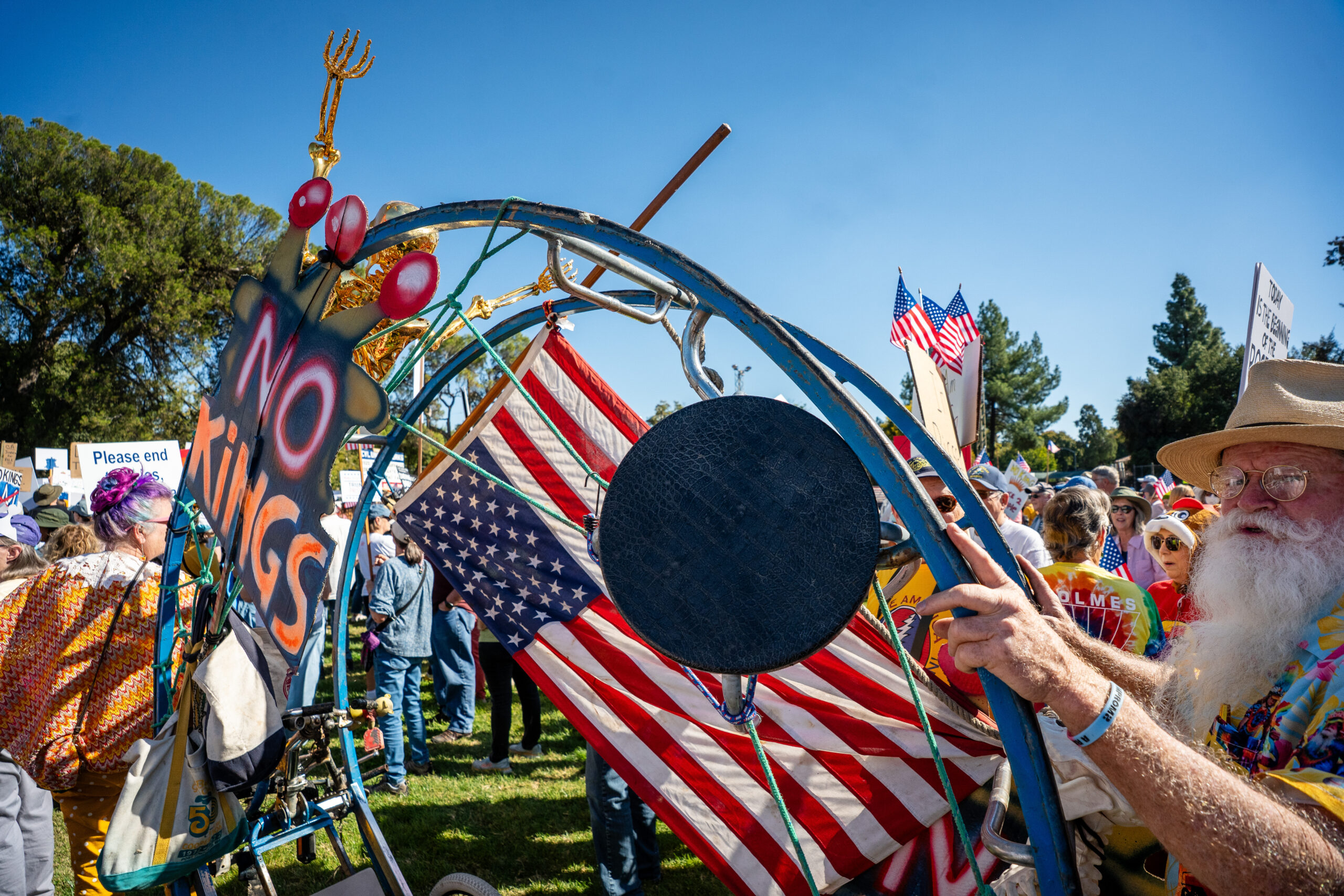
On October 18th, 2025 at around 1:30 p.m., thousands gathered at Civic Center Park in Davis, California for a “No Kings” rally. The rally was part of a greater movement of “No Kings” protests across the country.

Protestors carry “We the People”-themed signs for the “No Kings” rally on Oct. 18, 2025. (Christian Cendejas / Aggie)
A demonstrator pushes a decorated wheel through Civic Center Park for the “No Kings” rally on Oct. 18, 2025 (Sacha Chickering / Aggie)

Protesters marched downtown through G Street and past Central Park.

Demonstrators march down G Street for the “No Kings” protest on Oct. 18, 2025. (Christian Cendejas / Aggie)
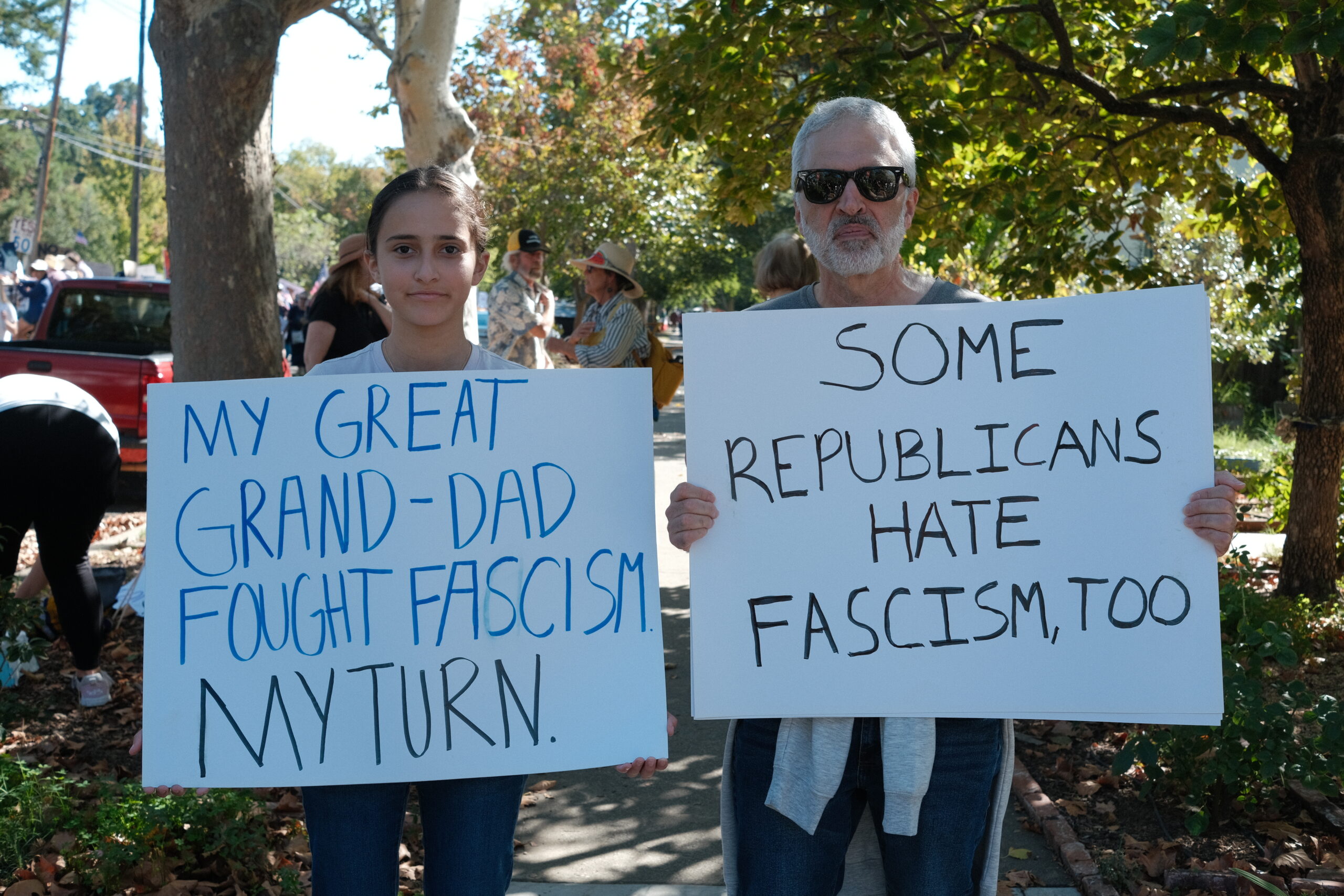
A demonstrator carries a sign at the “No Kings” protest on Oct. 18, 2025. (Sacha Chickering / Aggie)
Protestors display signs for the “No Kings” rally on Oct. 18, 2025. (Christian Cendejas / Aggie)

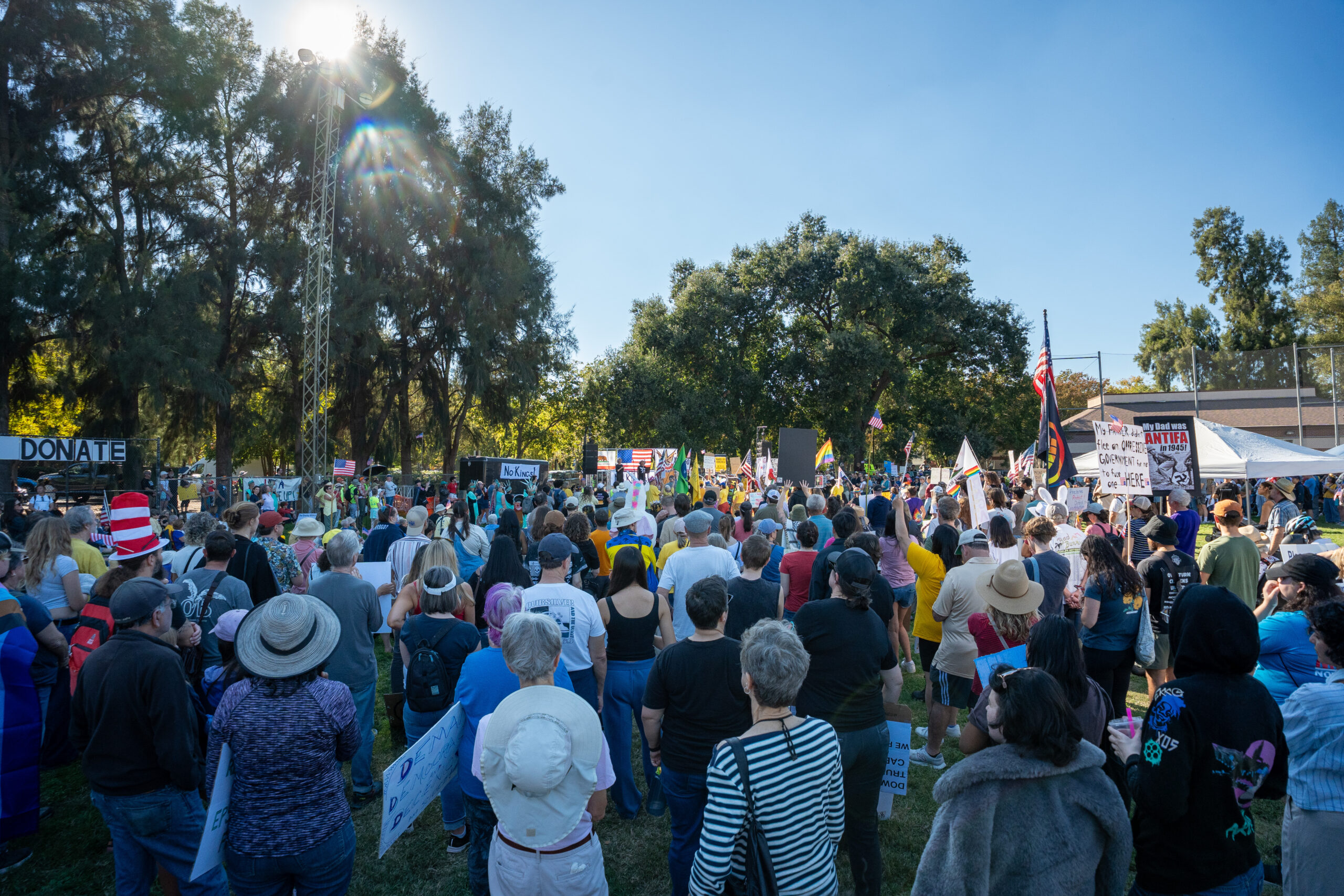
Protesters gathered after the march to listen to speakers deliver messages of resilience and hope.

People gather at Civic Center Park to listen to speakers for the “No Kings” rally on Oct. 18, 2025. (Sacha Chickering / Aggie)
Rep. Mike Thompson (CA-04) speaks to protestors at the “No Kings” rally on Oct. 18, 2025.
People gather to listen to Dr. Dawnté Early, West Sacramento city council member, at the “No Kings” rally on Oct. 18, 2025. (Christian Cendejas / Aggie)
Thomas Alvarez, president of Davis College Democrats (DCD), speaks at the “No Kings” rally on Oct. 18, 2025. (Sacha Chickering / Aggie)
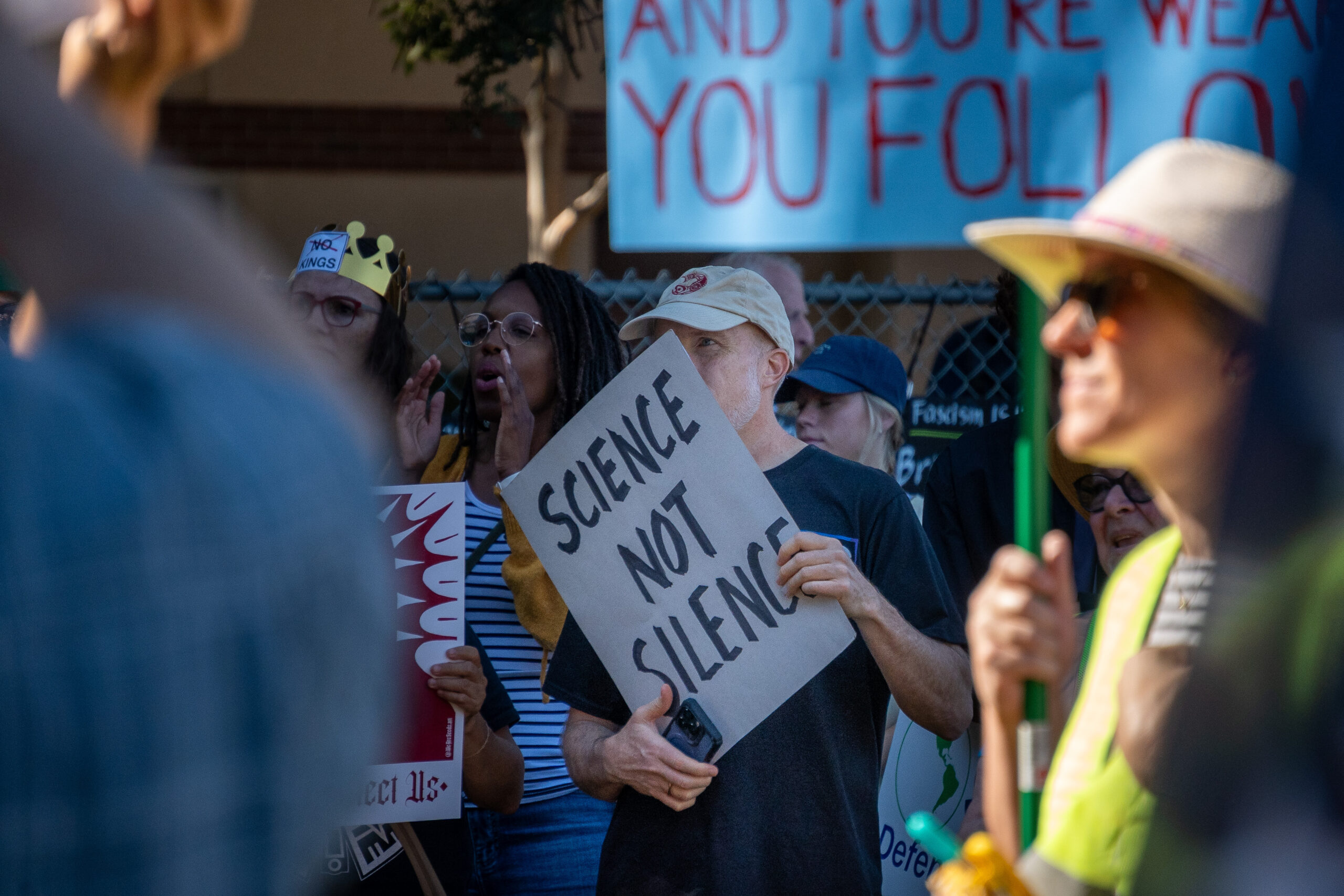
A protestor holds a sign in support of science at the “No Kings” rally on Oct. 18, 2025. (Sacha Chickering / Aggie)
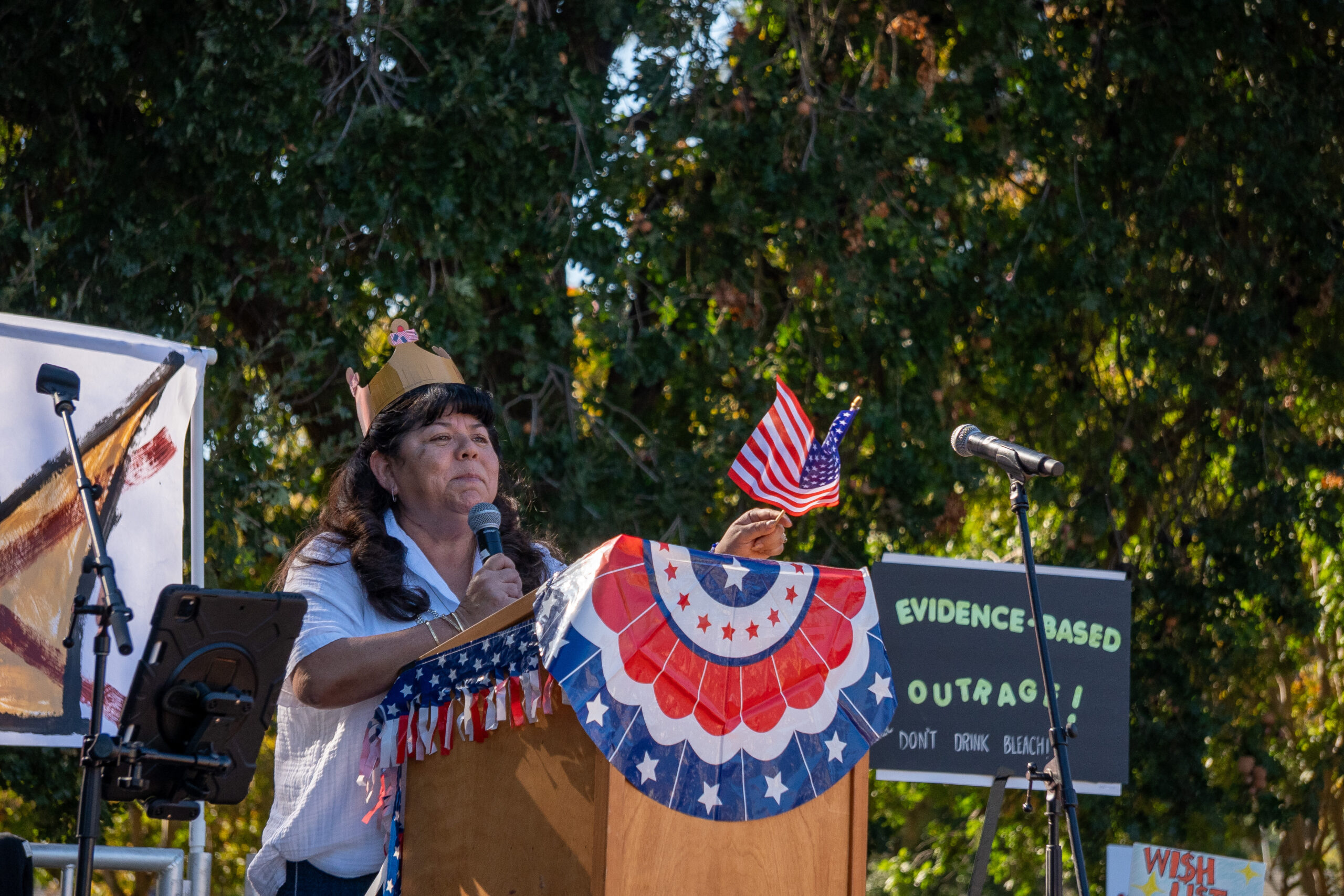
A speaker waves an American flag at the “No Kings” rally on Oct. 18, 2025. (Sacha Chickering / Aggie)

Many protestors showed signs of support for California Proposition 50.

A demonstrator holds a sign in support of Prop 50 at the “No Kings” rally on Oct. 18, 2025. (Christian Cendejas / Aggie)
Prop 50 lawn sign at the “No Kings” rally on Oct. 18, 2025. (Christian Cendejas / Aggie)
A demonstrator holds up a Prop 50 sign during Dr. Dawnté Early’s speech at the “No Kings” rally on Oct. 18, 2025. (Sacha Chickering / Aggie)

Protestors showed support with homemade signs and costumes.

Protestors participate in the “No Kings” rally on Oct. 18, 2025. (Christian Cendejas / Aggie)
Protestors demonstrate support for immigrants at the “No Kings” rally on Oct. 18, 2025. (Sacha Chickering / Aggie)
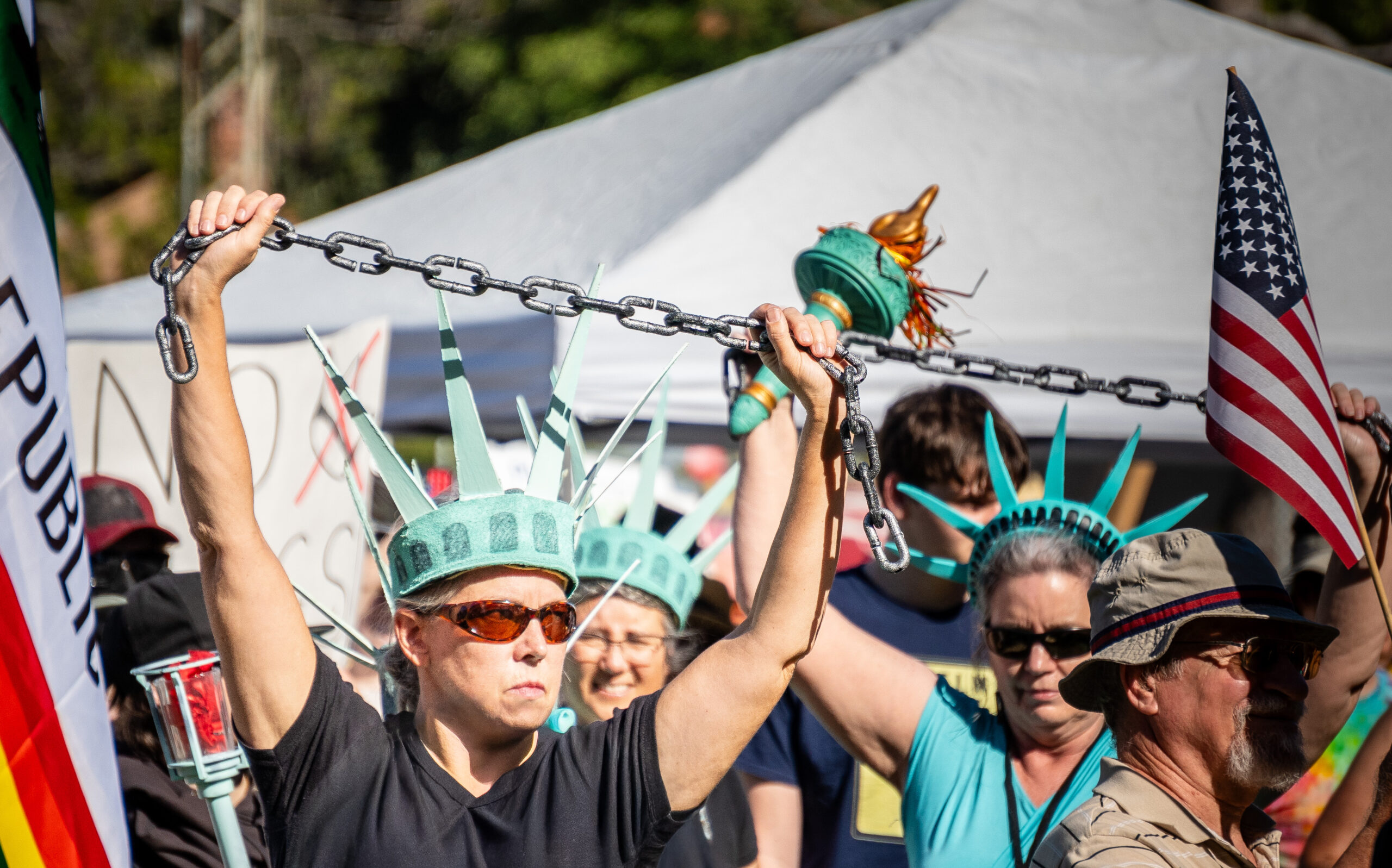
Demonstrators dressed in Statue of Liberty costumes hold up a chain at the “No Kings” rally on Oct. 18, 2025. (Sacha Chickering / Aggie)
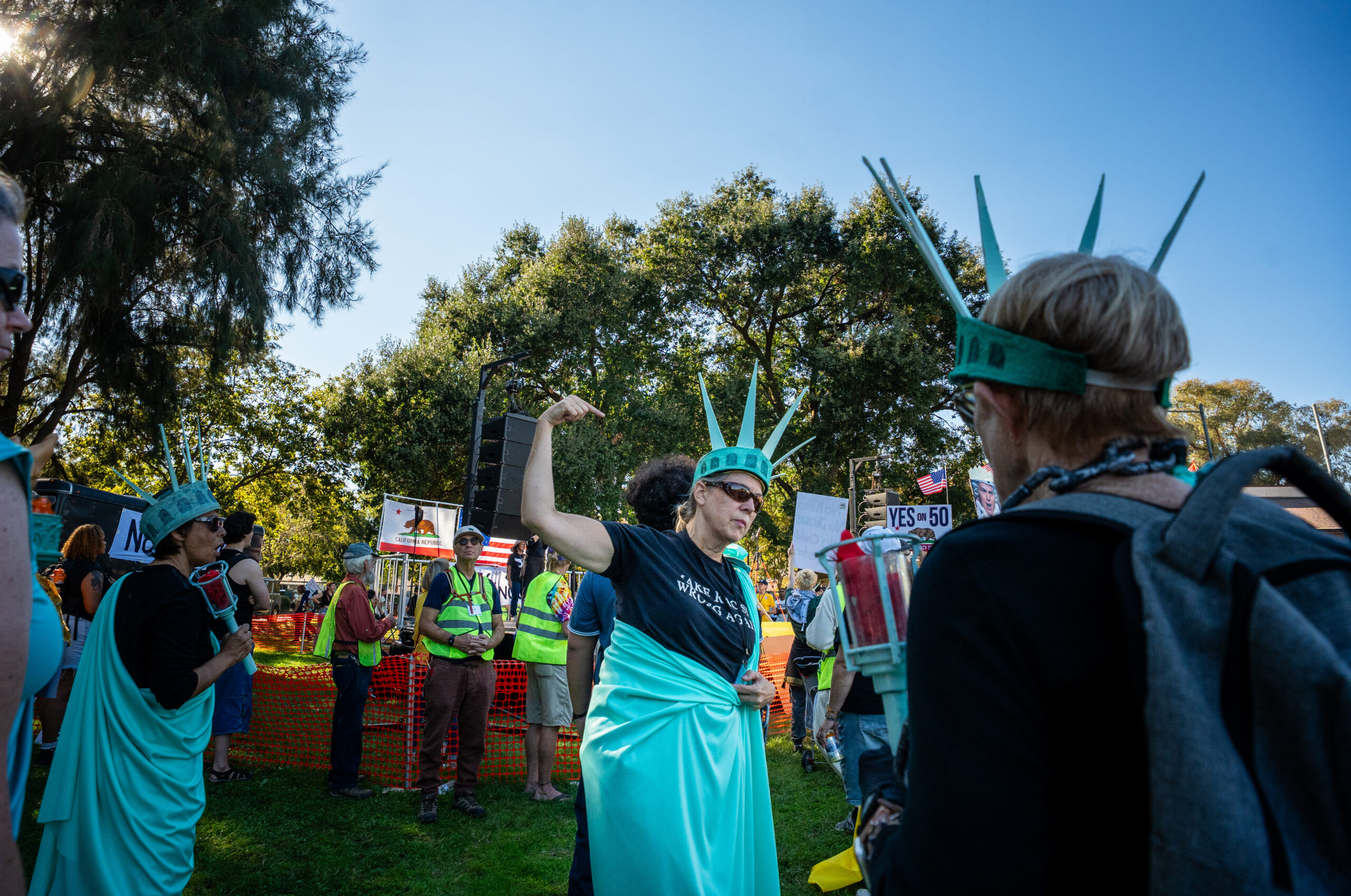
Demonstrators dressed in Statue of Liberty costumes participate in the “No Kings” rally on Oct. 18, 2025. (Sacha Chickering / Aggie)
People attend the “No Kings” rally on Oct. 18, 2025. (Sacha Chickering / Aggie)
A protestor carries a sign at the “No Kings” rally on Oct. 18, 2025. (Sacha Chickering / Aggie)
A bike with the American flag at the “No Kings” rally at Civic Center Park on Oct. 18, 2025. (Christian Cendejas / Aggie)
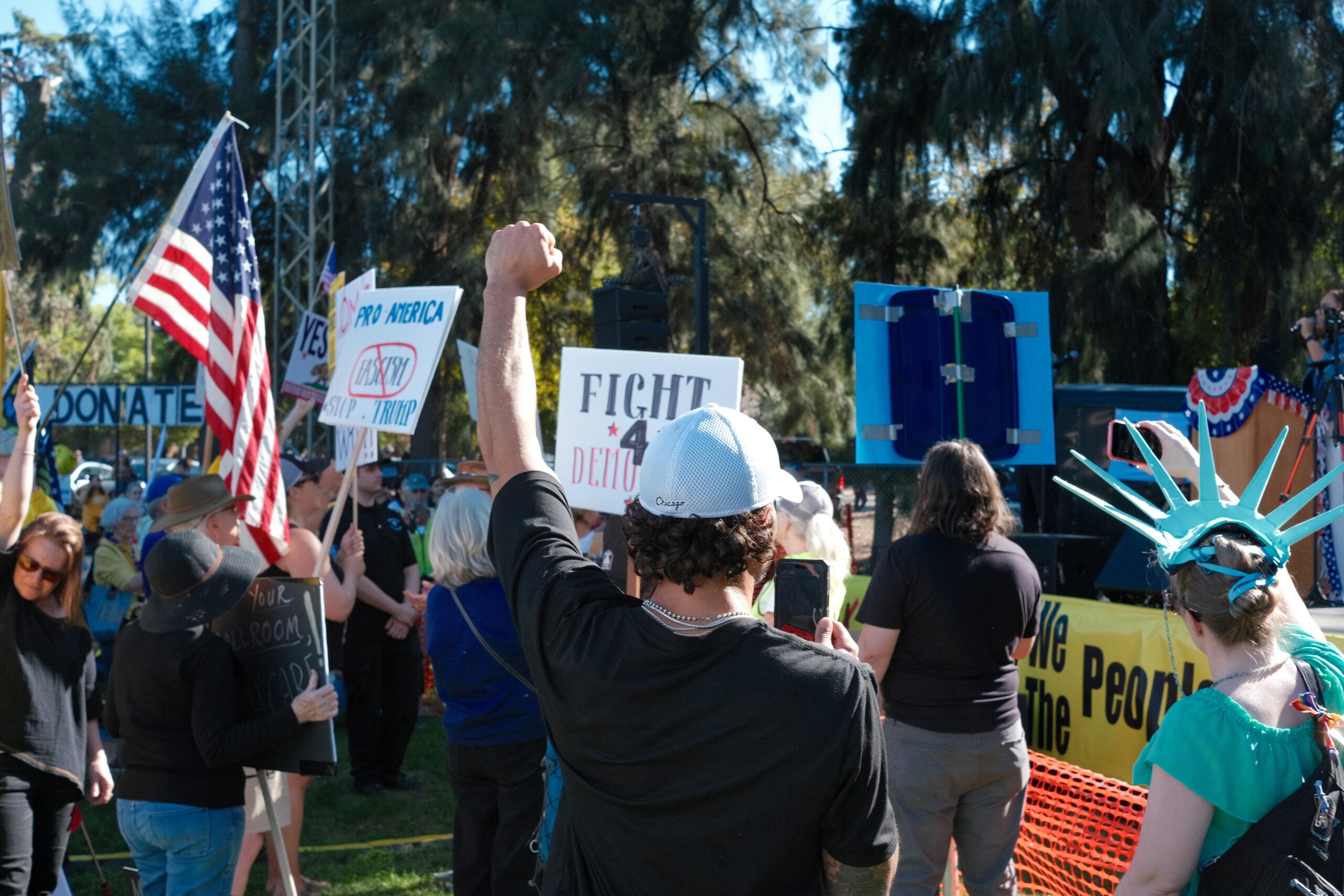
People hold up signs while listen to speakers at the “No Kings” rally at Civic Center Park on Oct. 18, 2025. (Sacha Chickering / Aggie)
A sign hangs on the fence at the “No Kings” rally at Civic Center Park on Oct. 18, 2025. (Christian Cendejas / Aggie)


PHOTOGRAPHED BY: Christian Cendejas and Sacha Chickering — photo@theaggie.org

From high school sports to college athletics

0

A deep dive into the college athletics recruiting process

By MIKALA SLOTNICK — sports@theaggie.org

The professional athletes you see on television have all been recruited in one way or another. Many began playing in elementary school and continued to do so through high school, continuing their sport all the way to college and eventually going on to play for the big leagues. Though there are some exceptions to the rule, such as Los Angeles Angels baseball player Mike Trout, who was recruited out of high school in the 2009 MLB draft, most athletes start their careers playing in college. 

For student-athletes interested in playing on a team in college, the specific division of the university they choose to attend is an important factor to consider. The National Collegiate Athletic Association (NCAA), which is the largest college sports association, has over 1,100 member schools and three different divisions. Each division has a different set of requirements, with Division 1 (D1) being the most popular and the most challenging to get into

Universities such as UC Davis, Stanford and Texas A&M University are all colleges that are part of the Next College Student Athlete (NCSA) College Recruiting, the largest college recruitment organization in the United States. Other sports associations include the National Association of Intercollegiate Athletics (NAIA), which is commonly used for smaller, private schools, and the National Junior College Athletic Association (NJCAA) for students interested in two-year colleges. 

Recruiters gather information about student-athletes using websites such as Rivals, 247Sports.com and NCSAsports.org. College coaches recruit for university-level sports using several methods, including looking through highlight videos and statistics, attending games, showcases and tournaments and contacting the student athlete via email or phone call

Before any type of communication occurs, athletes should do their research about the university and the coach, according to Coaches Insider. This can be done by athletes attending their chosen sports athletic events at the university, reading the coach’s bio or even connecting with other players who are already on the team. 

If an athlete chooses to contact a recruiter or a coach, the NCSA says that “email is the best way to introduce yourself to college coaches.” Social media platforms may also play a role in capturing the attention of potential recruiters. The most popular social media platforms for this purpose are Instagram, TikTok and X. Instagram and TikTok allow potential recruits to upload highlight reels that capture their most successful plays on the court or field, while X is mainly used by coaches to engage and promote their college team. 

When a player sets up their social media platform, athletes may consider including their location, high school/community college/club team, class year, GPA, a highlight video and their NCSA profile, according to the NCSA website. It is also recommended that you dress in the uniform for the sport that you play and include your real name. An important rule of thumb, according to NCSA, is to give credit to the people who helped you, such as teammates or coaches. It’s also recommended to talk about your athletic and academic achievements and showcase parts of your personality outside of the sport. 

Though engaging recruiters via social media is often an effective strategy, it can also be a disadvantage to those who go against community guidelines or the school’s code of conduct by posting vulgar or discriminatory material, political opinions or engaging in any form of online bullying or harassment. 

Once a student-athlete is on the recruiter’s radar, the recruiter typically creates a list of prospective athletes. The recruiters often send out questionnaires, camp invites or recruiting letters. A recruiting questionnaire is a form that prospective student-athletes fill out to share information about themselves with a college program, which can either be mailed or emailed to the student athlete. Filling out this form puts the student’s measurable statistics — such as height, weight, sports played and any connection to the school — into the university’s database. 

 Examples of recruiting questionnaires are the University of Oklahoma softball questionnaire and the Texas Christian University volleyball form. However, it is important to note that when a university sends a student-athlete a questionnaire, it does not mean that they are being recruited; it only signifies that they are on the university’s radar. 

After the initial questionnaire, recruiters will conduct an evaluation that assesses a candidate’s physical ability, coachability and academic achievements. It is in this evaluation that the recruiter will decide whether to extend an offer to play for the team. In most cases, a recruitment offer comes with an athletic scholarship, which helps most student-athletes pay for college tuition. These scholarships range from covering only a portion of tuition to covering room and board expenses. The offer becomes official when the student athlete signs their contract and commits to the university’s athletic program.

While there is always potential to be a Mike Trout, a student-athlete can also be a Jalen Hurts or Aaron Judge, who were recruited from high school to college through these processes. Given the different parts of the recruitment process, student-athletes have a variety of potential paths to playing a collegiate-level sport.

Written by: Mikala Slotnick— sports@theaggie.org

From youth club teams to a semi-professional soccer team, the City of Davis holds ample sports opportunities

0

A peek into sports outside of UC Davis athletics

By DANIELLE WIRNOWSKI— sports@theaggie.org

Davis might seem like a small town — with a majority of the 66,850 year-round residents being students, according to the 2020 census — but there are still sports opportunities for all individuals outside of the university. These can be found in local athletics, in both professional teams and youth leagues. 

The City of Davis is often referred to as “the college town of Davis” and “the biking capital of America;” thus, Davis offers many opportunities for individuals who want to further their biking skills. The Davis Bike Club allows individuals of any age to join, with membership ranging from competition racing to just casual rides. With many ride options offered throughout the week, there is something for everyone.

Other sporting teams found in Davis are the High Wheelers, Football Club Davis (FC Davis), Team Davis, Davis Lacrosse Association (DLA) and many more. 

FC Davis was founded in 2017, giving the City of Davis its own semi-pro soccer team. While it launched the men’s team first, the women’s team soon followed. Team Davis is a non-profit organization to help those who have “developmental, intellectual and/or physical disabilities” participate in “athletic, social, recreational and educational activities,” according to their website. DLA is a part of the Nor-Cal Youth Lacrosse League (NCJLA) and has youth teams for both boys and girls. It has U10, U12 and U14 teams — with future hopes of establishing a U8 team, according to their website — as well as a clinic.  

The Yuba-Sutter High Wheelers, an independent baseball team founded in Davis in 2024, is a part of the Pioneer League — a professional baseball league in the western United States. Despite being currently located in Marysville, they still maintain a community benefits agreement with UC Davis, providing employment opportunities and youth programs.

“People don’t realize that you can come to Davis and get a really great academic degree, but also have a really great sports experience,” Rachel Bronson, the current community relations manager for the Yuba-Sutter High Wheelers, said. 

During their time in Davis, the High Wheelers were a major part of the community during the summer, sponsoring and organizing local collaborations and events.

“We used local partners, we partnered with Woodstocks, the university, we used the university athletic trainers — it was really like one big family,” Bronson said. 

Beyond the High Wheelers, the Davis community still has plenty of other sports opportunities for individuals to get involved in athletic programs and recreational teams in the city. On the student level, local high schools, middle schools and elementary schools also offer opportunities for individuals to get involved. For Bella Gonfiotti, a high school student in Davis, her club team and high school team were both avenues through which she was able to get involved in the community.

“I don’t think I would have interacted with people that were so much older than me and on a regular basis like that,” Gonfiotti said. “There’s opportunities where there wouldn’t be elsewhere. It got me engaged with people around my age, older and outside of my school.” 

Sophia Mattingly, a professor of education at UC Davis and Gonfiotti’s mother, noted how participation in community sports teams is a traditional part of Davis culture.  

“The community values exercise [and] time outside,” Mattingly said. “It is something that the [Davis] community comes together about all the time.”
As the “biking capital of California,” the City of Davis is bustling with activity, offering various opportunities for participation in athletics both in and outside of the university. More information for individuals wanting to get involved can be found on the City of Davis website, under the sports tab. Individuals are encouraged to get involved in sports at any age in Davis, whether it’s through youth clubs or semi-pro teams. 

Written by: Danielle Wirnowski — sports@theaggie.org

Field hockey falls to Delaware in inaugural MPSF championship game

0

Although Aggies scored first, they were unable to equalize after Delaware netted two goals

By COLINA HARVEY — sports@theaggie.org

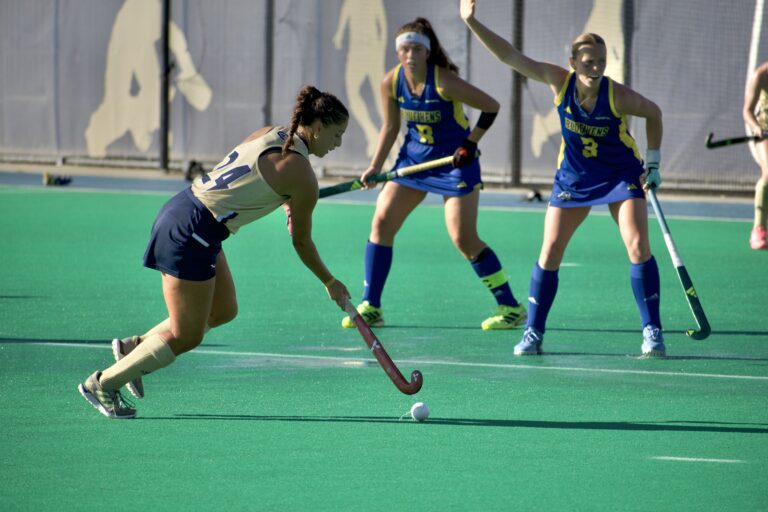
On Nov. 8, the UC Davis Field Hockey team’s season wrapped up with the Mountain Pacific Sports Federation (MPSF) Championship match against the University of Delaware. The game was the first-ever MPSF Championship and was hosted by the Aggies. Although UC Davis fought hard until the end, they fell to Delaware with an end score of 2-1. 

The Aggies struggled throughout the season, finishing with an overall record of 6-10. Although the team faced challenges, they still found moments to celebrate. 

“Our culture was really good this year, just celebrating the small wins. Like, whenever a goal was scored, everyone on the field or the bench is just cheering like crazy,” Karly Redman, a fourth-year environmental policy, analysis and planning major and forward, said.

Redman pointed to the Aggies’ win against Ball State University on Sept. 5 as a special moment for the team. Going into the fourth quarter, the Aggies trailed 1-3. Despite Ball State scoring again in the fourth quarter, the Aggies were able to stay in the game with three of their own goals, tying the game. 

“We took them into overtime, and then we ended up winning. It was just really hype and fun,” Redman said. 

After the regular season wrapped up, the Aggies had a chance to win the inaugural MPSF championship. Although the Aggies came out strong, Delaware responded quickly to their early goal. 

“We ended up scoring first off a deflection goal. That just brought really good energy, and we were winning, but then Delaware ended up scoring two minutes or so after,” Redman said. “They just quickly caught us on our back foot.”

Throughout the match, the Aggies outshot Delaware and remained competitive, but ultimately suffered a loss. The team especially struggled with converting plays and shots into goals.

“We just tried to attack as much as we could, but just came up short,” Redman said. “[We] couldn’t tie it, but […] I just feel like we gave it as much as we could. […] A lot that we focused on leading up to the game, in practice, was converting on our short corners — we just weren’t converting on them. It’s pretty much just a straight shot on goal, and just our set plays weren’t working. I think if we capitalized on those, we could have gotten more goals.” 

Although the Aggies were not able to secure the MPSF championship, many players were given MPSF honors to commemorate their work. Redman won the MPSF Offensive Player of the Year award, and Addy Collingwood, a first-year business major and goalkeeper, won Freshman of the Year. In addition to Redman, several other players were selected to the MPSF All-Conference Team; Hayden Ma, a fourth-year cognitive science major and defender; Beth Munro-Morris, a fourth-year design major and midfielder; Ella Franken, a third-year international relations major and midfielder; and Morgan Caldera, a third-year cognitive science major and midfielder. 

“It feels really good [to be awarded]. I just think all the work we put in in the off-season just really shows,” Redman said.

As the field hockey season has officially come to an end, the UC Davis athletes will now focus on off-season training and improving their gameplay. Overall, the team had a mixed season; they hope to focus on refining their team strategies and improving their results for the next season, according to Redman. 

“I think [we need to work on] solidifying our style of play,” Redman said. “I think throughout the year, we’d kind of dip at times with the connecting passes, so I think if we just really hone in on our key concepts and just strengthen those, then I think we’ll be pretty solid.”

Written by: Colina Harvey — sports@theaggie.org

ASUCD fall elections called: 6 students elected to serve as student government senators after two disqualifications

Senator Jenna Younes won her bid for re-election, while Aggie Alliance Slate members Ryan Kan and Aaron David Heth were disqualified

By VINCE BASADA — campus@aggie.org

This article was posted on Nov. 20, 2025

The ASUCD Fall Elections have been called, with six students elected to serve one-year terms on the ASUCD Senate.

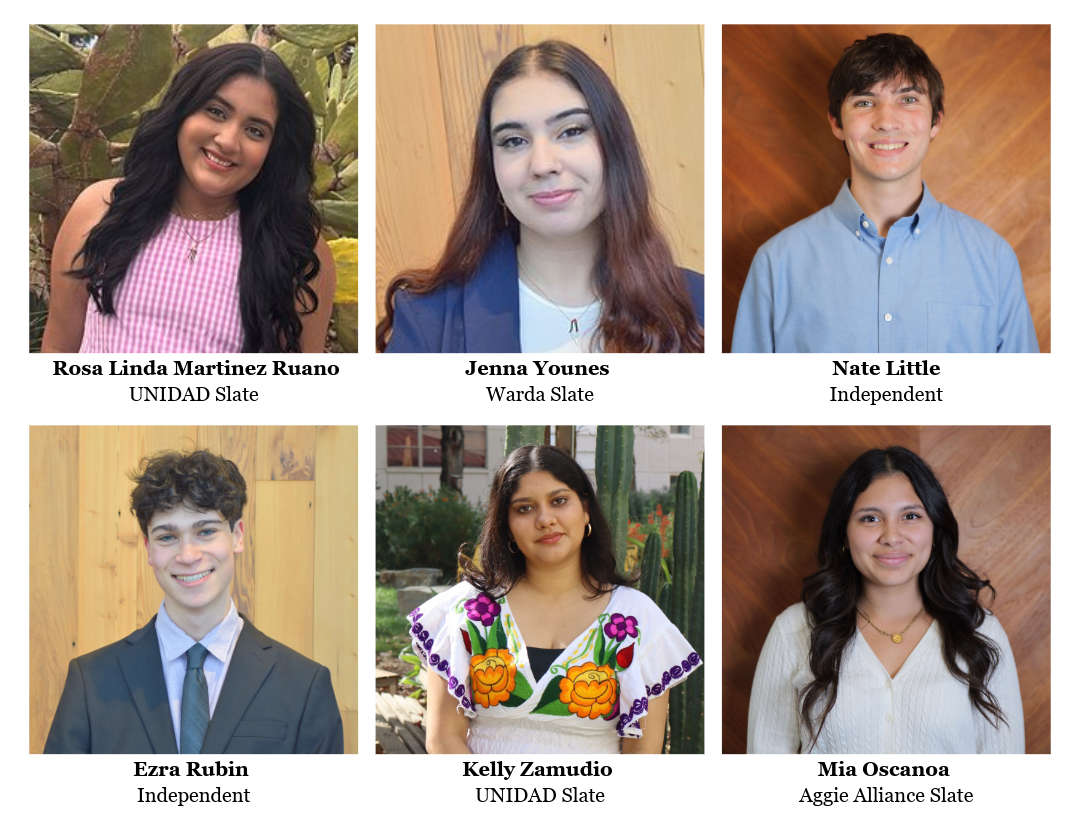
The senators-elect are, in rank order of votes received: Rosa Linda Martinez Ruano (UNIDAD Slate), Jenna Younes (Warda Slate), Nate Little (Independent), Ezra Rubin (Independent), Kelly Zamudio (UNIDAD Slate) and Mia Oscanoa (Aggie Alliance Slate).

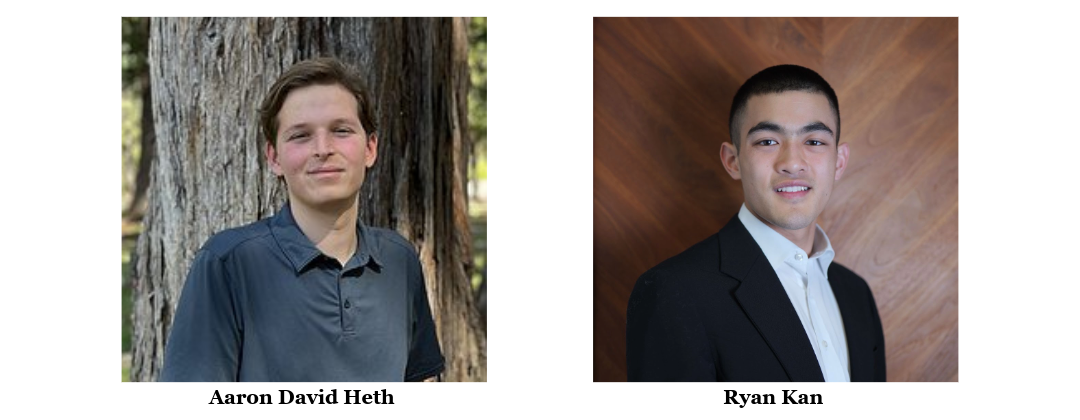
13 total candidates appeared on the ballot, though two were disqualified before voting closed Friday evening: Ryan Kan, a third-year political science and economics double major, and Aaron David Heth, a third-year political science major. Both were members of the Aggie Alliance Slate. Before being disqualified, Kan and Heth were the first and second place candidates respectively, according to raw elections data results published by the ASUCD Elections Committee.

ASUCD bylaws require that any candidate or slate that accrues three violation points during the course of a campaign be disqualified or dissolved by the Elections Committee. Both Kan and Heth accrued three violation points, according to the committee

ASUCD Elections Officer Jack Wang, a third-year political science and sociology double major, did not provide comment on why the violation points were given. However, bylaws state that they can be assigned for breaking ASUCD rules on campaigning, endorsements or campaign spending.

Heth, in an interview with The California Aggie late Monday, declined to give comment on his disqualification or the reasons behind his violation points. Heth plans on contesting the decision with the ASUCD Judicial Council, responsible for adjudicating contests to election results. Kan also confirmed to The Aggie that he will be appealing his disqualification.

If Heth and Kan’s disqualifications are overturned, it is unclear what would happen or if any senators-elect would have their wins overturned or revoked. ASUCD uses a ranked-choice voting system, with student voters able to rank as many or as few of the candidates as they prefer. The rankings before the disqualifications were: Kan, Heth, Little, Younes, Ruano and Oscanoa. 

Per elections data, 2,132 voters participated in last week’s election — about 6.67% of the undergraduate population.

Wang, whose one-year term ends this quarter, attributed some of the low turnout to poor weather on Thursday, Nov. 13 and Friday, Nov. 14, affecting tabling and outreach efforts. He said that he hopes that his successor will be able to increase turnout for the spring election.

“I think we can do a better job improving awareness of the student government, because I think the student government is more important than a lot of people perceive it to be,” Wang said “A lot of students know that there’s an election, but they don’t really feel compelled or feel convinced to vote.”

As new senators, the winning candidates will join the student government’s highest-profile legislative body and take responsibility for overseeing the Association’s $22 million annual budget. They replace the seats left vacant by Senators Nanki Kaur, a fourth-year biomedical engineering and South Asian studies double major; Lexi Raben, a second-year environmental sciences and management major; and Umar Shaikh, a third-year political science major. Two interim senators are also set to vacate their roles at the end of the quarter: Livreet Sandhu, a third-year political science major, and Shaina Taebi, a second-year political science and philosophy double major.

Younes, a fourth-year international relations major, was the only currently serving senator seeking re-election. Rubin, a third-year international relations and classics double major and former senator, will be returning for a second term after leaving ASUCD in the spring.

Both members of the UNIDAD slate are set to join the Senate table from other positions in ASUCD. Ruano, a third-year sociology and community and regional development double major, currently serves as the chairperson of the ASUCD Undocuscholars Advocacy and Aid Committee. Zamudio, a fourth-year political science and sociology double major, currently serves on the ASUCD Academic Affairs Commission as its vice chair. 

New faces will be joining the table as well. Little and Oscanoa are both first-year political science majors who will join the Association for the first time. Alongside the other winners, they are set to be sworn-in at the last Senate meeting of the quarter on Dec. 4.

Written by: Vince Basada campus@theaggie.org

Police Accountability Commission members discuss potential use of AI in policing

0

The meeting featured a presentation by the Office of Independent Review Group 


By KATYA OKS — city@theaggie.org


On Nov. 3, the Davis Police Accountability Commission held a meeting to discuss the potential role of artificial intelligence (AI) in policing. The meeting was led by Michael Gennaco, a founding member of the Office of Independent Review (OIR) Group. The OIR Group collaborates with community members and local governments, as well as police agencies, to address oversight and accountability, internal investigations into misconduct and conduct training to ensure law enforcement is following up-to-date practices. 

Gennaco also served as the chief attorney for the OIR in Los Angeles County, with expertise in law enforcement reform. Gennaco began his presentation with a working definition of AI for the purpose of the topics he was set to discuss. He then reflected on the current state of policing and the criminal justice system through his work in the OIR Group. 

“In Santa Clara County, which we monitor, […] [there was] a murder in their jails in January this year [of an] incarcerated person,” Gennaco said. “Unfortunately, he was killed by [other inmates] and beaten to death. The assault […] went on for several minutes, and there was a camera in the dorm that captured all of it. […] No one was watching this assault happening in real time that led to this person’s death.” 

After describing the incident, Gennaco cited the lack of resources as a potential contributor to the event. 

“There are hundreds of cameras in the two jails in Santa Clara County, so there are not [enough] resources for a person to keep eyes on these cameras at all times,” Gennaco said. “AI may be able to fix that.”

Gennaco transitioned to discussing another issue concerning the nature of policing. He noted that the footage from officers’ body-worn cameras are crucial to investigations, evaluating complaints and more. 

“One of the things that we do as auditors when we are reviewing the way the police department has handled a complaint is [by] looking at the police report [and] the recordings of any interviews. We also look at any body-worn camera that the officers activated that showed them responding to the event,” Gennaco said. “[But because] there are so many interactions that the police are recording and upload[ing], […] at some point [the footage goes] away and no one ever looks at [it].”

Gennaco offered a proposal on how the integration of AI could potentially help to resolve this issue. Through training an AI model to sift through footage and watch out for “discourteous language, profane language, racial epithets” and “whether an officer is using force in the field,” according to Gennaco, the policing system can catch these instances more effectively.

 “AI can now do the work of sifting through all of this — tons of evidentiary material and identifying issues — and then the supervisor is able to take appropriate action,” Gennaco said. “The same can be done for good officer behavior as well [to create] positive reinforcement.”

The presentation also explored potential drawbacks of an overreliance on AI programs for policing. An example that Gennaco brought forth is AI face identification. 

“This is sort of a generalization, but generally, folks that are trans or LGBTQ+ tend to not always look the same like some of the rest of us: They are altering their hair, [and] a lot of other things that the robot is using to identify [faces],” Gennaco said. “And to some degree, that’s also true for women. Women tend to change their hairstyles more than men, for example, […] which can lead to misidentification.”

Cecilia Escamilla-Greenwald, a member of the Police Accountability Commission, brought up a concern regarding the topic. 

“The misidentification of potential women in particular minorities is a big concern,” Escamilla-Greenwald said. “If [law enforcement officials] are in fact going to use AI, […] they have a lot of work to do [to improve] in that area.”

Gennaco also brought up the use of police drones and the potential integration of AI software into them. Escamilla-Greenwald brought forth another potential concern.

“What if [law enforcement officials] call drones to go after protesters?” Gennaco said. “Protesting is a right, and to go after people who are peacefully protesting [is dangerous] […] If they start using AI and drones, rights will be stripp[ed] away, even more so than the [Trump] administration is already doing.”

Angela Willson, a chairperson on the Police Accountability Commission, offered another perspective on the use of drones and AI technology. 

“On Picnic Day [last April], having drones would have been beneficial in being able to find out who the shooters are,” Willson said, referring to the incident that left two teenagers injured at Davis Community Park on April 12. 

Gennaco agreed with both sentiments, reflecting on what the mindset should be in developing such equipment. 

“The question is: Even if you tolerate the technology for its good, what guardrails can be placed to ensure that this technology is doing what you want it to do?” Gennaco said. 

No immediate decision was reached by the end of the meeting, with the committee deciding that more research should be conducted before implementing AI in the Davis Police Department. 


Written By: Katya Oks — city@theaggie.org

A look into dinosaur ecosystems and its insights on evolution

Examining the various theories and evidence about life before the extinction of the dinosaurs


By EMILIA ROSE— science@theaggie.org


66 million years ago, an asteroid of similar size to Mount Everest collided with Earth with the power of 10 billion atomic bombs. Not long after, on a geologic timescale, nearly 75% of all animals died out; among the most notable creatures to perish during this era were the dinosaurs. 

Among scientists in the field, a question remains: Were the dinosaurs already in decline, doomed before the asteroid hit, or did they die purely due to a sudden cataclysm?

One commonly-held theory argues that dinosaurs were already on the path to extinction prior to the impact of the asteroid. In a 2016 research article, paleobiologist Manabu Sakamoto commented on the specific evolutionary statistical trends within dinosaur populations. 

“We find overwhelming support for a long-term decline across all dinosaurs […] where speciation rate slowed down through time,” Sakamoto said. “Our results highlight that […] dinosaurs showed a marked reduction in their ability to replace extinct species with new ones, making them vulnerable to extinction and unable to respond quickly to and recover from the final catastrophe event.”

By looking at the rate at which new dinosaur species evolved, researchers found that this rate was slowing down, leaving them more vulnerable to extinction. Thus, when the asteroid hit, they didn’t have that evolutionary buffer to keep them from dying out. However, a problem with these findings remains: How do we know that these findings support every dinosaur species, and not just a few?

“Because the fossil record has long been known to be incomplete, it is possible that the observed slowdown and downturn are byproducts of undersampling,” Sakamoto said. “This assumption would imply that there is a systematic downward bias in the phylogeny toward recent times.”

In this way, regions with more complete fossil data can disproportionately influence the assumed global trend. It is essential to note that, although Sakamoto and his team accounted for these biases in their calculations, this factor raises a concern about assuming general patterns of decline to be consistent across all regions. 

Geerat Vermeij, a professor of marine paleoecology at the University of California, Davis, shared the same sentiment.

“Regional data cannot be easily scaled up to a global analysis,” Vermeij said via email.

Because of these sampling issues, it becomes way easier to find examples of regions where dinosaurs were thriving rather than declining.

In a research article published in October 2025, Andrew Flynn et al., discussed the uncertainty surrounding the diversity of dinosaur species before the asteroid, highlighting new evidence that they were, in fact, thriving in some regions.

“Ecological modeling shows that North American terrestrial vertebrates maintained high diversity […] with bioprovinces shaped by temperature and geography,” Flynn et al. said in the research article. “This counters the notion of a low-diversity cross-continental fauna.”

Additionally, Vermeij stated that marine ecosystems showed similar trends. 

“In general, there were no declines in marine ammonites or most other molluscs,” Vermeij said. “Reef-forming rudist bivalves apparently became extinct before the end of the Cretaceous […] but marine systems thrived until the catastrophe.”

Even though Sakamoto and his team’s findings were statistically valid, especially since they accounted for many biases, several regions throughout both land and sea have been shown to counteract the idea that all dinosaurs were declining before the asteroid hit. Any assumptions that were made about the global average created an illusion of universal decline.

The fact that some dinosaurs were thriving right before the cataclysmic event confirms the notion that it is not always the strongest members of a species who are guaranteed success in a given environment. Just one sudden event can cause mass extinction.

“Crises are crises for the simple reason that they are rare, extreme events to which organisms are not necessarily adapted,” Vermeij said. “Most of these crises hit some kinds of organisms more than others, depending on whether they are or are not predisposed to dealing with unusual conditions.”

Often, chance mutations can lead to the survival of a rare cataclysmic event like an asteroid. The survival of any organism is not about “winning” in normal conditions — it is about being born with or developing traits that allow them to survive.

For the dinosaurs, one change, shock or environmental shift led to their extinction. Evolution isn’t purely a linear process or a reward for being the best in a given environment; we exist now not because the species that survived the asteroid were superior, but because they happened to have the traits to survive the storm — something the dinosaurs weren’t designed for. 

“Resilience after [a] crisis is a hallmark of life in general,” Vermeij said. “Some groups can take advantage of newly-available opportunities and others cannot, but this is a recurrent pattern throughout the evolution of life. Crises reset ecosystems, but very often the new ecosystems come to resemble the old in terms of interdependencies and other interactions.”

Life today can be thought of as an echo of what came before. It is an extremely resilient force of nature, and yet some parts of it struggle to keep up, prompting extinction. When examining the demise of the dinosaurs and the many resets throughout Earth’s history, science shows that we would not be without those who came before. 

Written by: Emilia Rose — science@theaggie.org

The Dodgers aren’t ruining baseball

Calls for a salary cap are misguided at best and greedy at worst


By THEO KAYSER — tfkayser@ucdavis.edu 


Many are arriving at the presumption that “the Dodgers are ruining baseball” after the recently concluded 2025 Major League Baseball (MLB) season. Such a conclusion has its merits on the surface, especially if one were to view the past two seasons in isolation from all of the seasons which preceded it. After all, the Los Angeles Dodgers’ much maligned payroll has enabled them to create a roster overflowing with superstar talent which far exceeds, and in some cases multiplies, the budget set by their competition. 

The argument would then follow that MLB needs to implement a salary cap in congruence with other leagues, such as the National Football League (NFL) and the National Basketball Association (NBA), in order to create a more competitive and fair playing field. This discourse is by no means new — the 2011 blockbuster film “Moneyball” tackled this same issue — however, it has recently gained traction in sports media and has even been labeled an “issue” by MLB Commissioner Rob Manfred.

While it is fair to point out the obvious fact that the Dodgers, along with the New York Mets, New York Yankees, San Diego Padres and other “big market” teams have a competitive advantage due to their enormous financial resources, the argument in favor of the salary cap made by many fans is far flimsier than it appears. 

Firstly, to suggest that MLB faces a competitive balance issue compared to other popular sports leagues would be to entirely ignore the past two decades of their results. Since 2000, MLB has seen the championship won by 16 different franchises, as compared with 13 franchises in the NFL and 12 in the NBA. The Dodgers being back-to-back Champions in the years 2024 and 2025 has revived ire for the lack of a salary cap, but they were the first team in MLB to repeat since the Yankees concluded a three-peat in 2000. 

Comparatively, the NFL has seen two repeat champions since 2000 and the NBA has seen four. This very basic step of viewing MLB compared with its peers, beyond a miniscule sample of just two seasons, paints an entirely different narrative; one which sees baseball as a beacon of parity compared to the NBA and NFL, who have been long-dominated by the dynasties of the New England Patriots, Kansas City Chiefs, Los Angeles Lakers, San Antonio Spurs, Miami Heat and Golden State Warriors. 

By arguing in favor of a salary cap, what fans are mistakenly doing is ideologically attaching themselves to the political and monetary ambitions of the greedy, uber-wealthy owners of floundering franchises like the Pittsburgh Pirates, Miami Marlins and Oakland Athletics. 

The argument being made by most fans regarding the Dodgers “ruining the sport” is laughably simplistic, and can be debunked by a cursory inspection of the sport’s recent history compared with its rival leagues. However, that is not to say that no competitive balance issue exists — I would simply argue that the blame for this issue falls far more on the most frugal of franchises than it does on teams like the Dodgers. 

It’s important that anyone asking for a salary cap in MLB is aware of the guard against massive payrolls that is currently in place: the competitive balance tax (CBT). This gradient tax has a few thresholds which are readjusted each season to keep up with inflation. In other terms, the CBT serves as a “soft-cap,” preventing teams from exceeding the cap to moderate effectiveness. 

To apply this to MLB, it’s important to recognize the forces at play in creating the disparity in team spending that exists today. In 2025, the Dodgers had a player payroll of $350 million, while the Marlins had a payroll of $67 million; less than one-fifth of that of the Dodgers. 

The outstanding budget of the Dodgers is an obvious driver of this issue — the amount they’re spending in 2025 is simply unattainable for small market teams like the Marlins. Yet, to act as though they couldn’t come any closer to matching it is a facade pedaled by many owners across the league. In spite of every team earning a revenue of at least $240 million in 2024, coupled with the steady increase of MLB franchise values, many owners cry poor when faced with backlash over their frugal approach to player acquisition, according to Forbes.

Even with a hard salary cap, it’s very likely that many of the current failing MLB franchises who refuse to spend money will still refuse to do so. The only difference being that , instead of having one-fifth of the payroll of the Dodgers, they’ll have one-third. 

The truth of MLB at the moment is that it is apparent that many of the franchise owners view owning a team as merely an advantageous investment in their broader financial portfolio, rather than a community pillar adored by millions of fans. The current collective bargaining agreement is, from a financial perspective, very acceptable to the “poor” teams like the Pirates, Athletics and Marlins. 

For instance, half of the tax money collected by MLB from the CBT is given to the “supplemental commissioner’s discretionary fund,” a long title which is code for “evenly redistributed among the teams.” For reference, the Dodgers will pay pitcher Tanner Scott an average of $18 million over the next four seasons. Correspondingly, the Dodgers will contribute approximately $19.8 million to the league fund as a result of that transaction. For example, at the end of the 2025 season, the athletics owner will collect $330,000 as a result of this one transaction. 

If you think that the low-spending owners are the victims in this equation, you are mistaken. There unquestionably exists an issue of spending inequality in Major League Baseball. A salary cap, however, is not the quick fix that many fans believe it to be; such action would only lead to players losing out on their hard-earned money, making the owners of these clubs even wealthier. 

A more accurate assessment of the issue makes one thing very clear: The problem is not that the Dodgers, Yankees and Mets are trying too hard to win, it’s that other teams aren’t trying hard enough. Bryce Harper of the Philadelphia Phillies put it best when saying, “I feel like only losers complain about what [the Dodgers] are doing.”


Written by: Theo Kayser — tfkayser@ucdavis.edu


Disclaimer: The views and opinions expressed by individual columnists belong to the columnists alone and do not necessarily indicate the views and opinions held by The California Aggie. 
 

The Editorial Board’s fall 2025 interview with Chancellor Gary May and university leadership

UC Davis administration discusses federal funding cuts, SNAP/EBT benefits, safety initiatives, research innovations and protection of undocumented students


On Nov. 17, The California Aggie’s Editorial Board met with Chancellor Gary May, Provost and Executive Vice Chancellor Mary Croughan, Associate Chancellor and Chief of Staff Carl Engelbach, Chief Marketing and Communications Officer Dana Topousis, Vice Chancellor of UC Davis Finance, Operations and Administration Clare Shinnerl, Vice Chancellor for Inclusive Excellence Renetta Tull, Chief Campus Counsel Mike Sweeney, UC Davis Police Department Chief Joseph Farrow and Associate Vice Chancellor for Student Life, Campus Community and Retention Services Sheri Atkinson. 

Below is a transcript of the meeting that has been edited for length and clarity. Note: Part of the first question was not recorded, so that section of the response was not included.

Editorial Board: UC Davis has ranked within the top 10 of the nation’s public universities for the fifth year in a row, according to the U.S. News Best Colleges Ranking. What do you believe contributed to this success, and how does the university plan to uphold this standard in the future?

Chancellor May: We were ranked No. 2 up behind only one of our UC peers in the Wall Street Journal public school rankings. And the rankings just kind of demonstrate that we create opportunities for our students to be successful. I mentioned that Wall Street Journal in particular because that one measures your success after graduation. So, that’s more meaningful than how much money we have in our endowment, right? So, that’s something that we’re proud of. 

It’s a testament to the faculty and the quality of their work and the research that they do preparing our students for their careers and for graduate school, and our staff who support students throughout their time here, and for admission to graduation, making sure their basic needs are met, and all the resources are available, and questions are answered, and also reflects the commitment of you, the students. You guys excel academically. You represent us well. You’re ambassadors for us before and after you graduate. I think one of the things I said when I came to UC Davis eight years ago was that I want us to no longer be the best-kept secret in higher education, as I was calling it, and I think this is one way we’re showing we’re no longer a secret and people are recognizing the quality. 

Editorial Board: How is UC Davis adapting to federal changes in funding for research grants? How is UC Davis and the University of California (UC) system compensating and is the state providing additional fiscal support to the university’s research mission?

May: I’ll just start by saying this has been a really big challenge for our university and most other universities around the country. Last year, we received about $450 million in federal grants, which is about a little less than half of the total funding that we got in research, and those funds cover both direct costs of the research, as well as what we call indirect costs associated with the conduction of research.

It’s no secret to say that the reductions occurring in those funds have a really devastating impact on research that we do and innovation that results from that. Some of the global leadership and national leadership that we’ve had, you probably are hopefully seeing some of the features that we’ve done. We’ve done a workshop called Labs to Lives, which talks about how the research that we conduct actually translates to improving the quality of people’s lives. We couldn’t do that without the federal support, so we’ve been doing a lot to try to mitigate this. We have litigation that we’re involved in, we have lots of advocacy work, we meet with regional and national elected officials regularly to raise awareness and to plead our case here about the proposed changes.

Recently, the other chancellors and I, along with President James B. Milliken, endorsed what’s called the Fairness, Access, Inclusion, and Representation (FAIR) model, which is a new model for indirect cost recovery. We hope that that will be something that’s accepted by the administration and sort of get us back to a reasonable amount of what we can charge for the cost of doing research. It basically modernizes the reimbursement process and the structure to make us both accountable and transparent for the research that we do. Our Office of Research is doing a regular series of projects to actively help our faculty and scholars navigate new projects and work within this shifting landscape. That includes both appealing grants that we’ve lost as well as trying to strategize for how to win new grants. 

Sweeney: Well, I’ll just mention that certainly more than 100 grants were terminated or suspended through a lot of aggressive effort by the primary investigators. Lawsuits by UC and lawsuits by our faculty, about 95% of the grants were reinstated, which is good. But I’ll just add, I view it as catastrophic cuts to future funding. So, that’s something we have to work on.

May: Some of the grants couldn’t be reinstated because the entire agency was dissolved, like the United States Agency for International Development (USAID), for which we had about $95 million in awards that we won but were not received. Yeah, so the impacts are pretty serious.

Croughan: Also, the training grants. It’s bad enough for current researchers and what’s happened with them, but you’ve also got the next generation of students and a lot of Ph.D. programs across the country are either not accepting students or accepting significantly fewer than they have traditionally. So, what happens to the next generation of researchers that either have fields they want to do research in that are no longer being funded or they can’t get a graduate training program in the U.S.? I just spent time last night reviewing faculty requests for work they do outside of the university, and this is the first time ever that the majority of those requests were sabbaticals or visiting professors outside the U.S. I’ve never seen that one. I get like three a year, and eight out of the 12 requests last night were to go work outside the United States. You can take that for what it is, but I suspect I know why.

Editorial Board: UC Davis’ new Bachelor of Science in Business major launched this fall. What has been the initial feedback from students and faculty in the program?

May: You know, when I came, I was shocked that we didn’t have an undergraduate business degree at UC Davis. That’s kind of unusual in most peer universities. It’s been sort of decades in the making, and a lot of credit goes to the two people sitting next to me on my right [Croughan and Kelman] that made it happen, and they can tell you about that. I’ll just say we had about 9,000 applicants for the major. We only were able to admit a fraction of that: 175. Nevertheless, this magazine, Poets&Quants, named us as one of the top 10 undergraduate business schools to watch in 2025, so we’re excited about that. 

I think the students that are enrolled are very excited and motivated. There’s a student success seminar that’s offered by the Business Advising Office that provides those students with opportunities to connect with each other and learn and grow within the major. Faculty seem to be pleased with the quality of the students, even though they’re just now in the early part of their studies doing the foundational courses, not the business courses, but we’re excited about what’s to come.

Croughan: I’ll just add one more thing: This Poets&Quants is like the top business magazine or journal, really, I should say. And they also just named H. Rao Unnava, the dean of the UC Davis Graduate School of Management, as the top dean in the country. So, not only are we the one program to watch, but we just got Dean of the Year basically. Ari Kelman did massive amounts of work to make this happen. It really was almost 30 years of people trying to get us a business major. We’ve finally got it. It passed up computer science for being the top major that students were interested in when they applied for admission for this fall quarter and just kind of blew everything out of the water. So, we expect it to continue to do extremely well there, and after probably five to six years, we’ll look at what we can do to grow the major even larger.

Editorial Board: On Nov. 1, Supplemental Nutrition Assistance Program (SNAP) benefits were set to be frozen amid the government shutdown. Many students rely on these benefits — is there anything UC Davis is doing to ensure that students facing food insecurity have additional resources?

May: We’re always very concerned about the basic needs of our students. Even though the shutdown has ended, and the benefits will resume soon for SNAP, there’s no doubt that this disruption has had an impact, and we’ll continue to be committed to supporting basic needs. The Aggie Compass has an update page on its website that helps the students who are receiving CalFresh benefits stay informed. The website is aggiecompass.ucdavis.edu/calfresh for students, so please put that in the transcription of the article.

Food programs across campus are actively working to increase the quantity of food available. That includes our Pantry — two pantries, the Undergraduate Pantry and the Graduate Pantry — the Aggie Eats food truck, which I got to drive on its first time around, the Yolo Food Bank and the Satellite Pantry Network. On Nov. 8, we had 400 volunteers help Yolo Food Bank. The food bank delivered 10,000 pounds of groceries to support our students who are facing disruptions from the CalFresh benefits. I want to encourage any students facing any insecurity in food or housing to connect with Aggie Compass. They do provide really good resources to help them navigate these difficulties. I encourage others to volunteer, lend a helping hand, contribute to The Pantry, to Aggie Compass and volunteer at the Yolo Food Bank, which I try to do during the holidays as well. 

Atkinson: Just adding that we believe that students did receive their benefits after the shutdown ended from Nov. 1, and then we know that the Nov. 10 folks also received them, so we think that students didn’t have too much of a gap. But again, we have these programs available in case students do.

Editorial Board: Given the current political climate under the Trump administration, how will UC Davis continue to advocate for and support its undocumented and first-generation students who may be fearing for the safety of their families amid Immigration and Customs Enforcement (ICE) raids?

May: That’s a really great question. So, we are now and have always been firmly committed to supporting that student community, undocumented students and first-generation students, especially with the current climate of fear and anxiety surrounding ICE and other activities. Through the Undocumented Student Resource Center, the university offers free legal consultation, Know Your Rights workshops and emergency support to anybody who’s directly impacted since the center was created in 2014. We have institutionalized support for undocumented students, some permanent funding, a campus-wide UndocuAdvocate Program for Educators (UPE) to educate faculty and staff about these issues and the dynamic immigration landscape. This also extends to partnerships with campus units and departments like the UC Immigration Legal Services Center, Student Health and Counseling Services, Financial Aid and Scholarships, as well as the Aggie Compass, which we talked about.

We feel it’s our responsibility to protect this community, not just now, but in all times, but especially in times of need, and build opportunities for them after graduation. We have these policies and resources available to promote belonging and safety. I’m going to stop there. I don’t know if Chief [Joseph] Farrow may want to say something about ICE and what its practices are with respect to new legislation.

Farrow: Yeah, I can just tell you that I know that’s a big concern by a lot, the entire community, about ICE and what their role is and how they may play some role here on our campus. We have had conversations with people that work at ICE to really understand what their game plan is. A lot of these agents have been deployed elsewhere in California and across the nation. College campuses remain places where they’re really not interested in coming to do their business. But I always caution everybody just to understand that sometimes, if there are events where somebody has a high-profile warrant, you know, criminal-type activity, the rules change just a little bit. But for their very nature of ICE involvement, the college campuses are not the places that they’re focusing on and that we do have a good protocol and procedure with members of the federal government if they were so inclined to come here, and we would have knowledge of that. We have a system set up to alert our community, and I think Mike’s [Sweeney’s] group has put out correspondence in the past about what our roles are, what we should do and things that we cannot do. I think that’s been public, and I think you probably have access to some of that.

Sweeney: California law used to require citizenship for police officers. You didn’t have to be a citizen to be chancellor or chief counsel or provost, but you had to be a citizen to be a police officer. And our police department envisioned, sponsored and advocated for a new law to eliminate the citizenship requirement and then became the first police department in America to hire an undocumented police officer, and he’s still with us. It’s a fabulous organization. It’s supportive of our undocumented community.

May: And Joe [Farrow] gets credit for championing that whole legislation that went through the state a couple of years ago.

Farrow: I’ll just add on that. Our officer, who’s very well known in the AB 540 center, frequents there quite a bit, and people in AB 540 work in our police department, in the Aggie Host Program, so we have a pretty good relationship there and constant communication, so they feel part of our team, part of the system, and we keep them apprised of everything that we know, and so I think we have a pretty good relationship going on within the center.

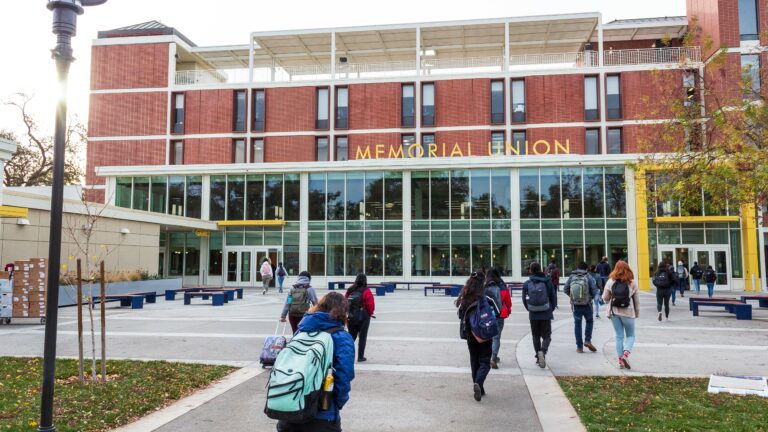
Editorial Board: Throughout fall quarter, construction has been present around the Memorial Union (MU) Quad. What does the construction aim to achieve, and what is the timeline of completion? What are the goals of campus planning at this time?

May: So, you know, UCD not only stands for University of California, Davis, it also stands for Under Construction Daily. That was my dad joke for the day. But, for a campus of our size and complexity, construction is just a reality. I always like to say it’s a sign of a healthy campus. If you didn’t see anything going on, that would really be something to worry about. But you talked about the MU in the question, so the construction that’s closest to the Quad there is work on our various seismic projects; the buildings that are east of the Quad on this side — Voorhies, Young and Social Sciences and Humanities (SSH), or the Death Star — have renovation work requiring barriers and pedestrian pathways and bicycle rerouting. 

In addition to the seismic improvements to these buildings, that work includes upgrading fire alarms and sprinkler systems and elevators and security systems, accessibility improvements for the physically challenged population, restroom innovations, roofing, mechanical and electrical updates, landscaping, painting, all sorts of things, all sorts of upgrades. At the corner of Third and A Street, we are filling in the pit stair at the SSH building to create a more open and welcoming space to that entry point to campus where you guys like to take pictures. We have ongoing work in something we call the Big Shift, which is our Fossil Fuel-Free Pathway Project. The latest construction there is at the Coffee House, and you’ve probably noticed some of the closed entrances there because of the Big Shift. Clare [Shinnerl], you want to add anything about campus construction?

Shinnerl: Closer to the 113, you’ll see a lot of construction there for a brand new center that’s going to open up next summer: Resnick Center for Agricultural Innovation.

May: And then there’s also new housing, the Segundo Infill Project that’s already started as well. Did I forget anything? 

Shinnerl: More to come. I’ll just add that the construction by the MU is largely funded by the state. So, we’re grateful for that and would like to get more.

May: And we’re excited about sometime in the future, after you’re all graduated, we’re going to tear down Freeborn and rebuild something real nice there: the Student Opportunity Center, we’re calling it.

Editorial Board: As UC Davis continues to accept more students each year and grow its student body, which steps are being taken to accommodate the increasing population size (e.g. housing, dining, class availability, parking, etc.)

May: Yeah, I mean, we actually aren’t really growing. We’re not growing at a high rate right now. When I came, we were about 38,000, maybe 37,000. Now we’re about 40-41,000, and the undergraduate level is especially stable. So, when admissions offers increase, people think that means enrollment is growing as well, but that doesn’t mean every student that gets admitted ends up enrolling. We admit many more students than actually wind up setting foot here. But, we’re committed to meeting these challenges in infrastructure as they arise — with protected housing, dining classrooms and parking, etc. 

One way that we assist incoming students with course availability is through reserved seating; I don’t know if any of you have used that. It started three years ago. We have reserved seats set aside for incoming students, and since incoming students register after you, the continuing students, this has really helped them have access to the courses they couldn’t have, that could have been filled up by the time they got a chance to register. Housing and Dining has expanded housing inventory to accommodate more than 15,000 students living on campus. I think we can house about 40% of our enrollment now, which is a really big change over the last several years. We’ve added more than 7,000 beds or so in the last eight years, and this is in keeping with a Memorandum of Understanding we signed with the City of Davis to try to house the growth that we were having at that time. I mentioned the new construction, the new Segundo Infill Project. We’ll have 400 to 600 new spaces for residents there, opening fall of 2027.

Croughan: Actually, for this coming year, we’ll likely go down slightly. Because, across all the University of California campuses, we have more than met the compact, as it’s known with the state of California. We’ve actually enrolled more students than the state of California asked us to enroll, and they have not, in turn, paid for those enrolled students. I don’t mean this as a tit for tat or a fight. It’s just, if you’re not going to pay for them, we need to scale back. So, this year we will take less. The chancellor’s right in his numbers that things have basically been pretty stable. I think where students feel it sometimes is when you’re trying to sign up for courses and you might have trouble getting in. What we’re trying to do is offer more sections, because it’s usually biology, chemistry, maybe calculus or perhaps physics. There tends to be specific courses where there’s waitlists and things. My rule post-pandemic was no one could have a waitlist anymore. Rather than that, they had to just offer another section and enroll everybody else. So they’ve been doing pretty well, not perfect.

But it’s getting better, and this year specifically we’ve launched a new biology series: Bio 1, 2, 3. I actually see heads nodding — there’s still doing 2A, 2B, 2C, the prior series. So right now, your biology faculty are offering two sets of courses, which is pretty demanding, but by next year, the old series will end, and the new series will begin. That’ll have a lot more labs available. It’ll also have molecular and cellular biology, which has not been in the old series, and more sections. So, waitlists are not a thing of the future with biology.

May: We also are having some enrollment decrease because of the current political environment. International students are not showing up as readily as they did in past years. That will have an impact as well.

Editorial Board: On Sept. 1, on-campus parking fees were increased by 50 cents per day for most drivers. What went into the decision to increase these fees, and is there an expectation of further increases in the future?

May: I have to say parking is my favorite topic. I gotta talk about parking. It actually comes up in every meeting. Breaking news, though: The parking rates increase was postponed, so it did not happen in September, and parking rate increases are approved only when it’s necessary for Transportation Services to meet the significant financial obligations — they have debt service on some of the parking lots and keeping the road and pathways, of maintaining all those sorts of things, as well as the salaries for the staff and things that need to be repaved or repaired. These costs go up like everything else every year, and we have to meet those costs. So, we don’t make money on parking. I think that’s one myth we want to bust here. People think that we’re making all this money in parking and parking fees, but that’s not the case. We actually are behind. We’re committed to maintaining the improvements that keep everybody safe, and these efforts are all outlined online on the fall 2025 operational updates page that Transportation Services maintains. So you can take a look at that.

The fees also go to improve lighting and cameras and pedestrian pathways and mobility shuttle operations and all these projects that we think are beneficial to the safety of the community. I also want to note that Transportation Services is doing something pretty neat. Up until Nov. 21, they’re partnering with The Pantry and the food drive. In this program, you can donate food and essential items instead of paying for your citation. So, get more tickets, so it can go to the food drive. If you want more information, that also is on the Transportation Services webpage.

Shinnerl: I’ll just emphasize the word postponed. Yeah, so it is postponed for now, but we will have rate increases for the reasons that [May] mentioned. We just cannot operate, paying our folks and keeping everything up without an increase.

May: I’ll also encourage everyone to look at the parking rates at some of our sister campuses. You’re getting a really decent deal here compared to some of the other UCs. I won’t mention them by name.

Editorial Board: In past years, there have been multiple safety-related incidents happening on the UC Davis campus, such as instances of sexual assault, as well as the series of stabbings that occurred in spring 2023 in the city. What is currently being done to maintain and improve campus safety measures?

May: Safety is always the highest priority that we have, for everybody — students, staff, the entire community — because everybody deserves to be able to work or study in a place that’s safe. So in 2023, we committed to collaborating more robustly with the community to improve things like lighting, enhance campus safety practices; the Safe Ride program is an example. Clare [Shinnerl’s] team has voted $20 million, a five-year investment, to improve lighting and install security cameras, enhance AggieAccess and build up security systems. We do this based on the feedback we get from students and staff and faculty through one of the programs that the chief conducts every year, the lighting safety walk; it’s once or twice a year, so you may have done this. A group of people can walk around with Chief [Joseph] Farrow just to see where places are maybe too dark or lights have burned out, or things like that. Student Affairs is also heavily involved in that, in design and construction management.

Lighting upgrades will occur roughly one mile from pedestrian pathways in various key areas across campus. By December 2025, these locations will be Olson Hall, Bike Parkway, East Quad Bikeway, Shields Avenue, California Avenue, 8th Street, South Court Campus neighborhood near the Art, Music and Writing Hall Park walkways and the plaza between the School of Education and Olson. We’ve got seven new emergency call boxes installed, bringing our total number to 30. We have 11 new outdoor security cameras added, including near the Egghead sculptures and along La Rue, Hutchison and Old Davis roads. We’re expanding AggieAccess to more and more buildings, enabling remote door locking, modernizing our security infrastructure while still trying to keep the campus open and welcoming. Safe Rides gives free evening and late-night transportation or escorts for anyone who prefers not to walk or travel alone after dark. The police department operates that. It’s a really trusted option that students use for getting home safely. We have the Health 34 program that the fire department manages, and Student Health and Counseling Services that provides 24/7 mobile response for non-emergency mental health and medical calls, like students in crisis, directly connecting those individuals with the care and support they need. So, we really have a comprehensive approach to safety. 

Farrow: I would add this: You’re seeing a much more visible security team that’s on campus, not the traditional police officers. We try to tier it, so we have about 125 students who work as your Aggie Hosts, who are also security. They go out at night, and they’re kind of the eyes and ears for us. We also have professional security staff that we will embed in the core and in areas where we don’t necessarily always send our police officers. And then, of course, the police officers do their job to try to maintain and lower criminal activity. As those reports come in, they’ll do the investigations and adjudicate those through the criminal justice system, but it is a very wide, tiered response that we’re trying to do.

Also, I just wanted to add on the lighting in the call boxes; that was a student initiative in 2018. It was a product of ASUCD who did a Senate Resolution and asked the university to put in call boxes in various strategic locations. We’ve followed that map for about six years, and all of those cameras are coming in via grants. So they’re not coming in from student tuition money; they’re coming in from different grant opportunities that we have. It’s an evolutionary process to continue to grow, but the plan of these would be corridors to get you from places of learning to where you live and dormitories and that sort of thing. So, the Aggie Host program is one that continues to grow with students helping students, and we’re running just under 80,000 rides per year. That’s a lot, and sometimes we’re slow to get there because of the demand. It just depends on what it is. But we put more vehicles out.

Editorial Board: What is the status of UC Davis’ effort to receive a Hispanic Serving Institution (HSI) designation? Is the university actively pursuing HSI status at this time given cuts to HSI grants under the Trump administration?

May: The good news is last year we became eligible as an HSI, so 25% of our domestic undergraduate population is Latinx. The bad news is in September, the Secretary of Education announced that they were ending the minority-serving institution programs. So, we are still — we meet the threshold — but there’s no money for those programs. But, regardless of that and how it winds up, because I know that’s being disputed, we remain committed to serving those students and all of our students. And, despite that uncertainty, we continue to advance HSI-related goals through various initiatives. I know Renetta [Tull] will have something that she can announce in just a second, but before I turn it over to Renetta [Tull], I just want to acknowledge that more than 9,300 students at UC Davis identify as Chicanx or Latinx, which makes us second in the UC system; I think Riverside has more. So, we’re committed to serving that population here with equitable access, especially since more than half of the California high school graduates are in that demographic.

Tull: We also have our Cesar Chavez Youth Leadership Conference, which is one of the largest conferences for high school students, middle school students in Northern California; we’re doing a lot with the K-16 project to make sure that we are also serving students throughout the North State and the Redwood Coast all the way to the Oregon border. We have a director called the Avanza Director, Avanza meaning move forward and advance, to serve all of our students.

There have been all kinds of efforts on campus, from student success and equitable outcomes, for example, and our Avanza director — our Avanza initiative — is looking to see how we can make sure we’re serving all of our students. It seems to be going very, very well. We’re looking at retention; particularly, our new Avanza director is trying to make sure that students across the campus are going to be retained. We are really excited about all of the things that are happening to move forward. 

May: I think we just — I don’t know if it’s been announced — identified the new Avanza director.

Reneta: Her name is Mayté Frías. 

Editorial Board: What is UC Davis’ position on university-wide regulations or standards regarding artificial intelligence (AI) usage by students? Are there any changes to current policies that faculty or students have advocated for? Are there any changes that the UC Davis administration would like to see?

May: As with anything, we want to be a leader. So, we want to be a leader in AI, but we also want to be responsible in how it’s used and policies that drive how we use it in teaching and research and innovation. We’re in the process of developing various models for adoption that create opportunities for students and staff and faculty to engage more deeply with various AI tools. A real bedrock principle in that endeavor is shared governance. The faculty has all its control and purview of all matters related to the curriculum. So, when it comes to considering what happens in the classroom with respect to AI or anything else, we work with our colleagues in the Academic Senate to establish those policies. Just last month, we established the UC Davis AI Council, and that council has issued a draft report addressing AI on campus in a variety of ways — in the classroom, research and operations. 

I convene that council, including representatives from across the campus, including some student representatives. They’re gonna be charged with developing campus-based principles and government structure for how we implement AI on campus. I’ve charged them with delivering these following items: a comprehensive implementation governance plan for your activities; some proposed policies and procedures for AI evaluation, approval and oversight; a structure for continuing campus governance beyond that committee’s term, although it may be an ongoing committee; and identification of resource needs and infrastructure requirements and capacity gaps that might happen. The committee is going to be guided by some systemside principles that were established by the University of California Office of the President (UCOP) and the Regents: transparency, accountability, equity, inclusion, respect for academic freedom, and human oversight and responsibility. 

Sweeney: I think your generation has a healthy skepticism about AI. I have two daughters that are in college, and they worry about privacy. Generative AI stores that data. So, we are very cognizant of the rules around this. I don’t want to say policing it. I mean, AI is here. On the other hand, we’re just ensuring folks are receiving guidance on what’s an appropriate usage for AI and what’s not an appropriate usage. I think this will be evolving a lot over the next few years.

Editorial Board: Following the recent Canvas shutdown on Monday, Oct. 20, are there any plans to move away from or broaden web service usage apart from Amazon Web Services (AWS) or to provide a safeguard or alternative resource for students if this re-occurs in the future? 

May: I think you probably know this, but it wasn’t just our campus that was affected. It was Amazon Web Services users nationwide. My wife works for — she’s a software developer, and they are heavy users of AWS products and services — and they were impacted dramatically as well. But anyway, back to UC Davis. I guess Canvas access was impacted for maybe 10 hours that day, and it was a Canvas, it was a power grid issue, I think AWS was the source. 

We are reviewing the incident through our vendor accountability and problem-review processes. We have taken some action. We’re engaging with vendors, including the Canvas vendor and AWS, on their root cause analysis and remediation plans. We have business continuity efforts to review and refine our business continuity plans, including campus communications about such things. And then finally, communication and transparency. We have a follow-up summary on the IET website outlining what occurred, explaining how UC Davis and our partners are working to respond to these disruptions. But we have to be realistic that these disruptions can and probably will occur in the future. We just have to try to be more prepared and resilient as possible when they do occur.

Editorial Board: On Nov. 4, there was a Statewide Special Election in California. Since many UC Davis students are California residents, what does UC Davis do to encourage the student body to register and vote?

May: We actually have an Aggies Vote campaign that we created a few years ago to promote voting information and awareness to students during elections. As part of that campaign, we have an Aggies Vote webpage, which gives information about voting registration and resources for students, election information, as well as ASUCD voting guidelines. We also offer the Are You Ready to Vote resource for students, which gives details about voting, registration processes, considerations and local voting centers where you can vote and vote through mail and other mechanisms.

These are resources we provide in a variety of ways through Student Affairs and partner units. We use emails and newsletters, social media, LCD screens are on campus and on myucdavis.edu site, and I do promotional videos; you may have seen one. We’re very excited about encouraging students to vote.

Tull: Inclusive Excellence also has a non-partisan voting page with information and resources and things like that that we always do around the time when it’s time for Californians to vote.

Engelbach: And we also host on campus a voter center, so you do not have to leave campus.

Editorial Board: Latitude is now offering breakfast options for students. Was there student demand for this change? How has it been received thus far, and are there any plans to expand other food options on campus?

May: So first of all, I’ll just say, Latitude is one of my favorite dining commons. [My wife and I] go to all the dining commons and just sit by students and make them feel awkward. I guess that decision was based on high participation numbers in Tercero during the 2024 academic year. 

Latitude was built to support the Tercero neighborhood’s high density, so it made sense to open the location there for an additional option for those residents in that area. 

We think that change has been well received. Attendance numbers have increased since fall, and the team continues to do a great job serving the menu items to the students. Dining Services is always receptive to any feedback that you might have to improve that experience. I don’t think we have any plans to further expand. 

Editorial Board: Aggie Square opened a new mixed-space residential building earlier this year — how are operations at the Sacramento campus and are there any recent achievements related to their medical research?

May: I’m really proud of Aggie Square, and it opened in May. We’re really happy about the developments there. About 350 of our scientists from the School of Medicine and various research centers over there have moved and will conduct collaborative studies at 75 state-of-the-art laboratories, which we’ve built there for patient care, quality of life, public health, all sorts of things. The U.S. Department of Veterans Affairs is a partner we’ve had for a long time, and they’re going to be collaborating in cancer and neuroscience research at Aggie Square. The School of Veterinary Medicine is moving and expanding its veterinary genetics lab to Aggie Square, and they will be examining the connection between human and animal health, and how both can be improved. We have a new master’s in engineering medical device development, which will be housed there. The first graduate degree program line exclusively for Aggie Square.

Some discoveries: We had a new gene therapy developed for Angelman Syndrome, which is a collaboration between Davis neuroscientist Jill Silverman, and a stem cell gene therapy specialist, Joseph Anderson. And they’re developing a novel approach to use patients’ modified stem cells to deliver a functional version of a missing gene directly to the brain to treat that condition, which is pretty cool. Another team, Aijun Wang and Jill Silverman, and Berkeley’s Niren Murthy, they’re pioneering in utero gene editing therapy for severe neurological genetic disorders, for infants, and their approach uses nanoparticles that deliver a gene editing tool non-virally to the fetal and neural stem cells, and it’s designed to prevent conditions by correcting mutations that occur before childbirth. I’ll just mention one other, Diana Farmer, who’s the chair of surgery, has moved her lab to Aggie Square, and she and others on the team have, we think, cured Spina Bifida. So, that’s a really, really exciting one. 

Croughan: Can I add to that? I think it’s really particularly cool and could have only been done at Davis. They’ve determined that stem cell therapy — of actually taking stem cells and inserting them into where there’s a hole in the spinal column in bulldogs in utero, which have a very high rate of Spina Bifida, that they could cure Spina Bifida. So, the bulldogs are born without the hole. The spinal column fuses, forms normally. Dogs can run around. They’re fully continent. They do beautifully. 

We took that technology from our vet school and applied it at the medical school, and Diana Farmer does it to human babies in utero instead of puppies. And now we have human babies running around, fully formed and not paralyzed or paraplegic. It’s a pretty phenomenal Davis story between the vet school for the animal model and the human model. 

May: It’s a really emotional video. The couple who had the baby that they were worried about came out wiggling his toes, and it’s a really tear-jerking moment.

Editorial Board: Many of our readers — both first-years and transfers — are finishing up their first quarter at UC Davis. Now that you have been the chancellor for eight years, have you noticed any resources/opportunities offered on campus that are consistently overlooked and that you would like to share with new students?

May: I’ll let everybody jump in on that one. I don’t know if these things are overlooked, but there are some things I’m proud of. I’ll start with the Aggie Compass, which didn’t exist before I came. The Student Affairs colleagues have done a great job in making that resource available for students that have real needs in food security and rapid rehousing and other needs. I’m excited about all the projects that we’ve completed, including the Diane Bryant Engineering Student Design Center, Coffee Center, the Resnick Center for Agricultural Innovation, and the Teaching and Learning Complex. We’ve extensively renovated the chemistry building. The Edwards Family Athletic Center, all these things that have happened, and multiple housing projects, West Village, and multiple other housing projects that happened. 

I think we’ve done a really good job of transforming the Davis campus. And we already talked about Aggie Square on the Sacramento campus. But in addition to Aggie Square, there’s a new outpatient facility called 48X. It’s the biggest outpatient surgery facility in the country. There’s the new bed tower that’s going to open in 2030.

Croughan: No. 1 thing, and this is as a mom of four plus provost. I really think it’s important for students to go to office hours. If you’re going to talk about the one thing you can do that actually changes the trajectory of your time at Davis academically, it’s going to office hours with the professor or the teaching assistant or both. I can tell you, as a professor, if a student who comes to office hours is on the border of two grades, I’m going to bump them up to the higher one. Let’s say you’re between a B+ and an A-. I’m going to give you the A-, because you came to office hours, and I know you were trying hard during the course. 

The other thing is to get a research opportunity while you’re here. I say that across every single discipline. If you get an opportunity to work with a non-profit, if you get an opportunity to work in a lab, you get to go work with a museum, you get to do field research, whatever it might be, do it at least once, if not more than once. It tells you a lot about what you do and don’t want to do later. It opens more doors for you for opportunities.

Tull: I am incredibly proud of our Principles of Community. We just celebrated 35 years of the principles, and there’s this one part of it that talks about how we affirm the dignity inherent in all of us, and I hope that new students when they encounter or learn about this and that it’s something that we have to help as a framework for how we connect with one another, how we treat one another, that they’ll remember dignity, connection and respect for all of us. I’m just really, really proud of that, and I think that there are people who know about it, but I hope that more people know about it going forward and that all of our students can connect to it in some kind of way.

Editorial Board: Earlier this year, 160 UC Berkeley students and staff’s names and personal information were given directly to the Trump administration in efforts for them to “investigate antisemitism” on the UC campus. What does the UC Davis administration think of this exchange, and would the personal information of students and staff here be given out under similar circumstances? How does UC Davis manage student-staff confidentiality matters in this context? 

May: I’ll just start by saying the federal government can request such information any time. There’s nothing unique about the Trump administration, although we have concerns about that administration. I understand that anxiety, but these information requests happened under the Biden administration, you can keep going back to any administration. So that part is not new. It’s about as new as traffic on I-80. But I do get the concern. 

I don’t want to sound tone-deaf. I understand that there’s specific concern about this administration and what happened at Berkeley. Mike [Sweeney], do you want to comment?

Sweeney: Yes, I mean, this is not my time to provide comments on the Trump administration. My comments, if I did provide them, would be very similar to your comments on the Trump administration. But, as the chancellor said, certain agencies of the federal government have the legal right to information. Information was provided to the Johnson administration, the Nixon administration and the Ford administration, all the way up to the present. 

I used to be a regulator with the state civil rights agency, and we would get that information. That’s very common. When you receive information, it goes into kind of a lockbox for that agency, and it can only be used for that purpose. You can’t share it with another agency. You can’t send it over to the police or over to immigration. You’ve got to use it for the purpose for which you collected it.

It is a fact that at Davis, we have not disclosed information, but that’s not answering the question. Legally, do we have to? The answer is legally, we do have to. Right now, we have redacted names. We’re waiting for the shoe to drop and for them to demand that we un-redact those names, but that hasn’t occurred. So, I’m happy to answer follow-up questions, but it’s a complicated space. Can they go get an order commanding us to produce it? Absolutely. It’s a difficult position to be in.

May: That’s what happened to Berkeley. It wasn’t Berkeley volunteering information. They were required to. 

Mike: It’s a very difficult position to be in. I think no one even bothered to ask that question on the Biden administration or the Obama administration. But that’s the norm for regulatory enforcement in America.


Written by: The Editorial Board — opinion@theaggie.org


LA Dodgers vs. Toronto Blue Jays: Dodgers become first team to win back-to-back World Series titles in 25 years

0

The 2025 Major League Baseball season ends in historic fashion

By EMMIA J RIVERA— sports@theaggie.org

For baseball fans worldwide, October is the most exciting month of the year. As the 162-game grind finally comes to a close, the stakes heighten for every player’s childhood dream of hoisting the World Series trophy. 

In a showdown for the history books, the Los Angeles Dodgers surpassed the Toronto Blue Jays 5-4 in 11 innings, securing the franchise’s eighth overall title and second consecutive championship. The Dodgers and Blue Jays traded strikes all series long in the best-of-seven games, featuring patient swings, clutch defensive plays and late-game heroics. 

The Blue Jays reached the World Series after securing the American League title, fueled by their young core and lineup — led by power-hitters Vladimir Guerrero Jr., Addison Barger and Bo Bichette. 

The Dodgers advanced from the National League thanks to a deep roster, featuring two-way Japanese superstar Shohei Ohtani, dependable pitching and an offense that had proven itself in the postseason; the stage was set for a legendary showdown.

The series started just north of the Canadian border, where the Blue Jays stunned the reigning champs in an 11-4 blowout — powered by heavy offense and a strong bullpen.

The Dodgers responded in Game 2 behind the arm of Yoshinobu Yamamoto, signed from Japan earlier this year, who threw a complete game. His pitching was paired with his teammates’ timely at-bats, capitalizing on runners in scoring position. The 5-1 win evened out the series on the road, before heading home to Los Angeles.

Back at Dodger Stadium, Game 3 became the longest World Series game in over a decade, totaling a whopping 6 hours and 39 minutes: an 18-inning game. Both teams burned through their bullpens and dug deep, but the game was ultimately decided in a walk-off home run by Dodgers legend Freddie Freeman. The series was then controlled by the Dodgers, who held a 2-1 lead.

Games 4 and 5, still in Los Angeles, were dominated by the Blue Jays, who fought back into contention, defeating the Dodgers twice in a row. In Game 4, the Jays took a 6-2 win following a punctual two-run Guerrero home run and a four-run seventh inning that sealed the win over the Dodgers’ short-handed bullpen, evening out the series again by 2-2.

Game 5 ended in a 6-1 victory that pushed the Blue Jays’ advantage even further. They set the tone early in the game by hitting two home runs in the first three pitches. Rookie pitcher Trey Yesavage, who was pulled up to the major leagues less than two months ago, shut down the Dodgers’ offense with 12 strikeouts and zero walks to seal the game.

After three games in Los Angeles, the Blue Jays led 3-2 back in Toronto and were a win away from seizing their first title since 1993.

Facing elimination, the Dodgers once again turned to their ace, Yamamoto, who delivered a series-saving performance. The right-hander threw seven shutout innings, while allowing only five hits. Offense from both teams was limited to a third-inning triumph, and was held to a score of 3-1 following a game-saving double-play by Dodger veterans Kiké Hernández and Miguel Rojas, sending the World Series to Game 7.

The last game of the season had Ohtani start on the mound for the Dodgers on short rest, allowing a three-run home run to Bichette for an early 3-0 lead for the Blue Jays in the third inning. The Dodgers cut the lead to 3-1 with a sacrifice fly ball in the fourth, then to 3-2 in the sixth; however, the Blue Jays’ astounding offense brought the difference back to two runs with a hard shot hit to the outfield in the bottom of the sixth. 

The score stayed at 4-2 until the top of the eighth, when another Dodgers veteran, Max Muncy, hit a long ball to deep right field to bring the score back within one. Both teams and fans all over the world were on the edge of their seats, gearing up for the last inning of the game.

The Dodgers were brought back into the contest at the top of the ninth with a miracle home run by Rojas, tying it up at four and pressuring the Blue Jays to fight back. Yamamoto was brought back to pitch for the Dodgers, and, with the help of his relentless defense, escaped a bases-loaded jam at the bottom of the ninth.

The 10th inning was scoreless from both sides, but with two outs at the top of the 11th, Dodgers catcher Will Smith delivered a tie-breaking home run to take LA’s first lead of the night, 5-4. 

Guerrero crushed a ball to deep left field with no outs, and was advanced by a sacrifice bunt in the Jays’ attempt to come back in the game, with a runner on third and one out. A walk added to the hope for Toronto, but it was not enough: a game-ending double-play to shortstop Mookie Betts secured the game for the Dodgers

The game was over and the victory sealed — walked off in extra innings and behind the Japanese phenom that is Yamamoto — cementing The Dodgers’ legacy and making history. The Los Angeles Dodgers are now the first team to win back-to-back World Series titles since the 1998-2000 New York Yankees. 

Written By: Emmía J Rivera— sports@theaggie.org