57.3 F
Davis

Davis, California

Wednesday, December 24, 2025
Home Blog Page 326

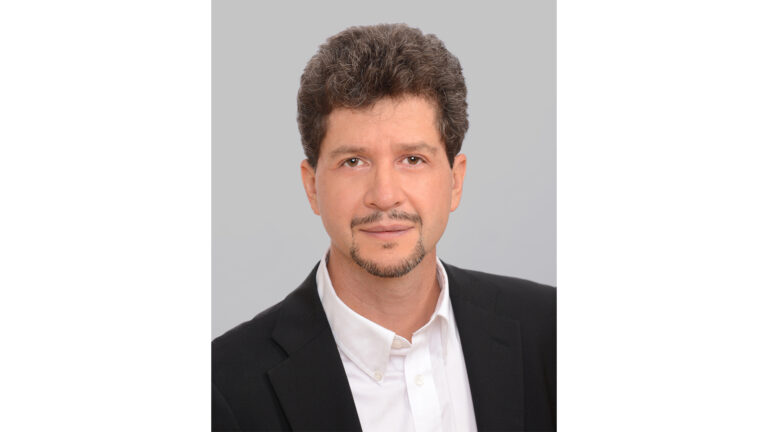
Carnegie Fellowship awarded to UC Davis Professor Andrés Reséndez

Exploration of 500 year-old sea voyage relevant to COVID-19 today

Andrés Reséndez, a Latin American historian and professor, was recently awarded the Andrew Carnegie Fellowship, becoming the first professor at UC Davis to receive this award.

The fellowship awards exceptional scholars engaged in research in the social sciences and humanities who are working to address important societal issues. Award recipients receive a $200,000 stipend to help further their research.

Reséndez is a foremost scholar in colonial Latin American studies and has published several acclaimed works focusing on labor coercion and enslavement of indigenous peoples in the Americas. 

His research focuses on Ferdinand Magellan’s voyage from Spain to both Latin America and Asia. Magellan’s initial voyage in 1519 helped cultivate a dense network of trade, exchange and cultural transformation that flourished for multiple centuries. Beyond commerce, this trade route fostered a sustained evolution of ideas, industries and diseases that impacted historical realities going forward. While other trade routes have been explored at length, the Magellan Exchange is an exception and has not been widely studied. 

“I wanted to focus on exactly what exchange entails and how it shapes societies on both sides of the Pacific,” Reséndez said.

A key aspect of understanding the trade route’s significance is contextualizing the global influence China had at the time, Reséndez explained. With over 25% of the world’s population, China was a critical force that influenced the trade route and its impacts. Sustained trade led to the evolution of China’s agricultural sector, production of both luxury and low-cost goods and demand for New World minerals like silver. Delving into the complex realities of the trade route’s impacts on both Chinese and Latin American societies, Reséndez’s research moves away from a Eurocentric historical worldview.

“The story [of silver mining and extraction] is traditionally told as one of Europe extracting silver from the New World, but the end consumer was in fact China,” Reséndez said. “Most of the silver ended up in China either directly through the Manilla Galleon, or indirectly through Europe.” 

While Reséndez originally applied for the fellowship in November, his research focus has uncanny relevance to the ongoing pandemic.

“COVID-19 is, after all, the transfer of a disease from China to other parts of the world,” Reséndez said. “This [voyage and trade route] is really the start of that transfer of germs, plants and animals to other parts of the world.” 

Professor Charles Walker, who also teaches Latin American history, commented on the significance of the award.

“This is a timely and fascinating topic,” Walker said. “The Andrew Carnegie fellowship is a wonderful acknowledgement to a fantastic historian and dedicated teacher.”

Twenty-seven Carnegie fellows are selected each year out of over 300 applicants. Over the next year, Reséndez will engage in research surrounding his topic.

History Department Chair Sally McKee expressed enthusiasm about the award and its significance for the department.

“We in the History Department are extremely proud of our colleague,” McKee said. “The public attention and affirmation his scholarship has received are entirely deserved. In addition, he’s a great colleague.”

Due to COVID-19, Reséndez’s plans to engage in archival research are somewhat constrained. With hopes to travel to Mexico, China and Spain among other countries, the realities of his travel plans have been severely impacted by the pandemic. Reséndez said he can delay dispersal of travel funds until it is again safe to travel.

Written By: Ally Russell — campus@theaggie.org
UCD Police chief asserts department is releasing records pursuant to state law

Recent investigation by UCSD alumnus details use-of-force cases across UC

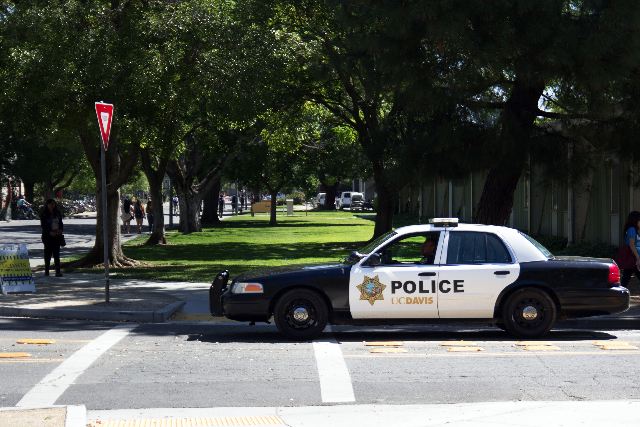
Senate Bill 1421, passed in 2019, requires police departments statewide to release records regarding use of force, sexual assault or misconduct within their departments if asked. A recent investigation by Gabe Schneider, an alumnus of UC San Diego and founder of The Triton, a student-run newspaper at UC San Diego, questioned whether UC police departments are releasing those records, as required by law.

Schneider, who used public records laws to compile his data, said that neither UCLA nor UC Berkeley provided responsive records. UC Riverside could not release applicable police records due to an ongoing investigation, while UC Santa Barbara, UC Merced and UC Davis each provided one record.

 The record from UC Davis was related to a shooting in 2004 when a man came on the UC Davis campus and attempted to kill his girlfriend. The perpetrator died in the gunfight.

 “It took months to get anything back; it seemed way too low to have three records from all years from three campuses,” Schneider said. “[I figured out that there were] around 200-plus instances of use of force around UC campuses, and around 80 involved someone who was injured.”

While Schneider expressed concern about the fact that there were few records available following his request, UC Davis Police Chief Joe Farrow explained that there is a relatively high threshold regarding the parameters in SB 1421, especially since Section A of the law specifies that all police records are confidential unless requested under court order or by a grand jury.  

“Notwithstanding Section A, the following are releasable: discharge of a firearm at any person by a police officer, an incident with use of force by a police officer resulting in death or great bodily injury […] or any incident related to a sustained finding released by a law enforcement agency involving sexual assault or dishonesty,” Farrow explained. “That’s a real threshold. At the end of the year, I still am required to notify the Department of Justice about all use of force that applies to the parameters.”

According to Farrow, the law can also apply retroactively, although there was initially confusion about that after it passed.

“There was a little controversy when it first came out, because there were people who felt that it only applied from the day it was passed,” Farrow said. “Some departments released everything from the very beginning and some didn’t.”

Farrow stressed the importance of transparency between police and the communities they are in, describing the implementation of the Police Accountability Board (PAB) at the university. PAB was created in 2015, partially in response to an incident where police officers used pepper spray against student protestors at UC Davis in 2011. 

Mikael Villalobos, associate chief diversity officer in the Office of Community Relations at UC Davis, is on the board. 

“We are an independent body but we do have a healthy working relationship with the police department,” Villabolos said. “Chief Farrow works with us and that informs the work we do with PAB, especially within the context of civilian oversight.”

Complaints about police department behavior are taken up by PAB, which is composed of students, staff members and faculty to allow for maximum input. UC Davis is the only campus to have such a board. UC President Janet Napolitano’s police task force report, released in 2019, recommended the creation of a similar program on other campuses. 

“These independent advisory boards can be helpful in identifying needed changes in police practices and training and providing an important forum to bring stakeholders together,” the report said. “In order to carry out their work, these independent advisory boards should have access to all publicly available reports, audits or data involving their respective police departments and their operations and should meet regularly with their campus community.”

The task force report also noted that complaints about UC Police Department behaviors decreased by 24% between 2016 and 2017, yet concerns remain among students about increased transparency. Some have called for the campus police to be disarmed, for example. 

But UCPD remains critical, the report said, especially with “threats being made to individuals on campus.” Due to these concerns, the report added, the UCPD owes students a “heightened standard of care.”

The report further revealed that individuals on campus often don’t know how to file complaints or are uncomfortable contacting the police directly about their concerns. It cited the need for better communication about these efforts and for the existence of independent advisory boards to ensure transparency in interactions among officers, students and other community members. 

Written by: Rebecca Bihn-Wallace — campus@theaggie.org

Traffic, emissions, fuel-tax revenues decline due to shelter-in-place guidelines

Social distancing mitigations put U.S. on track to meet goals of Paris Climate Accord

As individuals across the country slow down their lives and practice social distancing, they are driving less, flying less and using less public transportation. Since early March, car travel has reduced by billions of miles, greenhouse gas emissions have decreased by millions of metric tons and fuel-tax revenue reductions have resulted in states losing millions of dollars, according to the latest special report from the Road Ecology Center.

The Road Ecology Center released two reports regarding the impacts of COVID-19. Their first report, “Impact of COVID-19 on California Traffic Crashes,” was released on April 1 and focused on how traffic reductions have led to fewer car crashes, according to Fraser Shilling, the director of the Road Ecology Center. Researchers then investigated the additional benefits of reduced traffic, leading to the next report, “Impact of COVID19 Mitigation on Traffic, Fuel Use and Climate Change,” published on April 30.

“For America, I strongly believe that the pandemic has brought a huge, huge construction to transportation, which most likely will not only act as a temporary effect,” said Giovanni Circella, the director of the Three Revolutions Future Mobility Program at UC Davis. 

Using data from Streetlight.com, the Road Ecology Center researchers estimated the changes in vehicle miles traveled across the U.S. each day from before and after the shelter-in-place guidelines were enacted. From early March to the second week of April, vehicle miles dropped from 103 billion miles to 29 billion miles. Across all states, travel by vehicle reduced by at least 60%, according to the report. 

The report also noted a correlation between a state’s quantity of COVID-19 cases and their reductions in traffic. People drove fewer miles in states with higher reports of infection cases and death. During the reporting period, New York had the highest case rate. Drivers in New York and surrounding states drove at least 80% fewer miles.

Reductions in travel caused fuel use to drop from 4.6 billion gallons to 1.3 billion gallons from early March to mid April. Overall, drivers saved $8.6 billion per week. These cutbacks in driving have had major impacts on the economy, especially in California, Shilling said.

“In California we’ve created an economic system that’s very dependent on people’s driving vehicles, and to suddenly not drive can have big effects on the functioning of that economic system,” Shilling said. 

Driving less also results in lower fuel-tax revenues, which vary by state. In California, vehicle miles dropped more than 75%, causing state fuel tax revenue to plummet from $61 million to $15 million during the reporting period. 

“It’s probably going to result in billions of dollars of reduced tax revenue from just the sale of gasoline and diesel, so that’s a big deal,” Shilling said. “It’s a big deal for the consumer, because we must pay for gas and it’s a big deal for the states because then they’re getting less sales tax money.”

For an eight week stay-at-home order, states lose an estimated $370 million, which normally supports public transportation improvements aimed at reducing emissions, highway construction and maintenance, according to the report. 

“The fuel tax reduction has a ripple effect through the economy,” Shilling said.

 Additionally, less individuals have been using public transportation, threatening their financial wellbeing, said Susan Handy, a professor in the department of environmental science and policy. Her advice for those looking for transportation that is social-distancing and environmentally friendly is biking, especially in Davis. 

“To what degree [public transportation] will be able to maintain good service is a big question,” Handy said. “There’s a concern that this will have less transit ridership than before, and that would be a bad thing from an environmental standpoint.” 

Overall, reductions in transportation have lowered greenhouse gas emissions, placing the nation closer to Paris Climate Accord goals. The report’s authors noted a 71% decline in carbon dioxide emissions from local road travel across the U.S. For all of 2020, this represents a 13% decrease in transportation-related annual emissions and a 4% decrease in total emissions. 

“If there’s less fuel being bought and burned in our vehicles, we’re producing less greenhouse gas emissions,” Shilling said.

In 2015, the U.S. committed to the Paris Climate Accord agreement by agreeing to reduce greenhouse gas emissions by 2.5% per year. Due to reductions in emissions over the past two months, the U.S. has already exceeded the annual commitment. While the U.S. was formally able to withdraw from the Paris agreement on Nov. 4, 2019, the notice, and thus the final withdrawal, does not become official until a year later. 

“If a stay-at-home guidance continues, if people continue to drive less during this year, then we will greatly exceed our commitment,” Shilling said. “This is what it feels like to follow the Paris Climate Accord.”

Other than greatly reducing driving over a small two month window, there are other ways to meet the Paris Climate Accord. If people reduced their driving by 10% per day, per month, or across the whole year, or if vehicle fuel efficiency increased by 5 to 10% per year, then the targets would be met, Shilling said. 

Learning to change one’s behavior to drive less is the most important lesson to take away from the report, Shilling said. These lessons can be applied to help the U.S. meet the greenhouse gas emission targets after stay-at-home orders are lifted. 

“A lot of people are suffering economic consequences and many people are suffering from health conditions, but at least the planet can breathe, and has been breathing for 10 weeks,” Circella said. 

Due to major changes in greenhouse gas emissions, Shilling predicts a stalling in the global temperature increase causing climate change.

“There’s such a high rate of greenhouse gas introduction into the atmosphere that if you suddenly slow it down by half, at some point, you’re going to have a slowing down of the rate of climate change,” Shilling said. 

The study acknowledges that emission benefits of the stay-at-home order could go away once normal activity resumes. Shilling predicts that the shelter-in-place restrictions for the coming months will be less strict, causing driving to increase. In California, instead of the 75% reduction in driving that was witnessed in the reporting period, Shilling believes these values will oscillate between 25 and 50%.

“The big question is, ‘What’s going to happen as the restrictions are lifted?’” Handy said. “‘Are people going to go back to their old ways?’ Some of the current data shows that driving is starting to increase again. It’s still less than it was, but it is likely to trend back upward.”

As the tight grip of shelter-in-place restrictions begin to loosen, individuals must learn to disconnect economic well-being from driving in order to continue the decline in greenhouse gas emissions, Shilling said. 

“There’s going to be a huge political pushback against trying to do climate change policy, when people realize, ‘Oh, if we do that, we’re not going to have a job,’” Shilling said. “The short term benefits of having a job will outweigh the seeming long term benefits of having a planet.”

Written by: Margo Rosenbaum — science@theaggie.org

Letter From The Editor

Congratulations to the UC Davis Class of 2020 — we did it! While this year has certainly been challenging, forcing us to adapt to unprecedented situations, I’m incredibly proud of our amazing staff at The California Aggie. Of my four years at The Aggie, this has by far been my favorite. I’ve never seen and worked alongside such a strong, determined, dedicated and passionate group of people who never fail to bring a joyful presence to our dimly lit basement office at 25 Lower Freeborn.

The Aggie staff has accomplished so much this year, including the passage of the Basic Needs and Services Referendum, which our unit and all other units of ASUCD would not survive without. We’ve put out our Best of Davis issue, which set a record with the greatest number of responses we’ve had to date, along with our Literary Magazine, which was also a huge success. We’ve covered breaking news, the Band-Uh! sexual assault misconduct, COVID-19, mental health resources and much more.

Reflecting on my four years at UC Davis, I am most grateful to The Aggie for allowing me to grow so much as a person, writer and editor, and for giving me a place and people who make it feel like home. Congratulations to a majority of our managing staff who are graduating — you should feel very proud of all you have accomplished, both at UC Davis and The Aggie. While it will be an adjustment to have a completely new Editorial Board and mostly new managing staff, I’m proud to say that Anjini Venugopal will be the next editor-in-chief of The Aggie. I have no doubt that she and the new managing staff will continue to make The Aggie proud and lead it to new heights.

I would also like to thank our staff writers, photographers, graphic designers, layout artists and copy readers who have worked tirelessly to produce amazing content. Without all their hard work, we wouldn’t have a newspaper. Thank you to our managing staff for always being so prepared, leading your desks with the utmost ease and being people whom your desks can look up to. 

Thank you to our Editorial Board for showing me different perspectives and allowing for such a safe, collaborative environment. And thank you to my amazing managing editor, Hannah Holzer, who has been my absolute rock without fail and without whom I would not have been able to lead such a large news organization. All of these people are the backbone and spirit of The Aggie, and they have made my job so enjoyable. I’m beyond honored to have worked side by side and be friends with each and every one of you.

So, thank you again to everyone who has made this journey at The Aggie an unforgettable experience. I’m forever thankful for everything The Aggie has given to me, and I can’t wait to see what next year’s staff will accomplish.

Signing off,

Kaelyn Tuermer-Lee

Editor-in-Chief

One in a thousand: Students like Shondreya Landrum navigate being Black at UC Davis

 Black students, Chancellor May, discuss facing discrimination, finding community

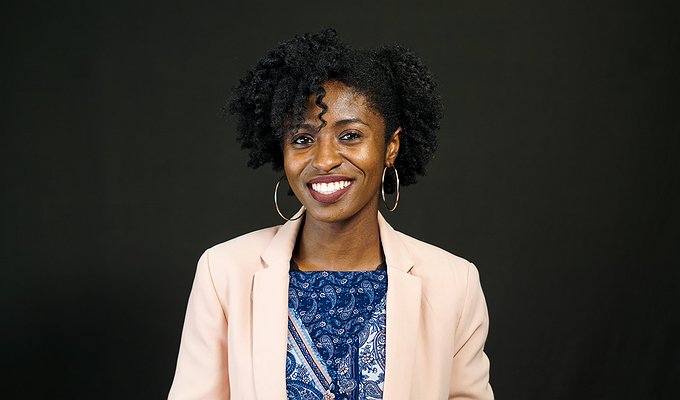
In the ASUCD Winter 2019 Elections, Shondreya Landrum won a seat on the Senate table. The ASUCD Elections website, which uses a ranking system, asking students to rank their top choices — up to six people — in numerical order for Senate positions. At the time, Landrum not only received the highest amount of #1 votes, she also made history for receiving the most overall votes for an ASUCD senator in recent memory — 863 students ranked Landrum as their top choice. 

            Eight hundred and sixty-three is almost equal to the number of Black students on the UC Davis campus. This landslide win was more than just something Landrum could add to her résumé. When only 1,096 undergraduate students identify as Black or African American, this accomplishment was not just Landrum’s, but the Black community’s. And even though Landrum does not speak for every Black student on the UC Davis campus, her experiences are reflective of many of those of her peers.

            “I ran because every time we would have a [Black Student Union] event, every time we would come into safe spaces, there was always an issue,” Landrum said. “Why are we going to a school where not everyone is accepted?”

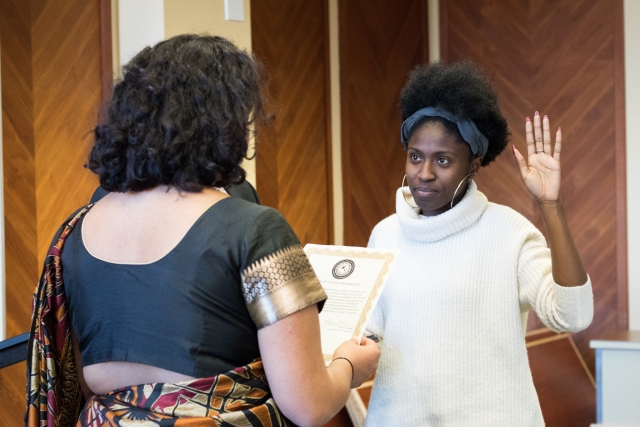
Shondreya Landrum being sworn in by then-Vice President Shreya Deshpande.

        Landrum was born in San Diego, the fifth daughter of Mel and Ken Landrum, who met in the early ‘90s in Wisconsin, where Ken worked at a local Pick ‘n Save and Mel worked for Airborne Express. The Landrums moved their family to San Diego before Shondreya — or Shonna — was born. 

In San Diego, Landrum was part of the first class to graduate from Chula Vista Learning Community Charter School. In high school, she was the president of the Associated Students Union twice, was on the cheer team and served as Senior Class President. Her high school involvement only foreshadowed what was to come. 

For Landrum, the decision to come to UC Davis was an easy one. The academics, reputation and proximity to the State Capitol made it an attractive option. After her first tour, she knew that the competitive attitude that permeated her high school was not something she would have to endure at UC Davis. She did consider attending a historically Black college or university (HBCU) and thinks she might like to attend one for law school in the future. 

“I felt like everyone was just so nice to me,” Landrum said. “I actually felt like I could talk to people and feel comfortable.”

Landrum is just a few quarters away from earning two degrees, one in political science-public service and the other in cognitive science. She is also pursuing a minor in gender, sexuality and women’s studies. Out of her immediate family, she will be the first one to graduate with her bachelor’s degree, though some of her older sisters are in community college right now. Her mother has an associate’s degree, and her father was a year away from earning his bachelor’s degree, but after sustaining a football injury, lost his scholarship. Landrum’s little sister, Darvy, is following in Shonna’s footsteps by playing volleyball and “doing everything under the sun.”

“[It feels] good because it’s nice that I’m able to do something that nobody else was able to fully get to or actually accomplish, but at the same time, it sucks,” Landrum said. “My sisters are so intelligent. They could have been the first ones to graduate, but everybody had things in their life happening, and that deterred them.”

“I still felt very isolated.” Adjusting to life in Davis

Destanie Smith, like Landrum, was also the first in her family to graduate from college. A UC Davis graduate who majored in religious studies and biological sciences, Smith once seriously considered attending an HBCU — she was accepted to Howard University and Spelman College — but UC Davis’ academic opportunities were more attractive. 

            “I just figured that growing up in high school, middle school, I was always put in classes where I was kind of the minority anyways, so I figured it wouldn’t be as bad coming to a college campus,” Smith said. 

Choosing to attend UC Davis is an easier feat than adjusting to living in Davis, where Black students are confronted with a culture shock of sorts. At UC Davis, only 4% of students identify as African American or Black.

“[Transitioning to UC Davis] was difficult because although I met a lot of people, I still felt very isolated,” Landrum said. “At least in San Diego, even though I was still one of the only two Black people that went to my school, I had my family to go home to at night to take that burden off. I didn’t know why I was sad. I didn’t know why there was an issue until I actually went to a [Black Student Union] event.”

This feeling of isolation is not exclusive to the students at UC Davis. Chancellor Gary May, who graduated from Georgia Tech in 1985, had a similar experience. 

“African Americans were significantly underrepresented,” May said. “I think we were, at that time, 6 or 7% of the student body, which probably sounds good compared to Davis, which is 4%. It wasn’t a new experience for me being in a classroom or a lab full of students who did not look like me.”

To combat this feeling of isolation, some students, like second-year political science-public service major Ayiana Keith, choose to live on the African American Living Learning Community floor in Student Housing during their first year. There, Keith found her community and a group of friends that she continues to live with today. 

“It was definitely a big culture shock when I first got here,” Keith said. “Like, I knew I wasn’t going to be around a lot of Black people, but literally, there’s nobody here. I don’t see myself. Oftentimes, I’m the only Black person in [my] class.”

Smith, who came from a diverse high school in San Diego, also wasn’t prepared for the culture shock she would feel at UC Davis. She did, however, eventually find her home in the Turtle House, a co-op style living space on 2nd Street. Turtle House is home to 20 people — some students, some young professionals — all committed to living together in a creative, harmonious space. Their blue house, with chickens and often someone playing guitar in the yard, is named for the suspended turtle statue hanging above the porch and is known for their house shows and large, family-style dinners.

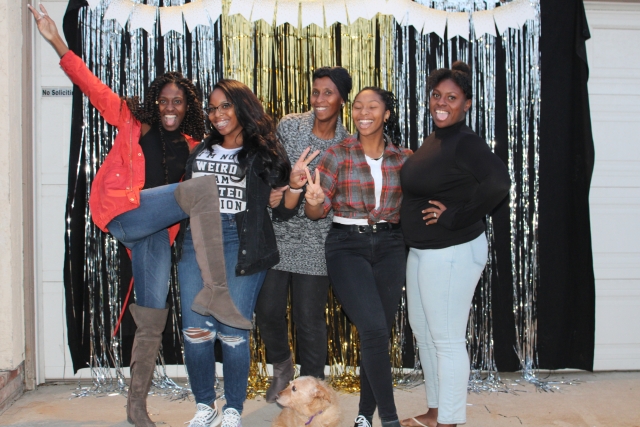
The Landrum women, with Shondreya on the left and her mother in the center.

            “I feel like I’m in a safe space there,” Smith said. “You don’t feel that sense of comfortability everywhere. No one’s ever really judgmental there.”

“I am most definitely hyper aware of how to present myself.” Life on campus

Banks, who chose UC Davis because it was the furthest school from her hometown of Bakersfield, California, did not find community in a traditionally Black space, but rather in the California Aggie Marching Band, formerly known as Band-Uh!

“I always have people to talk to and I like to keep things close and so I did find that [closeness] there,” Banks said. “It’s not diverse at all, but they do give me the space to push back on that.”

Banks pointed out to band leaders that their music folders did not feature any songs written by an artist of color. 

            To Black and African American students, being faced with prejudice, even on a campus that prides itself on diversity, is inevitable. Not everyone will find a space where pushing back is welcomed. Black students are faced with the struggle to not only exist, but to be exceptional and the knowledge that people’s eyes are always on them.

            “I am most definitely hyper-aware of how to present myself in every sphere that I am in,” Landrum said. “I’m always on my P’s and Q’s […] because if you slip up, especially as a Black woman, you get screwed.”

            Many students are faced with stereotypes and microaggressions because of their race or ethnicity. Smith recalls having been asked at least once per quarter if she was in the right class, or if her acceptance to UC Davis was contingent upon athletics, especially when asking for help from faculty.

            “I often get asked, ‘Oh, what sport do you play?’” Smith said. “That all comes with the territory.” 

Smith often had to explain that she wasn’t attending office hours because she was on the basketball team, but because she just needed help on different class concepts.           

Although no longer a student, even May has experienced microaggressions in the professional spaces he navigates as chancellor of the university. 

“[At] my first meeting of our Athletic Conference presidents, everybody’s introducing themselves, and I say, ‘I’m Gary May from UC Davis,’ and one of the other presidents says, ‘and what is your role at UC Davis?’” May recalled.

           Banks, now in her fourth year, reflected on the low numbers of students of color and Black students at UC Davis. She said “a lot of Black people think that they need their body to get into college,” and, “typically,” sports are the way to go to a top tier school. 

Racism in the community

Fourth-year human development major Jamarca Banks has been subjected to overt racism in the City of Davis. Twice, she has been called the “N-word,” once by a group of white men in a pickup truck with an American flag and twice by a white colleague. 

“When I heard the one by the guys in the truck, it shook me to my core,” Banks said. “[When my colleague said it to me], I didn’t think anything of it until months later. I knew it wasn’t okay at the moment, but then it really hit me that someone actually had the audacity to say it to my face multiple times.”

Banks is not alone in being subjected to overt racism and harassment on campus. 

            On his first day at Georgia Tech in the early 1980s, May moved into his dorm room to find that he and his roommate, Chip, had both been subjected to overt racism. 

“[His name card said] Chip is an N-word lover, so that was my introduction to the campus,” May said.  

Incidents of racism and white supremacy are not uncommon on the UC Davis campus. Last October, The Aggie reported that 25 staff and students linked to the African American studies and political science departments received an email containing the message “It’s okay to be white.” The next week, a student reported that the fifth floor of the Death Star had been vandalized with two discrete N-words. This is on top of countless incidents of anti-Semitism on campus. 

“The students who have grown up more within their culture […] want to feel safe on campus and I don’t think UC Davis has done the best to provide that, truthfully,” Landrum said. 

May argued, however, that the university walks a fine line between protecting students to the best of its availability and preparing students for the difficult situations they will inevitably face after graduation.

“I think we are doing quite a bit, but we’re never going to be different from society at large,” May said. “I straddle this line between wanting the students to feel safe and wanting them to be able to function in society. So, it’s a difficult balance.”

“We are a very strong community.”

Landrum and her ASUCD staff were tasked with making a video for UC Davis’ Orientation aimed at Black students to inform them of different resources and opportunities. Mostly, the video aims to make sure that incoming Black students feel seen. Keith, Landrum’s chief of staff, took the lead on the video. 

“[This video is for] when they come in, they can look at Black students and they will see, these are Black students and here’s what they’re doing on campus,” Landrum said.

Landrum wants more attention paid to what Black students are accomplishing on campus. For example, the Black Pre-Law Association went on a fully funded trip to Columbia University for the Black Pre-Law Conference, and the Black Engineers Association hosted a state-wide conference at UC Davis.

            As a senator, Landrum worked last summer to secure more space for the Center for African Diaspora Student Success (CADSS). After ASUCD dissolved the Experimental College, Landrum took advantage of the opportunity and worked to double the amount of space dedicated to CADSS. 

“They have been fighting for more space since they got the space [they’re in now], but CADSS was literally put on the list last,” Landrum explained. “It was extremely difficult because even though there aren’t many Black students on campus, we are a very strong community. And we do like being with each other. And we do like having a safe space to be on campus with each other.”

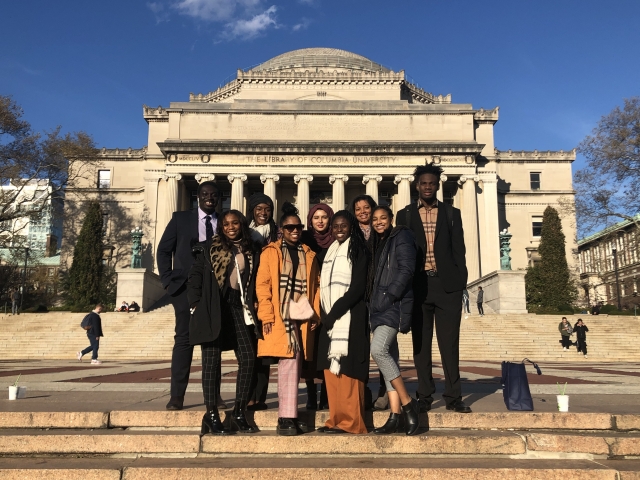
The Black Pre-Law Student Association at UC Davis in Washington, D.C.

Landrum has spent much of her time on the Senate table advocating not only for her own community, but for all underrepresented communities. The ASUCD Senate table is often divided, but it was Landrum’s reputation for communicating with students and her ability to work across the aisle that won her the election. 

Before the COVID-19 outbreak, Landrum planned to host an ASUCD banquet that would invite alumni and different ASUCD units to come together and raise money for the association. Alumni would be given the opportunity to reacquaint themselves with the different programs and initiatives spearheaded by ASUCD. 

Former ASUCD Vice President Shreya Deshpande admires Landrum’s ability to ask the right questions: “What can I do for you? What are the issues that you need addressed? And how can I make sure that you’re feeling represented and feeling heard?”

These questions are especially important when the table’s discussions are focused on police brutality and the Blue Lives Matter flag, on allocating funding and space to different commissions and committees or processing instances of hate and racism on campus. 

“She won the election by a freaking landslide,” Deshpande said. “The way she humbled herself, and continues to humble herself at the table, shows [that she is someone] in power, using her power, to be able to create that space.” 

That effort to create space was recently acknowledged by the Black Student Union. Landrum was awarded the Helping Hand Award for the second year in a row. 

Landrum plans to take the lessons she’s learned through her internships, her time at the Senate table and what she learned at the Black Pre-Law Conference to law school. Even if she doesn’t attend an HBCU — though she would love to — she is confident that she will thrive, regardless. Being a Black woman at UC Davis has taught her to thrive in the face of adversity. 

“At the end of the day, I’ve pulled through and the most challenging times were in places where it was very unlikely for me to succeed,” Landrum said. “But I did it.” 

Written by: Liz Jacobson — arts@theaggie.org

UC Davis clinicians and engineers collaborate to develop low-cost portable ventilator

Ventilator created with goal of 80% functionality for 10% of cost compared to commercially available device

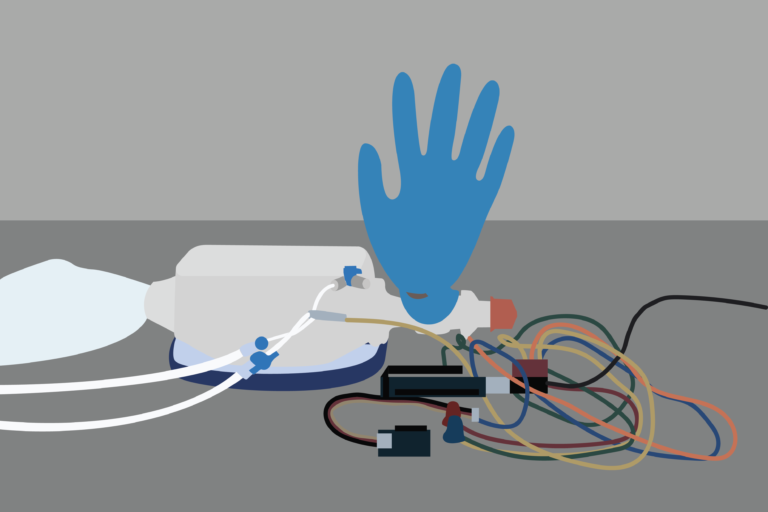
In response to the national shortage of ventilators across the country, UC Davis biomedical engineers and clinicians have collaboratively developed an automated low-cost portable ventilator. The device has been named AmbuBox and is on track to becoming publicly available in the near future following urgent authorization from the FDA. 

The AmbuBox is expected to cost between $100 and $500, according to engineers and developers involved in the ongoing project. This contrasts greatly with commercially available ventilators, which can cost upward of $50,000 in some cases. 

The AmbuBox design was originally developed by clinicians and engineers at MiNI Lab, which is directed by Dr. Tingrui Pan, a professor within the Department of Biomedical Engineering. His lab is particularly interested in exploring interdisciplinary links between nanoengineering, biomedicine, and related fields. 

“The idea was first Dr. Pan’s idea,” said Dr. Andrew Li from the Department of Surgery at UC Davis Medical Center. “Whether it’s pumps or converting small volumes of liquid from one area to another, that’s kind of [MiNI Lab’s] specialty — they’re very interested in the flow of liquids and gases, and this was the perfect application.”

After learning early on that there could be a potential shortage of ventilators due to the pandemic, Pan started leading work on easing this issue.  

“During the pandemic, I was working with my collaborator in the Medical Center and they told us that there could be a potential shortfall on the ventilator, and so we started working on it,” Pan said. “The goal is not to create a new category of ventilator [but rather] to make a simpler ventilator design that can be quickly manufactured.”

There are many commercially available ventilators that are equipped with advanced technology in order to improve the user experience, according to Pan. These ventilators are furnished with advanced interfaces and various breath delivery settings, which significantly raise the price of the device but do not provide a significantly greater degree of care to the patient. 

“[The traditional ventilator] consists of thousands of components that you have to order, not only from the US but [also] globally,” Pan said. “If there’s any glitch in the supply chain, you might not get a ventilator in a short time frame.” 

With this challenge in mind, Pan’s lab emphasized a minimal amount of working parts when they were considering various designs for the AmbuBox. Some inspiration for the project came from AmbuBag, an existing manual ventilator which requires a nurse or doctor to squeeze air into the bag to allow for ventilation. 

“[AmbuBox] is a very simple design with no major moving parts,” Li said. “This is in contrast with a traditional ventilator that often has many, many moving parts, and on top of that, sometimes very elaborate electronics. [AmbuBox] is more meant to be a low cost, reliable, durable, hopefully less power-consuming device with the same basic features that would help sustain someone’s respiratory system.”

The AmbuBox has been designed to include an automated compression mechanism for the airbag, making it so that a doctor or nurse is not needed to operate this ventilator. The device is designed to utilize existing compressed air from a medical center, for example.

“Our prototype will be very inexpensive, it will [use] less power,” Li said. “The machine really will drive a breath into a patient with the use of compressed air. Compressed air is relatively easy to obtain versus battery power. The only thing that’s really battery controlled are the pressure sensors and also the solenoid valve that controls the flow of compressed air into the chamber.”

In addition to the changes in power utilization made possible by AmbuBox’s design, developers of the prototype also hope to utilize existing mobile compressed air for the ventilator system. 

“What we also would like to consider is medical transport, whether it’s via ambulance or medical airplane or air transport,” Li said. “All of those vehicles and aircraft have compressed air on board.”

Before the design can be finalized and sent to the FDA for approval, extensive testing must be conducted on the AmbuBox. This is already in progress and involves the use of various test lungs, which are devices designed to mimic the human lung. 

“[The test lung is] essentially a balloon that’s supposed to mimic the elasticity and compliance of lung tissue,” Li said. “The [human] lungs are made up of [somewhere in the order of] hundreds of millions of little balloons called alveoli. But unlike a standard balloon, the lungs have a very low surface tension, so it’s very easy to inflate them.” 

Due to the delicate nature of alveoli, Li agrees that it is very easy to over inflate the lung tissue in a select number of COVID patients. This over inflation, called barotrauma, is thus a danger that engineers must factor into the design of AmbuBox. Despite the challenges of developing this ventilator, engineers and clinicians are hopeful the device will prove successful once testing has been concluded. 

“Preliminary data looks very good,” Li said. “We’ll be planning definitive testing on a much larger test lung piece of equipment in the respiratory therapy area of the Medical Center.”

Written by: Dina Gallacher — science@theaggie.org

UC Davis Athletics to wait, follow county guidelines on reopening facilities for practices

Decision follows NCAA announcement allowing voluntary training starting June 1 

On May 22, the NCAA announced it would allow voluntary activities to be held for Division I sports starting June 1. The announcement means that all Division I programs can now hold voluntary practices for eight hours each week. This expands on a previous NCAA decision from May 20 allowing for D-1 basketball and football teams to begin holding on-campus voluntary activities on June 1 as long as all “local, state and federal regulations are followed.”

Prior to this announcement, the NCAA only allowed teams to hold eight hours of voluntary virtual activities each week. This decision, coupled with UC Davis’ decision to cancel all on-campus athletics activities for the spring season, meant that spring sports teams have been unable to practice in person since mid-March. Now, UC Davis Athletics is deciding how to move forward with summer training.

Currently, the state of California’s COVID public health guidelines allow for local health inspectors to commence with a gradual reopening under state guidelines. Following this directive, Yolo County recently lifted its shelter-in-place orders and has moved into Phase 2 of its reopening plan. In Phase 2, the county will allow for the gradual reopening of lower risk facilities, including schools, with some modifications. 

Some of these modifications may need to include adjusting the practice schedules and activities for the UC Davis sports teams that have been unable to practice in person this quarter.

“We are eager to resume permission for student athletes to partake in voluntary activities,” said UC Davis Director of Athletics Kevin Blue. “However, the availability of our facilities, and the availability and the permissibility of UC Davis students doing voluntary learning activities on our campus is subject to Yolo County and the County Public Health guidelines and how the shelter-in-place Order affects what’s permissible activity.”

The Athletics Department is currently awaiting word from Yolo County officials as to whether or not it will be able to reopen and in what capacity. As a result, the department is unsure when, exactly, teams will be able to resume in-person training. In addition, it’s possible that in the coming months only certain training functions will be available.

“Right now, it’s within the shelter-in-place guidelines for people to go for an outdoor run, so long as they maintain social distance,” Blue said. “Our distance runners, for example, can train on running trails the same as they would in a more conventional environment so long as they’re maintaining social distancing. On the other hand, indoor spaces, like a basketball gym, may not be available for access because of public health guidelines from Yolo County in the State of California.”

Regardless of when local and state guidelines will allow for the reopening of UC Davis facilities, the university would still need to take proper precautions before allowing for in-person practice and the use of athletics facilities.

“Any reopening would be done safely and gradually, but we don’t have details or specifics on it because we simply lack any advanced understanding of what the state and county will do as far as relaxing [restrictions],” Blue said.

Written by: Priya Reddy — sports@theaggie.org

Professional sports in US slowly preparing to return

Countries across the globe provide glimpse of new reality for live sports

As sports leagues in the U.S. begin to reveal plans for their potential return, professional  leagues across the world are providing the first glimpse into what could be the new reality for live sports amid the coronavirus pandemic. 

Beginning in early May, South Korea became one of the first countries to resume play, as the Korean Baseball Organization (KBO) implemented several preventive measures in an attempt to make the playing environment as safe as possible. 

Players and coaches must go through fever screening prior to entering stadiums and are not allowed to high-five teammates with bare hands. Masks are required for umpires and base coaches, as well as for anyone who enters training facilities. The KBO has also decided that if any team member tests positive for the virus, the league will immediately shut down.

Germany’s Bundesliga became the first major soccer league to return to play as well, implementing their own protocols such as disinfecting match balls, fever screening and requiring substitutes to wear masks and sit six feet apart from each other on the bench. Players have also been discouraged from typical celebratory actions such as hugging and high-fiving.

Italy’s Serie A and England’s Premier League have also announced their expected return around mid-June. They will most likely be following similar preventive measures. 

Among the many preventive measures implemented, the one that presents the biggest challenge to a return to normalcy is the new reality that all sports are going to have to be played without fans — or a severely limited number of fans — for the foreseeable future. South Korea and Germany have attempted to ease this obvious sense of emptiness by placing cutouts and images of their fans throughout stadiums. 

The KBO said it hoped to have fans return to games as soon as early June, starting out with 20% capacity and increasing from there. But a recent spike in coronavirus cases in South Korea has put that plan in jeopardy for now as the situation remains uncertain. 

In the U.S., leagues have slowly started to release their plans to move forward with their respective seasons. But considering the country has had more confirmed coronavirus cases than any other, it will likely take more time for sports to resume. 

The MLB released a detailed, 67-page safety proposal regarding its potential return for the 2020 season, which includes a wide range of modifications it hopes to implement. 

The proposal consists of procedures such as multiple daily temperature screenings, balls being thrown away after being touched by multiple players and consistent testing for players and staff, which would require upwards of 10,000 tests per week. Players are also discouraged from showering at stadiums and socializing with opponents during games and are not allowed to use any ride-sharing apps when traveling. 

The MLB’s possible 2020 season relies on approval from the MLB Players Association before moving forward with an official start date. All 30 teams were consulted regarding the proposed safety protocols, but the two sides still remain in negotiations regarding the financial details. 

It’s apparent how much effort and attention-to-detail will be required if the MLB does decide to move forward with the season. Although it seems to have a very thorough set of guidelines, it is difficult to predict exactly how all of this could be carried out, and whether it will succeed at all. 

The NBA is also working on a plan to resume its season, as teams have opened training facilities under a strict set of protocols that players and staff must follow. These include a check-in area upon arrival to training centers, temperature screenings and training on an assigned court. Only four players are allowed to practice at a time, and groups must rotate at designated times to avoid coming into contact with one another. 

The NHL released its plan to move straight into the playoffs with a 24-team playoff format, but has not yet revealed when the season will be returning — if at all. It is expected that the NHL will select two “hub cities” where games will be played to avoid traveling as much as possible while also relying on temperature screening and voluntary workouts with limited numbers of players. 

Neither the NBA nor the NHL have released official health protocols or specific dates in which they plan to resume their respective seasons, although the NBA is targeting July 31 as a possible return date. 

The National Women’s Soccer League (NWSL) decided it will be returning to play, scheduling a month-long tournament in Salt Lake City at the end of June. The U.S. Women’s National Team Players Association and U.S. Soccer Federation have both agreed they will allow each player to choose whether or not to compete in the tournament. If the tournament continues as scheduled, the NWSL will be the first U.S. league to resume play since the professional sports shutdown.

Although the future of sports remains uncertain, the effort put into resuming play indicates the strong desire that owners, players and fans have to bring sports back into their lives. While it may seem like an attractive concept, there are many difficulties leagues could end up facing if seasons return too soon. 

As displayed in the MLB’s proposal, there are a large number of guidelines that players and staff must remember to follow, and questions remain about how leagues are going to monitor every single aspect of the game to make sure every rule is being adhered to. 

There is also the possibility of a player testing positive for the virus, which could ultimately lead to their teammates or family members being infected as well. Leagues will have to account for this possibility and decide whether or not resuming their seasons is worth this risk. 

Between the lack of close celebration that fans are so used to seeing from their teams and the unusual silence from the stands, fans and players are constantly reminded of exactly how far the world is from any sense of normalcy — not to mention that players adhering to strict guidelines day in and day out might begin to feel more disconnected from their sport as ever.  

Nonetheless, there comes a time when the sports world will have to start again, and fans and players can only hope that leagues will account for all possible risks and resume play when it is safe to do so. 

Written by: Rain Yekikian — sports@theaggie.org

The truth about virtual romance

Can we find love online, or is it virtually impossible?

If you’ve ever been romantically involved, you probably know what it’s like to get butterflies when someone flirts with you or gives you a certain look. And in this day and age, it’s not uncommon to experience this when you’re not even with the person — whether it’s a Snapchat, text or phone call, you can develop real feelings for someone based on virtual interactions. But how do these feelings compare to those established in real life?

 With the uncertainty of a global pandemic and the subsequent increase in permanent at-home work, the way we make connections as we know it may change for good. Everything from work meetings to class is online, leaving less time for socializing, which means less potential for new connections.

These changes to the way we build relationships makes romance seem increasingly out of reach. The ways we meet might someone, in a casual setting like a discussion section or a shared table at the CoHo, have vanished. And even when starting out on Tinder, you typically meet up in real life soon after. 

Day-to-day socializing — including scoping out partners — will return one day, but for now, anyone interested in finding a partner or deepening their relationship with one has to go about their endeavors online. 

This doesn’t mean romance is dead. We can, in fact, sustain an intimate connection online, even if it’s not exactly how we do so in person. 

Bo Feng, a professor of communication at UC Davis, has done research on the way we develop personal relationships in technological environments. 

“The core elements [of developing a relationship] are not restricted by the particular medium through which we develop intimacy,” Feng said. 

When we are just getting to know someone, the way we appeal to each other online isn’t so different from how we do so face-to-face. According to Feng, sharing information about each other virtually and leaving a positive (or negative) impression can be equally as effective in indicating your interest in pursuing that person — and, in some cases, more effective. 

“On the surface, people may see [texting] as a downside of online communication, but it can have its positive impact,” Feng said. “When people rely solely on textual communication, especially at the early stages of a relationship, that may allow people to develop a more positive impression if the information is shared selectively.”

Choosing specifically positive traits to share is called selective self-presentation, and we do it across all contexts, whether online and in person or professionally and casually, to project the best version of ourselves. When communicating online, this can lead to what’s called hyperpersonal communication, where virtual communication allows for a more personal connection than face-to-face interaction does. 

According to Feng, through “hyperpersonal communication, people may develop intimacy at a greater level online compared to offline.”

So, virtual connections have the potential to be stronger than those in person. But this can have its downsides. It’s one thing to portray yourself in a positive light to attract a partner, but it’s another to deceive or omit relevant information. In extreme cases it’s known as catfishing, but it can also just be lying about certain parts of yourself, which is harmful at the outset of a romantic relationship. 

We can also use non-face-to-face communication to enhance what we say to potential partners. Because millennials and Gen Z are so centered around virtual life, now more than ever we know the ins and outs of communication through social media and texting. From subtweets, or indirectly sending someone a message over social media, to the difference between ‘Hey’ and ‘heyy’ when texting, we know how to send strong signals about our interest in a person. 

“People have the luxury to craft what they say, which means more time to plan messages,” Feng said. “Better planning leads to better quality messages, and better communication leads to more positive impressions, and that can elicit intimacy.”

It seems like online communication isn’t so detrimental to romance after all. We can still get to know someone on an intimate level and develop deep feelings without in-person contact. 

But primarily online relationships are less common than those in person for a reason. Despite certain advantages of deepening the connection online, it’s easy to idealize a person without meeting face-to-face.

Steven Brunner, a lecturer for the Department of Communication, explained, “Part of the reason why [we can become more intimate online] is because we have this over attribution of similarity. There are lots of holes when you’re interacting with someone online, there’s lots of information you don’t know. But we fill in those holes by just presuming similarities that we haven’t proved are wrong.” 

Even if you know everything about a person, there are going to be inaccuracies in your idea of them until you meet in person. Beyond just discovering mannerisms or traits only visible in real life (that you may either love or hate), a physical bond is necessary in almost any romantic relationship. 

“At some point, if you want to take a [romantic] relationship to a certain level, you have to move it offline,” Brunner said. 

The emotions we develop toward someone online can, initially at least, be just as legitimate as those developed in real life, but they are only sustainable for so long. Other drawbacks of exclusively interacting online persist, but there are ways to curtail conflicts that prevent authentic relationship growth. 

“Making sure people are honest in face-to-face contexts is important, but it’s extremely important in the online context,” Brunner said. “It’s super easy to misrepresent yourself when you have such high abilities to edit what you put out there.” 

Selective self-representation can be useful, then, to attract and connect to partners, but make sure you understand the importance of sharing a genuine version of yourself — and that your partner does, too. 

And be careful not to confuse the potential for deeper intimacy online with flawless communication. The nonverbal ways we communicate in person are absent virtually, so we have to make up for those missing signs.

“Online, there are more challenges associated with the transitioning from one type of relationship to another,” Feng said. “In the online environment there can potentially be more confusion and misunderstanding so it requires more effective communication from both parties to redefine the relationship and communicate expectations.” 

Whereas we can touch one another or give certain looks that show romantic interest in person, we usually can’t see those online, so moving forward with someone requires explicit conversation about what both parties want. 

The ways we develop romance online seem to be effective, if complicated and susceptible to failure, but is it so different in person? There are countless reasons why relationships end or never begin in person, some which are solved online, and some that are exacerbated. At the end of the day, no matter the medium through which you communicate with your partner, your ability to foster romance and intimacy with a partner comes down to how much you like each other. 

“If the quality of communication is good, whether it’s online or offline is not that important,” Feng said. “It’s really about how much you enjoy spending time interacting with someone. That is the defining predictor of relationship quality.”

If your only route to romance right now is via online communication, don’t be wary, just make the effort. It’s how you spend your time, not by which channel, that dictates your success of falling in love. 

Written by: Allie Bailey — arts@theaggie.org

2019–20 Goodbye Editorial

The Editorial Board, all nine graduating seniors, says goodbye to The California Aggie

Kaelyn Tuermer-Lee, Editor-in-Chief

by Claire Dodd

Kaelyn, it is because of you that I’m on the Editorial Board today. I remember last year, sitting in the Freeborn basement editing my article with Kenton, and you turned to me. “Claire, are you going to apply for a managing staff position?” you asked. “I think you’d be really good.”

Knowing that this incredibly intelligent, kind, successful human had faith in me gave me the courage to apply, and now I’m lucky enough to work alongside some of the smartest people I’ve ever met. Kaelyn, I will always be so grateful for that moment. More so, I am grateful to have been able to witness your fearless leadership. I am grateful for your patience when it comes to dealing with logistical issues and fighting for your entire staff’s paychecks. But most importantly, I am grateful for your friendship. 

A month ago, I was in a difficult situation. I texted Kaelyn and Hannah, explaining why I wouldn’t be able to attend our meetings that day. The love and support I received from you that week were unlike anything else. It meant more than you know — thank you for making me feel valued and for being such an amazing friend. I hope one day I can return the favor. I love you!

Hannah Holzer, Managing Editor

by Kaelyn Tuermer-Lee

The first time you introduced yourself to me was over the summer after our first year. I remembered already thinking you were so kind, and I had hoped we’d become good friends throughout the year — plus, the two second-year babies had to stick together, right?

And boy, am I glad we stuck together. After both secretly hoping we’d run The Aggie together our last year, I’m so glad it came true. Thank you for making me a better person and editor, and for being my absolute rock. You’ve had my back without fail, and I can say without a doubt that there’s no one else I’d rather have by my side. I truly don’t know how I became so lucky to have you not only as my partner in news and managing editor but also as my best friend. You are incredibly smart, kind, driven and dedicated, not to mention that you are an outstanding reporter, editor and friend. The world is such a better place with you in it, Hannah Holzer, and I know you can accomplish anything. I can’t wait to read your work in The New York Times, the Los Angeles Times or wherever you decide to go — because if anyone can do it, it’s you.

Kenton Goldsby, Campus News Editor

by Stella Tran

I completely marvel at Kenton’s dedication to The Aggie, watching him advocate for reforms, angles for editorials or even punctuation marks during editing sessions is both an enthralling and awestruck experience. As a new editor, I really had to learn as I go, and Kenton has been one of my most influential teachers. He has not only pushed me to become better at structuring my sentences grammatically but has taught me to empathize with others through the words that I write. I constantly improve — as a writer and person — because of him. 

Kenton’s worldly knowledge on what seems like almost every topic is astounding. Not only is he intelligent, but he has such witty humor and a very unique laugh that always puts a smile on everyone’s faces. While it can take me days to marinate on a thought, Kenton can express everything on his mind, with poise, in a matter of seconds. Without a doubt, Kenton will go on to do amazing things and will shine light wherever he goes. Thank you for all that you do for The Aggie, Kenton — you continue to inspire me. 

Stella Tran, City News Editor

by Hanadi Jordan

When I first joined the Editorial Board, I remember being both excited and nervous to take on a new position and work alongside new people, many of whom have known each other for years. Terrified of making a mistake or a bad impression, I entered my first week in the office as opinion editor feeling incredibly nervous. But when Stella first smiled at me, I got the feeling that she was genuinely happy to see me. Whether or not she really was, her smile alone made it easier to feel physically at ease. Her calm and kind demeanor has always brought a level of comfort from our first Ed Board meeting to our various late nights in the office. 

You can learn a lot about a person by watching how they work, and two things I’ve learned about Stella after three quarters of working together is that she’s not only kind but incredibly hard working. With all the hours and energy that goes into the work we do as editors — from covering breaking news to endorsement interviews to late night Ed Board meetings — I don’t think I’ve ever heard Stella complain once. I only wish we had this last quarter to continue working together in person, but it has been nothing short of an absolute pleasure for me to serve alongside you and our fellow editors.

Hanadi Jordan, Opinion Editor

by Cecilia Morales

Joined by Claire, Stella and me, Hanadi was new to the Editorial Board this year. But you wouldn’t know it from the outside looking in. Hanadi always shared her editorial ideas, often on dense and serious topics, with so much clarity and consideration but in an approachable way that made me feel welcome to discuss with her. She strongly navigated her role as leader of our editorial meetings as if she’s been doing it for years. 

Her honesty and humor were a breath of fresh air in our basement newsroom (and in Aggie Zoom calls throughout this social distancing quarter). I miss seeing what snacks Hanadi would bring down to the office to offer to everyone, but now I will miss listening to her say, “I hateeeee this part!” in response to us coming up with headlines and layercakes. Just knowing such an intelligent, independent and passionate mind like hers is going out into this world makes me more at ease about the future. Good luck with everything Hanads (although I know you don’t need it)! <3 

Claire Dodd, Features Editor

by Dominic Faria

There are a few things you should know about Claire, starting with the fact that she has perhaps the kindest and most inviting personality out of anyone at this newspaper. Like a ray of warm sunlight, Claire’s presence immediately fills any room with an overwhelming sense of positivity. Especially in the dark dungeon that is (was?) Lower Freeborn, you can’t help but be uplifted by her beaming smile. No matter how turbulent the times, I always know that she’s there to talk to about our economics classes or have a laugh about some wild story that happened to one of us.

But more than that, she’s an adept and accomplished journalist who truly loves and values her job. She has undoubtedly made her mark on this paper not just through her incredible reporting, but through her mentorship of her desk of writers as well. Claire, we all admire your radiant attitude and cherish the supportive friendships that you have formed with all of us. Thank you for uplifting us all, and I wish you nothing but the best as you continue to shine upon the world outside of UC Davis.

Liz Jacobson, Arts & Culture Editor

by Kenton Goldsby

“Aren’t you in my Spanish class?” Isn’t it fitting that our friendship started at an Aggie event where we talked about Spanish? Your companionship has spanned four years, two continents, five countries (even if we only crossed paths in Spain, we were there at the same time!), two emergency beers and an endless number of laughs.

But I could never put into words the true value of what you’ve done for me. You cared for me when I felt broken and alone. You gave me family when I needed it so desperately. For that and more, I can never repay you. When things were going horribly, horribly wrong you were the first person that crossed my mind to call and ask for company — you dropped everything and were there.

I’d say I’m going to miss all of the little things that we would do together, but I already do. These past few months have completely broken our routine and brought an end to our early morning Philz and goss sessions. But your friendship has been there all the same. With all we’ve gone through, there’s nothing that could ever break our friendship. ¡Te quiero un montón, Liz!

Dominic Faria, Sports Editor

by Hannah Holzer

There’s a running joke about Dom being the dad of the group — which was fitting especially during that brief period of time he had a mustache. In certain ways, this rings true: He is mature beyond his years, he is the most well-respected person I have ever met and to disappoint him would truly be the greatest shame.

Dom is like a celebrity on campus — everyone knows him and likes him. But it’s more than this, because everyone who knows Dom genuinely admires him. Bring Dom up in conversation with his friends and they will inevitably sing his praises. And it’s much deserved: I have worked closely with Dom for two years, and he is truly one of the best people I know.

In the newsroom, we occasionally find ourselves swept up in the chaos of a situation. But Dom has always been a grounding presence. In Ed Board meetings, when we get fixated on a single word, Dom is the voice of reason, always able to offer sound advice. In short, it has been a pleasure to work with Dom, and I wish him only the greatest success and happiness.

Cecilia Morales, Science Editor

by Liz Jacobson 

Cecilia, I consider it a shame we didn’t get to know each other until this year, but I also consider myself incredibly fortunate to have served on the Editorial Board with you. You bring an unmatched passion for social justice and equality to our editorials, and we are all better for it. Your wise voice and knowledge are an example for us all, especially now.

Being editors, I feel like we all have a more expansive vocabulary than most, but if someone asked me to describe you, the best word I can think of is cool. Effortlessly cool. I feel like there’s a joke in there about you being so cool you wear thermals under your clothes during the winter, but I haven’t thought of it yet. Every day, you walk into the office from what I can only assume was your Vogue cover photoshoot. I will let you know here that I bought a vintage patterned blazer after I saw you rock one the day we took our staff photos.

And a final note: I have never read more science articles than with you as the science editor. Next year’s editor will have big shoes (read: Dr. Martens) to fill. All of the love.

Written by: The Editorial Board

What have we been listening to this year?

The Arts and Culture Desk (and a bonus!) shares our most impactful albums from this year

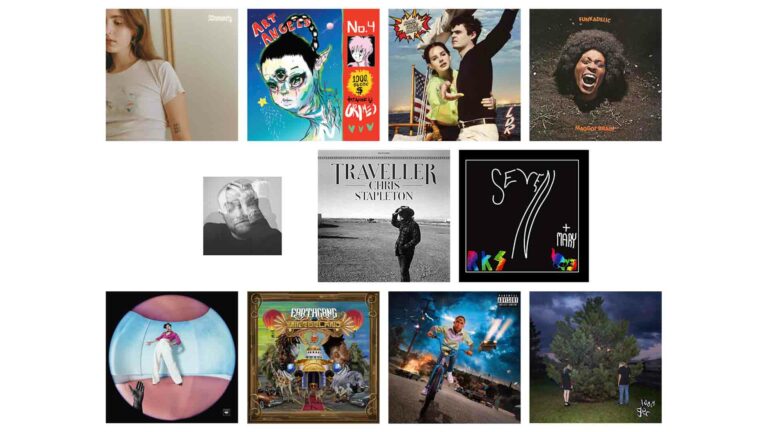
Liz Jacobson, Arts and Culture Editor: “YHLQMDLG” by Bad Bunny

Bad Bunny’s second studio album pays homage to reggaetón’s past and showcases its future with features by the genre’s legends and fellow Latin trap up-and-comers. The album’s title is an abbreviation of “Yo hago lo que me da la gana” (“I do whatever I want”). “Safeara” and “Yo Perreo Sola,” along with the rest of the party album, will have you feelin’ yourself and doing whatever you want.

Allie Bailey, Assistant Arts and Culture Editor: “Circles” by Mac Miller

Only some of the greatest musicians have a strong enough collection of recordings to release an album posthumously. Mac Miller joins this talented crowd with “Circles” — chill, real, at times upbeat and often heartbreaking, the album is an accumulation of Miller’s lyrical intimacy and distinguished sound that transcends anything we’ve seen from him before. 

Itzelth Gamboa: “Seven + Mary” by Rainbow Kitten Surprise

There is no comparable feeling to the feeling I got while listening to RKS blast in my 2001 Buggie. My third year in Davis was filled with an immense amount of new music, but “Seven + Mary” was, without a doubt, the best album. The music brings a sense of nostalgia, and will be accompanied by nothing but good memories. 

Alyssa Ilsley: “Fine Line” by Harry Styles

Styles’ sophomore album is contemplative and emotional. Inspired by ’70s rock, Styles infuses folk, soul and psychedelic pop influences into an album that promotes a sense of timelessness. Styles is modernizing the pop-rock genre, with “Sunflower, Vol. 6” and “Cherry” demonstrating this best.

Sierra Jimenez: “Traveller” by Chris Stapleton 

This album was made by the spirit of scraggly hairs on a wild cowboy’s beard and aimlessly driving to nowhere under a sea of stars in a beaten down truck. It stands along the border with one boot in country twang and the other, a bare foot, in the soil of bluegrass. You’ll definitely need some whiskey when listening to this diamond in the rough — Tennessee whiskey to be exact. 

Josh Madrid: “Norman Fucking Rockwell!” by Lana Del Rey

This nosedive into the grey zone of American nostalgia takes place in my hometown of Long Beach, and it’s the type of lyrical poetry that one contemplates in the smoking section of the bar patio while thinking, “What’s next?” The best song on the album is “Hope is a dangerous thing for a woman like me to have — but I have it.”

Livvy Mullen: “Art Angels” by Grimes

More than ever, I really need music that makes me feel absolutely feral. “Art Angels” just gives you that rush! Though I only understand 20 to 30% of the lyrics, I am confident that it is the greatest album in the history of music. My current isolation self-care routine is streaming it in full at 2 a.m. while I try to move things with my mind. Highly recommend!

Caroline Rutten: “Immunity” by Clairo

This young, emerging artist offers us a glimpse into adolescent experiences with love — it’s innocent, it’s intense and it’s heart-wrenching at times. Clairo offers lyrics of perfect simplicity, partnered with the sound of ex-Vampire Weekend’s Rostam. Bedroom pop has reached a moment of beauty with this album. 

Ilya Shrayber: “1000 gecs” by 100 gecs 

There is truly nothing in our sonic landscape that sounds quite like 100 gecs. Sit back, relax, pour yourself a cup of tea, then stand back up, throw the cup against the wall and start flailing along to the endless array of bangers found on their debut release “1000 gecs.” 

Andrew Williams: “Maggot Brain” by Funkadelic

Funkadelic’s third studio album pits all the groove and move of the ’70s against, y’know, “Nam” and all that stuff. Strap yourself in and prepare for a psychedelic eruption of face-melting guitar solos and funktastic basslines — just don’t forget to pack your stinkiest “stank” face.

Added Bonus: Dominic Faria, Sports Editor: “Mirrorland” by EarthGang

This is one of the most creative and expressive albums to come out of the ascendant Dreamville label. Olu and WowGr8 take you on a rhythmic ride through Atlanta that changes course with each unique track. It blends art and imagination with heartfelt poetry, and it begs to be listened to over and over again.

Written by: The Arts and Culture Desk — arts@theaggie.org

UC Davis Camp Kesem will continue serving community through online format

Camp directors discuss transition to online camp this summer

Usually located in the wooded Tahoe Foothills, UC Davis Camp Kesem, the Davis chapter of the national Camp Kesem organization, serves children of cancer patients, cancer survivors or those who have lost family members to cancer. This year, the UC Davis student-run camp will continue remotely via Zoom for about 260 campers. 

According to Tomer Fidelman, a third-year economics major and camp director, the Camp Kesem organization decided to move camp online in March, allowing the counselors more time to plan for the summer.

“That decision came relatively early in the pandemic, which was great because we have ample time to prepare,” Fidelman said. “We’ve been able to really focus on how we’re going to make this the best experience for our community.”

This decision seemed natural for him, as many campers come from a family that is immunocompromised, making the risk of contracting a respiratory disease higher for the Kesem community members. 

“We’re serving a highly vulnerable population, and we should not be in a position where we might be endangering them,” Fidelman said. 

Camp in a Box

Running from 9 a.m. to 8 p.m., there will be about four hours of programming each day, including camp games and arts and crafts. In addition, each camper will receive a box with materials such as markers, a journal and more.

“The activities we’ll be doing will be things that we can do from home like tie-dying,” said Armando Gonzalez, a fourth-year sociology major and camp director. “We’re sending all of our campers a little pot and a seed so they can grow a little plant.”

In normal circumstances, Kesem is an overnight camp with campers divided into cabin groups. According to Gonzalez, these groups will continue online, and campers will still be able to participate in a signature Kesem activity: the evening “Cabin Chat.”

“We ask our campers questions about how they’re feeling [and] things that they’re interested in so they can build a community and realize that there’s other people out there who are very similar to them and have similar experiences and that they aren’t alone,” Gonzalez said.

Online engagement

Kesem offers spots for kids aged six to 16 with a teen leadership program for 16 to 18-year-olds. Because of this age range, Gonzalez worries that the younger campers will struggle to stay concentrated. 

“As a former counselor for the six-year-old bunch, I’m a little concerned about having them just sit in front of a screen and be focused and attentive for more than an hour at a time,” Gonzalez said. 

However, Kesem’s many counselors, according to Gonzalez, are more than equipped to keep the campers interested. 

“Typically, our ratio is about three campers for every one counselor, and so that makes it a little more manageable for the counselors to be giving them more direct attention,” Gonzalez said.

The Kesem community

Although the camp has had to remove all of the physical games and activities from the schedule to accommodate with social distancing, Fidelman said he believes UC Davis Camp Kesem will be able to retain the emotional connection that is, in his words, highly impactful for the kids.

“Sometimes, I think we can get disillusioned with the fact that if we’re not there in person, we might not be able to provide the same kind of support,” Fidelman said. “We’re really emphasizing here now that when we create our virtual camp schedule, we’re trying to retain all the emotionally connective parts of camp, all the parts that are cathartic and are healing and are great spaces for our counselors and our campers to connect.”

Although the camp is only six days long, in Fidelman’s experience, campers often use this time to talk for hours with others and bond over shared experiences. According to Fidelman, Kesem’s most important role is to facilitate this discussion and bring children with similar backgrounds together, a role it can still have over the internet. 

“That’s been the call to action now; the fact that there is some emotional reserve there that we need to access so that connection is still there and still possible even over Zoom,” Fidelman said. 

To Gonzalez, Camp Kesem is, at its heart, a community that does not require in-person meetings to serve its purpose. 

“We talk a lot about the community that we are and how there isn’t really any physical location or anything physical that needs to be there for the power of the community to be felt,” Gonzalez said. “Times like this exactly show that. It’s an incredible group. It’s so much more than just a camp.”

Written by: Sophie Dewees — features@theaggie.org

Aggies share summer plans amid COVID-19 pandemic

A look into how three students are spending a summer like no other

The sun is shining, the school year has come to an end and Bachelor in Paradise is on: It’s summer. Summer is a time of exploration for many students — a time when to focus on school, potential careers or just relax. 

This summer, like much of 2020, however, is drastically different from the ones in years past. With COVID-19 regulations in place, many regular summer plans are no longer available, and summer plans have been adjusted to fit the new normal of the pandemic. Yet, students have still found ways to spend their summers productively. 

Samveda Rukmangadhan, a first-year neurobiology, physiology and behavior major, decided to take summer classes at Davis over the summer to get ahead. This is an option that many students have chosen due to the pandemic, as online classes can be done safely from home. In fact, in a message sent on May 8, Chancellor Gary May said there has been a 22% increase in Summer Session enrollment since last year.  

Rukmangadhan’s original summer plans were to travel to India and see family, but these have been canceled due to COVID-19 concerns. Instead, Rukmangadhan said she decided to take two of her harder classes, CHE 118A and B, at a time where she can put all of her focus on them.

“I chose these courses because they are some of the hardest courses I would have to take,” Rukmangadhan said. “I decided, since many other health-related opportunities are closed over the summer, such as labs and hospital volunteering, I may as well focus all my time into harder classes.”

Kavenpreet Bal, a third-year genetics and genomics major, has a multitude of plans prepared for the summer. He is taking classes at UC Davis for Summer Session One and Two and, at the same time, he plans to continue his work as a microbiology assistant at the UC Davis Veterinary Medical Teaching hospital, where he will culture bacteria to assist in diagnosing various conditions in animals. Additionally, as a part of the Bhagat Puran Singh Health Initiative (BPSHI), Bal will distribute medical supplies to hospitals in need. Lastly, Ball will volunteer at Sutter Health and participate in mobile research at Hunter Laboratory. 

Bal shared his gratitude for all of these opportunities and looks forward to when restrictions are lifted so he can take on even more of his interests. 

“I am fortunate to be able to work at an essential job, take classes online and engage in mobile training/research, while giving back to our first responders and hospitals,” Bal said. “After restrictions ease up, I look forward to ideally being able to shadow physicians with specialties in internal medicine and emergency medicine.”

Rodrigo Altamirano, a first-year hydrology major, is enlisted in the California Army National Guard and plans on participating in annual training this summer. Altamirano will use this time to maintain and improve his skill levels, such as obtaining a Military Occupational Specialty (MOS).

Altamirano shared his excitement for his upcoming training during the summer, and emphasized its safety. Above all, his family’s safety is the driving force which keeps Altamirano optimistic for the future during these hard times.  

“Even though we only see each other once a month for our drills, my section is very close and knowing them, there’s not going to be a dull moment at annual training,” Altamirano said. “My chain of command, as with many others in charge, are going to do their best to keep the health and safety of their soldiers a priority. Knowing that my family is healthy and safe is what is able to keep me optimistic, to do everything you can to make sure the ones you love are safe is what keeps me going.”

Written by: Nora Farahdel — features@theaggie.org

Tragedy plus time equals comedy, but how soon is too soon?

Exploring whether “humor” is still “funny” in midst of pandemic

Over these last two months — excuse me, first two months — of “attending” virtual lectures via Zoom, students have conditioned themselves to always abide by one basic, fundamental, overarching, all-encompassing supreme law of the land in the new planet-spanning, intercontinental virtual classroom: “muting” themselves.

This practice has some readily apparent benefits. Of course, it seems like an obvious common courtesy to prevent every little bit of background noise from disturbing and distracting from the entire virtual class’ virtual classroom experience. For example, it’s probably a good thing that I was “on mute” during my music history class last week as my housemate and I (with my laptop in hand and earbuds still in) frantically heaved my mattress across the room as part of an arduous, harrowing, Herculean, profanity-laden effort to apprehend a quite sizable spider that had fallen beneath my bed.

Muting myself during that incident was no doubt the politest thing I could have done in that situation. But was it the funniest thing I could have done? Most certainly not! For instance, I could have “accidentally” “forgotten” to “mute” myself. That would’ve been pretty damn funny. I would gladly give a million bucks to have been on the other end of that Zoom call. Perhaps even more than that, given the state of the world right now… 

And therein lies my problem with Zoom’s “mute” function. As an unintended consequence of this primary “feature” of Zoom etiquette, we have effectively deprived the classroom of collective laughter. It’s almost as if the function is specially designed to stymie, stifle and smother the laughter resulting from the shared jokes, jests, quips and moments of situational irony that make the in-person classroom experience so special. “Muting” seems like a tailor-made tool for subconsciously reminding us that this pandemic is not an appropriate time to be laughing about anyone or anything. 

And thus, we are often left with a virtual learning environment more comedically sterile than the classroom of a yardstick-wielding Catholic nun. So it’s perfectly reasonable to argue that this makes “muting” more of a bug than a feature. Especially for any recovering Catholics keen on avoiding those memories.

With the classroom robbed of the usual mechanisms that promote collective laughter, we’ve been forced to rewrite the language of humor in the classroom — with mixed results. You can’t hear people laugh, but can you see them laugh? Yes, but only if their video is on. Does anybody in the virtual classroom do that? Nope, virtually nobody. Damn, how impersonal! But that’s understandable for privacy reasons. So can students just use the chat function to say “LOL” then? Yes, they can, and they do, but virtually nothing is more annoying than that. Luckily, if you think like Larry David on “Curb Your Enthusiasm,” you can at least be happy that they aren’t “verbal texting” by literally saying “LOL” out loud. And at least I only have to “virtually meet” these people!

Nonetheless, virtually nothing can adequately replace the smattering of chuckles that moves across the classroom like an ocean wave whenever the professor makes a clever and topical joke. Or the joy of exchanging a bemused single eyebrow raise with your neighbor when the professor may have just said, “let’s shit gears” instead of “let’s shift gears.”

Speaking of which, I can’t even begin to imagine how awkward and bizarre the virtual classroom must be for the world’s teachers and professors. For starters, if virtually the entire virtual class has deactivated their audio and video, then the act of teaching is reduced to nothing more than lecturing into a blank, empty, lifeless void. I’m sure that before this pandemic, that metaphor has inspired decades of incomplete screenplays from teachers across the globe.

Like the students, teachers can’t hear or participate in collective laughter from any amusing or unexpected situations that arise in the virtual meeting space. And to make matters worse, they can’t tell whether or not any of their jokes are actually landing! I’ve long felt that the best teachers are the ones who have a little bit of stand-up comic in ‘em — the teachers who can guide you to not only consume the course material, but also to appreciate and internalize it to the degree required in order to find sources of humor, amusement and irony. 

Whether bringing that humor to lectures is done through traditional joke structures or via George Carlin-esque, cleverly wordsmithed monologues that call attention to peculiar yet comical details is up to the teacher. Both approaches can work. But on Zoom, there’s no way to tell what works when we’re all muted. Just as comics need time to work out their material in comedy clubs, teachers and professors need to be able to get that same type of feedback, which is virtually impossible when we’re apart. 

I’ve seen slogans like, “together even though we’re apart” making the rounds lately. That’s a great sentiment for boosting quarantine morale for and encouraging positive thinking during these trying times. But it doesn’t exactly work like that for comedy. If it did, then failing stand-up comics who bomb virtually every gig would have the greatest excuse ever: “Even though the audience didn’t find me the slightest bit funny, I could feel so much laughter!” I’ve heard a rumor that one of my former music professors has been inserting laugh tracks into her lectures, which is a pretty brilliant solution for this problem.

For many people, the struggles of Zoom might be yet another unwelcome stressor during times that are already stressful enough. And for others, the gravity of the pandemic and its global consequences may reduce Zoom to just one more irritating, trivial annoyance that provides ample kvetching material. For example: Aren’t you getting a bit exhausted from being forced to listen to virtually everyone say the word “virtually” virtually all the time?!

But for both of these groups of people, Zoom gives one crucial benefit that might make it well worth purchasing the official Zoom license in order to have meetings longer than 40 minutes. Zoom provides us with small and absurd details amid the overwhelming physical and psychological horrors of the pandemic. Details that we will eventually be able to look back on and laugh at, precisely because they are trivial, absurd and amusing. 

This will prove invaluable because laughter can be a highly effective method for healthily processing tragedy. Many celebrities and late-night comedians have been trying their best to make sure we don’t forget that, keeping their shows, acts and brands going from their homes. While this is a positive and valuable trend, there is something weird and off-kilter about watching them putter about their homes as they eagerly scramble to entertain us and make us laugh. 

This has forced us to re-evaluate our relationships with celebrities and question why we devote so much valuable time to living vicariously through them and their “content” (whatever the hell “content” is). Especially when they are often no more interesting or enlightened than we are. All we know is that, for some reason, viewing endless “content” on our countless devices keeps us content. Filmmaker and American treasure David Lynch perhaps best captured this curious phenomenon with an apt metaphor in his magnum opus, “Twin Peaks: The Return” (2017), in the now-infamous subplot about a dude hired for the mysterious job of continuously staring into an empty glass box on the off-chance that something might appear inside it (spoiler alert: Something does, and it murders him, but that’s not important right now).

Meanwhile, the continued presence of comedians to help us break down the day’s coronavirus news makes us think a lot about whether pandemic-themed comedy is appropriate right now. This leads to a larger philosophical question concerning whether joking about serious subjects should be considered appropriate at all. One important consideration in answering that question is whether you narrowly define “joking” as just traditional setups and punchlines, or whether it is defined more holistically to include the complex, multi-layered and irony-saturated Carlin-style riffs. But that is merely an important stylistic consideration regarding how to joke about something, not a strict criterion for evaluating whether or not you should joke about something. And I will provide no such criteria because there should not be any.

I’m of the opinion that no person, group or subject matter should be off limits for joking or being made fun of. That is, as long as the jokes are made in sensitive ways, crafted with care and clear intent. I often fear that our culture is losing the ability to distinguish between making fun of something and making light of it. They are not the same. Mocking, minimizing and making light of serious, sensitive subject matter is where we run into problems with tone deafness, ambiguous targets of jokes and flat out poor taste. Diminishing the seriousness of tragedies simply should not be done.

But in my book, making fun of things is different. It requires a quite refined and self-aware critical lens in order to produce humorous and subversive commentary on serious issues while still making it abundantly clear that you should be taking the seriousness seriously — not the jokes seriously. If there is a “correct” way to joke about something as serious as a global pandemic, then this is the way to go about it.

This is why I think John Oliver has been, by far, the most effective and important comedic voice of the coronavirus era. On his show, “Last Week Tonight,” Oliver spoke about the pandemic and our (mis)management of it with thoroughness and razor-sharp wit while still being respectful, true and real.

Because of the stay-at-home orders, he has been broadcasting his show in quarantine from his “blank white void full of sad facts.” And Oliver’s success right now is because of this “void.” It embodies why his idiosyncratic sense of humor could not be more appropriate in this moment. He is making sure that the show is not about him. He’s not promoting himself or trying to distract us with everything in the background of his home. He has distilled the show down to nothing but the information and the bitter ironies we need to make sense of everything right now. He prioritizes sharing information and his sense of bewilderment. Reacting with laughter seems more like a byproduct than his primary goal.

I have tried to adapt this approach in my own humor writing. Originally, I had planned to write another set of opinion columns this quarter so I could continue my pattern of switching between columns and satire articles every quarter. But once things started to get *interesting* in March, I realized that trying to write good humor pieces during a crisis that could not be any less humorous was a challenge that I needed to take on. 

I’ve tried to approach the art of humor writing from neither a joke writing perspective nor with the primary goal of garnering laughter. Rather, I set out to identify ironies and figure out ways to repackage them and vividly show them, not just tell them. Engaging with current events by highlighting ironies within them has become the method of “reporting” with which I’m most comfortable. I’m now hyperaware of how essential it is to clearly distinguish between my satirical voice and my actual voice and to avoid leaving targets of criticism ambiguous or open to misinterpretation. This has been an invaluable exercise in critical thinking and comedic style.

Yet, I constantly fear that some people may look at my coronavirus-themed humor as extremely distasteful. To illustrate this point, I return to David. After hosting “SNL” in 2017, he faced significant backlash for a joke he made involving hypotheticals about if and how flirting ever occurred between prisoners in Nazi concentration camps. A very dark and twisted scenario indeed, but David navigates it delicately and brilliantly. By channeling his Jewish history, his unique brand of observational comedy and his distinctive ability to scrutinize the puzzling patterns of how people make conversation, David shines a light on the complicated but very human emotions that were most certainly felt by the prisoners. Nothing about the joke even remotely attempts to make light of concentration camps or the Holocaust. The humor is derived from the incongruity and the situational irony, not from the sick notion that anything about the Holocaust is inherently funny. I think it’s unfortunate and disappointing that even The Washington Post managed to overlook all of these considerations, instead publishing an article titled, “The debate over Larry David’s Holocaust joke on SNL: Bad taste, or just bad comedy?

Commenting on the human condition with a sense of humor and irony should not be considered “bad taste,” no matter how tragic the subject, because it might just happen to ring true and provide solace for some people.

Due to the relevance of this incident, it seems quite fitting that my jumping-off point for trying to come to terms with the pandemic through humor was nothing other than David’s show “Curb Your Enthusiasm.” As an avid Seinfeldian, I began my quarantine by rewatching a few episodes of “Seinfeld,” which has been my go-to “feel-good show” and philosophical guide for over half of my life. I’ve surely watched every episode at least six or seven times now. But because of the unprecedented nature of our new reality, I found myself needing some fresher comedy with a bit more bite and kick to it. So, I decided it was finally time to watch “Curb” — that “weird, improvised show that’s kinda like ‘Seinfeld’ but not really (and way cringier)” that I had long been told I “probably wouldn’t fully appreciate until I got older.” 

Well, the verdict is in, and I have indeed “gotten older.” Within the first month of quarantine, I binge-watched all 10 seasons of the show, shooting up “Curb” every day like a comedy-addicted junkie, trying desperately to keep the high of experiencing David’s genius going just a little longer. Now that I’ve finished what is certain to be my first of many watchings of the show, I’ve cut back on “Curb” (a good street name for a drug). Instead, I frequently end up watching random short clips from the show that pop up on YouTube, like a sophisticated and rational intellectual microdosing on hydroxychloroquine would. 

“Curb” really helped me keep a positive attitude and, more importantly, my sense of humor during the first few weeks of being totally alone under shelter-in-place orders. So much so, in fact, that I began keeping a list of small-but-amusing pandemic-related things that had the makings of classic “Curb Your Enthusiasm” moments. Perhaps we should instead call it, “Cure Your Enthusiasm.”

For instance, one day at the grocery store, an elderly woman jumped behind me in the checkout line, not realizing that she had cut somebody else who was standing six feet behind me. They proceeded to passive-aggressively bicker with each other for at least five minutes regarding who was in more of a hurry.

Someone I know who is nearing retirement age told me that after they accidentally cut the entire line wrapping around Trader Joe’s, an employee informed them that they could return during the store’s “senior hours.” Ouch! Major faux pas! A few hours later, I thought to myself, “Uh oh, did I just commit a major faux pas myself by failing to offer to pick up anything for them next time I was at the store? Or would that offer have just offended them even more?!”

Then, of course, there’s the infuriating person who only wears their mask around their neck. But at least I can sneer, swear and stick out my tongue at them with zero consequences, since I’m actually wearing my mask. Davis would also have to struggle through the intricacies of “the Zoom hello,” “the Zoom goodbye,” “the veiled Zoom restroom visit,” “the accidental unmuted offensive Zoom remark” and the inconvenience of not being able to mute people in real life. And David would now have a better excuse than he’s ever had to avoid doing the dreaded “stop and chat” if he runs into someone he doesn’t like. I could go on…

In week nine, during one of my policy theory classes, the professor supplemented our discussion of the Tragedy of the Commons by showing a hilarious clip from “Curb” of David lecturing Christian Slater about how he had “gone over his caviar allotment” at a party.

Watching that in class absolutely made my day. I just hope that other students who aren’t as obsessed with “Curb” found it funny too. If they didn’t because they don’t think “Curb” and observational comedy are funny in general, then I’d be quite offended. But if they didn’t find it funny because they don’t think that now is an appropriate time to find anything funny, then that would just make me sad.

If we begin feeling guilty whenever we remember funny aspects of life before the  coronavirus, or feel like it would be in poor taste to laugh at anything now given the catastrophic loss of human life, then we should not interpret it as an indication that we should be pessimistic, disheartened and humorless about virtually everything. Rather, we should see it as a sign that we should have been laughing more all along.

Written by: Benjamin Porter — bbporter@ucdavis.edu 

Disclaimer: The views and opinions expressed by individual columnists belong to the columnists alone and do not necessarily indicate the views and opinions held by The California Aggie

Yolo County enters phase two of four-phase plan for recovery, gets approval from state to proceed to late-stage two

Childcare, outdoor museums among services allowed to resume, county officials discuss opening of dine-in restaurants

Yolo County is allowing several previously restricted activities to resume with social distancing measures after California adjusted its shelter-in-place order. The state has also allowed for more individual variation between counties in reopening businesses and other activities, prompting a discussion by the Yolo County Board of Supervisors for when the county will be ready to reopen.

In a Yolo County press release, city officials described the services that can continue as the state transitions into phase two of a four-phase plan for recovery from the COVID-19 pandemic.

“Effective immediately Yolo County has amended the current Shelter-in-Place order to now allow childcare for non-essential workers, select services, and outdoor museums and open gallery spaces to re-open while non-essential office-based businesses must remain closed,” the statement said. 

The “select services” mentioned in the amendment include services that require limited person-to-person contact, like car washes, pet grooming and residential cleaning. The press release explains why office-based businesses were not included in the list. 

“While the State Order is in effect, counties are permitted to be more restrictive than the state regarding the re-opening of activities,” the statement said. “The State’s Order now allows for office-based business to re-open, while strongly encouraging continued teleworking. The County will delay reopening non-essential offices until next week in order to develop localized guidance.” 

Though the county is not immediately reopening all of the services allowed by the state, officials received approval from the State of California for Yolo County to progress more quickly through phase two of the Resilience Roadmap. The services that would be open later in stage two include dine-in restaurants, schools with some modifications and in-store retail shopping, according to the Yolo County Roadmap to Recovery

Yolo County’s Health Officer Ron Chapman recommended that the county progress toward these late-stage two reopenings with the appropriate safety measures at a Board of Supervisors meeting on May 19. According to Chapman, in his personal experience, businesses and residents are coming together to protect the community.

“I’ve been really impressed,” Chapman said. “These businesses have a steady flow of customers, all of whom are wearing face coverings [and] following safe distance practices. These businesses and their customers have created a new normal. Our coronavirus dashboard shows this new normal to be successful.”

In another presentation to the Board of Supervisors the following week, Chapman discussed the county’s testing capacities in relation to businesses reopening. 

“Our testing capacity is exceptional at this point and far exceeding public and clinical demand,” Chapman said. “Our positive test rate remains very low. Our number of cases and hospitalizations combined with our outstanding level of preparedness makes our county ready to expand the opening of businesses in a safe manner following state and local public health guidance.”

During the same meeting, Yolo County Director of Environmental Health April Meneghetti discussed how the Environmental Health Department approves the reopening of dine-in restaurants but encouraged the county to provide more specific guidance on requiring employees to wear face coverings and that employees who are sick should stay at home. 

Meneghetti discussed the various situations that the county is experiencing now — situations that may require additional guidance if restaurants are open for dine-in. She said restaurants have only seen a few customers who refuse to wear a facemask, but that in those instances, the restaurants are not responsible for the customer’s actions.  

“If somebody’s refusing to wear a face-covering, for example, we’re not going to cite the restaurant for that,” Meneghetti said. “They’re going to need to work through that, and if things become extremely difficult our recommendation would be to call law enforcement at that point.”

The Board of Supervisors expressed concerns about how to protect employees of essential businesses as restaurants open back up. Supervisor Don Saylor discussed the ways essential workers can protect themselves and report unsafe practices. 

“As we open these businesses, we may be transferring risks from the community to these people who work in the kitchens and in serving, and they sometimes can’t avoid them,” Saylor said. “I’m interested in us delving into the use of sick leave, and the use of paid sick leave. If you’re working in a restaurant and you see an unsafe practice, how do you deal with that?”

Written by: Madeleine Payne — city@theaggie.org