57.5 F
Davis

Davis, California

Wednesday, December 24, 2025
Home Blog Page 328

A new reality

As sports begin the process of returning, packed arenas aren’t coming with them

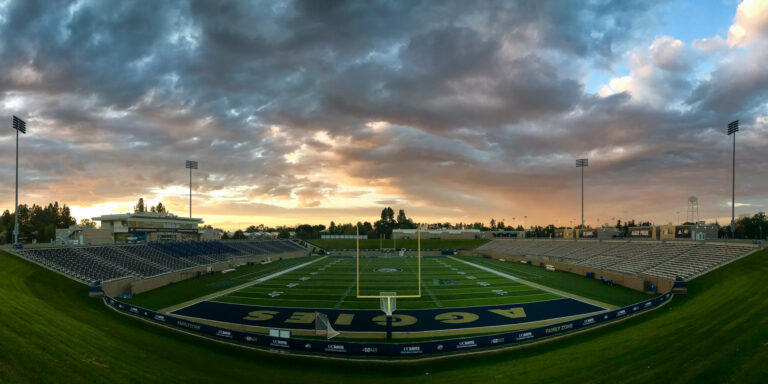
There is nothing like walking into your favorite stadium or arena and feeling the tense atmosphere of competition. From the second the game starts to every exciting moment during it, being at a live sporting event is an experience that is nearly impossible to recreate. But at this moment, that feeling seems like a relic of the past. With the ongoing COVID-19 crisis and no signs of returning to normalcy anytime soon, the belief is that sports will have to enter a new era — the era of empty arenas. 

If leagues like the NBA, MLB and NHL elect to resume their activities, they will have to do so by following health guidelines, including the exclusion of fans. 

When you think about the most iconic moments in sports, the swell of cheers and emotional reactions from the crowd are a significant part of them. Whether it’s a big shot, a clutch home run or a timely goal, the explosion of sound that accompanies it is unique. For the time being, it appears to be the end of that.

Before the season came to a halt, the NBA was gearing up for its postseason that was scheduled to begin in mid-April. Now, the league is beginning to finalize a plan to continue the season in July, and it seems like all games will be played in Orlando, Florida without fans. The playoffs are always intense, but if the NBA ends up proceeding with this plan, the element of home-court advantage will not be a factor. In terms of any sort of advantage, everyone seems to be on equal footing. 

“You still focus on winning the game, but you need the extra wind in the back to push you and give you energy that basketball is all about,” Dallas Mavericks center Boban Marjanovic told Bleacher Report. “When you hear the fans, hearing everyone cheer your name, say something good to you, you feel awesome.”

Fans give players an extra boost of adrenaline in a NBA game and can sometimes be the deciding factor in the outcome of a series. At least for this season, that won’t be the case. But, some still see this as a positive and unique experience. 

“I guess playing without fans would be much more like a typical practice environment and I think that the one thing about these guys is they don’t compete any less hard in practice,” Boston Celtics head coach Brad Stevens told reporters a few weeks ago. “In fact, sometimes in those quiet gyms where you can hear everything somebody else is saying, it gets even more feisty. And so, I think that it would be great basketball if we’re able to do that.”

The MLB was preparing for the start of its season when everything was put on hold. Now, it is working on a plan for a shortened 82-game season without fans in attendance. Anaheim Angels superstar Mike Trout doesn’t seem to mind it. 

“It’s going to be strange,” Trout told FOX Business. “I think any baseball is better than no baseball, so if we have to do it, we have to do it. It’s definitely something to get used to. It’s the world we’re living in right now. If that’s what it takes to get back, obviously that’s what we’ve got to do to get back.”

“I think that’s going to be tough for a lot of guys because people feed off the electric crowds, people feed off the energy,” Trout said. “But I think everybody’s just anxious to get back.”

Unlike the NBA, which was close to wrapping up its regular season, the MLB’s regular season never officially got underway. After the extended hiatus, there is now a growing competitive itch among those in baseball to get out on the field, regardless of whether the season is shortened or not. 

The NFL regular season does not begin until September, but what happens from now until then is still largely unclear. Being that football stadiums are typically outdoors and much larger in capacity than that of other types of arenas, there could be a case where fans are allowed in the stadium under social distancing guidelines. But at the moment, it seems that the NFL is planning to carry on as normal.

“We are planning to have full stadiums until the medical community tells us otherwise. Now remember when we’re talking—we’re talking about September, August, September,” NFL Executive Vice President of Football Operations Troy Vincent said on “The Brian Mitchell Show” on The Team 980. “So there’s a lot that can happen here. So we’re planning for full stadiums.”

“We also know that we have to plan for half stadiums. Three-quarters. So we’re planning for all of these different scenarios. But first and foremost, we’re making every effort, working with the medical community, if we can have those stadiums with all people until they tell us otherwise when that time comes, that’s our plan. That’s our plan of action.”

As Vincent said, a lot can change, for better or worse, between now and the beginning of the NFL season. There is still concern that games may be played without fans in attendance, and that doesn’t seem to sit well with some players. 

“You need fans to play a game,” Los Angeles Rams all-pro defensive tackle Aaron Donald said in a video conference with reporters. “I don’t see how you could play a game without no fans. I feel like that takes out the excitement and the fun out of the game.” 

Many other athletes and many of the team owners share similar sentiments. For owners and league executives, the financial losses that would result from a shortened or fan-less season would be quite large. The hope is that this will be the only year that these types of changes would have to be made, but it will take some time to recover from the billions in lost revenue. 

The return of sports with games being played in empty gyms, rinks or stadiums could offer some interesting new features for fans watching at home. With no noise aside from the action itself, fans could be able to hear everything players and coaches say, from trash talk to coaching tips throughout the game. How television networks approach this new reality remains to be seen, but they will have to get creative if they want to avoid some vulgar language. 

“Now you’re gonna hear everything,” former New York Knicks coach David Fizdale told NBC San Diego. “You’re gonna hear dialogue between people. You’re gonna hear a lot of vulgarities. You’re going to hear a lot more conversations. I think it’s going to add a cool element to TV games.”

As Fizdale suggested, the idea of miking up players across all sports during the games could provide those watching with a unique experience. It will definitely take some adjusting, but it has the potential to be positive if done correctly.

Another thing that could change is the mental side of the game for players, where the absence of fans could help those players who tend to crack — or “choke” — under pressure. It could also affect those who do show up in high-pressure situations, as the pressure may not be as intense, leading to a let-down from someone who would otherwise show up. 

“You remove (the crowd) altogether, you’re probably going to see changes in performance for individual players,” chairman for the University of Buffalo’s department of communication Mark Frank told CBS Sports. “Those who tend to rise up for the moment, their performances may not be as good. Whereas others, for example, some who have a reputation for choking may choke less because of the lack of arousal that takes them into that domain.”

This new reality of limited fan attendance will take some time to get used to, but for those who crave sports, it will likely not matter as much. Just the return of sports alone would be enough to satisfy fans who have been waiting for something to cheer about. Right now, the health and safety of the athletes, coaches and the public is and should be the number one priority. Perhaps someday stadiums and arenas will be packed with screaming fans once again. 

Written by: Omar Navarro — sports@theaggie.org
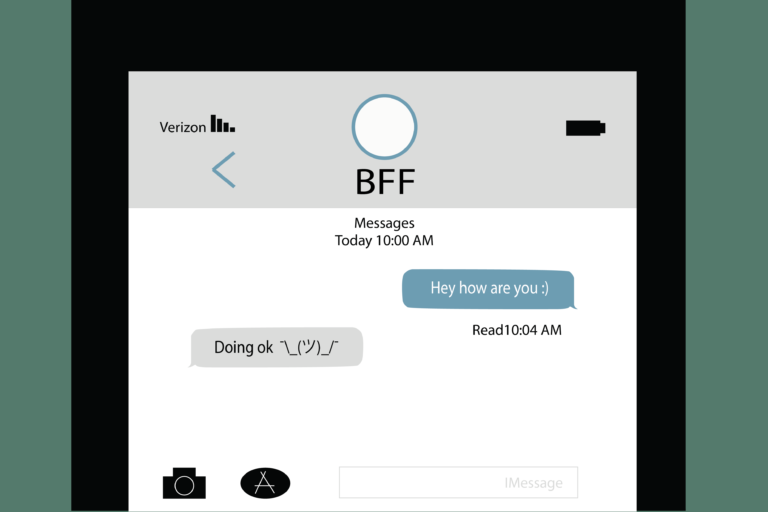
:o) Emoticons: a Conversation :o)

Like the characters, not emojis (@_@;)

We are all familiar with emojis, the little pictures that communicate what words just can’t. Emoticons, on the other hand, are an often unappriecated art of communication where the icons made of keyboard characters are put together to resemble an image. Emoticons create a platform where user creativity shines.

Emoticons vary drastically in look, mostly due to their origin. Western emoticons are read horizontally and come from America and Eurpope, like the classic 🙂 . Eastern emoticons come from mostly East Asia and are read vertically, like (ヽ´ω`). To increase complexity and create compatibility with Western keyboards, users often combine the styles. Like  <(o_o<) or (T_T). The Cyrilic alphabet is often incorporated too: (#゚Д゚).

To get a gauge on the UC Davis reaction to emoticons, three first-year students spoke about their specific emotions and experiences connected to the icons. Each shared the role emoticons play in their day to day lives.

Cameryn Anderson, an undeclared life sciences major, said she doesn’t use them often. She normally goes for emojis because of accessibility since “it takes a lot of effort to type out a whole face, effort I just don’t have.”

Angie Cummings, an art history major, feels differently. She’s passionate about the subtleties in online communication. 

“I use them everyday, they’re more sincere,” Cummings said. “Like, if I actually want to show someone I’m smiling, I’ll type it out. It’s more genuine than emojis.” 

She listed B-), 😀 and 🙂 as her most frequently used emoticons, but emphasized :/ is her favorite because it says a lot.  

Joelle Page, a psychology major, finds a similar sincerity in the tiny faces, an experience many share. 

“I use them [in place of] a period because actual periods are too formal,” Page said. 

Each student responded to specific emoticons so that readers can understand the reception of the different categories.

\ (^o^)/

Category: Eastern

Anderson is enthusiastic about the face.

“I look at it, and I’m like woo!” Anderson said. “If I had this on my copy and paste where I could access it easy, yeah I’d use it all the time.”

Cummings brought up a very valid point: “It’s a little too uwu, I hate UwU.” 

“UwU,” an emoticon that has come to embody cuteness, is overused and, for that reason, disliked. Page harbors different feelings toward the emoticon. 

“I associate that with people who like K-Pop,” Page said. “On my explore page, K-Pop fan accounts use very detailed emoticons.”

xD

Style: Western

This iconic face was revolutionary for the disgustingly ugly graphic tee industry. Many remember it fondly.

“I think ‘Rawr XD’,” Page recalled. “The scene kids. Positive feelings.” 

Those further from the aesthetic dont have the same happy memories. Anderson said the emoji isn’t really her type.

“It’s a little edgy for me, it makes me feel like I need swoop-over bangs,” she said. 

Cummings was split on her feelings toward the emoticon, admitting that it made her mad, but the association with “the glory days” of middle school was overpowering.

~(_8^(I) Homer Simpson

Style: Unknown 

Too often, emoticons are discredited and not seen as what they actually are: art. This portrait proves it. All three interviewees had very emotional responses to the face, from joyous shrieks to confused rage. Page, initially unsure of what it meant, was amused, once she looked at it sideways, “Wow, I’m in shock. I love it.”

Cummings, a forward thinker, analyzed it like a true art history major. 

“It’s very conceptual,” Cummings said. “Deconstructed like Picasso.”

Anderson was ecstatic.

“She is everything,” she said. “I don’t know what context I would use it in, but she’s a keeper.” 

There is a world of emoticons waiting to be copied and pasted into your Notes app for future use. Each means something different to the individual, each conveys a different unique feeling. But most importantly, they make typing (which is very boring) fun and pretty. <( -‘.’- )>

Written by: Livvy Mullen — arts@theaggie.org

Three ways that “The Hunger Games” is actually a cornucopia of truth

A dystopian fiction: the mockingjay of reality

The “Hunger Games” series gained immense popularity back in the 2010s — so much so that its dystopian fiction has clawed its way into reality. The gore and perverted essence that made the series so captivating may not be so appealing in real life. But if we observe today’s realities, perhaps the “Hunger Games” wasn’t so far from the truth as we once thought. 

1: Tracker Jackers

Recent headlines have succeeded in terrifying and amusing the American public with the absurdity that is the Japanese giant hornet a.k.a “murder hornet.” Native Asian hornets have found their way to Washington state, according to The New York Times.

Besides its two-inch long monstrous body length, the Japanese giant hornet is quite cartoonish. The creature flew right out of The Davis Varsity Theatre’s screening of “Ant-Man and Wasp” and into reality. 

Confession, that’s false. It didn’t fly out of “Ant-Man and Wasp,” but perhaps “The Hunger Games.” Tracker Jackers, larger and stronger genetically mutated wasps, with a sting strong enough to kill. Sound familiar? 

As soon as the headlines of these notorious murder hornets came to my attention, tracker jackers were the first thought in my mind. Both the fictional and nonfictional species seem to be the Superman of hornets — or maybe Lex Luthor. 

The wet and wooded habitat of Washington state is ideal for the hornets. By chance, in the 74th annual Hunger Games which took place in the first novel of the trilogy, the setting of the arena was a wet and wooded environment. Coincidence? I think not!

2: We are the 99%

The dystopian world of Panem is divided into 12 Districts in which a select few hold all the wealth and power while the others gravely suffer. While the privileged Districts are fine dining, the remaining feed off the scraps of the wealthy, confined to their District with no wiggle-room to rise in power or status. 

What a horrifying truth, yes? Take a closer look and you’ll see that this isn’t so different from the current state of America as you might think. The gap between the rich and poor is growing and further deepening into a systematic habit. 

While the rich get richer, the poor get poorer. The one percent of Americans bathing in their wealth is analogous to Districts such as District 1 (must be the lucky number for the rich) with the economic and social disparities magnified by the so-called “gap.”

The extent of this imbalance is so apparent in the novels and films of “The Hunger Games” that perhaps its fictional dystopia opens eyes to the truth right outside our very doors. The problem isn’t restricted to the spine of the book but seeps into the backbone of our society as well. 

3: Blood, Sweat and Tears 

“The Hunger Games” is the biggest reality television show of Panem. It’s like “Survivor” on steroids. Each of the 12 districts pick one girl and one boy (systematic gender binarism, take it or leave it) to compete to the death in an annual “game” broadcast to the public.

Bigger than the Grammys, the annual event is to die for, literally. It romanticizes violence and manslaughter in the form of entertainment and a part of conventional culture. Normalizing such brutality may seem absurd until you realize “Call of Duty: Modern Warfare 2019” was the No. 1 best-selling video game in 2019. 

From a young age, children are exposed to violence from the media. As a result, they may be prone to fear the world around them or behave aggressively towards others. Although there is no tangible comparison to the Hunger Games in real life, this digital age is tiptoeing on a fine line between artificial and natural. 

So while “The Hunger Games” may not be as fictional as once perceived, with real-life tracker jackers on the loose, may the odds be ever in your favor. 

Written by: Sierra Jimenez — arts@theaggie.org

“Definitely not the 21st I would ever imagine” — celebrating a birthday in quarantine

A look at how students spent their 21st birthdays in quarantine

Among the many special occasions that college students celebrate, a 21st birthday is among the most anticipated. It is a birthday that recognizes a legal gateway into the world of alcohol and a new stage of adulthood. While many usually celebrate their 21st with a trip to the bar, a party or any other elaborately planned celebration, students turning 21 amid the pandemic have had to forego these milestones for an alternative in quarantine. 

COVID-19 regulations have forced these birthdays to be altered and celebrated in different ways than what was once expected. Taylor Silva, a third-year English and neurobiology, physiology and behavior major (NPB), celebrated her 21st at home with her family. She ordered take-out Chinese food for dinner and later had birthday cake. A few days prior, she also had a small cake celebration with her housemates at Davis. Above all, Silva looks forward to the day where she will be able to go out and celebrate the way she had hoped. 

“I keep saying, ‘I’m going to celebrate my 21st when things reopen,’” Silva said. “It couldn’t happen on my birthday, but I’m still going to celebrate eventually when I can. It’ll be fun when I finally do get to go out.”

Kaylena Principe, third-year NPB major, celebrated her 21st with a drive-by parade of friends and family. Principe’s family planned the celebration in an effort to keep her birthday special, even decorating outside with balloons and posters. 

Family and friends passed by in their decorated cars and wished Principe a happy birthday. As each car passed by, there were stations for getting drinks, giving presents and even receiving goody bags for any kids on board. Of course, these exchanges were socially distant, with plenty of gloves and hand sanitizer involved.

Overall, Principe found value in the experience, as it allowed her to appreciate the people in her life and all that they do for her. 

“I was so overwhelmed seeing everyone because I’m lucky enough to have a lot of my family be in the area, but there were people who drove like two and a half hours from parts of the Bay to just see me for five minutes,” Principe said. “I was so overwhelmed that people came and it just felt really great. So you definitely do gain a new perspective, I really did. It was just kind of really eye opening. I didn’t really have this whole bourgie birthday up in Napa on a party bus, [but] I have everyone around me and like that’s more than enough.” 

 Lauren Ford, a third-year NPB major, similarly celebrated her birthday at home with a drive-by celebration where loved ones wished her a happy birthday. Later in the day, her neighbors toasted a glass of champagne from their porches in celebration. 

Ford said that despite her birthday not being what she expected, she appreciated the effort the people in her life put to make her day special during such difficult circumstances. 

“It was definitely not the 21st I would ever imagine: no bars, no excessive drinking,” Ford said. “But all of the people in my life wanted to make up these losses by making me feel even more special.”

On the other side of the exchange, third-year animal science major Charlize Zuraek created a special experience for her housemate’s birthdays. In a creative effort to mimic what the birthday would’ve been like during normal times in Davis, Zuraek and her housemates surprised their other housemates and set up their apartment to create a bar hopping experience. Each room in the apartment was themed as a different bar in Davis, and Zuraek and her housemates even dressed up as bouncers to check ID cards at the entrance of each room. 

“For 3rd & U we got Denogginizers, for Red 88 we made a shotski, switched out all the lightbulbs for red ones and made a wheel to spin, for Froggy’s we set up karaoke with a projector, […] for Bistro we made mojitos and set up string lights outside and for Parkside we made fishbowls,” Zuraek said.

Whether it’s a drive-by parade or ordering a special meal, a “trip” to the Davis bars or a communal champagne toast, there are many ways to celebrate a birthday during quarantine. As a word of advice to students who have upcoming birthdays during this time, Ford shared the importance of acknowledging what was lost in order to truly enjoy the day and recognize its beauty. 

“Go in with no expectations, but allow yourself to mourn what you missed,” Ford said. “By giving myself space to be upset about the bars closing, my friends moving back home and my birthday setting taking place in the Bay rather than Davis, I allowed myself to just enjoy what was given during the day. At the end of the day, a birthday is a celebration of your life and you don’t need big parties, alcohol or your best friends in your location to do so.”

Written by: Nora Farahdel — features@theaggie.org

Students, community members protest police brutality after police killing of George Floyd

Student activists inspired by Black Lives Matter protests across nation call for change in Davis community

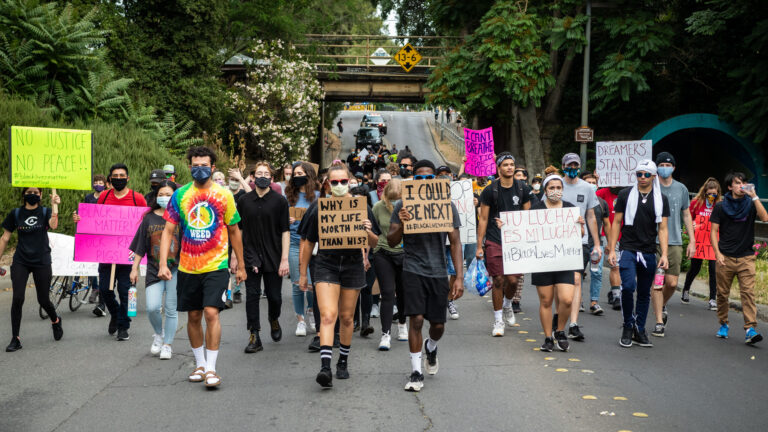
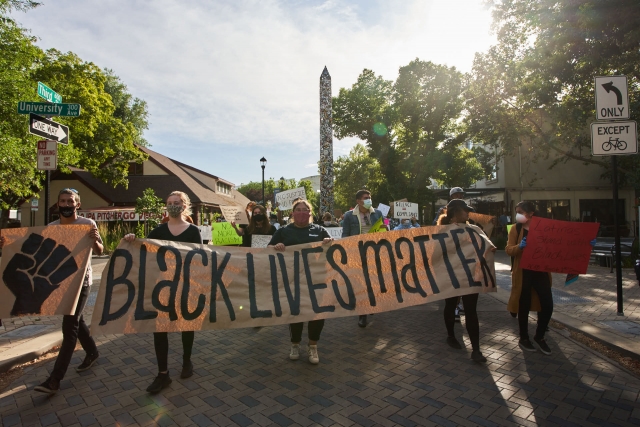
Protesters in Davis took to the streets this weekend to speak out against police brutality following the murder of George Floyd, a Black man killed by police officers in Minneapolis, Minnesota on Monday. The demonstrators — a crowd of around 80 to 100 students and community members who marched through Downtown Davis — were among the thousands of Americans involved in ongoing protests and demonstrations focused on racism and police brutality that took place in cities around the country and the world.

Black Lives Matter protestors faced Davis Police and the California Highway Patrol by the Richards Boulevard Overpass in Davis on Sunday, May 31. (Benjamin Cheng / Aggie)

Kevin Kimura, a second-year economics major and one of the organizers for Saturday’s protest, said he wanted to organize a peaceful protest after connecting with Davis students over social media.

“Out of the blue, I decided to post something on the Wildfire app, and some people responded saying they wanted to protest as well,” Kimura said. “I wasn’t expecting that, but that’s where it took off.”

Another student organizer for Saturday’s protest is Maya Martinez, a second-year biological sciences major. Martinez said she felt compelled to act after seeing social media posts about Floyd’s death and the news coverage of the Black Lives Matter protests happening across the country.

“I was just outraged because this has been a regular occurrence in people’s lives,” Martinez said. “As someone who is non-Black but who has also experienced other types of injustice and racism, I just wanted to help in any way I could — while also understanding my role as an ally.”

A woman wearing a Colin Kaepernick jersey raises her fist as Black Lives Matter protestors faced Davis Police and the California Highway Patrol by the Richards Boulevard Overpass in Davis on Sunday, May 31. (Quinn Spooner / Aggie)

Kimura explained that he and those who responded to his post became the main organizers for Saturday’s event. Together they planned the route, created a Facebook page and drew fliers to be shared on social media. Kimura also informed the Davis Police Department ahead of the protest.

“In preparation, I actually notified the Davis P.D. before the protests were happening,” Kimura said. “They were essentially escorting us, but the goal was basically to keep the protest peaceful because we were expecting outside groups to come in.”

While the protest on Saturday had structure and a public Facebook page, Sunday’s protest was different. Various fliers circulated around Wildfire that called for a protest beginning at the intersection of Anderson Road and Russell Boulevard and ending at Central Park Gardens, but the source of the fliers remains unclear.

One protester, who wished to remain anonymous, said the fliers for Sunday’s protest were “originally posted on Wildfire after many individuals wanted to protest,” but that they themself “did not want to attend Saturday’s event because the police were informed and escorted protestors.”

A protestor shakes hands with a California Highway Patrol officer as protestors faced Davis Police and the California Highway Patrol by the Richards Boulevard Overpass in Davis on Sunday, May 31. (Benjamin Cheng / Aggie)

Ultimately, Sunday’s protest led to a standoff with police in riot gear, who were blocking the freeway bridge at the intersection of Olive Drive and Richards Boulevard. The protests continued without any violent confrontations, as the group of protesters turned around and returned to Downtown Davis.

Despite disagreements over police involvement, many students are passionate about inciting change in the Davis community. Martinez said the protests have made her think more critically about how UC Davis could be doing more to support Black students during this time.

“I think extra resources should be provided to Black students,” Martinez said. “Counseling, health services and even professors and TAs checking in on Black students is really important because they are undergoing a type of stress that people who are non-Black don’t understand.”

Black Lives Matter protestors march by the Davis Needle towards Downtown Davis on Saturday, May 30. (Justin Han / Aggie)

Kimura added a more urgent message — a sentiment that is being echoed throughout the streets of America.

“It is time for change,” Kimura said. “This is not the America I want to be living in.”

Written by: Madeleine Payne — city@theaggie.org

All BIS 2B seats held for incoming first-years for Fall Quarter 2020

Students encouraged to take series out of order for smoother transition, stronger chemistry foundation 

During Fall Quarter Schedule Builder pass times, continuing students found that all seats for BIS 2B were closed. According to Evolution and Ecology Professor Susan Keen, all of the seats for BIS 2B in Fall Quarter will only be open to incoming first-year students until after orientation. 

“Normally what happens is continuing students register first and if they still need the BIS 2 series, they take all of the seats and incoming first-years don’t have any seats,” Keen, the previous associate dean of Undergraduate Academic Programs, said. “Last Fall Quarter, we told all advisors across the campus that we were not going to let continuing students register first for BIS 2B for this coming Fall Quarter.” 

With incoming students registering for classes online using Zoom conference advising, Keen said it is particularly important to have those reserved BIS 2B seats to lessen worry and better ensure that students will be able to register for a class they need. She explained that incoming students will have the first opportunity to register for one of the roughly 1,300 open seats in BIS 2B in order to begin the BIS 2 series. Any remaining seats will be reopened to continuing students once orientation is over. 

In previous years, incoming College of Biological Sciences students were advised to start with BIS 2A — an introduction to the fundamental chemical, molecular, genetic and cellular building blocks of living organisms and universal core concepts in biology — if they wanted to begin the BIS series in their first quarter. Beginning in fall of 2018, however, students were encouraged to take BIS 2B, which examines ecological and evolutionary processes that shape biological diversity. 

“If a student says they are really strong in chemistry and they want to start with BIS 2A, we don’t stop them,” Keen said. “We just encourage people to start with BIS 2B, which doesn’t require nearly as much chemistry.”

Keen said the real motivation for the change was BIS 2A faculty wanting to give their students time to take general chemistry classes first. 

“A lot of what [BIS 2A faculty] were finding was that a lot of students did not remember or had not taken high school chemistry, so they felt if students had taken some chemistry at UC Davis, they would feel happier in the class and more comfortable in the material,” Keen said. 

Some students who took BIS 2B before BIS 2A, however, found that the overlap with 2A and chemistry would have been more beneficial and cohesive. 

“Because I took the chem series my first year and BIS2A this quarter, it was challenging for me to recall some of the concepts that I had learned back in the chem series,” second-year human development major Megan Alejandrino said. “I think the material for BIS2B was unrelated to anything I was learning at the time, so it did seem out of place.” 

After encouraging students to start the BIS series with BIS 2B while also holding BIS 2B seats for incoming first-years this coming Fall Quarter, Keen said she is interested in seeing if those changes would make first-year students’ transition to UC Davis smoother and their progression through the series easier.

Written by: Graschelle Fariñas Hipolito — campus@theaggie.org

UC Davis announces two new COVID-19 live video series

New series updates public on COVID-19 research

To provide the public with regular updates on COVID-19 research by UC Davis clinicians, veterinarians and faculty, the university launched two new series to be broadcasted on social media platforms. One of these series, “UC Davis LIVE: COVID-19” features Soterios Johnson, the director of humanities, arts and cultural partnerships at UC Davis, as the host. 

The UC Davis LIVE series has been in production and was broadcasted prior to the COVID-19 pandemic, covering topics such as the Ebola outbreak and research surrounding it, according to Johnson. Although the LIVE series team went on a hiatus due to stay-at-home orders, they decided to develop the COVID-19 series after seeing all of the relevant research being done by the university during this pandemic. 

“One of the things that we focus on is letting people know how much interdisciplinary collaboration happens between researchers who are working in totally different fields who normally wouldn’t work together,” Johnson said. “One of the really great things about how UC Davis is able to get people to collaborate is that […] it can lead to really exciting and novel approaches to solving problems.”

The first episode of this bi-weekly series aired May 7 where Johnson interviewed guests UC Davis School of Medicine Dean Allison Brashear, UC Davis School of Veterinary Medicine Dean Michael Lairmore and Vice Chancellor for Research Prasant Mohapatra. Topics discussed included the importance of collaboration between disciplines, recent research in each field and the role of UC Davis amid the pandemic. 

“Being a Research-1 university, we should share our research efforts to the world,” Mohapatra said via email. “In addition, being a public university, we should avail all possible channels of communication with the general public to educate them about the pandemic situations and the progress being made to address the challenges.”

Future topics that may be discussed include antibody testing, vaccine development and virus tracking, according to Johnson. People can watch the discussion live via Facebook or YouTube and are able to submit questions through Facebook.

“People can have access to these brilliant minds who are working on these really challenging problems to find out answers to the questions that they have,” Johnson said. “I think it’s a really great way to share the expertise with the outside world on topics and the work that they’re doing that may not have had public exposure yet.”

The other series, set to begin in late May, is titled “Deans Discuss: COVID-19” and features a discussion between Brashear and Lairmore about the contributions their schools are making to COVID-19 research. Lairmore stated that both schools have a long history of collaborating and that this pandemic has further solidified their partnership.

“Dean Brashear and I know each other quite well and have frequent meetings, so it was easy to arrange a project like this,” Lairmore said via email. “We have held calls and emails to organize, but for the most part we take pride in knowing about the research and clinical programs in our Schools and feel comfortable talking about the subject.”

Lairmore hopes that this new series will provide accurate information based in real-time to inform both the campus community and the general public about the impact of each school. Because UC Davis has both a medical school and a veterinary school, researchers in various disciplines can focus on a common problem and come up with a creative solution, according to Lairmore.

“The advantage we have is a very comprehensive campus that includes not only veterinary medicine and medicine, but also agriculture, engineering, and biological sciences,” Lairmore said. “When these disciplines come together the magic happens, we call this One Health.”

Both series can be accessed from the UC Davis channel on YouTube.

Written by: Michelle Wong — science@theaggie.org

City faces $22 million loss due to COVID-19, considers implementing hiring freeze

After grim economic forecasting, city must cut costs but remains hopeful for future, citing “resilient” community

At a May 5 special meeting, the Davis City Council viewed a presentation assembled by Management Partners about the city’s financial status as well as long term economic forecasts as a result of COVID-19. Councilman Dan Carson summarized the expected future losses.

“These are very serious problems that the city of Davis faces — the current estimate is that over four fiscal years, we would face a revenue loss of about $22 million,” Carson said.

To save money in the short term, the presentation recommends that the councilmembers freeze hiring and cut “50% of positions that become vacant in one year” and either temporarily reduce pay or defer the cost of living adjustments for employees. 

Carson explained the importance of reducing staff as employee-related costs represent a significant portion of the city’s budget. 

“A very large part of our general fund operations is people — benefits, healthcare and other things — and we’re going to see if there are any opportunities to reduce cost there,” Carson said.

Management Partners also recommended lowering city contributions to previously-approved projects including the Nishi Gateway and the West Davis Active Adult Community. 

The city will most likely not cut costs by postponing work on roads and bike paths. These issues grow worse with time, Carson said, and it’s cheaper, in the long run, to fix them quickly. 

“We want to prioritize maintaining things like roads and bike paths, because we know if you put off fixing those things, it makes them significantly more expensive down the line,” Carson said. 

City staff released a staff report detailing the reasoning behind taking such drastic measures to save money, describing how that COVID-19 crisis has caused massive drops in gross domestic product (GDP). 

“The impact of the pandemic has been unprecedented on not just the City of Davis, but on the US and the State’s economy,” the staff report reads. “The gross domestic product (GDP) declined 4.8% in the first quarter of 2020, and is expected to decrease 30-35% in the second quarter, when the full force of the economic shutdown will be reflected.”

Carson acknowledged that the stay-at-home orders issued because of the pandemic and UC Davis’s transition online have caused much of this economic downturn but still believes these cautionary measures were necessary for public health. 

“I would definitely say that the shelter-in-place orders have had a significant impact on the economy of the City of Davis,” Carson said. “We understand the reasons for these actions — lives are at stake, so this isn’t a criticism. We’re also happy that UC Davis has taken serious steps to allow students to take the spring quarter classes remotely. But by having taken those actions, those cash registers aren’t ringing as much in Downtown Davis.”

Despite the grim forecasting, City Manager Mike Webb remained confident in the city’s ability to get through this crisis during the city council meeting

“I think one of the realities is that it’s going to take multiple measures to mitigate the revenue loss impacts,” Webb said. “Some of these decisions are not going to [be] easy ones — they are really going to require a shifting of mindset, […] but I think it’s quite doable. And I think we’re very fortunate in that our community is very resilient.”

Carson felt similarly hopeful for the future and was confident that the Davis economy will bounce back as soon as it’s safe enough to lift pandemic-related restrictions. 

“It’s important that we take the steps that will keep us healthy and safe, and when we’re able to fully reopen our economy, I’m quite sure we’ll be able to rev up our local economy,” Carson said. 

Written by: Eden Winniford –– city@theaggie.org

An ensuing crisis or opportunity? The role, quandary of replication in science

UC Davis researchers, faculty speak to the reasons behind, the impact of the replication crisis

A 2015 exposé revealed that political scientist Michael LaCour had fabricated results in his ground-breaking paper about the effects a conversation with gay canvassers can have on voters’ preferences. Having recently read the article, my interest in the validity of research piqued. After just a few clicks, I discovered that within the scientific community — beyond just fabricating results — lies a more nuanced issue: a replication crisis. 

The replication crisis refers to the inability of researchers to recreate studies from the past to yield similarly robust results. Repeated replication is a vital element in upholding the integrity of the scientific process, and assessing the validity and applicability of experiments. Some major, well-known studies that haven’t been able to be replicated in recent years are the Stanford Marshmallow test and power poses. In 2016, the weekly science journal Nature conducted a survey of 1,500 scientists asking their thoughts on replication — 90% said the issue was a crisis (52% said it is a significant crisis and 38% said it is a slight crisis).

Noah Yardeny, a third-year chemistry major, discussed his own experience with irreplicability while working in David Olson’s lab where he helps conduct research on psychoactive drugs, exploring their potential to increase neuroplasticity to treat anxiety and depression. 

When attempting to yield a specific chemical by recreating previous experiments, Yardeny said he finds that, oftentimes, his results don’t align with the research. He described one instance where the research from an older, peer-reviewed journal didn’t even come close to producing the stated results.

“I followed it to a tee,” Yardeny said. “Did what they did. I had the re-agents, my timing, my solvent, but it went to absolute sh-t. And I was like, I wonder what this is? I went to one of my graduate mentors, and they’re like, ‘Where did you find this?’ I said the source and they said there’s no way that’s reliable.”

It’s natural that some studies and their results are irreplicable, especially ones from older, less reputable journals like the one Yardeny referenced. The inability to replicate on larger scales, however, is a problem that even the most revered journals, like Nature and Science, have. 

In a study published by Nature, researchers attempted to replicate 21 social science studies from Nature and Science. Of the 21 experiments, only 13 were replicable and many of the 13 that could be replicated yielded results that were significantly less robust than the original papers denoted. The failure to replicate by no means is a cut-and-dry condemnation of a study, as irreplicability can arise for a variety of reasons: For example, the replicating team may have botched their own attempt or obtained their own false positive.

The impact of nonreplication is not evenly distributed across all scientific disciplines. Experiments that deal with human subjects — especially social psychology — have a particularly hard time holding up to scrutiny. That said, replication issues are not isolated solely to psychology — they have reared their head in other areas, such as economics and pharmaceutical studies. 

Kate Laskowski, an assistant professor in the Department of Evolution and Ecology, remarked that a couple of breakthrough studies on the effect of water acidification on fish behavior within her own field drew attention for replication issues.

“A handful of papers came out a few years ago that ocean acidification is having really horrible effects on fish, changing their behavior in really detrimental ways, and it got a lot of attention,” Laskowski said. “Recently, a group of researchers tried to replicate these results with an actual, true replication. They redid the experiments, they reran analyses and the results didn’t replicate. They found no effects of ocean acidification on fish behavior. So the moral of the story was that one or two fancy results do not necessarily mean that this is the be-all to end-all truth.”

Within the academic community, there is a formidable bias toward groundbreaking work, skewing the rate of positive results in publications — the more groundbreaking research, the more funding and prestige. This leads to the publication of a higher number of false positives. Emily Merchant, an assistant professor and historian of science and technology at UC Davis, discussed her understanding of the problem.

“I think it is more of a structural issue in science than an issue of people doing sketchy things with their data,” Merchant said. “There are instances of outright fraud, but I don’t think that’s really what’s behind this replication crisis. I think it’s been that there hasn’t been any incentive to try to replicate. And there has been a bias toward positive results without any attempt to figure out whether it’s a true positive.”

Merchant explained how nonreplication can be a byproduct of the current structure of academic publishing.

“In the social sciences, in particular psychology, it’s really hard to publish negative results,” Merchant said. “You can only publish a new finding where you’re statistically able to reject the null hypothesis with an alpha value of .5. That’s a confidence of 95%. With that standard, you get false positives 5% of the time, but if you can only publish the positives, then you have a higher concentration of false positives in what gets published.”

For people without a background in statistics, Merchant rephrased the issue in layman’s terms: “A really useful thing that I heard someone say is that if all you find is groundbreaking research, you just end up with a bunch of holes in the ground.”

            This effect is further augmented by the “publish or perish” environment where researchers fight to establish credibility and advance their careers by breaking into major publications. 

“Within academic research, we just don’t have enough jobs for all the people that are trained,” Laskowski said. “It’s highly, highly competitive.”

Laskowski stressed that the arrangement with researchers fluctuates between universities — some being more high-pressured and others more accommodating.

“I think it’s important to note that academia is extremely heterogeneous,” Laskowski said. “There are differences from university to university and how strong the level of competition is and certainly, there are many universities where it’s cutthroat and you are expected to have really high power publications coming out every year or every few years. Other universities are, I think, a bit more humane. They value quality science and people who are making good, solid progress, even if maybe that doesn’t result in a Nature paper every other year.”

The pressure to publish positive results can leak into experiment methodology when researchers subconsciously p-hack — the practice of changing their original hypothesis during the experiment and retesting the data to render a desired, but often flawed, positive.

“If you run the data in 20 slightly different ways, you’re going to get a positive result at least one time, even if it’s not a true positive,” Merchant said.

Merchant takes issue with the phrasing “crisis.” She noted that the issues of replication are not occurring due to an increase in faulty methodological practices, but because only recently has there been a significant effort to replicate results.

“The way that some people see this is kind of the self-correcting nature of science,” Merchant said. “The issue is that we don’t know if these findings are robust until we try to replicate them.”

So how does the scientific community start-up the charge for tackling replication? Although some solutions require long-term institutional transformations, there are a couple helpful steps to be taken in the meantime. Merchant suggests establishing procedures for hypothesis registration to curtail the effects of p-hacking.

“The idea of registering a hypothesis is that you can only register one hypothesis and then you can only test that hypothesis,” Merchant said. “So you’re not doing 20 different experiments, you’re just doing one.”

Laskowski mentioned the need for more rigorous training in statistics for researchers.

“If you have a firm understanding of statistics, you’re at least more aware of these problems so you can’t make them ignorantly,” Laskowski said. “I think maybe a more firm grounding in statistical training certainly helps. It lets people understand the power of what they can do with the data that they collect. It also helps them collect better data and actually test the hypotheses they want.”

Laskowski also advocated for more transparency within the publication process by increasing accessibility to the procedures and data used to carry out studies.

“The other thing I think is really important is moving toward more open and transparent data practices, in the sense that any data that you collect and [publish] should be uploaded with that paper,” Laskowski said. “My data and the code that I use to analyze my data should be available for anyone to look at to look at assuming there’s no problems with personal privacy.”

Replication is not a new issue in science; however, the widespread discovery of nonreplicating experiments is. The magnitude of this issue cannot be understated, especially when politicians and special interests use irreplicability as a crux to undermine science that they don’t agree with — with most setting their sights on fields such as climate science. 

Addressing the issue demands careful reflection about the pressure academic institutions and academic publications place on positive results. 

“You’re much less likely to get published if you show, ‘I did this, this and this and this and it doesn’t work,’” Yardeny said. “You did the science, you had a hypothesis, you ran a good experiment, you just didn’t get the result. There is still this power in saying something didn’t work.”

Written by: Andrew Williams — science@theaggie.org

US Women’s National Soccer Team’s ongoing battle for equal pay

USWNT continues to fight after court sides with U.S. Soccer Federation

The U.S. Women’s National Soccer Team (USWNT) is continuing its fight against the U.S. Soccer Federation (USSF) following a federal judge’s decision to dismiss their equal pay claims. 

The lawsuit, which asserts that USSF is in violation of both the Equal Pay Act and Title VII of the Civil Rights Act, is aimed at putting an end to the long-standing gender-based discrimination that the women’s national team has faced for years. 

On March 8, 2019, 28 players from the USWNT filed a wage discrimination lawsuit against the USSF, claiming that not only are they paid substantially less than the U.S. men’s national soccer team for the same work, but that the women face “institutionalized gender discrimination” under the USSF. 

On May 1 of this year, a federal judge ruled in favor of the USSF, stating that the USWNT did not prove any wage discrimination under the Equal Pay Act and had not presented any triable issues. 

Megan Rapinoe and Alex Morgan, two of the stars from the women’s team, were shocked by the decision and spoke out following the court’s dismissal of their claims. They made it clear that they were going to keep fighting. 

One week later, the USWNT announced that it will be asking for a postponement of their currently scheduled trial date of June 16 and filing a motion to immediately appeal the court’s most recent decision, sending it to be reviewed by the U.S. Court of Appeals for the Ninth Circuit.

Several months after the initial filing in November 2019, the case took a step forward in the USWNT’s favor, when the court granted it the ability to pursue the case as a class action lawsuit. This meant the players would be able to fight the case as a group and any players from the U.S. women’s team dating back to 2015 would have the ability to “opt in” to the class. 

At the time, this ruling appeared to be a huge step forward, giving players hope that the court would acknowledge the ongoing discrimination against the team. The court’s most recent decision to side with the USSF proves the fight toward equal pay is not even close to being over.

The main reasoning behind the court’s decision to side with the USSF is that the women’s team entered a collective bargaining agreement with the USSF that it now wants to get out of. Collective bargaining agreements are a result of negotiations between players and management, and the court claims that the women’s team previously agreed to their current pay conditions. 

The USWNT countered this claim, explaining that the contracts received by the male players were never presented to the women’s team and the reason that the women accepted the CBA was a result of equal pay never being on the table to begin with. 

The lawsuit is not only seeking back pay of $66.7 million plus punitive damages, but is also looking for some form of acknowledgment of the blatant gender discrimination that has been carried out by USSF through the years. 

The recent events of this case are only the latest in a long dispute between women’s players and the USSF that dates back to boycotts from the women’s team during the 1996 Olympics. At the time, the USSF claimed it would only present bonuses to the women if they received gold medals, explaining that it “cannot reward mediocrity.” 

The unsteady relationship between the two groups reached a tipping point following the women’s 2015 World Cup victory.

In March 2016, five players from the 2015 World Cup side, including Morgan and Rapinoe, filed a federal complaint against the USSF. 

The women explained that they earned only 40% of what the men’s national team made, despite the fact that they put in the same amount of work and have consistently outperformed their male counterparts. 

At the time, the USSF was standing by the argument that the men’s national team brings in “multiples” of the revenue, attendance and television ratings compared to the women’s team. While that argument was largely unjustifiable to begin, it has proven to be especially untrue today, considering the unparalleled success that the women’s team has enjoyed. 

The USWNT has four World Cup victories and four Olympic gold medals under its belt, compared to zero World Cup titles from the men’s national team. The women’s 2015 World Cup victory had over 500 million viewers worldwide, along with a record one billion who tuned in to their 2019 World Cup Final match. They have also received a huge amount of support from the public, including chants from fans demanding equal pay during their 2019 World Cup Final appearance. 

The lawsuit’s 25 page filing from March 2019 explains that the 2015 women’s team was far more successful than the men’s team, garnering a $17 million profit for the USSF. Yet, female players were still paid substantially less than the men. 

The women’s team claims a representative for the USSF stated that “market realities are such that the women do not deserve to be paid equally to the men” in response to the demands for equal pay in 2016. 

The USSF has also previously presented a shocking suggestion that male players have “more responsibility” and “require a higher level of skill” than the women’s team. 

This claim is disputed by the USWNT in the March 2019 filing, part of which referred to the fact that from 2015-2018, the women’s national team competed in 19 more matches overall than the men’s team, mainly due to the womens’ high level of success in those years. 

The filing also demonstrates the differences in pay, comparing the revenue each team would receive if they were to play 20 friendlies and win all 20 of them. Female players would receive a maximum of $99,000 compared to $263,320 for the male players. 

As far as payments for advancing through the rounds of the World Cup tournament, the men’s national team received over $5 million in 2014 for being defeated in Round 16 of the tournament, while the women’s team received $1.7 million for winning the entire tournament in 2015. 

Since the women’s 2019 World Cup win was not until after their March 2019 filing, a good amount of their claims reference the success of their 2015 victory campaign. The USSF has previously claimed that this is the team’s way of selecting an especially successful year from which to draw conclusions. 

The filings also cite multiple instances of discrimination outside of wage inequality. The women indicate that their team had to compete on artificial turf, which has a higher potential to cause serious injury to athletes, for 21% of their matches from 2014–17, compared to only 2% of the men’s team’s matches. 

The men’s team has also received better travel conditions from the USSF, receiving charter flights 17 times in 2017, compared to none for the women’s team. 

While these are just a few of the many claims made against the USSF, they reveal clear discrepancies in the treatment of the women’s team compared to the men’s team on multiple occasions. 

The USSF has a new president, Cindy Parlow Cone, following the resignation of former USSF president Carlos Cordeiro. Cone and Cordeiro have apologized for the language that the USSF has used in previous claims, and Cone claims she would like to work to rebuild the relationship between the USSF and the women’s national team. 

Cone’s claims do not amount to much, considering the USSF continues to move forward with challenging the USWNT’s desire for something as basic as the right to equal pay.

Since Cordeiro’s resignation, the USSF has also moved on from its original arguments that the men’s and women’s teams do not perform equal work. It now has the majority of its claims riding on the fact that the women’s players willingly entered their collective bargaining agreements during the time period that their case references and that the difference in their CBA’s are not enough to prove discrimination. 

Regardless of the changes made by the USSF, its past claims should be enough on their own to indicate multiple instances of gender-based discrimination. The apologies from USSF along with the decision to switch its main focus in this case does not erase the past. 

The fact that multiple public statements made by the USSF, along with the evidence presented in the 2019 filings, are being overlooked demonstrate how unnecessarily challenging the fight for equal pay remains to this day.

Nonetheless, the drive demonstrated by the women’s team in this battle and the utilization of its platform to fight for something the players believe in is commendable. As the USWNT continues to fight for something that should not even be in question, they have presented other female athletes, and women in general, with a clear message of what it means to keep fighting through adversity. 

Written by: Rain Yekikian — sports@theaggie.org
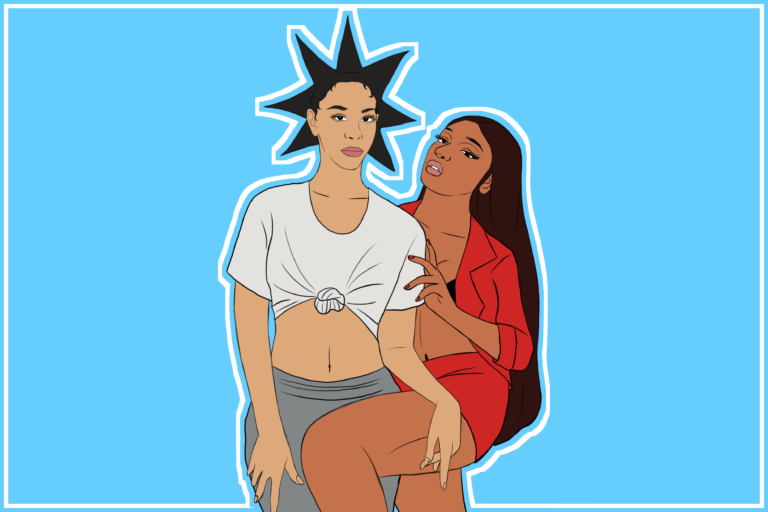
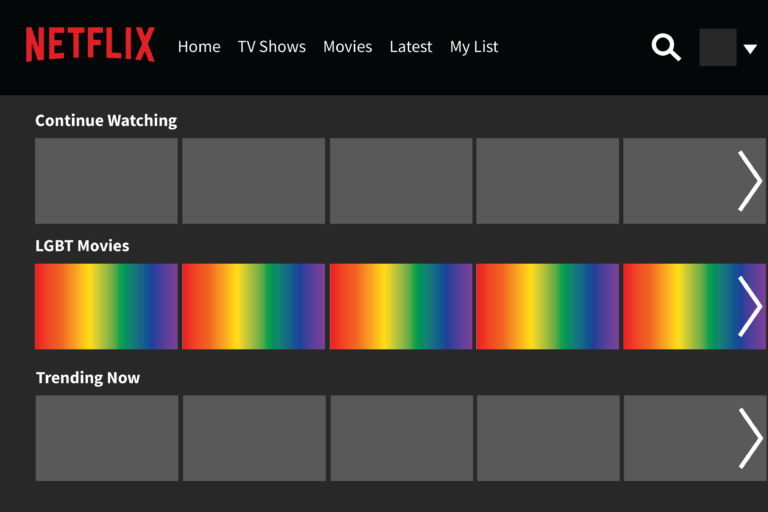
From movies to characters, here’s what Netflix has to offer the LGBT community

Exploring different television shows, movies that feature LGBT characters, storylines

Television:

“I Am Not Okay With This”

Following the hype of “Stranger Things,” Netflix cast the popular Sophia Lillis to play Sydney Novak, a young teen struggling to cope with the dangers of high school, her sexuality and superpowers. Sydney, who is 17 and lives with her mother and younger brother, struggles to cope with the death of her father after he dies by suicide. 

The show is about representation. It’s about giving young women the ability to see themselves as a powerful character that can be the main character, that can have cool superpowers and be gay.  

“Atypical” (Season 2)

Atypical” follows Sam, a penguin-loving teenager with Autism, who suddenly decides he’s ready to get a girlfriend. This fun comedy shows Sam’s story as he navigates his way through romance, highschool and dealing with his overprotective younger sister. The show gives an admirable amount of plot to all of the characters in Sam’s life.

“Atypical” was a beautiful Netflix show with a short run of four seasons. Cassey’s story picked up in the beginning of Season 2, and although a lot of her choices were questionable, I found myself more angry with her than favoring her. She gives a new voice compared to the LGBTQ characters we have previously seen. In popular shows, LGBTQ characters are often the ones without any depth, those that are simply “good.” “Atypical,” however, throws away this problematic idea and gives Cassey dimension, allowing her to move the plot forward. 

“One Day at a Time”

The small Alvarez apartment houses three generations of Cuban-Americans. With a spunky grandmother, a divorced mother, a closeted teen and a popular tween, the house gets a little crazy with everyone running around. The sitcom finds itself touching upon modern subjects that most comedies avoid. The divorced mother is a military veteran who, after deployments to Afghanistan, struggles with PTSD, all while her oldest child is struggling to come out to their religious family. 

Elena Alvarez is stuck with a religious Cuban family — quite possibly the worst combination for a lesbian. The show highlights what it means to live in silence when you’re afraid of coming out, not only to a highly Hispanic family with traditional roots, but to a Catholic family with a God who frowns upon homosexuality. The show brings in episodes of Elena having to face coming out to her family, being rejected by people that she loves and being afraid to go out in public with her girlfriend.

LGBT Directed Movies: 

“Other People”

This autobiographical film focuses on the struggle of losing a family member. After breaking up with his boyfriend and having an overall terrible year, David moves back to his tiny hometown to take care of his dying mother. While David deals with his dysfunctional and homophobic family, everyone struggles to cope with the thought of losing a beloved family member. 

The movie is loosely based on writer Chris Kelly’s life after the death of his mother in 2009, when he was four. Kelly was a writer and director for Saturday Night Live. He has received eight Emmy nominations for his work on SNL and wrote “Other People” for the opening at the 2016 Sundance Festival. 

“Paris is Burning”

This 1990 documentary focuses on drag queens trying to make it in New York City. The film speaks to the “house” culture and its ability to provide a comforting sense of community for those individuals who are commonly outcast. The documentary took seven years to make and sheds light on individuals we don’t normally get to see on-screen: gay people of color, drag queens and transgender women as they compete in shows. The film alternates between the colorful lives they portray on stage and candid interviews discussing prevalent topics in drag such as racism, classism and beauty standards in the industry. 

“The Half of It”

When the golden-hearted but dim Paul Munsky hires shy Ellie Chu to write him a love letter, things get a little out of hand. Paul loves the popular Aster Flores, but so does Ellie. In a religious town, the pair of friends find the friendship they never had while Ellie decides exactly who she wants to be. 

Having a slow, non-sexualized lesbian romance is rare. But adding a mixed racial lesbian romance is completely mythical. The movie showcases a kind of LGBTQ representation that is not frequently seen. Often, we are given white LGBTQ characters on a silver platter, so a mixed race couple is unspeakable if one of the individuals isn’t white. Lesbian filmaker Alice Wu brings a nice change of pace for young girls who are now able to see themselves in a movie.

“Holding The Man” 

This film, adopted by Timothy Conigrave’s 1995 memoir of the same name, features a 15-year romance between Tim and John, a high school drama student and a star football player who fall in love. Conigrave was an actor, playwright and LGBTQ activist, and his memoir won a Human Rights Award for nonfiction in 1995 from the Australian Human Rights Commission

Director Neil Armfield took this story from the pages to the screen. Armfield connects to this story personally, as he knew Conigrave before he passed. Ultimately, their connection was a familiar one in the LGBTQ community, of friends lost to AIDS. 

“Alex Strangelove”

In this slightly cringe-inducing, coming-of-age movie, Alex Truelove is ready to have sex. He sets out to lose his virginity to his girlfriend, but plans change when he goes to a party and meets a charming boy from outside of town. 

Director Craig Johnson found that Alex’s story reflected his own coming out story. He admits that the tale of the Truelove boy is largely autobiographical and he wanted to shed light on what a realistic coming out story looks like. The movie came out in 2018, but was in the writing process for over 10 years. 

“The Way He Looks”

The Way He Looks” is a Brazilian film and, like so many LGBT films, a coming-of-age story. The story focuses on Leonardo, a blind teen who wants his independence. His friends help him through school as the love he has for one of his closest friends blossoms. 

The movie is Daniel Ribeiro’s feature debut and is based off the 2010 short film “I don’t want to go back alone.” Ribeiro’s film won the Teddy Award for best LGBT-themed feature. 

Written by: Itzelth Gamboa — arts@theaggie.org

Experimental student musician “Nina Spheres” talks about debut album

Spheres discusses “Spherical” and the recording, editing process

Experimental musician Nina Spheres, a fourth-year philosophy major, sat down with Arts and Culture Editor Liz Jacobson to discuss their latest project “Spherical,” released on June 30, 2019. “Spherical” fulfills Sphere’s dream of finishing a project — from recording to editing — by themselves. 

“Spherical” tackles solitude and the mind, transporting the listener to another realm, a hypnotic soundscape, which creates a space for self-reflection and exploration. The nine-track album listens like a soundtrack and builds like a crashing wave, full of emotion with heavy synths and deep vibrations (and accordian) throughout. 

This following interview has been edited for length and clarity. 

The California Aggie: Tell me about “Spherical.” 

Nina Spheres: The album itself is a culmination of mostly random musical projects — I didn’t begin recording with any idea of how to mold them all into a cohesive unit. So, in this way, recording was pretty sparse and directionless. Much of this had to do with the fact that my recording is usually done in solitude, with only myself and my own opinions as a reference point. 

This is increasingly common among recording artists today, especially solo artists, and it really is a difficult thing to tackle. The album was my way of tackling that solitude and of finding some sort of direction in my music. It gave me the chance to explore the depths of my mind — much of it is ugly, monotonous. But some of it shines and progresses. It reflects my own ideas and history, as well as a monomania of the recording process. I spent (and wasted) a lot of hours on this music. I’d wake up in the morning, record all day, go to sleep and repeat this, every day, for months. Sometimes it would yield something worth keeping, sometimes it would yield trash, and the album is only the pieces that fit well together.

TCA: Beyond tackling the solitude, what went into the production of the album?

NS: I had friends add in things here and there arbitrarily, but really the album is just myself exploring the medium of recording. My dream at 19 was to make a full album, one that I was at least mostly proud of, without the help of anyone above me in terms of technical knowledge, hence a lot of bad recording quality, bad mixing, mastering, et cetera, because I was learning how to do it all as I went along. 

But it really was a beautiful thing for me because I learned it all myself. In some sense, the album — beyond its content — is also a journal of my work in learning how to conduct this sort of process. It’s helped a lot in terms of connecting with other people because I’m able to use this knowledge to others’ benefit, as well as my own, like The California Aggie’s Couch Concerts. It also piqued the interest of some people at KDVS, and I was able to finally form a group and be comfortable outside of my own head.

TCA: Where did the name Nina Spheres come from?

NS: Nina Spheres, at the time of the album’s release, was just me. I chose the moniker as a way to feel as if someone else was releasing the music. I was really uncomfortable with the thought of other people hearing the stuff I’d been working on. I wouldn’t show the music to anyone over the course of making it, save for one or two friends. 

The “alter ego” helped a lot with this initial release, and it still does now. It’s as if I’m morphing into whatever fictional character is behind that name, and really, it’s a liberating experience. I think many of us need to construct fictional characters out of ourselves in a world that, especially in the United States, has become almost entirely fictional. Music is a way for me to take a colorful, fictional stance on hard, tangible phenomena, and an alternate identity helps with forming that fiction.

TCA: Where do you draw inspiration from?

NS: Inspiration isn’t easy to pinpoint, and I’d like to think that the inspiration is just derived from my place in the world and how I feel about that place and how I navigate it. I don’t take inspiration from a single thing or event, more so from a generalized outlook. I usually choose not to write music about anything, instead just engaging with the act of recording, knowing that something is expressed regardless. 

  It’s up to the listener to try and find some meaning, but really, the music is simply a location in which one can immerse themselves and reflect on their own feelings. I think that — reflecting on oneself through another’s work, rather than concentrating on the artist and their message — is important, and so I try to accentuate that experience with the things I work on.

TCA: How would you describe the sound of “Spherical?”

NS: In terms of sound, I guess there are certain musical ideas that I wanted to explore, such as repetition and drone. These are ways to structure music that I’ve been really interested in for a while now. The hypnotic aspect of repetitive, droning music opens up a space to think in the abstract. I find this attractive in the work of someone like Phill Niblock, who focuses on lengthy, multilayered drone music, which evolves and builds slowly over time. When I listen to his music, I’m carried to this foreign landscape where I’m able to take a fresh perspective on things. I sort of imitate that kind of location in my own music.

That’s the thing, I don’t really think of my music in terms of sound, but instead in terms of location. That location would be somewhere, like, the bottom of a well, in the middle of the desert, or something.

TCA: “Experimental” is a pretty broad term. Do you think that your music fits into a genre?

NS: I call it degenerate, because first off, I don’t really know what I’m doing, and over time I go to great lengths to make my recordings “worse” — empower them by deconstructing them. Lee Perry would urinate on and burn his recordings, and then reuse them, and I think this is the greatest production tactic ever: destruction over production. 

In a world that demands productivity, one way of retaliation is constructive destruction. You’re still being productive, in an artistic sense, but you’re making destruction the dominant ideology in terms of treatment of the material, and that makes for interesting results in music. I also think cinematic experiences are also really valuable; they get ingrained deep in the mind, because of how drawn we are to cinema and cinematic life. 

“Spherical” has a cinematic quality to it, which was in many ways intentional. The genre would be a collection of these aspects, but usually when this happens it gets called “experimental,” even though there’s music out there that’s way more experimental than my own.

TCA: What is your favorite part of the album — a certain song or snippet?

NS: My favorite part of the album is the accordion piece that comes in around three minutes into the first track. This is actually a motif that appears in a few different places during the span of the album. When my grandpa died, his accordion was given to me because no one else in my family plays music. That little riff was the first thing I played when I picked up the accordion — totally at random. It meant a lot to me and still does. It’s a beautiful little thing, and that accordion also appears all over the album.

TCA: What can we expect from Nina Spheres in the future?

NS: Unfortunately, all Nina Spheres operations are again limited to recording, but once the quarantine is lifted, we’ll be focusing our energy on live performance. Before COVID-19 came along, we had a decent run of shows, and we’re really looking to continue doing that, and potentially tour, if we can make it happen. We’re hoping to release another album by the end of this year, or early next year.

Nina Spheres and “Spherical” is available on Bandcamp.

Written by: Liz Jacobson — arts@theaggie.org

VR in Quarantine

Aggie Gaming officer and avid VR gamer talk about the experience of VR, what it offers during quarantine

Appearing in many forms, virtual reality (VR) first emerged through a wearable headset called “Sword of Damocles” in 1968, earning its name because it had to be suspended from the ceiling while worn due to its weight. Even earlier forms of VR included the Sensorama. Created by a cinematographer, this seated arcade-style experience attempted to emulate all five senses using fans, smell generators, a vibrating chair and speakers. While the definition of virtual reality is debatable, today’s standards generally label it as complete visual immersion in an interactive virtual environment where technology responds to your tracked movements in real-time. Headsets such as the Oculus Quest, Vive Pro and Valve Index dominate the VR market today and can range from prices of $50-$1,000. 

Eriz Sartiga, a first-year computer science major and owner of the Valve Index headset, said VR has unique value that differentiates it from other games.  

“Unlike normal games where you sit in front of a TV or monitor, VR immerses you into the game by giving you a presence in it,” Sartiga said. “Rather than playing a character, you are the character. Given controllers, you can move exactly the way you want to, and I think this makes VR unique.”

Fourth-year managerial economics major and Aggie Gaming officer Andrey Sanin has been chipping away at a new video game release, Half-Life: Alyx. He said his first time playing the game was surreal. 

“It’s incredibly immersive,” Sanin said. “The first time I opened the game up, I think I spent 30 minutes just on the balcony that you start the game on. It’s really something, it’s crazy.” 

Other than just gaming, VR offers immersive video experiences, which include the settings of roller coasters, carribean islands and underwater realms. For Sanin, these simulations have helped contribute to the quality of his experience in quarantine.  

“Honestly, there’s some 3-D videos that came out years and years ago, but watching that kind of thing in VR, especially more the landscape ones, it’s very nice,” Sanin said. “I really like being outdoors and with the whole quarantine situation, it’s a little bit harder to go outside, so it’s nice to have access to a video that at least simulates it.”

In addition to games and videos, there are ways to interact with others using VR. Sartiga, who formerly hosted small get-togethers in his dorm allowing others to try his headset, recommends that people give VR a try.    

“With more time on our hands and more people bored, I highly recommend it,” Sartiga said. “You don’t have to play just games, you can even socialize on apps such as VR Chat where you can enter chat rooms and interact with friends and other people. There’s definitely a lot to do and explore in VR.”

Half-Life: Alyx, which came out in March of this year, is the third game in the Half-Life series. According to Sanin, this game gives reason to test out VR. 

“I think the Half-Life: Alyx is just one of the best arguments for VR gaming,” Sanin said. “Half-Life 2 kind of set the bar, and Valve did it again with the Half-Life: Alyx, where they completely took something that people were experimenting with and brought it to [another] level.”

He said playing such a high-intensity game — where it feels as though the player is the one being attacked by the game’s zombies, not the character — can be intense. 

“It’s not like in a video game where you have a character and you just back off,” Sanin said. “They’re running at you, I mean, they’re in your face and they’re about to hit you in the face. It’s definitely unsettling.”

For a first experience with VR, Sanin recommended a game he thought was slightly less involved.

“In terms of things to make you comfortable with VR, I think a great one is Beat Saber because you’re slicing blocks of things in time to music, it’s good fun,” he said.

Written by: Lyra Farrell — features@theaggie.org 

Students alter courses they planned to register for in light of uncertainty surrounding Fall Quarter

Adjustments to schedule may change planned graduation date, other quarters’ schedules

With no clear answer to the question of how instruction will look in the fall, many students took the possibility of online instruction into consideration when deciding the courses they want to take during the first round of registration for Fall Quarter. 

For second-year history and anthropology double major Dhanya Indraganti, that deliberation centered around one course, ANT 100 (Sociocultural Theory), which is generally offered only in the fall. Indraganti had hoped to take the course this fall so that she wouldn’t have to take the heavy theory course along with her history seminar in the fall of her fourth year. Based on her experience with online instruction this quarter, Indraganti decided that she would push ANT 100 to her fourth year and try to take her history seminar another quarter. She said the quality of online courses is lower, in part due to decreased accessibility regardless of the quality of the professor. 

“For me, I’ve noticed that I feel like I’m not understanding the things that are going on in class even though I’ve been doing the readings,” Indraganti said. “If it’s a really difficult and more intense course, I might as well wait to take it.” 

Making these changes meant that she had to shuffle around the courses she wanted to take, something that is a little inconvenient for her since she planned her courses carefully to ensure she would meet all the requirements for her two majors. As a result of these changes, she has decided to take courses over the summer too, which she had not anticipated.

On top of this, Indraganti, who is currently still in Davis, is an international student from Qatar. If she is able to go back home over the summer and decides to do so, there is the additional concern that she won’t be able to return to Davis in the fall. 

“I don’t want to be taking courses that will be really difficult to do remotely,” Indraganti said. “Some courses have office hours in the middle of the day, and if I’m home I can’t [attend them].” 

Indraganti plans to be back in Davis in the fall, but with things as they stand, there’s no way for her to be sure.

“Mostly it’s just a concern of whether I can handle courses,” Indraganti said. “Because it’s really difficult to pay attention, finish my homework on time, finish reading on time and just make sure I’m still okay.”

When second-year sustainable environmental design major Andrea Ayotte was considering classes for Fall Quarter, she made two potential schedules — one for if classes were online and one for if classes were in-person. Ayotte said this quarter has been difficult, in large part due to a course that is supposed to involve field trips and outdoor labs that are no longer feasible. 

“They’ve done their best to teach what they can remotely, but I definitely feel like I’m missing out on skills and field experience that would help me in school and my future career,” Ayotte said via email. “It’s also an issue because we aren’t able to get as much feedback as before. My major has a lot of studio classes and it’s really hard to get that kind of individual experience remotely.”

Ayotte made her decisions for her fall courses based on her experience this quarter — she says that although remote instruction has made courses easier in some ways, it seems like professors know this and are trying to compensate through more difficult open-note exams, for example. 

“It’s interesting because I didn’t expect the standards to be higher during a global pandemic,” Ayotte said. “Because of this, I ended up having to drop a class at the beginning of the quarter because I couldn’t handle the workload, even though I was taking an amount of units I usually feel is well within my ability.”

Ayotte’s pass time was on May 18 and she opted to register for the classes in her online schedule based on her experience this quarter. She said she made her decisions because she felt that it would be better to be prepared for online courses and not “set [herself] up for failure.” 

If “things had been normal,” as she put it, she planned to take the LDA 140 series, the capstone courses for her major, starting this fall, setting her up to graduate early or allowing her to add a minor and decrease her course load intensity if she chose to stay for a fourth year. 

“It is really hard to make decisions when nothing is definite and you have no applicable life experiences to draw from,” Ayotte said. “Unfortunately, I feel sure that if they had to be taught online I would not get the full experience I want. Part of the classes are community projects and group work that I can’t see happening anymore. I had to make the tough decision to wait a year and work on minors and other classes instead of following my original plan.”

As a design and communication double major, second-year Dorothy Hung has a number of studio courses, which she describes as “labs for design students.” This quarter, she was supposed to have two three-hour long studios, but her two professors have approached remote learning differently.

“One of my professors decided to go the asynchronous route and meet with us briefly at the beginning of each week, while the other preferred to meet in person,” Hung said in an email. “It’s been interesting since both value social interaction differently.”

Hung feels that a lot of her courses are “quite relevant” and are “born to be taught online.” One course she is taking for her minor is a course on learning in the digital age, which she finds interesting especially since everyone seems to be figuring that out by trial and error this quarter. 

“As we analyze the pros and cons of technology and doing school away from school, we get to tie the content into current events and situations that we are experiencing with COVID-19,” Hung said. “I’m also taking a class called Designing for Quarantine, my studio class that meets in person each week. This class was created after the fact that school got canceled and this pandemic blew up, so it wasn’t much of a coincidence but still an interesting experience with designing to help people cope with social distancing.”

Hung also registered for an interpersonal communication course this quarter but ended up dropping it as the professor recommended students take it in person. She has registered to take the course this fall, but depending on how it goes, she may drop it again. 

For second-year political science and American studies double major Moa Smith, a number of the upper division courses that she is most excited about are being offered in the fall. Given the circumstances and what she had heard about other universities making their fall semesters and quarters entirely online, she decided not to register for them. 

“Since they’re the classes I’ve been looking forward to taking most since I’ve been at Davis, I really want to take them in person,” Smith said. “I feel like I learn so much better in person and you just get so much more out of it.”

Smith has chosen to take easier upper division courses and her last few lower division courses this Fall Quarter — classes that she cares about less. Even when she took a hybrid class as a first-year, she felt that it was harder to learn and to get as much work done in comparison to a traditional in-person class.

“I don’t want to risk not getting what I want to get out of a class just because it’s put online,” Smith said. 

This quarter has been interesting for Smith, who was enrolled in a year-long program in Sweden but had to return home in mid-March as a result of COVID-19. She described it as a big shock — even though everyone had some idea that their programs would be canceled, it all happened very fast and was stressful and chaotic. 

She said she is glad to be back home now, but she is not a huge fan of online courses. She has signed a lease and is looking forward to returning to Davis in the fall where she will have a better space in which to study and an environment more conducive to focusing on schoolwork.

“There’s so much uncertainty, it’s definitely hard to plan,” Smith said. “So I wish, in a way, that the school would just decide out of best interest to make [Fall Quarter] online so that we can plan for that for sure instead of sort of guessing and then hoping that classes will be offered later. Or just that there would be some sort of certainty so that it would be easier to plan ahead.”

Written by: Anjini Venugopal —  features@theaggie.org 

Female rappers are the future of hip-hop

With fresh stories and perspectives, female rappers are elevating hip-hop higher than ever before

We’re lucky enough to be living in a period that, despite the COVID-19 pandemic, is musically rich and diverse. Excluding the frequent tone-deaf decisions made by the Recording Academy, the world is fully embracing the hip-hop genre and its many faces. 

Hip-hop and its contemporaries are based on the business of storytelling. These stories aim to highlight different individual experiences: from childhood memories to fortune and fame. 

Female rappers have distinct voices and unique stories to tell. The ways in which female rappers continue to direct the hip-hop narrative to stories of womanhood and feminism is instrumental in furthering the genre as a whole. 

“Not Tonight” is a ’90s collaboration that celebrated unity among female rappers and is where Missy Elliot, Lil’ Kim, Da Brat and other influential female rap figures celebrated spending time with their squads during ladies’ night. Elliot tells listeners they “should be like Missy ‘stead of being like Mike,” referencing the infatuation with Michael Jordan.

At the same time, however, there have been moments where hip-hop feminist rhetoric has faltered. Ignoring these moments would undercut the work done to progress feminism in hip-hop. 

Ms. Lauryn Hill is one of the most popular hip-hop artists. “The Miseducation of Lauryn Hill” became the first rap album to win Album of the Year at the Grammy Awards. She was the trailblazer for female hip-hop artists at the turn of the millennium.

 For all of her amazing achievements, Ms. Hill used the formerly prominent trope of “giving it up” (with “it” being one’s body or sex) on “Doo Wop (That Thing).” On the classic track, Ms. Hill remarks on how women “give it up so easy” and let men “hit it.” 

 Some argue that these phrases were nothing more than colloquialisms for sexual activities, but they are actually steeped in internalized misogyny. It perpetuates the idea that sex is a one-way street: Women are giving and men are taking. Despite this criticism, Ms. Hill is consistently lauded for her feminist appeal and rightly so. “Doo Wop (That Thing)” as a whole is a very empowering song with some pertinent messages throughout: “Don’t be a hard rock when you really are a gem!”

Feminism in hip-hop isn’t perfect or concrete. What is? The movement is constantly growing and evolving. The same thing goes for the music industry — trends ebb and flow to mesh uniformly with current culture. To fully discuss the aspects of hip-hop feminism is to understand the nature of the movement as it changes through history. 

Due to the cyclical nature of musical trends and fame, the hype surrounding Lil’ Kim and Missy Elliot eventually dropped, leaving a gaping hole in the hip-hop scene where mainstream female rappers previously reigned. Nicki Minaj’s 2010 album “Pink Friday,” and especially her hit single “Super Bass,” managed to make up for this tragic disparity. Hip-hop found its next shining star.

Minaj’s indisputable talent — evident in her showing up Kanye West on his own song — and infectious energy catapulted her past one-hit wonder status from the success of “Super Bass.” 

In grade school, I was struck by how Minaj was so uniquely herself. Minaj famously voiced her opinion in a documentary clip, now known as the “pickle juice” clip. Here, Minaj demands more for herself as a female artist and addresses double standards in the rap game.  She was one of the earliest female figures to do so for my generation, which is somewhere between millenial and zoomer. 

Lil’ Kim, Missy Elliot and Minaj alike paved the way for today’s artists to create mega cultural phenomena like Megan thee Stallion’s “Hot Girl Summer” (a moment of silence for Hot Girl Summer 2020). Before this, women had to pick between two lifestyles: “nine to five or shaking that ass.” Now we can have both. Our culture allows women to be simultaneously college-educated, independent and sex-positive — or just some (or none) of these things. 

This isn’t just a win for feminism. It’s a win for hip-hop. In a genre where women were often disparaged or barred from inclusion, putting female rappers like Megan thee Stallion, Noname, Rico Nasty and City Girls at the forefront of today’s hip-hop is a critical step to creating a more multifaceted genre. The feminine experience is finally being included. 

People argue that hip-hop doesn’t have to change, and that’s simply not true. Society is progressing, and it would be a disservice to the artists and the genre if hip-hop didn’t follow suit.

 Written by: Isabella Chuecos –– ifchuecos@ucdavis.edu 

Disclaimer: The views and opinions expressed by individual columnists belong to the columnists alone and do not necessarily indicate the views and opinions held by The California Aggie