56.6 F
Davis

Davis, California

Thursday, December 25, 2025
Home Blog Page 329

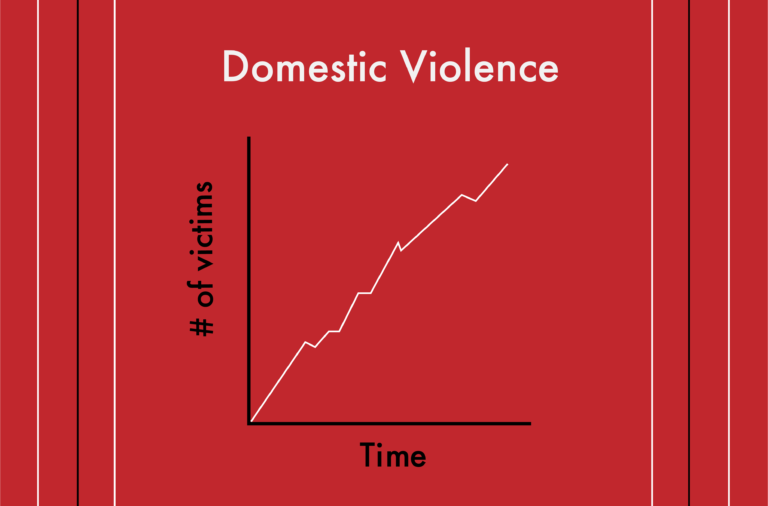
Correlation between shelter-in-place and domestic violence suggested by Davis Police Department statistics

Victims of domestic violence now forced into isolation with abuser, limited access to support

With the extensions of the shelter-in-place order, there have been negative consequences for those who are trapped in unsafe living situations with domestic violence.

Sarah Meredith, the director of the UC Davis Center for Advocacy, Resources and Education (CARE), defined domestic violence as “any form of violence or abuse that is committed within an intimate partner relationship or prior intimate partner relationship.”

Meredith explained that domestic violence typically exists within a pattern of abuse based on power and control, and the abuser will often seek to isolate their victim. Due to this isolation already being imposed on all households as a result of the COVID-19 pandemic, victims no longer have access to normally-available support and resources.  

“Many of them are living in the home or sheltering in place with the person who is also trying to keep them isolated,” Meredith said. “Until we get back to a place where people have access to their support system, the isolation just further exacerbates the effects of domestic violence.”

Since the first shelter-in-place order back in March, domestic violence calls to the Davis Police Department have increased by 6.4%, according to The Davis Enterprise

Forensic Science International, a journal about medical and scientific contributions to administering justice, released a report on the necessity of social distancing despite its negative impact on domestic violence.

“Though necessary to slow the spread of the novel Coronavirus (Covid-19), actions such as social-distancing, sheltering in-place, restricted travel, and closures of key community foundations are likely to dramatically increase the risk for family violence around the globe,” the report reads.

Amy Groven, the director of clinical programs at Empower Yolo, explained how the mandatory shelter-in-place order has resulted in an added financial burden that can significantly impact a person’s stress level, possibly leading to increased incidence of domestic violence.

Stressors such as reduced employment hours or job loss are additional factors for people to worry about, along with the initial stress caused by the pandemic itself.

“All of these things can add to a person’s stress level,” Groven said. “While stress itself is not something that makes people necessarily violent, it is a contributing factor.”  

These times are already challenging enough, and Groven fears a further increase in domestic violence incidents if the shelter-in-place order continues to be extended.

“[Providers] need to be innovative with the way that we handle domestic violence and helping people,” Groven said. “The most important thing if you are in a domestic violence situation is to let somebody know, whether it’s calling a crisis line or telling a friend or family member.”

Empower Yolo and CARE both serve to help survivors of domestic violence and sexual assault. CARE offers support-based resources including confidential crisis intervention, information about reporting options, safety planning and resource referrals. Empower Yolo has a 24-hour crisis support line, peer counseling, specialized support groups and a therapy department.

The CARE website provides a message for families during the COVID-19 pandemic.

“CARE recognizes the additional hurdles created for survivors by the COVID-19 health crisis […] the need for resources and support has never been greater for our community,” its website reads. 

Meredith emphasized that resources like CARE are still available no matter where people experiencing domestic violence are sheltering in place and that they will work with survivors through a communication method that is safest for them. 

“Our job is to understand survivor rights and options,” Meredith said. “We provide confidential crisis intervention, advocacy and accompaniment.”

Meredith had a few final words of advice for anyone currently experiencing domestic violence. 

 “This is not your fault,” Meredith said. “You don’t deserve to be treated in a way that is abusive, and you deserve to have healthy, respectful relationships.”      

Written By: Jelena Lapuz — city@theaggie.org 

Excursions in and around Davis

Students discuss destinations they consider worth visiting

Many students who are still in Davis have found themselves in a rut, drowsily shifting from the bed to the couch and back again. There isn’t much room for the giddy joy that often accompanies Spring Quarter, but that doesn’t mean that Davis has lost its unique feel — that uniqueness remains, but it might be undermined by watching Netflix all day. Here are a couple of spots that can provide a respite from boredom as the stay-at-home order stretches out to May 31

Susmita Bagchi, a second-year philosophy major, finds the Hutchinson parking structure to be the ideal spot in Davis to relax and take pictures. Hutchinson is known for being the best place to watch the sunset, especially with the views it provides of the entire school. Additionally, this is an easy solo activity, making it more feasible to do while maintaining social distancing. 

“Me and my little went there with a speaker and [Dutch Bros Coffee] and listened to music and watched the sunset. It was really nice,” Bagchi said. “Another time, me and my friend got In-N-Out and [just] sat in our cars and talked to each other.”

Aliza Lauter, a fourth-year international agricultural development and international relations double major, said Putah Creek is one of her favorite excursions, specifically the Winters swimming spot.

A popular Spring Quarter location, many UC Davis students found their way to this area of the creek, especially as the summer heat began to settle in in years past.

“It’s a really cool area of Putah Creek my friend showed me where you can pull off the road a little past Winters and walk down to the creek,” Lauter said. “There are some awesome jumping rocks and it’s beautiful there.”

Leah Kalish, a second-year sociology major, recently went to a drive-in theater in Sacramento. She was able to enjoy a movie while still acting under the health guidelines from the comfort and safety of her car. With popcorn and candy, this is an easy way to cure cabin fever. 

“The drive-in theater in Sacramento is such a fun night out, especially when the options are as limited as they are now,” Kalish said. “There are six screens, each playing different movies, and they update their selection every week. I went there most recently to see ‘Wonder Woman’ for a date night and am going back to see ‘Back to the Future.’”

These three spots provide different types of activities and can provide solace as California begins to lessen its restrictions. 

 Written by: Athena Aghighi — features@theaggie.org

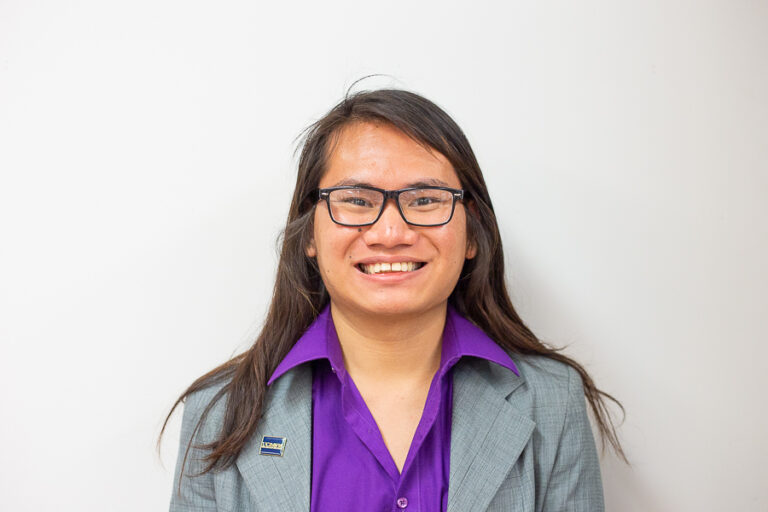
“I didn’t want to change my name” — From spending six years in a refugee camp to coming out as a trans woman, how Ko Ser Lu Htoo came into her identity

Former ASUCD senator shares what motivates her, future aspirations

“People believe in you.” 

Ko Ser Lu Htoo’s father told her this when she was elected to serve as an ASUCD senator. Most would consider this a remarkable victory in itself, but for a trans woman of color and Karen refugee, this was yet another testament to Htoo’s tenacity and courage. 

There are 7.5 million Karen people in the world. The Karen are an ethnolinguistic group from southeastern Myanmar (formerly Burma) and they make up approximately 7% of the Burmese population. Although they used to have their own independent state, the Karen people are now the target of persecution and ethnic cleansing by the Burmese military. Only 15% of the Karen people are Christians, making Htoo and her family a minority within a minority. 

Htoo, the fifth child of a Karen Christian missionary, was forced to flee her northern village when they heard the bell ringing, installed by the village to signal when the Burmese military was near. With just the essentials, her family left their burning village and walked for 10 days over the mountains to a refugee camp on the Myanmar-Thailand border.  

In the United Nations refugee camp, Htoo (who also uses they/them pronouns) focused on her education. Her family no longer farmed for their food but instead relied on rations. After five years, her father applied for asylum in Canada, but they didn’t qualify; after seven years in the refugee camp, their asylum application to the U.S., which 12-year-old Htoo pushed to get submitted, was approved.

“I was so scared!” she exclaimed. “But it was totally crazy and amazing. The whole time I thought the plane was going to fall out of the sky!”

“Really?”

Htoo thought to herself when she saw the small apartment she was expected to share with her seven siblings and parents. 

“It wasn’t at all like we saw on TV or in magazines,” she said. “We thought America was all big, fancy houses.”

But she was fortunate to have a new home in the U.S., and her apartment building became a community. There was no hierarchy — everybody was from somewhere else. She started her first day of middle school speaking no English, and endured bullying from her classmates.

“You don’t know your homework!” they taunted in a sing-song manner. 

For high school, Htoo transferred to Oakland International High School, where there were 300 students from 35 countries who spoke 37 languages. Here, no one was bullied.

“I need help.”

Although no longer bullied, Htoo felt an all-consuming feeling of confusion. Htoo needed to “discover who she was” and joined her school’s Gay Straight Alliance (GSA), of which she would later become the president. In this space, she and her fellow students shared stories, watched movies and learned from each other. Still not out to her family as transgender, Htoo did what many other teenage girls were doing: put red lipstick on in the school bathroom before the first period bell rang.

At her senior prom, she wore a dark blue women’s suit but no tie — nothing too girly or too boyish. Her boots had a one-inch heel. Her older brother dropped her off, and once she was at school, she put on her red lipstick in the bathroom. When she made her appearance on the dance floor, some peers clapped, others flashed a smile — overall, she was met with acceptance. 

“I feel happy,” she thought to herself. “I wasn’t ready to come out to my parents or my teachers. I just wanted to explore.”

After graduation — where her alluded to her identity in her speech — she came out to her very traditional family during a family meeting. She was met with some acceptance but mostly tolerance. Htoo understands that not everyone will like who she is, but the most important thing is that they respect who she is. It wasn’t until she won her seat on the ASUCD Senate table that her father would see in her what she saw in herself. But she still doesn’t wear her signature red lipstick and high heels at home or at church, where her father is the pastor.

“We need to care. We have to go and participate.”

            Like many students, UC Berkeley was her first choice for college. Originally disappointed, she took the advice of her English teacher and enrolled at UC Davis, taking the challenge to go off on her own in a new, scary place — again. She found a sense of community at the LGBTQIA Resource Center, the Cross Cultural Center and her floor in student housing. 

            A political science major, she took to ASUCD and got involved as quickly as she could. At UC Davis, as in her home of Myanmar, there were people who weren’t being represented by the administration and government. At the Senate table, as part of the community advocacy-focused BASED Slate, Htoo fought against bigotry and homophobia. People in positions of power purposefully misgendered her and disrespected her community, but that didn’t matter — she was there to give a voice to the marginalized. 

“It’s important to be transparent and inclusive and make sure their voices are heard at the table,” Htoo said. “It can be partisan, but you can’t leave anybody behind, any communities behind.” 

As a senator, Htoo adopted countless units and served on countless committees, so many that she can’t even name all of them anymore, but she cared deeply about each and every one. She fought for more scholarships and endorsed both the Unitrans Fee Referendum and the ASUCD Basic Needs and Services Referendum. 

“We need to know what’s going on in the university, where our money gets spent,” she said shortly after being appointed the BASED Chair.

“I am proud of who I am.”

Last year, Htoo received her American citizenship — she is officially a U.S. citizen, no longer a refugee. But she still values her culture and carries it with her every day. Every weekend, she teaches at Karen Sunday school where she wears her traditional clothing. 

“I want them to know who they are,” she says about her students. Her lessons focus on her native language and their traditions.

In her native language, Ko Ser Lu Htoo means gold crown. As both a trans woman and recent American citizen, she has twice made the decision not to change her name because it carries her ancestors and her identity.  

“It’s about my ethnicities, my blood, the Karen people,” Htoo said. “It has to do with my identities. By keeping the name, it doesn’t mean it’s going to take away my identities with the LGBTQIA+ community. I could change my name to Carol or Katie, but it doesn’t reflect who I am as an ethnic minority from Burma.”

Htoo and her mother, who also just received her American citizenship, recently returned from a mission trip to Myanmar after taking a quarter off to work with their family and fellow Karen people. Now back in school, Htoo commutes to and from Dublin in the East Bay every day so she can be near her family. 

This passion for her people’s struggle does not fade away when she is in Oakland or Davis. One day, she hopes to move to Washington, D.C. to continue her advocacy work and give hope to the Karen people. 

“I will not rest until my Karen people regain their state and freedom from the corrupt and evil Burmese government and its military.”

Written by: Liz Jacobson — arts@theaggie.org

Some pre-trial inmates released in effort to prevent spread of COVID-19 rearrested in Yolo County

Inmates released after California Judicial Council adopts new rule aimed at lowering prison populations during pandemic

Pre-trial inmates in Yolo County released due to the statewide emergency $0 bail schedule due to COVID-19 have committed several crimes. The plan was instituted by the California Judicial Council on April 6. 

The emergency rule set the bail for pre-trial inmates charged with misdemeanors and lower-level felonies to $0 — an effort to decrease crowding in California jails during the COVID-19 pandemic. The Yolo County Sheriff’s Office expressed its disapproval for this decision in a press release a few days after the rule came into effect.

“We have made important decisions in order to prevent the spread of the COVID-19 virus and to protect the health of staff, inmates, and the community,” the statement read.  “Unfortunately, the efforts of this Office and the efforts of our public safety partners throughout Yolo County are not being considered as decisions at the state level are made and imposed upon us.”

The Sheriff’s Office noted that they had already taken measures to protect inmates against COVID-19, like reducing the jail population to 250 below maximum capacity and allowing each inmate to be individually housed to enforce social distancing. 

“Additional efforts we have made include enhanced medical screening procedures for all incoming inmates, a screening for all inmates already in custody, and daily medical screenings for all staff arriving for duty,” the press release added. 

County officials expressed concerns that inmates could pose a threat to the public if released before their trial date.These concerns were confirmed only a few days later, when the Yolo County District Attorney’s Office announced that a man had been charged with additional felonies after being let out on $0 bail. 

After his release, Woodland resident Jacob Dakota James was charged with auto theft on three separate occasions before being rearrested on April 18, according to a press release from the Yolo County District Attorney’s Office. James allegedly committed two felonies the day of his release, April 9. 

Since then, the District Attorney’s Office noted three other inmates who were released due to the Statewide Emergency “0” Bail Schedule and have been rearrested for allegedly committing more crimes. The four men who were rearrested faced charges such as assault with a deadly weapon, attempted carjacking and looting within an affected county in a state of emergency, among other crimes. Additionally, each man was charged with the misdemeanor, “violation of an order issued by Yolo County Public Health officials during an epidemic.”

Shaun Lamar Moore, one of the men rearrested, was initially charged for burglary and attempted possession of a restricted biological agent after allegedly stealing a COVID-19 specimen from Davis Sutter Hospital. He allegedly impersonated a Centers for Disease Control and Prevention official in order to obtain the sample, as reported by The California Aggie

After his first arrest, police noted that they did not think Moore intended to harm others and added that they were investigating whether any mental health conditions played a role in the crime. During his bail hearing, the court ordered that Moore could be released if he was fitted with a GPS tracking device and monitored by the probation department. 

Three days following his release, Moore allegedly committed petty theft in Sacramento, and sexual battery in Woodland, according to a press release by Yolo County. His bail is currently set at $10,000.

Though the $0 bail schedule is facing pushback on local levels, Justice Marsha G. Slough noted that this rule strikes “a balance between public safety and public health,” during a California Judicial Council meeting on April 6. Those with, “serious and violent offences, domestic violence, sex offenders, restraining order violations, and certain gun offenses,” would remain at the current bail schedule, according to Slough.

She added that this rule will bring greater consistency across all California courts — some of which had already adopted a $0 bail schedule before the April 6 meeting — and still allow for some local discretion.

“During this time, however, there is a need for greater uniformity throughout the state,” Slough said. “This proposal provides that uniformity while still allowing for higher amounts of bail and local discretion for the most serious offenses.”

Written by: Madeleine Payne — city@theaggie.org
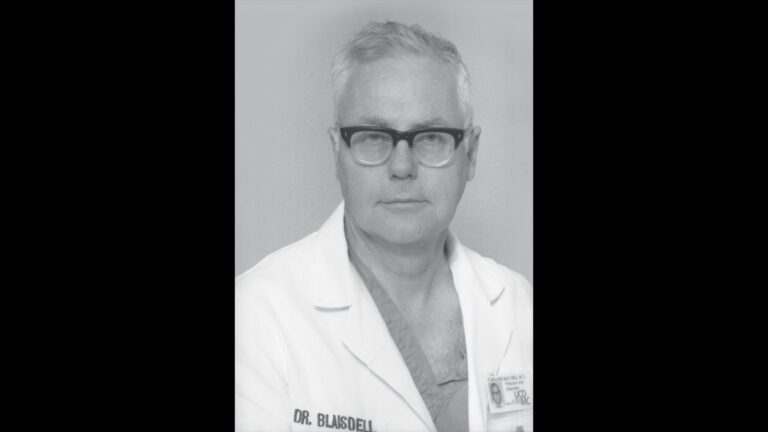
In Memoriam: Dr. F. William Blaisdell, former chair of UCDMC Surgery Department

Founder of trauma care as a surgical speciality passes at age 92

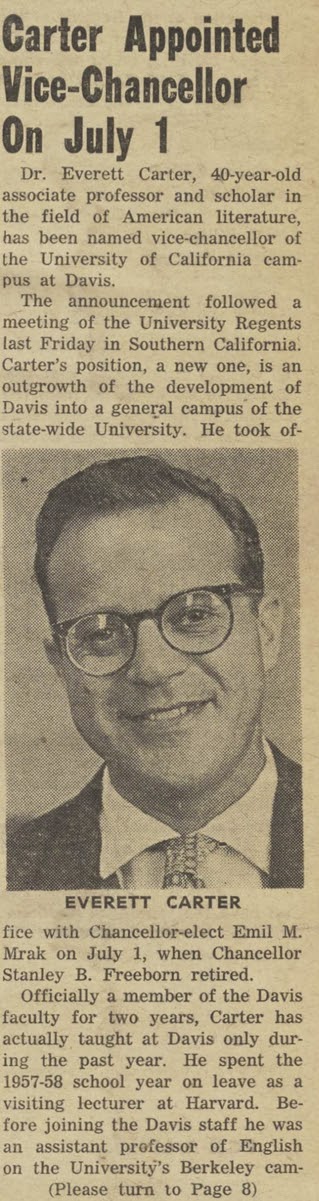
Dr. F. William Blaisdell, “widely considered the founder of trauma care as a surgical speciality,” passed away on April 18 at the age of 92 from natural causes, according to the UC Davis Health website.

“He was one of the most remarkable human beings that I have ever met,” said Dr. Kathrin Troppmann, a surgeon with UC Davis Health. “There are many reasons for that. From a professional perspective, he was the ideal version of a surgical leader. That relates to his skills and his commitment to teaching, research, and clinical care of a patient.” 

Before serving as chair of the Department of Surgery at the UC Davis Medical Center from 1979 to 1995, Blaisdell established the “nation’s first dedicated, 24-hours-a-day, seven-day-a-week trauma program,” at San Francisco General Hospital, according to UC Davis Dateline

“The way he accomplished this was because of his persona as a surgeon,” Troppmann said. “Professionally, he expected the same from his trainees and faculty as he would expect from himself. He was a very patient teacher.” 

The Trauma Surgery service at San Francisco General Hospital, launched by Blaisdell, became “the model for urban trauma surgery systems worldwide,” according to the UC San Francisco website

Applying his expertise and experience, Blaisdell was able to transform the trauma program at UC Davis Medical Center.

“He came to UC Davis and applied the lessons he had learned in San Francisco in a very organized fashion,” Troppman said. 

According to the UC Davis Health website, the American College of Surgeons verified UC Davis Medical Center as a level I trauma center and a level I pediatric trauma center. UC Davis Health is one of less than 20 Level 1 trauma centers verified for both adults and pediatrics.

In addition to revolutionizing these two trauma programs, Blaisdell “set new standards in surgery and critical care medicine that improved wound and fracture treatment and reduced post-surgical infection, lung failure and DVT risk,” according to the UC Davis Health newsroom

“In clinical care, he was exceptional,” Troppmann said. “Not only was he competent in the knowledge of surgery, but he was very well studied. His knowledge-base was extraordinary. He also took care of patients as though they were his own family. I witnessed this on numerous occasions where he was very compassionate, honest, respectful, and professional in how he interacted with patients. He treated every patient exactly the same.” 

He also devised novel approaches for cardiac compression, liver and kidney trauma and bypass procedures. 

“Just to work side-by-side with him for two to three months was an incredible privilege and honor,” Troppman said. “I could see all aspects of his character that made him an icon in surgery.”

Blaisdell also spearheaded a “unique surgical education program to train military and civilian surgical residents side-by-side,” according to the UC Davis Health website. 

In December of 2006, Blaisdell’s dedication to medical education was recognized in the naming of the health sciences library on UC Davis’ Sacramento campus as “F. William Blaisdell, M.D., Medical Library.”

There is also a medical student scholarship fund named for Blaisdell, to “honor [him] and his impact on surgical education and training for an entire generation of physicians,” according to UC Davis Giving’s website. 

Blaisdell was also at the forefront of diversifying the field of surgery, by including women in surgery.

“As long as we were hardworking, competent and dedicated to the care of the patients, he wanted to teach us everything we knew,” Troppmann said. “In my intern class, in 1992, five of the six categorical residents were women, and that was at a time when it was lucky if other programs took their one token female. He hired women based on their qualifications, and at that time that wasn’t the case around the country. It didn’t matter if you were a man or a woman.”

In addition to his contributions to the UC Davis Medical Center, Blaisdell served as president for the following organizations: Society for Vascular Surgery, American Association for the Surgery of Trauma, Michael E. DeBakey International Surgical Society and Uniformed Services Medical School Surgical Society.

He was awarded with the distinguished service awards from the American College of Surgeons and State of California. Additionally, he was recognized with a Distinguished Alumni Award from Stanford University. 

Troppmann said Blaisdell was “kind and witty” — he “knew everybody’s name” — and he “became an icon in surgery.”

“Many of us saw the way he practiced as a surgeon, [and consider him] as a role model,” Troppmann said. “He worked harder than anybody else, and we all wanted to be like him.”

Written by: Aarya Gupta — campus@theaggie.org
Humor: New perspectives on pain, pandemics & human suffering with Zorbulus the Reptilian

Guidance and wisdom for trying times — from an unlikely source

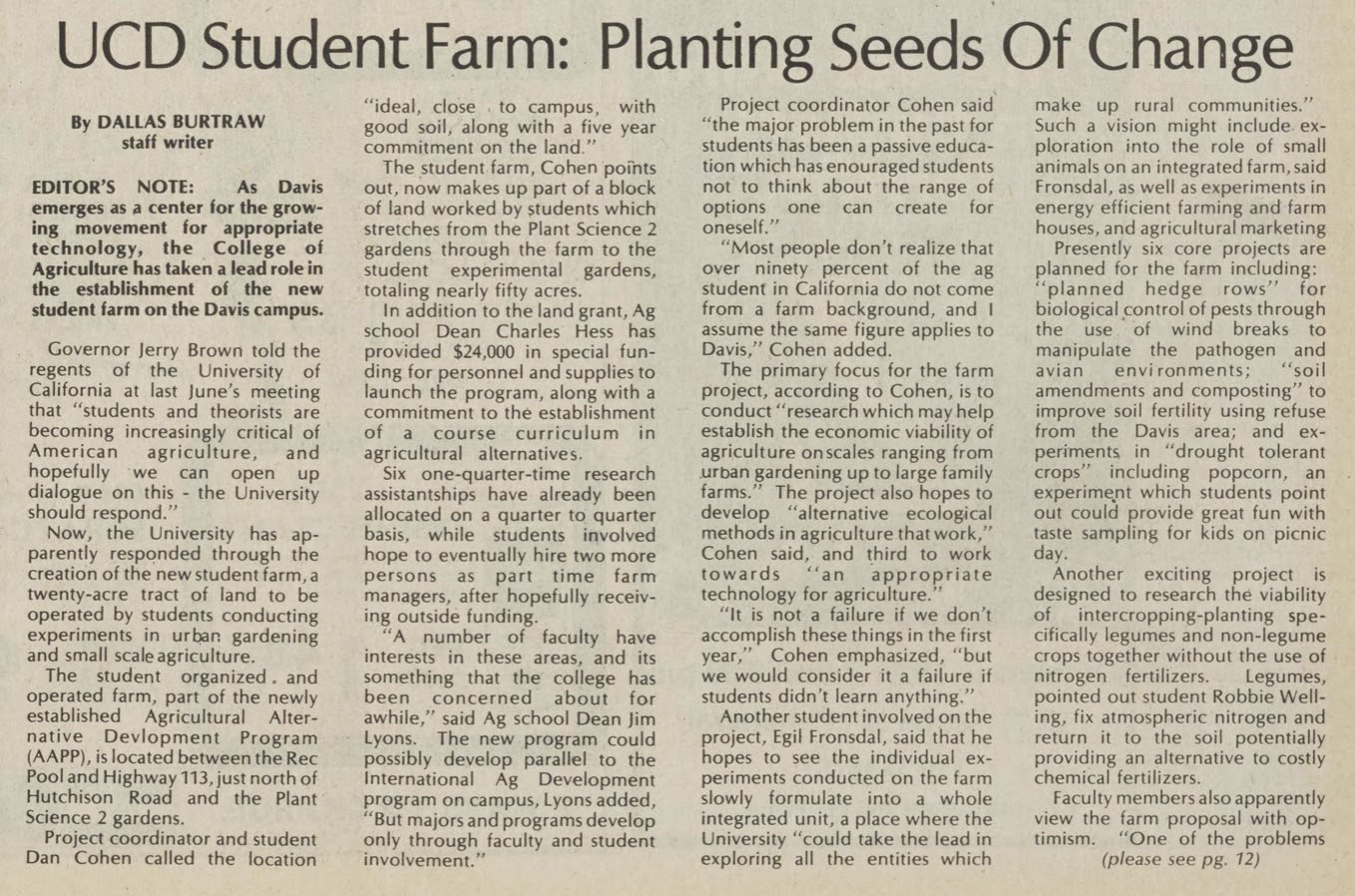
Reporter R.E. Porter is typically tasked with analyzing health and science issues, reporting on leaked government documents or interviewing world leaders. But this week we thought we’d give him a break by assigning him a totally different type of story. To get some different perspectives on these tough times we’re currenting experiencing, we thought it would be enlightening if reporter R.E. Porter and cameraman Cam Raman sat down for an exclusive interview with Zorbulus Nebuloid (Anglicized from ⌵ ⌣ ⌢ ⌞ ⌆), a Reptilian from the Planet :O: – ⍒ϑ ⏇ (not translatable). With our Earth-centric perspective, it’s simply impossible to make sense of everything about our absurd new coronavirus reality, so we hope that Zorbulus’ unique experiences as an extraterrestrial can bring us all some much needed guidance and wisdom that can’t be found anywhere else. 

Disclaimer: We believe our translator Tara N’Slater had difficulties with certain nuances of Mr. Nebuloid’s native language, but we did the best we could to accurately communicate his highly original and thought-provoking insights into our upside-down world.

R.E. Porter: Hi Mr. Nebuloid, thank you so much for agreeing to chat with us today. We’re so glad to be here with you in person. We really appreciate your taking the time to share your extraterrestrial knowledge and wisdom with us Earthlings.

Zorbulus:  ⏇ * # =  ϒ{ /* \ ⍆ ; : ” ⌁ ◬ ◝ ϐ  ⤞ + . ; ⍊ ⌿ ⌟ ⌵ ⌣ ⌢ ⍙ ⍒ ⍓ ⎑ ⎒ ⏇ ⍊ ⌿ ⌵ ⌣ ⌢ ⍙ ϐ ϑ ⏇ ⌝ ϐ ϑ ⏇ ⍒ ⍓ ⏈ ⏉ ⏊  ◺ ⏖ ❉⇶  ⍆ ⌝ ↹ ↯ :O: ϐ ϑ i ; : ”  ␥ ⎈ ⍅⌁ ◬ ◝ ϐ  ✕ ⤞ * # + . ; ⍊ ⌿ ⌟ ⌵ ⌣ ⌢ ⍙ ϑ ⍒ ⍓ ⎑ ⎒ ⏇ ⍊ ⌿ ⌵ ⌣ ⌢ ⍙ ⏊ ϐ ϑ ⏇ ⌝ ϐ ϑ ⏇ ⍒ ⍓ ⏈ ⏉  ⌌ ⏊ ::: [Translation: Thssss thssss thssss thssss thssss thssss thssss thssss thssss thssss thssss thssss thssss thssss thssss thssss.]

R.E. Porter: I think our translator had some trouble with that last bit. This isn’t a feast or a banquet, this is just an interview. Sorry if there was any misunderstanding. But you did begin with a very important point, which I’ll try to repeat. While early studies are showing that coronavirus cannot infect Reptilians like yourself, nothing is absolutely certain yet, so we understand that you’re taking a risk by actually being here with us in person. We do not take that lightly, and we really appreciate the gesture.

Zorbulus: ⌵ ⌣ ⌢ ⌞ ⌆  ⎐ ⌵ ⌣ ⌢ ⌞ ⌅ ⤔ < < < [Translation: Thssss thssss thssss thssss thssss thssss thssss thssss thssss thssss thssss thssss thssss thssss thssss thssss.]

R.E. Porter: No, really, it’s our pleasure! Okay then, so I guess I’d like to start by asking you to just tell us a bit about how the coronavirus has affected you and your family, how you’ve adjusted and what advice you have for others who are struggling to cope right now.

Zorbulus:  ϐ ⏊ + ⍆  . ; ✘ ◹ ~ : ‘  ⌌ ❡ ❖ ◺ ⏇ * # =   < x ⌞ ⌜ ◺ j * \ ⍅ ϑ ϐ :O: ϑ ⌵ ⌣ ⌢ ⌟ ~ : ‘ ⌇ ⌇ =  ::: ❡ ❖ ⏇ ⌜ ϐ ⤞ ✗ [Translation: Thssss thssss thssss thssss thssss thssss thssss thssss thssss thssss thssss thssss thssss thssss thssss thssss!]

R.E. Porter: I’m so sorry, Zorbulus, we’re having a bit of trouble with the translation again. I don’t think I’m understanding everything you’re trying to say. You said the worst thing about quarantine and making everyone follow these stay-at-home orders is that your family is hungry and you can’t feed them because now there aren’t any prey walking around on the city streets anymore? Prey?? What prey??? Or pray? You’re praying? Are you preying or praying? Who are you praying to?

Tara N’Slater [to R.E Porter via earpiece]: I’m telling you R.E., I’m not making any mistakes, that’s what he said. Please just listen.

Zorbulus: ⌆ ⌅ ⌁ ⍊ ⌿ ⌵ ⌣ ⌢ ⌞  ⌜ ⌇ ⌍ ⎏ * # * # ⎐ ⍾ ⍳ ⍨ ⍚ ⍙ ⍒ ◁ ◈ ⌝ < ◍ ✘ ⌟ ⏋ ⍆ ⌝ ◜<  ◊ ◌ ○ * # 8 ◇ ◸ ◺ ◽ :O: ␥ ⎈ ⎉ ⎊ ⤘ ⤝ – ] ⌿  ⤿ ; : ” =  i ⤗ ⤘ ⤝ ⌟ ⤞ ϑ ° ⌜……….

Cam Raman [to R.E. Porter, whispering via earpiece as Zorbulus continues]: Pssst R.E., R.E., is it just me, or is Zorbulus looking at me kinda funny?

R.E. Porter [to Cam Raman, whispering via earpiece]: No, don’t worry about it, it’s fine. I’m sure it’s just some weird “Reptilian thing.” Please just be quiet, you’re distracting me.

Zorbulus [rolling up his sleeves]: …….⌁ ◬ ◝ ϐ  ✕ ⤞ * # + . ; ⍊ ⌿ ⌟ ⌵ ⌣ ⌢ ⍙ ϑ ⍒ ⍓ ⎒ ⏇ ⍊ ⌿ ⌵ ⌣ ⌢ ⍙ ⏊ ϐ ϑ ⏇ ⌝ ϐ ϑ ⏇ ⎐ ⍳ ⍨ ⍚ ⍙ ⍒ ◁ ◈ ⌝ < ◍ ✘ ⌟ ⏋ ⍆ ⌝ ◜<  ◊ ◌ ○ * # 8 ◇ ◸ ◺ ◽ :O: ␥ ⎈ ⎉ ⎊ ⤘ ⤝ – ] ⌿ ⤾ ⤿ ; : ” =  i ⤗ ⍾ ⤘ ⤝ ⌟ ⤞ ϑ ° ⌜ ⌇ ⌍ ⎏ ⌆ ⎐ ⍾ ⍳ ⍨ ⎑ :O: ⏈ ⏉ ⌟ ⍚ ✗ ✕ ` ; , – : ^ ⌜ ⌇ ⌌ ⌍ ⥁ – ] i ⌞ ° ϐ ⏊ + ⍆  . ; ✘ ◹ ~ : ‘  [Translation: Thssss thssss thssss thssss thssss thssss thssss thssss thssss thssss thssss thssss thssss thssss thssss thssss!!!]

R.E. Porter [to Zorbulus]: I’m sorry you’ve had that experience. It’s certainly quite true that America isn’t always the most welcoming to immigrants. But we’re happy to see that despite these challenges and these unprecedented new circumstances, you’re still managing to live the American Dream. You’re a true hero. Based on your experiences on your home planet, what actions would you recommend America’s political leaders take to better manage the fallout from the pandemic? And how do you think your background has uniquely prepared you for making the best of this situation?

Zorbulus [slowly moving within six feet of Cam Raman]:  ⌝ < ◍ ✘ ⌟ ⤾ ⏋ ⍆ ⌝ ◜<  ◊ ◌ ○ * # ◇ ◸ ◺ ◽ :O: ␥ ⎈ ⎉ ⎊ ⤘ ⤝ – ] ⌿  ⤿ ; : ” =  i ⌟ ⤞ ϑ ° ⌜ ⌇ ⌍ ⌜ ◺ j * \ ⍅…….

Cam Raman [in earpiece, beginning to sweat profusely]: No, man, I’m serious. Look at him. I’m pretty sure he just looked me dead in the eye and licked his lips. Please ask him to stop!

Zorbulus [removing his facemask]: …….❈ ⎒ ⏇ ◹ ✗ – : ^ ◽ :O: ␥ < ⎈ ⎉ ⎊ ⤗ ⌝ —

R.E. Porter: Hey, sorry to interrupt you, Zorbulus, but Cam was wondering if you could stop looking at him like that, you’re making him a bit uncomfortable. Don’t worry, we’ll cut this out, this part won’t air, we don’t want to embarrass anyone.

Zorbulus [salivating]: ::: ⌵ ⌣ ⌢ ⌞ ⌆  ⎐ ⌵ ⌣ ⌢ ⌞ ⌅ ⤔ < < < < < ::: [Translation: Thssss thssss thssss thssss thssss thssss thssss thssss thssss thssss thssss thssss thssss thssss thssss thssss!!!!!!!]

R.E. Porter: Thanks. So now I think it would be good if we talked about the fact tha—  Hey please, Zorb— Hey wait a sec— What are you— Wait no— No stop— STOP— Oh— Oh my god— HELP!!!

Cam Raman: Oh my g— wait no— NO— AHHHHHHHHHHHHHHH—

Zorbulus [lunging at Cam Raman while unhinging expandable lower jaw and unsheathing second and third rows of teeth]: < < < < < < < < < < < < < < < < < < < < < < < < < < < < < < [Translation: THSSSS THSSSS THSSSS THSSSS THSSSS THSSSS THSSSS THSSSS THSSSS THSSSS THSSSS THSSSS THSSSS THSSSS THSSSS THSSSS!!!!!!!!!!!]

Cam Raman [indecipherable]: […]

R.E. Porter [exits, pursued by a bear]: [static, cuts to black]

Zorbulus [wiping off hands and face]: [offers a petrified Tara N’Slater 15% of Cam Raman as a tip for providing accurate translation and showing him the door]

Written by: Benjamin Porter— bbporter@ucdavis.edu

(This article is humor and/or satire, and its content is purely fictional. The story and the names of “sources” are fictionalized.)

UC Regents unanimously vote to suspend use of SAT and ACT in admissions

New test that more closely aligns with what students need to know to prepare for UC will be identified or created 

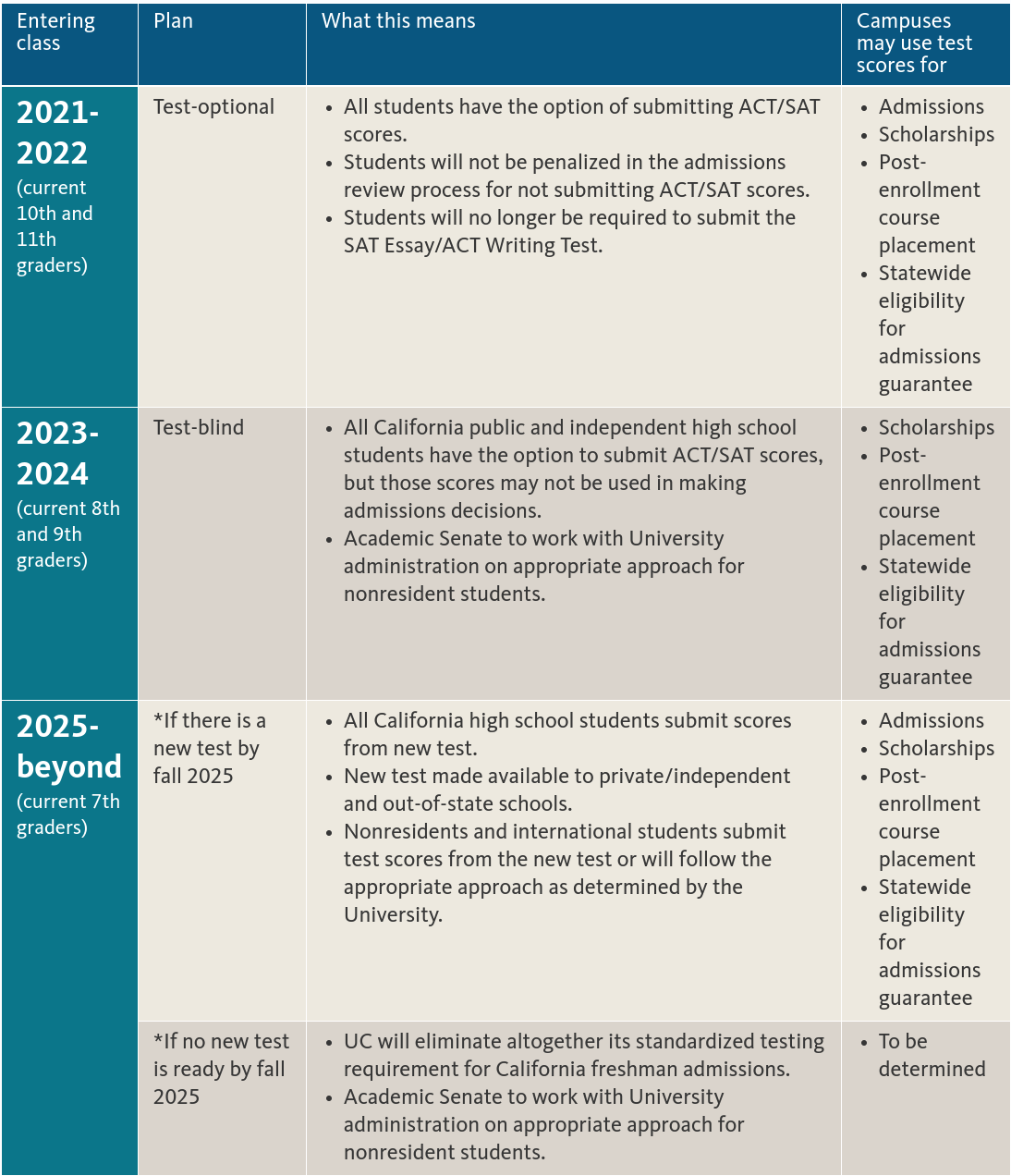
The UC Board of Regents unanimously voted to end the use of the SAT and ACT in admissions until 2024. It aims to replace the SAT and ACT with a test better aligned with the UC’s academic expectations for incoming students by 2025.

The entering class of 2021 and 2022 will be considered test-optional; students may submit SAT and ACT scores but are not required to. From 2023–2024, the UC will adopt a test-blind model where standardized test scores will not be a factor in admission decisions but may be used for class placement and scholarship purposes. By 2025, any use of the SAT and ACT will be eliminated for all California students. 

Beginning summer 2020, the UC will work to identify or create a new test that more closely aligns with UC values and expectations of content mastery for incoming California first-year students. If, by 2025, the UC finds that the creation of a new test is infeasible or the test is not yet ready, SAT and ACT scores will still be eliminated from the admissions process and no admissions test will be used for California applicants. 

Though non-resident students complete similar coursework to California students, out of state and international courses cannot be “pre approved” as is the case in California, and the UC will have to determine an equal and practical way to admit these students.

“Several possible options for nonresidents that may be considered include extending the new content-based test required of California students to out-of-state applicants as well, or requiring scores from the ACT, SAT or other approved standardized test(s),” a press release from the UC Office of the President read.

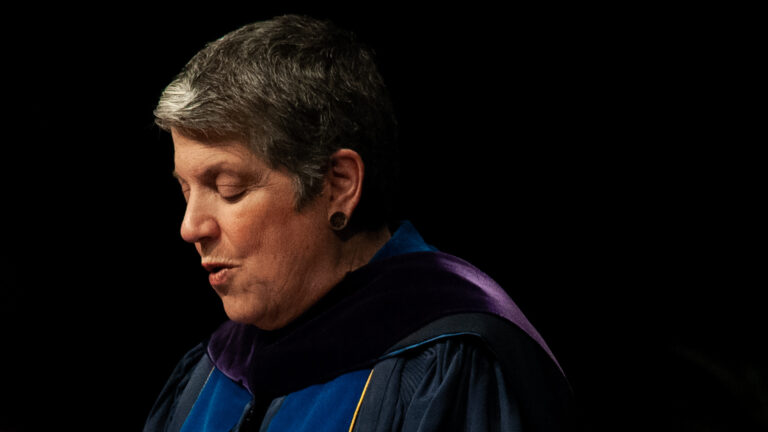
This decision comes a mere month after the UC’s Standardized Testing Task Force (STTF) recommended to UC President Janet Napolitano that the university system continue to use the SAT and ACT in admissions while identifying or creating the new UC approved test. President Napolitano went against this recommendation a week ago when she proposed that the UC Regents eliminate the SAT/ACT while identifying or creating a new test. 

“In a staff report released last week, President Janet Napolitano presented new recommendations for your consideration that we fear will inadvertently create more confusion, present varying scenarios without clarity of a final direction and ultimately drive more angst,” the CEO of the ACT Marten Roorda wrote in a letter to the Regents on May 18. 

Roorda voiced concerns about the cost of creating a new test, especially now with unexpected losses due to COVID-19 and raised doubt about the feasibility of the timeline. Roorda also cast doubt on the decision as Napolitano steps down as UC President at the end of the summer and questioned whether this action will address discrimination in testing. 

With six of the UCs topping the list of most applied to schools in the country, Roorda has more to worry about than just the success of these tests in predicting success in college; the UC phasing out the use of SAT and ACT will have major impacts on the larger academic sphere, especially in large public institutions.

“One thing I can predict pretty strongly is if UC gives up the SAT and the ACT, those tests are going to be dead,” said member of the STTF James Griesemer.

Though the most recent actions were taken in quick succession, it is in fact standard policy that the UC revisit the role of testing in the admissions process about every 10 years. 

“This is really the result of many years of work from a variety of different perspectives,” said Chair of the Board of Regents John Pérez after the Regents voted to move forward in phasing out the SAT and ACT in admission. “It [was] important that we came at this question from a variety of points of views and we come out of this question unified in this 23–0 vote.”

Written by: Jessica Baggott — campus@theaggie.org

Through the decades: snapshots of UC Davis life from the past 105 years of The Aggie

The California Aggie revisits its years reporting on life at Davis through the recently launched digital archives created with the UC Davis Library

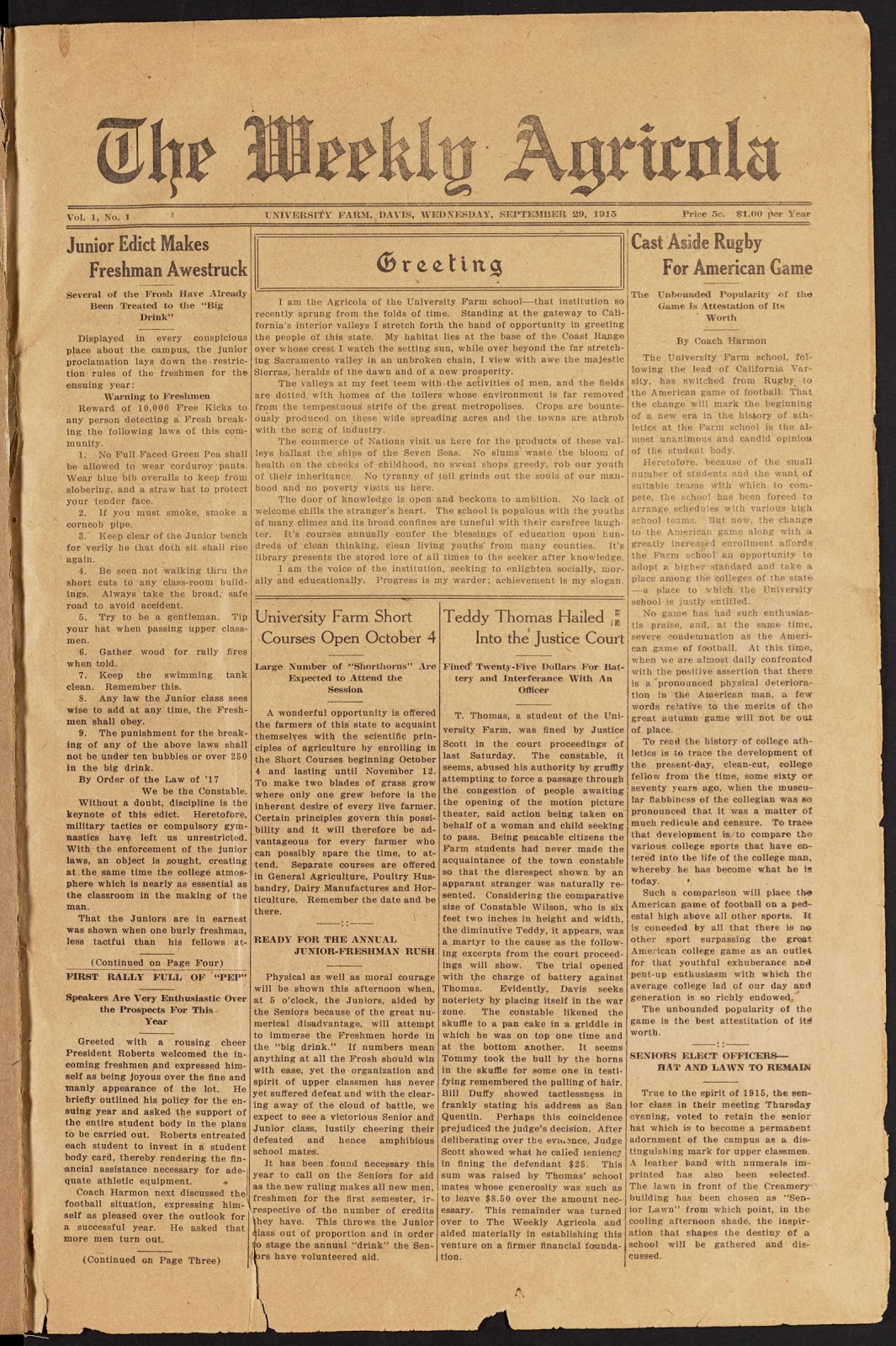
From writing about world wars to agricultural innovation to student strikes, as a newspaper nearly as old as UC Davis itself, The California Aggie has continued to cover university life for 105 years. With the launch of its digital newspaper archives in April 2020, created in partnership with the UC Davis Library, The California Aggie revisits a few articles and memorable front pages from each of its many decades.

1910s

September 29, 1915

Founded in 1915, The California Aggie was originally entitled “The Weekly Agricola.” Here is the front page of the first edition of the paper.


1920s

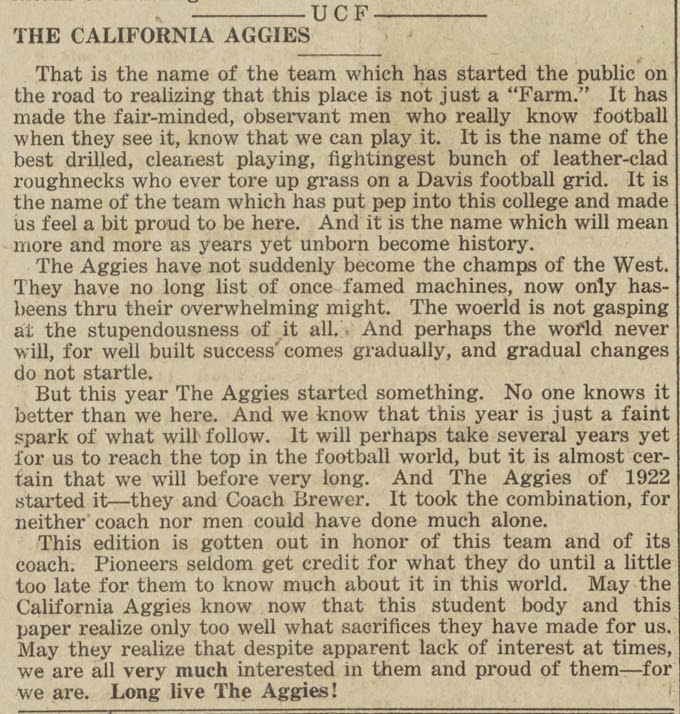
November 22, 1922

The university changed its name from “University Farm” to the “Northern Branch of the College of Agriculture,” and the California Aggies became the official school mascot. 

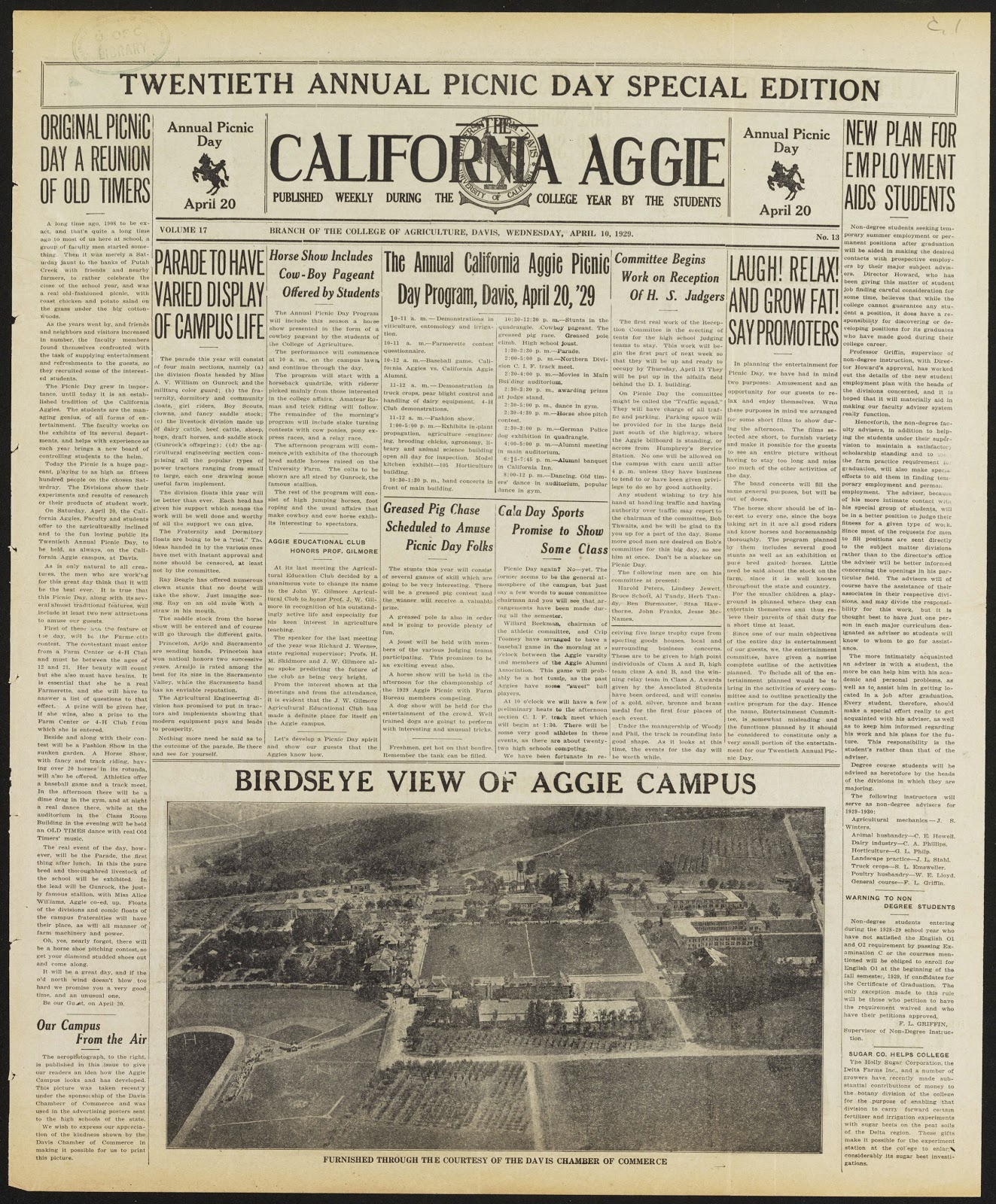
April 10, 1929

The school celebrated the twentieth anniversary of Picnic Day, founded in 1909.

1930s

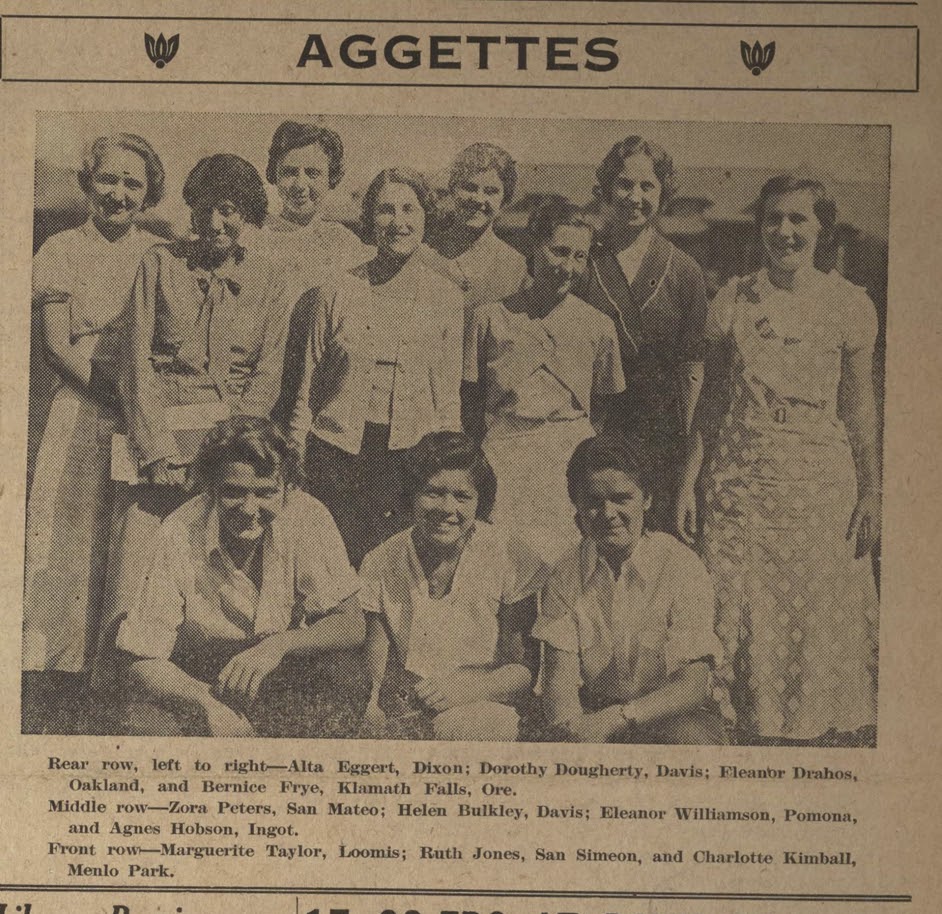
October 11, 1933

The Cal Aggie’s Women Association was established in 1934 by the 17 female students at Davis. Here are 11 of them.

January 27, 1938

In 1938, the campus was renamed the College of Agriculture at Davis.

1940s

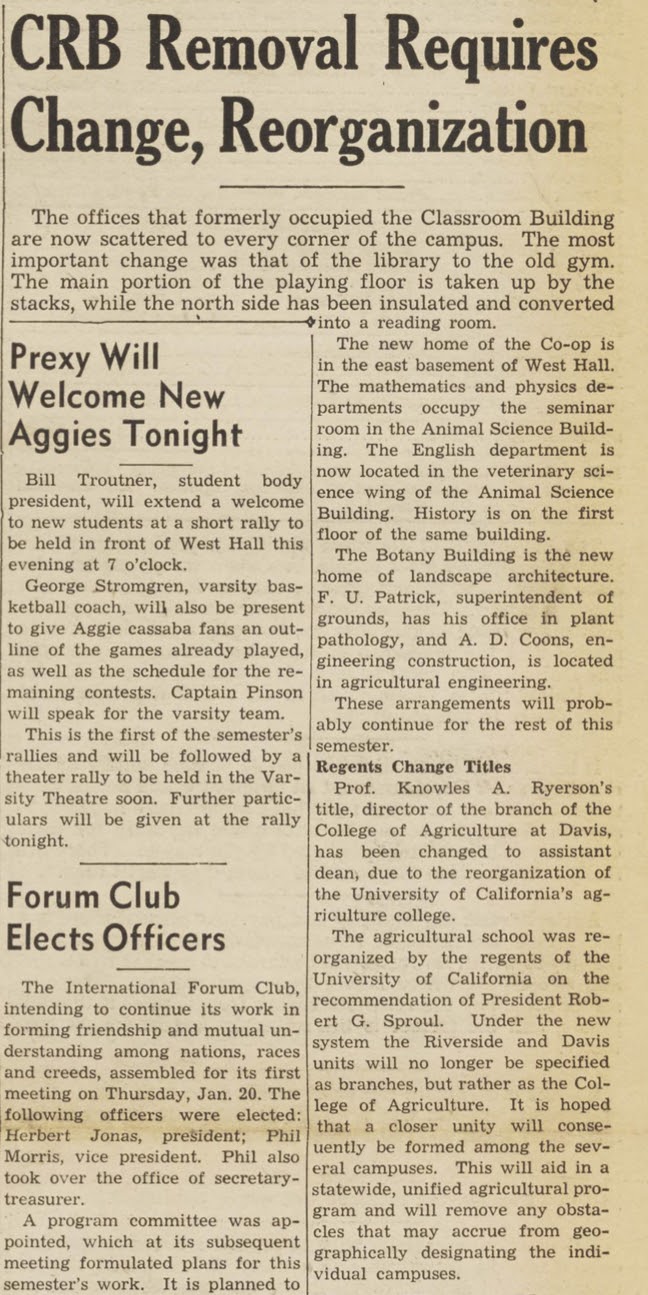
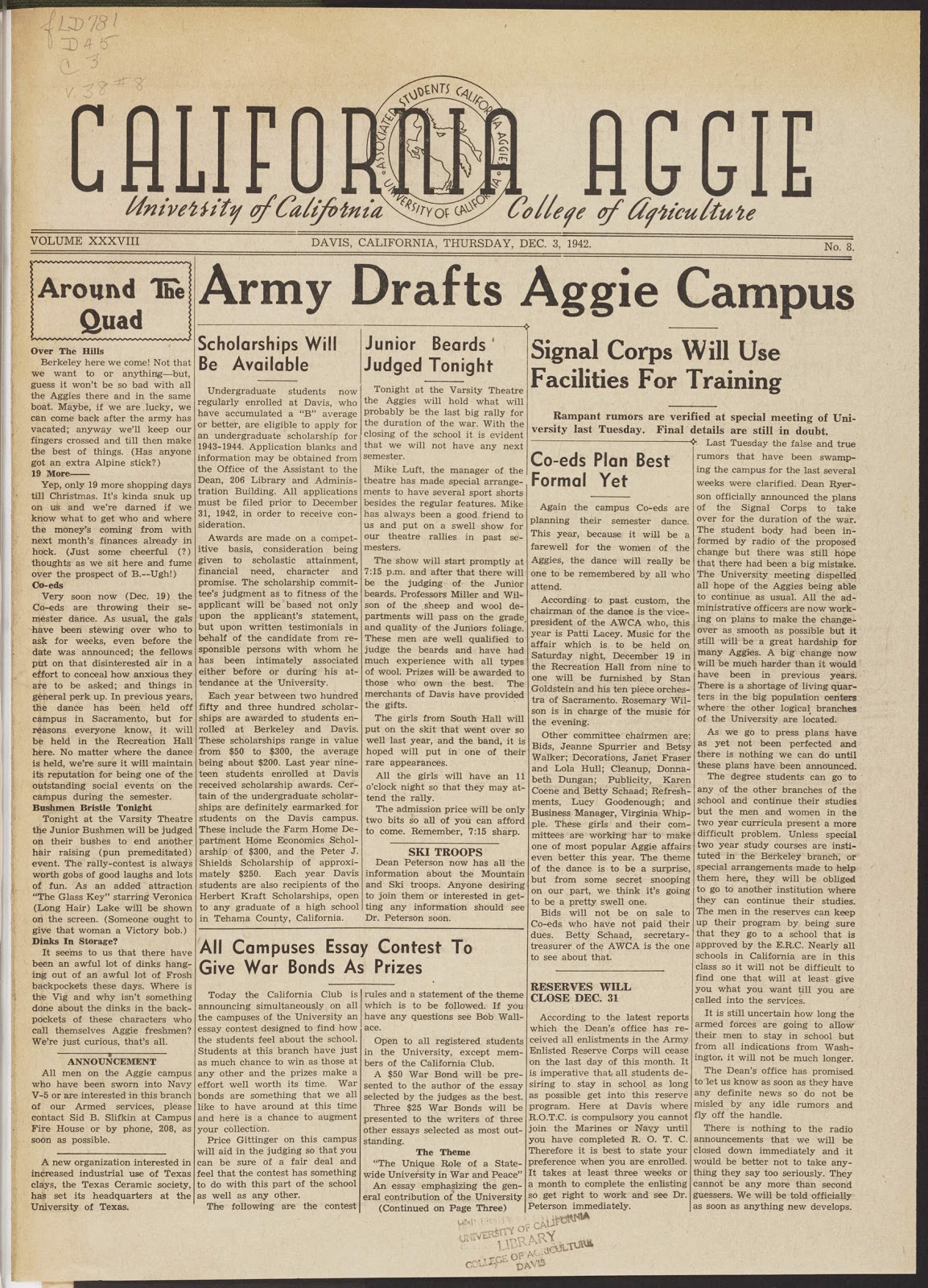
December 3, 1942

The U.S. Army Signal Corps took over the campus in 1943 and used it for a trading center, ceasing instruction until 1945.

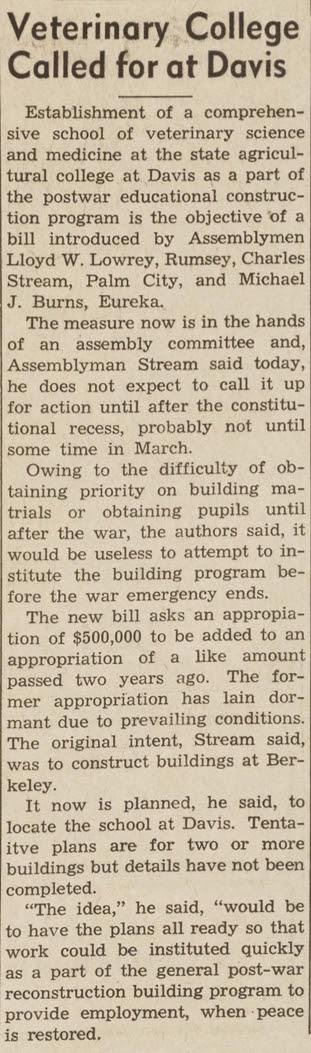
January 28, 1943

Although it was not established until 1946 after the resumption of school, discussion about the School of Veterinary Medicine began in 1943.

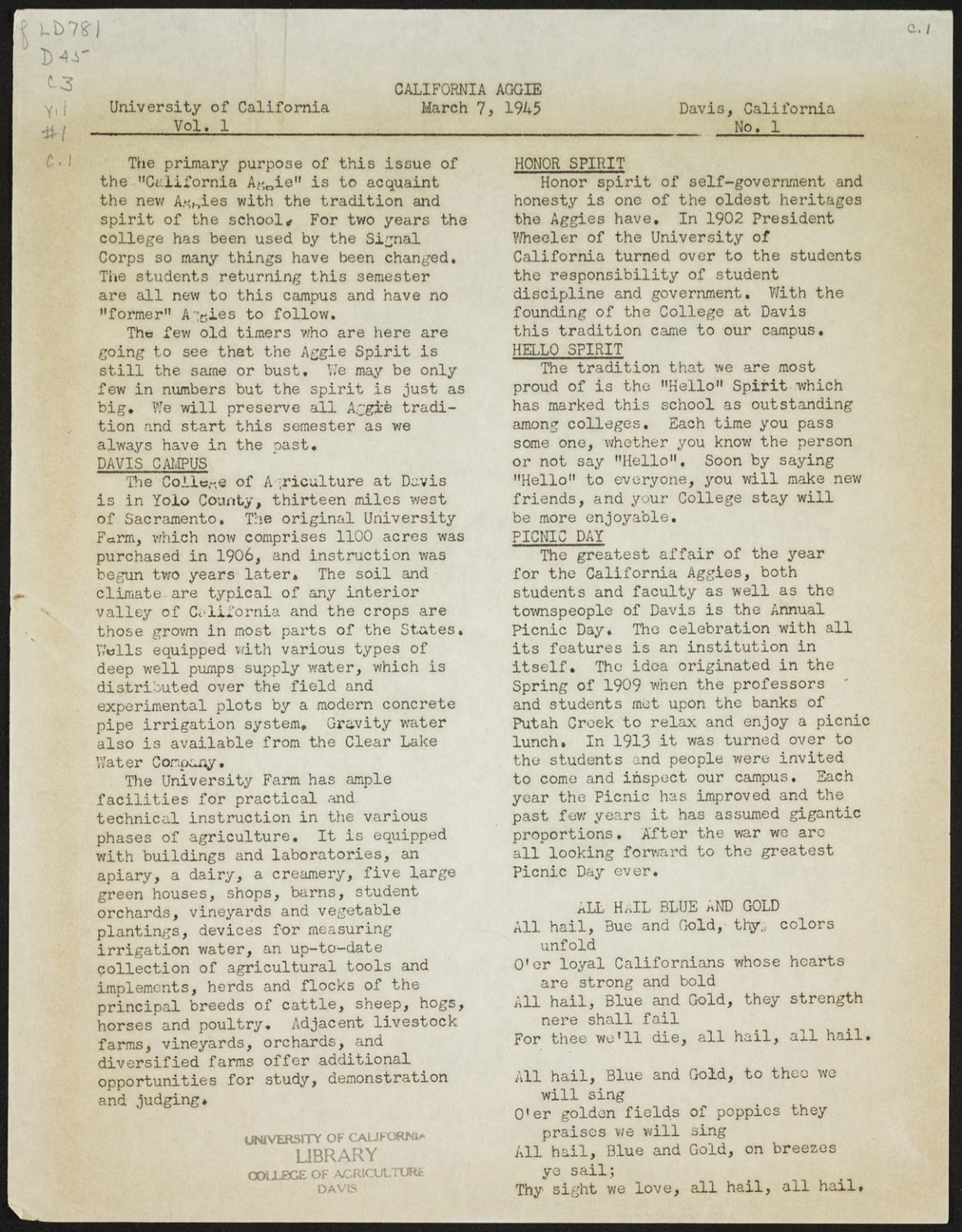
March 7, 1945

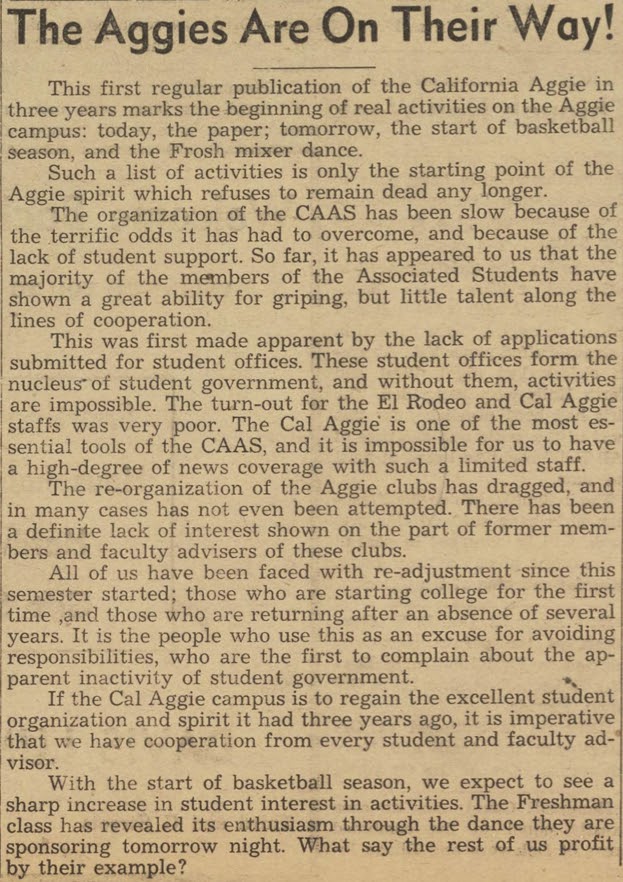
With the return of students to campus in March of 1945, The California Aggie published this single page issue dedicated to acquainting new students with “the spirit of the school.”

December 13, 1945

The California Aggie began its regular publication with this issue in December 1945 after a three-year hiatus.

1950s

September 20, 1951

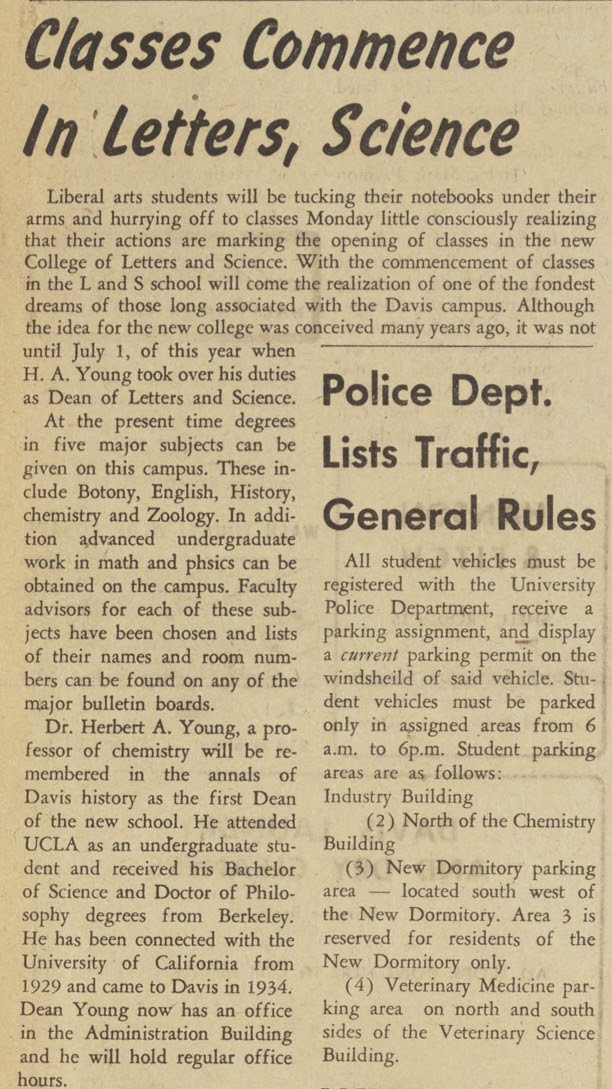
Fall quarter 1951 marked the first time students enrolled in the College of Letters and Science.

April 10, 1958

For Picnic Day in 1958, the UC Davis Arboretum opened for the first time. 

September 17, 1959

UC Davis became a general campus in the UC system.

September 17, 1959

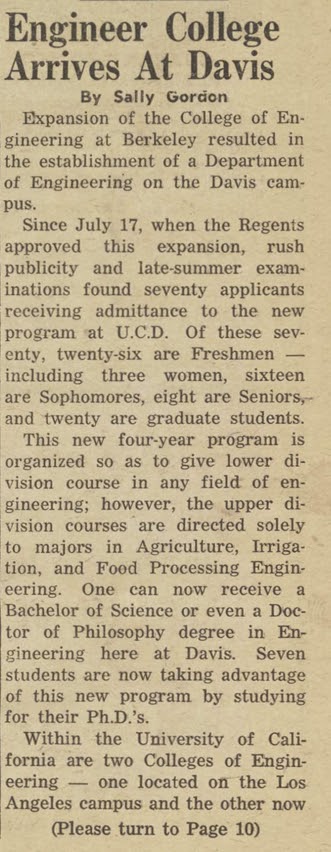
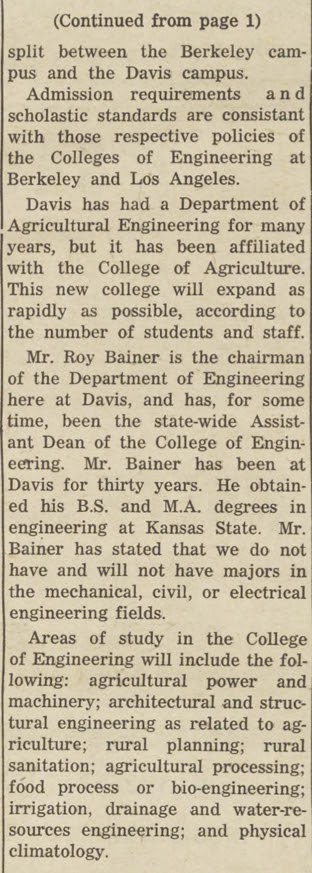
That same year, the College of Engineering at Berkeley expanded to the UC Davis campus.

1960s

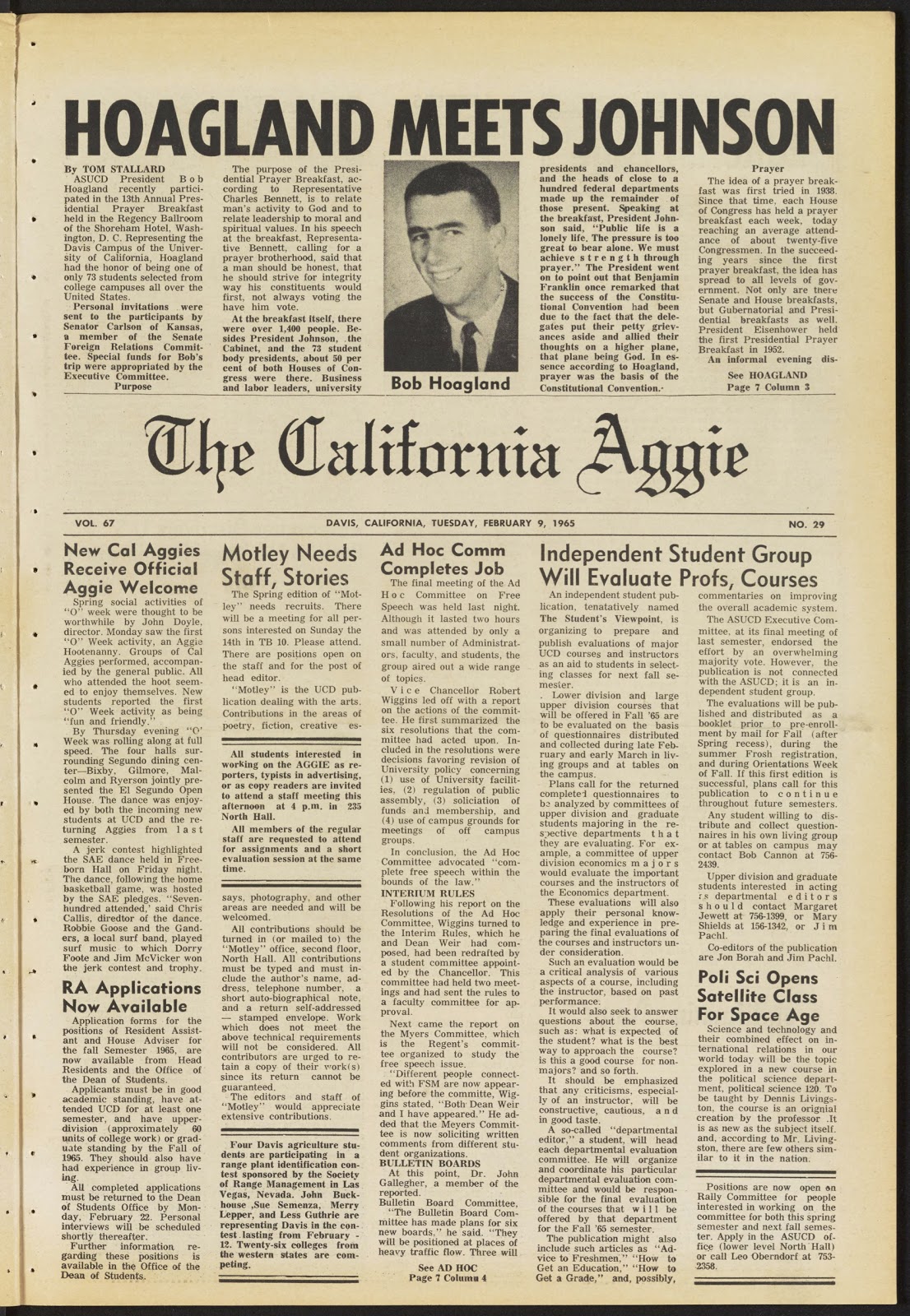
February 9, 1965

The then ASUCD president met President Lyndon Johnson along with 73 other college students in 1965.

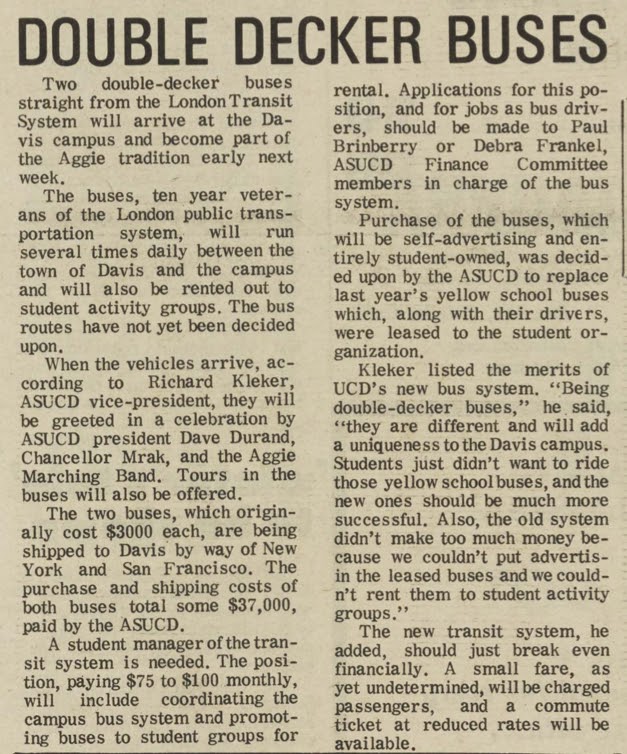
October 9, 1967

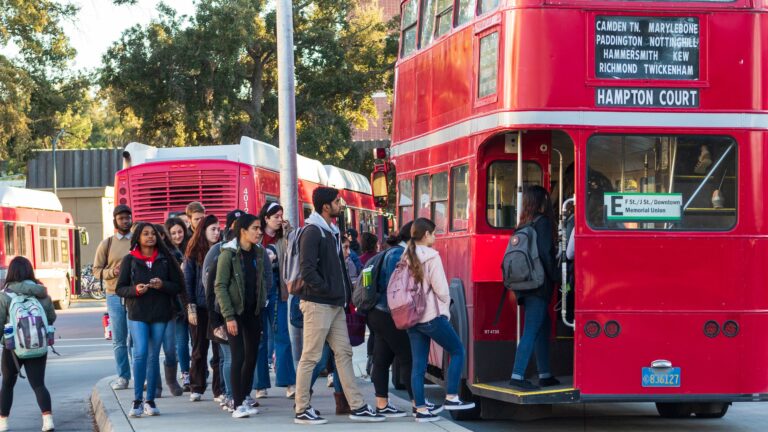
ASUCD purchased two London double-decker buses to replace the formerly used yellow school buses.

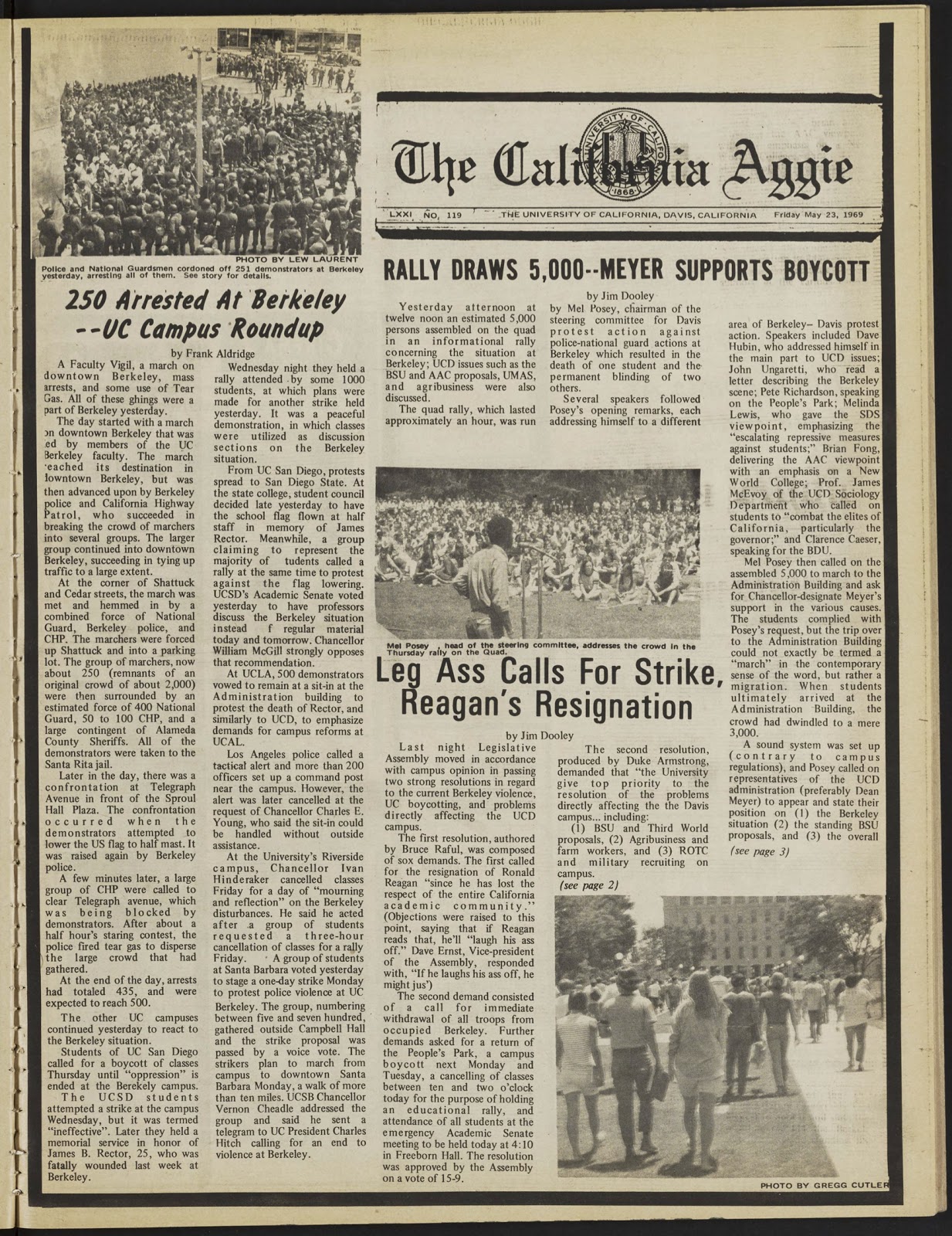
May 23, 1969

Two months after the first ethnic studies department was established on May 7, 1969 at San Francisco State, students organized a UC-wide strike, calling for ethnic studies to be implemented in the UC system.

1970s

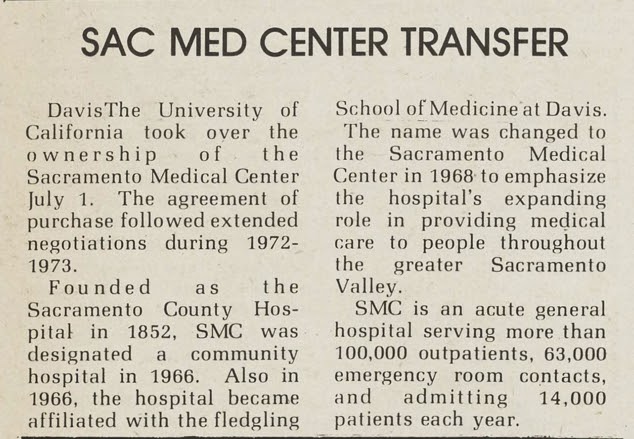
July 5, 1973

UC Davis took over the Sacramento Medical Center.

October 5, 1977

The UC Davis student farm that still brings fresh produce to the Davis community was first established in 1977.

October 20, 1977

Prince Charles, heir to the British throne, ended his visit to the U.S. in October 1977 in California, making a stop at UC Davis for a presentation on agricultural research.

July 12, 1978

Allan Bakke, after his application was refused by the UC Davis Medical School, filed a lawsuit against the UC regents in 1974, claiming he was discriminated against because of his race. The Supreme Court ruling in 1978 in favor of Bakke declared affirmative action constitutional but did not allow the use of racial quotas. 

1980s

January 14, 1980

In support of a gay rights bill, gay student organizations from Berkeley and UCLA in addition to the Davis Gay Task Force marched in Sacramento.

1990s

April 6, 1999

UC Davis took over ownership of the McClellan Nuclear Research Center in 1999 from the United States Air Force.

November 22, 1999

A Graduate School of the Environment, established in 2001, was first proposed in 1999 by 30 faculty members.

2000s

July 21, 2005

The College of Biological Sciences was established at Davis in the summer of 2005. Students began enrolling in the fall.

September 29, 2005

Fall of 2005 was a period of expansion for the campus; the parking structure was underwork, construction on Giedt Hall was scheduled to begin and more.

2010s

December 5, 2012

The Manetti Shrem museum began construction by choosing three pairs of architects.

January 16, 2013

The Welcome Center at UC Davis opened its doors for the first time.

Written and compiled by: Sophie Dewees — features@theaggie.org
 

UC Santa Cruz police monitored picket lines of graduate students supporting COLA

Recent discovery reminiscent of COLA organizers’ previous, current experiences with policing, drums up motivation to keep movement alive

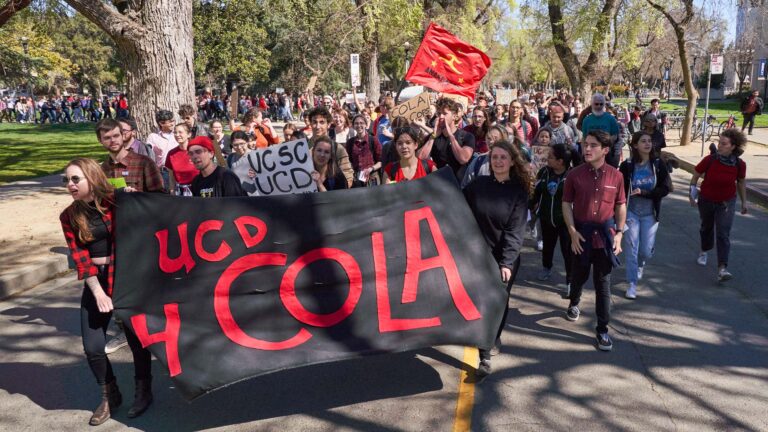
Graduate students at UC Santa Cruz striking for a Cost of Living Adjustment (COLA) had their picket lines monitored by California police using “friendly force trackers,” VICE News’ Lauren Kaori Gurley reported on May 15. 

According to emails from Feb. 11 and 13 that Gurley acquired, police who were assisted by the California Office of Emergency Services (Cal OES) used the FBI surveillance portal LEEP to keep track of social media in order to plan a response to the protestors. 

Scott Hernandez-Jason, a spokesperson for UC Santa Cruz, said via email that the VICE story’s headline and lead made unsupported “bold claims.” 

“Throughout the strike, UC Santa Cruz police officers were focused on supporting the safety of our community on and off campus and protecting the rights of everyone in our campus community, including those engaged in expressive activity,” he wrote. 

COLA activism has gained traction across the UCs since February earlier this year, when UC Santa Cruz graduate students in support of a COLA decided to go on a full “wildcat” strike — one not sanctioned by their union, the United Auto Workers (UAW) 2865. They stopped all teaching, grading and research, gathering at the base of the UC Santa Cruz campus to form a picket line and pledged to withhold grades from the classes they taught. 

That strike, which started on Feb. 10, ended by May 1. 

UC Santa Cruz, UC San Diego, UC Davis, UC Santa Barbara and UC Berkeley COLA supporters withholding grades submitted them to their respective registrar’s office. 

Only one COLA movement — at UC Irvine — is still on some variant of a wildcat strike. Its organizers are focusing their efforts on what they call a “social welfare” strike, devoting their teaching, grading and labor time to connect students and workers with resources.  

In an interview with the Daily Cal, Cal COLA organizer Juliet Lu said that COVID-19 had a major impact on the movement’s ability to physically gather and be active in public spaces. 

Though in-person organizing has ceased, the VICE article uncovered concerns around policing that COLA supporters have had since February.

“Cops on campus, COLA in my bank account” has been an oft-chanted slogan for COLA supporters. During UC Santa Cruz internal meetings, external vice chancellor Lori Kletzer said the university spent over $300,000 on riot police. 

One fourth-year UC Santa Cruz graduate student who wished to remain anonymous for privacy reasons said that on Feb. 12, the police were “evidently very excited” to get into full riot gear when they saw the protestors. 

“We actually saw them pose for pictures in their gear at one point,” the graduate student said via email. “I think many of us were very angry to see such an unwarranted show of force directed at ourselves and the undergraduates.”

Police arrested 17 people at the picket line. The graduate student allegedly saw the police pick out the supposed leaders of the protest and bruise, bloody and beat them. 

“Many of us who were not being brutalized just kept speaking to the officers and asking them not to arrest us — we were protesting peacefully,” they said. “Even so, all of us underwent some degree of pain compliance techniques and were chained around the waist, handcuffed and loaded onto the Alameda Sheriff’s paddy.” 

While a video posted on Feb. 12 does not show police beating protestors, it does show police pulling back protestors’ arms and handcuffing them. One person had their head pushed down, though it is unclear if it led to further injury. 

Hernandez-Jason said in a previous statement with The Mercury News that the officers repeatedly tried de-escalating the situation, given that protestors were blocking a major roadway.

“Demonstrators locked arms, sat in the roadway and refused to move back onto the university field,” he said. 

At a Feb. 20 demonstration where UC Irvine students rushed into the administration building, videos were released showing UC Irvine police using force on students. A black woman unaffiliated with the action was also arrested, according to an email statement UC Irvine’s COLA movement provided to The California Aggie. 

Another student, who wished to remain anonymous for privacy reasons, was affiliated with the UC San Diego COLA movement and witnessed what they called “police surveillance/intimidation” at a small town-hall style meeting the movement’s supporters were holding back in February.

“Two UCPD officers were watching us through the glass walls of the meeting room,” they said, though they noted that the meeting was not a protest action.
Emails provided to The Aggie show that UC San Diego COLA organizers reached out to the university’s assistant vice chancellor, Patricia Mahaffey, and proposed a discussion about the police presence. 

“Is the administration now going to call [the] police any time we gather as a community!?” one organizer wrote. 

Mahaffey responded by saying she was unaware of the police presence and that she did not intend to call the police, though one student said they were unsatisfied despite the response.

After a discussion between her and the UC San Diego police, Mahaffey emailed back saying the police presence at the gathering would be an anomaly and that students were free to hold open forums and discussions without feeling surveilled.

In response to the VICE article, Hernandez-Jason said there was no tracking of students or strikers.

“The department solely used trackers to know the location of on-duty officers who were helping keep people safe,” he said, calling any further inferences “erroneous.”

He added that UC Santa Cruz’s geography — 2,000 acres of hilly land with two entrances — made it vital to understand where officers were located in order to coordinate efforts.

Additional police involvement, according to documents Gurley acquired, came into play once Senator Bernie Sanders (D-VT) tweeted out his support of the strike on Feb. 19. UC Santa Cruz Police Chief Nader Oweis requested the assistance of the California State Threat Assessment Center (STAC) commander, Eli Owen, to see if Sanders would visit the campus.

STAC is a “fusion center” partly funded by the Department of Homeland Security. Fusion centers gather, share and analyze information that hints at a possible threat and convey that information to state, local and national leadership for threat analysis. 

Ken Montenegro, the cofounder of the Stop LAPD Spying Coalition, called fusion centers “spy hubs.”
“It’s funny to even call them ‘spy hubs’ — they say people are ‘paid to monitor open source intelligence,’ which is really just a cop watching the news and social media,” he said.

Fusion centers began popping up throughout the U.S. after 9/11 in order to facilitate and streamline communication and intelligence gathering between law enforcement agencies at all levels of government. 

But their effectiveness has been debated. One major concern of fusion centers is that they have contributed to racial and religious profiling. Seventy-eight prevent of Suspicious Activity Reporting, which allows any citizen or authority to document “observed behavior reasonably indicative of pre-operational planning related to terrorism or other criminal activity,” were filed against non-whites, according to one review collected in Los Angeles. 

Montenegro believes the STAC’s involvement in UC Santa Cruz actions highlights the university’s antagonism toward students.

“That really shows surveillance is a form of state violence, deployed against what [government calls] the ‘other,’” he said. “Surveillance of graduate students, who are part of the university community, gives the university a lot of information to use against them: Who are protest leaders? What are they worried about? How precarious are their situations?”

Hernandez-Jason maintained that UC Santa Cruz was only paying attention to the candidate’s publicly posted campaign schedule to plan ahead for a campus visit, given that it would significantly impact the campus and city.

“I cannot speak to any actions taken by Cal OES or other agencies VICE referenced in connection with the strike activities,” he said.

UC Santa Cruz has not addressed the allegations in any public press release. 

Supporters of the COLA movement have widely condemned the UC Santa Cruz administration once the VICE article came out. 

Frustrations were already high among COLA supporters at UC Santa Cruz, with the university’s Faculty Organizing Group publishing an open letter on May 4 asking the university to halt disciplinary process during the pandemic, citing the example of a graduate student who had already submitted Winter Quarter grades being investigated for temporarily moving those grades off Canvas.

According to the letter, at least 49 students are participating in disciplinary proceedings for strike-related activities.

“These actions traumatize the students involved,” the group wrote. “It is alarming that as we transition to distance learning, the most immediate connection that students maintain with UCSC is through its disciplinary bureaucracy.”  

Despite the new information the VICE article provided, some COLA supporters, such as psychology and critical race and ethnic studies double major Alissa Vierra, said they are not surprised. 

Vierra said she has already known and experienced the surveillance herself. Having witnessed the police actions on the picket line during the first week of the UC Santa Cruz picket line, she said that made it clear the university wouldn’t play nice.

“The most shocking aspect […] was that it has taken this long for the news to break,” she said via email. “I am suspect of the depth and length the university admits to. There is not a shadow of a doubt to me that they have been and are continuing to surveil and target students at degrees far worse than they will ever admit.” 

Another graduate student involved with the UC Santa Cruz COLA movement, who requested to remain anonymous for privacy reasons, said they hoped the general public came to understand that the growth of the UC administrative class has come at a mounting cost to academic workers’ survival. 

“COLA signifies a moment when academic workers voiced their refusal to allow the university to continue being held as a cash cow,” they said via Twitter direct message. “Admin, in their excessive spending on policing and surveillance, have shown that they would rather discredit the university as a place of learning than give up their cash cow.” 

Abolish UC Davis, a group that said it stands in solidarity with the COLA movement, said in a statement that UC Santa Cruz’s actions reminiscent of UC Davis’s 2011 cover up, when then-UC Davis chancellor Linda Katehi paid a communications firm $175,000 to erase all references of a campus police officer spraying protestors.

More importantly, the group said in its statement that the actions of the university against the strikers make it important to recall the 1969 FBI-incited murders of the Black Panthers Bunchy Carter and John Huggins on the UCLA campus.

“Such history accurately underscores that policing and militarization of the UC campuses is historically bound to the state’s relationship to education and has a specific role in targeting Black and brown students in particular,” the statement reads. 

Montenegro added that it was important for people to continually ask where their resources were going.

“What we prioritize in terms of budgeting is a reflection of values,” he said. “Graduate students have done a wonderful job highlighting where the UC budget is just a hot mess.” 

Vierra, also a single parent, has faced other types of targeting in her time organizing for a COLA. Though she has a parking permit, she said that when she came home to her on-campus apartment, she received excessive parking tickets. There were times, she said, when a police vehicle followed her wherever she went on campus.

“The police on campus even resorted to calling Child Protective Services on me, stating that I was mentally unstable and that my living environment was unsafe for my daughter,” Vierra said. She continues to struggle with the police in that regard. 

Still, her experiences haven’t diminished her hope in the COLA movement. 

Vierra called solidarity a “helluva drug.” 

“The space we [COLA organizers] created was the most rejuvenating, uniting and entirely wholesome thing I’ve ever had the privilege & pleasure of participating in,” she said. “We have risen up to feed, to teach, to relieve one another while you brought a literal army. We will not stop until the whole system is repaired.”

COLA movements throughout the UC are continuing to gather pledges to initiate a Unfair Labor Practice Strike Authorization Vote through UAW 2865, which would enable the entire union membership to launch a strike. The vote was initially scheduled for early April and is now slated to take place when there are 5,000 pledges in support of a “yes” vote. Currently, there are over 2,300 of those pledges.  

Written by: Janelle Marie Salanga campus@theaggie.org 
Senate confirmation hearings bring up concerns that “rules are being applied willy-nilly”

Contention over bylaws, cultural tensions on campus arise in hearings for Judicial Council, Ethnic and Cultural Commission

The May 14 ASUCD Senate meeting was called to order at 6:11 p.m. Vice Controller Alexis Lopez was absent and Chief of Staff Justin Hurst stepped in for Academic Affairs Commission chair Naomi Reeley.

Vice President Akhila Kandaswamy clarified that the ASUCD Judicial Council ruled that Senator Samantha Boudaie could continue as senate pro tempore.

Second-year international relations and history major Jenna DiCarlo, who was recommended by Boudaie, was confirmed as a Judicial Council (JC) member. DiCarlo’s confirmation hearing sparked debate over her previous slate affiliation and her ability to remain impartial as part of the neutral JC.

“What steps have you taken to make yourself unbiased and prevent any association with any slate affiliation?” Senator Khalil Malik asked DiCarlo.

“I like to get both sides of every story,” she said. “Last week, I did say that I had previously run on a slate, but I don’t think that will affect my impartiality at all.”

DiCarlo outlined her experience disaffiliating from her Panhellenic chapter during her time as a Panhellenic recruitment counselor to emphasize her ability to remain impartial. 

“Given that a lot of cases in JC don’t have hard evidence, because it is the word of one student against another, what measures are you going to take to make sure you’re really upholding this welfare of the entire student body when you’re making a decision?” Senator Shreya Deshpande asked.

“Your question actually relates to the trial back in 2019 that I served as a jury on,” DiCarlo said. “A majority of the evidence in that trial was oral evidence, so it was really a matter of what was being said rather than who was saying it.”

When Deshpande asked DiCarlo to name an article and clause in the ASUCD Constitution that outlines the goals of the JC, DiCarlo was unable to provide a clear answer.

“I’m not the best public speaker,” DiCarlo said. 

She again provided an example of her experience on the Panhellenic judicial council as her response to Deshpande’s question.

Senator Camille Randolph asked what DiCarlo thought about last year’s Judicial Council’s ruling that Senate Resolution #17 was unconstitutional on the basis that it benefitted one group of students at the expense of another group. 

The resolution, passed in 2015, urged the UC to “divest from ‘corporations that aid in the Israeli occupation of Palestine and illegal settlements in Palestinian territories.’”

“If I’m presented a case in the future, I will make sure to consider all the evidence and the UC Davis Principles of Community to ensure that my ruling is as fair as possible for all students on campus,” DiCarlo responded. “SR #17 is a precedent, but precedents can be changed.”

In response to DiCarlo’s answer, Randolph said “saying fair and equitable doesn’t have anything tangible.”

“I think having concrete ideas and decisions in the future is something that we, as a table, can agree upon,” Randolph said.

Senator Lucas Fong motioned a roll call vote to confirm DiCarlo to the Judicial Council. DiCarlo was confirmed in an 8-4 vote. Senators Malik, Randolph, Deshpande and Tenzin Youedon voted no — all are members of the BASED slate. Senator Laura Elizalde was the lone BASED senator to vote yes to confirm DiCarlo.

Randolph said they voted no due to DiCarlo’s lack of clear answers to several interview questions. 

The table then moved to quarterly reports.

The DREAM Committee informed the table of efforts to arrange cap and gown rentals in Davis through a drop-off and pickup system, adding that graduating seniors can still take graduation pictures amidst campus closures.

Unitrans General Manager Jeff Flynn delivered the Unitrans quarterly report, addressing reduced lines and a transition to an hourly schedule. 

“In the category of happier news, we are taking advantage of this time to kick off construction on our new unitrans facility that will support electric buses,” Flynn said.

He reported that Unitrans will be operating six electric buses by 2021 and its goal is to operate solely electric buses by 2030.

Elections Committee Chair Karolina Rodriguez delivered the committee’s quarterly report, during which she announced that the committee is searching for students to fill vacancies. She emphasized the importance of continuing to promote ASUCD elections throughout the transition to distance learning.

Aggie Public Arts Committee (APAC) Chair Kinu Koide then delivered the APAC quarterly report. Koide said APAC is working with multicultural clubs and campus organizations to spearhead campus murals celebrating UC Davis’s diversity.

Alexander Cohen delivered the Student Health and Wellness Committee (SHAWC) quarterly report. Cohen announced that SHAWC has seen a recent significant growth in membership. The committee currently has 15 members, which he said is a substantial number considering its relatively new presence in ASUCD.

The next item addressed was the confirmation of the Ethnic and Cultural Commission (ECAC) chair, which sparked heated debate over cultural and ASUCD constitutional issues. 

 Former ECAC Chair Jonina Balabis recommended third-year sociology major Yalda Saii for ECAC chair. Deshpande also recommended Saii for the position. 

“She goes out of her way to make sure she’s listening to other people,” Deshpande said. “She has a strong head on her shoulders.”

Saii was asked about her involvement with ECAC and community outreach.

“There’s always room for improvement in how effectively and how often we reach out to community members on campus,” she said. “At the end of the day, while it is great that we bring our own ideas to the table, we exist to work with marginalized communities on behalf of their interests. The more we reach out to those communities, the more ideas we have for projects.” 

Boudaie asked Saii about her experiences working with the Jewish community on campus, noting that Jewish students have, in the past, felt that ECAC’s outreach to and involvement with the Jewish community has been lacking. Boudaie referenced recent incidents involving anti-Semitism on campus. 

“I don’t know if you know this, but UC Davis has continually ranked as one of the top anti-Semitism universities in the nation, so I think it’s really important that ECAC recognizes that Jewish students are marginalized and deserve respect as well,” Boudaie said.

Saii said ECAC was “very dedicated” to eliminating anti-Semitism at UC Davis. 

“I was part of the commission where we reached out to the Jewish community leaders [following anti-Semitic messages posted around campus], so in that regard, yes,” Saii said, addiing that that effort was done by the commission and not an individual effort.

When Boudaie asked how familiar Saii was with issues surrounding the Jewish community, Saii said she knew Jewish students were being targeted and was open to learning more. 

Boudaie’s next question — about whether Saii believed Jews were indigenous to Israel — received contention from the table. 

Balabis asked for a point of clarification on whether nominees could be questioned on their political ideologies. 

Rotenkolber responded that such interrogation was unconstitutional and Saii could refuse to answer questions if she wanted to do so. 

Boudaie withdrew her question and yielded her time, offering to be a link between the Jewish community and campus organizations to the ECAC.

Senator Roberto Rodriguez Ibarra then asked Saii how she would address celebrations and the stigma that exists around Cinco de Mayo.

She said she would love to make a flowchart about how to respectfully celebrate Cinco de Mayo and all holidays.

Deshpande moved to confirm Saii as ECAC chair. The motion was seconded by Randolph.

Boudaie objected to Deshpande’s motion on the grounds that Saii’s interview process was unconstitutional. 

“While I do think Yalda is a great candidate, the interviewing process was done improperly,” she said. “I think we recognize the due diligence was not taken care of here. Why would you have six different interviewing committees for six different candidates if you wanted to make sure that all the factors are the same if you’re interviewing someone?”

Balabis interjected, announcing to the table that she was not notified of the issue surrounding the interview process until after the interview. Balabis displayed screenshots of messages between herself and all senators involved in Saii’s interview.

Boudaie’s inconsistency sparked backlash from commission chairs, who said Boudaie addressed the constitutionality of the ECAC confirmation, but not the JC confirmation.

Gender and Sexuality Commission (GASC) chair Elena DeNecochea said she didn’t feel the table’s support, calling the commissions similar to lobbyists.

 “A lot of us commission chairs feel completely isolated by this table, and I feel like a lot of you don’t understand your privilege of having a vote at this table,” DeNecochea said. “We [commissions] don’t have voting power at this table, so all we can do is our best to represent our respective communities on campus and bring legislation forward and bring points of clarification forward to make sure we’re not being racist, sexist, homophobic, transphobic, classist and so on.”

She added that she felt for Balabis given that she had to show receipts as proof of how difficult organizing interviews was due to COVID-19 public health restrictions. 

Elizalde agreed with DeNecochea, saying Boudaie sat in during the two interviews and still didn’t say anything.

Boudaie said she now realized it would not be fair for ECAC to violate the bylaws.

“If you want to talk about being fair, I don’t think it’s fair that you’re picking and choosing when to follow these rules,” Elizalde said. “Earlier with the JC confirmation, you didn’t follow the 48-hour rule there. I didn’t receive my 48-hour notice for my seat on the interviewing committee.”

Senator Mahan Carduny then questioned if the argument was in decorum.

External Affairs Commission chair Shelby Salyer joined DeNecochea and Elizalde in agreement. 

“I’ve been disappointed with this process and I’ve been disappointed with the JC process,” Salyer said. “It feels like rules are being applied willy-nilly. Nobody’s agreed on when to apply rules and when not to apply rules.”

Boudaie said her concerns had nothing to do with partiality and added that when mistakes were made, the table and commissions should be able to work together to fix them. 

“I think that Senator Boudaie brought up a lot of really good points about respecting the bylaws,” Randolph said. “And I think that respect should be continuous.” 

Randolph then moved to suspend bylaw 502(B)(4) to confirm Saii to ECAC chair.

The motion received a 10-0-2 vote. Fong was absent and Senator Juan Velasco abstained.

A second roll call vote to confirm Saii was moved by Randolph. Saii was confirmed as ECAC chair with no objections.

Next, Student Advocate Ashley Lo recommended Emily Barneond as Internal Affairs Commission (IAC) chair.

“I look forward to improving the bylaws in the constitution,” Barneond said.

Lo asked whether the bylaws would be suspended for the IAC confirmation given the controversial JC and ECAC confirmations.

Hurst moved to suspend bylaw 502(B)(4), and Barneond was confirmed.

DeNecochea then presented the candidates for GASC committee member confirmation. Two candidates were present and two others, who were absent, prepared written statements.

The table suspended bylaw 503(B) to allow the two absent members to present their statements.

Jane Casto, a first-year political science and gender, sexuality and women’s studies major, and Nora Martinez, a third-year gender, sexuality and women’s studies major, were present to deliver their statements.

“It is my hope through GASC, we have the opportunity of bridging gaps and building coalitions that we could further educate the members of our community, and turn that education to policy,” Martinez said.

DeNocochea shared written statements by Hailey Lynch, a fourth-year gender, sexuality and women’s studies major and Laura Nickol, a fourth-year international relations major.

Malik moved to confirm all GASC nominations. All candidates were confirmed with no objections.

Kandaswamy moved to consider ASUCD Senate Bills #55, #56, #57 and #58. Krueger signed and passed all legislation in consideration.

Randolph moved to consider Senate Bill #62 as emergency legislation. The emergency legislation was drafted to define the resignation process for ASUCD Senate Pro Tempore in the event that one steps down again.

Senate Bill #62 passed in a 9-1-1 vote. Senator Velasco abstained.

Senate Bills #53, #55, #58 and Senate Resolution #18 were then introduced and considered.

Senate Bill #53 addressed Robert’s Rules, the standard set of parliamentary procedure that the vast majority of all legislative bodies in the U.S. use. Under SB #53, the rules will now work as suggestions rather than as mandatory procedures.

Senate Bill #55 passed with an 11-0-1 vote, with Fong absent. SB #55 serves to update the bylaws to respect constitutional changes to the ASUCD Vice President position. 

Senate Bill #58 passed with an 11-0-1 vote. The bill reforms the way that stipends work in ASUCD and classifies students receiving stipends into four categories, each with its own maximum and minimum pay rate. 

Senate Resolution #19 was introduced by GASC and demands compensation for student employees affected by the UCPath payroll failures during Fall Quarter. The resolution asks for a minimum compensation payment of $450 to all employees affected. Students who were affected by UCPath payroll issues already received a $50 gift card as compensation, but this resolution says that was not enough. The resolution passed in an 11-0-1 vote.

Senate Bill #57 was also passed by unanimous vote. The legislation updates the roles and duties of the ASUCD management team, the controller and budget hearings procedures, requiring that all senators be present at budget hearing meetings. 

The Business and Finance Commission introduced Senate Bill #56, which passed unanimously, to create a budget for the “Better Business Practices/Pilot Program.” The reallocated budget ensures that ASUCD units will have access to the resources needed to start new programs and different business models.

Written by: Hannah Blome — campus@theaggie.org
Editor’s Note: The California Aggie will be directly affected by SB #58. The Aggie is a unit of ASUCD and must follow its rules around pay. Aggie guidelines explicitly prohibit Aggie staff from being a member of the ASUCD government or from working on the team of a member of the ASUCD government.

Almond orchard recycling a sustainable and beneficial strategy for growing almonds

UC study reveals soil health improvements, increased yields associated with orchard recycling 

Whole orchard recycling of almond trees is a sustainable practice that can significantly increase the productivity and health of subsequent replanted orchards and soil according to a study conducted by UC researchers.  

This practice entails on-site grinding of whole, removed trees and the incorporation of the wood chips back into the almond fields before the next replanting. Brent Holtz, a UC cooperative extension county director and farm advisor in San Joaquin County, has been studying whole orchard recycling for over 10 years. 

Holtz began the first orchard recycling trial site in 2009 at the Kearney Research and Extension Center in Fresno County after seeing the potential benefits of this practice on his own family’s almond farm. The trial had two main treatments, whole orchard recycling on one plot and a separate plot that incorporated ashes from burned trees into the soil.

“We could see that putting the wood chips back on on our farm was improving our soil quality and as that went on several things happened,” Holtz said. “The Clean Air Act caused growers to be restricted on burning their trees and co-generation plants were being built which took farm waste and forestry waste to burn to generate electricity.” 

The stricter air quality regulations were forcing farmers to find alternatives to the common practice of on-site burning of their trees. Farmers still had the option to give their waste to biomass power plants, but in 2015 this all changed. In a shift to renewable energies, utility companies stopped renewing contracts with biomass power plants, causing the shutdown of many plants.

“Growers needed an alternative option to co-generators so there was a sort of biomass crisis so I published an article in a magazine that most growers read and that’s when I started getting more attention because they needed an alternative practice,” Holtz said.

Over the last five years, Holtz has continued the field site in Fresno with additional help from Amélie Gaudin, an associate professor of agroecology in the department of plant sciences. With data reaching back almost 10 years, they have collected substantial long term data showing the many benefits of whole orchard recycling. 

In terms of soil health, the researchers found a 58% increase in soil carbon as well as a 32% increase in water holding capacity compared to conventional burning practices. Overall productivity of the trees increased by 20% as well.

As droughts and variable weather patterns occur more often in California, the increased water holding capacity of the soil proves to be highly beneficial. Higher water holding capacity allows the soil to retain more water during heavy and wet winters providing extra support during the dry months that may follow. Additionally, increased water holding capacity allows farmers to lower the amount of water they demand for irrigation. 

“The soil will be able to absorb the water rather than having it running off site because of the better soil condition,” Gaudin said. “The soil is less compacted and more porous which helps recharge the groundwater as well.” 

While the cost of whole orchard recycling is $1,000 per acre and more expensive than purchasing permits for the burn method, the benefits of increased yield and soil health provide incentive for growers.  

“Whole orchard recycling is expensive but when research came out that it was better for their soils and had increased yields, growers became very interested,” Holtz said. 

Additionally, last year the California Department of Food and Agriculture began the Healthy Soils program, which provides growers with funding to support their own implementation of whole orchard recycling. The benefits of this practice span even further than just soil health, since its use has the potential to decrease a grower’s contribution to climate change. By preventing the burning of trees, large amounts of carbon are not being added directly into the atmosphere. 

“When you take all this wood and burn it, all of the carbon trapped is released back into the atmosphere,” said Kelsey Brewer, a postdoctoral student in the soils and biogeochemistry graduate group. “When we bury the wood into the soil, some carbon will decompose and then some carbon will long-term stay sequestered in the soil.” 

Soil is one of the largest carbon sinks on earth and the opportunity for farmers to add this immense amount of carbon to the soil does not come often. Growers typically remove their orchards every 25 to 30 years, so Holtz sees this as a special chance to increase the carbon in soils. 

“The huge thing is that our soils in California and especially in San Joaquin County tend to be very low in organic matter,” Holtz said. “Most times, growers plant their trees and add synthetic fertilizers. They typically don’t add a lot of organic matter back to their soil, so this is a once-in-a-20-years opportunity.”  

Over the next decade, 30,000 to 40,000 acres of almond orchards will be removed each year, according to the Almond Board of California. The researchers hope that widespread adoption of whole orchard recycling will occur and allow for increases in soil health and carbon sequestration across the state. 

Written by: Alma Meckler-Pacheco — science@theaggie.org 
UC Davis Softball deals with an unprecedented Spring Quarter

Softball team discusses new training schedules, recruitment, team bonding 

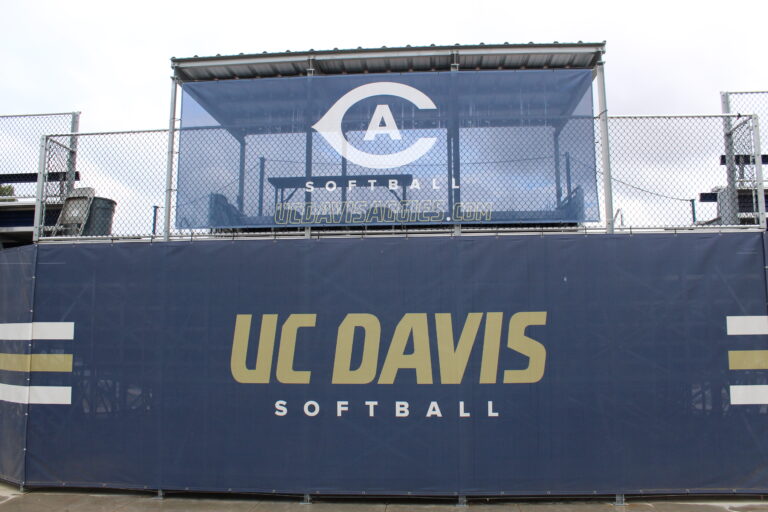
With the spring season of collegiate athletics canceled, teams and coaches have had to adjust their training strategies for a season where most players are scattered across the country — and the UC Davis Softball team is no exception. The team is currently unable to practice together in person due to mandatory restrictions on any physical activity that uses UC Davis facilities. In addition, most of the members of the team have left Davis since the season’s suspension. 

While the cancellation of the season did not necessarily come as a surprise to many of the players, they still felt the loss of the season that they had been preparing for. 

Junior outfielder Alyse Rojas said that because the team had been receiving regular updates from the coaching staff about other conferences and games being canceled, they were able to guess that this was the direction their season was heading. 

“It was really upsetting when we first figured it out and everyone was crying and stuff — the seniors especially,” Rojas said. “[We felt] really sad, honestly, […] in that hard moment.”

According to Head Coach Erin Thorpe, the team has felt the loss of what would have been the last season for those senior athletes.

“To know that we have players on our team that were set to graduate this June and were not able to have their senior days and go out and finish their career the way that they wanted to, [that] really affected everybody,” Thorpe said.

Thorpe, along with UC Davis Athletics staff, has been working with the players over the past several weeks to grapple with the feelings that came with the loss of the season. And when the NCAA announced that it would be granting spring sport student athletes an extra year of eligibility, Thorpe worked through the options with each player to come to a decision.

“The first six weeks of this, we kind of worked through that process with each of the seniors,” Thorpe said. “I think that we’ve found a really good place where each of our seniors have made their decisions. They feel good about where they’re at and they feel good about what they’re going to be doing next year, but it was quite a process.” 

Beyond losing their season, the athletes also lost out on spending time with their teammates. Prior to the switch to remote learning, many of the players saw each other every day. So with most of the team split up and no longer in Davis, they have turned to regular team Zoom calls to stay connected. 

“It definitely is really nice to see your teammates,” junior catcher Riley Siegel said. “Me and Alyse [Rojas] probably spent 24 hours a day together, because we [were] teammates, roommates and we have some of the same classes. And now we don’t see each other at all. So it definitely is a huge adjustment for some people, because […] a lot of girls on the team lived together.”

As part of the team’s mandatory virtual training, Thorpe has arranged a variety of weekly coach-led — as well as student-led — team bonding activities through Zoom. These activities include leadership pep talks, weekly check-ins, Aggie EVO program meetings and alumni guest speaker talks.

“It’s a great opportunity for us to be able to utilize this time to grow in other aspects of the game that’s not just physical [such as] our leadership skills and our life skills,” Thorpe said. “And it’s mostly related around team bonding, the team just being together and doing some activities.”

In giving other examples of bonding activities, Thorpe mentioned that team members have written letters of gratitude to frontline workers, made face masks and baked banana bread together. 

These bonding activities serve not only as a check in with the athletes, but also as a way to strengthen the bonds between players as they deal with the disappointment of a season cut short. 

“I think, right now, too much time by ourselves to kind of sit in our own thoughts can sometimes be a little bit dangerous,” Thorpe said. “Especially during this time, just to be able to connect and communicate with each other and see each other and be able to provide that support, and just knowing that we’re there for each other, I think is really important for the girls to not only adjust to the shelter in place, but also for their own mental well-being.”

Adapting to online communications has also been important in preparing for the future of the team. During a typical season, the incoming freshman players might have been able to spend the summer on campus working with the coaches and athletics staff to train and get used to the new environment. But with the remote learning model and the halt on athletics activities, Thorpe and the coaching staff have had to get creative. They have been working with the new recruits through Zoom and phone calls to prepare them for the upcoming year.

“Our strength staff has gone virtual with some of our summer workouts,” Thorpe said. “Our strength staff has been utilizing [these platforms] that allow them to interact with our student athletes digitally, in terms of providing them workouts or providing them assistance with their workouts. So all of our incoming freshmen also have that as well. We’re trying to keep them connected that way.”

While the team is currently not allowed to meet in person, the NCAA recently announced that some voluntary, in-person practices would be allowed to resume for certain Division I sports starting June 1. The athletics department must now determine what activities will be allowed for this summer and, possibly, the upcoming year.

“Right now, we’re just kind of taking the lead from the NCAA as well as our local governing bodies as far as what’s safe to do moving forward,” Thorpe said. “Right now, we are not allowed to do anything with our teams through May 31 with regards to physical activity and face to face and that type of stuff. We just kind of have to wait to see how things go.”

Despite being unsure about what life will be like for the softball program in the coming months, Thorpe is planning for a typical start to training in September. From there, she will be able to wait and take cues from the fall and winter sports seasons.

“It’s definitely going to be different, our seasons are going to be different, maybe how the game is played is going to be a little bit different,” Thorpe said. “It’s going to be interesting. It’s gonna feel weird for a little while, and that’s okay, and we’re trying to prepare for that.”

Written by: Priya Reddy — sports@theaggie.org
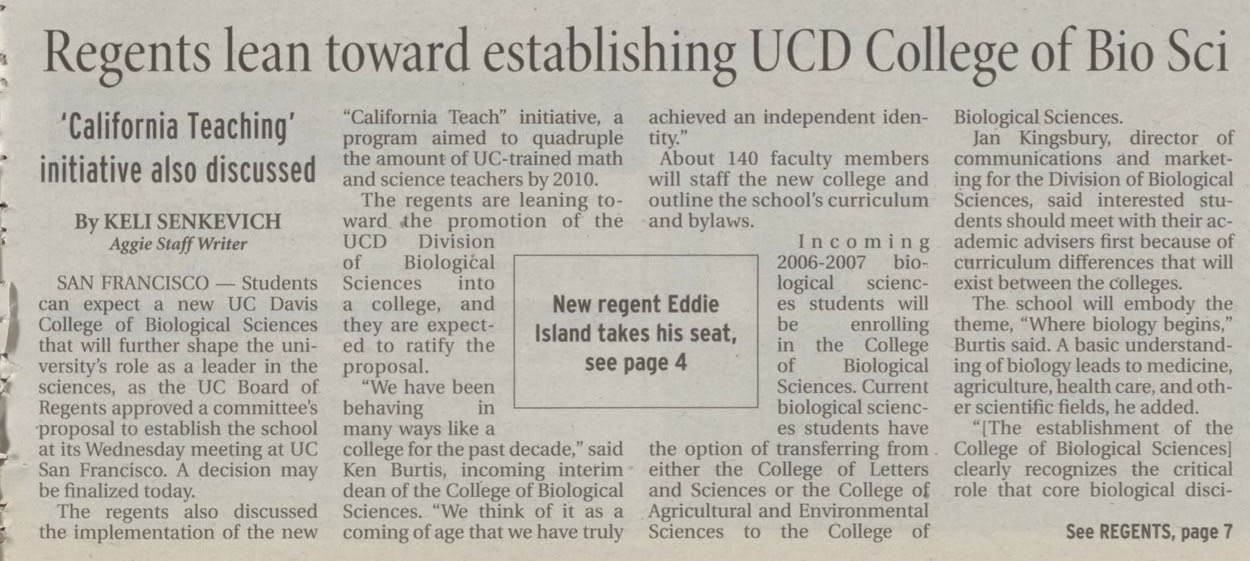
Culture Corner with Josh Madrid

The Arts Desks’ weekly picks for movies, books, music and television shows

Television: “Hollywood” on Netflix

Hollywood is a miniseries that fantasizes about the LGBTQ experience the 1950s never gave actors. The story follows Jack Castello, a World War II veteran, who moves to Los Angeles to pursue an acting career with Ace Studios and a group of other actors and writers that don’t fit the Hollywood mold of the time. Historical Hollywood figures such as Rock Hudson and Vivien Leigh are woven into this historical fiction where the cast is fighting to produce and film a movie about a girl who jumped off the Hollywood sign after being rejected by the industry. And along the way, avoid getting killed. 

Movie: “God’s Own Country”

This 2017 movie has since rotated out of Netflix, but it’s reemerged in the media — although this time its reemergence was not to praise its successful portrayal of a gay experience with raw emotions and grueling internal turbulence. The UK film director, Francis Lee, pointed out that the version that recently began streaming on Prime Video censored gay sexual scenes. Amazon has responded by saying that the distributor, Samuel Goldwyn, is to blame for the censorship. Regardless, the film is about a young farmer named Johnny and a Romanian migrant named Gheorghe falling in love after Johnny hires Gheorghe to help the family farm during lambing season. It is a carefully crafted drama that shows that circumstances and years of tradition can’t block out love. 

Album: “Madame X” by Madonna

The “X” in Madame X, the secret agent name Madonna gave to her jack-of-all-trades character, represents a multitude of professions and positions that the madame identifies with. The album intrinsically asks why one can’t embody a whore, a saint and a head of state — among other things — in the eyes of society. My favorite song on the album is the seductive club song, “Medellin,” sung with Medellín that begins with Madonna whispering, “One, two, one, two. One, two, cha-cha-cha…” The song mixes latin drums and heavy-synth with autotune that shapeshifts much like Madame X. The album discusses gun control, politics and trans rights all while simultaneously entertaining. And of course, there are several high-budget music videos that follow her trend of controversial music videos — a trend spanning long before “visual albums” were the norm. 

Book: American Carnage: On the Front Lines of the Republican Civil War and the Rise of President Trump

That long title is in itself the summary of this fascinating book that provides a bird’s eye perspective as to how right wing politics have built up to where they are now. Author Tim Alberta explains that in the days after the George W. Bush era, the Republican party was left without an identity and a clear path for the future and the changing American society. Factions within the GOP began to form with influences from familiar names like Mitch McConnell and Ted Cruz, as well as groups like the Tea Party. Together, they all set the stage for soon-to-be president of the U.S., Donald Trump. 

Written by: Josh Madrid – arts@theaggie.org
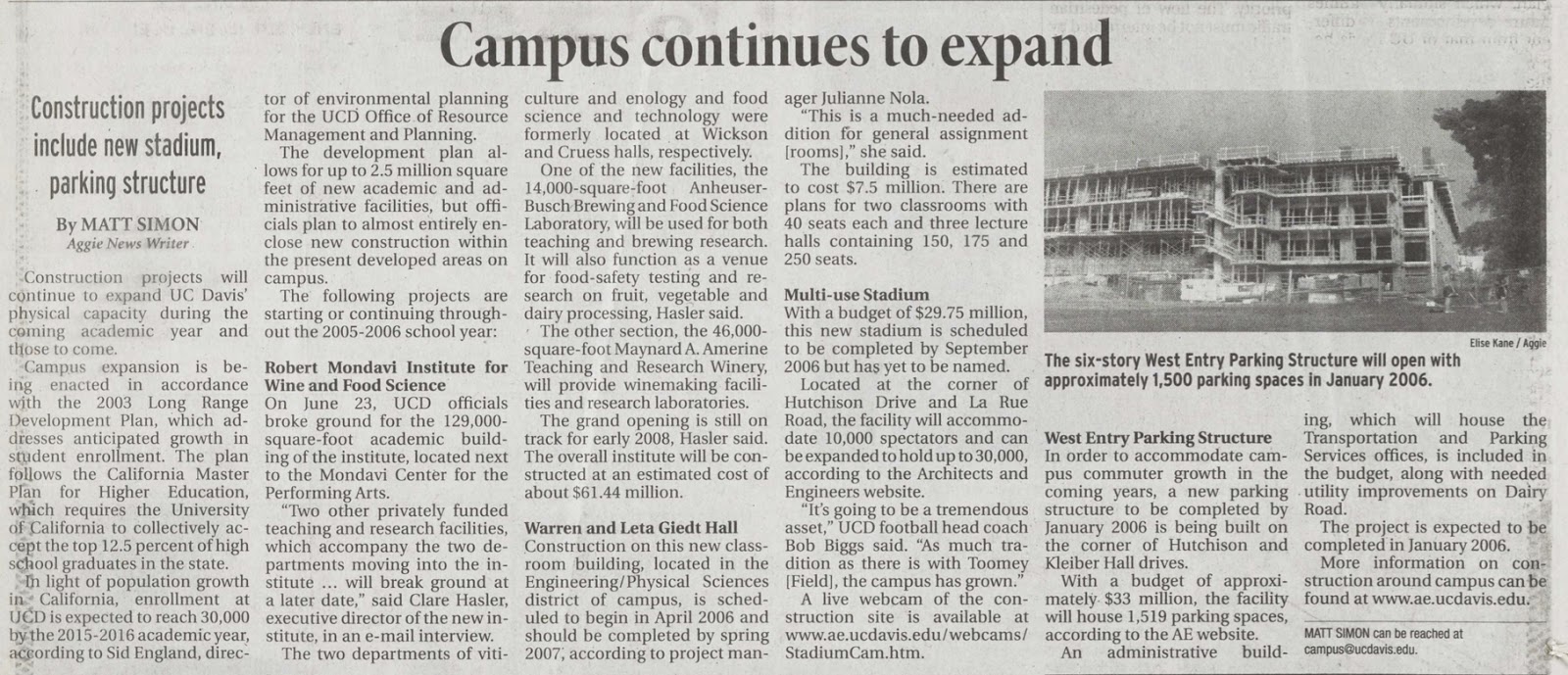
Unitrans proposes service changes for 2020–2021 service year

Proposal includes drop-off only stops, schedule adjustments, rear door boarding

Unitrans has proposed new service changes for the 2020–21 school year, set to take effect Aug. 3, 2020. These changes, inspired by reliability and crowding, are open for public comment until Friday, May 22.

“Proposals focus on improving your ride by making it faster and more reliable,” said the Unitrans website.

Two pilot programs include all-door boarding and new spots for drop-off only. 

Prepaid riders or those with a pass are now able to board the bus from both the front and rear doors, a newly implemented change.

“It’ll be an honor system,” said Jeff Flynn, the general manager of Unitrans. “We trust our customers to pay for their fares.” 

Flynn said bus services in cities like New York, Seattle and San Francisco have adopted similar systems. 

Unitrans is also proposing drop-off only stops to help clear congested lines. They are proposing to convert five stops on the G and J line and two stops on the V line to be drop-off only. One of the stops on the V line has already been converted to a drop-off only zone, Flynn said. 

“These drop-off spots will only be in the outbound direction,” Flynn said. “What we’ve seen over the past few years, the later and more unreliable the busses are getting, the more that we see people boarding on the outbound side of the street in order to travel inbound. If more people do that, it slows down the bus service even more.” 

When asked about riders with disabilities who may need to use outbound stops to ride to stores like Safeway, Flynn responded that “the drop-off only designation would apply to all customers,” and that those who would be affected should provide comment on the proposed changes before the May 22 deadline.

This trend exacerbates the strain on the system, and Flynn believes these changes will improve time performance. 

Both of these programs, the rear boarding and drop-off ony spots, will be a one-year pilot program. 

Beyond these pilot programs, Unitrans is also making service changes to some of their lines. 

“The biggest small change is that in the morning between 6:30 a.m. and 9:30 a.m., we’re proposing to shift all the schedules five minutes earlier,” Flynn said. “Between 8:30 and 9 is when the most people are using Unitrans, and it’s also the time where there’s the highest traffic.” 

This service change, based on GPS and traffic data, is to ensure that morning buses arrive on time. 

Unitrans is also proposing an afternoon schedule update on the V line, proposing to adjust the 25 minute after-the-hour afternoon and evening departures to 20 minutes after the hour. In addition they propose “capacity focused improvements,” proposing increased weekday morning capacity trips on the A and V lines, new 7:10 p.m. Z line and 8:10 p.m. K and Z line trips and the elimination of 6:20 p.m. D,G, J and W lines and 6:25 p.m. V line trips. 

On top of these service changes, Unitrans is preparing for the 2020–21 academic year while facing a severe drop in ridership.

“Ridership has fallen significantly,” Flynn said. “During the regular academic year, we carry 23,000 people a day. Right now, we’re carrying about 400 people a day. That’s about a 98% drop in ridership.”

As a result, Unitrans has reduced the number of fully operational lines. 

“For fall we have our ear to the ground,” he said. “We don’t have any information on what’s going to happen, but right now Unitrans is planning on regular service. I’m not sure how likely that is, but we need to set a goalpost for ourselves.” 

This drop in ridership also comes as ASUCD faces potential losses of $1.1 million due to COVID-19. 

“Right now, Unitrans is funded half through student fees and half through the City of Davis,” Flynn said. “The City of Davis, through the CARES act, received emergency aid funding for public transit. Our plan is to work with the city to use that federal stimulus to backfill any holes we may end up having in our budget.”

Any customers who this may impact should call Unitrans at 530-752-2877, email at comments@unitrans.ucdavis.edu or send mail to Unitrans, 1 Shields Avenue, 5 South Hall, Davis, CA 95616. The comment period ends on May 22, 2020. 

Written by: Alex Weinstein — campus@theaggie.org

Yolo County passes key reopening benchmarks after change to state guidelines

More Yolo businesses will be allowed to reopen under relaxed public health metrics

Yolo County has been cleared for further reopening under new, relaxed guidelines issued by the State of California on May 18. Gov. Gavin Newsom’s office amended earlier public health benchmarks that may have otherwise prevented further reopening in the county. 

Previous guidelines stipulated that individual counties must have no deaths from COVID-19 in the past 14 days in order to move further into Stage Two of the state’s Pandemic Resilience Roadmap — which would allow dine-in restaurants, in-store retail and other businesses to reopen — according to the original attestation form. Other benchmarks included the number of recent positive tests, contact tracing and hospital surge capacity in the county. Individual counties were required to submit attestations that detailed how they were meeting each of these “pandemic readiness” requirements in order to be cleared by the state for further reopening.  

For Yolo County, the initial death-count benchmark was the sole metric that prevented the county from progressing further along the reopening process. In the May 19 Board of Supervisors meeting, Public Health Director Brian Vaughn said the state rejected the initial attestation form submitted by the county. 

“We submitted that [form] with the caveat around that one benchmark we didn’t meet — that zero deaths in the last fourteen days,” Vaughn said. “We considered that a very high benchmark and one that wasn’t realistic for our local context. We provided that explanation, submitted it and just received feedback that we did not meet that requirement, and our attestation wasn’t approved for round one.”

Vaughn pointed to new May 18 guidelines issued by the state which replaced the death-rate metric with one of two potential metrics measuring hospitalization rates. These had been outlined the day before in a press conference by California’s Secretary of Health and Human Services, Dr. Mark Ghaly. 

 “Those two data points are hospitalizations looking at no greater than 5% increase in hospitalizations over the past days on average,” Ghaly said. “And for some counties that have very few hospitalizations already, we’re looking at no more than 20 people hospitalized with COVID-19 throughout your County in any one of the last 14 days.”

According to Vaughn, Yolo County easily met both of these new state standards. 

“Both those metrics — whichever we choose — we meet them with flying colors,” Vaughn said. 

On Thursday, May 21, Jenny Tan, the Yolo County Public Information Office’s Manager of Public Affairs, announced in a daily briefing that the county had submitted a new attestation form under the amended guidelines and that the state approved the plan. 

“This means that our county has met criteria outlined by the California Department of Public Health to move more quickly through Stage Two,” Tan said. “Activities and businesses that are now eligible in Yolo County to reopen include dine-in restaurants and shopping centers like retail stores and swap meets.”

This approval doesn’t mean that all businesses of this nature will reopen right away, however. Tan emphasized that the county would be proceeding with caution, and there would be substantial discussion between county public health officers, supervisors and business owners about “which business to reopen and when.”

“Even though we’re eligible to reopen restaurants and retail, we’re not quite going to do so yet,” Tan said. “We will be taking a gradual approach while communicating with business and partners to keep public health a priority.”

Any businesses that do eventually reopen — as well as their future patrons —  will still have to abide by public health guidelines, like mask requirements and social distancing protocol, according to Tan. 

The upcoming Board of Supervisors meetings will include discussions of which specific Stage Two business and activities in Yolo County will be approved for reopening in the near future, Tan said. 

Written by: Tim Lalonde — city@theaggie.org