56.1 F
Davis

Davis, California

Thursday, December 25, 2025
Home Blog Page 331

Hollywood’s “Lolita complex” still a problematic issue for young, female stars

Preservation of innocence of child actors while simultaneously hypersexualizing their every move creates vicious cycle

Child actress Millie Bobby Brown sparked controversy at the 26th annual Screen Actors Guild Awards over what she was wearing. Only 15 at the time, Brown was dressed in a low-cut Louis Vuitton coat-dress outfit. While some took to Twitter to criticize her team for dressing her in such a mature manner, others have spewed hate and insults at Brown, judging her character. Some defended the outfit choice and claimed that the 15-year-old should own her sexuality. 

“Did people criticize her SAG Awards look for her sake, or because it made them uncomfortable?” questioned an article in Popdust. “In the same way that it is absolutely inappropriate to sexualize Brown, is it not also inappropriate and unfair to forcefully ignore her sexuality completely?

Brown’s team deliberate decision to dress her in such an adult way for a publicized awards show, and the response it elicited from the public, reveals a prominent issue deeply entrenched in the entertainment industry: Young female stars are hyper-sexualized by the business that they are in, then either celebrated or criticized for that same sexualization by the public. 

This is no new phenomenon. One of Shirley Temple’s first roles in 1932 was as an exotic dancer in a bar for soldiers in “War Babies.” She was three years old at the time. Throughout her childhood, she was placed in roles that were oddly mature for a young actress. An article in The Guardian analyzes Hollywood’s “Lolita complex” and the ways in which those in charge of Temple’s career exploited the sexualization of her childhood innocence.  

 “[They figured] out just how to preserve the veneer of innocence while teasing the men who proved her greatest admirers both on and off the screen,” wrote Molly Haskel. “Often orphaned, she finds herself the darling of bachelors, widowers, lonely uncles, in ‘love’ stories that feature non-childlike caresses on both sides.” 

The 1994 film “Léon: The Professional” uses a similar trope explained in the article. Natalie Portman, only 12 at the time, played a character who developed an unusual relationship with an older man through a presumed case of Stockholm Syndrome. Despite Portman’s acting merits, the public’s reaction to the film would cause overt sexualisation and harassment that would follow her throughout her career. Portman is open about the horrifying objectification she experienced as a child. Her first fan mail ended up being a rape fantasy story written by a grown man. Later, a local radio station would start a countdown to her 18th birthday.  

At the 2018 Women’s March, Portman spoke about the effects of constantly being seen as a sexual object for grown men at such a young age. 

“At 13 years old, the message from our culture was clear to me,” she said in her speech. “I felt the need to cover my body and to inhibit my expression and work in order to send my own message to the world: That I’m someone worthy of safety and respect. The response to my expression from small comments about my body to more threatening deliberate statements serve to control my behavior through an environment of sexual terrorism.”

This sexual terrorism continues to permeate the industry. Brown has received the most criticism out of all her male co-stars on “Stranger Things.” Her publicity team and those around her push a mature narrative on the young actress in order to enhance her career, while the media seems to be torn between objectifying Brown and criticizing her for allowing herself to be objectified in the first place. 

Young stars really can’t win, no matter what they do. Dancer and performer JoJo Siwa has been subject to internet bullies for years now because she caters her image to her predominantly young audience. Often compared to Brown, people criticize the 19-year-old star for wearing colorful bows and “childish” outfits. 

Singer Billie Eilish rose to fame at the age of 15 with her song “Ocean Eyes.” She became known for wearing baggy clothes that hide her frame in order to avoid being sexualized in the way so many young stars before her have. This alone sparked controversy and dialogue in the media, with many shocked that a child would not want their body to be objectified. Even more controversy arose recently when Eilish posted a picture of herself in a swimsuit.  

“‘It was trending,” Eilish said in an interview with Dazed. “There were comments like, ‘I don’t like her anymore because as soon as she turns 18 she’s a whore.’ Like, dude. I can’t win. I can-not win.”

Written by: Alyssa Ilsley — arts@theaggie.org
Oh no, I’m with them: my quest to befriend a rapper

If I could charm the guys at my local In-N-Out to sneak some free fries in my order, how hard could it be to become extremely close to the most desirable and famous people in the country?

There comes a time in every person’s life when they are called to do something higher. Many go off to graduate school, fulfilling dreams of becoming doctors or lawyers. Some volunteer their time in inner cities or far away places. Some even decide to risk it all and strike it rich in the big city. I believe my higher calling, without hyperbole, is to be the confidant, right-hand man and best friend to one, if not a multitude of, different rappers. But first, a personal history.

I had my first encounter with hip-hop in middle school, when friends would pass around an iPod loaded up with Kanye West’s “Gold Digger” during recess. It was epic. I had never heard anything like it before, rendering the Soviet cassettes my mom played in the car obsolete. Goodbye Alla Pugacheva, hello “Late Registration.” Suddenly, my fascination with a genre turned into a genuine interest. 

Fast forward to high school. Do you know when people say they fell into the wrong crowd? It was, essentially, the exact opposite for me — and I am forever thankful for it. The band of outsiders I befriended were a hodgepodge of exceptionally strange, exceptionally cool weirdos: people with dreams of getting tattoos of childhood cartoons on their chest who asked their English teachers to junior prom. It was the perfect breeding ground to get even more into hip-hop than I had been before. And immerse myself I did — a policeman once stopped us for blaring Madvillian’s “Accordion” too loud at a public park. We, like deer in headlights, stopped, only to hear him remark, “Guys, I love this album, but you’re gonna have to turn it down.” 

I am now finishing up my studies here at UC Davis, which I tell many is the Harvard of Yolo County. My love for hip-hop and its cultural significance has perhaps waned a bit, bleeding into myriad other genres spanning from lo-fi house to library music. But I see this not only as a strength but as an asset, and it leads me to my first qualification as a potential best friend to any rapper: helping cook up ideas in the studio. 

Picture this: Migos has been sitting on a beat for about a week now. They toil and struggle, giving the track their trademark high energy flair, yet greatness eludes them. This is where I come in. 

“Hello, Ilya?” Quavo says, a smile behind his $10,000 grill. “Well, well, well. If it isn’t my favorite Migo!” I shout. (The phone is on speaker, and Offset frowns slightly.) “What’s going on?” I ask. Quavo explains the situation, and I hop into an UberPool. 

Within less than half an hour, I walk through the gates of the studio. “Mmm, I know what this needs,” I say to myself. I load up a sample of the opening piano melody from Italian lounge legend Enrico Intra’s “Nicole” and splice it throughout the track. “Wait, this is like, really cool, and honestly the sort of energy we’ve been looking for this whole time,” Takeoff remarks. “No worries, guys,” I reply. “And hey, I’ll get out of your way… don’t wanna spoil the magic!” 

This brings me to my next qualification: only sticking around when you want me to. Rappers are modern day painters, and the styles they employ range from the classical style (G-funk, jazz rap) to the expressionist (drill, trap) to the postmodern (mumble rap, industrial hip-hop). Because of this range, and the general nature of an artist, I will always leave room for your own thoughts. Having a fight with a record label? I will egg their building, and then I will go directly home. Want something from Whole Foods? Not only will I text you asking, but I will not stick around for idle chit-chat when I drop off your essential oils. Do you want me to pick you up something from the new Supreme store that just opened? Not only will I go, I’ll even make smalltalk with the braindead degenerates who still stan that brand. And look at that: a perfect segue into my next and final qualification. 

The last thing I bring to the table is my subtle yet keen sense of style. I am aware I am not your typical hip-hop fan. I only have one pair of Jordans, to be fair. But the dominance of a streetwear aesthetic in hip-hop leaves so many doors left unopened. Of course, trailblazers like Young Thug and A$AP Rocky have dipped their toe into escaping the streetwear realm, rocking dresses and babushka scarves, respectively. But what if we went way off the charts here? Dressed like we were in the French Riviera in the 19th Century? Or as characters from biblical frescoes done by the likes of Micheangelo? Or even as something more conceptual, donning plain cardboard boxes to ask deep questions about both the industry and the world in which we live? We would be the talk of the town, and perhaps even win a few Grammys along the way. 

In the original pitch for this article, I told my editor I was going to befriend around one, maybe two dozen rappers. If I could charm the guys at my local In-N-Out to sneak some free fries in my order, how hard could it be to become extremely close to the most desirable and famous people in the country? 

  It turns out it is exceptionally difficult, which is why this piece has pivoted from an account of all the crazy times rappers and I were supposed to have, to a desperate plea asking for any of them to respond to my DMs. If you or someone you know is reasonably close to a rapper, with at least one million Spotify followers, please, send this their way. Things right now are wild and this is all I have. At the end of the day, when all is said and done, it’s not about how crazy something seems, it’s about how much work you’re putting in to make it happen. 

Written by: Ilya Shrayber — arts@theaggie.org
Post-Soviet sentimentalism

The rise of Soviet nostalgia signals a lack of closure

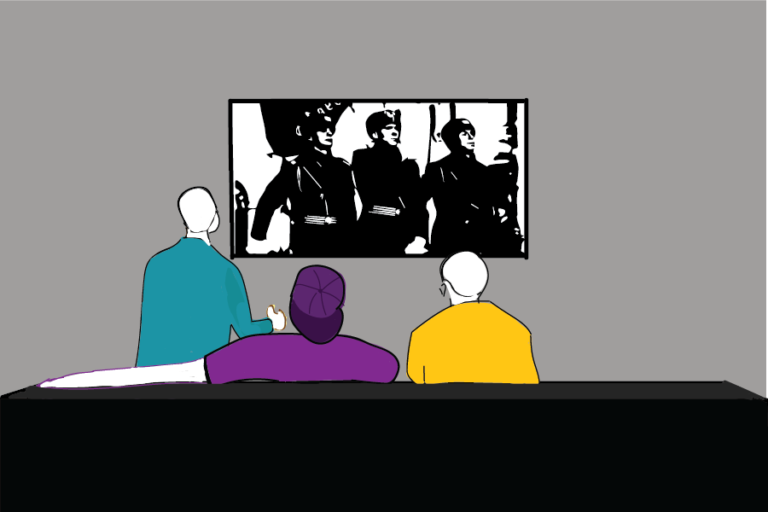
On Dec. 26, 1991, the infamous hammer and sickle flag lowered, and the red, white and blue Russian flag took its place. In just one night, a new nation was established alongside 14 others.

Twenty-eight years since the fall of the Soviet Union, and its presence still haunts Russia today. Across the country, statues of wartime leader Joseph Stalin remain erect, reruns of old movies play nonstop and Soviet-themed eateries serve customers without a smile.

Despite the failed economic policies and restricted civil rights that plagued the Soviet state, there was little celebration at its demise. President Vladimir Putin even called the collapse “the greatest geopolitical catastrophe of the century.” 

With 66% of Russians regretting the breakup of the USSR, the longing for Space Race exhilaration and victory day parades speaks to the overwhelming nostalgia that defines the “post-Soviet era” — a term that further implies this hesitancy to move forward.

While most Russians occasionally partake in nostalgia through television and music, others actively live out the past in the modern era.

“Compared to our government now, Stalin is a god,” said a member of Essence of Time, a pro-Kremlin, Stalinist group.

Led by Russian scientist Sergey Kurginyan, the group’s objective is to restore the USSR by fixing the mistakes of the past and implementing new principles founded in communism.

And although history has proved Stalin to be a dictator who terrorized his people, many Russians refuse to acknowledge this and still commemorate him as a great leader. Footage of past victory parades with Stalin’s portrait held high play on Russian television every year as a reminder of the nation’s former glory.

Some Russians even maintain conspiracy theories that the document dissolving the Soviet Federative Socialist Republic, signed by then-President Boris Yeltsin, is illegal –– meaning that the Soviet Union still exists.

They carry Soviet passports, evade taxes and disobey laws that would otherwise validate their Russian citizenship. In these extreme cases, nostalgia verges on disillusionment.

“For the past 28 years I’ve tried to live in this country called Russia,” said Soviet revivalist Konstantin Vyatkin. “But in my heart I still live there, in the Soviet Union.”

More generally, nostalgia is fed through Russian media. The television channel “Nostalgia” is dedicated to broadcasting music, movies and TV shows of the 70s and 80s. They even recently launched a YouTube channel. Besides airing reruns, the channel features a segment during which guests discuss historical events from the USSR.

The Museum of Soviet Arcade Games also serves as an archive of childhood memories. With 50,000 daily visitors in the Moscow and St. Petersburg location, its success speaks volumes on Russia’s obsession with the past.

Of course, cultural nostalgia is not exclusive to Russia. Many Americans seek out vintage diners to eat at or record stores to shop at in the hopes of reimagining an era they may have never lived.

But with reminiscing about the good times comes the danger of romanticizing the bad. As a political system, the Soviet Union was far from perfect. In the same way that Americans fluctuate between admiring the retro aesthetics of the 50s and acknowledging the reality of segregation, oversimplifying history risks diminishing past evils.

Growing up, I noticed my Armenian grandma using the names “Russia” and “the Soviet” interchangeably. Although she’s well aware of the difference, the two have come to mean the same, even decades later. 

For former states like Armenia, the period of Soviet rule was a golden age. But for other nations who suffered under communist rule, the collapse was a blessing.

The uncertainty of the current political climate could very well be the reason for Soviet nostalgia. While both the Soviet Union and present-day Russia experienced their fair share of economic recessions, the USSR still stood proudly as a beacon of hope. And although Putin may try to recreate the nation’s former “greatness,” that chapter has already closed.

Written by: Julietta Bisharyan — jsbisharyan@ucdavis.edu

Disclaimer: The views and opinions expressed by individual columnists belong to the columnists alone and do not necessarily indicate the views and opinions held by The California Aggie

The importance of music samples

Sampling is more than just an artistic choice

A little birdie by the name of Mark Twain imposed an idea about originality on us all. Maybe you’ve heard it uttered as you walk through the Quad, unintentionally eavesdropping on the debates of impassioned college students: There is “no such thing” as an original idea. 

Many use this idea to bemoan the repetitive nature of society. The resurgence of ‘90s fashion (crushed velvet and bucket hats) and our newfound obsession with retro-style television shows like “Stranger Things” are prime examples of this recycling.

Musical artists have lifted motifs and melodies from other works for decades. The practice of reusing and sometimes repurposing audio clips is known as sampling, and it has become foundational to the music we listen to today. 

Many people perceive the resurgence of past trends as a testament to modern society’s lack of originality. 

A famous case is Vanilla Ice’s “Ice Ice Baby.” The song’s blatant use of Queen and David Bowie’s “Under Pressure” bass line sparked a debate between creative uses and artistic theft.

But sampling was a crucial component to hip-hop before this, with N.W.A.’s sample-heavy “Straight Outta Compton,” in which individual tracks would include four or five samples. Most notably, the 1988 track “Express Yourself” resulted in a skirmish between N.W.A. and Charles Wright, as Wright was not initially aware that his 1970 song “Express Yourself” was the main motif for the group’s track. 

A majority of these legal battles operated under the guise that sampling is an unoriginal and cheap way to create music. 

We’ve come to fully embrace sampling, conceiving it as more than an artistic choice. Sampling is transformative not only in its integration of past musical themes but also in strengthening the messages that artists implement in their music. 

The manipulation of samples is key in creating the “mood” for a song. For example, Tyler, the Creator’s “GONE, GONE / THANK YOU” samples “Cozy,” a song by Japanese city pop artist Tatsuro Yamashita. In “Cozy,” Yamashita is thanking a significant other for being part of his life and making it better. 

Tyler, the Creator repitched and slowed a portion of Yamashita’s song and, as a result, changed the mood of the song through his manipulation of the sample. Now, Yamashita’s “thank you for the love, thank you for the heart…” is a reflection on a past relationship with a broken heart. 

The way that Tyler altered Yamashita’s track strengthened the creative ideas and emotional impact of “GONE GONE / THANK YOU.” 

Sampling has also evolved to where artists use samples to create messages that transcend simple lyrical implications. Beyoncé’s “***Flawless” was an expansion on an older song snippet called “Bow Down, I Been On.” The original clip had feminist intentions but was misinterpreted, as some people (Rush Limbaugh) believed she was encouraging women to “bow down” to their husbands and, in turn, patriarchal authority. 

The track evolved into “***Flawless” when Beyoncé’s self-titled album was released. In order to clear up her message, she added a portion of Chimamanda Ngozi Adichie’s “We Should All Be Feminists” TedTalk speech. By including Adichie’s speech, Beyoncé solidified her feminist intentions. 

Jay-Z’s “The Story Of O.J.” samples Nina Simone’s “Four Women.” Jay-Z’s musing on financial independence can be seen as a personal reflection on his own come up, but the inclusion of the sample stretches the meaning to African-American youths through the repetition of “my skin is black.” It strengthens Jay-Z’s argument and allows the audience to attribute their own meanings to the track.

Nina Simone’s impact on hip hop sampling can’t be discussed without referencing Kanye West’s “Blood on the Leaves.” In this track, West samples Nina Simone’s cover of “Strange Fruit.” The choice to include this song is two-pronged: “Strange Fruit” contains a famous anti-lynching message, and Nina Simone’s performances are rooted in civil rights. 

Considering these instances, it’s obvious that sampling has been transformed from a simple musical tool to an integral part of the music community. Samples that offer a window into the social perspectives and issues of the past are crucial to developing nuanced pieces of music. 

Written by: Isabella Chuecos –– ifchuecos@ucdavis.edu 

Disclaimer: The views and opinions expressed by individual columnists belong to the columnists alone and do not necessarily indicate the views and opinions held by The California Aggie

UCs explore options for reduced density in residence halls for fall based on local impacts of COVID-19

Some campuses could reopen one-third to one-half of dorms

Some UC campuses are exploring an array of scenarios to reduce density within housing and dining facilities due to the COVID-19 pandemic, including potentially only reopening one-third to one-half of dorm rooms this fall. 

UC President Janet Napolitano said campuses will first be required to satisfy systemwide guidelines to ensure public health and safety, with any reopening being greatly reduced, according to a Los Angeles Times article. Decisions on Fall Quarter may come in June or July. 

“During this very dynamic time, UC Davis is striving to have both in-person and remote classes available for Fall Quarter,” said UC Davis Associate Vice Chancellor of Housing, Dining and Divisional Operations Michael Sheehan. “We don’t know what directives may be given by the state, county and UC. Taking all of this into consideration, we are all hoping for the best while preparing for multiple scenarios.” 

Sheehan said Student Housing and Dining Services is continuing to plan for fall occupancy, although occupancy density is still to be determined. According to the UC Davis Student Housing and Dining Services FAQ webpage, UC Davis guarantees on-campus housing to all incoming first-years, transfer students and second-year returning students, but it may withdraw or amend this guarantee in the case of public health guidance or other extenuating circumstances due to the COVID-19 pandemic. 

“The strategies and safety measures around occupancy will be developed in collaboration with campus leaders, campus health professionals and Yolo County Public Health,” Sheehan said. “If the decision is made to reduce density within the residence halls, then we will spread out the beds throughout all properties. This will reduce circulation in common spaces such as entry ways, lounges, hallways and bathrooms.” 

Other UC campuses are also discussing possibilities for safe reopenings in the fall.

“Each campus is undertaking their own scenario planning, as are we,” UC Merced Interim Chancellor Nathan Brostrom said in an email. “Occupancy at 50% is just one of the many scenarios we are looking at.” 

UC Merced Assistant Vice Chancellor of Marketing, Public Relations and Signature Events Jim Chiavelli said every campus in the country is in the position of managing a flood of data sources and predictions trying to make decisions that are timely, but not rushed. He also noted that few campuses are comfortable making firm pronouncements for fall. 

“Certainly we are not yet there, and, as the chancellor said, every campus is planning its own path forward, based in part on local impacts,” Chiavelli said. 

Written by: Graschelle Fariñas Hipolito — campus@theaggie.org

New study highlights success of gene drive technology with preventing mosquito-spread diseases

Genetically engineered mosquitoes join fight against vector borne illness

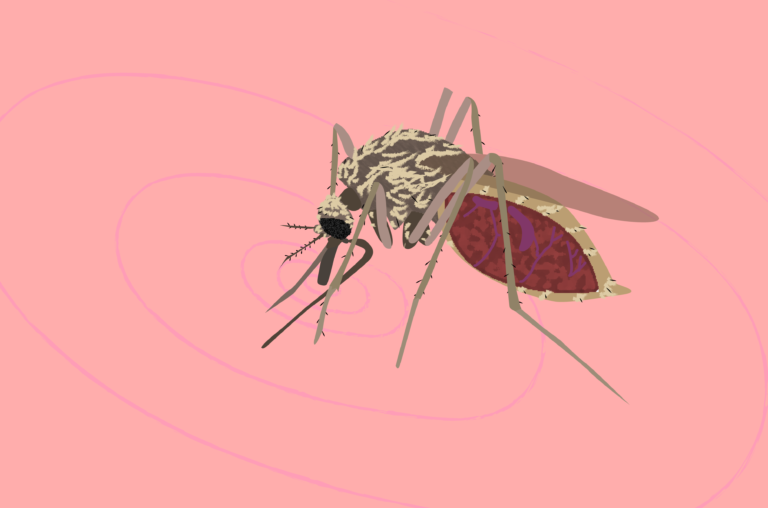
Malaria is one of the most significant vector borne illnesses known to humans, causing 500,000 deaths each year, according to the World Health Organization. Mosquitoes, a majority of the genus Anopheles, transmit the plasmodium parasite to humans. Malaria control-tactics rely largely on resources such as insecticides — which are costly and becoming less and less effective as mosquitoes grow resistant. So new management strategies are being researched.

“The conventional methods of treating malaria such as drugs or insecticides [are] very expensive and labor intensive,” said Gregory Lanzaro, a professor in the Department of Pathology, Microbiology and Immunology. “That got us thinking about using the mosquito itself to produce a cost-effective and sustainable way to control malaria.” 

For the past 30 years, researchers have studied the usage of gene drive technology to stop the spread of malaria. The idea is to create genetically engineered mosquitoes (GEM) that are either resistant to carrying the malaria parasite or that fail to reproduce, which would result in the reduction of the mosquito population. The gene drive technology relies on the use of the Cas-9 enzyme, which ensures the passing of the new modified genes onto offspring in the introduced population. 

Concerns over the success of this technology arose due to the high sequence variation in the genomes of mosquito species. The Cas-9 enzyme requires a specific 23 base pair stretch of target DNA to be effective. 

“For the GEM strategy to work, it is essential to have a sequence of DNA that is identical in almost every specimen of the target population,” said Hanno Schmidt, a postdoctoral researcher, via email. 

Researchers began to question the viability of this technique, as many thought wild mosquitoes might not have the specific target DNA, which could result in individuals carrying the variation resistant to the drive.

“People were worried about using Cas-9 because mosquito genomes are very polymorphic and have lots of base pair substitutions,” Lanzaro said. “The concern was that it would be hard to find a 23 base pair sequence that didn’t have some variation which could lead to the Cas-9 not working.”

A recent study conducted by entomologists in the Vector Genetics Lab, led by Lanzaro, alleviates these concerns, as it proves the success of the technology despite the high variation in the genomes across mosquito species. 

The lab determined that 90% of all protein-encoding genes include at least one Cas-9 target site. The researchers obtained these results through examining the genomes of three different species of mosquitoes. A total of 1,200 whole genome sequences collected by the lab and the Ag1000g Consortium, a research project being conducted by MaleriaGen, were examined for potential target sites. This large collection of genome sequence data allowed the researchers to dismiss concerns over the potential failure of gene drive.

With confidence in the success of gene drive, further progress can be made in this field. The Vector Genetics Lab works closely with UC Irvine’s Malaria Initiative, which leads a population modification approach to treating malaria. The goal is to use gene drive to stop mosquitoes from transmitting the malaria parasite.  

“Professor Anthony James and his team at UC Irvine advance the laboratory strain of the modified mosquitoes,” Schmidt said via email. “The Vector Genetics Lab currently investigates natural populations at African oceanic islands that are potential targets for initial field release trials.”

Leading the field application aspect of the project, the Vector Genetics Lab selected two African island nations, the Republic of São Tome and Príncipe and the Union of Comoros, as potential field sites. The research is in the initial stages as they work to understand the population genetics of the mosquitoes native to the islands.

“On the science side, we need to have a very thorough understanding of the mosquitoes on the islands and their ecology,” Lanzaro said. ”Our goal is to understand mosquito biology from the perspective of malaria transmission in a broad site.” 

An equally important aspect of their work on the island is community engagement and education. The team works closely with the National Malaria Control Programs of each field site.

“In the next several years there is a lot of education that needs to happen in the highest level of the countries,” said Ana Kormos, the community engagement manager for UCI’s Malaria Initiative. “At the same time, really building some strong relationships with different groups within the countries on how they feel about malaria and how they might respond to a field trial.”

The lab produces a large amount of educational materials on gene drive technology and the research process, such as what a GEM is and why these countries may want to consider implementing GEMs. This helps inform and build relationships with the countries as they decide whether or not to approve the release of GEMs. 

“Even if we are not able to release them at these islands, we would still have a lot of information on the malaria transmission on these islands for them to use in a more conventional way,” Lanzaro said.

While no GEMs have yet been released, the potential benefits of this technology are immense. As a cost-effective and highly efficient control tactic, gene drive could greatly reduce the spread of not only malaria but many other mosquito transmitted diseases such as zika, dengue fever and yellow fever.  

Written by: Alma Meckler-Pacheco — science@theaggie.org 

Therapy is for more than times of crisis

We shouldn’t wait for things to get worse in order for them to get better 

There are few smooth ways to mention your therapy appointment during casual conversations. At the mere mention of the phrase, people will immediately question your sanity, look at you sympathetically or simply awkwardly or just silently stare at you. For whatever reason, talking to a friend about your problems is normalized, but talking to a professional is not.

 Society often assumes that if you are seeing a therapist, then you are either emotionally unstable or going through a crisis — or both. But neither of these assumptions are true, nor should they be.

In the last decade, the culture around mental health has improved dramatically, but a stigma still remains that one only sees, or should only see, a therapist if they are in a crisis. But we shouldn’t have to wait for our situations to worsen in order for them to improve. It should be perfectly acceptable to see a therapist regularly. 

Part of the problem has to do with how we categorize mental health. Instead of considering mental health care a necessity, we put it on the back burner as a sort of last resort for our most dire situations. We should be encouraged to seek help for our mental health just as we seek help for a broken bone or a cavity. 

Yes, sometimes we can take Advil to lessen our physical pain, but if the pain persists, then we see a doctor. In a similar sense, we can talk to a friend if we are having negative thoughts, but if our thoughts and feelings continue to weigh us down, then we should be encouraged to speak to a professional. 

Unfortunately, the social stigma around mental health has hindered people in their attempts to take care of themselves for far too long, contributing to our current mental health crisis. As a community, we should promote therapy as a healthy means to self-care. We shouldn’t feel ashamed for seeking help. More importantly, therapy is not solely reserved for times of crisis. Even the most seemingly content among us could use a little time at a therapist’s office. 

Under the current circumstances induced by the coronavirus pandemic, the importance of therapy and access to mental health resources has never been more apparent. So much of our lives has changed since the outbreak of COVID-19. Being stuck inside and limited in our contact with others is not good for our mental health. Fortunately, much like many parts of the world, therapists have moved online — making it easier to find help during these hard times. 

Yoga, meditating, journaling and going to the gym are healthy habits that may also help us cope with our troubles. They are also an especially great way to get out of the house right now. Therapy, however, can help us work through the problems we avoid, or offer the relief of simply talking to someone about our thoughts, issues, feelings or experiences we often deem too trivial to discuss. 

With help from professionals, we may gain new perspectives, learn something about ourselves or find new and better ways to handle certain situations. 

There is no age when the stress of life stops. At each stage in life, we will be faced with new problems or stressors that we may not know how to handle. We shouldn’t have to keep our struggles to ourselves. Mental health shouldn’t be a taboo topic or one that we shy away from during conversations. In order to #breakthestigma, we must encourage one another to take care of our mental health and to share our stories without shame. 

Written by: Kacey Cain — klcain@ucdavis.edu 

Disclaimer: The views and opinions expressed by individual columnists belong to the columnists alone and do not necessarily indicate the views and opinions held by The California Aggie

UC President thanks UC researchers for COVID-19 related work at UC Davis’ second virtual COVID-19 symposium

Researchers, medical professionals across UC system share recent work, answer questions regarding novel coronavirus

On April 14, UC Davis held its second virtual COVID-19 symposium to update the public about recent research being conducted across the UC campuses as well as to answer questions from viewers. Walter Leal, a distinguished professor in the Department of Molecular and Cellular Biology, moderated the event again after organizing the first symposium.

Due to his involvement in research during the Zika virus pandemic, Leal received many questions when the current pandemic began. Fueled by a love for learning and former experience with hosting large events, Leal decided to gather people who could answer these questions. 

“There are many unknowns about this new virus and how it is transmitted and prevented, etc,” said You-Lo Hsieh, a distinguished professor and chair of the Department of Textiles and Clothing, via email. “As new scientific data and analyses become available, symposiums like these organized by UC Davis are effective in relating the most current knowledge to the public.”

The symposium involved medical professionals such as Allison Brashear, the dean of the UC Davis School of Medicine; David Lubarsky, the vice chancellor of human health and chief executive officer for UC Davis Health; Emanual Mverakis, an associate professor in the Department of Dermatology at UC Davis Health; William Isenberg, the chief quality and safety officer for Sutter Health and Anoop Maheshwari, a doctor at Riverside Community Hospital. The full three-hour symposium can be streamed on the “’Biochemistry Channel” on Youtube.

The event opened with a statement by Chancellor Gary May who introduced UC President Janet Napolitano. In her welcoming address, Napolitano thanked faculty across the UC system for their efforts in researching COVID-19, highlighting undocumented students and faculty who are also contributing to these studies.

Among the panelists was Atul Malhotra, a professor of health from UC San Diego Health, who discussed the effects of COVID-19 on the respiratory system and its shared similarities with acute respiratory distress syndrome (ARDS). Malhotra warned that mechanical ventilators can be life-saving if set up correctly but deadly if not placed at the right settings. 

Malhorta studies the antibody tocilizumab’s response to COVID-19-induced pneumonia. While the antibody has shown significant improvement in patients in terms of body temperature, oxygen saturation and oxygen inhalation, further tests and more data are necessary to confirm its effectiveness.

“These symposia provide an excellent vehicle to disseminate knowledge,” Malhotra said via email. “The information we receive through mass media often has some spin or interpretation based on political or other pressures. Having a frank discussion with questions and answers is a good way to keep people informed.” 

In the closing statements of his presentation, Malhotra spoke about the importance of randomized treatments and studies, as opposed to applying various medicines in hopes that one will act as a cure. In doing so, people are depleting supplies for patients who actually need specific medications for their health conditions.

“Many people on TV recommend just trying various medicines in a haphazard way without any evidence,” Malhotra said. “The use of medications this way makes it very hard for us to tell the truth. Also medications have costs and side effects so the use of medicines without evidence has important risk as well as possible benefits.” 

In addition to a discussion on clinical trials and prevention methods for humans, the concern of contracting COVID-19 from pets was addressed by Jane Sykes, a professor in the Department of Medicine and Epidemiology at the UC Davis School of Veterinary Medicine.  

“The most important thing is that even though cats, and to a lesser extent, dogs, can be infected through contact with infected people, pets are not the drivers of transmission of SARS-CoV2 – human to human transmission is,” Sykes said via email. “People should continue to enjoy the benefits of the human animal bond, especially at such a stressful time. It remains possible that we will see evidence of pet to human transmission, but people are much, much more likely to get infected by going to the grocery store or a restaurant. The finding of animal infections needs to take into account the ‘big picture.’”

After the panelists gave brief presentations, Leal introduced Maheshwari to share his testimony of being diagnosed with and recovering from COVID-19. Maheshwari explained that he had contracted the virus from a patient despite wearing the necessary personal protective equipment. He described the worsening of his condition and the emotional toll he experienced when it had seemed his chances of survival were slim. 

Maheshwari advised people to visit the hospital if they recognize any symptoms rather than thinking they can recover on their own.

Leal then relayed questions asked by viewers to each of the researchers, addressing topics such as reinfection and the use of antibiotic tests. One topic that was frequently asked about was the utilization of homemade masks and their effectiveness.

“Wearing masks can reduce the spread of COVID-19 by reducing the largest droplets from sneeze and cough,” Hsieh said. “However, smaller droplets or aerosol from speaking or breathing can travel far for minutes and are too small to be blocked by homemade masks. Keeping distance is still critical.”

Leal concluded the event by thanking all of the panelists for their time and thanking health care workers for their continued work fighting COVID-19. Leal added that this symposium also took the efforts of information technology experts and communication specialists, as well as his family members, to make the event run smoothly. 

“From what I heard from attendees, they say it was helpful,” Leal said. “If so, mission accomplished.”

Written by: Michelle Wong — science@theaggie.org

Role of architecture in disease transmission emphasized in research from UC Davis, University of Oregon

Humidity, ventilation among factors that affect viral transmission within buildings

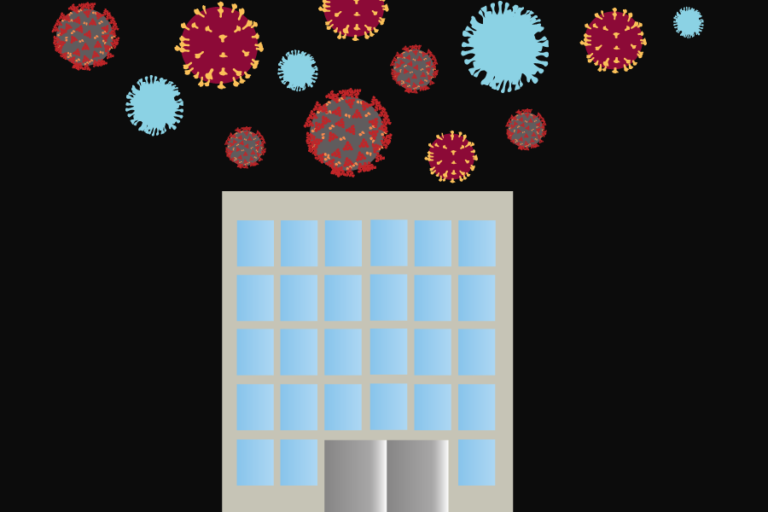
The built environment and building design may influence disease transmission more than previously believed, according to a collaborative review recently published by researchers from UC Davis and the University of Oregon. 

The review highlights various structural elements of buildings, such as ventilation, air flow patterns and humidity levels, which may influence how easily a virus spreads between people within a building. 

Among those involved in the collaborative journal review were Professor Jonathan Eisen in the Department of Medical Microbiology and Immunology, David Coil, a project scientist, and colleagues from the Biology and the Built Environment Center at the University of Oregon. 

“When the pandemic occurred, we started thinking about how we could contribute to the fight against this virus,” Eisen said via email. “We have been putting in many proposals on various topics and two have recently been funded, but we do not have any major results yet [as] we just started this work.”

Due to the recent emergence of COVID-19, little research has been formally published relating viral transmission and the built environment. UC Davis researchers, however, elected to continue their study with the Biology and the Built Environment Center at the University of Oregon due to their expertise on the subject. 

“There’s a ton of information cycling around about COVID-19, most of it related to clinical stuff and human transmission and things like that,” Coil said. “Our group in Oregon has worked for many years on the microbiology of the built environment.”

The focus of the review and the topic of viral transmission is highly multidisciplinary, with relevant links to various fields including architecture, engineering and microbiology. 

“The review paper was just that — a review,” Eisen said. “With the other authors we went through the literature and reviewed what was known about the virus and the built environment.”

Although more research must be completed before definitive statements can be made regarding COVID-19 and the built environment, there are general guidelines that can be followed to reduce transmission likelihood within buildings, such as considering that direct contact is the largest risk for viral transmission. 

“Sunlight is known to inactivate a lot of viruses, [and] it’s not good for envelope viruses like SARS,” Coil said. “Heat inactivates a lot of viruses including SARS, [although] it depends on what the transmission looks like.”

Researchers agree that increasing ventilation and sunlight levels in existing buildings could prevent disease transmission; however, negative pressure and isolation are more effective at mitigating viral spread in a building when an infected individual is already present. 

“If you put a fan in the window, pushing [air] out, you would be drawing air from the house into that room and then [outdoors],” Coil said. “That would be negative air pressure.”

Though more research on the relationship between viral transmission and the built environment is in progress, scientists have already identified a few factors as having significant effects on transmission within the built environment. 

“In general, the built environment plays major roles in transmission of a huge number of infectious diseases,” Eisen said. “Examples of issues to consider include filtration, relative humidity, temperature, cleaning, surface materials, water storage, and more.”

Written by: Dina Gallacher — science@theaggie.org

Women’s Basketball team comes to terms with abrupt end to season

Aggies discuss conference tournament cancellation, plans for future

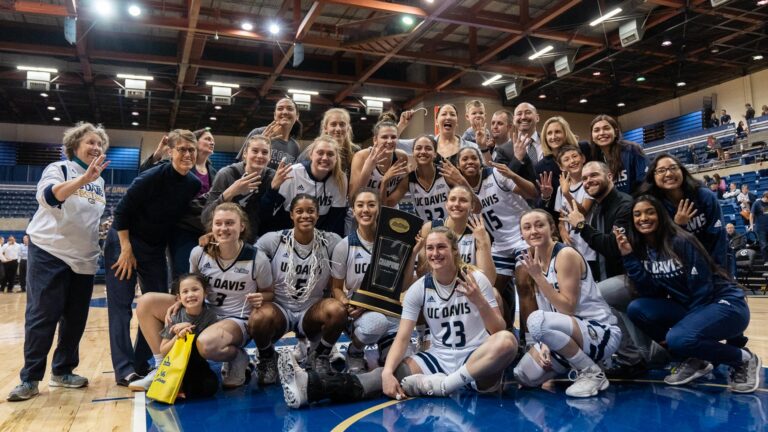
With the cancellation of this year’s Big West conference tournament, the UC Davis women’s basketball team has had to adjust to a season cut short. The team cruised through the regular season, winning their fourth consecutive conference championship and had been on its way to defend its conference tournament title when Big West officials made the decision to cancel the remainder of the competition due to concerns over the spread of COVID-19.

After winning the regular season, the Aggies had earned the top seed and a double bye in the tournament and, as a result, did not have a game scheduled until the semifinal round on March 13. Although the tournament had started a few days prior on March 10, the team was still in Davis at the time, practicing and looking on anxiously to see who it would be playing against. 

After the conclusion of the quarterfinals on March 11, UC Davis was set to take on eighth-seeded Cal Poly. The following day, the Aggies were practicing for the tournament and getting ready to board the bus that would take them to Anaheim when they received word that the remainder of the tournament was cancelled.

“It was definitely heartbreaking,” said Head Coach Jennifer Gross in a phone interview. “I won’t say it was shocking because that morning, a number of conference tournaments were starting to get cancelled and so we were wondering if that might happen. And we understood. We understood that it was the best thing for everybody’s health, but it was really heartbreaking.”

Gross relayed the message to the players as soon as she heard the news, and she said that although the decision was understood, there were definitely some tears. For the team’s three seniors, the decision was especially devastating. After winning yet another regular season conference championship, the seniors were looking forward to playing in the conference tournament as a way of ending their college careers. When senior forward Nina Bessolo initially heard the news, she was in shock. 

Bessolo described feeling “numb” and looking around to see people in tears when the news was announced in an email. Later, Bessolo recalled feeling “frustration, anger [and] sadness” while still being understanding of why the season had to end. These feelings all occurred with the realization that the team members “had worked so hard […] just for it to end like this.”

For Bessolo, the realization that, as a senior, her time playing with the other members of the team with whom she had forged tight bonds had come to such an abrupt end was especially saddening. After injuring her thumb earlier in the season, Bessolo had been working hard to get back on the court. Having to end the season without being able to showcase everything she had been working for was frustrating. Despite these feelings, she was also understanding of the situation and that continuing to play would have been putting others at risk.

Redshirt-senior guard Katie Toole also had a hard time processing the tournament’s cancellation and the abrupt end to the season. A transfer from Utah State, Toole was a major player for the Aggies in the 2019-2020 campaign and ended this season ranked among the top 100 in the NCAA for field goal percentage — 60th with a 51% rate in 29 games. Toole had been looking forward to playing in the championship game this year and was devastated to hear about the cancellation.

“I have never played in a championship game before,” Toole said via email. “We have gone to the championship game but I didn’t actually get to play any minutes in those games. And I thought this season would be my year. It was really hard to wrap my head around the fact that I may never get that chance. The whole team was really distraught and there was a somber feel in the locker room after practice. We were ready to go down and win another championship, and now we don’t even get the chance.”

Part of the difficulty that both Bessolo and Toole have had with adjusting to the new reality is the isolation and the inability to be with the team. Both players found a home with the team and were able to bond with their teammates, and not being able to see them or play with them has hit hard. 

“Some of my most memorable moments of my basketball career was traveling with my teammates,” Bessolo said. “I loved joking and fooling around with them on the bus, in the hotel rooms, and at meals. I am going to miss playing with them very much.”

Team members were used to seeing each other everyday, but when the season ended and classes at UC Davis transitioned to the virtual format, many players decided to go back to their respective hometowns.

“It has been weird adjusting because as soon as we heard the news many of my teammates went home,” Toole said. “It is strange going from seeing these people everyday to not at all within a few days. It has affected my future plans [too] because I am wanting to play overseas and many teams aren’t even sure if they are going to be able to have a season next year let alone take on new players.”

Despite being physically separated, the players are still making efforts to stay in touch with each other. Team members regularly text one another and make use of a variety of social media platforms, including snapchat and instagram, to stay in contact. 

In addition, Gross has been using Zoom to conduct team building sessions with the players. The team generally does a variety of these activities throughout the year that reinforce the core values of the program, as well as help build relationships between the team members. Usually these activities would be done in person, but the team has had to adjust to a new situation.

“Usually we would do once a week where we would meet with the team and do all different kinds of activities and have team discussions,” Gross said. “Sometimes, they’re just a chance for us to get to know each other better. Other times we’re discussing something that we think is really important to our team. Other times, we’re just playing some games and having fun. But, we’re trying to get creative and do some of those things virtually.”

As the team continues to process the end of an incomplete season, its members are also beginning to look to the future. Although it is difficult for the athletes to practice right now since some do not have their own basketball hoops and many public facilities are closed to the public due to health concerns, Gross has been working with her team and offering optional strength and conditioning workouts.  

“We’re moving on to: How do we prepare ourselves as best we can for next season? And one thing in our program that’s really important that we talked about all the time is having really strong relationships, player-to-player, player-to-coach, [and] coach-to-coach,” Gross said. “Because we can’t be working on our physical game right now, that’s something that we’re trying to do — work on building the foundation for our team heading into next season. Really strengthening our relationships, both with the players on our team and the incoming players. We’re really trying to be very intentional with that aspect of our team right now.”

In addition to looking out for the incoming athletes, Gross and other members of the coaching staff have remained in touch with the current seniors, offering them support, words of encouragement and advice for those interested in continuing their basketball careers post-graduation. The team as a whole is continuing to move forward and is looking toward next season.

Written by: Priya Reddy — sports@theaggie.org

West Davis Pond’s island-dwelling bear, nick-named Gilligan, met an untimely death

A young black bear recently sighted in West Pond area was struck by a car 

A two-year-old black bear sighted in Davis who earned the nickname “Gilligan” after taking up residence on an island in West Pond was discovered to have been struck by a car and killed on May 2 after eluding capture by city officials for several days. 

Police first sounded the alert of a bear sighting in Davis on social media early morning on April 29 around 8:30 a.m. Included was a short clip from a home security camera, showing a small brown bear wandering down a residential driveway. 

“The Davis Police Department has received reports of a small brown bear last seen at about 7 AM near the West Davis pond (Near Arlington Blvd/Shasta Dr – west of SR 113),” the post read. “If seen please use caution, do not approach, and call 911 immediately. Animal Control Officers are in the area.”

John McNerney, the wildlife resource specialist for the City of Davis, said the bear had traveled to West Area Pond — about a half mile from the area of the initial sighting — by the time he was notified of its presence. Yolo County Animal Control and the Davis PD had been searching for the animal that morning without luck, he said, though another reported sighting had placed the bear in the stormwater basin of the pond.  

While he and other officials spent the day looking for the bear, McNerney said he remained in contact with biologists from the California Department of Fish & Wildlife (CDFW) to discuss the best course for safely capturing and removing it from the area. 

“The best-case scenario [is] that [the bear] wanders back out of town and goes on its merry way to find a better habitat,” McNerney said. “But even then, we understood that it was in the middle of agriculture and urban development. That’s not a really good spot for the bear.” 

Wildlife officials planned to tranquilize the animal and transport it to a suitable habitat, McNerney said. The bear’s chosen spot made this strategy challenging, however, as dense foliage and water presented a risk for both wildlife personnel and the bear itself.   

“While the bear was down there inside the basin it was unsafe to do any kind of chemical immobilization,” McNerney said. “Largely that’s because of the water down there, and there’s a lot of vegetation, trip hazards. The bear could drown [or] the researchers and biologists could drown.” 

The next day, the bear was seen again inside the pond. That evening, pedestrian access to that part of the Greenbelt was closed. With humans gone, CDFW officials hoped that the bear would leave the pond, either continuing out of town or moving to a location where it could be safely captured, McNerney said. 

“That didn’t work out,” McNerney said. “It stayed in the pond the rest of that afternoon, through the evening, apparently.”

The next morning, McNerney said officials saw the bear again on the island in West Pond. At that point, it seemed it was beginning to set up a more permanent residence. 

“It looked like maybe it was setting up a little bit of a territory, going out on a foraging mission at night, and coming back to the safety of the pond during the day, “McNerney said.  

CDFW officials set a trap in the basin on May 1, but McNerney said the bear didn’t take the bait. There were no more sightings until about 1 p.m. the next day when a resident near County Road 29 reported that she and her family had seen a bear on their property earlier in the day. 

It was that evening a dead bear was reported next to Highway 113 near County Road 27. Unique color markings on the bear’s head confirmed it was the same bear that officials had been tracking in Davis, McNerney said. 

CDFW officials conducted a necropsy on the bear’s carcass, determining its age and health, as well as how it died. McNerney said the bear was a two-year-old male of about 170 pounds. Its injuries were all consistent with its apparent death by a vehicle collision.

McNerney said he wasn’t sure who dubbed the deceased bear “Gilligan,” since his department tends to avoid nicknaming wildlife. He guessed that social media users had named it after the ’60s sitcom “Gilligan’s Island” upon learning about the bear’s chosen island habitat. 

Bear sightings are typically rare in Davis, however, in June of last year, another young black bear was successfully captured and released after wandering into the Arboretum, as reported by UC Davis News and Relations. That bear had likely been kicked out of his original habitat after his mother had new cubs, according to Josh Bush of CDFW. 

“Sometimes they get lost and wind up in places that are less desirable for bears and people,” Bush told Campus News. 

“Gilligan” probably wound up in Davis under similar circumstances, McNerney said, with a pregnant mother forcing the young bear off her territory to make room for her new offspring. 

“Mom says, ‘It’s time for you to go, you’re on your own, I’ve got to defend my territory and feed your brothers and sisters,’” McNerney said. “She then will start pushing those ‘older youngsters’ off-territory.”

The recently evicted young bears must then find a new habitat, McNerney said. Often the surrounding area is already occupied by other bears, however, pushing the bear to move further and further in its search for a new home. Sometimes, they encounter human-made or natural physical barriers, forcing them to travel down available corridors — such as irrigation channels or roadways — which can eventually leave them deep into human territory, McNerney said. 

Written by: Tim Lalonde — city@theaggie.org

Parents of UC Davis students who died by suicide turn to advocacy work

Suicide needs to be “discussed and addressed,” parents say

Content Warning: Suicide. Resources for 24/7 national and local crisis phone lines and text lines are listed at the bottom of this piece.

This article is the third in a three-part investigation by The California Aggie looking at suicide in the UC system. Parts one and two are available at theaggie.org.

What is a public university’s obligation to the well-being of its students? Several of the nation’s leading mental health experts, including from the National Institute of Mental Health, said, in actuality, there is none. 

Universities “are not required to provide any care,” said Dr. Victor Schwartz, the chief medical officer of The Jed Foundation, a non-profit organization focused on suicide prevention for the nation’s teenaged and young adult population. “It doesn’t have to be that everything is provided on campus.”

Victor Ojakian is quick to dismiss this notion.

“The general premise of what an educational institution should be doing […] is graduating their students, and one of the ways you do that is by making sure that they have mental health treatment if they need it,” Ojakian said.

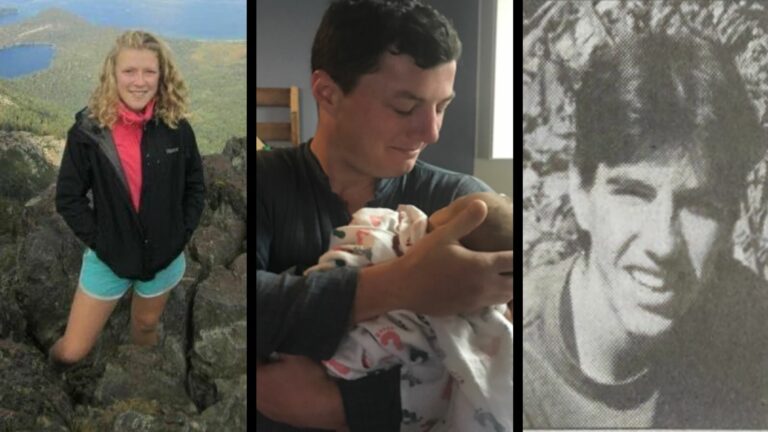
Ojakian’s son, Adam, died by suicide in December 2004 when he was a senior at UC Davis. Adam had not shown suicidal tendencies, and he was never diagnosed with a mental illness. His death is what is referred to as an “out-of-the-blue” suicide, Ojakian said.

“You’re subjected to someone you love taking their life unexpectedly,” Ojakian said. “And there is a level of trauma around that. I’m not even sure if I’m capable of explaining it.”

Later, in conversations with his son’s peers, he heard “what a wonderful guy” Adam was.

“I think one called him a ‘gentle giant,’” Ojakian said.

In retrospect, Ojakian suspects his son was struggling with major depression.

Adam’s death was also part of what is referred to as a suicide cluster. He was the fifth of six UC Davis students who died by suicide that year. A cluster, according to Ojakian, is not stopped “by doing nothing,” so it upset him that the university had not informed families of the situation.

At the time of Adam’s death, Ojakian said he “didn’t know four students had killed themselves prior to my son taking his life.” In his eyes, “it might have been helpful to know that.”

UC Santa Barbara, unlike UC Davis, notifies its campus community when a student dies. UC Davis students who served on the chancellor’s mental health care task force, convened in 2018, “were asking for more communication” from the university, and brought up examples of emails sent by UCSB to its student body upon a death in the campus community, said Margaret Walter, UC Davis’ executive director of Student Health and Counseling Services. 

Currently, no changes have been made to UC Davis’ policy.

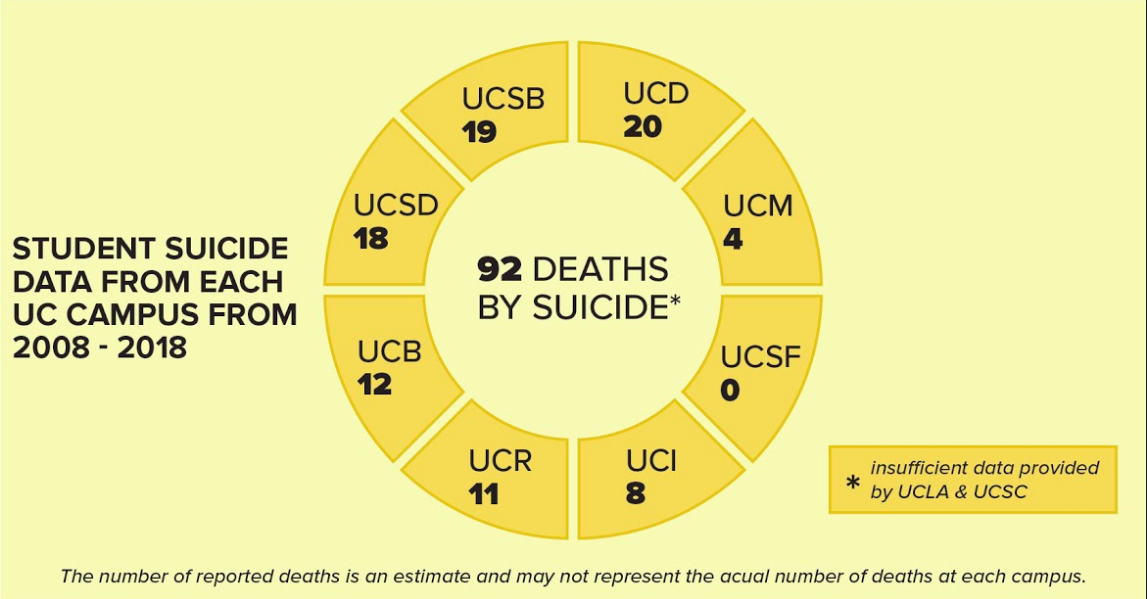
In the decade between 2008 and 2018, an estimated one to two UC Davis students died by suicide each year. This is the case for every year except three: An estimated four students died by suicide in 2011, an estimated three students died by suicide in 2012 and an estimated five students died by suicide in 2013, according to data collected by The California Aggie.

The UC does not require its campuses to collect suicide-related data, nor does there exist a “systemwide UC policy or standard on collecting suicide data,” according to Andrew Gordon, a spokesperson for the UC Office of the President (UCOP).

“There is no systemwide definiton of suicide nor policy thresholds at which suicides must be reported by a campus,” Gordon said via email. “Though campus counseling centers typically do collect this data and share with campus leadership locally.”

The Aggie submitted 20 California Public Records Act requests for the previous decade’s worth of student suicide statistics at each of the 10 UC campuses. 

According to the responsive records, UC Davis, which saw 20 student deaths by suicide between 2008–2018, had the highest number of any UC campus. This number is based on deaths classified as a suicide by the county coroner, who then notified UC Davis Student Affairs. This data may not represent the actual number of student suicides at UC campuses over the previous decade. Because there is no system-wide definition or standard in use, it is difficult to accurately compare data on deaths by suicide across UC campuses.

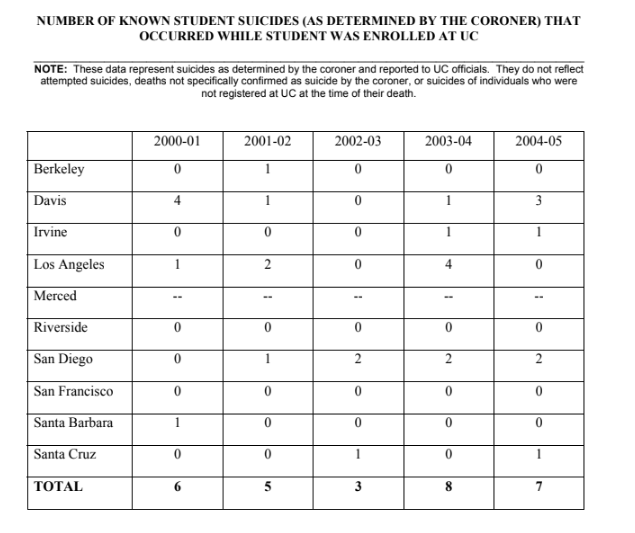
UC Davis also showed the highest number of student deaths by suicide of any other UC campus between the years 2000–2005, the period of time during which Adam died. UC Davis saw nine out of the UC system’s total 29 student deaths by suicide during this time period, according to the 2006 “Report of the University of California Student Mental Health Committee.”

In 2006, Ojakian was asked to testify at a U.S. congressional hearing aimed at updating the National Mental Health Act. He recalled that an aide for former Congressman Patrick Kennedy approached him and remarked on the UC’s report from that year.

“He said that they had been touring in California, and they’d just been visiting UC Davis and they understood that it had the highest number of suicides of any of the campuses,” Ojakian said. “That’s not something to be proud of. If you’re in that situation, you should be doing more.”

As far as he knows, Ojakian said his son had not sought out counseling services beforehand — but, as Ojakian noted, “I don’t know how he would have.” Over the past 15 years, the mental health resources offered by UC Davis have drastically changed. In 2004, the year Adam died, the CAPS budget “had been cut eight consecutive years; they were operating on a shoestring,” according to Ojakian.

In 2004, the year Adam died, the CAPS budget “had been cut eight consecutive years; they were operating on a shoestring,” according to Ojakian.

“We knew that students who were in need had no idea about what was available, what to do,” Ojakian said.

That’s when he and his wife, Mary, became advocates for student mental health.

For over a decade, the Ojakians’ advocacy work has led to tangible changes at UC Davis (additional student services); changes at UCOP (the creation of a Suicide Prevention Website and the Red Folder Initiative, a reference guide to mental health resources used by campuses both inside and outside the UC system); changes at the state level (Assembly Bill 89, which requires that all psychologists in the state receive training in suicide prevention) and even changes at the federal level.

Both Ojakian and Lomax worked on getting AB 89 passed for over five years — as Ojakian noted, if you do work in suicide prevention, “you have to be persistent.”

Described by others as a “fountain of information” on student mental health and suicide prevention, Ojakian repeatedly clarified that none of this advocacy work was done alone. He is also adamant about the fact that his advocacy work, which has saved lives, is not enough.

“We still think suicide is not something we can do anything about”

Since 1999, the U.S. has seen a 33% increase in its national suicide rate, and that rate is expected to rise amid the coronavirus pandemic. Yet, a “statistically strong and reliable method” to identify those at high-risk of suicide “remains elusive,” according to a 2016 study in the journal PLOS One

Dr. Jane Pearson, the special advisor to the director on suicide research at the National Institute of Mental Health, said identifying factors that explain the upward trajectory of the nation’s suicide rate over the past decade is “the big question we would love to answer.”

“To say what one thing is contributing to suicide risks is really hard,” Pearson said. “The field is struggling right now […] to understand what’s going to be the most effective type of intervention.”

A key factor identified by several suicide prevention advocates is awareness. According to Craig Lomax, when a group of individuals understands foundational information about suicide and mental health, relevant stigmas and fears associated with seeking help are “reduced dramatically.”

In June of 2012, Lomax’s daughter, Linnea, died by suicide when she was a 19-year-old freshman at UC Davis.

“People described her as being extremely positive, extremely generous and just very interactive and encouraging,” Lomax said.

She was also diligent, thorough and a perfectionist, he said.

In May of 2012, Linnea was severely underweight and engaging in other physically destructive behaviors — “I just didn’t understand that it [was] the size of something much deeper going on,” Lomax said. 

He remembers apologizing to Linnea’s roommate about the stress of the situation, and he recalls that “the roommate’s response was one of, ‘Oh yeah, well this kind of thing happens when you don’t know how to handle stress. I handle it just fine.’”

“She was clueless,” Lomax said. “I’m really not irritated, but that echoes my point of: What if everybody in the room understands the foundation of this? She might have been able to help surface Linnea’s understanding of what was going on. [Linnea] might have been able to get help earlier.”

On her 19th birthday, Lomax tried to talk Linnea out of taking her upcoming finals and coming home. UC Davis was immediately cooperative to the idea, but because Linnea was over 18, it was her decision to make. She was “absolutely certain” UC Davis was not going to let her return because she felt her grades were so poor, Lomax said, noting that she had a 3.83 GPA.

“Our rights are wonderful, […] however, when a mental illness comes in, it starts representing the body and that isn’t reflective of who that person is or their values,” Lomax said. “People start listening to the mental illness while the person is dying, and the mental illness wants to be destructive to the body.”

Soon after her birthday, Lomax found his daughter in a suicide attempt and took her to UC Davis’ Counseling and Psychological Services (CAPS).

“The clinician looked at her and […] said, ‘Yeah, I don’t think that she’s going to commit suicide.’ I just came from a suicide attempt 30 minutes ago,” Lomax said. “The clinician was a little bit impatient because she had other things to do, but I pressed for a letter because in order to get her out of finals, we needed a letter. 

“So we got that, but we didn’t get any other direction,” Lomax said. “We didn’t get any other help. We have no [idea] what to do, where to go, what to learn. Now that I know a lot about suicide prevention, [that was] completely incompetent and wasn’t adequate at all.” 

 “We didn’t get any other help. We have no [idea] what to do, where to go, what to learn. Now that I know a lot about suicide prevention, [that was] completely incompetent and wasn’t adequate at all.”

Lomax decided to write emails to a number of psychologists, one of whom recognized a dangerous combination in Linnea: that of suicidal ideations and perfectionist tendencies. The psychologist made an emergency appointment to see Linnea and recommended that she be admitted to an outpatient therapy center in Sacramento.

Linnea spent 10 days in a psychiatric hospital under a hold. On the eleventh day, she went to a voluntary outpatient program under the supervision of her hospital psychiatrist. On this day, she voluntarily left, three hours before her parents were scheduled to pick her up. She had not alerted anyone to her whereabouts.

“We were stupid, we didn’t think voluntary meant voluntary […] or I would have had a chair and waited and watched the building — that’s how concerned we were,” Lomax said.

Over the next 10 weeks, as Linnea’s story gained media coverage, over 1,300 people from Sacramento and the Lomax’s hometown of Placerville searched for her. Lomax said his family received over 300 phone calls reporting Linnea sightings, but only two of the 300 calls were actual sightings.

“Most parents can’t get it around their heads that their kid is suicidal, but even after you know that your kid is suicidal, it’s another thing to actually think they would do it,” Lomax said. “And that’s true of any human. We respect each other enough that we can’t fathom that that person that we know could actually do that, it just doesn’t make sense. So you have a hard time believing it. And we had 300 phone calls that said, ‘We’re seeing her in Sacramento.’ We would rather believe that.”

Ultimately, after a 10-week search, it was Linnea’s mother who found her body.

“It’s completely horrific and destroyed us in so many ways,” Lomax said. “It didn’t destroy us all the way, if I was still searching for my daughter, which I would be.”

The Lomaxes received hundreds of cards offering condolences for Linnea’s death, including one from UC Davis.

When Linnea died, Lomax said he was “totally uninformed about mental health and mental illness.” He has now educated himself and others on these topics.

“We do a lot of things nowadays to save a life,” Lomax said. “What degree will the campus go to save one of those lives? I suspect that they’d be willing to spend millions of dollars if they thought they could save a life. We still think suicide is not something we can do anything about.

How we talk about suicide

Patti Pape, an active member of the National Alliance on Mental Illness, is currently teaching classes aimed at de-stigmatizing mental illness. In these classes, she talks about suicide and addresses the “fact that bringing up suicide does not ‘plant a seed.’”

“It needs to be discussed and communicated,” Pape said.

Pape’s son, Eric, died by suicide in May of 2017 while attending UC Davis. Eric was a traveler, an anthropologist and someone who “worked hard” and “felt deeply,” Pape said. A psychology major, he entered UC Davis as a junior transfer and worked in a neuroscience lab. 

According to Pape, Eric had not struggled with his mental health before transferring to UC Davis.

“The transition to Davis was more difficult than I had seen him experience before,” Pape said. “He had always had pretty stable relationships with friends and family, and not having that support system right at hand, right away, really took its toll on him.”

Eric began receiving support for anxiety and depression through drug therapy and through UC Davis counseling services. His first suicide attempt was in January of 2017, and he was checked into Sutter Davis Hospital and placed on a 72-hour 5150 hold. While there, an altercation occurred between Eric and a nurse at the hospital. After his release, and after he returned to school, Pape said Eric was doing better until he was charged with felony battery for the altercation.

“The trial was delayed and he felt more and more desperate,” Pape said. “He was still going and seeking services but he […] basically just decided there was no other way to solve the problems. His perception of himself was all based on what was going on with this trial and the outcome of that, because that was going to change his life irrevocably.”

In his last few weeks, Eric requested to see a specific UC Davis counselor, but there was a wait until he could see them. If Eric had been able to see the counselor, “I think that could have made a difference in the outcome,” Pape said. She believes the support UC Davis provided to Eric was “adequate,” but that “in a crisis, they let him down.”

After her son’s death, Pape received Eric’s diploma posthumously. She said she appreciated meeting the chancellor and being treated “in a nice way” by university officials, “but there was no acknowledgement of the fact that he killed himself.”

When a student dies by suicide, there is some level of fear held by a university that it will be blamed for the death, said Paul Gionfriddo, the president and CEO of Mental Health America. 

Although UCOP does not require that campuses maintain student suicide statistics, Ojakian believes “they know who’s died on campus.” 

“They try and hide it and mask it because they don’t want it reflecting on their service,” Ojakian said. “There’s a legitimate reason: They don’t want to create concern or consternation on a campus, but there’s also a level where they don’t want people to know students are dying on campus.

“My son died in the middle of December,” Ojakian said. “Then we got a call from the CAPS director — I think it was between Christmas and New Year’s. He’s calling for a reason. He knows my son is dead. They know. Regardless of what they say.”

In Ojakian’s mind, the UC president needs to be making sure that each campus has a plan and that these plans are being communicated between the campuses — “the fact of the matter is that the president’s office should be more involved.”

When it comes to work in suicide prevention, “you have to overcome things like being dismissed or avoiding dealing with suicide,” Ojakian said. “We think if we turn the other way, it won’t exist.”

But what happens when you lose someone to suicide?

“Other people talk with you, they ask you about what’s going on with their loved one or tell you about what happened to one of their children, so then you start seeing the bigger picture,” Ojakian said. “People started telling [me], ‘My son is at a community college and he has attempted to take his life.’ But it’s not just the campuses, it’s the whole culture that doesn’t want to talk about this. So, then you get to realize how big a problem that is. If you just sit back and do nothing, it’s not a solution.”

Ojakian’s home county of Santa Clara has a formalized suicide prevention plan, thanks to work done by Ojakian and others. His county is one of only seven out of the total 58 California counties that has a suicide prevention plan (Ojakian worked on a bill that would have required every California county to have a suicide prevention plan, but the bill was held by the appropriations committee without explanation).

Santa Clara has the lowest suicide rate in the state. Whereas the state of California has seen an increase in its suicide rates over the past several years, Santa Clara has seen a decrease from 150 down to the low 130s.

“I’m not a clinician, but it doesn’t prevent us from doing something,” Ojakian said. “I’ve educated myself on this topic, because my end goal is to save lives. In a sense, I’d rather not have people call me. I’d rather know that everyone’s loved one is safe and/or getting help because they need it.”

Suicide prevention at UC Davis

When the head of a university’s counseling department is asked about the work they do related to suicide prevention, they will say that all of their work is, in some form, related to it. 

“All the work we were doing was effectively an attempt at suicide prevention in the same way providing medical care working in hospitals is working death prevention,” Schwartz, who was also the former medical director at New York University’s counseling services and current chief medical officer of The Jed Foundation, said.

The current work related to suicide prevention undertaken by UC Davis is vast and varied. After noticing an uptick in student suicides, UC Davis officials began a multi-year process guided and supported by The Jed Foundation. The process has consisted of the foundation providing the university with feedback aimed at improving its mental health care and suicide prevention efforts.

When schools provide more of these types of services, “suicide rates go down,” Schwartz said.

As part of a recommendation by the foundation, UC Davis has recently created and implemented a set of postvention guidelines used by the university in its response to traumatic events, including suicides. The guide is meant to ensure “a rapid and adaptable response aimed at preventing the trauma from growing,” according to the UC Davis website.

“Last year was about improving access,” Walter said. “We’re trying to open up the avenues where students can get support.”

And because universities provide some form of reliable community support, there is reason to believe that college is a safer place to be for individuals with mental health issues. In fact, the “actual rate of suicide is lower among college students than non-college-attending 18- to 25-year-olds,” Schwartz said.

Ojakian and other advocates, however, see college campuses as having a “captive audience” and, thus, an opportunity to reach out to students and let them know that “there are alternatives to taking your life.” There is a shared belief held by Ojakian, Lomax and Pape that universities can and should be doing everything in their power to prevent suicides from occurring. 

“As parents, we send our children to an institution of higher learning assuming that these places are enlightened and open to research-based changes, and then when they seem to disregard that responsibility it’s disheartening,” Pape said. “What is the focus of the UC system? Is it research? Is it fundraising? Or is it our undergraduates and graduate students who need to get an education in a nurturing environment?”

This past May 4 marked the second anniversary of Eric’s death. In a recent email, Pape talked about the feelings that the anniversary prompted. 

“Everyday is a bit easier to recognize the reality of our loss, but it certainly doesn’t keep us from missing his presence and wondering how he would be reacting to the craziness our world is in with this pandemic,” Pape said. “We all agree he probably would have backpacked up into the mountains and waited it out.”

Amid the coronavirus pandemic, Chancellor Gary May has made it a point to highlight the mental health resources available to students. Those resources, as they appear on the SHCS website, include the following:

  • Mental health visits: Counseling Services are available by phone or via secure video conferencing. Schedule an appointment through the Health-e-Messaging portal or by calling 530-752-0871. All Mental Health Crisis Consultation Services are offered via phone consultation or secure video conferencing. Call 530-752-0871 to access these services.

The number for the 24/7 National Suicide Prevention Lifeline is (800) 273-8255; the number for the 24/7 Crisis Text Line is 741741; the number to speak with a trained counselor through The Trevor Project, available 24/7, is 1-866-488-7386 and the number for Yolo County’s 24-hour crisis line is (530) 756-5000 for Davis callers.

Written by: Hannah Holzer — campus@theaggie.org 

Editor’s Note: A previous version of this article stated that Linnea Lomax voluntarily left a Sacramento hospital. This has been clarified to reflect that Lomax spent 10 days in a psychiatric hospital and was then transferred to a voluntary outpatient program. It was this program that she voluntary left. The article has been updated to reflect these details. The Aggie regrets the error.

Asian giant hornets sighted in US for first time, UC Davis entomologists say media exaggerated severity of issue

Despite sightings of giant hornet species, spread through North America highly unlikely, experts say 

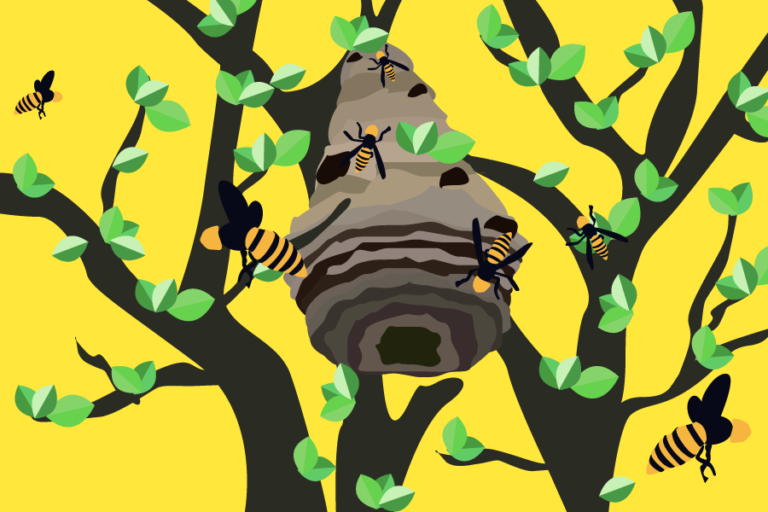
Giant, tiger-striped insects have been making quite the buzz lately. Vespa mandarinia, or the Asian giant hornet, typically lives in eastern and southeastern Asia, but two individuals of the species were sighted in the U.S. for the first time.

The Washington State Department of Agriculture (WSDA) verified two reports of the Asian giant hornets near Blaine, Washington in December of 2019. One report was of a dead hornet, while the other was of one spotted flying back into the forest. Additionally, a giant hornet nest was found and destroyed in a park south of Nanaimo, British Columbia, Canada.

In Washington, neither the second hornet nor its nest were found, but researchers are fairly confident their removal efforts were successful. In April, Blaine local authorities alerted residents to the possible threat and asked them to stay vigilant, according to the WSDA.

“They found a dead individual and were able to confirm that, yes, this is Vespa mandarinia,” said Eleanor Field, a doctoral candidate in entomology from Iowa State. “Then the same resident also said, ‘Hey, I saw another one and it went off into the woods.’ That means we have one confirmed dead individual and another presumed confirmed sighting.”

Although recently introduced potentially invasive species should not be downplayed, many researchers, including Lynn Kimsey, a professor of entomology and director of the Bohart Museum of Entomology, believe the media exaggerated the severity of this issue. 

“[Somebody] at the Associated Press got bored with coronavirus coverage and decided to whip up frenzy on something else, but it’s absolutely ridiculous,” Kimsey said. “This happened almost six months ago. This is old news.”

While nobody knows exactly how these hornets arrived in the west coast, most likely a mated queen was transported via shipping cargo from Asia to the U.S, Kimsey said. 

One possibility is that someone brought a colony to the U.S. to eat the larvae, but that is “less likely,” Kimsey said. While this species is novel to many people in the U.S., these insects are well known in Asian cultures, and their “crunchy” and “very flavorful” larvae are considered a delicacy, Kimsey said. This species has also been well studied by scientists in Asia, especially in Japan. 

“As large and as nasty as these wasps are, they’ve been in China and Taiwan and Korea and Japan for thousands of years cohabitating with people and beekeepers there,” said Douglas Yanega, the senior museum scientist for the Entomology Research Museum at UC Riverside. 

Although the term “murder hornet” has been readily adopted by news outlets, Asian giant hornets present no more of a threat to humans than other species in North America. All hornets will sting intruders multiple times with their straight stingers to defend their hives, Field said. 

“There’s nothing more aggressive about this species that makes it sting multiple times, it’s just physically able to do that,” Field said. “Their venom is a little more potent than honeybee venom, but it’s not the most potent venom. It’s not even the most dangerous hornet of them all.”

Unless individuals have an allergy or receive dozens of stings, stings from these hornets rarely require medical attention, Field said. In Japan, these hornets kill up to 50 people per year, according to The New York Times

“It’s very, very unlikely that a person here in the United States is going to come across these guys,” Field said. “These are big hornets, so you’re probably going to know that they’re there. So, the risk is pretty low for people here in the United States.”

Just because the hornets have been introduced to North America does not mean a population will be successfully established. Many barriers exist for species in new environments, such as surviving new climates and competing with native species, Kimsey said. 

Since hornets are social insects, the survival of their reproducing queen is paramount to a population’s success, Field said. Queens mate in the fall, hibernate through the winter and reemerge to reinstate the population in the spring. The one hornet that escaped in Washington would not be able to survive on its own.

“It takes almost an entire year for [the hornets] to build the colony up before they can produce reproductively,” Yanega said. “If they get intercepted or interrupted anywhere in between, then the whole thing fails.”

Since no individual hornets have been seen thus far in 2020, it is likely that no queen survived through the winter to reestablish a colony, Field said. 

“It doesn’t matter how many males or non reproductive workers survive, you really have to have the mated queen, so that automatically kind of reduces the likelihood of the chances that they successfully survived,” Field said. 

Despite widespread news coverage, only people in Blaine, Washington should be paying attention to the pest watch, Field said. WSDA released a statement regarding the hornet to alert their community, not to cause widespread panic throughout the U.S. 

“For anybody living anywhere else, this is none of your business really, and it shouldn’t affect you and you shouldn’t be thinking about it or worrying about it,” Yanega said. 

One reason for the surge in news stems from the hornets’ large size. As the largest hornet species in the world, adults can be up to two inches long, Kimsey said. 

“People are very excited about their size, but they’re not the only large hornets,” Field said. “There are several other large wasps out there so just seeing something big is not a great indicator that you have this species.” 

While some media outlets have been depicting this hornet species as aggressive and “particularly mean,” many of their behaviors resemble that of other hornets, according to Field. Behaviorally, this species shares characteristics with other social wasps. 

“[Their antivenom stinging mechanism to protect their hive] is not something specific to the species, it’s something that you see across social insects,” Field said. “They’re not meaner than others, they’re just doing their job.” 

The most focused-on behavior of these giant hornets is their predation of honey bees, despite the fact that other insects, like yellow jackets, prey upon them as well. Asian giant hornets have a particularly gruesome way of ambushing a honey bee colony, Field said. After decapitating honey bees, these hornets remove their thoraxes and feed them to their larvae. 

Even though western honey bees are not native to the U.S., they have been living in North American environments for so long that they are now essential agricultural pollinators, said Gigi Melone, a third year entomology major. 

“[Asian giant hornets’] effect would be on the crops that use honey bees to pollinate them,” Field said. “This is a huge, multi billion dollar industry here in the United States so the concern really is economic and less ecological.”

Their gruesome honey bee attacks may be why people use the term “murder hornets” to describe the species. Field said she is unsure how this name originated but guessed that it could have been coined from a translation of a Japanese common name, or by media outlets in the U.S.

“I think they picked [the name] to draw up hysteria and to sensationalize this insect,” Field said. “It was pretty effective at doing that. It’s crazy because they’re not going around murdering people.”

Despite the negative coverage regarding the Asian giant hornet, it always excited Melone to see insects in the news. Both Melone and Field hope the news about the hornets will spike interest in insects. 

“I think if this has made people curious about insects, it’s a great time to start learning about insects, because they’re all around us, especially in spring,” Melone said. 

Written by: Margo Rosenbaum — science@theaggie.org

NCAA takes next step in move to change NIL guidelines

Board releases 31-page plan outlining recommendations for athletes, schools

In October of 2019, the National Collegiate Athletic Association (NCAA) Board of Governors announced its decision to begin allowing student-athletes to be compensated for their own name, image or likeness (NIL). In the weeks and months that followed the announcement, many questions remained, including how to ensure these new rules would not create an unfair imbalance in collegiate athletics. 

On April 17, the NCAA finally provided some additional clarity on how it planned to move forward with “modernizing” NIL rules. In its 31-page “final report and recommendations” document, the NCAA Board of Governors Federal and State Legislation Working Group outlined the basic guidelines it planned to use in crafting its new NIL rules. 

Student-athletes will now be able to take advantage of their own success and marketability. They will have the opportunity to be paid for their social media influence, appearing in commercials, giving athletic lessons, holding autograph signings and more. Athletes that enter college with a national following, or develop one during college, will be able to capitalize off that by seeking out paid opportunities — but many believe that the majority of athletes will receive the bulk of their endorsements locally.

Schools in any pre-existing NIL negotiations or activities will be excluded from this. While student-athletes will continue to be a part of their respective school’s program, they are not permitted to be paid by the universities themselves or be classified as employees of said schools. Colleges, universities and their athletics departments are to play no role in the student’s activities regarding seeking compensation for their NIL. 

Another major recommendation set out by the NCAA states that a student-athlete is not allowed to show any signs of affiliation, like a school or conference logo, when conducting NIL activities. This allows the NCAA and its member organizations to further distance themselves from such dealings.

Opponents of new NIL guidelines have been concerned about the nature of possible student-athlete deals, as some say they could be used to create improper incentives for certain players or programs to sway a recruit away from another school. But the NCAA emphasized that these potential deals will be completely separated from athletics. 

“Any compensation received by student-athletes for NIL activities represents a genuine payment for use of their NIL, and is not simply a disguised form of pay for athletics participation,” the report reads. “Schools or boosters are not using NIL opportunities as a recruiting inducement.”

These recommendations may seem cut and dry on paper, but in reality, the NCAA will likely have a difficult time keeping track of recruits and ensuring that NIL deals do not have a direct impact on a recruit’s decision. Especially when it comes to well-known, power five programs, there are obviously more opportunities for student-athletes to capitalize on their NIL at these schools compared to others. 

“It is representative of progress in economic freedoms and rights for student-athletes, which I think is very positive,” said UC Davis Director of Athletics Kevin Blue in an email. “There are a number of granular details that will still be worked out.”

Although these rules seem to favor schools with bigger and more lucrative athletic programs — football in particular — that doesn’t mean that similar opportunities for student-athletes are nonexistent at schools where athletics are on a comparatively smaller scale. 

“The visibility for student-athletes at some of the FBS programs is certainly higher, therefore the earning potential […] is higher,” Blue said. “But I would not underestimate the earning opportunities that will present themselves locally. Our intention is to educate our student-athletes as to how they can best optimize their earning potential.”

How some schools will go about adapting to these new rules — which will go into effect at the beginning of the 2021–2022 academic year — remains to be seen, but UC Davis Athletics seems to be committed to helping its student-athletes. Blue, at least, sees this as a possible learning experience for student-athletes, rather than a hindrance to their academic performance.

“There are people who believe increased commercial rights […] will have an impact on academics, I just don’t believe that at all,” Blue said. “In fact, these commercial experiences will help student-athletes become more sophisticated about how the real and business worlds work.”

A major takeaway from the NCAA’s report is the organization’s continued attempts to separate itself from student-athletes and underscore the fact that the students aren’t employees of the NCAA or its member universities. While the NCAA is loosening its financial hold over these athletes, it still emphasizes that all new NIL rules must be made in congruence with its “core values, mission and principles.” 

The plan on paper seems reasonable, as some student-athletes will finally be able to freely profit off of their own hard work and talent. How the NCAA will go about enforcing these rules, however, is still unclear, as many more details are set to be released in the near future. Nonetheless, endorsement deals, social media influencing opportunities and much more will be at the disposal of college athletes across the country, as they will soon begin the new era of college athletics.

Written by: Omar Navarro — sports@theaggie.org

Sexual recession heightened by social distancing

Staying six-feet apart in the streets and in the sheets

Sex is a highly taboo subject in American culture. We would rather use euphemisms like “sleeping around” than that one syllable, three-letter word to avoid judgemental eyebrow raises from the stranger next to you. 

But I’ll just go ahead and take advantage of its lexical simplicity and say “sex” roughly 69 more times than you would typically hear on a daily basis. I’ve already said it twice… uncomfortable yet? 

Through memes, social media and word of mouth, it’s evident that the pandemic has made individuals sexually frustrated. 

“Now we’re just chilling and forced to realize how freakin’ horny everyone is,” said one third-year human development major, who requested to remain anonymous. 

Our libido has skyrocketed in the past few months, but because of the stigma around sex, nobody is really emphasizing the pandemic’s effects on our sexual well-being.

Nevertheless, Dr. Nicole Polen-Petit, a professor of human sexuality in the human development department, views the act of sex as “beautiful” and “wonderful,” contrary to popular belief. In an ideal world, sex would not sound and feel dirty spoken aloud, but rather be “seen as positive where it’s acknowledged in its different facets and importance throughout the lifespan,” she said. 

According to Polen-Petit, humans are sexual creatures and require connection with one another from the very first to the very last breath. Without being touched, held and cuddled, we cannot thrive as infants. Without touch, “we cannot sustain life,” she said.

Our sensual nature in infancy flourishes into sexual desire, where “sexual touch and interaction become more important,” Polen-Petit said. She describes human sexuality as a journey rather than a stopping point or destination.

“What I would like to see is that we move away from a fear-based understanding and instead, understanding how much it can add to our lives rather than this discourse about taking away from it,” Polen-Petit explained. 

Initially, Polen-Petit was saddened by the idea of a COVID-19 sexual recession. There was evidence of a sexual recession prior to the pandemic, according to The Atlantic, and Polen-Petit believes that social distancing will only further negatively impact our sexual connections. 

“To know that there is yet another force that is moving people away from each other rather than bringing them together is sad,” she said. “For me, the hardest thing about this situation is the distance that it’s causing between human beings.” 

Confirming Polen-Petit’s fears, one anonymous animal science major predicted that, as time went on, her sexual restlessness would increase as a result of social distancing. However, she’s “so used to the fact that [sex] isn’t an option” that she’s not as sexually inclined overall.

“I always thought [sex] was just a fun bonus,” said one second-year animal science major, who also requested anonymity. Although sex is important to her, it is not the most significant part of an intimate relationship — it’s moreso the icing on the cake. The change in her libido is a result of many different reasons, but is significantly due to stress. 

Prior to the coronavirus pandemic, normal routines were inundated with deadlines and anxiety. These external pressures hindered relationships, and social distancing measures make people even more fearful of contact with others.  

Polen-Petit worries that this social distancing and constant vigilance may seriously harm our mental, emotional and relational health. In order to prevent this from happening, she recommends focusing on emotional literacy with our intimate partners we are sheltering in place with during this time. 

“We act on fears, we act on those emotions, and we often take them out on those that we love the most,” she cautioned. 

It is important to name the stressors and talk them out rather than act them out in order to ultimately grow our communicative, emotional and relational well-being. Learning about our sexual desires, however, doesn’t always need to involve others.

“[The current pandemic] can really be a time of self-reflection and self-understanding, and that can really improve our health and our sexual well-being,” Polen-Petit said. 

According to the human development major, he has taken this time to consider his own sex drive and how it can be observed rather than always responded to. 

“It’s good practice to settle down, take a breath and realize it’s not as important as we once thought,” he said. 

Social distancing has forced him to engage in less meaningless sex and convert that energy once dedicated to hook-ups to exercise and meditation. He has even realized that as a heterosexual male, he sincerely enjoys female company and that he misses that platonic connection maybe even more than the sexual one. 

Some individuals, however, are taking a more hands-on (as hands-on as we can be) approach. 

“I’ve been sending and receiving more nudes than I ever have,” said the animal science major. 

She is in a committed relationship and is viewing this time apart as a test to her relationship. As physical beings, she admits that although there are sexual barriers that restrict the physical aspect of the relationship, she still communicates with her partner frequently. 

For those not engaged in a committed intimate relationship, these solitary times can be tough without social scenes creating opportunities for potential relationships. But with advanced technology, many individuals are “shooting their shot” by sliding into DMs or utilizing the Tinder app more than ever. 

While some are just waiting to get back in the game to make up for lost time, others are engaging in do-it-yourself approaches. If you thought that sex was the only taboo subject I was going to whip out, just wait until this next one — masturbation. 

If you cringed a little while reading that, you’re not alone. The taboo around masturbation has existed for hundreds of years — to the point where it was thought to cause mental illness and hysteria, according to Polen-Petit.

“Despite masturbation’s notorious reputation, it’s a great way to get to know your own body, understand your own anatomy and learn what feels good so that you better communicate with partners,” Polen-Petit said. 

“It’s all positive,” she said. “We need lots of tools in our toolbox during this time, [and masturbation] can certainly be one of the more interesting tools to help us cope in a healthy way.”

Self-orgasm is a powerful method to “keep some of those passions alive” amid the sexual obstacles of the time. Orgasms are pain relievers and release endorphins like oxytocin, a hormone in our body which helps our emotional bonding with partners — all good things. 

It’s a common adage that it’s best to have sex with someone you love, so who better to love than yourself? It is certainly the time to “masturbate while you isolate” because it is safe, educational and satisfying. 

Polen-Petit highlights the positive health aspects of masturbation since coronavirus has seemingly taken precedence over sexual healthcare. 

“What we’re seeing now is that behavior is actually translated to individuals not seeking care for themselves, and we’re seeing lots of problems going undiagnosed,” she said. “If you need something, seek it out.”

Although our healthcare seems to be limited right now, there are online resources providing care even while social distancing orders are in place. Many providers are utilizing Zoom and phone call appointments to limit contact. That said, do not hesitate to reach out to your healthcare providers if you have any questions or concerns.

“Put your sexual health as a priority,” Polen-Petit said. 

Polen-Petit is optimistic that the coronavirus pandemic will positively impact attitudes surrounding testing so that people are more comfortable getting tested, in general, whether for the flu, COVID-19 or sexually transmitted diseases.

“We have an opportunity to emerge from [the pandemic] better human beings,” Polen-Petit said. “Thinking more of each other having taken this time to think about ourselves and learn about ourselves.”

You’ve made it through, congratulations. Twitter memes were simply the tip of the iceberg to this inevitable conversation. Although I had to do the dirty work (no pun intended) to get there, here we are. 

Written by: Sierra Jimenez — arts@theaggie.org