We’ve spent millennia seeing spirits in nature — now we’re filling the void with Alexa
By MILES BARRY — mabarry@ucdavis.edu
David Hume once said, “there is an universal tendency amongst mankind to conceive all beings like themselves, and to transfer to every object those qualities.”
If you’ve ever named your car, kicked a broken vacuum or yelled at a dysfunctional television remote, you’ve felt this urge.
Anthropomorphizing is defined as “the tendency to imbue the real or imagined behavior of nonhuman agents with humanlike characteristics, motivations, intentions, or emotions,” according to PubMed. It can serve as a useful heuristic when attempting to understand complex systems; it’s easier to imagine your thermostat “wanting to” increase the temperature than to understand its complex mess of wires. Psychologists and cognitive scientists are divided on the evolutionary reasons for anthropomorphism, but they generally agree that it’s hardwired into the human psyche.
In fact, some scholars believe that this impulse led to animism — a pre-modern belief that non-human things have souls. Before we had scientific explanations for natural phenomena, anthropomorphism meant seeing human-like beings everywhere; trees and streams were cared for by friendly spirits, natural disasters meant the gods were angry and, according to anthropology professor Christine VanPool, even clay pots “had a spiritual essence that is affected by and that impacts humans.”
All this to say, we see human traits in everything: in our fickle bicycles, irritating electric toothbrushes and trustworthy hammers. Humanity collectively yearns for the time when our world was enchanted; when we could speak to a clay pot and it would answer.
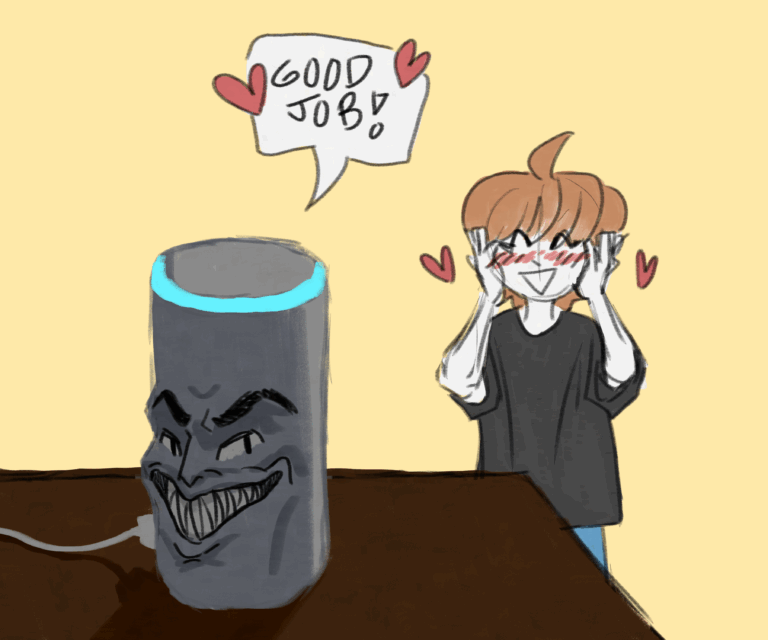
This desire for enchantment is the driving force behind the effort to make computers conversational. Because of our instinct to anthropomorphize inanimate objects, projects like Amazon’s Alexa, Apple’s Homepod and Google Home are easy sells for executives and consumers alike. Tech companies use this blurred line between user and device to sell you machines that will re-enchant your life.
Clifford Nass argued in 1994 that computers are social actors — he found that computer-literate college students would treat speaking computers according to gender stereotypes, follow politeness norms with them and respond well to their praise. Paying careful attention to the language humans use to describe computers reveals further tendencies to humanize: we “interact” with computers, they have “memory,” they are “intelligent.” We’ve also begun to describe our own brains in computer terms, saying things like “I’m still processing that” or “that’s just how I’m wired.” Now, with the continued development of artificial intelligence (AI), it’s never been easier to speak with a computer.
But re-enchantment, when cynically abused by profit-seeking tech companies, is dangerous. For one, David Hoffnes, a professor at Northeastern University, said that smart devices “allow nearly any company to learn what devices are in your home, to know when you are home, and learn where your home is.”
Beyond tracking, these devices are also listening. The Verge reported in 2019 that anonymized Alexa audio recordings are reviewed by a small army of human workers — if the device is activated by mistake, a stranger could hear some of your most intimate moments. I wouldn’t trust Amazon — the company with “a sophisticated, secret program and team to spy on its workers in closed Facebook groups” — to use its microphone-equipped devices responsibly.
Smart devices also reinforce gender stereotypes by defaulting to female voices for subservient roles. Derek Connell, senior vice president for search at Microsoft, told the New York Times that “both men and women prefer a woman, younger, for their personal assistant, by a country mile.” Siri used to respond “I’d blush if I could” when users verbally abused her — reinforcing that female-voiced entities should tolerate, and even enjoy, abuse.
Letting smart devices infiltrate (or “re-enchant”) your home is more dangerous than is popularly believed; it’s a step towards the insidious erosion of boundaries between humans and our tools. Americans are lonely enough that the United States Surgeon General penned an advisory in 2023 detailing health hazards caused by our loneliness epidemic. We’re stuck with tech oligarchs who want you to pay for computer friends, instead of effective policy addressing the epidemic’s root causes — isolated, car-dependent suburbs, dwindling availability of third spaces and a high cost of living.
When your house can talk to you, agree with everything you say and understand all of your interests, will you still want to go on that coffee date? Smart devices promise convenience, but as they get more intelligent, it will be dangerously easy to retreat into a cocoon of artificial companionship, without any of the work of maintaining real relationships. We may have re-enchanted the world, but we’ve done so in the loneliest way possible.
Written by: Miles Barry — mabarry@ucdavis.edu
Disclaimer: The views and opinions expressed by individual columnists belong to the columnists alone and do not necessarily indicate the views and opinions held by The California Aggie.