57 F
Davis

Davis, California

Monday, December 22, 2025
Home Blog Page 51

The language of dehumanization

How dangerous political rhetoric works to normalize the mass deportation of undocumented Latino immigrants


By TARA ROMERO— tcrome@ucdavis.edu


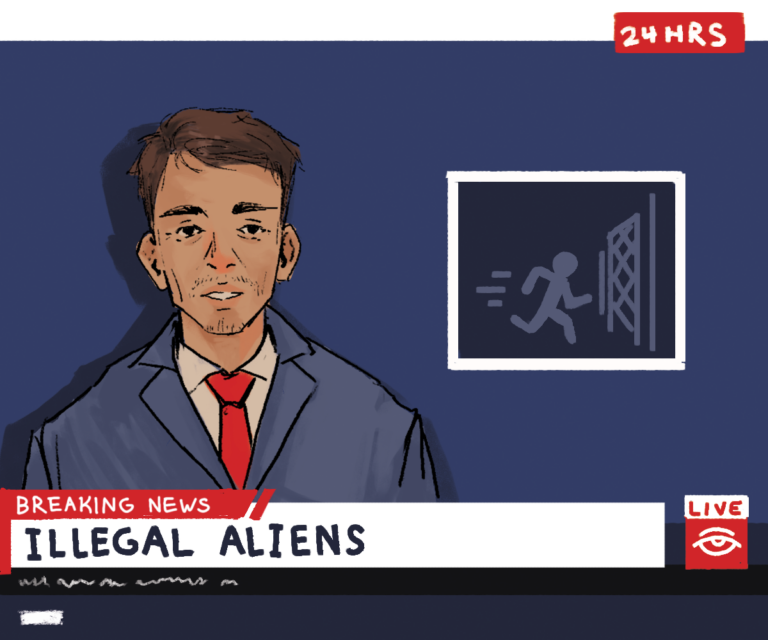
“Illegal aliens.” It’s a phrase that already feels like Propaganda 101, and yet it’s plastered across news outlets and feeds throughout the country.

With President Donald Trump’s return to office, dehumanizing rhetoric has circulated in the news and on social media in an attempt to justify the mass deportation of undocumented Latino immigrants. Although Trump has only been in office for a month, he has already passed over 20 different executive orders that directly target undocumented Latino immigrants.

It’s unsurprising that “illegal alien” is the term that the United States Immigration and Customs Enforcement (ICE) uses throughout their website to refer to undocumented immigrants — unsurprising in the same way that their three enforcement subheaders are “arrest,” “detain” and “remove.”

The words our own government offices and officials use to label undocumented immigrants are intentional and harmful. Language is a powerful source of manipulation. Simple things like word choice can be extremely loaded — particularly when used against marginalized groups of people.

Dehumanizing language works in many ways, but specifically in labels. The most explicit form of dehumanization is to reduce a person or group to an animal or object. Just in April of last year, in a campaign speech, Trump himself provided us with an example of this type of harmful language against undocumented immigrants:

“No, they’re not humans,” Trump said. “They’re not humans; they’re animals.”

However, dehumanizing language can also be more subtle. Another word that is being thrown around to label undocumented immigrants is “criminal.” Without the proper context, “criminal” may not seem like dehumanizing language at all. However, “criminal” has a history of racialized violence associated with it. In her work “The Racialization of Crime: A Brief Genealogy,” Miranda Pilipchuk tells readers how criminality appears to be a race-neutral term, even though it has historically targeted people of color.

Furthermore, Education Initiatives Manager at College and Community Fellowship Lisette B. Hughes drew from her own research and personal experience as a formerly incarcerated person to discuss how words like “criminal” and “convict” dehumanize incarcerated people. She explained how these words essentially justify mistreatment and the withholding of basic human rights within the U.S. prison system. They define incarcerated people as no longer people and instead reflections of whatever “crime” they are associated with, further justifying their mistreatment.

With this understanding of how dehumanizing rhetoric works, let’s return to “illegal aliens.”

“Illegal” is an especially dangerous word because it has underlying connotations of supposed morality. There is a mass perception that what is legal must be inherently good. “Good” people follow the laws and “bad” people break the laws. Therefore, “illegal” is automatically “bad.” Similarly to the word “criminal,” labelling someone as “illegal” classifies them both as amoral and no longer a person.

Not to mention, using the word “illegal” to describe a human being doesn’t make any logical sense. How can someone’s own body be illegal? The answer is, it can’t.

Now, as for the word “alien,” this word did not initially have the xenophobic context we think of today. Since the medieval English period, this word instead has meant “foreigner,” or “not from one’s own country.” However, in the U.S., this word has become heavily racialized toward Latino immigrants. In Edwin Ackerman’s research, he found that “illegal alien” was first used to label Latino immigrants during the 1960s as a way to replace a slur against Mexican people. Initially well-meaning, this word has grown derogatory through its use in anti-immigrant rhetoric.

Right now, in the face of mass deportations, word politics may not seem all that important — and honestly, you’re right for thinking that.

However, it feels like so much more than just words. It’s people who have built lives here, people who had kids here and people who just got here wanting to start their new lives — they all sacrificed so much to be in the U.S. and are vulnerable to losing it all. People have already been torn from their families and communities, and even more people live in fear that it will happen to them or a loved one.

Yet, re-centering undocumented people’s humanity is why this conversation matters. The federal administration and politicians are reducing people to terms like “illegal,” “criminal,” “alien” and worse in official statements, while simultaneously stripping people of their livelihoods, agency and human rights. This use of dehumanizing language attempts to normalize these extremist enforcement measures that affect real people.

We cannot allow mass deportation to become normalized, because this is not normal. People should not be living in fear of their own government because they don’t have the “right” papers. The 14th Amendment should not be getting overturned because one guy said so. People should not be taken out of the home they have lived in for 20+ years.

I’ll leave you with the only two words I can think of to replace “illegal alien,” and that’s “Abolish ICE.”


Written by: Tara Romero— tcrome@ucdavis.edu

Disclaimer: The views and opinions expressed by individual columnists belong to the columnists alone and do not necessarily indicate the views and opinions held by The California Aggie.
Davis Food Co-op hosts Game Day Cook Out in honor of Super Bowl weekend

0

The co-op revives its barbecue tradition while celebrating community and fresh food


By ALMA CULVERWELL — city@theaggie.org


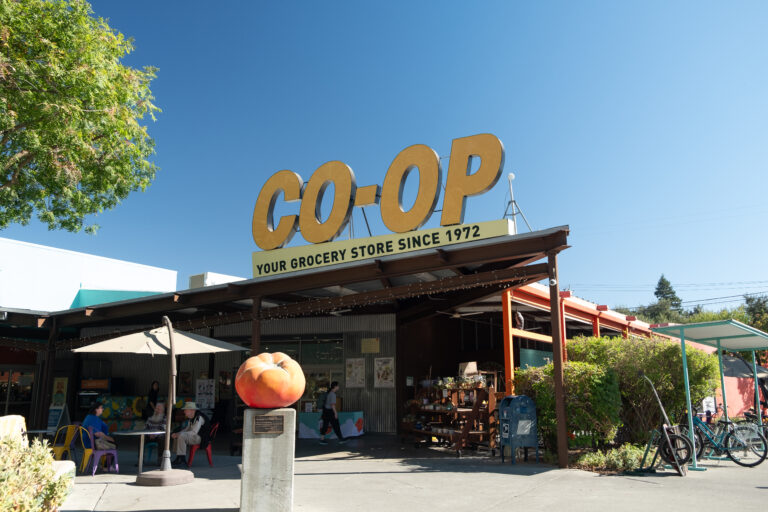
The Davis Food Co-op recently hosted a three-hour Game Day Cook Out to celebrate the Super Bowl on Sunday, Feb. 9.

The Deli at the co-op offered various traditional grilled game-day favorites, including chicken teriyaki skewers, cheeseburgers, bacon-wrapped hot dogs, chili and vegan dogs, as well as classic picnic sides. The co-op also offered a wide selection of beer and non-alcoholic beverages.

Additionally, the co-op offered a celebratory sale on game-day essentials including 12- and 24-packs of beer, party wings, baby back ribs, chips, salsa and guacamole ingredients.

The co-op originally started as a buying club in a living room in 1972, but over the years, it has transformed into a full-service grocery store cooperatively owned by over 8,000 local households, becoming a staple of the Davis community.

Liliana Agredano, the marketing director for the co-op, explained the longstanding tradition behind the co-op hosting barbecues and the motivation for reviving them.

“We used to do cookouts, actually way back in our heyday, like [the] ‘80s, ‘90s, early 2000s,” Agredano said. “I think it was a certain specific day of the week. The co-op would just have a barbeque outside and people just knew to go. We are attempting to bring it back in the best way we can. So this is kind of our first one of the year, and we’ll likely be doing more going forward.”

Agredano also shared the thought process behind planning their first-ever Super Bowl event.

“We kept it quite simple for this first one,” Agredano said. “It’s going to be hot dogs and burgers and skewers. Basically we wanted to stick to the classics of what you usually have when you’re doing a barbecue, and we do always have a vegan option. We provided vegan hotdogs, sides and a beet poke.”

It is events like this that make the co-op a beloved pillar of the Davis community. Sanjeevini Dobhal, a third-year biological sciences major, explained why she frequents the co-op.

“I love the co-op because of its strong sense of community,” Dobhal said. “It’s a place where you can find fresh, high-quality food while supporting local farmers and businesses.”

Meghan Van Note, a third-year international relations major, similarly chimed in on her positive experiences at the co-op, praising their customer service.

“I love the co-op because they have the best produce,” Van Note said. “The workers there are really sweet.”

Looking ahead into the rest of the month, the co-op has a variety of new and exciting events planned for community members. Agredano described what she is most looking forward to within the next couple of weeks.

“We have two really fun events in February,” Agredano said. “We have a Citrus Fest where we’re going to have four of our local citrus farmers come and interact with customers, answer questions and let people try the citrus from their farms, as well as the varieties we currently have at the co-op. We’ll also have recipes for people to try, and citrus experts from the California Department of Food and Agriculture talking about the importance of citrus groves and how community members can care for their own citrus trees.”

With the return of community barbecues and more engaging local events, the Davis Food Co-op continues to serve the community, fostering connections and providing residents with sustainable, high-quality food.


Written by: Alma Culverwell — city@theaggie.org

February blood drives pop up across Davis

0

As blood shortages grow, organizations across Davis host numerous blood drives to encourage donation 


By GIA LOOMIS — city@theaggie.org


This February, organizations across Davis are hosting several blood drives throughout the month. This month alone, over 10 different blood drives are taking place with a large concentration of drives around Valentine’s Day.

Many of Davis’ blood drives are hosted by Vitalant, a non-profit blood collection agency. These drives typically take place on UC Davis’ campus, their blood collection office or at local organizations the drives partner with like the Davis Odd Fellows, a social welfare and fellowship-focused fraternal organization.

Nationwide, many organizations, like Vitalant, strive to encourage donations during this time of year. Colder weather patterns typically decrease blood donations especially due to seasonal illnesses. However, it can be one of the most important times to donate as hospitals have a low supply and high need of blood as they are faced with seasonal accidents and illnesses.

As February blood shortages are growing, Vitalant aimed to decrease the severity of these problems through a three-day blood drive event. Vitalant hosted three UC Davis campus blood drives the week of Valentine’s Day on Feb. 12, 13 and 14. They encouraged students to attend and donate as these drives are fueled by student donors and volunteers.

Campbell Lee, a second-year cell biology major and Vitalant’s student co-director, worked the recent campus blood drives over the past week. Also serving on the Blood Drive Committee for UC Davis’ Pre-Med American Medical Student Association (AMSA), Lee explained the unique importance and scarcity of blood donations especially as hospitals begin to run low.

“Blood isn’t like other resources,” Lee said. “We can’t take it from other animals like we do with insulin, we can’t make it in labs like medications, we can’t buy it from other countries — blood depends on people in our community to help each other. 2025 is not a blood shortage yet, but it’s becoming a possibility. If it happens, hospitals may have to start shuffling around patients, canceling people’s elective surgeries; It could really change a lot of lives.”

To increase accessibility and donations, blood can be donated all across Davis. In an effort to increase and encourage more donors, Davis Odd Fellows hosted their own blood donation event on Feb. 11. They typically aim to host around four to five blood drives throughout the year that are open to the public, and this was their first drive of the year. Their next blood drive will take place on May 14, with more following every couple of months.

Organization-hosted or sponsored drives really help to boost the amount of blood donors banks receive. As seen with the Odd Fellows’ drives, they speak to an audience that may not have been as inclined to donate blood before the event.

Evan Bledsoe, a member of the Odd Fellows, explained how the organization’s connections help encourage more donors.

“A lot of the Odd Fellows know a lot of people in the community,” Bledsoe said. “It really helps to bring more people out to donate and spread awareness, because they know a lot of different people and age groups which helps to increase donations.”

Bledsoe continued by explaining the Odd Fellows’ motivation for hosting these blood drives as they strive to help out community members and those in need.

“The Odd Fellows help out in a lot of different ways in the community,” Bledsoe said. “For the blood drive, specifically, they want to help out patients who need operations because there’s been a blood shortage and national crisis for a long time. Especially as less people have been donating less since [COVID-19], we really want to help get more blood out there for those who need it.”

From organizations to non-profits, there are numerous ways to help out and become a blood donor in Davis. Vitalant commonly hosts blood drives at varying locations across Davis to encourage all residents to come out and donate. Additionally, UC Davis Health partners with the American Red Cross to host blood drives and take donations. Their next drive will be on the UC Davis campus on April 10.

However, giving blood is not the only way to help out against blood shortages. Vitalant volunteer and Meghana Tummala, a first-year human biology major, explained how to get involved if you are unable to donate.

“If you’re not able to give blood yourself, the best way to get involved is by finding clubs and organizations that get involved with blood drives and events,” Tummala said. “Another great way to help out is to help educate other people about giving blood and if they can potentially be donors.”

With the blood shortages presented by the unpredictable weather of February, blood donors are more in need than ever and blood drives are popping up all across Davis. Check out upcoming blood drives from Vitalant, Davis Odd Fellows, UC Davis Health and more.


Written By: Gia Loomis — city@theaggie.org


Letter signed by 750+ UC faculty expresses concern for undocumented students

0

A letter to UC President Michael V. Drake demands action regarding recent national immigration policies


By EMME DUNNING — features@theaggie.org


As fear surrounding national immigration policy grows for many, faculty across the University of California system have put effort into supporting impacted students. This was reflected in a letter to UC President Michael V. Drake on Jan. 17, 2025 — signed by over 750 UC faculty members — calling on Drake’s office to take specific steps to support undocumented students and their families.

The letter outlines the proposed federal policies regarding immigration, specifically expressing concern for the impact new policies may have on University of California students across the state. In response to the proposed immigration rhetoric outlined by the Trump Administration, a large group of faculty has called on Drake to take five steps to support impacted students, according to the language of the letter:

  1. “Publicly reaffirm the UC’s unwavering support for its immigrant students.”
  2. “Invest significant additional funds into the existing programs of support for immigrant students.”
  3. “Create a new program to provide emergency funds to immigrant students.”
  4. “Commit to increasing student data privacy.”
  5. “Provide clear guidance to campus community members, including administrators,

faculty, staff and students about best practices for supporting and protecting immigrant

students.”

Dr. Robert Irwin, the deputy director of the Global Migration Center and a professor in the Department of Spanish and Portuguese at UC Davis, decided to be a part of the letter. This decision was made to show solidarity with impacted members of the UC community, as well as to assert the importance of implementing formal guidelines to faculty members regarding interactions with immigration officials.

“We were very concerned not just about what might happen, but about the level of anxiety amongst students who might be affected,” Irwin said. “We thought it would be important to have a strong message coming out of the president’s office, as well as some procedures in place in case something were to happen so that employees and faculty would be well positioned to help our students as much as possible.”

Irwin said that although the Trump Administration has been unpredictable, it would be unprecedented to target their immigration policies toward college campuses.

“The general public doesn’t want [Immigration and Customs Enforcement (ICE)] to be going after those kinds of people,” Irwin said. “If they start making high-profile arrests on college campuses of childhood arrivals that are just trying to study, I think it would look really bad and I think it would cause them damage.”

Despite a lack of precedent for raids on college campuses, such an action would not be completely out of line with the stated values of the Trump Administration, which issued a directive on Jan. 21 allowing ICE agents to enter previously protected schools, churches and hospitals to carry out immigration enforcement operations.

A Martin Luther King Jr. Professor of Law at UC Davis, Dr. Raquel Aldana, believes that taking action against these policies now can provide security for the future.

“This isn’t a strategy of overstating the issue — I think it actually is a fairly certain landscape that it could happen at any point,” Aldana said. “It is important for institutions to be ready and prepared for the potential worst.”

Although Aldana hopes that Drake will implement these directives, she also asserted that individual faculty members and students can make changes on their own.

“There’s limitations in what we can do as individuals, but there’s also possibilities — especially in the collective,” Aldana said. “We look to administrators as being the only sights of solutions, but we give up too much agency and too much power when we only seek solutions from the top. We are the institution. Each of us.”

Dr. Veronica Lerma, an assistant professor of sociology at UC Davis, has a research focus on criminalization and intersectionality. Lerma believes that supporting students through this period is incredibly important.

“I recognize the harm that the Trump Administration’s immigration policies, particularly those that emphasize mass deportation and family separation, have on students and their families,” Lerma said. “The letter just aligns with my ethical and professional commitment to support and stand with and advocate for my students, especially those who may be the most marginalized, which includes undocumented students.”

At a high-level institution such as UC Davis, it is easy for academic pressures to mount. When coupled with real-world concerns about the future for undocumented students, it can become increasingly difficult to maintain the level of academic performance expected of UC Davis students.

“I have students who are maybe in class, but they’re not really ‘there,’ right?” Lerma said. “Doing the things that they need to do as students to succeed in school is kind of like the furthest thing from their mind when they’re worried about whether they’re gonna lose their family or whether or not they’re going to be here. I think it’s unethical to hold those students to the standards that I’m holding other students who don’t have to navigate what that is and what that looks like.”

In response to these concerns, Lerma hopes to alleviate some of the academic pressures for her students who are experiencing increased stress levels during this time.

“Just giving them grace in this moment has gone a long way,” Lerma said. “That means flexibility with turning in assignments or even sometimes just being an ear to have a conversation.”

The policies proposed in the letter aim to give undocumented students and their families long-term security and support in the face of an uncertain next four years. Lerma hopes that these actions, coupled with support from classmates and faculty, can help provide solace amid the uncertainty.

Sometimes, she said, this just looks like making it through another day.

“If they’re surviving today, that’s enough,” Lerma said.


Written by: Emme Dunning — features@theaggie.org

Culture Corner

The Arts Desk’s weekly picks for music, movies and more


By JULIE HUANG  — arts@theaggie.org 


Song: “Wuthering Heights” by Kate Bush (1978)


During the rainy season, indulging in periodic glances out of the window to watch puddles grow ever larger on the uneven pavement outside is a classic activity enhanced by background music —  and “Wuthering Heights” is particularly appropriate. As a retelling of Emily Brontë’s only novel, Kate Bush’s shivering vocals and enigmatic lyrics perfectly represent the Gothic novel’s toxic relationships, its perpetually windy, stormy English moors and my mood while studying for midterms. I also admire how the song manages to fit a remarkable amount of content into four minutes and 29 seconds, given that the novel it’s based on is usually around four hundred pages long. 


Movie: “Cinderella” dir. Kenneth Branagh (2015)


Although I maintain that animations retain a magical quality that live-actions films usually fail to replicate, an exception is made for 2015 rendition of “Cinderella” — the live-action remake adds more intricate visuals and brings depth to certain characters. For one, the narrative choice to frame the evil stepmother as a foil to Ella herself adds an enjoyable sense of tension and tragedy. However, the costuming may be the most enchanting facet of the film. The animated Cinderella’s iconic silver ball gown is adapted into a breathtaking blue variant that shines brighter than every other dress at the ball. This is a deliberate choice that highlights Ella’s one-of-a-kind innocence and kindness that shines from within. Thanks to the costume designers’ attention to detail, though, the external presentation is just as radiant.


Book: “The Seven Husbands of Evelyn Hugo” by Taylor Jenkins Reid (2017)


Overcoming the midst of the quarter usually demands that any leisure reading be low-effort, and “The Seven Husbands of Evelyn Hugo” is just that — it’s easy to follow but rich in emotional rewards (or devastation). The novel follows a movie star’s tumultuous romantic history over 30 years through the end of the Golden Age of Hollywood, culminating in her finally sharing her personal truth in its entirety with a struggling writer who could use the inspiration. Reid’s novel goes from intriguing to gripping to ultimately heart-wrenching, and I was left reflecting on its numerous plot twists long after I put the book down.  


TV Show: “Gossip Girl” (2007 to 2012) 

On the one hand, it’s a teen drama of the 2010s that has already had its time to shine, but on another hand, it’s perfect if one ever feels like watching self-important rich people engage in psychological warfare with one another, competing to see who is the most out of touch. The plot largely consists of every major character on the show taking turns backstabbing or dating each other, or both, but it makes sense within the context of the show, kind of. An advantage of the characters’ massive wealth is their easy access to expensive fashion, which translates on the screen into beautiful costuming completed by eye-catching designer pieces. Overall, “Gossip Girl” remains a good watch if you want to disconnect from reality for a little while and think only about which self-absorbed man the millionaire heiress should end up with. 


Written by:  Julie Huang — arts@theaggie.org


Amidst tense times, students discuss transgender history and legislation

0

UC Davis students share contributions of transgender individuals, contemporary rhetoric surrounding transgender rights


By EVELYN SANCHEZ — features@theaggie.org


The political climate has presented a troubling and frightening time for many communities in the country. With extensive immigration policies and widespread misinformation, underrepresented and marginalized communities have had the most to lose.

One specific group targeted recently has been the transgender community. Legislation specifically concerning the Trump Administration and how it might impact students immediately and long-term has been a topic of conversation. One of the more recent bills passed, AL SB79, outlines a standard for sex-based terms and requires the assigned gender at birth to be legally reported on documentation. President Donald Trump also recently signed an executive order titled “Keeping Men Out of Women’s Sports,” specifically barring transgender women from competing in women’s athletics programs.

“Transgender people have been around since the existence of humanity,” Newts Henkel, a first-year wildlife, fish and conservation biology major, said. “There’s documentation of trans people in cultures all around the world. Until now, there hasn’t been a necessarily defining name for those people, but in a lot of places historically, trans people have been significant religious and social leaders in society.”

The Navajo ‘nádleehi’ was a term for gender-fluid individuals in the Diné culture who existed outside of the traditional binary. As many as 150 pre-colonial Native American tribes recognized and integrated transgender or gender-nonconforming individuals within their communities. The Indigenous people of Oaxca’s Zapotec culture also held non-binary individuals in a very high regard, their cultural term for them being ‘muxes.’ They would adopt traditionally feminine work such as embroidery and decoration.

“[Transgender people are] acknowledgments of change and things that exist beyond our understanding and what is readily apparent,” Henkel said.

River Baker, a second-year political science and philosophy double major, also commented on the dominant role that transgender people play in terms of all queer rights.

“[For] a large portion of our rights, if you start taking away queer rights, you start the process of taking all of them like a domino effect,” Baker said. “In terms of the queer community, trans individuals play the dominant role in [queer people] having rights at all. If you take away trans rights, you take away all [queer] rights.”

On Jan. 7, 2025, Oklahoma passed a resolution, OK HR1002, regarding restroom access for transgender individuals.

“Only a person born as a biological female shall be allowed into any restroom facility which is designated for female members of the Oklahoma House of Representatives, except as authorized for the operations of the House,” the resolution reads.

This legislation is one of many examples fueling rhetoric based in bioessentialism, the  belief that people’s most important characteristics are controlled by biology and cannot change.

“I’ve been trying not to look at the news,” a second-year student, who wishes to remain anonymous, said. “There’s nothing I can do about these things, so why should I let it take up much of my mind?”

Henkel continued by sharing significant contributions that have been made by transgender individuals.

“Quite a few trans women have made significant contributions to technology,” Henkel said. “Trans people have been contributing to society regardless of identity, but I feel like trans people because of their identity are important. We are the embodiment of what can be and free choice and possibility.”

Transgender people have contributed to many important forums, from technology to activism. Lynn Conway designed very-large-scale integration (VLSI), which is the process of embedding hundreds of thousands of transistors into a single chip, transforming the global microelectronics industry. Sylvia Rivera founded The Gay Liberation Front and her participation alongside transwoman Martha P. Johnson during the Stonewall Riots was pivotal in asserting LGBTQ+ rights across the country. Sisters Lilly and Lana Wachowski wrote and directed “The Matrix” and “Cloud Atlas.”

Despite transgender people’s contributions and importance in society, students at UC Davis and beyond feel that their importance hasn’t been properly recognized by either political party.

“I have an issue with the Democratic party because they don’t take any stances with anything,” Baker said. “They’re not liberal but more conservative in that they pander to the center-left and moderates. [America] is a very conservative country no matter who is in office.”

Baker continued by discussing that the left side of the political spectrum often settles for less active policies to avoid being considered too radical.

“They pander towards the moderate conservative because they don’t want to be that far left,” Baker said. “It’s less about their morals and what’s going to get them the most votes. I fear that liberalism is not an accurate way to define the Democratic party.”

With the establishment of Elon Musk as the head of the Department of Government Efficiency (DOGE), many important organizations and initiatives are being cut off under the pretense of streamlining government spending, including Diversity, Equity and Inclusion initiatives.

“I think [DOGE] is a very unconstitutional creation and is giving authority to someone who wasn’t elected,” Baker said. “[It’s] giving them access to our private information.”

Musk has been outspoken about anti-transgender ideas and, during an interview with Jordan Peterson, claimed that his child was “killed” by the “woke mind virus” after she transitioned. In the same interview, he described gender-reassignment surgery as “child mutilation and sterilization.”

“The court has blocked [some] things, but I think that the fact that Elon Musk can have so much authority despite not being elected but simply because he has money points towards how oligarchical our country is becoming,” Baker said.

Regarding Trump’s appointment of colleagues to important roles such as Pete Hegseth, a television presenter for Fox News and former officer of the National Guard, who has held no previous political office, as the U.S. secretary of defense, students also shared their grievances.

“It’s a combination of distaste and disappointment,” Henkel said. “I would expect better from the world and government.I would expect better from the people who are making decisions for millions of people. [It’s] the rise of an era of utter anti-intellectualism and it’s so stupid.”

Despite modern legislation seeking to limit their rights and minimize their societal contributions, transgender individuals have been an integral part of society for centuries. UC Davis students have shared not only the contributions but also the important role that transgender people have played and continue to play in communities all over the world.


Written by: Evelyn Sanchez  — features@theaggie.org

An inside look at Nineteenth Operator, Davis’ latest musical duo

0

 Bernadette Grace Albano and Rosie Mendoza discuss their band’s history and inspiration


By LAILA AZHAR — features@theaggie.org


The musical duo Nineteenth Operator is the type of partnership that seems like it was meant to be.

Bernadette Albano, a fourth-year biological sciences major, and Rosie Mendoza, a fourth-year English and American studies double major, crossed paths early on in college. They lived in the same dorm building as first-year students, although they didn’t speak to each other much.

It wasn’t until they both found themselves in Cowboys After Dark — a well-known, local band in the Davis community — that they truly began to interact. Initially, however, the duo wasn’t exactly harmonious.

“She didn’t really like me much at first,” Albano said.

It didn’t take long for the two to put any initial friction behind them. They had been talking about forming a band for quite some time before Nineteenth Operator came to life.

“We’ve been talking about doing this for about a year and a half, I’d say,” Mendoza said.

Going from being a part of Cowboys After Dark, a cover band, to writing their own music has been a change for them. However, they are enjoying the process of creating their own songs.

The two come from different musical backgrounds. Albano’s roots lie in theater, where she discovered her love for performing and singing, while Mendoza’s journey started with learning to play the trumpet, inspired by her older sister. She eventually learned other instruments such as the ukulele and guitar, and began writing songs in her spare time.

Nineteenth Operator draws from a variety of different musical artists, such as 1990s dream pop artists The Sundays, Mazzy Star and The Cranberries. They additionally cite the narrative structures of Remi Wolf’s songs and Chappell Roan’s anthemic choruses as inspiration.

Albano and Mendoza have very distinct personalities, but they each show a deep appreciation for what the other brings to the table.

“I don’t think we have anything in common,” Mendoza said. “But I think that might be why we work well together. Because we’re so different.”

Albano pointed out Mendoza’s creative spirit.

“Rosie’s one of the most creative people I know,” Albano said. “She learned how to crochet in like a week and started wearing these clothes she crocheted just because she could. It’s incredible.”

Mendoza, on the other hand, noted Albano’s management skills.

“Bernie can bring to life any vision I have,” Mendoza said. “It’s amazing how she can grow the seed of whatever I plant.”

On Feb. 15, Nineteenth Operator performed at Secret Spot, an art and music lounge in Davis. Audience members were able to don the band’s “Girl of the Year” sashes.

The next night, they delivered a stripped-down, acoustic set at Downtown Davis’ Armadillo Music, complete with an impromptu cover of Norah Jones’ “Don’t Know Why.”

Layla Abedini, a second-year biological sciences major, attended the show and expressed her excitement about what Nineteenth Operator has in store.

“They both have really good stage presence and beautiful voices,” Abedini said. “They sound great together. I’d definitely want to see them perform again.”

Their first single, “Crazy Ex Girlfriend,” will be released on Feb. 28. To stay up to date with Nineteenth Operator’s shows and song releases, fans can follow them on Instagram, @nineteenthoperator.


Written by: Laila Azhar — features@theaggie.org

Cancelled again: ‘Wipeout,’ a crucially important show to Gen Z

0

UC Davis students reflect on “Wipeout” and how the game show shaped humor and childhood memories


By JALAN TEHRANIFAR — features@theaggie.org


There are a lot of things that seem to define Gen Z — existential dread, an obsession with saying “slay” and an ability to diagnose obscure psychological conditions based on one TikTok video, to name a few. But if there’s one thing that truly unites them, it’s growing up watching people get absolutely wrecked by giant rubber balls.

Enter “Wipeout,” the game show that turned slipping, tripping and face-planting into a competitive sport, shaping Gen Z humor for eternity, according to UC Davis students and beyond.

Sure, Wipeout was just a show where people willingly launched themselves onto unstable platforms while two hosts made dad jokes about their misfortune. But for Gen Z? It was so much more. This wasn’t just television — it was an art form in the hearts of many. It was survival of the goofiest. It was the backbone of their childhood entertainment. And, quite frankly, it taught some valuable life lessons.

For many, “Wipeout” was a core memory. It was considered a perfect after-school show — mindless, hilarious and requiring absolutely zero emotional investment. Whether Gen Z kids were eating Goldfish crackers on the couch or avoiding homework, “Wipeout” was there for them.

To Nava Regev, a fourth-year political science major, “Wipeout” wasn’t just a silly show, it was a lifelong dream.

“When everyone still had cable TV and ‘Wipeout’ was at its peak, my brother and I would sit and watch episodes for hours and we would make fun of everyone who wiped,” Regev said. “All I wanted to do growing up was be on the show — the obstacle courses looked so fun. I even had the ‘Wipeout’ game on my Wii — I think I still do, actually.”

Regev recently began rewatching “Wipeout” with her college roommates, hoping to relive the joy it brought her as a child. As she watched contestants wipe out in spectacular fashion, she couldn’t help but reflect on her younger self’s confidence.

“I used to be so high and mighty about it; I swore that if I were on the show I would complete the obstacle courses with no problem,” Regev said. “Rewatching it now, I probably would’ve been eliminated in the first round.”

Midway through Regev’s nostalgic binge, curiosity struck — did the iconic obstacle courses still exist? A quick search revealed that not only were they still standing, but the show itself had been revived in 2021, now hosted by none other than John Cena.

“When I found out the show was still running, I forced my friends to fill out a casting application for the 2025 cycle with me,” Regev said. “I am determined to make this dream come true; I don’t care if I embarrass myself on national television, this needs to be done.”

After learning that TBS announced the cancellation of the “Wipeout” revival earlier just this month, Regev was devastated. The news may have even hit harder than a contestant getting launched off the Big Red Balls.

“My heart is broken,” Regev said. “I have class in 15 minutes, but now I have to just go home and sit in my bed and mourn the loss of this momentous show. No wonder I haven’t been contacted for my casting call, this sucks. I was waiting to see what my king, John Cena, would nickname me on the show. How could they do this to me?”

Gen Z grew up on the internet, and their humor reflects that. They send each other videos of people falling down and call it bonding. Wipeout was essentially the live-action version of that. The show walked so TikTok fails could eventually run.

Even though the show technically ended in 2014 (before making a comeback in 2021), its influence never really died. Why? Because, according to students, it was tailor-made for meme culture. The exaggerated sound effects, the slow-motion replays, the contestants getting absolutely destroyed — it seemed to be the perfect recipe for internet gold.

Anna Bronstein, a fourth-year psychology major, said that “Wipeout” played a large role in shaping her sense of humor. Growing up, she found endless entertainment in watching contestants get smacked off platforms and sent flying into water, all while the hosts delivered hilariously unfiltered commentary.

“That show was so funny,” Bronstein said. “The hosts would say the most out-of-pocket things and the contestants’ reactions just made it even better. Nothing was funnier than watching them swim back to the start of the obstacles so they could get knocked off again. I swear I think that’s why I’m so funny now, it’s because of that show.”

Emily Tyryshkin, a fourth-year biological sciences major, said that watching “Wipeout” with her family makes up a lot of her core memories. Even though the show was full of ridiculous crash-outs and stunts, it was the shared excitement and laughter that made it unforgettable for her.

“I remember watching ‘Wipeout’ with my family all the time when I was younger,” Tyryshkin said. “It was like our thing after dinner. We would always try to guess who would wipe out next, and we’d be dying laughing when someone fell into the water. We would get really competitive about it too. When the [episode] started, we would all pick a person to root for, and I would get so hyped when the person I chose would win.”

At the end of the day, to Gen Z, “Wipeout” wasn’t just a game show, it was a cultural event. It was a right of passage. It was a reminder that sometimes life will smack you in the face with a giant foam mallet, and you just have to get up and keep going.

So here’s to “Wipeout” — seemingly one of the greatest shows ever made about falling down and getting back up. Who knows? Maybe one day it will get revived again; Until then, members of Gen Z at UC Davis and beyond await the day.

“[Rest in peace], ‘Wipeout’ — a fallen soldier,” Regev said.


Written by:  Jalan Tehranifar — features@theaggie.org

California legislators discuss wildfires, home insurance and homelessness

0

The Public Policy Institute of California facilitated the conversation amongst Republican representatives on California’s most pressing issues


By RORY CONLON — city@theaggie.org 


The Public Policy Institute of California (PPIC) hosted a discussion with James Gallagher, the California State Assembly Republican leader, and Brian Jones, the California State Senate Republican leader, at the Sheraton Grand Hotel on Feb. 6. The event, which is part of PPIC’s 2025 speaker series, covered topics like California’s future, wildfire recovery, home insurance and homelessness. 

Rusty Areias, a board member on PPIC’s board of directors, introduced the event. 

“One of the truly great legislators of modern California, the late speaker Bob Reddy, was asked what politicians do, and [he said], ‘They shape destiny,’” Areias said. “The subject today is the future of California. In answering the questions about what awaits us, it is important to remember that history has accorded our guests extraordinary authority and responsibility.” 

Tani Cantil-Sakauye, the president and chief executive officer of PPIC, moderated the discussion. She asked the two legislators to list the biggest issues facing Californians today. 

Jones cited ongoing concerns about the rising cost of living in California and a range of current issues brought up by the 2025 Southern California fires.

“I think the two biggest [issues] for the last several years have been affordability, cost of living and public safety,” Jones said. “And then, of course, in the last couple of weeks, wildfires, insurance and recovery have come to the top as issues as well.” 

In addition to the rising cost of living, Gallagher said fire prevention was another key issue that needed to be addressed. 

“We have to reduce devastating fuel rates on our lands,” Gallagher said. “Vegetation, shrubs, chaparral, thinning, forested lands — those are all things that we really need to put some focus on because that is the No. 1 cause of these catastrophic fires.” 

Cantil-Sakauye asked what the state could do to aid victims in rebuilding their homes in the aftermath of the fires. 

Gallagher cited Governor Gavin Newsom’s executive order streamlining the California Environmental Quality Act (CEQA) and the Coastal Act regulations as a positive step forward in removing barriers to people rebuilding their homes. He said that local governments also need to work with non-profit organizations to provide more aid. 

“You probably don’t have enough public staff at the building inspection office to handle permits,” Gallagher said. “You’re probably going to need to utilize the public sector non-profits and [see] what they can bring to the table. I think it’s going to be a huge thing, because there are so many things the government just can’t cover, and non-profits could step in and help with recovery.” 

Jones said officials needed to be held accountable for mistakes they made in fighting the fire. 

“Why was there no water in a fire hydrant?” Jones said. “Why are fire hydrants being stolen? Why were the fire trucks not able to get to where they needed to be? We all should expect accountability from our government. An elected official or appointed person made these decisions that exacerbated and made the wildfire worse, and those people need to be held accountable.” 

Discussion turned to how the legislature could stabilize the home insurance market in California in light of recent fires. Jones said the problem lies in over-regulating the home insurance market. 

“The legislature telling insurance companies what they have to cover, in my opinion, is a command and control economy that is inappropriate for a free-market system,” Jones said. “We need to back off the regulations a little bit and give the insurance commissioner more authority […] and then bring the insurance companies to the table and tell us what they need to stay in business. Not one single person in California benefits if one insurance company leaves the market.” 

Gallagher said the state should also mitigate risk for insurance companies by conducting prescribed burns and thinning in certain locations. 

“The governor and the president, a while back, came to an agreement where they said they were going to [burn] 500,000 acres a year,” Gallagher said. “They haven’t even come close. In fact, the governor got caught in a lie a few years ago when he said he did 90,000 acres and it turned out he really did 11,000 — the bottom line is, we haven’t been doing the job.” 

Cantil-Sakauye asked what the legislators would do to help the 180,000 unhoused people in the state. 

Gallagher alleged that, as of last year, the governor’s office has not been collecting metrics on the money spent by non-profits and government agencies to combat homelessness. He said that instead of taking a top-down approach, the state should have local regions submit their own plans for addressing the issue. 

“We already have counties and local governments who do a lot of great work getting people connected to resources,” Gallagher said. “And then we fund regional plans that have been brought together, as opposed to just sending out money and saying, ‘I hope they spend it well.’”

Gallagher said the state also needs to change its strategy to empower people out of homelessness. 

“Some of the policies have changed,” Gallagher said. “We’re saying, ‘Look, some people with severe mental illness, for example, you have to get them off the street and get them medicated, and that requires conservatorships.’ We supported that legislation. It was actually bipartisan to finally do that.” 

Audience members were invited to ask the legislators questions. One audience member asked how the legislators, who represent minority parties in both the California State Senate and the California State Assembly, lead in their roles. 

Gallagher said he lobbies everyone in the committee to find common ground on policies. He gave the example of securing one billion dollars’ worth of funding in the aftermath of the 2021 Dixie Fire. 

“I think that was a lot to do with the minority party pushing the issue and also finding alignment with Democrats to get that through,” Gallagher said. “The negative is, ever since that time, the budget has slowly decreased and we need to get it back up. But there’s definitely those opportunities, even in the minority, to be a part of moving substantive change.” 


Written By: Rory Conlon — city@theaggie.org


Reuse, reduce, recycle: How single-use technology culture has impacted the UC Davis community

0

Students and faculty discuss the lack of accessibility for affordable technology on campus


By JENEVAH HARRISON — features@theaggie.org


In an era where sustainability is at the forefront of many conversations, the accessibility of refurbished and second-hand technology remains a challenge for UC Davis students. While initiatives like the TechHub on campus provide repair services and financing options for new devices, students seeking affordable used technology often find themselves with limited choices.

For students who cannot afford a new device, UC Davis does offer some temporary solutions. The campus library provides laptop rentals for up to four hours daily, offering short-term access to technology. Additionally, students in financial need can request a computer loan through the Financial Aid and Scholarships department. However, both options come with limitations.

A loan, while helpful, still requires repayment after graduation, which may place a financial burden on students. Similarly, a four-hour rental period is far from ideal for full-time students who rely on a device for extended periods throughout the day.

Recognizing the financial strain of purchasing new devices, the TechHub repair team offers an alternative for students looking to maintain their current devices.

“Aside from payment with cash or card, we do allow students to pay for their repairs via their Student Account in which they can pay for the repair the same way they would pay tuition through MyBill,” the TechHub repair team said via email. “This allows for some flexibility to students who may not have the direct means in paying for the repair upfront.”

For students interested in upgrading their devices, TechHub Manager Patrick Khamvongsod highlighted the store’s trade-in program.

“If students are looking to upgrade their devices, we have a trade-in program,” Khamvongsod said. “You get the value of your device, come to our counter, we take your old device and issue you a bookstore gift card. Most of the time you would use that credit towards another device purchase.”

While this program provides an option for students looking to upgrade, it does not directly address the lack of affordable technology for students.

The Aggie Reuse Store, which promotes sustainability by providing free, used items for students, currently does not serve as a resource for used technology, noting that they typically only receive items such as clothing and houseware. Besides a few AirPods cases, the store was predominantly stocked with non-technology items.


This gap highlights a significant issue: While students may be willing to donate or sell used clothing and household goods, there is no established culture or system for recirculating technology on campus.

Phoebe Anzalone, a second-year American studies major, shared her frustration with the lack of options for purchasing used technology on campus.

“Everything on campus pushes you toward buying something brand new, whether it’s a laptop, charger or tablet,” Anzalone said. “There’s really no alternative unless you go off campus or find something on Facebook Marketplace, which isn’t always reliable.”

This sentiment underscores the broader problem within the UC Davis community of single-use culture surrounding technology. Without a structured program to encourage the reuse and resale of electronic devices, students are left with few sustainable and affordable choices.

“I recently had to get my computer replaced and for the days it was broken, I fell behind on my classwork,” Anzalone said. “I tried going to TechHub, but due to insufficient stock, I wasn’t able to get a new device for at least a week. Not to mention there really isn’t much of a discount for students, and I definitely think that should change.”

A potential solution to this issue could be the implementation of a used device initiative at UC Davis and possibly UC-wide, according to students like Anzalone. Establishing a formal marketplace for second-hand technology for enrolled students would make essential devices much more accessible while also promoting sustainability. Such an initiative could involve a designated campus store or online platform where students can buy and sell used laptops, tablets and other tech accessories.

Anzalone further shared her experience at the UC Davis TechHub.

“Even with the student discount, I think they try to make it more accessible,” Anzalone said. “But $100 dollars off of a $1300-1400 computer isn’t really much more accessible, in my opinion.”

This student discount, a promotion provided by Apple and not the university, is not entirely sufficient, according to Anzalone. An alternative solution to this could be a discount provided directly through the university rather than a private company to ensure sufficient accessibility for students.

UC Davis students have proposed several potential initiatives to enhance access to affordable technology and reduce electronic waste. These suggestions include creating a second-hand tech marketplace, expanding the Aggie Reuse Store’s inventory to include electronics or establishing a formal system for students to sell or donate used devices.

“I think considering the universities commitment to sustainability, it definitely makes sense for there to be second-hand technology available for students,” Anzalone said. “It seems like a win-win situation to me if UC Davis were to implement this type of program.”

Implementing such programs could increase the availability of cost-effective technology while also supporting waste reduction efforts and sustainability goals. Expanding this access could potentially further promote UC Davis’ sustainability practices and commitment to equal accessibility for their students.


Written by: Jenevah Harrison — features@theaggie.org

Do yourself a favor and delete your social media

Limiting your time on social media can open up a world of self-discovery and connection


By JHANA RHODES — jsrho@ucdavis.edu


          I chose to disappear in an era where social media is equated with connection, relevance and visibility. Gone with the likes and comments, I deleted all of my social media accounts in a single hour, albeit with much hesitation. No more Reddit, X, Instagram, Snapchat or TikTok. Years of memories, messages and thousands of friends vanished with the click of a button — or, in the case of Instagram — gone after a tedious verification process.

When I first deleted my accounts, I didn’t know what to do with myself. My whole life revolved around social media, and it seemed impossible to stop using it. Now, three years into my digital detox, I’ve never felt better. This experience has given me profound clarity on my sense of self, helped create meaningful connections and transformed how I prioritize my time. 

          Before the COVID-19 pandemic, deleting my social media accounts was something that I would have never done. I saw social media as a fun way to occasionally post a picture of my half-eaten breakfast or share entertaining videos with my friends. With all of this being said, I would spend no more than four hours a week on it. 

During the pandemic, everything I did and all of the media I consumed was from social media. Whether I wanted to talk to a friend, find a new recipe or look up the latest influencer gossip, I could do that all on social media. However, that quickly consumed all of my time. It got so bad that I would spend almost 14 hours a day on TikTok. That’s when I realized I was stuck in an endless loophole of media content that did nothing but take away my time. From that moment on, I knew I had to say goodbye to my social media accounts. 

          After spending a few hours posting long messages on my Snapchat and Instagram stories to inform all of my friends about my absence, I finally deleted everything. For about 30 seconds, I felt a deep sense of liberation and joy. Yet, soon after I deleted everything, I asked myself, “Is this worth it?” After a few hours passed, I felt like I had just deleted my whole identity. Dramatic, right?

Nevertheless, it felt like I had gone from being wholly seen to disappearing into thin air. What was my life without connection? Social media was the only thing that kept me connected with the world. With it gone, I was forced to reinvent myself offline. 

          The first year was challenging. Most people I called my “friends” stopped talking to me, and I was devastated. I soon realized I had been using the term “friend” too broadly. I used to think that the people who liked my Instagram posts about my cats were my friends; however, the moment I disappeared online, so did they. Now I know that although I’ve lost a lot of connections, the people who stuck around are lifelong friends.

          Two years passed, and, before I realized it, I had gone three years without social media. It got easier after I overcame the overwhelming sense of boredom and the habitual instinct to check my phone for TikTok videos. No more fear of missing out (FOMO) after seeing pictures of all of my friends at a party, no more obsessing about creating the perfect caption and no more comparing my life to those I saw online. 

          The moral of the story is that even though deleting all of your social media accounts in one day is extreme, it gave me the means of finding my true offline identity. It is a dramatic change, so if you’ve needed a break from social media (whatever the reason), it’s good to start off small. Limit your time online by putting the phone down to pick up a new hobby or go someplace new. The more time you spend off of your phone, the more time you have to build genuine connections. Hopefully, one day, you will find that being offline will give you more time to connect with others and with yourself. 


Written by: Jhana Rhodes— jsrho@ucdavis.edu 


Disclaimer: The views and opinions expressed by individual columnists belong to the columnists alone and do not necessarily indicate the views and opinions held by The California Aggie.
 

Weekly Wisdom Talks give UC Davis students the chance to learn about Krishna

0

Brian Pearson, Devavrata Das, Suvarna Bindu Das and other monks arrive in Davis to share Hindu teachings 


By NOAH HARRIS — features@theaggie.org


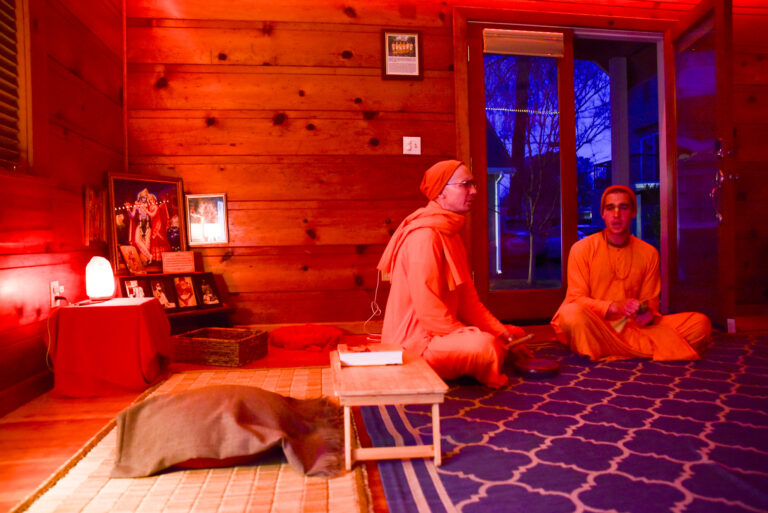
The unassuming house sits in a small corner of Davis, on B Street and E 8th Street. There are no decorations outside, no signs to lead any wanderers to it. However, inside its wooden walls filled with colorful artwork and books for sale contains monks taught in India, devoted to the Hindu deity Krishna. 

These men, two of whom are from Orange County, moved to Davis around a month ago, and seem to be one of Davis’ most unique gatherings. Three of the monks, who outlined and shared about their practice, are Brian Pearson, Devavrata Das and Suvarna Bindu Das.

Every Thursday at 6 p.m., an event called Wisdom Talks is held at 400 E 8th St. If one arrives late, they will be greeted by a loud chanting sound coming from a very small group, typically around 10 people. 

The chant, named Hare Krishna, goes: Hare Krishna, Hare Krishna, Krishna Krishna, Hare Hare, Hare Rama, Hare Rama, Rama Rama, Hare Hare.

Charlie Zivny, a fourth-year economics major who has attended multiple Wisdom Talks, shared his initial thoughts on the event.

“I walk into the alleyway and I hear the drums and the ringing and, I’m like, okay, there’s some rhythm going on,” Zivny said. “I get there and there’s this glass door and I see people sat in a circle. The inside of the house is kind of like this wood, and it’s dimly lit with orange lights. If you like video games, it was like you entered a new zone that you just unlocked.”

Before entering, people must take off their shoes, and most choose to sit on the floor even though there are chairs available. The chanting, which is a prayer to Krishna, repeats over and over again for around 20 minutes.

 Pearson, one of the monks from Orange County, further described the weekly Wisdom Talks. 

“We have a talk session on spiritual wisdom from Bhagavad Gita, the ancient Vedic literatures,” Pearson said. “After that, we have an ecstatic vegetarian feast or plant-based feast. The best food you’ve ever had.”

Zivny described what he was feeling when he first arrived.

“At first, [it was] really uncomfortable — it [may] feel culty [to some],” Zivny said. [However], if you’re gonna do something, commit to it. It’s not trying something new if you only put one ass cheek on it, it has to be both.”

Zivny ended up enjoying his experience and went back the next week.

Next, the dancing portion of the night begins. A circle forms, and hands are thrown in the air as participants loudly sing the same Hare Krishna chanting that started the night dozens of times. After some time, the dancing ends and dinner is served.

The monks can be found in various places around UC Davis during the day, such as the Memorial Union and Silo. They traditionally wear orange or white robes and are typically clean shaven, except for small ponytails on the backs of their heads.

While they moved to Davis with the intent of speaking with college students, Das, one of the monks, explained that they don’t want to force students to affiliate with their religion. 

“Whatever tradition one may be from, whether they’re Christian, Jewish, Muslim or whatever their background is, anyone can come — because the purpose is not conversion, the purpose is education,” Das said.

Another reason for coming to Davis was that there are very few universities where those interested can learn how to be “Krishna conscious.” 

“Krishna consciousness — for one to make progress in that education, one needs to engage in service,” Das said. “There’s no facility for [Davis students] to actually be educated in Krishna consciousness or self-realization.”

Pearson expanded more on the effect that he wanted Wisdom Talks to have.

“It’ll have a really big impact on society if we’re able to, you know, kind of inculcate this ancient wisdom, which we’ve seen has benefited not only our own lives, but those who we know are also practicing and those in the past,” Pearson said.

They traditionally broadcast live videos on their Instagram account. While devotees of Krishna are technically a branch of Hinduism, they consider themselves monotheistic, and only pray to Krishna. Traditionally, devotees believe in concepts such as karma and reincarnation.

Das explained the first part of his daily ritual, which included going to sleep early and waking up early. 

“I wake up at 3 a.m., but most of us wake up at 4 [a.m.],” Das said. “We come into the temple, and then we start our personal meditation.” 

In their house, they have many religious and informational books for students to buy. There are also beaded necklaces for sale, which in total have 108 beads, each one symbolizing one run through of the chant that they sing during their Wisdom Talks. 

“We chant the full mantra around the beads 16 times [per day],” Das said. “We’re so active all day trying to serve, when we sit down to chant, generally we feel the reciprocation from our service in the joy we experience while chanting.” 

In total, they chant the Hare Krishna, which is 16 words, approximately 1,728 times every day. It routinely takes over two hours, and is done from around 4:30 a.m. to 6:45 a.m.

Aside from Davis, the monks visit other universities in the general area to spread their message. 

“We go to Sacramento State [University], and we go to practically all the universities in the Bay Area, UC Berkeley,” Das said. “We distribute literatures, and we also do what’s known as Harinam, which is public kirtan.” 

Kirtan is a form of singing meditation, which they do every day starting at around 6:45 a.m. 

Students are welcome to visit every day or attend the Wisdom Talks weekly. The monks hope to educate UC Davis students about their practice and way of life, and for more information on the group and their upcoming events, anyone interested can visit their Instagram page, @wisdomtalks.davis. 


Written by: Noah Harris — features@theaggie.org


Review: The newest dark comedy, ‘Companion,’ brings our biggest fears to life in a world of ever-advancing technology

Once again, men prove to be absolutely terrifying


By SAVANNAH ANNO — arts@theaggie.org

With a pastel pink title card, dreamy doo-wop music and a grocery store meet-cute in the very first scene, the structure of “Companion,” as a whole, perfectly encapsulates the relationship between its two main characters. Iris (Sophie Thatcher) is beautiful, endearing and dedicated to her seemingly lovable and witty boyfriend, Josh (Jack Quaid) — but of course, about 15 minutes in, it all turns out to be a ruse.

Perhaps the movie’s biggest mistake, “Companion” gives away its most exciting twist in its trailers and promotions — look away now if you still haven’t seen the movie — revealing Iris to be a robot, one that Josh purchased and programmed to act out his idea of the perfect girl. 

For viewers who went into the film blind, the reveal was rewarding. As Josh takes Iris to a remote house in the woods (of course) for a weekend away with his friends. Director Drew Hancock does a fantastic job of not entirely giving the twist away, but making sure that things feel… off. 

The way Iris walks, talks and is able to tell Josh the exact temperature at any moment offers an eeriness that all builds up to the very first moment where, in a panic, Josh audibly commands her to “go to sleep.” Not only does she go to sleep, but her eyes roll back into her head as she powers down. 

While it was disappointing to have the big twist taken from you, the other half of viewers who knew what was coming were also able to enjoy the hints and puns Hancock embedded into the first couple of scenes. While Josh’s cast of friends — the deeply-in-love couple Eli and Patrick, the snide Kat and the owner of the house, Sergey — are all in on the secret, so is the audience, allowing them to pick up on things like why Kat is so unsettled by Iris’ presence. 

“Companion” hits the mark when it comes to balancing comedy and murder, with the audience sure to laugh at least once during every scene. Where it falls short, however, points to a glaring issue in its ability to provide depth to the main theme at hand: how men view and treat women. 

While Iris’ existence as a robot allows audiences to easily connect the dots to a feminist lens, the horror of the idea feels overshadowed at times. Small moments like Iris realizing Josh had her intelligence setting programmed to 40% or him reasoning his purchase of her by saying, “It’s so hard to be a guy like me” (a straight, cisgender, white male), are lost in a sea of frenzied action and comedy, rather than giving audiences time to actually contemplate their significance to the reality most women face on a daily basis (without being robots). 

This, of course, could be excused by the argument that “Companion” doesn’t need to be a serious critique of the way men view women — disposable machines they dream of completely controlling — as other films and works already do that. But, the idea of excusing a film as being “just for fun,” when it simultaneously parallels domestic abuse relationships, shows Iris losing her autonomy and touches on sexual assault, doesn’t seem right. 

Hancock being another straight, white male and the movie being created by an all-male crew — except for the set decoration, wardrobe and makeup leads, of course — “Companion” makes you wonder what it could have been shaped into if directed by a woman instead. 

While ending in female empowerment, as Iris kills Josh with a wine-opener — reclaiming her power by, in turn, treating him as an object for once — “Companion” focuses more on the robot and less on women, reflecting its attempted themes right back at its creators. 

Written by: Savannah Anno — arts@theaggie.org

The beauty of Bad Bunny’s newest album: ‘DeBÍ TiRAR MáS FOToS’

Bad Bunny initiates a dynamic conversation around the issues affecting Puerto Rico


By SABRINA FIGUEROA — sfigueroaavila@ucdavis.edu

On Jan. 5, Bad Bunny released his sixth studio album, “DeBÍ TiRAR MáS FOToS.” While he sings about love and heartbreak in some songs, the album is ultimately a love letter to Puerto Rico: the land, the people and the culture. Because this is the objective of the album: There are some subtle — and some not-so-subtle — social and political commentaries made about the state of the island, considering its current occupation by the United States. 

Bad Bunny fills the album with traditional Puerto Rican genres like plena, salsa, bomba and reggaeton, allowing for every generation of the island to be seen and connected with. Sara Delgado from Teen Vogue said it best in her article.

 “‘DeBÍ TiRAR MáS FOToS’ is more than just an idyllic postcard,” the article reads. “It is also an act of activism and cultural reclamation.”

“DeBÍ TiRAR MáS FOToS” shows that music, media, history and the celebration of culture is an act of resistance. They are used to educate individuals about occupation, gentrification, mass tourism and the ostracization of local people. While all of these themes are present throughout the album, what stands out most was the short film that Bad Bunny released along with the project. 

Titled the same as the album, the short film depicts an older, well-traveled Puerto Rican man who wishes he had taken more photos of Puerto Rico before it was occupied by the U.S. He goes to a cafe or restaurant and, while he is walking, Americans give him weird looks — as if he is the one who doesn’t belong there. The man wants to buy two food items, costing him $30, which he can’t pay for because the café doesn’t take cash. Eventually, a young man pays for the food, reassuring the man that Puerto Ricans are still there and always will be. 

As much as it is a story of how we should try to capture and cherish good times, it’s also a story of how struggles are generational and how memory serves an important role in fighting those struggles. Memories and the act of remembering — whether it’s about the past, the people, food, culture or specific moments in time — haunts oppressors. 

This album is especially timely in the context of the current U.S. political climate, given that Latinos are being painted as outcasts. During the height of the 2024 U.S. presidential election, Tony Hinchcliffe — who, ironically, is an uncomedic comedian — attempted to make a joke that Puerto Rico was a “floating piece of garbage.” At the same time, Donald Trump falsely claimed that immigrants from Haiti were eating dogs and cats. And, as you are reading this, ICE raids and mass deportations are occurring in many parts of the U.S., especially in sanctuary states. 

Though the album’s main focus is Puerto Rico — deservingly so — the commentary transcends borders and language, hitting home for many other Latin American and Caribbean people. Though these countries all have unique cultures, Latin American and Caribbean countries have been victims of gentrification for a long time, so it’s easy to see why so many people have connected with Puerto Rico’s situation. 

Fans of the album have shared their appreciation on social media through a popular TikTok trend, in which they post photos of their lost loved ones, their home countries or even childhood pets to the song “DtMF” — even non-Spanish speakers and non-Latinos have shown admiration for specific lyrics and songs. This album wholeheartedly reminds Latinos to stand their ground and make themselves unforgettable — we are still here and we always will be. 

Written by: Sabrina Figueroa — sfigueroaavila@ucdavis.edu

Disclaimer: The views and opinions expressed by individual columnists belong to the columnists alone and do not necessarily indicate the views and opinions held by The California Aggie.

ASUCD Senate discusses then tables resolution to affirm protections for undocumented students at Feb. 13 meeting

SR#7, which had support from attending members of the public, was saved for a later date over concerns that not all stakeholders were consulted


By VINCE BASADA — campus@theaggie.org


The ASUCD Senate indefinitely tabled a resolution on Thursday, Feb. 13, affirming protections for undocumented students over concerns from ASUCD President Gaius IIupeju that not all relevant stakeholders had been consulted. Many members of the public who attended the meeting spoke in favor of the resolution, though some criticized its language.

Senate Resolution (SR) #7 aims “to serve as a direct response to the racist and xenophobic Trump administration.” It called on the university to “adopt and implement policies that designate the university as a sanctuary campus,” including but not limited to forbidding University of California police departments from complying with federal immigration agencies, guaranteeing privacy, supporting international scholars and staff, restricting the use of excessive force and expanding services for marginalized communities. 

SR#7 also called on Davis City Mayor Bapu Vaitla and California Governor Gavin Newsom to reaffirm sanctuary status for the city and state, respectively. Davis was originally declared a City of Sanctuary in 1986; California became a sanctuary state in 2017.

The resolution was authored by Chely Saens, a legislative director for the ASUCD, and lists Senate Pro Tempore Dhilena Wickramasinghe as a co-author.

“This is not necessarily a call to action,” External Affairs Commission (EAC) Chair Henry Rosenbach said of the non-binding resolution. “It’s more of an embrace and a certainty that things are going to be all right even in times of uncertainty.”

ASUCD resolutions express, according to internal bylaws, “the views of the [ASUCD] membership” including “stances on city, county, state, and national political legislation and issues.” If passed, copies of SR#7 would have been sent to UC President Michael V. Drake, the UC Regents, UC Davis Chancellor Gary May, a cadre of other university officials, leaders of the city of Davis and the press.

Several members of the public additionally addressed the Senate in support of SR#7, noting the need for support from student officials.

“Everybody deserves the right [to] an education,” Maya Lopez, a first-year political science — public service major, said during the meeting’s open comment section. “A lot of students and faculty [are] of immigrant status and they just want a better life. We just need a better life.”

Luis Garcia, a second-year political science major and former ASUCD interim senator, echoed this point.

“No student should have to live in fear or uncertainty simply because of their immigration status,” Garcia said. “These students are our classmates, our friends and a crucial part of this community. I understand there might be some language in the resolution that some of you might not agree with, but don’t let that take away from the bigger picture.”

Not everyone at the meeting agreed with the merits of SR#7. Daniela Lurey, a fourth-year environmental policy and planning major, spoke against the legislation on behalf of the Davis College Republicans (DCR), of which she is the co-chair.

The resolution is legally unenforceable, financially unsustainable and politically driven,” Lurey said. “[SR#7] conflicts with federal law, which risks UC Davis’ funding, and it demands policies that are beyond the authority of the university. It promotes selective law enforcement, which could create potential security risks and jeopardizes campus safety.”

Lurey and the DCR also took issue with the resolution’s description of the current presidential administration as “racist and xenophobic.”

Ilupeju and others pointed out that the requested protections for students conveyed in SR#7 are an extension of existing ASUCD practices and previously stated values.

That said, while Ilupeju agreed with the resolution’s sentiments and support of undocumented and international students, he provided criticisms for the bill in terms of research and discernment between actions ASUCD wanted to be done and those already in practice. 

“The language [in SR#7] says that ASUCD calls ‘on [UC Davis] to adopt and implement policies that designate the university as a sanctuary campus,’” Ilupeju said. “It doesn’t say ‘protect and make new policies.’ It says ‘adopt and implement.’ If this hadn’t been pointed out, we were about to send it to the entire campus community saying that we didn’t believe that they had adopted or implemented those policies.”

Ilupeju provided an additional comment. 

“I would just implore you all to be a little bit more thorough,” Ilupeju said.

Rosenbach later provided a response to these comments. 

“We’re really scared and [university leadership] hasn’t done anything out in the open, and we’re [having] to beg for information, especially for services for international students,” Rosenbach said. “This went through my commission and my commissioners, and a lot of them are non-U.S. citizens, including myself. I apologize for the language. In our understanding, it was not as damaging as it appears to be, especially given that this is a personal stance for a lot of [us].”

Ilupeju also expressed concerns that by passing too many resolutions, the Senate was devaluing them to possible recipients. He also said that he felt that the table did not properly communicate with the resolution’s intended audience before SR#7 was drafted.

“There’s a reason why ASUCD resolutions aren’t given much weight,” Ilupeju said. “[It’s] because we pass them all the time without having conversations with [university leaders]. When we’re appealing to them to do something and we haven’t done the due diligence of [talking] with them, what does that say about the conversation we’re trying to have with them after we pass this?”

He instead proposed writing a letter to university officials or making some other public statement, rather than communicating their viewpoint through legislation.

Some provided a different opinion on the matter, including Senator Siddharth Jasthi.

“If you know people in admin are working on these things and making progress towards them, then it does fall on them for not publicizing it and not communicating it to the Senate,” Jasthi said. 

While Ilupeju acknowledged that there had been a failure in the line of communication between UC leadership and the student government on the matter (something he said he had been pressing administration on), he and Internal Vice President Aaminah Mohammad reiterated that work was indeed being done for affected student groups. 

“What our [UC] administration is doing right now is to our satisfaction,” Ilupeju said. “What I’ve constantly criticized them on is the messaging, but I don’t doubt for a moment that they’re doing everything they could, because they’re sharing these things with me. I’m sorry that we hadn’t had this conversation earlier.”

He also said that UC officials had met with him and other student leaders in private to discuss plans to support students at risk, though he added he was not at liberty to disclose any specific initiatives to the general public at that time.

Ultimately, SR#7 was tabled without objection for further discussion and deliberation.

Before adjourning, Ilupeju gave members of the public and the table an opportunity to address their concerns to the table.

Lurey pointed out the need for the entire UC Davis community to feel supported by the ASUCD. 

“That means regardless of their opinions, regardless of who they voted for, their race, their sex, their gender, their sexuality, all of those things,” Lurey said. “Not just the quote, unquote ‘marginalized community or communities,’ but everybody.”

Senator Mia Cohen, who had signaled opposition to SR#7, likewise expressed her belief that the table, while outwardly open to all, did not properly conduct themselves when presented with opposing viewpoints. 

“Yeah, everyone’s welcome, but sometimes we don’t always feel welcome,” Cohen said. “I mean at almost every meeting [and] almost every time I’ve spoken, it feels like people are snickering. Sure, we don’t agree on probably a lot of things, but I’ve always treated everyone here with respect, and I expect that from all of you.”

Another student, Ximena Hernandez Ayala, a fourth-year economics major, acknowledged these concerns while also pointing out that the backgrounds of some students necessitate different needs.

“I do think it’s important to acknowledge that while everybody should be treated the same, some people go through certain difficulties that are not the same, so they should be treated not differently, but supported accordingly,” Hernandez Ayala said.

Another speaker, who asked to remain anonymous, criticized the lack and difficulty of accessing legal resources and expressed frustration for the both-sides narrative that they had observed.

“If [the situation] doesn’t affect you personally, [if] it doesn’t change your life, it doesn’t take your parent away, and it’s a basic human right, then why is it bothering you?” the speaker said. “It’s like if I get shot in the foot and they’re like, ‘But my foot matters too.’ Your foot’s not shot. So having that understanding for the student body is really important to me.”

In total, the resolution was discussed by members of the public and the Senate table for around 80 minutes, with an additional 35 minutes of further conversation on the concerns of students before the meeting was adjourned.

While it is unclear if/when a similar resolution will be introduced, Iluepju did indicate that the topic may be revisited after Feb. 26, following his meeting with Drake and depending on what action is taken at that time.


Other Senate updates: 

At the Feb. 13 meeting, the Senate also bestowed three students with the Mark and Linda Champagne Award, recognizing outstanding employees of the ASUCD. The recipients are: Benjamin Bartel, a third-year economics major and Unitrans route supervisor, Ulysses Trejo-Vasquez, fifth-year political science and economics double major and Unitrans driver, and Rishita Dwivedi, a third-year economics major and Picnic Day vice-chair.

The Senate also confirmed John Carraher, a fourth-year computer science and engineering major, as the new unit director of the Innovation and Research Lab (IRL), ASUCD’s in-house research and software development group.

Later that evening, they heard quarterly reports from the IRL, the Coffee House (who reported on plans to restart Saturday service this spring) and the Gender and Sexuality Commission.

In legislative matters, Senate Bill (SB) #51, restructuring the order of quarterly reports presented to the Senate, passed unanimously. SB#52, which sought to add an IRL survey to the student election ballot, was returned to commission for further review.

The meeting began at 6.13 p.m. and adjourned at 9:12 p.m.

Written by: Vince Basadacampus@theaggie.org