55.4 F
Davis

Davis, California

Monday, December 22, 2025
Home Blog Page 50

Davis Stampede brings runners and community members together at Feb. 23 race

0

The event, hosted by A Change of Pace, is an annual opportunity for active community involvement 


By RACHEL GAUER — features@theaggie.org


On Feb. 23, community members and students alike laced up their sneakers and hit the streets of Davis for the annual Davis Stampede race, which offers a 2k, 5k, 10k and a half marathon for those looking to run in the community. Hosted by local Davis organization A Change of Pace, the event began in 1983 and strives to bring community members and students together for the shared goal of running and promoting healthy lifestyle practices. 

All routes began at Playfields Park in South Davis and brought runners through local neighborhoods, sections of the Greenbelt and, for half-marathon runners, up north along Wildhorse Golf Club. 

Maya Miramontes, a volunteer for A Change of Pace and site coordinator, commented on the advantages of exploring the city through the event. 

“You get to run all around Davis and maybe appreciate some of the parts of the Greenbelt you don’t normally see or the neighborhoods you never seem to cross through,” Miramontes said. “It gives even the most local people the opportunity to appreciate some of the areas that they may not be completely familiar with.” 

Miramontes, a local resident herself, is the daughter of A Change of Pace founders, Dave and Jen Miramontes, who established the company in 1987 and acquired the Davis Stampede event just years later.

The organization hosts and coordinates additional races in town and in the greater Sacramento region, including the annual Davis Turkey Trot in November and The Lucky Run in March. 

Miramontes explained the organization’s goal for the events, which she summarized as striving to support health and wellness in the community.  

“We put these events on to promote healthy and active lives,” Miramontes said. “We want to let people have these events to have a fun activity they can do that gets them outside and gets them moving while being able to bring [their] friends and family.” 

Miramontes also described her personal history with the organization, which began through her family’s ownership and evolved to a more active role in its operations. 

“All throughout middle school and high school, I was always volunteering and helping at these events, but it wasn’t about four years ago that I started to take on a bigger role in the company,” Miramontes said. “I’ve grown up with this team, and I love working with them. It’s been my whole life; I have always known this company.”  

Sam Wu, a fourth-year physics major, and Sam Costello, a third-year aerospace science and engineering and mechanical engineering double major, first registered for the Davis Stampede two years ago, both racing the 5k event. Now, the two have made a tradition out of the event: Wu explained that he and Costello, who are both part of the Cross Country, Track, and Field Club at UC Davis, have participated in the event together every year since. 

“We did the 5k my first year, 10k last year and now doing the half marathon this year,”  Wu said. “We make a thing out of it every year.” 

Costello was injured prior to the race this year and was unable to run with Wu as planned. However, he commented on the experience of participating in the two prior events, highlighting the community-building element of the race. 

“It’s as much an opportunity to race as it is for people to come together,” Costello said. “Sharing a common interest and a common goal is awesome. Any sort of activity that people do recreationally, if you can manage to make it an official event within the community, I think [is] a great way to bring people together.” 

Wu discussed the popularity of the event within the community, highlighting the vivacious nature of a highly populated race. 

“It’s always surprising to me how many people show up and do it — there are hundreds of people in each race,” Wu said. “Sometimes there is a little issue trying to get around people and it can be a little crazy, but I think that’s what makes this race so much fun. There are so many other people doing it.” 

Costello compared the event to others he has been involved in and highlighted the appeal of the relaxed nature fostered through the community-based event. 

“I’ve done competitive racing in high school through cross country and track and even in the club here,” Costello said. “Sometimes you can feel that people are nervous and there’s a weird vibe — with community races like this, it’s a lot more relaxed and everyone seems to be there to have fun.” 

 Miramontes commented on promoting local businesses through the event, highlighting several sponsors of the event that she feels promote active lifestyles within the Davis community. Some of the sponsors include Orangetheory Fitness, which will be opening a location in Downtown Davis this year, and Milestones Movement Therapy, which is partnering with a new wellness spa center to open in town, Tulē.

“We want to help support these new and expanding businesses coming into our community and give them a little jumpstart to reach the community [at] these events,” Miramontes said.

A Change of Pace’s next event is The Lucky Run, which will take place on March 29 and offers a 5k, 7k, 10k and a “Fun Run” for children. The high volume of participants at Sunday’s race served as an indicator that the Davis population strives to foster a community that emphasizes active recreation and local togetherness. 


Written by: Rachel Gauer — features@theaggie.org

 

The evolution of the laugh track

Commanding a laugh: cue or crutch?


By Abhinaya Kasagani— akasagani@ucdavis.edu


The laugh track sits itself down beside you on the couch, right as you are in the middle of shoveling popcorn into your mouth. You want the laugh track to be like watching television with you. You want the laugh track to like being your friend. The laugh track laughs, so you join in. It’s never really that funny, but maybe it is and the joke is simply lost on you. Follow their lead and you’ll learn what is funny with time.

The presence of the laugh track has long been a source of controversy. What was once a fixture of national television now raises questions regarding its use: Is this tactic a comforting cue for one to follow or is it an outdated crutch that deters the viewer from truly laughing? No consensus has yet been reached regarding whether the laugh track has been retired to television history or if it still has a role in modern comedy.

The laugh track, first introduced in the ‘50s, quickly became a staple of the American sitcom. Initially meant to simulate the presence of a live audience, radio and television producers used it to enhance the communal experience of television viewing. The laughter was real, filmed in front of live studio audiences.

While it dates back to ‘50s classics like “I Love Lucy” (1951), the laugh track managed to secure itself a home nearly 20 years later, with “The Brady Bunch (1969). By then, television production had shifted to a pre-recorded and manufactured response designed to replicate a live studio audience.

Laugh tracks were deeply embedded in sitcom culture — for instance, “M*A*S*Hrelied heavily on “sweetening” techniques, which referred to using pre-recorded material to enhance the existing audio. Some argued that this effectively reinforced punchlines, and others believed it relied on external validation for a joke to be funny. What was once welcome became intrusive.

By the early 2000s, the ways in which people consumed media evolved. The shifting comedic sensibilities of the time rendered earlier jokes less funny and traditional methods began to pale in comparison. Sitcoms like “The Office,” “Arrested Development,” “Curb Your Enthusiasm” and “It’s Always Sunny in Philadelphia” embraced awkward silence, facial expressions and naturalist dialogue to more implicitly convey humor.

Some argue that the laugh track aided shows that failed to produce truly funny material — by deviating from the comedic norm, these shows proved that they were more immersive on their own and that their material was able to speak for itself. What one understands now is that since comedy is subjective, the idea of being told when to laugh can be grating. For many viewers, laugh tracks are not only reductive but outright patronizing, leaving the viewer feeling more exhausted than engaged.

Most shows today have abandoned laugh tracks altogether, but they haven’t disappeared from the zeitgeist entirely. Shows like “Friends and “Seinfeld are lauded for their quippy dialogue and remain some of the most rewatched sitcoms of all time. The format still holds nostalgic value. Multi-camera sitcoms have thrived with laugh tracks just as much as mockumentaries have without them.

Psychologists have concluded that this is because people tend to laugh more within group settings. Since television is mostly watched alone, this can help substitute that communal experience. If leveraged wisely, the format of the laugh track does wonders for comedic timing. It makes you really laugh, and not simply because you are told to.

When it comes down to the question of whether or not the laugh track is a welcome addition or a distraction from the premise of the show, who can really say? Most critics reason that laugh tracks are coercive, deceptive and make audiences passive. Others suggest that perhaps audiences were never so easily humored. Sometimes, a synchronous laugh, despite not being very highbrow, can be warm and familiar. Laughter is contagious, after all.

Besides, the evolution of the laugh track mirrors the evolution of comedy itself. What worked then occasionally fails now. What once dominated sitcoms can sit in the corner — or next to you on your couch — and simply wait its turn. The future of the laugh track is undetermined, but it might still have a place in television’s extensive comedic landscape.

So, I sit down next to my laugh track and sometimes tell it that it is distracting me. Sometimes, I thank it for being reassuring. Sometimes, I ask it to leave so I can have my own thoughts for once. This friendship is a beautiful thing.


Written by: Abhinaya Kasagani— akasagani@ucdavis.edu

Disclaimer: The views and opinions expressed by individual columnists belong to the columnists alone and do not necessarily indicate the views and opinions held by The California Aggie.

The eggheads have been infected by the bird flu

How will this impact my daily omelet?


By ALLISON KELEHER — adkeleher@ucdavis.edu


Late one night, I left the library around closing time (since I am a nerd), and I noticed something peculiar in the distance. Looking toward Mrak Hall, I saw a team of doctors in hazmat suits rushing toward the Eye on Mrak egghead. They sprung into action and quickly set up a quarantine tent around the egghead. Even more weirdly, the doctors then assumed their places at each corner of the tent. 

I took my glasses off to rub out a little smudge, and then I went home.  

The next day, the campus was buzzing about the quarantine tents: They were set up around each and every egghead on campus. Some brave students attempted to approach the doctors for more information, but a loud siren noise would go off if anyone got within six feet of the tent. 

“They won’t tell me anything either,” Chancellor Gary May whined when asked for a statement.

Apparently, this whole operation is bigger than we will ever know. Some students are really worried about this, but my nonchalant nature doesn’t allow for that. 

I strolled over to my economics lecture and took a seat. As my professor started talking about supply and demand, he referenced the current supply shortage of eggs due to the avian influenza, or the bird flu. Then, my professor let out a little giggle and said: “Although we won’t have to worry about that now…”

This was suspicious, because people with doctorates in economics shouldn’t be giggling over people not being able to afford breakfast. Luckily, I didn’t need to say anything because my classmate asked, “What does that mean, professor?”

“I’ve said too much!” my professor exclaimed. Then, he abruptly ended the lecture and rushed out of the hall. 

I decided to follow him since I had nothing better to do. He went straight to the Stargazer egghead and, surprisingly, the alarm didn’t go off for him. The doctors pulled open the tent flaps to let him through, abruptly closing them afterward. Since I couldn’t see inside the tent, I decided to linger on a nearby bench. 

When my professor eventually emerged, he was carrying a large syringe full of what looked like egg whites. He tucked it under his trench coat and rushed off toward his lab. Luckily, I had already been stalking his lab in an attempt to get hired, so I knew exactly where to go. In fact, I made it there before my professor did. I watched through the windows as he started running tests on the egg white goo from the syringe. 

After what felt like hours, my professor left his lab with a wide smile on his face. Unfortunately, he ran into me hiding in the bush outside. Since my cover was blown, I said, “I have a quick question from today’s lecture.” 

“Ma’am, it’s 9 p.m.” 

I ignored the fact that he called me “ma’am” and started to follow him as he walked away with a pep in his step. “What are you doing to the eggheads?” I asked, for investigative journalism purposes. 

“You mean what are the eggheads doing for us?” he countered maniacally. I honestly had no idea what this could mean. I didn’t even realize there was goo inside of the eggheads. While I was pondering these thoughts in my head, my professor vanished into the night air. I didn’t see him again for the rest of the quarter. 

A month or so later, balance had been restored on campus and the doctors left. Everyone seemed to collectively forget about the weird egghead incident in February. That was until swarms of paparazzi made their way onto campus and surrounded the eggheads. Flashes of light blinded the poor eggs, who couldn’t consent to having their picture taken. My professor was at the front of the mob, seemingly directing the paparazzi to the best angles for taking photos. 

Later that day, I got a notification for a news article titled, “The Avian Flu is Over.” When I opened the link, I saw a large image of my professor smiling over an egg. Within the article, it outlined how the eggheads contracted the bird flu and how their antibodies were unlike any other. Apparently, the eggheads held the cure, because the eggheads aren’t chickens, but they are eggs themselves. 

From the article, it seemed as though my professor cured the avian flu for chickens and solved the supply shortage of eggs. Sadly, the career fame got to his head, because in the image, he was wearing a large gold chain around his neck, a gold watch and Gucci sunglasses. He even had a gold-plated egg. My professor is the golden goose of the eggheads. 

Once we finish rejoicing over the anticipated lower price of eggs, I think we should shift our focus to the real question: Since when did the eggheads become alive?


Written by: Allison Keleher — adkeleher@ucdavis.edu


Disclaimer: (This article is humor and/or satire, and its content is purely fictional. The story and the names of “sources” are fictionalized.)

Rate my performance

Contract grading can become a tiresome statutory obligation


By Abhinaya Kasagani — akasagani@ucdavis.edu


“On a grading scale of one (below expectations) to three (exceeds expectations), give yourself any grade you wish to have and we will expect that you uphold this promise. We might check in once throughout the quarter, but otherwise have fun and good luck! Attendance and participation are required. Complete all of the necessary assignments and you are good to go. If you dislike this system of grading, we apologize, but hey, at least it’s not a letter grade!”

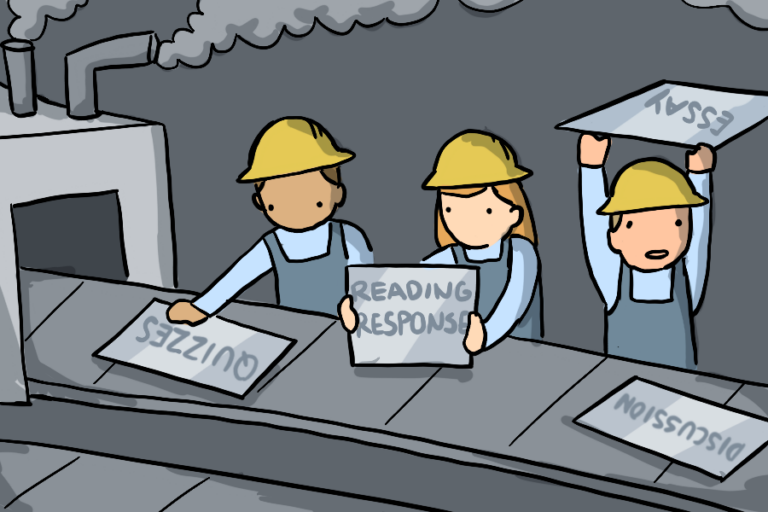
Unconventional grading approaches like these emphasize personal accountability and flexibility, yet, simultaneously, open up larger questions about the role and purpose of grading in education. Grading systems have long been a point of contention, with debates centered around one’s ability to truly learn within organized spaces.

Contract grading, one such alternative to foster genuine learning, has garnered interest for its potential to reduce anxiety and empower students. Still, this raises another important question: Does contract grading really prioritize mastery of the subject, or does it risk reducing education to being simply about checking all of the necessary boxes?

Contract grading is a system of standards-based grading where the student and instructor work with one another to determine the requirements of assessment; The student then agrees to complete the set of tasks needed to be complete, to achieve a specific grade. Unlike traditional grading practices, which rely on percentages and letter grades to evaluate a student’s performance, contract grading prioritizes effort, participation and progress.

Several proponents advocate for such a recentering of priorities, claiming that this eliminates the fear of failure and replaces it with the freedom to be experimental and exploratory in their work. They further contend that it deprioritizes grades as an incentive for learning and applying oneself. This system can assist those who struggle with the demands of traditional assessments.

One of the most notable benefits of contract grading is that it gives students more autonomy than is typically expected from a grading system, imploring them to strengthen their craft without the fear of being reprimanded for work that is thought to be “incorrect.” By clearly outlining the expectations for the student, it removes the unpredictability of letter grades. What you work for, you receive.

This enables the student to work more effectively, not only to complete their tasks, but to take additional risks. By not penalizing or rewarding them for any prior knowledge or experience they have with the course material, it promotes intrinsic motivation and prioritizes those who have invested their time and energy into learning.

Yet, the truth of the matter is that effective pedagogy seeks to balance the needs of the learner with the overall goals of the curriculum. If contract grading does not align with these principles in ways that can emphasize critical thinking, growth and subject mastery, it could inadvertently undermine the very essence of education. One major concern is that it encourages students to focus on meeting the minimum requirements in order to acquire their chosen grade. While it decenters letter grades and their limitations, it dissuades the student from pursuing excellence.

When the emphasis is instead placed on completing a set of tasks to achieve a grade, students tend to prioritize quantity over quality, potentially resulting in superficial engagement with the course material. One can churn out a variety of poorly structured or hastily thought-out assignments if all they had to do was meet a requirement. Checking boxes risks reducing education to a transactional completion of the subject, where mastery of the material becomes secondary to fulfilling obligations.

While traditional grading systems have their flaws, they often include mechanisms to evaluate the originality and complexity of a student’s work. However, the lack of emphasis on qualitative assessments can undermine critical thought and creativity, fostering a culture of task completion without genuine understanding. This approach may be particularly detrimental in fields that require rigorous analysis or problem solving, where mastery is not easily quantifiable.

More often than not, the answer to all things is balance. Educators should work to combine the strengths of contract grading with the accountability that comes with traditional evaluation methods. Reflective components such as self-assessments or peer reviews should be integrated into the contract system to encourage students to engage critically with their work. Students should be asked to vouch for themselves to ensure that they are able to argue for the coherence, originality and depth of their work. This approach would preserve the benefits of contract grading while addressing its limitations. It would guarantee student accountability while also allowing them to approach the task at hand in any way they wish.

Contract grading ultimately has the potential to be a transformative tool for education, but its success is dependent on its thoughtful implementation. If it fails to prioritize mastery of the subject over task completion, it risks failing to facilitate genuine learning. Until students are encouraged to attend to the qualitative feedback given by the instructors — whether through self-assessment or otherwise — this system of grading cannot truly value the time and labor that has been committed to the class.

Until this change is made, I shall be thoroughly pleased with the percentiles, letter grades and gold stars that ask too much of me.


Written by: Abhinaya Kasagani— akasagani@ucdavis.edu


Disclaimer: The views and opinions expressed by individual columnists belong to the columnists alone and do not necessarily indicate the views and opinions held by The California Aggie.

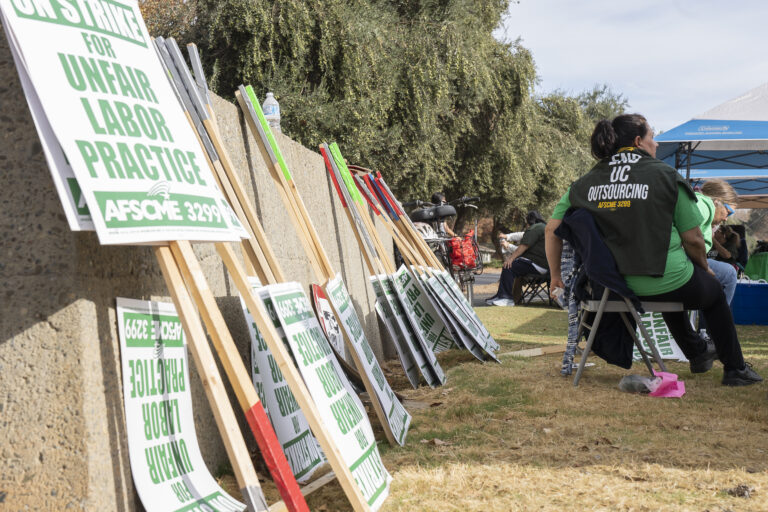
Thousands of UC workers strike, alleging unfair labor practices, interference with rights and staffing shortages

AFSCME 3299 and UPTE-CWA, representing 50,000 workers combined, strike, with multiple campus dining services closing during this time


By KHADEEJAH KHAN — campus@theaggie.org


Around 50,000 University of California workers, represented by two major unions, are set to strike on Feb. 26 to 28 across all 10 UC campuses and five medical centers, citing unfair labor practices, interference with workers’ rights and staffing shortages.

The workers are members of the American Federation of State, County and Municipal Employees Local 3299 (AFSCME 3299) and the University Professional and Technical Employees Local 9119 (UPTE-CWA). 

AFSCME 3299, representing over 37,000 service, patient care and skilled crafts workers, is striking Feb. 26 and 27 across all 10 university campuses. At UC Davis, AFSCME 3299 workers will be striking at La Rue Road and Hutchinson Drive, as well as the UC Davis Medical Center in Sacramento.

In the AFSCME 3299 press release announcing the strike, the union alleged that the UC had negotiated in bad faith, failed to provide wages that meet the cost of living and limited workers’ rights to speech, protest and assembly under threat of discipline or arrest. Previous contracts with the UC expired in July and October 2024, and bargaining began again in January 2024. The two parties have yet to come to an agreement.

“By refusing to bargain in good faith, the University has made it clear that it does not value the frontline workers who clean its facilities, serve food and treat patients,” AFSCME Local 3299 President Michael Avant said in a statement. “UC’s efforts to illegally silence dissent from workers who are struggling the most is suggestive of an effort to concentrate even more power and wealth for its ivory tower elites. This is not a solution to the workforce supply and affordability problems facing this institution, but a glaring symptom of the problem that is driving workers onto picket lines.”

UPTE-CWA, representing over 19,000 health care, research and technical employees, is striking Feb. 26 through Feb. 28. The union will be striking outside of the UC Davis Veterinary Hospital and in front of UC Davis Medical Center in Sacramento.

In their announcement in the Los Angeles Times, the union alleged staff shortages that harm patient care and research operations, bad faith negotiations and raised healthcare costs. They believe the UC implemented “draconian” restrictions on workers who striked for two days at UC San Francisco.

​​“We’re hoping this will send a message to UC about our members being fed up with these unfair labor practices,” UPTE President Dan Russell said in the statement. “We hope this will produce a change in UC’s behavior.”

During the strike, Latitude Restaurant and Market, Scrubs, The Gunrock, Spokes and the meal card office will be temporarily closed from Feb. 26 to Feb. 27, according to Student Housing and Dining Services. Segundo, Tercero and Cuarto Dining Commons and their markets will remain open. Additionally, all Peet’s Coffee locations (with the exception of the Scrubs location), Silo Market, Sage Street Market and the food trucks outside of the silo will remain open with regular hours during the strike.

A UC spokesperson has denied a staffing shortage or claims of silencing unions and claimed the UC has “continuously reached out to the unions in an attempt to settle these contracts.”

“While both AFSCME and UPTE may say they want UC to return to the table, the successful resolution of these contracts depends on their willingness to engage in productive bargaining,” UC said in a statement. “The University will do everything possible to ensure strike impacts on patients, students, faculty and staff are mitigated.”

Students should not expect significant changes in campus operations during the strike, according to a UC Davis spokesperson. 

“We expect instruction, research and other campus operations to proceed without significant disruption,” the UC Davis spokesperson said. “Service levels in our dining halls and some other food outlets will be adjusted for the duration of the strike.”


Written by: Khadeejah Khan — campus@theaggie.org


Editor’s note: Follow along with The California Aggie’s website for more information as the strike progresses daily and for any information about potential resolutions between the university and the unions.


The city of Davis hosts ‘Who You Gonna Call?’ community informational event

0

The Davis Police Accountability Commission partnered with the Social Services Commission to discuss community resources available in Davis


By YUENJO FAN — city@theaggie.org


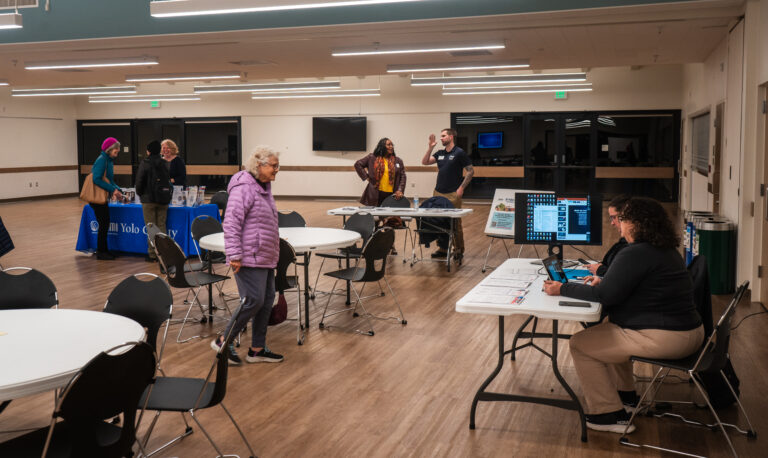
On Feb. 12, the city of Davis held the “Who You Gonna Call?” community informational event at the Veterans Memorial Theatre, organized by the Police Accountability Commission and the Social Services Commission.

In a free public outreach effort, city residents were invited to hear from government and non-profit organizations about local resources to help address crises or social service issues.

A total of six organizations were present: the Davis Emergency Dispatch Center, Davis Community Meals and Housing, the Downtown Streets Team, Yolo County Department of Health Services Agency, Davis Social Services and Housing Department and the National Alliance on Mental Illness (NAMI) Yolo County.

Assistant City Manager Kelly Stachowicz touched upon why the city decided to host the event and the importance of residents having different ways of finding help.

“Every year, [the commissions] try to put on a public outreach event to help people understand law enforcement or [their] alternatives,” Stachowicz said. “The purpose of this event was: if people are in crisis or they have a particular issue where they need assistance of some sort but it might not be a criminal issue, […] who do they call? What resources do we have in the community? […] A law enforcement officer may come out, but somebody else is going to be the one who’s going to be trained to deal with the mental health issue or homeless outreach, etc.”

Stachowicz emphasized how different crises warrant different responses and that Davis has the necessary resources specific to all types of non-criminal issues that could arise. For instance, the Davis Social Services and Housing Department is responsible for issues regarding housing and homelessness, focusing on promoting community health and safety.

Dana Bailey, the department’s director, spoke on how the department aids community members currently struggling with homelessness.

“What we attempt to do is to go out, boots on the ground, and engage with people that have experience of being unhoused on the street,” Bailey said. “So, our team of two will go out in response to calls from the community and try to talk with someone that is either in crisis or just living on the street and try to connect them to some form of services.”

Non-profit organizations such as the Downtown Streets Team also seek to aid those experiencing homelessness by providing jobs and a sense of belonging. Those who are experiencing homelessness can use this as a resource to find ways to seek assistance and employment.

Heather Mundy, the director of Downtown Streets Team Sacramento and Yolo County, provided a deeper dive into what the organization does.

“We want to work with people who are in the experience of homelessness and we want to help them feel included in a community,” Mundy said. “So, you may see our team members in yellow shirts. […] They put those on and they know that they belong somewhere and that they are part of the team. Our volunteers then go out, pick up garbage and they beautify the community. They have picked up a lot of garbage in Davis so far.”

Moreover, presenting mental health resources was also another large part of the city’s outreach event. NAMI Yolo County has an array of programs and public awareness initiatives that hope to inspire change. Founded in 1979, NAMI has grown into a nationwide non-profit that holds more than 600 affiliated programs and continues to be a trusted support outlet for those struggling with mental illness.

The organization’s Executive Director for Yolo County, Jen Boschee-Danzer, believes that NAMI is a place where those struggling with mental illness can go for support.

“All of our programs are offered at no cost to participants and everything that we do is peer-led,” Boschee-Danzer said. “Our mission at Yolo County is to provide advocacy, support, education and public awareness so that all individuals and families who are affected by mental illness can build better lives.”

The “Who You Gonna Call?” community informational event is held annually and sponsored by the city of Davis, the Police Accountability Commission and the Social Services Commission. More information on other upcoming events can be found on the city of Davis’ website.


Written By Yuenjo Fan — city@theaggie.org


Multicultural Extravaganza celebrates diversity on campus during Black Futures Month

The Lambda Xi Chapter of the Delta Sigma Theta Sorority, Inc. hosted an annual celebration of cultural diversity at UC Davis 


By MEGAN PUSL — campus@theaggie.org


On Feb. 18, the Lambda Xi Chapter of the Delta Sigma Theta Sorority, Inc. on campus hosted the Multicultural Extravaganza. The event showcased the many cultures present at UC Davis through performances, including song and dance.

The Lambda Xi Chapter sorority hosts this event annually at UC Davis, continuing a Davis tradition that dates back to 1922, according to the program. The Lambda Xi Chapter was chartered on May 24,1974 as a chapter of the Delta Sigma Theta sorority, a Black Greek-letter organization, according to their website.

The President of the Lambda Xi Chapter, Korley Reese, opened the event by sharing the importance of celebrating cultural diversity.

“The reason why we have this program is to incorporate diversity and cultural awareness at UC Davis,” Reese said. “We do this through performance, through art, through dance [and] through song because it’s important, […] especially in today’s time when diversity, equity and inclusion [are] being limited in certain spaces.”

The hosts of the show were members of the Lambda Xi Chapter, Alexis Muthoga, a fourth-year African American and African studies major, and Claire Ekwedike, a fourth-year managerial economics major.

February was deemed Black History Month in 1976 and represents a time dedicated to honoring and celebrating the history, culture and contributions of African Americans in the United States.

UC Davis is committed to celebrating black excellence, resilience and the impact of the Black community during the many events of Black Futures Month on campus, according to the UC Davis Black Futures Month website.

Black Futures Month represents a collective vision for the future of the Black community on campus and on a wider scale, according to their website. The events during Black Futures Month serve to honor Black history and enhance the visibility of the many contributions of African/African American/Afro-Caribbean and Afro-Latinx/Afro/Black Diasporic peoples. Black Futures Month is co-hosted by the Women’s Resources and Research Center, the Cross Cultural Center and the LGBTQIA+ Resource Center.

Lolita Adkins, the undergraduate research and administrative director at UC Davis, guided the audience in standing up for the Black National Anthem called “Lift Every Voice and Sing.”

“If you do not not know the Black National Anthem, I [want to] challenge you to learn at least the first verse,” Adkins said. “It is something that everyone should know.”

The student performers at the event included Afrovibes, Bakuhatsu Taiko Dan, Lady Mustangs Majorette, Reach Justice, Danzantes del Alma and Phi Beta Sigma Fraternity, Inc.

Reese emphasized the importance of this multicultural event in celebrating the many cultures at UC Davis.

“We find it necessary to keep these traditions alive in our community, and we are so excited to have this event tonight and all the performers worked really, really hard,” Reese said. “We all worked hard to put this event together.”

To find out more about Black Futures Month at UC Davis, visit the UC Davis Diversity, Equity and Inclusion website. The last of the events include the Isidore String Quartet, Let’s Link Up, Lights, Culture, Action!, After Hours Movie Night and Paint and Sip.


Written by: Megan Pusl — campus@theaggie.org


The Trump administration’s first month: mass deportations, neglecting environmental issues and cutting budgets

What hasn’t the Trump administration done?


By THE EDITORIAL BOARD


This week marks the one-month anniversary of President Donald Trump’s return to power, with a new and fascist-aligning administration. Within a month of assuming office, Trump has signed 73 executive orders, with many more expected throughout his term. 

During this time, the Trump administration has implemented several dangerous and unconstitutional policies. While current news may feel more and more overwhelming everyday, we have an obligation to stay aware of these unprecedented orders and we must continue to condemn them as they arise.  

Below is a summary of some key executive actions:

Hinting at an unconstitutional third term

In speeches dating back to 2020, Trump has expressed his desire to potentially run for a third term, despite the 22nd Amendment limiting presidents to two terms — whether consecutive or non-consecutive. 

“Should I run again? You tell me,” Trump said on Feb. 20, 2025 at a Black History Month event. 

This was just one day after Trump referred to himself as “King” in a social media post, writing, “Long Live the King.” We need to take these threats to our democracy seriously — brushing off these claims is what allows a dictatorship to develop right in front of our eyes.

Detaining undocumented migrants at Guantanamo Bay 

On Jan. 29, the administration released plans to detain undocumented migrants at Guantanamo Bay, a naval base previously used as a military detention facility. The facility gained notoriety during the George W. Bush administration for unethically detaining and interrogating suspected terrorists after the 9/11 attacks. Plans to house these migrants in tents at the center have since been suspended due to detention standards. However, as of Feb. 23, the Trump administration transported 17 more migrants to the center. This inhumane and blatantly racist treatment of migrants is part of an ongoing effort by the Trump administration to dehumanize and target Latino and immigrant communities.


Withdrawing the United States from the Paris Agreement and Paris Climate Accord

On Jan. 20, Trump signed Executive Order 14162, officially withdrawing the United States from the Paris Climate Accord. The Paris Agreement, adopted in 2015, aims to combat greenhouse gas emissions and mitigate global warming worldwide. The executive order, titled “Putting America First in International Environmental Agreements,” was issued just hours after Trump took office. The U.S. previously left the Paris Agreement during Trump’s first term (2017-2021) and later rejoined in 2021 under former President Joe Biden. 

Additionally, Trump has made misleading claims regarding climate change and its effects. 

“The biggest threat is not global warming, where the ocean is going to rise one-eighth of an inch over the next 400 years, […] and you’ll have more oceanfront property,” Trump said in an August press conference

However, his comment has no evidential support regarding the actual rate of sea level rise — with sea levels projected to rise much faster at a rate between 10 to 12 inches in the next 30 years — and his denial and mockery of climate change represents a concerning trajectory for the planet’s environmental well-being. Making a joke of this serious issue shows his blatant disregard for the environment and those who will be affected by climate change.

Suspension of foreign aid 

On Jan. 20, Trump signed Executive Order 14169, halting all U.S. foreign development assistance programs for a 90-day review period. While later exemptions were made for essential humanitarian aid, significant portions of U.S. foreign aid have been pulled back. The executive order, titled “Reevaluating and Realigning United States Foreign Aid,” includes restrictions on aid programs established prior to Trump’s latest term.

Since its foundation in 1961, the United States Agency for International Development (USAID) has grown to be the largest provider of foreign assistance around the world. With its services halted, USAID no longer provides humanitarian resources to Ukraine in the face of continued Russian aggression. Programs that distribute vaccines for viruses like Ebola and polio, along with treatment for human immunodeficiency virus (HIV) and food supplies for poverty-stricken areas have also ceased. The crude disbanding of an international organization with this much influence, which was developed over the course of more than 80 years, is a clear signal from Trump that no humanitarian effort is safe from scrutiny. 

Imposition of tariffs on Canada, Mexico and China

On Jan. 31, the Trump administration announced the implementation of a 25% tariff on imports from Canada and Mexico, two long-time U.S. trade partners. An additional 10% tariff on all imports from China took effect on Feb. 4, 2025. 

These tariffs do not and will not lead to a decrease in prices for everyday goods such as eggs, contrary to Trump’s assertions. A video of him stating that “groceries” is “sort of an old-fashioned word” only emphasizes his complete lack of understanding toward the daily lives of the majority of American citizens. 

His blatant disregard for promises he made to the public, with him remarking that it’s “hard to bring things down once they’re up,” further shows that Trump has no intention to create a more affordable day-to-day lifestyle for citizens and used empty promises to secure the vote of the lower and middle classes. 

Instead, these tariffs will make everything from fruits and vegetables to electronics significantly more expensive, since many of these products are produced by the aforementioned countries.

New cabinet appointments 

Trump appointed and confirmed new leaders for key positions in his administration, including Secretaries of State and Defense, as well as the Director of the Federal Bureau of Investigation (FBI). More confirmation hearings are expected in the coming weeks. 

It has become abundantly clear that Trump selects his cabinet members based on loyalty and partisanship rather than on individual merit and qualification. Multiple new members of Trump’s cabinet are under public scrutiny for this perceived lack of qualification, including Robert F. Kennedy Jr., the recently implemented U.S. Department of Health and Human Services secretary and Pete Hegseth, the newly confirmed secretary of the Department of Defense. 

Kennedy has a history of scrutinizing vaccines, promoting conspiracy theories and recommending moral-based drug addiction recovery, rather than science or health-based treatments. Hegseth, a television presenter who formerly served in the National Guard, has no experience serving in the government, working in a senior military role or acting as a leader to a large or influential organization. 

When threatened or questioned by individuals in his party, Trump has been known to publicly turn on those who he has worked closely with in the past. This has included Trump’s former Vice President Mike Pence, who spoke against Trump’s prioritization of himself over Constitutional values during his own presidential campaign in 2024. 

Censorship and worsening press relations

The Trump administration has received criticism for restricting press access to White House events, barring certain media outlets and calling for the arrest of journalists. Specifically, Trump has banned reporters with The Associated Press from attending White House briefings, the Oval Office and Air Force One. Elon Musk has even suggested that journalists from 60 Minutes should be arrested. 

“60 Minutes are the biggest liars in the world! They engaged in deliberate deception to interfere with the last election,” Musk said on X. “They deserve a long prison sentence.”

This remains an ongoing issue as legal challenges arise. These are blatant examples of censorship, directly violating innate freedoms of speech and press. The restrictions being placed on the press are incredibly reflective of the Trump administration’s fascist tendencies as propaganda circulates on a mass scale. Encouraging the public sphere to distrust reliable sources of information and place blind trust in his own policies instead is incredibly dangerous. 

The Editorial Board condemns this ongoing rhetoric toward journalists and encourages the public to continue to research, fact-check and consume reliable media. No matter who has taken the political stage, we should never blindly support the views and actions of any presidential administration.   

As this month is coming to a close, staying informed about ongoing policy changes remains crucial. The Editorial Board encourages readers to explore these topics further, as this article provides only a brief overview of recent policy changes. With the Trump administration’s bold policy changes, the coming months will, without a doubt, determine the future of our nation.


Written by: The Editorial Board


UC Davis play ‘Small Mouth Sounds’ opens Thursday, Feb. 27

The director, cast and crew share their experiences creating the play


By GRACIELA TIU — features@theaggie.org


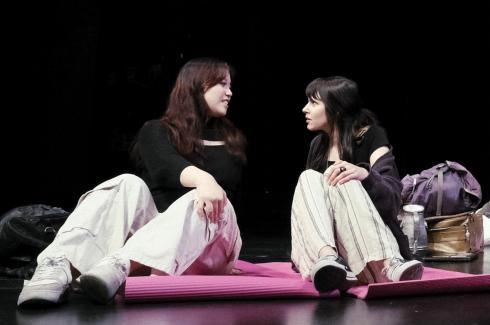
On Thursday, Feb. 27 at 7 p.m., the UC Davis Department of Theatre and Dance’s production of the play “Small Mouth Sounds” will have its opening night. The show, taking place at the Wyatt Pavilion Theatre, will have additional performances on Feb. 28, March 1 and March 6 through March 8. 

Student cast and crew have been working tirelessly since the beginning of the quarter to put together the production, which features elements of experimental and minimalist theatre. 

Jane Lee, a fourth-year theatre and dance major who plays the role of Alicia, described the preliminary audition process.

“The auditions held by the Theater and Dance Department are open to students of any major and year,” Lee said. “I signed up for a slot two days before the audition and prepared a monologue from a contemporary play. I printed out my resume, performed my monologue and had a conversation with the Director, Peter J. Kuo, and the Assistant Director, Ainsley O’Brien.”

This production followed a typical play audition process, calling back certain auditioners after their first auditions and asking them to read through various additional pieces.

Once the cast was selected and rehearsals began in early January, the actors noticed how they came to build friendships and connections through their work. 

“Every day, we grow closer as a cast,” Lee said. “Since there are only seven of us — a small cast for ‘Small Mouth Sounds’ — every rehearsal has its share of exciting and fun moments. We share laughter, tears and valuable lessons from one another.”

Peter J. Kuo holds the position of the Granada Artist-in-Residence at the UC Davis Department of Theatre and Dance for winter 2025. “Small Mouth Sounds” cast members especially appreciate Kuo’s approach to directing and his enthusiasm in regard to character exploration. 

“He’s so hilarious and radiates such a fun energy,” Sabrina Chen, a third-year theatre and dance and psychology double major, said. “He truly immerses himself in the script and allows us to explore our characters while providing us with specific points on how to clearly communicate our actions to the audience.”

Kuo described that a large aspect of both his directing and casting methods included creating space for actors to critically examine their characters’ journeys.

“Part of my process as a director is also talking about the play — the characters, the themes and what journeys they’re going through — and creating a room of people that I also enjoy spending time with and having critical dialogues with,” Kuo said. “Thinking about characters and themes deeply is part of the casting and curation process for me.”

Many cast members share the hope that the audience will resonate with the characters and feel encouraged to reflect on the characters’ experiences.

“I hope the audience will be able to witness the change that the characters go through as each day progresses,” Chen said. “I hope they see themselves through the characters, even if it’s a small part. ‘Small Mouth Sounds’ highlights the challenges that we face as humans just existing, making mistakes and learning from our past. And that amidst the chaos of life, sometimes what we truly need is […] silence.”

Sophia Warnock, a fourth-year evolution, ecology and biodiversity major, hopes that audience members will also share moments of laughter amidst the more serious themes of the show.

“I really hope they laugh,” Warnock said. “There’s a lot of non-verbal comedy in this show and a few blink-and-you’ll-miss-it moments as well.”

Playwright Beth Wohl intentionally left many pieces of the show up to interpretation, and cast members noticed how this element can feel particularly unique compared to other plays.

“Paired with the very raw view of interpersonal relationships and the importance of connection, I think that the great part of the mystery is that so much is left to interpretation, and every audience member will hopefully be able to see a character on stage within themselves,” Arman Abbassi, a third-year managerial economics major, said.

The production also features student designers, with EJ Agata, a fourth-year theatre and dance and English double major, working as the show’s lighting designer. 

“Lighting enhances by adding depth and texture to the set design and works in tandem with sound design to create the world the characters are in,” Agata said.

They also described their creative process for building the lighting design in a way that works well with the show.

“I often start by focusing on where the actors are in the scene and by giving them front light, that way we know for sure that they can be seen by the audience,” Agata said. “I then think about sidelight and where the fill light for the scene is coming from. Since a lot of the show takes place outdoors, they need a lot of side lighting to make sure they can be seen from multiple angles.”

Different elements of the lighting design can often heighten elements of the show and help accentuate certain moments.

“After our designer run a few weeks ago, I thought a lot about the smaller moments that occur between characters, whether good or bad, and realized that even in day-to-day life we tend to miss a lot of them if we aren’t paying attention,” Agata said. “I’m referring to the glances we share with people, brief hand-holding, those kinds of little things. Since this show relies less on the dialogue that the characters share with each other, I wanted to highlight those moments instead as they really carry most of the scenes of the show.”

The details of the show, whether in the acting or technical aspects, come together to deepen the varying themes within the story. Kuo described that the play’s themes of connection and nature fit well with the UC Davis environment because of the school’s strong integration with nature.

The show especially aided the cast members in strengthening their acting skills and technique.

“Good acting is about finding your motivations and emotional beats off of those of the characters you are working with,” Abbassi said. “It’s really intrinsically a team art, and it’s so rewarding when it comes together so well as it has in this play.”

When rehearsing for this play, the group came to deepen their trust in each other, especially with the more delicate scenes.

“There’s a lot of trust involved in emotionally intimate and vulnerable scenes,” Warnock said. “But I feel like I’ve learned that some people really do deserve that trust. The cast wholeheartedly puts themselves out there every time we’re in rehearsal, and the bravery to do so inspires me to do the same.”

Utilizing that trust when working through each scene brought a sense of stability to some actors, aiding them in bringing their characters to life.

“I’ve learned a lot from my cast members, and one thing that stands out is truly how trusting the people around [me] changes my own voice and character,” Simon said. “The more I would trust them, the better my acting was, because I wouldn’t have to worry about them missing anything.”

The cast members also noted that they learned the value of true collaboration when working and acting with others onstage.

“This is a lesson that I took from another one of my acting professors: work with your scene partners, not at them,” Chen said. “It’s more challenging in the beginning, as I’m just trying to memorize and process the script, but as I grow more comfortable with the words, I really play off my actions and dialogue through the other characters, registering their reactions in real time and using the language and movement to my advantage to drive the action.”

Giving actors the space and opportunity to come up with their own ideas can help them feel confident in themselves and encourage further creativity, according to Kuo. 

“Part of that collaborative process is building and empowering these artists [to know that] that their input matters, their creativity matters and how their thoughts and critical analysis of the play combined with how they’re bringing their life experience and approaching the text matters,” Kuo said.

Cast members felt that another special aspect of the show is the diversity of the group and the representation that the audience will see on stage.

“[Kuo] selected a really diverse cast, and I am so glad to be a part of that representation that I hope the audience will receive,” Chen said. “Specifically for me, it’s always a gift to work with other Asian Americans in theater.”

The hard work and dedication the cast and crew put into the show made the experience especially rewarding for them.

“The friendship we have and the amount of work that everyone, most importantly our director, [Kuo], has poured into this production is what makes it special,” Abbassi said. “I truly think that a production’s quality is so accurately exemplified by the amount of care, effort and attention to detail that its director is able to imbue into it in order to get the most out of the material and the actors’ performances and [Kuo] has most definitely [proven] that.”

Another one of the many takeaways the group hopes the audience will leave with is a reevaluation of time and its interconnectedness with relationships, according to Kuo. 

“I think part of it is just being able to re-appreciate time,” Kuo said. “And that sometimes things happen at a slower pace or happen in unexpected ways. […] Journeys of healing are around how we connect with others, and I think that’s what this play does and is teaching us. Part of what this piece is reminding us of is that it’s okay to have moments of stillness and reflectiveness.”

The cast and crew are excited to bring the show to the UC Davis community and share the product of their effort and commitment. The play has tickets available for purchase on the UC Davis Department of Theatre and Dance website, with discounted tickets available for students at $5, faculty and staff tickets at $12 and adult tickets at $15.


Written by: Graciela Tiu — features@theaggie.org


History Department presents UC Davis Professor Adam Zientek’s lecture on how fascism was allowed to flourish in a democratic Germany

The lecture defined fascism in a way that echoes present-day American politics while warning the consequences of inaction  


BY JULIE HUANG — arts@theaggie.org


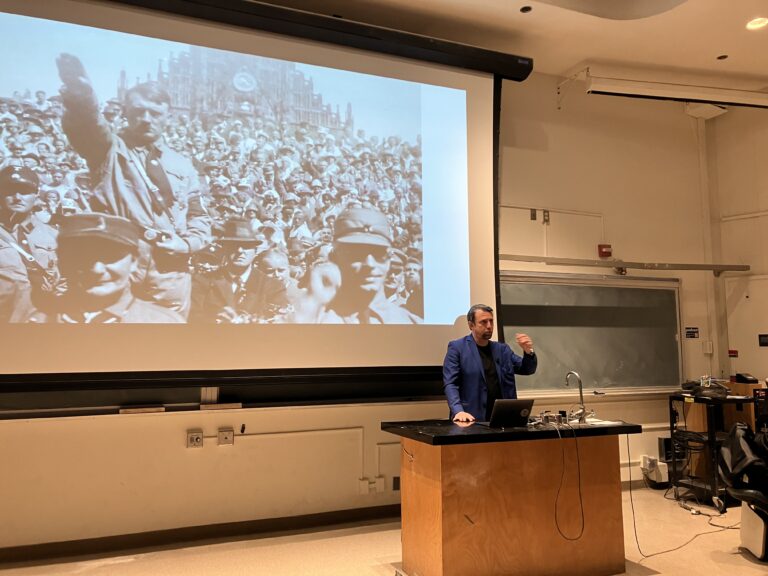
On Feb. 18, the UC Davis Department of History held a lecture given by Professor Adam Zientek on the “Machtergreifung,” referring to Adolf Hitler’s rise to power in 1930s Germany. 

Over the course of an hour and 20 minutes, Zientek sought to detail the process by which Hitler established a fascist dictatorship within a highly literate and cultured republic, revealing how quickly fascism takes root even in societies that are committed to democracy. 

“I’ll give the moral of the story away at the beginning,” Zientek said. “Hitler only came to power because he had lost.” 

After Germany’s tremendous losses in World War I, many Germans turned to the “stab-in-the-back” myth as a soothing explanation for their defeat. Many small, right-wing political parties, known as “patriot parties,” promoted the idea that Germany’s loss was caused by traitorous internal enemies, which included socialists, communists and Jewish people, who had betrayed the invincible German army when they sued for peace in 1918. This narrative, although not grounded in reality, resonated strongly with middle-class German veterans, one of whom was Hitler. 

Only after Germany’s defeat in World War I did Hitler resolve to become a politician, becoming drawn to the German Workers’ Party, a small, far-right party that subscribed to the stab-in-the-back myth. 

“They shared a group identity as honorable and brave patriots who had their glory taken from them by the left, the French and the Jews, stewing in resentment and shame,” Zientek said. “They were exactly Hitler’s kind of people.” 

Following his entry into the German Workers’ Party, Hitler spent years honing his oratorical skills in the beer hall where the group met. 

“Up to 6,000 people a night would sit transfixed and listen to him as he raved that only he could protect Germany from Jews and save Germany from international bankers,” Zientek said. “Hitler’s language in these speeches was ugly, brutal, coarse and omitting facts — a program that you’d think would be unpopular, but you’d be wrong.” 

In 1923, Hitler attempted a coup d’etat and was convicted of treason. Yet being prosecuted made him more popular than ever, and attempts to hold him accountable only increased his influence and his belief that he was the victim of political persecution.
“Hitler’s coup taught him the lesson that overthrowing a democratic state was not done through violence,” Zientek said. “Through legal means, he could pervert and then take over the parliamentary institutions of government to establish a one-party state.” 

Millions of Germans who had never heard of him read about his trial in the newspaper, giving him a platform to promote his ideas. 

“Nazism became about winning hearts and minds, blackening the former and emptying the latter,” Zientek said. “Hitler’s goal was to win enough votes to destroy the opposition once and for all.” 

Yet Hitler’s brand of far-right extremism was unpopular in 1920s Germany due to growing economic prosperity and cultural optimism. Germany experienced a series of diplomatic victories in the 1920s, was welcomed back into the League of Nations and largely reintegrated into the European economy by 1929. 

Only after the economic crash of 1929 did interest in the Nazis’ radical solutions begin to grow. 

“This was devastating for the living standards of ordinary Germans, and it seemed to prove that democracy, liberalism and capitalism had failed catastrophically,” Zientek said. “These things that had promised prosperity and peace produced a world in shambles. The German people looked for alternatives, and the Nazis had them.” 

Before continuing his discussion of Hitler’s rise to power, Zientek stopped to explain what he meant by fascism, citing historian Robert Paxton’s definition of the term.

“Fascism may be defined as a form of political behavior marked by obsessive preoccupation with community decline, humiliation, or victimhood, and by compensatory cults of unity, energy, and purity, in which a mass-based party of committed nationalist militants, working in an uneasy but effective collaboration with traditional elites, abandons democratic liberties and pursues with redemptive violence and without ethical or legal restraints the goal of internal cleansing and external expansion,” the definition reads.

Zientek went on to list other characteristics of fascist ideology, which include the superiority of one’s own group above others and dread of that group’s decline under liberalism, as well as class conflict and alien influence, which supposedly justify domination of other groups without any legal or moral constraints. 

“This is as good a definition as you’ll find, and a definition that has some spooky relevance to the 21st century in the West,” Zientek said. 

Despite his growing popularity with the German people, Hitler was never voted into office. Paul von Hindenburg, a conservative politician and monarchist, remained president and strove to protect democracy as an elected official even though he did not believe in it.

“Hindenburg disagreed with Hitler’s rabble-rousing rhetoric and rightfully worried about mass violence in the streets should Nazis take power,” Zientek said. “It was an irony that this old conservative represented the final bastion of the democratic republic in Germany.”

Hitler reacted by threatening Hindenburg with direct opposition. Although they failed to win a majority, the Nazi party had won the largest number of seats in the Reichstag, the German parliament. 

“The Reichstag was a complete disaster incapable of governing, and Hindenburg governed by bypassing it entirely and ruling through the president’s power to decree,” Zientek said. “He was desperate to restore the Reichstag to a functional government.”

In mid-November, Hitler received an offer to become vice-chancellor, which he rejected. He would only accept complete Nazi control of the government.

The current chancellor, Franz von Papen, convinced Hindenburg that they needed to enter a pact with Hitler, believing that they could exercise control and limit his power. Not wanting to struggle against his dysfunctional parliament anymore, Hindenburg allowed himself to be convinced that Hitler could be safely appointed chancellor. 

“The final stage of this was not some brilliant takeover, as the Nazis later represented,” Zientek said. “Hitler lost the contest for governmental authority, [only being] offered governmental authority ex-post-facto. He was only given this authority because he had already lost it and his opponents thought him weak and powerless. They were wrong.”
In February 1933, Hitler announced his intentions to dissolve the Reichstag and rule Germany forever. By mid-March, 10,000 individuals were in concentration camps. Hitler used the Weimar Constitution to enact a permanent state of emergency, restricting personal freedoms. When Hindenburg died in 1934, Hitler passed another law that combined the chancellorship and presidency into one office, effectively establishing his dictatorship. 

“In other words, the catastrophe happened very quickly,” Zientek said. “It took only a year for the Nazis to establish political power and intimidate the rest of society into acquiescence. When Hitler took power, ordinary Germans were enthusiastic. They believed that he would solve their problems. They did not quite grasp where they were. They did not grasp that their world was on a course to war, genocide and annihilation.” 

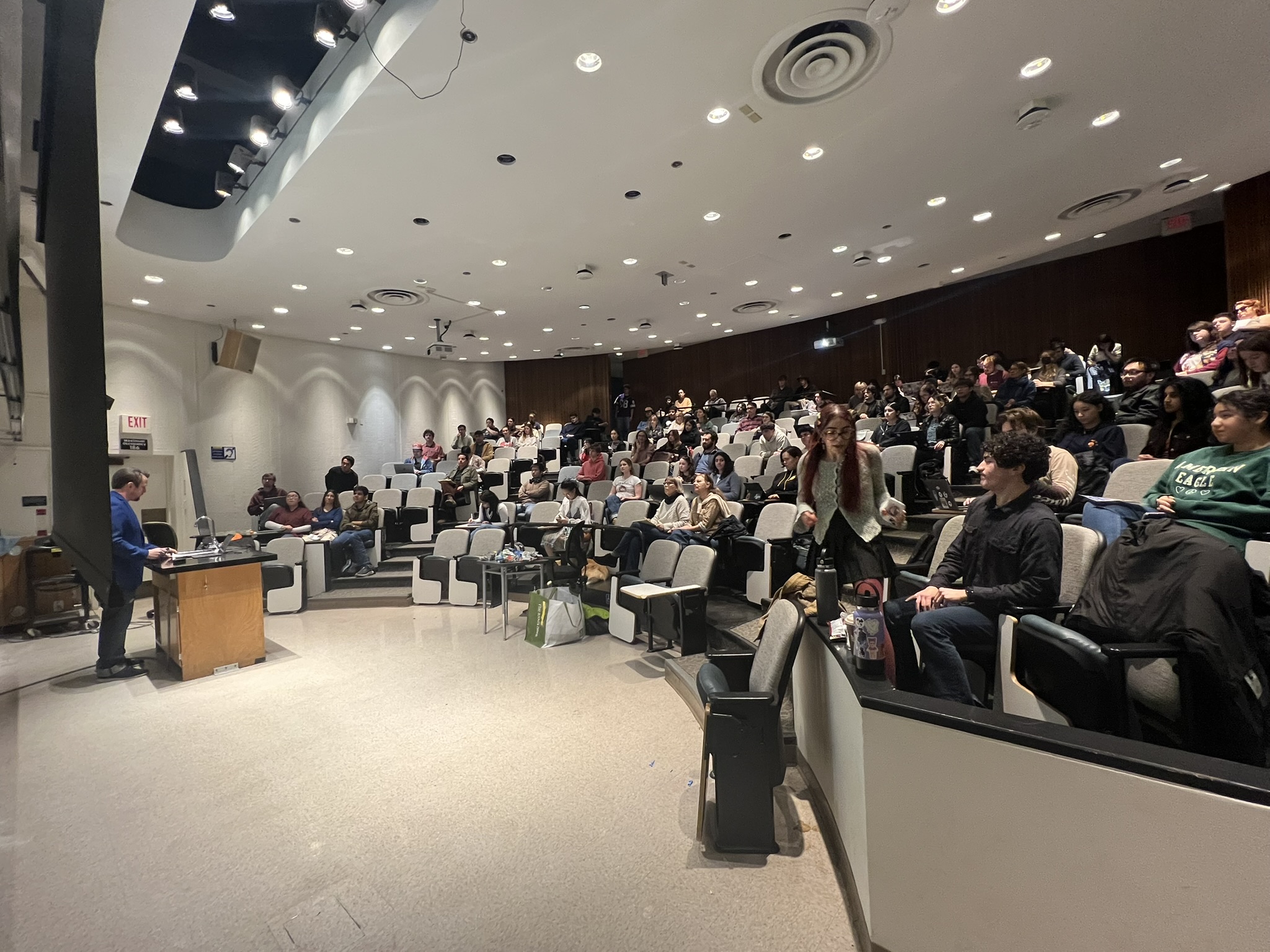
Students gather to hear Professor Zientek’s lecture. (Courtesy / Kathy Stuart)

Zientek made three points in the way of conclusion. 

“First, Hitler was legitimately popular,” Zientek said. “He wasn’t hiding who he was. His message was public and his rise to power was not a case of pulling the wool. There’s this trope that the first victims of the Nazis were Germans — that’s one of the dumbest things I ever heard.” 

Second, Hitler’s original grasping of power happened through entirely legal means. 

“Hitler’s goal was to win control of the institutions of democratic government and then twist and pervert them so that the destruction of democracy would appear to be democratic,” Zientek said. 

Lastly, Hitler’s rise to power was dependent on those in power willfully blinding themselves to the clear danger that Hitler posed to democratic government, failing to act in any meaningful way against the threat of fascism. 

“Had von Papen and Hindenburg believed they would not be able to control Hitler, the entire history of the world would have been much better,” Zientek said. “It did not have been this way and it would not have been, if not for the myopia and blind optimism of the traditional conservatives in Germany. They, more than anyone else, are to blame for Hitler’s seizure of power— they simply gave it to him.” 

After concluding his lecture, Zientek engaged in a short Q&A session and addressed similarities between Hitler’s rise to power and the United States’ current political circumstances.

“Who knows what the hell is happening?” Zientek said. “The days we’re living in right now, people are going to be talking about a thousand years from now — if there’s still people. We won’t know what will happen until 30 years from now.”

Zientek also found resonances in how left-wing German political parties failed to take action in the pivotal years following the Great Depression, leading to the eventual Nazi regime. 

“The German Social Democrats thought the good years would last forever, and when the depression [of the 1930s] came, they couldn’t come up with a solution, not even a bad or fake one like the Nazis had,” Zientek said. “The failure of the centrist left to do anything is an  interesting story, which has its parallels as well.” 


Written by: Julie Huang — arts@theaggie.org 

Editor’s Note: This story has been updated to include photographs from the lecture, courtesy of UC Davis History Department faculty.

ASUCD Senate creates new subunit to support, partially integrate with Aggie House at Feb. 20 meeting

Vital Emergency Shelter and Transitional Assistance to support Aggie House’ facility and operational costs by establishing a new shelter at Russell Park


By VINCE BASADA — campus@theaggie.org


The ASUCD Senate created a new subunit Thursday, Feb. 20, to expand transitional housing options for students in collaboration with Aggie House. ASUCD President Gaius Ilupeju also announced that ASUCD would begin renting a property at Russell Park to serve as a new transitional housing shelter in pursuit of this goal.

The Vital Emergency Shelter and Transitional Assistance (VESTA), a nod to the Roman goddess of the hearth and home, will be responsible for the budget of the Russell Park facility and will be tasked with collecting data on the causes of housing loss for UC Davis students and the outcomes of ASUCD advising. 

It is a subdivision of the Housing Advising for Undergraduate Students (HAUS) unit, which largely focuses on connecting students to existing housing options.

“I hope we bring into the conversation what ASUCD could show other student governments is possible,” Christina Smith, a fourth-year political science — public service major and the chair of ASUCD’s Housing and Transportation Advocacy Committee (HTAC), said. “We are leading the forefront here with this charge.”

Aggie House, the celebrated transitional shelter for and managed by students, was created in 2021 by former ASUCD commissioners. It has served over 70 residents since opening and has served as a model for similar shelters at UC Los Angeles, University of Southern California and several other college campuses.

“The foundation and core values of Aggie House have always been inclusivity and collaboration,” Emely Marroquin, a fourth-year neurobiology, physiology and behavior major and an Aggie House internal co-president, said at the meeting. “We’re so excited to have the opportunity to work with ASUCD and broaden our impact, not only through the capabilities of being able to house more residents but also by expanding our volunteer base.”

Additionally, VESTA’s creation and the Russell Park location will help relieve some of the shelter’s issues with financial reliance on grants, spatial constraints and lack of a permanent location, considering Aggie House has changed locations twice since its founding.

“Relying on grant funding has been extremely unstable for [us] and our efforts largely have focused on just trying to stay afloat and survive, rather than thrive,” Nikhi Sundarapandian, a fourth-year political science — public service major and an Aggie House external co-president, said. “We’re really looking forward to a potential collaboration.”
While HTAC and HAUS will both be involved with supporting and expanding Aggie House’s operations, Smith made it clear that ASUCD will still continue its own advocacy work.

“Our main thing is advocacy always,” Smith said. “We never want to have to do this work. Transitional shelters aren’t something that undergraduate students should have to worry about being involved with or going to.”

In a 2024 survey, 19% of UC Davis undergraduates reported that they were sometimes or often unable to pay their housing costs on time; 50% said that they had worried about being able to cover their housing costs.

VESTA was created under Senate Bill (SB) #55, which passed at the meeting unanimously and thereby partially integrated Aggie House with ASUCD. Senate Resolution #8 also passed, affirming the Senate’s commitment to allocate $80,000 to rent the Russell Park property for the 2025-26 academic year.

At the meeting, Ilupeju commented on housing and basic student needs becoming a new main focus of ASUCD in the future.

“If we were to think about ASUCD’s next big thing, especially as we go into the 2030s, I think this is it,” Ilupeju said of VESTA. “The direction we’ve been heading the last few years is working with campus partners to offer more robust services for students. That’s exactly what this does.”


ASUCD Pride Festival

During public comment, former ASUCD Senator Jacob Klein, a third-year political science – public service major, provided criticism of ASUCD’s leadership over the lack of hiring of a unit director of the Pride Festival Unit. 

“If President Ilupeju, [Internal Vice President Aaminah] Mohammad and our executive branch as a whole want to demonstrate to the student body that they give a singular fuck about the LGBTQ+ community, they need to get their shit together,” Klein said. “When I was an ASUCD Senator for the last two years, I was one of the only LGBTQ+ identifying members of the table. I worked so hard to nearly double the budget of the Pride Unit to ensure that they could continue to implement effective projects for the UC Davis community. Unfortunately, none of these projects and none of these funds have been used as the Pride Unit does not currently have a unit director.”

Klein continued by expressing his frustrations with the actions of student leaders.

“ASUCD President Ilupeju and IVP Mohammad have not done shit to uplift our community,” Klein said. “You must take accountability for this oversight and explain what you are doing to ensure that ASUCD will host a Pride Festival this spring, and that you will not let us down at a time when our federal government and your administration already have.”

Ilupeju, in response, noted that the unit director vacancy had been posted multiple times since the start of the academic year, with few applicants. He also provided a defense for some of Klein’s criticisms of his administration. 

“I think the assertion that we haven’t done anything for the LGBTQIA+ community and that we’ve just been sitting on our ass and watching this go by — that’s character assassination,” Ilupeju said. “I told [the Senate] that I’ve been working with the LGBTQIA Resource Center to get [human immunodeficiency virus (HIV)] and [sexually transmitted infection (STI)] mobile units here on campus. So you can criticize us for not doing enough for Pride, but to say that we’re not doing anything for the community is false.”

He also said that the Davis Pride Festival had approached ASUCD about possibly integrating the two events and criticized Klein, who had been a senator during the 2024 fall quarter, for not raising the issue while he was still a member of the table and a student official.

“We have a responsibility to represent ASUCD and make sure this association is functioning,” Ilupeju said. “But there are 20 people at this table, 14 voting members. You were [a] voting member all throughout fall and you’re now bringing it up in winter, when you’re not on the table. I’m taking blame on my end for not being more direct, but I need you to take responsibility as well because you swore an oath.”

Klein provided no response and left the meeting without further comment.


Other Senate Business

In non-housing matters, the Senate heard from the Environmental Policy and Planning Commission (EPPC) Audit Team on the Audit Sustainability Fund. The commission is encouraging units to exercise operations in a more sustainable manner and award sustainability bonuses to units demonstrating efforts on this front, in part to offset costlier alternatives. According to EPPC Commissioner Kelsey Meyer, a fourth-year environmental policy and planning major, EPPC is working on getting access to purchasing records and rating/grading purchasing sustainability. They plan on awarding these bonuses until the fund is depleted.

The table also heard six quarterly reports during the meeting, including from Whole Earth Festival Co-Directors Jaye Duckhart, a fourth-year neurobiology, physiology and behavior major, and Katherine Krinsky, a fourth-year English major, who said that this year’s festival theme is “Earth to the People.”

KDVS General Manager Fritzi Kornstaedt, a fourth-year environmental engineering major, reported on challenges in preparing for the station’s move to the Silo this summer. Then, Campus Center for the Environment Acting Unit Director Arianna Blandon, a third-year environmental policy and planning major, spoke of recent remodeling done at the student garden and chicken coop. 

Outgoing ASUCD Head Justice Katrine Lee, a fourth-year political science and Italian double major, also presented, alongside Justice Iman Tariq, a third-year sociology and political science double major, on the Judicial Council’s continued legislative review efforts.

The California Aggie’s Editor-in-Chief Chris Ponce, a fourth-year political science and philosophy double major, and Managing Editor Alyssa Crevoiserat, a third-year managerial economics major, also presented on recent updates at the paper. 

The Senate posed questions on environmental concerns regarding the excess of print papers not picked up by students, with members of the table asking if it was possible to reduce the size of The Aggie’s distribution.

“The most sustainable option would be to produce the amount [of papers] that students will take,” EPPC Chair Annie Kanjamala said. “It just seems like, from our perspective, that there’s an overproduction of papers.”

In response, Ponce and Crevoiserat asserted that lowering the print volume, currently at 2,500 papers per issue, would “drastically” reduce advertising revenues; industry standard is 4,000 papers per issue. They did, however, say they were open to working with ASUCD officials on addressing the topic via other means.

Ilupeju also asked for projections on the paper’s advertising revenues, with Ponce estimating that the paper had reached some 50% of its fundraising goals.

“Advertising levels are lower than we want to be [at] right now,” Ponce said.

The last quarterly report was delivered by the External Affairs Commission, who Ilupeju commended for their productivity and work accomplished this quarter, including a flashlight distribution program.

In legislative matters, the Senate unanimously passed SB#50, allocating $819 for the ASUCD Ethical Spending Committee Public Seminar on Feb. 24, and SB#49, codifying and clarifying ASUCD bylaws regarding the Judicial Council.

The meeting began at 6:29 p.m. and ended at 9:43 p.m.


Note: The California Aggie, while an ASUCD unit and therefore responsible for giving quarterly reports to the Senate, operates separately from the student government and maintains editorial independence.

Written by: Vince Basadacampus@theaggie.org

From live raptors to carcass collections

0

UC Davis hosts 14th annual Biodiversity Museum Day


By PIPER AWEEKA — city@theaggie.org


UC Davis held their 14th annual Biodiversity Museum Day across a variety of city-wide locations on Feb. 8. Activities were held at the California Raptor Center, UC Davis Arboretum and Public Garden and the Bohart Museum of Entomology.

Tabatha Yang, the coordinator and co-founder of the event, was busy delegating tasks to university volunteers amidst crowds of children and adults. As the education and outreach coordinator for the Bohart Museum of Entomology, Yang gave background to the annual celebration.

“Bohart [Museum of Entomology] had been doing open houses on the weekend, and they were popular,” Yang said. “Then we would collaborate with [the Department of Wildlife, Fish, and Conservation Biology] because they are our neighbors. And then we connected with the Botanical Conservatory. So one year we just did this kind of three open-house thing across campus, we were like, ‘This is great,’ and then it expanded from there.”

Citing UC Davis’ powerhouse in biology and ecology research, Yang elaborated on the expansive focus of Museum Day.

“We just wanted one day working together,” Yang said. “Some of the collections are living, and then some of the collections are preserved, but we’re all science collections.”

Julie Cotton, the co-manager of operations at the California Raptor Center, emphasized the center’s special contribution to Museum Day.

“Our collection is a little unique in that we’re one of the only collections where our specimens are primarily live specimens,” Cotton said. “We have a collection of non-releasable birds of prey that serve as educational ambassadors for their species here.”

Cotton then talked more about the Raptor Center and also elaborated on its objectives and long-term goals.

“One of our big goals is to be open to the public and family-friendly, […] we host many visiting school groups, we offer classes and tours,” Cotton said. “There’s a whole part of our mission that people don’t get to see as much. We also rehabilitate injured, orphaned and sick birds of prey that members of the public find. […] Last year was actually a record-setting year for us, 261 birds [rehabilitated] in 2024.”

Kurt Wendlenner, an attendee at the California Raptor Center, reflected on Biodiversity Museum Day’s significance for the community.

“It’s a great event that we try to bring the kids out to,” Wendlenner said. “It’s a great component of Biodiversity Day and showing everything that UC Davis and the Davis community has to offer.”

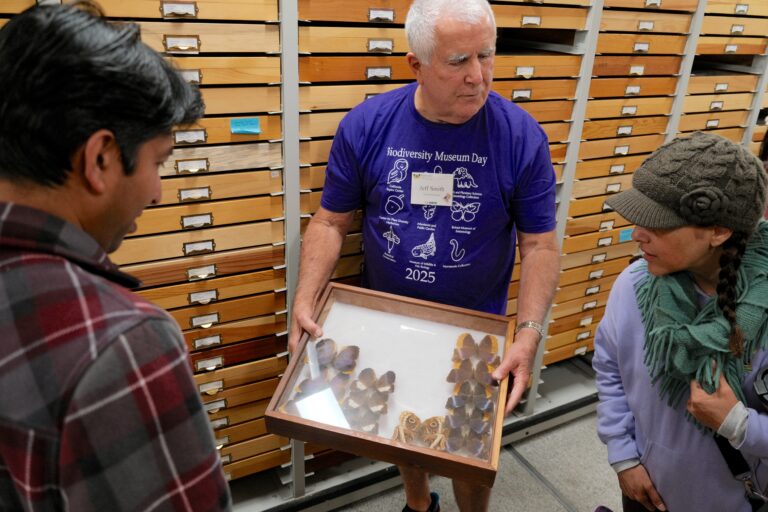
Ash Robinson, a UC Davis student volunteer majoring in evolution, ecology and biodiversity, talked over the crowd inside the Bohart Museum to share about preserved fish specimens and the success of the event.

“We keep all of our fish in 70% ethanol to kind of preserve them,” Robinson said. “So all of them are dead. This is my first time doing Biodiversity Day, but there are a lot of people who are engaged, which is very fun.”

With throngs of attendees actively engaging with displays of preserved animal carcasses and live birds of prey, Yang spotlighted the unique beauty of UC Davis’ Biodiversity Museum Day.

“We try to open our doors to the public, […] that was the way Dr. Bohart operated as a professor — he always had an open-door policy,” Yang said. “If you go to other collections, it’s not this open. It’s highly unusual.”


Written by Piper Aweeka — city@theaggie.org


Sudwerk Brewery Co. hosts Stories on Stage Davis

0

The monthly production is thriving in its new era: “Second Sundays at Sudwerk”


By OLIVIA HOKR — city@theaggie.org


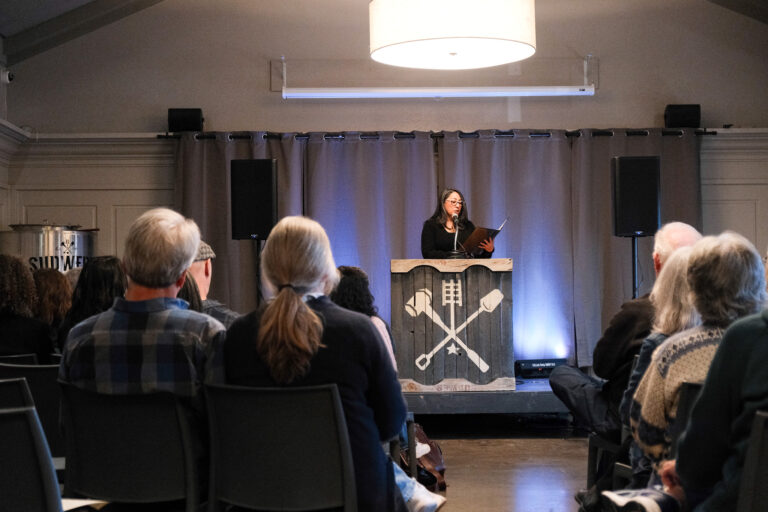
On Feb. 9, Stories on Stage Davis (SOSD) held its monthly reading event in the Sudwerk Brewery Co. Beer Hall. The productions were previously held in an art gallery, but due to increased popularity, they recently switched over to Sudwerk.

Maya Sinha is the Season 11 director of Stories on Stage Davis. She shared the purpose of the Stories on Stage organization and its development over time.

“Stories on Stage Davis is an all-volunteer, non-profit organization founded by Davis resident Jeri Howitt,” Sinha said. “Starting with Howitt, who remains the founding director, SOSD has had a series of local writers as directors over its 11 seasons.”

Sinha explained their need to move to a large space due to the successful growth they have had over time.

“For its first 10 seasons, SOSD’s monthly readings were held at the Pence Gallery in Downtown Davis, a fruitful collaboration in the local arts community,” Sinha said. “In September 2024, needing more space for our growing audience, we moved the readings to Sudwerk Brewery’s Beer Hall for Season 11. We’re very happy with the new space and increased turnout this year.”

Each month’s production brings a different energy to the stage, with some stories on the humorous side and others more emotion-provoking. For the February event, the production focused on flash fiction, which is a story that is limited to a small number of words.

Kat and Matt Miller, a husband and wife acting duo, read stories by Hema Padhu and Grant Faulkner, respectively. Kat Miller read “The Pea That Changed Everything” and “Unremembering.” Matt Miller read “Invocation to Possible Angels” and “Cold Hard Cash.”

Sinha shared insight into the intricate process the organization goes through each month to choose authors and actors and put together a successful and entertaining reading performance.

“Howitt, a voracious reader, takes the lead on choosing stories for each season, in consultation with the seasonal director,” Sinha said. “With some exceptions, we look for writers in Davis, Woodland, Sacramento and the Bay Area, whose pieces would present well for an audience. We aim for authors with a wide variety of backgrounds, ages and styles, including some nonfiction. Once the stories are selected, Casting Director Tim Gaffaney draws from a diverse group of regional actors and casts a performer suited to each piece.”

Stories on Stage holds their events on the second Sunday of every month from September until May, beginning at 4 p.m. The readings are free, though they provide the option to give a $5 donation. The organization aims to provide a space for showing support for local writers and performers while socializing and enjoying dinner or a drink. More information on upcoming performers and authors can be found on their website.

“Our commitment to literature, live performances and the vibrant culture of our city is the driving force of our efforts,” the website reads. “Behind the scenes is a collective of talented and diverse community members, each of whom believes that there is nothing better than hearing authors and actors live. We hope you’ll join us for ‘Second Sundays at Sudwerk.’”


Written by: Olivia Hokr — city@theaggie.org


Reproductive Rights Panel empowers students with knowledge and resources

ASUCD Student Health and Wellness brought together students and experts in the field to discuss reproductive health topics


By MEGAN PUSL — campus@theaggie.org


In response to the current political climate, the ASUCD Student Health and Wellness unit (SHAW) organized a reproductive rights panel to advocate for student health and share resources.

On Feb. 6 from 10:30 a.m. to 12:30 p.m., SHAW hosted three guest speakers and highlighted various campus resources for reproductive justice. The first 100 students to attend received free Plan B, an emergency contraceptive.

Four different campus organizations tabled at the event to provide resources, including SHAW, Love Lab, Gender and Sexuality Commision (GASC) and Sexual Assault Awareness Advocacy Comittee (SAAAC).

Adeena Rahman, a third-year molecular and medical microbiology major and the director of SHAW, had a large role in planning the event. Rahman, along with the other SHAW coordinators, organized this event to provide resources for students and highlight notable guest speakers.

“Because of the current political climate, I really wanted to have an event that could help inform the student body about what is accessible to us in regards to reproductive rights and health,” Rahman said. “I brought in three speakers hoping that they could all address reproductive rights [and] reproductive injustice through different lenses.”

The first guest speaker was Rachel Cradit Henry, the sexual health promotion specialist at Health Education and Promotion (HEP) at UC Davis. The second guest speaker was Mitchell D. Creinin, the director of the Complex Family Planning Fellowship in the Department of Obstetrics and Gynecology at UC Davis.

Creinin covered many topics in the scope of reproductive healthcare during his talk. He taught the audience about the process of In Vitro Fertilization (IVF), types of emergency contraceptives, such as Plan B and Ella, and the process of getting a male birth control approved for the public.

Creinin stressed the importance of legislation as it pertains to reproductive rights.

“It’s all about who you vote for and who you put into power, that’s really the issue,” Creinin said. “The short term is to make sure you’re protected, make sure your friends are protected [and] have emergency contraceptive around. But the long game is always gonna be voting.”

The third and final guest speaker of the day was Essential Access Health’s Public Affairs Coordinator Melody Yan. Essential Access Health is a non-profit based in Berkeley and Los Angeles that works to advance reproductive equity for all.

Yan shared her experience working in public policy, speaking about reproductive health laws in California with a focus on minor confidentiality and teen rights laws. She emphasized the importance of youth having access to trusted adults with whom they can discuss topics like birth control, sexuality and sex, noting that many minors lack this support.

“That is the reality for a lot of young people and teens,” Yan said. “They don’t have that openness and safety with adults. That is why minor consent laws play a huge critical role in empowering young people to make decisions about their healthcare.”

Next, Yan highlighted past California legislative victories within her non-profit that contributed to protecting and expanding contraceptive and abortion care in recent years. She mentioned grant programs that Essential Access Health administers for California such as Los Angeles Abortion Safe Haven, Uncompensated Care and Practical Support.

Yan explained the importance of maintaining funding for these grants to protect reproductive rights.

“We cannot forget the importance of maintaining this infrastructure we’ve created in California ensuring that people in the state and people who really need to come here can get the care,” Yan said.

For anyone who wishes to find out more about SHAW, you can visit their Instagram account, @asucd.shaw. To keep up with events hosted by the other student health resources featured at the panel, you can follow their accounts on Instagram: @asucd_gasc, @asucd_saaac and @ucdlovelab.


Written by: Megan Pusl — campus@theaggie.org

These stars are making their way back to their original curtain call

Several Hollywood actors are returning to the West End stage this year 


BY BETH MUNRO-MORRIS — arts@theaggie.org


Actors often first hone their craft on stage, where theater serves as a stepping stone toward a more lucrative career in film. While the glamor of Hollywood may be the ultimate destination for some, not every actor is satisfied with a career spent in the spotlight of Los Angeles. In fact, some crave a break from the intense spotlight of film altogether. Actors are increasingly setting up base across the Atlantic, choosing to showcase their talents far from the camera lens.

The past year, theater has seen several big names return to their humble beginnings or make their debut on London’s West End stage. Here’s a look at just some of the actors who are proving that they can truly do it all:

Many Marvel fans flocked to London this summer to watch their favourite superhero return to the West End stage. Known predominantly for his iconic role as Peter Parker in the latest Spiderman series, Tom Holland starred as Romeo in a new adaptation of “Romeo and Juliet” at the Duke of York Theatre. Despite its localized display, the production gained the status of a global event, becoming a complete sell-out months before its opening night on May  11.

However, Holland is not new to the West End stage. In fact, it was where he got his start. At just 12 years old, Holland starred as Billy Elliot in the iconic “Billy Elliot the Musical,” a role that launched his career. Returning for the first time after 15 years, having cemented his place as both a film and theater star, Holland’s performance as Romeo marked a full-circle moment for himself and fans.

From “Love Rosie” to her leading role in “Emily in Paris,” Lily Collins made her West End debut in the comedic drama “Barcelona.” The production, which ran from October 2024 through early 2025, saw Collins leave behind her signature brown locks, opting for a blonde transformation where she played Irene — a painfully American real estate agent who’s vacationing in Spain.

Ironically, her character’s experience mirrors Collins’ own as an American abroad in a European city. What begins as an innocent one-night stand with a local Spaniard quickly escalates into a dangerous and tangled narrative. Teaming up with “Money Heist” star Pedro Alonso, the two-person show captivated the audience with its blend of the personal and the political, bringing a combination of comedy, sexuality and darkness to live theater.

Rising star Daisy Edgar-Jones recently appeared in the West End’s “Cat on a Hot Tin Roof.” Edgar-Jones’ more recent roles in award-winning films “Where the Crawdads Sing,” and the “Twisters” sequel, where she appeared alongside Glen Powell, is likely where she attained her global recognition. However, true fans of the actress will recognize her as Marianne Sheridan from the on-screen adaptation of Sally Rooney’s “Normal People.”

After a long stint in the United States, Edgar-Jones returned home for Rebecca Frecknell’s revival of “Cat on a Hot Tin Roof” over the winter period. Having graced both Broadway and the West End multiple times, the play centers on a troubled Southern family struggling to cope with a crisis, their relationships riddled with lies and secrets. For “Normal People” fans, this wasn’t Edgar-Jones’ first time grappling with a complex, dysfunctional family dynamic. However, her recent portrayal of a wife, rather than the teenage Marianne, showcased her maturity and evolution as an actress.

Another A-list actor to emerge from the world of Sally Rooney’s work is Paul Mescal. Taking on the infamously misunderstood Connell Waldron, Mescal can also trace his rise to fame back to the hit TV series “Normal People,” where he played Edgar-Jones’ love interest. Like Edgar-Jones, Mescal has since made his mark on the film industry, starring in award-winning independent movies like “Aftersun” as well as the Hollywood blockbuster “Gladiator II.”

Tennessee Williams’ play, “A Streetcar Named Desire,” recently returned to the West End for a brief three weeks at the Noël Coward Theatre in London, where Mescal reprised his turn as Stanley. This short run will be met by a slightly longer Broadway showing, as the production is set to move to New York later this year.

This isn’t the first time Mescal has stepped into the world of live performance. Even prior to his breakout role in “Normal People,” Mescal had already made a name for himself in theater. Across the United Kingdom, he has performed in productions including “The Great Gatsby” and “The Plough and the Stars,” while extending his hand to musicals such as “The Phantom of the Opera” and “Les Misérables.”

The trend of Hollywood A-listers moving to the stage continues to grow. After his recent performance in “Wicked,” it’s no surprise that Jonathan Bailey is now showcasing his theatrical talents to a live audience. The “Bridgerton” heartthrob is currently the lead in West End production of “Richard II,” where he effortlessly channels his charisma and wit into the character of notable King of England from the 14th century.

Looking ahead, the intersection of film and theater remains a popular one, with many more actors set to appear in West End and Broadway productions this summer and fall. So if you haven’t managed to see your favorite star perform in person just yet, you still have the chance to catch them in action.

Written by: Beth Munro-Morris — arts@theaggie.org