58.6 F
Davis

Davis, California

Monday, December 22, 2025
Home Blog Page 49

The modern fool

Musicians now play the role that jesters once played in Shakespearean plays  


By VIOLET ZANZOT— vmzanzot@ucdavis.edu


I am proud to announce that I was the kid in high school who didn’t mind, and honestly kind of loved, reading plays. I’ve decided that owning this truth is half the battle of rebranding the enjoyment of English class. The other half lies within the literature’s significance.

There are some plays out there that loom large in their historical, social and political significance. If you’re one of those people who really hated “Romeo and Juliet” and just wanted to throw things at the 14-year-old girl who seemed far too eager to read the part of Lady Capulet, then I deeply implore you to try a different play, or perhaps, a different character. 

When it comes to Shakespearean plays, my personal favorite role is that of the jester, the fool or the madman. “The fool,” as he is named in “King Lear,” is one of the most significant figures in life. “The fool” was probably far more important than we could have understood while waiting for the lunch bell to ring — who else in history has ever dared to tell the king “thou shouldst not have been old till thou hast been wise?”

The role of the fool is to challenge the characters around him. He is the truth-teller in a world of untruths and misperceptions. It is the way the character speaks that allows him to deliver this truth to figures in power. 

This is true both on and off the stage — much of Shakespeare’s work was meant to depict the nature of everyday life. He built the character of the funny, forgotten, slightly deranged, almost useless “fool” to come in and say the perfect thing in the perfect way so it could be heard. No one else could have said what the madman, the jester or the fool would say, even if it desperately needed to be said. 

I’m sure you’re on the edge of your seat, wondering who could fill that position today. After all, we still live in a world of untruths and misperceptions. Look around, there are more than a few power struggles that need to be questioned and life truths that we could all stand to hear — whether or not we are comfortable with that confrontation or not.

When there is no “king” to speak to and no play that has center seats, who is the voice of humanity, the arbiter of truth? Well, as Black people were lynched in the South, Billie Holiday told the people and the powerheads (please note the distinction), “Southern trees bear a strange fruit.” As violence ran rampant through the United States, manifesting as war, terrorism and racism, the Black Eyed Peas asked our country and its leadership: “People killin’ people dyin’ children hurtin,’ I hear them cryin’ can you practice what you preach?” And, when that violence still did not dissipate, Kendrick Lamar called out once again: “You hate me, don’t you? You hate my people, your plan is to terminate my culture.” 

I asked the Internet for a better word for “truth-teller”; I wanted something with a punch, so you can really get the point I’m trying to make. Musicians are able to be honest. “Honest” is the word that Google came up with. “Honest” are the lyrics musicians provide. Much like the fools, they wrap the truth in intricate webs of poetry. They are able to speak the truth to the powerful, because they sing it so sweetly.  


Written by: Violet Zanzot— vmzanzot@ucdavis.edu


Disclaimer: The views and opinions expressed by individual columnists belong to the columnists alone and do not necessarily indicate the views and opinions held by The California Aggie.


Students look back on Library Lovers’ Month, reflect on the value of libraries

Students discuss the resources libraries offer and how to show support 


By AMBER WARNKE — features@theaggie.org


As February comes to a close, many students have recognized National Library Lovers’ Month, a time to express specific appreciation for the libraries that offer countless resources to community members. In Davis, this includes the public Mary L. Stephens Library and the Peter J. Shields Library on campus, which is well known to busy college students studying for finals, borrowing textbooks, printing essays and more.

While it is commonly understood that libraries loan books, they are also important hubs of community building and cultural diversity. Local libraries have held events such as the Year of the Snake celebration at the Mary L. Stephens Library on Jan. 18. The Shields Library also hosts community events, such as an “Art at Shields” percussion event that was held on Feb. 25 and a “Data Science Tea Time” event on Feb. 27 and March 6.

Thea Wagner, a fifth-year sustainable agriculture and food systems major, touched on the important role she believes libraries hold.

“I think they’re wonderful community spaces, and they’re incredibly vital public spaces,” Wagner said. “Public spaces, libraries in particular, provide a really important resource to the community in that it is free and accessible to everyone. They often have free bathrooms, free water, it’s usually accessible [and] a lot of them have free Wi-Fi. Also, sometimes you can get free or limited computer access.”

In addition to its ample resources, Shields Library also received 52% of votes for Best Study Spot in the 2024 Best of Davis survey.

Public study spaces like libraries are becoming increasingly important as more and more spaces are being monetized. Other public spaces such as malls are based around selling merchandise, and many coffee shops expect patrons to purchase something in order to use that space for studying or socializing.

In this way, libraries are able to act as third spaces — a place outside of the home and work for community building and social interaction — while standing as symbols of free educational resources for all.

Quinn Chapin, a third-year English and history double major, works at the Shields Library circulation desk, welcome desk and discharge area, where books are checked in. Chapin believes that libraries provide opportunities to both community members and, specifically, to students.

“They’re a really good resource for people in the community because it [offers] equal access to information,” Chapin said. “And specifically as a student, I find that I get a lot of books here from the library.”

Despite their many resources, libraries have been losing funding for years, with New York City’s mayor proposing to reduce the city’s library budgets by more than $58 million in 2024. The National Archives and Records Administration has also reported having to get by on its slimmest budget in 30 years in 2024. This issue is only likely to get worse, with libraries often being seen as sucking up public funds due to the fact that they do not churn a profit.

Chapin commented on the benefits libraries can provide and why it is important that they receive proper funding.

“They could definitely be funded a little bit more, because they’re a really important resource for people who don’t necessarily have the personal funds to purchase books because of how expensive books are,” Chapin said.

Rebecca Newman, a fourth-year English and cinema and digital media double major, works at the Shields Library. Newman believes that libraries are increasingly important even as more and more people are relying on digital mediums for information.

“Don’t forget about libraries — because in an advancing digital age where everything is online and there’s a rise of technology like [Artificial Intelligence], misinformation is getting more and more rampant,” Newman said. “Libraries are going to be more important than ever. Not just in terms of staying informed, but libraries as a space are an incredibly valuable resource that a lot of people won’t recognize they need until [they’re] gone, because a lot of libraries are losing funding and losing support.”

There are many things that students can do to show support for their local libraries, both on and off campus. Newman suggested that students first support their libraries simply by using the resources they provide.

“Just being in this space and using the resources helps keep them afloat, because showing that members of the community use the resource is often just enough to keep it going,” Newman said.

Wagner also offered her view on how community members can show support for their local libraries.

“Just signing up for a library card keeps things afloat there,” Wagner said.

Students looking to get even more involved can reach out to their local public libraries about volunteer opportunities, such as the Mary L. Stephens Library, which offers opportunities for tutoring adult learners and language tutoring for Spanish or English as a second language.

No matter how students choose to support their libraries, the most important thing they can do to keep them alive, as these UC Davis students have shared, is by continually showing up.


Written by Amber Warnke – features@theaggie.org

Culture Corner

The Arts Desk’s weekly picks for music, movies and more 


By ELIZABETH BUNT — arts@theaggie.org


Book: “The God of the Woods” by Liz Moore (2024)


“The God of the Woods” is perfect for fans of the mystery/thriller genre as well as anyone looking for their next page turner. Set in New York’s Adirondacks in 1975, it tells the story of 13-year-old Barbara Van Laar’s disappearance from summer camp. Her sudden disappearance mirrors the missing persons case of her older brother a decade earlier. The novel spans generations as the reader slowly uncovers the ugly secrets of the Van Laar family. “The God of the Woods” is an intricate mystery that doesn’t rely on cheap plot twists or scares to unsettle its readers. It has something for everyone, even those who are not typically fans of the thriller genre.


Song: “Motel 6” by River Whyless (2018)


River Whyless is an indie/folk band based in Asheville, North Carolina. They are known for their festival appearances at events like Newport Folk Festival and Bonnaroo as well as their NPR Tiny Desk Concert. This song comes from their 2018 album “Kindness, A Rebel” and was written by the band’s Ryan O’ Keefe. It tells the story of two people parting ways in a Motel 6 parking lot and the subsequent emotions of the narrator. Its sound is lilting and dreamy, floating from verse to verse. The final line of the chorus, “From a dream / I’m waking up / and for the first time / I’m terrified of waking up alone,” drives the nostalgic heartache of the song home.


Album: “Reading, Writing and Arithmetic” by The Sundays (1990)


“Reading, Writing and Arithmetic” is the debut studio album of English alt-rock band The Sundays. It appeared on several Best Album lists including Pitchfork’s rankings of “The 30 Best Dream Pop Albums” and “The 25 Best Indie Pop Albums of the 1990s.” The songs on this album are a showcase for lead singer Harriet Wheeler’s voice. Her uniquely expressive voice creates a dreamy vibe and adds another layer of sound to the already complex album. This is an album that can make listeners feel like the protagonist in an indie movie.


Movie: “Wildcat” dir. Ethan Hawke (2023)


This movie recommendation is directed toward all English majors and book lovers. “Wildcat” is director Ethan Hawke’s biopic of Flannery O’Connor. Starring his daughter, Maya Hawke, it blends the details of O’Connor’s life with the visualization of her short stories. The stories become more and more prominent as O’Connor copes with her Lupus diagnosis. “Wildcat” also centers heavily on O’Connor’s relationship with her Catholic faith, themes of which bleed through all of her fiction. The Hawke pair does an amazing job adapting both O’Connor’s inner life and fiction to the screen, and their work brings a new spotlight to one of the greats of American literature.


Written by: Elizabeth Bunt — arts@theaggie.org 


Your guide to figuring out that one classmate that just won’t stop staring

Do they hate you? Love you? A secret third thing?


By MADISON SEEMAN — meseeeman@ucdavis.edu


Nearly 30 minutes into my three-hour-long computer lab, I felt a strong disturbance in the vibes. Something was boring to me, strong enough to bypass all three layers of my incredibly cozy outfit. It was the kind of off-putting feeling that can only mean one thing — someone was staring at me.

You might think I was being a little self-obsessed. You might be shaking your head, thinking, “Maybe he’s not staring at you, Maddy! Maybe he’s tired and you’re in his line of sight.” However, an overthinker’s intuition is never wrong; The moment I turned to check if he was staring, he whipped his head away.

Guilty. As. Charged.

We’ve all been there — and if you haven’t, count your lucky stars. It’s exhausting to have to wonder what that stare might mean. Is my outfit really that cute? Do we know each other? Have I been walking around with red paint on my face all day? All of these have been true for me at one point or another.

But, how do you figure out what you have done to deserve the space you’re taking up in their mind? Or whether they are even thinking of you at all? There’s a science to it, and I consider myself a bit of an expert. Lucky for you all, I’m also willing to share! It’s an intricate process, but each cue gives you a piece to the puzzle.

To start, pay attention to the length of the stare. Have they been looking for a while? Are they stealing quick glances? The duration of a stare can tell you a lot about how much shame they feel about staring at you: The shorter the stare, the greater the shame.

Next, where are they looking? If it’s anywhere below your chin, it can be a bad sign — unless it’s a very good sign. Context is key; Ketchup on your pants, a wordy punchline on your shirt or new and blindingly white shoes — these may mean it’s less about you and more about the distraction your drip is providing. Alternatively, if your new sweater has been showered in compliments all day, you might have caught the attention of a casual fashion enthusiast.

Another thing: Are they looking at you from across the room? From out of their peripheral vision? Are you directly in their line of sight? In the case of the latter, it might be time for an ego check — she’s not looking at you, she’s just relaxing her eyes vaguely in your direction under the violent fluorescent lighting of the Wellman Hall basement. We’ve all done it!

Also, consider: How far did they have to turn their neck to look at you? Did it look painful? I find that any neck turn more than 26 degrees means they’re obsessed with you, but anything less and they could just be bored.

Facial expressions are another crucial clue. Consider mouth shape. There’s nothing more off-putting than someone staring at you with their mouth hanging open (unless you really want their attention). Are they drooling over you or are you just in the line of fire for their fantasies of lunch? Hard to say. A smile is usually a good sign, but, if it looks more like a smirk, it could be indicative of devious and evil intentions. Finally, a blank face is just the worst, because that could really mean anything.

You wouldn’t think to look at their hand shape, but next time you find yourself on the end of a mighty gaze,  take a stab at it! If their fist is clenched, it’s a sure sign they’re possessed by something — whether that’s passion for you or something a bit more sinister.

There are lucky, lucky people out there who walk around with horse blinders, oblivious to any attention they draw. But, be proud. There’s strength in being paranoid and devoting precious class time to interpreting the signs being broadcasted at you.

So, whenever you start to feel the tell-tale signs of having caught the attention of someone with a staring problem, stop. Consider these factors. And jump to conclusions.


Written by: Madison Seeman–– meseeman@ucdavis.edu


Disclaimer: (This article is humor and/or satire, and its content is purely fictional. The story and the names of “sources” are fictionalized.)

A look ahead to the spring 2025 season

0

Baseball, beach volleyball, lacrosse and more gear up for their season


By (Colina Harvey) — sports@theaggie.org


Preseason tournaments, scrimmages and exhibition games mark the start of a new spring season. While some of last season’s key players may have moved on, others are just getting ready to step up for their season. This is how the upcoming season is beginning for the UC Davis softball, baseball, beach volleyball, water polo and lacrosse teams.

For the first time in conference history, there will be a Big West Conference softball postseason tournament, giving the UC Davis softball team another opportunity to work toward and look forward to. The top six teams in the conference will compete in the tournament, which will take place in Fullerton.

Last year, the team went 12-15 in Big West play and 21-29 overall. The Big West Preseason Coaches’ Poll projected that UC Davis softball will rank eighth among the 10 teams, meaning they will have to outperform this projection in order to make it to the tournament.

While six of the UC Davis Aggies earned All-Big West Honors on the softball team last season, five of them were fourth- or fifth-year students who will not be returning. The loss of notable players will be an obstacle for the Aggies to overcome, and this young team will have to prove that they can be competitive in the Big West.

Ashley Sawai, a second-year, has demonstrated herself to be a strong performer and aims to lead the Aggies from her position on the mound. Last season, she was named Big West Freshman Pitcher of the Year as well as to the All-Big West Second Team.

The Big West will also be relaunching its baseball postseason tournament, which has not taken place since 1998. Five teams will take part in the tournament, and the Aggies are striving to be one of them. However, in order to achieve this, they will need to improve from last year’s performance, where they placed seventh in regular season play.

Key pitchers Carter Delaney, a Masters of Management graduate student, and Bryan Green, a fourth-year human development major, will both be returning for their final year with the team. These two will be among those relied on to bring success to the team this season.

The baseball team will begin the season with seven straight home games, which will hopefully allow them to use their turf to build momentum. They begin Big West play on March 14 against UC Riverside.

The next spring sport kicking off is the women’s beach volleyball team, with their four home games on Feb. 22 and 23. They will be playing the University of Utah, San José State University and Santa Clara University twice. After this, they will hit the road and not play any home games for the rest of the season.

After a strong season in 2023 where the team went 20-12, their record hovered around .500 in 2024. Kylie Miller, a fourth-year managerial economics major, and Lindsay Heller, a fourth-year communications major, will be returning for their fourth and final season. Hopefully, the return of these 2024 Big West Honorable Mentions will allow the Aggies to improve on last season’s performance.

Another women’s sports team fans are able to look forward to watching during spring quarter is the women’s water polo team. Although the team struggled last season with an overall record of 10-18, they were able to finish out the season strong with two Big West wins.

They were faced with a tough first-round matchup in the postseason, playing second-seeded UC Irvine as the seventh seed. While they lost to UC Irvine, they were competitive throughout the game, ending with a score of 6-9.

The team has played in multiple tournaments already this season in which they have gone 8-6 overall. While these results are mixed, the team looks to improve in Big West play going forward.

The first team the Aggies will be taking on is UC San Diego, which ranked fourth in the Big West Preseason Coaches’ Poll while UC Davis was ranked fifth. This will be an important matchup that will allow the Aggies to show that they can compete in the Big West.

Unlike the previously mentioned spring sports teams, lacrosse is not a sport included in the Big West Conference. In the previous season, the women’s lacrosse team members of the Pacific-12 Conference faced fellow West Coast teams including the University of Oregon, San Diego State University and UC Berkeley.

Last season, they struggled in Pac-12 play. Although their record was 9-8 overall, they only won two of seven games in conference games. Despite their struggles, the Aggies nearly pulled off an upset in the first round of the Pac-12 postseason tournament. As the sixth seed, they kept close with the third seed, University of Colorado, Boulder, ending the game with a score of 13-11.

This season, they will be joining the Big 12 Conference, giving the team a new set of competitors and offering them a chance to make a name for themselves in the new conference. The Aggies will now be traveling farther for their games, with conference matchups including the University of Florida and the University of Cincinnati.

Throughout the current season in non-conference play, they have suffered a close loss to UC Berkeley and also fell to Stanford University. The team has many returning players, including Ella Brislin, a fourth-year political science and history double major, and Grace Gebhardt, a fourth-year design major, both of whom were named to the All-Conference Second Team last season.

A brand new season provides these UC Davis Aggies’ sports teams with an opportunity to prove that they are a team to watch. Tune in for the spring sports season and make sure to support the Aggies in potentially one of the most competitive spring quarters yet.

By (Colina Harvey) — sports@theaggie.org

To pimp a metaphor

Bootcut jeans are a bold choice, eh?


By NEVAEH KARRAKER— nakarraker@ucdavis.edu


The ignition of a revolution is near: There’s a demand for justice and a cry for change, and Kendrick Lamar holds the power of unity within his grasp. His artistry is more than just songs — it’s a reflection of the complexities of identity and politics.

Each lyric, song and album is layered with rich symbolism and purpose. Kendrick’s album “To Pimp a Butterfly” acts as a testament to this, standing as a documentation of a rite of passage: an exploration of self discovery, internal conflict and discrimination.

This renowned album, along with the rest of his work, represents a paradox: Despite being criticized and undermined by the industry, Kendrick remains unfaltering in his beliefs and heritage. He aims to reinforce pride in African American culture for what it truly is and to demonstrate that it is not a trend to be exploited for popularity. It’s this quality that allows him to rise above the status quo and perfect his craft.

Through the use of unconventional techniques, he produces both captivating and thought-provoking music. After all, not many people can get a full stadium to chant an insult toward another celebrity. That’s Kendrick’s masterful ability; He doesn’t just make music to listen to, he challenges the norm, stirs the crowd and, somehow, also pleases the ear.

This distinctive trait extends beyond serving to challenge the music industry. He directly calls out institutions, artists and the system at large in an unmistakable manner. Kendrick highly values authenticity; He avoids plagiarism yet is also unafraid to express controversial themes.

His recent Super Bowl performance, for example, represented far more than a mere routine stage appearance. It was a calculated opportunity to send a powerful message to millions of viewers — to force listeners to confront the imminent, unacknowledged conflicts in America.

In this way, Kendrick uses his platform for advocacy and awareness. In particular, he highlights how our social system generates rampant political division. He also calls out how it unfairly exalts the rich, pushing the nation into a further state of poverty and unemployment.

The setup of a PlayStation controller and a split American flag is an example of this unfiltered, transparent statement. By collaborating with other Black artists like SZA, DJ Mustard and the Turffienz Dance Crew, Kendrick paves the road to amplify the voices of those desiring change.

Moreover, in dissing his “opps” on live television, Kendrick wasn’t just throwing punches, he was conquering the very forces that sought to censor him. Samuel L. Jackson’s eerie portrayal as Uncle Sam exposes this censorship and opposition to spirited outbursts, emphasizing how people often refuse to pay attention to opposing opinions. The look of triumph Kendrick wore during the performance expressed satisfaction in defeating rivals as well as the system itself — and, even more significantly, by profiting off of it.

After all, Kendrick is the epitome of transforming struggle into success. From growing up in Compton, a city overrun with crime, to becoming one of the most influential rap artists of our modern world, Kendrick projects something greater than music — dedication and perseverance.

Clearly, every decision Kendrick makes carries immense significance, even in the smallest details. His fashion choice for the Super Bowl, like his bootcut jeans, is a blunt reference to the counterculture movement of the 1960s. This, along with his “a” chain — whether to offend artists or represent his multimedia company “pgLang” — is subtle. These seemingly random choices play an effective role in a larger narrative.

When it comes down to it, Kendrick rejects partisan labels, taking an uncommon stance to convey a deeper truth: The problem is not the right side or the left side but in the very system that implements that divide — the illusion that choice gives us control. In reality, change will remain impossible unless the American people unite, regardless of race or, most importantly, political beliefs.

Maybe the people who dislike his music happen to be the ones who need to hear his message the most. After all, Kendrick pushes the boundaries for all, regardless of whether one understands or is willing to listen.

So tell me, is this really a game? Or are we all players in a system that Kendrick’s art is trying to caution and help us break free from?


Written by: Nevaeh Karraker—nakarraker@ucdavis.edu


Disclaimer: The views and opinions expressed by individual columnists belong to the columnists alone and do not necessarily indicate the views and opinions held by The California Aggie.

 

ASUCD Senate creates new subunit to support, partially integrate with Aggie House at Feb. 20 meeting

Vital Emergency Shelter and Transitional Assistance to support Aggie House’ facility and operational costs by establishing a new shelter at Russell Park


By VINCE BASADA — campus@theaggie.org


The ASUCD Senate created a new subunit Thursday, Feb. 20, to expand transitional housing options for students in collaboration with Aggie House. ASUCD President Gaius Ilupeju also announced that ASUCD would begin renting a property at Russell Park to serve as a new transitional housing shelter in pursuit of this goal.

The Vital Emergency Shelter and Transitional Assistance (VESTA), a nod to the Roman goddess of the hearth and home, will be responsible for the budget of the Russell Park facility and will be tasked with collecting data on the causes of housing loss for UC Davis students and the outcomes of ASUCD advising. 

It is a subdivision of the Housing Advising for Undergraduate Students (HAUS) unit, which largely focuses on connecting students to existing housing options.

“I hope we bring into the conversation what ASUCD could show other student governments is possible,” Christina Smith, a fourth-year political science — public service major and the chair of ASUCD’s Housing and Transportation Advocacy Committee (HTAC), said. “We are leading the forefront here with this charge.”

Aggie House, the celebrated transitional shelter for and managed by students, was created in 2021 by former ASUCD commissioners. It has served over 70 residents since opening and has served as a model for similar shelters at UC Los Angeles, University of Southern California and several other college campuses.

“The foundation and core values of Aggie House have always been inclusivity and collaboration,” Emely Marroquin, a fourth-year neurobiology, physiology and behavior major and an Aggie House internal co-president, said at the meeting. “We’re so excited to have the opportunity to work with ASUCD and broaden our impact, not only through the capabilities of being able to house more residents but also by expanding our volunteer base.”

Additionally, VESTA’s creation and the Russell Park location will help relieve some of the shelter’s issues with financial reliance on grants, spatial constraints and lack of a permanent location, considering Aggie House has changed locations twice since its founding.

“Relying on grant funding has been extremely unstable for [us] and our efforts largely have focused on just trying to stay afloat and survive, rather than thrive,” Nikhi Sundarapandian, a fourth-year political science — public service major and an Aggie House external co-president, said. “We’re really looking forward to a potential collaboration.”
While HTAC and HAUS will both be involved with supporting and expanding Aggie House’s operations, Smith made it clear that ASUCD will still continue its own advocacy work.

“Our main thing is advocacy always,” Smith said. “We never want to have to do this work. Transitional shelters aren’t something that undergraduate students should have to worry about being involved with or going to.”

In a 2024 survey, 19% of UC Davis undergraduates reported that they were sometimes or often unable to pay their housing costs on time; 50% said that they had worried about being able to cover their housing costs.

VESTA was created under Senate Bill (SB) #55, which passed at the meeting unanimously and thereby partially integrated Aggie House with ASUCD. Senate Resolution #8 also passed, affirming the Senate’s commitment to allocate $80,000 to rent the Russell Park property for the 2025-26 academic year.

At the meeting, Ilupeju commented on housing and basic student needs becoming a new main focus of ASUCD in the future.

“If we were to think about ASUCD’s next big thing, especially as we go into the 2030s, I think this is it,” Ilupeju said of VESTA. “The direction we’ve been heading the last few years is working with campus partners to offer more robust services for students. That’s exactly what this does.”


ASUCD Pride Festival

During public comment, former ASUCD Senator Jacob Klein, a third-year political science – public service major, provided criticism of ASUCD’s leadership over the lack of hiring of a unit director of the Pride Festival Unit. 

“If President Ilupeju, [Internal Vice President Aaminah] Mohammad and our executive branch as a whole want to demonstrate to the student body that they give a singular fuck about the LGBTQ+ community, they need to get their shit together,” Klein said. “When I was an ASUCD Senator for the last two years, I was one of the only LGBTQ+ identifying members of the table. I worked so hard to nearly double the budget of the Pride Unit to ensure that they could continue to implement effective projects for the UC Davis community. Unfortunately, none of these projects and none of these funds have been used as the Pride Unit does not currently have a unit director.”

Klein continued by expressing his frustrations with the actions of student leaders.

“ASUCD President Ilupeju and IVP Mohammad have not done shit to uplift our community,” Klein said. “You must take accountability for this oversight and explain what you are doing to ensure that ASUCD will host a Pride Festival this spring, and that you will not let us down at a time when our federal government and your administration already have.”

Ilupeju, in response, noted that the unit director vacancy had been posted multiple times since the start of the academic year, with few applicants. He also provided a defense for some of Klein’s criticisms of his administration. 

“I think the assertion that we haven’t done anything for the LGBTQIA+ community and that we’ve just been sitting on our ass and watching this go by — that’s character assassination,” Ilupeju said. “I told [the Senate] that I’ve been working with the LGBTQIA Resource Center to get [human immunodeficiency virus (HIV)] and [sexually transmitted infection (STI)] mobile units here on campus. So you can criticize us for not doing enough for Pride, but to say that we’re not doing anything for the community is false.”

He also said that the Davis Pride Festival had approached ASUCD about possibly integrating the two events and criticized Klein, who had been a senator during the 2024 fall quarter, for not raising the issue while he was still a member of the table and a student official.

“We have a responsibility to represent ASUCD and make sure this association is functioning,” Ilupeju said. “But there are 20 people at this table, 14 voting members. You were [a] voting member all throughout fall and you’re now bringing it up in winter, when you’re not on the table. I’m taking blame on my end for not being more direct, but I need you to take responsibility as well because you swore an oath.”

Klein provided no response and left the meeting without further comment.


Other Senate Business

In non-housing matters, the Senate heard from the Environmental Policy and Planning Commission (EPPC) Audit Team on the Audit Sustainability Fund. The commission is encouraging units to exercise operations in a more sustainable manner and award sustainability bonuses to units demonstrating efforts on this front, in part to offset costlier alternatives. According to EPPC Commissioner Kelsey Meyer, a fourth-year environmental policy and planning major, EPPC is working on getting access to purchasing records and rating/grading purchasing sustainability. They plan on awarding these bonuses until the fund is depleted.

The table also heard six quarterly reports during the meeting, including from Whole Earth Festival Co-Directors Jaye Duckhart, a fourth-year neurobiology, physiology and behavior major, and Katherine Krinsky, a fourth-year English major, who said that this year’s festival theme is “Earth to the People.”

KDVS General Manager Fritzi Kornstaedt, a fourth-year environmental engineering major, reported on challenges in preparing for the station’s move to the Silo this summer. Then, Campus Center for the Environment Acting Unit Director Arianna Blandon, a third-year environmental policy and planning major, spoke of recent remodeling done at the student garden and chicken coop. 

Outgoing ASUCD Head Justice Katrine Lee, a fourth-year political science and Italian double major, also presented, alongside Justice Iman Tariq, a third-year sociology and political science double major, on the Judicial Council’s continued legislative review efforts.

The California Aggie’s Editor-in-Chief Chris Ponce, a fourth-year political science and philosophy double major, and Managing Editor Alyssa Crevoiserat, a third-year managerial economics major, also presented on recent updates at the paper. 

The Senate posed questions on environmental concerns regarding the excess of print papers not picked up by students, with members of the table asking if it was possible to reduce the size of The Aggie’s distribution.

“The most sustainable option would be to produce the amount [of papers] that students will take,” EPPC Chair Annie Kanjamala said. “It just seems like, from our perspective, that there’s an overproduction of papers.”

In response, Ponce and Crevoiserat asserted that lowering the print volume, currently at 2,500 papers per issue, would “drastically” reduce advertising revenues; industry standard is 4,000 papers per issue. They did, however, say they were open to working with ASUCD officials on addressing the topic via other means.

Ilupeju also asked for projections on the paper’s advertising revenues, with Ponce estimating that the paper had reached some 50% of its fundraising goals.

“Advertising levels are lower than we want to be [at] right now,” Ponce said.

The last quarterly report was delivered by the External Affairs Commission, who Ilupeju commended for their productivity and work accomplished this quarter, including a flashlight distribution program.

In legislative matters, the Senate unanimously passed SB#50, allocating $819 for the ASUCD Ethical Spending Committee Public Seminar on Feb. 24, and SB#49, codifying and clarifying ASUCD bylaws regarding the Judicial Council.

The meeting began at 6:29 p.m. and ended at 9:43 p.m.


Note: The California Aggie, while an ASUCD unit and therefore responsible for giving quarterly reports to the Senate, operates separately from the student government and maintains editorial independence.

Written by: Vince Basadacampus@theaggie.org

Cats and kittens compete in Woodland’s 2025 Call of the Wild/Poppy State Cat Club

NorCal’s finest felines are put to the test in The Cat Fanciers’ Association’s various competitions


By MATTHEW MCELDOWNEY — city@theaggie.org


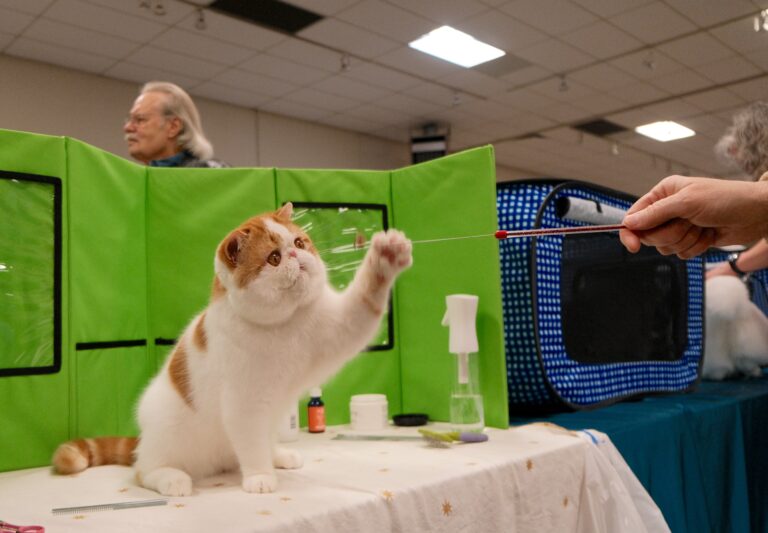
The Cat Fanciers’ Association (CFA), established in 1906, hosted the 2025 Call of the Wild/Poppy State Cat Club at the Yolo County Fairgrounds on Feb. 15. Competitors from all over the American Northwest brought their cats to be examined by a panel of the CFA’s official judges. 

The CFA held three competitions for pedigreed, household pet and agile cats with over a hundred registered cats vying for prize ribbons and association recognition.

CFA judges evaluate the pedigree of cats based on the association’s approved standards per breed and their competition placements: the kitten competition, the championship competition and the premiership competition. A big winner at this year’s competition was Dude, a Persian shorthair who earned the prestigious honor of Best Kitten of the entire event. 

The competitor kittens are aged four to eight months and may advance to the championship or premiership adult competitions. Both adult competitions are deemed as CFA standard; However, championship class cats are able to participate in certain breeding programs. 

Then, there is the household pet cats competition, which may not be of CFA pedigree standard but are nonetheless allowed to compete with their refined fluffiness and charming personalities. 

Lastly, all types of feline athletes are able to participate in the agility competition where they are evaluated in a timed, enclosed obstacle course. Further details and photos of all the event’s top cats can be accessed via the CFA website.

The CFA hosts many cat shows like the Poppy State Cat Club shows throughout the year which offer spectators the opportunity to meet these cats more personally. With permission from the cat’s exhibitors, spectators are allowed to pet and take photos with the competing cats; Though for cat lovers looking to find a new furry companion, the event also invited Super Fur-iends Rescue.

As a non-profit rescue operating in Solano County, Super Fur-iends specializes in the care of feral, disabled and senior cats. 

“Our mission is […] to foster and adopt out animals that are often overlooked,” Super Fur-iends’ mission statement reads.

The rescue is still currently adopting out some of their loveable cats on their website for those able and willing to provide them the special care they deserve. In addition, per Super Fur-iends’ mission to improve access to care for feral and tame cats alike, the rescue also offers affordable spay and neuter services for cat owners to reach through their website.

CFA’s Poppy State Cat Club judge, Dennis Ganoe, reflected on the programs and outreach of the association. With programs on their website for youth to get involved by setting up cat shows, conducting therapy cat visits and more through their Junior Fancier program

“The CFA have been thinking of more ways to get younger people involved,” Ganoe said.


Written by: Matthew Mceldowney — city@theaggie.org


Armadillo Music hosts Vinyl Apocalypse event at Dunloe Brewing

The event consisted of vendors selling vinyl, DVDs and CDs at a lower price 


By AALIYAH ESPAÑOL-RIVAS — arts@theaggie.org 


On Feb. 22, Armadillo Music invited physical media enthusiasts to Dunloe Brewing for Vinyl Apocalypse, an event where guests could peruse boxes and crates of CDs, DVDs and vinyl priced at two for one dollar. 

The event ran from 11 a.m. to 5 p.m., with the media selections being rotated as hours went on, bringing out new pieces for people to examine. The event is held every few months to help manage inventory, according to Armadillo Music’s General Manager, Paul Wilbur. 

“We’ve done 10 of these events now,” Wilbur said. “Every day, CDs, records and DVDs come through our front door and there is no way we can put it all in our store. We buy more things off the street than most businesses that you can imagine, but it gets to a point [where] we can’t deal with all of it.”

Joselino De La Rosa, a second-year human biology major, attended the event after hearing about it on the store’s Instagram page and described the setting of Vinyl Apocalypse. 

“Nowadays CDs are so expensive, so when I heard they would be two for one dollar, I knew I had to come,” De La Rosa said. “I heard about the event through the Armadillo Music Instagram page, and I was shocked to see how many people came. I only got there 30 minutes after it started and it was packed.” 

Students and community members alike entered the store in search of discounted physical media. Some shoppers weren’t aware of the event beforehand and found out while walking around Downtown Davis. Naima Montecinos, a fourth-year biochemistry major, stopped by the event after walking past it and thought it was a good deal. 

“I was just walking to the farmers market and happened to walk past the event and decided to go inside after hearing about the deal,” Montecinos said. “I have a CD and record player at home, so I’m always looking to grow my collection.”

Montecinos collects used physical media to reduce waste and support artists directly as opposed to streaming.

“I think collecting used media is a really cool way to reduce waste and learn more; Often, a pamphlet, lyric book or short biography accompanies a beloved physical album,” Montecinos said. “It is also important to me because collecting physical media supports the artists directly without a middleman like Spotify or Apple Music.” 

For De La Rosa, he collects physical media for the deeper connection he feels when playing an album as opposed to listening on streaming services.

“I feel like having the physical version of an album gives you a deeper connection to the artist or song because you physically own it and decide to play it,” De La Rosa said. “With streaming, there are algorithms that know your listening habits, so listening doesn’t feel as meaningful unlike choosing a specific album to physically play.” 

With the resurgence in popularity of physical media, Wilbur is optimistic that Armadillo Music can continue to host events like Vinyl Apocalypse.

“The event was a success, because people are getting back into collecting physical media,” Wilbur said. “People want to have a connection to the artists and the art, and by owning the physical copy of their music, it allows them to have that direct connection. We’re excited to continue to supply the Davis community.” 

Check out the Armadillo Music Instagram account or website for more information on future events, and mark your calendars for the next Vinyl Apocalypse.

Written by: Aaliyah Español-Rivas — arts@theaggie.org

UC Davis celebrates 35-year anniversary of the Principles of Community’s adoption

Various students and campus leaders reflect on the Principles of Community’s role on campus 


By JESSICA YUNG — campus@theaggie.org


During the month of February, UC Davis celebrated the 35-year anniversary of the Principles of Community. Different campus units hosted various events pertaining to the values that the mantra promotes. 

The Principles of Community are statements about the importance of community itself, the multiplicity of identities found at UC Davis and having a sense of belonging on campus, according to the UC Davis Diversity, Equity and Inclusion (DEI) website

The website states the Principles of Community in full, describing a commitment to respect and the importance of being open-minded and accepting. 

“We affirm the dignity inherent in all of us and we strive to maintain a climate of equity and justice demonstrated by respect for one another,” the website reads. “We acknowledge that our society carries within it historical and deep-rooted injustices and biases. Therefore, we endeavor to foster mutual understanding and respect among the many parts of our whole.” 

The Principles of Community were created by a group of student activists within Student Housing in the late 1980s, according to the DEI website. The student activists desired and created a statement of values to ensure respect among diverse groups of community members.

In 1990, the student leaders created the Principles of Community, which the DEI website describes as one of the first statements to be adopted by a university.

“Their work culminated in the adoption of the Principles of Community in 1990, making UC Davis one of the first universities in the country to establish a campus wide statement of values addressing equity, access, diversity and mutual respect,” the website reads. “This initiative reflected the university’s longstanding belief that supporting diversity and inclusion is integral to academic excellence and community building.”

Mikael Villalobos, Ed.D, an alumnus that was involved with the creation of the Principles of Community and the associate vice chancellor for the Office of Campus and Community Relations in the Office for DEI, discussed the goal of the mantra. 

“The Principles of Community are a call to let students know that they belong to the university,” Villalobos said. “It’s a core component of who we are as a university, and for many students, the pressures of finding their community can be immense, because […] a support system at the university setting is so important [and] very crucial in student success.”

Villalobos noted that the Principles of Community’s tenets inspire policies that are created by UC Davis as an institution. 

“It’s important for us to recognize that the principles are also backed by policies that certainly help us navigate the university,” Villalobos said. “The principles have a great deal of impact if we use them as guidelines or as a framework.”

Varsha Gaddipati, fourth-year psychology major, said she thinks that most students abide by the principles, however, they are applied sporadically.  

“There’s definitely students who just look them over and even some who couldn’t care less for them, but most students abide by them at least,” Gaddipati said. “While I don’t practice them explicitly, they align strongly with my beliefs about how to treat others in general.”

Villalobos stated that it’s the role of the university students, staff and community members to ensure that the Principles of Community are followed.

“I think asking ourselves: ‘What am I doing to ensure that someone feels that they belong here?’ [is important],” Villalobos said. “I certainly think about it, and it’s easier for me to think about it, because it is at the core of the work that I do. I do recognize that when it comes to ensuring that it is a living document, that we do take ownership in terms of what it means for us to be a part of this community.”

A second-year English major, who wishes to remain anonymous, noted that the student body largely follows the Principles of Community in their opinion. 

“I believe that the student body does follow them, regardless of whether or not they understand the school’s specific principles,” the student said. “The social clubs I am a part of like the [Transgender and Non-Conforming club] (TGNC), [Aromantic and/or sexual spectrum club] (ASPEC), [Asian & Pacific Islander Queers] (APIQ), etc. have helped me connect with other people and given me a sense of community.”

Gaddipati stated that while the principles contain good ideals, their usage can be seen as performative.

“They definitely serve as a useful reminder of the expectations of us as students, but I don’t see them as widely addressed and reviewed as they should be,” Gaddipati said. “It’s a good idea but sometimes seems to be applied sporadically [or] unevenly, which can make it appear performative.”

The anonymous student reiterated Gaddipati’s statement on the Principles of Community being seen as more surface level. 

“Last year, I felt they were performative,” the student said. “When some evangelists came on campus and screamed at anyone in the [Memorial Union] that we were all going to hell, I felt very unsafe. I felt like the school didn’t care about our safety.” 

Villalobos stated that his desire for students is to be engaged with the Principles of Community and to thrive while using these principles to guide them.

“I want to make sure that students find ways to engage in the important conversations that we have and we will continue to have, as to ensure that our university is going to be a place where everyone will thrive,” Villalobos said. “There are ways for them to get engaged as part of their classroom experiences. There are also ways for them to engage in co-curricular ways. We have a lot of different programs that certainly would facilitate that kind of engagement.”

Written by: Jessica Yung— campus@theaggie.org

‘UC’s greed has got to go’: Hundreds of UC Davis union members go on strike, alleging unfair labor practices

AFSCME 3299 and UPTE-CWA march across campus as part of their three-day ULP strike


By KHADEEJAH KHAN – campus@theaggie.org


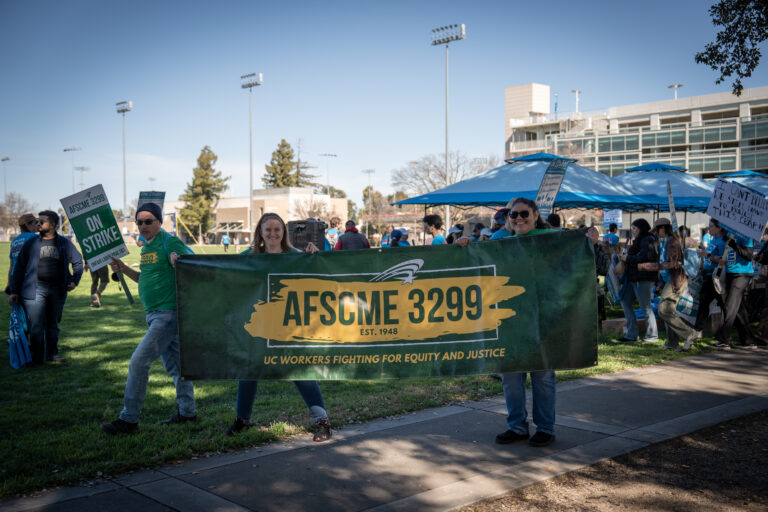
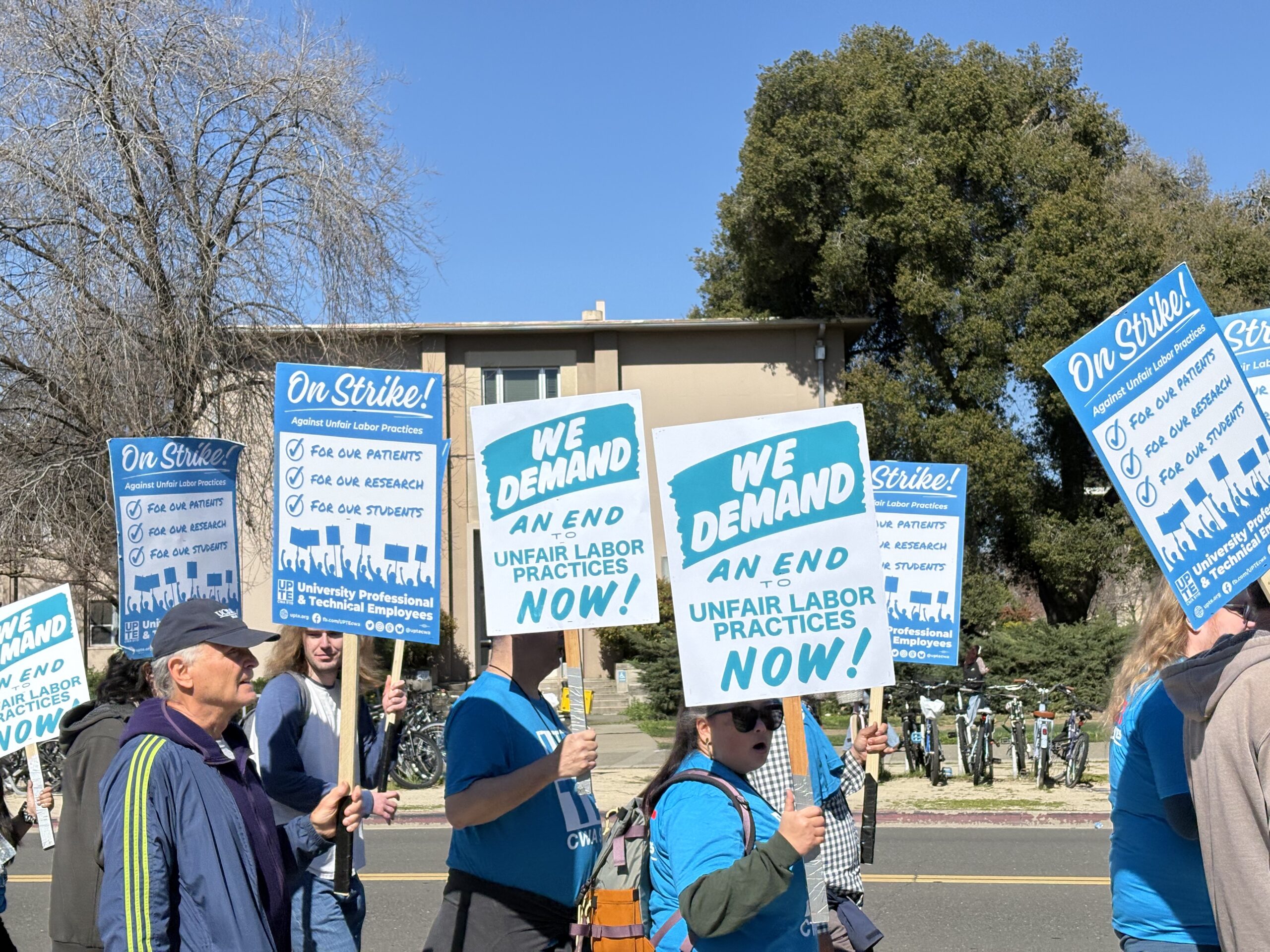
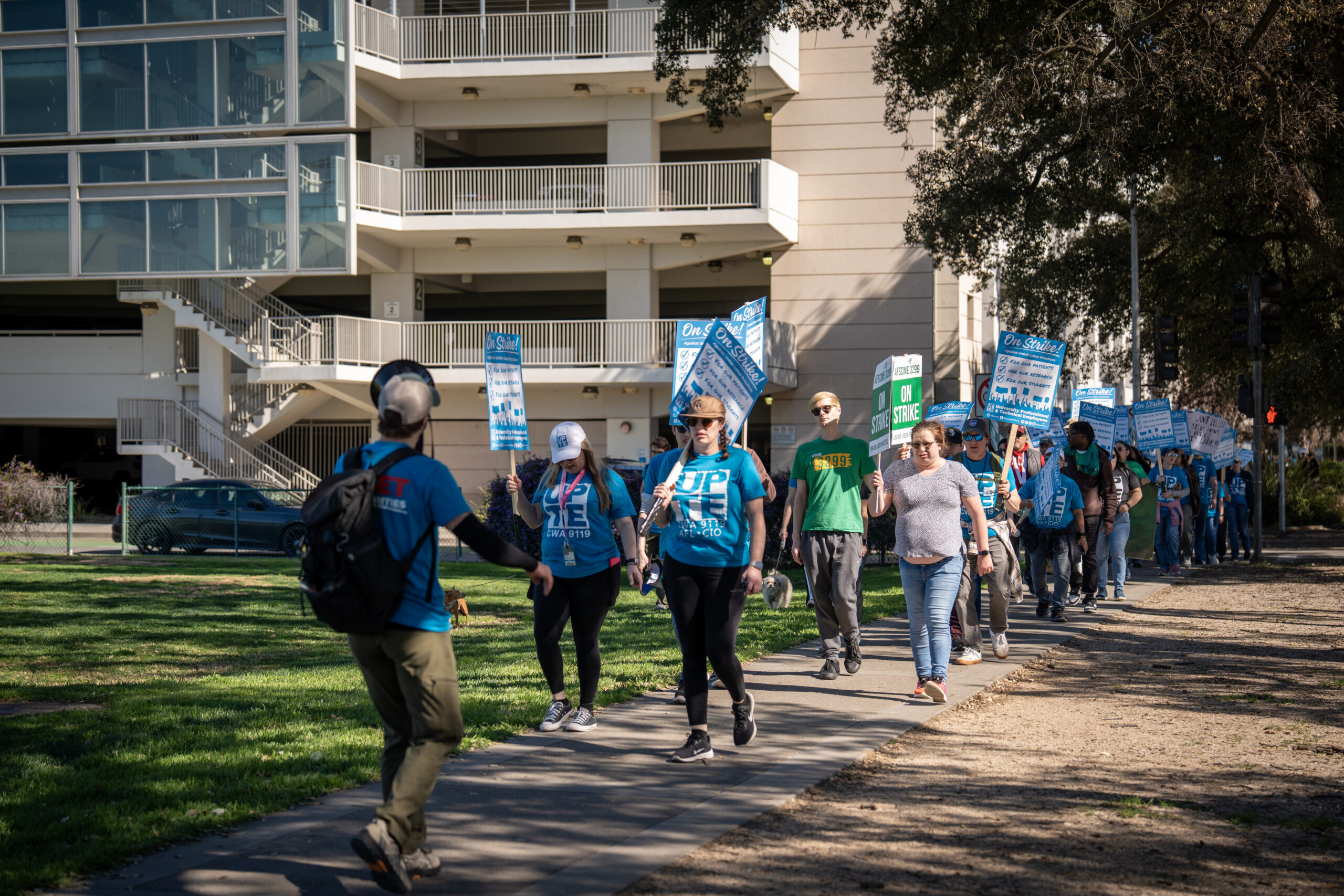
Hundreds of workers at UC Davis started the first day of their strike by marching through campus, voicing concerns about unfair labor practices (ULP), interference with rights and staffing shortages.

This strike is a part of system-wide ULP strike taking place across 10 University of California campuses and five medical centers from Feb. 26 to Feb. 28. The workers are members of the American Federation of State, County and Municipal Employees Local 3299 (AFSCME 3299) and the University Professional and Technical Employees Local 9119 (UPTE-CWA), representing over 50,000 workers combined across the system. 

AFSCME 3299’s picket line began at 6 a.m. on Hutchison Intramural Field where strikers shared coffee and snacks in preparation for the march through campus at 8 a.m. Walking down La Rue Road, strikers crossed the intersection making their way to UC Davis’ Student Health and Wellness Center. Strikers filled the air with drums, maracas, cowbells and loudspeakers.

“UC, UC, you’re no good, treat your workers like you should,” the strikers said through chants. “Hey hey, ho ho, UC’s greed has got to go.”

From UC Davis’ Student Health and Wellness Center, strikers crossed the intersection to make their way to Segundo Dining Commons. The strikers stopped in front of Segundo, and after the final chant, the pace of the drums accelerated until all of the strikers cheered in unison.

“UC, UC, you can’t hide, we can see your greedy side,” the strikers said through chants. “What do we want? A fair contract. When do we want it? Now!”

From Segundo, the strikers took a right past Cruess Hall and walked through the Silo Terminal. Strikers in neon vests ensured that other strikers made room for students who were biking through campus to ensure safety. 

“Who runs UC? We run UC,” the strikers said through chants. “Who got the power? We got the power. What kind of power? Union power. We’re fired up. We can’t take it no more.”

From the Silo Terminal, the strikers walked straight back to Hutchison Intramural Field, chanting “3299” to represent the union, AFSCME 3299. As the strikers returned to the picket line, cars at the intersection of Hutchinson Drive and La Rue Road honked in solidarity, and the crowd of strikers cheered and rang cowbells. 

AFSCME strikers march in front of UCD Silo (Christian Cendejas / Aggie)

The AFSCME 3299 strike is the second ULP strike of the academic year. Nicholas Hearl, a cook at Segundo Dining Commons, recalled the November 2024 ULP strike and expressed gratitude for the community bonds within AFSCME 3299 that have deepened since the previous strike. 

“We have a great community here,” Hearl said. “We have a great turnout. [We’ve] got snacks. We have nice weather. I’m hoping that luck will shine on us as well.”

UPTE-CWA joined AFSCME 3299 at Hutchison Intramural Field at 11 a.m. from their original picket location, UC Davis Veterinary Hospital. 

Both unions alleged unfair labor practices, interference with rights and staffing shortages. UC executive wages have increased 50% on average, yet AFSCME members have taken an average of 8% real wage cuts, both adjusted for inflation, according to James Clark, an AFSCME 3299 executive board member. He calls for UC’s $60 billion revenue to be reallocated.

“We’re here because UC deployed an unlawful campaign and intimidation in an attempt to stop us from fighting for what we deserve,” Clark said. 
”We refuse to be silenced in our ongoing fight for big raises that address inflation, affordable healthcare and housing benefits. We are struggling and they know it. We’re the people that make it happen, the frontline workers. UC’s greed has got to stop.”

Both AFSCME 3299 and UPTE-CWA strikers expressed concerns over increased copayments, despite the absence of an agreement. Leticia Garcia Prado, a medical assistant at the Student Health Center represented by AFSCME 3299, described how many UC employees struggle with housing, healthcare and other basic needs.

“We just want our workers to be able to retire,” Prado said. “For custodians, it’s hard work on their body. Someone can’t work here for 30 years and be able to retire.”

UC Davis workers protesting against alleged unfair labor practices at Hutchinson Field. (Ojas Mishra / Aggie)

Gemma Blumenshine, an animal health technician represented by UPTE, commutes 30 minutes daily from Sacramento due to the high cost of living in Davis. However, her commute is not a rare occurrence among UC employees, as she described that at least one-third of her co-workers commute more than 40 minutes.

“The cost of living in Davis is so high, so the UC really needs to come to the bargaining table and reallocate their funds,” Blumenshine said. “[The university] has a lot of liquid capital, and so [they need to] not just fund the campuses but make sure that it’s being allocated to the right places, too, and support our technicians that work these really hard jobs. After a hard shift, no one wants to drive an hour home.”

Amidst the November 2024 ULP strikes, many strikers cited the UC outsourcing workers and allegedly paying them $32 an hour, which is above workers’ $25 demand. Clark described this practice as “the lean concept” with the UC “doing more with less,” alleging the university of contracting one worker responsible for a job that requires multiple people. In this practice, workers often do not get replaced, intensifying their work loads.

LaShell Alpaugh, a registered veterinary technician represented by UPTE-CWA, believes that this practice contributes to the amount of understaffing on campus. She believes this issue affects not only workers but the quality of care patients receive.

“We’re so understaffed right now that, you know, our patient ratio is like one technician to 10 to 20 patients at a time, which is not fair,” Alpaugh said. “It’s not fair to the patients, it’s not fair to my co-workers and it’s definitely not fair to the clients that are bringing and trusting us with their pets.”

For Alpaugh, this strike represents an intertwined struggle experienced by both students and staff under the UC system.

“Everything has increased – housing, inflation, groceries, gas,” Alpaugh said. “But again, when you talk to people, most of the people out here on the strike, they’re not going to tell you, ‘We’re doing this for the money.’ We are definitely doing this for our patients and our clients and for our co-workers.”


Written by: Khadeejah Khan – campus@theaggie.org

UC Davis men’s and women’s basketball fall to UC San Diego

Both teams dropped in Big West Conference rankings after losses to the Tritons


By Lucienne Brooker — sports@theaggie.org


Feb. 15 was a difficult day for UC Davis Aggies fans as both the men’s and women’s basketball teams lost to the UC San Diego Tritons. The men’s team snapped their three-game winning streak with the overwhelming loss, and the women’s team fought hard but extended their losing streak to two games in a row.

The women’s team dropped to fourth in the Big West Conference rankings after their narrow 63-65 loss. Despite the undesired result, the Aggies gave a strong performance. Tova Sabel, a fourth-year psychology major and guard, scored 25 points, accounting for almost half of the UC Davis points scored. She also snagged a career-high 14 rebounds.

Although Sabel was the main engine behind the Aggie offense for this game, she was assisted by Ryann Bennett, a first-year undeclared major and guard, who came off of the bench to convert a total of nine points. It was a back-and-forth game, with the teams trading narrow leads for most of the first quarter.

The Aggies were able to gain a significant lead in the second quarter but the Tritons weren’t ready to be counted out. They fought back with 22 points in the final quarter, their highest total of any quarter in the game. Down three points in the final minute, the Aggies were able to pull one back but ran out of time before they could stage a comeback.

Although the teams sit on a two-game losing streak, there is plenty for fans to be optimistic about. Their three most recent losses have been by three points or less, and there have been plenty of victories in between. Sabel’s performance has proven her to be unstoppable on offense, and the Aggie defense has shown improved performance as well.

As the women’s game wrapped up at the University Credit Union Center, the men’s teams took the court in San Diego. With the Tritons ranked first in the conference, the Aggies went into a difficult game outmatched, with the final score ending 60-85.

UC Davis kept pace with UC San Diego at first, but the Tritons quickly ran up their lead. Nils Cooper, a second-year human development major and guard, and TY Johnson, a fourth-year communications major and guard, led the team in scoring, both hitting double digits. However, it wasn’t enough for the Aggies to make a comeback against the Tritons, who secured their seventh victory.

After a long stretch of away games, the men’s team will play at home for all but one of their final games leading up to playoffs. The team will be aiming to use this home-court advantage to motivate the team and shake off the weariness of traveling and the recent loss.

Both teams are hoping to bounce back against California State University, Bakersfield on Feb. 20 and California State University, Northridge on Feb. 22 as conference tournaments continue to approach. The key for both teams is climbing their way up the rankings to secure those coveted top seeds for playoffs.


By Lucienne Brooker — sports@theaggie.org


Yolo County District Attorney’s Office holds town hall on public outreach

0

The virtual meeting presented information about resources and programs provided by the DA


By YUENJO FAN — city@theaggie.org


On Feb. 11, the Yolo County District Attorney (DA)’s Office hosted their Commons Town Hall Meeting to provide insight to community members about the DA’s outreach efforts. Since the first town hall was held in 2021, the meetings have occurred on the second Tuesday of each month. Hosted by Sacramento attorney Marcus Wiggins, the Commons Town Hall touched on Yolo County’s data transparency dashboard, Restorative Justice Partnership (RJP) and youth outreach.

“Our Commons Town Hall is about real data, real talk and real change,” Wiggins said. “This is the chance for you, the public, to engage with policymakers, discuss community issues, see real and transparent criminal justice data and promote real change in our criminal justice system.”

Alongside Wiggins were three town hall panelists: Yolo County Chief Deputy DA Melinda Aiello, Restorative Justice Partnership Manager Nicole Kirkaldy and Yolo County Deputy DA Diane Ortiz. Each member of the DA’s Office brought forth a type of outreach while also describing how they help uphold criminal justice within Yolo County.

Aiello, who holds over 28 years of prosecuting experience, introduced the Data Transparency Portal, a website that provides updated statistics about court cases, offense types and other relevant pieces of information regarding criminal prosecution in the county.

“We have a commitment to our constituents to provide transparency,” Aiello said. “The portal provides really critical information about what’s happening in our county and what’s happening to cases that get referred to us. We break it down by various types of cases and by our law enforcement agencies. [The Data Transparency Portal] is something that we continue to review and evaluate. We look at the data and if we see some trends or concerns about how things are going. We look into whether or not we need to create [new] policies.”

The Data Transparency Portal also allows members of the public to access the DA’s policy goals and see which statistics are motivating and justifying these decisions. Those who want to give feedback can message a dropdown menu of over a dozen local representatives and media outlets, bridging the gap between the county and its residents.

Furthermore, the town hall touched on restorative justice, an alternate form of approaching criminal justice. Through her 11 years of experience at the office, Kirkaldy now oversees how this program can help bring change to the county.

“[Restorative justice] asks you to shift the focus from violation of laws and rules that we have in place to looking at the damage that crime causes to relationships in our community,” Kirkaldy said. “In shifting that focus, we [change] how that crime or offense gets addressed.”

Kirkaldy also explained the RJP program’s steps to implement this newer form of criminal justice.

“RJP uses a three-step conference model where we focus on building a sense of accountability and responsibility for the crime that occurred, the harm that happened and reaching that place with the person who’s caused harm,” Kirkaldy said. “Then, we facilitate a discussion on the impacts of that offense with members of the community […] and then seek a restorative outcome.”

The RJP program, currently seeking volunteer applicants, will hold a virtual training about restorative justice values on March 1 with more details online.

To close off the Commons Town Hall Meeting, Ortiz shed light on how the Yolo County DA’s Office is seeking to include young people in criminal justice. Named the Youth Leadership Academy, the DA-sponsored program is meant to provide youth with opportunities to work alongside members of Yolo County’s criminal justice community. The academy is a three-day, back-to-back program open to high school students and can be used to earn community service hours.

“It gives an opportunity for our youth to engage and have conversations with not only law enforcement but also big players and influential people in our community,” Ortiz said. “[We do this] so that our youth understand that they do have a voice and there are people and adults that are ready to listen to them. […] As we’re working with the youth, every day they get an opportunity to meet with someone that might have a career interest that they have or someone that might relate to them on many different levels.”

The next Commons Town Hall will be hosted on March 11. More information can be found on the Yolo County District Attorney’s Office website.


Written By Yuenjo Fan city@theaggie.org 


Review: Percival Everett’s ‘James’

The “Huck Finn” reimagining that took home the 2024 National Book Award


By ELIZABETH BUNT — arts@theaggie.org


It’s a pretty safe bet to say that anyone who attended American high school has at least heard of Mark Twain’s “The Adventures of Huckleberry Finn.” Published in 1884, “Huck Finn,” has been a mainstay of American literature since its release and is one of the country’s most widely taught novels. It tells the story of Huckleberry Finn, a teen boy who fakes his death to escape an abusive father and joins up with a runaway slave named Jim. Together they take a raft journey down the Mississippi River.

Percival Everett takes this journey — the details of which are familiar to most American readers — and turns it on its head. As the name suggests, “James” features Jim as the protagonist rather than Huck. In keeping with the source material, Jim is running away because he has heard plans of him being sold. The goal of his journey in both Twain and Everett’s novels is to flee Missouri until he can earn enough money to buy the freedom of his wife and daughter, Sadie and Elizabeth, respectively. In the meantime, Jim has to survive the float south without falling prey to any number of people who would like to do him harm. For Huck, the river voyage is a grand adventure consisting of mostly harmless larks, whereas for Jim the journey is a matter of life and death.

This is a facet of the original story that Everett really focuses on. Scenes that in the original are fun asides for Huck, like the encounter with the Duke and Dauphin, are harrowing for Jim. He must constantly watch his back and adapt his behavior to fit the expectations of white southerners. Everett communicates this necessary paranoia extremely well so that the reader is not spared the anxiety that Jim is forced to live with. The depth with which Everett communicates the danger of Jim’s situation makes his decision to remain with Huck so much more remarkable than in the original.

In “Huckleberry Finn,” Jim acts as a guide and father figure for Huck, but Twain doesn’t dive into Jim’s own mind and autonomy enough to show what a sacrifice this is. Everett places Jim’s humanity at the forefront of the story.

In addition to reimagining the major plot points of “Huck Finn,” Everett makes Jim’s incredible grasp of language and his vivid internal dialogue an important theme in “James.” Early in the novel, there is a scene in which Jim is giving an English lesson to the young children of fellow enslaved persons. Away from white people, Jim and the children speak in perfect, eloquent English, much more correct in fact than the language used by the barely literate Huck.

However, in this lesson, Jim is teaching the children how to change their dialect to make themselves sound gullible and ignorant. He calls this the “slave filter” and gives his students sentences to translate into a broken English that the white owners expect of their slaves. Everett shows Jim’s adeptness with this skill repeatedly over the course of the novel. Jim code switches automatically to fit his speech patterns to his audience’s expectations, speaking normally with other Black slaves but brokenly among white listeners to hide his intelligence. After reading “James,” readers will have a hard time not seeing this deception in Jim’s original “Huck Finn” dialogue.

Retellings of classic literature, especially works of mythology, have become a major trend in the literary scene over the past few years. Some, like “The Song of Achilles” by Madeline Miller, have become hugely popular, spurring even more writers to try their hand at a classic story. Because of this trend, critics and readers have become more wary of books claiming to be innovative reimaginings as many turn out to be nothing more than fluff, not adding anything new to the dialogue around the original literature.

“James” is not one of these books. Everett has added to Twain’s work in writing “James” because he has provided a complementary counterpart to “Huck Finn.” He has not only filled in the gaps left in “Huck Finn” but has finally given Jim the character depth to match, and exceed, Huck. “James” is a testament to Everett’s skill as a writer and his self-declared appreciation for Twain’s work. It is a well-deserving recipient of the National Book Award.


Written by Elizabeth Bunt — arts@theaggie.org 


Genuineness and celebrity advertising culture

Why do advertisements feel so surreal? 


By CALEB SILVER —chsilver@ucdavis.edu 


Ryan Reynolds, actor and billionaire, has appeared on my screen a lot lately — and it isn’t because I’ve been watching any of the films he takes part in. Reynolds owns a large chunk of Aviation American Gin, which runs ads featuring him mixing drinks using, in part, Aviation Gin, behind a minimally decorated, nicely lit bar counter. He also owns a quarter of Mint Mobile, a network service provider, which runs advertisements showing him walking into frame — most of the time in front of a television or into some sort of liminal space — and delivering a self-deprecating or hyper-self-aware quip. 

Reynolds’ movies in recent years have included “Ghosted” (2023), “Spirited” (2022), “Red Notice” (2021), “The Hitman’s Bodyguard” (2017), “The Hitman’s Wife’s Bodyguard” (2021), “6 Underground” (2019) and many others that sound and look just like these. Most of these movies are some sort of action-comedy, in which Reynolds is the one-dimensional protagonist whose only flaw seems to be his self-deprecating wit — which doesn’t seem to get in the way of him winning (within the film’s context) by the end.

Reynolds (the actor) does not differ at all from the Reynolds we see in ads or on social media. In fact, in a good amount of these movies, Reynolds will pour himself (or his character) a glass of Aviation Gin. These projects are blank slates for Reynolds to extend the “Ryan Reynolds” brand; They are not in service of trying to be an interesting movie (in fact, they are hardly in service of entertainment). 

His self-deprecation and dry humor give this billionaire a strange relatability to a lot of people. He continues to posture as a guy who just can’t seem to figure things out, all the while growing his businesses he bought into — with his trademark brand and face — and then selling them like he did when he sold Aviation Gin for $610 million and netted $122 million from his stake.

This isn’t so much a major American problem as it is something that bothers me intensely. But it is representative of the new style of hyper-self-aware advertising, in hopes to beat the viewer or consumer to the realization that the only purpose of this production is to sell you some product or process. Reynolds is not an actor or a celebrity or an individual who cares seemingly at all about attempting to increase in ability and range in acting or writing. He is a walking advertisement that’s deceiving you with his affinity for money.

Every advertisement now feels like a strange fever dream. The “technical” term for it is enshittification (a general decay in online products or platforms on the side of the consumer), wherein these celebrities and companies realize they have to try less and less to appease the consumer and really only need to appease shareholders and maximize net profits: this means spending as little money and creative energy as possible for an ad that profits. For Reynolds — since his movies are extensions of his brand — his celebrity image is a product of this yearn for money, resulting ultimately in enshittification. 


Written by: Caleb Silver — chsilver@ucdavis.edu


Disclaimer: The views and opinions expressed by individual columnists belong to the columnists alone and do not necessarily indicate the views and opinions held by The California Aggie.