55.4 F
Davis

Davis, California

Monday, December 22, 2025
Home Blog Page 86

The state of your closet might be a problem, but so is the state of our planet

Here’s how to fight fast fashion — and look good doing it

By THE EDITORIAL BOARD

Fast fashion has revolutionized the clothing industry with the mass production of trendy items, appealing to a wide range of customers for its convenience and affordability. The business model gets its name from the rapid design, production and marketing of clothing, allowing them to be sold as soon as the demand arises. The industry is quickly growing due to the continuous cycling of fashion trends and the rampant consumerism in today’s society.

The allure of fast fashion can be attributed to the ability to buy stylish (albeit low-quality) items at cheap prices, allowing customers to try the latest styles without the buyer’s remorse. As a result, many of these items are bought at the height of various social media trends, leaving them to be quickly discarded when they fall out of fashion. 

Individuals are often drawn to popular fast fashion brands like SHEIN, Cider and Zara because of this purchasing power. However, they may not be entirely aware of how their support of these companies contributes to numerous harmful effects, including environmental damage, animal endangerment and the exploitation of laborers. Despite their budget-friendly price tags, the affordability of these items comes with a different type of cost. 

Every year, around 11.3 million tons of textile waste are deposited in U.S. landfills. The manufacturing process leads to extensive greenhouse gas emissions, contamination of water from dye waste and the build-up of non-biodegradable microplastics from synthetic fibers. This type of clothing production also requires the use of hazardous chemicals like phthalates, parabens and formaldehyde, which can pose significant risks to the environment, human health and wildlife safety. 

The industry employs millions of laborers making unlivable wages who may be forced to work up to 16 hours per day. Fast fashion is also heavily reliant on child labor; the vulnerability that comes with their age means they are often subjected to poor working conditions and little compensation, affecting their education, free time and health.

It’s understandable that so many people fall into these buying habits, especially when the social nature of college often encourages people to buy a single-use costume for each day of Halloweekend, or a new dress for every occasion. But buying less and local is easier and more rewarding than you think.

It’s fun to experiment with your style, and there are many ways to do so while shopping sustainably. Downtown Davis is the perfect place to peruse thrift stores and support local businesses to find pieces that won’t be gathering dust in the back of your closet a few months down the line. 

On campus, the Aggie Reuse Store is a student-run thrift shop that offers free items to students with the help of community donations. If you’re looking to exchange items, you can participate in a clothing swap organized by The Aggie Trading Post. Furthermore, investing in a few high-quality wardrobe staples will ensure that your clothing lasts a long time and won’t need to be replaced after a few wears.

Before you make a purchase, ask yourself: Do I need this item? Will I still be using it a year from now? Do I actually like it, or is this a classic case of FOMO? It’s important to take a step back and consider what you already own, what you actually want and what you really need. By considering a more ethical approach to fashion and engaging in conscious consumerism, the planet (and your closet) will thank you.

Written by: The Editorial Board

‘It felt like I was in a dream’: Aurora borealis lights stun over Davis fields

One student describes her experience of checking off a bucket list experience on her college campus

BY SONORA SLATER — science@theaggie.org

The UC Davis Physics and Astronomy Club’s rooftop public viewing on Friday, May 10 was supposed to end around 10:30 p.m. But first-year biomedical engineering major Marin Cantrell had heard a rumor that there was a small chance the northern lights would be visible later that night — so she asked the organizers to stick around a little longer.
Needless to say, it paid off.

“I was sitting there and talking, and then somebody just yells around 11:30, ‘Oh my God, we can see it!” Cantrell said.

She jumped up, ran over to the ledge on the north end of the building, and eagerly looked out into the dark sky. She was rewarded with the sight of the pillars of light and pink and green spots that marked the phenomenon.

The Astronomy Club hosted an on campus stargazing event on May 10, during which they were surprised with a view of the aurora borealis. (Marin Cantrell / Courtesy)

“People always say, like, ‘It felt like I was in a dream,’ but I’d never actually felt that before,” Cantrell said. “And then I stepped back for a second. And I was looking around at all these people and I was looking at the sky, and you can see bits of color. I look at all of this, and I get this really weird feeling that I’m going to wake up any second now. Like this is a hallucination. Like this cannot possibly be happening to me, this cannot possibly be real.”

The northern lights, otherwise known as the aurora borealis, can usually only be seen close to the north pole. It’s caused by eruptions of radiation called solar flares on the sun’s surface, hitting the Earth’s atmosphere with particles that excite gasses in the atmosphere and make them glow in shades of pink, purple, green and more.

This year, however, the sun is at the peak of its 11-year activity cycle — contributing to a historic geomagnetic storm that allowed viewers as far south as Texas, Georgia and (of course) Davis to see the stunning display. For many, this was a fulfillment of a bucket list goal: one that they didn’t expect to come true in their own backyard.

“I’ve wanted to see the northern lights for a really really long time,” Cantrell said. “My family wants to see them as well. We were probably eventually going to travel somewhere to see them. But I never thought that I would be able to see them without even having to leave California.”

A long exposure photograph reveals stars among the dazzling northern lights. (Jersain Medina / Aggie)

So… how did the experience compare with seeing the lights in, say, Iceland? Well for one thing, the lights are visible closer to the horizon, rather than up above. And for another, the colors are significantly less vibrant to the naked eye. But with a phone camera on long exposure, the streaks of light are captured much clearer.

“You can see pink and green very vaguely in the sky,” Cantrell said. “But you can’t see much with your naked eye, [which is] true for a lot of astrophotography. It’s not [the same as] what you see on the camera, but being able to see it in person with your own eyes is so cool.”

The event was certainly unexpected for a lot of people — in fact, social media feeds the next day were flooded in near equal measure with pictures of the aurora, and those lamenting going to bed early and sleeping through it unaware.

“One of my friends actually texted his roommate [about the aurora], and his roommate was like, ‘That’s what your photos are for,” Cantrell said. “He did not want to get out of bed. I’m like, you’re insane for that.”

In general, Cantrell said it felt like a community affair, as everyone texted their friends to go outside and look up, and more and more people joined the party on the rooftop.

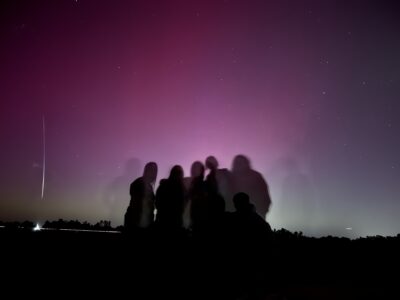
A group of friends poses in front of the aurora borealis in Davis on May 10. (Ellen Burns / Courtesy)

“We were all taking pictures and just being like, ‘We’re really glad that we were here,’ Cantrell said. “We were really glad to be able to experience that. That moment was a really special once in a lifetime thing.”

Written by: Sonora Slater — science@theaggie.org

Photo finish for racers at the Kansas Speedway

The closest ending to a race in NASCAR history


By DIEGO CERNA — sports@theaggie.org


On May 5, the National Association for Stock Car Auto Racing (NASCAR) held the AdventHealth 400 race at the Kansas Speedway in Kansas City, Kansas. 

The winner, Kyle Larson, was able to beat out runner-up Chris Buescher in the final stretch of the race with a margin of 0.001 seconds, the closest margin of victory for first place in NASCAR history. 

This NASCAR season has shown some of the closest photo finishes ever. Kansas City’s 0.001 second finish broke the record of a 0.002 second finish earlier this season at the Texas NASCAR Cup Xfinity’s Series (NXS) on April 13. Sam Mayer inched out the victory over Ryan Sieg in the 200 lap race for the Texas NXS title. 

Before that exhilarating race, The Ambetter Health NASCAR Cup held in Atlanta held a finish of 0.003 seconds for first place on Feb. 25. The race proved challenging as Daniel Suárez was able to beat out Ryan Bailey in the 260 lap race by nearly no time.

The most recent AdventHealth 400 was supposed to be a total of 267 laps for all racers, but the race went into overtime to ensure that there would be a green flag finish, signaling when the final two laps of a race would commence. Buescher had been leading the race up until lap 261, where he spun out. This caused a caution period, as cars are forced to slow down due to unsafe conditions. Buescher’s spin had also caused a restart, which forced cars to go to the pit and start over before going into overtime. 

With two laps to go, fifth-place finisher Denny Hamlin led the pack with Buescher in second and Larson in third. Going into the final lap, Hamlin fell among the pack with Buescher and Larson in first and second just before the final lap commenced. 

On the final backstretch of lap 267, Larson found a sliver of space between the wall and Buescher’s car in order to get better positioning and make them neck and neck into the final turn. After gaining the position, Larson and Buescher’s cars collided as they approached the finish line side-by-side.

At first glance, it looked as if Buescher had won, with Buescher’s pit team even celebrating right before the results were announced. After officials reviewed the replay, however, it was determined that Larson’s No. 5 Chevrolet’s front had just barely hit the finish line first, giving the victory to Larson.

Many people have compared the photo finish line picture to Disney Pixar’s film Lightning McQueen, where cars finished side by side to end the race. 

Larson’s victory marks his second victory so far this season, and the 25th overall victory of his career. 

“That race from start to finish was amazing. That first stage was incredible. The second stage at the end was fun, and then that whole last stage with the wrecks and cautions and then fuel strategy and tires running long and all that was wild,” Larson stated in a press conference after the game. 

The next two NASCAR Cup Series races will continue in North Carolina for the remainder of May, as racers make their way in the middle of the season to determine who advances to the NASCAR Cup Playoffs beginning in August.


Written by: Diego Cerna — sports@theaggie.org

Culture Corner

The Arts Desk’s weekly picks for music, movies and more


By JULIE HUANG  — arts@theaggie.org 


Album: “After Fillmore County” by Vansire (2020)


Vaguely describing a road trip through Vansire’s home county in Minnesota, the collection of songs featured on “After Fillmore County” slowly moves toward a discussion of love, loneliness and the existence of inescapable truths. These themes sit at the heart of the album and permeate every track with a sense of hazy uncertainty that grows larger the longer the songs go on. Do the words “fall short of something profound” or do they instead reveal the existence of such? The album itself strives to avoid certainty in its lyrics, enhanced by its sonic quality of dreaminess, and allows the listener to walk away feeling something intangible.  


Song: “Vapour Trail” by Ride (1990) 


With its distorted instrumentals, subdued vocals and melancholic lyrics, this song seems to perfectly encapsulate the bittersweet experience of nostalgia. Featured on English rock band Ride’s first album “Nowhere,” “Vapour Trail” is an elegant example of the shoegaze genre and its many merits. As I can attest, it is also a great song to play on solo walks in late spring or early summer, when the sun is shining down and stirring up the desire to reminisce and reflect on the passage of time. 


TV Show: “The End of the F***ing World” (2017 to 2019) 


“The End of the F***ing World” follows two teenagers who run away together to take a road trip across England, hoping to get different things out of their shared experience. The protagonist, Alyssa, seeks an opportunity to escape her messy home life with a thrilling cross-country adventure, while the other protagonist, James, seeks an opportunity to kill her and prove to himself that he is truly a 17-year-old psychopath. The intersection of these highly contradicting motives creates a dynamic between the two that is endlessly watchable and yet provides many opportunities for character development, leaving the protagonists in vastly different places than where they start out from. Although the show’s offbeat premise is often played up for dark comedic effect, it is also a way for “The End of the F***ing World” to contextualize its characters and their actions within circumstances which often feel uncomfortably realistic, creating a funny yet sharp and dramatic atmosphere for viewers. 


Book: “The Carrying” by Ada Limón (2018)


Ada Limón’s sophomore effort at a collection of poetry delivers on all accounts. Her poems showcase technical skill more than deserving of the National Book Critics Circle Award, but the most awe-inducing aspect of “The Carrying” is Limón’s ability to infuse each line of her poetry with feelings that are tender yet forceful in their intensity and vulnerable yet piercing in their clarity. The core concept tying this collection together appears to be an examination of what it might mean to live year after year in a changing world. What is constant, and what is certain? Limón’s exploration of these ideas encourages readers to widen their perspective and appreciate the smallest details. 


Written by: Julie Huang — arts@theaggie.org


Varsity Theater hosts screening of ‘20 Days in Mariupol’

With the support of the Davis Rotary clubs and F Street Dispensary, the screening raised funds for Davis’ sister city, Uman


By MATTHEW MCELDOWNEY — city@theaggie.org


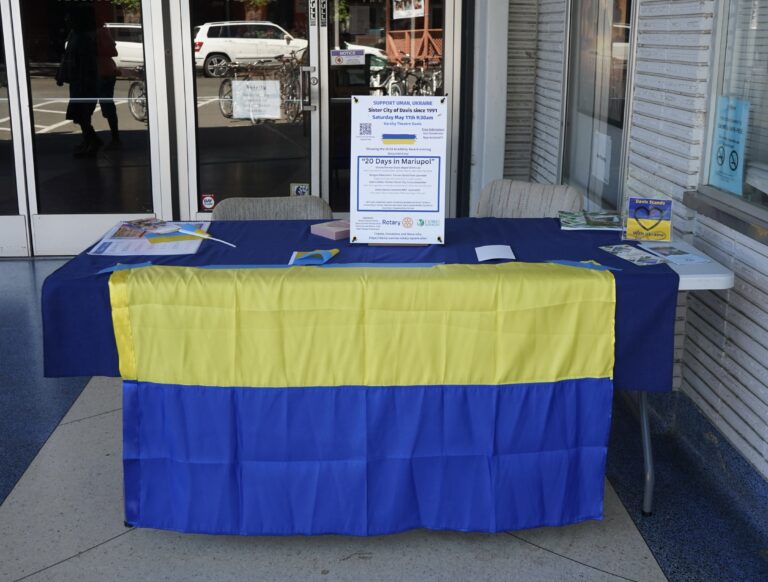
On May 11, former city of Davis Mayor Brett Lee organized a free-of-charge film screening of the Academy Award-winning documentary, “20 Days in Mariupol.” The documentary takes on the perspective of an Associated Press team of reporters as Russian invasionary forces besieged the city of Mariupol, turning it into a battleground. The documentary discusses the Russia-Ukraine war through its depictions of urban warfare. 

It is the onset of this war that prompted the city of Davis to attempt to rekindle their relationship with Uman for whom this screening was fundraising. They began coordinating fundraising efforts in March 2022 for charities like World Central Kitchen, but it was not until a Ukrainian refugee family had moved into Davis that the city was able to directly coordinate efforts with Uman, according to Lee.

In December 2022, the Davis Odd Fellows and Davis Sunset Rotary Club worked together to fund and send generators for Uman. To this end, Lee traveled to the city itself in March 2023 to ensure that these generators had arrived safely while getting the chance to meet and connect with the mayor and the people of Uman.

“Traveling on a bus with a bunch of people who don’t speak English, going somewhere where you’re not really sure about where you are going is an adventure,” Lee said. “But, the people are very kind, very appreciative and so I feel like I’ve been very fortunate to be able to visit.”

Uman, a city about the size of Davis, has a college called Pavlo Tychyna University. Lee spoke with his translator who was working at the university and said that in her department alone, there were two students that had lost parents in the war. This inspired Lee to create a scholarship fund of $20,000 for students who had been impacted by the war by the loss of a parent or displacement. 

This Davis-Uman sister city scholarship has provided financial aid for 28 students attending Pavlo Tychyna University. To continue funding for this scholarship, Lee reached out to the team behind “20 Days in Mariupol” to screen the documentary for free to the public. This screening received generous contributions from the Davis Rotary clubs, F Street Dispensary and from individual donations made by members of the Davis community. Davis Varsity Theater donated the venue for the screening itself.

Sinisa Novakovic, the owner of Davis Varsity Theater along with Mishka’s and Icekrimski cafe, knew Lee before and had previously organized a similar fundraising event at Varsity last year. Novakovic opened Mishka’s cafe 29 years ago and acquired Varsity 11 years after. Novakovic stressed the importance of values in his businesses by using ethically sourced and providing his support for causes such as the Russia-Ukraine war. 

”At least I am doing a little on my end that may not necessarily alleviate all that much but still fulfills me,” Novakovic said.

Lee along with the generous support of the Davis community has recently helped raise money for an animal refuge in Uman and he is hoping to raise enough to build a playground for the city in the future. Lee hopes that by calling on the Davis community the people of Uman can feel that they are not alone through this struggle.

“It’s not really just about me, it’s a bunch of good people and also the people who donated,” Lee said. “That’s what made this all possible.”

Written by: Matthew Mceldowney — city@theaggie.org

The buzz behind periodical cicadas: nature’s phenomenon

The 13- and 17-year cicadas emerge in the eastern part of North America, illustrating a rare phenomenon that only occurs every 221 years


By MARLE LAMOUNTRY— science@theaggie.org 


Every 13 and 17 years, a natural phenomenon occurs in the eastern part of North America that captivates scientists and nature lovers alike — the emergence of periodical cicadas. These fascinating insects are known for their unique life cycle. They spend 99% of their lives underground as nymphs and the other 1% above ground in their adult stage. 

Currently, both the 13- and 17-year periodical cicadas are waking up, an occurrence that can only be witnessed every 221 years. The last phenomenon hasn’t occurred since 1803. 

Unlike their annual counterparts, periodical cicadas have a prolonged life cycle that lasts for 13 or 17 years, depending on the species. For the majority of their lives, these insects feed on the xylem of tree roots as underground nymphs. Only during their short adult life stage can the cicadas court, mate and lay their eggs, creating a new generation. With periodical cicadas, there is only one age class in each brood.

One of the most astounding qualities of periodical cicadas is their synchronized emergence. Each brood is packed with thousands of nymphs underground, so millions of cicadas emerge from the soil within a short window of only three weeks. Rick Karban, a professor of entomology and nematology at UC Davis, described their emergence patterns.

“[It’s] fantastic about how in sync it is,” Karban said. “Millions of individuals come out of the ground within a few days of each other. Those that come out too early or too late get eaten by predators, so there’s tight selection.”

Entomologists have found that these insects take cues from their host plants to emerge, such as the temperature of the soil. Their synchronized emergence and long odd-numbered years in their life cycles are believed to be an evolutionary adaptation, but what triggers their synchronized emergence remains unknown.

Lynn Kimsey, a professor of entomology at UC Davis and the former director of the Bohart Museum of Entomology, spoke about the mystery behind their emergence patterns.

“They [may] do this to outrun predators [or] parasites, but we don’t really know,” Kimsey said. “We don’t really know much about them.”

Despite the mysteries surrounding their behavior, periodical cicadas play a crucial role in forest ecosystems. Since they emerge in large numbers, they serve as a great food source for predators, including birds, mammals and even humans. They are also beneficial to plants, as their waste and decomposing bodies contribute to nutrient cycles. 

Louie Yang, a professor and ecologist at UC Davis, spoke about the ecological importance of these insects.

“They almost immediately get eaten,” Yang said. “A lot of animals that [traditionally] eat cicadas eat them […] They represent a substantial resource pulse and aggregate resource, especially in the forest. We can see some of their effects in the soil, microbes and plants.”

As we watch the emergence of periodical cicadas, many people have sensationalized their stories, creating a version of events that differs from reality.

Karban offers a different perspective. 

“To some extent, [these stories are] pretty different from what is getting hyped in the national media,” Karban said. “[The cicadas] will be emerging close to each other, but the same tree will not be supporting both 13- and 17-year-old cicadas. It’s actually not clear that they will be coming into contact with each other.”

Written by: Marle Lamountry — science@theaggie.org

The cows got confused and started mewing instead of mooing

The jawline goes crazy


By ALLISON KELEHER — adkeleher@ucdavis.edu 


UC Davis is a well-known, acclaimed university with esteemed faculty and plenty of research opportunities. However, it’s also known as “cow town.” Every freshman who is accepted into this fine institution is selected based on their knowledge that the cow goes moo. 

Unsurprisingly, the freshmen in the Tercero dorms love visiting our dairy friends due to their close proximity. The smell is also a good reminder that they’re there. During cow enrichment time, the freshmen will be the silly little gooses they are, and the cows are always watching. 

However, lately, these freshmen have been spending FAR too much time with the cows because the cows have picked up some weird behaviors. One of my sources told me that she saw a cow wearing a silver chain around its neck. Investigations are still ongoing, but I predict that this was a gift from a freshman. Investigators are in possession of the chain, and they say they’re hopeful of finding the rightful owner soon. 

During investigations of the chain, I noticed that the cows were looking a little on the skinny side. My sources in the dairy farm tell me that they are getting proper nutrients, so that’s not the problem. After returning for further investigations, I noticed that it was mainly the cow’s faces that appeared to be skinnier. I noticed this because the jawlines have become very prominent. 

These cows were exhibiting weird behaviors to the point that I thought they were ill. My insider sources tell me that the veterinarians are concerned, too, because they haven’t discovered a diagnosis yet. 

To help out my veterinarian friends and against the police instructions, I conducted a night stakeout of the cows. I hid in a bush nearby with a bunch of snacks and my water bottle. I also brought my iPad for enrichment. I dozed off for not that long when I woke up to faint noises coming from the cows. “Bye bye…”

It took me a second to get a hold of my surroundings since I woke up with drool and crumbs on my face. I stumbled to grab my binoculars and once I got a good look, I saw the freshman huddled around a cow with their flashlights beaming from their phones. 

I almost had a heart attack when I saw the cows. The chain was back around its neck, and now I finally understood what was happening. The cows were mewing. As the audio looped over and over again, I began to question my priorities in life since I was sitting in a bush watching cows mew. 

Putting my existential crisis aside, these cows were actually getting pretty good. Those jawlines were looking sharp. Case closed. Bye Bye. 


Written by: Allison Keleher — adkeleher@ucdavis.edu 


Disclaimer: (This article is humor and/or satire, and its content is purely fictional. The story and the names of “sources” are fictionalized.)

UC Davis Coffee Center opens on May 3

The center is the first facility in the country dedicated solely to coffee research


By JORDAN POLTORAK — campus@theaggie.org


On May 3, UC Davis opened the Coffee Center, the first center in the United States dedicated solely to coffee research. The 7,000-square-foot center will house pre- and post-harvest coffee science research. This includes brewing laboratories, experimental bean storage, a sensory and cupping laboratory and a pilot roastery.

“We have the expertise here,” Tonya Kuhl, a UC Davis professor and co-director of the Coffee Center, said. “There are challenges coffee faces because of climate change, and we want to improve how it is processed in a sustainable way. This is the place where this activity can be attacked from all angles.”

The space will house many classes, such as The Design of Coffee (ECH1) created by Co-Directors Tonya Kuhl and William Ristenpart. The center plans to offer over 50 fields of study, covering subjects from chemical engineering to plant science and sociology. 

ECH1 was initially created as a first-year seminar. In its beginning, the lab equipment featured many items that can be found in a home, like a drip coffee maker. 

“We made do with the original lab space until about 2016,” Kuhl said. “Then, we renovated the space and devoted it to the coffee lab. It was paid for by Chevron, the College of Engineering and an alum [named] John Watson.”

In the new space, Peet’s Coffee provided the initial gift for their pilot roastery, and $6 million were provided by private donors to complete the center.

Eventually, Kohl and Ristenpart’s class evolved from a first-year seminar to a full-fledged course. 

“Many students take the class as a general education requirement,” Kuhl said. “Students from all sorts of majors get exposed to chemical engineering, and every year, we pluck off a couple of those students and get them to change to our major because it’s really fun.” 

Isabella Engler, a fourth-year international relations major, discussed the benefits of the course. 

“Not only does the class allow you to put the theory and science discussed in lecture into practice, but your newly acquired understanding will enhance your own coffee drinking experience,” Engler said.

At the ribbon-cutting ceremony for the center, over 200 individuals attended. There were student research displays and roastings as well as espresso brewing demonstrations.

Having a dedicated place for coffee research allows UC Davis to be at the forefront of the chemical engineering field. Kohl and Ristenpart’s textbook, “The Design of Coffee: An Engineering Approach,” is currently used at colleges such as University of San Diego, University of Colorado Boulder and Auburn University to teach similar classes. 

“Before [ECH1], I was convinced coffee could only be enjoyable when used to enhance the richness of a chocolate cake when baking,” Engler said. “I now have a whole other appreciation for the science and artist license that goes into brewing each cup.” 

Written by: Jordan Poltorak — campus@theaggie.org

The history of biking culture in Davis

Students share advice for newcomers and favorite aspects of our bike-friendly town 


By ZOEY MORTAZAVI — features@theaggie.org


Davis is known to many people — far beyond just its residents — as a community that is centered around biking. In fact, Davis is widely considered the biking capital of the United States. We have plenty of local infrastructure based around biking, including many bike stores, repair shops and the U.S. Bicycling Hall of Fame. Much of Davis similarly takes inspiration from cycling, including its decor, local art and even community events.  

Davis is home to the very first bike lane that was implemented in the United States; it was created in July of 1967 and was then referred to as a “lane for the preferential use of bicyclists.”

Davis bike culture has skyrocketed in popularity since 1967. Now, the city hosts 102 miles of bike lanes, as well as 63 miles of additional pathways for bikers. A significant amount of the Davis community, both residents and UC Davis students, utilize their bikes as a primary form of transportation. 

UC Davis students quickly grow accustomed to the bike rules and practices once the school year starts, even if they’re not always using their bikes. The campus is filled with cyclists year-round, and even pedestrians have to learn the cyclist rules of the road in order to get around successfully. 

Ashley Rewa, a first-year neurobiology, physiology and behavior major, shared advice for incoming Davis students about adjusting to the fast-paced bike lifestyle.

“For me, biking around Davis makes the campus feel smaller and more approachable,” Rewa said. “With Davis being the biggest UC campus, walking from the Cuarto dorms to the library can feel like a really long time. But on my bike, it only takes 10 minutes.” 

Rewa also commented on how biking has improved her experiences as a student.

“Not only is biking convenient, but I think it’s something that makes Davis unique and fun,” Rewa said. “A quick bike ride across campus can go a long way [toward] clearing my head after a tough midterm or long lecture, too. My advice for incoming students is to make sure you know how to ride before you get here because bike traffic is no joke sometimes!” 

Today, 98% of the main streets in Davis have at least some form of bicycle provision, according to The Guardian. When new classes of students arrive in September, many have a difficult adjustment period during their first-year induction days. 

During the first few weeks of each new school year, upperclassmen have a tradition of gathering at campus intersections and cheering as inexperienced first-years crash into each other and struggle to adjust to the bike-specific roundabouts and lanes.

Grace Pei, a first-year biochemical engineering major, shared her opinions on Davis’ unique bike-based culture after getting used to it for the first few weeks.

“Bike culture at Davis has been so cool to see and be involved in,” Pei said. “I love how it is a unique factor to Davis and almost brings a sense of comfort as everyone is immersed in the same culture. Biking is a great way to get around, but it’s also important to be mindful of others by following biking guidelines. Trying to bike with other people can be difficult at first, so everyone should learn to be patient while riding.”

Pei continued by sharing some of her favorite activities as a student who bikes to class the majority of the time.

“I love to bike with friends, whether it be going downtown or visiting the Arboretum,” Pei said. “Biking around Davis, surrounded by nature and when there’s a light breeze, is an enjoyable experience that I think everyone should try once.” 

Our city’s logo is a highwheel bike, which was the first practical human-powered wheeled vehicle, and has become a recognizable symbol of Davis. 

Local organizations aim to educate residents about bike safety and infrastructure. A primary example is Bike Davis, a non-profit organization that hosts an annual “Loopalooza” bike ride throughout the city that is open to the public.

There are also many examples of bike-centered events and groups in Davis. Our downtown is even home to the “Bicycling Hall of Fame,” located in Central Park next to where the farmers market is held.  

Whether you are new to Davis or not, it is clear that biking holds a special place in the heart of the community. Students at Davis have reported that the city’s flourishing bike culture makes them feel closer to the community as a whole.

Hazel Henninger, a first-year history major, shared what makes Davis’ biking traditions so special. 

“It’s been so cute to see how Davis took our bike traditions and really ran with them,” Henninger said. “A lot of the town’s identity is based on bikes, and it’s been a really cool thing to be a part of. Seeing everyone on bikes or scooters to get around is a huge part of the charm of downtown and Davis as a whole.” 

She continued by sharing her main takeaways for incoming students who are uncertain about adjusting to Davis’ bike-centered environment.

 “Future Aggies should definitely prepare themselves by dusting off their biking skills,” Henninger said. “Falling off your bike or getting into a bike accident — or a couple — is all a part of the Davis experience. More than that, they should also be ready for a really charming environment with wholesome [bicycle] traditions that will make them appreciate Davis that much more.”


Written by: Zoey Mortazavi — features@theaggie.org 


UC Davis lecture halls: the good, the bad and the ugly

Criteria includes comfy seating, aesthetic, lighting and more


By MAYA KORNYEYEVA — mkornyeyeva@ucdavis.edu


Ah, a lecture hall. The setting of so many power naps, failed microphones, unexpected quiz announcements and powerful waves of midterm stress. 

Beyond being the central setting for learning, a lecture hall should be designed for comfort for both the lecturers and the students and serve as a place that inspires creative thought and conversations. With this in mind, here are some of my thoughts, critiques and compliments regarding some of UC Davis’ most famous lecture halls. 


Rock Hall: This one holds a surprising amount of students, which is achieved by trading in comfort for the capability of squishing as many STEM majors into a single room as possible. The lecture hall contains a classic “slope down” seating arrangement, where about 400 student eyes are directed downward onto the (poor?) professor. Arrive early, because getting a seat right before the start of class will mean clambering over a whole row of annoyed students. Lastly, bring only the essentials, as there’s no way you’ll be able to fit your coffee, computer, notebook and phone onto the teeny tiny desk. 4/10.


Art Building: The best graffiti on campus (the talent level is insane) and great proximity for a ruminative stroll through the Arboretum (extremely necessary when your art final gets heavily critiqued in front of the entire class). 8.5/10.


Cruess Hall: I may be biased as a design major, but this is one of the best halls on campus. Featuring a mini design museum curated by students as well as a makerspace and tool room (with everything your creative soul could ever hope for), Cruess is catered directly to students working in the arts. The two main lecture halls are brand new and are relatively spacious with great projection screens and interior lighting. It’s like sitting in a movie theater! Finally, there are “Cruess Tattoos,” the adorable wall decorations that adorn the Cruess walls, ceilings and floors. Start exploring and you won’t be disappointed. ∞/10.


California Hall: So incredibly big!! So spacious!! So difficult to hear the professor when the mic goes out!! The best part of the hall is the two long vertical windows at either end of the room out of which you can watch clouds float by (while listening to the lecture obviously). 7/10.


Ann E. Pitzer Center: Just seats, no desks, but audio quality slaps. Very theatrical lighting. A perfect place for professors to invite guest speakers. 7.5/10.


Giedt Hall: You can’t get lost, but you may fall asleep because it does get pretty dark and dreary in there. 6/10.


Teaching and Learning Center (TLC): Recently built, this hall contains both classrooms and lecture spaces that are designed for students by students. It includes unique study areas scattered throughout the building and lots of outlets to plug in your devices, and there’s plenty of natural lighting. The architecture and color choices are inviting and thought-provoking, and the location is also pretty much perfect — situated right next to the Silo Bus terminal, the Silo, Latitude and the food trucks. 10/10.


Olson Hall: During orientation all those (two) years ago, I was told that Olson Hall had ghosts. Can confirm. It’s basically a maze of cement and poorly maintained classrooms: one of the windows of my discussion classroom remained broken and boarded up for the entirety of the quarter. 2/10.


The Death Star: Speaking of a maze of cement, that’s exactly what this is. Avoid having a class here unless you love getting lost or feel like wandering around in circles endlessly. The architects who built this place obviously had ulterior motives. -3/10.


Student Community Center (SCC): Personally a big fan of the computer lab and South Coho. A great place to chill and watch whatever cooking show is on the big TV on the first floor. 9/10.


Wellman Hall: This is your standard lecture hall: the water filters are always on red, the bathrooms are mid and the lighting is best fit for corporate offices. “Well man, I don’t know how to break it to you… but this one’s pretty average.” 5.5/10.


Written by: Maya Kornyeyeva — mkornyeyeva@ucdavis.edu

Disclaimer: The views and opinions expressed by individual columnists belong to the columnists alone and do not necessarily indicate the views and opinions held by The California Aggie.

Allergy season

Drawn by: Emma Lapidus –– eblapidus@ucdavis.edu 

Disclaimer: (This cartoon is humor and/or satire, and its content is purely fictional. The story and names of “sources” are fictionalized.)

The modern ‘Planet of the Apes’ series is a sleeper masterpiece

The film saga is the gold standard of reboots — why is it still slept on?


By JOAQUIN WATERS — jwat@ucdavis.edu


“You might not like what you find.” These are the words spoken to Charlton Heston’s marooned astronaut in the 1968 film, “Planet of the Apes.” He is told not to go looking for answers about the ape-ruled world he is trapped in. Sure enough, Heston falls to his knees upon discovering the ruins of the Statue of Liberty, realizing that this supposedly alien planet run by super-intelligent apes is, in fact, Earth thousands of years into the future. “You maniacs!” Heston cries, “You blew it up!” It is an ingenious, thought-provoking sci-fi twist ripped straight out of “The Twilight Zone” (in fact, the original “Apes” was penned by “Twilight Zone” creator Rod Serling), and it is one of the most iconic moments in film history. 

Unfortunately, the scene’s iconic status now means that practically everybody sitting down to watch the film today knows it’s coming, even if they know nothing else about the movie. It’s a problem shared with most of the great film twists: everybody knows that Bruce Willis is dead the whole time in “The Sixth Sense,” that Norman Bates is the killer in “Psycho” and that Darth Vader is Luke’s father (apologies if you didn’t know, but come on, you totally do). 

These twists have a diminishing effect on their respective stories. When the surprise ending is the whole point of the movie, watching it with that knowledge tends not to be nearly as rewarding an experience. So, understandably, the “Planet of the Apes” film series languished for decades, plopping out the occasional limp sequel in the 1970s and an ill-fated attempt at a remake in 2001. None were very successful because, well, where can you go from there?

At long last, an answer was found. In 2011, “Rise of the Planet of the Apes” was released. “Rise” is the seventh “Apes” film, but chronologically, it is a prequel set in (at the time present-day) 2011, explaining the origins of the super-intelligent apes and the circumstances behind humanity’s downfall. Already, this was a strong decision: rather than exploring the aftermath of the original, tackling the loaded implications of the iconic “it was Earth the whole time” reveal allows the series more freedom and intellectual weight. 

The film more than lives up to that promise. Rather than a campy action schlock-fest like most previous attempts at continuing the franchise, “Rise” is a slow-paced, thought-provoking and frequently depressing sci-fi parable about human hubris and animal cruelty. It takes its ludicrous premise (talking apes taking over the world) as seriously as possible. 

A scientist in San Francisco is trying to discover a cure for Alzheimer’s by testing a brain-enhancing viral drug on apes. The drugs work on one — a chimp named Caesar, who is adopted by the scientist only to wind up in a cruel animal shelter. Waking up to the injustice of how humans treat primates, Caesar stages a rebellion among his ape brethren, gradually increasing his intelligence. Meanwhile, further attempts at getting the viral drug to work on humans result in a deadly pandemic that wipes out 90% of the human race. It’s seriously grim stuff, not to mention unapologetically political — as all great sci-fi should be. Rod Serling would be proud.

Even more important than the writing (although the writing’s quality cannot be overstated) to “Rise’s” success is the great Andy Serkis as Caesar. Serkis is a motion-capture wizard best known for bringing Gollum to life in the “Lord of the Rings” films, but as far as I’m concerned, “Apes” is his best work. While the early films occasionally used hokey makeup and prosthetics to bring the apes to life, “Rise” and its sequels use motion capture, which, to the uninitiated, involves filming actors on set and layering a Computer Generated Image (CGI) character over their performance. The influence of the modern “Apes” films on motion capture cannot be overstated. The “Apes” films legitimized the craft. The entire team who worked to bring Caesar and his ilk to the screen — actors and VFX artists alike — deserve Oscars, especially Serkis himself, whose powerful, layered acting as Caesar is one of the great on-screen performances of the modern age, CGI be damned.

“Rise” was a sleeper hit, resulting in two sequels helmed by acclaimed director Matt Reeves: “Dawn of the Planet of the Apes,” released in 2014, and “War for the Planet of the Apes,” released in 2017. These three films chart the life of Caesar, from precocious child to grizzled old simian statesman, as he attempts to make peace with the fractured remnants of humanity in “Dawn” and begrudgingly battles them in “War.” The trilogy unfolds like a Greek tragedy, with each installment adding new layers to the foundation “Rise” built — from Biblical imagery to allusions to the rise and fall of Ancient Rome (fitting, given Caesar’s namesake), to the American slave trade, all coming back to the same central question: can intelligent beings live together in peace, or are even the best of us doomed to repeat the same cycle of war and tyranny for time immemorial? It’s dark and heady material, punctuated by thrilling action sequences and truly astounding VFX. It is, in short, a perfect film series. So why isn’t it discussed more?

For what it’s worth, these films are not languishing in obscurity. They are big-budget mainstream Hollywood productions that have received rave reviews with each passing installment. But they seem to fade from public consciousness far too quickly, never making as big a cultural mark as their immensely high quality suggests they should. The modern “Apes” films are a genuine contender for the best film franchise of the last 30 years. Yet, they are rarely mentioned this way and often brought up only in passing statements like “Hey, those movies are surprisingly good.” 

The latest installment, “Kingdom of the Planet of the Apes,” released just this month and set hundreds of years after the previous three, continues that tradition. It has received rave reviews and a solid box office, yet it still sits in the vast shadow of other recent hits like “Dune: Part Two” and “Civil War.” It’s just as well. Time will tell how the “Apes” films are remembered, and I suspect their reputation will vastly grow with time. Until that day comes, I will continue to espouse the gospel of Caesar: watch “Planet of the Apes.” You will like what you find.


Written by: Joaquin Waters — jwat@ucdavis.edu 

Disclaimer: The views and opinions expressed by individual columnists belong to the columnists alone and do not necessarily indicate the views and opinions held by The California Aggie.

Basement Gallery Senior Shows exhibit graduating artists’ final pieces as students

Artists and visitors of “The Singular is Plural” Senior Show discuss the importance of the yearly tradition 


By SAVANNAH ANNO — arts@theaggie.org

Every Thursday, from May 2 to June 7, the UC Davis Basement Gallery is hosting its annual series of Senior Shows. Featuring the work of three different graduating fourth-years each week, the Basement Gallery gives students a final opportunity to exhibit all they have learned over the past four years. 

“I think it was enlightening being able to get it done and realizing how much we’ve learned since we first started,” Danielle Dizon, a fourth-year art studio major, said. “We’re so much more used to installing and showing works now compared to when we were freshmen. Our four years actually gave us skills to put towards what we were doing, and we were actually able to throw a show together.” 

Dizon, along with fourth-year art studio and sociology double major Madeline Dei Rossi and third-year art studio major Noel Bresson, were the artists of The Basement Gallery’s second Senior Show on May 9, titled “The Singular is Plural.” 

Each show is identified by a unique title chosen collectively by the three featured artists to reflect an overarching theme. 

“We noticed that all of our works individually are really self-referential and about self portraiture,” Dizon said. “But we were reading across the themes larger than that. Our work is not so much about ourselves but more about how we relate to the collective and how [we], as singular people, are bigger than ourselves.” 

Exhibiting 24 different works, “The Singular is Plural” includes photography, painting, sculpture, charcoal drawings and more. Each artist included a range of mediums and focuses in their pieces: the self, patriarchal social structures, the environment, depictions of truth and even insects. 

Despite varying artistic styles, the show was able to flow together and create a reflective, intimate space as visitors made their way through the room. Filled with close friends and fellow students, The Basement Gallery was alive with celebration as they studied and discussed the graduates’ final pieces as students. 

“Seeing Maddie [Dei Rossi] is really great, because I’ve always known that she’s really talented,” Chelsea Chhem, a fourth-year art history major, said. “It’s so nice to see all of her works in one space and really consolidate everything she’s been thinking of throughout the year.” 

“Showing your work is nerve-wracking, but in the best way,” Dei Rossi said. “I’m feeling deep gratitude.” 

Not only does The Basement Gallery function to congratulate the fourth-years, it also gives them a final opportunity to practice curation as well as gallery planning, providing hands-on experience for their future careers in the art world. 

Esther Jung, a fourth-year art studio major, discussed the importance of the gallery’s existence on campus, proudly identifying as “The Basement Gallery’s biggest fan.” 

“I love the student-centered nature of it all,” Jung said. “I think it’s really good at actually preparing art students for a future career. A big factor that college art curriculum lacks in general is practical application, actually getting involved in the art world, in the people, and actually setting up art in a gallery.” 

Solely student-led, The Basement Gallery is different from other UC student galleries, which often utilize outside curators. As a result, The Basement Gallery gives featured artists like Dizon, Dei Rossi and Bresson complete freedom in designing and preparing their shows. 

“There’s a lot of work that goes into this stuff,” Bresson said. “You don’t really know until you’re doing it.” 

“It’s mostly just a ton of doing and re-doing,” Dei Rossi said. “I think that’s the hardest part and what’s the most time consuming. Then, there’s leveling things out, considering how people will interact with the art and thinking about where each piece should go.” 

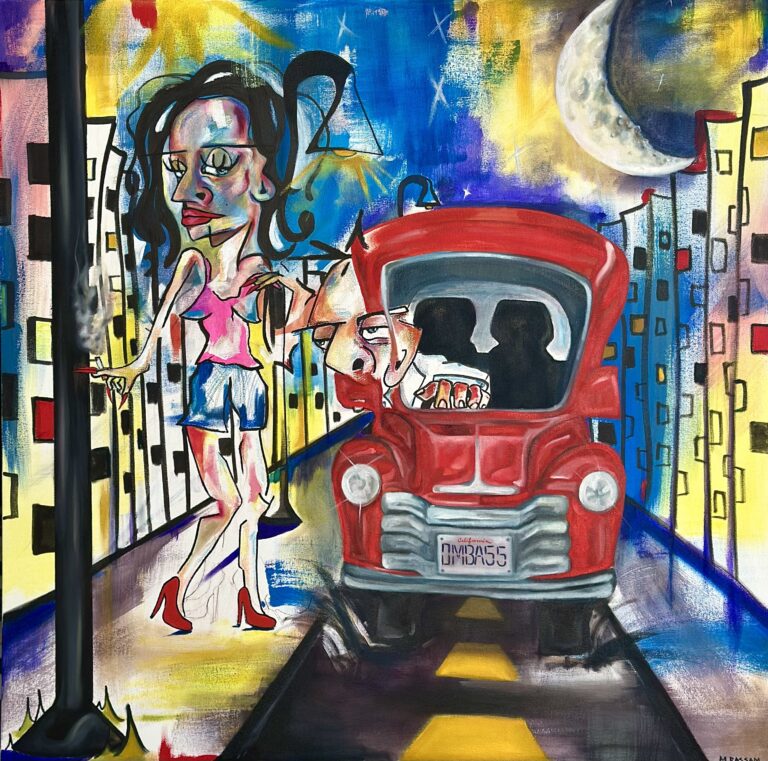
With the amount of time put into each show and the range of pieces exhibited by each artist, the Senior Shows serve as an intimate depiction of each graduate’s time and experience at UC Davis. While participating in the shows is optional, Mia Rassam, a fourth-year art studio major and co-lead director, explained that most fourth-years jump at the chance to be featured in the gallery and celebrate their final bodies of work. 

Hosting six different shows, The Basement Gallery will be featuring the work of 18 graduating seniors this year. Apart from “The Singular is Plural,” other past titles include “Still,” which featured the work of fourth-year art studio majors Rachel Li, Nelsy Perez and Evelyn Alvarez on May 2, as well as “Las Tres Chicas,” by fourth-year art studio majors Ary Calderón-Miramontes, Ji Ho Kim and Paola Vazquez on May 16. 

Their next Senior Show will open from 6 to 9 p.m. on May 23, showcasing the work of fourth-year art studio majors Mia Rossum, Cerina-Marie Smit and Mariam Tawfik. 

“Our show, ‘They’re Hysterical,’ is all about female-centric conversations, tension through material and healing,” Rossum said. “We’ve had such a great time organizing the show, and we’re honored to share it with the Davis community.” 

Exhibiting shows every Thursday up until June 7, you can find information on the following events through The Basement Gallery’s website or Instagram, @ucd_basement_gallery, and join the celebration, taking in the unique work and perspectives each artist has to offer. 

“It’s kind of overwhelming, especially when there’s a lot of people here, but it’s nice to feel like there’s an end point for all of this,” Bresson said. “This feels more like a graduation than anything else.”

Written by: Savannah Anno — arts@theaggie.org 

Guerneville: The LGBTQIA+ community hidden in the Redwoods

How “The River” became a safe haven for queer Californians and tourists


By SAVANNAH BURGER — arts@theaggie.org


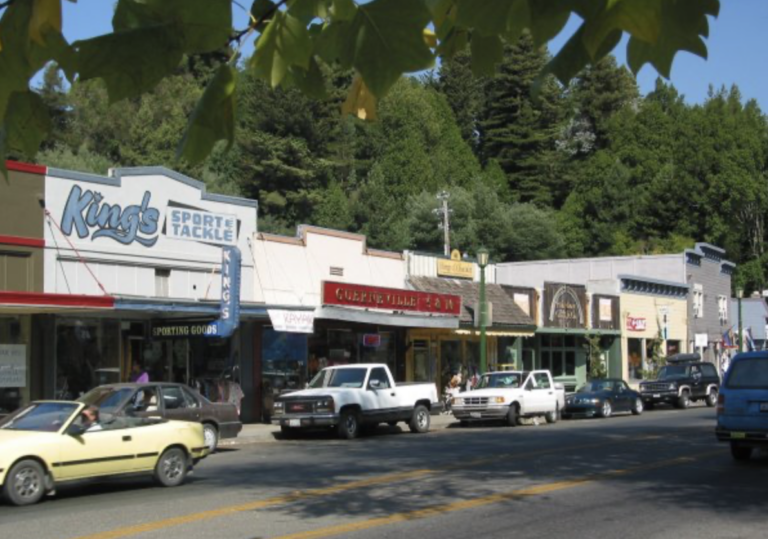
Nestled in the coastal redwoods along the Russian River in Sonoma County, the town of Guerneville has provided a sanctuary for local and visiting LGBTQ+ people for decades. Known affectionately as “The River;” it is regarded as one of the most safe and well-known havens in northern California for people of the LGBTQ+ community.

Although the gay scene has made Guerneville what it is today, it didn’t hit the town until somewhere in the mid-1900s. Before that, Guerneville was predominantly known as an ex-logging town, originally named “Stumptown,” because of all the clear-cutting that occurred in the area. When the town was established in 1877, it provided a large quantity of lumber used to build the first infrastructures and buildings in northern California following the discovery of gold.

The town was later named after one of the loggers that controlled the area and owned the sawmill, a Swiss immigrant named George Guerne. Because of the extreme logging practices, most of the redwoods in the Guerneville area are no more than 200 years old, as they were planted after the felling of thousands of old-growth redwoods. Now, only few remain, and a handful of them can be seen in Guerneville’s Armstrong Woods State Natural Reserve

After the logging industry went under, residents of California realized how beautiful of an area Guerneville is, and the town became a major vacation destination. Soon, train tracks were laid that connected the forest-encapsulated town with cities like San Francisco, which is a little less than two hours south of it.

During the 60s, however, as worldwide travel was becoming more popular, visits were starting to dwindle. Then the whole west of Sonoma County, where Guerneville is located, was hit with massive flooding. Just like that, Guerneville was practically wiped off of the vacation map.

Following this setback, a multitude of old, beat-up resorts and hotels were up for sale. It was here, in the 1970s, that a few members of the LGBTQ+ community began buying these properties. Soon, multiple gay-friendly resorts and bars were opening in the redwoods. Especially after 1975, when anti-sodomy laws were finally repealed in California, these queer spaces were able to be transparent and proud about their status of being gay-friendly and were able to directly cater to LGBTQ+ clientele.

Happening concurrently, the sexual liberation movement was in full swing, which attracted even more queer people to the redwood vacation town. Even when tragedy struck with the HIV and AIDS epidemic of the 80s and 90s, Guerneville remained steadfast as a refuge for those who were either personally suffering or had loved ones who were. 

It is also important to note that it was this point in time that really brought lesbians and gay men together, as it was largely the lesbian community that took care of the gay male community struck by the epidemic. This is why the “L” in the term LGBTQ+, which represents lesbians, comes at the forefront of the acronym. It’s a way to give respect to the lesbians who were caregivers during the HIV and AIDS epidemic.

Many of the original resorts, hotels and restaurants are still alive and well today, such as The Rainbow Cattle Company, The Woods Cottages & Cabins @ the Russian River, The R 3 Hotel, The Highlands Resort and more. As of recent decades, there have been new openings, such as the lesbian-owned Boon Eat + Drink and Boon Hotel + Spa. The woman who owns these two businesses, Crista Luedtke, is a renowned chef who has been featured in the likes of the New York Times, Cosmopolitan, Forbes and Food & Wine magazine, among others.

Guerneville also has a wide variety of LGBTQ+ events that happen throughout the year. Lazy Bear Week, one of the largest and most successful gatherings in the world for bears, a subculture of gay men, fundraises for charity every year. It’s happening this year from July 29 to Aug. 5. Women’s Weekend Russian River, which took place last weekend, happens every year to hold space for LGBTQ+ identifying women. There’s also the Russian River Pride happening between Sept. 19 to 21. These are just a few of the limitless LGBTQ+ gatherings held in the town.

Also boasting itself as a chapter of The Sisters of Perpetual Indulgence, a group of LGBTQ+ nuns that raise money for charity and promote joy, the town is a strong and established hub for the queer community. 

Welcome to people from all walks of life, Guerneville is an exemplary safe space and community in the redwoods that’s definitely worth the visit.


Written by: Savannah Burger — arts@theaggie.org 

UAW 4811 calls on academic workers at UCD, UCLA to strike starting Tuesday

The campuses will join UCSC in striking in protest of unfair labor practices, including the arrests of students and academic workers at UCLA

By VINCE BASADA — campus@theaggie.org

United Auto Workers (UAW) Local 4811, the union representing academic workers across the 11 UC campuses, called on union members at UC Davis and UC Los Angeles to strike starting on Tuesday, May 28. This will be the second round of campuses to join the strike, following workers at UC Santa Cruz who began on May 20.

The union — composed of 48,000 teaching assistants, graduate students, postdocs, researchers, some undergraduates and other academic workers — is calling on members of selected campuses to stop all work-related duties, including teaching discussions, grading papers and conducting research. Striking members would picket and hold rallies upon the return from the Memorial Day weekend, similar to actions taken on the UCSC campus earlier this week.

In calling for a strike, UAW 4811 has cited several unfair labor practices (ULPs), including the University of California’s alleged failures in preventing attacks on the pro-Palestinian encampment at UCLA and arresting an approximate 200 students and academic workers on May 1 and 2. The union has also taken issue with the university’s decisions to make “unilateral changes” affecting members’ workplaces and safety, as well as for disciplining and calling police on UAW members engaging in peaceful protests for workplace changes.

“The regents and office of the president [need to] take leadership to make sure that the situation is deescalated, because this is one university system and it is their job to make sure that it’s functioning well,” Emily Weintraut, a Ph.D. student in the UC Davis Food Science Graduate Group and UAW 4811 Davis Academic Student Employee unit chair, said.  “We’re ready. If they want to prevent an entire UC-wide strike, then it’s up to them to take action.”

5,700 workers are covered by the UAW at UC Davis, according to Weintraut.

The unions’ strike authorization vote was held from May 13 to 15 and passed with a supermajority. Weintraut did not go into detail on how the board and union leadership would choose which, and when, campuses would be called to strike.

On Friday, May 17, the University of California filed an injunction request which argued that the union’s strike was illegal. 

“Allowing the strike to continue will cause the University and its students irreparable harm — UAW members play a critical role in year-end activities like teaching, grading, and ongoing time-sensitive research,” one UC statement released Tuesday, May 21 read. “UAW’s strike is unlawful because the goal is to pressure the University to concede to a list of politically motivated demands closely linked to the protests occurring across California and the nation.”

On Thursday, May 23, the California Public Employment Relations Board (PERB) rejected the University of California’s injunction request. 

PERB said that the university “did not meet the threshold required for [them] to intervene,” according to an LA Times article

UAW workers previously striked in November 2022 to demand better wages and benefits. The contract dispute was resolved that December.

This story is developing, check back for updates. Last updated: May 24 (10:35 a.m.)

Written by: Vince Basada campus@theaggie.org