55.7 F
Davis

Davis, California

Monday, December 22, 2025
Home Blog Page 85

Armadillo Music hosts listening party for Wallows’ new album ‘Model’

Fans went downtown to get a sneak peek of the band’s new alternative pop album


By EMMA CONDIT — city@theaggie.com


On May 21, Armadillo Music, downtown Davis’ premiere record store, hosted a free listening party of Wallows’ new album “Model.” The store, which happens to be owned by Davis Mayor Josh Chapman, gained access to the album two days prior to its release, so attendees got an early peek into the unreleased music.

The event was primarily organized by Armadillo’s Assistant Manager Nick Rocci in collaboration with Record Store Day, a national organization that celebrates local, independent record stores. Alongside facilitating special events like this one across the country, the organization also celebrates Record Store Day each year on a Saturday in April.

Paul Vilbur, the manager of Armadillo Music, shared that in the era of Amazon and online streaming services, he enjoys listening parties because they show how many people enjoy the same music.

“They’re talking with each other about the music,” Vilbur said. “That’s the community stuff that my generation grew up with — talking music with the person who’s browsing next to you.”

Vilbur explained what makes Davis a special place to have a record store.

“We have a great community here because Davis residents are somewhat transient,” Vilbur said. “They buy 20 records from me and then four years later when they move away, they sell me back 15 and we can find used records.”

Rocci feels gratified to see how excited customers are when they find their favorite album in physical form. He thinks that live, communal listening parties have a similar effect.

“So many people just want to listen to a record,” Rocci said. “Something that helps a lot in keeping music alive is teaching and showing what records are, how they work […] That’s the best thing ever is people feeling it for the first time, physical music.”

Wallows’ album, while it brought many people together, received mixed reviews from its advanced listening.

Anne Saltel, a third-year community and regional development major, was not blown away by the album.

“I think their sound is very similar to their previous album, kind of derivative, but the vibes were good,” Saltel said. “It was a little more upbeat than their previous stuff.”

Vilbur enjoyed the album for its indie, youthful sound.

“I’m more of a heavy metal guy — Wallows [isn’t] necessarily the most metal band I’ve ever heard — but it was still cool,” Vilbur said. “Honestly, I’m older and hearing stuff that’s current with the younger demographic is really good for me.”

Kristen Mok, a third-year sociology organizational studies major, thinks that the album came just in time for summer.

“It had some social hangout music perhaps: kickback tunes, a hotdog by the pool, a good song for a summer barbecue,” Mok said.

Armadillo Music will host many more free listening parties to come, co-hosts Bikes and Beats every month and will be a venue at Davis Music Fest from June 14 to 18. It’s also open daily for patrons to peruse a wonderfully wide selection of records.

“It’s a place where people can come and hang out and meet other music-minded people,” Vilbur said. “Yes we need to be profitable and we need to sell stuff, but at the same time [the owners] are just as equally concerned about having a place for local music and where people can gather with their friends.”


Written by: Emma Condit — city@theaggie.com
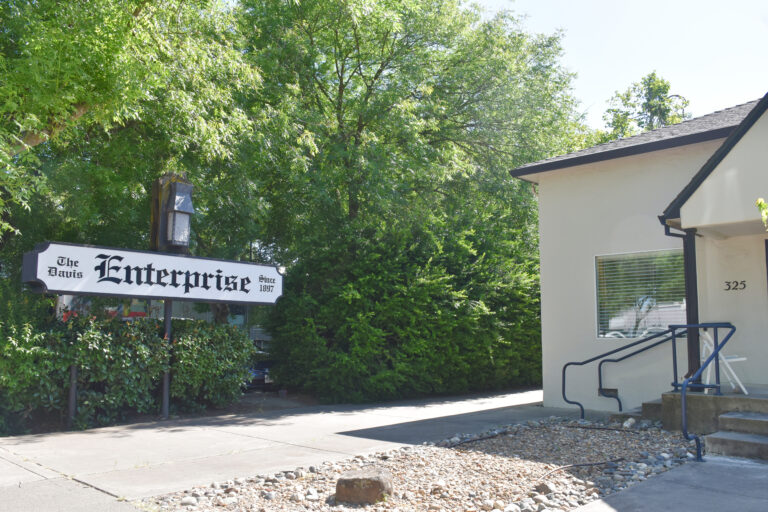
 

The Davis Enterprise fires popular columnist Bob Dunning without explanation

Several staff, including Wendy Weitzel, leave the paper in solidarity of Dunning


By CHRIS PONCE — city@theaggie.org


Bob Dunning, a popular columnist with The Davis Enterprise, was let go from the local paper after writing for them for 55 years — Dunning said that he was terminated without an explanation or warning. Since this decision, several popular journalists from The Enterprise left in support of Dunning.

“You can say fired, you can say let go and you could say laid off,” Dunning said. “All I know is I got a phone call and I no longer had a job and that was it.”

Since then, Dunning has moved his opinions over to Substack, a website where writers can publish their work and have readers subscribe directly to them.

“This is a column I thought I’d never have to write,” Dunning said on Substack. “Through these many years, the local owners of this newspaper regularly told me that as long as The Davis Enterprise existed, I would always have a job. I upheld my end of the bargain. They did not.”

Dunning was given no severance and no thank you from the owners, according to his column. He wrote that his articles with The Enterprise were his “life’s work” and that he felt discarded.

“There was no thank you,” Dunning said in the column. “No goodbye. Not a penny of severance. Just stone-cold silence. No golden parachute. In fact, no parachute at all as they pushed me out the back door of what I often lovingly referred to as the Starship Enterprise.”

Dunning said that the paper also refused to provide him his accumulated sick leave.

“Not only did they hurt me, they hurt my family, leaving them to scramble for suitable health care,” Dunning said.

Foy McNaughton is the chief executive officer of The Enterprise and R. Burt McNaughton is the publisher; neither have responded to requests for a comment from The Aggie by time of publication.

On May 19, Wendy Weitzel, popular writer of the “Comings and Goings” column at The Enterprise and their former managing editor, wrote her final column for the paper.

“I am sad for the paper but troubled by its handling of Bob, the person who personifies it,” Weitzel said in her column. “He deserved a severance for his 54 years of service. I waited a week to make this decision, hoping the McNaughtons would make things right. Apparently, that’s not going to happen. In the meantime, several other writers exited the publication without fanfare.”

The column was both in print and online. However, as of now The Enterprise has removed Weitzel’s column from their website. Weitzel believes that this was unfair on their part.

“I just basically said [in the column] that I didn’t approve of the way this went down,” Weitzel said. “The ownership got sensitive to that. But it’s not really fair, because, you know, it was my goodbye column. And now people don’t have access to it.”

Shelly Dunning, Bob’s wife and food columnist, Bruce Gallaudet, Tanya Perez and Julie Cross are among those who left their columns or positions at the paper, according to Weitzel.

Once Weitzel heard the news about Dunning, she was expecting that there would be a goodbye party or at least severance for him. She was surprised to hear that Dunning received none of those expectations.

“I’m sure there would be a nice severance and goodbye party and whatever,” Weitzel said. “And there was none of that; it was very mishandled.”

Weitzel talked about how she loved writing about the Davis community through The Enterprise.

“I realized I just loved it because it was the community I lived in and knew,” Weitzel said. “I got to know people and I think that’s part of my strength as well. Even today as a columnist I know the community. I know the people. I know the news. And it’s really hard to do that as an outsider.”

Weitzel’s “Comings and Goings” column regularly discussed business openings in Davis and news about old businesses closing down, among other updates. She explained why it gained such a following and legacy in Davis.

“I think it has a very practical use,” Weitzel said. “And people love that kind of stuff.”

While she went to college in Sacramento to study journalism, Weitzel lived in Davis and lived the “Aggie life.” This is when she first heard about Bob Dunning at The Enterprise.

“For more than 55 years, he has been the face and voice of The Davis Enterprise,” Weitzel said. “And I think The Enterprise ownership didn’t really appreciate the impact that he had on the community until they laid him off and are now having to deal with the consequences of people canceling their subscriptions, canceling their ads. They created a lot of ill will that really didn’t need to happen.”

Dunning said that Davis was a unique town, “like a town in the middle of Kansas,” and that local journalism and columnists are essential because of how major issues affect it.

“Davis has its own issues as every other town does,” Dunning said. “It has issues going on right now, as we’re seeing politically, even with international things there are major differences of opinion on the campus and in the community about real world issues.”

Dunning has six children and said that Davis is an amazing town for families and that he has been grateful to contribute to the public opinion of the community.

“Everybody feels that they’re living in the best place,” Dunning said. “But I think, objectively, this is one of the towns in America. Davis is one of the best places to live and raise a family.”


Written by: Chris Ponce — city@theaggie.org

Protesters blockade Unitrans

by SONORA SLATER

June 10, 9:40 a.m., 2024

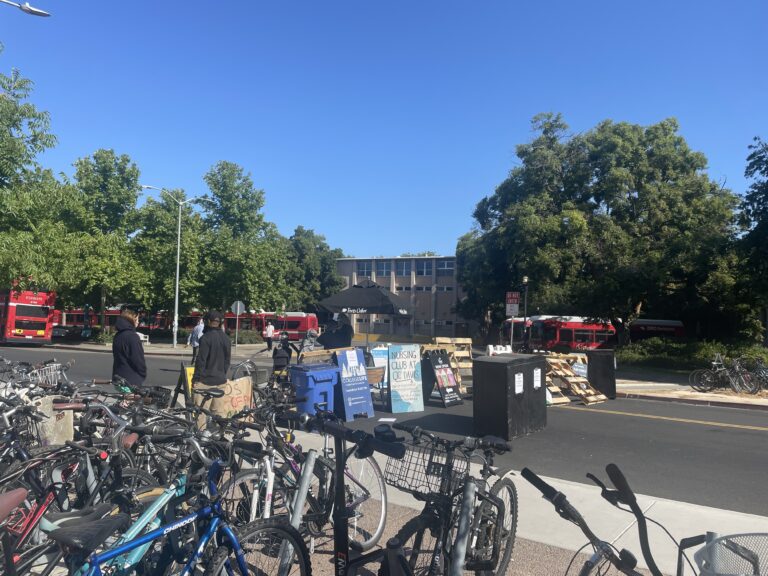
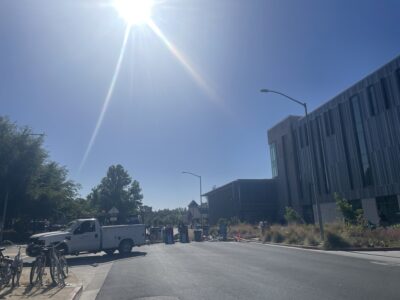
In the early morning of June 10, pro-Palestine protesters set up blockades on both ends of the Silo Terminal for the Unitrans bus system, preventing buses from entering and buses already within from exiting. The buses within did not appear to be operating at the time the blockade was set up.

UC Davis vehicle turns around after encountering Silo blockade on June 10, 2024. (Sonora Slater / Aggie)

According to an ASUCD Unitrans Instagram post, the Memorial Union Bus Terminal was also temporarily closed due to protest activity, but reopened around 9:20 a.m. A news brief on the Unitrans website said that the blockade at the MU was “removed,” but no further details have been shared yet.

In the comments of their Instagram post, Unitrans noted that they are working to set up service across from the West End Parking Garage on Hutchinson Drive. In the meantime, they let students know to “Expect major delays to all Unitrans bus routes [and] consider alternatives to campus.”

They also let students know that anyone currently waiting at the Silo Terminal should proceed to Lot 41 to catch a bus once service is restored.

Today marks the second day of spring quarter finals for UC Davis undergraduate students.

The blockade was continuing to grow as of the time of publication, being built from trash cans and recycling bins, the A Frame signs of various clubs, bikes, wood slabs, an umbrella taken from the nearby Peets Coffee, traffic cones and more. Several protesters, including at least one with a megaphone, stood behind the blockade and chanted pro-Palestine phrases.

Multiple UC Davis vehicles approached the terminal before presumably noticing the blockade and turning around. Bikers and walkers are still able to access classrooms and navigate around the blockade as of now.

Davis Police Department hosts community meeting regarding military equipment

In compliance with state law, Davis police gave the annual update on new military equipment 


By OLIVIA HOKR — city@theaggie.org


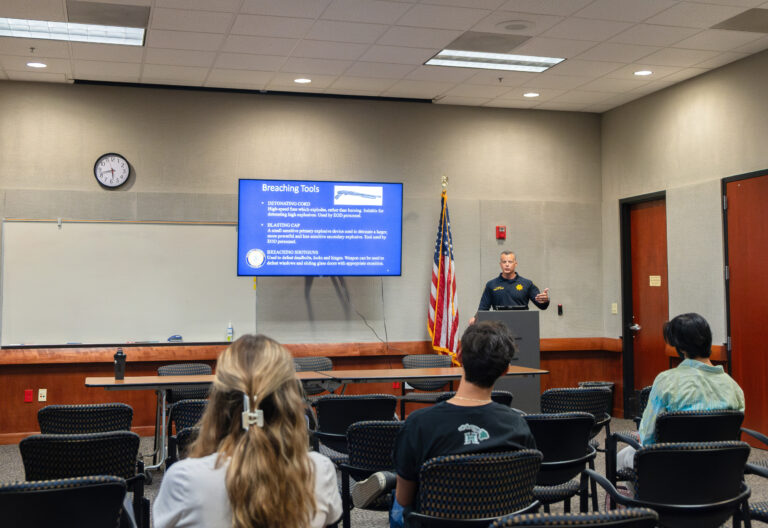
On May 28, the Davis Police Department held an annual community gathering at the Davis Police Station to report any new military equipment, a need for new equipment or a need to replace existing equipment. Police officials wanted to discuss the type of chemical agents the department possesses amongst other equipment.

Deputy Chief Todd Henry and Lieutenant Dan Beckwith gave a brief presentation with information about the different types of equipment and current quantities and allowed time for community members to ask questions.

“AB [Assembly Bill] 481 requires law enforcement to disclose what equipment they use that falls under the classification, according to the state of California, as military equipment,” Henry said. “Every year we have to report again and ask [the Davis City Council] for a new ordinance to allow the continued use of [the equipment].”

The term military equipment refers to armored rescue vehicles, chemical agents such as smoke canisters and tear gas, rifles, breaching tools and unmanned aircraft systems (UAS). None of the equipment owned by the Davis Police Department was purchased nor given by the military, according to Henry. The state determined which materials are considered military equipment.

The police department is currently in possession of one armored rescue vehicle, 13 small unmanned aircraft systems, about 50 different chemical agents, 13 noise flash diversionary devices, 45 AR-15s as well as a number of other rifles and two breaching shotguns, according to the Military Equipment Annual Staff Report, which can be found on the city of Davis website.

“The only real change in this policy from the last is the chemical agents: same amount, same type, different manufacturer,” Henry said. “Our old chemical agents had expired so they had to be destroyed.”

A few community members asked questions about the use of certain devices and the cooperation between the police department and the city council. One man who has lived in Davis for 55 years inquired about the last time chemical agents needed to be used in the community, to which Beckwith responded.

“I’ve been here 17 years, and we’ve never used any chemical agents in a crowd control environment,” Beckwith said. “We have used those as far as tactical operations in a barricaded-subject type scenario. As far as crowd control, that’s not something that happens, and we’ve talked about further restrictions of the law to make it an even higher unlikelihood for that to occur.”

The same community member also made a statement regarding the challenges that can occur within city councils and acknowledged that the Davis Police Department and the Davis City Council can combine efforts to work efficiently.

“City councils and police accountability commissions are sometimes very limited in their knowledge base, so I’ve seen that there are challenges there, but the way you have established criteria, I think, is good,” the community member said.

The aim of AB 481 is to create transparency and allow cities and their residents to be aware of what their police department is buying and what policies they have around that equipment.

“Our goal is to try and be as transparent as we can,” Henry said. “I think it’s really important for our community to be involved and engaged and aware of what your police department is doing.”


Written by: Olivia Hokr — city@theaggie.org 


‘Wellness’ is diet culture in a different font

Is it healthy or is it advertising?


By MOLLY THOMPSON — mmtthompson@ucdavis.edu


Workout and diet fads are constantly circling the media stratosphere. The rise of the internet sped up the cycle, but we’ve seen it long before the advent of social media (think back to the jazzercise craze of the ‘80s). Recently, we’ve had high-intensity interval training, creatine and other supplements, weight lifting, the 75 Hard Challenge, cold plunging, Peloton bikes, CrossFit, pilates and so many other fitness trends take over the internet. A myriad of diets have also come in and out of popularity in past years, such as paleo, keto, low-carbohydrate, intermittent fasting, raw vegan and high-protein, as well as diet programs like Noom and WeightWatchers.

A lot of these trends seem outdated and out of touch in today’s climate; we think of them as things of the past. Our current society is much more accepting and less focused on thinness — we’re no longer living in the toxic diet culture of the 2000s, right?

In reality, we’ve just taken diet culture and packaged it differently (with a nice little bow on top). It’s true that we’ve made progress through the ongoing body positivity movement, but idealized thinness is far from eradicated. It’s just that it’s now unacceptable to say that we think small bodies are better.

Focus in the fitness industry has shifted from body image to health and wellness, but what does that actually mean? They might not be saying it out loud, but the majority of people who push these wellness-oriented routines are still sending messages of slimness as an ideal. We’ve all seen TikTok videos that start with a clip of a thin, toned woman in a matching workout set who goes on to show you what she eats in a day or the fitness practice that she claims got her the definition in her abs — they all say it’s for our health, performance or well-being, but they’re still telling us that it’s about how we look.

This shift is happening because of the shift in society toward body positivity. As aforementioned, it’s becoming unacceptable to acknowledge our hierarchical biases around body composition and size, which means that companies can’t make money by selling the promise of a smaller body in the ways that they used to. People are realizing how damaging the harsh diet culture of the past was and are working to decentralize it from our society, so they’ve stopped buying blatant appeals to that desire for slimness and weight loss.

But that doesn’t mean that it’s not still pervasive, it’s just being marketed differently. An aesthetic video that’s advertising athletic wear, Bloom Greens & Superfoods powder, an Owala water bottle, a Pilates routine and a Ninja CREAMi machine is still selling you thinness. It’s implied rather than explicit, and it’s hiding under the guise of wellness, but it’s still riding on the aesthetic of the person in the video — you’re buying into the body as much as the product itself.

This is not to say that the movement away from conventional diet culture and toward health as a primary ideal is not positive or admirable; it absolutely is. We should continue working toward reframing the prioritized slimness that’s so deeply intrinsic in our society, but we need to make sure that what we’re doing is aiding those efforts and not secretly undermining them.

It’s so easy to have good intentions and still follow and contribute to this. If we constantly hear that a protein matcha latte and a reformer Pilates class is going to make us healthy, of course we’re going to want to join in and try it. It’s hard to know if what we’re being sold is actually health or if it’s diet culture in disguise — the current social media landscape is difficult to navigate. There’s also such a saturation of content that there’s bound to be some that genuinely intend to help viewers improve their health, but there’s no way to gauge the integrity of what we’re watching.

The other issue is that we as a culture have come to equate thinness with health, which simply isn’t the case. Thinness and health can certainly co-exist, but one does not equal the other. But because of that, content creators and brands can genuinely try to prioritize health but still be pushing thinness because that’s what we often view health to be.

The popular narrative now is one of wellness over slimness — the caveat is that they mean the same thing. Prominent wellness trends don’t support true health; they support a reformed edition of diet culture.


Written by: Molly Thompson — mmtthompson@ucdavis.edu  


Disclaimer: The views and opinions expressed by individual columnists belong to the columnists alone and do not necessarily indicate the views and opinions held by The California Aggie.

Yolo County health officials warn against drinking raw milk: why take the risk?

As cases of bird flu appear in dairy herds across the United States, Yolo County residents are advised to avoid dairy products from unpasteurized milk


By EMMA CONDIT — city@theaggie.org


On May 10, Yolo County issued a press release warning its residents against drinking raw milk due to the high risk of contracting avian influenza, or bird flu. Raw milk is milk that is not pasteurized, a process that preserves food by heating it up just below the boiling point. Untreated milk and dairy products can contain bacteria and viruses that would otherwise be killed during pasteurization.

Yolo and Solano County residents should refrain from consuming raw milk products due to the “recent detection of highly pathogenic avian influenza virus (H5N1), commonly known as bird flu, in dairy cows and their milk,” according to the press release.

Maria Marco, a professor of food science and technology at UC Davis, shared the importance of pasteurization.

“Pasteurization is a really effective way of making milk safe to drink,” Marco said. “When we look at raw milk, it contains all kinds of microbes. The microbes that are there may not even be coming from the animal but could cause harm to people.”

Marco explained that harmful microbes can come from the skin of the animal, the animal’s bedding, the animal itself and from surrounding fecal matter. Microbes found in raw milk can even be altered during storage and transit, according to a UC Davis study.

Yolo County’s primary concern is the spread of avian flu through milk. Though there have been no cases detected nearby, since March 25 avian flu has appeared in 63 dairy cattle herds in the United States. Although the virus rarely spreads to humans, when in humans the disease can cause very serious illness, according to the the Centers for Disease Control and Prevention. Since late March, the United States has seen two human cases of avian flu in people who contracted the illness through close contact with infected cattle.

A high viral load of bird flu is typically found in the milk of infected cows. Though cows can withstand the illness, it has been fatal to several cats that have consumed infected milk. Even though influenza is not typically seen as a foodborne illness, the threat of disease from unpasteurized milk is severe.

“Raw milk can harbor various pathogens capable of causing severe illness and death, including tuberculosis, salmonella, E. coli and now avian influenza virus,” according to the press release..

Despite all of its risks, the sale of raw milk has become increasingly popular in recent months. In California and 12 other states, the sale of raw milk as retail is legal. In 18 states, raw milk as a direct-to-consumer sale is legal. In the last year, weekly sales of raw milk have increased by as much as 21 to 65%.

Jack Lanham, a rising second-year at Willamette University, began drinking raw milk because of his stomach pain and digestion issues. Lanham said that the perceived advantages of drinking raw milk outweigh the health risks.

“If I’m able to drink milk without having severe stomach problems, I think it’s well worth the risk,” Lanham said. “I don’t like the idea that part of the milk is denatured when it’s pasteurized. With food being hyper-processed and being so fake, the idea of raw milk seems very natural and wholesome.”

Marco shared that unpasteurized milk, though it can seem appealing to some, is extremely dangerous.

“A lot of foodborne illnesses in the U.S. come from drinking raw milk,” Marco said. “There’s a perception that it’s probiotic or that it provides extra health benefits beyond pasteurized milk. If you want to have probiotic food, there are so many other options.”

Yolo County aims to take preventative measures to reduce the risk presented by the avian flu outbreak.

“Rather than wait for persons to contract avian influenza by consuming raw milk before issuing a warning, local health officials are acting based on preliminary data to warn about the potential for contracting avian influenza by consuming raw milk and milk products,” according to the press release.


Written by: Emma Condit city@theaggie.org


Review: ‘Challengers’ is just as action-packed as an actual tennis match

The film, starring Zendaya, Josh O’Connor and Mike Faist, offers a refreshingly intense movie about a love triangle happening on and off the tennis court


By ELIZABETH WOODHALL — arts@theaggie.org


“Challengers,” directed by Luca Guadagnino, was released in March 2024 and has a stellar cast led by Zendaya, Josh O’Connor and Mike Faist. The film scored an 89% on Rotten Tomatoes’ Tomatometer. The cinematography caters to the audience, making them feel like they are a part of the competition. It captures the movement between three different years, spanning from 2006 to 2019, and shows an intimate space between the emotional tension and passion-fueled action. 

Best friends Patrick Zweig and Art Donaldson have just won the boys’ junior doubles at the U.S. Open. Their intimate bond — emotional and sexual — exists on and off the tennis court as they were childhood best friends turned into tennis partners. Tashi Duncan soon joins the court; she is a young tennis player who has already signed brand deals with popular sports brands, capturing the eyes of anyone who likes a good game. Both boys are captivated by her and finally decide to make their move. With a love triangle spanning over 20 years, tennis has never felt so captivating. 

Patrick is infatuated with her image and who she could be: the best tennis player in the world, and his girlfriend. In contrast, Art views her for who she is: someone who knows how to play the right game in tennis. Art and Tashi are going to Stanford University, so their objectives are closely aligned. After briefly speaking to Tashi during an afterparty, Patrick and Art wait for Tashi to knock on their shabby hotel room door. When she finally arrives, she is interrogated by the boys, and their attempt to seduce her only proves who is in charge. Tashi leads them to the bed, kissing both simultaneously and then leading them to kiss each other. She’s aware of this connection between the boys, going as far as to say that she doesn’t want to be a “homewrecker.” While both boys have made a good impression on her, she promises to give her phone number to whoever wins the junior singles. 

Patrick wins the match, granting him the phone number of Tashi, but after she suffers a career-ending injury, we move forward in time to see that she is no longer with him. She is no longer a tennis player, but Art’s coach — and her greatest aspiration is for Art to win a Grand Slam title.

 To regain confidence on the court, Art is enlisted by Tashi in a lower-stakes Challengers tournament, but little do they know that Patrick, now a lesser-known tennis player who has blown through his money, will be playing against him. Patrick has never lost to Art, and so the tension grows as they both have to come to terms with this back-and-forth competition of who is deserving of Tashi’s affection as well as the better tennis player. However, this build-up isn’t out of nowhere. A flashback reveals that Tashi had affairs with Patrick while engaged and married to Art — making this rematch personal.

This movie is not just about tennis. Zendaya’s character offers an eventful performance of power and frustration from having to manage Patrick and Art away from making life-altering decisions on a whim. It’s about the remarkable passion for playing tennis and the lengths someone like Tashi will go to to experience some good tennis. Not only does she make Art one of the greatest tennis players, but she also has a consistent presence in the matches. She is willing to do anything to make sure she is in control of her future, including messing with Art and Patrick. Even though she is no longer on the tennis court, she is still making the winning move as she remains admired by everyone — her fans and her love interests. 


Written by: Elizabeth Woodhall — arts@theaggie.org 

Our timeline of the PULP encampment

The Aggie staff produced live coverage of the pro-Palestinian activists seven week encampment in the Memorial Union Quad last spring. Below is a timeline of negotiations, counter-protests and PULP updates. 

By THE CALIFORNIA AGGIE STAFF

June 5, 2:30 p.m., 2024

By RIVERS STOUT

PULP ALLEGES USE OF AMMONIUM SULFIDE BY COUNTER-PROTESTER 

On the Morning of May 30, UCD PULP media liaison Stanford McConnehey claims that a masked individual threw a glass bottle of Smirnoff into the encampment, . 

According to McConnehey, the bottle — which broke on impact — had the words “Fuck y’all” written on it. He also alleged that it contained vials of ammonium Sulfide, with at least one of the vials shattering. Nobody was injured, reportedly.

Ammonium sulfide is a skin, eyes and respiratory irritant. The substance is commonly used for stink bombs, and tends to not be lethal in small doses with limited exposure.

“This was an attack with poisonous chemicals,” McConnehey said. “Obviously the intent was that the glass bottle would break, and the [ammonium sulfide] bottles would break.”

McConnehey spoke on the accused person’s choice to wear a mask.

“People who are opposed to the encampment criticize campers and protestors for wearing masks,” McConnehey said. “Which we do to protect ourselves from COVID, which is being transmitted to people in our communities and to protect our identities when there is an open threat of doxxing and harassment. But, the same people wear masks when they come to assault us and to throw toxic chemicals into the camp, hoping that the vessels within them will break, and that they will harm people.”

McConnehey continued, saying that he believed these actions to be meant to “threaten” the people in the encampment, and make them feel “unsafe.”

“Often these are the same people [who] say they’re threatened just by the presence of the encampment, or the mere presence of disruptive protests in classrooms, or picket lines,” McConnehey said. 

He said that the encampment members did not contact the police during or after the event.

“As always, we’re not going to stop what we’re doing, and we’re not going to be intimidated,” McConnehey said.

McConnehey also said that, nearly a month later, the encampment has continued to grow. With the UAW strike beginning recently, the encampment has seen an increase in check-ins that is likely correlated. In preparation for the growth, the encampment was updated to make rows of tents that are available to all students. The strikers and campers now host programming together on the Memorial Union Quad.

Editor’s Note: Portions were of this piece were modified on 06/09/24 for the sake of clarity in reporting.

May 27, 2024, 9:10 p.m.

By RIVERS STOUT

UAW STRIKE

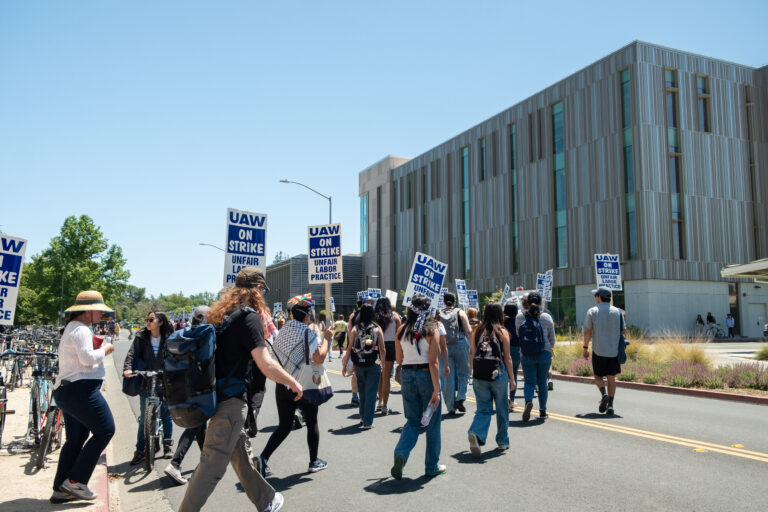
The United Auto Workers (UAW) Local 4811 announced they will be going on strike on Tuesday, May 28. The strike is over what the union believes to be unfair labor practices, including failure to protect the safety of protesters at the UCLA encampment. 

The Davis PULP encampment shared their reaction to the union’s decision. 

“We look forward to rallying with and supporting the striking UAW 4811 workers as they raise the issues of the unfair labor practices by the University of California, as it relates to speech and protected speech on campus, specifically as it relates to the matter of Palestine,” Stanford McConnehey, PULP media liaison said.

“We expect that the quad will be a space of collaboration between both undergraduate and graduate student campers and striking workers,” McConnehey added. “As always, all of our community is invited to engage in the public facing programming. We’re going to maintain this as a safe space for our community and we’re looking forward to accepting new people into the Popular University for the Liberation of Palestine.”

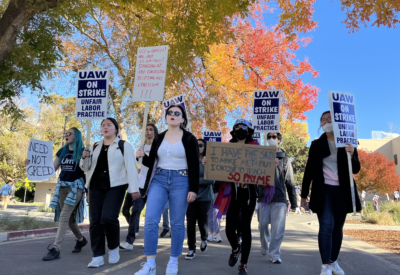
UAW members went on strike in November of 2022. A contract agreement was reached that December. In the above photo, UAW strikers marched on campus over wages and other benefits. (courtesy / David Kwon)

May 27, 2024, 6:20 p.m.

By RIVERS STOUT

PULP NEGOTIATIONS CONTINUE

On May 22, the second round of negotiations between UC Davis campus leadership and the PULP members occurred. 

“This round of negotiations was a chance for the administration to offer responses to our initial five demands,” PULP media liaison Stanford McConnehey shared. “It was not a detailed response to our fully detailed list of demands. It was very obvious that it was vetted through UCOP [University of California, Office of the President] and the regents. What they offered was insufficient to meet the needs and the demands of this community. Going forward the administration’s engagement teams will be setting up meetings in real time with the relevant decision makers as they relate to each of our demands.” 

According to McConnehey, offers to schedule more meetings were made at the table.

“Basically it was just offered to set up meetings in exchange for us breaking down the encampment,” McConnehey said. “We’re not here to be in meetings, we were in meetings before the encampment started.”

The establishment of meetings with the engagement teams has given hope to the PULP movement.

“We’re going to move towards discussions that need to be had, with the people who have the information, the access to information and the power to make changes or make recommendations for changes at the various institutional levels on which our demands operate,” McConnehey said.

“This movement is diverse, it engages in a multiplicity of various tactics, of which the encampment is just one,” McConnehey said. “We’re looking forward to coming together as a community to push our demands, until our demands are met.” 

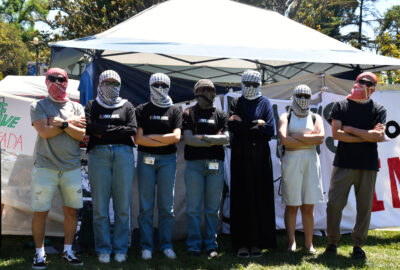
Encampment members stand for a photo in front of the encampment entrance. (Maia Zhu / Aggie)

May 15, 2024, 7:39 p.m.

By CHRIS PONCE

PULP NEGOTIATIONS BEGIN

Earlier today UC Davis News & Media Relations shared that campus leadership met with PULP negotiators on Monday, May 13. 

“Campus leaders expressed appreciation for the students’ efforts to keep the encampment safe and peaceful and listened to the students’ concerns about the ongoing humanitarian crisis in Gaza,” the university shared in a statement. “UC Davis leaders said the conversation was productive and that they will continue to engage with the students about issues they are raising.”

The statement also shared Chancellor Gary May’s previous sentiment that the university won’t punish students for remaining within their First Amendment rights. 

“UC Davis cannot and will not discipline students for speech protected by the First Amendment, even though [May] recognizes that such speech sometimes distresses or inconveniences members of the campus community,” the statement reads. “We remain committed to keeping the campus peaceful and welcoming for people of all backgrounds.”

The statement did not discuss PULP’s fifth demand which asks that May resign from the board of Leidos or as chancellor of the university.

This is the second statement from university leadership, following the first on May 6.

“Our Student Affairs team is working closely with UCD PULP members to offer guidance or information today, and they will remain available to UCD PULP to discuss their needs,” May said in the previous statement. “We are reviewing the demands we’ve seen posted and are working on responding.”

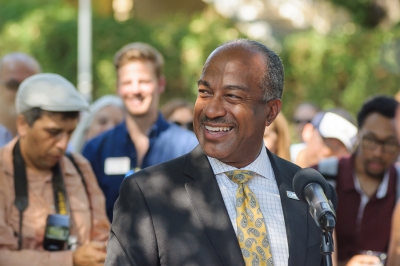
Chancellor Gary May speaking at a previous event. (Aggie File)

May 15, 2024, 7:21 p.m.

By RIVERS STOUT

At 10:30 a.m., protesters gathered at the East Quad for a walkout on Nakba day. The walkout was organized by the UCD Anti-Imperialist Student Association (AISA) and the Spartacist League. They traveled across campus, drawing some students to their walkout.

The march included chants such as “Gay Mary you can’t hide, we charge you with genocide,” “Walkout for Palestine,” “The working class will take a side, down with U.S. genocide” and more.

“We called a walkout to defend the camp against Zionist provocation and to free Palestnie,” Jameson, an organizer, said. “Over the past few days there’ve been provocations at the encampment, disruptions to their classes and just kind of general aggressive behavior.”

Those that organized the walkout don’t believe that negotiations aimed at divestment should be the primary means of aiding Palestinians. Instead, they aim for a class struggle.

“The university administrators are not neutral, they are agents of the capitalist class,” Jameson said in a speech. “Overseeing control and operation of higher education. The time has come. Let’s divest these administrative parasites of their authority to control schooling and serve as the bulwark of genocidal imperialism on our campuses. Abolish the administration, for student, teacher and worker control of higher education.”

While the walkout organizers and PULP organizers both want a free Palestine, the groups have ideological differences. An AISA organizer said that Students for Justice in Palestine (SJP) and the Revolutionary Student Union were too “liberal.” The organizations rely too heavily on working within the university to achieve their goals, they said.

“We’re happy to see people being active around the ongoing issue in Palestine,” they said.

May 14, 2024, 4:10 p.m.

By RIVERS STOUT

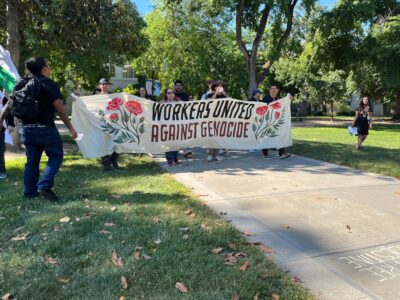
Today at 9:45 a.m., a group carrying a sign that read “WORKERS UNITED AGAINST GENOCIDE” marched near the Quad. They chanted: “Palestina sería libre/Cueste lo que cueste,” which means in English “Palestine will be free/It cost what it cost” and “Viva Palestina,” which translates to “Long live Palestine.” 

Workers march in solidarity with Palestine. (Rivers Stout / Aggie)

Marchers consisted of members of organizations that work within the California Coalition for Worker Power. Many marchers were members of Trabajadores Unidos, a Woodland and Sacramento based worker center.

Alma Soto, executive director of jobs with Justice San Francisco, was a member of the march.

“We’re here because we’re a worker-led organization and we very much honor solidarity,” Soto said. “We have an analysis of what it means to be in solidarity, like with working people internationally, not just here in the United States.”

The group had plans to be in town for a workers’ assembly in Davis, and wanted to express their solidarity with the encampment while they were in town.

“Palestine has been an issue that has been raised from workers in our communities — communities that are primarily immigrant communities,” Soto said. “Imperialism has impacted a lot of the communities that we represent. We see that happening in Palestine and we have a commitment to continue to be in solidarity as workers in Palestine have asked for solidarity actions from workers across the country.”

May 13, 2024, 1:53 p.m.

By CHRIS PONCE

PULP members pose for a photo outside of the encampment. (Maia Zhu / Aggie)

It has been one week since the PULP encampment was set up in the Memorial Union Quad. Since last Monday there have been counter protests, several donations made to the encampment and an alleged assault on a PULP member. A media coordinator with the group recently shared that negotiations with the university are expected to start sometime this week. 

“It’s going to be our first meeting [with the university this week], we just aren’t quite sure yet how things are gonna go,” the coordinator said. “But we are hopeful and have faith that our negotiators are going to do a good job.” 

In order to join the encampment, participants have to check in at the PULP entrance. The coordinator said there have been around 1000 check-ins since last Monday and that there are typically around 200 people who stay overnight.

“We have more systems in terms of dealing with food and dealing with cleaning up and maintaining the camp,” the coordinator discussed what has changed since day one. “At the beginning, there was such an influx of donations that things just kind of were not organized well. But now we’re getting much more organized and things are running smoothly.”

The coordinator shared why they feel hopeful about negotiations. 

“I think because we have so much community support, we feel hopeful,” they said.
“But we just are just really confident in our negotiators and confident that we’re going to stick to our demands.”

May 13, 2024, 11:48 a.m. 

By CHRIS PONCE

Aggies for Israel set up demonstration for Israeli hostages taken by Hamas. (Maia Zhu / Aggie)

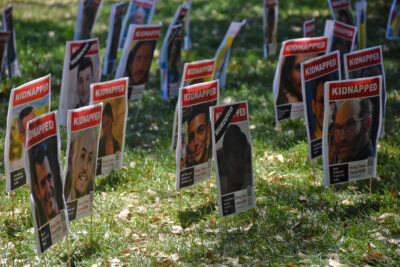
Today, Aggies for Israel (AFI) held a small demonstration in front of the Quad. They hung an Israeli flag from a tree and set up missing posters of Israeli Hostages taken by Hamas. Since Oct. 7, it is believed Hamas has been holding around 100 people hostage.

“It’s to bring awareness of the people that were taken hostage into Gaza, or kidnapped or murdered,” Elizabeth, a member of Aggies for Israel who didn’t feel comfortable sharing their last name, said. “I mean, so we’re just bringing awareness to the people that are still there since Oct. 7.”

It has been one week since PULP organizers set up their encampment in the Memorial Union Quad in support of Palestine. Elizabeth shared her thoughts on the encampment. 

“I don’t want to speak for everyone, but I know that I just want a peaceful campus,” Elizabeth said. “I just know that this is a very tough situation and some people are very personally involved. And I hope that those of whose family are also doing okay.”

Elizabeth shared she believes a sign in front of the encampment which reads “Davis to Gaza — Intifada,” is a call to violence. 

“It’s a little bit scary,” Elizabeth shared. “My reaction when they’re, you know, having signs that say ‘Intifada’ and things like — it’s a little nerve wracking. It’s a call for violence, it incites violence. And I know a lot of [the encampment members] say they don’t want that [violence]. And so I wonder if they know that that’s what [Intifada] means. I just really want a peaceful environment, I want everyone to be safe.”

She shared that there are misconceptions people have about their group and that there are also likely misconceptions held about PULP.

“I try to have empathy for them and understand where they’re coming from,” she said about the PULP encampment. “But I definitely want to encourage people to talk and have respectful and open dialogue. That’s what I would want. But yeah, I’m sure there’s misconceptions, those misconceptions on our side too.”

Elizabeth and another member, Ari, shared that they are cautious about supporting a total “prisoner/hostage for hostage” exchange in the war. They believe the Palestinian prisoners held by Israel are different from hostages that were taken by Hamas. 

“We want peace, we want to end the war,” Ari said. “It’s as simple as that. We want our hostages home, and we want Palestinians to have a government that doesn’t hold them hostage and that isn’t a terrorist organization.” 

Elizabeth has family in Israel and has been hearing about this conflict since she was a child.

“I mean, I’ve heard about this conflict since I was younger, it’s not something that just started now,” Elizabeth shared. “And every time I’ve talked to my family and to my family in Israel, there are so many different perspectives in Israel alone. So many people want to be able to live freely and be able to coincide and live together.”

Elizabeth believes that both Jewish people and Palestinians are indigenous to Israel and Gaza and that they can coexist.

“People can coexist and live on land that they are both indigenous to, that both have history and ties to,” she shared. “Palestinians do deserve rights and freedom and human rights and land. And so do Israelis and Jews, so I really think that’s just that’s where I would leave off — we really just want peace, we want to not be afraid for our family, of constant rockets and taken hostages.”

“I was so afraid that my family would be [one] of the faces,” Elizabeth gestured to the missing signs with hostage faces on them. 

Aggies for Israel place missing signs for hostages held by Hamas.(Maia Zhu / Aggie)

May 11, 2024, 2:02 p.m.

BY RIVERS STOUT

On May 10, at around 5 a.m., 4-5 older men encircled the UCD PULP encampment and blew airhorns. People in the camp responded with chants. Camp safety volunteers prevented the men from entering the camp, according to PULP liaison Stanford McConnehey.

A sign at the front of the encampment calls to “stop genocide” in Palestine. (Maia Zhu / Aggie)

May 10, 2024, 4:18 p.m.

By RIVERS STOUT

On May 10, around 2:45 p.m., a late middle-aged man walked into the PULP encampment and punched a camp safety volunteer, according to media liaison Stanford McConnehey. 

The attacker was soon expelled from the camp. Afterwards, a group of middle-aged men continued to record campers outside of the encampment until around 3:40 p.m., McConnehey shared.

This is a developing story, more updates will be provided in The Aggie’s ongoing coverage.

It is the fifth day of the PULP encampment. (Andrew Huang / Aggie)

May 10, 2024, 1:03 p.m.

By RIVERS STOUT

It is the fifth day since the PULP encampment was organized in the Memorial Union Quad.

A banner reading “JEWISH LIVES MATTER TOO” and “#BRING THEM HOME” as well as other phrases was placed in front of the PULP encampment earlier today. 

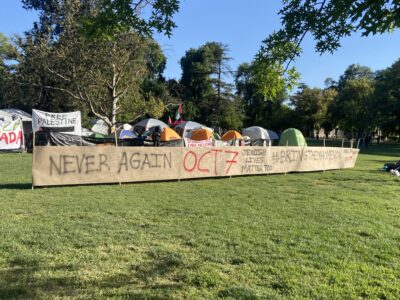
The sign previously appeared on Tuesday, May 7. A group called the Davis Oct. 7 Coalition claims responsibility for the previous sign. 

Campus News Writer Vince Basada contributed to this update

On Tuesday, May 7, in a counter-demonstration a banner was displayed that read “NEVER AGAIN, Oct 7.” (Aggie File)

May 9, 2024, 3:28 p.m. 

By CHRIS PONCE

Stanford McConnehey, third-year law student at King Hall, had a final exam this morning and graduates tomorrow. On top of his academic work, McConnehey is a media coordinator with Davis Popular University for the Liberation of Palestine (PULP) and is a part of the encampment. 

According to the United Nations, 80,000 people have fled from the Rafah area due to Israeli involvement. McConnehey shared his reactions to the ongoing violence in the region.

“The logistics of the encampment have been taking up a lot of my attention,” McConnehey said. “So every time I open my phone, it’s horrifying. Words actually can’t describe the level of loss. We have members of our community whose families are trapped in and around Rafah, unable to get into Egypt. And nor should they have to be faced with the decision to go into Egypt, the United States needs to force the Israeli occupation forces to get out.”

McConnehey said he hopes all prisoners, both held by Hamas and Israel, are exchanged safely. He believes that a fully military withdrawal is also necessary for the region. 

“I personally am in favor of an all for all prisoner exchange,” McConnehey said. “That includes everybody that is held by the Palestinian resistance factions and every Palestinian that’s held by the State of Israel including those in administrative detention should be swapped. There needs to be full military withdrawal from the Gaza Strip and immediate attempts at rebuilding.”

He is feeling hopeful about the future of the encampment and shared that he believes negotiations between the administration and protesters are in process. 

“I think those talks are in process, as far as what negotiation would look like and how far they’re willing to come on our demands,” McConneyhey said. “And I think that might have to do with the Chancellor’s travel schedule.”

While there have been some counter protests, McConnehey said PULP is avoiding escalation. 

“We’re not here to get into fights with people,” he said. “We’re here to focus on Palestine. And so we’re trying to avoid any escalation. Obviously, there are some folks who want to come and take high resolution photographs of people’s faces inside in order to threaten them with doxing and things of this nature.”

McConnehey also believes that the encampments have provided a space for people to take action against the violence in Gaza and also grieve what has been lost. 

“Being able to share this space and collectively grieve and mourn and also act and take up this space and bring other people’s attention to it is a meaningful way to not normalize a genocide,” he said.

Encampment members set up signs in front of the encampment reading “LIBERATED ZONE AGAINST GENOCIDE” (Summer Sueki /Aggie)

May 9, 2024, 2:31 p.m. 

By CHRIS PONCE

Today is the fourth day of the encampment protests at the Memorial Union Quad that was organized by the Davis Popular University for the Liberation of Palestine (PULP). 

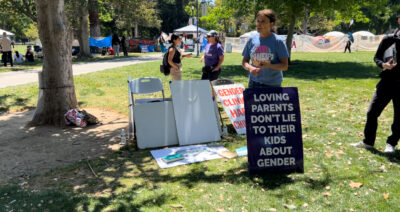
Earlier today, Yolo County Moms for Liberty Chair Beth Bourne and other protesters gathered in front of the encampment to protest against gender affirming care for transgender children. 

“You know, they have their First Amendment right to free speech and I have my First Amendment right to free speech,” Bourne said about the encampment protesters. “So that would be my message for Chancellor May and all the administrators. If there’s a mother, father or grandmother who’s concerned that we have these new medical procedures and treatments and drugs that have never been given before to young people, then we should be able to be critical of it and question it.”

A media coordinator with PULP said they were unaware of the Moms for Liberty protest, but another encampment member who wished to stay anonymous referred to them as “transphobes.” 

“They’re just here to draw attention to themselves,” the coordinator said about Yolo County Moms for Liberty and counter protesters. “They’re here to get into arguments. They’re here to kind of distract from the reason we’re here which is the ongoing genocide in Palestine.”

Beth Bourne engages in heated discussion with bystander about trans youth and gender affirming medications (Chris Ponce / Courtesy)

May 9, 2024, 2:05 p.m.

By CHRIS PONCE

PULP press coordinator shared that the group is working to make an on-demand pathway for people with disabilities and other accommodations to move through the Quad.

Encampment protesters use black umbrellas to shield faces of members from photos and doxing (Summer Sueki / Aggie)


The Editorial Board meets with Chancellor May, UC Davis administrators — Spring 2024

May and administrators discuss UAW 4811 strike, AI usage, pro-Palestine encampment and their advice to graduates 

By THE EDITORIAL BOARD

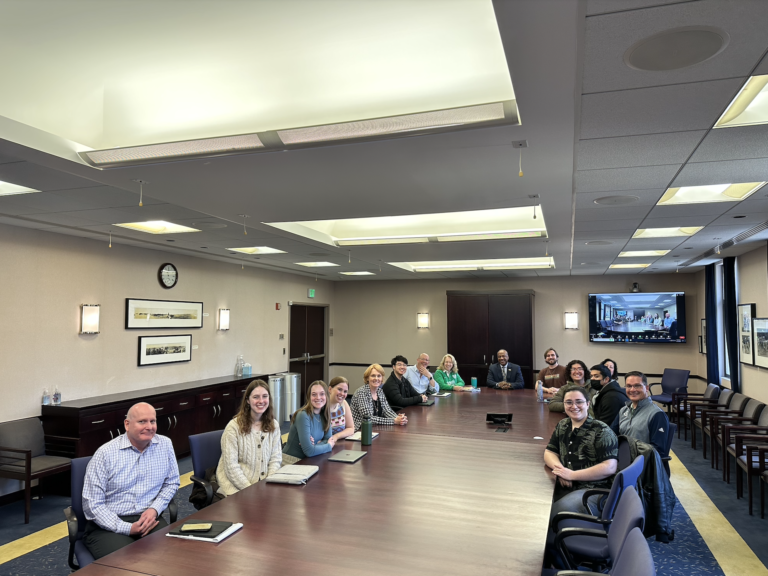
The California Aggie’s Editorial Board met with Chancellor Gary May and administrators via Zoom to ask questions about the quarter. Attendees also included Faculty Advisor to the Chancellor and Provost Ari Kelman, Chief Marketing and Communications Officer Dana Topousis, Associate Chancellor and Chief of Staff Karl Engelbach, Associate Vice Chancellor for Student Life, Campus Community and Retention Services Sheri Atkinson and Vice Chancellor for Finance, Operations and Administration Clare Shinnerl.

The Editorial Board meets with administrators every quarter and shares the full transcript online afterward — if you have a question you would like us to ask for the fall 2024 quarter, you can submit it to editor@theaggie.org. 

Below is a transcript of the meeting that has been edited for length and clarity.

Editorial Board: This quarter’s ASUCD elections saw a 23.7% voter turnout — a fairly significant increase from prior quarters, and one that enabled The Green Initiative Fund (TGIF) to pass. What do you think contributed to this? How can the administration continue this momentum and further increase student involvement in elections?

May: I think obviously we are all very supportive of the increased turnout in this election and hopefully others to come. It’s an encouraging sign that students voted and enough voted for TGIF to finally pass, I think after the fourth or fifth time [of TGIF being on the ballot]. I would give most of the credit to the students and student leadership in ASUCD for increasing turnout, but I know that the administration has also been very supportive of those efforts. There was additional signage promoting QR codes to encourage the voting; the voters were incentivized with $10 CoHo gift cards; the voting period was extended from three days to five days [and there was] lots of social media promotion, a raffle [and] prizes. Then we promoted it on “Checking in with Chancellor May,” “Thursday Thoughts,” the UC Davis Life newsletter, social media, student housing communications and support from IET staff on the Schedule Builder navigation menu with a vote button. We’re always eager to do whatever we can to support the voting on campus.

Atkinson: As Chancellor May has said, the students in ASUCD were very organized this year and did a lot of promotion and had a lot of these different ideas. Their idea of having a [raffle] drawing [for] coffee with the chancellor was one of their ideas to increase voter turnout. The students were really motivated, and then we supported their efforts as Chancellor May mentioned. 

Editorial Board: What has your reaction been to the ongoing PULP encampment for Palestine in the MU Quad? What is the state of negotiations and what has this process looked like? 

Topousis: I’m just going to jump in here, if the chancellor doesn’t mind. I know that [the Editorial Board] has submitted at least three questions, maybe four questions, about [the encampment]. We’ve made a public statement on May 15 and that’s going to remain our public comment on the situation. I hope you understand we’re just preferring to not undermine the ongoing engagement process and the communication that we’re having with the students. We’d rather just leave our public comment to what it was on May 15 for all.

Editorial Board: So just for clarification, you guys will be making no comment on those questions for today?

Topousis: We’re making the comment that this is our statement, we don’t want to undermine the engagement process with the students, so we are going to keep to the message that we put out on May 15 as our most recent statement.

The Editorial Board reviewed all the prepared questions regarding the encampment to give the campus leadership an opportunity to provide additional information on any of them. These are the questions that the Editorial Board asked: 

The group has five demands, one of which is for you to step down from the executive board of Leidos or resign as chancellor. Have you considered this demand and communicated your stance with the protesters?

If the protests continue to go on, does the university have a plan on how to address them outside of the negotiations? Will/has the university considered police enforcement? If not, is there a line when the university will consider authorizing the use of police? 

How has the UC system as a whole been reacting to the effects of encampments at campuses across the system? Are administrators collaborating with each other to address violence that has occurred at campuses such as UCLA and UCSD?

If the UC did divest in part or in full as requested by protesters, what would the most likely impact be in terms of decreased scholarship availability, changes to campus operations funding, etc.? What moves could UC Davis make to minimize any negative impacts?

After going through these questions, Topousis responded as follows. 

Topousis: I think the ones about their demands, their requests and what the universities are doing in the process are the same [in that] we don’t want to undermine the discussions we’re having with the students, and we don’t want to say anything that might undermine that process.

I would say the UC has made a statement about their reaction to the system. On April 30, UC President [Michael] Drake did issue a statement about freedom of expression. We can certainly point to that, but that’s probably the most we can say there. I will turn to the chancellor related to the president’s comments [and] if there’s anything further we should say about the UC system.

May: Only that there’s been an investigation opened at UCLA to find out a little bit more detail about what exactly happened and why. We’re waiting to see how that investigation unfolds. [The Editorial Board] asked if we are collaborating, and the chancellors have a regular monthly meeting where we do talk about various issues happening on our campuses. This is certainly an important one that we have been discussing. I don’t know if I would call it collaboration, but we’re certainly sharing information.

Topousis: I’ll just also clarify our not wanting to undermine the process. The statement that we released on May 15 [was reviewed by] students that we’re talking to […] before we released it. We’re really trying to respect each other and respect their role in this as well. That’s why we don’t want to say anything without them being part of the table.

Editorial Board: With violence continuing overseas and tensions rising at college campuses across the country, what is the university’s plan to make Jewish, Muslim and Arab students feel safe and protected from discrimination? Is the university’s current approach to addressing these types of issues different from in the past? 

May: I’ll just start by saying the events in Gaza and Israel have been heartbreaking and have created a really challenging environment for our campuses, both in the UC and across the nation. I believe that Student Affairs here at UC Davis has done a tremendous job of working with our students on all sides of the issue and the student organizations that represent them to provide the necessary resources and support. 

I want to make it clear that whenever the university receives any sort of complaint about antisemitism, islamophobia or any type of intolerant or offensive behavior, we immediately reach out to the affected parties to provide support and resources using HDAPP [Harassment and Discrimination Assistance and Prevention Program] and other resources of similar type. We review each allegation and compare it to the university’s anti-discrimination policy and then take action appropriately.

We’re always looking for ways to improve. If there are ways that the campus climate can be improved to ensure that every student is not restricted in their participation in our programs and activities and most importantly, their classes, we want to make sure we take those suggestions for improvement and develop an environment where every student, faculty member and staff member can feel welcome and thrive.

Atkinson: We take any kind of report very seriously in Student Affairs. We will work with individual students to review their case, help them navigate any challenges they might be facing and help them find the resources that they need. We have done this with various groups of students to hear their concerns and talk about them. It’s definitely something that we’re very concerned about, and we want to support our students in having a positive campus climate.

Shinnerl: I can just add that we have teams of professionals here to help with safety on campus. I think one of the areas we’ve been pretty busy with is vandalism and removing offensive language quickly when it’s reported so that it does not damage property, but also does not hurt people. 

Editorial Board: UAW 4811 has just authorized a strike in response to the UC’s “unprecedented acts of intimidation and retaliation directed at [their] rights as academic employees to free speech, protest and collective action.” UAW has listed various concerns to negotiate and discuss with university leaders, such as the right to free speech, divestment, disclosure regarding university funding sources and investments and amnesty for students and faculty who were arrested or faced disciplinary action due to protests. How does UC Davis plan to address the strike and demands of strikers, as well as the potential interruption to education posed by the event? 

May: The strike [in 2022] was a difficult situation for the entire campus community, and we always hope that any strike activity does not meaningfully disrupt teaching or learning or campus operations. It’s the position of the University of California system that this strike is illegal and violates the collective bargaining agreement that was reached in 2022. There is a contract that has been in place since that collective bargaining was concluded, and it specifically says in that contract that the UAW will not strike during the period the contract is in place.

The university has asked the Public Employment Relations Board [PERB], per an injunction, to stop the UAW from striking and we await that outcome. I will say that many of the same issues that are raised by the UAW and their strike authorization vote were raised by the encampment students and others, and we do think that that’s a constructive conversation to have. We just don’t think the strike is the appropriate way to have the conversation.

Kelman: I was disappointed to see this is a so-called “stand-up” strike — which is to say that the strike happens at different places at different times, and our campus has been constructively engaged with the leadership of the encampment on the quad. I was surprised to see a stand-up strike on our campus based on its reasons for striking. I would say further that the strike is creating additional stress for students, for faculty and staff. We recognize that we’re in the process of considering ways that we can try and mitigate some of those issues. We’re going to, as we did during the previous strike, find ways to [provide] additional support for faculty who might need help because they’re facing significant additional work around grading, leading sections [and] otherwise maintaining the integrity of the curriculum.

We had some unfortunate activity the other day [where] some classes were disrupted. The Student Affairs team has reached out to students who were very uncomfortable because of some of the ways in which those events transpired. More broadly, students who are facing impacts because of the strike can reach out to case managers and others in Student Affairs for a variety of different kinds of support.

Editorial Board: Governor Gavin Newsom’s new budget proposal will decrease the amount of financial aid students receive – around 300,000 students receive the Middle Class Scholarship every year, which is losing funding. In addition, this new budget will potentially harm many low-income students. Is there any plan to ensure that students will have enough opportunities for financial support throughout their education? 

May: The UC firmly supports the Middle Class Scholarship program’s goal of making the entire UC education, as well as CSU education, debt-free. To that end, we’ll continue to support President Drake’s debt-free program for our lowest income students. We were always going to rely on the Middle Class Scholarship program to make the rest of our students debt-free. Unfortunately, the proposed cuts would mean a delay in reaching that goal and likely an increase in borrowing by students. The Learning-Aligned Employment Program was also a key program for our debt-free goals, which provides high quality employment opportunities for UC students, so that’s another area of disappointment. 

I would just add that the UC has done its part to achieve the debt-free goal by setting aside 45% of new tuition revenue under the Tuition Stability Plan that was passed a few years ago. That money is already needed to fund UC’s debt-free program [and] we were unable to make up for the loss and potential middle class scholarships from that source, so the budget is not final. The legislature and the governor will still be negotiating the budget for the next two or three weeks. We hope that there’s some possibility that the Middle Class Scholarship will get placed back in the budget, or at least some portion of it, but that’s all we can say at this point.

Editorial Board: As you know, the Arboretum is undergoing restoration. What has been the administration’s role in facilitating this process and can you tell us a little more about the set timeline or when it will be fully restored?

May: We’re supportive of the project. We’ve contributed $2.5 million in deferred maintenance funds as a match to a grant that we received from the California Natural Resources Agency for the project — that grant was $5.4 million. The Arboretum and Public Garden staff have really worked closely with partners in Finance, Operations [and] Administration, which was led by Clare [Shinnerl]. This includes collaborating with campus planning, environmental stewardship, design and construction management [and] utilities, as well as various academic contributors across UC Davis to implement the project.

As far as the timeline goes, construction occurs over 2024 and 2025, and mainly from April to November of each of those years, and we expect to be complete by winter of 2026. The construction will begin at Lake Spafford and extend this year. It’s always somewhat frustrating to have disruptions in any kind of campus construction project, so we appreciate everyone’s patience as we try to make things better for the Arboretum.

Shinnerl: I don’t have much to add other than that this Arboretum, you know, it’s a lake, right? It doesn’t have a source and it doesn’t have an outlet, so algae was really building up there. It’s disruptive, but we absolutely had to make these repairs to keep our campus looking great and healthy for the Arboretum to be healthy. I do have a fabulous video [which] tells a really great story that this work will be well worth it.

The video can be found on the UC Davis Arboretum and Public Garden Youtube channel. 

Editorial Board: UC Davis SHIP rates are increasing next year — what went into this change, and how will it affect students? Are there any plans to subsidize this rate increase for students who need it?

May: So UC SHIP is a self-funded plan, which means that the annual premium is based on the members’ overall utilization of the plan. During the last half of last year, 2022 to 2023, UC SHIP had experienced significant increases in planned use when members came back after the pandemic and began using services, and the pandemic wound down. The use was so high that the UC SHIP program had to pull about $75 million from its reserves to cover the claims above what the actuarial team had forecasted for last year. By the time these claims were submitted and processed, the premium for this year had already been set. It was too late to adjust the premium for this year. 

Over the past several years, SHIP insurance premium increases have stayed pretty much in line with state and national insurance plan costs. The increases that students will be expecting next year are not unique to UC SHIP. Plans across the country have seen dramatic increases in demand similar to what I described in the last half of 2022 to 2023, and we expect that might continue.

Some adjustments were made to the planned benefits for next year to help mitigate the increase in premiums: The emergency room copay, the annual out-of-pocket maximum and the copay for special medications were all standardized across campuses that participate in the program. These changes in discontinuing services brought down the premium increase by about 5%, so there was some relief there.

In terms of subsidizing, Student Health allows students to waive the UC Student Health insurance program cost if they have approved health insurance coverage, such as from their parents or from some other source. Annually, approximately 40% of the undergraduate population here at UC Davis opts out of SHIP. We also offer gift aid to cover the full cost of SHIP for our neediest students, [and] of those students, about 50% of those were enrolled in SHIP — that’s 6,443 students as of fall 2023. That financial assistance that was provided totals about $20 million.

Lastly, I’ll just note that a 17% increase in the number of undergrads who qualified for SHIP coverage for fall occurred compared to 2022. There’s a couple of things happening: the increase in the number of students that we have to serve, as well as those premium increases. 

Shinnerl: I can add that this is now a national trend for all health premiums. We, as employees, had gigantic increases this year. You’re seeing rising healthcare costs everywhere for a lot of reasons.

Editorial Board: With commencement coming up soon, can you tell us what the process of choosing commencement speakers is like? Why were this year’s speakers chosen? 

May: We start by advertising the opportunity to apply to be a student speaker for the undergraduate commencements, and that’s advertised throughout the general UC Davis community. We get typically 25 to 35 applications to be student speakers each year. The selection committee that [selects student speakers] is about 12 to 14 people, [and] that includes faculty, staff and students. 

To apply, the students submit a draft copy of the speech and a one minute video that demonstrates their presentation style. There’s a scoring rubric which is used to move the applicants through the various rounds of the selection up to the live auditions, which are conducted in mid-May. Once the five speakers have been selected, Student Affairs, Marketing and Communications works directly with the students to help them prepare to give the speech. All the speakers get to rehearse the speech at the Golden One Center a few days before the commencement ceremony.

Engelbach: I’ll speak to our faculty speakers. We actually reach out to college leadership and ask for nominations about the most outstanding faculty among their peers within a respective college, and we make selections of one faculty speaker for each of the five separate ceremonies. We added faculty speakers for the first time last year, and we received feedback from both students as well as parents that they appreciated hearing faculty voices as part of the commencement ceremony. 

Finally, we have an advisory committee for our undergraduate commencement ceremonies, including student faculty, staff and administrators. That advisory committee made recommendations about external speakers that we might consider inviting to serve as speakers at the upcoming undergraduate ceremonies. This year, our undergraduate student representatives suggested Sacramento Kings Head Coach, Mike Brown. We reached out to him, and he provided remarks [via video] that will be shown at all five of the ceremonies. [We are] happy to answer any other questions [students] might have about speakers at commencement ceremonies, whether student, faculty or external.

Editorial Board: There seems to be a construction site being set up near Young Hall. What can you tell us about this project and its timeline?

May: So that would be my statue that’s going up. No, I’m kidding. We’ve started the construction at Young Hall. It’s going to be one of six existing buildings on campus that get funds for mandatory seismic improvements that we do as needed. UC has policy requirements that drive those improvements and will provide some increased seismic capability and accessibility for students, employees and the public. This project will deliver those seismic improvements [in] Young Hall for the roof, floor, column reinforcement, lab renovation, some interior lighting upgrades, restroom upgrades and some enhanced safety requirements. Access to the building is going to be limited during construction, so detailed plans for temporary relocations for affected faculty, staff and students have been developed. The target for completion is summer of 2026.

Editorial Board: There were some changes to the questions asked in this year’s Undergraduate Experience Survey — what are you hoping to learn from the questions related to artificial intelligence, and how will you apply this knowledge?

May: There are many emerging technologies that are reshaping education, research and everything we do at the university — AI is certainly a big part of that. We want to understand how this tool is being used today. The new questions related to AI were understanding how often students use the generative AI tools that are available, how they use those tools, how often they go beyond what instructors have allowed in using those tools and understanding how faculty in their courses explain the use of AI. We think that understanding how students use the generative AI tools will also help faculty provide better guidance on academic honesty, citations and their own scholarship to protect students. One of the goals of doing this is to reduce the AI referral rates for academic dishonesty claims.

I will also add that we’ve just kicked off a campus-wide AI council that just met this week, [which is] going to not only include some of the things I just talked about, but also research anything you can imagine where AI might impinge upon what we do at the university. There are two students on the council: a graduate student and an undergraduate student.

Atkinson: I think there’s a lot of exciting potential with AI and a lot of discussion about how we can make sure we’re using that in ethical ways. I think the survey questions will be an important piece of the student voice in informing how we move forward with AI and what that looks like on our campus here at UC Davis.

Editorial Board: Just to clarify, did you specify when the experience survey results would be released?

Atkinson: It’s maybe late fall or winter quarter of the following year. There needs [to be] time for analysis, so that’s my best guess.

Editorial Board: The one-year anniversary of the stabbings in Davis was a few weeks ago. Do you have any reflections as this time marker passes, in regards to mental health resources on campus, lighting/student safety and resources for unhoused residents? 

May: We continue to have deep sympathy for the victims of the stabbings, in particular our own Karim Abou Najm and his parents, who are, I’m sure, still grieving in terms of what we’re doing. Aggie Mental Health is ending its second year of that program. One of the significant updates this year was obtaining student feedback to revamp the Health  e-messaging system to make it easier for students to make their counseling appointments. We have a new Academics and Mental Health webpage designed to help those students struggling academically or mentally navigate the complex university system. We have the Aggie Mental Health ambassadors that continue to do outreach to students — they’re running a promotion in May for Mental Health Awareness Month for students who take a free suicide prevention training course called QPR. There’s a “Let’s Talk” mural at the CoHo that was installed in the winter to encourage and affirm students as they connect in that space. We also have Health 34 and other mechanisms available to assist students who are in crisis.

Shinnerl: I’ll say that with the chancellor’s approval, we have $20 million to spend over the next few years on infrastructure improvements, which includes lighting, cameras, call boxes and access cards. [Students will] see a lot of work over the next few years to improve the infrastructure on our campus.

I’ll [also] point out that some of you have gone on the lighting walk. We hold them usually once a year, but the last year we’ve held them twice, and 94% of the identified fixes have been repaired. I think that’s a really good success rate. At night, [community members] walk around, tell us which paths they go down and help us identify areas that are dark and where improvements are needed.

Atkinson: I can chime in on the housing piece. Aggie Compass has a lot of information, it’s outlined on their website, for resources available for unhoused students — I’ll highlight a few of those now. We have a rental assistance program which provides emergency financial assistance, rent, food and housing and security deposits. We have a college-focused rapid rehousing program which provides safe and stable housing for houseless students, as well as a meal plan and case management to help provide that holistic wraparound support as well. We [also] have some emergency and short-term housing options for folks that may be facing struggles.

Editorial Board: The fifth and sixth floors of the Hutchinson Parking structure, a popular place to watch the sunset for students, have been closed for a little over a week and marked with ‘No Trespassing signs.’ What can you tell us about the decision behind this closure, and what is the plan moving forward in terms of reopening?

May: It’s not only a popular place to watch the sunset, it seems to be a popular place for partying. What’s the thing to do with cars? The spinning thing and other things that are dangerous [drifting and donuts]. That’s really the motivation for the closure.

Shinnerl: It’s really a safety measure. We’ve had things thrown from the top that could hit people. I will also let you know that this is a permanent fix. So, the temporary fencing is there now, but we are going to be doing some permanent fencing that looks a lot nicer. We can open the top garage areas when there’s a big event or if a student group wants to reserve the top and has supervision, that’s really different. We’ve just had too many incidents.

Editorial Board: So there’s no plans to reopen it just for people to go up there? 

Shinnerl: No, we’re going to help all the students find an alternative place for their celebrations.

Topousis: It’s also true that I think it’s a lot of high schoolers and people from Sacramento who come up there, and it becomes a really dangerous place sometimes. It’s not necessarily our UC Davis students.

Editorial Board: What advice do you have for graduates, since many of us and many other students are graduating soon? 

May: I would say this is an exciting time in your life, and you’ve received a great education that’s prepared you to really do great and wonderful things in your careers. Follow your passions [and]  find something to do with your life that feels like you’re not working. There’s an old saying, “If you enjoy what you do, you never work a day in your life,” and that’s not completely true, but it’s somewhat true. I would say congratulations to the graduates.

Topousis: You’re starting a new chapter in your lives, but this time in your life should also be about just enjoying the freedom as much as you can. You have your whole lives to have all kinds of obligations and commitments. Do those things that you really want to do, if that’s pursuing a graduate degree or if that’s doing something else. Just don’t take everything too seriously, because life just gets really complicated the more you get into decades and decades. Enjoy the time that you can to do the things you want to do, without a lot of the obligations that might hold you back later.

Shinnerl: Don’t forget about UC Davis, we’re also a really big employer. A lot of people forget that we are the second largest employer in the entire region, second only to the State of California. [There are] a lot of jobs here [and] a lot of opportunities, but most of all, be super proud of your accomplishments here. I’ll also say lean on each other — I’m going to my reunion next week at UC San Diego [and] I’m still in close contact with a lot of them, and it’s a prized network.

Atkinson: Definitely take this moment to really pause and take in this achievement because you all have worked really hard. I know the hustle and bustle can sweep time by, but just take in the moment that you’re experiencing and know that the journey continues. [With] life after college, you’ll continue to grow and learn about yourself. 

Engelbach: You may discover you’re going down a path, and the path isn’t exactly the one that you thought it might be. It’s okay to say, “This isn’t working, and I’m going to do something different because now’s the time to make those decisions.” When you get to your mid[dle-aged] years, it’s not quite as easy to make those changes. Seize that opportunity to make the change for yourself because life is short and you need to be happy.

Written by: The Editorial Board

UCD Academic Workers Union begins strike on May 28, joining UCLA and UCSC

UAW 4811, covering 5,700 workers at UC Davis, initiates total work stoppage and calls for cancellation of classes, research and discussions


By VINCE BASADA and RIVERS STOUT— campus@theaggie.org  


UAW Local 4811, the union representing academic workers across the nine undergraduate UC campuses, has now initiated strikes at UC Davis and UC Los Angeles, joining colleagues at UC Santa Cruz. Union members on these campuses — including teaching assistants, graduate students, postdocs, researchers, some undergraduates and other academic workers — are asked to stop all work-related duties, from teaching discussions to grading papers and conducting research. 

The strikes, announced on May 23 before the Memorial Day holiday weekend, took effect Tuesday, May 28. UAW 4811 held a rally at the MU Quad late that morning, where approximately 1,000 individuals joined the UAW picket line, marching around campus and through lecture halls for an hour. UAW leadership at UC Davis plans to hold programming and workshops at the MU as the strike continues.

Marchers walked through the MU, toward Wellman and Storer Halls, and then looped around to go through the Teaching and Learning Complex and around Mrak Hall. They carried identical signs that read “UAW On Strike, Unfair Labor Practices,” as well as homemade signage with pro-Palestinian messages and imagery. Chants, initiated by march leaders, included, “There is only one solution! Intifada, revolution,” and “Gary May, how many kids have you killed today?”

“The regents and Office of the President [need to] take leadership to make sure that the situation is de-escalated because this is one university system and it is their job to make sure that it’s functioning well,” Emily Weintraut, a Ph.D. student in the UC Davis Food Science Graduate Group and UAW 4811 Davis Academic Student Employee Unit Chair, said in an interview.

The tensions between UC leadership and UAW 4811 stem from several alleged unfair labor practices (ULPs), with the catalyst being an accusation of failure to prevent an attack on the pro-Palestinian encampment at UCLA, where several union members were present, and the subsequent arrests of 200 students and academic workers from May 1 to 2.

Other ULPs include “unilateral changes to standard for employee discipline,” as well as disciplining and calling police on UAW members engaging in peaceful protests for workplace changes which the union says infringe on members’ right to free speech.

At the same time as the UAW march, UCD Popular University for the Liberation of Palestine (PULP) and leaders of the pro-Palestine encampment staged a similar march, recruiting undergraduates. The march followed a similar route through campus, and at one point marched through Shields Library.

Weintraut says that encampment leaders, UAW 4811 and other unions have formed a “community coalition” with aligned ideals. She also asserted that the union maintains a separate list of demands and that it will not negotiate on behalf of protestors.

“This strike is objectively about the ULPs,” Weintraut commented. “It’s about the extreme unsafe work environments that we’re dealing with.”

Also according to Weintraut, the union covers 5,700 workers at Davis. By the group’s own acknowledgment, not all union members have participated in the strike.

The union’s strike authorization vote was held from May 13 to 15 and passed with a supermajority, giving the union’s executive board power to call campuses to strike until June 30. Weintraut did not go into detail on how the board and union leadership choose which campuses would be called to strike, and when. But she did say that union leadership and campuses currently not on strike were making preparations in anticipation of possible expanded work stoppages.

The union previously went on strike in November of 2022 over a pay and benefit dispute resolved that December.

The ULPs have been cited to the California Employment Relations Board (PERB), which handles collective bargaining relating to workers at California public schools, UCs and other civil and public offices throughout the state. On Thursday, May 23, PERB rejected a University of California injunction request which argued that the union’s labor stoppage was illegal. Weintraut called the UC’s actions “illegal,” and says it has resulted in further ULP filings by UAW 4811.

A statement on the union’s expansion released by the University of California on May 23 reads, “[We remain] disappointed that the UAW is engaging in an illegal strike in violation of our contract’s mutually agreed no-strike clauses to advance issues that have no bearing on employment at UC.”

The statement continues, “We are working with campus administrators to minimize disruption as much as possible, but it is inevitable and unfortunate, especially amidst an already stressful quarter and educational experience for students.”

On UC leadership, Weintraut said, “I think sometimes we see the regents, and the folks like Michael Drake in the Office of the President, taking a step back.” 

Weintraut added, “We don’t have separate deals [or] side door things. That’s not within our purview or contract. We negotiate as one union.”


Written by: Vince Basada and Rivers Stout — campus@theaggie.org

Celebrate Davis takes place for 21st year

Davis Chamber of Commerce hosts annual celebration to recognize local businesses


By OLIVIA HOKR — city@theaggie.org 


On May 17, the Davis Chamber of Commerce held its annual Celebrate Davis event to highlight local businesses and organizations in the community with educational booths, live music, games and other fun activities.

Bobbi Vaughn, the director of Events & Communications for the Chamber of Commerce, shared that Celebrate Davis was founded with the purpose of bringing local businesses into the community in an entertaining setting. 

“We have hundreds of nonprofits in our community, [with] mom-and-pop shops next to chain establishments and everything in between,” Vaughn said. “For us, bringing out the diverse types of businesses at the event, and all the events we do, really celebrates how lucky we are to have what we have here — a small-town feel, residents who care about their community and the businesses that support us.”

 This year there were about 80 different businesses in attendance along with six city of Davis departments, the Yolo County Sheriffs and UC Davis departments, according to Vaughn. The businesses included local food vendors as well as informational booths from organizations such as Meals on Wheels. 

Meals on Wheels is a nonprofit organization in Yolo County that provides fully-prepared and nutritious meals for struggling seniors. Bonnie Sanchez, the engagement manager from Meals on Wheels, shared that her organization was participating in Celebrate Davis to give out information about their mission, look for volunteers and talk with people who would be interested in joining their program. 

“[At Meals on Wheels] we deliver cooked meals,” Sanchez said. “We have two kitchens, one in Woodland and one in Winters. And we deliver them to the doorsteps of our seniors — anybody that’s 60 years or older.”

Along with nonprofits and small businesses, the city of Davis Police Department and Fire Department were both in attendance. Patrick Sandholt, a fire marshal with the city of Davis Fire Department, has been with the station for 25 years and has come to nearly every Celebrate Davis event. Sandholt expressed the importance of having organizations such as the fire and police departments present at these community gatherings. 

“We come out here to support the event and to answer any questions the public may have about fire safety or safety in general, and then we have some supplies we give to the kids,” Sandholt said. “We like to come out to stuff like this for that reason, to discuss safety. And also we really want to get the kids familiar with us and comfortable with us so they know if they have a problem that they can come to us.”

Celebrate Davis brings awareness to the vast resources available to community members from different organizations and allows the community to show appreciation for local businesses and city departments. 


Written by: Olivia Hokr — city@theaggie.org 

Review: Ursula K. Le Guin’s “A Wizard of Earthsea”

The diverse 1968 fantasy novel that still resonates with this generation of readers


By SAVANNAH BURGER—arts@theaggie.org


Are you looking for a new wizard-focused fantasy book to satiate your magic desires? What if I told you there was a book on par with that of J. R.R. Tolkien and C.S. Lewis that featured a cast of ethnic diversity? This novel is the amazing “A Wizard of Earthsea,” written by the late, famous feminist author Ursula K. Le Guin. In her lifetime, she wrote 23 novels and many other volumes of short stories and poetry. Le Guin was lauded for her science fiction and fantasy work, with “A Wizard of Earthsea” being one of her most popular.

“A Wizard of Earthsea” is the first book of what is called the “Earthsea Cycle,” which consists of five other sequels. The world of the novels is set in the fictional archipelago of Earthsea, which has countless island-based, non-industrial civilizations. It follows the story of a boy named Ged and the journey he takes across the islands of the archipelago of Earthsea to eventually become history’s most wise and powerful wizard. At the beginning of his story, he’s sent to a wizarding school on the Island of Roke to unlock his magic potential. Immature, bold and brash, he accidentally unleashes an unspeakable evil unto the world and leaves the school to escape the darkness he created. During his journey, he ages, matures and faces dark sorcerers, shape-shifters, dragons and even purgatory. Eventually, he faces the monster that hunts him in a cathartic battle defined by self-acceptance. 

One of the most notable elements of this book is its nearly unheard-of ethnically diverse cast of characters. Especially because the book was written in the ’60s, it is astonishing that a book in which all of the residents of Earthsea, besides those residing on one small chain of islands called the Kargad Lands, are people of color. Every newly introduced character, besides those belonging to the Kargad Lands, are depicted as shades of brown, including Ged himself, who is a reddish-brown. Even to this day, media has had a history of caucasian people dominating casts and leaving those of color to make the minority if that. Because of this, the fact that Le Guin chose to flip this dynamic on its head only four years after segregation was abolished in the United States is revolutionary. Even popular fantasy books that are modern, such as the “Harry Potter” franchise, do not reflect anything close to this kind of diverse representation.

“A Wizard of Earthsea” is a beautiful representation of closeness with the natural world and nature’s part in self-acceptance. Le Guin herself had a deep interest in Taoism, which is reflected in her novel. Magic in Earthsea has an intimate relationship with the balance of the environment. The name of the archipelago itself, Earthsea, represents the balance of nature with opposite elements, earth and sea. Everything is centered on embracing both darkness and light of the self along with cherishing that of the natural world. All magical power is based on the visceral knowledge of the true names of the organic environment and only calling upon those names when necessary, out of respect. In the book, Ged must learn not to force nature to do his bidding—although he has the power to blow a rainstorm away, he only finds with maturity that he should allow the rain to fall where it desires, as is the order of nature. He must let Earthsea live and breathe without human intervention, be it magical or not. Because of this, the whole book is an encouragement to form a symbiotic relationship with the natural world and the soul.

Despite Le Guin being a staunch feminist in her lifetime, “A Wizard of Earthsea” doesn’t do very well in means of positive representation of female characters and their magical abilities compared to that of males. Although this makes the book less inclusive, the deficit in gender equality greatly evolves throughout the book series. By the fourth book, “Tehanu,” written in 1990, women and their sorcery are depicted equally, and there is an emphasis on the magic’s beauty, which is positively linked with female sexuality.

The characters, setting, imagery and message of self-loving this novel has to offer makes “A Wizard of Earthsea” just as relevant today as it was in 1968. Le Guin’s writing is masterful, and it is easy to get swept away with Ged in the whimsical world that is Earthsea. 

Written by: Savannah Burger—arts@theaggie.org

California must not cut spending on crucial financial aid programs

The Middle Class Scholarship and Cal Grant provide millions for California students, and cutting them will cause students to suffer 


By CLAIRE SCHAD — cfschad@ucdavis.edu 


For many students, attending college would not be possible without financial aid and scholarships. Luckily for myself and many others, California has been a leader in the efforts to make college more affordable to all students. 

However, in early May, a shadow was cast over California’s progressive approach to financial aid when Governor Gavin Newsom unveiled a revision of the state budget which included many cuts and limits to higher education grants and scholarships. 

For many years California has been one of the few states to acknowledge and act on the increasing burden that paying for college has on not only low-income families but also middle-class families who had previously been left out of financial aid opportunities. The disproportional rise in college prices in relation to income has made paying for college more difficult for the middle class, who were once defined by their ability to pay for their children’s college. Now, many middle class families struggle to afford the price of college without spending an outrageous and often impossible amount of their income on tuition. 

Unfortunately, the revolutionary Middle Class Scholarship program, which is designed to alleviate financial stress for middle-income families, was hit hardest in Gov. Newsom’s May budget revision. Since its founding in 2013, the Middle Class Scholarship has provided financial assistance to over 300,000 students attending the University of California (UC) and California State University (CSU) systems, as well as California Community Colleges (CCC) that have a household income of less than $217,000. 

If the newly unveiled budget revision is finalized in June, the Middle Class Scholarship will undergo cuts totaling $510 million, affecting students as soon as next fall. This means students who currently receive the scholarship could see their award amount reduced by as much as 80%. This will undoubtedly create issues and increase financial strain for eligible students at UC Davis and across the state, who currently receive anywhere from $500 to over $7,500 per year from the scholarship. 

Additionally, if approved, Gov. Newsom’s proposed budget revision would also put a halt to the promised yearly expansion of the Cal Grant, which provides support to over 350,000 students, with awards ranging from $1,000 to upwards of $15,000 yearly. In 2022, Gov. Newsom signed AB-1746, the Student Financial Aid: Cal Grant Reform Act, saying the state would increase the reach of the Cal Grant each year, allowing more students access to the program and increasing the amount of aid many students receive. This promise helped modernize the Cal Grant system, which hadn’t been updated in nearly six decades, allowing the expansion of access to the Cal Grant and making the California financial aid system more equitable and inclusive overall. However, Gov. Newsom’s signing of AB-1746 came with one important condition: the expansion of the Cal Grant would only occur if the 2024-2025 budget year allowed it. This very condition is why we are now grappling with the proposed cuts to financial aid. 

Despite this, the governor has made it clear that he doesn’t want to make cuts to public education funding, saying it ultimately boils down to the fact that California has “a math problem,” referring to the state’s $27.6 billion deficit.

Ultimately, whether Gov. Newsom likes it or not, cuts to financial aid will have lasting negative effects and are not the solution to the state’s budget problems. If these cuts are implemented, thousands of students will see their financial aid reduced next fall, placing more strain on families and forcing students to take on more loans that will take years to repay. California’s budget deficits are undeniably problematic, but cutting spending for financial aid programs that will fund the education of our future leaders is not the answer. 


Written by: Claire Schad — cfschad@ucdavis.edu 


Disclaimer: The views and opinions expressed by individual columnists belong to the columnists alone and do not necessarily indicate the views and opinions held by The California Aggie.


Pride Fest returns to Davis for 10th year

The Davis Phoenix Coalition hosts an all-inclusive, family-friendly Pride celebration 


By ALEXANDRA SHAPIRO city@theaggie.org


June in Davis is filled with excitement as the annual Davis Pride celebration kicks off. Davis Pride is inviting the community to join in on the fun with various events welcoming members and allies of the LGBTQIA+ community. 

The Davis Pride Fair and Music Festival will be held on June 1 at the new location of Davis Civic Center Park, starting at 11 a.m. Voted “Best California Pride Celebration” for three consecutive years, it’s also the oldest and largest LGBTQ+ celebration in Yolo County.

Held to celebrate and support the LGBTQ+ communities in Yolo County, Davis Pride aims to foster allyship and increase awareness. The event is in part organized by the Davis Phoenix Coalition (DPC), whose mission is to unite the Davis community against intolerance while promoting diversity. 

Proceeds from Davis Pride support the coalition’s initiatives which include anti-bullying campaigns, workshops and outreach programs involving local law enforcement, churches and schools.

The 10th annual Community Fair is made possible by 100+ volunteers, around 125 local exhibitors and Northern California-based businesses and community organizations. These include craft vendors, informational booths and some of the most popular food vendors in Yolo County.

The event has remained free with support from the city, county and sponsors such as  Outward Magazine, Armadillo Music and Dignity Health.  

Additionally, the California Department of Public Health (CDPH) and the Yolo County Health Department are sponsoring this event by providing the first dose of the MPOX Vaccine, also known as the Monkeypox vaccine, during the festival. In recent years pride events have offered this vaccine due to the way the virus has disproportionately affected Gay men.

The highlight of this year’s celebration is the music festival held at the Sutter Health Main Stage, starting at 11 a.m. with eight performances by various groups, including Butterscotch and Willie Gomez. One of the performers at the festival is the Sacramento Gay Men’s Chorus (SGMC), originally established in 1984 as the Sacramento Men’s Chorus. In 1996, their name was officially changed to The Sacramento Gay Men’s Chorus, and in 2017 SGMC began to diversify and now aims to reflect the LGBTQ+ community as a whole. Davis Pride is just one of many events that SGMC participates in throughout the region. 

“We love to perform and give back to the communities that always give back to us,” Don Henkle, the vice president of SGMC, said via email. “Our mission statement is to foster pride and enhance lives, one song at a time. SGMC looks forward to a fabulous performance at Davis Pride.”

After the music festival ends at 5 p.m., patrons can continue at the Davis Pride After Party from 6 to 11 p.m. on G Street between Second and Third Street. DJ Mellax of Davis Rave Co. will perform a DJ set, and attendees can purchase food from downtown restaurants.

Additional community Pride month events include the Drag Story Hour hosted by the Avid Reader Bookstore on June 9, Davis Pride Comedy Night on June 21 at the Stonegate Country Club, Skate with Pride on June 8 at Central Park and Drag Queen Trivia on June 27. In 2015, after a 10-year hiatus, the board of directors at the DPC rebranded the community celebration event as Davis Pride which has grown from about 500 attendees to an estimated 6,000 to 8,000.

Following a violent anti-gay assault on a Davis resident in 2013, the DPC was founded by city councilmember Gloria Partida, the victim’s mother, alongside Sandré Nelson and others. 

“Our mission ensures individuals have a community [where] they are welcomed in and can get the resources they need,” Davis Pride director Sandré Nelson said. “We want to make sure that those who are struggling [have] a place [where] they can reach out.” 

Partida sparked the idea for a 5K race and recognized a need for an accompanying event, which eventually evolved into the Davis Pride festival, according to Nelson. 

The annual Walk for Equality remains a popular tradition, with over 250 participants in the 5K. This year, the Walk for Equality begins in Central Park at 8 a.m. on Sunday, June 2.

Austin Arredondo, third-year clinical nutrition student, is ecstatic to attend this year’s Pride. 

“I grew up in a town with only a couple thousand people [where] there was no such thing as pride in any aspect,” Arredondo said. “It is such an amazing thing to feel accepted here, largely because of the uplifting LGBTQ+ community in Davis.”

The pride website, https://www.davispride.org/, has a complete calendar list of events that attendees can look to for information. Nelson shared that this year’s pride has more sponsors and that the community has a lot to look forward to. 

“[This year] there are more sponsors, the musical artists are excited and our pride is out there,” Nelson said. “This is an event that our community is looking forward to.”

Written by: Alexandra Shapiro city@theaggie.org

Senate hears multiple quarterly reports, responds to concerns regarding SR #10

The meeting also gave several members of the Senate table a chance to voice their goodbyes as their term comes to an end


By BENJAMIN CARRILLO — campus@theaggie.org


Vice President Aarushi Raghunathan called the May 23 Senate meeting to order at 6:21 p.m. After roll call, she read the UC Davis Land Acknowledgement.  

First on the agenda, the Bike Barn presented their quarterly report, discussing some of the issues affecting the Bike Barn in recent times. 

Teddy Mates-Munchin, the business manager for the Bike Barn, asked during the presentation if any lawsuit could arise from the Bike Barn publicly supporting Palestine.

“Would you pay for your own lawyer in that situation?” Senator Jacob Klein said. “Or would you expect that to come out of reserves?”

“I’m not sure why it’s only an issue of a lawsuit when it’s Palestinian rights in question,” Senator Yara Kadaan said. “Through a quick scroll through the Bike Barn’s page on Instagram, I see a post supporting Pride Month. And yet there’s no issue of a lawsuit there?” 

Next, the Senate approved Vanessa Sandoval, a third-year environmental science and management major, to be the internal affairs commission chair. With the previous chair, Thuyanh Truong, stepping down, she delivered a speech with her goodbyes and her time working with the senators.

“So much time I have spent here has been spent reflecting on the past, but I think now as I’m leaving I can say that I enjoyed my time here and that I feel as if I have made an impact with my time on the Senate,” Truong said. 

Afterward, there was a quarterly report presentation by the Whole Earth Festival (WEF) The presentation went through the highs and lows of the festival, which took place from May 10 to 12.

Senate President Pro Tempore Trinity Chow then gave her quarterly report and talked about the highs and lows of being a president pro tempore the last two quarters. The senators and chairmen all applauded Chow once she finished and thanked her for not only being a great president pro tempore but also for her kindness and care for the table.

Then followed public comment, where three students, including a previous senator, discussed their opinions of the recently passed Student Resolution (SR) #10, which affirms support for UCD Popular University for the Liberation of Palestine (PULP) and the encampment going on in the Memorial Union Quad. 

“I’m not only hurt but scared about what this bill means and the nuance that ASUCD neglects to acknowledge,” one student said in their comment. “I’ve been stalked, harassed and bullied for my Jewish and Israeli identity.” 

Senator Katia Bouali said that no one should feel unsafe in this environment and most senators nodded in agreement.

A previous senator was the next to make a public comment. 

“Your commitment to democracy and transparency is disingenuous at best,” they said. “You all manage and vote for the budget you vote on. While you consider my ex-[Senate] table to be toxic, we would never usurp the democratic process.” 

Kadaan was the first to respond, saying that she didn’t want to give any validity to the undemocratic claims. 

Senator Bouali, Senator Nur Ambaw, Senator Gabriel Gaysinsky and Senator Jonathan Ng also answered this public comment, saying that there was no validity to the claim of undemocratic actions.

The senators then decided not to reconsider Constitutional Amendment #90 this meeting and postponed the voting to the next meeting. The table then passed the consent calendar, looked at the status of previous legislation and approved the meeting minutes.

The meeting was adjourned at 10:08 p.m.

Written by: Benjamin Carrillo — campus@theaggie.org